Church Life

Christian Colleges Level Up Video Game Degrees

Popular new programs focus on the power of storytelling and the potential for evangelism.

Christianity Today August 17, 2023

Across the years—and gaming systems—Christians have engaged the realm of video games. They’ve played, discussed, and developed games, but they haven’t always had formal training in the theology of video games.

Now, more than a dozen Christian colleges offer video game majors, minors, and concentrations, giving students called to game design the chance to learn in settings that integrate their faith.

Messiah University students in the mobile application and game design concentration are “bringing a Christian perspective to bear on the digital world they will be helping to create.” Abilene Christian University students learn from Christian instructors in the field of digital entertainment technology and are challenged to “change the game” as they dream and create.

At Oklahoma Christian University, class enrollment in the gaming and animation program has tripled over the past seven years. Biola University’s degree in game design and interactive media began as a concentration in its cinema program in 2019 but quickly became its own major the following year.

The program equips students to see the growing medium as a mission field and a platform for compelling storytelling.

“Anywhere where there’s a powerful means of communication, it makes sense for Christians to be in that space,” said Michael Steffen, who heads the Biola program and owns Lantern Tower Games.

While Biola teaches video game majors about programming, the primary focus is gameplay: storyline, characters, world-building, and the themes and messages embedded within. A video game allows its audience to interact with the work and be impacted by it in an experiential way, rather than exclusively through visuals.

“Through video games, we could bring people into our Christian community,” said rising senior Aiden Arrendondo, who will be part of the program’s third graduating class next spring. He considers the idea of using video games to spread the gospel to be a “really cool, unique thing” that holds promise. “We haven’t tapped into yet, but we’re striving for it,” he says.

Last month, Arrendondo attended the Christian Game Developers Conference, where speakers highlighted the importance of God’s gift of creativity and how Christians could use that to glorify him.

Budding game designers like Arrendondo are part of a community of Christian gamers across the web that celebrates video games’ potential to bring people together and reflect the ways of God.

“Jesus talked about loving your neighbor as yourself,” said Brock Henderson, chief technology officer and co-founder of PxlPug, which specializes in games that “can spark great communities.”

“He also talked about being salt and light in this world,” Henderson continues, citing also how in Genesis, we are given “the cultural mandate where we’re supposed to cultivate and create.”

“Because games are such a cultural force, I think they’re the preeminent art form of the century. I think we need to take them seriously.”

Efforts to take the “cultural force” of video games seriously have ranged widely among Christians. Some evangelical schools have introduced increasingly popular esports programs—or video game competitions—to reach students and expand into new ministry opportunities.

One video game demo released last year gave gamers the chance to walk in Jesus’ sandals and play as the Messiah. But Christian designers aren’t confined to overtly faith-based games. They can reflect a worldview, a sense of morality, and a delineation of good and evil, without bringing a Bible character or reference onscreen.

Biola’s game design program teaches students how to integrate faith by helping them recognize Christian worldviews in existing media and within their own ideas. Students then learn how to emphasize those sorts of elements in their work.

A student-created game called Surface Runner, for example, explores subtle Christian themes. Immersed in the story of an AI character, players can hear the voice of a “creator” guiding them throughout the game. Eventually, players hear a new voice—one that is antagonistic. This part of the game is an indirectly Christian concept reflective of how outside voices can attempt to influence people, luring them away from God.

“If I’m designing a game, I should be thinking about the players first and how this game is going to ultimately serve the player,” Steffen at Biola said. “The best way to serve them is to point them to God. But maybe there’s also other ways, [like] how [do] we serve our team? When we’re working in a game company or with a game development team, how do we love them?”

Henderson agrees. Some games, he said, simply seek players’ attention and monetize their experiences through ads—practices that don’t necessarily “love” the player.

“Creating things that are true, beautiful, and good point to God and provide the salt and light. So that’s kind of what I’m focused on. I really want people to think critically about what they’re creating,” Henderson said.

Allegorical games—ones that tell stories similar to the style of J. R. R. Tolkien and C. S. Lewis—are also ways that video game creators can spread the gospel. But outside of classic fantasy-driven plotlines lies another narrative option: testimonials.

Testimonials can evangelize and break down certain barriers in a way that an obviously Christian-themed game might not be able to accomplish, Henderson said.

That Dragon, Cancer was a video game released in 2016, designed by Ryan and Amy Green as a love letter to their son during his battle against cancer. It immerses its players in the Greens’ heartbreaking battle, introducing the challenges and doubts the family faces and showing how their faith played a huge part in it. While the game doesn’t have any score or point system, the power of the narrative is what drew players in.

Steffen knows believers working in major game companies, like Insomniac or Riot, who start Bible study groups within their work context.

“If you’re a Christian at a game company, you have an opportunity to bring the kingdom,” Steffen said. “I was thinking the other day about how we are, as Christians, representatives of God’s kingdom. So if you’re a Christian working in the secular games industry, you are a representative of the kingdom at that company.”

Arredondo’s favorite part about the Biola program is the collaboration—the opportunities he has to work with a team in a creative context.

He sees creativity as a blessing, a way to showcase art as a form of ministry. While he said that he’s excited to share his passion for video games, he’s also grateful for the opportunity to integrate his faith into the field.

“The one thing I wanted to take away after I graduate is that I glorify God through the abilities that he’s gifted me—whether it’s in game design or my athletics and academics.”

Samantha Saad is CT’s 2023 Habecker Fellow and a student at Taylor University.

Church Life

Capture This: How Christians Used Cameras to Expose Injustice

Photography played a key role in 19th- and 20th-century Christian outreach and missions.

Christianity Today August 17, 2023
Illustration by Christianity Today / Source Images: WikiMedia Commons

Note: This story includes mentions of graphic violence.

In the early years of the 20th century, Jacob August Riis was spotlighting the squalid New York City neighborhoods where hundreds of thousands were packed into dank and dangerous tenements. Half a world away, Alice Seeley Harris was working to expose the brutal regime terrorizing millions in the Congo Free State. In their quests to capture attention and inspire action, Riis and Harris each discovered a secret weapon: photographs.

A reporter who immigrated to the US from Denmark when he was 21, Riis turned to new techniques of flash photography to illuminate the conditions of impoverished New Yorkers crammed into shoddy, windowless apartment buildings. Meanwhile, Harris and her husband John, both British Baptist missionaries in the Congo, smuggled out photos documenting the shocking atrocities being committed under the colonial rule of King Leopold II of Belgium.

Using the still-novel craft of photography, both Riis and Harris spurred national and international efforts that helped change the lives of millions of people. More than a century later, their efforts are honored in books, plays, and exhibitions and also remembered on World Photography Day—August 19—which pays tribute to the history of the craft and its power to influence people.

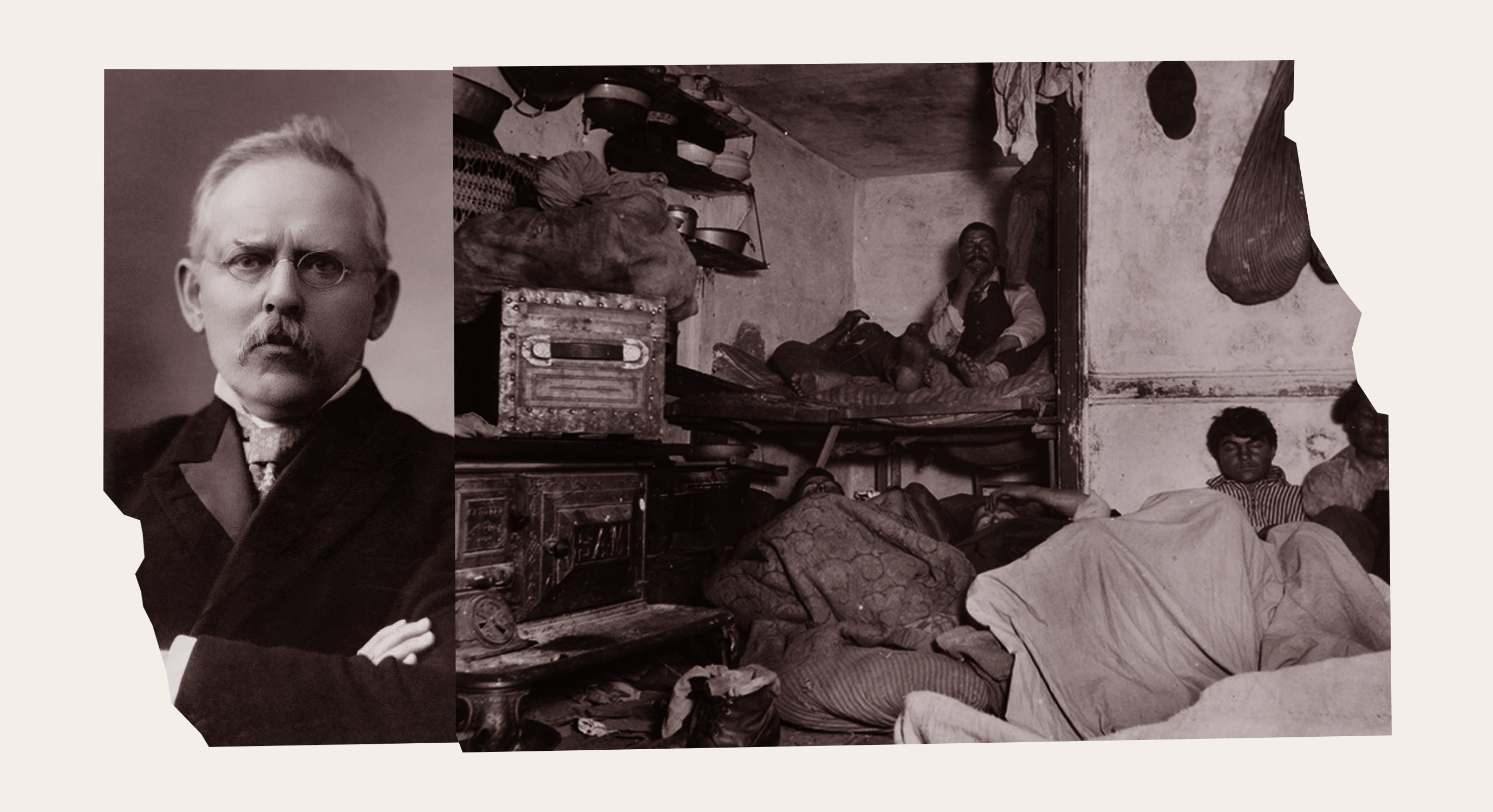
Neither Harris nor Riis would have described themselves as photographers. Riis was a writer and lecturer who implored the public to rise up and fight the misery he witnessed in the slums of New York City. He published articles describing how people lived like “vermin” and “inmates” in decrepit buildings that lacked ventilation and basic plumbing, but his message took on new power when he realized how flash photography could shed light on those issues. Riis took photos in sweatshops, alleys, underground bars, and filthy streets.

Left Photo: Jacob August Riis circa 1903. Right Photo: Lodgers in a crowded Bayard Street tenement taken in 1889.Illustration by CT / Source Images: WikiMedia Commons
Left Photo: Jacob August Riis circa 1903. Right Photo: Lodgers in a crowded Bayard Street tenement taken in 1889.

When he presented these photos in lectures to groups in New York City and across the country, Riis would often end his talks with a slide of the cross or a picture of Jesus as he exhorted Christians, especially, to help the poor. According to Bonnie Yochelson and Daniel Czitrom, authors of Rediscovering Jacob Riis, “Riis was fundamentally a preacher who delivered powerful and entertaining sermons supported by statistics and photographs.”

In 1890 Riis published a book, How the Other Half Lives, with material from his lectures. The book, which includes photos that have since taken on iconic status, became a bestseller that remained in publication for decades.

Riis believed that Christians had a unique responsibility to engage in civic reform. In early 1903, he delivered a four-part lecture series to students at the Philadelphia Divinity School. A church without outreach programs, he said, was an “unfaithful steward.”

“Tell me, what sense is there in a man’s sitting comfortably in his pew of a Sunday, inviting his soul of the view of the beautiful mansion he has engaged on high, and letting his brother below wallow in his slough the while?” he wrote in The Peril and the Preservation of the Home.

Riis was convinced that strong outreach programs were essential to growing a church congregation, and he praised those with sewing and cooking schools, kindergartens, and soup kitchens. “That is the kind of faith that moves the world, mountains and all, and fills the churches! Not sermons, but service,” he wrote. His photographs swayed audiences far more than his writings and lectures.

Alice Seeley Harris also lived out her faith in service. She was born in 1870 and raised by devout Christian parents in Wiltshire, England. She met John Harris through a mission outreach program in London, and they attended a missionary training college together before leaving for Africa four days after their 1898 wedding.

The Harrises planned to minister to isolated tribes in the Congo Free State, privately owned and run by King Leopold II of Belgium. He was enriching himself through the country’s rubber resources and using a private mercenary army, the Force Publique, to compel the Congolese to collect the sap of rubber vines for him. The Force Publique exploited the Congolese through rape, torture, widespread murder, and enslavement.

According to Dean Pavlaklis, history professor at Carroll College and author of British Humanitarianism and the Congo Reform Movement, “the brutality was so horrific that it may have wiped out half of the country’s population in just a few years.”

News of these atrocities hadn’t reached the outside world, so the Harrises were ignorant of the conditions before they arrived in Africa. Over time, however, villagers began telling them about the violence. Using the camera she had packed to take pictures of insects and wildlife, Alice began to document the abuse. She took hundreds of black and white photos that remain influential to this day.

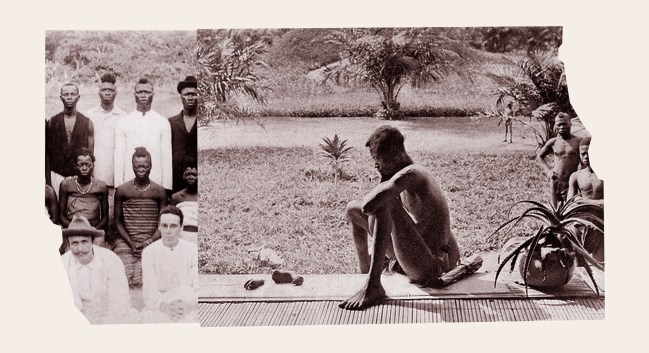
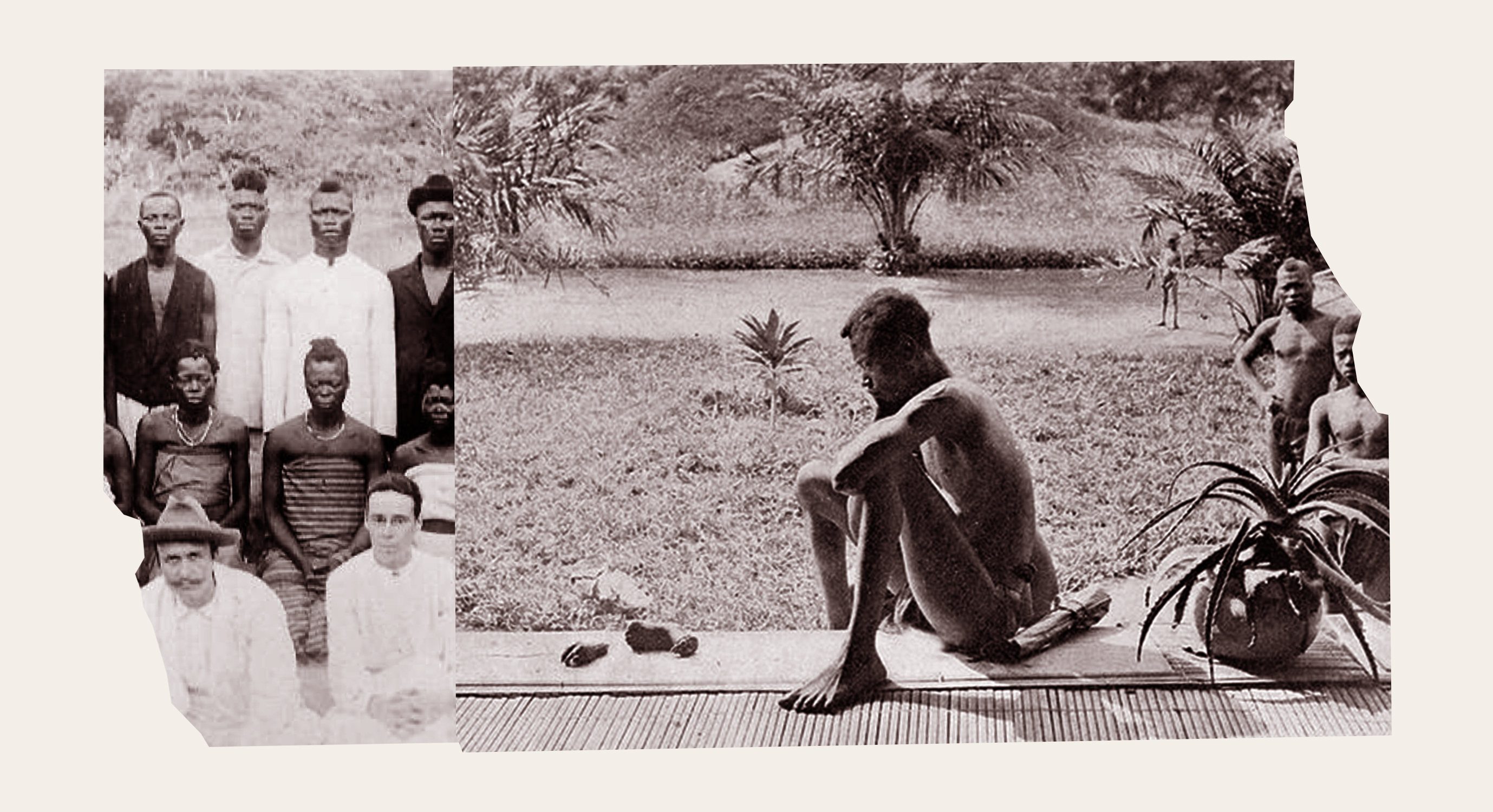
One of Harris’s most famous images shows a father mourning over the severed hand and foot of his young daughter. The man, Nsala of Wala, had failed to gather his rubber quota, and sentries had killed and eaten his wife and daughter, giving him the severed limbs as tokens of his punishment.

Along with other missionaries and several leaders of humanitarian organizations, the Harrises participated in a letter-writing campaign to politicians and religious leaders around the world to stir up support against the abuse, and Alice’s photographs began showing up in publications. She and John toured Europe and America and used her photos to compel action.

The images made their way to Mark Twain, who in 1905 penned a scathing satirical pamphlet—King Leopold’s Soliloquy—that set off a firestorm and helped force Leopold to cede power in the region in 1908.

According to Joel Carpenter, director of the Nagel Institute for the Study of World Christianity at Calvin College, the Harrises—like other 19th-century missionaries who undertook similar campaigns—were rarely “systemic social reformers.”

They were “first and foremost people who loved other people. They [cared] about other people, saw that they’d been wronged, and [wanted] to make it right,” he told CT for the 2014 cover story, “The Surprising Discovery about Those Colonialist, Proselytizing Missionaries.”

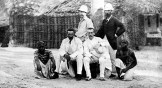
Left Photo: The Reverend John Hoobis Harris (left front) and his wife Alice Seeley Harris (right front) with a group of indigenous people on their visit to the Belgian Congo. Right Photo: Nsala of Wala in Congo looks at the severed hand and foot of his five-year old daughter, 1904.Illustration by CT / Source Images: WikiMedia Commons
Left Photo: The Reverend John Hoobis Harris (left front) and his wife Alice Seeley Harris (right front) with a group of indigenous people on their visit to the Belgian Congo. Right Photo: Nsala of Wala in Congo looks at the severed hand and foot of his five-year old daughter, 1904.

Their Christian advocacy work had much greater impact because of their photography.

Jacob Riis died in 1914 at age 65, after spending more than 30 years as a voice for social reform. A park and a settlement house in New York City bear his name. Alice was telling stories of injustice and abuse well into her 90s, before she died in 1970. More than a century later, historians and others have taken renewed interest in the work of both Riis and Harris. An exhibition of Riis’s work toured the US and Denmark from 2015 to 2021, and several books have been written about him, including the aforementioned book by Yochelson and Czitrom.

Alice’s story was told in Don’t Call Me Lady: The Journey of Lady Alice Seeley Harris by Judy Pollard Smith, and some of her photographs were featured in What They Saw: Historical Photobooks by Women, 1843–1999, which won the prestigious Kraszna-Krausz Photography Book Award. Her story was also featured in a stage play, Possession, that premiered in East London in June 2023.

Riis and Harris believed God created them “for such a time as this” (Esther 4:14) and accepted their respective callings, despite the danger and personal cost to themselves and their families. Their photographs exposed the suffering of brothers and sisters in North America and Africa and, in so doing, established the camera as a tool for kingdom work.

Christina Ray Stanton is the award-winning author of Out of the Shadow of 9/11: An Inspiring Tale of Escape and Transformation.

Church Life

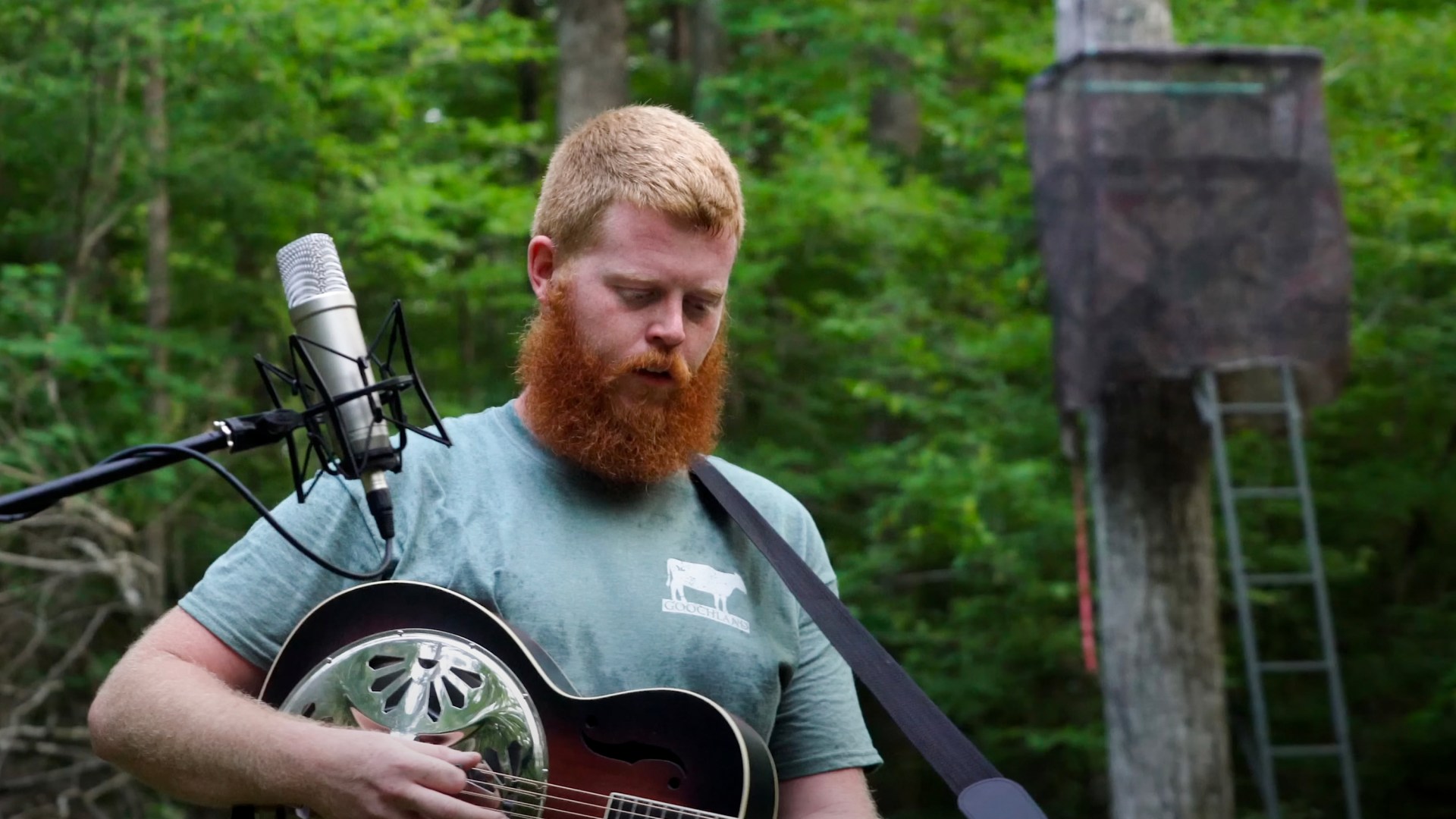
Oliver Anthony’s Viral Hit Doesn’t Love Its Neighbors

“Rich Men North of Richmond” is disdainful towards people on welfare. Christians shouldn’t be.

Oliver Anthony in his music video for Rich Men North of Richmond.

Oliver Anthony in his music video for Rich Men North of Richmond.

Christianity Today August 17, 2023
Screenshot from Youtube

As a native of Appalachia, I can’t remember a time when I wasn’t aware of the plight of blue-collar Americans. Mine is a region shaped by the struggle for fair pay and safe working conditions. To this day, “coal country” for many is synonymous with hard living and generational poverty.

So when I heard about Oliver Anthony’s viral hit, “Rich Men North of Richmond” (a reference to powerful elites in Washington, DC), I was excited for a song in the tradition of Johnny Cash, Pete Seeger, and Woody Guthrie—music that names the inherent dignity of the poor, lodges a protest against establishment excess, and echoes Old Testament calls for justice, like God’s condemnation in Jeremiah 5:28 of those who “have grown fat and sleek” yet “do not promote the case of the fatherless” or “defend the just cause of the poor.” Then I heard these lyrics:

Lord, we got folks in the street, ain’t got nothin’ to eat
And the obese milkin’ welfare
Well, God, if you’re 5-foot-3 and you’re 300 pounds
Taxes ought not to pay for your bags of fudge rounds

Immediately, I was transported back in time.

I’m a 30-year-old mother of three again, standing in the checkout line of our local grocery store. Rhonda, the organist from the church that my husband pastors, has cued up directly behind me. She says hello, and I nod back.

Normally, I would ask about her grandbabies or garden, but instead, I mumble an excuse about having forgotten bread and navigate my cart out of line toward the aisles stocked with food. But I haven’t forgotten anything. It’s a charade, a charade brought about by the shame I feel because my family is on welfare, and Rhonda is about to see me pay with food stamps.

Food stamps are the colloquial name for the federally-funded Supplemental Nutrition Assistance Program (SNAP) that serves nearly 42 million Americans (13 percent of the population) at risk of food insecurity. It grew out of a Depression-era initiative that bought excess farm commodities and redistributed them among the hungry.

Over the decades, the program morphed to become a major line of defense against food insecurity in this country. Today participants use an electronic benefit transfer (EBT) card to purchase groceries, in much the same way one might use a debit card.

Despite the number of people accessing SNAP, their experiences are not widely known among the general public—or, at least, the experience isn’t often openly discussed. That’s partly due to the negative stereotypes that accompany food insecurity and social programs more generally, like Anthony’s disdainful words about those who use welfare in a song that otherwise champions the downtrodden.

These narratives are so powerful that they caused me to hide my own participation, a choice made all the easier because I didn’t fit the common cultural assumptions about SNAP participants.

My husband and I were both college-educated. He was employed full-time while I cared for our children, who were all under five. When I could, I volunteered in the church as a Sunday School teacher, pianist, and counselor. On the surface, we were the epitome of conservative values—exactly the kind of people who don’t use government subsidies.

But after our youngest son was born, making us a family of five, we simply couldn’t stretch my husband’s $28,000 pastoral salary any further. We appealed to the church board for just enough to cover the gap but were given half of what we needed and told that social services were available to cover the rest. When we asked the board to reconsider, the head deacon’s response was blunt: “You don’t just ask for a raise and get what you want. There are always negotiations.”

With no other choice, we easily qualified for SNAP, our monthly income being well under the eligibility threshold of 130 percent of the poverty line for a family our size. At first, a weight lifted from our shoulders. The money we would’ve spent on food was reallocated to things like gas and my daughter’s preschool.

But there were still limits. Paper products, toiletries, and cleaning supplies didn’t qualify. We’d have to keep those in the budget. And while the financial burden lifted, a new one took its place: shame.

I felt it creep in the first time I used my EBT card, and it grew each time I ran into a congregant or neighbor at the store. It climaxed one day when I intentionally laid my credit card on top of my EBT card to conceal it as I swiped the reader. In that moment, I knew I had a bigger problem than finances.

Today, a decade later, I can see how shame dominated my experience of SNAP, manifesting in behaviors like overthinking my purchases and avoiding friends and neighbors while shopping. I can trace some of that shame to the fact that eating itself is a deeply spiritual act. As theologian Norman Wirzba puts it in Food and Faith: A Theology of Eating, “To receive food as a gift and as a declaration of God’s love and joy is to receive food in a theological manner.” But what happens when we can’t access the very food that declares God’s love and joy? What happens when a means of grace becomes a means of judgment?

As our family struggled to afford food, I would often hear careless comments from my Christian brothers and sisters. Conservative political rhetoric melded with spiritual language, sometimes to the point of thoughtlessly blaming the hungry for their own suffering. Paul’s instruction that “the one who is unwilling to work shall not eat” (2 Thess. 3:10) was wielded like a cudgel.

Instead of serving as a warning against idleness, becoming a busybody, or drifting away from orthodoxy—the context Paul gives four verses prior in 2 Thessalonians 3:6—this interpretation simply condemned those who needed assistance as obviously not working hard enough. If we live in a land of abundance and opportunity, how could anyone but the lazy go hungry?

Add to this the language of “welfare queens” and the perpetual suspicion about whether SNAP participants were using benefits “responsibly”—whether our purchases were both healthy and frugal, or whether we were buying “fudge rounds”—and you can begin to understand why I hid in shame.

Of course, many Christians never think or speak this way. Many are deeply compassionate and make sacrifices to help those facing food insecurity. It is often churches and Christians, after all, who stock food pantries, support food kitchens, and organize backpack programs to combat childhood hunger. It is Christians who show up at church dinners with casseroles in tow. It is Christians who celebrate our faith with a meal.

When we used SNAP benefits, I found myself wrestling with these contrasts among my fellow Christians—and a conflict within myself. On the one hand, I was deeply grateful to God for providing for our family. I loved being able to feed my children healthy food, to watch their young bodies grow and develop.

At the same time, I felt isolated from and abandonded by the very people I worshipped beside every Sunday. Even worse, I felt they would judge me if they knew how I kept my family fed. I knew we weren’t idle or unorthodox busybodies, and that I had no choice but to access subsidies. But because of the messages I’d heard, I also couldn’t shake the sense that I was doing something wrong. And if I was in the wrong, I felt I had to hide what I was doing.

In total, our family used SNAP benefits for three years until my husband found a position that compensated him fairly. By then, I’d worked through my feelings of shame and was actually beginning to take joy in God’s provision of food.

Though I now realize my shame was unfounded, that did not make it any less real or any less harmful to my soul. And while none of us can singlehandedly dismantle the larger narratives that encouraged it, each of us can make small adjustments to ensure we’re not reinforcing those patterns.

We can take care of how we speak about programs that provide needed care for the poor, remembering that a debate is only theoretical if your life isn’t at the center of it. We can extend the freedom we enjoy in our own food choices to those who are dependent on social safety nets. In a word, though we may differ in our political preferences, we can love our neighbors as we love ourselves.

I understand why so many feel “Rich Men North of Richmond” gives voice to their struggle. Perhaps the only thing worse than watching your hard work be exploited and your dreams go up in smoke is the sense that no one notices and no one cares.

But protest against wealthy elites and government corruption, no matter how justified, cannot ride on the backs of others who are also suffering. The price of accessing food through SNAP or a church food pantry must not be the poor’s dignity and self-worth.

Instead of trafficking in easy caricatures and political tropes, we must understand that the plight of our food-insecure neighbors is our plight as well. Put more simply, we must see their God-given humanity and honor it—something I’m certain Anthony himself would affirm.

Hannah Anderson is the author of Made for More, All That’s Good, and Humble Roots: How Humility Grounds and Nourishes Your Soul.

News

Hillsong Founder Not Guilty of Sexual Abuse Cover-Up

An Australian court found Brian Houston may have had a reasonable excuse not to call police about his father’s crimes.

Brian Houston preaching in 2022.

Brian Houston preaching in 2022.

Christianity Today August 17, 2023
Screengrab / James River Church YouTube

Hillsong founder Brian Houston has been found not guilty of concealing his father’s sexual abuse of a young boy.

An Australian court ruled Thursday that while Houston did not report his father’s crimes to the police when he learned about them in the 1990s, the evidence does not prove beyond a reasonable doubt that he did not have a reasonable excuse.

“I am not my father,” Houston said, leaving the courthouse in Sydney. “I did not commit this offense, and I feel a sense of relief that at least the truth has come out.”

Houston and his father’s abuse victim, Brett Sengstock, sat yards apart in a tiny courtroom in Sydney’s Downing Centre as magistrate Gareth Christofi delivered his judgment. It took almost two hours to read, as Christofi reviewed the facts and legal arguments.

In the crowded room, Houston’s supporters appeared confident the judgment would be in his favor, but they visibly relaxed as Christofi spoke.

“I am not satisfied beyond a reasonable doubt that in not reporting to police, the accused did not take the victim Brett Sengstock’s wishes into account,” Christofi said. “Therefore, I am not satisfied beyond a reasonable doubt that the accused did not have a reasonable excuse.”

Houston’s father, Frank, sexually abused Sengstock in the 1970s, starting when Sengstock was just seven years old. The elder Houston, who died in 2004, was a prominent and respected Assemblies of God pastor who was jokingly called “the bishop.” Sengstock told 60 Minutes Australia that the abuse continued for five years and destroyed his childhood.

Houston learned about the abuse in the late 1990s and, as the Assemblies of God’s national president, removed his father’s ministerial credentials. “The Crown”—which is how Australian courts refer to the prosecution—argued, however, that Houston’s subsequent actions were intended to protect the reputation of the megachurch he had founded in New South Wales: Hills Christian Life Centre, which would soon be renamed Hillsong and grow into a global phenomenon.

Prosecutors argued before the Australian court that Houston slow-walked information about the allegations against his father, used vague terms like serious moral failure instead of sexual abuse or pedophilia in sermons and public statements, and attempted to manage the denomination’s response to the allegations. The court rejected these claims.

“The accused was not slow to act,” Christofi said Thursday. “[He] confronted his father, and called an emergency meeting of the national executive, and disclosed the allegation to them, and disclosed to them a detail few people knew, that his father had confessed. He let the national executive act as it saw fit.”

The judge found evidence that Houston left the room during important decisions, to ensure the Assemblies of God leaders were not influenced by his presence. Houston also told many people—including his family, 150 pastors, his congregation, and a conference of 10,000 people—about the accusations against his father. Christofi said those facts were inconsistent with accusations that Houston was attempting to cover things up.

It is true that Houston did not report the decades-old crime to police, Christofi said, but it is possible he was taking note of Sengstock’s desire for anonymity. The magistrate said that, of course, a person could have two or more reasons not to report their father to police, but the Crown was required by law to prove that one reason, in particular, outweighed all the others, and they didn’t do that beyond a reasonable doubt.

Houston claimed that when he spoked to Sengstock in the 1990s, the adult survivor of sexual abuse did not want the pastor to go to police. Sengstock contests those claims.

He told the court that his desires were not taken into account and that everyone around him was worried, first and foremost, about protecting the reputations of churches. There was testimony that both Sengstock’s mother and aunt (also a Pentecostal pastor) opposed going to the police or involving the “secular courts.”

The judge ruled that, given what Houston knew, he may have reasonably believed he was doing what Sengstock wanted. Legally, if an adult survivor does not want a crime to be reported, that is considered a viable reason not to report it.

Christofi did not entirely exonerate Houston, however. He was specifically critical of the megachurch pastor’s involvement in his father’s efforts to pay off Sengstock.

The evidence showed that, at a meeting at a McDonald’s, Frank Houston promised Sengstock ten thousand Australian dollars (about $6,400 USD) and told Sengstock to contact Brian Houston about the money.

There was also evidence presented to the court that Brian Houston sought legal advice about the payments, talking to a law firm about how the money could be given to Sengstock without appearing to be a payment for silence.

Nevertheless, the judge told the Sydney court room that the Crown failed to prove Houston did not have a reasonable excuse not to contact police.

“Therefore,” he concluded, “the verdict is not guilty.”

As Houston left the court on Thursday, he repeated his condemnation of his late father.

“We probably will never know the extent of his pedophilia,” he said. “A lot of people’s lives have been tragically hurt, and for that I’ll always be very sad.”

Houston also claimed the case against him was unfair.

“If I wasn’t Brian Houston from Hillsong, this charge would never have happened,” he said. “I know a lot of people agree with me on that.”

On Instagram, Houston thanked his 668,000 followers for their “prayers and love and support” during what he called “25 years of persecution.”

Sengstock told reporters he appreciated the fact he’d received at least some recognition of the brutal abuse he received “at the hands of a self-confessed child rapist and coward.”

News

Violence Against Indian Christians Is Becoming a Problem for American Politicians

As the US pursues a closer relationship with India, activists are concerned some are overlooking the persecution of religious minorities in the world’s largest country.

Lydia Tombing Khuptong, of Tulsa, Oklahoma, the secretary and chair of fundraising for the North American Manipur Tribal Association, speaks at a rally organized by the group in front of the White House in Washington DC.

Lydia Tombing Khuptong, of Tulsa, Oklahoma, the secretary and chair of fundraising for the North American Manipur Tribal Association, speaks at a rally organized by the group in front of the White House in Washington DC.

Christianity Today August 16, 2023
Courtesy of North American Manipur Tribal Association

For nine days, Pieter Friedrich starved himself to get his congressman’s attention.

Drawing from his own Christian tradition of prayer and fasting and the Indian political tactic of satyagraha, the activist and journalist fasted from July 27 until August 5, aiming to convince US Rep. Ro Khanna, a California Democrat, to speak on the House floor about violence against Christians.

“He has not just a political responsibility, but a human responsibility to raise these issues,” said Friedrich, after he had abandoned his strike at the request of two Indian organizations. “I believe the only way he continues to refuse doing so is because he’s continuing to straddle the fence.”

The Christians whose plight Friedrich was demanding Khanna take responsibility for, however, were not Californians, but Indians living more than 7,000 miles away in Manipur. The fence he was accusing an American congressman of straddling was US policy toward Indian prime minister Narendra Modi and his troubling history of Hindu nationalism.

From President Joe Biden to Indian American congressmembers like Khanna, American politicians are under increasing pressure to account for their courtship of Modi, the leader of a strategically important ally and the world’s largest democracy, while ignoring the Indian regime’s oppression of religious minorities.

Modi’s recent visit to Washington—where he met with President Biden, attended a state dinner, and addressed Congress—fully rehabilitated a figure who was refused a visa by the US State Department in 2015. At the time, Modi, then chief minister of the state of Gujarat, held a precarious position on the international stage after more than 900 of his constituents, mostly Muslims, died in religious riots. Since being elected prime minister in 2014, his record has improved, but marginalization of minority groups has continued.

In its 2023 annual report, the US Commission on International Religious Freedom cited India for its “systematic, egregious, and ongoing violations of religious freedom.” Open Doors ranked India No. 11 on its 2023 World Watch List and No. 4 on its countries where Christians face the most violence.

In May of this year in northern India, violence erupted in the Imphal Valley of Manipur after members of the mostly-Christian Kuki tribe protested a court order extending benefits to the Meiteis, an ethnic group many Kukis believe the government already favors. After the protest, Kuki were subjected to egregious violence and sexual crimes by Meitei mobs.

During Modi’s June visit to Washington, DC, Indian Americans, along with leaders of civil rights and interfaith movements, gathered in front of the White House to protest these attacks as well as the Indian government’s increased restrictions on the press and civil society.

“Prime Minister Narendra Modi has been silent. … This is ethnic cleansing, pure and simple,” said Lien Gangte, the president of the Canadian Chapter of the North American Manipur Tribal Association (NAMTA). “We call on every concerned individual to exercise their democratic rights by urging their elected representatives in the US [to] provide humanitarian aid and security.”

That same week, former US president Barack Obama warned the politician he once called his “friend” that if the government did not “protect the rights of ethnic minorities in India, then there is a strong possibility India at some point starts pulling apart.”

Concurrently, in a letter to Biden, Rep. Pramila Jayapal and Sen. Chris Van Hollen, along with 73 congressional colleagues, called on him to address the imperative of safeguarding human rights and democratic principles in India during his forthcoming meeting.

“A series of independent, credible reports reflect troubling signs in India toward the shrinking of political space, the rise of religious intolerance, the targeting of civil society organizations and journalists, and growing restrictions on press freedoms and internet access,” the letter stated.

Senators Bernie Sanders and Elizabeth Warren also signed the letter, though American politicians of Indian descent, notably Reps. Ami Bera, Raja Krishnamoorthi, Shri Thanedar, and Ro Khanna, refrained from endorsing it.

In July, a video of a mob parading and sexually assaulting two naked Kuki women during the atrocities from early May went viral on social media. Enraging those inside and outside of India, many slammed law enforcement agencies for failing to make a single arrest until after the footage ended up online.

Shortly after the video’s release, Indian American and Indian expats took to the streets in cities in Texas, California, New Jersey, Massachusetts, Illinois, and Michigan. More than 700 Indian Christians rallied in front of the United Nations headquarters in New York City to pray for peace and justice in Manipur. Protests have also been organized in Canada, Germany, and the UK.

Friedrich, a human rights advocate whose Twitter account has been banned twice in India for putting pressure on the Modi regime, has also urged American politicians of Indian heritage to speak out against rights violations in India.

“I feel like I’ve been called to be doing what I’m doing,” said Friedrich in an interview with Religion News Service. “These are people from my community, and I believe in the teaching that we are all one body in Christ. And whatever does harm to that body does harm to the whole.”

On July 30, midway through his hunger strike, Friedrich attended a Khanna town hall to confront him. Tinnei Haokip, a Kuki Christian woman and US citizen, explained that her family, including her quadriplegic brother, had fled their home during the attacks and found refuge with a sympathetic Meitei family.

“I believe that there should be absolutely no violence against any place of worship,” Khanna told the town hall audience. “I will be co-leading a bipartisan delegation in coordination with the State Department that will build on President Biden’s relationship with India, which is critical to American foreign policy interests.”

As the co-chair of the Congressional Caucus on India and Indian Americans (CCIIA), Khanna has been working on US-India relations since his election in 2017. He has condemned Hindu nationalism, which many accuse Modi’s government of promoting, but in June, Khanna invited Modi to address the India caucus. Modi’s opponents say the invitation was a public affirmation. Khanna’s tepid official response to the violence in Manipur was considered another strike against him.

Khanna, a Hindu himself, has spoken out against Hindutva, the ideology of Narendra Modi and his party, as recently as 2019.

Not surprisingly, his comments earned the ire of right-wing Indian Americans who staged a protest accusing him of betraying his culture and identity and calling him “Hinduphobic.” Since then, he appears to have moderated his public position.

Currently, Khanna is in India with his CCIIA co-chair Michael Waltz, as they lead a bipartisan congressional delegation as part of India’s 77th Independence Day. The delegation was present during Modi’s national address at the historic Red Fort on August 15.

Kanna has shared photos on social media of meeting and rubbing shoulders with prominent Hindu right-wing voices like actor Anupam Kher and activist Abhijit Iyer-Mitra.

“The American public is largely unaware of what’s happening to Christians in India. Most people still find it hard to imagine Hindu nationalism as violent ideology. Most people have these benign images of Hinduism as practiced by Gandhi and others. Most people think of yoga or vegetarianism when they hear the word ‘Hindu,’” John Prabhudoss, of the Federation of Indian American Christian Organizations of North America (FIACONA), told CT.

“This image is working against our efforts to make people understand the threat the church is facing in India.”

One week before this trip, Hindus for Human Rights (HHR), along with the Indian American Muslim Council and India Civil Watch International, met with Khanna to discuss their concerns, especially regarding the role of Modi’s Bharatiya Janata Party “in eroding democracy and rights.”

In response, Khanna “expressed his unwavering commitment to upholding democratic values and human rights both within India and the United States,” according to a HHR press release.

“A lot of people in DC have made this calculation that for the sake of a deeper US-India relationship, they need to be nice to Prime Minister Modi,” said Ria Chakrabarty, HRR’s policy director.

Since becoming prime minister in 2014, Modi has made six trips to the United States. His engagements included speaking at Madison Square Garden and participating in a joint rally alongside then–US president Donald Trump in Houston. The recent state dinner and congressional address further reinforce the perception that Modi has not only experienced a rehabilitation but has been warmly embraced.

But questions have been raised in the United States on whether India is getting a “free pass” on human rights. These concerns arise from the praises of Indian democracy by Secretary of State Blinken as well as from Trump’s previous endorsement of Modi on his record of religious freedom, even as communal riots in Delhi were breaking out and leading to the deaths of many, the majority Muslims.

Indian government’s continued human rights violations and mistreatment of religious minorities have not kept other American politicians from aligning with Modi and his policies due to its growing significance as a counterbalance to China and its emergence as a major trading partner, particularly in the defense sector.

India plays a substantial role in America’s strategy of diversifying from China—enough that, concurrently with Modi’s address to Congress, lawmakers including Khanna introduced a resolution aiming to expedite arms sales to India.

From 2022 to 2023, the trade relationship between the two nations has increased exponentially from $63.7 billion to $128.55 billion. The US has now emerged as India’s biggest trading partner.

“Most US politicians are dead silent on the persecution of Indian Muslims and Christians. It’s not because they don’t know about it,” Friedrich told CT.

“The Biden administration and most of Congress are stuck on this theory that India can serve as a geopolitical balance against communist China’s expanding global influence, but they refuse to see the forest for the trees,” he said. “A Hindu nationalist regime which turns India into a fascist state that slaughters its own citizens is incapable of being a reliable partner in such a geopolitical scheme.”

Meanwhile, at least three Indian Americans—all from the Republican party—have announced their bid for the presidential elections: Nikki Haley, Hirsh Vardhan Singh, and Vivek Ramaswamy. While Haley professes a Christian faith, Singh and Ramaswamy are Hindu, with Ramaswamy facing criticism of being a Modi admirer.

In addition, Indian Americans with ties to the Rashtriya Swayamsevak Sangh (RSS), an Indian right-wing, Hindu nationalist, paramilitary volunteer organization that birthed the BJP, have been increasingly running for office as Republicans and Democrats at state and national levels. Other prominent political names in the US who have been accused of close ties to organizations affiliated with the RSS are Tulsi Gabbard and Brad Sherman.

Thanedar, who represents Detroit, Michigan, and the area around it, has announced plans to form a “Hindu Caucus” in the US Congress that he says he’s forming “not only to ensure that there is no hate against Hinduism, [but] to ensure that there is no bigotry and no discrimination towards (the) Hindu religion and those who practice Hindu religion.”

In the meantime, Kuki activists in the US continue to work to assert their right to be heard.

Two days after the crisis in Manipur began, Florence Lowe, a tech entrepreneur in Dallas, founded NAMTA, one of the primary groups organizing in the US on behalf of the Kuki. Her 77-year-old mother, her sister-in-law, and young nieces and nephews live in Manipur.

“It’s just evil,” said Lowe. “I don’t recognize who these people are.”

In May, Lowe got a harrowing call from her sister telling Lowe that the family had been forced to flee from their home in the town of Paite Veng. (They were originally sheltered by a Hindu Meitei neighbor, and have since found refuge with family.)

In the continuing violence, houses have been burned and looted by mobs and churches destroyed. Lowe’s family’s neighborhood church was razed, and along with it, the pulpit Lowe’s father had designed. Aside from the thousands of displaced Kukis, hundreds of others have been physically attacked, raped, or killed. Lowe is worried that violence in Manipur will soon be forgotten and seen as “one of the many atrocities.”

“Just trying to raise awareness is not working,” she told RNS. “We need the body of Christ to speak up.”

Lowe is clear that the US government has the responsibility to address ethnic cleansing of this nature, no matter what the deep-rooted causes of violence are.

“I’ve always been religious, but this has made me so much more of a believer,” said Lowe. “One thing I’ve realized is that for all my education and experience, I don’t know how to solve this problem. I’ve realized that God is the only one who can really do anything.”

Culture

Barbie and Taylor Swift Are Bringing Us Together

Beyond hot pink and bejeweled outfits, they showcase a deeper desire for community and collective joy.

Taylor Swift (left) and Barbie (Right)

Taylor Swift (left) and Barbie (Right)

Christianity Today August 16, 2023
Edits by CT / Swift: John Medina / Stringer / Getty / Barbie: Courtesy of Warner Bros. Pictures

The “epic trifecta” of Greta Gerwig’s Barbie, Beyoncé’s Renaissance Tour, and Taylor Swift’s Eras Tour (all raking in millions of dollars) are taking over social media—having grown adult women reliving their youth in a “Tween Girl Summer.”

But the enthusiasm and participation are no less among actual young people.

Both my 18-year-old son and my 16-year-old daughter—despite never having played with Barbies as children and being on the younger end of the age spectrum for Taylor Swift fans—are all in.

There’s a cultural conversation here about the “spending power of women” and the “female dollar,” and there’s plenty to be said for this: Barbie, Swift, and Beyoncé are enormous capital successes.

Barbie and Swift’s Eras Tour in particular open up dialogue about what Michelle Goldberg at The New York Times calls “entertainment that channels female angst,” awakening a “seismic shift for women” in “helping women reclaim girlhood without rescinding power.”

These cultural artifacts draw on the ambiguities of the female experience, celebrating the feminine while honestly addressing the difficulties of being a woman in a male-oriented world. And certainly, these events are occasions for women to enjoy this together.

For me, though, it’s the “together” more than the dollars, and the hope more than the “angst,” that I notice when I try to see this summer through my children’s eyes.

The pandemic interrupted my kids’ lives at a crucial developmental point. For them, there’s almost no “before” the pandemic in their teen years—there’s only the newly opening of the after. And in that wake, what if what my kids want is communal meaning—the kind that is supposed to mark our local churches?

As Justine McDaniel pointed out, the “Barbie-Taylor-Beyoncé summer offers a release of pandemic emotions”—exposing a hunger, Goldberg said, that is “a palpable longing for both communal delight and catharsis.”

Today, there’s church versions of the kind of transportive singing experience shared by those who attend concerts like Swift’s—where everyone is on their feet, some with hands in the air, some with tears on their cheeks. Many Christians are cynical about this, but Swift concertgoers and Barbie moviegoers are not.

Powerful communal experience can be manipulated, but it doesn’t have to be manipulation. When a song or movie tells the truth, it can be joyful and even transformative.

As Russell Moore recently wrote in response to the skepticism around emotional worship experiences, “transformative change happens at a much deeper level than intellect or willpower.”

And in a world that has known few mass cultural events since COVID-19, my kids are in on shared Barbie viewings and Swiftie togetherness. They’re in on gathering for these events, and they’re in on these female-identified celebrations of what it means to be human together.

Movie theaters are full of families and groups of friends, dressed in pink and laughing together; the country’s biggest stadiums are packed out with a tiny slice of those who would have come to see Swift perform, had more tickets been available.

For both my son and daughter, Taylor Swift is at the top of their playlists. When this summer’s tour was announced, our family spent several angsty days in online lotteries trying to score the chance to purchase tickets for the Eras Tour. We failed, but then a kind friend landed two tickets and took my daughter with her to the concert.

The COVID era loomed large in my kids’ adolescence—they exchanged in-person school for hours-long Zoom meetings, hanging out with friends for lonely texting, and church for a streaming service viewed on the sofa. All these changes still feel immediate.

Now they’re hungry for togetherness. They’re hungry for large-scale shared cultural events and wearing dress-up clothes in public.

Many in their generation are cynical, broken by the pandemic and cultural polarization, and so maybe my view of their enjoyment of Barbie and Swift is too much optimism. You’ll forgive me, perhaps, for being tempted to hope that what they’re charmed by is precisely the shared group experience of hope.

The kids are hungry, but they’re not in when the church fails to tell the truth. Like Barbie and Swift, they’re sharp-eyed and good at spotting a false god.

Sasha (Ariana Greenblatt) is their generational representative in Barbie. On meeting Barbie (Margot Robbie), Sasha unleashes a teenage diatribe, calling Barbie a “fascist” and accusing her for being responsible for almost everything wrong with the world, particularly all that’s wrong for women.

But my kids seem to be more in alignment with Sasha’s conversion than her denunciation—with her reconciliation with her mother as well as to a Barbie-versioned celebration of the female.

“I liked how the Kens were metaphors for women in the real world,” said my son.

From my daughter: “You don’t expect a Barbie movie to be about deep existential meaning.”

My son doesn’t seem put off by the feminine in these events. He’s not losing sleep over the purported feminization of the culture or the accusation that Barbie is demeaning of men. He’s never even heard of the supposed feminization of the church, nor do I think he’s ever considered the idea that such a thing might be a threat to him.

What he wants is to be with his people, seeing a good movie, listening to good music—aware of what’s wrong with this world but, maybe, hoping for something better.

Barbie is full of theological themes, and, while I wouldn’t presume to know her faith, Swift has expressed public frustration with ways American Christianity has been attached to partisan politics.

And that “existential meaning” my daughter noted in Barbie is about what it means to be human, what it means to live the good life together. The same goes for many of Swift’s smartest lyrics and the very human feelings that come with singing them out loud.

My daughter, who is sometimes more reserved, was on her feet, singing all-out, for the whole three hours that Swift was on stage. She picked out her outfit months in advance—an homage to Swift, a way to place her body within the event. She took photos, which she says she’s “never letting go.”

She has gone from a school COVID-19 era of eating her lunch at a solitary table to raising her voice at Soldier Field in Chicago, united with 55,000 other people who know every word to every song.

Of course, she wants this full-bodied, communal, ecstatic experience.

Barbie and Swift are about the lived experience of embodied life together. Barbie (spoiler for the movie) leaves her plastic world behind and, in the words of Amy Peeler writing at the Holy Post, “takes on a real body, including sexual organs, experiences the devolution of the body, and becomes a mortal woman. She does this to experience the deeper beauty of imperfection.”

Katelyn Beaty writes about the film as an affirmation of female embodiment: “It’s through our bodies” that we “experience both common and supernatural grace.”

Swift, too, invites her fans into her own embodied life as she sings unabashedly of emotion and relationship and loss. We humans are embodied creatures, and we need life in the body together.

And that’s what church is. It’s life in the body together, the people gathered around the one who is the truth, who gives life meaning, who knows our embodied longings because he took on flesh for our sake.

The kids want communal meaning. So I’m going to keep hoping—hoping that, maybe, what they want is the body of Christ.

Beth Felker Jones is professor of theology at Northern Seminary. She is the author of many books and writes regularly at Church Blogmatics.

Ideas

Trump’s Georgia Election Meddling Didn’t Just Look Wrong. It Was Wrong.

Staff Editor

The ex-president’s new indictment isn’t about appearances. Some things are just as evil as they seem.

Donald Trump

Donald Trump

Christianity Today August 15, 2023
Saul Loeb / Getty

The Georgia grand jury’s decision to indict former president Donald Trump on Monday night was surprising only for its speed.

Grand juries are famously—or infamously, if you prefer—willing to indict. That’s because they’re presented with only the prosecutor’s case (there is no defense at a grand jury hearing) and not required to reach a unanimous decision (here, 12 of 23 jurors had to agree) or to settle the actual question of guilt (all the grand jury must determine is if there’s enough evidence to bring charges). Fulton County district attorney Fani T. Willis may not manage to convict Trump and the 18 lawyers and other allies charged along with him. But the Georgia indictment has long since struck me as a sure thing.

I can’t say the same of Trump’s three other indictments: the arcane tax and campaign finance case in New York, the federal documents retention case, and the federal case concerning Trump’s behavior in the run-up to the storming of the Capitol on January 6, 2021. All three have some moral or legal ambiguity (though it's important to note the federal January 6 case has some overlap with the Georgia indictment). Reasonable Christians might disagree over whether these prosecutions are politically motivated, punishing behaviors that may look bad but aren’t, in fact, illegal or wrong.

In the case of the Georgia indictment, though, I don’t see the same ambiguity—at least where Trump himself is concerned.

To borrow a phrase from an often misunderstood and misquoted Bible verse, I see a clear “appearance of evil” (1 Thess. 5:22, KJV). Legally, we don’t know yet if he’s guilty. But from what I can tell, this isn’t a case of undeserved ill repute. Trump’s election meddling in Georgia didn’t just look wrong. It was wrong—and likely illegal too.

There are two halves to my assessment here. The first is what Trump did, which was significantly undisputed because we have the key action—asking Georgia state officials to “find” him just enough votes to tip the state’s election result in his favor—recorded on tape. If you haven’t already listened to the audio of this phone call from January 2, 2021, or read the transcript, I recommend it.

“So look,” Trump pleads. “All I want to do is this: I just want to find 11,780 votes”—the number, by a margin of one, he’d need to win the state. The Republican officials to whom he’s speaking explain repeatedly that there are no more Trump votes to count or recount, that every investigatory angle he proposes has already been explored, but the then-president ignores them and presses on: “So what are we going to do here, folks? I only need 11,000 votes. Fellas, I need 11,000 votes. Give me a break.”

Trump may have gone into that call sincerely believing he’d won Georgia, perhaps unaware of steps the GOP-run state had already taken to verify the election outcome. But he certainly couldn’t have ended the call that way—not after an hour of conversation in which members of his own party explained all they’d done to check and double-check the votes and confirm that President Joe Biden did win Georgia by a nose.

“The way of fools seems right to them, but the wise listen to advice” (Prov. 12:15), and Trump was plainly not interested in listening to advice. He was interested in winning, and he kept pursuing victory even after it was made wholly clear that this was a goal he could not obtain legitimately.

That brings me to the second piece of my assessment, which is about the “appearance” of evil. Like many American Christians, I spent years reading and hearing 1 Thessalonians 5:22 quoted in the King James Version: “Abstain from all appearance of evil.” And like many American Christians, I assumed “appearance” was used in a common contemporary sense of the word, commanding us to avoid doing anything that looks wrong to other people, even if it’s morally permissible.

Some other, more recent translations and paraphrases might reinforce this interpretation. The New Living Translation says we should “[k]eep away from everything that even looks like sin.” N. T. Wright’s New Testament for Everyone advises that “if something looks evil,” we should “keep well away.” And Eugene Peterson’s The Message tells Christians to “[c]heck out everything, and keep only what’s good. Throw out anything tainted with evil.”

But the NIV, NASB, ESV, and others render this verse quite differently. Instead, these translations advise us to reject every “kind” or “form” of evil. The difference, as biblical scholar Preston Sprinkle has argued, has to do with the Greek word in the original text and different English uses of “appearance.”

To modern ears, the exhortation to “abstain from all appearance of evil” seems more concerned with how people might perceive us than what we do or don’t do. It seems to be about how we appear and how our actions might look to others rather than whether we’re truly in the right or in the wrong.

But the way the King James translators used the word in question is more like a “television appearance” or “appearing at a party.” It’s closer to “incident” or “instance” or “a time something or someone showed up.” “Paul’s admonition is not to stay away from anything that might look like evil,” Sprinkle contends, “but to stay away from evil in every form [in which] it appears.”

In the case of Trump’s accumulating indictments, a common defense is that what he did wasn’t actually wrong—or, more precisely, that his actions only look wrong if you possess certain prior assumptions about him or accept a certain skewed media narrative. In some cases, this may be true—and in those instances, Trump does not stand condemned by the command in 1 Thessalonians 5:22.

But when it comes to the charges in Georgia (and their overlap in the second federal prosecution), while Trump’s legal guilt or innocence has yet to be decided, there is little question that what he did was wrong. This case isn’t about inflammatory political rhetoric or document classification rules or the intricacies of campaign finance law. Rather, the evidence seems to point to a real attempt to pervert the well-verified results of a free and democratic election.

That is, we seem to be dealing with behavior that is just as evil as it appears.

Bonnie Kristian is the editorial director of ideas and books at Christianity Today.

Church Life

The 6 Hymns Tim Keller Picked for His Memorial Service

The late pastor taught us how to live—and die.

Redux / José A. Alvarado Jr.

It was June 3, 2020. The subject line of the email from Kathy Keller made my heart sink: “Tim’s got pancreatic cancer.” The diagnosis was stage IV. With current therapy, life expectancy is less than a year. There is no stage V. Thus began a three-year journey that explored the cutting edge of experimental cancer therapeutics—but more significantly, the courageous approach to terminal illness by a man of deep faith.

Tim had been my friend for a decade. In the early years of BioLogos, he agreed to cohost intensely interesting and productive meetings in New York, where deep discussions about the complementarity of science and Christian faith took place. Though we didn’t completely agree on everything, Tim became my most significant spiritual mentor.

But now I was in a different role. As a physician-scientist and the director of the National Institutes of Health (NIH), I reached out to help him and Kathy sort through the options for interventions. Chemotherapy can sometimes help pancreatic cancer, but only for a time. On the horizon, however, are new approaches called “precision oncology”—characterizing the unique DNA mutations in the patient’s cancer in exquisite detail and then teaching the body’s immune system to recognize the masked intruders.

Tim and Kathy, his partner in life, love, and faith, weighed the pros and cons and elected to sign up for an NIH clinical trial that had shown some initial promise for advanced breast and gall bladder cancers but for which there was so far very limited experience with pancreatic cancer. Tim was clear-eyed about the likelihood of benefit, but he wanted assurance that whatever happened, the medical research team would learn from it and be able to advance the protocol for the next time and the time after that.

Those assurances having been provided, he came to NIH for an operation to capture some of the cancer tissue so its specific and unique DNA mutations could be identified. A few of these misspelled proteins might make good targets for an activated immune system, should traditional therapy fail—as it almost certainly would.

Meanwhile, high-dose chemotherapy was started—one week on, one week off. The weeks where toxic drugs were administered were rough, but I never really heard Tim complain. The recovery weeks saw him intensely engaged in writing, teaching, leading church planting activities, and counseling many who reached out to him for comfort and advice.

Nine months into treatment, he wrote a powerful article in The Atlantic: “Growing My Faith in the Face of Death.” In deeply honest prose, he described the struggle of coming to terms with his own mortality. He described the disciplines that carried him through this dark valley, coming to a greater confidence in the death and resurrection of Jesus than he ever had. Summing it up, Tim wrote, “I can sincerely say, without any sentimentality or exaggeration, that I’ve never been happier in my life, that I’ve never had more days filled with comfort. But it is equally true that I’ve never had so many days of grief.”

Kathy and Tim Keller receiving a gift from members of Tim’s virtual book club.Courtesy of Francis Collins
Kathy and Tim Keller receiving a gift from members of Tim’s virtual book club.

Chemotherapy worked better for Tim than it often does for pancreatic cancer, providing many months of stable disease. But then in the spring of 2022, the drugs stopped working, and the beast was unleashed—dozens of liver tumors began growing rapidly. Survival appeared to be measured in just a few short weeks.

Tim and Kathy came to NIH for the experimental immunotherapy trial. Billions of his own immune cells isolated two years earlier and programmed like little “ninja warriors” to search and destroy the cancer cells, were infused. The battle was joined. It was dramatic; for several days every part of Tim’s body was wracked with the consequences. He suffered hallucinations that were terrifying, but never wavered in his determination to press on.

And bit by bit, his characteristic calmness and gratitude reappeared. As he began to heal, he wanted less to talk about cancer and more to talk about faith, love, truth, and beauty—and about the deep ache he felt for the state of the Christian church in America. If you have not read his sobering treatise on GospelinLife.com, “The Decline and Renewal of the American Church,” written in the midst of cancer treatment, you will find there a compelling diagnosis and treatment for the church’s current malaise.

Being with Tim Keller during this time was a gift of profound significance to all of us who were able to be connected. As an NIH physician, I was able to spend periods of time in his room. Tim, Kathy, and I had intense discussions about how our society seems to have lost its anchor to the truth that Jesus says will set you free, and Tim strongly encouraged me to map out a book on this topic. I told him it was too bad he had to get cancer so that I could learn more from him.

He continued to be a profound contributor to virtual groups that met regularly, and a group of his book club friends sent him a special gift to reflect their deep love and admiration. The gift was an original printing of a 1739 sermon from George Whitefield (a favorite preacher), and a framed copy of words written by the late Michael Gerson, ending with this: “We will love Tim in this life and beyond, bound in a fellowship that does not end.” Amen.

Six weeks later the scans showed a response to the immunotherapy that was much better than any of us thought possible. The tumors in the liver had just melted away. I sent an email to friends with the subject line “This will make you shout for joy.” We all shouted and gave thanks. I showed the scans anonymously to a few other docs, and they were slack-jawed in amazement. Could this be a cure?

A sweet period of several months ensued. Tim was in full productivity mode. But the beast reemerged. Of the billions of cancer cells that had been vanquished by the therapy, a few rogues had escaped. The immune system could no longer see them. They grew with wild abandon. A second cancer cell target was identified, another plan was implemented to educate the immune system to go after it. Tim and Kathy returned to NIH for another month-long admission, but this time there was no dramatic response, and Tim was growing weaker.

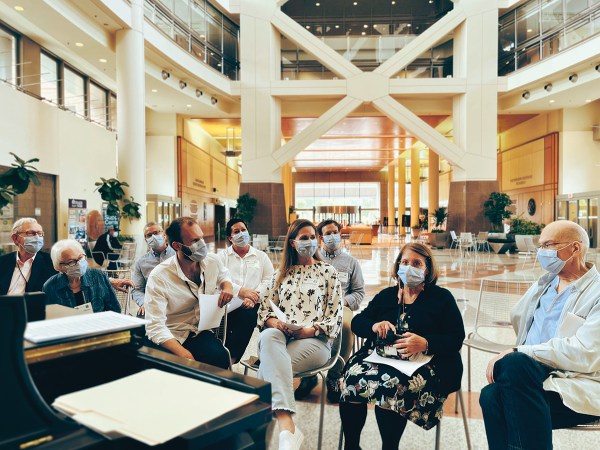
Kathy and Tim Keller (right) sitting with a group of friends for worship at NIH hospital. Courtesy of Francis Collins
Kathy and Tim Keller (right) sitting with a group of friends for worship at NIH hospital.

It was a Saturday in April near the end of Tim’s NIH hospital stay. I knew this might be the last time I would see him. It felt like a time to come together for worship. I suggested an impromptu service in the spacious atrium of the NIH Clinical Center on Sunday afternoon and asked Tim if he had any favorite hymns to suggest. I should have known that would not get an off-the-cuff response. “Yes,” he said. “Let’s sing six hymns in a particular order, because they tell the whole story of Christian faith and God’s care for us.” I rounded up some others to join us. Despite my occasional wrong notes on the piano, we had one of the most memorable services of my life. Tim explained the choice of hymns:

“Immortal, Invisible, God Only Wise”
A tremendous depiction of God’s attributes. Tim particularly wanted us to take note of that final line: “’Tis only the splendor of light hideth thee.”

“And Can It Be That I Should Gain”
A reflection on how we connect to God and have a personal relationship with him. Tim sang the bass part.

“How Firm a Foundation”
God’s Word, in good times and bad. This was Kathy and Tim’s wedding recessional. Tim was firm about the right tune to use (Lyons).

“Jesus Lives and So Shall I”
A quiet but profound hymn about hope for the future. “Jesus lives and is now but my entrance into glory.”

“Glorious Things of Thee Are Spoken”
A proclamation that Zion, the church, was founded on the Rock of Ages.

“For All the Saints”
We will all be gathered at the end.

Kathy and Tim said this was the first time they had been able to worship with others in person in three years. No one who was there will ever forget it. Kathy decided that those hymns would be sung at Tim’s memorial service.

To conclude the service, we sang one more song, “There Is a Redeemer,” that Kathy had suggested. Only then did Kathy and Tim tell us that this praise song was sung after every service for the first few years Tim pastored Redeemer Church. The last verse is this: “When I stand in glory, I will see his face, and there I’ll serve my King forever, in that Holy Place.”

Tim, you are standing in glory now. You are seeing his face and serving him, as you did here on earth. Someday, God willing, we shall see you again in that Holy Place.

Francis Collins is the founder and senior fellow at BioLogos and former director of the National Institutes of Health.

News

Maui Fires Burn Site Where Hawaiian Queen First Brought Christianity to the Island

Once the capital of the Hawaiian kingdom, Lahaina was home to Maui’s first church and seminary.

Lahaina’s Grace Baptist Church meets Sunday at Maui Coffee Attic in Wailuku after the church and their pastor’s home were destroyed.

Lahaina’s Grace Baptist Church meets Sunday at Maui Coffee Attic in Wailuku after the church and their pastor’s home were destroyed.

Christianity Today August 14, 2023
Yuki Iwamura / AFP via Getty Images

In the aftermath of the worst disaster in memory on their island—the deadliest fire in US history—Maui’s Christians gathered on Sunday morning to offer prayers, continue to coordinate relief efforts, and mourn the loss around them.

At Grace Bible Church Maui, pastor Jonavan Asato likened the destruction to the death of a loved one. “When you look at that town and the memories that you’ve had there, it’s not just a home,” he said with tears in his eyes. “It’s a part of our culture. It’s a part of our island.”

Days before, his church had sent supplies by boat to Lahaina—the former capital of the Hawaiian kingdom, a landmark in 200 years of missionary history in Maui, and the site that bore the brunt of the brush fires that devastated the west side of the island.

Having witnessed the scorched cars, the embers of Front Street, and smoke dissipating from the more than 2,000 buildings burned, Asato asked his congregation to stand up and face in the direction of Lahaina as he repeated, “We speak life and light to you in Jesus’ name.”

In Lahaina, local Christians grapple with the widespread damage. While the leaders of Lahaina Baptist Church were “amazed” to learn that their church was still standing—despite everything around it “literally in ashes”—all but two of their church families lost their homes.

“I would estimate that over half the residents of our communities lost their homes and possessions. The big question is: Where will those people live? It will take years to rebuild,” pastor Barry Campbell wrote on Facebook on Sunday. “Another big issue is jobs. If the hotels and resorts are closed down, where will locals work?”

Fellow believers in Maui have been on the frontlines to help, caring for the thousands of victims of a disaster that, as of Monday, killed 96 people and could cost as much as $5 billion to rebuild from. They have transformed churches into donation centers, cooked hundreds of hot meals, and delivered generators, gas, and food across land and water.

In central Maui, Kahului Seventh-day Adventist Church provided emergency shelter for 40 displaced Lahaina residents. The church says it sees its work as also offering “spiritual rejuvenation” to families in the midst of displacement and trauma.

“At the Friday welcome program, one member started singing Adventist children’s songs, which instantly brought joy to the faces of kids who had been evacuated from their homes,” stated an announcement from its conference. “Soon, the adults joined in, and the moment became a much-needed source of joy and comfort for all. We will continue providing moments of joy for as long as they are with us.”

While Christians from all over have offered donations and prayers, it’s locals who understand the scope and significance of the loss, concentrated around the place where Christianity first came to Maui.

“It’s a historic town with a lot of cultural and historical significance for the Native Hawaiian people,” Rocky Komatsu, pastor of Waiehu Community Church, told Baptist Press, who compared the devastation to a war zone. “A lot of people talk about it as a tourist town, but it really is very important to the Native Hawaiian community.”

When Queen Keōpūolani—married to the ruler who united the Hawaiian islands, King Kamehameha—moved to Lahaina in 1823, she invited two American missionaries who brought the faith to the island. Americans William Richards and Charles Stewart taught Scripture to Keōpūolani and prayed with her, and she converted shortly before her death later that year.

After Honolulu, “Lahaina is home to the second-most complete complex of historic Hawaiian Christian sites in one place to be found in all of Hawaii,” said Chris Cook, an expert on Hawaiian missionary history. “The loss of all but the Lahainaluna sites leaves a major gap in the statewide census of intact Hawaii missionary-era (1820–1863) structures.”

Lahaina’s historic Waiola Church just celebrated its 200th anniversary. The church dates back to a service that Richards and Stewart organized in May 1823. Buried in its graveyard are members of Hawaii’s aliʻi, or royalty, including Queen Keōpūolani. Previously known as Waineʻe Church (Waineʻe means “moving water” in Hawaiian; Waioli means “water of life”), over the years, its building has been damaged or destroyed four other times by strong winds and fires, and the church hall was engulfed in flames in last week’s blaze.

“Buildings can be replaced, even though our church has an awful lot of history,” Anela Rosa, the church’s lay minister, told USA Today. “Our strength lies in our people, who are just as important, if not more.”

Last week’s fires also reached Maui’s oldest house, the Baldwin house, a former compound where American missionaries lived in the 1800s, including physician Dwight Baldwin. Baldwin had learned Hawaiian well enough to preach the gospel in the local language, and he was credited with quarantining and vaccinating Maui residents to help control a smallpox outbreak in 1853.

Lahaina’s famous banyan tree also has a connection to the island’s Christian history. The 60-foot tree was planted in 1873 by William Owen Smith, the then-sheriff of Maui and a child of American missionaries, in honor of the 50th anniversary of the arrival of Protestant missionaries on the island. Smith later helped overthrow the Hawaiian kingdom’s last monarch, Queen Liliʻuokalani.

The Lahaina fire spared the town’s high school, which was originally a seminary that housed Hawaii’s first printing press. According to Cook, the school was the place where Native Hawaiians wrote and published their first history of the islands in 1837.

Ministries from the mainland have begun to come alongside the island’s local churches. Citizen Church ABQ in Albuquerque announced last week that its sister church in Maui would host disaster relief groups Convoy of Hope and Mercy Chefs.

Samaritan’s Purse said that it had already sent over chaplains and that in the coming days, it would fly over supplies and coordinate volunteer teams to help people search for valuables and mementos. World Vision is not shipping supplies but rather distributing funds through Pukalani Community Church of the Nazarene in the Upcountry area. This region of the island, about 30 miles east of Lahaina, has struggled with its own wildfire situation in the past week.

Churches damaged by the fire are still working to minister to each other in the ashes. Kaanapali Beach Ministry pastor Richard Murray and his wife Betsy lost their home in the fire. The church website also mentioned that they had lost all their livestreaming equipment, and in a request for donations, it noted that “the Post Office in Lahaina (where our PO Box is located) has also burned down to the ground, so we are using a temporary address for now to receive donations / tithes.”

https://www.instagram.com/reel/Cv5O7cvLXVc/

A Hawaii News Report (HNR) Instagram reel captured Christians praising God through song and dance at Word of Life Kahului. Around a quarter of the congregation is from Lahaina and the surrounding areas; senior pastor Charli Abihai’s Instagram stories shared numerous GoFundMe links for families affected by the fire.

“My mindset is to continue to push and press forward to what is ahead. The positive. I’m not going to dwell on what’s happening now and what I see,” one unnamed attendee told HNR. “I’m not in denial of what I see. But I know what is ahead of us is life and life more abundantly.”

Church Life

Worship Music Nostalgia Brings New Profit to Old Songs

Gen X and millennials’ favorite Christian throwbacks are also easy moneymakers.

Christianity Today August 14, 2023
Edits by Christianity Today / Source Image: Getty

In April of this year, worship leader Krista Treadway planned a “throwback” worship service with nostalgic favorites from the ’90s and early 2000s, songs like “The Heart of Worship,” “Shout to the Lord,” and “In the Secret.”

“They’re special songs,” said Treadway, who grew up with the music as a pastor’s kid. “They hold such a dear place for us because they were our firsts.”

As songs like “The Heart of Worship” (Matt Redman, 1999) and “Here I Am to Worship” (Tim Hughes, 1999) come back around as throwbacks for Christian millennials and Gen Xers, the music industry is in the midst of a financial sea-change focused on previous recordings.

Back catalogs across the music industry are more profitable than ever, and it makes fiscal sense for entertainment companies to market the music they control with the musicians they have already signed. So if you see a popular artist release a new recording of an old hit—it’s not just to tap into our nostalgia.

In recent years, industry giants like Capitol Christian Music Group (CCMG), which, as of 2021, claims over half the market share of the Christian music industry, have invested more in catalog acquisitions and are seeing profits from publishing catalogs increase. In 2020, Universal Music Group (UMG), which owns CCMG, spent over $1 billion on catalog acquisitions.

In an investor meeting earlier this year, UMG described its catalog as “strategic assets that we can control and [that] improve monetization within our portfolio.” While catalog acquisitions have slowed since last year, the investments UMG has made in the previous few years have given the group a lucrative and diverse publishing catalog, which includes some of the most popular and widely-used contemporary worship music of the past three decades, such as “Oceans (Where Feet May Fail),” “Blessed Be Your Name,” and “Mighty to Save.”

Just as the industry wants to market the back catalogs for revenue, a wave of Christians who who came of age during the rise of the worship music industry and in the aftermath of the worship wars are eager to tune in and sing along. The songs from decades ago represent the soundtracks for their faith journeys.

“These songs hold a special place for folks of my generation,” said Ian Stewart, a worship leader in northern Colorado.

Stewart, 35, vividly remembers the message and resonance of songs like “The Heart of Worship,” which encouraged churchgoers to focus on the posture of the heart rather than the style of the music, even as churches installed new sound systems and projectors.

When Redman released “The Heart of Worship” in the US in 1999, it quickly became a hit and helped establish a mainstream worship culture that took root in the UK and the US. The song was included in one of the first WOW Worship albums.

In 2003, Redman edited a book inspired by the song called The Heart of Worship Files, with contributions from Louie Giglio, Darlene Zschech, Brian Doerksen, Chris Tomlin, and Rita Springer.

From the vantage point of 2023, it makes sense that some Christians would want to revisit the worship world of 1999—through private listening and congregational singing—as new technologies like auto-tune and post-pandemic standardized streaming are again reshaping worship practices. Redman’s lyrics, “When the music fades, and all is stripped away,” resonate now as strongly as they did almost 25 years ago.

“The ’90s was our turning point,” said Treadway of her church and its relationship with contemporary worship music.

Treadway joined her youth group’s worship band as a teen, just as her Free Methodist church in Sedro-Woolley, Washington, was making the switch from hymnals to contemporary drums-and-guitars music. As the daughter of the church’s worship pastor, it had been her job to put out the hymnals on the pews every Sunday.

Songs like “The Heart of Worship” had helped her congregation navigate the jarring cultural shift without losing focus on God.

For Treadway and her church today, returning to “The Heart of Worship” during the throwback service was sacred. It seemed to awaken an enthusiasm for singing that she hadn’t seen in a long time.

“Even folks who aren’t usually that engaged were actually singing,” said Treadway.

Some of the contemporary worship songs that millennial and Gen X Christians remember learning as kids or teenagers have never dropped out of regular rotation for church worship leaders.

“For some churches, ‘The Heart of Worship’ and ‘Blessed Be Your Name’ are about as new as they get,” said Stewart, who leads worship in his own nondenominational church in Colorado, as well as in churches across the West as a contractor. But even the most popular songs from the ’90s fell off the radar for a while, and it’s now becoming more common for churches to revive them. As of the first Sunday in August, “The Heart of Worship” was the 37th most popular song on the Top 100 list for Christian Copyright Licensing International (CCLI), and “Here I Am to Worship” was 27th.

Nineties nostalgia and back-catalog profitability converge on Instagram and YouTube accounts run by Worship Together, CCMG’s church resource division, with videos of Kari Jobe singing a new mash-up version of “The Heart of Worship” and UPPERROOM’s Abbie Gamboa singing “Here I Am to Worship.”

Each are current CCMG artists, and the company controls 100 percent of the publishing rights for both songs in their publishing catalog. Generally, the publishing-rights holder takes a 50 percent cut of royalties—the other half goes to the songwriters—so CCMG takes a cut every time a song is streamed or sung in a service, as well as royalties from streams, covers, live performances, and remixes.

Last month, Benjamin William Hastings, a longtime Hillsong songwriter and recording artist, released an album called Songs You Maybe Didn’t Know I Wrote and Some You Maybe Did. It’s a self-aware, tongue-in-cheek nod to Hastings’ impressive songwriting credits and a reintroduction to his own back catalog, which includes “Gratitude,” “O Praise the Name (Anastasis)” and “So Will I (100 Billion X). “Gratitude” is currently No. 11 on the CCLI Top 100.

One side-effect of the growing focus on catalog maintenance is that major labels have little incentive to take chances on new artists and new music (the dearth of breakthrough pop artists is starting to concern some in the industry).

“Record companies and publishers are going to put more focus on their catalogs,” said Chris Lawson Jones, cofounder of Wings Music Group. “They are finding it harder to develop new worship music.”

Getting a record deal with a label used to be most aspiring musicians’ endgame. It meant money to make an expertly produced album, access to corporate marketing, and connections with industry insiders. But the days of a label discovering and sweeping up an unknown artist are gone, and up-and-coming artists are okay with that.

“Artists are usually faced with a binary choice: complete independence or a massive corporate label,” said Lawson Jones, who was formerly the head of artists and repertoire (A&R) at Integrity Music UK, formerly Kingsway. “I rarely speak to artists who want a record deal.”

Wings works with independent Christian artists who are finding audiences without a major label. It provides distribution services and artist support, helping indie musicians navigate the streaming world, release music effectively, and collect royalties from digital service providers.

Stephen Bradley, a British musician and producer who releases music as “sxxxt,” has been able to start and sustain a career as an indie artist, but it took a long-term plan and commitment.

“Hungry artists need money. They are drawn to the advance you get with a record label. But labels expect so much of you,” said Bradley. “If I own all my music [masters], I have potential.”

“Giving up publishing rights would be giving up a cut of a major revenue stream,” said Wendell Kimbrough, a worship leader and recording artist based in Dallas.

Kimbrough, who released a new album, You Belong, in July, receives artist support from Integrity Music but retains all of his publishing rights and owns all of his master recordings.

Elias Dummer is a former member of The City Harmonic and is now an independent artist who also works in marketing. He also has a label services deal with Integrity Music. “As an indie artist, I can release music and not play a single show a year,” he said.

Most of Dummer’s music revenue comes from Spotify; being bivocational gives him freedom to be particularly selective about touring. His experience on a major label with his former band and his marketing work have helped him navigate the gatekeepers and algorithmic systems that drive streaming traffic online.

Dummer, who belongs to the team behind Worship Leader Research, is hopeful that broader shifts in the industry will provide more freedom and opportunity for indie worship artists.

The worship wars of the ’80s and ’90s resulted in an unofficial worship “monoculture,” where songs like “How Great Is Our God,” “The Heart of Worship,” and “In Christ Alone” have become contemporary standards that cross denominational and generational boundaries.

Dummer also sees the monoculture dominated by Hillsong, Bethel, and Elevation “starting to divide.” If the worship music space is poised for fragmentation, perhaps the tent-pole songs of contemporary worship music will become even more valuable, part of a small repertory of enduring songs born out of a particular historical moment.

“Over one million Christian and gospel tracks are released every year. Worship leaders who are struggling to navigate are going back to old music,” said Lawson Jones. “People are going to look back and find evergreen songs for the church.”

Apple PodcastsDown ArrowDown ArrowDown Arrowarrow_left_altLeft ArrowLeft ArrowRight ArrowRight ArrowRight Arrowarrow_up_altUp ArrowUp ArrowAvailable at Amazoncaret-downCloseCloseEmailEmailExpandExpandExternalExternalFacebookfacebook-squareGiftGiftGooglegoogleGoogle KeephamburgerInstagraminstagram-squareLinkLinklinkedin-squareListenListenListenChristianity TodayCT Creative Studio Logologo_orgMegaphoneMenuMenupausePinterestPlayPlayPocketPodcastRSSRSSSaveSaveSaveSearchSearchsearchSpotifyStitcherTelegramTable of ContentsTable of Contentstwitter-squareWhatsAppXYouTubeYouTube