News

Church of England Advances Plans to Bless but Not Affirm Same-Sex Couples

UPDATE: After Synod vote, services will soon be available on a trial basis.

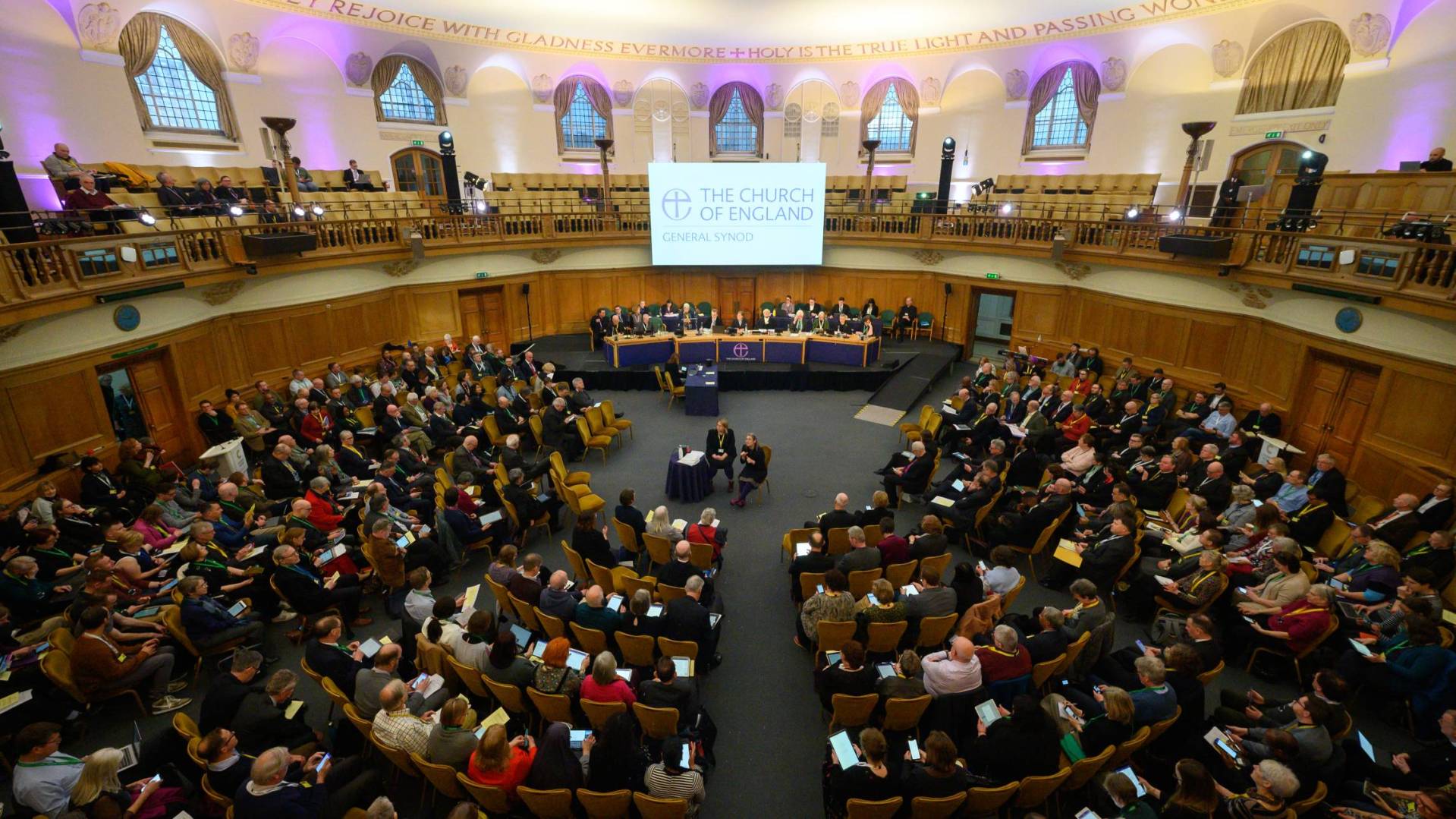
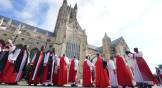
General Synod at the Church House in London

General Synod at the Church House in London

Christianity Today October 26, 2023
Leon Neal / Getty Images

Update (November 16, 2023): Following a nine-hour debate, the Church of England’s General Synod voted on Wednesday to introduce special services asking for God’s blessing for same-sex couples “on a trial basis.”

The national director of the Church of England Evangelical Council (CEEC), John Dunnett, said that the proposals marked “a ‘watershed’ moment, in that it appears that the Church of England no longer sees Scripture as our supreme authority.”

Nikki Groarke, a senior member of the clergy in the diocese of Worcester and a member of Inclusive Evangelicals, wrote that she was “thankful … that we can be a welcoming and inclusive church for all. Recognise this step will be painful for some, but I believe it is the right one.”

The Synod’s lengthy discussion highlighted divisions over the legal process for the change. Bishops had suggested that “stand-alone” services blessing same-sex couples be subject to approval by the General Synod—a process that would not have been complete until 2025 and might not have met the threshold for approval. But this week, the Bishop of Oxford moved an amendment asking the bishops “to consider whether some standalone services for same-sex couples could be made available for use, possibly on a trial basis.”

This was passed by a narrow majority: by just one vote in the House of Laity, one of the three houses of the Synod. The two archbishops had already indicated that they would support the move.

——

Church of England clergy could soon be authorized to pray for God’s blessing over same-sex couples, though not quite affirming their unions as they would a marriage, according to a controversial paper set to be debated at an upcoming meeting of the church’s national assembly, General Synod. Services with liturgy to bless the couples wouldn’t take place until 2025.

In the 108-page document, bishops make the case for celebrating the “faithfulness, stability, fruitfulness, love, faith, grace” in same-sex relationships, with pastors “finding ways to help people move forward in holiness in a world that falls far short of ideals in every area, without giving up on the idea of the ideal altogether.”

They also speak of “acknowledging and celebrating what is good in same-sex relationships even if the Church is unable to commend every aspect of some relationships.”

Both conservatives and progressives have spoken out against the rationale for the proposals in the paper, calling it “bonkers theology” and “another fine mess.”

The report is the latest development in a lengthy and often painful process of discernment for the Church of England as it grapples with deep internal disagreement about same-sex relationships in what it describes as a “rapidly changing social context.”

In February, after eight hours of debate, the General Synod voted to welcome proposals by the church’s bishops to issue prayers to bless same-sex unions in church. This update, issued ahead of November’s gathering, sets out how difficult the bishops are finding it to bring the proposals to fruition.

The new paper explores how the prayers might be approved under canon law, the legal framework governing the Church of England. To authorize new liturgy, the bishops, clergy, and laity in the General Synod must approve it by a two-thirds majority in two houses. This process typically takes years to complete.

Or they could bypass General Synod. They could introduce the same-sex blessing services under a part of canon law that allows ministers to use forms of service that are “neither contrary to, nor indicative of any departure from, the doctrine of the Church of England in any essential matter.” Under another part of canon law, the archbishops can approve a service themselves.

After the February vote, the bishops indicated that they might opt for one of the alternative routes, prompting the intervention of a group of church leaders, including several high-profile evangelicals. The critics warned that bypassing the General Synod would be “unlawful, illegitimate and unconstitutional” and leave the church exposed to “significant legal challenge.”

The latest decision has left neither conservatives nor progressives happy. The bishops have decided to “commend” a collection of prayers, blessings, and readings (“Prayers of Love and Faith” or PLF) that ministers can use with same-sex couples during a regular church service. This is described as “pastoral provision.”

This collection will not need to be approved by the General Synod. The paper acknowledges that providing prayers of blessings for same-sex couples who may be in “sexually active relationships” might represent a departure from the previous understanding of the church’s teaching. But they argue that this would not be a departure from the doctrine of the church in an “essential matter”—a highly contentious conclusion.

When it comes to “stand-alone” services, where the blessing is the focus, the bishops have decided to seek approval of the General Synod. This might begin in February next year, but a vote on final approval wouldn’t take place until 2025.

Given that last February’s vote on same-sex blessings secured only narrow majorities in two houses, it remains uncertain whether the two-thirds threshold would be met.

It is clear from the paper that the bishops were anticipating criticism. The Bishops of London and Winchester, who wrote the introduction, explain:

We recognise that for some, pastoral provision represents far too little, and is considered deeply disappointing and distressing. We also recognise that others dispute the claim that this pastoral provision does not represent a change in doctrine.

But they argue that the fruit of their deliberations reflects “significant disagreement” within the church. They refer to offering “pastoral provision in a time of uncertainty,” noting that there exists “a consensus for change within the Church but not a consensus on what that change should be.”

Twelve bishops have already issued a statement earlier this month announcing that they are unable to support the decision to commend the prayers.

LGBT Anglicans and their allies have expressed disappointment at the content of the paper, with many describing it as a retrograde step for a church whose bishops recently publicly apologised for homophobia. Some suggested that for all its talk of “pastoral provision,” it offers no real change.

“It is almost unfathomable, yet entirely predictable, that we have ended up exactly where we started,” wrote Charlie Bell, a psychiatrist and priest in London. “Out of years and years of patient work, all we can do is pray for people like we already could do, and now we are specifically banned from holding special services for them.”

Other aspects of the work have also been pushed back, including guidance on whether clergy such as Bell can enter same-sex marriages, which is currently prohibited.

The motion approved in February was amended to stipulate that there would be no change to the church’s doctrine of marriage and that the final version of the prayers “should not be contrary to or indicative of a departure from the doctrine of the Church of England.”
The new paper repeatedly offers reassurance that the prayers do not equate same-sex relationships to marriage. It states that, in a service of blessing, rings should not be given or exchanged “to avoid the impression that the service is a marriage service” and emphasizes that the prayers “fall short of affirming a couple’s entire way of life as ‘made holy by God’ and ‘blessed’ as a marriage service would do.”

Helen King, a lay member of General Synod, suggested that the paper was “all about … conservative fear” and that “any sense of joy, of celebration, of welcome, of blessing, has now disappeared.”

The paper’s drafted “pastoral guidance” provides an idea of the sort of concerns that have been voiced by churches who will not use the prayers; it includes advice on how to communicate this decision to a couple and whether such churches could face legal action under secular equality legislation.

There is reference to establishing an “independent reviewer” who would hear disputes over the decision to use or not use the prayers. The paper also acknowledges that some Anglicans have called for “structural differentiation,” whereby churches who do not agree with the blessing of same-sex relationships might, for example, be overseen by bishops who share their convictions.

The paper has been published in advance of the meeting of General Synod in London next month, when members will simply be asked to recognize the “progress” made by the bishops since February and encourage them to continue their work on implementation.

LGBT Anglicans and their allies show signs of losing patience with the bishops after years—and ultimately decades—of discussion, consultation, and study.

“We have had enough,” wrote Bell this week. “We have been taken for granted in Synod, and you should know, bishops, that you are no longer guaranteed inclusive votes based on private assurances. You are called to ‘serve and care’ for your whole flock, and that includes us.”

For the majority of the English population, who do not attend church and no longer describe themselves as Anglican, the debate is unlikely to hold much traction. The “rapidly changing social context” to which the paper refers includes high rates of approval for same-sex marriage, while the majority of heterosexual weddings are now carried out in secular settings.

But for the Church of England and the Anglican Communion, the stakes are high. A statement issued on Monday, at the end of a meeting of Anglican leaders from the Global South in Cairo, applauded the stand taken by the 12 dissenting bishops and reaffirmed an earlier statement that said they were “no longer able to recognise” the archbishop as “first among equals.”

Among those present was Nicky Gumbel, a former vicar of Holy Trinity Brompton, a flagship evangelical church and pioneer of the global Alpha course. To date, Gumbel has sought to avoid taking a public stand on sexuality but was one of the signatories to the September letter warning that the bishops’ proposed process was unlawful.

For the bishops seeking recognition of their work to date, the plea is for understanding about the challenge of holding together a church riven by deep disagreement.

The Church of England is in a “complex space,” they argue, “in which we want change but without changing the doctrine of the Church; we lament and repent of the mistakes of the past but are uncertain about the future.”


News
Wire Story

Evangelical Mike Johnson ‘Raised Up’ as House Speaker

After weeks of jockeying in Congress, Republicans voted in the Bible-quoting Louisiana Southern Baptist.

US Rep. Mike Johnson, newly elected Speaker of the House

US Rep. Mike Johnson, newly elected Speaker of the House

Christianity Today October 26, 2023
Justin Sullivan / Getty Images

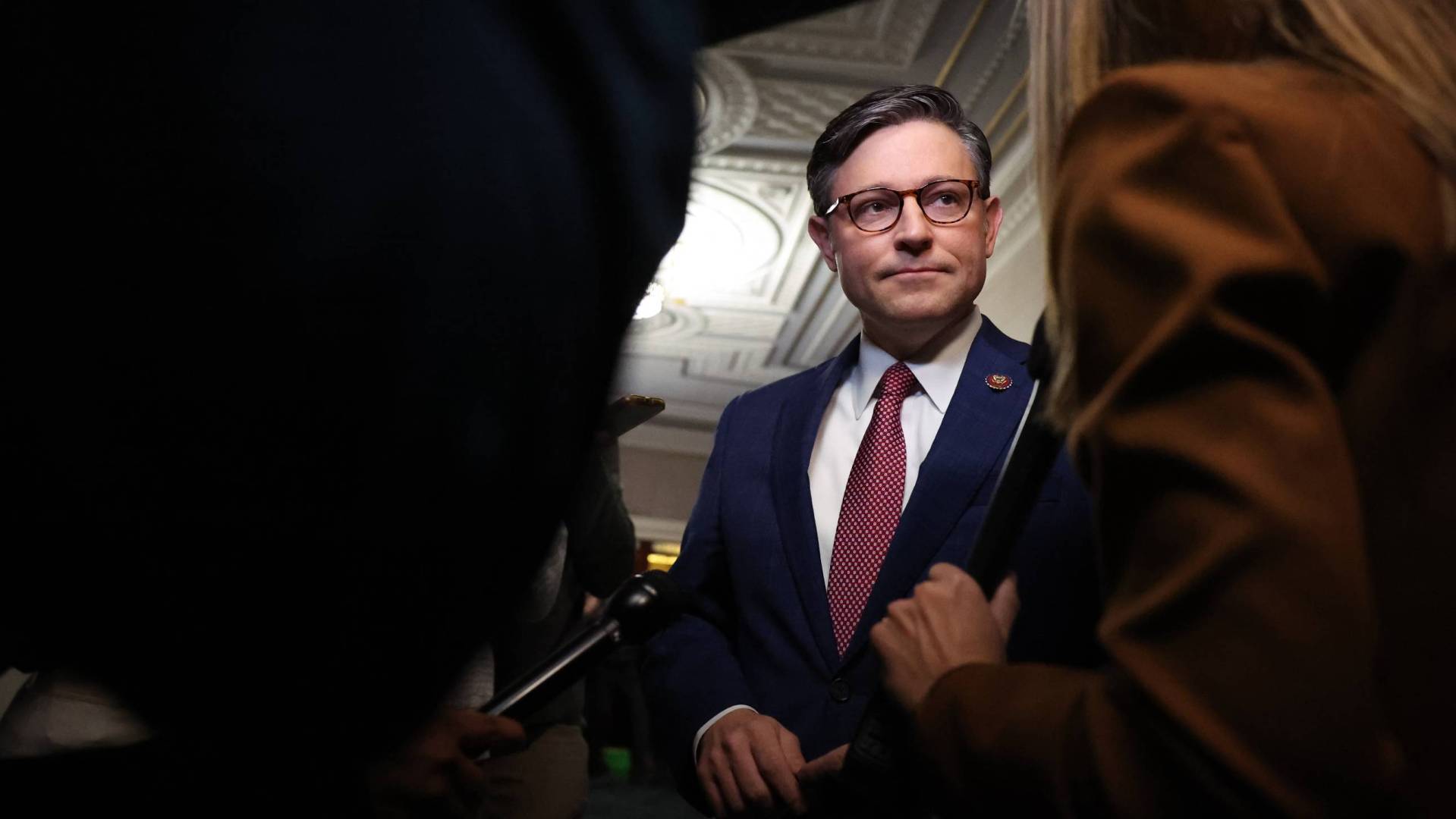
After weeks of turmoil, House Republicans elected Rep. Mike Johnson on Wednesday as the new speaker of the House, an act the Louisiana congressman suggested was ordained by God.

“I believe that Scripture, the Bible, is very clear: that God is the one who raises up those in authority,” Johnson said in his first speech after being elected speaker in a 220–209 vote. “He raised up each of you. All of us.”

Johnson, an evangelical Christian, peppered his remarks with religious references. He recounted the history of how the motto “In God We Trust” was placed in the House chamber—a rebuke of communism, which many associated with atheism—and highlighted the Declaration of Independence’s use of “Creator.” He also noted the presence of Moses on the wall of the House chamber.

“Through adversity, it makes you stronger,” he said, referencing the three-week period in October that it took Republicans to elect a new speaker to replace the ousted Speaker Kevin McCarthy.

In a later speech on the Capitol steps, Johnson framed his leadership goals by citing Romans 5:3–4.

“I was reminded of the Scripture that says ‘Suffering produces perseverance, perseverance produces character, and character produces hope,’” he said. “What we need in this country is more hope.”

Johnson has been tied to multiple Baptist churches over the years and currently attends Cypress Baptist Church in Benton, Louisiana, according to the Louisiana Baptist Message. He is also a former lawyer and communications staffer with the Alliance Defense Fund, which later became known as Alliance Defending Freedom, a conservative Christian legal firm.

According to CNN, Johnson penned a number of editorials while working at ADF, including ones in which he decried homosexuality as an “inherently unnatural” and “dangerous lifestyle” that could lead to the collapse of “the entire democratic system.”

Johnson has continued to voice support for conservative Christian viewpoints while in office, even hosting a podcast with his wife, Kelly, a licensed pastoral counselor, aimed at providing an “analysis of hot topics and current events from a Christian perspective.”

Among other things, Speaker Johnson has repeatedly rejected many broadly held interpretations of the separation of church and state.

“The founders wanted to protect the church from an encroaching state, not the other way around,” he said during a September 2022 episode of the podcast.

He went on to argue that “a free society and a healthy republic depend upon religious and moral virtue,” arguing that society would crumble without it.

His views echo the writings of David Barton, a controversial Texas activist who has spent years railing against the separation of church and state. On Wednesday, Substack writer Warren Throckmorton pointed out that Johnson lauded Barton during a 2021 talk to a group of state legislators organized by WallBuilders, an organization founded by Barton.

“I was introduced to David and his ministry a quarter century ago, and it has had such a profound influence on me and my work and my life and everything I do,” Johnson said at the time.

Johnson’s victory was celebrated by Brent Leatherwood, head of the Southern Baptist Convention’s Ethics and Religious Liberty Commission. Johnson served on the commission’s board from 2004 to 2012.

“Mike Johnson, a name familiar to many Southern Baptists, has been tapped to lead the chamber, and I want to offer my personal congratulations to him,” Leatherwood said in a statement.

He later noted that his first Capitol Hill meeting as head of ERLC was with Johnson and lauded him as someone who “carries an abiding devotion to our convention of churches, subscribes to the principles that are dear to so many Southern Baptists and has deep pride in our nation.”

Johnson’s views are likely to clash with that of many of his colleagues on the other side of the aisle. His election comes the same day as a House Subcommittee on National Security, the Border and Foreign Affairs hearing, which included a discussion of Christian nationalism between Rep. Maxwell Frost of Florida, who said he was raised Southern Baptist, and Amanda Tyler, who heads the Baptist Joint Committee for Religious Liberty.

During their exchange, Frost recalled recent remarks by Rep. Lauren Boebert of Colorado, who declared that “the church is supposed to direct the government, the government is not supposed to direct the church.”

“(The Bible) warns us against people who would preach of a Christ that differs from the true Christ we learn about in the Bible,” Frost said. “That’s exactly what Christian nationalism is doing.”

Johnson also has ties to former President Donald Trump, having supported the effort to stop the certification of Joe Biden’s victory in the 2020 election—a movement based on erroneous claims that ultimately culminated with the January 6, 2021, attack on the US Capitol. Trump celebrated Johnson’s nomination on Truth Social earlier on Wednesday.

Johnson ascends to the speakership after three weeks of chaos in the House spurred by the ouster of McCarthy from top leadership.

The resulting jockeying for power proved to be a surprisingly religious affair: When Rep. Jim Jordan of Ohio vied for the chair, he was introduced by Rep. Elise Stefanik, who cited the biblical Book of Esther to insist Jordan was to be lifted up for the position “for such a time as this.”

When Jordan later failed to win the speakership multiple times, Rep. Mike Gallagher of Wisconsin, who is Catholic, reportedly left a heated Republican caucus meeting saying he was so upset he needed to “go up to the chapel and pray the rosary.”

When Jordan decided to pursue the speakership yet again he did so after referencing in a news conference a verse from the New Testament book of 1 Timothy, saying he needed to “Fight the good fight of the faith.” (Jordan failed that vote, too.)

News
Wire Story

Religious Freedom Commission Laments Israel-Hamas War at Anniversary Gathering

As the International Religious Freedom Act turns 25, advocates look ahead to next steps.

25th anniversary of the International Religious Freedom Act

25th anniversary of the International Religious Freedom Act

Christianity Today October 25, 2023
Screengrab / CSPAN

Religious freedom advocates lamented the loss of civilian lives in the Israel-Hamas war, antisemitism, and Islamophobia on the 25th anniversary of the International Religious Freedom Act (IRFA).

The bipartisan and multifaith US Commission on International Religious Freedom (USCIRF), created by passage of the act in 1998, commemorated the 25th anniversary of IRFA at an October 23 event on Capitol Hill with an overview of USCIRF accomplishments, panel discussions, congressional remarks, and historical summaries of the act’s passage.

“As a clergy, as a man of faith, I am really disturbed by the loss of civilian life in Israel and Palestine,” said USCIRF commissioner Mohamed Magid, cofounder of the Multi-Faith Neighbors Network to build bridges between Muslim, evangelical, and Jewish communities.

“And also, I stand against antisemitism and Islamophobia in America, on campuses. Also the loss of many lives as we speak now, of civilians in Gaza, of children, and therefore we have to value all human life,” Magid said. “But I’m really standing with my brothers and sisters in Jewish community, and brothers and sisters in Muslim community.”

Commissioner Frederick A. Davie, USCIRF vice chair and senior strategic adviser to the president at Union Theological Seminary, reiterated USCIRF’s October 11 call for an international prayer service in response to the Israel-Hamas war. Death tolls vary, but thousands have been killed and injured. The US has confirmed the deaths of at least 33 Americans.

Davie offered USCIRF’s help in organizing and participating in such a prayer service that would acknowledge “the brutality and the horror and the depravity that is taking place in the region, calling for compassion for human life and innocent lives in the region, and calling for a just and peaceful resolution to the horrors that now exist there.”

At “The First 25 Years: IRFA Accomplishments and Next Steps,” USCIRF cited accomplishments achieved and recommended steps forward in advancing religious liberty.

No other country has a similar commission, bipartisan and multifaith, USCIRF chair Abraham Cooper said. Through USCIRF and IRFA, religious issues are integrated into US foreign relations more than ever before, he said, with violations documented and exposed, violators often sanctioned, some prisoners released, and repressive governments improving laws and policies.

“Importantly, the United States no longer stands alone in recognizing the significance of international freedom of religion or belief … for everyone everywhere,” Cooper said. He characterized USCIRF as among the first to decry China’s persecution of Uyghurs as genocide, Russia’s antisemitism and Holocaust distortion, Russia’s invasion of Ukraine, and Hamas’s attack on Israel.

In the five years since USCIRF marked the IRFA’s 20th anniversary, Davie said, the group has seen robust use of new tools to promote and achieve international religious liberty through the Frank R. Wolf International Religious Freedom Act and the Global Magnitsky Act. But he said much work is still needed.

“We cannot be complacent,” Davie said. “State and non-state actors around the globe continue to perpetrate or tolerate severe religious persecution. In too many countries, individuals and communities are still targeted for their religious beliefs, activity or identity, or for their religious freedom advocacy.”

USCIRF monitors and documents religious freedom violations internationally, advocates for religious liberty, compiles frequent reports on religious freedom in numerous countries, compiles annual reports, and designates certain countries as Countries of Particular Concern (CPC) for their religious freedom violations.

Moving forward, USCIRF urged the US Congress to use the CPC designation more effectively and to apply more meaningful consequences against violators. USCIRF urged more congressional oversight hearings on USCIRF policy; urged Congress to be more vocal in referencing religious freedom issues in various settings, including hearings, floor speeches, and congressional delegations abroad; urged Congress to advocate for prisoners of conscience; to permanently reauthorize USCIRF through bipartisan support, and to increase USCIRF’s budget to support the body’s original intent.

Other speakers included USCIRF commissioner Frank Wolf, who was instrumental in IRFA’s passage. Wolf applauded faith communities’ support of USCIRF, and urged renewed multifaith vitality in the effort.

Theology

When Media Becomes the ‘Prince of the Power of the Air’

Breaking free from disinformation and systemic oppression entails discipling a nation.

Christianity Today October 25, 2023
Illustration by Mallory Rentsch / Source Images: Unsplash / Pexels

In the Philippines, my home country, fake news travels fast—not only through social media, but through word-of-mouth communication spread by “Marites,” a Tagalog word for a person who gossips.

This is a compound word from mare, meaning “godmother” as well as clusters of friends in the neighborhood, and the English word latest. In effect, it means “Mare, what’s the latest?” So gossip goes around very fast, especially in densely populated, poor urban communities.

Technology has accelerated and expanded the spread of misinformation beyond what chatty friend networks ever could. It happens in the US and the West as a whole, as well as in countries where the government influences or restricts the media.

Analysts say that part of the reason Ferdinand Marcos Jr. and his allies have returned to power is the way they have been able to massively use social media to revise narratives of our experience of authoritarianism under his father’s rule.

Christians across the world have rightly lamented the spread of fake news in their communities, the prevalence of conspiracy theories, and the skepticism toward ever being able to know the truth. Those of us in the Majority World are also sensitive to another dimension of this phenomenon: We are more likely to see the spiritual reality behind it.

We sense how the demonic could lodge and entrench itself in media technologies—our contemporary version of what Paul calls the “prince of the power of the air” in Ephesians 2:2 (ESV).

Paul’s language of “thrones or dominions or principalities or powers” in Colossians 1:16 (NKJV) suggests that the demonic manifests itself not only in personalities, but also in subhuman forces—structures and institutions—that enslave or oppress people.

Untruth usually couples with oppression, says the prophet Jeremiah. When truth has fallen in the public square, “oppression upon oppression, deceit upon deceit” grows (Jer. 9:6, ESV). Those who bend their tongues to speak lies proceed from evil to evil.

The state and other powerful institutions have the power to deceive masses of people through media and social media. It is not an accident that the first thing despots do to consolidate power is muzzle the press.

In a time of massive disinformation, Christians are to fight back for truth. We engage the “prince of the power of the air,” articulating persuasively God’s norms for society in the public square.

Building a “hermeneutical community”

Participation in the political and social life of a country does not merely mean putting Christians into office or capturing positions of power so as to advance our values and agenda like the Religious Right in America. It means creating a social and intellectual environment that argues the cogency of Christian values and frames behavior in public life.

As the writer T. S. Eliot puts it:

What the rulers believed would be less important than the beliefs to which they would be obliged to conform. And a skeptical or indifferent statesman, working with a Christian frame, might be more effective than a devout Christian statesman obliged to conform to a secular frame. … It is not primarily the Christianity of statesmen that matters, but their being confined, by the traditions and the temper of the people which they rule, to a Christian framework within which to realize their ambitions.

How do we go about creating such an environment?

Firstly, we intentionally build what I call a “hermeneutical community,” one made up of those who, like the tribe of Issachar (1 Chron. 12:32), can discern the times and give guidance on how to effectively influence and impact society.

Witness, in the Pauline sense, is to “take captive every thought to make it obedient to Christ” (2 Cor. 10:5). Unfortunately, this missional mandate has been sidelined by the massive energy put on shallow gospel proclamations that pass for what we call “evangelism.” We train believers to use the Bible on matters like how to get saved, but not on how the whole counsel of God can be applied to the many issues we face every day.

Concededly, the kind of nurture that enables people to engage issues in the public square requires focused attention on those with relevant professional gifts and expertise, opening their minds to the gospel’s relevance to all of life. It is time we bring to the center of our church life and witness the artists and scientists, those with gifts that can communicate creatively to the outside world.

The importance of such a hermeneutical community was impressed upon me at the height of the struggle against former Filipino president Ferdinand Marcos’s authoritarian regime. Some evangelical leaders in the Philippines kept criticizing my organization, the Institute for Studies in Asian Church and Culture (ISACC), for being part of the surge of resistance against the continuance of Marcos’s rule.

ISACC is a small community of social scientists, development practitioners, writers, artists, and a handful of pastors and theologians. We were convinced that the results of the 1986 snap elections that proclaimed Marcos as winner were fraudulent. He had no more right to rule our country.

We mounted a protest together with other movements. Evangelical leaders then labeled this as “rebellion” and kept referencing Romans 13:1–7, which talks of being subject to the governing authorities.

But our reading of the times differed greatly. Our discernment was that the relevant text to the times was not Romans 13, as most evangelicals thought, but Revelation 13. There are times when the state ceases to be a servant and instead assumes the proportions of a beast (Rev. 13:5–8) and so must be resisted.

Our reading of both the times and the relevant text won the day.

After the 1986 People Power Revolution, some church leaders began to ask, How come ISACC seems to have its finger on the pulse of where our people are, but we missed it?

Lest we miss our historical cues, we must raise a critical mass of young thought leaders who can read the signs of the times accurately and creatively apply Scripture in analyzing and confronting the burning issues of our day.

Discipling nations

Secondly, we are told to disciple nations, not just individuals. We are to create new life-affirming systems within our cultures.

This is not primarily done by building alternative structures that we baptize as “Christian,” like “Christian” media or a “Christian” school, but by penetrating our cultures and existing institutions. We affirm or critique our customs and traditions and turn them to Christ and the values of the kingdom.

The rousing outcry we raised against Marcos may have happened 37 years ago, but we continue to wrestle with similarly sinister beasts of our day.

For instance, there is a resurgence of authoritarianism in many countries where democracy was supposed to have been restored. The cult of the caudillo, or the mythic strongman, persists.

Part of the reason is the lack of congruence between the operative values in the culture and the established structures of governance. As Guatemalan sociologist Bernardo Arevalo puts it, “We have the hardware of democracy, but the software of authoritarianism.”

Change needs a “software” of values that will support the “hardware” of the structures and institutions that we put in place.

Creating supportive patterns of culture that will make our systems work requires discipling a whole nation. The process starts but does not end with the internal transformation of individuals. Such change is meant to issue in the “good works, which God prepared in advance for us to do” (Eph. 2:10), that then radiate out into the larger society.

The missiologist-historian Andrew Walls, in tracing Christianity’s leap from Judaism to inculturation into Greek thought forms, explains how the Bible engages cultures and transforms the social fabric of nations:

The Word is to pass into all those distinctive ways of thought, those networks of kinship, those special ways of doing things, that give a nation its commonality, its coherence, its identity. [The Word] has to travel through the shared mental and moral processes of a community.

As we bring the Word into the public square, we set people free from what Paul calls “strongholds” of the mind (2 Cor. 10:4, ESV). Strongholds, in the way Paul uses it, are not primarily territories of spiritual powers out there, but the web of lies in our minds that shape a society’s consciousness and keep our cultures in bondage.

Witness involves destroying intellectual barriers to belief in Christ. It means getting the Word out there and making “every thought captive to obey Christ” (2 Cor. 10:5, ESV).

Unfortunately, we have reduced our witness to mouthing pre-packaged gospel formulations that we assume will work from culture to culture and that do not really engage the hearts and minds of our people. It is also unfortunate that those of us who are recipients of theologies developed in the West have tended to gloss over the cultural and incarnational nature of our witness.

A transforming work

These days, massive poverty has caused the erosion of the Filipino people’s values. Economic pressure makes our bureaucrats surrender integrity and our overseas workers into willing smugglers and couriers of drugs in remote places. We call it kapit sa patalim in Tagalog, referring to how people will graspingly take hold of the blade of a sharp knife—even if it cuts their own hands—just to seize opportunities to survive.

But change can happen and can spread through the structures that organize our common life, just like how the early church­, through its practice and witness under persecution, broke through barriers of class, race, and gender to eventually tear the social fabric of Greco-Roman society, a civilization borne on the backs of slaves.

The battle for the soul of a people begins with the mind. People follow the “prince of the power of the air” until the Word breaks through. And as the gospel penetrates and transforms our mental models of how the world works, communities are enabled to move toward new patterns of culture.

Melba Padilla Maggay is a writer and social anthropologist. She serves as president of Micah Global and was formerly the president of the Institute for Studies in Asian Church and Culture.

Speaking Out is Christianity Today’s guest opinion column and (unlike an editorial) does not necessarily represent the opinion of the publication.

Theology

We Must Put Our Body Where Our Mouth Is

The path to restoring Christian credibility is paved with embodied action, not empty words.

Christianity Today October 25, 2023
Illustration by Mallory Rentsch / Source Images: Getty

It’s no secret that people today are questioning their faith and leaving the church because of religious hypocrisy—there’s even a recent study showing this to be the case.

The unbelieving world is paying more attention than ever to whether Christians’ beliefs and actions match up. If there’s anything we’ve learned in recent years, it’s that our simply knowing what is right doesn’t necessarily mean we will do it.

Of course, this kind of hypocrisy is not unique to religious people.

My sister, a nurse, once strolled by a couple of pulmonologists she knew as she was leaving the hospital. They were standing outside smoking cigarettes. She was struck by the irony: These doctors know all there is to know about lung disease and the toxic effects of smoking, and yet that did not prevent them from doing it anyway.

Similarly, there’s a world of difference between our intentions and our actions when it comes to doing the will of God. Yet many of us believe that if we think about the truth, theologize about it, and talk about it, we are doing God’s will. This is a mistake. Having a rational understanding of God’s will does not amount to true belief unless and until we act on that knowledge.

That’s because our being is shaped by our doing, rather than the other way around like many assume. We might know we should trust Jesus, for instance, but that’s different from actively putting our trust in him. Wanting to obey God is not obeying him. As Jesus puts it simply, “If you love Me, you will keep My commandments” (John 14:15, NASB).

Our kinship with others flows out of our relationship with God because God has made us the keepers of our brothers and sisters, and of the earth. That was his plan. And this is not a matter of knowledge, but of embodiment: actually putting one foot in front of the other.

That requires setting our sights on Christ—on doing, knowing, and being like him—and filtering all our thoughts, actions, and dispositions through his eyes and heart. By imitating Christ, we come to understand him, and our being is transformed in the process. As we become more like Christ, we get better at seeing and treating others the way he sees and treats them.

Our posture toward and treatment of others is a good indicator of our level of transformation and capacity to do God’s will. That’s especially true for those who are closest to us, with whom we live and work and play. It’s easier to treat well the people with whom we have little interaction than those with whom we regularly interact, who can get on our nerves or push our buttons.

The real test of our love is how we treat people when there’s no chance to put on a pious show.

The opposite of this kind of selfless love is what I call Invictus-ing—taking the self-deifying stance described in William Ernest Henley’s famous poem “Invictus”:

I thank whatever gods may be
For my unconquerable soul.
… I am the master of my fate,
I am the captain of my soul.

This attitude of self-governance can lead us off-course from God’s will and entangle us with death (Ps. 18:4)—which can, in turn, leave destruction in our wake and make us run aground.

If we truly love God, and if Jesus is indeed within us, then we should be bothered when our neighbors are not flourishing. If we aren’t, we are self-deceived in believing we love God—for “whoever claims to love God yet hates a brother or sister is a liar” (1 John 4:20).

But it is not enough to love our neighbors in our imaginations. If asked, would our neighbors attest to us tangibly caring for them?

Not long ago, I was teaching an undergraduate class, and the day’s topic was abortion. I was explaining the lay of the land, talking about the number of abortion clinics and the concept of viability. I also highlighted the cost of raising a child in different parts of the US.

What I’ve found profoundly interesting each time I’ve done this unit is that students across the value spectrum don’t argue about the humanity of the baby, although they may disagree on when life begins. And I always encourage my students to listen to those whose views on abortion are different from their own instead of demonizing each other.

As students registered their opinions, one student spoke up. “I had an abortion,” she said. “There’s no way I could have continued going to college if I’d had a baby. My boyfriend and I can’t afford to raise a child.” The class grew silent; some students stared down at their desks or phones, while others turned around to look at the student as she spoke. “My parents tried to talk me out of it,” she continued.

Then she laid it all out:

I asked if they were going to babysit the baby while I was at school and work. If they were going to purchase clothing and formula and help with whatever bills insurance did not cover. If they were going to help put money away for the baby’s college tuition and help with miscellaneous expenses. I also wanted to know if they would vote for laws that give mothers and children a stronger safety net after the child is born instead of just being pro-birth.

Then—having established almost a semester’s worth of credibility and trust with the class—I asked, “Do you mind telling us what they said? Of course, you don’t have to answer this question if it makes you uncomfortable.” Students can always opt out of answering questions in my class, and I’ve had some elect not to answer specific questions or participate in certain discussions before.

After what seemed like an eternal pause, she then said, “They did not say much, except that they could not commit to all those things. Obviously, it was too much. So I had the abortion. Like I said, my boyfriend and I can’t afford a baby right now.” And then she added, “Pro-birth people talk a good game, but they don’t want to support mothers and children once the babies are born.”

I was stunned. All I could do was offer my deepest thanks for her entrusting us with such intimate details.

Really, I could not argue with her. She was 100 percent right. For our pro-life stance to be credible, Christians in the US need to vote differently to care for mothers, children, and families. We should hold the fathers responsible and our representatives accountable to crafting holistically pro-life policies. And with the price of housing, childcare, medical care, diapers, and formula, folks need more of a safety net in place.

But that would require a cost from us. Not only would we likely have to pay more taxes, but most of us would also have to simplify our lifestyles and pay more out-of-pocket expenses to support those who need it. Being truly pro-life may mean housing a single mother or helping her get back on her feet, or perhaps creating a special fund to support the struggling families in our churches.

Love is action-oriented—not merely talking about what we believe and support. If we continue to do Bible studies and memorize Scripture without applying it to our lives, then we will become the kind of people James speaks so strongly about in his epistle: “Suppose a brother or a sister is without clothes and daily food. If one of you says to them, ‘Go in peace; keep warm and well fed,’ but does nothing about their physical needs, what good is it? In the same way, faith by itself, if it is not accompanied by action, is dead” (James 2:15–17).

Christian activist and journalist Dorothy Day nailed it when she put it this way: “I have long since come to believe that people never mean half of what they say, and that it is best to disregard their talk and judge only their actions.” That’s what my student was doing: judging her parents’ action (or rather, inaction).

Sometimes the simplest, most basic things in life—eating well, exercising regularly, getting plenty of sleep, and not overscheduling our calendars—can be the most difficult for us to accomplish on a consistent basis. As a result, many of us content ourselves with ill health and dysfunction. Why? Because health requires exertion, sacrifice, and a change of habits.

Similarly, we often miss out on the wholeness and shalom of loving God with all we are and loving our neighbors as ourselves because doing so can be difficult to learn—at least at first, and without the help of the Holy Spirit and wise friends, or within a toxic church culture.

But it is possible. And it is necessary if we hope to restore the witness of the Body of Christ for this next generation.

My student felt that having an abortion was her only option, the only way to take responsibility for her behavior. She did not want to raise a child in poverty. What would we say if my student had put the question to us or to our churches? Do our actions vindicate our words?

Marlena Graves is assistant professor of spiritual formation at Northeastern Seminary in Rochester, New York, and the author of Bearing God and The Way Up Is Down.

This excerpt has been adapted from Bearing God: Living a Christ-Formed Life in Uncharted Waters by Marlena Graves © 2023. Used by permission of NavPress. All rights reserved. Represented by Tyndale House Publishers, Inc.

News
Wire Story

Chiang Mai’s First Pregnancy Center Offers Thais a Pro-Life Alternative

Last year, Thailand legalized abortion up to 20 weeks.

Christianity Today October 24, 2023
Getty Images

Getting pregnant at 15 hadn’t been part of Anong’s plans. The young Thai teenager ran away from home to live with her boyfriend’s family, and though they helped a little, the young couple still felt at a loss about how to navigate their situation.

What hospital should she go to? How would she get insurance? How would she take care of a child? Questions like these piled up and threatened to overwhelm Anong.

Should she just abort? That would be easier, she confided in a friend.

Months before Anong’s dilemma, IMB missionary Beth Hipps began building a network of believers and healthcare professionals in Chiang Mai, Thailand, who desired to walk alongside those experiencing unexpected pregnancies.

One of those believers heard Anong’s story and called Hipps.

“Can you come help her?” Hipps remembers the phone. All she could think was that Anong was the same age as her own daughter.

That day, Hipps and a friend were able to take Anong to a clinic for an ultrasound. Over the next few weeks, they talked through her questions and problems and helped her see she wouldn’t be alone if she decided to give birth.

Four months later, Anong gave birth to a healthy baby girl. As she settled into motherhood, she continued to have support from Hipps and other believers. She heard the gospel and knew her family was prayed for.

This was a life-changing experience, not only for Anong and her family but also for Hipps. She’d been praying and hoping to establish Chiang Mai’s first crisis pregnancy center but had no idea how to start outside of building a network of connections.

Working with Anong clarified for Hipps that helping didn’t have to be complicated. More than anything, those in crisis needed prayer, support, and encouragement.

Now, several years later, Hipps has helped found a crisis pregnancy center called the ELM Pregnancy Center that has seven care teams throughout Thailand.

These teams show pregnant women and teens what their options are while walking alongside them, step by step, so that they have support at each stage of the pregnancy and for up to two years after the child is born.

Care teams help women get ultrasounds and prenatal checkups. They teach them using a booklet that explains what they’ll face during each trimester and how their babies are developing. This information gives women knowledge on how to prepare and what to expect in that phase of pregnancy.

Care teams, made up only of believers, also seek opportunities to share their testimonies and the gospel. “We want to equip and empower women to choose life,” Hipps said.

In recent years, Thailand decriminalized abortion, and in 2022 the country expanded abortion access up to the 20th week of pregnancy. ELM’s ministry meets a need for a specific and overlooked community and provides another alternative to pro-choice organizations with strong influence in the country.

Additionally, in a culture where shame is the driving force behind people’s decisions, abortion tends to be the go-to option for women who see their pregnancy as a mistake. Their only goal is to get rid of the shame before anyone knows about it, and as a result, many women, Christians included, are ignorant to the realities of abortion.

ELM seeks to not only care for pregnant women but also to educate Thais about the growth and development of babies in the womb. Though the challenges are great, Hipps is hopeful they are slowly making progress.

“We are, I believe, on the cusp of writing the pro-life narrative in Thailand,” Hipps said.

She said her favorite part over the years has been to see how lives, including hers, have been changed by God’s incredible provision every step of the way.

“I think that part is the best,” Hipps said, “to see how God transforms lives, not only of unplanned pregnant women but women who are just willing to answer the call.”

Some names may have been changed for security purposes.

News

Texas Prisoner Who Leads Death Row Worship Faces Execution

The case of prison convert Will Speer shows the significance of ‘peers’ leading ministry behind bars.

Christianity Today October 24, 2023
Courtesy of Texas Defender Service

Update (October 26, 2023): A few hours before Will Speer’s scheduled execution on Thursday, the Texas Court of Criminal Appeals stayed his death pending further review of his case. Speer has presented several legal claims, including that his counsel did not provide mitigating evidence.

—————

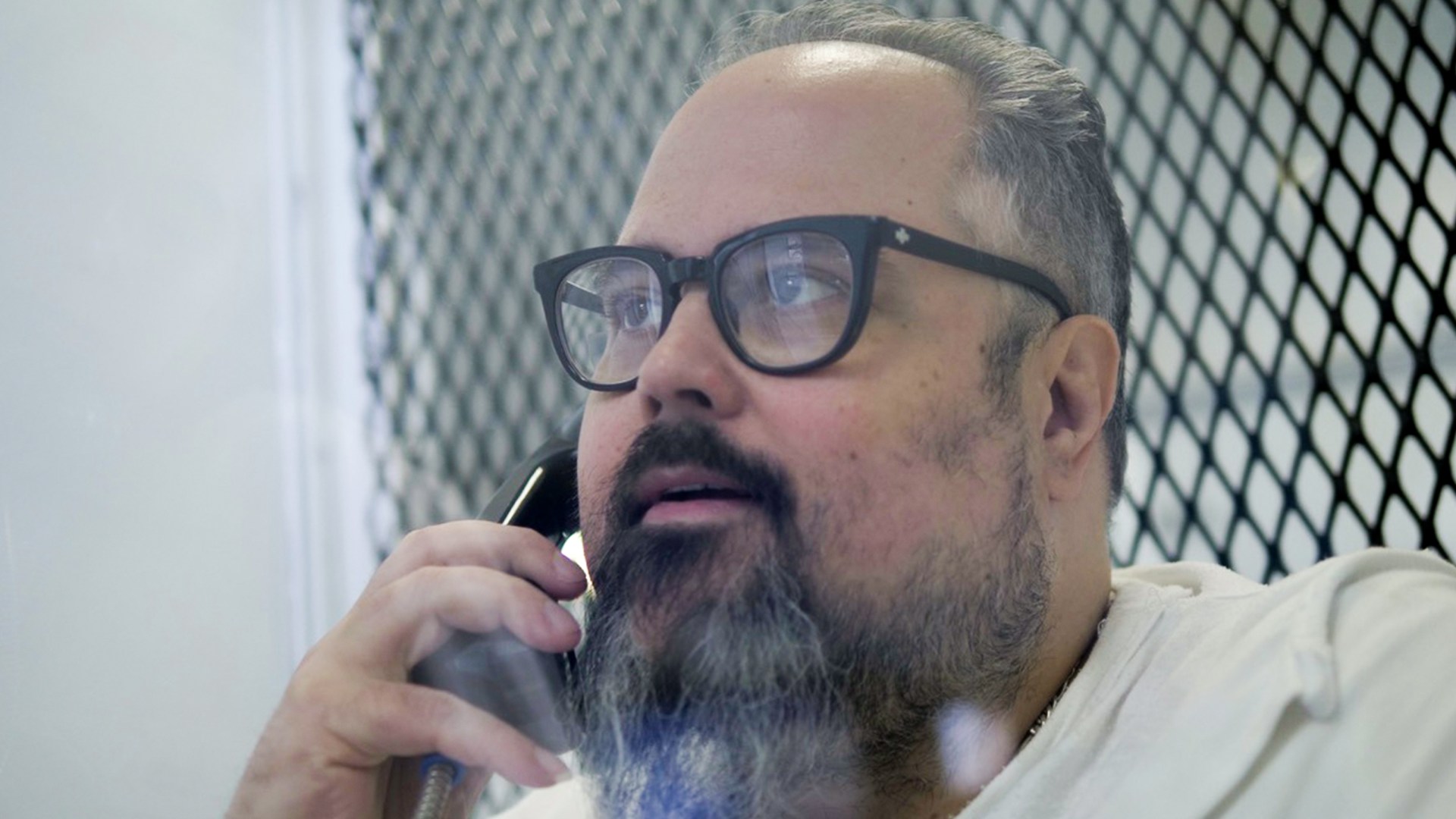
The first death row prisoner to help lead a death row ministry in Texas’s Allan B. Polunsky Unit, a state prison with maximum security units, is scheduled to be executed on Thursday, October 26. On Tuesday, Texas denied Will Speer’s application for clemency.

Every morning, Speer leads prayer and worship—sometimes delivering a sermon through prison radio—on death row. Though the men are in solitary confinement for 22 hours of the day, they can still sing together through the walls, said pastor Dana Moore, who has spent years ministering to those on death row in the Polunsky Unit.

In 2021 the Texas Department of Criminal Justice started an 18-month faith-based program for 28 death row inmates who passed an application process. The program became known as the “God Pod,” consisting of classes, worship, and rare fellowship for those normally in solitary confinement.

Speer graduated from the program this year and became the first “inmate coordinator” for the God Pod program, which meant he could teach classes and mentor others in prison despite being on death row.

Speer was convicted of murdering Jerry Collins when he was 16 and was sentenced to life in prison as an adult. Then, a decade later in 2001, he was convicted of murdering a fellow prisoner, Gary Dickerson—he says the murder was to get gang protection in prison—and was sentenced to death.

He argues that mitigating information was not shared with juries. He testifies to a horrific childhood of repeated abuse and violence, and to being sent to a hospital as an adult after a severe beating in prison. His highest level of education was eighth grade. Speer has expressed remorse for his crimes and was baptized behind bars in 2022.

The only surviving immediate family member of Dickerson, whose murder resulted in Speer receiving a death sentence, said she did not want Speer to be executed. Sammie Gail Martin submitted a letter to the Texas Board of Pardons and Paroles asking that Speer’s sentence be commuted to life in prison.

“I have spent much time reflecting on what justice my brother and family deserve,” she wrote. She said she believed Speer was remorseful and “has something left to offer the world.” If he received a life sentence, “hopefully he can continue to help others and make amends for his past crimes.”

J. C. Collins, the son of victim Jerry Collins, told the Baptist Standard that he would attend the execution, but in order to pray for Speer. “I don’t want to see him die,” he said.

“I know what I robbed from them and their families,” Speer told the Baptist Standard. “I understand, because I’ve been there. The stepfather who abused me killed my mother. I know what it feels like. I can’t restore what I took away from them. But maybe I can give back some other way.”

Speer’s attorney Amy Fly stated that if Speer was allowed to spend the rest of his natural life in prison, he would join the Texas field ministry program, which involves more seminary training than the God Pod program and makes the incarcerated graduates de facto prison chaplains.

Ministry programs available on death row vary state by state. Official prison chaplains have the most access, ministry leaders say. Evelyn Lemly, the CEO of Kairos Prison Ministry, said their death row ministry programs generally depend on whether the facility allows them in.

But more “peer” ministry is happening at prisons now. When those behind bars are leading ministry, it allows the incarcerated population to have more access to ministry, since chaplains are stretched to cover an entire prison population and outside visitors are limited.

“It’s increasingly common,” said Michael Hallett, a researcher who has studied the religious lives of long-term prisoners at the Louisiana State Penitentiary, also known as Angola. He has followed prisoner-led ministry programs in Texas and Louisiana.

Critics of prisoner-led ministry say “it’s just a way for Texas to spend less money on prisons by putting inmates in as de facto chaplains,” Hallett told CT, adding that chaplains have more training and certification in things like crisis intervention and grief counseling.

But these “peer” ministries do “bring great comfort to prisoners,” he added.

“Many times, prisoners are better able to relate to one another than to outside volunteers,” he said. “It eliminates the shame factor and allows for very genuine and open conversations.”

Those behind bars need visits from the outside, too, reminding those in prison that “they’re not forgotten,” Southern Baptist pastor Dana Moore told CT.

Moore, who leads Second Baptist Church in Corpus Christi, Texas, has ministered to others on the same death row with Speer. He was part of a US Supreme Court case a few years ago, where prisoner John Henry Ramirez had asked prison officials to allow Moore to lay hands on him at his execution. The Supreme Court ruled in Ramirez’s favor.

Moore laid hands on the chest of Ramirez when he was executed in October 2022. He’s now ministered on death row for six years and finds the biggest difference from his regular ministry is that, apart from the execution, he can never shake hands with or hug the men he’s talked to for years. They speak through a phone with plexiglass between them. He mostly listens to them and hears how they are doing, and they often talk about God or a sermon.

Ministering to men who are eventually executed “is a toll,” he said, especially with the flurry of last-minute court decisions. Moore also visited with Jedidiah Murphy, who was executed in Texas earlier this month. He says he is pro-life, and therefore against the death penalty and abortion. People in his church might not agree with him, but “they’re supportive” of his approach, and some volunteer in a Kairos prison ministry program. In his sermon this past Sunday, he told his church that each of them know a condemned prisoner: Jesus.

Hallett said the Texas faith-based programs are valuable, but they need to be “more ecumenical” so they are not coercive. Becoming a field minister in Texas prisons, for example—a program where long-term prisoners receive training to be de facto prison chaplains—happens through the Heart of Texas Foundation, a Christian organization. (Texas Monthly reported that the God Pod included Buddhists, Muslims, and an Odinist.)

“The Christians there, they’re vocal but they’re not overbearing with it,” said Moore, the Baptist pastor.

States other than Texas and Louisiana have unofficial ministries led by prisoners themselves. In Tennessee, Kevin “KB” Burns became an ordained pastor while on death row and wrote materials on incarceration for the Christian Community Development Association. He does not currently have an execution date, and Tennessee executions are currently paused while the state resolves issues with its lethal injection protocol. Burns has worked as a chaplain’s assistant, according to one pastor who has regularly visited him, and goes cell to cell praying with men on death row.

Burns maintains his innocence but was convicted in 1995 of the two felony murders of Damond Dawson, 17, and Tracey Johnson, 23.

Pastor Kevin Riggs of the nondenominational Franklin Community Church has visited Burns for years and said his church elders agreed to ordain him after observing how he was already ministering to others on death row. That ordination process took place over two years of training, and now Burns is listed on the church’s staff webpage as its “minister on death row.”

But outside ministers are the ones present for execution. Stacy Rector, a Presbyterian Church (USA) pastor in Tennessee, visited a man on death row, Steve Henley, for ten years. Visitation rules for death row are complicated in Tennessee and require a lot of paperwork and patience, Rector said.

“For anybody thinking about doing this work, this ministry, there has to be a commitment level to it, because there needs to be consistency for the men and women,” she said. “It’s life for them. But you also have to have boundaries.”

Henley, convicted of killing a couple in 1985, was executed in 2009, with Rector present for his death as his spiritual advisor. Rector is now the head of Tennesseans for Alternatives to the Death Penalty.

In the time she has ministered on death row, she has seen how “unconditional love from God and other people” can profoundly change those who are incarcerated, people who maybe didn’t have that love or time to reflect on the outside. But she also now appreciates more deeply, from more exposure to victims’ families, “the absolute devastation that homicides cause.”

“It’s a scale we’re trying to balance that is not balance-able,” she said. The family of Henley, the executed man she knew, is also struggling. “The ripple effects of this thing are everywhere.”

Whatever happens in Speer’s case, on Tuesday elsewhere in Texas, Moore, the Baptist pastor, was setting up his visits for the month to the men on death row.

“We’re remembering them,” he said.

This article has been updated with the current administrator of the field ministry program, Heart of Texas Foundation, and to reflect that Texas denied Speer’s clemency application on Tuesday afternoon.

Ideas

You Can Only Break the News of War so Gently

Contributor

The Israel-Hamas war is thousands of miles from my daughter—and on her phone. I can’t keep her from the world’s sorrows.

Christianity Today October 24, 2023
Illustration by Mallory Rentsch / Source Images: Unsplash

As we drive to school, the first streaks of pink and orange spill across the horizon. Cars change lanes beside me, and in this madly spinning world—everyone and everything moving—the expansive sky looks still. I turn the radio down and catch my 12-year-old daughter’s eyes in the rearview mirror.

We’re on the way to her middle school, and she’s sitting in the back seat, blissfully unaware of the fresh grief unfurling in the Holy Land on this October morning. It occurs to me that there are only a few letters separating ignorance from innocence. Wanting both to last a little longer, I let the space between my words stretch out. “There’s something I need to tell you.”

I am in a brutal bind. Tell her too little, and she’ll be caught off guard when—not if—she hears of the Israel-Hamas war from some source other than me. Tell her too much, and I needlessly rush her toward the end of childhood.

I fumble forward, words spilling out of my mouth despite my reticence. I tell her about the attacks in Israel this month and the rumors swirling as Israeli troops prepare their response. But I don’t tell her about the grandmother whose murder was livestreamed or that babies were reportedly burnt and beheaded. I don’t tell her that Hamas uses civilian Palestinians as human shields or that, because the Palestinian population skews young, hundreds of children have already died in Israel’s response, and that more will die even if Israel does its best to abide by the laws of war.

I’m telling her this news, I explain, because I want her to be careful—aware of what might be coming next when someone casually hands over their phone and says, Hey, look at this. I am taking a little of her innocence in hopes of preserving most of it.

Now that she’s in middle school and immersed in a world where everyone has the world in their pockets, I’ve learned our family’s personal boundaries about technology are all but irrelevant. We don’t allow social media on her cell phone, but she could see a murder over someone’s shoulder in health class. We limit her contacts, but we can’t keep her from overhearing, in the school cafeteria, the screams of a woman halfway around the world.

What is the right thing to do here? No one has a motherhood playbook for this kind of psychological terror. Even five years ago, my child was much less likely to encounter such depravity in a passing period at school. As an Israeli psychologist poignantly noted, “The videos and testimonies we are currently exposed to are bigger and crueler than our souls can contain.”

After I speak, my daughter looks out the window. I want to know what she’s thinking. I want to turn the car around and go home. I want to pretend all is well. Yet I know I cannot stop the world’s wild spinning or time’s fast pace. She is growing up, a God-crafted creation “for such a time as this” (Esther 4:14)—or, at least, that’s what I tell myself in my more grounded moments, finding confidence in the story of Esther. But right now, I mostly just feel a sinking dread: Ready or not, here the world comes.

Author Wendell Berry wrote a poem for his granddaughters after visiting a Holocaust museum. It opens with the sad resignation of watching childhood crack wide open, spilling innocence like blood, in the lives of his beloved:

Now you know the worst

we humans have to know

about ourselves, and I am sorry,

for I know you will be afraid.

The simplicity of these words—the totality of the ache they contain—reverberates in my heart. I hear them echoed, too, in the plea of a Palestinian mother, told to flee but with nowhere to go: “What did my children do to deserve this?” I hear them in the soul-sick voice of an Israeli mother whose 12-year-old autistic daughter was kidnapped by Hamas terrorists: “I’m helpless but not hopeless.” I am sorry, we all must say to our children, that this is the fallen world you must know.

My sadness, I realize, isn’t the same as that of Israeli and Palestinian mothers—or of mothers in Myanmar or Ukraine or Afghanistan or Ecuador. The pang of ordinary sadness I feel watching my daughter—and her younger sister—grow more aware of the world’s jagged edges is balanced by my awareness that each day’s growth is an exquisite gift many parents never get to experience.

“I don’t feel comfortable talking about such a mundane breaking-apart in a world where real wreckage lies scattered everywhere,” as author Mary Laura Philpott so poignantly said. “I carry this sadness around quietly, so as not to take up too much air with it, to leave space for the far more significant sadnesses of others.” That seems right, given humans’ limited attention spans and capacity for mourning. But I also trust God has no such limits, and he will wipe away the tears of ordinary sadness as much as those of great griefs (Rev. 21:4).

In the car with my daughter, I set my eyes on the road ahead. How do we go forward? This much I know: I cannot keep my daughters from this beautiful, terrible world. But I can seek to prepare them for it, teaching them that in a world at war, Jesus calls his people to something different—to be peacemakers (Matt. 5:9).

The sky is crimson now. The world is aflame, and we are told to be peacemakers, turning cheeks and giving cloaks and breaking bread and laying down our lives (Matt. 5:38–48). I almost laugh at the absurd impossibility of it.

But it shouldn’t feel absurd to followers of Jesus. If it does, perhaps that is because our culture has replaced a scriptural vision of peace with shallow symbolism and culture war fodder, with hippies and peace signs and word-salad secular pacifism which can’t account for the depths of evil in our world. That cultural framework makes it too easy to dismiss peacemaking as impractical, naive, outdated—or worse.

But peacemaking is what Jesus commanded. The truth is I have no control over global affairs, but I can work toward peace in my own heart and peace in my home. I can start in this smaller sphere, from the innermost parts of my being to my children, family, and church. As parents, peacemaking must start this way, in our very hearts and homes.

This doesn’t just matter on a theoretical level; higher levels of parental anxiety have been found to correlate with higher levels of child anxiety, whereas a non-anxious presence changes the atmosphere around us. Like an infusion of oxygen in a suffocating space, it gives others the capacity and inner resources to cultivate peace as well.

We must pay attention to where we allot our attention. We must develop the lost art of discernment, asking God to help us filter through the endless noise of fear-stoking pundits in this much-afraid world. We must be guided by the Spirit to be wise like serpents and harmless like doves (Matt. 10:16), compromising neither our humanity nor our values. In any polarized situation, we must work to complicate our narrative, actively seeking out voices and perspectives that challenge our assumptions. When we hear of people celebrating the deaths of innocents, we must refuse to join that bitter cycle and listen instead to those who speak with love even in their heartbreak.

In our homes, we must foster honest but prudent conversations about what is happening in our world. We must help our children understand how deeply all creation groans for redemption (Rom. 8:18–22) without tipping into terror. We must pray together for Jesus to be near to every victim regardless of their nationality, to comfort those who mourn, to help us to love our enemies, and to make our own hearts light as we learn to trust ever more in him.

We must preach to ourselves and our children the promise of the Resurrection, rooting ourselves deeply in the promise that no matter what may come, in the end, “all sad things become untrue.”

“You do not have to walk in darkness,” Berry ends his poem:

If you have the courage for love,

you may walk in light. It will be

the light of those who have suffered

for peace. It will be

your light.

I texted my daughter later that day, knowing she might see my message between classes. “One way to fight evil in the world is to stand strong and resist their attempts to control or manipulate you into being afraid,” I urged her. “Protect your eyes. Protect your heart. Hate no one, and be unafraid.”

A few minutes later my phone dinged with a reply. “I am OK and not afraid.”

May it always be, dear daughter. May it always be.

Carrie McKean is a West Texas-based writer whose work has appeared in The New York Times, The Atlantic, and Texas Monthly Magazine.

News

Ukraine Passes Law to Ban Russia-Linked Orthodox Church

Threatened amid accusations of collaboration with an enemy state, implementation awaits more votes, presidential signature, and judicial review. UOC leader calls it “a struggle against God.”

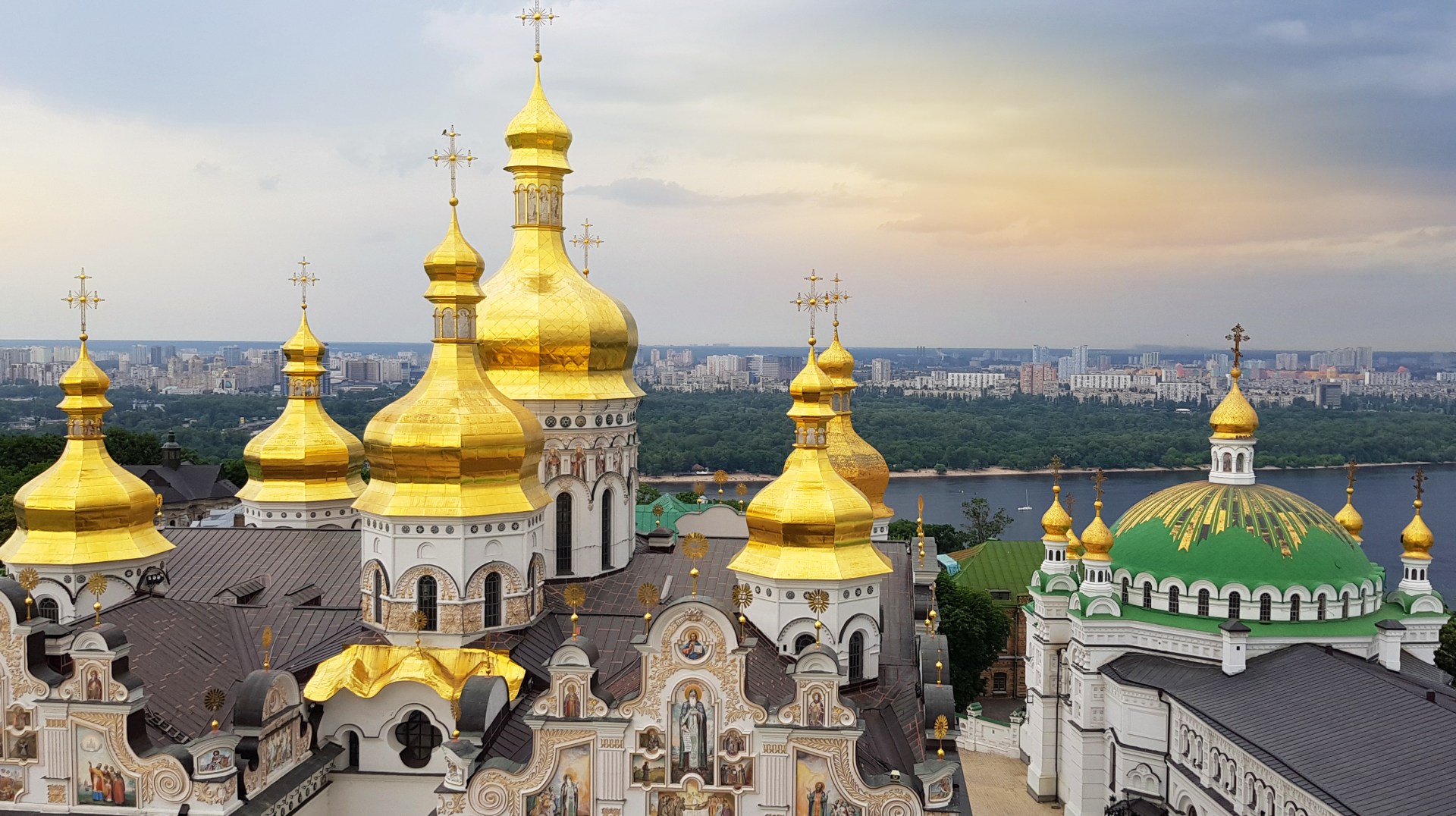
The Pechersk Lavra Orthodox monastery in Kyiv, Ukraine

The Pechersk Lavra Orthodox monastery in Kyiv, Ukraine

Christianity Today October 23, 2023
UNESCO Heritage / iStock / Getty Images

Ukraine’s parliament overwhelmingly passed a preliminary vote last Thursday for a bill that could ban the Ukrainian Orthodox Church, which has close ties to the Russian Orthodox Church, from operating within Ukraine’s borders.

Law 8371 would give Ukrainian authorities power to examine the connection of religious groups in Ukraine to the Russian Federation and to ban those whose leadership is outside of Ukraine. The draft law, approved by a tally of 267–15, with two abstentions, still needs to undergo a second vote, where it may be amended. It would then move to President Volodymyr Zelensky for his approval before it becomes law.

Since the outbreak of full-scale war between Russia and Ukraine, Russian Orthodox priests in Ukraine and around the world have faced accusations of spying and otherwise working to advance Russia’s political interests. Moscow’s Patriarch Kirill, a close ally of the Putin regime, has provided religious justification for the conflict in sermons and public appearances.

“The Russian Orthodox Church’s connection to the Russian Special Services has a very long history,” Oleksandr Kyrylenko, a scholar of religion and Orthodox Christianity in Ukraine, told Religion News Service.

Last month, Bulgaria expelled three of the highest-ranking Russian Orthodox priests in the country. At the same time, the FBI warned Orthodox communities in the US that Russian intelligence services may be using their churches to recruit assets.

Since the 10th century, Russian and Ukrainian Orthodox Christians had been part of one church. The Moscow Patriarchate itself began as the Metropolis of Kiev and all Rus, the people who formed the first Russian nation.

The relationship between the Russian church and Ukrainian Orthodox Christians began to sour almost a decade ago after Russia’s support for separatist insurgents in Ukraine’s eastern Donbas region and Russia’s occupation of Crimea in 2014.

In 2019, the Ecumenical Patriarch of Constantinople, considered “first among equals” in the Orthodox Christian world and a customary mediator among its many patriarchates, granted a “Tomos of Autocephaly” to Orthodox Christians in Ukraine, allowing them to come under the authority of the patriarch of Constantinople rather than Kirill.

The move caused the Russian church to break communion with Constantinople and patriarchates that recognized the ruling. In Ukraine, the Orthodox community also divided, with those who embraced autocephaly and styled themselves as the Orthodox Church of Ukraine (OCU) and those who kept the name Ukrainian Orthodox Church (UOC).

The latter, while not accepting Constantinople’s declaration, says it is independent of the Russian Orthodox Church and has publicly criticized Russia—and Patriarch Kirill’s support of the invasion.

The OCU has formally adopted Ukrainian as its liturgical language, ditching Old Church Slavonic, still used by the Russian Orthodox Church. This summer, the OCU also dropped the Julian calendar and adopted a newly revised one, which, among other changes, moved the date of Christmas from January 7, as it is celebrated in Russia, to December 25.

Thousands of parishes in Ukraine have re-registered themselves as part of the OCU, particularly since the 2022 invasion by Russia.

Since the outbreak of the war, 68 UOC priests have been accused of collaboration, treason, and other offenses, according to the SBU, while this year alone, nearly 20 of the church’s leaders have been stripped of their Ukrainian citizenship.

“We are talking about stopping this influence, about dismantling the structures of the Moscow Patriarchate,” stated Viktor Yelensky, head of the State Ethnopolitics Service, tasked to provide religious expertise in the case. “But in no case is it about people who previously belonged to this church being unable to practice their faith and express their religious feelings in a dignified way.”

In December 2022, Ukraine’s constitutional court approved a law that officially changed the church’s registered name to highlight its affiliation with Russia. Today, it is legally known as The Ukrainian Orthodox Church–Moscow Patriarchate. At the same time, Zelensky signed a bill sanctioning several leading members of the UOC and instructing Ukraine’s parliament and security services to further investigate its ties to Russia.

Isolated criminal cases should not ban the whole church, said Yevhen Shevchenko, one of the few members of parliament to vote against the bill. Russian traitors and collaborators are also in the police, the security service, and even parliament itself, he continued, and by logic these also should be eliminated.

But his own opposition was personal.

“I don’t cheat on my wife, I don’t betray my country,” he stated. “I don’t betray the faith and the church in which I was baptized.”

In a statement released Thursday, the Russia-linked church argued that the draft law violates its religious freedom and constitutional rights. While acknowledging that the legislation does not name the Ukrainian Orthodox Church, the church said that it “prohibits the activities of religious organizations associated with the aggressor state” and “is essentially aimed at banning the Ukrainian Orthodox Church and violates the rights to freedom of religion of Ukrainian citizens who belong to the Ukrainian Orthodox Church.”

But Metropolitan Yevstratiy of Bila Tserkva, a spokesman for the independent Ukrainian church, said there is no evidence to show that the UOC has separated from Moscow. If the UOC is really operating free of Russian influence, he added, the draft law “will have nothing to do with their situation because this draft law imposes restrictions only on those subordinate to Russian religious centers.” In May 2022, the UOC council declared itself independent of Moscow.

In Moscow, Kirill immediately came to the defense of the UOC, noting his “sadness” that “in many countries of the world the children of our church become objects of oppression and even bullying simply because they are bearers of centuries-old Russian culture, which is inseparable from the heritage of Russian statehood,” according to a statement released by the Moscow Patriarchate.

“The so-called abolition of Russian culture, shameless slander, and unpunished destruction of the Ukrainian Orthodox Church are ways to oppose and quarrel [with] those who are related to the single spiritual and cultural heritage created by the peoples of historical Rus.”

The UOC chancellor interpreted the new law in divine terms.

“[This] is not a political matter, as it may seem at first glance,” stated Metropolitan Anthony. “In reality, it is a deliberate struggle against the true Church of Christ, and, in general, a struggle against God.”

The church that retained its ties to Moscow still claims a higher number of total parishes than the OCU, but the number of parishes does not necessarily represent the total number of the faithful, as the count doesn’t differentiate between large urban cathedrals and tiny village chapels. It also claims that many of the re-registrations were made by overzealous police officers without the knowledge of local congregations.

A study conducted last year found that a majority of Ukrainians identified with the OCU while only 4 percent identified with the Russia-linked church, though a larger number identified simply as Orthodox Christians without specifying either church.

Kirill Aleksandrov, an Orthodox journalist, stated that the second and third readings of the law, along with the presidential signature, may experience extended delays while the authorities test public and international opinion. And even if passed, court cases and appeals—even for individual parishes—will face a lengthy litigious process.

Appeals will also likely be made to the Constitutional Court of Ukraine and the European Court of Human Rights.

The danger, he continued, is not the legal but socio-political implications, as the passage of the law may signal endorsement of continued pressure on the UOC. The church itself, he warned, should be careful not to be drawn into a political struggle.

“The path for believers can only be one,” stated Aleksandrov. “Standing firm in faith, refusing to harbor anger and condemnation in their hearts, praying, and placing their trust in God, who said (in Matthew 16:18): I will build my church, and the gates of hell shall not prevail against it.”

Primary reporting by David I. Klein for Religion News Service. Additional reporting by Jayson Casper for CT.

Editor’s note: CT now offers select articles translated into Russian and Ukrainian.

You can also join the 10,000 readers who follow CT on Telegram: @ctmagazine (also available in Russian and Chinese).

Theology

Blessed Are the Thrifty?

Jesus’ teachings challenge how we spend when money is tight.

Illustration by Daniel Forero

In May, Italy’s government called an emergency meeting over the rising prices of pasta. Italians have also been hit in the pocketbook by high natural gas prices, an expense of boiling water for cooking. In 2022, the Italian government recommended reducing how long home cooks boil pasta water as a thrifty “virtuous action.”

This is just one symptom of the recent surge in prices that makes paying for our daily bread difficult. Inflation has hit around the world, and with it have come different pressures on households. In the United States, the average lifestyle costs more than twice as much as it did in 1990. In Ghana, where inflation may be the highest in Africa, food costs twice as much as it did one year ago. Its last annual inflation figure was over 50 percent per year. Moth and rust, of a sort, have destroyed.

But there are other pressures on consumers to be thrifty, including a sense of responsibility to slow our waste. For example, America tosses about 13 million tons of clothing a year. And although there are hungry people, almost a third of the cultivated land in the world grows crops that will benefit neither humans nor animals. After that, about 14 percent of food is discarded before it even reaches a shop.

In view of our consumption and its costs, slack can feel elusive, and extra can seem outrageous. One response to these tensions of wealth, waste, and need always seems to have the stamp of virtue: thrift.

Thrift is a response to tradeoffs—to the choices we often make between having and eating our cake. It means using less, buying less, or spending less in order to redirect resources. Thrift may be a way of managing a small budget or big expenses, such as making money saved on used clothing stretch to cover fresh fruit.

But it may also be a way of avoiding waste, gaining for future financial ease, or preserving resources to last another generation. Thrift may even be about managing an image, projecting admirable qualities in a context where extravagance or new wealth is considered gauche.

Is thrift truly the virtue we often assume it to be?

Thrift has long been associated with a Christian heritage—as part of the Protestant work ethic Max Weber described, vows of poverty in Roman Catholic and Eastern Orthodox religious orders, and one of the most recognizable characteristics of Mennonites and other Anabaptists.

“The Protestant movement was an argument about money,” says Clive Lim, an investor and entrepreneur who has cowritten several books on Christians and money. He points to Protestant outrage at the Roman Catholic Church’s methods of earning and spending income. But he also highlights the prominence thrift had in dissenters’ teachings. To the Reformers and their successors, “no matter how much wealth you have, you have to live simply. Frugality is important.”

That is, Lim says, until the past hundred years, when high consumption became part of our idea of a healthy economy.

It almost goes without saying that it’s good to live within one’s means, and when those means are small or one’s needs are great—a situation many people are in now—thrift is a responsible and godly solution. Practicing it is nevertheless countercultural in the US and many other countries. “I think today we are being challenged on frugality,” Lim says.

If, as Lim points out, the issue of thrift is a spiritual one, then our task is to exercise frugality when we should (and differentiate that frugality from seeking God’s kingdom and righteousness). But some common tendencies frequently stand in our way, especially our dread of being told to live uncomfortably and our impulse to make money the standard of all worth and our sole solution for big problems.

Jesus does not mention thrift in his teachings recorded in the Bible, unless you count his guidance to not throw pearls to swine (Matt. 7:6) or telling his disciples to gather the leftovers of his miraculous provision of food for 5,000 (“Let nothing be wasted,” John 6:12). But Jesus frequently mentions money and how to manage it.

Victor Nakah, Mission to the World’s international director for sub-Saharan Africa, says that much of Jesus’ teaching on money can be summarized as “When you have an obsession with material things or your material needs overwhelm you, you then behave like you’re not part of God’s family.”

Alongside his teachings and parables on money and worry, Jesus lacked a permanent home (Matt. 8:20) and his own money was in a group fund (which Judas stole from, John 12:6). Second-century Greek philosopher Celsus reportedly described Jesus’ “shamefully” modest lifestyle as “disgraceful.”

When Jesus talks about money and possessions, it’s hard to escape the impression that depending on wealth seems to him as silly as putting your hopes in the value of a Beanie Baby collection—and that it’s because of mercy that he comforts rather than mocks those who are concerned about money. But it’s also because of his awareness that they are in danger of worshiping a false (and unreliable and all-consuming) god.

Jesus’ teaching is aimed at shifting people’s hope for rescue from Mammon to God and their orientation from what loses value to what has eternal value. How do we take on Jesus’ perspective of our wealth, position, appearance, entanglements, obligations, and financial priorities? Doesn’t thrift tie our right priorities together?

I have a clear early memory of first learning to ride a bike. When I had finally found enough balance for a few seconds of forward movement, my beloved brother toddled into my path. There was plenty of room for both of us on the sidewalk, but I mowed the little guy down and we both fell onto the lawn, sobbing.

Now I know that the reason I couldn’t avoid him was something called “target fixation,” which means that we aim for what we’re focusing on—no matter how much we consciously try to avoid it.

Jesus keeps telling us to take our eyes off money. And in many places and times—including in the church today—we see people falling into the trap of requiring more and more of it to feel good. But on the flip side, we too often think that the change we must make is from lusting after money to avoiding money. In this way, thrift can also become a target we fixate on, disorienting us and leading us to crash right back into Mammon.

Jesus’ words to his followers showed his disapproval of hoarding money, making wealth the capstone of a life, and believing that money will make us safe. But we sometimes miss another aspect of Jesus’ teachings: the importance of where we focus our attention.

As Christians around the world live through a period of discomfort—or worse—in their household budgets, even thrift can bring them dangerously close to the errors often attributed to greed. Any perspective that filters reality through money distorts our ideas of worth. And isn’t seeing worth as God sees it an enormous part of discipleship?

Thrift can make austerity seem like a virtue for all times. One story of early church ascetics says that a fourth-century monk, Macarius, got a bunch of grapes and sent them to another monk, who sent them to another, and so on. Each craved the grapes, but none ate them. They eventually returned (presumably wrinkly) to Macarius, who still didn’t eat them. The monks had proved their ability to deny themselves.

Such denial can be a response to a belief that possessions are hot potatoes, things to be divested of before they ruin us. Jesus did call at least one person to treat money this way (Matt. 19:16–22). But far from solving an obsession with money and possessions, this form of living on as little as possible can result in miserliness.

Lucinda Kinsinger, a Mennonite and author most recently of Turtle Heart, says, “If you’re focusing on thrift for the sake of being thrifty, you’ll just end up being a tightwad. If our focus is being a good steward, then we’re in a good place.” And if thrift is a way of stockpiling for greater personal wealth in the future, we should question our focus.

Asceticism doesn’t seem to be the primary spiritual danger in North America at the moment. Rather, we seem overeager to keep what we have, whether it’s a little or a lot.

Many evangelicals in the US are familiar with Dave Ramsey’s Financial Peace University, which claims to have trained nearly 10 million people, often in churches. This program and courses like it can coach people in how they spend and save, which is both a real relief and a way to be responsible with resources. But both tithing and saving up while eating “beans and rice. Rice and beans,” as Ramsey puts it, can coexist with service to Mammon. The change in our financial assets must be accompanied by a change in our hearts and our attention.

Nowhere does Jesus emphasize living below one’s means as a way to peace. That’s because peace doesn’t actually come from financially astute money management, even if it includes tithing.

Jesus did tell the rich young ruler, “Go, sell everything you have and give to the poor, and you will have treasure in heaven” (Mark 10:21) and the crowd on the hill, “Sell your possessions and give to the poor” (Luke 12:33). These teachings of Jesus may be among the biggest hang-ups for Christians around the world.

Anabaptist Essentials author Palmer Becker points to the story of the rich young ruler as a summary of Jesus’ teachings on money. This isn’t widely practiced as the Christian standard.

Karen Shaw, author of Wealth and Piety: Middle Eastern Perspectives for Expat Workers, says that in her research on Middle Eastern perceptions of money, the idea of voluntary poverty was mind-boggling to those she interviewed. A very small minority among her Christian interviewees was familiar with modern voluntary poverty among Christians.

In the West, where people are more familiar with the idea, Shaw says, “I’ve been to so many Bible studies where [the rich young ruler] is discussed, and the whole discussion is about why this doesn’t apply to us—how we can get out of it.”

Sometimes we try to outsource the duty to take care of the poor—or to give at all. Nakah is concerned that Christians expect voluntary poverty of pastors and missionaries, rather than of themselves, thinking that those Christians they perceive to be more virtuous can shoulder the burden of living on little.

But, Nakah says, this is a misreading on more than one level. Not only must we all give, but also “there’s no virtue in poverty. Most people struggle because they think the Bible teaches that we ought to be poor.”

Jesus’ words to sell what we have and give to the poor were directed not only at the wealthy. Lim grew up in poverty and crowded conditions and says it was difficult for him not to think of money as a source of security. But as a Christian, he says, “you have to leave the past behind you” and figure out what is enough and what is extra.

Illustration by Daniel Forero

What Jesus commands is “not just downsizing,” says Shane Claiborne, cofounder of Red Letter Christians and a member of The Simple Way, where neighbors try to live in a sharing community as the early Christians did. Claiborne says a truly Christian way of managing resources is more radical than we are often prepared for—more radical than thrift. It is the opposite of envy; it is acting on a desire to provide for others from what we have.

And yet, there is a difference between Jesus’ commands to the rich young ruler and to the crowd—the absence of the command to the group on the hillside to sell all they have.

Lim says, “All Christians, I believe, are called to provide for the poor. We are expected to sell what is precious to us to release us from the hold of possessions and at the same time to do good. The question is how much of our possessions to sell. The rich young ruler in Luke 18 was told to sell everything, but Zacchaeus promised only half [to the poor] and it was enough for Jesus. It was more about what is required to break the hold of money.”

Isn’t the simplest way to avoid financial fixations just to get rid of money and the need to manage it? We could spend it down or pool it with others, letting someone wiser make the decisions. Getting rid of our money will not clear us of our responsibilities, however. Jesus called out those who withheld money from family obligations and claimed it was set aside for God; to him, it was not holier to pledge all one’s wealth to religious causes than to take care of dependents (Mark 7:9–13).

Together, Jesus’ teachings seem to say that our responsibility to manage our wealth remains even as we are also called to give it away. Following Jesus is not just a matter of getting rid of possessions and money—dropping them down a well or melting them down.

Nor is there a specific amount of giving that makes us good Christians. The Bible points us to the truth that it is not the extremeness of an act of service or self-denial that pleases God. “If I give all I possess to the poor … but do not have love, I gain nothing,” 1 Corinthians 13:3 says.

“Our orientation must be framed through love of God and a love of neighbor,” Claiborne says. There is an eagerness in Christian love to “make sure everybody gets to experience the gifts of God.” If we don’t experience a desire to share, Claiborne says, we should question what is really going on in our hearts.

In other words, when we try to obey Jesus’ teachings on money by aiming at a percentage or amount that we can apply to every Christian, we are still aiming at money.

Henry Kaestner, an entrepreneur and the author of Faith Driven Investing, says that, similar to unjustified excess, spending that you don’t feel is spiritually dangerous. He says that, quite often, “your idols are what you can spend money freely on.” And Claiborne warns that we should watch out for defensiveness about what we have or what we spend money on, seeing that as a possible indication of idolatry. So carefulness ought to be part of Christian money management, even while we keep our eyes on Jesus.

But there’s a further misconception—one I think is less about spirituality than about mistaken thinking. It’s the idea that only a certain amount of money exists to spend on all the things in the world.

If that were the case, it would be unchristian and wasteful to spend on anything but emergencies. Like some Christians throughout history, we might believe that charity done right will suck all else dry. Thrift can become the lens we see through. Worship, fun, or anything not strictly necessary looks like waste.

Judas—though insincere—parroted this perspective when Mary of Bethany poured perfume over Jesus’ feet: “Why wasn’t this perfume sold and the money given to the poor? It was worth a year’s wages” (John 12:5).

The first time I read Beowulf, I was struck by one of its last scenes, where Beowulf, a hero who had been praised for bringing his people wealth, was buried with treasure. “Gold in the earth, where ever it lies / useless to men as of yore it was.” I balked, then thought again. What was that gold good for, anyway? It couldn’t have brought antibiotics to the North Sea. Nothing Beowulf’s people could spend would have resulted in children born in safety. Even unimportant delights were impossible then—Beowulf’s money couldn’t have bought puffer jackets, cardamom lattes, or peaches.

But today our money can buy such things and many more. There is more of value on Earth.

This possibility of creating new value means that expensive projects, like building a cathedral, don’t necessarily preclude someone else from getting a fair wage or a vaccination. Wealth is more like sourdough starter than a loaf of bread. Even in non-Christian terms, money just isn’t as limited as we can sometimes think.

Likewise, Jesus didn’t accept Judas’s objection that Mary should have sold her perfume and given the proceeds to the poor.

“Leave her alone,” Jesus replied. “It was intended that she should save this perfume for the day of my burial. You will always have the poor among you, but you will not always have me.” (John 12:7–8)

In other words, her worship (and its prophetic nature) was a worthy cause for pouring out a year’s wages. And her extravagance would not limit anyone’s ability to minister to the poor; the opportunity for that would remain—if Judas’s heart would allow him to give.

It’s not that waste isn’t a concern; it is. Jesus talks about it, too. There is, of course, the prodigal—or wasteful—son. In another parable, a wealthy man punishes one of his managers for not profitably investing money (Matt. 25:14–30).

“Waste is a bad thing. We never want to see a steward be wasteful,” Kaestner says. But the waste is less about whether an investment pays off than about a faithful process for spending money and an understanding of the true worth of what we can pay for.

There is a related danger—of depending on money as an all-purpose solution. If the problem is very simply too little money and you want to, for example, pay your employees higher wages, more money generally works, with a few cautions about tax brackets. But if you want to end homelessness, reduce corruption, or end conflict, there are aspects of these problems that do not respond to an infusion of money—and other aspects that respond to it like fire to oil.

Lim says he certainly found this when he was funding projects meant to help people. “In the beginning, I thought money was the solution,” he says. “I would throw money at it and hope the problem would go away.” But the problems came back. Now, he says, he knows “money isn’t a panacea. It’s narcotics. It doesn’t solve deeper problems. The money allows you to avoid the pain.” He still gives, but now he knows that it takes more creative ideas to really make a difference.

Money should not be the only Christian solution, “the answer for everything,” as the cynic in Ecclesiastes put it (10:19).

It’s necessary and responsible to insist on thrift and a lack of corruption when we give through organizations. But an emphasis on thrift can also make us lose sight of what money is good for. Are overhead costs too low? Are staff being asked to sacrifice what their families need—in terms of their time as well as their income—so that the organization looks good?

Or what if our constraints in giving to the poor diminish how we see God? Shaw, the author and researcher, says, “Because mission and church budgets are often really tight, we might come to think that God is a little bit stingy. We would never say it out loud, but you sometimes get that impression.”

Many of us know the poetry of Jesus’ words on the hillside:

Do not lay up for yourselves treasures on earth, where moth and rust destroy and where thieves break in and steal, but lay up for yourselves treasures in heaven, where neither moth nor rust destroys and where thieves do not break in and steal. For where your treasure is, there your heart will be also. (Matt. 6:19–21, ESV)

For people around the world, literal rust and moths have destroyed what they had saved. Fires have melted and burned it. Politics have invalidated it. Inflation has reduced it. Money isn’t reliable. This lesson is fairly straightforward, especially to those who know it by experience.

Jesus’ second command in this teaching is harder, though. What can storing up “treasures in heaven” mean? He seems to be saying that our literal money can be exchanged for things of value to God himself. What would these things be?

Nakah says, “All that falls under the eternity category has to do with people, with changed lives.”

When asked about this principle of spending on what yields eternal blessings, Susie Rowan, former CEO of Bible Study Fellowship, said, “What immediately comes to mind is the Good Samaritan. He immediately interrupted his life to take care of the man” who was assaulted. And Jesus tells us to “go and do likewise” (Luke 10:37).

Nakah gives a less urgent example of a friend who funded a little girl’s education. Later, the girl became a believer, and the friend realized that what he knew to be important now (her education) had led to her eternal life.

Financial advice often focuses on the tradeoffs between present and future, encouraging people to stockpile and painting a vision of future wealth as the payoff for present thrift. Claiborne says, “That’s one of the consistent things I see in the teachings of Jesus. God rebukes the idea of stockpiling.”

This theology appears in the parable of the rich fool (Luke 12:13–21). Without Jesus’ condemnation, the story seems to be a morally neutral tale about a man using his successful harvest to provide for his future. The surprise for Jesus’ hearers, and for us, is his conclusion: “But God said to him, ‘You fool! This very night your life will be demanded from you. Then who will get what you have prepared for yourself?’ This is how it will be with whoever stores up things for themselves but is not rich toward God.”

Those who encourage thrift now to earn wealth later, Kaestner says, are “talking about compounded interest.” But they’re missing the best way to spend money: by investing in eternal things. That, according to Kaestner, returns “compounded blessings.”

Looking across cultures can be useful in seeing our own blind spots in how we use money, Shaw says.

In comparison to many other places, North America is clearly weak on hospitality. “I’m so grateful for the time I had in the Middle East where [there’s] this extravagant hospitality and this love of giving—it’s just been wonderful to be able to learn from people who reflect God in this way,” Shaw says.

Nakah adds that in his Zimbabwean culture also, people find hospitality and generosity to strangers to be quite natural. “If for some reason you get stuck in a village, you run out of gas—whatever homestead you go to, they will literally treat you like royalty. If there is only one bed, they will let you sleep on that bed. If there is one chicken, they will slaughter it for you.”

Something Nakah says he learned by looking outside his culture is that even quality time falls into the category of a treasure that can be stored up in heaven. “Speaking as an African, there is a lot to learn from Western cultures when it comes to the importance of saving for vacation, for anything that helps create memories,” he says.

Illustration by Daniel Forero

Becker says another example of an eternal investment is a gift from his Anabaptist community to a friend in Ethiopia: a high-quality roof. “To their neighbors, it looks extravagant,” as most of them have thatched roofs that need frequent replacement. Becker sees it as the opposite of hoarding. “Inequality of wealth is one of the biggest problems in our society and in our world. How money is managed is very important.” What may appear extravagant in this case, he says, is both practical and a right use of their difference of resources. It will keep the friend’s family safer from the elements and mosquitoes as well as drain far less of their energy and money over time.

“Extravagance used rightly would be putting the best that you have in places to bring God glory without looking for others to see it,” Kinsinger says. It doesn’t even have to be a practical gift.

All our money management must be shot through with the consciousness of eternity—the worth of people, the value of worship, the disintegrating nature of our money, a confidence in God’s riches, and a participation in his eagerness to see creation flourish.

What can help keep our eyes on Jesus instead of on our resources? Once we have popped our illusions about money’s worth and reliability, and about living austerely, it is easier to consider Christian simplicity. Simplicity is what we really need to navigate the fluctuations in our wealth. And it may look surprisingly like thrift.

Thrift overlaps with simplicity, which is the fulfillment of Jesus’ command to “seek first his kingdom and his righteousness” (Matt. 6:33). Simple people, like thrifty people, may be indifferent to image. They find that enough isn’t always a little further out of reach and can contently live below their means.

This simplicity isn’t the same as being normal or average. “Give me neither poverty nor riches” (Prov. 30:8) is a cry not for a middle-class life but for a life in which money management has a minor role.

Simplicity allows us to see the worth of possessions and activities in light of Christ’s kingdom. It helps us welcome back the joy, beauty, and fun that thrift wants to cut out. But it doesn’t lead to waste or mismanagement. Rather, simplicity helps us understand worth.

Richard Foster wrote that simplicity is really about a singular focus on a “with-God life.” Someone who prioritizes prestige, comfort, and autonomy and also tries to squeeze in an interest in Jesus is not simple. But a biblically simple person could nevertheless be a financial whiz kid or a Proverbs 31 entrepreneur-manager-artisan.

While simplicity certainly marks a person, “we quickly learn that the outward lifestyle of simplicity will be as varied as individuals and the multifaceted circumstances that make up their lives. We must never allow simplicity to deteriorate into another set of soul-killing legalisms,” Foster wrote.

Nakah says simplicity is “a deeper appreciation of what Jesus has given us. You want a lifestyle that is easy to manage, where you’re not worried about your white carpet” and where “you can enjoy things without wanting to own them.”

Rowan agrees, especially since we cannot tell whether people are following Jesus’ teachings on money simply by looking at their tax brackets.

When we think of simplicity as a focus on Jesus, we can see how to balance the needs to not waste, to not find our worth in money, and to be generous and hospitable rather than stingy. What might look like a contradiction to non-Christians—being neither reckless nor tightfisted—can make sense.

One thing that will stand out most in a simple Christian life is radical generosity. It’s a generosity that doesn’t cement our social standing or yield returns in the form of favors or income. It’s a generosity that changes how we live.

When we consider how generous to be, thrift works against the good. But when we plan for generosity, thrift works for the good.

Shaw says that, unfortunately, evangelicals don’t seem to share Jesus’ own emphasis on God’s generosity. In the Gospels, she says, “there’s this wonderful sense of contentment with what God has given and appreciation for God.”

Jesus taught us to be dismissive of the worth of money. He can use any amount and could be as thrifty as feeding 5,000 with five loaves and two fish or as extravagant as accepting a gift of perfume that cost a year’s wages.

When we consider in what ways we can splurge, we should also consider what those items mean, Kinsinger says. Would a Land Rover be a help or a barrier to discipleship? What is the message our kids receive from a mountain of Christmas presents? Is a big wedding worth the cost? The answer might not be the same for each Christian.

One answer is the same. Should Christians ever be extravagant? “Yes, yes, yes, yes!” Shaw says. “How else can we be like the Father?”

So what remains seems to be in tension: We must take responsibility for ourselves and others with our wealth, yet we must not depend on wealth. We must not waste, but we also must not be obsessed with bookkeeping. We must share our wealth, especially with the poor, but we must know when to pour out a shocking amount in a gesture of worship or celebration. We must use money for eternal ends, but we must not take on Mammon’s pressures. We must develop wisdom about worth apart from what markets or culture dictate.

We’ll find both our balance and our direction by focusing on Jesus. In him we’ll see someone of infinite worth and infinite resources who is generous beyond our imaginations.

Susan Mettes is an associate editor for Christianity Today.

addApple PodcastsDown ArrowDown ArrowDown Arrowarrow_left_altLeft ArrowLeft ArrowRight ArrowRight ArrowRight Arrowarrow_up_altUp ArrowUp ArrowAvailable at Amazoncaret-downCloseCloseellipseEmailEmailExpandExpandExternalExternalFacebookfacebook-squarefolderGiftGiftGooglegoogleGoogle KeephamburgerInstagraminstagram-squareLinkLinklinkedin-squareListenListenListenChristianity TodayCT Creative Studio Logologo_orgMegaphoneMenuMenupausePinterestPlayPlayPocketPodcastprintremoveRSSRSSSaveSavesaveSearchSearchsearchSpotifyStitcherTelegramTable of ContentsTable of Contentstwitter-squareWhatsAppXYouTubeYouTube