Theology

A Leader of India’s ‘Untouchables’ Considered Christianity and Found It Wanting

Why B.R. Ambedkar, a Dalit himself, ultimately embraced Buddhism as the faith best for him and his community.

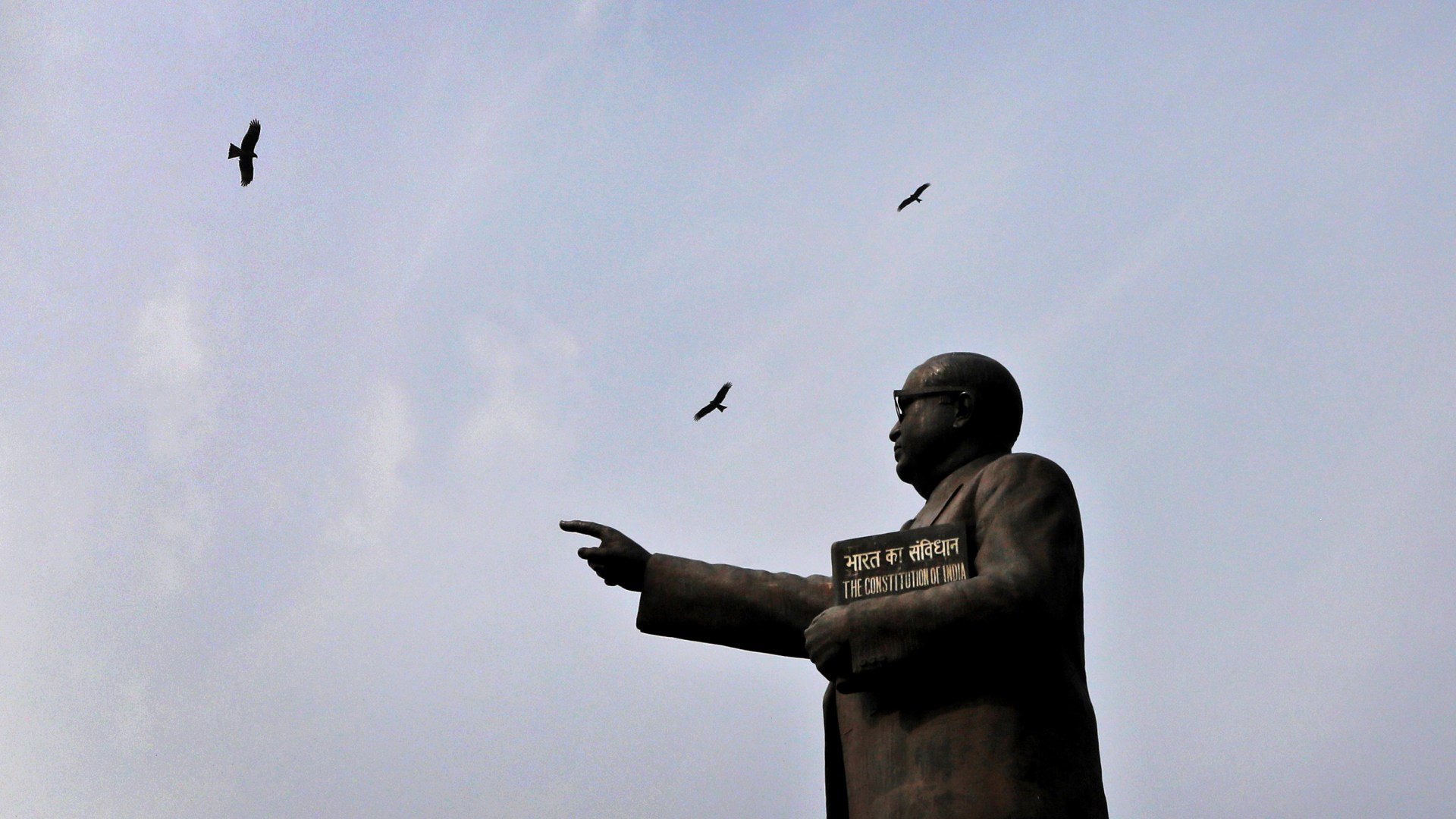
Birds fly over a statue of B.R. Ambedkar, who is regarded as the architect of India's constitution.

Birds fly over a statue of B.R. Ambedkar, who is regarded as the architect of India's constitution.

Christianity Today November 9, 2023
Manish Swarup / AP Images

Last month marked the 67th anniversary of India’s most famous Dalit’s conversion to Buddhism.

“Though I was born a Hindu untouchable, I shall not die as a Hindu,” wrote Bhimrao Ramji Ambedkar, who devoted his life to abolishing the caste system and who embraced his new faith just two months before his death in 1956.

The Dalit community cherished the activist and politician so much that half a million of his followers followed him to Buddhism. But Ambedkar was not always certain he would leave Hinduism for this other Eastern faith and he spent years engaging with the Bible and Christian leaders. A friend who served as a Methodist bishop later said that Ambedkar had twice asked to be baptized, and when in Delhi, he attended an Anglican church and was friends with its vicar.

“I have had a great impact on my mind of two great personalities, Buddha and Christ,” he said at a Christian gathering in 1938. “I want a religion which could teach us to practice equality, fraternity, and liberty.” But though he admired Jesus, Ambedkar was disappointed by the blind spots church leaders appeared to have toward his community and ultimately found numerous tenants of Buddhism that spoke to the Dalit condition.

Today, while many Dalits have rejected Hinduism for Christianity, millions more have converted to Buddhism. On April 14 of this year, 50,000 Dalits and individuals belonging to tribal communities participated in a Buddhist mass conversion ceremony on Ambedkar’s 132nd birthday.

Christians seeking to reach those in this community today would do well to remember Ambedkar’s praise of Buddhism—and his critiques of the church. Many of these feel sadly still true today.

Why Buddhism?

Born in 564 B.C., Buddha spent a significant portion of his life in India combatting chaturvarna, an ideology that would eventually evolve into the caste system. He staunchly opposed the rigid hierarchical social structure that classified individuals based on birth, challenging the notion that one’s status should be predetermined by factors such as caste, or varna.

A central theme in Buddhist teachings is the belief in the equality and inherent worth of all individuals, regardless of their social background. Because of this, Ambedkar saw Buddhism as a tool to challenge the caste system and attain social equality, which resonated deeply with the Dalit community.

Ambedkar spent considerable time comparing Buddha with Jesus, Mohammed, and Krishna, noting many of his observations in his essay, “Buddha and the Future of His Religion,” which he wrote in 1950, six years before his conversion. He noted Buddhism’s unique elements, such as:

  • The core of Buddhist faith lies in morality rather than a deity, distinguishing it from other religions where God holds that role.
  • Jesus asserted his divine identity as the Son of God and emphasized the need to recognize him as such for entry into God’s kingdom; Mohammed taught that salvation required accepting him as the final messenger of God; and Krishna declared himself as Parameshwara, the God of Gods. But Buddha was a regular man, who chose to live and preach as an ordinary individual.
  • Buddha’s religion was rooted in reason and experience. He urged followers not to blindly accept his teachings. He allowed for modification or abandonment of his teachings if they no longer applied.

Ambedkar’s overall case for Buddhism rested on his deeper conclusions about religion: society needed morality to function; religion needed to be in accord with science and also needed to recognize “the fundamental tenets of liberty, equality and fraternity,” and it could not “sanctify or ennoble poverty.”

“So far as I know, the only religion which satisfies all these tests is Buddhism,” he wrote.

[Buddha] taught as part of his religion, social freedom, intellectual freedom, economic freedom and political freedom. He taught equality, equality not between man and man only, but between man and woman. It would be difficult to find a religious teacher to compare with Buddha, whose teachings embrace so many aspects of the social life of people, whose doctrines are so modern and with main concern to give salvation to man in his life on earth and not to promise it in heaven after he is dead!

Today embracing Buddhism has allowed Dalits to reject the oppressive hierarchical structure of the caste system that has marginalized them in society, while simultaneously staying connected to their historical and cultural roots, since Buddhism began in India. (Though Christianity arrived in the first century, the religion is not indigenous to India.) Further, though the faith did not have a historically robust political presence, Ambedkar’s influence led to the rise of a neo-Buddhism movement that helped further fight for Dalit rights and representation.

Why not Christianity?

During his struggles against caste and untouchability, Ambedkar at one point considered encouraging Dalits to convert to Christianity. In order to defend themselves from the Hindu community, “Dalits had to think in terms of supplementing their strength from the outside,” wrote Anand Teltumbde, in Strategy of Conversion to Buddhism: Intent and Aftermath. “This strength could come only through merging with some other religious community, by converting to its religion.”

However, Ambedkar ultimately rejected this idea, recognizing that even within India, Christianity was not exempt from caste divisions. He likely understood that Dalits converting to Christianity wouldn’t alter their social standing; they would still be viewed as untouchables, not just by Hindus but also by those of higher castes.

Further, Ambedkar himself had faced discrimination from Christians during challenging times. After studying in the West, Ambedkar returned to India in 1918 and moved to Baroda (Vadodara) in Gujarat. He immediately ran into housing troubles; all the hotels had Hindu owners who did not allow untouchables. After he was forced to leave a hotel specifically for Zoroastrians, he asked a Christian friend to accommodate him in his house. The friend said that he would have to ask his wife.

“He and his wife came originally from a family which was Brahmin by caste and although on conversion to Christianity the husband had become liberal in thought, the wife had remained orthodox in her ways and would not have consented to harbour an untouchable in her house,” he later wrote.

Echoing Ambedkar’s experience, another prominent Dalit leader, the former speaker of the Indian Parliament’s lower house, was denied housing by an Indian Christian in London due to her Dalit identity.

These actions challenged Ambedkar, an avid student of the Bible who had a vast collection of biblical literature. In a 1938 speech, he had sharp words for missionaries and the Christian community in general, calling for Christians to go beyond religious conversion to address the broader issues faced by the Dalit community.

“Missionaries feel they have done their duty when they convert an untouchable to Christianity,” he said. “They do not look after their political rights.”

“The Christian missionary has never thought that it was their duty to act and get the injustice that pursues the untouchable, even after his conversion to the Christianity, removed. That missions should be so inactive in the matter of the social emancipation of the untouchable is of course a very sad thing. But far more painful is the inaction of the untouchable who became a convert to Christianity. It is the saddest thing. He continues to suffer from the Hindus the same disabilities which were his lot before conversion,” wrote Ambedkar, as quoted in volume 5 of his Speeches and Writings.

In Ambedkar’s view, the division between the secular and sacred within the Indian Christian community had largely kept them away from actively participating in Indian politics. Ambedkar urged Christians to actively engage in democracy and encouraged them to participate in politics and in government service.

Ambedkar highlighted the historical absence of Christians in Indian politics and emphasized the vital role of political support for the church’s institutional survival, noting that despite being labeled as ignorant, many untouchables had actively engaged in politics, holding 15 seats in the Legislative Assembly (at the time of his writing his speech), and benefiting from affirmative action scholarships and government hostels, which housed students who were poor, Dalit, or from a tribal background.

But at the same time that Dalits began to politically represent themselves and assert their rights, Christians failed to organize politically and had virtually no representation among the judiciary, wrote Ambedkar. In the absence of this power, they had no means of rectifying the injustices experienced by Christian untouchables.

Ambedkar placed much of this blame on the shoulders of educated (and higher caste) Christians, who he deemed responsible for building solidarity and for leading a political movement on behalf of Dalit Christians.

Ambedkar also questioned why Indian Christians had become inconspicuous in their own nation, despite the fact that they were overrepresented as educators and the educated. One of his theories concerned Christian Dalit and tribals’ dependence on foreign missionaries for economic sustenance. If they depended on the government, they would need to mobilize, agitate, educate, and organize their masses for effective political action. Without such organization, governments would not address their needs, leaving them marginalized in public life due to their lack of engagement in current affairs.

What Christianity does offer

For most Dalits, their fundamental existential question is the identity placed on them by the caste system. The historic Indian church and Western missionaries emphasis on Christianity’s salvation image and forgiveness from personal sin have often felt peripheral or like secondary concerns. For Dalits, too often, Christianity doesn’t present a trip to the Promised Land, or of liberation from physical suffering, but to a wonderful afterlife, that is Swarga or Indraloka (heaven).

Though Christians in India may not have been clear to Dalits about where God’s heart stood toward their condition, the Bible itself is clear. As the first chapter of the first book of the Bible states, “So God created mankind in his own image, in the image of God he created them; male and female he created them” (Gen. 1:27).

While Christianity can indeed offer Dalits the answer to their deepest questions about who they are, the church would do well to reflect on Ambedkar’s words. Even after all these decades, his prophetic voice continues to echo, urging the Indian Christian community to address broader issues and systemic problems. To this day, Dalit Christians have still not been able to secure their constitutional rights to affirmative actions, and the caste system is unfortunately pervasive in sections of the Indian Christian community.

In the light of this reality, the call for justice and a pursuit of the values of the kingdom of God become paramount. The church of Christ in India must continue to pursue the values of the kingdom of God and strive for justice for Dalits in India, especially Dalit Christians, and strive for a society where constitutional rights are upheld and the ubiquitous caste system is dismantled.

Ram Surat, a doctorate, has spent 27 years sharing the vision and mission of Bhimrao Ramji Ambedkar and fellow Indian anti-caste social reformer Jyotirao Govindrao Phule. Currently based in Bihar, India, he champions the cause of caste reconciliation among the Dalit and OBC communities in North India.

Surinder Kaur is Christianity Today’s South Asia correspondent.

News

Kids’ Access to Porn Is a Problem. Are State Laws the Solution?

As some Christian advocates fight for age verification, others say it’s parents’ responsibility to monitor.

Christianity Today November 9, 2023
Edits by CT / Source Image: Getty Images

When parents ask Chris McKenna at what age they should give their kid a smartphone, he has a stock answer: “the age you want them to see porn.”

The former youth pastor started Protect Young Eyes, a nonprofit that teaches tech safety to schools, businesses, churches, and parents, in 2015 after he became concerned about the dissolving barriers between pornography and young people.

“I was watching for the first time in human history as we were putting the internet in the pockets of kids,” he said, “and that terrified me.”

In the years since, the average age at which kids are first exposed to pornography has trended younger. Researchers estimated in 2021 it was somewhere around 11.

As data continues to show the harms of viewing porn, particularly for children, support for stricter legal limits on pornographers has grown. McKenna’s job description as head of Protect Young Eyes has grown too—it now includes political advocacy.

In 2019, McKenna testified before the US Senate Judiciary Committee, recommending lawmakers hold tech companies responsible for making safety filters and parental controls on their devices easier to use.

This year, McKenna consulted with lawmakers and testified before legislators in several states in support of new age-verification laws, which require porn websites to verify their users are 18 or older. Seven states—Texas, Louisiana, Utah, Mississippi, North Carolina, Arkansas, and Virginia—passed age-verification laws this year.

In Texas, McKenna helped lawmakers draft what became House Bill 1181, which Gov. Greg Abbott signed into law over the summer. The measure was immediately challenged on First Amendment grounds, and a district court judge struck it down, citing free speech and privacy concerns. The office of Texas Attorney General Ken Paxton is appealing his decision.

Paxton’s wife, Texas state senator Angela Paxton, was the original sponsor of HB 1181. The Paxtons are members at Prestonwood Baptist Church, a megachurch in Plano. A Prestonwood pastor, Mike Buster, worked with Paxton and Chris McKenna on drafting and advocating for the bill at the Texas statehouse.

The mechanics of each age-verification law differ across states. In Louisiana, porn websites automatically redirect visitors to a state-run website where they must upload their ID information. Most other states require the porn websites themselves to collect and verify users’ ID information.

But there’s no doubt the laws have curbed access to online pornography, whether directly or indirectly.

Pornhub, the nation’s largest pornographer, now blocks access to their site from users in at least four states—Utah, Arkansas, Virginia, and Mississippi—in an effort to evade requirements to collect user ID data. Four months after Louisiana’s law went into effect last January, a Pornhub spokesperson told CNN visits to their site from Louisiana IP addresses had decreased by 80 percent.

Christian ministries like Focus on the Family and Covenant Eyes have advocated for stricter obscenity limits in entertainment and in law for decades, often without any secular support. The National Center on Sexual Exploitation, a nonsectarian organization with Christian roots as the formerly known Morality in Media, has also spoken up in favor of regulations.

Sometimes caricatured as prudes or scolds, Christian anti-porn advocates grounded their advocacy in the biblical teaching that sex is sacred and that every human person, and their bodies, should be treated with respect and dignity. (Responses to new House Speaker Mike Johnson’s use of Covenant Eyes highlight the gap between how evangelicals and secular culture approaches porn use.)

But McKenna and other anti-porn Christian advocates argue that creating or viewing porn isn’t just sinful for Christians. They believe, like all other sins, it’s destructive for everyone.

Research continues to bear that out, which has moved the anti-porn position closer to the mainstream. So far, 17 states have passed resolutions naming porn a “public health crisis.”

Still, McKenna hopes more Christians will engage the issue. “I believe that church leaders should be showing up in flocks to support legislation that works toward creating safer digital spaces for children,” he said. “Families need more help.”

Some Christians and conservatives, however, don’t support a legislative approach. The provocatively named XXXChurch, a ministry that helps people struggling with porn addiction, says on its website that “blaming the porn industry for our problems or relying on legislation to protect us doesn’t work.”

Others are concerned that age-verification laws are an invasion of privacy or that the responsibility to protect kids from pornography rests with their parents, not the government.

Steve Demetriou is the parent of two young sons with a new baby on the way. He’s also a state representative in Ohio, where he recently introduced an age-verification bill. Demetriou is a member of the Greek Orthodox Church and said his faith, as well as prompting from a Catholic legislative aide, motivated him to introduce the bill.

“It’s already illegal in Ohio to distribute pornography to children,” Demetriou said. “We’re just bringing this into the digital age and creating common-sense barriers online.”

Demetriou says he’s sensitive to First Amendment concerns about the Ohio bill, which includes criminal penalties for using AI-manipulated images of a real person in pornographic videos without the person’s knowledge or consent. He said he plans to ask Ohio’s Casino Control Commission how they verify the age of their customers without violating free speech or privacy laws.

“We need to make it as difficult for kids … to watch porn online as it is to place underage sports bets or buying cigarettes,” Demetriou said.

Danny Huerta is a licensed professional counselor and the vice president of parenting and youth at Focus on the Family, where he oversees Plugged In, the conservative organization’s media reviews and ratings publication. He said age-verification laws are a “good start” in the effort to protect kids from online porn.

“I do think it could help some,” Huerta said. “It’s still not a substitute for parents to put filtering … and to be very intentional in their conversations with kids.”

Huerta, who has also counseled families in his private practice for 20 years, said he’s seen an alarming increase in the past decade in the number of kids watching pornography, as well as a troubling increase in the degree of deviancy in porn, including sexual violence, sexual activity with animals, and even sexual attraction to blood.

Huerta often recommends parents install porn-blocking software on their kids’ devices, even though it may slow the system’s processing. Products such as Net Nanny, OpenDNS’s FamilyShield, BrowseControl, and Net Angel offer to block certain websites identified as containing “adult content.” Huerta is particularly hopeful about Canopy, a filtering software that uses AI to learn in real time whether an image is pornographic and can instantly block it.

Still, Huerta said filters and even age-verification laws won’t fix everything. “Let’s say there’s an 18-year-old brother or 19-year-old who is accessing [porn]. Kids can still accidentally run into that,” he said.

That’s why Huerta is primarily focused on helping parents disciple their kids toward choosing to look away from pornographic images on their own. To that end, Focus on the Family has created a “phone contract” template that parents and kids can fill out together as they negotiate tech limits and consequences.

McKenna at Protect Young Eyes said the responsibility to protect kids from pornography can’t and shouldn’t rest solely on parents. He worries particularly about kids whose parents don’t have the time, knowledge, or motivation to guard their children’s tech use.

Instead, McKenna believes tech companies should be accountable to make their devices as safe as possible for kids. In Texas, he helped draft companion legislation to the age-verification law that would have set requirements for stricter default settings and simpler parental controls on device creators like Apple and Google.

“It currently takes over 30 steps to properly set up parental controls on an iPhone,” McKenna told federal lawmakers in 2019. He urged Texas lawmakers to force device manufacturers to simplify that process and make the default settings on any device that may be used by children the strictest possible. That could include blocking access to the internet or certain apps during school hours or overnight.

Texas lawmakers “ran out of time” to pass that bill, McKenna said, but he believes focusing policy efforts at the “device level” is the best way forward.

“We’ve created patterns of living and learning that require children to be online,” McKenna said. “Every single device knows when a child is using it. … Shouldn’t the default of that device be its safest possible version? Isn’t that how we treat everything else that kids use—cribs, car seats, bicycles, playgrounds?”

Some advocates say they favor the device-filtering laws since age-verification laws risk being overturned on constitutional grounds like in Texas.

Nevertheless, McKenna at Protect Young Eyes is hopeful Texas’s age-verification law will survive judicial scrutiny and prove ultimately worthwhile—and that other states will consider similar measures.

“It has to work at some level,” he said.

Theology

The Eternal King Arrives

Journeying through Advent with our humble and mighty Savior

Phil Schorr

Welcome to the season of Advent. It’s a special time in the Christian calendar—one that we all want to take heed of, with its deep and lasting significance, even in the midst of the season’s sometimes overwhelming demands. As you and your family approach a time of full calendars and bustling kitchens, candlelit services and living rooms strewn with wrapping paper, we invite you to journey through the season with this Advent devotional.

This devotional is meant to help you dive deep into theological truths and personal revelations as we prepare to celebrate the arrival of our humble and glorious King. We have structured the devotional to help us ponder the glory and tenderness of Christ, who came in the form of a vulnerable baby and displayed a gentle love for his creation through his incarnation. Throughout the month of December, we will herald both the sovereignty and power of his kingship and his self-emptying lovingkindness.

First, we will immerse ourselves in the prophetic inauguration of Christ, with devotionals that speak to the hopeful yearnings of Israel for the promised King—and the signs that would accompany his revival—woven throughout the Old Testament. Next, we will celebrate the eternal jubilee that Jesus’ incarnation heralds: a time of freedom, joy, and new life that he now offers. Finally, we will draw near to Christmas Day by gazing in awe at Christ’s royal enthronement and the establishment of his kingdom. He is our long-awaited Savior, and this Advent we celebrate the life-changing truth that our eternal King has arrived.

This article is part of The Eternal King Arrives, a 4-week devotional to help individuals, small groups, and families journey through the 2023 Advent season . Learn more about this special issue that can be used Advent, or any time of year at http://orderct.com/advent.

Church Life

I Started Attending Diwali Parties to Break Out of My Christian Bubble

I was raised in a vibrant Indian community. How I’m trying to build relationships with Hindu friends in America.

Christianity Today November 9, 2023
Illustration by Abigail Erickson / Source Images: Getty, Unsplash

“We have turned into the kind of Indians we have always hated.”

I cringed. I couldn’t believe my husband would say something like this—at least out loud. But inside, I agreed.

Though we are both ethnically Indian, I grew up in the Middle East among other Indian immigrants, while my husband was born and raised in India in a town where his family has lived for generations.

We’ve both been living in the United States for nearly two decades now. And while we both wanted to retain ties to our Indian community in the US, over the years, we’ve struggled to keep the connection.

Part of the reason was because we wanted to strengthen our Christian connections. We became increasingly involved in our (predominantly white) church, and our family found it comfortable to stay in our “holy huddle” even if that meant becoming more and more Americanized. But even as we judged others who had forsaken their Indian traditions, we worried we were doing the same.

Something has changed in recent years, though. I have felt God prompting me to cultivate closer relationships with my Hindu Indian friends. I still receive invitations to Diwali and Holi celebrations, and lately I’ve begun to accept these offers.

I’m not interested in worshiping their deities or adopting a syncretistic faith. Rather, I now see that my Indian heritage is a gift that allows me to build relationships with people who share my culture, who intuitively feel comfortable with me. Sometimes that leads to opportunities for me to thoughtfully share about my relationship with God.

After years of trying to find a Christian community in America, I realize I’m now called to lean into the process that the apostle Paul described as “being all things to all people” for “the sake of the gospel” (1 Cor. 19:22–23).

I grew up in a religiously diverse community in Oman, where my family and I lived in an Indian immigrant enclave. Thousands of miles from our loved ones, we attended each other’s birthday parties, watched movies together, and ate dinner with one another.

Whether Christian, Hindu, or Muslim, we didn’t live as isolated nuclear families; rather, mothers and fathers parented every child as their own, and I knew each adult as my uncle or aunt. We learned our mother tongues and retained our traditions easily. I had a ringside seat to the celebration of many Hindu festivals and felt that casually observing religious holidays didn’t compromise my Christian faith.

After moving to the US, our Hindu friends always remembered us and invited us to celebrate. They kept asking us to join them. But our schedules filled up, often with church events, and we found ourselves declining most invitations.

While these rejections were primarily due to family logistics, in speaking with Indian church leaders, I noticed deeper theological concerns. Christians attending Diwali or Holi events risk “making the gospel softer,” Nitin Christopher, senior pastor at Church of the Way in Plano, Texas, warned me.

Though American culture may see these holidays as more broadly “Indian,” pastors of Indian immigrant congregations I spoke to in Texas, where I live, said they don’t see these holidays as ideal outreach times because of their Hindu origin.

In some ways, the fact that I grew up (casually) celebrating these holidays makes me more of what I would call a “normal” Indian. Most Indian Christians do not observe the festivals with the intent of a puja (act of worship).

Many of us would have a day off from school for Diwali or Eid, and we loved it when our friends came with sweets prepared specially for the day, and even small gifts or trinkets. We lit sparklers and firecrackers for Diwali, and everyone loved playing with the colored powder for Holi. It did not seem sinful to be happy for our friends on their special festival days.

When I moved to the US, I wanted my family to belong. But belonging in America looked different from the kind I had experienced growing up.

It often meant pretending to understand what TV shows or singers everyone was discussing. American friends and acquaintances misunderstood my Indian slang, and I determined to never use those phrases out of the house again. I felt exhausted from my self-consciousness about my “conspicuous” attire, with its bright colors and ethnic jewelry. I decided to attend church events in Western clothes to fit in.

But what if there was a place where these parts of my culture—which I had learned to reject—might not only be accepted but also help me lean into what I believe is God’s call in my life: to be a bridge builder?

Since I’ve begun actively reaching out to my Hindu friends again, I’ve started to reflect on Paul’s words in 1 Corinthians 9:19–23:

Though I am free and belong to no one, I have made myself a slave to everyone, to win as many as possible. To the Jews I became like a Jew, to win the Jews. To those under the law I became like one under the law (though I myself am not under the law), so as to win those under the law. To those not having the law I became like one not having the law (though I am not free from God’s law but am under Christ’s law), so as to win those not having the law. To the weak I became weak, to win the weak. I have become all things to all people so that by all possible means I might save some. I do all this for the sake of the gospel, that I may share in its blessings.

Paul also tells us in Galatians 3:28, “There is neither Jew nor Greek, slave nor free, nor is there male and female, for you are all one in Christ Jesus.”

This verse “does not mean the dissolution of all identities under one; instead, it can be shown through other passages in Paul that he expects his pagan listeners to accept a new identity as Christians, but at the same time not to discard or deny previous identities,” writes Felix K. Maier, who studies cross-cultural interactions in the Roman Empire.

Paul embraced various identities and spaces, viewing them as tools provided by God for spreading the gospel. Despite his role as an apostle to the Gentiles, he cherished his Jewish heritage and maintained ties with his kin. His Roman citizenship endowed him with rights and credibility. He respected the cultures he encountered and used this knowledge to connect with people effectively.

Further, Paul’s upbringing in the multicultural city of Tarsus shaped his complex character. His ministry primarily focused on Gentiles, forming diverse churches with leaders from various backgrounds. He fostered relationships with individuals across societal hierarchies, from slaves to their masters, exemplified in his correspondence with Philemon and Onesimus.

As I studied Paul’s example, I asked myself what it would mean for me to lean into my eclectic identities and begin using them to build relationships. Could I once again get comfortable in Hindu spaces? I hardly felt like I could invite my Hindu friends to church events or functions if I was unwilling to meet them at gatherings they were organizing.

Despite my convictions and my shared heritage, truthfully, I felt awkward the first time I accepted my Hindu friends’ invitation to a Diwali celebration.

I had become used to a very Western form of Christianity and Western hospitality expectations. Even dressing up in Indian clothing felt unfamiliar, let alone dealing with Indian culture, which includes tables filled with sweets and delicacies, children running around, silks, sarees, jewelry, the scent of flowers, agarbatti (incense sticks), and people stepping in to help the hostess and make themselves at home. Things are not always super scheduled at Indian events—not that we don’t ever plan things—and time often flows freely.

I wondered if I had forgotten how to behave around people who were Indian, as even the Indian Christians I knew had adopted Western habits. And yet, on the other hand, I knew the rituals and inside jokes—and that affirmed my presence.

Over time, our shared culture has allowed me to build trust more quickly, to engage my friends in spiritual conversations, and to discuss God with them. Sometimes I even end up pushing them slightly out of their comfort zones by asking how I might pray for them.

As an Indian, I see myself as a counterexample to my Hindu (and Muslim) friends, who might worry that becoming a Christian might cost them their heritage. (Christianity, I often point out, has been in India since St. Thomas shared the gospel here in the first century.) And regardless of where Christians might fall on this holiday discussion, Indian Christians, like other Christians who are part of a specific subculture, have a unique responsibility and role in reaching the people with whom we share a heritage.

Today, part of being a Christian in the Hindu community means being an ambassador for Christianity.

Growing Hindu religious extremism has increased violence against Christians and other religious minorities in India. An unfortunate number of Indian Americans and immigrants to America have continued to cheer Modi and his regime on. Among other reasons, the intense persecution of many Christians in India underscores the criticality of the American Hindu community’s relationship with Indian Christians.

Having wrestled with these feelings for years, I have concluded that Christ has not called me to discard or deny the identity I was born into—or the one I’ve put on since coming to America. Instead, I believe Christ seeks to reconcile my different parts into a cohesive bridge that connects non-Christians in my world to him.

Perhaps my husband’s statement—that we’d become exactly the kind of Indians we didn’t want to be—is one we both needed to think about and contemplate. Maybe it wasn’t about hating the kind of immigrants we had become, but about the wake-up call we needed to hear to become the immigrants God intended us to be.

Sherene Joseph is a third-culture kid born in India, raised in the Sultanate of Oman, and now living in the United States. She is currently working on the SICNA21 (Study of Indian Christians in North America 2021) project, including recording an oral history of the community and studying the prospects and challenges facing the diaspora.

Church Life

Pray for the Persecuted Church. But First Learn About It.

Amid rising persecution to Christians in the world, here are some stories that can guide your intercessions.

Schoolchildren participate in a peace rally against ethnic clashes in Manipur state.

Schoolchildren participate in a peace rally against ethnic clashes in Manipur state.

Christianity Today November 8, 2023
Bikas Das / AP Images

Christians around the world are praying for their 360 million brothers and sisters in Christ who live in countries with high levels of persecution and discrimination, as part of the International Days of Prayer for the Persecuted Church, which fall on Sundays November 5 and 12.

One in 7 Christians worldwide—including 1 in 5 believers in Africa, 2 in 5 in Asia, and 1 in 15 in Latin America—suffer greatly for their faith, according to the 2023 World Watch List (WWL). That’s up from 260 million in the 2020 report.

https://datawrapper.dwcdn.net/zZvb1

Among believers who live under threat of violence, in Latin America, Colombian Christians are most at risk, followed by Mexican. In Asia, Pakistan ranks first, closely followed by India and Myanmar, while Nigeria ranks first in Africa and worldwide.

https://datawrapper.dwcdn.net/dCNp8

The hardship affecting the greatest number of Christians is displacement, with 124,310 Christians forced to leave their homes or go into hiding for faith-related reasons, in addition to 14,997 Christians who were forced to leave their countries.

While persecution is on the rise, however, the number of Christians coming to the United States from countries on WWL resettled as refugees dropped from 32,248 in 2016 to 9,528 in 2022—a decline of 70 percent.

In 2021, President Biden set the refugee ceiling at 15,000 before raising it to 62,500 after faith groups protested. This past year, the ceiling was set at 125,000—however, the US resettled only about 60,000 refugees in fiscal year 2023.

https://datawrapper.dwcdn.net/AjZLY

CT seeks to report the news affecting the global church, so that as the body of Christ cries out in pain, Christians can cry out to the Lord on their behalf. Believers can extend their prayers for non-Christians who may be part of the same targeted minority groups as Christians. Believers also may pray for the persecutors, as Jesus himself instructs (Matt. 5:43–48).

Here are 10 stories about the persecuted church that CT hopes readers can use to guide their prayers this year.

Theology

Meet the Zoomers’ Martin Luther

He plays Minecraft and talks church history on YouTube—and he’s organizing a new mainline reformation.

Christianity Today November 8, 2023
Illustration by CT / Source Images: Getty Images

It’s October 31 in Denver. Snow is falling. A cutting wind makes the air feel much colder than it is. But nothing will stop Jake Boston, a Gen Z Episcopalian, from celebrating the holiday.

No, not Halloween—Reformation Day, when Protestants remember Martin Luther’s courageous choice to post his 95 Theses critiquing the Catholic church and launching the Reformation. Jake is reenacting that old story by tramping through the Colorado snow from mainline church to mainline church—60 in total—to post his own theses on their doors.

The lists, tailored to the seven American mainline denominations, critique their drift from orthodoxy into theological liberalism, challenging them to reaffirm the Resurrection, the divinity of Jesus, the authority of the Bible, and much more besides.

And Jake was not alone. A group of 1,000 Gen Z mainliners committed to their historic denominations—part of a grassroots group called Operation Reconquista—were working across the country to do the exact same thing. By the end of Reformation Day, they claim, they’d mailed, emailed, or physically posted their 95 theses to every mainline church in the United States, all without funding or a full-time organizer.

When I first heard about this operation, I admit I was both intrigued and worried. On the one hand, the past year has seen a surprising number of Gen Z–led spiritual renewals, most famously the Asbury revival. Maybe this was a similarly hopeful development?

On the other hand, their branding use of sordid military history was reminiscent of the “manosphere,” a highly online movement capturing the imagination of many young conservative men. (“Reconquista” is a nod to the Christian reconquest of the Iberian peninsula from Muslim kingdoms, whom Christian Europeans commonly called Moors, and the group’s website uses martial language and imagery.) Like many manosphere influencers, Reconquista first got traction online, largely through a YouTube channel run by a young man who goes by the digital pseudonym Redeemed Zoomer, as well as a Discord server.

Redeemed Zoomer creates lo-fi explainer videos—with Comic Sans font and what he describes as “derpy” graphics—about Christian theology and denominations, some of which have racked up millions of views. When he’s not explaining history or ideas, he’s talking about mainline institutional renewal as he creates cathedral-centered cities in the world-building video game Minecraft.

Despite these superficial similarities between Reconquista and the manosphere, the substance is radically different. Redeemed Zoomer and his fellow activists aren’t interested in “going their own way,” accelerationist politics, or “trad LARPers”—as Zoomer put it in an interview on my podcast—who spend more time burning institutions down than rebuilding them.

Their interest is institutional renewal in the mainline church, and their method—as detailed in a video explaining their Reformation Day activism—is calling young, theologically conservative Christians to reform and revive the denominations that their Christian forebears sweat and bled to build. Beyond the Reformation Day event, this primarily looks like mapping theologically conservative mainline congregations and encouraging Gen Z peers to join and serve in those communities.

To that end, Zoomer continually reminds his audience that their enemies aren’t people; they’re the principalities and powers of darkness (Eph. 6:12). Even when he’s critical of progressive Christians, he’s never crass or vitriolic. In fact, he explicitly asks those watching his channel not to harass or attack the people he’s critiquing.

When I asked Zoomer if allusions to violent conquests might lead the group astray, he noted that the Bible, too, uses military metaphors for the life of faith (e.g., Eph. 6, Phil. 2:25, 2 Tim. 2:3). He hopes Reconquista will channel youthful energy, which may otherwise be spent on vacuous or outright noxious pugilism, toward noble ends.

As a safeguard, the group has invited older mainline pastors to join Reconquista, and members are encouraged to rise above the fistic fray, season their speech with love, and challenge each other when they fail to meet these goals. Reconquista wants to be characterized by love, joy, peace, patience, kindness, goodness, faithfulness, gentleness, and self-control, Redeemed Zoomer told me, not by the belligerent neo-pagan Twitter dunking of Andrew Tate wannabes.

Reconquista also rejects the racialized ugliness common in the manosphere and very online corners of the political Right. While their 95 theses to the Presbyterian Church (USA) state that “theology should not be done through a critical theory lens”—a sentiment I share, with some nuance—they also clearly anathematize racism and emphasize the importance of listening to the Global South. “The Mainline Church globally claims to want to elevate non-white voices,” one thesis says, “yet ignores the cries of repentance for theological liberalism coming from Church bodies in Africa and Asia, as is happening in the Anglican and Methodist communions.”

By contrasting Reconquista with the manosphere, I don’t mean to imply that it’s entirely male. The Episcopalian wing, which Redeemed Zoomer reports has seen the most success, is led by a young woman. But the group’s members are mostly young men, and Zoomer argues this is an asset in a time when—as is increasingly recognized even outside the church—young men are adrift in a predominantly progressive culture with no positive vision for masculinity and desperate to be connected to a mission that gives their lives purpose.

Progressive mainliners love to argue that progressive theology is the only way to make Christianity that mission for a young and progressive generation, Redeemed Zoomer says. But, speaking from experience, he disagrees, arguing that churches that liberalize to the point of abandoning orthodoxy have nothing distinctive to offer Gen Z.

Unchurched Gen Zers don’t need to go to a stodgy sanctuary to learn how to fly the rainbow flag. They can get that anywhere—without giving up Sunday mornings. To attract young people, and especially young men, the church must point Gen Z toward a divinely inspired, ancient purpose the secular world can’t offer: living for Jesus.

This is exactly what Zoomer experienced at age 14. Until his conversion, he says, he was a “secular leftist,” but at a small music camp led by a PCUSA professor, he encountered the beauty of Jesus through friendship, service to the poor, hymnody, and beautiful church architecture. The aesthetics of traditional churches weren’t merely a vibe for him—they became a window into the truth, goodness, and glory of the gospel.

Returning to his home in New York City, he found life by rooting himself in the Presbyterian tradition, singing hymns, studying the confessions, and taking the sacraments. This is the best way to integrate Gen Z men, like himself, into church life, he contends: engaging them in institutional construction.

He’s right. Gen X was cynical about institutions. Millennials, my own generation, deconstructed them. Gen Z may be the first generation to turn the tide, to renew, reform, and recover what past generations built.

Churches who build their congregation on critique—by perpetually deconstructing and disavowing the past or endlessly dunking on institutional leaders for not being “based” enough—will not survive and flourish long-term. Reformers like Luther did not only criticize; they also built.

If we want to see Gen Z—the most unchurched, secular generation in American history—join in the life of the church, we must actively involve them in institution building. We must invite and integrate them into a community of belonging rooted in history, orthodoxy, and tradition. This is especially the case if we want young conservative men to do more than ape Tate, as Matthew Loftus recently argued at CT.

Of course, there will be legitimate critiques of movements like Reconquista. Is its militaristic branding a strength or a hindrance? Is it driven by theology and liturgy, or merely an aesthetic vibe? Why not break away from heretical institutions that have already proven immune to reformation, as Luther himself did? Is this simply nostalgia for a golden age that never existed?

While these are important questions—and members of Reconquista have addressed many of them—they risk missing the lede: God’s Spirit is at work in Gen Z in surprising, beautiful, and encouraging ways.

They deserve our encouragement in turn. Left- and right-wing deconstructors will do their worst to distract these young builders from the labor at hand. My hope is that they will take up Nehemiah’s cry: “I am carrying on a great project and cannot go down” (Neh. 6:3).

Don’t come down, Gen Z. Build something that will last.

Patrick Miller is a pastor at The Crossing in Columbia, Missouri. He’s also the co-author of Truth Over Tribe: Pledging Allegiance to the Lamb, Not the Donkey or the Elephant, and the co-host of the cultural commentary podcast Truth Over Tribe.

Church Life

The Christian X-odus

As faithful Twitter users drop the platform, writers, leaders, and ministries adapt to a new social landscape.

Christianity Today November 8, 2023
Illustration by Mallory Rentsch / Source Images: WikiMedia Commons

Scrolling through our Twitter X feeds over the last several weeks, we’ve seen familiar Christian names, from David French to Sam Allberry, signing off the platform. Many more are wondering aloud whether they want to stay much longer.

“Yet another person I really enjoy following left this platform yesterday,” tweeted Bible teacher Beth Moore, who’s amassed almost 1 million followers on the site. “I may not last long on here either. Shoot, I could close my account tomorrow.”

Since its acquisition by business mogul Elon Musk last year, the microblogging platform has changed more than its name. Its original verification system for journalists and public figures is gone, replaced by blue checkmarks (and a host of other perks, including “prioritized rankings”) for paid subscribers. In October, the platform stripped headlines from articles and announced that new users might need to start paying $1 a month in an attempt to combat bots.

For many loyal Twitter users, including Christians, these changes have made “the bird site” harder to navigate: less egalitarian and more pay-to-play, less a source of vetted news and interesting ideas and more a source of confusion.

In the last year, X has “hemorrhaged” users and advertisers. A Pew Research survey from May 2023 found that a majority of US users have taken a break from the platform in the past year; a quarter said they weren’t likely to use it in a year’s time.

In an analysis provided to CT, Pew found that American Twitter users who are members of historically Black Protestant denominations were more likely than evangelicals and Catholics to have taken a break from Twitter. And across all religious groups, only a quarter or less say it’s not likely they will use the platform a year from now.

Those who’ve stuck around have seen engagement on their posts drop, while spam, trolling, and vitriol remain.

“I think the worse that Twitter becomes, in the sense of user experience, the more that raises the question ‘Why do I put up with this anyway?’” said New Testament scholar and New York Times columnist Esau McCaulley. “To say that you have to pay for it or we're going to continue to make it worse and worse and worse … Now I have to start over and build my audience all over again. Is it worth it?”

On a platform that “rewards antagonism,” McCaulley said he has had to make a conscious effort to keep from retweeting and screenshotting opponents, avoiding “forming communities around mutual disdain.” Yet his presence on Twitter/X has also been part of his ministry, and he mourns the loss of his ability to share writing that might bless others.

The dilemma McCaulley faces—how to adapt as social media setups shift and audiences disperse—is shared by not only individual Christian commentators but also Christian organizations.

Digital communications managers and consultants for churches, ministries, and denominations are changing their social strategies in response not only to X’s struggles but also to the rise of short-form, vertical video on Facebook, Instagram, and YouTube and plummeting traffic to outside links on Facebook.

They’re also asking deeper questions about their presence on the platforms in the first place and wondering how much time and money to invest. (As the audience engagement editor for Christianity Today, I include myself in this group.)

Justin Brackett is the founder of Digifora, a marketing agency that’s done work for churches like Joel Osteen’s Lakewood, ministries like The Voice of the Martyrs, and Christian leaders like Christine Caine.

Since he started doing social media professionally in 2007, “people have just assumed that these platforms were always going to benefit the user,” but “they’re all built for profits,” he said. “When they make these changes, they’re simply trying to increase their revenue.”

So he encourages clients to prioritize what they own—their websites, their podcasts—with social media in a supporting role. Constant “chasing of the algorithm” doesn’t do any good.

“The mass exodus of Twitter, the greatly suppressed reach of Meta … organizations right now, fourth quarter of 2023, have to start committing dollars and energy into their own platforms,” Brackett said.

Andy Jones runs Roundtree Agency, which provides marketing services for Christian nonprofits. He’s also advised clients to focus on media they can “own,” like email lists or even snail mail, as they seek to raise support for their causes.

When they do post on social, Christian nonprofits shouldn’t chase viral success, understanding that building donor relationships requires patient, clear, and dependable communication.

One of Roundtree’s clients, Langham Partnership, uses Instagram to share inspirational quotes from pastors it serves in the Majority World, then encourages followers to sign up for its daily email devotionals.

Another client, Geneva Benefits, which manages retirement assets for Presbyterian Church in America staff, uses social media to raise money for its relief fund—sharing the stories of a newly widowed pastor’s wife or a minister who got into a mountain biking accident.

“The relief fund has grown quite well over the last few years,” said Jones. “Part of that’s through social, but a lot of it is clear communication across all channels.”

And not all channels lend themselves to fundraising. “Twitter sounds like your uncle talking at a backyard barbeque three beers in,” he joked. It isn’t a place where an organization can easily “cast a positive vision for the world.”

Peter Slayton, manager of media relations and social media for The Lutheran Church—Missouri Synod (LCMS), focuses his Facebook, X, Instagram, and LinkedIn efforts on promoting awareness and evangelism; connecting people with local LCMS congregations; and sharing denominational resources, like Bible studies.

“The mission has always come first,” he said. “When it comes to different platforms, the question becomes ‘Can we still remain faithful to who we are, to what our confession is, to who we believe Jesus is, and what we want the world to know about him?’”

Slayton has been working in social media long enough to remember when Facebook Live was the “shiny new thing”; now, his denomination is hiring another social team member to focus on making reels, trading fancy camera equipment for iPhones, iPads, and some microphones.

“One constant in social media is change,” he noted, but the consequences of that change aren’t predictably good or bad. LCMS has actually seen increased engagement on X this year; Slayton isn’t sure whether to attribute that to more conservatives joining the platform or an increase in spam accounts.

For Christy Chappell Belkin, director of public relations and editorial for the college ministry InterVarsity Christian Fellowship, “what you’re actually trying to accomplish” is getting college students off the apps and into embodied communities.

Student leaders run their own chapter accounts on Instagram and TikTok; they’re learning how to be faithful online just as they’re learning to teach Bible studies and plan retreats. The ministry provides some guidelines for them as they post: “Be humble. Point to the hope of Jesus. Be compassionate. Be truthful and accurate.”

While social engagement metrics are down for everyone, the clients Justin Brackett has seen garner success are focused on consistency, both in their posting frequency and in their messaging. Searches for “church” on Instagram, he says, too often bring up the same kinds of graphics in different color palettes. It’s not just “selling them on Sunday,” he insists, and “no one really cares about your next event.”

Instead, he thinks churches should be using social media to answer the questions followers are really asking—questions about grief and mental health and marriage and current events. “Why should I have hope today?” he asks. “We need to have an opinion.”

In today’s social media landscape, Christian thinkers who’ve long made a living by “having opinions” are wondering what’s next.

“I consider myself lucky enough to have gotten on social media at a time when words and thoughts mattered,” says Christian writer Hannah Anderson. “If I had to try to start my career today or even five years ago, it would never have happened.”

Contemporary social media, as she sees it, privileges charismatic entrepreneurs who perform well on camera, not necessarily writers “who excel in reflection or observation.” With that in mind, Anderson acknowledges, she needs to pivot—perhaps by building a platform of her own on the email-newsletter service Substack.

“I’m going to have to accept that Twitter is gone,” she said, “that what it did for me in terms of circulating ideas and meeting people isn’t going to come back.”

Scholar Karen Swallow Prior doesn’t know whether X was so beneficial for writers in the first place: “Increasingly, I came to realize that, especially on Twitter, people don’t read the articles (sometimes because of paywalls, but mainly because of laziness) and simply respond to headlines (which are increasingly clickbaity).” She hopes her Substack, The Priory, will serve readers “weary of the hot takes and the clickbait” who “hunger for something deeper and more substantial.”

Esau McCaulley won’t start a Substack; he’s already got a regular writing commitment with the Times. But he, too, is awaiting what’s next. “We don't own these social media spaces. We only rent them. And hopefully, we did some good ministry while they were healthy. And now we pack up shop and go to the next town; we could do some good work there as well.”

And Beth Moore? She might “pack up shop” and head to Threads. But she knows it won’t be the same.

“Most of my friends who have moved to threads still come over here to check Twitter for this or that,” she tweeted. “And why?? Because we know good and well we’ve had something here we haven’t been able to find anywhere else. Variety. So for now, I do things like block, mute, ignore and get on here less often. And still get to be in your good company. Fact is, I just flatly love a lot of people on here.”

Kate Lucky is CT’s senior editor of audience engagement.

News

First Graduates of Persian Seminary Prepared to Serve a Traumatized Iran

London-based theological institute celebrates the academic success of 15 Muslim-background students, many of whom have suffered family rejection and political repression.

Christianity Today November 8, 2023
Courtesy of Pars Theological Centre

Iran’s Islamic republic is driving its citizens away from religion—and into trauma and depression. But as Christianity grows among a disillusioned public, the church is not exempt from complications, whether at home or in the extensive diaspora.

“Many Iranian Christians struggle with high levels of anxiety and post-traumatic stress disorder, stemming from persecution but also from the general oppression of a totalitarian regime,” said Shadi Fatehi, associate director of Pars Theological Centre. “We see the marks in many of our students.”

Last month, the London-based institute celebrated its first graduating class.

Fifteen students completed the Farsi-language, three-year bachelor’s in theology degree. Accredited as an institution by the World Evangelical Alliance–associated European Council for Theological Education, nearly half of Pars’s over 600 students live in Iran, with almost a third in Turkey.

Its hybrid education model is primarily online, with a yearly residential program.

Located in 23 nations overall, the seminary launched the Pars Counseling Centre five years ago and began deliberately integrating it within the academic program. While the World Health Organization estimates five percent of the world population suffers from depression, peer-reviewed studies describe far greater numbers in Iran.

Between 15–31 percent of Iranians experience some form of mental disorder, with that number increasing to 37 percent in Tehran. Saeed Moeedfar, president of Iran’s Sociological Association, described a “terrifying despair” gripping society, as one in five prescriptions are issued for antidepressants or sleep-inducing medications. And a 2021 study found that political repression “contributes significantly” to mental health problems.

Meanwhile, a 2020 GAMAAN study found that nearly one million Iranians called themselves Christian, while only 32 percent of Iranians identified as Shiite Muslim. Officially, however, Iran puts that number at 95 percent.

Citing oppression and economic troubles, one anonymous secular Tehran-based NGO came up with a somewhat spiritual solution. Fighting a culture of mental health stigma, it combines both pro- and anti-regime patients within group counseling sessions. Alumni describe a “second household” atmosphere and readily volunteer to extend what they call “the chain of love.”

Pars similarly calls its theological model “the centrality of love,” centered around spiritual (love of God), personal (self), communal (church), and missional (world) formation. Many converts to Christianity suffer rejection from their family, Fatehi said, and new life in Christ does not automatically heal their wounds. In fact, given the nature of the Iranian underground church, it can even amplify them.

“Believers often suddenly find themselves as leaders in a house church,” she said. “But only having seen authoritarian models, traumatized people tend to exert controlling power over others out of self-preservation.”

Pars offers three courses in servant leadership, she said.

“Our background in Shiite Islam leads us to believe that the pastor represents the image of God and that we should accept his teachings without question,” said Samira Fooladi, a graduating student in Turkey. “My goal now is to develop healthy women’s leadership.”

Experts say the Iranian church is largely female, reflected in 57 percent of Pars students.

Despite growing up in a religious family in Isfahan, Fooladi followed her older sister to underground services during university studies in Tehran. Non-practicing herself, she compared the Quran and Bible while praying that God would show her the right way. She gave her life to Christ in 2000 at the age of 18.

Fooladi quickly became a cell group leader, but it was not until after her studies at Pars that she fully realized her network pastor was angry, possessive, and demanded full commitment to the ministry. She was forbidden from her prior passions for painting and sports, and she neglected her family—who were also coming to faith—in order to spend six days a week traveling throughout Iran to encourage scattered believers.

In 2012, Fooladi learned of Pars and began taking her first courses, and her theological perspective began to expand. Two years later, she and 13 others were arrested in a house church raid. She spent 12 days in prison before posting bail, but then fled the country in advance of the final verdict, before her name was officially registered for a travel ban.

Now married with a two-month-old daughter, she awaits asylum decisions in Europe while attending an international church in Istanbul. Fooladi has referred 35 others to study at Pars but dreams of returning with the gospel to Iran.

As does fellow graduate Behrouz Saki.

“The day will come when the kingdom of God can be proclaimed openly,” said the IT consultant at a Norwegian company in Oslo. “Until then, I continue to prepare.”

Saki fled Iran in 2003. As a 15-year-old son of an atheist political activist, he felt lost between the two cultures. An Iranian friend gave him a Bible, and in 2010 Saki placed his faith in Christ. Given his background, he first approached it critically.

“But as I read, I started noticing changes in my life,” Saki said. “I wanted to commit myself to the teachings of this book.”

He has been devoted to it since.

Enrolling in Pars in 2014, when it had less than 100 students, he chose the seminary over others in Norway due to its focus on “service, solidarity, and sacrifice” for Iranian believers back home. Praising the institute for its commitment to social justice, equality, and human rights, he also became a better husband and father over time.

But his initial motivation for pursuing studies was due to an ecclesial leadership failure.

After conversion, Saki joined his friend at a Persian-speaking church in Oslo. It was a transformative experience, during which time he met his wife and became part of a close community. But less than a year later, a pastoral power struggle split the congregation, halving attendance to around 50 people.

He praised the counseling aspects of Pars for his emotional health today.

Saki is now one of three preachers at his church, but the only one with a theological degree. He designs the teaching program of the church while virtually overseeing a 15-member cell group in Iran comprised primarily of converted members of his extended family.

Until the dream of returning to them can be realized in person, he is helping lead the Lutheran state church–affiliated body into a Free Church association—to “be the face of Jesus in Norway,” he said. But he is also pursuing an online MA in theological studies through Southeastern Baptist Theological Seminary (SEBTS)—like Pars, also in Farsi.

Having begun its Persian Leadership Development program (PLD) in 2016, last June SEBTS celebrated its first graduating class, with 23 students awarded a bachelor’s degree in pastoral leadership. Of these, 19 will join Saki for graduate studies, with 104 students from 16 countries enrolled in academic pursuit.

“I’m so happy for the success of Pars,” said Kambiz Saghaey, director of the PLD. “I pray God will continue to bless them in laying a theological foundation for the Iranian church.”

Accredited theological studies are also available through Elam Ministries, which partners with Global University to offer a Farsi-language BA in theology. Currently there are 84 students enrolled from 10 nations, in addition to Elam’s network of trainers and evangelists inside Iran and neighboring countries.

Building Pars, however, has not been easy. Its founder and president Mehrdad Fatehi—Shadi’s father—left Iran in 1991 specifically to pursue theological education and lay a foundation for future seminary education. Along the way, seven of his colleagues were martyred, including Haik Hovsepian, superintendent of the then-legal Assemblies of God church in Iran.

Mehrdad Fatehi never returned home.

Graduating with a PhD from London School of Theology in 1998, he worked with Wycliffe Bible Translators and Elam in Bible translation and leadership training. But in 2010 he registered Pars as a legal entity, assembling a team to develop courses one-by-one. The first class was held in 2013. With 30 modules now available, he said even full-time enrollment would soon be possible. However, as most students are already deeply involved in ministry, they are encouraged to complete the program within seven years.

Yet none are trained without spiritual formation.

Every year, students are brought to a secure location in groups of 15–25 for one week of seminars, counseling sessions, prayer, and above all, fellowship. Given the surveillance nature of the state, Iranians learn to not trust one another. The paranoia that develops, Mehrdad Fatehi said, stunts the growth and mission of the church. Time together builds common faith.

“Iran is a deeply traumatized country,” he said. “And believers are not exempt.”

Therefore, in addition to standard academic offerings in New Testament studies, biblical interpretation, and systematic theology, Pars offers contextualized classes in crisis and trauma counseling, healthy Christian living, and marriage and the family. All are tied together through courses on the history of Iran and the history of its church.

As each evolves continually, so does Pars. And with enrollment surging there and elsewhere, a foundation of faith is being prepared to address a distressed nation. The runway has been paved; Shadi Fatehi said that the aviation infrastructure must follow.

“We are like a plane lifting off while the passengers are building it,” she said. “But with Iranians desperate for theological education, it is best to be deliberate.”

Ideas

This War Shows the Weakness in Just War Theory

Staff Editor

Many Christian responses to the Israel-Hamas conflict lean on just war theory. It’s well intentioned—but deeply flawed.

Israeli armored personnel carriers move in formation near the border with Lebanon.

Israeli armored personnel carriers move in formation near the border with Lebanon.

Christianity Today November 8, 2023
Edits by CT / Source Image: Getty Images

Just war theory is a venerable Christian tradition. It is the philosophical basis of international and American laws of war and undeniably noble in its intent. But it’s also deeply flawed, and the horrific Israel-Hamas war—to which many Western Christians have responded within a just war framework—demonstrates its limitations anew.

The basic elements of just war theory are two considerations: jus ad bellum (right to war) and jus in bello (right in war). As those phrases suggest in Latin and English alike, it’s about determining whether you have just cause to enter a war and whether you fight justly once the war is underway.

To answer those big questions, just war theorists ask many smaller ones. For jus ad bellum: Is war the option of last resort? Is it publicly declared? Is it declared by a legitimate authority? Is there a just cause? Is there a just goal? Is there a realistic chance of achieving that goal?

Then, for jus in bello: Is the use of force proportionate? Is sufficient care taken to avoid civilian casualties? Are prisoners of war treated humanely? Are war crimes punished by their own country? Is strategy set with an eye to de-escalation wherever possible and, ultimately, a just peace?

Just war theory isn’t monolithic, as probably no theory of this age and import could be, but the basics have been well established for centuries. A classic formulation comes from medieval theologian Thomas Aquinas in his Summa Theologica, building on the work of the early Christian thinker Augustine. You’ll find most iterations run much along these lines.

Just war theory is the intellectual ancestor of the Geneva Conventions—treaties dealing mostly with jus in bello questions that are central to the international law of war. The theory’s influence is also visible in how the US Constitution makes Congress, not the president, the legitimate authority to declare war. The rationale, as James Madison’s note taking at the Constitutional Convention put it, was “clogging rather than facilitating war [and instead] facilitating peace.” In other words, bring more scrutiny to the start of a war and it is more likely to be just.

Many later US laws of war, most notably the 1973 War Powers Act, are similarly informed by just war theory’s demands. Prominent modern Christian thinkers like C. S. Lewis and Reinhold Niebuhr also worked significantly within this tradition.

With such a lineage and so many queries in pursuit of justice, it may be hard to see why I believe just war theory is deeply flawed. Because, in one sense, there’s much to appreciate in this theory.

Indeed, compared to most alternatives—and history is bristling with examples, but last month’s obscene Hamas attacks should provide sufficient contrast—the dominance of just war theory in the modern order is a remarkable achievement of Christian thought.

Given a binary choice between this and “a world in which there are no limits on warfare even in theory, and in which what can be done may be done,” as pacifist Catholic writer Tom Cornell put it at Plough—well, give me just war theory every time. And insofar as governments have promised to abide by just war principles, as the US government has, they should be held to that standard.

The problem is that the standard is manipulable. My core critique of just war theory is not primarily about hypocrisy, though there is plenty of that. It’s not merely that adherents say one thing and do another—that the theory’s stringent standards are often ignored by those pledged to uphold them.

It’s that the standards aren’t all that stringent. Just war theory can all too easily function less as a limit than as a malleable justification for whatever we’ve already decided to do. It needn’t be flouted because it’s more flexible than it seems. Like the legal expert to whom Jesus told the parable of the Good Samaritan (Luke 10:25–37), we often ask questions not to better love our neighbors but to justify ourselves.

“Ever since Just War theory was invented, every side of every Western war has used its language to justify self-interested claims, and done so with ease,” as Cornell observed. “After all, no government has ever announced its intention to wage an unjust war. … No victorious nation has ever attributed its success to its own evil deeds, nor have its leaders ever been indicted by an international tribunal for war crimes. That happens only to losers.”

Just war theorists in private life are not much better, Cornell continued. “Church leaders have had no better track record than the statesmen and generals,” he charged. “Throughout the ages, they have written a blank check to their governments on every side of virtually every war.”

There are exceptions, particularly in the jus ad bellum phase before a war begins. But I can’t think of a single US war in living memory in which a critical mass of American just war adherents deemed a war unjust in real time, before the verdict of history came in. And that category of adherents includes—at least in practice, even if they don’t know the theory’s name—almost every US evangelical who isn’t part of a historic peace church.

Is that because our government always gets it right? Or is it because the theory’s standards are too stretchy?

The historical record suggests to me that phrases like just cause and legitimate authority and sufficient care to avoid civilian casualties are not mathematical formulas but judgment calls. And we are prone to judge in our side’s favor, to decide that our choices and those of our friends are justified, whether or not a dispassionate (or, say, omniscient) observer would agree.

“Christians cannot support violence if they feel that such support renders them liable to theological censure, if they feel that they are not doing the right thing,” in the words of the French theologian Jacques Ellul. “Thus acceptance of violence necessarily involves theological views; but these are formulated ‘after the fact,’ after the decision for violence has been taken.”

In direct contravention of its purpose, just war theory becomes retroactive justification rather than proactive restraint.

This is how former secretary of defense Donald Rumsfeld, even with a decade of hindsight, used just war theory to defend the 2003 invasion of Iraq—a preventive attack and regime-change project that notoriously included the use of torture, left hundreds of thousands of innocents dead, and almost eliminated ancient Iraqi Christian communities.

It’s how then-president Barack Obama invoked just war theory to explain his approach to foreign policy, while his administration used legislation from 2001 and 2002 to justify military intervention against groups in Yemen and Syria that did not exist when that legislation was written.

The more desperate a situation, the more tempting this kind of ethical elasticity will be. And the situation in Israel and Gaza is extremely desperate.

Unlike Hamas, of course, Israel did not start the current violence with a surprise attack on innocents. Israel is a partial signatory of the Geneva Conventions, has its own laws of war, and doesn’t fight in total disregard for civilian life.

But the Israeli ground assault on Hamas in Gaza, now ramping up, will be “fiendishly difficult,” as former US general David Petraeus told Financial Times. The most comparable modern fight may be the 2016–2017 Battle of Mosul, a fight against ISIS that took nine months—three times longer than anticipated—killed thousands of civilians and Iraqi troops, and displaced a million people. A compelling analysis at The Economist argues the war in Gaza will be even bloodier.

The unavoidable reality, as counterinsurgency expert David Kilcullen explains at Foreign Affairs, is that Israeli ground forces will face “horrendously difficult tactical conditions, including room-to-room combat and tunnel warfare that would lead to massive casualties.” Kilcullen continues:

In Gaza, a key initial IDF [Israeli Defense Force] objective was to separate Hamas fighters from civilians. This was partly to protect the population and partly to identify legitimate targets. But this is one of the hardest aspects of urban combat, given that enemy forces are often dug in and embedded in noncombatant populations that, whether or not they support the adversary, become human shields. [In mid-October], Rear Admiral Daniel Hagari, the IDF spokesperson, stated that Israel’s “focus has shifted from precision to damage and destruction” in an effort to make Gaza untenable as a Hamas base. This suggests the IDF is placing less emphasis on avoiding civilian targets than before.

“We will do our best not to harm innocents,” Israeli ambassador to the European Union Haim Regev said shortly after Hamas’s murderous onslaught. “We are a democratic country. We are bound to the international law.” But Israel “will use all the means to eliminate Hamas and to rescue our people,” he said in the same breath. “You cannot fight against terrorists with your hands tied behind [your back].”

Tied, that is, by stringent application of the principles of just war. Less than a month in, the stretching of jus in bello has already begun.

Bonnie Kristian is the editorial director of ideas and books at Christianity Today.

Theology

Why a Creator God Attracts Tibetan Buddhists to Faith

Dreams and visions are bringing them to Christ. But how can church leaders keep them from backsliding?

Christianity Today November 7, 2023
Illustration by Mallory Rentsch / Source Images: Unsplash / Pexels

Practiced mostly among Tibetan and Mongolian people groups, Tibetan Buddhism is probably best known for its spiritual leader and representative, the Dalai Lama, as well as the Free Tibet campaign.

Yet with 20 million adherents worldwide, the religion is practiced not only in Tibet but in Mongolia, northern Nepal, eastern Russia, northeast China, and Bhutan. Tibetan Buddhism, or Vajrayana, is one of the three main schools of Buddhism, combining basic Mahayana Buddhism philosophy with practices such as chanting mantras, meditating on mandalas, and yoga to accelerate the process of enlightenment. The religion is also mixed with Tibetan shamanism, known as Bon.

Chris Gabriel, who has worked in Asia for more than 25 years enabling and equipping Christians in creative access areas, shared with CT about Tibetan Buddhism, challenges to ministry to Tibetan Buddhists, and the need for discipleship. (CT changed Gabriel’s name due to his work in sensitive areas.) The interview has been shortened and edited for clarity.

When we think about Christianity, we often describe it by its theology. Is it similar for Buddhism?

In Buddhism, the fundamental thinking is that all roads can lead you to enlightenment. That means Buddha’s message is very accepting. Even though you have different schools, they aren’t always confrontational and don’t have strong distinctions from each other.

Take away all Christian connotations of “theology.” Most Buddhists never think about theology. Most of them are just following what their parents did, so it becomes their culture. When I talk to Buddhists, they have no clue why they do prostrations, why they make some of these merits [gaining good karma through good deeds], and sometimes what is even considered a merit.

So then why do they go to the temple? Well, for them it’s never been a question. They’ll say, “It’s just what we do. If we are Thai, if we are Tibetans, we go to the temple. We do the kora [walk around a sacred object], we spin the prayer wheels, and it’s helpful. And if we don’t do it, then there will be accidents or bad karma.” It doesn’t need to be much deeper theology than that.

What happens when Tibetan Buddhists become Christians and stop these practices?

A lot of times the Christians are blamed for droughts and landslides and other accidents because they were the ones who disrupted these practices and made the gods angry.

They often feel a lot of shame. They feel like they don’t belong anymore, like they are the guilty ones. They can even be blamed for their mom’s cancer because they have not treated the gods well. Christians face a lot of pressure from their family and the society.

The young believer may think, Maybe God forgot me, maybe he has given up on me or he’s not as strong anymore. This leads them to lose their faith. If the church is not stepping up, if the church is weak, then who do they turn to?

Then their parents are calling and asking them to come back. At least you can work in the field here. We will help you and provide you with food. And then they are back, cleaning the altar, praying, and following their parents to the temple. The pressure is enormous, so we often see backsliding among the Christians.

What do Tibetan Buddhists think of Christianity?

Some Tibetan Buddhists, in areas where they can speak more openly like Nepal, blame Christians for worshiping a “hungry” God. A lot of Buddhists would say, “Why can’t you do a little bit for our gods too? Why do you need to be so strict that all your worship is only going to one God?”

On the philosophical side, Christianity is very hard for Tibetan Buddhists to understand, because if you look at reincarnation and the Wheel of Life [which depicts the cycle of rebirth], in your next life, you could become a god or a demigod or a devil. Buddhists wonder, What makes your God different from our gods? Also, for Buddhists, living is suffering, so who would want to live for eternity? Nirvana is nothingness, so what is heaven?

It’s very hard for them to understand that we worship an almighty Creator God. But when they do understand that fact, it’s one of the strongest testimonies. If they’re not met by a healing, a dream, or a vision, then understanding God as Creator is probably the most common way Tibetan Buddhists come to Christ.

Why is the idea of God as Creator so powerful to Tibetan Buddhists?

In my study of theology, I was always taught that if you think of God as Creator, you think of his transcendence as something far away that’s too big for his creation. But when I discussed God as Father and Creator with Tibetans, they responded, “If God made the world, then of course he would like a relationship with me.” Suddenly, it becomes relational because he made them. They find a purpose because he made them. This is different from the Wheel of Life, where there’s never a purpose—just get away from suffering, get away from desires.

When you talk about God loving them, even if they don’t understand it, a lot of them do understand the feeling of I don’t need to be alone. If I don’t have work, if I get sick, then I have a God who actually cares for me. That speaks powerfully to both non-believers as well as believers. Seeing that Christians actually care for people and their God cares for them is a very strong testimony.

How common are dreams and miracles in leading Tibetan Buddhists to Christ?

It’s quite common. Miracles also happen in the Tibetan Buddhist world with non-Christians. For them, their whole spiritual world is full of it.

These miracles are a testimony that our God is active, that he cares for them, and he is more powerful than the other gods. Sometimes in a dream, Jesus or an angel speaks to them and points them to where they should go and who they should talk to. One Tibetan Buddhist woman said that in her dreams, she sometimes saw a light, while other times someone spoke to her. It took quite a few visions before she really started accepting.

After a miracle occurs, how do Tibetan Buddhists usually respond?

They think, This is good. Why would I say no to Jesus? Why do I need to understand more about what Jesus has done? For Westerners, we want to see a confession, we want certain steps done. But they are responding to God: You have done everything for me already, why would I say no?

I was shocked the first time someone said, “I went to church and I believed in Jesus because my dad believed.” “Did you know who Jesus was?” “No, I have no clue who he was. But my dad has always made good decisions. If he says he’s a believer and he follows Jesus, then I do too.” And that was her journey. Today she’s leading a church with her husband.

If you see your faith more as a relationship than a dogmatic theology, it becomes different. How well do I need to know you before I say I’m your friend? Or how much do I need to know a person before I like them? A lot of it is intuitive feeling and reading between the lines. They think, I can see Jesus is something good and I want to join that.

I think that is also why backsliding is very common with Tibetan Buddhists when their conversion is not rooted in understanding. When their relationship with God is weakened or forgotten or distractions come, then they give up because their faith is not built on a strong foundation.

How do you build a stronger foundation for these new believers?

Discipleship is very important. What mission workers can’t figure out is how to do that discipleship.

First of all, it’s so easy for them to say, “I learned a method or I got some knowledge so I can teach someone else.” The problem I see is the whole education system in Asia, where students just repeat what their teacher or what their pastor told them. They can answer a lot of these questions, but they don’t know what it means to them.

We want to make it practical. Instead of focusing on head knowledge, we are trying to make it more about the process. It’s easy to say God loves you, but what does it look like? How do I know it? It needs to be tangible. We talk about sin while still not understanding what sin is. If I talk about a broken relationship, everyone understands that. Those are some areas for us to work on.

We also work on getting Christians, both pastors and laypeople, to read the Scriptures more. When leaders don’t read the Bible consistently, it results in sermons that are random rather than systematic. It means they speak from their experience or from a verse they read that morning and preach about that. They don’t connect it to anything else.

I heard one pastor say, “We need to stop preparing our sermons during the worship service. We need to be part of the worship.” Most of them are preparing the sermon during the service, believing that God will give them something to say. They’re not planning on how to mature believers.

How can leaders help new believers who face pressures from their families?

It’s important to teach them the Bible and provide them with a basic understanding of who God is and how he loves them. We need to teach that even if they are facing challenges, it’s not all punishment. This is a very easy belief to slip into if you’re from a Buddhist background.

Even Christians think, I didn’t read the Bible enough, I didn’t pray enough so God is punishing me. So we ask, “Would you do that if you’re a good father? Of course he wants to spend time with you, but he doesn’t punish you because you’re not correct all the time.”

We also need to think a bit more about how we can encourage sharing in the church, including discussing life problems. How do we pray for each other, how do we listen to your doubts and catch them before they become too serious? It’s difficult because people feel shame for being weak in their faith. They think they shouldn’t tell anyone or else people will start pointing the finger and asking if they had this accident because they were being too cocky or because they sinned.

We need to get real with each other and say, “We all need help, we are on the journey together.” But that means changing attitudes and how we look at each other.

What is most encouraging to you about this Christian community?

I love to see the passion. Many of them are very good at sharing the gospel and thinking creatively about how to get into different areas. Tibetan culture is very exclusive as they don’t like outsiders. Still, so many of these believers are very keen on sharing the gospel and even going into these closed communities.

addApple PodcastsDown ArrowDown ArrowDown Arrowarrow_left_altLeft ArrowLeft ArrowRight ArrowRight ArrowRight Arrowarrow_up_altUp ArrowUp ArrowAvailable at Amazoncaret-downCloseCloseellipseEmailEmailExpandExpandExternalExternalFacebookfacebook-squarefolderGiftGiftGooglegoogleGoogle KeephamburgerInstagraminstagram-squareLinkLinklinkedin-squareListenListenListenChristianity TodayCT Creative Studio Logologo_orgMegaphoneMenuMenupausePinterestPlayPlayPocketPodcastprintremoveRSSRSSSaveSavesaveSearchSearchsearchSpotifyStitcherTelegramTable of ContentsTable of Contentstwitter-squareWhatsAppXYouTubeYouTube