Ideas

We See the Morning Star More Brightly Through the Ages

Columnist; Contributor

Jesus’ title in Revelation is only enhanced by our improved knowledge of astronomy.

Source Images: Noriakimasumoto / Getty / Wikimedi Commons / Edits by Rick Szuecs

Sometimes the biblical writers speak better than they know. They say things and use pieces of imagery that are profound and illuminating on their own terms but become far more profound and illuminating as we learn more about the world.

Take, for instance, a well-known passage from Psalm 8: “When I consider your heavens, the work of your fingers, the moon and the stars, which you have set in place, what is mankind that you are mindful of them?” (vv. 3–4). Reading it today, we marvel that there are billions of times more stars than David realized and that humanity is immeasurably smaller in the cosmos than he understood. Or consider John’s statement that God is light. We see more layers to it than John ever fathomed: the range of colors in white light, the wave-particle paradox, the invisible reaches of the spectrum, and so forth.

One beautiful example is in the last chapter of Scripture, when John records Jesus saying, “I am the Root and the Offspring of David, and the bright Morning Star” (Rev. 22:16). The first half of that statement is clear, albeit paradoxical. Jesus, as Isaiah had prophesied, is simultaneously the product of the messianic line (“the Offspring of David”) and the source of it (“the Root”). But the second half contains depths of which John was entirely unaware.

Nobody in the ancient world could fail to notice the morning star. Its brilliance has made it a common reference point in human history, from Sumerian myth to Greek poetry to Vincent van Gogh’s The Starry Night. As the brightest celestial body in the sky after the sun and moon, the morning star was an obvious symbol for anything or anyone that shone brighter than their companions. That is how the image appears elsewhere in Scripture, whether negatively (when describing the king of Babylon in Isaiah 14:12–15) or positively (when describing Christ in 2 Peter 1:19). John, in Revelation, clearly employs it in this latter sense.

He may have seen something else in the image as well. By the time the New Testament was written, educated Greco-Romans were aware that the morning star and the evening star were identical: The first star to appear and the last to disappear were one and the same. Given how often Jesus is described as bookending history in Revelation 22—Alpha and Omega, First and Last, Beginning and End, Root and Offspring—John may have pondered this connection too. Jesus is not just the brightest star in the firmament, but the star that is present before the others appear and after they have all receded.

What John did not know, however, is that the morning star is fundamentally different from every other star in the night sky. It is made of rock, not gas. It reflects the light of the sun rather than generating its own. Physically speaking, it is more like earth in its properties than the stars. Today, we call it the planet Venus.

At the same time, John had no concept of the morning star’s surprising nearness relative to the rest of the heavenly host. Various models of the cosmos existed in his day, with varying theories of how the sun, moon, planets, and stars fit together. How much John knew about these we can only speculate. But he scarcely could have imagined that the morning star was 175,000 times closer than even the closest of the others.

Like Venus in relation to the stars, Jesus is utterly unlike all the “gods” to whom people compare him. Everything else in the theological night sky is distant, unmoved, and unmoving. The Morning Star, by contrast, is in a class of his own. Not only is he much brighter than his companions. Not only does he open and close the celestial symphony as both overture and finale. He is unlike them in his very essence, similar to us in ways we still struggle to believe, and far, far closer than we realize.

Exegetically, it is usually considered bad form to find meanings in texts that the original author did not intend. But then again, every Scripture has two original authors—one divine and one human—and the speaker in this case is the Morning Star himself, the Creator of the heavens and everything in them: the Lord Jesus. Perhaps there is more here than we know.

Andrew Wilson is teaching pastor at King’s Church London and the author of God of All Things.

Reply All

Responses to our September issue.

Edits by Christianity Today / Source Image: Mary Skrynnikova / Unsplash

There Are Many Mansions in Heaven, but We’d Like Something Sooner

Three days after I passed the Kentucky real estate exam, I was greeted with the September issue. As I read Julie Kilcur’s thoughtful analysis of what home truly means, I was taken back to when my wife and I visited Eastern Kentucky to help with disaster recovery after the devastating floods there. As we worked ripping our host family’s house down to the studs, I was in awe of the love and faith they continued to show. The flood had destroyed their house and just about everything in it, but it hadn’t touched their home. I’ll always keep that family in my heart as a reminder of why I chose real estate.

Chris Cole Alexandria, KY

This is tone-deaf. While some may be seeking their HGTV dream home, many cannot afford a basic starter home because housing costs are so high compared to income and availability is low.

@lauraflynnsteele (Instagram)

The Curious Case of Coronavirus Contagion in Church

As an infectious disease physician, this article caught my eye. I pulled up the actual study and read it. It is not worth the paper it was written on. [Among] my reasons for saying that are: (1) A huge dropout rate: 50 percent. (2) How many people tested positive? Twenty-three. How many were ill but did not get tested? We don’t know. (3) They asked people if they knew someone with COVID-19. The question should have been, were they around someone with COVID-19. I would advise you, please be cautious about the results of published studies, even in the best of peer-reviewed journals.

Paul Jost Leawood, KS

Stopping Abuse Is Sexual Ethics 101

I am one of those abusers. [Over a decade ago], I was arrested and gave nine hours of confession to crimes in the church, sex crimes against minors. I pled guilty and signed for 165 years without parole. I am freer now than ever before. The most resounding statement in your article was “The abusers, enablers, and fixers lurking in our pulpits and pews have no healthy fear. As a result, they take their sins to the closet instead of the altar and lose the ability to discern good from evil.” Wow! How true that was for me! I took all my sins from my childhood and hid them, never telling anyone of the abuse. And then I became what I hated. And not wanting to be exposed and face the wrath of the church, I hid more sins in the closet instead of taking them to the altar. I wanted help, prayed for help, but I feared the church’s wrath and its exile more than God and his mercy and grace. There is no help for me. But there is hope out there for those that I have hurt. I pray they have gotten the help they needed. I pray you keep speaking out about this. I wish I would have spoken out a long time ago.

Johnny L. Wooten Lovelady, TX

Sexual ethics in the church is complex. So I was surprised by Ms. Dilley’s assertion that “the Left’s view of sex is misguided.” Who or what is meant by “the Left”? I consider myself a progressive Christian in many respects, and I subscribe to conservative views on sex. Where do I fit? I have been a reader since the 1970s, and I value CT’s usual even-handed approach to difficult subjects.

Pat Walsh Clifton, NJ

If the author is proposing a theological diagnosis, I’m not sure why she stopped short of naming it as idolatry. The SBC board worshiped their reputation, valued power over love, and trampled the Golden Rule. This fails to examine how the board might think they were fearing God while protecting abusers.

Martin Howard (Facebook)

Refugees create and need communities of fellow immigrants to support each other, but encouragement given by US citizens can be a big help as well.

Denise Dutton (Facebook)

How Americans Got Away with Abortion Before ‘Roe v. Wade’

It seems the author makes no attempt to pit enforcement against persuasion despite the subtitle “Christians should focus less on enforcement than on changing cultural attitudes.” One can agree that “laws helpfully affect the supply side, but problems of enforcement are all the more reason to keep trying to lower demand and change public sentiment.” How this leads to the conclusion that we should direct our focus away from the law I failed to see. I was extremely disappointed for a number of reasons: (1) It dismisses the moral necessity of the law. The law does matter. The law is a teacher. We abandon the necessity of the law as an embodiment of moral permission and prohibition at our own peril. (2) It’s morally objectionable. Could one really fathom an article reciting the history of racial oppression in order to make the claim “We should focus less on enforcing an anti-slavery law than on changing racist attitude”? CT has a laudable record regarding pro-life advocacy. I’m grateful, and I hope it continues without qualification.

C. J. Carter Lexington, KY

There Is No One Fully Optimized, Not Even One

Readers of Low Anthropology may wish to check out the views of John Calvin at age 26 in 1536, when he wrote, “Nearly all the wisdom which we possess, that is to say, true and sound wisdom, consists of two parts: the knowledge of God and of ourselves. But, while joined by many bonds, which one precedes and brings forth the other is not easy to discern.” It was the opening lines of his Institutes.

Ted Boswell Chicago

Theology

What Ancient Italian Churches Tell Us About Women in Ministry

An artistic record challenges the idea that Christian leadership was always restricted to men.

Byzantine Empress Theodora carries a golden chalice. Across from her, on the opposite side of the altar in the Basilica di San Vitale, her husband, the Emperor Justinian, carries a loaf of bread. The bread and wine are the two elements of the Eucharist. RAVENNA — 6th century

Byzantine Empress Theodora carries a golden chalice. Across from her, on the opposite side of the altar in the Basilica di San Vitale, her husband, the Emperor Justinian, carries a loaf of bread. The bread and wine are the two elements of the Eucharist. RAVENNA — 6th century

Photography by Radha Vyas

The Bible tells us of the important place of women in the early church. Women were the first to reach the empty tomb and to proclaim the Resurrection (Matt. 28:1–10; Mark 16:1–8; Luke 23:55–24:10; John 20:1–2, 11–18). They contended for the gospel alongside Paul (Phil. 4:2–3), taught new converts (Acts 18:24–28), prophesied (Acts 21:9), had churches in their homes (Acts 16:14–15, 40; 1 Cor. 16:19), served the church (Rom. 16:1), delivered Paul’s epistles (v. 2), and were considered “outstanding among the apostles” (v. 7).

There is also a lesser-known visual record of women in ministry in Italy’s oldest churches. From around the time of the First Council of Nicaea down to the 12th century, Christians created depictions of women preaching, women marked as clergy, and even one carrying a Communion chalice, with which believers have always recalled Christ’s words “This is my blood of the covenant, which is poured out for many for the forgiveness of sins” (Matt. 26:28).

Radha Vyas, a photographer and a student at Dallas Theological Seminary, takes us on a tour of this artistic record of women in ministry.

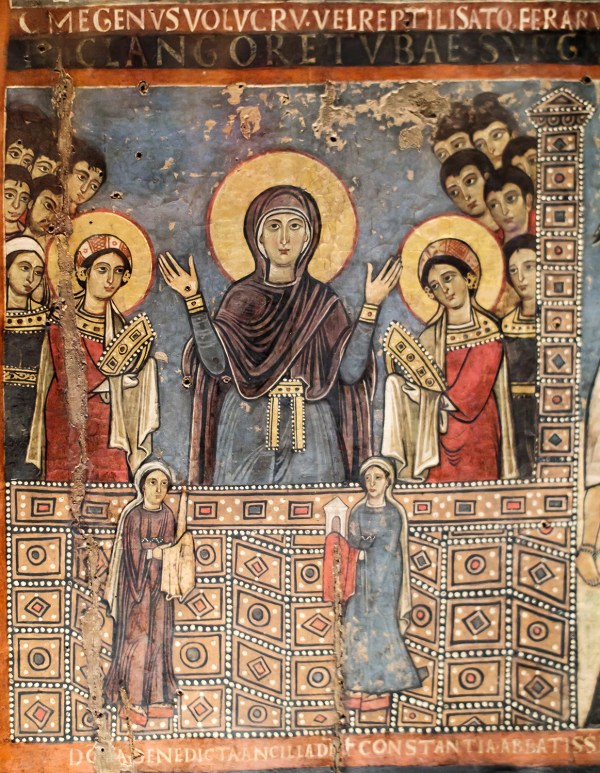
Mary lifts her arms in the orans pose in the Vatican museum. The white maniple at her waist indicates a clerical rank. Flanked by saints, she appears to be exhorting the two women below her. The two were probably benefactors of the church.  Rome — 12th centuryPhotography by Radha Vyas
Mary lifts her arms in the orans pose in the Vatican museum. The white maniple at her waist indicates a clerical rank. Flanked by saints, she appears to be exhorting the two women below her. The two were probably benefactors of the church. Rome — 12th century
In the Basilica Sant’Apollinare Nuovo, 22 woman martyrs, ranked just below the apostles, are led by the Magi toward Mary and the newborn Christ. Each is identified by name and honored for giving her life to Jesus. Ravenna — 6th centuryPhotography by Radha Vyas
In the Basilica Sant’Apollinare Nuovo, 22 woman martyrs, ranked just below the apostles, are led by the Magi toward Mary and the newborn Christ. Each is identified by name and honored for giving her life to Jesus. Ravenna — 6th century
A mosaic in the Chapel of Bishop Zeno of Verona depicts the Lamb of God and below that, four women. They are, from right to left, second-century saint Praxedis, Mary, Praxedis’s sister Pudentiana, and one living person indicated by a square halo. She is named Theodora, believed to be the mother of Pope Paschal I, and above her head is the Greek word episcopa, the feminine form of bishop. Some have argued this was an honorary title only. The feminine ending of her name has also been obscured. Rome — 9th centuryPhotography by Radha Vyas
A mosaic in the Chapel of Bishop Zeno of Verona depicts the Lamb of God and below that, four women. They are, from right to left, second-century saint Praxedis, Mary, Praxedis’s sister Pudentiana, and one living person indicated by a square halo. She is named Theodora, believed to be the mother of Pope Paschal I, and above her head is the Greek word episcopa, the feminine form of bishop. Some have argued this was an honorary title only. The feminine ending of her name has also been obscured. Rome — 9th century
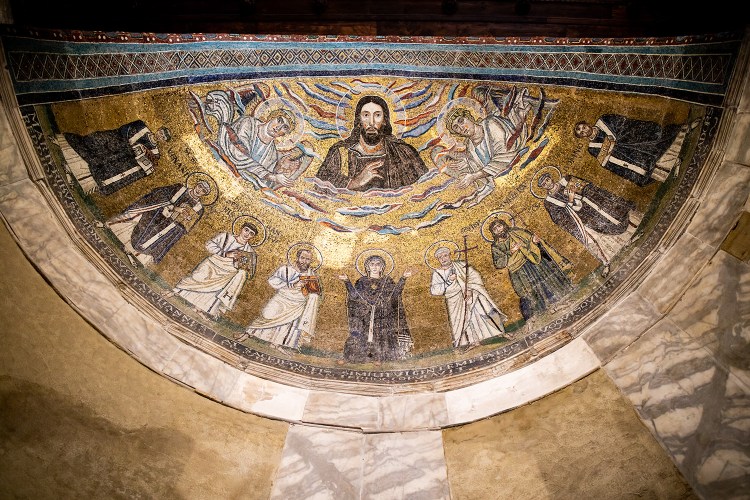
The apse of the central dome in the Lateran Baptistery places Mary between the apostle Paul to her left and the apostle Peter to her right, with Jesus above all. In this mosaic, Mary can be seen with her arms in the orans pose, “lifting up holy hands” (1 Tim. 2:8). ROME — 4th centuryPhotography by Radha Vyas
The apse of the central dome in the Lateran Baptistery places Mary between the apostle Paul to her left and the apostle Peter to her right, with Jesus above all. In this mosaic, Mary can be seen with her arms in the orans pose, “lifting up holy hands” (1 Tim. 2:8). ROME — 4th century
News

Why Should Pastors Get All the Good Theology Textbooks?

Churches across the country are reclaiming theological education to make it available to everyone.

Illustration by Paige Vickers

For years, Caleb Bartel wanted to deepen his understanding of the Bible and theology.

“There’s really not a way to get that from just a Sunday morning sermon or just Sunday school,” said Bartel, who attends Central Church in College Station, Texas. “You can grow on your own, absolutely, but you’re not getting seminary-level teaching.”

Bartel never felt called to become a pastor. He’s a home remodeler and a married father of five, which makes seminary impractical. But the 33-year-old is now getting the chance to study theology thanks to a program at his church.

Congregations across the country are implementing in-house theology programs, designed to engage members like Bartel who aren’t pursuing professional ministry but still want to study theology, church history, and the Bible. Some programs, like Central’s, are designed to replicate formal theological education, just without the seminary setting or the tuition bill—which can easily run up to $16,000 per year. Others aim to be more accessible.

That’s the kind of thing Tyler Johnson at Redemption Church in Phoenix started doing 20 years ago. He wanted to make the gospel understood and applicable among people who might never read the Bible in Greek or know how to pronounce exegesis. Along with fellow church planters, he launched a one-year theology program called Surge, open to anyone who would commit to about a school year’s worth of weekly meetings.

“It just feels like a lot of the deeper theological stuff gets outsourced to Bible schools,” he said. The church planters wondered, “Could we do this inside, at communal levels, at tables?”

The church planters started with a list of books and articles they felt broadly encapsulated the church’s tagline, “All of life is all for Jesus.” They turned that list into a curriculum. The Drama of Scripture by Craig Bartholomew and Michael Goheen and Salvation Belongs to Our God by Christopher J. H. Wright were foundational texts.

At each Surge meeting, participants gathered in groups called Tables and heard from pastors, guest lecturers, and the authors of the books they were reading. A few times a year, the Surge Tables from all participating churches met together for intensives.

Two decades later, Surge has expanded to include dozens of churches across Arizona, each using the same core curriculum.

Pastor J. T. English—formerly of The Village Church in Flower Mound, Texas, and now lead pastor at Storyline in Arvada, Colorado—had similar convictions that the church should reclaim its place educating the people of God.

“Too many churches have transferred the responsibility of discipleship to nonprofits, seminaries, colleges, and other organizations,” said English, whose 2020 book Deep Discipleship makes the case for theological training for laypeople at the local-church level. “Christians should not have to leave the local church in order to be disciples.”

In 2015, English started The Village Church Institute in Texas. Almost 500 people applied that first year, which surprised English “because of how rigorous the program was.”

The in-church programs had one big thing in common with seminary: There were a lot of books involved. The curriculum is deliberately academic. Students are tasked with memorizing Scripture and reading texts by theologians including Athanasius, John Calvin, and Herman Bavinck.

Similar to Surge, The Village Church Institute is a one-year program with weekly two-hour sessions, including lectures and group discussions. Students write and submit doctrinal statements. They compose and recount the “story of Scripture” in 20 minutes.

Daniel Patterson, Central Church’s executive pastor, said whether or not lay Christians learn big theological words, understanding Christian doctrine is essential. And although churches feature theological teaching in sermons, Sunday school, and Bible studies, Patterson said deep study isn’t always possible or prioritized in the life of the church.

“For our weekly corporate worship gathering, the primary thing it delivers is worship,” he said.

Central members also learn the Bible at midweek Life Groups, but the focus there is community, he said. So the theology program, which started in September, is where the church puts learning at the forefront.

The program is open to anyone, including people who aren’t among Central’s roughly 3,000 regular attendees. Some take the class as part of the process of becoming an elder, but many see it just as a way to grow in their knowledge of the faith.

Over 100 people signed up this year, including Bartel, the home remodeler.

“When I finished college, I wasn’t really aware of programs or things that I could do to continue to grow in my faith other than go to seminary,” Bartel said. “I just want to apply this to the stuff in my life that I’m already doing, in my work, with those that are around me.”

Forest Park Church, a small Acts 29–affiliated congregation in Waldorf, Maryland, is in its second year of the Core Classes program, which runs through the school year, as well as the church’s more intense and book-laden Training Program. Pastor Neil Grobler credits English’s Deep Discipleship for prompting him to start the classes at his 200-person congregation.

“We need about four elders, but the church is not going to be able to afford four pastors. So most of them are going to be lay leaders,” Grobler said. “But I do think theological training is going to be important for them.”

Grobler has an undergraduate degree in biblical studies, but he hasn’t gone to seminary. He’d like to someday. But as a pastor, he thinks it’s the church’s job to offer robust theology to all Christians.

At the beginning of Forest Park’s inaugural Core Classes last year, he said he was unpleasantly surprised to find “deep biblical and theological illiteracy” among his incoming students.

“People knew the many stories of the Bible that they grew up hearing in Sunday school,” Grobler said. “But they had a hard time seeing how these stories point to the one big redemptive story of God in the Bible.”

Certain Christian teachings, like the doctrine of the Trinity and the idea of Jesus as fully God and fully man, were new concepts for some.

The pastors who have implemented these programs are adamant that they don’t mean to supplant a seminary education for aspiring clergy. Some even partner with accredited seminaries to offer class credits or degrees. A few years ago, Surge in Arizona launched a partner ministry called The Missional Training Center, which offers an accredited degree from Covenant Theological Seminary in St. Louis. Students of The Village Church Institute in Texas can also earn credits toward degrees at Dallas Theological Seminary and The Southern Baptist Theological Seminary.

Though most of these programs lean toward Reformed theology, Johnson and the other leaders of Surge have expanded the program across denominations. This year, Surge includes Presbyterian, Anglican, Pentecostal, and Baptist congregations. The churches host their own Surge Tables but gather for occasional intensives.

The model highlights Johnson and his team’s original motivation for starting Surge, which was named in part after the US military’s “surge” of troops into Iraq in 2007.

Johnson balks now at the use of militaristic language, but the heart of the program, as well as others like it in churches across the country, remains the same: to teach everyday Christians that God made the world, that Jesus came to save that world, and that truth should mark the lives of all believers—including pastors and plumbers and everyone in between.

Maria Baer is a contributing writer to CT based in Columbus, Ohio.

Our November Issue: What Happens When We Testify

The bold witness our CT reporter encountered in Buffalo.

Photography by Brandon Watson for Christianity Today

Emily Belz expected to encounter a community in grief when she traveled to Buffalo this past May to report on the funerals of those murdered in the racially motivated Tops supermarket shooting. And, of course, she did. “The city’s Christians aren’t rushing the grieving process,” Belz wrote at the time, noting a pervasive sense of both “righteous anger” and “resilience” among Buffalo’s Black Christians.

But one experience Belz didn’t write about continues to stand out for her: time she spent in a local cigar shop where she personally experienced the bold passion for Jesus characterizing many of the believers gathered there.

A local pastor had directed Belz to the cigar shop, located just a block from Tops, because it served as a neighborhood gathering place. In three separate conversations at that shop, Christians shared the gospel with her. Not knowing her own faith background—and despite their own heavy sorrow—these people seized the opportunity to witness to her about Jesus, to testify to his love, and to boldly ask if she had faith in him. There as a CT reporter, Belz found herself being ministered to by the very people whose loved ones had been murdered just days before. What a compelling testimony to the vibrant work of God within the Christian community in Buffalo.

In this issue of CT, Belz returns with further reporting on the work of churches and ministries in Buffalo’s East Side. She examines the ongoing challenges that Christians there face six months after the shooting and spotlights the resilient ministry of “young Black Christians who grew up in the neighborhood [and who] were already working to change their city before May 14. When a gunman took the lives of people they were close to, it spurred them on to more love and good works.”

The thing about a powerful testimony is that even just hearing about the cigar-shop evangelism secondhand has spurred me on in my love for Christ. I have a similar reaction to our regular Testimony features—including Eduardo Rocha’s story in this issue, in which he tells of the Holy Spirit speaking esperanza (hope) into his life in a moment of desperation.

This editor’s note is the first in my new role as print managing editor as I work alongside my colleague Andy Olsen in his new role as senior editor. My hope is that everything you read in CT would testify to the love of Jesus and the truth of his gospel. Whether in these printed pages or in cigar shops and other gathering places, may we boldly spur one another on in faith.

Kelli B. Trujillo is print managing editor of Christianity Today.

News

Australian Football Executive Forced to Resign, Prompting Debate about Religious Liberty

Andrew Thorburn’s affiliation with an evangelical Anglican church was “a clear conflict of interest,” according to the club’s president

Nick Hind and Dyson Heppell of the Essendon Bombers compete for the ball in an Australian football match with the North Melbourne Kangaroos.

Nick Hind and Dyson Heppell of the Essendon Bombers compete for the ball in an Australian football match with the North Melbourne Kangaroos.

Christianity Today October 14, 2022
Michael Willson/AFL Photos/Getty Images

He lasted 30 hours.

Andrew Thorburn, a former banker, was appointed chief executive of Essendon Football Club on September 27. A little more than a day later, he was forced to resign from the prominent “footy” club because of his connection to a conservative Melbourne church.

In a public statement, Thorburn summed the situation up briefly: “My personal Christian faith,” he said, “is not tolerated or permitted in the public square.”

The president of the Australian football club strongly disagreed with that characterization, saying in a statement that “this is not about vilifying anyone for their personal religious beliefs, but about a clear conflict of interest with an organisation whose views do not align at all with our values as a safe, inclusive, diverse and welcoming club.”

Thorburn is chair of the board at City on a Hill, an evangelical Anglican church that started in Melbourne in 2007. It currently has eight sites; five are in Melbourne. The founding pastor, Guy Mason, is affiliated with Acts 29. In 2013, Mason preached about homosexuality, calling same-sex sex a sin, and he has also spoken from the pulpit about abortion, at one point comparing the number of terminations of unwanted pregnancies to the Holocaust.

Online clips of the old sermons surfaced after Thorburn’s appointment, creating a scandal.

Thorburn’s short stint and dramatic resignation may be one of the most egregious examples of someone being forced out of a prominent position for their affiliation with conservative Christianity. His resignation is especially shocking because no one has accused him of saying or doing anything inappropriate. According to the Essendon board, Thorburn doesn’t even hold the offensive views that the club found unacceptable.

“The Board made clear that, despite these not being views that Andrew Thorburn has expressed personally … he couldn’t continue to serve” as the club’s chief executive, president Dave Barham said.

The resignation has sparked a new debate in Australia about freedom of religion. Legal experts point out that Victoria’s Equal Opportunity Act 2010 says people cannot be treated unfavorably because they engage in a religious activity or because they hold or do not hold any lawful belief. Shouldn’t that protect Thorburn?

“The issue we have here is he holds the position in the church,” said Kiri Jervis, a partner at the Sydney law firm Clyde & Co., “and the church holds those views, so does that make the two incompatible in a workplace? That’s the question.”

Neil Foster, a Christian professor at Newcastle Law School, thinks there’s a clear argument the club violated the law. Even though Thorburn officially resigned, he was effectively dismissed.

“It seems likely that what has happened here is ‘direct discrimination,’” he wrote. “It is unlawful to take ‘adverse action’ against an employee on the basis of their religion, unless it can be shown that the action was taken “because of the inherent requirements of the particular position concerned.”

Foster said he couldn’t think why an executive’s churches views on homosexuality or abortion—“views on moral issues that have been shared by Christians, Muslims, Jews, and many other religious believers for a long time”—would be relevant to Australian football.

“Is it really essential to delve into the moral positions of senior executives in a football club?” he asked.

Some religious fans of the Essendon team, known as the Bombers, were deeply offended by the resignation. Peter Comensoli, Melbourne’s Catholic Archbishop and an Essendon supporter, said he was “appalled” and would no longer support the club.

“It is quite a bizarre reality we seem to have entered into,” Comensoli said, “where people are being judged unworthy to lead because of some of their basic Christian beliefs.”

The responses of Anglican leaders were more muted. The Archbishop of Canterbury, Justin Welby, is currently visiting Australia but has declined to comment on the controversy, saying only that secular countries have not yet determined how to deal with differences over faith, ethics, and behavior.

Philip Freier, the Anglican archbishop of Melbourne, said he regretted that Thorburn’s short-lived appointment has been the source of “so much angst for so many people.” He added that it would be “unfortunate if people of faith are sidelined from participation in professional and public life on account of personal religious belief.”

Richard Condie, the Anglican bishop of Tasmania, said he thought that Thorburn’s position was “untenable,” but Essendon should have tolerated his affiliation with a conservative church.

“It seems those whose highest virtue is their professed tolerance have few qualms about being intolerant of others,” he told the Australia Broadcasting Corporation’s Religion and Ethics program.

Before Thorburn’s 30-hour position as the chief executive at Essendon, he was chief of the Bank of New Zealand. Then he moved to Australia in 2014 to take a position as the head of the National Australia Bank. During his tenure at the Australia Bank, the bank teamed up with the Australian Football League to sponsor the inaugural Challenge Pride match, promoting LGBT inclusion in the Australian Football League, the most popular sport in Australia.

“I love all people, and have always promoted and lived an inclusive, diverse, respectful and supportive workplace,” said Thorburn, who has been a fan of the Essendon club since he was a child. “Despite my own leadership record, within hours of my appointment being announced, the media and leaders of our community had spoken. They made it clear that my Christian faith and my association with a Church are unacceptable.”

According to Thorburn, he was told he could keep his position at the club if he resigned from the church. He felt he couldn’t comply with the ultimatum.

“I was being required to compromise beyond a level that my conscience allowed,” he said. “People should be able to hold different views on complex personal and moral matters, and be able to live and work together, even with those differences, and always with respect.”

In a second statement released in early October, Thorburn thanked the hundreds of people who had reached out with support and said he’d heard from many people who “expressed genuine worry” about religious discrimination.

“True tolerance, inclusion, and diversity also includes people of faith,” he said.

On the other hand, Stan Grant, chair of Australian/Indigenous Belonging at Charles Sturt University, argues that “inclusion is always selective,” and “if Thorburn was chairman of a social club that barred women or black people he would have been asked to make the same choice.”

Social mores are changing, Grant wrote, and that will come at the cost of some careers. That’s the price of social progress. He summed it up briefly: “Rendering unto Caesar what is Caesar’s and to God what is God’s is becoming more difficult.”

Thorburn would likely agree.

Ideas

Herschel Walker and the Platform of Cheap Grace

Staff Editor

Christians believe in mercy amidst moral failing. But how then should we vote?

Herschel Walker speaking at a rally in Athens, Georgia.

Herschel Walker speaking at a rally in Athens, Georgia.

Christianity Today October 14, 2022
Megan Varner / Stringer / Getty

A recent campaign ad for Herschel Walker, the Republican Senate candidate in Georgia, is titled “Grace.”

Democratic Sen. Raphael Warnock is “a preacher who doesn’t tell the truth. He doesn’t even believe in redemption,” Walker says about his opponent in the clip. “I’m Herschel Walker, saved by grace, and I approve this message.”

The messaging, leaning on Christian language around forgiveness, is part of Walker’s campaign among Christian conservatives in Georgia. And it came two days after the former NFL and UGA football star dismissed a Daily Beast report that he urged a then-girlfriend to get an abortion after he impregnated her in 2009.

It’s a neat trick: I didn’t do it, Walker’s overall messaging says, but if I did it, you should forgive me if you believe in God’s redemption. You should give me grace.

He insists the receipt from the abortion clinic, the bank image of his signed personal check, and the signed “get well” card she presented as evidence “haven’t shown anything.” He brushes off the New York Times report in which the same woman alleged he pushed her to get a second abortion in 2011 and, after she refused, became a distant father, rarely present in the life of their now 10-year-old-son. He’s sworn to sue the Beast for defamation over its “flat-out lie.”

Maybe Walker is telling the truth, in which case I hope his suit succeeds (even though, full disclosure, I regularly write for The Daily Beast). To be falsely subjected to an accusation like this in the national press would be a great wrong.

But unlike some other years-old accusations of candidate wrongdoing to which the Walker allegations have been compared, this case has a paper trail. It’s not just his word against hers. Walker’s early conduct—claiming he didn’t know the woman though they share a son—doesn’t lend his denials credibility, nor does his established record of mistreatment of his other children and their mothers.

Politician brazenly lies and conceals his past misdeeds is a dog-bites-man kind of story, so absent more context, this might not be particularly interesting for those of us outside Georgia.

But there’s the question of the evangelical vote: Will pro-life Georgia Republicans, many of whom consider themselves evangelicals, stick with a candidate who claims he’s “always” been pro-life with “no exception” (except for his own unwanted child)?

Polling on this race, as well as other reporting, suggests the answer is mostly “yes.” Among those voters and their critics alike, the decision has been widely framed in a grotesquely distorted narrative of Christian forgiveness. The way many of Walker’s evangelical supporters have defended their decision has opened them to accusations of hypocrisy and perversion of redemption as a tool of convenience—that is, accusations of what we would call “cheap grace.”

Many have simply accepted Walker’s denial. But others, perhaps not quite convinced, apparently had ears to hear the redemption plea. Walker had not confessed, yet they seemed eager to offer grace, which also happens to be the path toward a GOP Senate majority.

The abortion allegation changed “not a damn thing,” even “if The Daily Beast story is true,” declared right-wing pundit Dana Loesch, because Warnock is pro-choice and “winning is a virtue.”

“Herschel’s story is one of redemption and hope,” said Ralph Reed, a Georgia resident and chair of the Faith and Freedom Coalition, in an interview dismissing the abortion report. Walker represents “the power of grace, redemption, and the opportunity America still provides,” echoed Tony Perkins of the Family Research Council in an endorsement made after the abortion allegation came out.

“Herschel Walker is a man who, when he gave his life to Jesus Christ … became a sinner saved by grace,” argued the Christian Broadcasting Network’s David Brody on his podcast. “He admits he was never a Boy Scout. But when you truly give your life to Jesus Christ, he forgives you of your past. It’s washed away, covered under the blood, as they say, despite members of the liberal media who clearly can’t grasp that concept.”

But read the “liberal media” closely on this, and it’s evident they not only grasp the concept, but they see the precise piece this rhetoric leaves out: repentance.

Walker is benefiting from political evangelicalism’s “tolerance for candidates who, whatever their personal failings or flaws, advance its power and cause,” summarized a New York Times report. He’s “wielded his Christianity as an ultimate defense, at once denying the abortion allegations are true while also pointing to the mercy and forgiveness in Jesus as a divine backstop.”

Even the hosts of The View pinpointed the problem: “Why isn’t he coming forward and saying, ‘I did this, and I’m sorry’?” one asked. “I think there’s room for redemption with anyone,” responded another, “but you have to admit fault.”

That’s the rub. Had Walker confessed and repented—preferably before reporting forced him to address the issue—pro-life voters could have ushered him to the fold without losing a whit of integrity. Even in the complicating muck of politics, repentance and redemption are always welcome and good.

Instead, we seem to have a partisan version of what theologian Dietrich Bonhoeffer famously called “cheap grace”:

the preaching of forgiveness without requiring repentance … absolution without personal confession. Cheap grace is grace without discipleship, grace without the cross, grace without Jesus Christ, living and incarnate.

It is forgiveness “thrown away at cut prices,” as Bonhoeffer puts it, sought in the same breath as denial of wrongdoing, which amounts to denial of any need for grace at all.

The issue at hand is much bigger than this or any single race. A transactional approach to politics, one which prioritizes ends over means and accepts grave moral compromise as the price of power, is already highly questionable for Christians. It amounts to a refusal to pluck out the eye that tempts you (Matt. 5:29) because it has espied the crown.

But as bad as that kind of transactionalism is, to practice it with cheap grace and label it as redemption is much worse. If Herschel Walker, or any would-be leader of any political party, confesses his sins, God is faithful and just and will forgive those sins and purify him from all unrighteousness (1 Jn. 1:9).

But if he doesn’t confess, our skipping past repentance to public absolution is a lie (1 Jn. 1:10), and a lie told so the election can still be won. This is power politics, not true grace, and it is an insult to the gospel to pretend otherwise.

Theology

How Kanye West’s Breakdown Makes Sense of Our Social Crisis

Evangelicals are part of the shock culture ecosystem that exploits celebrities.

Christianity Today October 13, 2022
Kevork Djansezian / Stringer / Getty

This past week, the artist formerly known as Kanye West—who now goes by “Ye”—was suspended from Twitter after an unhinged rant. He posted comments using antisemitic tropes about the “influence” of Jewish people, followed by an almost incomprehensible threat to go “death con 3” on Jewish people.

Twitter and Instagram, too, were right to take these comments seriously. We’ve seen how antisemitic threats of violence can incite terror—in the Tree of Life synagogue shooting and beyond. The lead-up to the suspension, though, followed a kind of publicity tour punctuated by deliberate controversy. West appeared at an event with the contentious media figure Candace Owens wearing “White Lives Matter” T-shirts. During an interview with Tucker Carlson, he spooled out conspiracy theories to such a degree that he stopped to ask if he’d landed in Alex Jones territory yet. Then Vice posted additional video of him being even more explicitly antisemitic and even more open about bizarre conspiracy theories.

Instability from this artist is hardly surprising. Several years ago, I noted that I was worried for the rapper—not because of his mental health challenges but because of what American evangelicals often do to celebrities who profess faith. Too often we claim them as, at best, mascots for “our side” and, at worst, as trophies from the culture wars.

Over and over, the church has expected things from these figures that they do not have the maturity, wisdom, or even stability to handle.

The issue is in part that a celebrity is saying something insane (and highly offensive). But it’s equally problematic that we have an entire media ecosystem willing to exploit him when he does. Within days of his antisemitic Twitter rant, Owens was defending Ye, saying “death con 3” should be interpreted as a move to protect the Jewish people. After all, she reasoned, DEFCON is a defensive military category, not an offensive one.

It's hard for me to imagine anyone taking that argument seriously. But even so, another social media flurry began right after she spoke. “Can you believe what Ye said?” morphed into “Can you believe what Candace Owens said?” and so on.

Long after we’ve forgotten the names of Kanye or Ye or whatever comes next, that conversational reality will stay with us, including and maybe especially within the church.

My friend David French wrote last week about the “gutter” levels of cruelty and character assassination he and his family have experienced from some sectors of the online world. When David’s wife, Nancy, bravely came forward about the sexual abuse she suffered as a child from a predatory pastor, one commentator said that Nancy “screwed around with her pastor when she was a teen.” Another publication blasted their family with a poem too vile for me to even quote.

David wrote about the very real struggle of deciding when to deny these purveyors of hatred the attention they deserve and when to respond. In most cases, the first is better. But sometimes, we have to point out what’s happening right in front of us and ask, “Where is this coming from?”

The short and ultimate answer, of course, is that it’s coming from the human heart and from a fallen humanity giving itself over to the passions of the flesh. But there’s something else at work too.

For years, Neil Postman and other media critics warned that we were moving into a time of vapidity, propelled by social media and other forms of communication. We were becoming the societal equivalent of Kim Kardashian—famous for being famous.

If only that were the case. It seems that we’ve ended up in a much bleaker place: at the societal equivalent not of Kardashian but of her ex-husband, Kanye West. What we see is less empty vanity and more active hostility, combined with what appears to be a mass-level mental health crisis.

We’ve moved into a time in which many clamor for the fame that comes with outrage, cruelty, or craziness. As I’ve written before, in some places, crazy has become a strategy for expanding church congregations. But church-growth really isn’t the goal in most cases. For many of them, the shock is the point.

Someone recently sent me a Twitter thread by a pastor named Trey Ferguson. I gather from his tweets that Ferguson is decidedly not an evangelical, and maybe his critique is much broader than I would make. Still, his basic point is hard to refute:

There is an entire, self-contained, self-sustaining, conservative evangelical complex where conservative evangelicals say outrageous things, wait for the inevitable reaction from people who are not conservative evangelicals, and then point to that reaction as confirmation that they are doing God’s work.

Ferguson then pleaded with his followers to be free from that cycle.

The basic thrust of it does in fact describe what’s often happening in our evangelical spaces. Someone will post an incendiary statement. As Ferguson points out, that person can count on a multitude of quote-tweets denouncing them. Someone will then respond, “I’m just here for the ratio,” referring to the ways people object to a tweet they don’t like. But the author of the original tweet is also there for the ratio.

To a certain kind of angry person, all controversy is good controversy. And to a certain kind of needy person, all attention is good attention. Like an obscene crank caller in the days of landlines, shocking the recipient is the twisted goal. They want to be hated by one tribe so that they can be loved by their own.

Ordinarily, these dynamics might not be worth mentioning—if they were only about social media. But increasingly, our real-life interactions are being affected by the online world. The more a person lives behind screens, the more their character is shaped “out here” by who they are “on there.”

These trends are bad for society, bad for democracy, and bad for the church, but they’re maybe worst of all for those finding attention and identity through social media.

For some of them, creating shock culture is the result of a breakdown. For others, it’s a business model. We should provide help for the first group and work hard not to be the second. It’s no way for anyone to live—especially a church charged with telling the world that Jesus loves you, and me, and Ye.

Russell Moore is the editor in chief at Christianity Today.

Church Life

Africa’s Worst Famine in Decades Threatens Family Unity and Human Dignity

The plight of herding communities facing hunger echoes Old Testament examples.

Christianity Today October 12, 2022
Photo by Martin Muluka

“I am the father and mother of my children,” said Regina, sitting on the ground of the straw hut she built herself and weaving a basket.

The family’s possessions hang on the wall: a plastic blue bowl, a pair of small sandals, a green bottle cap. A toddler plays behind Regina’s back. A baby squirms in her lap. It is midafternoon in Nakorio village in northeastern Kenya, and nobody has eaten today.

Last year, Regina’s husband left for Lake Turkana. Other men have also abandoned their families—some desperate to save their herds of camels and other livestock; some ashamed of coming home to their starving children.

“I don’t even miss him because he doesn’t bring any food for me,” she said. “If he returned, I would chase him away.”

The Turkana, a semi-nomadic people in Kenya, share a plight with millions of East Africans, starving and displaced as a result of the worst drought in at least four decades. The ongoing threat of famine and food shortage in sub-Saharan Africa has become, to outsiders, a global suffering cliché.

But for Christians, the crisis in the dusty East African terrain should offer a jolt of recognition. Famine appears as a recurring character across the lives of Abraham, Isaac, and Jacob—a force that not only incites physical hardship but also brings degradation on their families, a pattern echoed in families like Regina’s.

“The stories of Genesis were not told to teach about famine,” said Yohannes Sahile, an Old Testament theologian at School of Theology at Africa International University, in Nairobi. “But we can find lessons about how to respond to famine even though such lessons were not the main objectives.”

In Turkana, drought and famine further upends their fragile lifestyle. Men care for livestock; women raise children, construct homes, gather and prepare food, and burn charcoal to sell. Most families are polygamous, and, as one local man recounted, women bear so many responsibilities that they’re often the ones approaching their husbands about adding another wife to help.

Even when rainfall is consistent, communities engage in deadly fights over grazing territory. These days, dead camel carcasses and bleached goat skulls lay out in the sun in Nakorio. One local family said they had lost 70 of their 80 animals in recent months.

Since drought struck in 2019, many men left, ostensibly in search of grazing lands for their animals. Without them, women have few ways of providing.

Regina sells her baskets to adventurers. She makes a 12-hour trek on foot to the nearest village to purchase wheat flour on credit. Most days, there’s nothing she can offer her children besides boiled water or tea.

Regina and her child (left) The remains of a goat (right)Photos by Martin Muluka
Regina and her child (left) The remains of a goat (right)

When everyone’s weak and lethargic, the family sleeps. “And when my children cry, I cry with them,” she says.

“If you look at it superficially, you may think these men have abandoned their families,” said Tom Masinde, who oversees World Vision’s operations in Turkana. “And, of course, their families will lose access to basic household needs, children will stop going to school, mothers won’t get support while they are away for four to six months. But livestock is their main livelihood, so they are bargaining between losing 50 to 100 goats versus staying here.”

Even if their husband’s motives may be altruistic, few women feel empathy toward them.

“I am thanking God because he gave me this useless man. He has made me go through a lot,” said Margaret, a mother of three kids under the age of four. “I am asking God that he will see what I have gone through and that God has provided me and that he will know God is out there.”

In the Old Testament, some of the patriarchs fled famine with their families and some stayed back. Their stories show how famine multiplies the consequences that families face for another’s selfishness.

In Egypt, Abram, allegedly afraid for his life, abdicates his responsibility to his wife Sarai. He lets Pharaoh bring her into his home after lying and saying they are siblings. In the midst of famine, Isaac similarly lies to the Philistines about Rebecca being his wife. In 2 Kings 6, one woman proposes to another that they should eat her children. After they eat the other woman’s child, she hides her own.

“In this story, where are their husbands? We don’t see them. Women are left to struggle. Women are the ones who feel the pain of family because they have to watch their children die,” said Wanjiku Kihuha, a Kenyan theologian and lecturer at St. Paul’s University and Pan African University.

“What is more important for this man? Is it his wife and children or the animals?” Kihuha asked, lamenting how the desperation of hunger steals human dignity. “I’ll leave it to the men in the community, to interrogate, where is your heart? I know they value animals so much, which may not be our case in this discourse. I say we see it, and those questions are asked, and perhaps we need to be in those people’s shoes to understand, why would your family die for you to save the animals?”

World Vision feeding the hungry and speaking at a local church.Photos by Martin Muluka
World Vision feeding the hungry and speaking at a local church.

About five years ago, World Vision entered the Kalapata community, which sits about a three-hour 4×4 ride away from Nakorio. Part of its efforts involved microlending programs and a new model of child sponsorship where kids select their benefactors. Several families operate convenience stores from their huts.

But a significant part of World Vision’s work has focused on building more relational resilience into the community that is consistently at risk of famine. A new 36-member pastors’ network includes local leaders from the Reformed, Pentecostal, Orthodox, and Catholic churches.

They incorporate World Vision curricula into their service. One course seeks to address fatalism with Scripture. Others focus on marriage and parenting—even within the polygamous context.

Leah doesn’t try to break up families. A pastor in the network who has ministered for nearly a decade, she advises proactive steps to solidify marriages from the beginning, like discouraging child marriage. She also offers encouragement as marital tensions rise over food.

“I advise them that life has a lot of challenge, and they need to persevere,” she said.

Several years ago, Jackson and Aleper had 20 goats. Now the couple, who has three toddlers, can only claim two. Though the family’s livestock was devastated by the drought, Jackson has no interest in leaving family to take care of their animals and says he could always give them to departing relatives to look after.

“Before I joined church I thought could have two wives, but when I went to church, I felt I only had strength for one woman,” he said.

Jackson, Aleper, and their children (left) Pastor Leah (right)Photos by Martin Muluka
Jackson, Aleper, and their children (left) Pastor Leah (right)

The Book of Joel suggests that those suffering famine as a form of God’s discipline are not helpless to their circumstances, promising to “repay you for the years the locusts have eaten” (2:25) and “you will have plenty to eat, until you are full, and you will praise the name of the Lord your God” (2:26).

Interpreting a Scripture in today’s context as saying that people only need to pray more to end a famine is problematic, says Kihuha, the theologian. And people should avoid blaming every bad thing on disobeying God or God’s anger.

“However, individual cases of famine were not because of the immorality of the inhabitants of the land. The ancient Near East faced famine regularly as we see in Genesis. Even Egypt faced famine even though it was the one place that the patriarchs went to during famine in Canaan,” said Sahile. “I have heard many Africans confessing that the problems in Africa including famine were because of the sins of Africans. The story of Genesis does not support such interpretation. Abraham left his relatives and country and followed God to Canaan. And yet he faced famine, when he arrived at Canaan. This continued during the times of his descendants. Therefore, even godly people could face famine.”

Instead, those struggling with famine today should understand passages like Joel 2 as reminders that they are not helpless to their circumstances and can continue to call on God.

“In the Bible, we see people negotiating and having conversations with God, and God tells them ‘If my people who are called by my name will humble themselves and pray, I will hear from heaven and forgive their sins and will heal their land,’” said Kihuha. “That’s the kind of agency we see from people, especially in the Old Testament, just humbling themselves, praying, dialoguing with God.”

The current famine threatens the lives of millions across Kenya, Ethiopia, Somalia, Sudan, and South Sudan. Nobody can make it rain, and historically, droughts haven’t persisted for multiple seasons like the current “40-year drought” that many link to climate change. Plus, the Russian invasion of Ukraine, a global source of grain, contributed to inflation, rising gas prices, and a disruption in trade around the world.

Genesis 26 gives an account of Isaac whose family endures famine but does not leave for Egypt for food. Instead, he raises animals but he also plants crops and grows very wealthy. This story suggests that there is something that East Africans can do, says Neema Ndooki Mollel, a Tanzanian pastoral care and counseling PhD student at St. Paul’s University in Kenya.

“The pastoralists are proud that they only depend on the animals, but now, life has changed,” said Mollel, who herself is Maasai, a community where many still practice pastoralism. “They could have got some teaching to help them to know that when you keep the animals that you can manage them, it can be better that you will take care of the family.”

Joseph implores to Pharaoh the need to plan in advance of famine, a lesson Nathan Chiroma, a Kenyan theologian at Pan African University, believes Christians living in fragile contexts should take to heart.

“We don’t have to wait until there is famine,” he said. “When the church is training pastors, we must train people to work with their hands, so that people will not depend on only the government.”

Climate and environmental degradation play a factor in today’s famines, underscoring the role of stewardship and creativity to address the crisis.

“In modern times, we have to be innovative in thinking of how to combat famines. We have to use our spiritual resources, our intellectual resources, to see how we can combat famine,” said Kihuha. “We want to partner with God and with other people.”

Translation provided by Dhymphine Emuron

News

Nursing Homes Still Haven’t Recovered from Pandemic Loneliness

Ministries double-down on efforts to build community in the wake of debilitating isolation.

A nursing home in Los Angeles, California has its first post-pandemic social event in April 2021.

A nursing home in Los Angeles, California has its first post-pandemic social event in April 2021.

Christianity Today October 12, 2022
Mario Tama/Getty Images

Inside an Upper East Side nursing home on a September Sunday, Mimi Weinstein, who organizes and leads a weekly worship service there, bounced from resident to resident. She handed out bulletins and greeted people by name while shaking a tambourine. Two dozen residents showed up for the service, filling the activity room. Weinstein’s husband, Jerry, sat down at a baby grand piano, the top propped up with a copy of Jonathan Franzen’s Freedom, and started playing worship songs.

When a volunteer announced the first song of the service, one resident shouted at the top of his lungs, “Amen sister, Amen!”

This same neighborhood was bleak in 2020, with empty streets and mobile morgues outside of overwhelmed hospitals. In the US, over 200,000 long-term care residents and staff have died from COVID-19, according to a count from the Centers for Disease Control and Prevention. In five states, they accounted for more than half of COVID-19 deaths up through 2021. But since the vaccine rollout, they make up a much smaller portion of COVID-19 deaths in the US.

All across the country, nursing home residents didn’t have visitors other than staff for months, and sometimes more than a year. In March 2020, the Centers for Medicare and Medicaid Services banned visitors from nursing home facilities, and administrators have dealt with regularly changing guidance on visitation since.

Cleopatra Mullings, 84, who resides at the Upper East Side Rehabilitation and Nursing Center in New York, didn’t see her son Gene Mullings for a year.

“I think about it sometimes, but I try to push that thought back,” she said from her wheelchair, with her son sitting beside her on a Sunday in September. They were participating in the weekly worship service put on by volunteers from Hope for New York, an organization that partners churches with other organizations serving the city.

Nursing home residents would like to forget the isolation of the previous two years, but the new norms of postpandemic life mean that a few infections might close a home to visitors for a week, a month, or more. Before the pandemic, nursing home residents dealt with social isolation, but if norms from the pandemic lockdowns continue, they could be more isolated than ever. Some churches and ministries are responding to this new reality by expanding their work in nursing homes.

An October 2020 survey of nursing home residents by healthcare nonprofit Altarum found residents’ activities inside homes (including religious services), their visits, and trips outside all dropped precipitously since the pandemic restrictions.

Participation in three or more weekly activities inside nursing homes dropped from 58 percent of residents to 21 percent. After the pandemic, 76 percent of residents said they felt lonelier than usual, and 87 percent said they ate alone in their room. Before the pandemic, 68 percent said they ate in a dining room.

Another survey from January 2021 of residents’ families reported that, when they were able to finally return to visit, they found their loved ones in extreme mental decline. Residents wept, stared vacantly, hallucinated, or stopped walking. Some nursing home staff reported that residents had stopped eating.

“Although the regulations were deemed essential to COVID-19 containment, the continuation of this lockdown for a prolonged time has resulted in potentially irreversible physical, cognitive, psychological and functional decline,” said one 2020 paper in the Journal of the American Medical Directors Association, which focuses on geriatrics.

Ministries want to be careful about seniors’ health while also attend to the deep loneliness they are finding in these facilities, as well as the exhaustion and stress among nursing home staff.

“The isolation is, without question, devastating to the souls of the people,” said Bill Goodrich. He leads God Cares, a 30-year-old organization to support about 10,000 nursing home ministry volunteers. He has been visiting residents since September of last year and says, “They’re numb… They’ve turned off. They just exist. …They’re not dying from the one thing, but they’re dying from the other thing.”

The pandemic did bring attention to residents’ plight. Ministries are trying to return relationships and joy in homes in creative ways, like enlisting elementary classes to write letters if a facility goes into lockdown. The window visits that took off during the pandemic have continued when the visitor or resident is sick. Homes and ministries are better at using technology for outside connection, with Zoom Bible studies and Facetime calls.

On the Upper East Side, Gene Mullings has visited his mother every day since the facility incrementally opened up. Visitors at this facility take a rapid test upon arrival and wear masks.

“She’s a trooper,” Mullings said, wrapping his arm around his mom.

Cleopatra Mullings’s facility has a host of activities now, and she is signed up for all of them: jazz, karaoke, a reading group, bingo, and Sunday worship. The Mullings family is part of a Lutheran church and the Christian Cultural Center in Brooklyn.

This Sunday, the scheduled preacher for the day got stuck in a malfunctioning subway train, so Mimi Weinstein gave a brief message. She read the biblical text the pastor had chosen, John 5:19–23, and then asked the room, “What are some miracles Jesus did?”

“Healed the blind!” said one resident.

“Raised the dead!” said another.

Weinstein read John 5:20 again. She talked about Jesus being the vine, and his followers the branches: “We are getting all the nutrients we need by the vine. And we can bear fruit. Are we loving? Are we peaceful? Are we patient? Are we doing good? Are we gentle with one another?”

She went on: “There’s more we need than food and clothing and entertainment. There’s something more we need for nourishment, which we get by sticking with Jesus.”

Setbacks and severed relationships

Kitty Foth-Regner has volunteered at a 100-bed nursing home in Milwaukee for more than 20 years. Before the pandemic, she used to visit 15 to 20 residents every week and lead a weekly Bible study and a monthly hymn sing. Now she only visits three or four residents individually each week, and only one church volunteer comes with her. Other volunteers switched activities when they couldn’t get into nursing homes for so long.

Because of privacy laws, she doesn’t know what happened to the residents she used to visit: “There were few funerals during the pandemic, and little in the way of published death notices,” she said in an email.

A few weeks ago, Angela Hey, who is both board chair and volunteer pianist for SpiritCare Ministry to Seniors in California’s Bay Area, was supposed to go to an assisted living home to play hymns. But three residents had just died of COVID-19, and the home went into lockdown. It was pouring rain outside, so SpiritCare couldn’t have a service outside on a patio, the usual backup plan.

“It’s like Whac-A-Mole; just when we think we’ve got the schedule all worked out, someone says, ‘We’re going to shut down for a couple of months,’” Hey said. But long-term mass shutdowns seem to be over.

When Hey was allowed to come back to play piano about six months ago, the residents were “thrilled,” she said, even though “I’m not the best pianist.” Some residents had given up walking when they had no one to visit and walk alongside them, but Hey said residents are starting to walk again.

Lessons and new approaches

SpiritCare has learned some things from its pandemic ministry: It did Zoom services during lockdown but found that, especially for patients with dementia, the big heads of people on a Zoom screen were disconcerting.

“It’s like a monster,” Hey said. People did better with individual Facetimes, so one of their chaplains would walk around with a tablet and hold it for residents to do Facetime calls.

During the height of the pandemic, one resident had asked for prayer, and a volunteer began calling the resident to pray with her every week. The volunteer said the resident burst into tears during the first phone call.

Churches affiliated with SpiritCare got more involved, organizing a few hundred Christmas presents for low-income seniors: shawls, quilts, sudoku books, or simple jewelry.

SpiritCare has, like others, ministered to staff too, who are grieving the loss of residents and even some coworkers. Homes are often short-staffed and dealing with the stress of regular turnover. Families pulled family members out of elderly care homes because of the pandemic, Hey said, which created even worse financial problems for the homes.

Sometimes when a church wants to start a ministry, Goodrich from God Cares said the church will want to just convert all the residents: “That’s cool but it’s not how it works. … You have to provide something that assists the staff. … We’re going in not to do our thing, but to support their home.”

He suggests asking a facility’s activity director how to help meet the spiritual needs of the residents. After decades in the work, Goodrich said that ministry in a nursing home often starts with visiting a friend and then visiting others. “Because there’s such a need, you can’t help it.”

Some ministries grow

When Tenth Presbyterian Church in Philadelphia had to halt its nursing home ministry, two Tenth members were also cut off from the church. They live in the nursing home a few blocks from the church.

For almost a year, no one could visit the two members. Church staff and volunteers called them on the phone and got them tablets to watch Sunday services. Another Tenth member worked at the home and kept an eye on them and their health.

“The pandemic helped us to realize there is a sense in which nursing home residents are like prisoners,” said Enrique Leal, who leads Tenth’s mercy ministries. “They cannot get out, and during the pandemic they were not allowed to see people.”

Leal and his staff prayed about how to restart all their mercy ministries to international students, immigrants, prisoners, the homeless, the deaf, and those in nursing homes. Their prison and nursing home ministries were the toughest to figure out—Tenth couldn’t return to a detention center in the city to do its weekly Bible study until September.

At the nursing home, eventually Leal and one other ministry worker could—with a rapid test, a temperature check, and masks–go to the lobby of the nursing home. Staff would bring the two residents to the lobby, and they would meet with Plexiglass between them.

For months, they read the Bible together, prayed, and took Communion. Now the staff lets them meet in a room that used to be a cafeteria. The Tenth volunteers now do a monthly worship service, a weekly Bible study, and monthly Communion during Bible study. A few weeks ago, another resident became a Christian.

“I think it was a good testimony for the people in the lobby,” said Leal. “Some of the other residents started to be curious.” People were hungry for fellowship, Leal said.

Despite outbreaks and shutdowns, Leal estimates their ministry is doing 60 percent more in the nursing home than it did before the pandemic. He hopes eventually they have enough volunteers to do a weekly worship service.

At the weekly service on the Upper East Side, Gene Mullings bragged about how well his mom was doing post-pandemic. She went into the nursing home three years ago weighing 117 pounds and has gained 50 pounds as her health improved.

“I give all praise and glory to God,” Mullings said, adding that they would be at the worship service next week.

Apple PodcastsDown ArrowDown ArrowDown Arrowarrow_left_altLeft ArrowLeft ArrowRight ArrowRight ArrowRight Arrowarrow_up_altUp ArrowUp ArrowAvailable at Amazoncaret-downCloseCloseEmailEmailExpandExpandExternalExternalFacebookfacebook-squareGiftGiftGooglegoogleGoogle KeephamburgerInstagraminstagram-squareLinkLinklinkedin-squareListenListenListenChristianity TodayCT Creative Studio Logologo_orgMegaphoneMenuMenupausePinterestPlayPlayPocketPodcastRSSRSSSaveSaveSaveSearchSearchsearchSpotifyStitcherTelegramTable of ContentsTable of Contentstwitter-squareWhatsAppXYouTubeYouTube