Theology

Top 5 Heresies Among American Evangelicals

It’s 2022, but Arianism and Pelagianism are steadily making a comeback, according to the State of Theology report.

Christianity Today September 19, 2022
Edits by Christianity Today / Source Image: Getty

American evangelicals’ grasp on theology is slipping, and more than half affirmed heretical views of God in this year’s State of Theology survey, released Monday by Ligonier Ministries and Lifeway Research.

The report references Ligonier founder R. C. Sproul’s teaching that everyone’s a theologian. “However, Dr. Sproul would be quick to add that not everyone is a good theologian,” it read. That caveat applies to Americans in general and evangelicals too.

Overall, adults in the US are moving away from orthodox understandings of God and his Word year after year. More than half of the country (53%) now believes Scripture “is not literally true,” up from 41 percent when the biannual survey began in 2014.

Researchers called the rejection of the divine authorship of the Bible the “clearest and most consistent trend” over the eight years of data.

“This view makes it easy for individuals to accept biblical teaching that they resonate with while simultaneously rejecting any biblical teaching that is out of step with their own personal views or broader cultural values,” the researchers wrote.

It’s clear that US evangelicals (defined by belief and church affiliation) share some core faith convictions. Well over 90 percent agree that God is perfect, God exists in three persons, Jesus’ bodily resurrection is real, and people are made righteous not through works but through faith in him.

But in some areas, even evangelicals responded with significant misunderstandings and were not far off from the trends in society overall.

In the 2022 survey, around a quarter of evangelicals (26%) said the Bible is not literally true, up from 15 percent in 2020. They also became more likely to consider religious belief “a matter of personal opinion” and “not about objective truth”; 38 percent said so in 2022, compared to 23 percent in 2020.

Here are five of the most common mistaken beliefs held by evangelicals in this year’s survey:

1. Jesus isn’t the only way to God.

More than half—56 percent—of evangelical respondents affirmed that “God accepts the worship of all religions, including Christianity, Judaism and Islam,” up from 42 percent in 2020. And while the question doesn’t include all religions, it indicates a bent toward universalism—believing there are ways to bypass Jesus in our approach to and acceptance by God.

This contradicts orthodox theology found in the Scriptures, in which Jesus affirms that “I am the way and the truth and the life. No one comes to the Father except through me” (John 14:6).

2. Jesus was created by God.

A surprising 73 percent agreed with the statement that “Jesus is the first and greatest being created by God.”

This is a form of Arianism, a popular heresy that arose in the early fourth century. Those believing it caused such a stir that it led to the gathering of the very first ecumenical council of church leaders. They discussed and denounced these and other unorthodox beliefs as heretical for being contrary to Scripture.

Out of the Council of Nicea came the Nicene Creed, which states in part that Jesus was “not made” but “eternally begotten” and “one in being with the Father,” as found in passages including John 3:16 and John 14:9.

3. Jesus is not God.

Given the above beliefs on Jesus as a created being, it’s not too surprising that 43 percent affirmed that “Jesus was a great teacher, but he was not God,” which is another form of Arian heresy.

This effectively denies the divinity of Christ and his unity with God the Father as an equal member in the Trinity, who is one God in three persons. This has been considered classic orthodox belief since the early church, and is based on many biblical passages—like where Jesus says “I and the Father are one” (John 10:30). For this, he gets accused of blasphemy (and threatened with stoning) by religious leaders for claiming to be God.

4. The Holy Spirit is not a personal being.

Speaking of the Trinity, 60 percent of the evangelical survey respondents had some confusion about its third member, believing that “The Holy Spirit is a force but is not a personal being.”

To be fair, the Spirit of God is often described as an impersonal force throughout the Bible (sometimes as a dove, a cloud, fire, wind, or water), but these are all just metaphors for the Spirit’s personal presence. The Scriptures clearly affirm that the Spirit is fully God—just like Jesus and the Father, who sent us the Spirit—including the time when Ananias was described as simultaneously lying to the Holy Spirit and to God (Acts 5:3–4).

5. Humans aren’t sinful by nature.

Interestingly, 57 percent also agreed to the statement that “Everyone sins a little, but most people are good by nature.” In other words, humans might be capable of committing individual sins, but we do not have sinful natures.

This response indicates that many American evangelicals believe humans are born essentially good, which leans toward a heresy known as Pelagianism. This denies the doctrine of “original sin,” which is based on a number of biblical passages, such as Romans 5:12. Even David acknowledged in the Old Testament that humans were born in sin, saying “Surely I was sinful at birth, sinful from the time my mother conceived me” (Ps. 51:5).

Respondents were considered evangelical by belief if they strongly agreed in the Bible as the highest authority; the importance of encouraging non-Christians to trust Jesus as their savior; that his death removed the penalty of sin; and that trust in him alone brings salvation. This four-part definition was adopted by Lifeway and the National Association of Evangelicals in 2015.

While evangelicals were found to be moving away from orthodox beliefs in several of the questions about God, they’ve grown more assured in their stances on cultural and ethical issues.

Among evangelicals, 94 percent believe “sex outside of traditional marriage is a sin” and 91 percent believe abortion is a sin, both the highest levels since the survey began.

You can take the State of Theology survey and view full results and data visualizations at stateoftheology.com.


News

Strategy Questions Divide Pro-Life Politics After ‘Dobbs’

What’s the best way to oppose abortion? Some pursue a national ban while others object that “plays into liberals’ hands.”

Senator Lindsey Graham proposes a 15-week abortion ban, backed by leaders of several major pro-life organizations.

Senator Lindsey Graham proposes a 15-week abortion ban, backed by leaders of several major pro-life organizations.

Christianity Today September 16, 2022
Drew Angerer/Getty Images

What comes next?

The pro-life movement has focused on the fight in the Supreme Court for so long that when the Dobbs v. Jackson decision finally came—overturning Roe v. Wade and ruling that abortion can be regulated—it wasn’t clear what the plan was after that. The hoped-for, prayed-for, and worked-for victory didn’t end abortion, after all. Ending Roe was just one political battle in the process, even if took 50 years.

“When the decision first came out and shortly after that, there was a lot of jubilation in the pro-life community,” Timothy Head, executive director of the Faith and Freedom Coalition, told CT. “But there wasn’t a second clause to that sentence, ‘Roe has been overturned, ______.’”

After a bit of a scramble over the summer, the largest pro-life groups have emerged to embrace a national plan, calling for a federal ban on abortion. They don’t see it as state’s rights issue. They want to deal with abortion at the level of national politics.

They were ready to support Republican Senator Lindsey Graham when he came out on September 13 with a proposal for a ban on abortions after the 15th week of pregnancy, a few weeks after the first trimester. While top pro-life leaders may disagree with some details of the draft legislation, they focused on using it to frame the choice voters will face in the upcoming midterm elections.

“The Protecting Pain-Capable Unborn Children from Late-Term Abortions Act would prevent cruel and painful abortions from being performed on innocent children,” Carol Tobias, president of the National Right to Life Committee, said in a statement. “The only thing the Democrats are offering the American people in this campaign is an opportunity to kill more and more children by abortion.”

Tobias joined Graham at his press conference, along with Americans United for Life president Catherine Glenn Foster, Concerned Women for America president Penny Young Nance, and March for Life Education and Defense Fund president Jeanne Mancini.

Marjorie Dannenfelser, president of Susan B. Anthony Pro-Life America, stood at Graham’s right. She has pushed Republican candidates to see a national abortion ban as a winning issue. They should make it a top priority to motivate conservative Christians to vote on on election day.

According to a Morning Consult poll done in July, 41 percent of evangelicals support an abortion ban with no exceptions, though for most, it is not a top priority.

“If Republicans want to win elections and save lives, it is imperative they learn from past mistakes,” Tobias wrote in an op-ed in The Washington Post. “With just two months left in this pivotal election cycle, they must learn very quickly, lest the only ‘red wave’ come from the bloodshed of countless innocents.”

But not everyone in the pro-life movement agrees with this strategy. The Faith and Freedom Coalition, which was founded by Ralph Reed as the Christian Coalition for the 21st century, is pushing for a state-by-state approach.

There are no big theological differences between the two sides. Both agree on the moral question of abortion. But they disagree about what to do now, after Dobbs.

There are philosophical reasons for the difference. While some on the Religious Right, such as those who call themselves “national conservatives,” have been arguing state power should be used to defend traditional ways of life and American values, many still identify with the small government politics of 20th century Republicans. They believe most issues impacting the general welfare should be dealt with at the state and local level—including moral issues, such as prayer in schools and bans on abortion.

There are also strategic reasons. Speaking to CT before Graham proposed his national ban, Head said he thought that kind of approach would be “playing into liberals’ hands.” Pro-life activists, he said, are more likely to win state by state than they are in a big, national confrontation.

“Most groups on the Left don’t have chapters in places like Topeka, Kansas. We’re better organized across the country and have 50 times more staff in the states than we have in Washington, DC,” he said. “Conservatives are more engaged in local politics. … Conservatives are better equipped to fight a multifront battle than liberals are.”

The state-by-state approach also allows the pro-life groups to advocate for different policies in different places, pushing for the legislation most likely to be successful in a specific context. A novel civil enforcement mechanism might be politically feasible in Texas but stand no chance in Illinois. Missouri voters might support a parental consent law, while in North Carolina, parental notification might be more palatable.

In states like Colorado and New Jersey, where there are currently no limits on abortion, pro-life legislators could find common cause with progressive colleagues on policies that have the practical effect of reducing the number of abortions. The Faith and Freedom Coalition is talking to conservatives at the state level, for example, about legislation that rewards corporations that offer more parental leave. They also have draft legislation for programs that help mothers afford diapers, car seats, formula, and other basic necessities for caring for a newborn.

“I think that’s correct, constitutionally, but also the states are the best laboratory for figuring out the right approach,” Head said. “As the states start tackling these issues, you start to see the proliferation of ideas.”

A number of pro-life groups have prepared a menu of options for state legislatures. Americans United for Life, for example, has a proposed draft of legislation to completely ban abortion.

“The [Legislature] of the State of [Insert name of State],” it says, “finds that (a) The life of each human being begins at conception; (b) Unborn children have protectable interests in life, health, and well-being; and (c) The natural parents of unborn children have protectable interests in the life, health, and well-being of their unborn children.”

But the group also offers model legislation with more limited aims, proposing laws that would require pregnant women be informed of all their options or banning abortions done on the basis of the unborn child’s sex. Americans United for Life only had one similarly creative policy proposal aimed specifically at the national level: a draft of an executive order that a president could sign that would recognize fetuses as legal persons, entitled to due process and equal protection under the Constitution.

The strategic disagreements may resolve themselves quickly, as activists and operatives respond to the political situation on the ground. And pro-life voters may well choose an all-of-the-above approach and not worry about national versus federalist political philosophy questions.

Graham’s bill, however, may force candidates in the midterm election to take a stance on a national abortion ban. And it’s possible the different approaches, after Dobbs, will be an issue in 2023, as the contenders for the Republican presidential primary start to jostle for position.

A similar strategic question divided pro-life activists in the days after Roe was handed down by the Supreme Court in 1973. Some urged support for targeted programs helping mothers and reducing the number of abortions, historian Daniel K. Williams writes in his book Defenders of the Unborn. But most embraced a bolder plan that was simpler to explain and backed a constitutional amendment saying life begins at conception. That decision connected the pro-life movement to the Republican Party, shaping evangelical engagement with politics and the broader political landscape for the next 50 years.

There are also a few pro-life political operatives who are holding out hope for an alternative. Rather than fighting state by state or backing some kind of national ban that will become a contentious election issue for the foreseeable future, they’d like to see a creative compromise that effectively depoliticizes the issue.

Perhaps Democrats could agree to ban late-term abortions if Republicans would allow a range of exceptions; maybe Republicans could accept abortion in the first trimester if Democrats would agree that no federal funding could be used. It wouldn’t be perfect and no one would be really happy, but there could be a way of reaching a national settlement that would be broadly popular with voters and lower the temperature on debates about the issue, said Democratic political strategist Michael Wear.

He believes a deal—whatever the details looked like—might open up new possibilities for ways to reduce abortion and help women and children.

“Now is when a cultural of life is more imaginable,” Wear told CT. “One of the things Dobbs did was it actually widened the range of options the country could go in.”

Still, he’s not especially optimistic about a compromise. Connecticut congressman Jim Himes, a Democrat, proposed something similar to what Wear has suggested in a closed-door caucus meeting in July. None of his colleagues seemed to think it was a good idea. No one on the Republican side has floated anything similar.

“Congress can step in and let some of that steam out, or abortion politics could be worse in the next 50 years in terms of the effects it has on voters, on our politics, and on the legal regime for abortions,” Wear said. “There is a side of me that thinks, maybe this is the best it ever gets.”

News

Wanted: Creation Care Coordinator for Major British Evangelical Church

A new position at Holy Trinity Brompton reflects growing concern about climate change among some Christians.

Christianity Today September 16, 2022
Google Maps

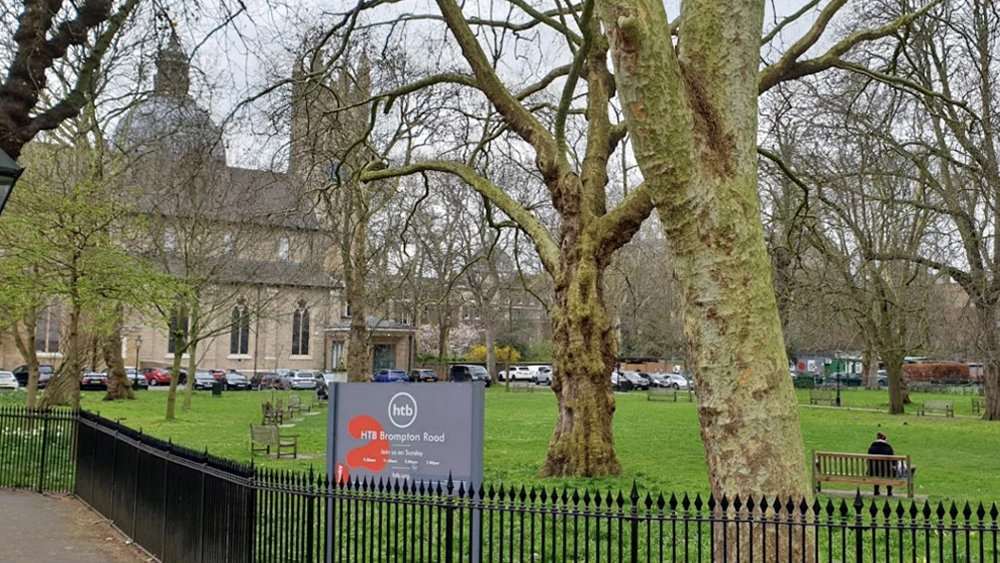
The job ad was a little different than the ones normally posted by London’s largest churches. It wasn’t for a pastor, priest, choir director, or organist. Instead, the large evangelical Anglican congregation wanted an environmental project manager.

Holy Trinity Brompton (HTB), perhaps best known as the birthplace of the evangelistic Alpha course, has advertised a position for someone who will help “oversee the strategy, planning and execution of HTB’s approach to Creation Care.” The individual will work closely with other lead team members to put an “environmental response at the heart of church life.”

Jobs like this at places like HTB are notable, said Jo Chamberlain, national environment policy officer for the Church of England. Such roles, she said, signal a sea change. Evangelical churches in the UK—and perhaps elsewhere—are embracing the critical importance of creation care and environmental stewardship at the congregational level.

“People are recognizing that we have to get our house in order,” Chamberlain said. “We can’t just talk about taking care of creation without doing the work and changing the way we do things.”

HTB has six sites in London with around 3,500–4,500 worshiping every Sunday. It has planted 130 churches in England and Wales and become influential enough that some have called it the “centre of British evangelicalism.” The new staff member will help the six sites develop plans to be recognized as “eco churches” in five to seven years.

The “eco church” designation is awarded by A Rocha UK, part of an international network of environmental organizations with a Christian ethos, for churches in England and Wales who “want to demonstrate that the gospel is good news for God’s earth.” According to the organization’s website, there are currently more than 5,000 churches enrolled.

To start the process, churches examine how their worship practices, teaching, building use, land use, community engagement, and lifestyle choices are “caring for God’s earth”—or not. The self-audit includes questions about whether the church’s children’s ministry teaches about caring for God’s earth, whether buildings are energy efficient, and if some of the congregation’s property has been set aside for native wildflowers. A Rocha then makes suggestions for how congregations might take further actions to improve their “eco church” status.

Getting eco status will just be the start, said Mark Elsdon-Dew, HTB’s director of communications. The bigger goal is to kickstart a culture change at HTB that will “transform the way we do things more permanently,” he said.

The project manager is a fixed-term, one-year position, but Elsdon-Dew said HTB hopes the individual will shift things across the church. Immediate areas of improvement may include creating a carbon-neutral website, using more biodegradable consumables, and installing LED lighting. Longer term, the church wants to see broad cultural changes.

Elsdon-Dew said those changes could reach beyond HTB to influence evangelical Anglican churches around the UK. Those planted by HTB may be eager to pursue eco church recognition too. Church planters and the network of churches tend to replicate HTB’s culture in their own context.

“They are eager to pick up on ‘new vibes’ at the home church,” he said.

At the same time, he said, HTB is not trying to be a trendsetter.

“We don’t do this kind of stuff to make a point,” he said. “We go ahead and do our stuff, go as far as we possibly we can, and leave the rest to the Holy Spirit.”

Ruth Valerio, director of advocacy and influencing at the international Christian relief and development agency Tearfund, said she is seeing more Christians and churches like HTB grapple with their role in combatting climate change.

“Creation care used to be very much a fringe issue that wasn’t understood or embraced by the mainstream church,” she said. “As the reality of the climate crisis becomes clearer, and as vulnerable communities around the world begin to feel its devastating effects, Christians have rightly increased their response."

For her, the most significant development is how churches are beginning to frame creation care as a core part of their ministries.

“New environmental responsibility jobs in Christian organizations are proof that the church is taking these issues seriously,” she said. “Environmental responsibility jobs should be just as integral to a church’s mission as a children's worker or evangelism coordinator.”

In the Church of England, more than 40 environmental officers work along with a growing network of activists, theologians, grounds managers, and local environmentalists who help congregations take practical steps on energy usage and nature conservation and connect them with other people active in their communities.

“Sometimes, the fix is simple, but often it’s complicated,” Chamberlain said. “You’re going to need someone to manage and oversee the process.”

Even so, Chamberlain occasionally gets pushback from those who feel creation care and environmental stewardship distract from what they see as the church’s principal work of evangelism. But, Chamberlain said, “creation care is part of the gospel, it’s a fundamental aspect of loving our neighbor, it’s key to our mission.

“I don’t think you can do mission unless you are getting environmental stuff right these days,” she said. “This issue is so prominent in the UK; this is actually a matter of accountability for churches.”

That’s why she is particularly encouraged to see a prominent institution like HTB taking a committed step to emphasize creation care in the church’s day-to-day life.

“It is important for a church that is passionate about evangelism, like HTB, have something to say about the environment,” she said. “It is perhaps saying this is an issue of credibility for churches, not just a ‘nice to have.’”

Cameron Conant, board member at Operation Noah, which helps provide a Christian response to the climate crisis, echoed Chamberlain, underscoring the HTB’s symbolic value.

“This feels like a significant change for a network that, previously, has not shown a great deal of interest in environmental issues. It made me wonder whether other big evangelical churches or networks in Europe or North America were hiring similar roles,” he said.

But even churches that don’t have the budget for a new position can take steps towards prioritizing creation care, Conant said. They can start by supporting people who want to walk or bike to church, planting trees and installing solar panels, or divesting from oil and gas companies.

“All of this helps show that we are living in a world God loves,” Conant said. “We’ve got to do this as churches, because when we understand the impact these things have on our neighbors, we realize this is gospel work, not because we are progressive or woke or anything—but because we are Christian.”

The new position is scheduled to start in mid-October.

Church Life

British Illustrator Is Drawing All 300 Churches in Her Diocese

The “arty pilgrimage” through Leicestershire has given her a chance to share and deepen her faith.

Christianity Today September 16, 2022
Courtesy of Hayley Fern

As England loses a number of its churches and rethinks the role of church buildings, one artist is finding a new appreciation for the over 300 churches in her hometown by drawing each and every one.

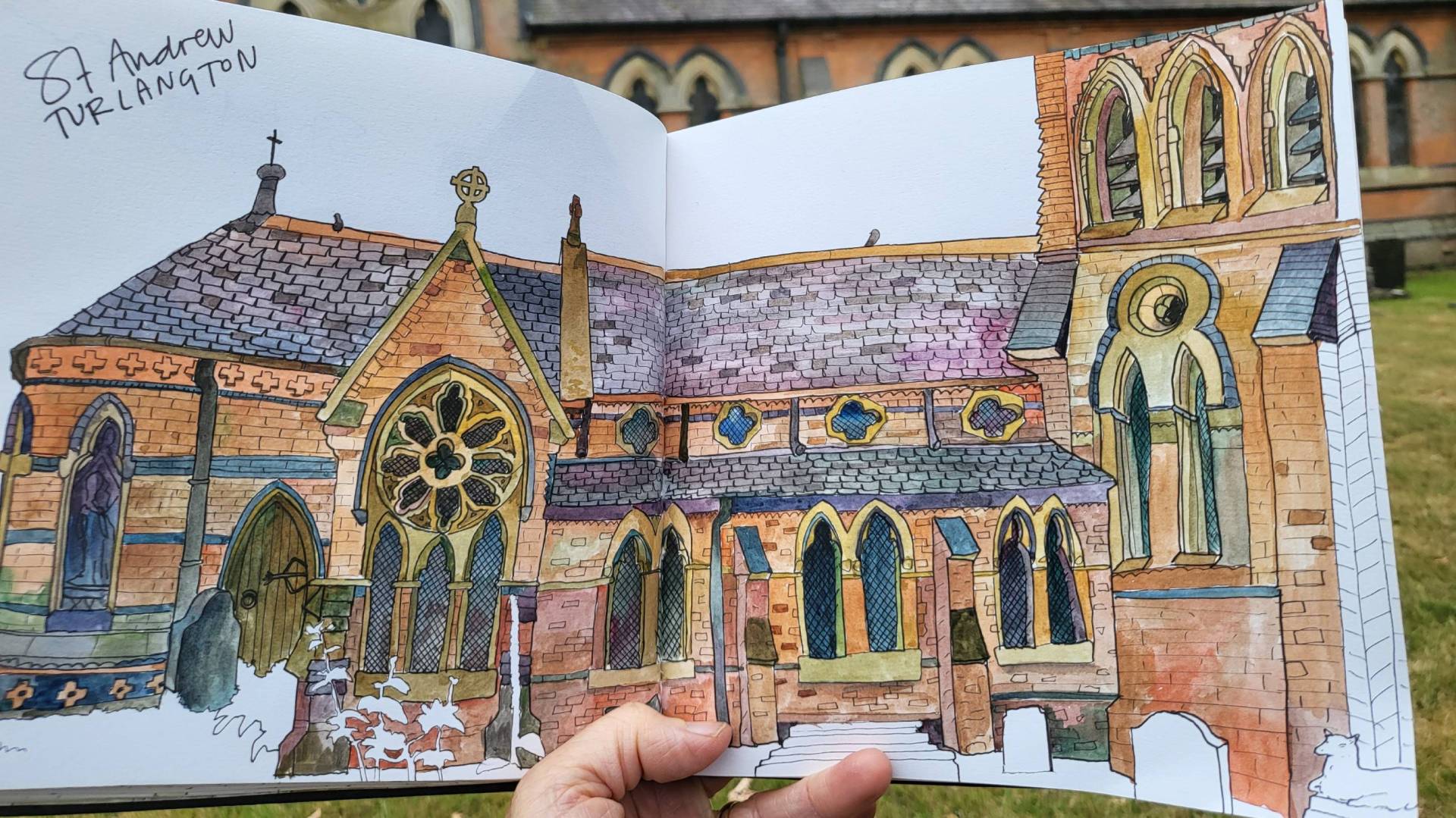
Art teacher Hayley Fern pulled out a new sketchbook during a visit to Leicester Cathedral and drew the 900-year-old Gothic-style church, with its pointed arch windows and 220-foot spire.

She enjoyed it so much that she decided to draw the church she attends, St. John the Baptist Church, and then the church she was christened at.

“Somebody actually said, ‘Oh, are you doing all Leicestershire churches?’” Fern said. “I said, ‘Oh, that’s a good idea. I might just do that.’”

And that’s how her “arty pilgrimage” began.

In her county in central England, there are over 300 Anglican churches, quite a lot but still an obtainable goal, she decided. With each church she adds to her sketchbook—and her social media feeds—she’s learned about nearby places she’d never been or only passed through.

“When you’re visiting a church, you go to the absolute heart of the place. You’re going to the original center of the village or town, the highest point, and it’s often the oldest part,” Fern said. “I’m now really discovering that even the villages and towns that I wasn’t necessarily drawn to actually have these beautiful centers, and the community is really evident there as well.”

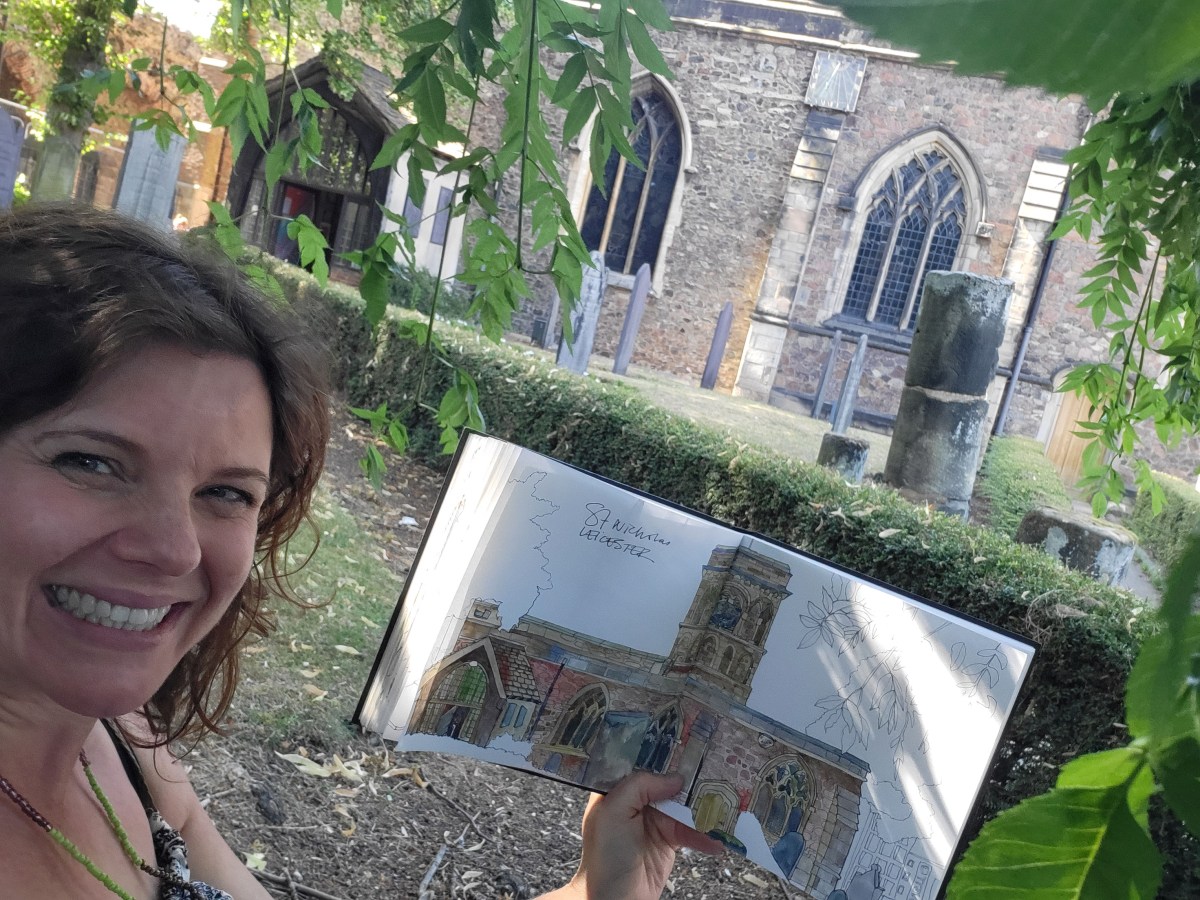
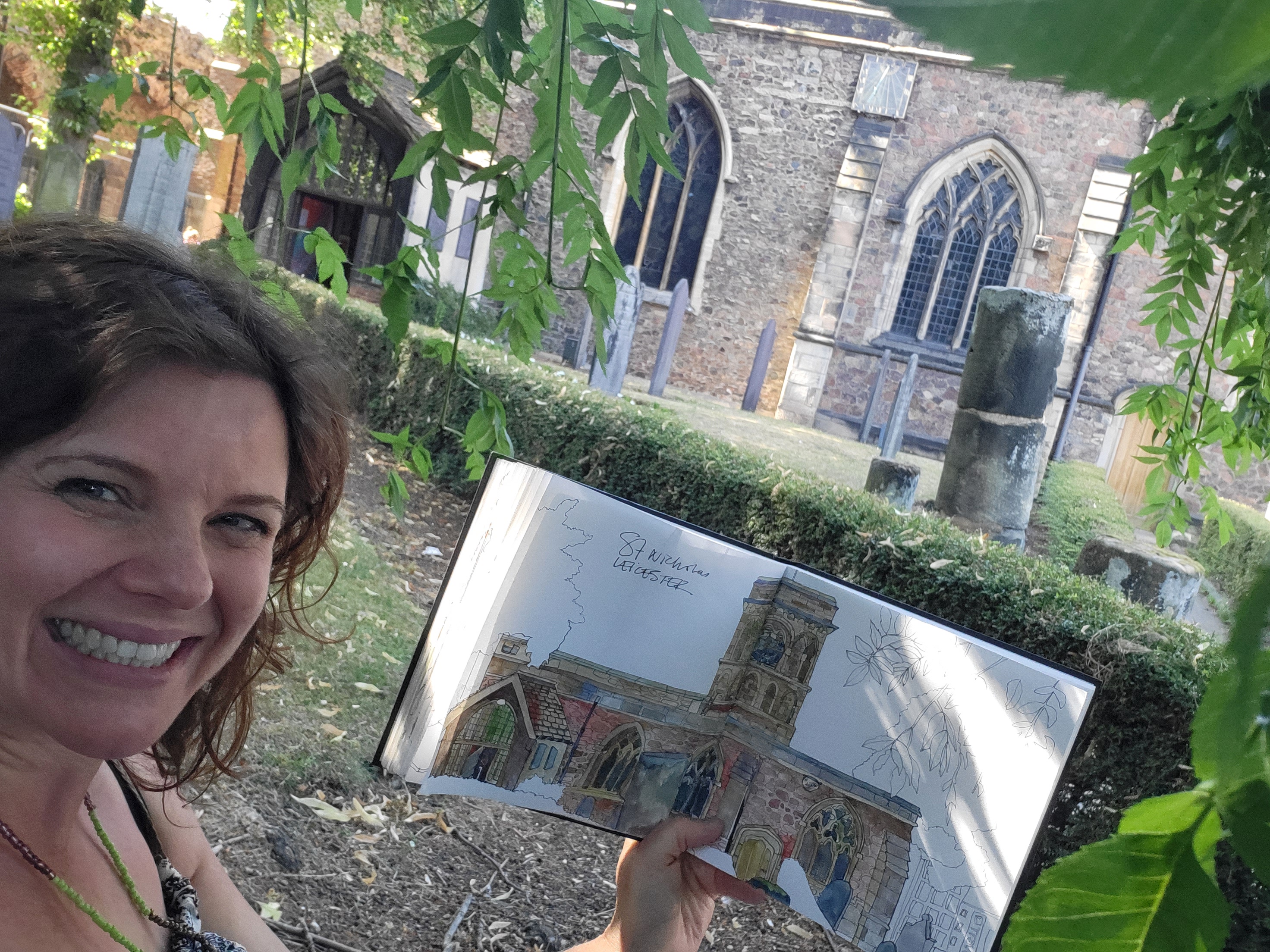
A former freelance illustrator, she uses a fine waterproof pen to draw the details: porches and porticos, stained glass windows, neat bricks and cobblestone. Then she fills in with watercolor. Each drawing gets labeled with the church name and town, sometimes details about its founding date. She leaves behind a card saying, “I drew your church!” so the community can see the results and follow her project.

Fern meets locals who are grateful someone is taking time to appreciate and honor the church in their town. Seeing an artist’s attention directs them to what they haven’t noticed before.

“I don’t think anyone fails to realize how beautiful their church is, but it’s actually stopping and taking that time, isn’t it? I think that’s what I’m encouraging people to do a little bit as well,” Fern said.

Even for people who don’t go to church regularly—before the pandemic, fewer than 1 percent of the population attended Church of England services on a given Sunday—the old landmarks in their towns are still a place they feel proud of and connect with.

Leicestershire is a rolling countryside dotted with towns and historic sites that can be traced back nearly 2,000 years. Some of the church buildings that made their way into Fern’s notebooks have been houses of worship for centuries.

At her husband’s suggestion, Fern created social media accounts (@HayleyFern4 on Twitter and @hayleydrawschurches on Instagram) to post her work so people beyond passersby could see. The accounts gained a following, and as more and more people have become interested in her work, Fern has had opportunities to discuss her faith.

https://twitter.com/HayleyFern4/status/1559234716368355328

“It didn’t occur to me at all that doing art was in any way evangelical, but I’ve had so many conversations now. I’ve had so many people that have come and talk to me about their faith, people that maybe didn’t really have someone to talk to, or didn’t have the excuse to discuss their feelings about going to church or not going to church,” said Fern, a member of the Church of England.

“It’s made me a more visible Christian because people generally assume I’m a Christian because I’m doing it. I think in a lot of ways, it’s opened up more conversations than anything else I’ve ever done regarding my faith.”

Sometimes sharing her faith has been as simple as just listening. At one church, a man sat down by Fern after laying flowers on his wife’s grave. He talked about his wife and how much he missed her, and Fern was grateful she had been there simply to lend an ear.

Fern believes drawing the churches has been a great way for her to reflect, express her faith, and worship. She believes that God-given gifts should be used for his glory, whatever that looks like.

From a young age, Fern learned to draw from her grandfather who also loved art. She decided to pursue art in college, graduating with a degree in art textiles. She worked in a dress shop before becoming a freelance illustrator so she could stay at home with her kids.

Once her kids grew older, Fern took a job as an art teacher. She works full days during the term, using her weekends to catch up on housework and rest and her holidays to visit churches and draw.

Courtesy of Hayley Fern

When going to a new church, she doesn’t look at pictures beforehand, so she can have a “wow” moment when seeing it in person for the first time.

When she sits down to draw, using a fine line pen helps her to not overthink and commit to it quickly. When painting a church, she pays attention to key details that give the church its character.

“I really enjoy exploring the different colors and tones of each church because I think that’s massively part of its history. Often you can tell the relationship between the stones and the area,” Fern said.

She doesn’t paint the green of the trees or the blue of the sky, ensuring the focus remains solely on the church buildings rather than the landscape around them. It also helps give the project a consistent style from church to church.

Amid all the centuries-old stone churches in Leicestershire, a 1923 church building stood out.

“I’ve not seen anything in that sort of art deco ’20s style before or since. … That was a real favorite. It was incredibly satisfying to draw,” Fern said. “I think if I see something architecturally very different now, that is such a delight to draw.”

In the future, Fern hopes the sketches might become a published book. She serves on her parochial church council, a committee of church staff as well as members that deals with all sorts of church matters from budgets to outreach efforts. Because of this, Fern knows how the proceeds from such a project could help churches financially.

“I’d love to be able to support churches, and if some good can come of that, that would be amazing,” she said.

As she continues her artistic pilgrimage, Fern reminds her newfound following that this is a project that will take her years to finish, as she’s drawn 55 so far.

Regardless of how long the project takes, Fern plans to faithfully use her time off to visit and draw new churches, slowly filling her sketchbook with buildings that have remained at the centers of their communities for years, sacred spaces that have stood the tests of time.

News
Wire Story

Under Franklin Graham, Samaritan’s Purse Grows to a $1 Billion Powerhouse

The humanitarian aid organization works on the frontlines around the world and ranks among the largest charities in the US.

Franklin Graham visits Samaritan's Purse's disaster response programs in Ukraine.

Franklin Graham visits Samaritan's Purse's disaster response programs in Ukraine.

Christianity Today September 15, 2022
Courtesy of Samaritan's Purse / RNS

Each week, in a hulking warehouse in this small, western mountain town, Samaritan’s Purse employees load semi trailers full of supplies for the people of Ukraine: medicines, food, tarps, blankets, hygiene kits and school bags for kids.

The trucks are then driven 80 miles east to the Piedmont Triad International Airport where they are loaded onto the nonprofit’s DC-8 aircraft specially configured to carry up to 84,000 pounds of cargo. From there the goods are airlifted to Poland and then trucked across the border into Ukraine.

This week, Samaritan’s Purse, headed by evangelical leader Franklin Graham, made its 30th airlift since Russia began its offensive against Ukraine in February.

The Christian relief organization estimates it has helped 5.5 million Ukrainians with medicine, food and water. Earlier in the conflict, it also operated an emergency field hospital in Lviv, and outpatient clinics across the country treating an estimated 17,758 patients. It now supports 30 medical facilities across the war-ravaged country.

The organization’s 160,000-square-foot warehouse and offices in North Wilkesboro employ 385 people who buy, repair, maintain and retrofit millions of dollars’ worth of medical equipment, generators and water filtration systems, much of them donated. The warehouse has six emergency field hospitals ready to ship, four with tents, hospital beds, anesthesiology equipment, X-ray machines, and surgical suites—all engineered to fold into a plane’s fuselage. There are also miles of plastic tarps, mountains of clothing and boxes full of small brown teddy bears with the Samaritan’s Purse logo—a cross inside a circle.

Samaritan’s Purse, now in its 52nd year, has become a powerhouse of faith-based international relief.

Ukraine is now drawing on much of that relief, but in any given year, the organization aids people in 110–120 countries. It sent supplies to Pakistan after unprecedented flooding from monsoon rains this past month. It has a mobile medical team at 11 different sites across civil war-torn Yemen. It is helping farmers in Iraq’s Sinjar Mountains plant strawberries.

And then there are multiple US-based recovery efforts. Samaritan’s Purse volunteer teams recently sawed off tree limbs and cleared damaged homes in Kentucky and Missouri where a rash of disastrous floods ruined homes and businesses.

The nonprofit’s mission is based on the parable of the Good Samaritan as told in Luke’s Gospel, in which a man is stripped, beaten and left for dead on the side of the road. He is rescued, not by those with power or authority, but by an outsider—a Samaritan—who bandages his wounds, takes him to an inn and pays the innkeeper to look after him.

To many, Samaritan’s Purse may be best-known for giving shoeboxes full of toys to needy children around the world. But over the past 10 years, it has grown into one of the largest US faith-based nonprofits, with annual revenues last year of $1 billion.

A review of its annual 990 IRS form shows Samaritan’s Purse’s revenue has doubled since 2014, and its assets have quadrupled. It now ranks at No. 23 in the Chronicle of Philanthropy’s 25 largest US charities, a list that includes mostly non-religious charities.

Today, Samaritan’s Purse is in a league with the American Red Cross, Catholic Charities, and Lutheran Services in America. In 2020, it surpassed in cash revenue the Christian charity World Vision, with whom it shares a founder: former missionary and evangelist Bob Pierce, Franklin Graham’s inspiration and mentor.

That growth has come largely on the strength of its frontline work in public health crises and natural disasters around the world.

Even before the COVID-19 pandemic, Samaritan’s Purse designed and assembled emergency field hospitals. In the past two years it put them to use in Italy; the Bahamas; New York City; Los Angeles; Jackson, Mississippi; and Lenoir, North Carolina. Its quick response to emerging health crises was tested in 2014, when two of its medical personnel contracted the deadly Ebola virus while treating people in Liberia. They were evacuated to Atlanta’s Emory University Hospital where they were treated and recovered.

“When we say we run to the fire, that’s not idle talk,” said Ken Isaacs, vice president of programs and government relations and the logistical and regulatory brain behind the group’s sophisticated international enterprise.

Samaritan’s Purse has built up a corps of Christian doctors, nurses and other medical professionals who volunteer on short-term trips to mission hospitals across the world and a cadre of domestic volunteers trained in debris removal, mud-outs, and light construction.

The organization’s headquarters are in North Carolina’s Blue Ridge Mountain town of Boone. It has warehouses in Coppell, Texas, and Fullerton, California, field offices in 17 countries across the world and a lodge in Alaska where it runs marriage seminars for wounded soldiers and law enforcement officers.

But unlike many other Christian charities, Samaritan’s Purse is distinct in a particular way: It has a galvanizing, and sometimes polarizing, leader.

“I think most people today would be hard-pressed to name the president of Catholic Charities, World Vision, or Compassion (International),” said David King, director of the Lake Institute on Faith & Giving. “Many organizations are not led by personalities in the same way that Franklin Graham leads Samaritan’s Purse.”

As the son and successor to Billy Graham and the president of the Billy Graham Evangelistic Association, Graham, 70, has outsize stature in the evangelical fold. With his 10 million Facebook followers and 2.5 million Twitter followers, he inveighs regularly on some of the hottest issues of the day, drawing as many supporters as detractors for his conservative and partisan views.

He is a staunch supporter of former President Donald Trump; most recently he blasted the FBI for raiding Trump’s Mar-a-Lago home, claiming, falsely, that Trump would return the documents, if asked. A culture warrior on the social issues of the day, whether it’s abortion, same-sex marriage, or sexuality, Graham regularly denounces what he sees as a godless America set adrift by secular culture. He applauded the Canadian Freedom Convoy. He labeled Disney a “moral failure” for its gay-friendly policies. He pushed a domestic abuse victim to return to her pastor husband.

But when it comes to running Samaritan’s Purse, he has also proven to be an effective leader committed to helping people in crisis in the most nimble and resourceful ways possible.

“Franklin always liked the challenge of getting on the ground fast and cutting through red tape and bureaucracy,” said Mark DeMoss, a now-retired public relations executive who represented Graham. “He wants to go where others can’t go, get set up quicker than others and show (people) you’re on the ground.”

Graham is unconventional in more ways than one. He doesn’t hire outside companies to produce direct mail appeals. He doesn’t socialize with charity professionals.

“We’ve never used outside fundraisers,” Graham said in a telephone interview. “We tell people what we’re doing, and people decide if they want to help us.”

Evangelicals have responded. Graham claims hundreds of thousands of people make small donations of $100 of less, and while that may not be entirely accurate, the charity draws from a large net of donors, many in evangelical circles.

Only 5.1 percent of Samaritan’s Purse’s revenue in 2021 came from federal dollars. In past years, it has partnered with the US Agency for International Development to provide aid in Iraq, Sudan, Congo, Liberia, and Colombia. It also worked with the United Nations’ World Food Program, the United Nations’ High Commissioner for Refugees, and the International Organization for Migration, another UN organization.

Despite Graham’s social views, Samaritan’s Purse is committed to providing services to everyone regardless of race, ethnicity, religion, or sexual orientation. It will, however, tell them about Jesus.

Part of Samaritan’s Purse’s growth and financial success may be due to the Graham brand. Graham inherited from his evangelist father a reputation for personal integrity and financial transparency.

“There was no scandal in Billy’s life, and I think that’s true of Franklin, too,” said Grant Wacker, a historian and the author of America’s Pastor: Billy Graham and the Shaping of America. “Whatever one thinks of his politics, he has stayed on track in terms of his personal ethics. What that does is it creates a consistency between the message and the public appeal.”

While some donors may be unaware of Graham’s politics, Wacker said, some give precisely because of it.

“The inclination to contribute is based on trust,” he said. “For evangelicals, both Black, white, and Latino, personal trust is to a good extent based on a perception of your personal life.”

Then there’s Operation Christmas Child. The longstanding program, begun by Samaritan’s Purse in 1993, partners with local churches, who in turn enlist members to buy small gifts and pack them in shoeboxes for needy children around the world. (It also helped Samaritan’s Purse to be reclassified by the IRS as an association of churches.) Churchgoers’ enthusiasm for the program knows no bounds. Samaritan’s Purse estimates it has 90,000 volunteers each year. In 2021, those volunteers packed and shipped more than 10.5 million shoeboxes worldwide.

Operation Christmas Child remains a signature program, but it is no longer the central focus of the organization. In 2001, more than half of the charity’s revenue came from Operation Christmas Child, and about two-thirds of the organization’s expenses were spent on that program, according to a 990 report. By 2021, less than a third of Samaritan’s Purse’s revenue came from Operation Christmas Child, and the program made up about 44 percent of the organization’s expenses.

But the relationships formed with churches who either donate shoeboxes or receive them for distribution has given the organization global reach and quick access when disaster strikes.

Sergii Syzonekno, pastor of Central Baptist Church in the Ukrainian city of Dnipro, had been participating in Operation Christmas Child for eight years. When the war began, he, like other churches already in Samaritan’s Purse’s Operation Christmas Child network, immediately received $5,000 in cash.

That support has now ramped up with weekly shipments of supplies. The church has opened its building to shelter Ukrainians fleeing the war. Some 430 people slept there one night at the height of the war. Church volunteers use their own cars to go out and evacuate people under siege from the Russians and deliver food and water.

“We are very thankful to Samaritan’s Purse for food, medicine and encouragement,” said Syzonekno. “We are partners. We are doing God’s work together.”

Theology

Don’t Quiet Quit the Church

We should continue to let ourselves be amazed by God’s good work whenever and wherever we find it.

Christianity Today September 15, 2022
Illustration by Mallory Rentsch / Source Images: Getty

This piece was adapted from Russell Moore’s newsletter. Subscribe here.

The concept of “quiet quitting”—refusing to do anything but the minimal effort—is all over media these days. Commentators are debating whether or not today’s workers, most notably Gen Z employees, are quiet quitting their jobs.

Count me among the skeptical. Some of the quiet-quitting talk is just another generational caricature (one I’ve not seen any evidence for). And it may well be that workers are getting just as much or more done but are putting healthy boundaries between themselves and their jobs.

Perhaps quiet quitting is happening in some workplaces, although I suspect it’s no more than always. Yet even if mythical, the idea points to something real in many people’s lives: a sense that what they do will make no difference, that things will never change.

I’ve found this mentality to be a genuine temptation in the context of the church.

Those of us who see what’s happening in church life might easily come to the same conclusion that nothing will change, no matter what we do. We might keep attending, keep praying, keep teaching, keep serving—but never really anticipate anything different than the same crises.

I noticed this tendency in myself within the past week.

Recently, I was preaching in a city far from home, and an impressive Baptist Christian in his early 20s picked me up from the airport. As we talked about ministry and what he was doing in the church, he reflected on something I had written here—about how so many leaders I know are demoralized by the craziness of the present moment, both inside and outside the church.

Since he came of age over the last decade, he said he can’t remember a time in which social-media trolling, institutional collapse, family-dividing and church-splitting politics, and rolling waves of scandal were not considered normal.

This is precisely what I’ve feared all along. Regarding the integrity crisis facing the church right now, I of course worry about those who leave the church in disgust. But I’m far more worried about those who have come to see the present broken state of the church—and of the country—as “normal.”

This young Christian had been discipled and could see the scope of history well enough to tell the difference between what is and what ought to be. But I asked myself, What about all those who can’t? While we talked, my phone pinged with a text—which informed me of yet another ministry friend stepping away because of a crisis.

Afterward, I met with a group of equally impressive pastors from multiple different evangelical denominations. Many of them talked about friends in ministry who were experiencing mental-health emergencies due to the hardships of leading their churches through the COVID-19 pandemic and political division. Many spoke of younger people they knew who had concluded that the church is nothing but political opportunism, or worse.

While I sought to encourage these pastors, I kept thinking about the bad news that had come by text, the worries that emerged from the car conversation, and the stakes of what the church is now up against.

Even for someone who had just written that week about the dangers of a reptilian-brain-oriented fatalism, my expectations were lowering, my mindset was darkening, and I was starting to grow numb from hearing so many of these stories. They didn’t surprise me anymore.

And then another conversation shook me to attention.

This past Sunday was the first week of a seminar (what I’m still too Baptist to call anything other than “adult Sunday school”) I’m teaching through the Book of Genesis. Afterward, a young man—maybe 19 or 20 years old—came up to say hello. He’s attending a vocational trade school in the area and told me he’s hoping to follow in his grandfather’s footsteps.

His grandfather, a mechanic, had not only served his community repairing vehicles but also, throughout his life, ministered and shared the gospel in homeless shelters and prisons—showing love to people that many others had forgotten about.

This young man said he wanted to be like his grandfather—to learn a skill and practice it with excellence (no quiet quitting there) and to learn how to minister to prisoners, the homeless, and any other group of people to which Jesus might call him. The young man lit up when he talked about being around non-Christians and the opportunity to represent Jesus with love and integrity.

I walked away feeling enlivened and encouraged about the future of the church. This grandfather, whose name I don’t even know, was such a model of gospel integrity that his grandson aspires to be as much like him as possible. I don’t even know whether the older man is alive or dead, but his ministry is still burning—fueling his grandson in the same direction.

And that’s not to mention all the people from prisons and homeless shelters who are serving Christ right now because of this man’s witness. How many lives were saved, how many eternities were redirected, and how many families were put back together by conversations he had over broken fuel pumps or malfunctioning alternators?

My conversation with this man’s grandson was a grace disrupting my life.

I don’t think of myself as cynical, but maybe I was coming a little too close to it until this encounter reminded me of why I’m a Christian. I really believe that Jesus is alive, that the Spirit is stirring, and that the gospel still works the way it always has—like fermenting yeast or a germinating seed, like life from the dead.

I grow impatient with those who say, “Well, don’t talk about the ugly stuff; talk about all the good things that are happening,” in light of all the atrocities taking place in American Christianity right now. That’s not what I mean here. That’s public relations management, and everyone can see it for what it often is—tribal protection.

The way to love the church is to bear witness—which means to tell the truth. If we don’t speak truthfully about the ways the church is veering from the mission of Christ, then we don’t really believe what we say: that the church is meant to be a light to the world, a redeemed people demonstrating what it means to repent and follow the Way.

When we don’t see or acknowledge the very good reasons many have lost confidence in the church—or when we highlight only the parts that don’t call us to repentance—we say to many, almost literally, “To hell with you.”

The way we can help those who are skeptical of the church is by loving them, standing up for them, and doing our best to be trustworthy. But we can do that only if those of us who are called to stay and stand don’t give up. We owe it to those who are losing hope to hold up hope for them.

Hope does not appear out of nowhere. “Hope that is seen is not hope at all. Who hopes for what they already have?” the apostle Paul wrote. “But if we hope for what we do not yet have, we wait for it patiently” (Rom. 8:24–25). Moreover, Paul wrote, hope comes through suffering—for “suffering produces perseverance; perseverance, character; and character, hope. And hope does not put us to shame” (Rom. 5:3–5).

Hope is not a public relations or marketing strategy. Hope doesn’t dismiss those who are suffering or struggling to endure. But even as we endure, even as we hope, we can find ourselves growing numb to the ways God is not only shaking up his church but also building it, reforming it, and reshaping it.

Sometimes God refreshes our hope by giving us a little flash of awareness of what’s happening beyond our sight. Sometimes we need a random conversation to see just how bright his glory still glows.

This also means we should not stop letting ourselves be amazed by grace or surprised by joy. Whether loudly or quietly, let’s not quit.

Russell Moore is the editor-in-chief at Christianity Today.

News

Belarus Proposes Legislation to Stop Christians From Appealing to the UN

Pentecostals targeted for Bible studies, baptisms, and outdoor worship amid increasing efforts to “repress civil society.”

Belarusian protestors pray in a Catholic church during mass anti-government demonstrations.

Belarusian protestors pray in a Catholic church during mass anti-government demonstrations.

Christianity Today September 15, 2022
Misha Friedman/Getty Images

Six months after a Pentecostal pastor won a religious liberty case before the United Nations, Belarusian politicians are trying to strip citizens of the right to appeal to the intergovernmental organization.

Human rights organizations warn the legislation under consideration this fall “will close one of the last remaining opportunities to seek justice for human rights violations” in the Eastern European country, according to Forum 18, which tracks human rights violations in the region.

The UN was the last court of appeal for Valentine Borovik.

Police raided the Pentecostal pastor’s Bible study in the western town of Mosty in June 2008 and charged him with illegally starting a religious organization. Prosecutors argued that the group did not meet the requirements to register as a church, since there were only 13 adults. But the Christians also could not meet without registering, since they “had all characteristics of a religious community.”

Borovik, objecting to this Catch-22 and claiming he had the right to meet with other believers without registering with the state, was convicted and fined. He appealed and lost, and appealed and lost again.

The case went to the Supreme Court. He lost there too, despite constitutional protections for “the performance of acts of worship and religious rituals and rites.”

“This case exemplifies the difficulties faced by Christians in Belarus,” Mervyn Thomas, founder of Christian Solidarity Worldwide, said at the time. “The Belarusian government must be pushed to respect its own laws and international commitments and to allow Belarusians to meet together and practice their faith freely.”

In 2021, Borovik pushed again. He took his case to the UN Human Rights Committee, and the committee forced the government to answer questions about religious liberty in Belarus and the laws behind the charges against the Pentecostal pastor. In March, the UN committee handed down its ruling: Borovik finally won.

The same month, a UN report criticized the Belarusian government, saying it was attempting to “crush dissent and repress civil society.” More than 1,000 people have been charged in what the report calls “politically motivated” prosecutions since masses of demonstrators publicly protested the reelection of authoritarian president Alexander Lukashenko.

The government has also shut down more than 270 nonprofit organizations and 13 media outlets, designating them as extremists. Dozens of journalists have been detained and more than 30 lawyers who have defended dissidents and spoken out against civil rights abuses have lost their licenses.

Authorities have also continued to crack downs on minority religious groups, including Pentecostals, Jehovah’s Witnesses, and Hare Krishna devotees. Several, like Borovik, have appealed their cases to the UN.

Now parliament is considering withdrawing from the International Covenant on Civil and Political Rights, which would mean that Belarusians do not have the right to file appeals with the UN, Forum 18 reported. The legislator overseeing passage of the bill has not given a public justification for the proposal, telling Forum 18 in a statement by her secretary that, “We do not give any comments on this issue.”

The bill is set to be discussed by the lower house of parliament this fall. If it is approved by both houses and signed into law, Belarus could withdraw from the international civil rights agreement early next year.

Lukashenko, who has run the country since 1994, has allowed little to no opposition in parliament, according to international observers. Elected representatives largely rubber stamp his agenda.

Lukashenko has said that he’s “no dictator,” but admitted to some “elements of authoritarianism” in his leadership.

“Our system of power is tougher,” he told Agence France-Presse. “I … do not rule out the word ‘authoritarian.’”

International observers have said Lukashenko’s last five elections were neither free nor fair. The European Union does not recognize Lukashenko as the legitimately elected president and Belarus has been sanctioned by the EU, the United Kingdom, and the United States. Lukashenko’s only major international supporter is Russia.

According to some observers, the pressure from the West has pushed the authoritarian leader to attempt to exert more control over Belarusian society and crack down on perceived threats.

“Political isolation has turned him into a delusional, paranoid and petty man,” Ivar Dale, a policy adviser with the Norwegian Helsinki Committee, a human rights watchdog, told Al Jazeera. “What you see is an unstable and dangerous man who is desperately clinging on to power, a power that he is convinced can belong only to him personally,”

Belarus passed a religion law in 2002 that was considered the most restrictive in Europe. This year, an additional law banned “organization of or participation in activity by an unregistered political party, foundation, civil or religious organization.”

“The current policy of the Belarusian government, sadly, is to create a kind of mixture of the Soviet Union and the Russian Empire,” Pentecostal pastor Antoni Bokun wrote after spending time in jail for leading a worship service. “The authorities give the appearance but not the reality of granting privileges to the Orthodox Church, while restricting religious freedom for all. … These efforts are being met with opposition, however, particularly from Protestant churches.”

Borovik’s victory at the UN has not forced Belarusian authorities to respect the rights of other evangelical Christians. Since the March ruling, several churches have been treated with reregistration.

A Pentecostal church in Minsk has been repeatedly cited for holding meetings in its parking lot. New Life Church was evicted from its building—a converted cowshed—in 2021 but has continued to meet outside, even during the cold winter months. Officials say the unauthorized meetings threaten the church’s legal status, which would allow it, hypothetically, to hold authorized meetings.

“We have nowhere to go and emotionally we are attached to this place,” the pastor told Forum 18. But, he added, “our situation is not without God's miracle … our church is still functioning.”

Another church has been fined for holding baptisms at a river and in a pool in 2022. It may also be stripped of its legal status. The pastor could appeal to the UN but told Voice of the Martyrs he probably won’t.

“There’s no point,” he said.

Theology

Why Mentoring in Ministry Still Matters

The need for vocational discipleship of church leaders is more critical than ever.

Christianity Today September 14, 2022
Illustration by Mallory Rentsch / Source Images: Unsplash / Pexels

What defines the practice of mentoring theologically is far from obvious.

Books, articles, and programs abound about mentoring, but few offer more than what one otherwise finds at the intersection of human decency and common sense. Yet the practice of mentoring demonstrates its value over time—and, as a result, is worthy of our reflection.

This is especially true in the sphere of Christian ministry.

Take the example of Seth, who believed from the time he was young that God had called him to the ministry. While neither of Seth’s parents served as ministers, they raised him in the church and supported his calling. Seth’s youth pastor and senior pastor also affirmed this vocation and encouraged him to attend a Christian college, where he thrived and garnered the support of peers and professors.

Before heading on to seminary, Seth accepted a position as a youth pastor at a suburban church near his alma mater. And although he enjoyed working with the youth, there were ongoing challenges with some of the parents, who had competing agendas for the way Seth conducted the youth ministry. In one situation, Seth realized neither set of parents was willing to compromise.

The parents soon appealed to the senior pastor—who had shown little interest in Seth’s efforts or his transition into full-time ministry until then. The pastor simply directed Seth to resolve the situation before other parents were drawn into the fray. But when other parents got involved on social media, the senior pastor stopped by Seth’s office to ask why Seth had failed to resolve the situation. At this juncture, we may all recognize Seth needed a mentor as well as a supervisor.

Arguably, those most likely to benefit from the Christian practice of mentoring are millennials (born between 1981 and 1996) and members of Generation Z (born between 1997 and 2012), since certain qualities of these generations are often perceived as sources of friction. For example, in a New York Times Magazine commentary from 2020, Jasmine Hughes advised employers to hire a “generational consultant” to “keep Gen Z workers happy.”

Regardless of one’s views of the younger generations, they are gradually entering the workforce and filling roles formerly held by baby boomers and Gen Xers. By 2016, for example, millennials had become the largest generation in the US labor force.

Resisting the changes spurred on by millennials and Generation Z members is not only pragmatically misguided, but it also fails to appreciate the positive qualities they may introduce. For example, Claire Cain Miller and Sanam Yar posed the following question about the next generation: “Could they, instead, be among the first to understand the proper role of work in life—and end up remaking work for everyone else?”

To take advantage of such positive qualities in the younger generations, sociologists point to an increased need—and even appetite—for mentoring.

In his 2016 book studying young people and the church entitled You Lost Me, David Kinnaman noted that the next generation’s “prodigious use” of technology, entertainment, and media is historically significant. But such forms and usage of media often disconnect younger believers from older adults and, in turn, impacts how they will inherit their future roles.

Kinnaman suggests mentoring practices focused on the cultivation of vocational awareness and wisdom as ways to address these challenges.

But we still need to explore a theological definition—to clarify what it means to be human, what it means to cultivate wisdom, and what it means to flourish—if we are to position mentoring as a distinctively Christian practice that serves the next generation.

Understanding what it means to be human is the theological starting point for mentorship. In Genesis 1:26, we read, “Then God said, ‘Let us make mankind in our image, in our likeness.’” Unlike any other created being, humans were made in the image of their Creator and bear that image on earth.

In Creation and Fall, Dietrich Bonhoeffer notes the obvious but often forgotten truth that humans are the result not of their own creation but of the relationship they share with God. Mentors are called to cultivate that awareness by helping their mentees understand that while they are finite, the unique potential they possess reflects the One who created them.

Next, helping mentees see the potential they possess involves cultivating wisdom.

Mentors must recognize that the challenges they faced likely differ from the ones their mentees face. However, mentees will benefit greatly from knowing the nature of the challenges they encounter is not unique—and that they are not alone in their experiences. Wisdom invariably comes with limits, but mentors who have faced comparable challenges and met them with varying levels of success can offer their mentees counsel.

In many of its passages, the Book of Proverbs speaks to the importance of wisdom—including the value of identifying and avoiding the ways of the wicked, recognizing the blessings and curses wealth offers, and understanding the value of work. Proverbs 1:9, for example, describes the wisdom gleaned from a father’s instruction and a mother’s teaching as “a graceful garland for your head and pendants for your neck” (ESV).

The value of wisdom is not simply in helping others respond well in a particular situation; it’s in helping them understand how their response to one situation relates to their response to another situation.

In A Public Faith, Miroslav Volf argues that wisdom in that sense offers “an integrated way of life.” Mentors, then, must consider whether they are helping their mentees learn how to respond in various situations as well as how those responses relate to one another.

Doing so, according to Volf, “enables the flourishing of persons, communities, and all creation.” Flourishing relates to the sum total of decisions we make rather than to each individual decision, which is why mentors can help mentees see flourishing as the end to which wisdom is the means.

Although Seth never found a mentor in the senior pastor at the church where he served, he fortunately found one elsewhere. While attending a luncheon for youth pastors in the area, Seth sat next to a youth pastor who had served at one of the larger churches in the region for nearly 20 years. Their conversation that day led to regular meetings over coffee going forward.

During those meetings, Seth found a mentor who appreciated his potential, helped him cultivate wisdom, and, in turn, helped him flourish. At times, their conversations involved shows of support, and at other times, they came with points of challenge. But by getting to know Seth, his mentor understood which response was merited at any given time.

This kind of mentorship not only deepened Seth’s call to the ministry but also improved his ability to support the youth at his church—and even a few of their parents.

Todd C. Ream is professor of higher education at Taylor University and senior fellow for programming with the Lumen Research Institute. Jerry Pattengale is the university professor at Indiana Wesleyan and codirector of the Lumen Research Institute. Christopher J. Devers is assistant professor of education at Johns Hopkins University and senior fellow for operations with the Lumen Research Institute. They are the editors for Cultivating Mentors: Sharing Wisdom in Christian Higher Education.

Testimony

I Was an 18-Year-Old Addict Carrying a Drug Dealer’s Baby

Abortion seemed like the obvious answer—until I met the Lord of life.

Christianity Today September 14, 2022
Illustration by Mallory Rentsch / Source Images: Unsplash / Getty

I was born in 1989 into a dysfunctional home in Glendale, Arizona. Alcohol and drug abuse had plagued our family for generations. My late father’s addictions earned him a revolving door in and out of prison. My mother got pregnant at 19 after running away from her own father’s abusive behavior. She raised me as a single parent, alongside live-in boyfriends. We moved frequently.

Having witnessed the horrors of drug and alcohol abuse firsthand, I entered junior high school vowing never to take drugs—at least until a fellow eighth-grader kept badgering me to try a marijuana joint at the school bus stop. I gave in, enjoying the thrill. But I told myself I would just smoke pot. Nothing else.

Whispering abortion

Desperate for love, I became sexually active at 13 and contracted a nasty STD two years later. I got hooked on alcohol from one drink at a high school party. Doing cocaine and methamphetamines followed. By age 15, I had quit high school and left home for a friend’s trailer, crawling with cockroaches and hungry mice, where I lived with a 19-year-old boyfriend.

Around that time, one of my mother’s boyfriends moved in with her. (They would later marry and have two sons.) Weary of wasting their lives with drugs and alcohol, they sought help. My mother gradually sobered up through Alcoholics Anonymous. Looking to escape the junk and craziness in Arizona, she decided to move us to New York state during the summer of 2007, when I was 17.

During our road trip north, I gobbled pills from a stash I had hidden. Upon reaching Tennessee when the pills were gone, I went crazy at rest stops searching for refills.

We ended up in Clinton, New York, a small village upstate. Again, I fell in with the wrong crowd after finding a job at a local pizza shop. I started dating a new boyfriend, Kirk, a drug dealer, and shortly thereafter I moved into his apartment. Daily bouts of drinking and drugs cemented our relationship.

One evening, out of nowhere, my mother invited me to her home for a lasagna dinner, one of my favorite meals. It was February 2008, and I had been feeling nauseous for several weeks. I remember asking myself, “Why is this hangover not going away?”

Before dinner, my mother urged me to the upstairs bathroom. She quickly locked the door and opened a small package. “You are going to take this pregnancy test,” she demanded, “and I am going to sit right here while you do it.”

We waited impatiently for the result—it was positive. The next moment I shut down, disbelieving and crying. A baby was growing inside me. But I was in no shape to give birth or care for a child. I was 18 and heavily addicted, with no car, no job, and no money.

Unprepared to become a father, Kirk offered to pay $400 so I could get an abortion. With everyone whispering abortion in my ears, I thought it was my only logical option. On some level, I figured I was doing my baby a favor. Drug addicts should never be parents, I reasoned, and I was certain I would be a terrible mother. Most of all, I feared repeating my family’s dysfunctional cycle by having another child just like me—in other words, another fatherless mess.

Deep down, and despite all my hesitations, I still wanted this baby. Nevertheless, I decided on abortion. Nothing could change my mind.

Glimmers of hope

Meanwhile, my mother experienced a strange incident while attending a 12-step AA meeting. A stranger walked over to her and gave her a note with a phone number on it. “Call the number tomorrow and take your daughter there,” he said.

It was the number for a local crisis pregnancy center.

My mother told me she was making an appointment to a pregnancy center. Not knowing any better, I believed the center performed abortions rather than discouraging them. As I walked inside, my heart pounded out of my chest. I felt alone, ashamed, embarrassed, and afraid.

I met a counselor who immediately made me feel comfortable and safe. After telling her that I wanted an abortion, she described the process of fetal development. For the first time, I learned about the stages of life after conception. She also reviewed a brochure explaining abortion procedures, including the physical and emotional risks.

The counselor arranged an ultrasound appointment, where for the first time I saw my baby moving all over the screen, so full of life with a strong heartbeat. What made the deepest impression, though, was the counselor’s story of being pregnant at 17 and opting to keep her baby. She told me she had surrendered to the Lord, who had blessed her with new life.

At this time in life, I was a Christian only in the barest sense—which is to say, not really at all. When I was an infant, my maternal grandmother had implored a cowboy pastor in Arizona to dedicate me to the Lord. I attended a church camp in Prescott, Arizona, where I gave my life to Christ when I was nine. Although I never committed myself to following God, I had cried out to him many times while coming down from a drug high. Somehow, I still knew he was real and represented the father I had missed.

Kailee PerrinIllustration by Mallory Rentsch / Portrait Courtesy of Kailee Perrin
Kailee Perrin

I left the pregnancy center that day reassured that I could choose life. The counselor’s story had given me a glimmer of hope that God was watching over me and my baby.

At the urging of my parents, I went to rehab for three weeks to sober up and be clean for my unborn child. A rehab nurse rattled me, stressing how my heavy drinking, smoking, and cocaine use during the first eight weeks of my pregnancy had injured the baby. Perhaps for life. “The damage is done,” she said.

Despite her foreboding, I held on to hope that God had a different plan. I relied on Jeremiah 29:11: “‘For I know the plans I have for you,’ declares the Lord, ‘plans to prosper you and not to harm you, plans to give you hope and a future.’” That trust seemed vindicated when Kirk called to say he was ready to be a dad and wanted to raise our baby together. I was beyond excited and thankful.

He stopped using hard drugs and selling them and began searching for a real job for the first time in years. On October 3, 2008, after 24 hours of hard labor, our daughter Preslee Olivia was born. She was heathy at eight pounds and three ounces. Holding her for the first time changed our lives forever.

Forgiven and clean

Kirk proposed to me a month later. But we waited two years before marrying, because we were struggling to live together and share the new responsibility for Preslee.

I also relapsed during this turbulent period. At a friend’s wedding reception, I took just one drink, which restored my craving for alcohol. Soon enough, I was drinking and smoking pot again on a regular basis. I feared the authorities might take Preslee away from me.

I was learning the hard way that having a baby wouldn’t fill the void in my heart and make everything fine again. My biggest problem, though, was that I had not totally surrendered my life to Christ.

The pregnancy center ladies helped me overcome my weaknesses. They discipled me and encouraged me to attend church services and weekly Bible studies. They never stopped praying for me, and they always assured me that “God has had his hand on your life.”

Finally, one night in December 2010, I was lying alone on the floor when I gave up, holding my Bible and crying out for forgiveness. God lifted the heavy weight of addiction off my shoulders. I entered the new year set free, a new creature in Christ. My life changed radically.

Since that time, I have never touched alcohol or drugs. Kirk also surrendered his life to Christ. Including Preslee, we have been blessed with five beautiful children.

I can never thank my pregnancy center sisters enough! They went far beyond giving me cartons of diapers and toilet paper, as essential as that was. In the end, they showed me how to become a godly wife and mother. It has been a joy and privilege to give my testimony at many pregnancy center banquets, on national speaking tours, and in churches.

While caring for our children, I’ve continued to support crisis pregnancy centers, where I help women struggling with unplanned pregnancies, abusive relationships, and addictions. My life may have been messy, but now I am a daughter of the King, forgiven and clean.

Kailee Perrin is a pro-life speaker and activist. Peter K. Johnson is a freelance writer living in Saranac Lake, New York.

News

ERLC Names New President

Brent Leatherwood stays on to lead the Southern Baptist entity after the “Dobbs” ruling and a major denominational abuse report.

Brent Leatherwood at the SBC annual meeting in June 2022

Brent Leatherwood at the SBC annual meeting in June 2022

Christianity Today September 13, 2022
Adam Covington / Baptist Press

The Ethics & Religious Liberty Commission’s interim leader, Brent Leatherwood, will become its next president.

Leatherwood spent the past year as acting president, leading the Southern Baptist Convention’s public policy arm during a historic span that included the reversal of Roe v. Wade and landmark denominational moves on abuse reform. The ERLC board of trustees unanimously approved his appointment on Tuesday.

A five-year staff member at the ERLC, Leatherwood was chief of staff under the previous interim leader, Daniel Patterson, and vice president of external affairs under former president Russell Moore, who left his position and the SBC in 2021. (Moore is now editor in chief of CT.)

Like during Moore’s leadership, the ERLC has continued to be a topic of debate in the Southern Baptist Convention (SBC), whose 48,000 churches operate independently but cooperatively. For some Southern Baptists, the ERLC’s lobbying and training efforts around issues like religious liberty and sanctity of life represent an important form of witness and engagement. Critics, though, believe the ERLC and its leaders have taken stances that do not represent the denomination overall.

At the annual meeting in June, as in previous years, a proposal to defund the ERLC was voted down. Former ERLC president Richard Land told the convention, “I cannot imagine a more damaging moment for the Southern Baptist Convention to defund the ERLC.”

Leatherwood also ran into pushback when he presented a vision for pro-life campaigns in the “post-Roe” era but didn’t agree with an abolitionist minority who wanted to criminalize abortion. “You are not going to get me to say I want to throw mothers behind bars,” he said from the stage.

The ERLC has also been involved in addressing the most high-profile issue the SBC has faced in recent years: its response to abuse. The ERLC had launched the Caring Well Initiative and conference back in 2018 to help train churches in how to respond to survivors.

The outside investigation into the SBC’s Executive Committee (EC), made public in a 288-page report in May, revealed how its leaders clashed with the ERLC over abuse, including censoring ERLC materials that described a sexual abuse “crisis” in the SBC.

“It is essential that we resist the urge to react defensively or from a position of protecting ourselves or an institution rather than precious individuals made in God’s image. Whether at a church or an entity, we must foster an environment where survivors are confident they will be received, listened to, and supported,” Leatherwood wrote in May.

“It is imperative that the stories of survivors be met with the same compassion Jesus exhibited for those who were marginalized or vulnerable.”

Last year, the ERLC began an “audit and assessment of sexual abuse within the SBC,” separate from the EC investigation.

Leatherwood has a background working for the Republican Party in Tennessee and on Capitol Hill in Washington, DC.

When he moved from politics to the ERLC, he said, “I’ve come to realize that politics flows downstream from culture. So, if I truly want to make a difference, I have to be active upstream.”

Over the past few weeks, Leatherwood has led the ERLC as it joined an amicus brief siding with the religious liberty rights of Yeshiva University, called attention to the mistreatment of Uyghurs in China, and applauded Tennessee’s recently enacted abortion restrictions.

Leatherwood said he was “honored and humbled” to become the next president. “True leadership begins as service,” he said in a statement. “That has been the heart I have brought each day to the ERLC these past 12 months. And it is that same heart I will continue to bring as this new chapter begins.”

https://twitter.com/liamsadams/status/1569792452692688897

He also emphasized the importance of the ERLC’s cooperation with churches, state conventions, and other entities.

Southern Baptists have seen giving levels climb, furthering its mission work, over the course of the pandemic; however, annual membership and baptisms have declined year after year for more than a decade, losing more than a million members in a three-year span, according to SBC reports.

Apple PodcastsDown ArrowDown ArrowDown Arrowarrow_left_altLeft ArrowLeft ArrowRight ArrowRight ArrowRight Arrowarrow_up_altUp ArrowUp ArrowAvailable at Amazoncaret-downCloseCloseEmailEmailExpandExpandExternalExternalFacebookfacebook-squareGiftGiftGooglegoogleGoogle KeephamburgerInstagraminstagram-squareLinkLinklinkedin-squareListenListenListenChristianity TodayCT Creative Studio Logologo_orgMegaphoneMenuMenupausePinterestPlayPlayPocketPodcastRSSRSSSaveSaveSaveSearchSearchsearchSpotifyStitcherTelegramTable of ContentsTable of Contentstwitter-squareWhatsAppXYouTubeYouTube