Inkwell

Theology in the Grit

On Developing a Theology that Can Stand the Tests of Life

Inkwell September 9, 2022

IF YOU HELD ME up at knifepoint, and asked me “how many ways of life are there?” I’d be perplexed at the philosophical depth of a mugger, and then I’d answer: “Two. There are two ways of living.” Genuine. Counterfeit. Those are the only two.

Sure, there are specific ways of living that get sorted under those two very broad umbrellas, but the point remains: our lives will either be genuine or our lives will be counterfeit.

Though dangers abound, the better way is to be genuine. Those who view all of life as an expression of honesty are under no guise; unmasked and free from all sorts of false pretences. Their way of life, these pioneers of sincerity, is raw, vulnerable, authentic, and, beyond a shadow of a doubt, gritty.


FOUR YEARS AGO my wife and I were living in Spain—on the coast of the Balearic Sea. Sounds glamorous, but it was a plan C to what we thought God was leading us into; a fall back plan (with a view). We were living off little, money coming in from my art and my wife picked up an online teaching gig. 

The city was what you’d expect on the coast—ubiquitously quiet until it was overwhelmed by expats and tourists who would drink their days away while roasting in the Spanish sun. It was a lonely time—internet was spotty at best—and we were separated from friends and family and church community.  Beautiful, but lonely.

And then my wife’s health seriously declined. Nights were spent awake, fearful if she was going to make it. The sun would rise over the sea, and we’d grit our teeth, tighten our shoulders, and prepare for another day. Living in the overlap of intense beauty and intense pain. Of both tears and laughter.

We took a trip to Guadalest, in the mountains of Valencia.  Try to get a bit of space to process exactly where God had led us, how he could allow this, and wondering if we messed it all up.

At the same time, mesmerized and filled with the joy of this ancient and beautiful city. While walking around a lake, telling jokes and stories, my wife said: “I feel like I’m looking at life from the outside.”

That she could understand, in a new way, what it looked like for people to live busy little lives, never questioning, never being genuine with the sharp swords of reality.  The joy and the sorrow.

This lonely and beautiful Spanish season, wrought with both suffering and joy, had exposed, once again, our deep need to be authentic and real. That the only way to truly live was to take each experience at it came; to feel it, to learn from it, and to grow.

Those who live with open eyes, broad minds, courageous hearts—those who face the times with their full face are liberated from a thousand prisons. They will feel the radiance of the sun, be soaked by the storm, and thrashed by gales. They will experience joy.

It will not always be easy, but it will be genuine. There is no pretending. No stifling. No forcing life into a contained and controlled box. Each aspect of life, both the heavenly and the hellish, are heeded and given space for expression.

The pain of loss is expressed as honestly as the pleasure of a kiss. The dread of betrayal is articulated as freely as the hope of fidelity. The weakness of loneliness is conveyed as sincerely as the strength of camaraderie.

There is an embodied theology that is ever-present in this genuine way of life: the idea that the only true way of knowing flows from an honest sort of living. We know, not just with our minds, but with our bodies. We know by living, and we know deeply by living deeply.


THE PHILOSOPHERS SAY that we often know by contrast. We understand by grasping the difference between two or more things. For the child locked in a dark basement by his older brother, a beam of light is hope eternal. Can we imagine what a warm hug means for one who is socially isolated, lost, and lonely?

In the same way, the contrast to the genuine life is that which is counterfeit: a life that has been built on superficiality and social charades—the constant work of keeping up appearances. This way of being becomes subsumed by the curated life—suppressed and repressed in order to fit into some cherished or socially desirable category. I call it an ontology of “keeping up with the Joneses.” Those who live this counterfeit life betray their deepest held motivation of self-preservation.

Everything, and I do mean everything, is sacrificed on the altar of perfectionism. That death, the death of sacrificing everything we are, breeds the maggots of comparison, harsh expectation, and false comfort. When suffering comes, and it comes for all of us, the core of the counterfeit life emerges. The fabricated reality, the cognitive dissonance, the perfunctory platitudes—shaped not by thought nor meditation, but by a tyranny of security—all bubble up as some sort of tenuous barrier. Self-preservation at all costs.

In this mode of protection, genuine emotion is quickly shuffled off the edge of a cliff—and with it genuine living. The dance of questioning and the song of curiosity are quieted, hushed, and sedated. False certainty reigns, anything considered “negative” is executed. What remains is, at best, a half-life.

The result is a low-grade, ongoing tragedy—and if we stop and listen, even for a moment, we can hear the clanging of Death’s double edged sword, hunting down these counterfeit lives.


WE UNDERSTAND by contrast, and if we live as though suffering is non-existent or just a temporary bump in the road, one easily ignored, we forfeit our understanding and enjoyment of true pleasure.

When we kill what is real and genuine within us—neutering it into safe and explainable platitudes—we lose more than simply what we fear. We lose what we loved. And we lose the ability to love. And we lose the ability to live. 

And so, the choice is yours, whether to live a genuine, embodied reality or to live in a false heaven of the mind, which will, inevitably, one day turn hellish. We have the choice to pursue the raw, unexplainable mystery of going beyond mere existence—to find the heartbeat and pulse of what we all desire: Life. It’s here, I believe, and only here, that we can do anything that truly matters.

Studying, writing, or speaking about theology—both specifically in seminaries and churches, or more broadly in a life lived as a Christian—is doomed if it is done by those who live counterfeit lives. For what can one begin to say about a theology of the body if they have never been honest with the pains and groans and longings of sex, pain, exhaustion, depression, or eating disorders?

What hope can one offer to those suffering, if every time the hounds of hell round the corner of their lives, they plug their ears, shut their eyes, and sing Sunday school songs, pretending like nothing is going on?

Counterfeit lives offer very little, though they market and advertise well; they are quite easily placed on a platform—whitewashed tombs, if you ask me.

Theology cannot be done separate from the harsh reality of the fallen world. That’s because theology isn’t just an enterprise of the mind. It is a journey of the heart and an experienced wisdom. Somehow, and for various reasons, we have divorced theology from what is most natural to it: life and worship.

Spain was the nail in the coffin for me learning this lesson. I had a theology of suffering—one that made sense. It was philosophically savvy, biblically coherent, and answered the big questions.  But it was only intellectual. It didn’t exist on the ground. It wasn’t embodied.

And when the fear of losing my wife, alone in Spain, hit me – my theology fell apart.  It didn’t save me from the dread of each day; it made it worse. The ideal I held to had crumbled, the lie that kept me safe buckled under the crippling weight of reality.

I had separated my thinking from my living. I needed something better. Better for me, better for my wife, and better for whatever community I found myself in down the road.  

I needed a kind of theology that, when the harshest seasons of life came, filled me with love and trust. That when I saw my wife weeping in pain, I could, somehow, embody both the security and empathy of Jesus for both of us. That my impulse would be a sort of lived trust in the Father.

And as I tried, even at that stage, to embody this reality—all sorts of new thoughts and feelings flooded in. I didn’t see Jesus as something to be dissected and systematized. He became a friend that was closer than a brother.  I was living a “theology” that my mind couldn’t understand. And it didn’t need to.  I needed to experience love—not process it.

And so, at last, my appeal is to reset our foundations. To pursue a very particular way of life—one that is deeply and relentlessly honest. It is not easy. It is both humbling and humiliating; unnerving and often ostracizing. For the most part, people are terrified of those who are genuine. Unadulterated tears and laughter horrify the one who cannot picture life with open eyes.

There is a deeper strength for those who choose to live the genuine life, one that has almost gone unmentioned. It is only in this place of true honesty that we can begin to comprehend and experience victory, and therefore begin to develop a robust theology of joy.

It is only those who see the storms that develop the strength to dance in them. It is only those who have been burned by the fire that will ever pass through the flames. It is only those who have been shipwrecked that will one day walk on water.

Living is gritty work. It is a vale of tears. And our Saviour was a man of sorrows, familiar with suffering—I think it’s best that we follow in his path.

We, like Jesus, must be honest with the pain, honest with the pleasure—learning to tell the difference between life and death, victory and defeat, heaven and hell. Finally, in that space of unity and congruity, we will begin to think his thoughts after him.

Selah.

Josh Nadeau Josh is the Artist Behind Sword and Pencil and is the Founder of Every Day Saints

News

Died: Queen Elizabeth II, British Monarch Who Put Her Trust in God

In her seven-decade reign, she spoke regularly of the importance of her personal faith.

Christianity Today September 8, 2022
Joe Giddens - by WPA Pool/Getty Images / edits by Mallory Rentsch

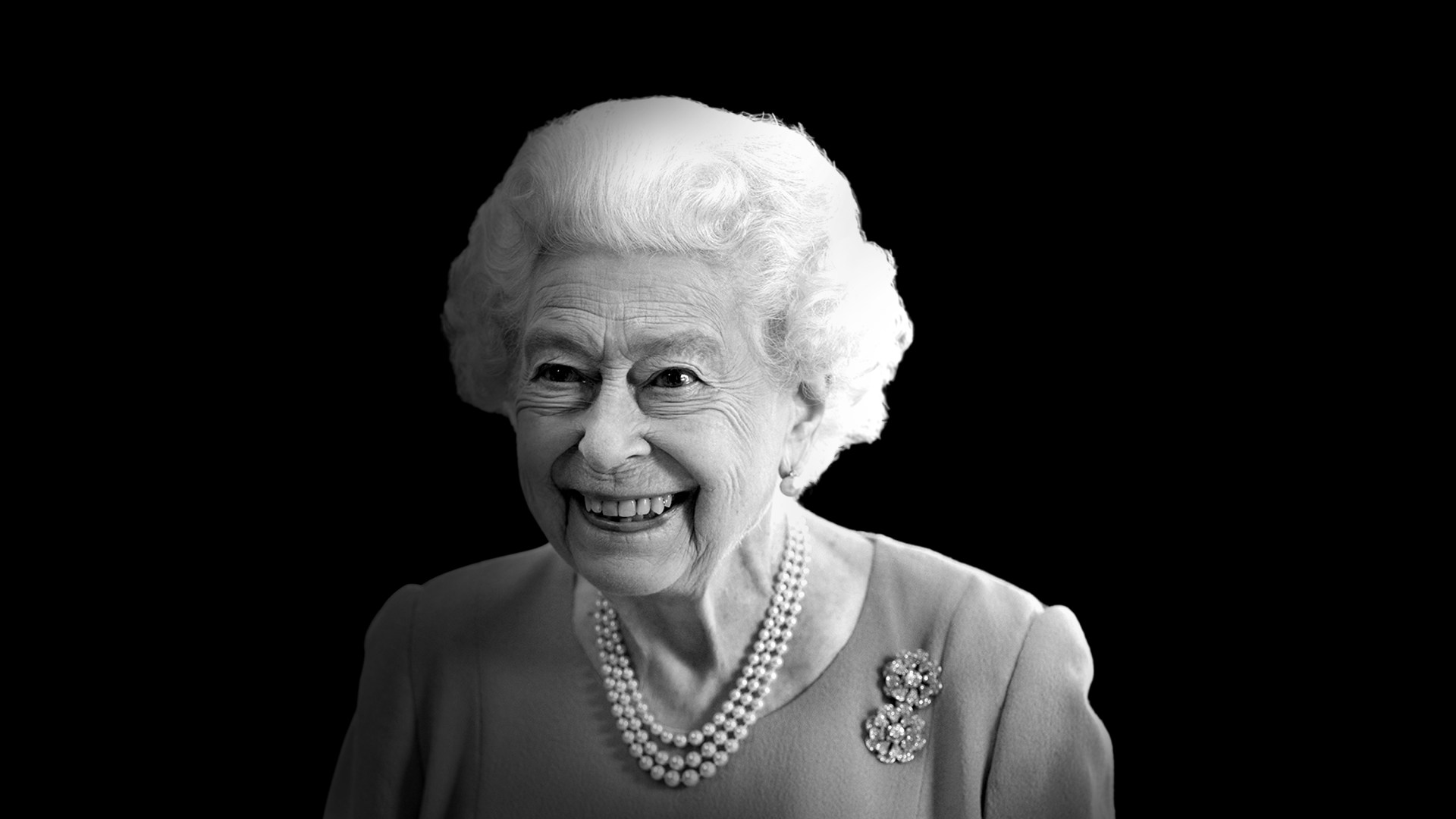
Queen Elizabeth II, the longest-reigning monarch in British history, has died at the age of 96.

Throughout the course of her unprecedented reign, Queen Elizabeth II spoke frequently about her personal Christian faith. Delivering her first Christmas Address in 1952, a tradition started by her grandfather, King George V, the Queen requested prayer for her upcoming coronation.

“I want to ask you all, whatever your religion may be, to pray for me on that day,” she said, “to pray that God may give me wisdom and strength to carry out the solemn promises I shall be making, and that I may faithfully serve Him and you, all the days of my life.”

As one of the world’s most recognizable and celebrated leaders for more than seven decades after that Christmas, the Queen demonstrated how to keep one’s Christian faith personal, private, inclusive, and compassionate while serving in a global, public role under intense scrutiny from virtually every sector.

Queen Elizabeth II inherited religious responsibilities as the Defender of the Faith and Supreme Governor of the Church of England, titles vested in the reigning British monarch since Henry VIII renounced the Papacy in 1534. At her coronation in 1953, Her Majesty took an oath to “maintain and preserve inviolably the settlement of the Church of England, and the doctrine worship, discipline, and government thereof, as by law established in England.”

Her duties included appointing archbishops, bishops, and deans of the Church of England as advised by the prime minister. In 1970, she became the first sovereign to inaugurate and address the church’s General Synod in person, a practice she continued every five years after diocesan elections.

Three weeks after her coronation, the Queen followed historical precedent and swore to maintain the Church of Scotland, honoring her duty to “preserve the settlement of the true Protestant religion as established by the laws made in Scotland.” The Church of Scotland is Presbyterian and recognizes only Jesus Christ as “King and Head of the Church,” resulting in Her Majesty’s lack of official title and participation as a regular member.

More than tradition

But the Queen’s faith was more than the product of polite deference to historical tradition. Throughout her reign, she articulated the importance of her faith and recommended it to her subjects.

“For me the teachings of Christ and my own personal accountability before God provide a framework in which I try to lead my life,” she said in 2000. “I, like so many of you, have drawn great comfort in difficult times from Christ’s words and example.”

In 2002 the Queen endured a painful year of personal losses with the deaths of her sister, Princess Margaret, and the Queen Mother. In her annual Christmas address that year, she spoke of how her faith had sustained her.

“I know just how much I rely on my own faith to guide me through the good times and the bad,” she said. “Each day is a new beginning. I know that the only way to live my life is to try to do what is right, to take the long view, to give of my best in all that the day brings, and to put my trust in God.”

The Queen consistently extended her influence to acknowledge and celebrate religious diversity and tolerance in the United Kingdom, the Commonwealth of Nations, and throughout the world. Her Majesty’s Christmas and Commonwealth Day messages often addressed the theme of interfaith harmony and respectful tolerance. Leaders of various faiths and denominations regularly attended royal ceremonies, including weddings and services of thanksgiving, at the invitation of the Queen and her husband, the Duke of Edinburgh.

Celebrating her Diamond Jubilee in 2012, the Queen attended a multifaith reception at Lambeth Palace, hosted by the Archbishop of Canterbury, featuring the leaders of eight faiths in the United Kingdom including Buddhism, Judaism, Islam, and Hinduism. At this event, the Queen said, “Faith plays a key role in the identity of millions of people, providing not only a system of belief but also a sense of belonging. It can act as a spur for social action. Indeed, religious groups have a proud track record of helping those in the greatest need, including the sick, the elderly, the lonely and the disadvantaged. They remind us of the responsibilities we have beyond ourselves.”

The Queen’s efforts were recognized in 2007 by the Three-Faiths Forum, an organization dedicated to building understanding and lasting relationships between people of all faiths and beliefs. It presented Her Majesty with the Sternberg Interfaith Gold Medallion, awarded to individuals who have helped promote peace and tolerance among people of different faiths.

Heir presumptive

Born on April 21, 1926, Elizabeth Alexandra Mary Windsor was the firstborn of the Duke and Duchess of York and the first grandchild of the reigning monarch, King George V, who reportedly delighted in the thoughtful, well-behaved child known by family as Lilibet. Elizabeth’s father acceded to the throne in 1936 as King George VI when his brother, King Edward VIII, abdicated in order to marry divorcée Wallis Simpson.

As the heir presumptive, Elizabeth was tutored privately and served in the Auxiliary Territorial Service during World War II. In 1947 she married Philip Mountbatten, of Greek and Danish royal lineage. Their union lasted 73 years until his death in 2021 and produced four children: Charles, Prince of Wales and heir apparent; Anne, Princess Royal; Andrew, Duke of York; and Edward, Earl of Wessex. In addition to her children, the Queen is survived by eight grandchildren and 12 great-grandchildren.

From the beginning of her reign, the Queen consistently cited references from Scripture, particularly in her annual Christmas broadcasts.

“To what greater inspiration and counsel can we turn,” she asked, “than to the imperishable truth to be found in this treasure house, the Bible?”

In her 2016 address, Her Majesty explained, “Billions of people now follow Christ’s teaching and find in him the guiding light for their lives. I am one of them because Christ’s example helps me see the value in doing small things with great love, whoever does them and whatever they themselves believe.”

Relationship with Billy Graham

Her friend and confidant Billy Graham attested to the Queen’s love for the Bible, as well as the strength and depth of her Christian faith, in his autobiography, Just As I Am.

“No one in Britain has been more cordial toward us than Her Majesty Queen Elizabeth II,” Graham wrote. “Almost every occasion I have been with her has been in a warm, informal setting, such as a luncheon or dinner, either alone or with a few family members or other close friends.”

They rarely publicized their meetings or leveraged their relationship professionally, but the two enjoyed a friendship that endured for more than 60 years until Graham’s passing in 2018. He wrote, “I always found her very interested in the Bible and its message.”

The Queen’s love of the Bible and its gospel message led to her participation in the publication of a special book to commemorate her 90th birthday. Titled The Servant Queen and the King She Serves, coauthored by Catherine Butcher and Mark Greene, this overview of Her Majesty’s Christian faith was published by Bible Society UK, for whom the Queen serves as patron, along with HOPE and the London Institute for Contemporary Christianity.

Her Majesty personally wrote the foreword, thanking readers for their prayers and good wishes. “I have been—and remain—very grateful to … God for His steadfast love. I have indeed seen His faithfulness,” she wrote.

The book was distributed to thousands of churches across the UK and throughout many Commonwealth countries prior to the Queen’s birthday in 2016. The book proved so popular that the Bible Society had to print another 150,000 copies to meet demand.

Fulfilling her vow

Part princess and part pope, both guardian and great-grandmother, diplomat and disciple, Her Majesty the Queen was the calm that carried on, stabilizing her nation and the Commonwealth during tumultuous periods of historical change and technological advancement.

“Ultimately, monarchy points beyond itself to the majesty of God,” wrote Ian Bradley, professor at the University of St Andrews School of Divinity. “It encourages the God-given human faculties of reverence, loyalty and worship. It derives its true sanction and authority from above rather than from below.”

Queen Elizabeth II was such a monarch. Bridging the 20th and 21st centuries, modernity and postmodernity, Her Majesty credited her personal faith in God and belief in Christ as her anchor amid the many storms, both public and private, that she endured. To the end, she fulfilled her sacred coronation vows to God, living faithfully and serving those entrusted to her care.

Dudley Delffs is a former English professor and the author of The Faith of Queen Elizabeth.

News

In Singapore, LGBT Perspectives Are Liberalizing. Can the Church Hold Together?

Evangelicals are eager to preserve their unity—and the country’s.

Christianity Today September 8, 2022
Illustration by Rick Szuecs / Source Images: Envato Elements / Stavrialena Gontzou / Unsplash

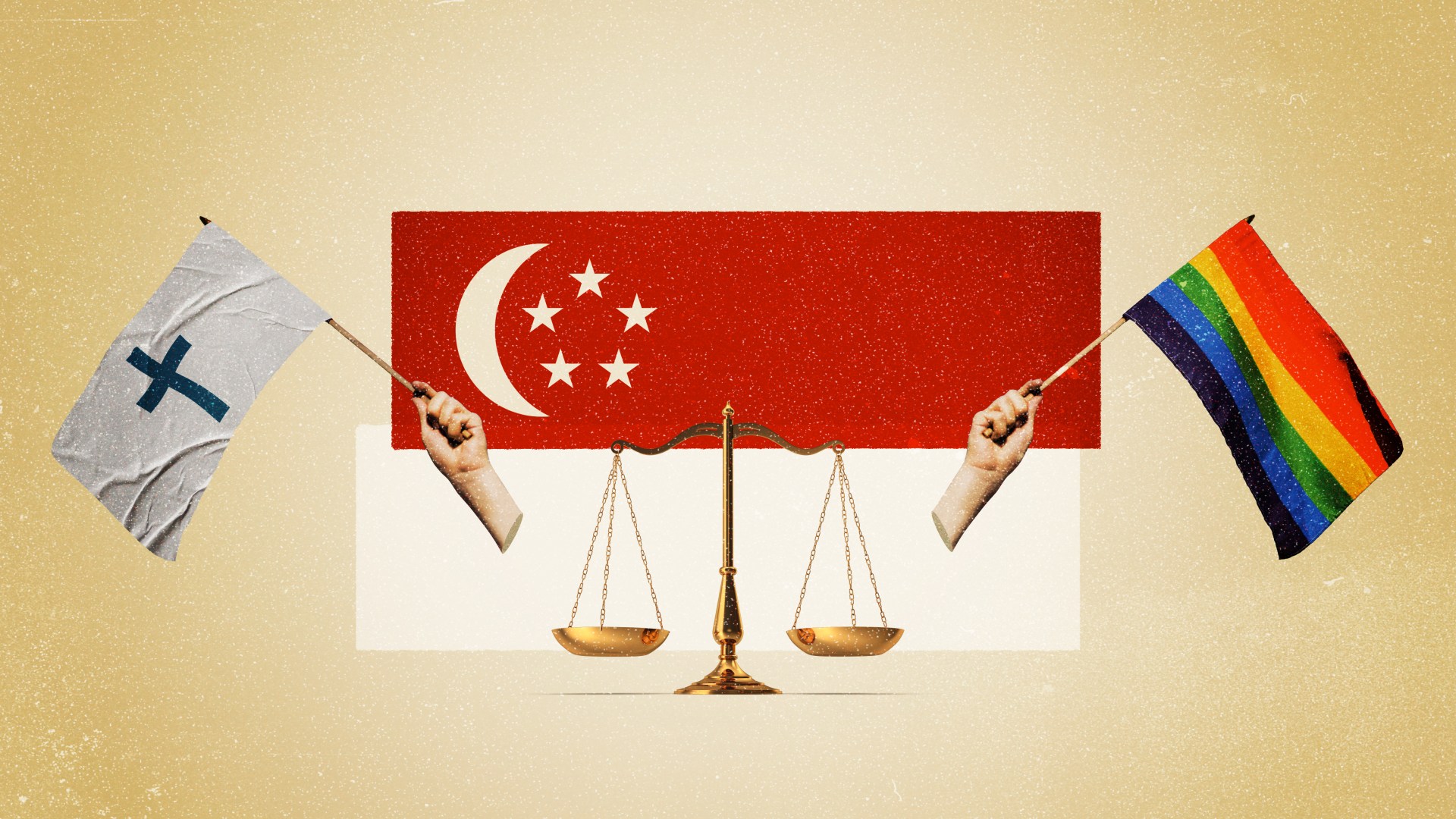
Singapore has decriminalized gay sex while pledging to add a constitutional amendment to protect the definition of marriage as between one man and one woman.

The country’s evangelical leaders broadly opposed the government’s decision to repeal Section 377A of the penal code and supported the proposed amendment. Though there are currently only mild discrepancies over strategies of engaging the government and the LGBT and same-sex-attracted community, they know the church is susceptible to division.

“There is understandable uncertainty and anxiety as we await the unfolding of a new social compact regarding marriage, family, and society involving citizens, the executive, and our law courts,” wrote pastor Christopher Chia in a letter to Adam Road Presbyterian Church. “What can we do on this journey? How can we watch and pray wisely, humbly and patiently? Do not allow S377A and sexuality to be the single issue that defines and divides us.”

Practicing biblical hospitality

Until prime minister Lee Hsien Loong’s announcement last month, sex between two men was technically punishable by up to two years in prison.

The National Council of Churches of Singapore (NCCS) praised the previous arrangement in which 377A existed but was not enforced. The Alliance of Pentecostal & Charismatic Churches of Singapore (APCCS) argued that the decision “signals a rewriting of acceptable sexual relationships, and celebrates homosexuality as being characteristic of a mainstream social environment.”

“There’s a profound fundamental agreement in terms of theological response. It’s the mode of engagement with government agencies that may differ,” said Keith Lai, former president of the NCCS. “We value this diversity of approaches while maintaining unity of spirit and heart.”

Evangelical denominations and institutions have been consistent: They did not want Section 377A to be repealed. If the government does repeal it, it should be done only when safeguards on marriage are put in place, says APCCS chairperson Yang Tuck Yoong.

“Then you have people who are more middle-of-the-road: Singapore is a secular society, so if the government is not enforcing 377A and decides to remove it, what’s the problem?” said Yang.

Some Christians have also seen 377A as hurting the church’s witness. In 2019, in a Facebook post generating nearly 600 comments, lawyer Jordan Tan said he was “completely at peace” with his role in advocating the constitutional challenge against Section 377A in the Singapore court and argued that his faith “required” him to do so.

The law prevents Christians and the LGBT community from communicating well and forming relationships, he wrote.

“It is self-evident which is more important: the roadblock or the potential of forming meaningful relationships with the entire LGBTQ+ community. It is also self-evident which will lead more people into a relationship with God.”

But at the local church level, leaders saw more differences in opinion around the repeal.

News about the penal code change last month spread like wildfire on Whatsapp, which led to “an uncomfortable amount of disagreement” among Singaporean Christians, said Jenni Ho-Huan.

Ho-Huan, a pastoral leadership consultant, contrasted the responses from ministry leaders who engage the government and local pastors who focus on their own congregations and communities.

“As an Asian society, we view the government as an ‘older brother’ and authority figure,” she said. To that end, Christians in Singapore typically leave interactions with the government to leaders of Christian networks.

“We have a high level of trust in our leaders [as well as] a passive citizenry,” Ho-Huan said. “Affecting the politics of the nation is very new to us.”

Instead, most of the way the church has previously engaged LGBT issues has been through personal relationships.

Prior to the repeal, local think tank ETHOS Institute™ for Public Christianity held a series of focus groups with people who experience same-sex attraction. Some stories from these gatherings were published in the 2018 book Good News for Bruised Reeds—Walking with Same-Sex Attracted Friends.

That same year, 3:16 Church, an APCCS congregation, founded True Love Is. The online ministry showcases stories of Christians who have turned away from same-sex attraction and experienced the restoration of their marriages and relationships.

More recently, the Methodist Church in Singapore, an evangelical liturgical denomination, has held workshops at its oldest and largest congregation, Wesley Methodist.

Young adults gather to discuss how believers may “welcome and provide a safe space for those wrestling with same-sex attraction in the church,” said bishop Gordon Wong, who also serves as an advisor to the Fellowship of Evangelical Students. “Many are keen to know practical handles on how to relate to friends, colleagues, and family members who have different views on this matter.”

Lai’s church, Covenant Presbyterian, has been inviting pastors and Christian leaders “at the frontlines” to speak at Sunday services and postlunch dialogue sessions. These speakers include activist Jason Wong, who organized against the repeal of 377A, and 3:16 Church’s senior pastor Ian Toh.

On average, 50 to 80 people have attended these events, which Lai says have left the congregation concluding that “we can’t come up with simplistic or naive answers” for people who experience same-sex attraction.

Methodist churches, meanwhile, agreed with NCCS’s statement and called upon its members to pursue a biblical vision of human flourishing that seeks the common good and demonstrates love for one’s neighbors, Christian or not.

“The church is always open to all, regardless of sexual inclination or other difficulties, because Christ is always open to all,” Wong said. “Every single human person has equal dignity before the face of God.”

J. Liu is a Methodist who opened REST@HARK, a ministry space for transgender sex workers in Geylang, Singapore’s red-light district. She’s keenly aware of the often divisive conversations between Christians and LGBT rights groups.

“There’s a difference between sitting on the fence and holding the tension between the so-called factions,” she said.

Though sex work is legal and transgender people are recognized in the country, they regularly face systemic discrimination and experience social stigma. Liu’s focus is not on changing regulations but on offering care and showing hospitality to people whose work is often regarded as taboo.

Kimhong Hazra, one of Liu’s mentors and an adjunct lecturer in mission studies at a local Bible school, says Liu occupies a unique position between the church and the transgender community: “She straddles both kinds of worlds in the hopes that both worlds can heal each other.”

To prohibit or proscribe?

The Singapore government’s plan to amend the Constitution to protect the definition of marriage against legal challenges would specifically “protect Parliament’s right to define marriage.” This falls short of demands from groups like the APCCS and the Evangelical Alliance of Singapore, as well as the Christian and Muslim organizers of Protect Singapore Townhall, who recently drew 1,200 people advocating against the penal code change.

Enshrining the definition of marriage in the Constitution as between one man and one woman means that it would require a supermajority to change its definition, explained Yang. By not doing so and protecting marriage only in the Women’s Charter, an ordinary law that sits below the Constitution, the definition of marriage could be amended with a simple majority vote. In Yang’s view, this would make it more vulnerable to change as LGBT activists push the boundaries and advocate for same-sex marriage.

Wong, the Methodist bishop, said that while safeguarding marriage through legislation is important, it is not the church’s ultimate priority.

“The church must, and will, always support marriages and families. But if the church places these above all else, or prioritizes political action or influencing legislation as our highest priority, then we would have missed the point of the two greatest commandments Jesus taught: Love God and love our neighbor.”

Because Christian marriages “are also falling apart,” the church needs to give “more robust explanations” for why marriage is meant to solely be between a man and woman and then proclaim this message to both Christians and society at large, says Ho-Huan.

“If you reduce its definition to the notion that marriage is intended for personal happiness, you will miss out on God’s heart for it,” she said. “Christian marriage is a sign of the kingdom of God.”

Changing political times

In 2007, the Singapore government repealed Section 377, which prohibited oral and anal sex between consenting adults. However, it opted to keep Section 377A about sex between men—which was introduced in 1938 by the country’s British colonizers—in the penal code.

This February, the country’s Court of Appeal ruled that while the statute would remain, it would be “unenforceable.” A month later, the government launched a public survey that gathered opinions on whether Section 377A should be repealed, modified, or retained. It received over 30,000 responses—a staggering number compared to the few hundred or thousand responses that such questionnaires usually get.

More recent surveys conducted in June and August showed an increasing acceptance toward same-sex relationships in Singapore, with 43 percent of citizens aged 18 years old and up saying they supported the repeal.

LGBT issues have fractured global denominations like the United Methodist Church and the Anglican Communion. But the Singapore story may develop differently.

Christian unity is a gift from God and something the church is to safeguard and uphold amid a culture of radical individualism, says Ho-Huan.

“At heart, this is about anthropology, and then ecclesiology,” she said. “We have a clear position on these as a church. They may need to be freshly articulated and agreed upon anew. This is a good exercise to mature the church.”

Beyond trying to maintain unity within the church, Singaporean Christians see it as their responsibility to help preserve the peace of their diverse nation. In a population of 5.45 million, 18.9 percent identify as Christian, 31.1 percent identify as Buddhist, 15.6 percent as Muslim, and 5 percent as Hindu.

It’s the government’s job to look after the social harmony of a diverse group of people, says Lai.

“Why do we expect a secular government to adopt Christian moral values?” he said. “It’s an unrealistic expectation. We set ourselves up for disappointment when we have that expectation.”

Theology

What Church Splits Can Teach Us About a Dividing America

As in the past, one can learn about our nation’s political divisions by looking at our religious ones.

Christianity Today September 8, 2022
Illustration by Rick Szuecs / Source Images: Envato Elements

This piece was adapted from Russell Moore’s newsletter. Subscribe here.

An uncanny number of people are imagining the looming collapse of the United States.

Some speak openly of preparing for “civil war,” while others crow about the need for a “national divorce” between red and blue states. Most, though, whisper these thoughts. They look at a country seemingly at the breaking point and begin to wonder whether we may indeed be heading for a national conflict of some kind.

To answer such questions, perhaps even the most secular Americans should look to a religious phenomenon that has proven in years past to be a leading indicator of our nation’s future: church splits.

In the Baptist tradition, the year 1845 was key—we learned about it in church history alongside other momentous years like 325 (the Council of Nicaea) and 1517 (the start of the Protestant Reformation). In 1845, the denominational structure I grew up in—the Southern Baptist Convention—was formed.

We always spoke of our founding as having been spurred by a passion for world missions and evangelization. And yet most of us knew that 1845 wasn’t really a “founding” at all; it was a split. Yes, there was a dispute between northern and southern Baptists over the nature of missions—but the real debate was over whether to appoint slaveholders as missionaries.

What’s relevant about this split is, first, that it happened alongside similar splits in almost every other American Protestant denomination, most notably the Methodists and the Presbyterians. What’s also noteworthy is the timeframe: These splits happened well before the actual onset of civil war—the Baptists’ split took place a full 16 years before.

If people had wondered then whether the country would hold together, they could have seen an eerie omen in the fact that its churches seemed to be tearing apart.

In those years, our churches and denominations were splitting not over the deity of Christ or the right way to baptize but over the exact same issue dividing the country as a whole: whether to perpetuate human slavery and proliferate white supremacy. And the religious divisions happened just as the political ones did—roughly along the Mason-Dixon Line.

Several years ago, I asked an older, lifelong Missourian minister in my tradition why so much fighting seemed to happen in the Missouri Baptist Convention. Sure, there was fighting everywhere, but Missouri seemed even more on edge than most places.

“It’s because we were a border state in the Civil War,” he said. “Nobody could be sure back then whose side anybody was on, so there was a kind of mistrust that just became a habit. That’s affected the churches till this day.”

I’m not sure whether his diagnosis is accurate, but we cannot deny that many clashes linger, sometimes for generations—long after everyone has forgotten what the fight was about in the first place.

Most places split neatly along regional and political lines. If one went to church in Massachusetts, that church—whether it was white or Black—was probably abolitionist. And if one went to a white church in Alabama—almost regardless of denomination—that church was probably pro-slavery.

The churches split before the country did, but for all the same reasons. The only difference was that once the country came back together—following the victory of the Union and the emancipation of enslaved people—the churches remained apart. Some of them are still split more than 150 years later.

This came to mind as I started paying attention to the fact that almost every church tradition in this country seems to be splintering right now. Yet this fragmentation seems quite different from the kind we saw back in the 19th century.

The United Methodist Church, for instance, is undergoing a formal split into at least two different churches over the presenting issue of human sexuality. The more “progressive” forces are staying within the existing structure, while the more “conservative” ones are joining with Methodists around the world—especially in the Global South—to form the Global Methodist Church.

This split makes sense to me. After all, most people would agree that the division is about more than just sex. For those who, like me, are more conservative, the issue is about the authority of Scripture. Those who are more progressive view it as a question of basic human rights and inclusivity. Both groups agree that the stakes, although different for each faction, are equally high—and there’s no way to meet in the middle.

When it comes to the future of American democracy, though, the most interesting point is not why but how the split is happening.

I asked a pastor of a large Methodist congregation what took the churches in the denomination so long to figure out that they must go in different directions. He responded, “You are looking at this wrong, and a lot of people do. People think there are conservative churches and progressive churches and we just put the one group in one denomination and the other in another and then we’re all happy. You’re wrong.”

“Most congregations are not ‘blue’ or ‘red,’ if you want to use the partisan political analogy,” he said. “Most of the conservative congregations are 30 percent progressive, and most of the progressive congregations are 30 percent conservative. We’re not talking about a dividing line going down the middle of a denomination but a dividing line going down the middle of almost every individual church.”

After that conversation, I started asking different questions of my Methodist friends. I asked one group of pastors, “When the Methodist Church splits, where is your congregation going?” One answered, “Thirty percent of my church wants to stay put, 30 percent wants to leave, and 30 percent just want everybody to get along. Ten percent don’t know that anything’s going on.” Many others nodded.

I then asked, “So what are y’all going to do?” One of the pastors quipped, “Take early retirement,” and the others laughed and said “Amen!” I’m not sure they were joking.

Yet their situation tracks with the state of the country—perhaps not in the reason for the division but in how it is playing out.

As many have pointed out, the idea of blue states and red states is not really accurate. California is blue, but what about Bakersfield? Texas is red, but what about Austin? Washington is blue, but what about Spokane? Louisiana is red, but what about New Orleans? And that reality is not just about urban areas in primarily rural states or the reverse. Even in the reddest part of America, at least a third of the people are blue, and vice versa.

This is why those who study civil wars and national breakdowns are warning us that a “national divorce” could indeed happen but that it won’t look like the firing on Fort Sumter. Instead, many of them say it could look much more like Northern Ireland of years past—with violent outbreaks and insurgencies and the sort of division that can’t be charted on a map.

In that sense, maybe the warning for our future is not in the split-up of the United Methodist Church—even with all its local complexities. Maybe the warning is what’s happening in almost every other denomination.

In many denominations and churches, the ones who are fueling the division don’t necessarily want to “win” or govern anything; they simply wish to channel their rage at existing institutions and express contempt at the real or imagined “elites.” Unlike the debates over sexual morality or biblical inerrancy, these insurgencies are usually about not theology or mission but the very secular forces fracturing the country.

For more conservative and evangelical churches or denominations, such insurgencies are often composed of ethnonationalist alt-right identity politics—and/or resentment of the norms and institutions that have held the groups together. How well these groups navigate the situation is determined largely by the way their leaders react.

In some church groups, leaders recognize that they must distinguish between those who dissent from some aspect of church life—an objection that should be respected and protected—and those who are, in reporter Amanda Ripley’s memorable words, “conflict entrepreneurs.”

In churches or denominations where leaders prioritize their positions or pensions—as is the case in much of the country’s civil arena—such insurgents will be appeased. This is especially true for leaders who are nihilistic since they will do and say anything.

Churches and denominations that will overcome all this are those that believe there is a higher accountability: the judgment seat of Christ and the authority of Scripture. For them, what matters is not just who wins or loses but what sorts of personal character and integrity mark those who win or lose.

I fully expect that the United States is resilient enough to overcome its present divisions and to conserve democracy for generations to come. But it won’t happen by pretending this will just occur on its own—or that some imagined superheroes will rescue us. Such a feat will take, as it has before, citizens who are willing to stand up for the norms and rules and institutions that have kept the country together thus far.

In the meantime, if we want to know where the country is heading, perhaps we should pay attention not just to the fact that our churches are splitting but to how they are splitting.

Russell Moore leads the Public Theology Project at Christianity Today.

Ideas

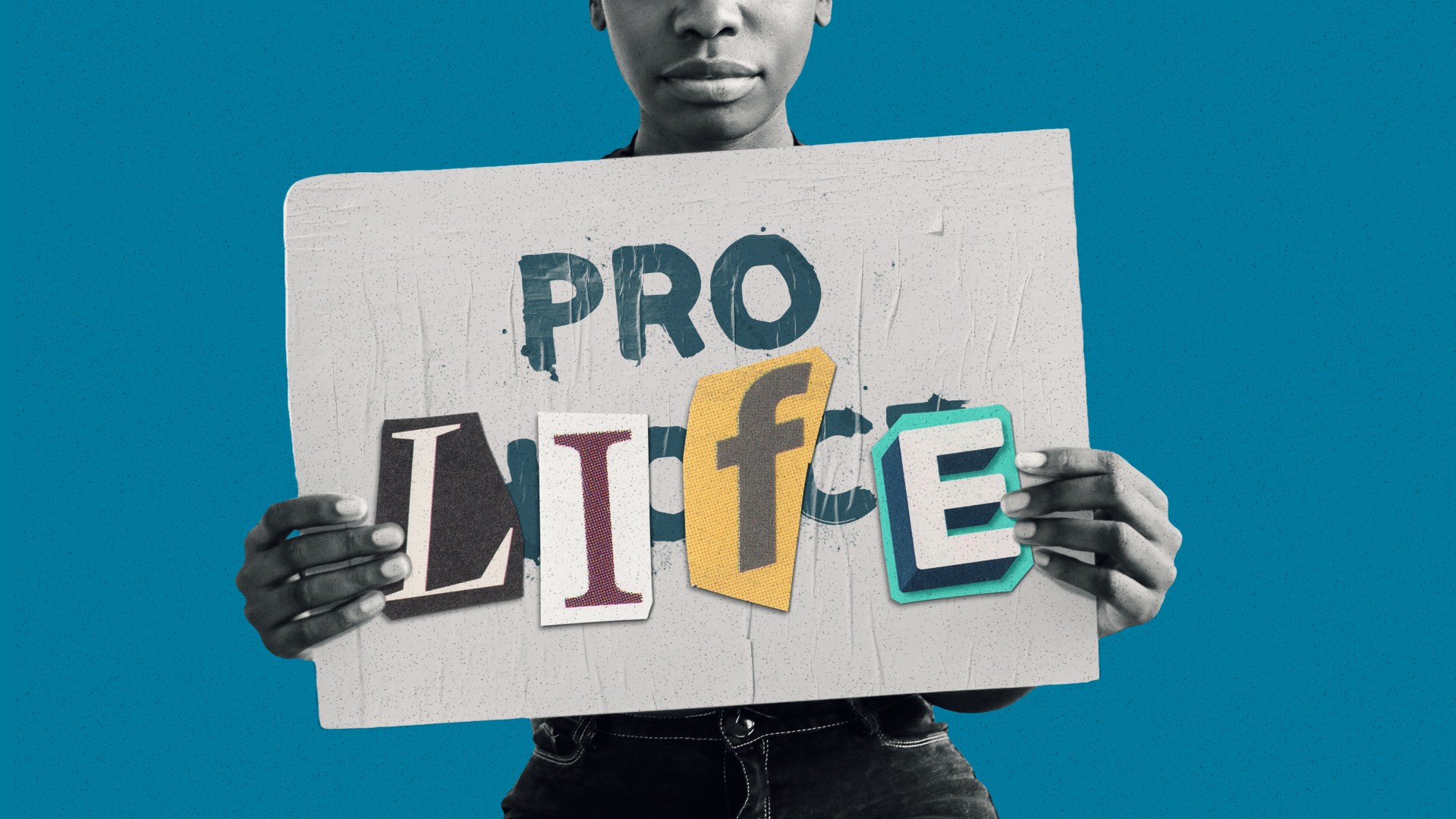
5 Reasons for Progressive Christians to Join the Pro-Life Cause

Contributor

Our historic, global faith tradition connects sanctity of life with social justice.

Christianity Today September 8, 2022
Illustration by Rick Szuecs / Source images: Envato / Polina Tankilevitch / Pexels

There was a time in the not-too-distant past when opposition to abortion united evangelical Christians across the political spectrum. Along with political conservatives, left-leaning advocates for the poor like Ron Sider spoke out against abortion.

In 1987, he published Completely Pro-Life as an explanation for why Christians should support a consistent life ethic. Sojourners magazine, the leading periodical of the evangelical Left, published several pieces against abortion in the 1980s.

But that moment is gone. This summer, when the Supreme Court’s decision to overturn Roe v. Wade ignited a political firestorm, the abortion debate became even more partisan than it already was, and some progressive evangelicals found it difficult to harmonize their social justice commitments and defense of women’s rights with antiabortion advocacy.

Though still claiming to be “consistently pro-life,” Sojourners reacted to the SCOTUS decision by publishing an editorial titled “Women’s Needs Are Holy. Overturning Roe Ignores That.” Another one of their editorials called for churches to help women find safe spaces for abortion.

If this is true of some Christian magazines and organizations, it’s probably even more true of Christians in the pews. Evangelical pastors who believe in the sanctity of unborn life know this better than anyone.

Those with urban congregations in blue states (or blue cities) have progressive-leaning attendees who now associate the pro-life label only with red-state Republicans, whom they sometimes view as Trump-supporting misogynists. Those church leaders may wonder if it’s even possible to talk about unborn life in a way that won’t drive their churches’ social justice–oriented progressives away.

Now more than ever, it’s important to remember two things: The church’s concern for the unborn long predates the Republican Party, and the pro-life movement is not an invention of American conservatism.

There is a way to defend the pro-life cause without falling into political partisanship. But doing so will require us to move our conversations about abortion out of the framework of American nationalism and into a broader, global Christian tradition that connects concern for the unborn with compassion for the marginalized.

With that in mind, here are five reasons why Christians who care about social justice should oppose abortion:

1. Concern for the unborn unites us with a 2,000-year Christian tradition of viewing human life as a unique creation of God.

Both abortion and infanticide were common in the ancient Roman world, but opposition to these practices distinguished ancient Christians from their pagan neighbors.

Some of the earliest extrabiblical Christian writings we possess—including the second-century works Didache and Epistle of Barnabas—condemn abortion. Though not all branches of the church have consistently opposed the practice, both the Roman Catholic Church and the Eastern Orthodox Church view it as a grave sin.

The pro-life cause, then, unites evangelicals with historic Christian teaching and the largest branches of Christianity throughout the world. It also unites us with a biblical witness that emphasizes the conception of Jesus by the Holy Spirit as the moment when God himself became united with humanity through the Incarnation.

The assertion that our lives belong ultimately to God—not to the state, not to the community, and not even to our parents—is a radically liberating Christian declaration that applies even to the preborn.

2. Concern for the unborn is a countercultural witness against a contemporary Western society that devalues children.

It was no accident that support for legalized abortion in both the United States and the larger Western world increased at the precise moment when concerns about overpopulation prompted many people in North America and Europe to view children and larger families as a social or ecological imposition.

A Christian witness against abortion is a countercultural protest against a society that too often treats children as an afterthought, a luxury, or even a burden.

The Christian responds to the early pro-choice slogan “every child a wanted child” with the affirmation that every child is already a wanted child in God’s sight. We believe the church has a moral duty to value those children and affirm the fact that they’re wanted. A baby is not merely a choice but instead a divine image-bearer—a creation of God with an eternal future.

3. Pro-life advocacy is a countercultural affirmation that women deserve better options than abortion.

“Do women want abortion?” asks the Orthodox writer Frederica Mathewes-Green. “Not like she wants a Porsche or an ice cream cone. Like an animal caught in a trap, trying to gnaw off its own leg, a woman who seeks an abortion is trying to escape a desperate situation by an act of violence and self-loss. Abortion is not a sign that women are free, but a sign that they are desperate.”

If Mathewes-Green is correct, the real pro-woman stance is not to advocate for greater abortion availability but rather to release the trap in which so many mothers (especially poor ones) are caught.

Seventy-five percent of women who get abortions are living either below the poverty line or just barely above it. The majority are already mothers of at least one child but find it difficult to contemplate welcoming another child into their home.

Instead of merely giving these women the opportunity to terminate their pregnancies, pro-life advocates insist they deserve something better. They find a way to empower these women so they can leave the trap they’re facing without metaphorically gnawing off their own legs.

4. Pro-life advocacy unites us with a global movement of people in lower-income, non-Western nations who are resisting the individualistic message of the secular West.

Abortion is illegal or heavily restricted in 50 of Africa’s 54 countries, and some African pro-life activists are sharply critical of Western efforts to make it legal.

Most “developing nations don’t want abortion,” argues Obianuju Ekeocha, the Nigerian biochemist who founded Culture of Life Africa. But Western international family planning agencies often ignore these countries’ traditional values. She views their actions as a form of “neo-colonialism” and “a distraction to the development project that should be happening in developing countries.”

Instead of providing food, water, and education, Western-funded family planning agencies assume that what Africa really needs is fewer people—and Ekeocha resents this.

Africans themselves value children as a “gift,” Ekeocha says, even when they are experiencing deep poverty. She believes the pro-life movement affirms this traditional African value.

5. Pro-life activism is a way to defend the value of those with severe disabilities, who are the most likely to be victims of abortion in an age of widespread prenatal screening tests.

In Iceland, there are now only one or two children with Down Syndrome born each year—not because the country has found a cure but because nearly every mother there whose unborn child tests positive for the condition opts to have an abortion.

What’s happening in an extreme version in Iceland is happening to a slightly lesser degree throughout the Western world.

While it is certainly true that a child with Down Syndrome requires an extraordinary amount of care, a Christian witness against abortion is in part a declaration that the world needs all the people God created—including those with Down Syndrome and even more severe disabilities.

It’s a declaration that people cannot be “scrapped like so many defective parts that fail to pass inspection at the end of a production line,” as Georgetown University philosophy professor Germain Grisez wrote in 1970.

These five reasons for opposing abortion might inspire some people to give the pro-life cause a second look, but if we want our witness to be genuinely persuasive to progressives, we need to make sure we’re not simply invoking a few progressive platitudes as window-dressing for a conservative movement. We need to make personal sacrifices to care for the marginalized people we insist are valuable.

If we declare that low-income women facing crisis pregnancies deserve better than abortion, we need to work hard to release them from the financial and relational traps they’re experiencing. If we insist that children with Down Syndrome are valuable, we need to make sure we’re offering support to parents who have undertaken the challenge to care for those kids.

If we say that children are valuable, we need to treat them as valuable in every sphere of our lives, whether they’re preborn or already born. And if we say that we’re pro-life because it connects us to the witness of the Bible, historic Christian teaching, and the global church, we need to make sure we’re open to that witness in every area of our lives.

As we witness to progressives in our midst, perhaps it’s especially important for us to genuinely care about women’s rights. What are we doing, for example, to promote better family leave policies in the workplace, or childcare options that empower women and promote their economic security?

Over time, we may well find that a lot of what passes for pro-life politics in this country is really not consistent with these larger values and will have to be jettisoned. And Christians who are concerned about the unborn may well disagree among themselves over exactly how to translate those values into law—which means that many pro-lifers may not necessarily support all antiabortion political initiatives that are labeled “pro-life.”

But the core pro-life message—that unborn human beings have great value in God’s sight and deserve our support—is one that all Christians need to affirm, regardless of our political ideology.

It’s a deeply countercultural message even for political conservatives—which is all the more reason that progressive evangelicals should embrace it in today’s partisan environment.

Daniel K. Williams is a professor of history at the University of West Georgia and the author of Defenders of the Unborn: The Pro-Life Movement Before Roe v. Wade.

Inkwell

Comic Relief

Inkwell September 8, 2022
Photography by Ricardo Braz

last night, i dreamed God laughed a laugh so hearty, his diaphragm shifted seismic plates; then aftershocks of his giggles rippled bonus joyous energy waves. as steaming hot tears streamed down his face, they washed civilians clean and his pearly whites beamed pure light over seven billion black holes. this morning, i awoke to the image of a throne, a gavel, a face unseen, captioned with a poem concerning the almighty supplier of humor who also reserved a portion for himself. scrolling away, i landed upon a meme liked by God and 2 others. last night, God laughed at a meme.

Isaac Akanmu is a poet & financial analyst. His debut poetry collection was published with Bottlecap Press (June 2022)

News

The Kenyan Presidential Election Is Over. The Conversation About Christians and Politics Has Just Begun.

William Ruto credited God and church leaders for his victory. Should this be the model?

Christianity Today September 7, 2022
Ed Ram/Getty Image

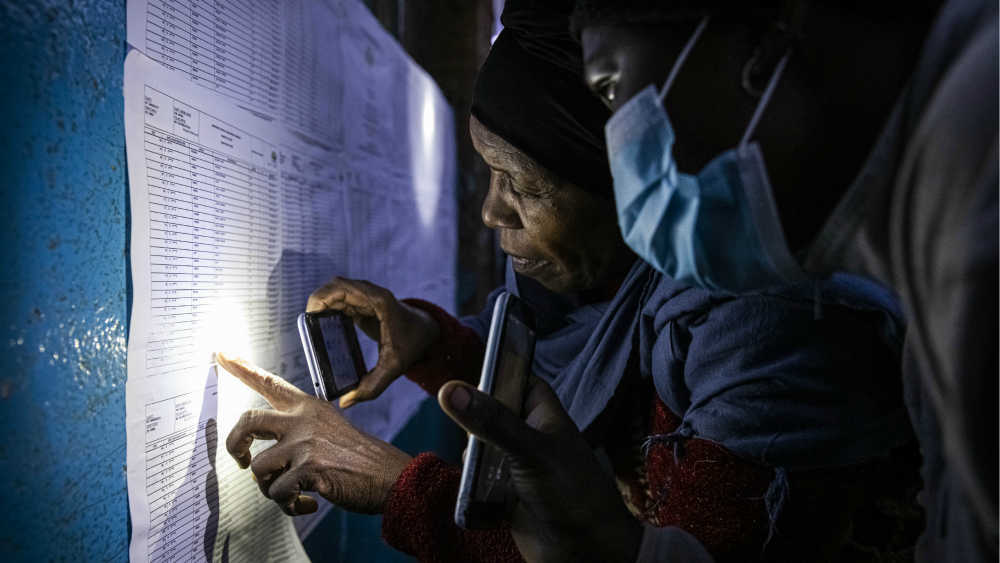
William Ruto sees the hand of God in Kenya’s presidential election results.

“We have worked hard,” the outgoing deputy president told his supporters after the Supreme Court ruled he won the presidency, defeating five-time challenger Raila Odinga. “But as the Bible teaches us … some trust in chariots, some trust in horses, but we trust in God.”

In another victory speech, Ruto credited the many pastors who opened their pulpits to him, accepted donations from his campaign, and urged their congregations to pray for his electoral triumph.

“I have been prayed into victory,” Ruto said.

But as the nation wrestles with the results of the contested election and fallout from the monthlong dispute over the legitimacy of the results, Christians in Kenya are left reflecting on the role believers should have in the fraught political system. Christians make up nearly 90 percent of the population. How should they push for their preferred policies, participate in the political jostle of a campaign, and work to prevent the violence that has too often followed national elections?

Few spoke out against one-party rule

Church leaders, like the rest of Kenya, are still adjusting to a multiple-party system. The nation achieved independence from Great Britain in 1963. But before the decade was out, all political power had been consolidated into a single party. The second president, Daniel arap Moi, stayed in power for nearly 25 years. He has been praised by some—including Ruto—for providing stability, but also accused of human rights violations and called a dictator.

Christians occasionally criticized Moi during his long presidency, but their voices were generally muted. Most supported Moi, even when they disagreed with particular decisions.

“The president was perceived as a benevolent friend of the church, himself being a committed member of one of the larger mainstream denominations—the African Inland Church,” said Wilson Kiuna, who heads a leadership program at Hesabika Trust, an organization supporting Christians in public service.

A few Christian leaders took strong stands against Moi. That agitation came at a cost, and Christians in Kenya are still divided over what to think about their examples.

“The suppression against these voices was so intense that those who engaged in the fight were few and pronounced,” said George Ogalo, the chief operating officer at International Fellowship of Evangelical Students (IFES). “Church leaders who confronted the government of the day were considered by the majority of Christians as being too political and deviating from their core mission as shepherds of the church.”

Since Moi left office in 2002, Christians have gotten more involved in the day-to-day debates over politics and policy. Many were drawn into political debates by a constitutional referendum in 2005—when two of Kenya’s largest Christian groups focused on different priorities and ended up on opposing sides.

The next year, a group of evangelical and Protestant leaders came together and launched their own party, the Agano Party, demonstrating that at least some Christians were interested in a new approach to politics in Kenya. Not many, though. In this year’s election, David Mwaure, the Agano candidate, only earned 0.2 percent of the vote. (Another Christian, gospel musician Reuben Kigame, submitted presidential nomination papers but did not make it on the ballot.)

Then in 2007, Odinga lost his second bid for the presidency but claimed the election was unfair. He made allegations of fraud and called for nationwide protests. His aggrieved supporters clashed with police and paramilitary forces, and more than 1,000 people were killed. Four churches were destroyed in the riots—including one in an attack that killed 50 people—but many in Kenya placed the blame on the pastors themselves.

Responsibility for catalyzing violence is disputed, but there’s no question that the crisis hurt the witness of many Kenyan Christians. The churches, at minimum, were unable to overcome ethnic divisions or prevent believers from attacking other believers.

“At first, leaders spoke like there was nothing wrong,” said one church leader in the Nyanza province who asked not to be named for his own safety. “When they should have spoken the truth, they kept silent, and some of them spoke too late.”

“I remember meeting Peter Mwangi, a young man from my neighborhood, whose family was affected by violence,” said William Kiptoo, the peacebuilding coordinator for Mennonite Central Committee in Kenya and Tanzania. “He told me that he was changing his faith because he saw Christians burning other Christians’ homes.”

Ethnic divisions trouble church

The divisions, of course, did not emerge suddenly in the crisis. Abraham Rugo Muriu, who leads International Budget Partnership Kenya’s office, says they can be traced back to Kenya’s colonial history, and the way people were separated and organized against each other to benefit British rule. The effects linger on.

“We don’t trust people who don’t speak our language, do not live in our areas, to speak for us,” he said. “Ethnicity has been quite divisive, because then it means that even when you have people who have fairly good standing, the fact that they don't belong to that ethnic group, or there seem to be ‘others,’ becomes a problem.”

Ethnicity also limits who receives presidential consideration in the first place, says Nelson Makanda, the general secretary at the Evangelical Alliance of Kenya (EAK).

“It remains more likely that a presidential candidate from any of the big five communities, Kikuyu, Luhya, Kalenjin, Luo and Kamba, will be elected president just because of their ethnic identity rather than any other factor,” he said.

Going into the 2022 election, many church leaders were still concerned about these internal divisions. They have an impact on national politics and limit Christians’ potential influence over the nation.

“The church in Kenya is split along ethnic lines,” Rugo Muriu said. “Faith and church seem to be sacrificed on the altar of ethnicity.”

As the candidates started campaigning in earnest, though, the pressing question for most churches was whether they would invite the presidential contenders to speak from the pulpit. A number of denominations—reflecting concerns about the past relationship between church and state—felt that having politicians speak in a service was a problem.

Anglicans, Presbyterians, Roman Catholics, and some evangelicals banned candidates from their pulpits.

“Christians from traditional denominations espouse more the popular theology of politics as a ‘dirty game,’” said Kiuna, with the Hesabika Trust, “and thus maintain a certain aloofness in matters of public and political engagement.”

One notable exception was the Methodist Church in Kenya, which decided that congregations could, if they wanted, invite presidential candidates to speak.

“The church is for all people,” said Joseph Ntombura, presiding bishop of the Methodist Church in Kenya. “Human beings are political, so there is nothing wrong with inviting the politicians in church.”

Questions about corruption

Many of the Kenya’s Pentecostal and charismatic churches also welcomed presidential contenders. Odinga visited a convention for the Akorino church, one of the largest of what are called the African Instituted Churches. He sat next to the church president and made a donation.

Despite his coziness with some church leaders, Odinga’s attempts to court conservative Christians didn’t always go well.

“Odinga and his running mate have made some damning statements that have rubbed evangelical Christians the wrong way—such as stating that small churches should be closed, that Christianity’s dominance in Kenya is a colonial legacy that needs to be brought down—and made promises to the Muslims to rectify this,” said Rachel Kitonyo, a Christian lawyer.

Ruto did better at reaching out to churches, she said. He repeatedly expressed his support for Christians and donated money to congregations and said his faith shaped his beliefs on homosexuality. He quoted Bible verses and talked about working together with Christian leaders, which resonated especially with Pentecostal Christians.

The candidates’ efforts to court Christians raised questions, for some Christian leaders, about the ideal relationship between pastors and politicians. Should churches be accepting money from political campaigns? For some, the donations raised the specter of corruption.

More than two-thirds of Kenyans (68 percent) think at least some religious leaders are corrupt. Kenya ranks 128th out of 180 nations in Transparency International’s Corruption Perception Index.

“It is not a secret that the matrix of money, power, ethnicity, and religion can create more hostility and relegate the values the nation has always aspired for,” said Ogalo.

Ruto “has projected himself as a genuine believer only interested in advancing the kingdom of God,” said Lucas Owako, an Anglican priest in Nairobi. “While some have argued that the millions given every week in such fundraisers are obviously proceeds of corruption and should therefore not be accepted in church.”

Owako finds it worrying that in his eyes the Kenyan church often only seems to speak with a collective political voice when it comes to abortion, LGBTQ issues, or religious freedom.

“Christians tend to feel that these issues directly concern them as compared to, say, issues of declining economy, national debt, corruption, or dysfunctional health systems,” he said. “That is why we all stood up to be counted during the campaigns for the 2010 constitution, which we opposed, but are muted, ambivalent or disjointed in confronting the latter issues, which are also real in the country.”

Organizing against postelection violence

One common point of consensus on Christian witness going into the 2022 election was that Christians could be—and should be—a voice for peace. Many viewed violence as a top concern and saw a role for Christian leaders. Churches came together and organized with the aim of preventing the riots that happened in 2008 and the violence that marred the 2013 and 2017 elections as well.

In an attempt to be proactive, several Christian groups organized a church and politics summit in 2021 and later released a Bible study guide based on the event.

The Association of Evangelicals in Africa’s (AEA) Msafara wa Upendo—a Kiswahili phrase that translates to Caravan of Love—pulled together groups in Garissa, Lamu, Isiolo, and Nairobi counties, all of which have seen conflict in past elections. Pastors and imams were asked to preach about peace inside and outside their houses of worship.

Some ministers affiliated with the AEA also served as election observers accredited by Kenya ’s Independent Electoral and Boundaries Commission and worked in five different counties.

“Be patriotic enough to accept the outcome,” said the AEA’s general secretary, Master Matlhaope, in a statement released on Election Day. “A peaceful election largely depends on the loser’s maturity and the winner’s magnanimity.”

Ruto declared himself the victory shortly after the August 9 election, with about 50.5 percent of the vote. As the challenge from Odinga made its way through the courts, the EAK called for peace and asked its members to pray for guidance for the judges. The organization also posted a hotline on their social media pages asking people to report any incidents.

These efforts came on the heels of another EAK program which had paired Christian leaders with presidential candidates, asking the former to pray for, encourage, and visit with these leaders.

“To a great success, these are the leaders that eventually became a bridge for/in mediation and peace building initiatives in the post-election season,” said Makanda.

To some observers, this seemed like an important step in Christians’ view of their political responsibilities in Kenya.

“Christian leaders’ understanding of the nexus between faith and politics is expanding, so many of them are taking their roles seriously as mediators, reconcilers, healers, advisers, and peacemakers,” said MCC’s Kiptoo. “There are many Christian leaders that organized prayer sessions for the country and for candidate and these help the congregants to take their roles seriously.”

There was little violence in the month of simmering tension as the challenge to the election results went to the Supreme Court. Christians, like their new president, are thanking God for that, as they continue to figure out their role in public life going forward.

Theology

Sex Scandals and the Evangelical Mind

How stories of misbehavior distort our vision of male-female friendship in the church.

Christianity Today September 6, 2022
Illustration by Rick Szuecs / Source images: Envato Elements

When news of Matt Chandler’s “inappropriate” online relationship popped up in my phone notifications last week, I was in the middle of a church staff retreat with my copastors, who are all male. I interrupted one of them to read the story aloud.

The news landed like a lead balloon between us, and then we came together as a group and talked about how stories like this make us feel and whether our own ministry friendships might be “inappropriate.”

The larger evangelical world was shaken too. Twitter exploded with a reanimated debate over the Billy Graham Rule, and many called on The Village Church to publicly release the investigation report. “It is always best practice to release the result of an independent assessment,” said Rachael Denhollander to The New York Times.

God’s call for truth and justice demand that leaders get to the bottom of what happened at The Village Church. But as one of the pastors of my local village-with-a-small-v church, that’s not the most important story for me to pay attention to. The question that matters more is not “What happened there?” but “What’s happening here, in me and among us, when we read stories like this?”

More specifically, how do scandals both small and large distort our view of male-female friendships in Christ? And when we read these narratives—one after another in the midst of an ever-accruing abuse crisis—how do our minds close off to the possibility of healthy brother-sister relationships in the church?

The stories we hear powerfully shape our imaginations, both positively and negatively.

For example, seeing Beth Moore teach the Bible has inspired a generation of women to pursue ministry they might not have otherwise considered. In the context of marriage, focusing on good stories from our shared pasts can help heal and improve those relationships. And on social justice issues, representation matters, because stories kindle our imagination for the diverse good that’s possible.

But painful news of scandal and failure affect us, too. They disciple us to be afraid, says Catherine McNiel, author of Fearing Bravely. Those fears are both particular and personal: For the 1 in 3 women (and 1 in 4 men) who are survivors of sexual assault, reading headlines about abuse and impropriety might trigger deep-seated trauma.

For those in vocational ministry, these scandals can leave us feeling trapped in a Catch-22 situation.

“It makes me second-guess everything I do,” one male pastor shared with me. “I could get in trouble for reaching out to a woman I’m pastoring, or in trouble for failing to ‘care for the flock’ if I don’t. I’m damned if I do, and damned if I don’t.”

Women feel a similar tension in the wake of community reactions to sexual scandal. Will we be frozen out as men retreat behind the “safety lines” of the Billy Graham Rule? Or will we get hurt if we stay engaged?

Horror stories of abuse and scandal trigger our “lizard-brain” fears, writes Russell Moore, and we run the risk of being paralyzed with despair. In those situations, says Brené Brown, always ask: “What’s the story you’re telling yourself?”

For many men and women, the story they might be telling—learned from headlines over the years—is that any male-female relationship is fraught with danger.

A case like Chandler’s “yet again sends the message that men, especially pastors, cannot have healthy sibling relationships with women,” writes Aimee Byrd, author of Why Can’t We Be Friends? “Be careful not to talk frequently with us! Be careful not to be too familiar with us! Be careful not to joke around us! You will not be above reproach.”

In the wake of scandal and sin, our deep-seated desire to protect the church from future harm often works itself out in a fresh iteration of policies and principles that are meant to demarcate male-female boundaries. In this case, for example, some leaders’ instincts to double down on the Billy Graham Rule seems understandable.

But, as I’ve written elsewhere, it’s not enough to legislate against sin. We need the Cross, and we need God’s grace. If all we do is avoid getting things wrong, we can’t grow a community of thriving relationships. The fear of the Lord—not the fear of sin—is the beginning of wisdom (Prov. 9:10).

Our news feeds contribute to this problem. A bad-news diet gives us a partial and distorted vision of what’s possible. The stories out there tacitly teach us that healthy community isn’t realistic or even desirable for my church in here.

I’m concerned by this dynamic. I’m concerned that when stories of scandal ring in our ears and wring out our hearts, our vision for what the community of faith could and should look like becomes stunted and malformed by fear. I’m concerned that we despair, withdraw, and give up because our fear of getting it wrong overrules the command to love the brother and sister right next to us.

How, then, can we cultivate communities with healthy male-female relationships?

The gospel does instruct us to take an honest and unflinching look at sin, but it also calls us to look beyond it. We are brothers and sisters in Christ, and avoiding each other for fear of doing harm falls far short of what the Father envisions for his family.

Just as I ultimately want more from my marriage than to “avoid having an affair,” and I want more for my children than “not landing in jail,” so too the Scriptures call us to a bigger vision for church than “We had no sex or abuse scandals.” We are called to love one another, which includes but far exceeds the bar of “Don’t hurt each other.”

To be clear, I’m not suggesting that we avoid telling or reading stories of sin in the church. I’m not advocating for naiveté, gaslighting, or silencing. What I am saying is that we must take care to be formed by other stories too.

We need narratives that teach us what to aim for. We need a biblically based (but not fear-fueled) theology of men and women, fleshed out by real-life, godly examples of men and women in partnership together. And we need to seek out and share testimonies of health where we see them: places where men have not given up working with women, and where marriages can flourish without going all “Billy Graham Rule or Bust.”

Redirecting our gaze is critical to this project. The mission of God depends on men and women faithfully working together in gospel work. We cannot afford to shrink back from that work just because we’re too afraid to put our hand to the plough with someone of the opposite sex.

Testimonies of those who’ve done this well are gateways to hope, guiding our minds and imaginations back toward what is beautiful, lovely, excellent, true, and praiseworthy (Phil. 4:8). Proclaiming God’s faithfulness in the past is a powerful way to store up our hope in the future (see Psalms 105 and 106).

For example, when I first started dating, I quickly realized that my own upbringing had taught me firsthand how infidelity, addiction, and hostility could wreck things. When I tried to envision myself as a happily married person in my 70s, my imagination sputtered. So as a 20-year-old student, I started working with a therapist, but I also went looking for incarnational stories of hope among our congregation. I invited myself to dinner and asked time-tested couples to tell me their stories. Slowly, my vision for what was possible grew.

The same holds true for male-female friendship. I’ve seen it in my own work life. As my copastors and I sat together last week and talked about the news of yet another scandal, we felt the pull to shrug and sigh. We mourned and then half-joked about quitting.

But then we took the opportunity to reflect on our own relationships. We told one another stories of healthy male-female friendships from our own community and beyond. We gave reminders of decades-long marriages and fruitful ministry partnerships. And we told quiet stories of a long obedience in the same direction—stories that would never make the news but that shored up our hope in God’s church.

Bronwyn Lea is the author of Beyond Awkward Side Hugs: Living as Christian Brothers and Sisters in a Sex-Crazed World and the pastor of discipleship and women at First Baptist Church of Davis.

Church Life

What We Sing as Creation Cries Out

The Porter’s Gate offers an album of “Climate Vigil Songs.”

Christianity Today September 6, 2022
Luke Porter / Unsplash

Deckers Creek, an Appalachian tributary that runs through Morgantown, West Virginia, was once clean and clear. These days, it often has an orange hue.

“That’s the heavy metals leaching into the creeks and ground water,” said Zac Morton, a pastor at First Presbyterian Church, a nearby congregation of roughly 250. “It’s notorious as an acid mine tributary.”

In Appalachia, Morton says, addressing climate change and weaving the theme of environmental justice into liturgy reflects the experiences of his community. His church members live in an area littered with reminders and effects of exploitative land use, from higher rates of childhood asthma linked to coal-powered plants to poor water quality due to runoff from nearby mines.

“People here are dealing with the consequences of mismanagement and exploitation of the land,” he said.

The global church is entering the Season of Creation, observed from September 1 until October 4, the Feast of Francis of Assisi, patron saint of ecology. Millions of Christians from various traditions will focus on creation and stewardship, including in their musical worship.

Music that meditates on beauty and laments its destruction can be a call to action and an antidote for despair. New resources from The Porter’s Gate Worship Project—the album Climate Vigil Songs (released in July 2022) and an accompanying worship guide—aim to help congregations make time for exultation, lament, and action.

When creating the album, The Porter’s Gate artists initially struggled to find a sense of hope amid the news of extreme weather disasters and uncertainty for the future.

“The vibe was, ‘This is all so dark.’ Is this whole record just going to be a big downer?” said Isaac Wardell, director of The Porter’s Gate. But “we have the tools to resist a catastrophizing worldview. The reality is that God has the whole world in his hands, and the end will come when he is good and ready.”

“Lord Have Mercy,” a song of lament and confession, is confidently hopeful, set in rich harmony to piano and strings, with lyrics that plead for deliverance, teaching, and leading. The track evokes joy and the joyful rest found in God’s grace:

Lord, have mercy / Holy Spirit rest upon us / Teach us how to tend to creation / Holy Spirit rest upon us / Guide us from our path of destruction

“We are not beyond redemption; all hope is not lost,” writes Anna Robertson, who works for Catholic Climate Covenant, in the worship guide. “In the Book of Jonah, we encounter a God of mercy.”

The work of renewal and restoration is an important theme in Climate Vigil Songs. The artists also challenged themselves to craft music and lyrics that seemed capable of motivating and mobilizing believers.

“It’s easy to write joyful songs about how good creation is. We have songs like ‘All Creatures of Our God and King,’ ‘All Things Bright and Beautiful,’ ‘This is My Father’s World,’” said Wardell. “Nobody likes ‘message music.’”

And yet, they believe “message music”—songs that give instruction and a call to action—can have a place in worship.

“In the church, we have ‘sending songs’ to send us out into the world to share the Good News,” said Peter Fargo, who cofounded the organization Climate Vigil and partnered with The Porter’s Gate to produce Climate Vigil Songs.

“The Kingdom is Coming” is a “sending song.” It draws from the style of spirituals and work songs, lending a sense of determination and urgency to the Good News that “the kingdom is at hand,” while insisting on participation in the work that still needs to be done:

The kingdom is coming! We are praying for it
The kingdom is coming! We are waiting for it
The kingdom is coming! We are working for it
All creation groans!

The lyrics, “we are praying for it,” “we are waiting for it,” and “we are working for it” voice grace and admonition, a mandate to participate in God’s work while resting in the knowledge that God will work with or without us.

For Fargo, worship that both exults in the beauty of creation and laments its destruction is inherently a catalyst for action and change.

“When we put creation and destruction together, side by side,” said Fargo, “how can our hearts not break?”

In Fargo’s view, the good news to those facing bleak environmental forecasts is that all things are possible with God, even restoration of what has been lost or destroyed. And musical worship itself is an act of participation in God’s creation, in helping bring beauty to the earth.

“God invites us to participate in the song of all creation,” said Fargo. “There are frequencies, songs that we can hear and others we cannot. All creation sings God’s praises, and we do too.”

Churches and individuals looking for additional resources to guide creation or ecology-oriented worship this season have access to tools like the Liturgies of Restoration workbook by Liuan Huska, which helps readers examine habits and practices that can shape relationships with creation and the Creator.

In August of this year, the Church of Scotland released a series of “stilling videos,” visual meditations on the natural world, to be used in worship during the Season of Creation. The United Methodist Creation Justice Movement has published a series of suggested readings, hymns, and prayers to guide worship throughout the month.

Calvin University also has a curated a list of worship resources for creation care. Like Climate Vigil Songs, Calvin University’s list of hymns and songs includes selections for expressions of joy, lament, and action. The list includes classics like “All Things Bright and Beautiful” and contemporary pieces such as “Creation Sings the Father’s Song” by Keith and Kristen Getty and “O Rejoice in All Your Works” by Wendell Kimbrough.

In Morgantown, Morton has found that revisiting the creation accounts and the eschatological vision of the new heavens and new earth has helped him encourage others to participate in creation care.

“Some of our eschatological ideas say the world is expendable, it’s all going to burn,” said Morton. “But it’s about renewal. It’s about rivers.”

Images of rivers, clean and living water, permeate biblical prophecy and poetry. They are reminders of the world God created and intended humans to inherit.

“We’re supposed to be cultivating the earth and seeing it thrive,” said Morton.

During a five-week series on ecotheology in May 2022, Morton’s church sang songs about the beauty of creation and invited members of the congregation to write and share original music.

“We sang ‘God of the Sparrow,’” said Morton, “which sort of gives creation a voice.”

Like the tracks on Climate Vigil Songs, the lyrics of “God of the Sparrow” contain the beautiful, the sorrowful, and the “sending”:

God of the sparrow, God of the whale, God of the swirling stars
How does the creature say Awe? How does the creature say Praise?

God of the rainbow, God of the cross, God of the empty grave
How does the creature say Grace? How does the creature say Thanks?

God of the neighbor, God of the foe, God of the pruning hook
How does the creature say Love? How does the creature say Peace?

In this Season of Creation, hymns such as “This is My Father’s World,” “For the Beauty of the Earth,” and “Morning Has Broken” have new company in songs like “The Kingdom is Coming”; “Lord Have Mercy”; and the meditative opening track of Climate Vigil Songs, “God of Grace and Mystery,” which invites the worshiper to sit in wonder and smallness.

God of grace and mystery
From your fullness overflows
More than we can ever hold

Fill us with a melody
Rising up to greet the dawn
Joining in creation’s song, ‘Holy, Holy, Holy!’

https://open.spotify.com/embed/playlist/4gyEvrfcj0BWex36X48Ucc?si=e805119d51c849d9

Kelsey Kramer McGinnis is a musicologist, educator, and writer. She holds a PhD from the University of Iowa and researches music in Christian communities.

Books
Review

A Religious Movement Divided Against Itself (Probably) Cannot Stand

Liberal Protestants built a global elite in the 20th century. Its fracturing holds a caution for evangelicals today.

Christianity Today September 6, 2022
Illustration by Rick Szuecs / Source Image: Envato Elements

Political upheaval has produced a split within a large Christian community. The once-unified people have hardened into separate and oppositional cultures. On one side is a mix of institutional leaders, pastors, and intellectuals who claim a centrist, even progressive, mandate by God. Most of the seminaries, NGOs, and charities are run by these people, and those institutions tend to promote the same worldview. On the other side are pastors and allied political leaders who represent a numerically much larger group of Christians, many of them from the laity: business leaders, media personalities, and grassroots organizations headquartered in Washington, DC. This second group has staked out politically conservative territory and has made one of its chief aims the toppling of the other side.

Before the Religious Right: Liberal Protestants, Human Rights, and the Polarization of the United States (Intellectual History of the Modern Age)

Does any of this sound familiar?

You might think this scenario describes the growing fault lines in American evangelicalism since 2016. It does, of course. But it also describes, with even greater accuracy, the state of affairs in liberal Protestantism 50 years ago, as documented in an excellent new work of scholarship, Gene Zubovich’s Before the Religious Right: Liberal Protestants, Human Rights, and the Polarization of the United States.

A professor of history at the University at Buffalo, Zubovich shines light on a dim corner of recent American history: the integral role that liberal, ecumenical Protestant leaders played in American liberalism in the mid-20th century, along with the underappreciated ways they helped drive the polarization that broke apart the mainline, opened the way for the Religious Right, and shaped our present moment.

Cracks in the edifice

The book’s subtitle mentions polarization, which implies a period of greater unity sometime in the past. Claiming, as Zubovich does, that such a period occurred in the 1920s might appear counterintuitive. The decade of the fundamentalist-modernist controversy and the onset of the Great Depression was not, on the surface, conducive to the ascendancy of a new generation of Protestant elite. And yet this is precisely what Zubovich establishes in the first half of Before the Religious Right, which charts the rise of “Protestant globalism” among a “power elite” in ecumenical Protestantism and the Federal Council of Churches (later called the National Council of Churches or NCC) that shaped US policy during the New Deal, World War II, and the early Cold War.

Protestant globalism, with its heyday in the 1930s–1960s, entailed a certain view of the world and the church’s role in it that is at once familiar and foreign. It had a distinct sociological profile (wealthy, educated, white, male) and a particular style (procedural, consensus-driven, institutional). It assumed Protestant superiority in matters of ethics and morality, and it was uncritically committed to the project of ecumenism, or ecclesial unity, through which it would exercise its power.

Encouraged by social gospel teachings and a renewed sense of American-led global influence after World War I, a young generation of Protestant leaders applied the liberal theological tradition to three areas of social engagement: social welfare policy, racial desegregation, and international relations. In each case, the budding Protestant globalists displayed an almost unquestioned certainty that Christianity, and the ecumenically fueled church, possessed the resources—theological, moral, financial—to meet the challenges of global economic injustice, racism, nationalism, war, and decolonization.

The generation included ecumenical leaders G. Bromley Oxnam (a Methodist bishop) and Henry Pitney van Dusen (professor at and later president of Union Theological Seminary), along with names once familiar and now largely forgotten, including William Ernest Hocking, John C. Bennett, and Edmund Soper. As a cohort, they toured the world and leaned on advances in academic disciplines to develop a more sophisticated understanding of American society and its shortcomings. Their political prescriptions resembled those of Franklin Roosevelt’s Democratic Party: enhancing social programs, implementing progressive taxation, and maintaining a close alignment between religious and political leadership. The alignment was so close, writes Zubovich, that “the ecumenical Protestant establishment” and “the liberal political establishment in the United States” display near “parallel” histories.

Over the 1940s, both establishments grew increasingly adamant in their calls for racial desegregation. Zubovich pinpoints a change in the language employed by the Federal Council of Churches (FCC). Gradually, the organization shifted from denouncing “race prejudice” (which implied a need to overcome racist attitudes) to advocating “desegregation” (which implied a need for systemic and political reforms). In 1946, the FCC became the first major white Protestant organization to call for racial desegregation. In 1948, it published a statement on human rights that took particular aim at segregation.

Today, appeals to antiracism aren’t commonly framed in the language of human rights—a difference that points to how Protestant globalism is the product of an earlier era. While Americans tend to see racial justice as a domestic issue and human rights as an international issue, the division made no sense to ecumenical Protestants. Instead, argues Zubovich, “human rights became the vehicle through which the new structural and global understanding of racism was delivered to the American public.” Consciousness of racism as a global problem emerged through numerous developments in the 1940s: the “World Order Movement” for global government, decolonization, and increasing knowledge of how race relations in such places as the Soviet Union and Brazil compared with race relations in America.

Protestant globalism enjoyed immense prestige and influence in the 1940s and 1950s. Some of its champions—Reinhold Niebuhr and John Foster Dulles—were household names. Arguably, FDR and Harry Truman were fellow travelers while in the Oval Office. Yet even at the movement’s apotheosis, there were cracks in the edifice. The FCC’s 1948 statement on desegregation drew concerted critiques from moderate white Protestants. As secretary of state, Dulles pursued not a world government but US Cold War interests. And Niebuhr, for his part, articulated a “Christian realism” in both domestic and foreign policy that dismissed the social gospel as naive.

Moreover, Protestant globalism failed to move beyond its small circle of leaders. It was a largely elite, white, and male endeavor, though it also included key figures like Thelma Stevens, a Methodist organizer for world government during World War II, and George E. Haynes, an African American educator who was executive secretary of the FCC’s Department of Race Relations. Yet liberal Protestants were reluctant to overhaul their own institutional hierarchies. They added few nonwhite or women leaders, and they largely neglected the class or cultural divides between themselves and the millions they claimed to represent. The pursuit of “one world” brought about its own undoing beginning in the 1960s, as Protestants divided along the fault lines that had been drawn in earlier decades.

The clergy-laity gap

The success of Protestant globalism produced a backlash that created the lines of polarization we see today. Yet while most historians have traced that backlash to actors outside the ecumenical camp—to the longer history of fundamentalist political activism and the mobilization of evangelicals later in the 20th century—Zubovich points to the liberal churches themselves.

Though it’s only one episode in the much larger story Zubovich tells, the origins of Christianity Today are a case in point. While the magazine was conceived by Billy Graham and featured evangelical theologian Carl F. H. Henry as its first editor in chief, its launch was funded by oil magnate J. Howard Pew. A Presbyterian active in the National Council of Churches, Pew attempted to gain control of the NCC through its National Lay Committee to blunt the organization’s leftward drift, especially on economic issues. When he failed, and the committee died in 1955, Pew turned to evangelicals, who he believed would speak the same conservative values on theology and economics without the institutional baggage of the NCC.

Pew’s hopes were largely realized. CT quickly outgrew its liberal competitor The Christian Century, helping Pew continue by other means his struggle against liberal Protestants. His money also informed CT’s editorial line, which may have otherwise been less beholden to his arch-conservative views. Henry, who became famous for his critiques of fundamentalism as too politically reactionary, had called for Christians to address social justice as part of the gospel. Christianity Today reflected little of this attitude in its early years, and Henry’s departure in 1968 was due to these differences. The destinies of both ecumenical and evangelical Protestantism, and the polarization between them, were just one byproduct of the “clergy-laity gap” sparked by Protestant globalism.

As the book’s title implies, the Religious Right hovers over this entire history of ecumenical Protestantism. Zubovich urges readers to understand that the narrative of “mainline decline” misses “the political work ecumenical Protestants have done—and continue to do—that shapes our world today.” The progressive politics of figures like Hillary Clinton and Barack Obama, he suggests, are rooted in the Protestant globalist vision forged in the 1920s. Yet it is hard not to see, beginning in Zubovich’s earliest pages, institutional decline as the likely outcome for an elite so ambitious and so self-confident.

No easy solutions

A striking aspect of Protestant globalism, as Zubovich describes it, is how little theology mattered to its leaders. There was implied theology at every turn, but the language of creedal confession itself was subsumed under sociology, politics, and other more modernist vocabularies. As the “clergy-laity gap” widened in the 1960s and 1970s—over social welfare and economics, the Vietnam War, and desegregation—the once-shared theological language of the elites and laypeople grew even more dissimilar, and neither side seemed interested in ceding rhetorical ground to the other.

This aspect of polarization should sound familiar to us today. A survey from 2018 (conducted, fittingly, by Pew Research) found that nearly four out of five respondents agreed that “voters cannot agree on basic facts” of issues. While misinformation and disinformation play a role in such a gap, another problem is that sociologically distinct groups—including evangelical clergy, professors and public intellectuals on the one hand, and regular churchgoers on the other—barely share a vocabulary to describe the world or the gospel. On any given Sunday morning, a centrist pastor might preach on biblical “justice,” and a conservative congregant chooses to hear an apology for secular “social justice.” Or a conservative pastor might invoke a “culture of life,” and a progressive congregant is convinced that life is just a code word for control.

There are no easy solutions to this problem—it flows from deeper trends in media consumption and spiritual formation, as well as a host of challenges that have existed since the first Christians moved beyond the confines of Jerusalem. A small—possibly too small—solution might be found in work by biblical scholars themselves, who spend their days bridging gaps between the language and ideas of the first and 21st centuries, which are far wider than anything related to today’s polarization.

All other things being equal, what would an institutional and intellectual project like Protestant globalism look like if undertaken by evangelicals? In some ways (and this remains far outside Zubovich’s purview) it was already attempted. We’re living in its aftermath. It looked like World Vision and Lausanne, like International Justice Mission and the National Association of Evangelicals, like Fuller Seminary and, yes, Christianity Today. And yet this movement, too—launching during World War II and helping to create, in historian Steven P. Miller’s phrase, “America’s born-again years”—now suffers from a lack of grassroots appeal in the US and, in recent years, a widening language gap between its leaders and the people in the pews. Many of its flagbearers no longer want to be associated with evangelicalism at all.

Before the Religious Right provides us with a version of how this history has unfolded for others and how the future may very well unfold for evangelicals. In an irony that Niebuhr would have appreciated, it falls to entities like CT to shape how, on the far side of white evangelicalism’s heyday in the halls of power, its clergy and laity will stand together or fall apart.

Daniel G. Hummel is a religious historian and the director for university engagement at Upper House, a Christian study center located on the campus of the University of Wisconsin–Madison. His forthcoming book is The Rise and Fall of Dispensationalism: How the Evangelical Battle Over the End Times Shaped a Nation.

Apple PodcastsDown ArrowDown ArrowDown Arrowarrow_left_altLeft ArrowLeft ArrowRight ArrowRight ArrowRight Arrowarrow_up_altUp ArrowUp ArrowAvailable at Amazoncaret-downCloseCloseEmailEmailExpandExpandExternalExternalFacebookfacebook-squareGiftGiftGooglegoogleGoogle KeephamburgerInstagraminstagram-squareLinkLinklinkedin-squareListenListenListenChristianity TodayCT Creative Studio Logologo_orgMegaphoneMenuMenupausePinterestPlayPlayPocketPodcastRSSRSSSaveSaveSaveSearchSearchsearchSpotifyStitcherTelegramTable of ContentsTable of Contentstwitter-squareWhatsAppXYouTubeYouTube