Ideas

Our Advent Waiting Goes Back to Eden

Columnist

At just the right time, God fulfills his promise.

Illustration by Rick Szuecs / Source Images: Wikimedia Commons / Evemilla / Getty

My children grew up with an Advent book that told the story of Jesus’ birth. The book itself taught the art of waiting. Each night, they got to read one new page. As adults, they can still recite the book from memory. I have only one quibble with it: Its retelling of Jesus being dedicated at the temple features Simeon but leaves out Anna the Prophetess.

Deuteronomy 19:15 decrees that “a matter must be established by the testimony of two or three witnesses,” a theme that can be traced throughout the Bible. We need both Simeon and Anna in our Advent imaginations because they are placed there to establish a credible witness. Together, they testify to the fulfillment of God’s promise, a promise given thousands of years earlier to another man and woman.

Consider the pair who greet the Christ child 40 days after his birth, when Mary and Joseph present him at the temple. In Luke 2, Simeon is described as “righteous and devout … waiting for the consolation of Israel,” having been told by the Holy Spirit that “he would not die before he had seen the Lord’s Messiah.” Anna, “a prophet, the daughter of Penuel,” has reached the advanced age of 84.

Her age equals seven twelves, signifying divine completeness. We begin to see that something has happened at just the right time. Her father’s name is aptly drawn from the location where Jacob beheld God face to face yet lived (Gen. 32:30). A man and a woman, waiting expectantly in God’s temple to see God face to face.

Now think back to that earliest of temples, the Garden of Eden. Face to face with God, a man and a woman bore witness to the prophecy of a son who would crush the Serpent’s head. Adam heard and gave a prophetic name to the woman: Eve, mother of all living. Eve heard and, after the travail of childbirth, proclaimed, “With the help of the Lord I have brought forth a man” (Gen. 4:1).

Eve’s exclamation reveals that we have never been good at waiting, that Advent has always taken longer than we expect. Her words communicate less the idea of Look, I have a son! and more Here he is! As James Montgomery Boice notes in his commentary, it’s a proclamation of a deliverer. Though you and I know the wait would be millennia, Eve did not. She expected that Cain was the immediate fulfillment of God’s promise. She couldn’t have been more wrong.

Though Adam and Eve could not live to see the Messiah, Simeon and Anna could not die until they had.

Instead of a life-giver, Cain was a life-taker. In the wake of Abel’s murder, Cain sneered, “Am I my brother’s keeper?” (Gen. 4:9). A question wrongly asked and wrongly answered—not just by Cain, but by all of us.

The wait for the Messiah continued, amplified by the sorrow of amplifying sin. Adam and Eve grew old and died. They did not live to witness the fulfillment of the promise. Another generation took up the wait.

For centuries, in the travail of childbirth, Hebrew mothers who bore sons would have wondered, Is this the one? Sarah, Rebekah, Leah and Rachel, mothers in Egypt, mothers in the wilderness, mothers in Canaan, mothers in exile, mothers in the 400 years of silence, mothers under the fist of Roman rule. Hebrew mothers whispering, Is this the one? Hebrew fathers praying, Send us the consolation of Israel.

Until, at last. At just the right time. And two witnesses appear in the temple of the Lord, male and female, not to hear prophecy but to utter it. Here stands Simeon, lips filled with acclamation. He has lived to see the day. There stands aged Anna the Prophetess, proclaiming, Here he is! She couldn’t have been more right.

Here is the one who is not life-taker but life-giver. Here is the one who asks rightly, “Am I my brother’s keeper?” and answers with “I AM.” The wait is over. Though Adam and Eve could not live to see the Messiah, Simeon and Anna could not die until they had. In Simeon’s old age, God gave him consolation. In Anna’s old age, God gave her pleasure.

Comfort. And joy.

The Advent witness of Simeon and Anna exhorts us to wait in expectant hope. He who promises is faithful. He is coming again. And on that day, every nation, tribe, and tongue will bear witness. A multitude will see the face of God and proclaim, “Here he is!”

News

Prayer and Forgiveness Offered at Texas Execution

And other brief news from Christians around the world.

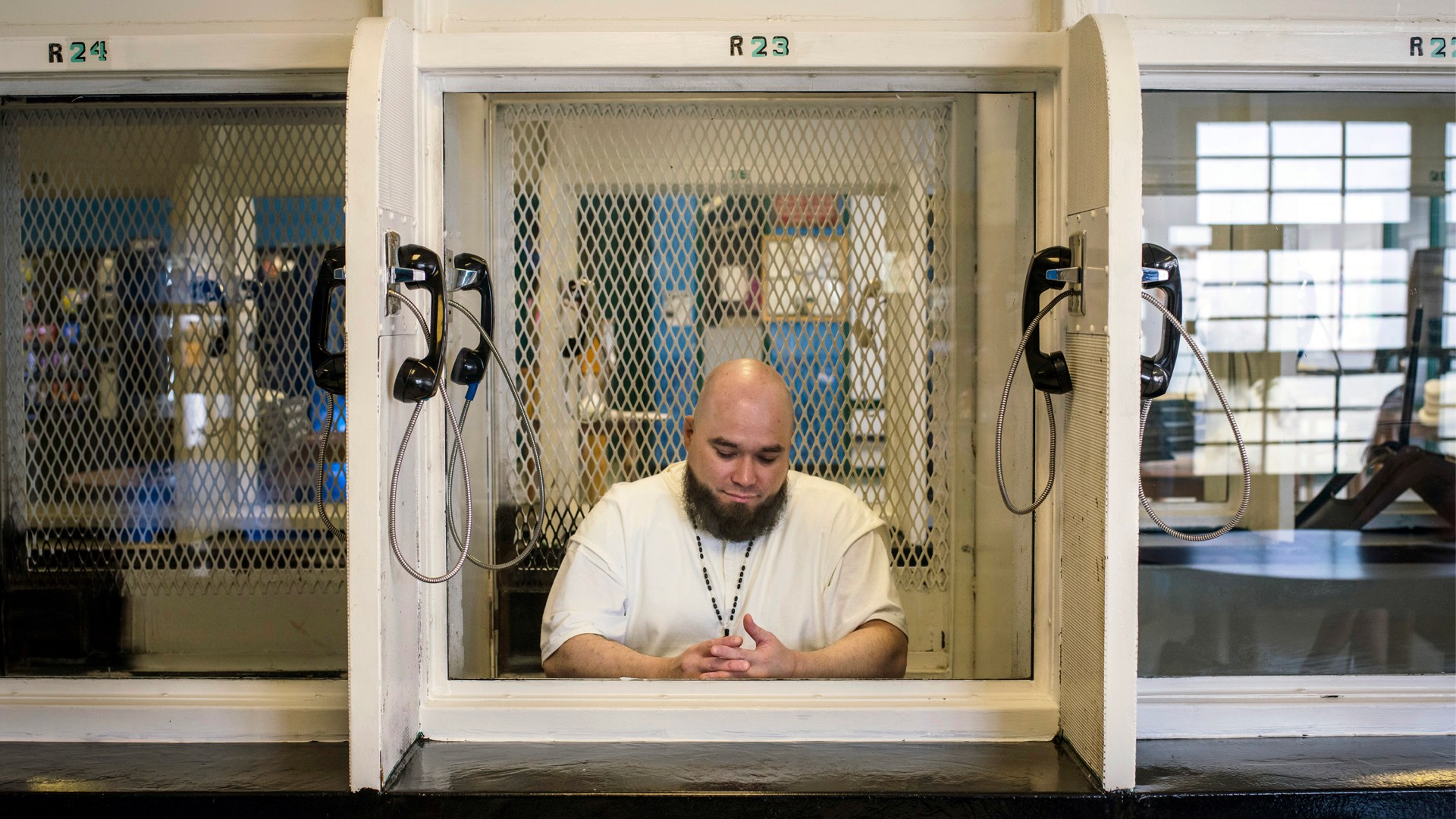
John Henry Ramirez, who was sentenced to death for the murder of a convenience store worker in 2004, in a visitation room at the Allan B. Polunsky Uni​t, a prison in Livingston, Tex​as.

John Henry Ramirez, who was sentenced to death for the murder of a convenience store worker in 2004, in a visitation room at the Allan B. Polunsky Uni​t, a prison in Livingston, Tex​as.

MATTHEW BUSCH / The New York Tim​es / Redux

A convicted murderer who appealed to the US Supreme Court to let his pastor lay hands on him during his execution was put to death in Texas with his minister by his side, laying on hands and praying. Pastor Dana Moore asked that John Henry Ramirez and those witnessing his death would feel God’s presence and peace, and he recited the Lord’s Prayer. In a statement, the brother of the murder victim asked God to have mercy on Ramirez, quoting Micah 7:18: “Who is a God like you, who pardons sin and forgives … ? You do not stay angry forever but delight to show mercy.”

United States: Court won’t hear megachurch dispute

A Florida court dismissed a pastor’s defamation suit against his church’s leaders, saying the First Amendment sharply limits judges’ ability to weigh in on ecclesiastical disputes. The Celebration Church board accused pastor Stovall Weems of “unjustly enriching himself at the expense of the church.” The conflict seems to date to 2018, when Weems claimed he had been transported to the Last Supper. After that, he allegedly made sweeping changes, including new financial arrangements, to protect his “spiritual acuity.” Weems says the fraud allegations are false.

United States: Seminary sells land amid turmoil

Southwestern Baptist Theological Seminary is selling 24 acres of student duplexes and triplexes appraised at $11 million. The Texas seminary once boasted of being the largest in the world, but it faced a 70 percent drop in full-time-equivalent enrollment from 1992 to 2022. President Adam Greenway resigned in September after protests over faculty treatment and reports of an annual operating deficit of $12 million. Greenway was replaced by O. S. Hawkins, who left within a week to be replaced by David Dockery, formerly president of Trinity Evangelical Divinity School.

Colombia: New believer of indigenous people group baptized

The first known follower of Christ among a tribe of the Emberá people was baptized in a river outside Medellín. Southern Baptist missionaries Travis and Beth Burkhalter have been ministering to indigenous widows and refugees from the drug wars since 2010. Travis Burkhalter learned Emberá and shared stories with the new believer—who is called “Sarah” by the International Mission Board—for about three years before she professed her faith in Jesus and asked to be baptized.

Brazil: Facial recognition used in churches

A number of evangelical churches in Brazil, including Restart Project Evangelical Church, are using facial recognition software during worship services. The technology collects general attendance data but also identifies individuals, classifies their moods based on facial expressions, and notes when they are late or absent. Personalized reports can recommend pastoral visits. “Today, who doesn’t want control of their environment?” said Luís Henrique Sabatine of tech company Igreja Mobile. “We found out that the churches really wanted to know about it.” Costs start at $200 per worship service.

Germany: LGBT welcome stirs debate

The Union of Free Evangelical Churches of Germany officially rejected same-sex marriage and sex between people of the same gender in a 2017 paper, but some of its 500 congregations have joined Coming-In, a network of Christians working to encourage LGBT inclusion. The move has stirred debate over whether the assembly can expel people over differing views on the topic. Board chair Ansgar Hörsting pleaded with delegates to have “a conversation, not an exchange of blows.”

France: Council will facilitate reports of abuse

The National Council of Evangelicals in France has launched an online platform for reporting sexual abuse. “Stop Abuse” will advocate for victims and connect them with legal, psychological, or pastoral support. The council formed a working group on the issue in 2019, following the revelation of abuses inside the Catholic Church, and released a handbook in 2021. “The #metoo movement and the latest revelations of sexual abuse and abuse of all kinds in our society have challenged us,” said the council’s former vice president Marc Deroeux. “It was important for us not to ignore them.”

Turkey: St. Nick’s tomb identified

Archaeologists believe they have discovered the burial site of Nicholas of Myra, the bishop who inspired the modern Santa Claus. His remains were stolen and taken to Italy in 1087. A recent excavation uncovered a stone box that appears to have held his body. There is also a marble floor tile with the Greek word for grace on it and a fresco depicting Jesus holding a Bible and making the sign of the cross. There are currently no Christians in the city that Nicholas shepherded, which is now called Demre.

Indonesia: Terrorist killed in shootout

Officials announced that the special counterterrorism force Densus 88 has killed Al Ikhwarisman, the last known member of the East Indonesia Mujahideen (MIT), in a shootout in the Sulawesi mountains. Al Ikhwarisman, also known as Jaid, was believed to be a key member of the terrorist group that pledged allegiance to the Islamic State and attacked and killed Christian farmers in Indonesia. Al Ikhwarisman allegedly murdered four people in 2021. The province’s police chief says the MIT have now been eliminated. Its founder was killed by police in 2016.

Japan: Church history helps modern astronomers

A Byzantine monk helped two astronomers and a librarian refine the modern understanding of the earth’s variable rotation. Records of total solar eclipses allow researchers to reconstruct the drift in the length of a day, but there is little detailed information from before A.D. 800. Three Japanese scholars found, however, that Theophanes the Confessor’s account of an eclipse in 346, four centuries before he was born, contained enough specifics to make a calculation. Theophanes’ source for the eclipse is believed to be a church history written by an unknown Arian.

News

The Season’s Greeting Most Preferred for Happy Holidays? ‘Merry Christmas.’

Americans expected to send 1.6 billion cards this year, continuing Victorian-era tradition.

Illustration by Jared Boggess / Source Images: WikiMedia Commons

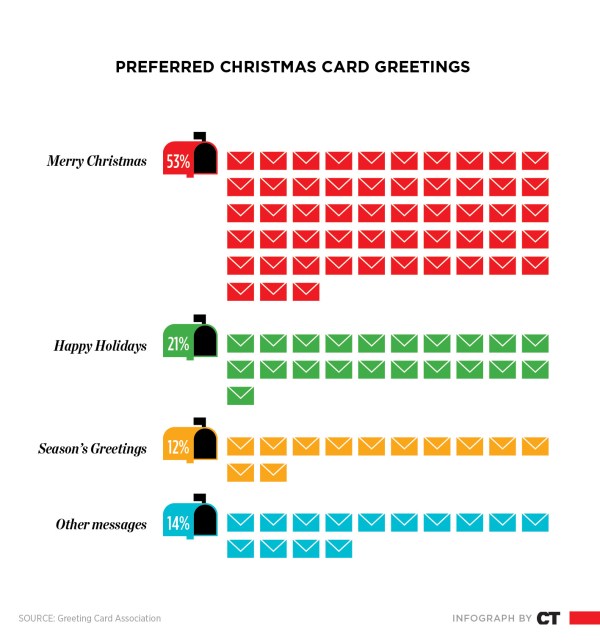
Debates about acceptable holiday greetings occasionally roil American retail stores and cable news shows, but when it comes to cards, most people prefer “Merry Christmas.” According to an industry survey, Americans send about 1.6 billion Christmas cards every year, and 53 percent carry the traditional religious greeting. “Happy Holidays” ranks second in card choice, and the more generic “Season’s Greetings” comes fourth after “other.”

The Christmas card tradition has proved surprisingly durable. It dates back to the Victorian era, when the celebration of Christmas was transformed into a family-centered commercial holiday. Queen Victoria started sending Christmas cards in the 1880s. Calvin Coolidge sent the first one from the White House about 40 years later.

There were always some people who bah-humbugged the tradition. A newspaper columnist in 1897 called Christmas cards “a well-meaning nuisance” that got in the way of businessmen’s more serious correspondence. But most respectable middle- and upper-class households in the English-speaking world sent and received cards.

The tradition sagged a little in the 21st century with the rise of social media—especially Facebook—but then millennials revived the tradition as a way to add a personal connection to holiday celebrations. Card-sending households mail, on average, about 30 cards, and most people prefer pictures of kids and an old-fashioned “Merry Christmas.”

Infographic by Christianity Today
Theology

When the Best Bible-Reading Tool Made Bible Reading Worse

The unintended consequences of concordances offers a warning to Christians today.

Illustration by Michał Bednarski

I open my Bible to 1 Peter 2:8: “A stone that causes people to stumble and a rock that makes them fall.” By “open,” I mean I get out my phone, tap on the Bible icon, and type the verse in a search bar.

With another tap I can underline the sentence if I want. Highlight it. Snip and save it into another file to reflect on, sans context, at some later date. In my Bible app, there’s also a little gray box that looks like a speech bubble from a comic strip, and if I tap on that, it opens up to show me a reference: Isaiah 8:14. It’s not hyperlinked to that verse, so instead of jumping to the prophet, I’m encouraged by the tech in my hand to close the box and keep reading 1 Peter: “They stumble because they disobey the message.”

As we enter into a third decade of what literary critic Sven Birkerts has called “reading in an electronic age” and biblical literacy reaches new lows, what impact does this tool have on Bible reading? How does it shape our interpretations?

There is a long debate about the correct understanding of sola scriptura. But no heir of the Reformation has ever taken it to mean we should read Scripture without any outside help. Protestants, in fact, have historically embraced innovations that might increase engagement and comprehension, from common-language translations to study Bibles, commentaries, illustrated editions, and abridgments, not to mention smartphone apps.

You don’t have to harbor deep suspicions of progress, though, to wonder if the tools we use to read the Bible might, in some way, reshape how we read. And if so, do they reshape it for the better, or the worse?

My own research on the history of dispensationalism suggests that our Bible-reading tools have, at times, changed our reading to such an extent they have even changed what it means to read the Bible literally.

There have been a variety of Christian views on what a literalist approach to Scripture should look like. Literal can refer to an emphasis on the inerrancy of the Bible; beliefs about the historicity of certain passages; a particular understanding of the fulfillment of prophecy (which would not be literally literal, but symbolic); or the view that a passage should be read in the plainest way possible and that’s why it’s important to understand genres and original reception. For dispensationalists, literal reading relied on “word chains”—connecting verses through the “links” of word usage and treating keywords like stone the same wherever they were found in the Bible. That approach to the text wouldn’t have become popular without the development of concordances.

Illustration by Michał Bednarski

Let me back up: Bible concordances date to the 13th century, when 300 Dominican monks under the leadership of Hugh of Saint-Cher produced a selective alphabetized index of the words they considered most important in the Latin-language Vulgate Bible. While it was a powerful reading tool for biblical scholars, the St. Jacques Concordance was rudimentary by today’s standards. Later Medieval concordances listed every occurrence of many, many more words.

With the Reformation came demand for similar works in vernacular languages. The first English-language New Testament concordance appeared in the 1530s, though it wasn’t very useful before the publication of the King James Bible in the 1600s made Scripture widely available.

The KJV got an excellent concordance in 1737 when Alexander Cruden, a bookseller and reclusive scholar, finished cataloging more than 77,000 words. It took him 26 years and several trips to a mental institution, but he finally finished and published his exhaustive masterpiece: Cruden’s Concordance. It remains in print today.

Cruden’s tool for Bible reading was often paired with other new aids, such as Bagster’s Polyglot Bible, which offered readers 60,000 cross-references in multiple languages printed side by side, and new commentaries such as Thomas Scott’s Commentary on the Whole Bible. All told, by the 19th century KJV readers had a lifetime’s worth of tools to help them understand the Bible in new ways.

These powerful new tools meant that regular readers could, for the first time, cross-reference any word in the Bible. The stone in 1 Peter could be connected with the one Moses struck in Exodus 17:6, the one Daniel described as being cut “not by human hands” in Daniel 2:34, and the one Jesus talks about falling on people and crushing them in Matthew 21:44. The cross-references created a new interpretive context, one that could be highly personal or communal, depending on how the tools were used.

In the United States, this approach to Scripture came to be called the Bible Reading Method. It democratized what was usually the purview of scholars or well-trained pastors. Readers could now select an English keyword to study and then examine all the uses of that word, extrapolating the meaning of a text from the compiled examples.

People often did this in groups, encouraging intensive Bible study that fed into theological reflections. A group might look at the word wait in Psalm 27:14, for example; connect it to Jacob’s plea in Genesis 49:18; cross-reference that with Paul’s eschatological hope in Romans 8:19, where “creation waits”; and then talk about how God’s deliverance is a deep theme running through the Bible from beginning to end. Who God was delivering and what that deliverance looked like could be shaped by the biblical context and narrative, but it was just as often conditioned by readers’ personal circumstances and their particular cultural assumptions.

The Scofield Reference Bible was a mainstay for millions of Christians steeped in the Bible Reading Method. It was very popular and widely distributed among some Christians. Cyrus I. Scofield, a minister closely associated with Dwight L. Moody, included in his reference Bible extensive footnotes explaining his theology, which relied on an intricate cross-reference and concordance system running down the middle of every page of the Bible. Oxford University Press published Scofield’s Bible for the first time in 1909, and it remains in print today. In addition to the on-page helps, Scofield included a 150-plus-page concordance index and instructions to train readers to build word chains. He explained that word chains would “lead the reader from the first clear mention of a great truth to the last.” And in case the reader didn’t get it, a Scofield summary would solidify the meaning at that last reference.

In its more sophisticated implementation, reading the Bible with the help of concordances allowed people to experience the unity of Scripture. As another dispensationalist writer in the early 20th century, Isaac Massey Haldeman, explained, “an intelligent and satisfactory study of the Bible” required a concordance to realize that a “unity of design” animated the 66 books. Concordances allowed lay readers to experience Scripture’s unity, even as they downplayed or set aside historical context, human authorship, the original languages, linguistic details, and often the actual narrative.

Some conservative Christians, such as Moody’s colleague R. A. Torrey, called the Bible Reading Method the “scientific” approach to Scripture. Haldeman described concordances and cross-references as “implements” and “tools” which, if used properly, produced repeatable results.

It’s unusual, today, to think of self-described fundamentalists touting science, but Americans at the turn of the 20th century were embracing science as the ultimate arbiter of truth across all sectors of life. As biblical higher criticism seemed to undermine the authority of Scripture in academia, this concordance-based interpretive frame was deployed to shore it up, scientifically.

We might expect fundamentalists who wanted to read the Bible literally to care more about how the first Christians received Scripture. But the tool they were using for their Bible reading pushed them in this other, “scientific” direction instead.

It also prepared the ground for a new theological movement, which came to be called “dispensationalism.” This developed out of the teachings espoused by the Exclusive Brethren—specifically the Anglo-Irish leader John Nelson Darby. He taught that humanity was divided into three parts: Israel, the church, and the nations. The nations didn’t have a covenant with God, but the church and Israel both did, so Scripture needed to be “rightly divided” into the parts that spoke to Israel and the parts that spoke to Christians.

For Darby, what made “every scripture fall into place” was a Christian reader’s “spiritual understanding by the Holy Ghost of things in heaven and our connection with them, and things in earth and our separateness from them.”

That approach to the Bible often focused on prophecy, a genre of Scripture Darby didn’t think was aimed at its original recipients, but future-oriented, predicting events that had not happened yet in human history, mostly having to do with Israel. To understand Scripture, then, you would want to know how a stone could be a foundation (Eph. 2:20), a stumbling block (Rom. 9:32–33), and something that would fall on people and crush them (Matt. 21:44), and how all of those were both actually Jesus and a sequence of events that was going to happen (literally/symbolically) to Israel.

Darby promoted concordances, but he was a stickler for keeping separate “earthly” and “heavenly” meanings of particular verses. This complicated the Bible Reading Method that was in vogue among the American Christians most eager to adopt Darby’s teachings.

Americans not steeped in the same Brethren assumptions insisted that Darby’s distinctions could be discovered from the Bible Reading Method itself. As James Brooks, one of Darby’s most important American popularizers, assured readers, “the language in which prophecy is written is as simple and as easy to understand as any other part of Scripture.” Concordances, which catalogued words and not meanings, were part of what made that seem true.

The largely American story of dispensationalism’s development after Darby shows how later readers tried to base his teachings in a plain reading of the text to bring them more in line with the Bible Reading Method. But the “plain” reading doesn’t appear so plain, of course, without the technology that encouraged people to read that way.

After several generations of outside scholars chipping away at dispensationalism, and popular dispensationalism like the Left Behind novels undercutting its credibility, that approach to the Bible has largely fallen out of favor. Dispensationalism is in decline, and the Bible Reading Method is not often taught in seminaries or Christian colleges.

Yet the reading instincts popularized by the Bible Reading Method persist. The practice continues to have a powerful effect on people. It still makes readers feel as if Scripture is opening up, as if they see into the obscurities of the Bible for the first time and there’s no need for specialized language or historical training. With a little practice and a concordance, every reader can do it themselves, and they can even claim this is the way to read the Bible literally.

And concordances still exist, of course. They’re valuable tools that we often take for granted. They can be amazingly helpful to reading the Bible when used properly. They’ve largely been replaced by more efficient tools for regular Bible readers. I can do a word search on my app or, perhaps, click on a link that jumps me from one part of the Bible to another.

That way of thinking about the Bible—as a hyperlinked text—really excites the popular Canadian psychologist Jordan Peterson. In one of his YouTube lectures on the Bible, he shared a graphic created by computer scientist Chris Harrison, showing the more than 65,000 cross-references in Scripture. Peterson marveled that if you followed each one, “You’d just journey through that forever. You’d never, ever get to the end of it.” What insights that journey would produce, however, would be entirely dependent on the path one chose to take. This endless variety is appealing to Peterson, but it should be less compelling to Christians committed to the unity and coherence of Scripture.

In an age of limitless digital tools to derive new meanings from Scripture, we should be cautious about how our reading technology shapes and reshapes the context of the text. We do not read Scripture solo, to be sure, but the tools we choose can shape and misshape our reading of the Bible. They can lead us to believe we’re reading simply and literally when, with a little critical distance, it certainly looks like a process of breaking and remaking contexts to fit our systems.

I don’t think that’s what happens when I tap open my Bible app. The technology feels more neutral than that. But history would suggest it is something to worry about.

Daniel G. Hummel is the author of the forthcoming book The Rise and Fall of Dispensationalism: How the Evangelical Battle Over the End Times Shaped a Nation (Eerdmans).

News

Finding Common Ground in a Big Fish

Christian scholars look for ways to connect with Muslims over the shared story of Jonah.

Tim Peacock

Twenty miles south of Beirut is a sandy beach called Jiyeh. It’s a rare interlude in Lebanon’s rocky coastline, and if you were out in the Mediterranean, crying for deliverance as currents swirled about you, waves and breakers sweeping over you, this is where you’d want God to command a fish to vomit you onto dry land.

And this is, in fact, the spot where ancient legend says that the Hebrew prophet Jonah was delivered safely to shore.

Jonah has long been honored here. Mosaics found in the ruins of a 1,500-year-old Byzantine church show the prophet who tried to run away from his mission to Nineveh getting turned around by a large fish. And today there is a Muslim mosque on the site with a shrine to Jonah.

The Hebrew story of the reluctant prophet is beloved not only by Christians but also by those who hold the Qur’an to be the final revelation of God. And chiseled on the shrine is the verse that he prayed from the belly of the fish, which Muhammad urged Muslims to recite when in trouble.

“The most common prayer of Muslims during times of crisis is the prayer of Jonah,” Emad Botros, professor of Old Testament at Arab Baptist Theological Seminary in Beirut, told CT. “We share a heritage with Muslims. And what is better to share than stories?”

Botros is one of a few scholars turning to Jonah as a site of common interest connecting Christians and Muslims. He is writing a book, Jonah: Bible Commentaries from Muslim Contexts, the second volume in a series on reading the Bible in the context of Islam. He thinks the story of the prophet—along with other shared stories—can help start a conversation across the faiths.

“The prophets of old were the heroes of Muhammad,” Botros said. “Knowing his reflections helps us communicate our biblical stories more effectively.”

The Qur’an’s account of Jonah—which Muslims believe was divinely revealed through the archangel Gabriel—is different from the version in the Hebrew Bible. In the Muslim version, the city he’s going to is not named as Nineveh, capital of the Assyrian Empire. It’s only a city with 100,000 people or more. The Qur’an does not mention how long the prophet was in the belly of a fish, compared to the biblical three days, and it emphasizes how dark it was. The fleeing prophet is also compared to a fugitive slave, something the Bible doesn’t do.

Jonah also has a different name. In the Arabic-language translations of the Bible, he’s known as Yunan. In the Qur’an, he’s Yunis.

According to Botros, some Christians engaged in apologetics have called these differences errors. Some have even argued that Muhammad willfully altered the details of the original, showing he didn’t really respect the Bible. Botros says this is the wrong way for Christians to think about the differences.

Muhammad’s use of Jonah is similar to Paul’s retelling of the story of Sarah and Hagar in Galatians, he said, or even Jesus’ reference to Jonah in Matthew 12:39–41. These are extrapolations and new applications, not meant to challenge the original.

“The Qur’an is a sermon,” Botros said. “It narrates the stories of prophets as illustrations, just as a preacher in church. … As a Christian reader, it helps me know how they understand it and the questions it raises for them.”

Mustafa Akyol, author of The Islamic Jesus, said early Muslims recognized that many of the Qur’an’s accounts of Bible prophets, including Jonah, Job, Elijah, and Elisha, were very truncated. They were encouraged to “ask those who were before you” if they had doubts and developed a body of literature called the Israiliyyat that drew from Scripture and Jewish tradition.

“In many cases, the Qur’an merely alludes to the Bible, assuming that it is already known,” Akyol said. Early followers of Muhammad didn’t mind turning to the stories with biblical details, because they didn’t have “any doubt it is a former revelation of God.”

As polemics among Muslims, Jews, and Christians increased, however, many Muslim scholars grew uncomfortable with the Israiliyyat, Akyol said. They emphasized the concept of tahrif—altering or distorting—and started to vehemently object to any suggestion the Qur’an was riffing on the Hebrew Bible.

“Today, Muslims theoretically respect the Bible,” Akyol said, “but hardly ever learn from it.” The story of Jonah is intriguing enough, though, that some Muslims might pick up a Bible to learn more.

And in the other direction, Jonah provides Christians with a chance to engage with the perspectives of another faith tradition.

At the shrine in Jiyeh, the Sunni imam Milad al-Khatib thinks the prophet’s story applies beyond each tradition, to Muslims, Christians, and everyone.

“You, me, and everyone are commissioned to call others to God,” he tells visitors to the mosque on the beach in Lebanon. “If sent on a mission, do not depart from it.”

A number of Christian scholars are also urging Christians to listen to more Islamic voices, including Muslim views of biblical figures, such as Jonah. Ida Glaser, cofounder of the Centre for Muslim-Christian Studies in Oxford, is coediting a series called Reading the Bible in Islamic Context. One volume offers a Muslim commentary on Galatians while another, still in progress, looks at Daniel.

Although she doesn’t believe the Qur’an is inspired, Glaser said Christians can learn from it.

“The Qur’an functions as the authoritative commentary on the Bible for a large segment of the world’s population,” she said. “But Christian scholars consult every book besides it.”

Understanding the Muslim view may help Christians explain their faith better. But it could also help them understand their faith better. Looking at the versions of a story can draw attention to details that would have otherwise gone unnoticed.

In the Qur’an’s Jonah story, for example, the prophet prays, “Glory be to you, for I have certainly done wrong.” In the Bible, Jonah never agrees he’s erred. God relents, but Jonah never does.

“I knew that you are a gracious and compassionate God, slow to anger and abounding in love,” Jonah complains in 4:2–3. “Now, Lord, take away my life, for it is better for me to die than to live.”

He doesn’t want the people he’s preached to to receive God’s grace. And the book ends with a question that Jonah doesn’t answer.

Readers should be surprised by that, said John Kaltner, professor of Muslim-Christian relations and coauthor, with Younus Mirza, of The Bible and the Qur’an. “They can then reflect on their response, if God’s mercy takes them somewhere they don’t expect to go.”

Botros, an Egyptian evangelical, says that studying the story of Jonah convicted him about his need to love his Muslim neighbors.

“Like Jonah, I had anger in my heart, but toward Muslims,” he said. “And instead of taking it to God, I ran away.”

As a student at the seminary in Lebanon where he now teaches, he resisted sharing about his faith. Many Middle Eastern Christians see Muslims as the source of their problems, he said, and he felt that if he talked to them about Jesus, he would be rejected.

But then he read about Jonah. In the Qur’an, the account of the prophet includes a call for tolerance: “Had God willed, all people on earth would be believers. Will you then force them?” He realized he wasn’t forcing anyone to believe anything, and was only responsible for having a conversation.

In recent years, he’s been thinking about how the biblical account of Jonah teaches about God’s great concern for people. But it also corresponds to Muhammad’s plea for Muslims to think of Jonah when they are in trouble. God tells the prophet he cares about the many children in Nineveh, the animals, and also believers who run away—anyone lost in the belly of a big fish.

“Jonah teaches us about the compassion of God,” Botros said. “In times of crisis, Christians and Muslims both call out to God, and he hears their prayers. Let us pray with them; it shows we care.”

Jayson Casper is Middle East correspondent for Christianity Today.

News

What Is a Missionary Kid Worth?

Risks remain higher in cross-cultural contexts. And misconduct is harder to report.

Illustration by Abigail Erickson / Source Images: Getty

When Letta Cartlidge got on a plane as a teenager to leave her childhood home, she carried a secret. As the child of missionaries in Nigeria, she was sexually abused by a teacher at a school for missionary kids.

As the plane rose above Nigeria, she believed she would have to carry that secret forever. She thought that if she ever reported him—if she even knew how to report her abuser—it would hurt God’s reputation.

“We were in a culture where there was a looming God,” she told CT almost 30 years later. “And that looming God would punish us for disrupting the work of God.”

Cartlidge would, eventually, decide that wasn’t true. As an adult she found the courage to lead fellow former Hillcrest School students in what she calls an “incredibly discouraging” year-and-a-half effort to bring to light more than 40 allegations of abuse spanning from 1961 to 1993. The alumni won a small victory in August, when the school board voted unanimously to approve an external investigation.

It’s a step in the right direction.

Missionary organizations and Christian nonprofits have started paying increased attention to the safety of workers’ children—“missionary kids,” commonly called MKs—and advocates say the past few decades have seen marked improvement. But the rates of abuse are still high.

A recent survey of 1,904 adults who were raised in cross-cultural contexts found they were three times more likely to experience emotional abuse than children raised in their own culture in the United States. More than a third had suffered three or more adverse childhood experiences, such as abuse, violence, or neglect. Almost 30 percent reported some kind of sexual harm.

“A lot of people in the international world think of this as this safe bubble for kids,” said Tanya Crossman, coauthor of the TCK Training report. “Our data is showing the opposite. We want to pay attention and provide the preventive care and provide protective factors.”

Not only do MKs and “third culture kids” (TCKs) suffer more abuse, but they also face extra obstacles reporting abuse overseas, advocates say. And when they do report, they risk being ostracized from the close-knit missions world.

“How is it going on so long?” said advocate Michael Pollock. “All these kinds of abuse continue, and we’re still unwilling to look at it square in the face to call it what it is, and to deal with it in a way that brings healing.”

Historically, missionary boarding schools have been especially vulnerable to abuse because they are very isolated, said Dianne Couts, president of MK Safety Net. They often developed a culture and religious rhetoric of control and discipline.

Boarding schools were considered a necessity for missions to continue, and those who spoke out against them were often seen as a threat to the entire missionary enterprise, said Ruth Van Reken, coauthor of the bestseller Third Culture Kids. In her earlier book, Letters Never Sent, she wrote about her own difficult experience at a boarding school.

Early whistleblowers including Couts and Van Reken brought attention and ultimately change to many MK schooling options. In the past, boarding schools were considered standard for the children of missionaries—often starting at age six. Now only 4 percent of the 170 schools accredited by the Association of Christian Schools International offer boarding options.

And yet, homeschooled MKs still report the highest rates of adverse childhood experiences. Most forms of abuse and neglect are more common for them than they are in the boarding schools, international schools, or local schools that MKs have attended.

According to the TCK Training research, MKs often live in isolated environments. And the more often they move, the more vulnerable they become to abuse.

“The sense of reality and what’s true and real in a new situation is thrown up in the air,” said Pollock. “Their relational anchors get pulled up. And then structures of reporting, like who’s safe, may be missing or changed.”

MKs are often put in close contact with other missionaries they don’t know but are expected to trust, he said. And their parents are often under a lot of stress and pressure to perform, with ideas about sacrificing their personal well-being for the gospel. Mental health care and social networks that prevent or catch abuse are weaker.

“The way that missions is set up is fundamentally broken,” said missionary life coach and speaker Sarita Hartz. “The mission is placed above those who serve the mission. Missionaries are collateral damage.”

The systems in place to protect MKs have improved dramatically in the past two decades. But survivors and advocates say the cracks are still glaringly obvious. The Child Safety & Protection Network (CSPN), for example, was founded in 2006 with 13 missionary organizations. Today, there are 130 member organizations.

Many of those have, for the first time, hired a child safety officer. The International Mission Board, the missionary arm of the Southern Baptist Convention, is a member of the CSPN and hired its first abuse prevention and response officer in 2018.

The network provides training and curricula, but it doesn’t actually investigate allegations of abuse.

“We’re not the ones that hold that accountability,” said board member Tom Hardeman.

Victims who believe their organization is mishandling abuse allegations often have no one to appeal to. Complaints can only be dealt with internally.

“We have mission boards who are accountable to no one but themselves who are funded by individual independent churches who are accountable to no one but themselves,” said Couts.

In 2003, president George W. Bush signed the PROTECT Act—Prosecutorial Remedies and Other Tools to end the Exploitation of Children Today—into law. It criminalized sexual abuse by American citizens who are overseas but doesn’t apply to citizens of other countries. MKs who are abused by Americans can report it to a US embassy or call the FBI. If the abuser is not a US citizen, abuse victims can contact local police.

According to victim advocates, however, reporting to local authorities can be fraught. Laws that define abuse and set age of consent vary, as do cultural norms around sex. It is often unclear what the repercussions of a report will be on the mission organization, and victims worry about upsetting the close mission communities that also function as their support system.

“Life as you know it is contingent on nothing dramatic happening,” said victims’ advocate Michèle Phoenix.

Many abuse victims feel responsible for what happened to them. MK victims can feel an additional responsibility to protect the missionary organization.

“You’re trying to protect your parents,” said MK Safety Net board member Rich Darr, “but you’re also trying to protect all these ‘aunts’ and ‘uncles.’”

Those “aunts” and “uncles” are also not required to report abuse if they become aware of it. There’s no mandatory reporting law internationally. According to Boz Tchividjian, attorney and founder of Godly Response to Abuse in the Christian Environment, mandatory reporting is critical for protecting children. He asked US legislators to pass an international mandatory reporting law in 2015, without success.

“Good luck if you’re a survivor of child sexual abuse on the mission field overseas,” Tchividjian said.

The difficult work of fighting to change things has mostly been left to survivors, adult MKs who are dealing with their own trauma and decide they have to do something.

Wess Stafford, former president of Compassion International, recalled how difficult that decision was for him. He wrote his memoir and at first didn’t include how he was abused as a child at a missionary boarding school in Guinea.

“It took me a long time to say, ‘You know what? All right. I don’t want to leave this world without having fought this battle,’” Stafford told CT.

Cartlidge—who’s in the thick of pushing for accountability for historical abuse—spends her days waiting for responses to emails, wading through arguments over who’s responsible, and figuring out the next step in a process that has no standard procedures.

But she’s not alone with her secret anymore. And she’s hopeful that more Christians will refuse to look away from scores of MK abuse survivors who are asking for help.

“Most of your missionary kids are going to say, ‘Just be the church to us,’” said Darr, sitting next to Cartlidge in a Zoom interview. “We’re hurting. We need your help.”

Rebecca Hopkins is a journalist living in Colorado.

News

They’re Not Religious. But They Oppose Abortion.

“Nones” take a more prominent place in the pro-life movement.

Illustration by Abigail Erickson / Source Images: Unsplash

Monica Snyder gave up her childhood faith. But she never stopped being pro-life.

She opposes abortion for different reasons than her Catholic parents. Snyder doesn’t believe fetuses are made in the image of God. She doesn’t think they have eternal souls. Though her arguments differ, as an atheist with a master’s degree in forensic science from the University of California, Davis, her conclusions are the same: Human life begins with the zygote, and abortion is almost always wrong.

“Pro-choice people act as if they are morally neutral,” she said. “But abortion is not amoral.”

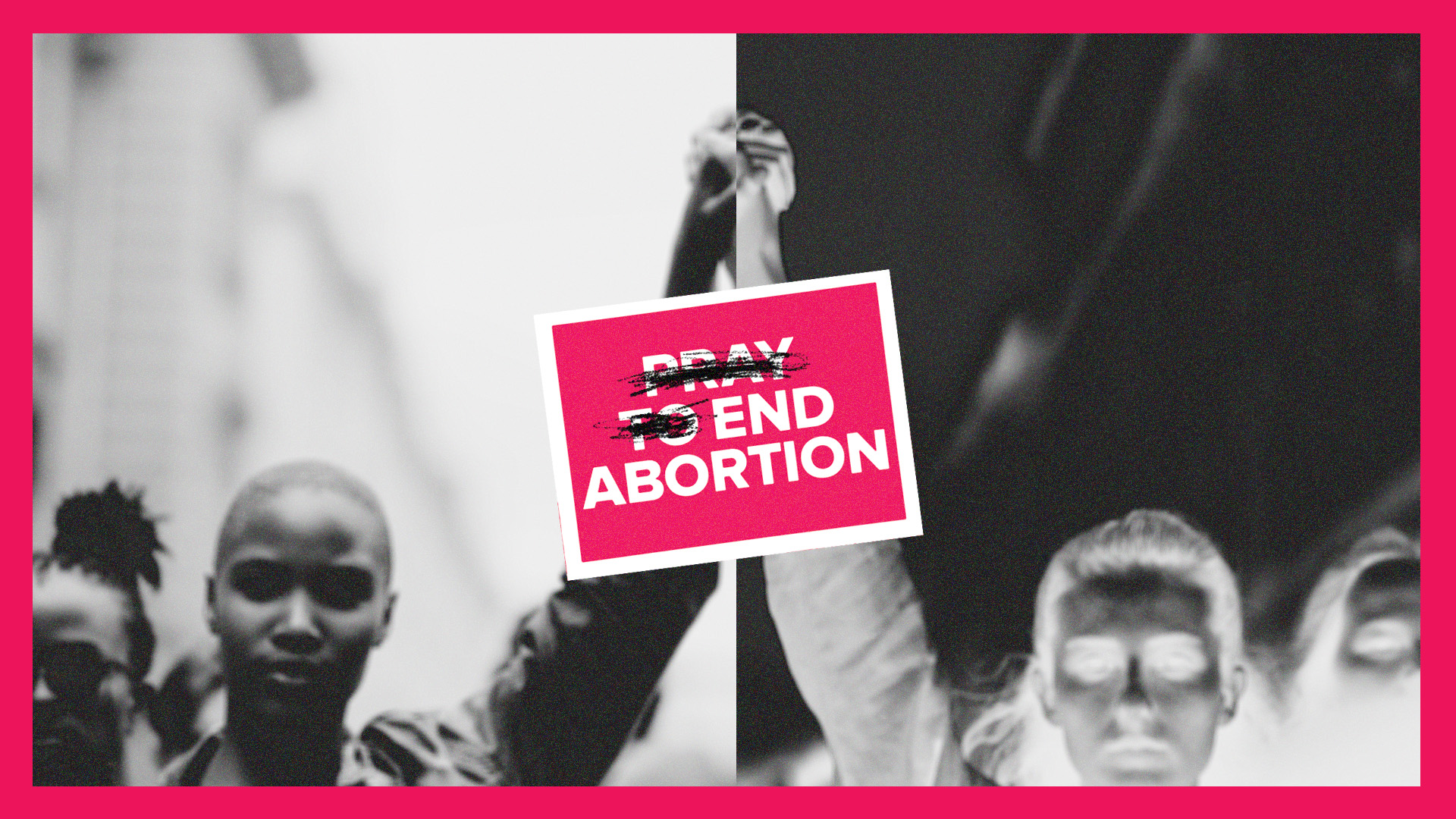
The executive director of Secular Pro-Life is one of a growing number of nonreligious people joining the pro-life cause. Historically, the pro-life movement has been almost exclusively religious, predominantly made up of Catholics and evangelicals. Nonreligious people—including the rising number of younger Americans who tell pollsters “none” when asked about their religious preference—generally defend a woman’s right to terminate a pregnancy.

But a 2022 Gallup poll found that 21 percent of the nones say abortion is morally wrong.

And as the pro-life movement celebrated the Supreme Court ruling overturning Roe v. Wade in June and then scrambled to fight abortion in 50 states, religious activists are increasingly finding themselves working side by side with secular allies. They welcome the support.

“The fact that these nonreligious groups are really coming alongside faith-based organizations is really significant and makes a powerful statement about where the movement is right now,” said Diane Ferraro, chief executive officer of Save the Storks, a Christian nonprofit that partners with pregnancy centers to provide free ultrasounds. “The tent is definitely getting bigger.”

It’s not just the extra bodies that help the cause, either. Christian pro-life leaders are glad to have non-Christians making secular arguments against abortion.

“The pro-choice strategy has been to paint the abortion debate as a religious argument,” said Frank Pavone, a former Catholic priest who is the national director of Priests for Life. “But the existence of these groups indicates that we can come to these pro-life conclusions with human reason alone.”

According to Pavone, the pro-life movement has always involved nonreligious groups, but their visibility seems to be increasing. At the annual March for Life in Washington, DC, a few years ago, one pro-lifer held up a sign that said, “For the Embryology Textbook Tells Me So,” while another had a sign that read, “Destroy the Patriarchy, Not the Preborn.” Many pro-life progressives have been frustrated by the way the Democratic Party doesn’t tolerate their views, Pavone said, so they’ve turned to grassroots activism.

A lot of that activism, in turn, focuses on using social media to elevate secular arguments against abortion and show the world that nonreligious pro-life people exist. The hashtag #secularprolife has more than 3.6 million views on TikTok, and #prolifefeminist has over 4.1 million. These numbers may be small potatoes for big-time content creators, but they still raise the profile of nonreligious pro-lifers.

Videos may reach nonreligious women who are considering abortions and feel alienated by the religious arguments against terminating their pregnancies. But the real target is people who want to know if it’s even okay for a nonreligious person to be pro-life.

Snyder says many on the left have never even heard nonreligious arguments against abortion. And for many atheists and agnostics, even expressing curiosity about pro-life positions can feel like a big risk. Pro-choice ideas are so dominant that asking questions can get you ostracized.

So Secular Pro-Life’s social media content shows nonreligious women who oppose abortion that they are not alone. One of @secular_pro_life’s most popular TikTok videos shows Snyder responding to people who say opposition to abortion is just “pushing religion.” The argument is a red herring and doesn’t respond to the real issue of human rights.

“You can do what I do,” Snyder says while holding a sleeping baby, “which is to say, ‘I’m an atheist. Do you want to address my points?’ ”

Another of her TikTok videos says that feminists who support abortion rights with slogans like “No Uterus, No Opinion” are erasing women and that feminists shouldn’t ignore those who hold pro-life views.

@feministschoosinglifeny

Women are social equals to men with our biological differences! #prolife #feminism #roevwade #abortion

♬ original sound – szasgrandchildren

The way the algorithm works, watching that video will increase the likelihood a viewer sees other pro-life content too, like maybe the TikTok responding to the argument that women need access to abortions to have equality with the viral audio “Hmm, funny, yes, but not funny ‘ha ha’—funny ‘weird.’” The social media platform may then feed viewers something from the Equal Rights Institute, an abortion language sensitivity guide posted by Save the Storks, or an abortion survivor story posted by Live Action.

Beyond social media, Feminists Choosing Life of New York, an organization that welcomes any type of religious affiliation (or lack thereof), hosts educational events, organizes women on college campuses, and lobbies the state government.

The group has recently gotten involved in counterprotesting pro-choice groups that target pregnancy support centers, said executive director Michele Sterlace-Accorsi. There, they often end up side by side with religious organizations.

Conservative Christians may not agree with Sterlace-Accorsi’s argument that abortion is bad because it’s a tool of the patriarchy that oppresses women. But, she said, they unite around the common cause of defending life.

“Working together with people of all faiths is so crucial,” she said.

Despite the work of secular pro-life groups, the issue of abortion continues to polarize. States’ reactions to the Dobbs v. Jackson decision have been sharply divided on political party lines. The pro-choice position is increasingly considered nonnegotiable on the left.

That could make things hard for grassroots groups of nonreligious pro-lifers, said historian Daniel K. Williams, author of Defenders of the Unborn. They may not really feel at home in the broader movement, since it’s so religious, and they have to endure conflict with their nonreligious peers. That tension can be difficult to sustain.

For some activists, though, the secular groups are a hopeful sign for the future of the movement.

“It’s important that we all join together regardless of our walk with Christ, regardless of whether we’re atheist or Jewish, whatever our background is,” Ferarro of Save the Storks said. “It’s so imperative and so exciting, truly, to see people step up from all walks of life to choose life.”

Kathryn Watson is a reporter from New York City.

Church Life

Bible Apps Are the New Printing Press

How evangelical computer programmers changed the way we read Scripture.

Illustration by Michał Bednarski

In the summer of 1979, just a few years after Jimmy Carter brought the term “born again” into the mainstream American lexicon and Steve Jobs made the home computer a part of everyday life, two engineers at Intel hatched a plan to create a new kind of technology company.

People of the Screen: How Evangelicals Created the Digital Bible and How It Shapes Their Reading of Scripture

Kent Ochel and Bert Brown’s new endeavor would combine their religious faith and their lifelong desire to build their own company, enabling them to do something unprecedented—they would bring the Bible into the digital age and put it on every personal computer in the world. Early the next year in Austin, Texas, at the crossroads of the American Bible Belt and the burgeoning computer industry, they created Bible Research Systems and set to work merging their technical know-how with their love of Scripture.

In January 1982, they released the first version of The Word Processor for the Apple IIe, making it the first commercial Bible study software on the market. Softalk magazine hailed it for including a complete and searchable text of the King James Bible, promising it would “aid the serious Bible student” and comparing Ochel and Brown’s accomplishments to Gutenberg’s printing press.

As the personal computer industry and Bible software market grew alongside one another in the 1980s, scholars and religious people alike began to wonder if computers might fundamentally change religion and, more specifically, how the shift from printed books to electronic media would transform the practices of Christians, who for centuries had been called “the people of the book.” What would happen to Christians as they became “the people of the screen”?

Before the advent of Bible software, Christianity had undergone two previous shifts in the use of media. The first was the shift from the scroll to the codex in the first century, which some scholars argue became an identity marker for early Christians that distinguished them from Jews and pagans.

Although the codex was not initially considered worthy of something as weighty as Holy Scripture, early Christians appear to have found the codex easier to use: faster for finding passages, capable of holding more information, and better suited for travel. On top of the technology of the codex, Christians added various innovations such as visual flourishes, parallel columns, notes, and other study tools, including divisions that are similar to our modern chapters. But the expense and time it took to produce a full copy of the Bible meant that average Christians could not afford their own Bibles and only clergy had the privilege of reading from them.

The second major technology change came in the shift from the handwritten codex to the printing press in the 15th century. Historian Elizabeth Eisenstein argued that the printing press was instrumental in spurring many of the large-scale cultural changes in Europe, including the scientific revolution and the Protestant Reformation. Indeed, Martin Luther, who wrote his 95 Theses (1517) more than 75 years after the construction of Gutenberg’s first printing press (1440), himself declared the technology to be “God’s highest and extremest act of grace, whereby the business of the Gospel is driven forward.”

What would happen to Christians as they became “the people of the screen”?

As with the codex, printers took advantage of new technology to add new features to the Bible that would go on to shape how the Bible would be read. Perhaps the most powerful was the creation and standardization of the chapter-and-verse numbering system.

Today, these numbers are so common that the average reader might assume they were part of the original biblical writings, but the modern versification scheme we use today was created by French scholar and printer Robert Estienne for his 1551 edition of the Greek New Testament. The printing press also drastically reduced the cost of Bibles, enabling the creation of more translations, study features, and other innovations.

The electronic or digital revolution represents a third shift that is just getting underway. Religion professor Bryan Bibb writes that “the current shift from codex to screen will be every bit as decisive as the historic shift from scroll to codex in the Greco-Roman world, or the shift from hand-lettered to printed manuscripts in the Late Middle Ages.”

Illustration by Michał Bednarski

The digital revolution is too new to truly assess whether it will create a new Reformation, but we are far enough into the digital Bible’s creation and use to begin examining the actors behind the industry. Technological change is sometimes framed in terms of the technology itself, with authors asking questions like “Is Google Making Us Stupid?”

But instead of attributing personhood and agency to technology itself, we can assess technology more clearly by pulling back the veil and investigating the people who create Bible software—programmers, entrepreneurs, and Christian business leaders—and their role in reshaping how modern readers encounter Scripture. Who are the Gutenbergs of today, we might ask, who are bringing the Bible to us on screen, and what are their motivations and beliefs?

What we will find is that of all Christian traditions, evangelicals stand apart for their involvement in both the production and consumption of digital Bibles. In fact, after the initial wave of Bible programming experiments in the 1950s and 1960s, nearly all the major companies and ministries involved in the creation of digital Bibles—beginning with academic software in the 1970s and continuing through the personal computing era of the 1980s, the launch of the internet in the 1990s, and the mobile era of this century—have roots in evangelicalism.

In addition, the churches and individuals most likely to incorporate digital Bibles in their faith are evangelicals. Muslims, Hindus, and other religious groups create applications for their followers, and nonevangelical Christians have created Bible software, but the most commercially successful desktop applications, the most highly trafficked websites, and the highest-ranked mobile Bible apps were all created by evangelical individuals, companies, or ministry organizations.

These technological entrepreneurs brought to the digital Bible enterprise a distinctly evangelical outlook on the Bible as an object and as a religious text, and their beliefs about how culture, media, and religion interact were mutually shaped by the move into digital media.

In the first full-length book on digital Bibles, Liquid Scripture, theologian Jeffrey Siker notes that YouVersion, in particular, “is clearly evangelical in scope, and proudly so,” and he goes on to argue that the app itself promotes evangelical ways of thinking about Scripture, its purpose, and the ways one should read it.

Similarly, Tim Hutchings has argued that evangelical developers who create Bible software have effectively, although unintentionally, employed social scientist B. J. Fogg’s concept of “persuasive computing” to privilege evangelical readings of the Bible in their applications. YouVersion, he argues, prioritizes daily reading and study patterns that lead to evangelical conclusions about the text.

While Ochel and Brown may have viewed their plans to combine faith and ministry with business and media as novel, in fact this impulse has deep roots in the history of the evangelical movement. As historian Timothy Gloege has shown in his analysis of the origins of Moody Bible Institute in the late 19th century, evangelicalism can be understood not only as a set of doctrinal beliefs or spiritual attitudes, but as a flexible outlook capable of adapting to economic and technological shifts and which sees a parallel between successful business outcomes and spiritual development.

As Bruce Shelley wrote in the 1960s, “Evangelical Christianity is not a religious organization. It is not primarily a theological system. It is more of a mood, a perspective, and an experience.” At times, this mood takes the form of a conservative outlook that fears technology and its potentially negative moral influence, but other strands of evangelicalism readily employ technology in service of their greater mission, exemplified by Billy Graham, who embraced and mastered radio and television.

More recently, YouVersion has been so successful in understanding the power of modern technology that it was featured as a case study in behavioral engineer Nir Eyal’s book Hooked: How to Build Habit-Forming Products. This flexibility and pragmatism regarding doctrine, practices, media, business, and politics are the very things that made evangelicals uniquely suited to be pioneers of the digital Bible industry and the primary early users of Bible software.

The evangelicals I have interviewed for my research, both developers and end users, emphasize the importance of the Bible in their worship and personal spirituality. They also extend this with an expectation that regular Bible engagement will lead to spiritual change and pair it with a flexibility and openness about how they accomplish this goal. For the developers, this can be observed in the way they move fluidly between discussing business and technological success alongside spiritual and missionary success. They do not equate the two, but they are comfortable with their being interrelated and intermingled on a parallel trajectory.

Of all Christian traditions, evangelicals stand apart for their involvement in both the production and consumption of digital Bibles.

While many Bible software companies have different business models and technological emphases, their outlooks on media, ministry, and business tend to share a set of common characteristics.

First, they have a hopeful outlook, exhibiting a net positive view of technology’s potential for Christian ministry and personal growth. Although they are aware of the potentially negative aspects of modern technology such as distracting notifications and skim reading, they tend to believe it is better to be a part of technology development than to retreat from such a significant aspect of modern life.

Second, they are highly engaged entrepreneurs and savvy business leaders capable of building successful technological and creative systems. Many of the successful Bible software companies were started by people with experience in the technology sector, and the evangelical penchant for integrating not only technology but also cultural trends and business methods served their companies well.

Third, they are pragmatic in approach, making decisions based more on what “works”—in both moral and business senses—than on any systematic beliefs or direction from an authority. The company leaders seamlessly move between markers of spiritual and financial success, and they are willing to try almost anything as long as they can find data demonstrating its effectiveness. They take seriously the call to make disciples of all nations, and they are excited about the potential of technology for helping the church accomplish its mission.

Together, these three traits can be combined into an attitude that I call “hopeful entrepreneurial pragmatism,” a summary of the approach evangelical software companies take toward the digital Bible. It is a useful framework for understanding why evangelical Bible app developers have been so successful and why evangelical readers are so open to embracing these apps.

Evangelical readers, too, bring with them the importance of regularly engaging in devotional and Bible study activities and the belief that they are to read the Bible for its capacity to “transform lives.” The Bible is not just a religious text for evangelicals, but a deep source of spiritual life and connection with God. The digital Bible gives them a variety of new means of accomplishing these goals and deepening this connection. From personalized reading plans to Bluetooth-enabled audio versions, they are open to all the options presented to them if it helps them become more like Christ.

They recognize that some of these are better for accomplishing particular types of Bible engagement (e.g., print for devotional reading, digital media for searches), and yet the churchgoers I studied admitted that their heuristic for choosing a Bible was often very simple. They chose what I like to call the NAB, or the Nearest Available Bible, which, due to the high percentage of smartphone ownership, is often a phone-based Bible app.

This adaptable approach to both technology and the Bible then reinforces evangelical ideas about the nature of Scripture and the goal of faith. And yet, potential problems with screen-based media, such as increased distraction and decreased comprehension rates, at times undercut the perceived gains offered by digital Bible technology.

While basic factual comprehension is important in Bible reading, the spiritual experience one has while encountering the text may be even more central to one’s faith. The data I found and summarized in People of the Screen suggest that Bible readers tend to see a kinder, gentler God when they read about him on a screen, and yet they report feeling more discouraged and confused by the encounter. Conversely, print readers tend to emphasize more of God’s holiness and judgment but report feeling more fulfilled and encouraged by the encounter.

It is also important to recognize that these changes in the habits and hermeneutics of today’s readers are not entirely comparable to the previous media shift to print. Where the print Bible entirely replaced the handwritten codex, today’s Bible readers often use screen-based Bibles alongside a print Bible, and they add audio Bibles to the mix, creating a multimedia experience. This suggests a rich new environment for exploring the relationship between culture, Scripture, and technology.

Bible software development has taken place in four waves. In the first wave, the preconsumer academic era (1950s–1970s), the only people using computers to interact with the Bible were scholars doing linguistic analysis. This shifted in the second wave, the desktop era (1980s), when the first consumer applications were released. These applications, such as ThePerfectWord, Logos Bible Software, Accordance, and PC Study Bible, were designed primarily for study and exegesis and used by pastors, seminarians, and scholars.

In the internet era (1995 onward), websites like Bible Gateway and new translations like the NET Bible began appearing online, and their presence expanded digital Bible usage beyond the offices of pastors and linguists into the homes of regular Bible readers.

Finally, in the mobile era (2007 onward), marked by the release of the iPhone and YouVersion’s Bible app, discussions about the digital Bible entered the mainstream as bloggers debated whether preaching with an iPad “sends an entirely different message to the congregation” than using a printed Bible or simply represents a natural transition in the digital age.

In the decade since its first release, YouVersion went from a small web-based experiment in user-generated content to being a staple in Apple’s list of the top 50 free iOS apps, making it the most popular Bible app and a fixed part of the religious technological landscape.

But this landscape also extends beyond smartphone apps to include desktop Bible study software, Bible websites and tools, and social media where users share Scripture with one another. The trends indicate that in the 40 years since 1982, when Ochel and Brown released the first commercial Bible software, digital Bible usage has gone from zero percent of all Americans to over 35 percent.

The American Bible Society’s annual State of the Bible research includes several trends that indicate that the number of Christians who use digital media to access the Bible has been steadily increasing over time, and they are doing so using many different forms of media. In 2021, 59 percent of respondents said they preferred print overall, but in the eight years between 2011 and 2019, the amount of American Bible readers who used a smartphone to access the Bible grew from less than a fifth (18%) to more than half (56%).

After asking about different forms of media, surveyors ask about the user’s overall preference: “All things considered, in what format do you prefer to use the Bible—print, digital, or audio?” The data show that during the period of increased digital media usages, the percentage of participants who reported a preference for reading the Bible in print has consistently hovered around 75 percent.

As one might expect, this varies by generation, with Gen Z being the first age group to rate print at under 50 percent. The fact that three-quarters of Bible readers use digital media at least some of the time, but two-thirds still prefer print, indicates that there is room to explore the interplay between media and the settings in which one is preferred over the other.

Print and digital should be understood less as a strict dichotomy and more as a broad spectrum of Bible engagement experiences.

In the early 2010s, some State of the Bible survey respondents attributed their recent increase in Bible reading frequency to downloading a Bible app, suggesting that the novelty of Bible apps may have played a significant role in their behavior. This is an indicator that evangelical Bible software developers have, just by creating apps, influenced the way Americans engage with the Bible.

Just as developers need to be aware of the power they and their tools have over our reading habits and hermeneutics horizons, readers need to be aware of the ways in which medium and message are inseparable. The new patterns of Bible engagement available to us—reading Scripture on a screen, sharing Scripture on social media, searching in a language we do not speak, hearing Scripture in the car—are no more neutral than the advent of the printed Bible several centuries ago.

In this digital era, I would encourage you to mix old and new, memorize not just search, meditate not just share, listen not just read, do not just hear. As you use different forms of media to encounter Scripture, reflect on them with others in your faith community and work together to make choices out of conviction rather than convenience alone.

One of the first questions I asked the participants in my study was how they felt their engagement with the Bible had changed since they first started using Bible apps. Many of them shared stories of their excitement and frustration with digital Bibles, but a few surprised me when they said they regularly used digital Bibles but it had not brought any change. This initially puzzled me, until I read one responder’s explanation: “I became a Christian after the advent of the smartphone.”

These words remind us that, as a new generation encounters the Bible for the first time, they will not experience it exclusively orally as in the days before the printing press, or primarily in print as was the case for the past several centuries. Instead, for them, “the Bible” will always be a multimedia category, and they will have more complex decisions to make about which combination of Bible media they want to use.

If the evangelicals in this study are any indication, the next generation will continue to find ways to faithfully navigate whatever comes, embracing new technology while holding on to what they believe is essential. As the prophet Isaiah might say, technology will advance and media will change, but the Scriptures will remain forever.

John Dyer is vice president for enrollment and educational technology and assistant professor of theological studies at Dallas Theological Seminary. Text from People of the Screen: How Evangelicals Created the Digital Bible and How It Shapes Their Reading of Scripture by John Dyer. Copyright © 2023 by John Dyer and published by Oxford University Press. All rights reserved.

Ideas

From Holistic Health to a Holistic Gospel

Wellness culture has infiltrated the church. Scripture casts a different vision.

Illustration by Monica Garwood

Seventeen years ago, I was 20 weeks pregnant with our first child, and my husband and I learned through an ultrasound that we were having a healthy baby girl. When Penny entered the world, she scored 8 out of 10 on her Apgar test, an immediate measure of infant health. She nursed and made eye contact and slept and pooped and cried. She came home from the hospital two days later.

But the doctors also told us they suspected Penny had Down syndrome. We wondered whether she was a healthy baby girl after all. As we took her to regular checkups, we learned Penny was so small she didn’t show up on the growth charts, and she rarely achieved developmental milestones “on time.”

She had a little hole in her heart that needed surgical intervention. She needed glasses. Her ears were filled with fluid. She had a greater risk of childhood leukemia, celiac disease, and autism. She also was learning, growing, and smiling. She loved us and we loved her.

We live in a world that measures health by a lack of illness, injury, and disability. The multitrillion-dollar global wellness movement tries to expand our understanding of health through proactive efforts to promote human flourishing. Yet neither health nor wellness as we define them in contemporary society makes room for people with disabilities.

Moreover, despite the trillions spent on wellness and health care, we are experiencing an epidemic of loneliness, pain, depression, and other mental health concerns, not to mention the ongoing challenges of COVID-19 and an epidemic of chronic pain.

We need more than medical interventions and wellness retreats in order to heal. A biblical understanding of health offers us a holistic experience of peace and connection within our bodies, minds, spirits, and communities. It shows us a different way to receive healing and bring healing to our hurting world.

Dozens of stories throughout the Gospels testify to Jesus’ holistic approach to restoration that extends beyond the bodies of individuals in need. Not only does Jesus heal people without bodily ailments—his encounters with Zacchaeus and the woman who washes his feet with her hair are moments of both healing and salvation—but his healing extends beyond the individual to the community.

Jesus reconnects the widow of Nain to her deceased son. He sends the Gerasene demoniac back to his people. He sends the lepers to the priests so they can be welcomed back to the life of worship. For Jesus, healing is about reconnection to self, to God, and to community. The contemporary body of Christ can reflect this renewal by creating communities of welcome and belonging.

In antiquity, the Greeks and Romans glorified idealized bodies and rejected abnormal ones. Both early and contemporary Christians often followed in their footsteps, equating bodily strength with God’s blessing and disability with evil. And yet early theologians understood that a biblical framework for health diverged from this pagan way of seeing human beings.

In Wondrously Wounded: Theology, Disability, and the Body of Christ, Brian Brock draws upon Augustine’s insight that, due to our own sinfulness, we can mistake physical prowess for signs of God’s favor and therefore dismiss “wonders” of God’s creation. Augustine considers how the physique of an athlete may well be a sign of hedonistic obsession with the flesh, and the abnormalities of a baby born with a chromosomal condition may well be a wonder. According to Augustine, unusual bodies and minds are sometimes intended to be communicative acts of God given for our mutual well-being.

The church has a history of rejecting or wanting to fix disabled individuals instead of looking to people with atypical bodies as those who might help us all see who God is. But both biblical writers and early theologians saw that God includes people with atypical bodies and minds among those who are fearfully and wonderfully made.

Just as Penny upended our ideas about health and wellness from the early days of her life, so people with various intellectual and physical disabilities, chronic pain, and other medical concerns can invite the church to a broader understanding of health and wholeness.

In Luke 14, Jesus depicts the kingdom of God as a banquet where “the poor, the crippled, the blind and the lame” come to the table first (v. 21). Then the rest of the town is invited. Disability and illness remain at this feast.

But this healthy community is defined by relationships—giving and receiving alongside one another and in God’s loving presence. If our churches begin to extend welcome to those living in bodies and minds that do not conform to our social norms, perhaps we too will create healthy communities that point to the kingdom of God.

Penny is 16 years old now, and last summer we traveled to Nauvoo, Alabama, for a week of Hope Heals Camp. It’s a camp for families affected by disability. Adults and children with autism, spina bifida, Down syndrome, cerebral palsy, traumatic brain injuries, and various neurodegenerative conditions come together for a week of celebration. There’s a talent show and a spa day and a dance party and tremendous joy amid visible hardship.

On the final night of camp, I had the honor of opening the doors so campers could enter the dining hall for a celebratory feast. Everyone streamed in—people limping, walking with canes, pushed in wheelchairs, wearing earmuffs to protect against excessive noise—and smiled with visible delight. In that moment, I saw a healthy community filled with people with diverse abilities who bore witness to the healing love of God.

The church can extend a different message of health and wellness if we broaden our understanding of healing beyond biomedical fixes and the individualistic and hyperphysical emphases of wellness culture. Jesus invites us to turn instead toward a more expansive, humble posture informed by God’s healing work and the biblical and theological witness to the Spirit’s surprising way of bringing healing into the world.

This concept of health and wellness does not ignore or denigrate the body, but it also does not idolize bodily health or even life itself. Rather, a biblical understanding of health centers love for God and love for one another rather than individual strength or bodily ideals.

The purpose of health from this perspective is not personal fulfillment, individual longevity, or even freedom from pain, though all those things may come. The purpose and measure of health is mutual relationships of sacrificial love.

Amy Julia Becker is an author and speaker. Her most recent book is To Be Made Well: An Invitation to Wholeness, Healing, and Hope. Speaking Out is Christianity Today’s guest opinion column.

Ideas

Why Are We So Cynical About Peace on Earth?

Staff Editor

Many evangelicals believe war is inevitable. But that shouldn’t stop us from praying for peace.

Illustration by Rick Szuecs / Source Images: David Kovalenko / Unsplash / Creative Commons

Sometimes it takes new horrors of war to remind us that our world is not a peaceful place. Against the long-standing backdrop of violence in Myanmar, Yemen, Syria, Ethiopia, Somalia, Afghanistan, and beyond, Russia’s aggression in Ukraine took center stage for months this year.

As Christians, we believe the world is supposed to be at peace and that, one day, it will be. When John the Baptist was born and his father Zechariah was filled with the Holy Spirit and prophesied God’s arriving redemption, it culminated with a vision of peace (Luke 1:67–79). Zechariah declared that God “has come to his people and redeemed them” from “living in darkness and in the shadow of death.” He would “guide our feet into the path of peace.”

When shepherds heard of Jesus’ birth soon after, that announcement too came with an invocation of peace. A host of angels glorified God, and out of all the blessings that could be given at Christ’s incarnation, they offered “on earth peace to those on whom his favor rests” (Luke 2:14).

The message God sent to the Jewish people, as the apostle Peter later summarized, was “the good news of peace through Jesus Christ” (Acts 10:36). As Christians, we have a gospel of peace (Eph. 6:15), a Prince of Peace (Isa. 9:6), both the peace of God and a God of peace (Phil. 4:7, 9), and a final hope of peace in a renewed world with no more death or crying or pain (Rev. 21:3–4).

That hope is not only for the future. Peace is not only for the eschaton, but that is too often how American evangelicals speak of it.

We tend to talk as if longing for peace and pursuing it is the province of Neville Chamberlain, Jimmy Carter, and John Lennon, a sign of weakness in peaceniks and appeasers who either don’t understand the evil that besets us or have no moral gumption to fight it. I’ve heard “wars and rumors of wars” (Matt. 24:6) invoked to prooftext unrest as normalcy far more often than I’ve encountered confident Christian expectation of God’s peace.

When “the time is right, Jesus will indeed come again, ending all wars,” conceded televangelist Jerry Falwell in his provocative 2004 essay “God is pro-war” that promoted the Iraq War. For now, he said, we “continue to live in violent times.” Falwell argued that the Bible tells us war will be an ongoing reality until the second coming of Christ, and that bearing one another’s burdens means choosing war, not peace.

It seems evangelicals use Chamberlain’s infamous phrase “peace for our time” most often in derision, never sincere hope. We talk about peace at Christmas because it’s there in the text, but we don’t really expect to see it any time soon, and we’d be a bit suspicious if we did.

One reason Chamberlain’s phrase stuck so firmly in the modern mind is its echo of the familiar language of the Church of England’s 1662 Book of Common Prayer. The Order for Morning Prayer, to be said daily throughout the year, links peace with God’s unfolding plan of salvation as inextricably as does the Gospel of Luke.

“O Lord, save thy people,” the celebrant says, “Give peace in our time.” The people respond: “Because there is none other that fighteth for us, but only thou, O God.”

I’ve been thinking of that prayer this fall and Advent season, after a year of headlines dominated by war between two countries where the largest religious groups are professing Christians. (The majority of Ukrainians and Russians—including Russian president Vladimir Putin—identify as Orthodox.)

It’s easy to be cynical about “peace in our time” in a moment like this, or to wave aside Zechariah and the angels’ words as nothing but early notice of a still-distant hope.

The prayer does not take that easy path. It assumes a world like ours, in which peace is sorely needed and in which we are often unable to achieve the peace we seek in our own strength. Yet, for all that realism, the prayer doesn’t consign peace to a perpetual tomorrow and accept war and strife for today. Neither must we.

God has come to his people and redeemed them. He wants to “guide our feet into the path of peace” and is more than able to give peace in our time.

addApple PodcastsDown ArrowDown ArrowDown Arrowarrow_left_altLeft ArrowLeft ArrowRight ArrowRight ArrowRight Arrowarrow_up_altUp ArrowUp ArrowAvailable at Amazoncaret-downCloseCloseellipseEmailEmailExpandExpandExternalExternalFacebookfacebook-squarefolderGiftGiftGooglegoogleGoogle KeephamburgerInstagraminstagram-squareLinkLinklinkedin-squareListenListenListenChristianity TodayCT Creative Studio Logologo_orgMegaphoneMenuMenupausePinterestPlayPlayPocketPodcastprintremoveRSSRSSSaveSavesaveSearchSearchsearchSpotifyStitcherTelegramTable of ContentsTable of Contentstwitter-squareWhatsAppXYouTubeYouTube