News

German Minister Not Guilty of Anti-LGBT Hate Speech

Marriage seminar set up a clash between religious teachings and gay rights, but “alienating” comments are not criminal, court rules.

Christianity Today May 31, 2022
Screengrab / Olaf Latzel

Standing tall in the raised pulpit of the St. Martini congregation in the northern German city of Bremen, Olaf Latzel, 54, cut a stark figure in his black gown and two white preaching tabs.

But it wasn’t his presence that caused a stir in Germany; it was what he had been preaching from that pulpit.

In October 2019, in a marriage seminar for about 30 couples, Latzel commented on what he called the “homolobby.” He attacked homosexuality, calling it “degenerative,” and said, “These criminals are running around everywhere” during the Berlin Pride Parade.

“All this gender s—,” he said, “is an attack against God’s order of creation. It is demonic and satanic.”

The address was posted on YouTube, where the words of the United Protestant Church minister raised a furor. The regional body of the church, which has a quasi-official status in Germany, initiated disciplinary proceedings. The local government launched an investigation and ultimately prosecuted Latzel for hate speech.

Latzel’s case has attracted less international attention than a similar one in Finland, where a politician was prosecuted for tweeting out Bible verses and a Lutheran bishop for publishing a pamphlet on biblical gender roles. But in both, observers saw a long-expected clash, as increasing concerns for the dignity and rights of LGBT people came into conflict with deep commitments to free speech and religious liberty.

This month, however, a German court decided that the Bremen minister is not guilty of inciting hatred against LGBT people.

On May 20, 2022, Judge Hendrik Göhner said that “these statements are more than alienating from a social point of view—especially from one holding such a high office.” However, the theological distinction between human beings and lived practice, Göhner said, can be hard to discern.

While Latzel condemned homosexual practices as well as theories of gender fluidity, he was found to not incite hatred against individuals. The judge reasoned that while the condemnation of homosexuality seemed to him “strange statements,” Latzel was nonetheless not guilty of hate speech.

Latzel’s lawyer said his client is “happy and relieved” about the acquittal.

The ruling overturned a Bremen District Court decision from 2020, which said the minister had committed hate speech and sentenced him to three months in prison, commuted to a fine of €8,100 (about $8,680).

“The presiding judge Ellen Best justified her verdict with the statement that Olaf Latzel incited ‘hatred against homosexuals’ by having the ‘marriage seminar’ put online,” said Regina König, a reporter for the German evangelical outlet ERF Medien. “The judge said it was fearmongering. The fact that the defendant condemned homosexuality from the perspective of the Bible was irrelevant.”

The trial caused a nationwide stir. Amid the furor, Latzel’s church, St. Martini, was tagged with pro-LGBT graffiti.

Supporters of LGBT rights see Latzel’s acquittal as a worrying sign that anti-gay hate speech can hide behind religion. They see churches as havens for bigotry. Protesting outside the court, they held up rainbow-colored signs with slogans like “You can’t pray the gay away.”

One protester told local media, "Latzel is the figurehead of a whole movement of right-wing political evangelical Christians and represents their anti-human values."

Latzel, at the same time, has a small but vocal group of supporters, especially among conservative Christians in the mainline Protestant churches and the free churches in Germany. They hold Latzel up as an example of how LGBT rights threaten to criminalize traditional Christian teaching.

Latzel’s public defense lawyer, Hamburg-based Sascha Böttner, said the prosecution opened a “gateway to restricting freedom of expression.”

He also argued in his defense that the Bremen church had engineered the public conflict because some of the leadership wanted to get rid of Latzel, who is an outspoken and controversial conservative. Latzel garnered international headlines in 2016 when his bombastic sermons were condemned by fellow pastors in the Bremen region.

The regional body of the United Protestant Church suspended its disciplinary proceedings while Latzel was facing criminal charges. Now that those charges have been dismissed, it will revive the internal investigation.

At the same time, the public prosecutor’s office is considering whether to appeal the verdict. In Finland, after the member of parliament was cleared of hate speech charges, prosecutors appealed. Some observers expect the case to go all the way to the European Court of Human Rights.

Whether or not German prosecutors also appeal the ruling clearing Latzel, Berlin-based Catholic theologian Georg Essen said there will likely be more clashes to come.

“The verdict is appropriate from a legal perspective,” Essen, who specializes in constitutional issues and state-church law, told the German Catholic news agency. “The legal hurdles to convicting someone of incitement to hatred are very high. It's not enough to be harsh on or insult someone. There must be a public call for hatred and a threat to public peace—and that must be clear in a court of law.”

But that doesn’t mean it’s the end of the conflict.

“We are living in a situation of social upheaval,” he said. “For about ten years, there has been increased debate on access to marriage for homosexuals and the importance of ‘queer’ identities. Traditional ways of life and gender identities are in flux. It would be strange if there weren't upheavals and conflicts.”


News

‘Thou Shalt Not Kill’: Ukrainian Orthodox Church Ruptures Relations with Russia

Possible manufacture of holy oil a signal of declaration of independence from Moscow patriarchate, while still opposing rival breakaway church.

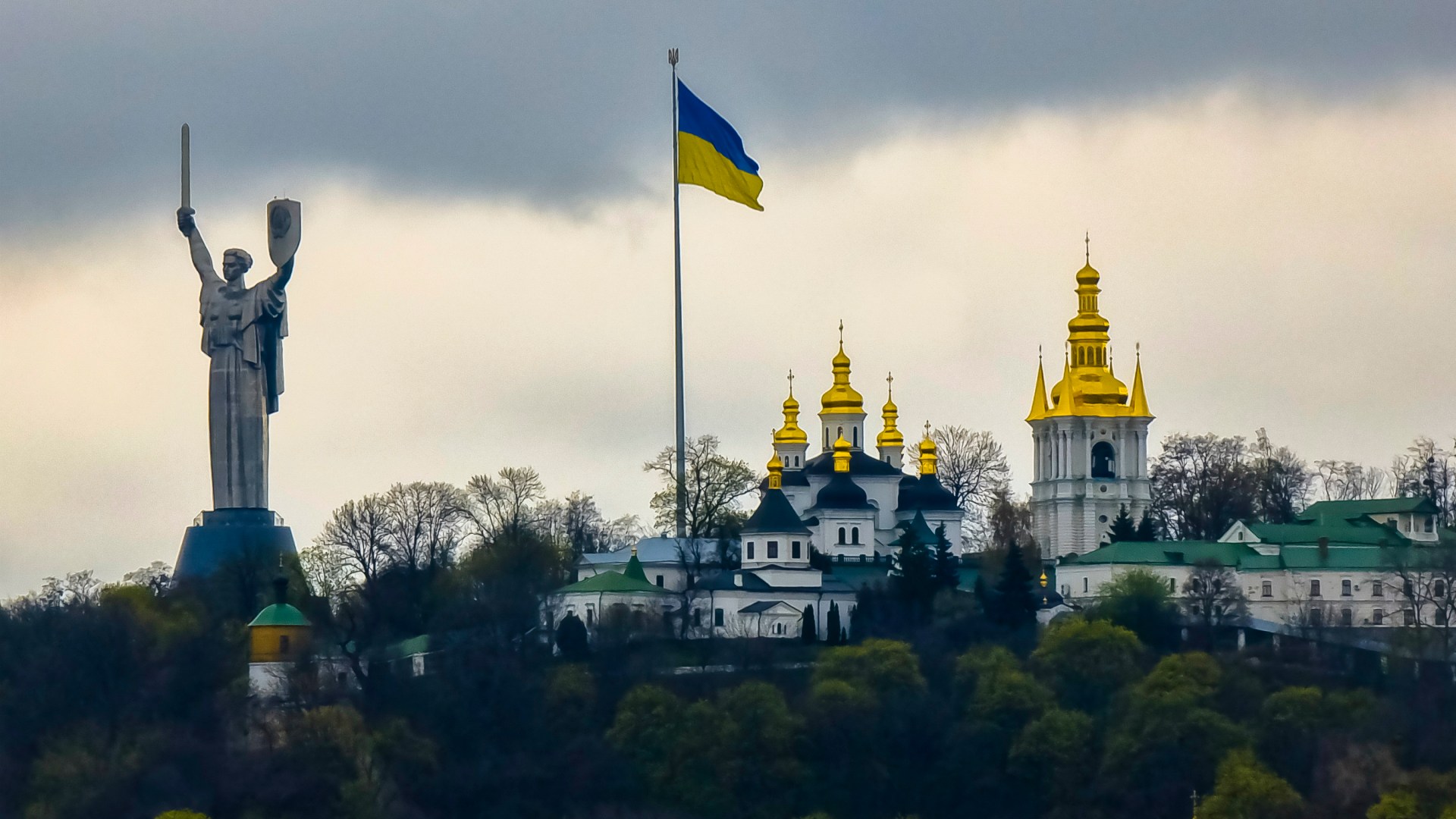
Pechersk Lavra (Monastery of the Caves) in Kyiv, Ukraine.

Pechersk Lavra (Monastery of the Caves) in Kyiv, Ukraine.

Christianity Today May 30, 2022
Artem Hvozdkov / Getty Images

After 93 days of war, the Ukrainian Orthodox Church-Moscow Patriarchate (UOC-MP) has definitively broken with Russia—maybe.

In a council decision taken May 27, the Russian Orthodox Church (ROC)–affiliated body declared its “full self-sufficiency and independence,” condemning the three-month conflict as “a violation of God’s commandment: Thou shalt not kill!

Such a condemnation was not new. The day the invasion began, UOC-MP Metropolitan Onufriy called it a “repetition of the sin of Cain.” But in dry ecclesial language, the statement dropped a bombshell.

It “adopted relevant amendments” and “considered … making Chrism.”

Chrism, the anointing oil of baptism and other liturgical rites, was last made in Ukraine in 1913. Its manufacture is a typical sign of autocephaly, the self-governing of an Orthodox church branch.

Continuing the tone, the UOC-MP reiterated its position.

“We express our disagreement with … Patriarch Kirill of Moscow and All Russia,” it stated of the ROC head, “regarding the war in Ukraine.”

Kirill has consistently supported Russia’s “special military operation.”

In 2018, the breakaway Orthodox Church of Ukraine (OCU) was granted autocephaly by the Ecumenical Patriarch of Constantinople, Bartholomew I. Rejected by Kirill and the UOC-MP, the act formalized the national schism. (A much smaller third Ukrainian Orthodox church joined the OCU.)

The UOC-MP council’s Friday statement continued to echo the ROC rejection. OCU bishops lack apostolic succession, it said, while overseeing the forcible seizure of churches to transfer jurisdiction. The UOC-MP stated a willingness to dialogue with the OCU if these dividing issues could be addressed.

And then, it symbolized division.

The next day during Holy Liturgy, Onufriy referred to Kirill as a fellow primate, not as his hierarch (superior). No mention was made of any connection to the ROC Moscow Patriarchate.

Andrey Shirin said these “unheard of” developments were “truly remarkable.”

“The ongoing war in Ukraine is a crisis on several levels—political, economic, humanitarian,” said the Russian associate professor of divinity at the John Leland Center, a Baptist seminary in Virginia. “This is another chapter in the theological crisis.”

The consequences could be felt “for centuries.”

Onufriy had been trying to keep a middle ground, Shirin said. UOC-MP spokesperson Archbishop Kliment confirmed Saturday there had been pressure from the Ukrainian government to make such a move, but told Agence France-Presse the decision was driven by common worshipers. A poll at the start of the war found 65 percent of UOC-MP members supported Onufriy against the invasion. And in recent weeks, hundreds of UOC-MP priests signed an open letter calling for Kirill to face a religious tribunal.

The Moscow patriarch’s esteem among his Ukrainian flock dropped below 20 percent, down from 50 percent a decade earlier.

Kirill could declare the statement void, Shirin said, and perhaps move to replace Onufriy with a more pliable leader in Ukraine. Or he could try to work with his Kyiv counterpart to preserve whatever unity possible.

Kirill’s first response suggests the latter, said Shirin. Announcing his “full understanding” that Onufriy and his church “should act as wisely as possible today so as not to complicate the lives of their believers,” Kirill warned Sunday against the “spirits of malice” that seek to divide the Orthodox people of Russia and Ukraine.

Cyril Hovorun said the UOC-MP council’s declaration was long overdue.

“The UOC-MP is in a much worse position now than it was in 2018,” said the Ukrainian priest and professor at Stockholm School of Theology. “Society affords it zero trust, many people openly hate it, and those who remain members must continually apologize.”

The only way out is dialogue with the OCU, Hovorun said, which hardline bishops in both churches might try to block. But despite the appearance of an ultimatum, the UOC-MP statement might be an overture.

“There is now a new opportunity for Orthodox unity in Ukraine,” he said. “The May 27 meeting created momentum.”

But for Roman Lunkin, momentum is in the opposite direction.

“The partition of Ukraine has happened,” said the head of the Center for Religious Studies at the Russian Academy of Science. “What was evident at the start of the special operation has now officially taken place in the church sphere. Logically, it will now follow politically.”

Last week, Henry Kissinger, the former US secretary of state, recommended a settlement through Ukraine ceding territory to Russia. In 2014, Russia annexed Crimea and backed separatist rebels who seized control of parts of Ukraine’s eastern Donbas region.

Ukrainian President Volodymyr Zelensky has insisted that peace negotiations begin after restoration of his nation’s sovereign borders. The UN stated 14 million Ukrainians have been displaced from their homes, with 6.6 million refugees now abroad.

Lunkin noted the UOC-MP stating it would respond by establishing dioceses outside Ukraine. But internally, bishops would be given independent authority to guide the church where central leadership is “complicated.”

Lunkin interpreted this simplifying of spheres of influence to mean that churches in occupied areas will be able to determine their own status—meaning de facto governance by the ROC.

“Schism in the church,” he said, “is a schism in the country.”

But is it even a schism?

It may be difficult to tell, noted OrthoChristian.com, until the adopted amendments are revealed. But Nikolai Danilevich, deputy head of the UOC-MP’s Department for External Church Relations, stated Friday on Telegram that as it “disassociated” from the Moscow patriarchate, “in its content, the UOC-MP statutes are now those of an autocephalous church.”

Alexander Webster noted the wording.

“He used odd phrases rather than declaring autocephaly,” said the American archpriest and retired seminary dean in the Russian Orthodox Church Outside Russia. “Dating back to the earliest centuries of Christianity, canon law makes impossible the unilateral pronouncement of independence by any segment of the Orthodox church.”

Archbishop Kliment, who lauded the declaration, elsewhere stated that the UOC-MP did not actually break ties with the ROC. In fact, the church has already been independent for three decades. In 1990, prior to Ukrainian independence from the Soviet Union, the Moscow patriarchate granted self-governorship under its jurisdiction.

ROC spokesman Vladimir Legoyda said Saturday the church has received no formal notice from the UOC-MP. Reportedly, half of UOC-MP dioceses had already stopped mentioning Kirill in their formal prayers.

But at least one significant site has continued. One day after the UOC-MP changed its statutes, a deacon in the Kiev Monastery of the Caves, founded in 1051, prayed for “our great lord and father, His Holiness Patriarch Kirill,” followed by a benediction for Onufriy.

Following Constantinople’s granting of autocephaly to the OCU, a 2018 survey found that 29 percent of Ukrainians identified with the newly independent church, 23 percent said they were “simply Orthodox,” and 13 percent belonged to the Moscow-linked UOC-MP.

By 2020, the figures had shifted to 34 percent OCU, 14 percent UOC-MP. And last month, 74 percent of Ukrainians expressed support for the UOC-MP to sever ties with the ROC (up from 63 percent in early March), with 51 percent supporting an outright ban.

More than 400 parishes have switched allegiances since the invasion.

Webster lamented these developments.

“However egregious or unjustifiable an internecine Orthodox war may be,” he said, “we cannot allow it to fracture the body of Christ.”

Bradley Nassif, former professor of biblical and theological studies at North Park University, noted the “sad irony” of their shared faith.

“The way forward lies within the church’s own gospel, which teaches that healing starts with the humility of self-criticism,” said the author of The Evangelical Theology of the Orthodox Church. “It is summed up in their famous prayer: ‘Lord Jesus Christ, Son of God, have mercy on me, a sinner.’”

Follow CT’s Russia-Ukraine war coverage on Telegram: @ctmagazine (also available in Chinese and Russian).

Select articles are offered in Russian and Ukrainian.

Ideas

The Uvalde School Shooting Sends Me to Matthew 18

Jesus gave specific instructions on caring for the “little ones.” The Texas tragedy suggests the church has gravely fallen short.

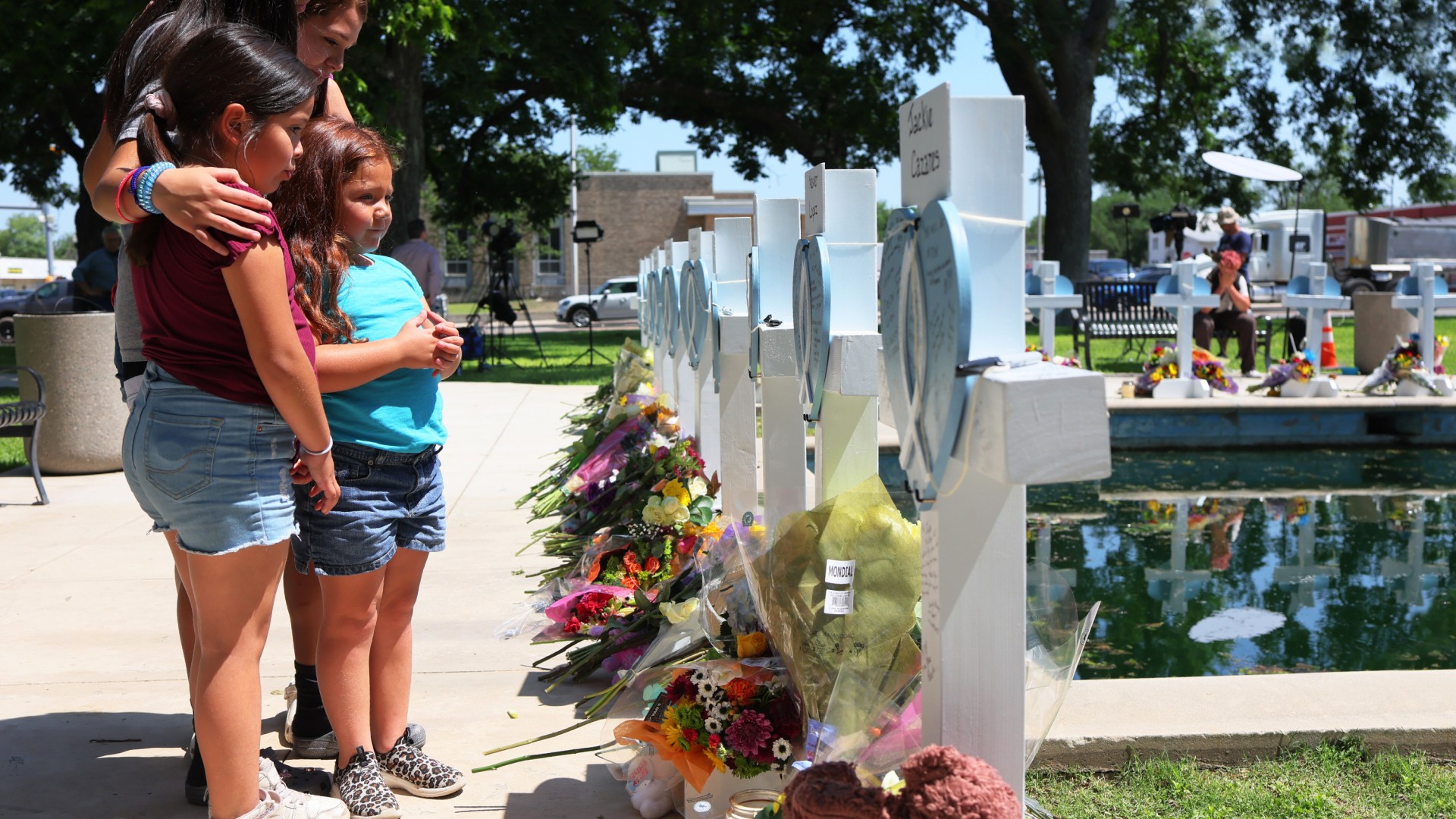
Mourners visit a memorial for a victim's of the mass shooting at an elementary school, in City of Uvalde Town Square.

Mourners visit a memorial for a victim's of the mass shooting at an elementary school, in City of Uvalde Town Square.

Christianity Today May 27, 2022
Michael M. Santiago / Getty

I remember being 10. I had just discovered a passion for soccer and watched the entire World Cup for the first time alongside my father and my brother.

I embarked on my first mission trip with my church that year to the sierras of Chihuahua, Mexico, where I was fascinated by the idea of one day doing ministry full-time.

I remember being 18. I had graduated high school a semester earlier and had moved to Alabama for a few months before starting college in the fall. My family was no longer together, and my mother had to work all the time because she was now a single parent of two kids.

I knew I wanted to leave those difficult experiences behind and study college away from home. Today I can tell you that I did not know much more at 18 than I knew at 10.

As a journalist and minister who has found a home in Texas, I’ve reflected on these stages of my life as I’ve mourned the tragedy currently crushing the Latino community—an additional chapter to our often painful history. As we so dreadfully now know, on Tuesday, 19 children, ages 9, 10, and 11, were murdered by one who had reached 18 a little more than a week earlier.

The victims loved their moms, celebrated first Communions, and made honor roll. They were children who, just like me years ago, might have watched their first World Cup with their dads and brothers later this very year.

The person who murdered these children was a man barely on the other side of childhood—one who, as Brennan Manning writes, was “broken on the wheels of living.” We know only the surface of what Salvador Ramos’s life was like: a parent struggling with drug addiction, bullying that targeted his speech impediment, violence that intensified as he grew older.

As we grieve these outrageous deaths, we know that Christ was not indifferent to children. Matthew 18 and 19 reveal that Jesus, the very embodiment of God, loves and sees them.

These passages show that as we mature in Christ, we are expected not only to become more like children—as the disciples learned when they asked who would be the greatest in God’s kingdom—but also to protect and look after them.

While we struggle to seek solutions to an infuriatingly intractable problem, perhaps one area the church should take care to not neglect is the care and stewardship of the youngest and most vulnerable members of our society.

A little child shall lead them

Matthew 18:1–5

At that time the disciples came to Jesus and asked, “Who, then, is the greatest in the kingdom of heaven?”

He called a little child to him, and placed the child among them. And he said: “Truly I tell you, unless you change and become like little children, you will never enter the kingdom of heaven. Therefore, whoever takes the lowly position of this child is the greatest in the kingdom of heaven. And whoever welcomes one such child in my name welcomes me.

Our culture understands greatness not unlike the culture that Jesus was born into. Wealth. Power. Markers of status that people devote their entire lives to seeking. But Jesus has a different model for those who want to make it in his kingdom: children.

To make his point, Jesus beckons to a child and brings him or her into the circle of disciples. He wants them to consider the child’s smallness, fragility, dependence, humanity and to emulate it. In contrast to his own culture, Jesus’ words and actions tell us that children not only are people but are also the most important members of the eternal and holy kingdom of heaven.

But children are not a prop that Jesus wants to use as an object lesson. Our interactions with them are our interactions with God. Welcoming a child, Jesus says, is welcoming God. Shaping a culture that will hurt children, tear them to the ground, ignore their loneliness, and violate their vulnerability suggests something about how we worship the Lord.

A world where mass shootings of children exist starkly reveals our failure to honor and love the stage of human life God sees as the greatest in the kingdom of heaven.

Woe!

Matthew 18:6

If anyone causes one of these little ones—those who believe in me—to stumble, it would be better for them to have a large millstone hung around their neck and to be drowned in the depths of the sea.

Have we adults in the church ever asked ourselves what we do that causes children to sin? In our conversations about the significance that community has on our spiritual lives, how often do we think about the type of company we offer children? What consequences result from a child growing up in a society that glorifies guns?

How are children impacted by parents leaving homes, society’s normalizing violence, or their experiencing poverty? How are kids hurt by leaders who lie to the parents, by authority figures who don’t trust them, and by elected officials who fail to steward their responsibility well?

The consequences of such dysfunction can destroy children for generations. Just as we see in family systems theory, events and behaviors tend to repeat over and over again, from generation to generation. Learned behaviors are transmitted to the next generation almost with no control or say from the previous generation. Mindsets and understandings are transferred almost involuntarily from elders to children. Our actions become just a mirror reflecting what our ancestors did—and will be done all over again by those who come after us.

The one wandering sheep

Matthew 18:10–14

See that you do not despise one of these little ones. For I tell you that their angels in heaven always see the face of my Father in heaven.

What do you think? If a man owns a hundred sheep, and one of them wanders away, will he not leave the ninety-nine on the hills and go to look for the one that wandered off? And if he finds it, truly I tell you, he is happier about that one sheep than about the ninety-nine that did not wander off. In the same way your Father in heaven is not willing that any of these little ones should perish.

Maybe there are some who grew up without the experiences of being an outcast, a reject. Maybe. But I think most of us remember and understand what it feels like to be alone. What it is like to be pushed away. These verses reveal that Jesus will leave everything behind when looking for the ones who have wandered off.

Our call to imitate Christ clearly commands us to do the same. Perhaps these verses have been said to refer to us when we step away from our faith or simply when we do something we know we should not do.

But to me, these words reveal the heart of Christ for children like Salvador Ramos or Eric Harris and Dylan Klebold. Those lonely, forsaken, and rejected children are out there, and Christ has a heart for them.

Our society takes children, beats them senseless, and then throws them out when they are no longer needed. Is Christ not calling us to go after those who have wandered off because our society has pushed them away?

Too many children grow up in our society neglected or abused by their parents, with few adults equipped to healthily deal with their anger and pain, who take their isolation and search for community and significance in the dark.

For Christians, our task then is to bring these children home. We are not to do this because we ourselves are their saviors or because through us they can experience a new life. And home does not mean our society or our culture or this nation that one day will pass. Our home is Christ’s kingdom.

Jesus loves the little children

Matthew 19:13-15

Then people brought little children to Jesus for him to place his hands on them and pray for them. But the disciples rebuked them.

Jesus said, “Let the little children come to me, and do not hinder them, for the kingdom of heaven belongs to such as these.” When he had placed his hands on them, he went on from there

Mark Madrigal had two cousins shot and wounded in Uvalde and knew a number of the kids who died.

“As a community, we’re together and looking out for everyone’s kids no matter what,” he said.

His attitude reflects the posture that Jesus calls us to. When it comes to children, he doesn’t limit his instructions to family members. The absence of specificity suggests a responsibility to all, including the lonely, the angry, the repressed, the traumatized, the bitter, the unchurched, the church haters, the sad.

While this latest wretched shooting suggests that we have significant work to do, an enveloping posture toward children is something I’ve witnessed firsthand. Growing up in a single-parent home, I received guidance and care from church members, my youth pastor and his leadership team, and several other pastors—helping my faith grow even during a period of intense difficulty. Children who have only one parent or a family member yet also have others committed to walk with them faithfully. Life can be harsh. We need a few who will tenderly and lovingly walk alongside us.

Our nation now carries even more broken children. How will we Christians in the wider church embody our love of God in how we love all the little ones in our communities?

Isa Torres is a minister, writer, and reporter, who lives in North Texas.

Theology

15 Prayers for a Violent World

In an age weary with suffering, how can we pray?

Christianity Today May 27, 2022
Illustration by Mallory Rentsch / Source Images: WikiMedia Commons

As the father of two elementary-aged children, the news of the May 24 mass shooting in Uvalde, Texas—just three hours south of my home in Austin, which resulted in the death of 19 children and 2 teachers—shook me deeply.

Driving my daughter to school the morning after, I felt acutely the fragility and unpredictability of life, and I found myself becoming intensely afraid—and increasingly angry.

Only 10 days prior, a racially motivated 18-year-old man, dressed in body armor and wielding a rifle with a high-capacity magazine, shot and killed 10 people at a Buffalo supermarket, wounding 3 others. Eleven of the 13 victims were Black.

A day after the mass shooting at a Tops Friendly Markets store in upstate New York, a gunman entered Geneva Presbyterian Church, in Laguna Woods, California—where a group of parishioners had gathered for a lunch to honor a former pastor of a Taiwanese congregation that uses the church for its worship services—and shot and killed one person and wounded five others.

One nation bombs another, a denomination keeps a secret list of abusive pastors, a man is profiled because of his skin color, a Christian is persecuted because of her faith, and thousands are cruelly displaced from their homes—all of it occurring against the backdrop of a global pandemic.

It’s tempting to shut down emotionally in light of all of this violence. It’s tempting to give into despair. “So goes the world,” we might say, wishing it were otherwise but feeling powerless to make a difference. It’s tempting to distract ourselves with busywork or to reach for spiritual platitudes to numb the pain. “Let go and let God.” “God works in mysterious ways.” “Heaven’s our real home.”

But our world is a violent one and the Bible does not allow us to ignore its violence or to explain it away with tidy theological slogans. It asks us to face our world squarely, together, and, where needed, to yell our rage to God. The Bible invites us to get angry at God, because he can handle all our bitter, angry tears and curses. And such words need to be said out loud, because that's partly how we keep the chaos of violence from taking root in our own hearts.

As I write in my book on the psalms, there is no faithful prayer in Israel’s official book of worship, the Psalter, that trivializes evil, no genuine faith that ignores the destructive powers of sin, and no true witness that turns a blind eye to the violence of our world. It is for this reason that we turn to the psalms for guidance in times such as these, for they show us what we can—and indeed should—be praying in a violent world.

But a question remains: How exactly do we pray in the aftermath of such violence? What words of lament can we put on our lips that make sense of the senseless? To what could the whole people of God possibly say “amen” in light of the corrosive power of hate that allows neighbor to irrationally kill neighbor? What do an exhausted and dispirited people say to God at such a time?

These questions are, of course, far from easy to answer, but over the past couple of years I have attempted to give language to such matters in the form of Collect Prayers—in the hopes that they might prove useful, and perhaps comforting, to people who face the terrors and traumas of violent activities in one form or another.

May the Lord, in his mercy, hear our prayers.

A Prayer of Anger:

To the God whose holy anger heals; To the Messiah whose righteous anger overcomes evil; To the Spirit who keeps our anger from turning destructive: Receive our wounded hearts; Take our burning words; Protect us from the desire for revenge. May our righteous anger become fuel for justice in our fractured world and for the mending of broken relations in our neighborhoods and homes. For God’s sake—and ours—we pray. Amen.

A Prayer After a Mass Shooting:

O Lord, you who abhor those who murder the innocent, be not deaf to our bitter cries, we pray, and do not abandon us to our pain this day. Hear our raging words of protest, O God of Jacob, heed our groans for justice and meet us in this lowly and desperate place. Awake, Lord! Rouse yourself! Deliver us from evil, for your name’s sake! We pray this so that we might witness your might to save and your power to heal. We pray this in the name of our Fortress and Refuge. Amen.

A Prayer of Bitter Lament:

Merciful God, you who weep with those who weep, who rescue the oppressed, who incline your ear to the needy and who bind up the brokenhearted: hear our prayer. Bring an end to our distress. Preserve our lives. Rescue us. Heal us. Be near to us this day. We pray this in Jesus’ name, a man of sorrows, acquainted with grief, on whom we cast all our cares. Amen.

A Prayer for Peace in a Time of War:

O Lord, you who are the True King, have mercy, we pray, on the people who suffer the ravages of war this day. Silence the warmongers, scatter the bloodthirsty, shatter the weapons of war, and take pity on the vulnerable, so that true peace and justice might be restored to this land. We pray this in the name of the Prince of Peace. Amen.

A Prayer Against Bloodthirstiness:

O Lord, you who abhor the bloodthirsty, rebuke the murderous, we pray, and break the sword of the violent, so that we might witness you as the God of Justice and the Lord of Righteousness under the light of the noonday sun. We pray this in the name of Christ our King. Amen.

A Prayer in Response to Death:

O Wounded Christ, you who have gone to the monstrous depths and swallowed death whole, tasting its bitter finality and conquering it once for all, we pray that you would free us from the fear of death and comfort us in the losses that we experience on account of death, so that our hearts might be infused this day with your resurrection life. We pray this in the name of the One who is the Resurrection and the Life. Amen.

A Prayer for Police Officers:

Oh Lord, you who love righteousness and justice, we pray for all police officers today, that you would support and bless them in their duties, and that you would strengthen them to defend the cause of the vulnerable, maintain the right of the oppressed, serve the good of the community, and preserve the peace in our cities, so that they might be emissaries of your justice in the world. We pray this in the name of the Ruler of the Nations. Amen.

A Prayer for Our Enemies:

O Lord, you who ask us to do the impossible—to bless our enemies, to pray for those who persecute us, and to love those who seek us harm—we pray that you would do the impossible in us: Help us to love our enemies as you love them and to remember who our true enemies are: Satan, death, and the spiritual forces of evil. Perform also a miracle in our enemies by your Spirit, and in your sovereign might restrain the power of evil in this world. We pray this in the name of the One who does impossible things. Amen.

A Prayer Against Neighbor Hate:

O Lord, you who command us to bless our enemies, protect us, we pray, from turning our neighbors into enemies, worthy only of hatred and deserving of nothing but insults and curses, and grant us instead the heart of Jesus, so that we might love our neighbors as you love them. We pray this in the name of the One who causes the sun to rise both on the evil and on the good. Amen.

A Prayer for Loving a Hurting Neighbor:

O Lord, you who do not look away from the pain of this world, open our eyes, we pray, to see the pain of our neighbor and, by grace, to become the healing presence and power of Jesus to them, so that our hearts might be kindled with your neighbor love this day. We pray this in the name of the Merciful One. Amen.

A Prayer to Become a Justice-Loving People:

O Lord, you who hate those who record unjust decisions, may we be a people who stand against injustice that occurs anywhere as a threat to justice everywhere, so that we might become worthy representatives of your righteous kingdom and extremists for Christ’s love. We pray this in the name of the One who sets the oppressed free. Amen.

A Prayer For Those Who Weary of Doing Justice:

O God, you who see the hearts of all with perfect clarity, I confess my irritation with those who bully their way with words, who think no one sees what they do in the shadows, and who live in a world of denial. I’m angry and scared and tired of doing the right thing. Strengthen my heart, I pray, so that I might not lose hope. I pray this in the name of the Good Shepherd and Just Judge. Amen.

A Prayer Against Duplicity of Heart:

O Lord, you who were cheered and jeered by the very same crowd, have mercy, I pray, on my own duplicitous ways: confessing one sin openly yet hiding another; blessing God out of one side of my mouth, while cursing my neighbor out of the other; smiling in public but raging in private; loving God and money equally much; and all other sins besides. Grant me the grace of integrity—of being one thing through and through—no matter what the cost. I pray this in the name of the One Who Remains True. Amen.

A Prayer for the Peaceable Kingdom of God:

O Lord, you who were manifested to the world at the visit of the Magi, manifest yourself to the world today as the King who refuses to use the violence of the world to the achieve the peace that we so eagerly desire, so that we might be strengthened to do the work of your peaceable kingdom in our own time and place. We pray this in the name of our Redeemer and King. Amen.

A Prayer of Allegiance to the Prince of Peace:

O Lord, you who deserve all our loyalties, we pledge allegiance this day to the Lamb of God and to the upside-down kingdom for which he stands, one holy nation under God, the Servant King and the Prince of Peace, with liberty and justice for all without remainder. We pray this in the name of the Holy Trinity. Amen.

W. David O. Taylor is associate professor of theology and culture at Fuller Theological Seminary. He is the author of Open and Unafraid: The Psalms as a Guide to Life and accompanying illustrated psalms prayer cards.

News

Passion Rekindled: Oberammergau Easter Play Returns with Great Joy

Tourists and pilgrims flock to German village as 1,800 local actors prepare to take the stage after pandemic interruption.

Christianity Today May 27, 2022
Oberammergau Passionsspiele / Arno Declair

Jill and Oscar Schmidt vowed that they would travel from their home in Washington State to Oberammergau, a small village in the south of Germany, to see the world-famous passion play about the death of Jesus.

They wanted to go in 2010 but didn’t get tickets in time. So they decided they would not miss the next performance—no excuses!—and made plans for the spring of 2020.

“Then they were cancelled,” said Jill.

The Schmidts understood, of course. Everything was shutting down at that time, as the pandemic swept across the world and dominated the headlines. But that makes this moment, two years later, very sweet.

“We are so glad to finally be here,” Jill told CT, “and experience the play at least once in our lifetime.”

This desire—to experience the Oberammergau Passion Play once in a lifetime— has driven millions of tourists and pilgrims to visit the village over the years. It began in 1633 with another vow. Suffering the ravages of the bubonic plague, the inhabitants of the Bavarian village promised to perform a “play of the suffering, death and resurrection of our Lord Jesus Christ" on stage every ten years if God would spare them further death and devastation. The plague ended, and the people of Oberammergau have been putting on the passion play ever since.

In the 19th century, it began to draw in international visitors, mostly Catholics and Lutherans. Today, a third of the 1 million guests are from the United States, the United Kingdom, and Scandinavia. The play resonates in this moment with the feeling of surviving a pandemic, but it has long spoken to the themes of crisis and overcoming hardship. The production, after all, retells the story of Jesus’ suffering and death.

But the Passionsspiele, as it’s called in Germany, is also a festival and public celebration.

It might be more celebratory than normal this year.

“It’s like Oktoberfest, Holy Week, and the end of the pandemic all rolled into one,” said Alex Schwarz, owner of a local bookstore selling passion play literature and souvenirs alongside the cookbooks and notebooks you could find in any German bookstore.

On May 13, the day before opening, locals declared themselves glad to get “back to normal.”

They recounted to each other how, two years ago, director Christian Stückl announced the postponement with tears in his eyes. Performing the play while practicing social distancing would have been impossible. When up to 1,000 people appear on the stage at one time, a safe distance between them would have required a stage almost two-and-a-half acres in size. It just wasn’t practical. Stückl put a temporary halt to the tradition that had been running for 400 years before.

Now, however, the crowds have returned. The visitors find a village that seems, at moments, sacred, but more often appears as a peculiar kind of film set. Some 1,800 of the 5,000 villagers are directly involved in the production. The rest play host. As visitors wander around, they can see “Nicodemus” eating ice cream, members of the Jerusalem Council getting tested for COVID-19 across from the train station, or even the man who plays Jesus shepherding his children through the crowds.

Jake Krengel, a guide with Bavaria and Beyond Tours, in nearby Garmisch-Partenkirchen, is happy to be back. He said there was a lot of uncertainty over the last two years.

“It’s a beautiful thing to see years of anticipation being realized,” Krengel said. “Even a few months ago, everyone in Oberammergau was still wearing masks and social distancing, there were so many questions left to be answered and fears that it actually wouldn’t happen.”

The pandemic created hard times for everyone. During difficult times in Oberammergau, people remind each other to hang on until the next passion play. There’s even a saying in the village for when money gets tight: “Passion wirds sho richten,” meaning “Passion will fix it.”

Over the last two years, many started to wonder if that would be true.

Now that the plays are actually happening, Krengel said, “we couldn’t be happier.”

The joy was palpable on opening day, especially during the pre-premiere ceremony and ecumenical worship service. Catholic Cardinal Reinhard Marx and Protestant Bishop Heinrich Bedford-Strohm presided over a service that felt like a celebration, though there were somber moments too.

In a joint sermon, the two religious leaders echoed how much the return of the plays meant for not only Oberammergau, but the world.

“The passion play these days cannot be seen simply as a historical play,” said Bedford-Strohm. “The passions of people are far too much in front of us today.” He mentioned those suffering from disease and war, famine and persecutions, racism and climate change. For all of them, he said, and for all of us, Jesus’ passion contains a message of hope.

“The greatest story of all time,” Marx said, reminds the audiences in Oberammergau that “violence does not have the last word, power does not have the last word.”

It is with these themes in mind that the director has modernized the play. Christian Stückl has reworked the 100-year-old script, which was originally written by a local pastor, Joseph Alois Daisenberger. Stückl has been working on this revision since about 1990, and in the two-year delay, he revised it some more.

“I had to take another look,” he said, “because for me, the religious ballast recedes into the background and the social comes to the fore.”

An angry, energetic Jesus takes center stage in Stückl’s retelling, calling followers to fight for mercy and justice on behalf of the oppressed. In this play, Jesus is presented as a reformist Jew who wanted to renew the religion of his fathers. While Christ may appear less “Christian” than he has in the past, the changes address persistent concerns about the antisemitic implications of the version in which Jesus didn’t appear to be Jewish at all.

Stückl and his ensemble have also added more nuance to characters like Joseph of Arimathea and Judas, the latter framed as a “betrayed traitor” rather than an inherently evil foil.

The idea, Stückl said, is to confront the audience with questions he and his team have long wrestled with.

Margaret Hinchey of Denver, Colorado, who is hosting an August tour with her husband Donald, a Lutheran pastor, said they are looking forward to the conversations the play provokes. The changes, they say, do not diminish the opportunities to start a dialogue that can lead to lasting spiritual change in someone’s life.

“I am not under any illusion that someone is going to go to the Passion Play and have a conversion experience,” said Donald, “but there may be some openings. Some questions. It can start a conversation.”

To help people on their tour prepare for these conversations, the Hincheys will be leading daily devotionals on some of the Gospel characters, such as Mary Magdalene and Malchus, a servant of the Jewish high priest Caiaphas, who participated in Jesus’ arrest.

Another tour leader, David Mahsman, will also be leading his group through discussions about how the play matches up with the narratives of the four Gospels. The conversations that come after the performance are almost as important as the production itself, according to Mahsman, but it’s not all religious.

“It’s a mix of a pilgrimage and a tour,” he said. “We enjoy the sights and sounds of Europe, but then have discussions and devotions while drinking German beer.”

Donald Hinchey feels the same. He’s simply been looking forward to traveling again. And, after more than a decade away, he’s eager to see Oberammergau and thankful to be finally, maybe, putting the pandemic behind him.

But he’s also hoping this trip will have a deeper significance.

“I find as I get older, my faith can be somewhat jaded. Every so often I need a bit of a reboot,” Donald said. “Last time, I just couldn’t get the passion play out of mind. I am hoping the same thing happens again.”

News

Uvalde Pastors Mourn Losses Close to Home

A Hispanic Baptist leader focuses on ministering to his family after his great-granddaughter dies in the school shooting.

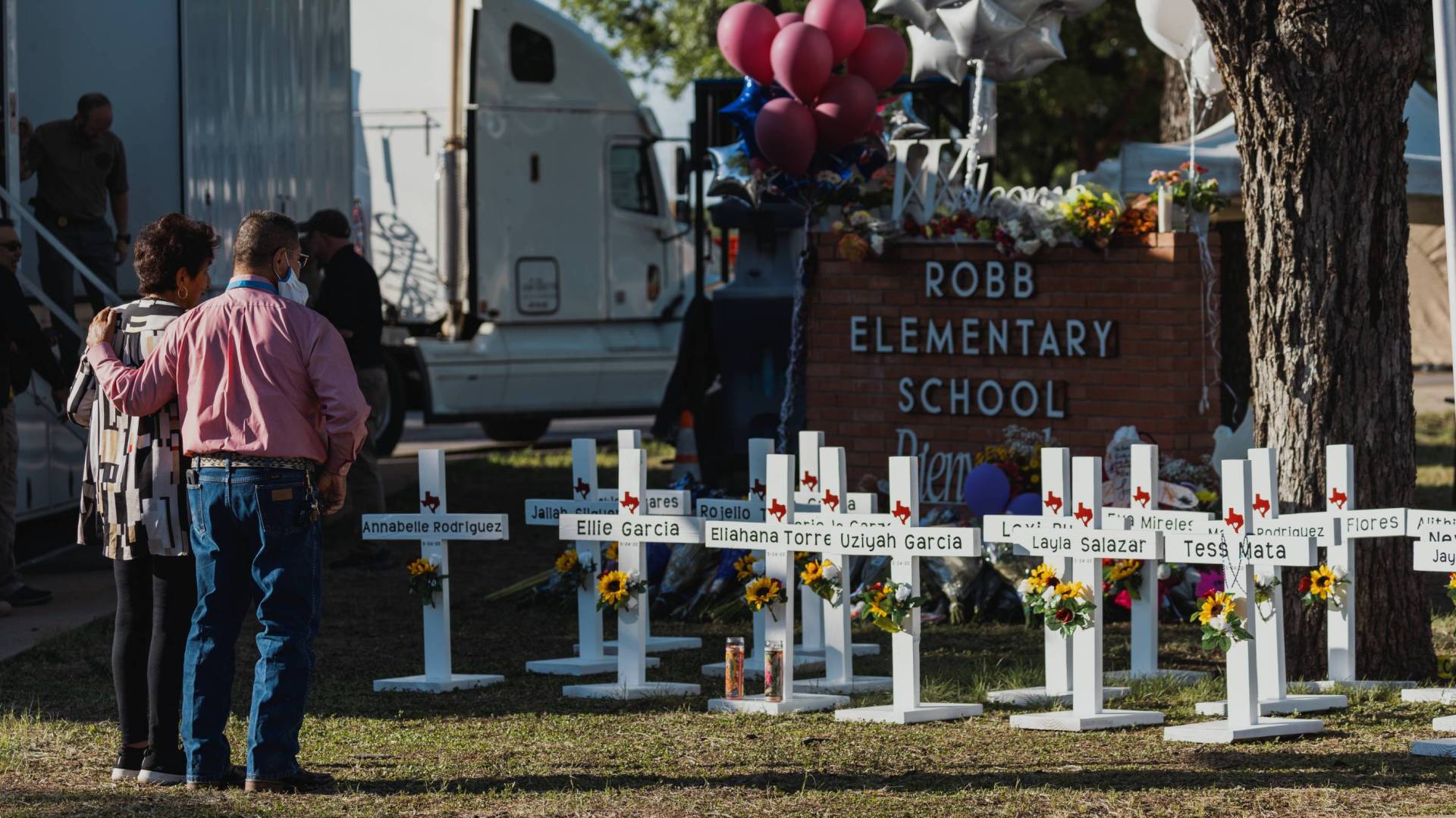
Robb Elementary School in Uvalde, Texas

Robb Elementary School in Uvalde, Texas

Christianity Today May 26, 2022
Jordan Vonderhaar / Getty Images

In the quiet, 16,000-person town of Uvalde, Texas, nearly everyone has connections to the children, families, and teachers shaken by the deadly elementary school shooting.

“I was watering my flowers in the front yard when I heard shots ring out,” said Julian Moreno, former pastor of Primera Iglesia Bautista. Moreno lives two blocks from Robb Elementary School, where an 18-year-old gunman killed 19 kids and two teachers on Tuesday.

Within minutes of hearing the shots, Moreno said he saw two policemen running down the street. Then, an exchange of gunfire so close he could smell the powder.

Knowing his great-granddaughter, Lexi, was a student at the school, Moreno walked to the campus once the shots ceased.

He later learned that the attack took place in 10-year-old Lexi’s classroom, and she was among the victims.

Outside the school, Moreno said, the atmosphere radiated with fear, as parents clamored to get into the barricaded building. Officers with the Texas Department of Public Safety (DPS) and Border Patrol shouted at one another as they put on their gear and approached the school.

“People were talking loudly, a lot were crying,” he said. “They were saying, ‘My son or my daughter is in that building,’ and the officers were just saying ‘I’m sorry, you can’t go any further.’”

Located 80 miles west of San Antonio, an hour from the Mexican border, the town of Uvalde is 82 percent Hispanic, with sizable Catholic and Baptist populations. Around 20 local churches have joined together to support their community, now known as the location of the third-deadliest school shooting in the US.

Because he’s a faith leader, people in the community have turned to pastors like Moreno for guidance in their grief. Moreno has been praying most with his granddaughter Kimberly Mata-Rubio, Lexi’s mother, who “went into complete shock.”

After the honor roll ceremony earlier in the day, Mata-Rubio wrote, “We told her we loved her and would pick her up after school. We had no idea this was goodbye.” She sobbed as her husband spoke about Lexi on CNN on Wednesday.

“I need to be as strong as I can to be able to minister to my family in particular,” Moreno said.

In such a small town, many of the people called on to help provide spiritual support are themselves grieving. The whole place is devastated.

“It’s a small town. Everybody knows everybody,” said Joe Aguilar, Texas Baptists’ area representative for the Rio Grande Valley. “They are going to need a lot of help.”

Texas Baptists reported that Aguilar drove to Uvalde to pray with community members outside the school on Tuesday and has helped coordinate chaplains to assist local pastors.

“You want to make sure the people that are providing care are trained, because we want to give the best help, the best assistance, to these families who are in their worst part of life. And not just anybody is prepared for something like this,” he said.

Anyra Cano, an adjunct professor at Baptist University of the Americas and pastor’s wife at Iglesia Bautista Victoria en Cristo in Fort Worth, made plans to travel to Uvalde to work with parents to “help their children address their fears.”

Neftali Barboza, pastor of Iglesia Nueva Jerico, had just picked up his son early from Robb Elementary before the attack occurred. The funeral home across the street from the school was filled with terrorized children, and Barboza was called to comfort them.

“I stayed and helped take care of the kids,” he told Baptist Press. “I let as many parents as I could know their child was safe.”

The Pew Research Center has found that 24 percent of Americans report their faith becoming stronger in times of tragedy, and churches often have high attendance weekends after a horrific event. Pastors like Barboza are preparing for full services, funerals, and prayer meetings as members of the community gather to process and cry together.

On Wednesday night, ministers organized a packed prayer vigil at the Uvalde Fairplex Arena, attended by Gov. Greg Abbott and US Sen. Ted Cruz. Amid worship songs and remarks, Baptist Temple Church pastor Tony Gruben prayed that “God will heal their little hearts and their little souls.” Some prayed in small groups, while others sobbed during a solo violinist’s rendition of “Amazing Grace.”

On Thursday, Sacred Heart Catholic Parish in Uvalde held a prayer service for victims as well.

Pastor Doug Swimmer of The Potter’s House Church told ABC News that he went to pray with families at the hospital. In addition to the 21 people killed, 17 others were injured in the attack.

“I know that one thing that is going to help us through is God’s grace and God’s love,” he said. “What the world needs and what our community needs is a light that shines in the darkness.”

News

Buffalo’s Black Christians Grieve the ‘Evil Among Us’

Angry but not shocked at racist violence, the victims’ families at funerals this week have a prayer: Let these deaths not be in vain.

Buffalo residents are in mourning over the mass shooting at Tops Friendly Market.

Buffalo residents are in mourning over the mass shooting at Tops Friendly Market.

Christianity Today May 26, 2022
Kent Nishimura / Los Angeles Times via Getty Images

Buffalo this week is bearing the heaviness of 10 funerals all at once.

Even though organizers tried to stagger funeral times, hundreds of cars converged on one cemetery on Wednesday for back-to-back burials. One local congregation, Elim Christian Fellowship, held memorials two days in a row this week, gathering hundreds to cry, sing, and proclaim that death did not have the last word over the loved ones they lost.

The church called for 30 days of mourning in honor of longtime member Celestine Chaney, 65. Chaney was among the 10 people killed in a racist attack at their local grocery store back on May 14. Most of the victims were devout Christians, active in Black churches in Buffalo.

The city’s Christians aren’t rushing the grieving process, even as national news reporters have left town and attention has shifted to a horrifying shooting at a Texas elementary school.

“I’m sure God is angry with what he sees,” said Bishop Glenwood Young Sr., who leads the Church of God in Christ in Western New York. Young’s sister-in-law, 77-year-old Pearl Young, was one of the victims at Tops Friendly Market.

The grief and anger in Buffalo is different than after other recent mass shootings. The shooter, based on officials’ accounts, targeted Black people because of his white supremacist beliefs. He killed the elderly, people who were called mother and auntie by their friends and neighbors. The incident added to the poor neighborhood’s troubles by creating a food desert, with the grocery store indefinitely closed after the shooting.

At the funerals and around the community, conversations swelled with righteous anger. CT heard from people who held to a firm belief that God would do something to address the evil that took place. There was also resilience, as community leaders immediately organized meals, lobbied for new grocery stores, and led worship services at the site of the attack.

But Black Christians in Buffalo also weren’t surprised about the violence that struck around the corner, even though they felt the horror of it personally and specifically.

A Pew Research Center survey from April showed 32 percent of Black adults worried every day or almost every day that they might be threatened or attacked because of their race or ethnicity. That compares to 21 percent of Asian Americans, 14 percent of Hispanics, and 4 percent of white adults.

“I’m f—ing angry,” said Phillip Dabney, 53, who grew up in the neighborhood around Tops grocery store. “There’s a normalization of violence against us, African Americans. It prevents us from valuing our own individual lives.”

Tops was a community gathering place, where people banked and shopped and talked. The East Side of Buffalo, a largely Black neighborhood, is close knit. Everyone CT spoke with knew someone tied to the shooting.

When the shooting happened, Dabney’s niece was in a dance class at a studio one block from the grocery store. She heard the gunshots, and her teachers locked the door. Dabney’s daughter called him in tears because she thought he might have been at the grocery store. “God covers us. It’s not unreasonable that I would’ve been here,” he said, reflecting at a shop a block from Tops.

Dabney described himself as a Calvinist, and he believes some purpose will come out of the attack: “It will not be in vain.”

That was one refrain that victims’ families from Columbine to Buffalo have prayed: Let their deaths not be in vain. That’s what Doreen Tomlin prayed when her 16-year-old was killed at Columbine in 1999, and that’s what family members at the Buffalo funerals prayed over and over.

“Don’t let her dying be in vain,” said Bishop Young at his sister-in-law’s funeral. He exhorted people in the church packed with hundreds to put their faith in Jesus. He earlier also brought up gun laws: “We’re tired. Something’s got to happen.”

Like Pearl Young, most of the victims were devoted churchgoers. The first funeral, held on May 20, was for Heyward Patterson, 67, a church deacon. Then last Saturday, another took place for Roberta Drury, 32. On Monday, Pilgrim Missionary Baptist Church held a funeral for Katherine Massey, 72.

Elim Christian Fellowship hosted Chaney’s funeral on Tuesday and Young’s funeral on Wednesday. Salter’s was at another evangelical church, The Chapel. Four more funerals were scheduled at neighborhood Baptist churches on Friday and Saturday.

Several hundred turned out for the Young and Chaney funerals at Elim. The congregations at both were mostly Black. The funerals were full of Scripture, testimonies, calls to faith, praise songs, and reminders about the Resurrection.

At Chaney’s funeral on Tuesday, people filed past an open casket of the longtime church member who worked in the women’s ministry. Church members passed boxes of Kleenex up and down the aisles.

“When our hearts are overwhelmed, lead us to the rock that is higher than us,” prayed Elim pastor Betty Pierce Williams. “We thank you as our sister made her transition you reached out and took her hand. You have always known this day would exist. So help us understand it … not from how we see it but how you see it.”

Elim pastor T. Anthony Bronner read 1 Corinthians 15, where the apostle Paul asks, Death where is your sting?

“On May 14, it looked like death won,” said Bronner. “I want to tell you today: Death don’t have the last word. … On May 14, that person might have believed he had the final word. I want you to know God has the final word.” People clapped and shouted amens.

A close community torn apart

Pearl Young’s sister-in-law Gloria Anderson had dropped Young off at the grocery store on May 14 after a prayer breakfast. The shooter killed Young in the parking lot.

Young had insisted on going to that grocery store because it wasn’t as far out of Anderson’s way.

“I have this guilt,” Anderson said. “Last night the Lord began to comfort me.”

Bishop Young said when he heard about the shooting, he sent his son to ring Pearl’s doorbell to see if she was home, but no one answered.

Pastor Andre Clark, Pearl Young’s nephew, grew up a couple of blocks from Tops and remembers when they built the store. He leads a congregation on the East Side called New Direction Christian Fellowship.

“I know my Aunt Pearl,” said Clark. “If she talked to [the shooter], she would’ve introduced him to Jesus.”

At Young’s funeral, one eulogizer said, “Everywhere she went, Pearl told somebody …” and the congregation finished the sentence, “… about Jesus!”

In addition to losing his aunt, Clark’s friend from high school was the Tops manager the day of the shooting, and called him to ask for prayer. “Unless there is God’s healing, [the survivors] are going to have PTSD,” Clark said.

Another community hub is the cigar store a block from Tops where people come and sit and chat. On Tuesday evening, Dane Alexander came into the store wearing a suit. He had just left a wake for his stepbrother, grocery store security guard Aaron Salter.

Like Salter, Alexander had a lifetime of service in the Buffalo police force. He had also worked security at Tops at one point, but he feels like he can’t do police or security work anymore.

According to official reports, Salter heroically gave his life defending the store: He shot the shooter, but the shooter was wearing a bulletproof vest and turned on him. At his funeral, the Buffalo Police Department gave him line-of-duty death honors even though he had retired.

“There is evil among us, but God is alive,” said Alexander. “Christians, we have to speak up. The time of denial is over.”

He lit up a cigar and sat back in a chair, talking to neighbors as they came in. He had been in the cigar shop the night before the shooting, and remembered telling another regular who was depressed that tomorrow was a new day. The next day he was taking a nap when he got a call that there was a shooter at Tops, and then he tried to figure out who was working security.

“It ended up being Aaron,” Anderson said. As Anderson sat in the shop on Tuesday, news flashed on the TV on the wall of the mass shooting at Robb Elementary School in Uvalde, Texas.

National attention crowding out grieving

The national attention overwhelmed the grieving process. Families didn’t find out until the evening who had made it out of the store and who didn’t, and by that time the media had already swamped the area.

Press conferences and outside offers of help, from Al Sharpton to food banks, meant many locals hadn’t had a minute to stop and think.

Adding to the chaos of media attention was the fact that the attack was livestreamed, and victims’ family members told me they came across the video in their social media feeds without wanting to. Ministry leaders are trying to figure out how to make sure children in the community don’t see the video or have it pop up on their phones.

A week after the shooting, when there was supposed to be a moment of silence at Tops, there was a meal distribution and media everywhere. Some Black Hebrew Israelites showed up and were shouting on a microphone. Another woman tried to play gospel music to drown them out. People did quiet down for the moment of silence, finally.

The funerals, then, served as a space without cameras—organizers asked them to stay behind a rope in the church parking lot—and a time to worship.

Young preached at his sister-in-law Pearl Young’s funeral from Amos 5:4. He said the time of Amos in Israel was a time like now in the United States, when there was unrest and people forgetting God. “Seek me and ye shall live,” he read.

“With all the death in the land, murders, violence, yet God has said, ‘Seek me and you’ll live,’” Young preached. He read through a series of Scriptures: Psalm 63, Proverbs 4, Psalm 90, and James 4. The congregation knew a lot of the selections by heart and murmured the verses.

“What is your life?” Young read from James 4. Some said back to him: “A vapor.”

Then he read Pearl Young’s favorite Bible verse, Psalm 30:5: “Weeping may endure for a night, but joy comes in the morning.”

Even after the services, family members kept pulling out Bibles, but it wasn’t just to find comfort for grieving.

Pastor Andre Clark, talking to CT shortly after burying his aunt Pearl, pulled out his Bible to read Proverbs 31:8–9: “Speak up for those who cannot speak for themselves, for the rights of all who are destitute. Speak up and judge fairly; defend the rights of the poor and needy.”

“If you say you’re a Christian, what you’re going to say is, ‘I’m speaking up for those that cannot speak—at the watercooler, at the football game, at our churches, at our PTA meetings … not just saying a prayer on Sunday morning,” he said, specifically addressing white Christians.

“Otherwise, we’ll be right back to ‘everything is OK,’ until there’s another Pearl Young lying dead in front of a Tops supermarket. It cannot be for a season. … Someone has to continue to speak.”

Church Life

When Churches Become Mafias

The recent SBC abuse report shows that churches often prioritize tribal unity and safety over “divisive” truth.

Christianity Today May 26, 2022
Illustration by Mallory Rentsch / Source Images: WikiMedia Commons / cyano66 / Getty

This piece was adapted from Russell Moore’s newsletter. Subscribe here.

If you ever want to do something kind for me, please don’t send flowers.

If I were to see a bouquet of them at the door, I would probably have a reflexive adrenal response. That’s because, for years in my Southern Baptist context, the lore was always about a leader in the denomination—who fancied himself a sort of party boss or even bishop—who would send to those who crossed him a bouquet of flowers, with nothing but a card with his name. The flowers were interpreted to signify something along the lines of “You’re dead to me” or “I know what you did” or some such thing.

The first time I heard this, I stopped and thought, “Wait, how is this not the mafia?”

Now I don’t know how many people ever received such flowers. When younger people asked about it, the leader would grin and look away. Maybe the legend was always bigger than the reality. But when it comes to fear and intimidation, legend is really all it takes.

And behind the legend is an even larger truth—one that the rest of the world can now peek into ever so slightly, after the release of an independent investigation that describes a culture of cover-up, retaliation, and stonewalling by the Southern Baptist Convention’s Executive Committee on matters of church sexual abuse, church sexual abuse survivors, and the advocates and whistleblowers who stood with them.

Since then, many people from outside the denomination called or texted as they watched some of the official proceedings, and all expressed some variation of how creepy they found the southern politeness—with everyone calling each other “Brother So-and-so”—given the circumstances.

To some of them I passed along a tweet by religion journalist Bob Smietana: “For those who are new to SBC politics. There’s so much going on when people call each other ‘brother’ or say they want to ‘change the direction’ and say ‘I appreciate you.’ It’s all Bless Your Heart and the Bible and Roberts Rules—and behind-the-scenes knives.”

Knives, yes. And flowers.

It’s not just that a Mayberry Mafia could hide stonewalling political tactics behind syrupy rhetoric of “sweet brother,” and so on. It’s also that folks like that could, and often did, exploit in others a genuine priority of “unity” and “cooperation” and “love of the brethren.”

A few months after I left, a reporter stopped me when I was defending Southern Baptists about something and asked why—to which I said, “I love them, and 90 percent of them are great people.” He said, “I think your math is off.” Maybe that was a kind of Stockholm syndrome, as he implied, of someone who couldn’t bear to think otherwise.

Maybe. But it’s also, if not entirely accurate mathematically, true. There are a lot of sweet people in those pews. The vast majority of them would never imagine that anyone would carry out mafia-style tactics in their name—and, even more so, they would never countenance mistreating sexual abuse survivors in the name of Jesus.

I still believe that. But it doesn’t matter if people don’t recognize that the mafia business is going on behind the scenes and understand how it works.

The primary way it works is through the fear of exile. Flowers at the door—whether literal or metaphorical—aren’t a threat to kill anybody. They are a threat to remove somebody from the tribe—to marginalize that person so that for anyone to listen to them on anything would mean to face the threat of exile themselves.

This works even more effectively in local churches. If a survivor comes forward to talk about what she experienced, she may be told that she’s sowing division and hampering the witness of the church. Those who stand with her may quickly find themselves considered “controversial.” From there, people find other—more popular—ways to show others that those calling for reform aren’t really “one of us.”

Rob Downen, the Houston Chronicle journalist who broke the SBC sexual abuse crisis story, detailed in a very perceptive Twitter thread the background of this current crisis—including the use of “critical race theory” as a way of demonizing people who were deemed to be “liberal.”

As a matter of fact, sociologist Ryan Burge shows with Google search analytics how “CRT” was a controversy in the SBC a full two years before it started showing up in the national culture wars. It would have been easier for me to find a Southern Baptist vegan at a men’s prayer breakfast that a Southern Baptist holding to critical race theory anywhere. But that’s precisely why the tactic works.

Imagine in a local congregation, Brother Tommy, the deacon, says in a prayer, “Hear O Israel, the Lord our God, the Lord is One.” A group of people starts talking about their “concern” with Brother Tommy’s Unitarianism. They start to pass along Wikipedia links about what Unitarianism is, and how it’s a heresy that leads to nowhere good.

Maybe even they hire an atheist to say how, yep, Brother Tommy’s a Unitarian and this is how that’s not consistent with Christian doctrine (that part might be far-fetched; surely that would never happen, but this is just a parable so let’s go with it).

Brother Tommy agrees that Unitarianism is a heresy; he’s Trinitarian to the core. His prayer was quoting a Bible verse from Deuteronomy 6—and saying something fully consistent with the Trinity. When the congregation then starts talking about how worried they are about “Unitarianism” in our church, Brother Tommy is caught off guard.

He’s not defending Unitarianism. He hates Unitarianism. It doesn’t exist in that church. As a matter of fact, he knows there’s a bunch of polytheism going on. But if he addresses the Polytheist Society that’s been gathering after Wednesday night business meeting, he’s told to “stop being divisive.”

When he outlines the danger of the Asherah poles some folks are wanting to put up at the church bazaar, he’s told to “stop being divisive.” When he quotes Deuteronomy 6, he’s told to “leave the politics alone and stick to preaching the gospel.” So, to take down Unitarianism—which is not a problem in that church at the time—Brother Tommy would have to first explain how Deuteronomy 6 is not Unitarian.

Then when people who know better—who’ve known Brother Tommy for years and who know there’s no Unitarian anywhere near that church—start to talk about how they are “taking a stand against Unitarianism,” hoping to quell the crowds and maintain their standing with those who are falsely charging Unitarianism, what is one to do?

At the end of all of that, Brother Tommy is considered “toxic” to be around, nobody’s paying a bit of attention to the Polytheist Society’s moving in another statue to Zeus, and there’s still not a Unitarian in sight. And maybe some of the people who believe Deuteronomy—after having been told it’s “Unitarianism”—might actually become Unitarians.

It’s a confused mess. If, in addition to all of that, there’s also some really dark things happening to vulnerable people—well, who’s talking about that? At least the so-called “Unitarians” have been defeated.

In a church context, any sort of reform on real issues can become difficult because those issues can’t be addressed by either insiders or outsiders.

Those who stay will be told—especially if they hold office in the church—that they can’t show disloyalty by trying to “blow everything up.” So, they often attempt the slow process of working “through the system,” trying to do everything the “right way” because, if they don’t, that—not the abuse—will become the issue.

They often encounter obstacle after obstacle after obstacle, finding themselves having to fight on 15 other fronts—often against imaginary or exaggerated issues—so that other people can then say, “See, they are always trying to cause trouble.”

After every stonewall, they will be told, “Be patient. Trust the process. We don’t want ‘hot takes’ on this very new, sudden problem that we only discovered a mere 20 years ago.” Behind all of that will be an appeal to responsibility—“Y’all are leaders in this church and you cannot stir disunity. We can’t fix this in chaos. You need to respect the other leaders and move this along.”

When nothing happens—and those calling for reform live through all the knifings and obstacles, and often gaslighting and psychological warfare—they might try to tell the congregation, in the politest of terms, that there’s a problem. And when people continue to ignore that, they might then venture to say explicitly what they’ve experienced.

But they know that then the problem will be the “way” they approached the issue. They shouldn’t have done it that way. If they say it publicly, they’ll be told they are “blowing everything up in order to take everyone down with you.” If they say it privately to leadership, and others find out about it, they’ll be accused of saying it privately knowing that it will eventually become public.

At that point—after many of their friends and mentors pretend not to even know the “troublemakers”—they might conclude there’s nothing they can do. And so, they leave.

Now, the people who previously said it would be inappropriate to speak up because they have responsibilities on the inside are now told that it’s inappropriate to speak up because they are on the outside. “You left; you don’t get a say in this” or “To say anything about this would be ‘I told you so’ and would be unseemly.” That can even be the case after what they have said is proven to be true.

If this happens to people with power in a congregation, how much worse can it be for the powerless and voiceless ones who suffer the crimes or the abuse? One of them might look at what happens to those trying to call attention to the mafia empowering the problem and conclude that she would never have a chance. She might even start to believe that the abusers and their protectors are right and that she’s ungodly or satanic or “crazy.”

And so, the message projected to the rest of the community is “You don’t want to be that guy” or “You don’t want to be like her.”

This is not a uniquely Southern Baptist problem. It can happen in any church, in any congregation, in any institution. In Southern Baptist life, it works well because being a Baptist—belonging as a Baptist—is part of what we were taught from birth. But this can happen anywhere.

The first step to achieving any sort of justice for anybody is to first break the power of the fear of exile. And that’s hard to do. But eventually, people will start to tell the difference between “conviction” and mafia threats, between “resurgence” and power politics, between preaching and demagoguery, between politeness and complicity.

Almost 30 years ago, I heard several good sermons from multiple people referencing Elton Trueblood’s warning of a “cut-flower” church—in which a bouquet in a vase can seem lovely and alive, but when severed from the root, it has only the appearance of life. That’s true. And it doesn’t just apply to people who lose their faith to liberalism, but to those who lose their way from Christ by any means. In whatever context, mafias—whether real or metaphorical—only work if all that matters is belonging and safety.

Flowers can only scare you until you can see that they’ve been dead all along.

Russell Moore leads the Public Theology Project at Christianity Today.

Ideas

A Destroyed Cuban Church Sits on Prime Tourism Real Estate

Devastated in the Havana hotel explosion, the historic Calvary Baptist Church—like many other congregations across the island—will face a drawn-out battle with the government to restore its building.

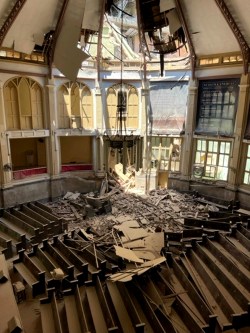
A member of the Cuban Red Cross takes pictures inside Calvary Baptist Church, damaged by an explosion that devastated Havana's Hotel Saratoga in Old Havana, Cuba, on May 6, 2022.

A member of the Cuban Red Cross takes pictures inside Calvary Baptist Church, damaged by an explosion that devastated Havana's Hotel Saratoga in Old Havana, Cuba, on May 6, 2022.

Christianity Today May 26, 2022
Ramon Espinosa / AP Images

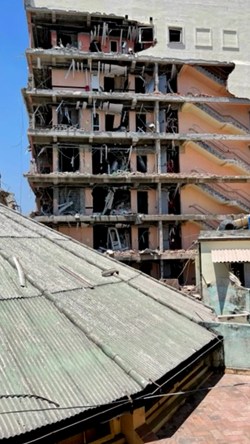
On May 6, an explosion rocked a heavily transited corner of La Habana Vieja (Old Havana). The almost century-old Hotel Saratoga, set to reopen the following week after extensive renovations, was left in ruins.

Media coverage centered on the iconic hotel, and images of the massive damage to the building and to the buses and other vehicles on the street in front of it circulated around the world. A week later, the final number of those killed by the explosion, including children, elderly people, and a pregnant woman, had reached 45, with more than 100 people hospitalized because of injury. Officials put the blame on the accidental ignition of liquid gas.

Government officials and state media coverage focused heavily on the hotel, which is owned by a tourism company belonging to the Cuban military, but also mentioned damage to surrounding buildings, including a school and some apartment buildings.

Absent from all state media coverage has been any mention of the catastrophic damage to Calvary Baptist Church, which shares a wall with Hotel Saratoga, or the total destruction of the home of an elderly retired couple, both Baptist leaders, which was sandwiched between the church and the hotel.

Calvary Baptist Church is one of the most historically important religious buildings on the island. The church, established in the late 1870s on the site of a former circus, was the first Baptist church in what would later become the Baptist Convention of Western Cuba. In addition to the sanctuary, church buildings house administrative offices for the denomination.

At the time of the explosion, 18 people, including three young children, were inside the church facilities. Miraculously, despite the collapse of the dome of the sanctuary and some of the administrative buildings, no one was hurt. Survivors managed to find one another and help each other climb out of the building to safety. The elderly couple were out of the house when the explosion took place.

Jorge Luis Iriarte, who works as a cook at Calvary Baptist Church and was there with his son during the explosion, shared his belief that a miracle had occurred, noting that the lives of many of church workers and children were saved because, for various reasons, at the time of the explosion they happened not to be where they were supposed to be.

“Once outside we really saw what had happened,” he said in a written statement. “The hotel lost almost three floors and the side that adjoins the church collapsed, destroying everything in its path, [including] the bathroom, … the pastor’s house, the side classrooms, offices and the roof of the sanctuary.”

Hotel Saratoga in Old Havana, Cuba, after the explosion on May 6, 2022.Courtesy of Reverend Abel Peréz Hernández
Hotel Saratoga in Old Havana, Cuba, after the explosion on May 6, 2022.

There are many questions about what will happen next. The Cuban government controls gas utilities, and the military owns the hotel, where the explosion occurred. These facts would suggest that the government should assume responsibility for all of the damages incurred and make restitution to those affected. That, however, seems highly unlikely to happen.

The government has said that the future of the Hotel Saratoga building is under consideration. As the property belongs to the Cuban military and is located on some of the most sought-after real estate on the island, it seems probable that the government, in partnership with private companies, will invest to ensure that it continues to serve tourists and bring in income in one form or another. Tourism is one of the main income streams for the Cuban military and government, and it would be surprising if they let the hotel go, despite how expensive it will likely be to rebuild.

The future of the church is more complicated.

The government has a long history of making it very difficult for religious groups to repair their buildings—even when they have managed to obtain building materials despite chronic shortages on the island—by denying or failing to respond to requests for required permits.

Calvary Baptist Church also sits at the center of Cuba’s lucrative tourism industry, on Old Havana prime real estate. Residents in the area report being approached by self-identified businessmen who have offered to buy them out of their homes.

And although the Baptist Convention of Western Cuba is a historic, legally registered religious association, it is not part of the government-supported Cuban Council of Churches. Its leadership has, in recent years, been targeted by the government because of its involvement in interdenominational unity initiatives and public criticism of government policies.

In order to rebuild, Calvary Baptist Church and the entire denomination will face an uphill battle. Based on previous experience, they can expect a lack of support, if not active obstruction, from the government.

Rebuilding and restoring the historic church and denominational headquarters will be prohibitively expensive, and will require materials that are difficult, if not impossible, to find on the island. Even if foreign groups attempt to help by donating financially and materially, they will still need permits to allow funds and goods onto the island. If they succeed in that, they will then need additional permits from the government for the work itself.

Every step will rest on support and cooperation from the government.

Cuban Christians have expressed concern to CSW (formerly Christian Solidarity Worldwide), pointing out that the government may see an opportunity to kill two birds with one stone. By simply failing to grant permits, or dragging out the process to the point that restoration of the historic buildings is no longer viable, the government has the power to force a religious group it views as a thorn in its side to surrender a site of deep historic and symbolic importance to Cuban Protestants. It could then potentially take it over and convert it into yet another money-making enterprise for the military via the tourist industry.

Calvary Baptist Church after the explosion.Courtesy of Reverend Abel Peréz Hernández
Calvary Baptist Church after the explosion.

“The building is considered [part of Cuba’s] national heritage, with a possibly English design. This means that any modifications must be approved by the government, and the exterior façade must be maintained. It will have to be transformed and the interior made more modern,” a legal expert based in Havana, who asked to be kept anonymous, told CSW. “However you look at it, it will be extremely expensive. [The government] helps with the restoration of buildings in Old Havana considered to be part of the national heritage, but they do not help the churches. They have to do it with their own resources via donations.”

The Office of Religious Affairs (ORA) of the Central Committee of the Cuban Communist Party is responsible for approving permits for religious groups for anything ranging from a simple repair on a roof or the installation of toilets to the remodeling of existing buildings. The ORA has long used the issuing of permits as leverage, in many cases rewarding groups deemed as sympathetic to the government with permits while denying permits, or simply failing to respond to requests, to religious groups deemed unsupportive or hostile.

For example, in 2010, after the leadership of Trinity Baptist Church in Santa Clara (also part of the Baptist Convention of Western Cuba), refused to ban the family members of political prisoners from attending the historic church, the government froze the church’s bank account, preventing it from accessing aid that had been donated from abroad to make critical repairs to the church roof.

In another example, El Cristo Baptist Church, originally built in 1901, which belongs to the Baptist Convention of Eastern Cuba (also registered but not part of the Cuban Council of Churches), waited 20 years for a response to a 1996 request to make vital repairs to the church roof. In the interim, the building was infested by bats and became so hazardous that in 2005 the Ministry of Health shut it down. The members of the church were forced to meet in a makeshift structure built onto the side of the church; the structure was unpermitted and so technically illegal. Only in 2016, after a hurricane devastated the area, did the government issue permits for the church to make repairs, like other buildings in the area, and allow it to receive donations from abroad to rebuild. Sadly, the long-term pastor of the church who fought for over a decade to repair the church died before its restoration.

There are hundreds of similar stories. In the case of Calvary Baptist Church, its unique location on highly valuable real estate of significant potential financial interest to the military itself makes the denomination’s prospects of fair treatment even more uncertain.

The legal expert expressed hope that the denomination will stand its ground.

“We should insist on not losing the location—the place itself is what is most valuable financially. The church should not give up the location or trade it for another. [The government] wants to convert the entire area into hotels. They’ll wait for it to fall down so that [the denomination] has to leave and they can begin putting a hotel there.”

Monitoring and advocacy in and outside of Cuba will be vital. It is highly unlikely that the Cuban government will accept responsibility for the destruction wrought by the explosion and indemnify those affected (except its own). Those who care about freedom of religion or belief in Cuba cannot remain on the sidelines. As the Baptist Convention of Western Cuba is able to secure funding and materials from counterparts and supporters abroad, our help will be needed to closely monitor the process. We must pressure the government to ensure that the authorities issue permits swiftly to allow for the urgent and expansive repairs and restoration work needed to ensure that Calvary Baptist Church continues to serve Christians in Cuba, from its strategic location, for decades to come.

In the meantime, some of those directly affected by the explosion still find reasons to give thanks. The elderly pastor whose home was destroyed in the explosion told CSW, “For two Sundays in a row, the government has allowed Calvary Baptist Church to meet [for religious services] in public places, something which, for more than 60 years, we were unable to do. God is in control.”

Anna-Lee Stangl is CSW’s head of advocacy and Americas team leader.

Speaking Out is Christianity Today’s guest opinion column and (unlike an editorial) does not necessarily represent the opinion of the publication.

News

After Raising a Hallelujah, Bethel Music CEO Leaves Redding

Joel Taylor, who directed the popular label since the beginning, has resigned.

While Joel Taylor directed Bethel Music, the label took home 11 Dove Awards.

While Joel Taylor directed Bethel Music, the label took home 11 Dove Awards.

Christianity Today May 26, 2022
Terry Wyatt / Getty Images for Dove Awards

Millions of Christians would not be gathering to “Raise a Hallelujah” had it not been for Joel Taylor, the producer and executive who helped to lead Bethel Music from a worship ministry to a major label.

Taylor announced last week that he was resigning “after 13 wonderful and challenging years” as CEO of Bethel Music. During that time, the organization captivated Christian listeners with long, spontaneous worship sets and harnessed its digital brand with high-quality music videos.

“When we founded the label, we knew God was going to use us to build something special,” Taylor wrote on Instagram. “But God’s plan was even bigger than our dreams … and we had big dreams.”

The launch of Bethel Music under Taylor in 2010—when the label was cofounded by worship pastors Brian and Jenn Johnson—coincided with a notable rise in the popularity of worship music for consumption via radio, streaming, and live performance.

“They didn’t play worship on the radio back then, and they told us we wouldn’t ever be on the radio. When we wanted to bring worship to the world on tour, we were told people wouldn’t host us,” Taylor wrote. “We had to listen to God and believe in our hearts the ‘impossible’ could happen.”

https://www.instagram.com/p/CdyGRi5Lcz0/

Bethel Music began as an extension of the music ministry at the Redding, California, charismatic megachurch. Within the first couple years, the budding label had released worship hits like “Love Came Down” and “One Thing Remains.” From 2014 to today, its singles have consistently landed on the Christian charts, with six songs reaching certified gold, two certified platinum (“It Is Well” and “No Longer Slaves”), and one certified double platinum (“Reckless Love”).

Bethel’s trajectory, in some ways, illustrates the shifts in the Christian music industry over the past decade: Worship music has become a mainstay of Christian radio, worship artists are in high demand for live arena tours, and major worship groups are up for Grammys.

During Taylor’s tenure at Bethel Music, the label has released 15 worship albums—around half of which have hit Billboard’s Top 10 Christian Albums chart—and has won 11 Dove Awards. Taylor himself cowrote many of Bethel’s songs, including “Forever (We Sing Hallelujah),” “Have It All,” and “Faithful to the End.”

Most famously, “Raise a Hallelujah” was written for Taylor’s family in 2019, when his son was battling a life-threatening infection. The story of the song, and his son’s miraculous healing, has become part of his testimony.

“I often get asked what it takes to build a record label. I don’t actually know,” Taylor wrote last year. “But one thing I’m sure of … it’s all about the songs. Most everything else is just a distraction.”

Bethel Music, a collective of artists out of Redding and beyond, embraces its charismatic roots in its performance. While some listeners have challenged the church’s theology, Bethel releases generally enjoy popularity across evangelicalism.

“Bethel Music has been transformative to the worship community,” Christian artist and worship leader Martrell Harris told CT. “There is a level of freedom in their expression. They are expressive. They are prophetic.”

Bethel Music’s immersive, emotional performance style often includes extended moments of improvisational or “spontaneous” worship, with songs running 10 minutes long in live recordings.

Jake Gosselin, who runs the worship resource site Churchfront, credits Bethel with popularizing the style (and spurring discussion over planned versus spontaneous worship sets).

Bethel Music’s YouTube channel has over 4 million subscribers. The channel is populated with hundreds of meticulously produced videos of live performances, designed to offer an immersive experience of a recorded event.

Harris, whose master’s thesis examined Bethel Music’s use of online platforms, sees its mastery of audiovisual media as a major factor in their success. “Watching their video content,” said Harris, “you can get lost in a moment.”

Again, it’s setting new standards for worship. The style of Bethel videos and performances has shaped the church production industry. Church creative teams can find resources that explain “how to get the ‘Bethel look,’” which cameras Bethel’s production teams are using, and how they approach production design.

When the 2020 pandemic forced churches to move their services online, Bethel’s investment in building a visual brand as well as a musical one made it a model for churches looking to produce engaging, professional online worship services.

“Bethel is just ahead of the game,” said Harris.

Bethel Music did not respond to Christianity Today’s request for comment on Taylor’s departure. He had been active as a songwriter, producer, and business executive but hasn’t said publicly what his next professional steps will be.

According to an Instagram announcement, he and his family are moving from California, where he also co-owned a coffee shop, to Franklin, Tennessee, outside Nashville.

“A lot of people ask what I’m going to do next,” Taylor wrote on Instagram. “I’ve been on a deep pursuit of God, His truth, His presence, and His direction as I enter into my second-half of life.”

Apple PodcastsDown ArrowDown ArrowDown Arrowarrow_left_altLeft ArrowLeft ArrowRight ArrowRight ArrowRight Arrowarrow_up_altUp ArrowUp ArrowAvailable at Amazoncaret-downCloseCloseEmailEmailExpandExpandExternalExternalFacebookfacebook-squareGiftGiftGooglegoogleGoogle KeephamburgerInstagraminstagram-squareLinkLinklinkedin-squareListenListenListenChristianity TodayCT Creative Studio Logologo_orgMegaphoneMenuMenupausePinterestPlayPlayPocketPodcastRSSRSSSaveSaveSaveSearchSearchsearchSpotifyStitcherTelegramTable of ContentsTable of Contentstwitter-squareWhatsAppXYouTubeYouTube