
Book Briefs: June 7, 1968

Three Views Of Vatican Ii

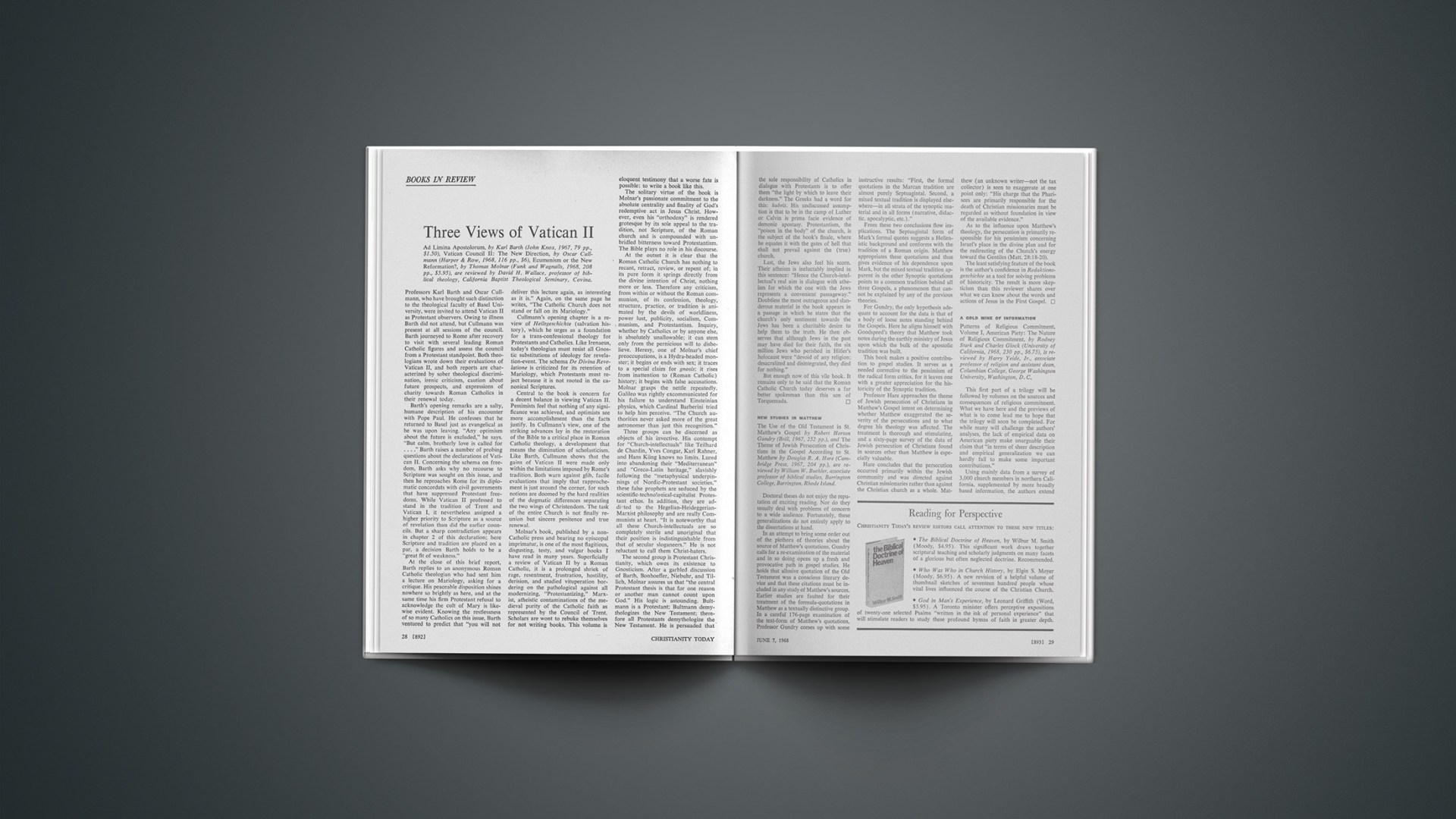
Ad Limina Apostolorum, by Karl Barth (John Knox, 1967, 79 pp., $1.50), Vatican Council II: The New Direction, by Oscar Cullmann (Harper & Row, 1968, 116 pp., $6), Ecumenism or the New Reformation?, by Thomas Molnar (Funk and Wagnalls, 1968, 208 pp., $5.95), are reviewed by David H. Wallace, professor of biblical theology, California Baptist Theological Seminary, Covina.

Professors Karl Barth and Oscar Cullmann, who have brought such distinction to the theological faculty of Basel University, were invited to attend Vatican II as Protestant observers. Owing to illness Barth did not attend, but Cullmann was present at all sessions of the council. Barth journeyed to Rome after recovery to visit with several leading Roman Catholic figures and assess the council from a Protestant standpoint. Both theologians wrote down their evaluations of Vatican II, and both reports are characterized by sober theological discrimination, irenic criticism, caution about future prospects, and expressions of charity towards Roman Catholics in their renewal today.

Barth’s opening remarks are a salty, humane description of his encounter with Pope Paul. He confesses that he returned to Basel just as evangelical as he was upon leaving. “Any optimism about the future is excluded,” he says. “But calm, brotherly love is called for.…” Barth raises a number of probing questions about the declarations of Vatican II. Concerning the schema on freedom, Barth asks why no recourse to Scripture was sought on this issue, and then he reproaches Rome for its diplomatic concordats with civil governments that have suppressed Protestant freedoms. While Vatican II professed to stand in the tradition of Trent and Vatican I, it nevertheless assigned a higher priority to Scripture as a source of revelation than did the earlier councils. But a sharp contradiction appears in chapter 2 of this declaration; here Scripture and tradition are placed on a par, a decision Barth holds to be a “great fit of weakness.”

At the close of this brief report, Barth replies to an anonymous Roman Catholic theologian who had sent him a lecture on Mariology, asking for a critique. His peaceable disposition shines nowhere so brightly as here, and at the same time his firm Protestant refusal to acknowledge the cult of Mary is likewise evident. Knowing the restlessness of so many Catholics on this issue, Barth ventured to predict that “you will not deliver this lecture again, as interesting as it is.” Again, on the same page he writes, “The Catholic Church does not stand or fall on its Mariology.”

Cullmann’s opening chapter is a review of Heilsgeschichte (salvation history), which he urges as a foundation for a trans-confessional theology for Protestants and Catholics. Like Irenaeus, today’s theologian must resist all Gnostic substitutions of ideology for revelation-event. The schema De Divina Revelatione is criticized for its retention of Mariology, which Protestants must reject because it is not rooted in the canonical Scriptures.

Central to the book is concern for a decent balance in viewing Vatican II. Pessimists feel that nothing of any significance was achieved, and optimists see more accomplishment than the facts justify. In Cullmann’s view, one of the striking advances lay in the restoration of the Bible to a critical place in Roman Catholic theology, a development that means the diminution of scholasticism. Like Barth, Cullmann shows that the gains of Vatican II were made only within the limitations imposed by Rome’s tradition. Both warn against glib, facile evaluations that imply that rapprochement is just around the corner, for such notions are doomed by the hard realities of the dogmatic differences separating the two wings of Christendom. The task of the entire Church is not finally reunion but sincere penitence and true renewal.

Molnar’s book, published by a non-Catholic press and bearing no episcopal imprimatur, is one of the most flagitious, disgusting, testy, and vulgar books I have read in many years. Superficially a review of Vatican II by a Roman Catholic, it is a prolonged shriek of rage, resentment, frustration, hostility, derision, and studied vituperation bordering on the pathological against all modernizing, “Protestantizing,” Marxist, atheistic contaminations of the medieval purity of the Catholic faith as represented by the Council of Trent. Scholars are wont to rebuke themselves for not writing books. This volume is eloquent testimony that a worse fate is possible: to write a book like this.

The solitary virtue of the book is Molnar’s passionate commitment to the absolute centrality and finality of God’s redemptive act in Jesus Christ. However, even his “orthodoxy” is rendered grotesque by its sole appeal to the tradition, not Scripture, of the Roman church and is compounded with unbridled bitterness toward Protestantism. The Bible plays no role in his discourse.

At the outset it is clear that the Roman Catholic Church has nothing to recant, retract, review, or repent of; in its pure form it springs directly from the divine intention of Christ, nothing more or less. Therefore any criticism, from within or without the Roman communion, of its confession, theology, structure, practice, or tradition is animated by the devils of worldliness, power lust, publicity, socialism, Communism, and Protestantism. Inquiry, whether by Catholics or by anyone else, is absolutely unallowable; it can stem only from the pernicious will to disbelieve. Heresy, one of Molnar’s chief preoccupations, is a Hydra-headed monster; it begins or ends with sex; it traces to a special claim for gnosis; it rises from inattention to (Roman Catholic) history; it begins with false accusations. Molnar grasps the nettle repeatedly. Galileo was rightly excommunicated for his failure to understand Einsteinian physics, which Cardinal Barberini tried to help him perceive. “The Church authorities never asked more of the great astronomer than just this recognition.”

Three groups can be discerned as objects of his invective. His contempt for “Church-intellectuals” like Teilhard de Chardin, Yves Congar, Karl Rahner, and Hans Küng knows no limits. Lured into abandoning their “Mediterranean” and “Greco-Latin heritage,” slavishly following the “metaphysical underpinnings of Nordic-Protestant societies,” these false prophets are seduced by the scientific-technolosical-capitalist Protestant ethos. In addition, they are addicted to the Hegelian-Heideggerian-Marxist philosophy and are really Communists at heart. “It is noteworthy that all these Church-intellectuals are so completely sterile and unoriginal that their position is indistinguishable from that of secular sloganeers.” He is not reluctant to call them Christ-haters.

The second group is Protestant Christianity, which owes its existence to Gnosticism. After a garbled discussion of Barth, Bonhoeffer, Niebuhr, and Tillich, Molnar assures us that “the central Protestant thesis is that for one reason or another man cannot count upon God.” His logic is astounding. Bultmann is a Protestant; Bultmann demythologizes the New Testament; therefore all Protestants demythologize the New Testament. He is persuaded that the sole responsibility of Catholics in dialogue with Protestants is to offer them “the light by which to leave their darkness.” The Greeks had a word for this: hubris. His undiscussed assumption is that to be in the camp of Luther or Calvin is prima facie evidence of demonic apostasy. Protestantism, the “poison in the body” of the church, is the subject of the book’s finale, where he equates it with the gates of hell that shall not prevail against the (true) church.

Last, the Jews also feel his scorn. Their atheism is ineluctably implied in this sentence: “Hence the Church-intellectual’s real aim is dialogue with atheism for which the one with the Jews represents a convenient passageway.” Doubtless the most outrageous and slanderous material in the book appears in a passage in which he states that the church’s only sentiment towards the Jews has been a charitable desire to help them to the truth. He then observes that although Jews in the past may have died for their faith, the six million Jews who perished in Hitler’s holocaust were “devoid of any religion; desacralized and disintegrated, they died for nothing.”

But enough now of this vile book. It remains only to be said that the Roman Catholic Church today deserves a far better spokesman than this son of Torquemada.

New Studies In Matthew

The Use of the Old Testament in St. Matthew’s Gospel by Robert Horton Gundry (Brill, 1967, 252 pp.), and The Theme of Jewish Persecution of Christians in the Gospel According to St. Matthew by Douglas R. A. Hare (Cambridge Press, 1967, 204 pp.), are reviewed by William W. Buehler, associate professor of biblical studies, Barrington College, Barrington, Rhode Island.

Doctoral theses do not enjoy the reputation of exciting reading. Nor do they usually deal with problems of concern to a wide audience. Fortunately, these generalizations do not entirely apply to the dissertations at hand.

In an attempt to bring some order out of the plethora of theories about the source of Matthew’s quotations, Gundry calls for a re-examination of the material and in so doing opens up a fresh and provocative path in gospel studies. He holds that allusive quotation of the Old Testament was a conscious literary device and that these citations must be included in any study of Matthew’s sources. Earlier studies are faulted for their treatment of the formula-quotations in Matthew as a textually distinctive group. In a careful 176-page examination of the text-form of Matthew’s quotations, Professor Gundry comes up with some instructive results: “First, the formal quotations in the Marcan tradition are almost purely Septuagintal. Second, a mixed textual tradition is displayed elsewhere—in all strata of the synoptic material and in all forms (narrative, didactic, apocalyptic, etc.).”

From these two conclusions flow implications. The Septuagintal form of Mark’s formal quotes suggests a Hellenistic background and conforms with the tradition of a Roman origin. Matthew appropriates these quotations and thus gives evidence of his dependence upon Mark, but the mixed textual tradition apparent in the other Synoptic quotations points to a common tradition behind all three Gospels, a phenomenon that cannot be explained by any of the previous theories.

For Gundry, the only hypothesis adequate to account for the data is that of a body of loose notes standing behind the Gospels. Here he aligns himself with Goodspeed’s theory that Matthew took notes during the earthly ministry of Jesus upon which the bulk of the apostolic tradition was built.

This book makes a positive contribution to gospel studies. It serves as a needed corrective to the pessimism of the radical form critics, for it leaves one with a greater appreciation for the historicity of the Synoptic tradition.

Professor Hare approaches the theme of Jewish persecution of Christians in Matthew’s Gospel intent on determining whether Matthew exaggerated the severity of the persecutions and to what degree his theology was affected. The treatment is thorough and stimulating, and a sixty-page survey of the data of Jewish persecution of Christians found in sources other than Matthew is especially valuable.

Hare concludes that the persecution occurred primarily within the Jewish community and was directed against Christian missionaries rather than against the Christian church as a whole. Matthew (an unknown writer—not the tax collector) is seen to exaggerate at one point only: “His charge that the Pharisees are primarily responsible for the death of Christian missionaries must be regarded as without foundation in view of the available evidence.”

As to the influence upon Matthew’s theology, the persecution is primarily responsible for his pessimism concerning Israel’s place in the divine plan and for the redirecting of the Church’s energy toward the Gentiles (Matt. 28:18–20).

The least satisfying feature of the book is the author’s confidence in Redaktions-geschichte as a tool for solving problems of historicity. The result is more skepticism than this reviewer shares over what we can know about the words and actions of Jesus in the First Gospel.

Reading For Perspective

CHRISTIANITY TODAY’S REVIEW EDITORS CALL ATTENTION TO THESE NEW TITLES:

The Biblical Doctrine of Heaven, by Wilbur M. Smith (Moody, $4.95). This significant work draws together scriptural teaching and scholarly judgments on many facets of a glorious but often neglected doctrine. Recommended.

Who Was Who in Church History, by Elgin S. Moyer (Moody, $6.95). A new revision of a helpful volume of thumbnail sketches of seventeen hundred people whose vital lives influenced the course of the Christian Church.

God in Man’s Experience, by Leonard Griffith (Word, $3.95). A Toronto minister offers perceptive expositions of twenty-one selected Psalms “written in the ink of personal experience” that will stimulate readers to study these profound hymns of faith in greater depth.

A Gold Mine Of Information

Patterns of Religious Commitment, Volume I, American Piety: The Nature of Religious Commitment, by Rodney Stark and Charles Glock (University of California, 1968, 230 pp., $6.75), is reviewed by Harry Yeide, Jr., associate professor of religion and assistant dean, Columbian College, George Washington University, Washington, D. C.

This first part of a trilogy will be followed by volumes on the sources and consequences of religious commitment. What we have here and the previews of what is to come lead me to hope that the trilogy will soon be completed. For while many will challenge the authors’ analyses, the lack of empirical data on American piety make unarguable their claim that “in terms of sheer description and empirical generalization we can hardly fail to make some important contributions.”

Using mainly data from a survey of 3,000 church members in northern California, supplemented by more broadly based information, the authors extend two points they have urged in other works. The first is that people are religious in different ways; they present widely varied mixtures of beliefs, methods of communal and private worship, religious experience, knowledge about religion, and involvement in church groups and friendship patterns. The authors attempt to express these differing modes of religious commitment in mathematical terms. Second, they also try to measure what everyone knows but sociologists often forget: that there are vast differences among Protestant groups not only in average social status but also in the kind and degree of religious commitment. Thus while 99 per cent of the Southern Baptists agreed that “Jesus is the Divine Son of God and I have no doubts about it,” only 40 per cent of the Congregationalists gave that answer. Other Protestant groups and Roman Catholics range between the two in an often repeated pattern on a large number of questions.

Readers of this journal will be interested in the assertion that conservative church bodies are suffering a net loss of members to liberal bodies. One must examine both the ability to hold members and the ability to recruit switchers. Although conservative groups do well on holding members in comparison to the liberal groups, they do very poorly in recruitment from liberals: “people who change their church tend to move from more conservative bodies to theologically more liberal ones.” The authors, aware that they contradict membership figures published by the National Council of Churches, offer reasons for believing that the NCC statistics are incorrect and/or misleading.

Glock and Stark link their findings to the larger thesis that the shift in membership in the liberal direction is but a step on the way out of the Church as we enter the post-Christian era. They are tentative in turning from description to prophecy but feel the Church must liberalize to survive. This they regard as unlikely. But they ask: Even if the Church could liberalize, would the final product be identifiably Christian?

This prognosis depends upon certain premises that flaw much of the diagnosis as well. Their idea of “orthodox” Christianity is constructed upon their perception of nineteenth-century rural American piety. Is it really surprising, then, that the Southern Baptists and certain sects consistently score highest? Does it not seem more strange, at least to Presbyterians and Lutherans, that orthodox beliefs are measured with no reference to justification by faith?

Similar questions are in order about their notion of “liberalism,” which seems at times to include any departure from their model of “orthodoxy.” Thus points of view understood by some Christian groups for centuries as orthodox can appear as signs of liberalism. On the basis of two questions on the necessity to salvation of “doing good for others” and “loving the neighbor,” the authors, noting the lower scores for some of the groups they judge as conservative, conclude that higher scores are more liberal and that liberal groups are more ethical than orthodox groups; they fail to perceive that some denominations, while encouraging “good works,” have insisted that they do not contribute to salvation. Other groups have, of course, regarded as orthodox the contribution of good works to salvation. Differences between Christian groups on such questions may have no relation to liberalization.

I suspect that the authors had difficulty perceiving such issues because of their natural sympathy for liberalization, a suspicion nourished by such an extravagant statement as: “It is not philosophers or scientists, but the greatest theologians of our time who are saying ‘God is dead,’ or that notions of a ‘God out there’ are antiquated.”

Whatever its flaws, however, the book merits widespread study as a gold mine of information and a challenge to the churches.

Elihu’S Lesson In Counseling

Dialogue in Despair, by William E. Hulme (Abingdon, 1968, 157 pp., $3.50), is reviewed by Richard Allen Bodey, Sr., professor of practical theology, Reformed Theological Seminary, Jackson, Mississippi.

“The man who shook his fists at God and got away with it!” Slip that one into your next Bible quiz. Chances are nobody will come up with Job for an answer. But then, what pastor ever recognized himself in Eliphaz, or Bildad, or Zophar, Job’s uncomforting comforters and unfriendly friends?

Exegetes and theologians traditionally prize the Book of Job for its theological value: it wrestles with the problem of why the righteous suffer. William Hulme, professor of pastoral care at Luther Theological Seminary, takes a different but complementary approach. He finds in this ancient drama a biblical resource for pastoral care. “It presents the dynamics of suffering and healing within the framework of the pastoral relationship.” Indeed, it attacks the enigma of human existence with “the reckless abandon of the modern existentialist.”

Confident of his self-righteousness, Job the counselee clings tenaciously to his integrity above the security of his relationships: human and divine alike. Bold, reckless, defiant, he dares to call God to account. His angry outbursts and stubborn self-acquittals threaten his friends’ philosophy of life. Insensitive to his personal need, and under pretense of defending God against Job’s assaults, they vainly try to bludgeon him into confessing that his plight is just punishment for his guilt. They typify the defensive counselor who substitutes reaction for response.

Happily for Job, a fourth and wiser counselor, Elihu, enters the conversation. Although he repeats much that the trio before him said, his attitude and timing are different. Meeting Job with empathy, he leads him to a deeper level of insight and action. Elihu’s counseling method is as up-to-date as Hulme’s book: identification, acceptance, restatement, confrontation. By challenging Job to develop a wider vision and see God’s redemptive purpose in his trial, Elihu paves the way for Job’s direct encounter with God. He then quietly exits.

Elihu’s role as mediator and his counseling techniques set the pattern for every pastor who wants to lead people out of the darkness of despair into living contact with the God who kindles faith and justifies hope. In his presence—which always has an element of mystery—they, like Job, may not learn the why of their trial. But they discover the who, and so are able to accept the how.

Pastoral commentaries threaten to become a fad in this day of the pastor-counselor. This one pushes to the frontiers of incisive, relevant biblical interpretation. It even furnishes suggestions, drawn from its pastoral perspective, that can be used to counsel Job’s literary critics on their inadequate understanding.

Atonement: Limited Or Unlimited?

The Death Christ Died: A Case for Unlimited Atonement, by Robert P. Lightner (Regular Baptist Press, 1967, 151 pp., $2.95), is reviewed by Norman Shepherd, associate professor of systematic theology, Westminster Theological Seminary, Philadelphia, Pennsylvania.

In deliberately putting a book by a four-point Calvinist into the hands of a five-point Calvinist, CHRISTIANITY TODAY doubtless expected something other than hearty endorsement. Any five-pointer would need at least 150 pages to unravel the fallacies he finds woven into its fabric. Lacking that, this one will just outline briefly why he remains unrepentant.

It is not, of course, simply a question of one point more or less. Lightner finds that “strict Calvinism,” with its particular atonement that secures all the benefits of Christ for the elect, makes faith unnecessary. In effect, he is saying that Calvinism is deterministic and determinism makes history meaningless. The remedy proposed is a large dose of indeterminism in a form oscillating between myraldianism (Lightner uses only the expression “moderate Calvinism”) and Arminianism. But then the problem is to show how one can have any faith or history at all. Having charged Calvinism with the one extreme, he is saved from the other only because, as a sincere believer, he subjects himself to the infallible authority of Scripture. In point of fact, the Orthodox Calvinist is not deterministic because he shares that same commitment. The question is, Where does Scripture lead?

The crux of the matter is that the substitutionary atonement in which Lightner believes is efficacious. He virtually admits this when he approvingly cites Walvoord to the effect that “Christ’s death constituted an act of purchase in which the sinner is removed from his former bondage in sin by payment of the ransom price.” Here, quite properly, cross and consummation are seen in the light of each other. But all this is denied when Lightner contends that the same sinner may well enter into eternal condemnation. J. Miley and H. O. Wiley are much more consistent when they adopt the governmental theory of the atonement in order to universalize it.

Lightner is worried lest the Calvinists deprive us of the universal offer of the Gospel. He does not see that a redemption that does not redeem and a propitiation that does not propitiate leave us with no Gospel to offer anyone.

The author has gone into print without allowing himself to feel the full impact of what he opposes. As a result, his analysis lacks depth of penetration and his exegesis tends to be cavalier. Spurgeon’s argument has not been answered: “God will not punish twice for one thing.”

Calling A Dog’S Tail A Leg

The Secular Saint, by Allan R. Brockway (Doubleday, 1968, 238 pp., $4.95), is reviewed by Robert L. Reymond, visiting lecturer and administrative assistant, Covenant Theological Seminary, St. Louis, Missouri.

This book is aimed at those “who have the suspicion that God is not dead, but can see no logical alternative,” according to its author, a Methodist clergyman and editor of Concern magazine. Its hero, the Secular Saint, is a “religionless Christian” interacting with both individual and corporate lifestyles.

The world is in transition. In our century we have already moved from the automobile and atomic-power ages into the age of space exploration. Change can produce various anxieties, but because transitions are now occurring so quickly, man has built up a resistance to the social shock produced by change. In this sense, the world of transition is also a steady-state world. This strange, new world, furthermore, is urban and leisurely, external (looking outside rather than inside man’s mind for the meaning of life and of the universe itself), and religionless. This is, for Brockway, the world of the Secular Saint.

Ancient Christian symbols must be reinterpreted for this new world. Orthodoxy’s stop-gap and escape-hatch God will suffice no longer. God, for Brockway, now becomes the absolute limits and impossible demands that confront a man; Christ is the possibility of receiving these limits and demands as good and for one’s good; and the Holy Spirit is the decision to receive the Christ possibility as the operating mode (Lord) of one’s life, the promise always to receive life as good, and the active reduplication of this decision and this promise in historical existence. Sin is rebellion against God so understood; it is the refusal to admit an absolute limit to one’s desires, power, and will. The Secular Saint is the man who in the “Christ response” refuses to receive the events of his life as threats to his significance and decides to entrust his own significance to the very limits and demands that threaten his sinful self.

Any man who so acts is a Secular Saint, whether he is aware of it or not. His individual life-style is one of freedom (from all allegiances and “causes” and toward death, even his own) and responsibility. He “joys in every little bit of life, worships and studies whenever he encounters another Secular Saint.” But there is another life-style: knowing that alone he cannot make the Christ possibility known to all parts of the world in relationship to himself, he supports the Corporate Saint, the organizational life-style whose purpose among other organizations is to make the Christ possibility available to society as a whole.

Brockway has, of course, committed the one basic error of all those who repudiate orthodoxy. He believes, autonomously, on the basis of his research and his experience, that his calling a dog’s tail a leg makes it so! Actually, his Secular Saint and Corporate Saint are not saints at all. They are simply reflections of Brockway’s humanism cast in traditional religious language.

Frankly, the orthodox Christian grows a little weary of the secularist’s use of Christian language that has become freighted with power by biblical usage and tradition to make the case for his non-Christian thought. Brockway’s God is of his own construction, and his Christ, as the possibility of choosing freedom and responsibility, speaks of two human categories incapable of definition and proper balance apart from the biblical revelation of Christian theism. The world, as Brockway says, is in transition; it has been since the creation. But man’s basic spiritual needs—redemption and restoration—have never changed, not since Adam’s fall.

The Kernel And The Shell

Jesus and the Christian, by William Manson (Eerdmans, 1967, 236 pp., $5.95), is reviewed by Stanley A. Ellisen, professor of biblical literature, Western Conservative Baptist Seminary, Portland, Oregon.

This book by William Manson, Edinburgh giant of New Testament studies of the past generation, is a posthumous compilation of his lectures and articles published in various journals between 1925 and 1957, arranged by T. F. Torrance. Here we see Manson’s concept of “depth exegesis” in relation to Christian living and the world mission of the Church. This exegesis moves from a clarification of Jesus’ ministry to the significance of that life and ministry for the Christian and then to its significance for world evangelism.

True to his concern for exegetical foundation, Manson first establishes the reliance of the New Testament sources and the solidarity of its witnesses, especially Jesus and Paul. Although he accepts many of the higher-critical findings on both Testaments, he renounces the methods and conclusions of form criticism as superficial and conjectural. And, assuming the priority of Mark, he pursues the essence of Jesus’ ministry through precept and event.

Jesus’ first coming was the eschatological event foretold by the prophets. The time of the eschaton had come. But, although Jesus came to fulfill the Messianic prophecies, he did not come to fulfill Old Testament expectations in their “external garb.” He came to clarify the true nature of the Kingdom, to strip off the “shell” and reveal the spiritual “kernel.” Manson says the parables demonstrate this; in them Jesus demythologized the reign of God for the faithful and spiritual. The passing of the Law involved also the passing of any claims to an Israel-centered eschaton. The spiritual enclave of the Church constitutes the “Israel of God” in the fullest sense. This interpretation is the product of Manson’s “depth exegesis.”

His greatest contribution doubtless lies in his treatises on the Christian life. His wholesome mysticism in regard to the believer’s life “in Christ” is fresh and challenging. He stresses the verticality of the Christian experience and implies that much Christian experience is of the “shell” rather than the “kernel.”

All these concepts of eschatological Christian living are brought to focus on the program of world missions. While there is a “realized eschatology” in Christ’s ministry, says Manson, there is yet an unrealized eschatology that motivates the Church in its gospel witness. The prophecy that world blessing would come through Israel is fulfilled in the Church’s world mission, he says, and indeed is the Old Testament impetus for this task.

Many points in this “depth exegesis” call for evaluation. While Manson offers some profound insights, a host of his assumptions lack verification. While there is a coherency in his theological structure, the “ex” is not always prominent in his exegesis. While he pleads for the Church’s proper expectation of the parousia and of Christ’s reign within the historical plane, he vaporizes the millennial content of that reign. While he seeks to demythologize the Old Testament prophecies, he mythologizes both the patriarchal covenants and the eschatological promises. In this, one suspects an “overplussage” of consistency. Having been deprived of the “shell” of biblical eschatology, which God vouchsafed by his solemn oath, one is hard put to find satisfaction in the uncertain meat of the existential kernel.

This outstanding book is a scholar’s manual and is certainly a work to be reckoned with, as was Manson’s Jesus the Messiah.

Protestantism Through A Prism

Spectrum of Protestant Beliefs, edited and compiled by Robert Campbell, O. P. (Bruce, 1968, 106 pp., $3.95), is reviewed by E. S. James, editor emeritus, “Baptist Standard,” Dallas, Texas.

This unusual book seeks to present five distinct Protestant viewpoints—fundamentalist, new evangelical, confessional, liberal, and radical—on twenty-one significant topics. These topics include the Trinity, the Bible, the Virgin Birth, original sin, heaven and hell, premarital sex, racial integration, anti-Semitism, the ecumenical movement, Communism, and the Viet Nam war. Many readers will find it hard to classify themselves in any of the categories on the basis of the thought advanced by some of the spokesmen. The compiler-editor selected well-known persons to represent the varieties of Protestants as he sees them: Carl F. H. Henry (new evangelical), John Warwick Montgomery (confessional), James A. Pike (liberal), William Hamilton (radical), and Bob Jones, Jr. (fundamentalist). But, in my opinion, the division of thought on doctrine and social issues is much too narrow.

Although Carl F. H. Henry has voiced well the views of the millions of Bible-believing evangelicals, I see no reason to call his viewpoint new evangelical. There is nothing new about it, since from their beginnings nearly all Protestants who have thought of themselves as evangelical Christians have believed essentially what he expresses concerning the Scriptures, and today millions of them agree with him on social issues. One could wish that John Warwick Montgomery’s position were representative of all confessional groups, but it clearly is not. James A. Pike is too radical for many liberals to claim him. And William Hamilton’s “God is dead” theory is too far-fetched and removed from scriptural teachings, its followers too few, to be considered a basic category in this survey. Bob Jones voices what seems to be the general opinion of a group that designate themselves fundamentalists; yet he is not representative of the millions who believe every fundamental truth of the Bible but refuse to speculate on prophecy and abhor the idea that God is responsible for the spirit of racism.

The book is well arranged, readable, concise enough to be read at one sitting, and enlightening. But it does not, in my opinion, live up to its title. A spectrum shows all the colors. The viewpoints covered in this book are too limited to be called the “Spectrum of Protestant Beliefs.”

Book Briefs

The Righteousness of the Kingdom, by Walter Rauschenbusch, edited by Max L. Stackhouse (Abingdon, 1968, 320 pp., $5.95). Today’s theological crusaders for social change will find much to agree with in this newly discovered, previously unpublished book written seventy-five years ago by “the father of the social gospel.”

Speaking in Tongues, by Laurence Christenson (Bethany Fellowship, 1968, 141 pp., $2.95). A charismatic Lutheran pastor appeals for renewal of the Church through the power of the Holy Spirit.

Modern Theologians, Christians and Jews, edited by Thomas E. Bird (University of Notre Dame, 1967, 224 pp., $5.95). Short essays that introduce such contemporary theologians as Buber, Murray, Hromádka, Schillebeeckx, Robinson, Hick, and Heschel.

God’s Answer, by W. Herbert Brown (Scripture Truth, 1967, 256 pp., $3.95). Brief but perceptive analysis of the verses throughout the Bible that refer to the Holy Spirit.

Christianity & Humanism, by Quirinus Breen, edited by Nelson Peter Ross (Eerdmans, 1968, 283 pp., $6.95). Students of a retired University of Oregon professor have collected and published some of his significant writings relating to Greek and Renaissance philosophy and Christian theology.

The GodB Within, by W. Farnsworth Loomis (October House, 1967, 117 pp., $5.95). A Brandeis University professor of biochemistry sets forth a naturalistic view of “God” and man. “God A” made a world ready for the evolution of man; “God B” was born in man circa 15,000 B.C. when Cro-Magnon man demonstrated his creative ability (as seen in the Lascaux cave paintings). In the foreword, Bishop James Pike lauds the thoughts of Loomis. The book is a glaring example of a scientist’s forsaking science for scientism.

And the Greatest of These, by George Sweeting (Revell, 1968, 128 pp., $3.50). The pastor of Chicago’s Moody Church writes about the power of Christian love. Well worth reading.

My Flickering Torch, by E. Jane Mall (Concordia, 1968, 176 pp., $3.50). A Christian woman’s victorious story of her experience after her chaplain husband died and she was left with five adopted children.

PAPERBACKS

Learning to Love God, Learning to Love Ourselves, and Learning to Love People, by Richard Peace (Inter-Varsity, 1968, 63 pp., 61 pp., and 73 pp., $1 each). Booklets to help new Christians become established in their faith through simple, inductive Bible studies.

Science and Religion, edited by Ian G. Barbour (Harper & Row, 1968, 323 pp., $3.95). An interesting collection of current essays with varying perspectives on religion and evolution, scientific method, and technology.

Between Christ and Satan, and Day X, by Kurt Koch (Evangelization, Berghausen/Bd., West Germany, 192 pp. and 128 pp., 1967). A German evangelical discusses (1) fortune-telling, magic spiritism, occult literature, and miraculous healings, and (2) the return of Christ.

The Seven Great “I Am’s”, by Archibald Campbell (Christian Literature Crusade, 1968, 133 pp., $1.50). Instructive and inspiring studies of the seven “I am’s” and seven miracles in the Gospel of John.

A Time to Embrace, edited by Oliver R. Barclay (Inter-Varsity, 1967, 61 pp„ $.60). A practical, biblically sound booklet on courtship and sex for today’s Christian young people.

From Call to Service, by Glenn E. Whitlock (Westminster, 1968, 122 pp., $1.85). An experienced counselor of ministerial candidates offers a sensible discussion of the ministerial call, candidates’ backgrounds and motivations, and the Church’s means for helping men fulfill their ministries.

Protestant Agreement on the Lord’s Supper, by Eugene M. Skibbe (Augsburg, 1968, 143 pp., $2.50). Shows how Anglican, Lutheran, and Reformed Christians are coming closer together in their understandings of the Eucharistic doctrine.

Understanding the Book of Hebrews, by Robert L. Cargill (Broadman, 1967, 133 pp., $1.95). Readable, devotional, inspirational.

Ideas

The New Testament and the Jew

The existence of anti-Semitism and its persistence in the West for over two thousand years is one of history’s greatest puzzles. With the tenacity of a brush fire, anti-Semitic feeling has burned its way through history, sometimes just flickering near the surface, at other times bursting out into the open. At times the destruction is minor. But occasionally prejudice against the Jews flares up with an intensity that destroys millions of people and engulfs entire nations.

Anti-Semitism is neither new nor limited to the West. The Book of Esther speaks of anti-Jewish acts during the fifth century B.C. by Haman, a high official in the Persian empire. Under the Romans the Jews enjoyed considerable privileges and even a certain measure of protection, thanks to their timely support of Julius Caesar in Alexandria in 49 B.C. But persecutions occurred sporadically nonetheless, and many were very intense, particularly at the time of the Jewish-Roman war (A.D. 66–70). In the Middle Ages anti-Semitism was fed by superstition. Jews were accused of many atrocities, including the ritual murder of Christian children, as Chaucer’s “Prioress’s Tale” shows. Modern times are hardly better. Napoleon’s “Infamous Decree” against the Jews in 1808 sparked more than a century of anti-Semitism in Europe, culminating in the Dreyfus Affair in France and later in the era of National Socialism in Germany. Unfortunately, many of the old attitudes linger today, despite a general repudiation of the Nazi war crimes by Western governments and the declaration against anti-Jewish prejudice promulgated by Vatican II and received favorably by most Protestant denominations.

What causes anti-Semitism? Many answers have been given: a general dislike for the different, hence a dislike for all minorities; the search for a scapegoat in times of social crisis; the tendency to generalize upon the shortcomings of a few individuals; a heritage of religious hatred that identifies the Jews as cursed of God for the execution of Jesus of Nazareth. These explanations seem inadequate, however, and the search goes on.

Recently a new factor has entered the discussion, particularly in Jewish-Christian dialogue. It is the claim that anti-Semitism has its origins in the Christian Scriptures and can be eliminated only when Christians repudiate their error at its source.

In a recent book, Rabbi Ben Zion Bosker argues that “the historic roots of Christian anti-Semitism go back to the basic teachings of the New Testament” (Judaism and the Christian Predicament, p. 17). And Rabbi Samuel Sandmel writes, “We Jews figure as villains, all of us or some of us, in much of your Bible. Only very lately has this bothered you extensively and intensively, and the reality has to be faced that some of you are not bothered by this at all” (We Jews and You Christians, p. 20).

The point has been advanced even more strongly by Protestants. A. Roy Eckardt, editor of the Journal of the American Academy of Religion, states that “all the learned exegesis in the world cannot negate the truth that there are elements not only of anti-Judaism but of anti-Semitism in the New Testament,” and calls for a denunciation by Christians of “anti-Semitic allegations” in John, Paul, and elsewhere (Elder and Younger Brothers, p. 126). At a recent conference, Noel Freedman of San Francisco Theological Seminary claimed that the New Testament “is simply an anti-Semitic book.” And in the foreword to Judaism and the Christian Predicament, Union Theological Seminary’s Frederick C. Grant expresses the hope that the reversal of traditional attitudes toward the Jews that he detects in our age “will in time … involve more than just a formal repudiation of anti-Semitism. It will also include a repudiation of impossible literalism and legalism in the interpretation of the Bible, or the refusal to interpret it at all” (p. vii).

One cannot help admiring the vigor with which these writers—both Christians and Jews—are attempting to purge the world of anti-Jewish prejudice. And there can be little doubt that the defeat of anti-Semitism, like that of anti-Negro prejudice, is long overdue. At the same time, one must question whether this approach properly represents the biblical view and whether the cure prescribed is adequate. Perhaps the cavalier way in which some Protestant exegetes handle Scripture breeds an insensitivity to it and consequently sets aside the one certain hope of cure.

In the first place, it simply is not true that the New Testament is anti-Semitic. It is true that the New Testament contains statements that sound anti-Semitic to modern ears, conditioned as they are by centuries of prejudice. The New Testament speaks of a general failure of the Jewish people, in the time of the apostles, to believe in Jesus as their Messiah and Saviour, and it laments this unbelief. But if this is to be judged as anti-Semitic, then statements about the failure of Gentiles to believe must be considered anti-Gentile. Actually, the New Testament writers show great anguish because those of their own nation have failed to embrace what was for them the “good news” of God’s definitive action in Christ for man’s salvation. At no point in any of the non-biblical literature of the times does any writer claim, as does Paul (Rom. 9:3), that he would be content to see himself accursed if that would bring about the salvation of the Jewish people.

Critics have imagined an anti-Semitic element in John’s references to “the Jews” as those who crucified Jesus. But John himself was a Jew. He used the phrase, not to make an ethnic distinction, but to make a political one. By it he designates the ruling body of the people of Judea under Pilate. The phrase distinctly excludes the Galileans, who were also Jews ethnically and who were even more Jewish than the Judeans in nationalistic fervor.

Second, the current judgment against certain biblical strains seems to overlook entirely the positive things said about the Jews in the New Testament, even by those writers who are judged to be most anti-Semitic in their statements. Paul is considered a prime offender because of his sharp polemic, particularly against the Judaizers who were subverting his hard-won churches. But it is Paul who most clearly spells out the advantages of Judaism. “What advantage has the Jew?” he asks. “Much in every way. To begin with, the Jews are entrusted with the oracles of God (Rom. 3:1, 2). “They are Israelites, and to them the sonship, the glory, the covenants, the giving of the law, the worship, and the promises; to them belong the patriarchs, and of their race according to the flesh, is the Christ” (Rom. 9:4, 5). This is certainly not anti-Semitism. On the contrary, it shows an unusual sensitivity to God’s dealings with the Jews in history and great appreciation for the spiritual inheritance available to all men through them.

Moreover, if the Jews as a whole have refused to believe in Jesus, this is remarkable to the New Testament writers precisely because of the way God worked through the Jews in the past. It is this that occasions extensive comment. In Paul’s mind, the fact that God seems now to be working through the Gentiles, calling out another people, the Church, is so unexpected and so astonishing that he calls it “a mystery,” kept secret since the world began.

Third, the New Testament teaches that all men are guilty in Christ’s death—the Jews represented by their leaders and the Gentiles by the authorities of Rome. Anti-Semitism cannot be justified on the grounds of a Jewish “murder” of Jesus.

During the Nazi era it was common to speak of the “Jewish problem”; but the Jewish problem was actually a human problem, the problem of sin and of an unwillingness to accept God’s gracious forgiveness in Christ. The Nazis were a prime example. It must not be forgotten, however, that God’s solution to the human problem was a Jew, his son Jesus Christ. The cross of Jesus reduces all to a common level as sinners, that in Christ God might have mercy upon all. One Jewish Christian, Jakob Jocz, writes of this out of his own experience:

God is no respecter of persons. Before Him, the Holy One, men stand not as Jews and Gentiles but as sinners who are in need of grace. Jesus the prophet may be speaking to the Gentiles; but Jesus the Son of God speaks to mankind. Jesus the martyr may be appealing to some and not to others; but Jesus the Lamb of God challenges the whole human race. God’s word is one word, and God’s way is one if it is the way of God [The Jewish People and Christ, p. 321].

Between these two points lies the cause of anti-Semitism: the sinfulness of man, which leads him to oppose all that is of God and to resent God’s special dealings with the Jews. But there is a solution in Christ. Paul speaks of an end of hostilities between the Jew and Gentile, thinking perhaps of the tensions that were even then building toward the Jewish-Roman war. He writes to the Ephesians, “Now in Christ Jesus you who once were far off have been brought near in the blood of Christ. For he is our peace, who has made us both one, and has broken down the dividing wall of hostility” (Eph. 2:13, 14).

Finally, the New Testament also points to great future privileges for Israel, when Israel as a whole will receive her Messiah even as many individual Jews receive him now. Eckardt argues that Jesus is not the Messiah of Israel because he is not the kind of Messiah Israel was and is expecting. But this is faulty logic. One might as well say that he is not the Saviour of the Gentiles because most Gentiles do not want a saviour. The Christian must argue against both of these conclusions, maintaining that Jesus is indeed Messiah and Saviour in spite of man’s rejection of him and that it is precisely man’s unawareness of this need that most reveals it. Moreover, the Christian must also assert that the Jews will not yet believe in Jesus. It would even be a correct reading of Paul (Rom. 9–11) and John (Revelation) to claim that God has preserved the Jewish people throughout history so that they can bear a great witness to him in the end days.

Christians must realize that none of these teachings can be entirely acceptable to those who are steeped in the Jewish religion and who wish to retain their Judaism. Only a sellout to a permissive universalism could make Christianity universally popular. At the same time, Christians must firmly assert that the New Testament does not justify anti-Semitism in the slightest and certainly is not its cause. In fact, the New Testament points out the cause and goes far to correct it. The New Testament does not teach prejudice of any kind. It teaches the love of God for all men, coupled with the recognition that all men stand in need of his salvation and can find it as salvation is offered to men through the Jew, Christ Jesus.

Daniel P. Moynihan, former assistant secretary of labor, writing in the Saturday Evening Post under the title “Has This Country Gone Mad?,” says, “The sheer effort to hold things together has become the central issue of politics in a nation that began the decade intent on building a society touched with moral grandeur.” And he adds darkly, “Increasingly the nation exhibits the qualities of an individual going through a nervous breakdown. Is there anything to be done? Not a great deal, perhaps” (Saturday Evening Post, May 4, 1968).

Such words might remind us of a long-ago psalmist, who seems to be speaking to our moment even more than to his own: “Fain would I fly from it all and live within the desert; swiftly would I escape from the fury of the blast, from all their storming and confusion, from the double tongues. For here in the city I suffer the sight of violence and disorder patrolling day and night the very walls; mischief and misery are what I see, and corruption, in the street” (Ps. 55:7–11, Moffatt).

One need not be a social or political expert to be aware of the ills that torment our nation and our world. The prospect of revolution and anarchy gnaws at our consciousness like a monstrous rat, ever growing bigger.

However, far too few who diagnose our sickness propose any impressive remedies. Like many persons today, Isaiah moaned that his nation’s whole head was sick and its whole heart faint. But too many modern minds eschew the prophet’s prescription for survival. For Isaiah held out no hope of restoration apart from repentance and a return to God.

Two decades ago Henry Luce touched on the hope of political health in our land:

The only basic principle of authority for the American nation is God. Our fathers’ God, to Thee, Author of Liberty. That popular hymn answers with simple truth the basic question of politics which neither Plato nor Aristotle could answer. The American people in their first century had no compact with godless liberty; they had made a compact of liberty under God [quoted in Time, March 10, 1967].

Sadly enough, in our time even religious analysts join in diagnosing our ills while pouring down the drain the remedy that can restore us. We are sick: this they admit. The Church itself, they confess, is sick—so much so that some have given it up for dead. But, having made their diagnosis, they join with secular philosophers in quest of redemption minus the Word of life. They ignore the New Testament’s warning that the “world” is powerless to save itself, that it not only is hopelessly corrupt but also will corrupt all who embrace its principles. The world is the enemy of God. It stands under divine condemnation (1 Cor. 11:32). A writer in the young Church warned, “Do not set your hearts on the godless world or anything in it. Anyone who loves the world is a stranger to the Father’s love” (1 John 2:15, NEB).

A troubled young churchman recently asked: “Tell me, what are we trying to do—discard the Gospel that has lasted for two thousand years for a new, untried one? Aren’t they saying in effect that they simply have no faith in what Jesus actually taught? That he is no match for life in our kind of world?”

The answer is: If the Gospel was ever right, it is right for our time. Today it is not inadequate; it is only largely unexpressed. The prophets have forsaken the Gospel just when the world needs it most. It has not been weighed and found wanting; rather, it is scarcely being weighed. It has been replaced by “gospels” quite foreign to the Word on which millions have staked their fortunes and their lives—the Word that changed Caesar’s world, shook the darkness at the Reformation, and renewed England in Wesley’s day. Unquestionably, vast numbers of present-day church members are strangers to that New Testament evangel which “turned the world upside down.”

Mr. Moynihan is right. Things are falling apart. How long will it take the prophets of our day to turn to the redemptive remedy prescribed by the great Book? That remedy is voiced by an apostle who was imprisoned for offering it two millennia ago: “All things are held together in him” (Col. 1:17, NEB). The Cross is the linchpin to keep everything from slipping. This is the existential Arrangement of the Highest, and nothing ever successfully supplants it. “Life from Nothing began through him, and life from the dead began through him, and he is, therefore, justly called the Lord of all. It was in him that the full nature of God chose to live, and through him God planned to reconcile in his own person, as it were, everything on earth and everything in Heaven by … the sacrifice of the cross” (Col. 1:18–20, Phillips).

Arrogant mankind may be loath to come to terms with such an Arrangement. Meanwhile, things keep falling apart. And we may hold out against God too long. Too late we may hear that quiet voice coming to us out of darkness, over a ruined world, saying, “Without me you can do nothing.”

MARRIAGE IN COMMUNIST LANDS

The Communists, according to a report in Time magazine, are cracking down on abortions and making divorce difficult. This is true notably in Hungary, where there are more abortions than births, and in Rumania, where the divorce rate is approximately 25 per cent. For years the Communists have looked on marriage lightly, especially in its religious dimensions. Now, it seems, they are changing their minds. A low view of matrimony hurts the family, and a weakened family structure hurts society. Communist governments are now allowing benefits to women who have children, and lonely-heart bureaus and marriage guidance councils have been established.

Once again there is evidence that the institutions set forth in the Scriptures are appropriate to the needs of mankind. God made man, with all his appetites and capacities for love and affection. And marriage is God’s idea, not man’s. God blesses the state of marriage. How unfortunate, then, that so many have tried to get along without it.

From age to age man has attempted to set up his own systems while ignoring the system created by the Lord. And always he has come to failure. The history of Communism should teach us that when a people denies divine ordinances in favor of man-made values, it may also be surrendering its soul in the bargain. Communism was wrong about marriage. God was right. And God will be proved to be right about countless other things that large groups of men are rejecting. God grant that the American people will not discover this too late.

THE POOR PEOPLE’S CAMPAIGN

For all its liabilities, the Poor People’s Campaign in Washington prods the heart and reminds Christians of an inescapable responsibility to the poor and hungry.

Scripture contains the often repeated admonition to care for the downtrodden and lift up the fallen.

There is in the Christian churches today a stifled capacity for sacrifice. But this latent concern cannot ideally be quickened in a climate that obscures essential differences between Christianity and Marxism. Nor can it prosper where ecclesiastical agencies use church funds to advance a dubious ideology, and not for a pure witness in Christ’s name.

It is unfortunate that the Washington dramatization of a social problem has taken on a political character, and a naïve one at that. Its “lobbying” has been thrust upon the national capital at a time when the specter of tension and violence hangs heavy, and when numerous public officials acknowledge a desperate need to cut government spending. Inflation brought on by deficit government spending hits first at food prices, and poor people feel it first. And this year the government will likely roll up its biggest deficit ever. The more the government doles out, the more vicious the cycle becomes.

Many Christians readily join in the recent confession of Dr. Franklin Clark Fry, president of the Lutheran Church in America, who laments that he has “been able to live all these years with so little pricking of my conscience when it ought to have been a wringing of my conscience regarding the fate, the difficulties and the disadvantages of the people who have been condemned to live in the ghetto.” To the extent that the Poor People’s Campaign represents a genuine plea for victims of destitution, it deserves the loving ear of Christians. Christians need to go the extra mile to help those who want to work and to use their resources to alleviate suffering. But the notion that government can “wipe out” poverty is an idle dream. It is no help to the needy to add an illusion to their misery.

The twenty-four-million-dollar April riot in Washington, D. C., and the serious rise in crime in the city since then have smashed the dream of governmental officials that the nation’s capital serve as a showcase to the world of the good life found in a democratic society. Rather, Washington today is an example of the critical breakdown in law and order that is spreading throughout the nation. Arson, robberies, burglaries, and race-related extortion—as well as killings carried out during the commission of crimes—have increased to such an extent that even LBJ-designated Mayor Walter E. Washington privately admits that “hysteria” and “panic” have gripped parts of the D. C. citizenry. Senator Robert C. Byrd (D.-W. Va.) referred to the city as “a veritable jungle where decent citizens must cower behind drawn blinds at night in fear that they may be robbed, maimed, raped, or murdered.”

The fatal shooting of a bus driver and seven bus holdups during the single evening of May 16 prompted D.C. Transit drivers to stop working nights until protection was provided or money for change was not required. They had experienced 223 bus robberies in less than five months of 1968 (compared with 326 in all of 1967). Their concern mirrored the exasperation and fear of the entire city, which had seen the crime rate rise every week since the April rioting. While serious crimes numbered 820 during a week in March, post-riot offenses totaled 991 during the week of April 15–21, and 1,114 the week of April 29–May 5. Continuing acts of arson in Washington’s riot-torn areas have followed the pattern of Newark and Detroit, where 100 to 150 cases were reported each month for several months after the civil disorder. Crime in the capital has brought vociferous complaints from small businessmen harrassed by burglaries and threats of harm and arson. Tourist trade, the city’s second largest industry, has dropped sharply because of the prevailing climate of lawlessness. The District government, burdened not only by the crime increase but now also by the volatile presence of thousands of participants in the “Poor People’s Campaign,” has recently increased the size and man-hours of its police surveillance activities.

The upsurge of lawlessness that has hit Washington and many other major American cities may be traced to many problems. These include such perennial factors as man’s inherent predisposition toward evil, lack of proper training in home and school, materialistic covetousness, and inadequacies in the social environment. But in recent years crime has risen and respect for law has diminished partly because important agencies of society have adopted erroneous, unrealistic, humanistic views of the responsibility for his crime. Often criminal acts have been looked upon as manifestations of illness for which society is responsible. Captured offenders have many times been set free because the courts have followed liberal judicial decisions that favor the criminal and work to the detriment of society. Frequently those convicted in court have had sentences suspended or probation granted because judges hold a low view of the value of punitive measures. In other recent cases, law-enforcement officers have been less than strict in apprehending offenders, particularly in riots, because they do not want to create problems for their superior officers, who must maintain good community relations. The failure of officials to enforce the law vigorously, apprehend criminals immediately, grant them speedy but fair trials, and hand out severe sentences upon conviction has made crime much more attractive to those tempted to try it. The unfortunate situation in Washington, where respect for law and order has deteriorated, should impress upon cities where crime is less rampant the utter necessity of maintaining strict law enforcement at all times.

Law-enforcement agencies cannot, however, do their job unless communities support them. Both Negro and white citizens must back the swift prosecution not only of all professional criminals but also of all rioters, arsonists, and looters in civil disorders. All who seek social change must take care to promote their causes lawfully. As disrespect of law increases, the nation cannot afford illegal actions by so-called conscientious protesters. The nation is hurt, not helped, by students who seize campus facilities to gain a greater voice in their university, or Southern Christian Leadership Conference leaders who disrupt a city to press for economic change, or religious activists such as the Jesuit Berrigan brothers who burn government files to protest the draft. We must make it clear to all law-breakers—the brutal criminal, the rampaging rioter, and the “righteous” but illegal protester—that defiance of the law will not be tolerated.

Important as the law is, however, it cannot redeem a man or a society. If our nation is again to achieve the unity, order, and purpose we so desperately need, we must experience an internal change. We must as a people turn to God, repent of our sins, experience a revival of true faith in Jesus Christ, and dedicate ourselves to his truth and purpose. If we again become a God-fearing people, we will experience not merely a return to law and order but an emergence of harmony and brotherhood that will make America greater than ever before. Our nation then will be a showcase to the world of the abundant life that God gives to a people who trust him.

IS THERE HOPE FOR PALESTINE?

A Christian has reason to believe that the ultimate crisis will center, not in Viet Nam, nor in the United States and its increasing turmoil, but in Palestine. Very few signs of a peaceful future are seen in the land of the Bible these days. Each new development seems to point toward a bigger showdown.

Rumors crop up, for example, that Israel wants all land from the Nile to the Euphrates. On the other hand, it is hardly a secret that for his part Nasser would like to see the Jews pushed into the sea. War is very possible and could spread considerably.

“Moscow will not accept a defeat of its diplomacy in that area,” says Charles Malik, former president of the United Nations General Assembly, “and the United States will not allow Israel to be beaten.” Malik, from Lebanon, paints a drab picture. The new element in the Middle East is that peace in Palestine currently turns on a settlement of American-Soviet tensions. Soviet ships cruise within sight of the eastern Mediterranean shores, and apparently intend to stay there. The U. S. Sixth Fleet is also in the Mediterranean, but not visible.

The refugee problem accentuates the tension. Many Arabs trace themselves back to the Canaanites and base their right to the property of the promised land on the grounds that they were there first. Even if treated properly, they refuse to accept the political authority of the Jews.

Israel seems uninterested both in the tragic plight of the Arab refugees and in the U. N. insistence that nothing be done unilaterally to change the status of Jerusalem. If considerations of social justice are not to be ignored, both these problems must be faced—and perhaps together.

The question of Palestine is probably the most baffling one of our day. Not even avant-garde churchmen have dared to make any meaningful pronouncement on who is right and who is wrong and how the issues might be resolved.

Men must strive to ease the friction, to temper the feelings, and to seek a compromise that will minimize bloodshed. But the very complexity of the issue points to the fact that ultimate resolution rests in the hands of Almighty God. We may not see that resolution until the climactic events of the end-time.

Wisdom

“My people are destroyed for lack of knowledge” (Hos. 4:6a). “Fools despise wisdom and instruction” (Prov. 1:7b). These words from the Bible apply both to individuals and to nations; they explain the cause of personal misery and national disorder. It is still true that by sowing the wind of folly we reap the whirlwind of chaos.

There must be an explanation for the phenomenon of a world gone mad—and there is; there must be a cure—and there is. Men have rejected God’s way and gone their own. They have rejected God’s wisdom in favor of man’s. “Claiming to be wise, they became fools,” because they “exchanged the truth about God for a lie and worshiped and served the creature rather than the Creator …” (Rom. 1:22, 25).

Basic to true wisdom is the recognition of God as Creator, the Source of all things. Rule him out of his universe and one has taken the road to folly. God has placed before every man irrefutable evidence of his wisdom and power. David speaks of this in Psalm 19. And the Apostle Paul neatly wraps up the truth in these words: “What can be known about God is plain to them, because God has shown it to them. Ever since the creation of the world his invisible nature, namely, his eternal power and deity, has been clearly perceived in the things that have been made. So they are without excuse” (Rom. 1:19, 20).

What then has happened? Is it not that men have accepted the wisdom of this world rather than the wisdom that proceeds from a reverential faith and trust in God?

True wisdom, for man, is adjustment to and acceptance of God’s revealed truth. It lies in seeing himself, the creature, in right perspective to God, the Creator, and in acting accordingly. The wisdom of the world denies or ignores God, but true wisdom gives him top priority in every area of life.

The words “wisdom,” “knowledge,” and “understanding” are often confused and used synonymously. Wisdom has to do with a right apprehension of God; knowledge, with the multiplicity of facts about the universe and the process of discovering them. Understanding may be said to be the proper evaluation of wisdom and the correct use of knowledge.

Without true wisdom, one may go far afield in any one of a thousand directions. God-given wisdom is the anchor of both knowledge and understanding.

It is clear from the biblical definition of wisdom that one may have great knowledge of facts about nature, history, all branches of science, art, sociology, economics—the entire gamut of knowledge—and yet be a fool in God’s sight. For many, this idea is hard to take. We all admire intellectual ability. It is a compliment to be called a “brain.” And we are all indebted to the accumulated knowledge of those who have excelled in learning. But knowledge without God-given wisdom can lead men and nations into chaos. Like an engine without a governor, a car without brakes, a ship without a rudder, knowledge that is not controlled by wisdom leads to folly.

We like to think we are smart and sophisticated. True, we live in a time of staggering discoveries in every area of learning. But we also live in a time of uncertainty, frustration, and despair. Apparently knowledge is not the answer to our problems.

Many people—the young in particular—look on the Bible as outdated. They think it speaks only to a time and culture far different from our own. But I believe that if anyone will take the Book of Proverbs and read it consistently—a chapter a day for a month, then repeat—he will be amazed to find in that ancient book the answer to every moral and ethical problem confronting men today. It is particularly relevant for young people living in the second half of the twentieth century.

In the first chapter of Proverbs, after a series of reasons for taking this compilation of wise sayings and riddles at face value, the basic message of the book begins. Two courses are open to man: “The fear of the Lord is the beginning of wisdom; fools despise wisdom and instruction” (Prov. 1:7).

Why is the proper attitude toward God the beginning of wisdom? First, because he is the Creator of all things and is therefore sovereign. In this he has demonstrated his wisdom—so deep and wide and high that man can only wonder and worship in his presence.

Because he is also the Sustainer of all things. Speaking of Christ, the one to whom creation power was delegated, the Apostle Paul says, “He is before all things, and in him all things hold together” (Col. 1:17). He created not only the universe but also the laws that govern it, and his control is so complete that he can cause all things to work out for the ultimate good of his own.

Because he is our Redeemer. He comes first because he saves from the guilt of past sins, gives power to overcome sin now, and promises a future free from even the presence of sin.

He has first priority because he is the ultimate Judge, and his judgment is based solely on the righteousness of his Son.

We put God first because he is King of kings and Lord of lords, the one who will rule for ever and ever. It is to him that man must ascribe all honor, power, and glory.

The second question is, How? How can man come into this relationship with God?

The first four verses of the second chapter of Proverbs tell us that top priority must be given to the search for God. Isaiah tells us to “seek the Lord while he may be found, call upon him while he is near” (Isa. 55:6). And this portion of Proverbs speaks of the urgency of the quest. We are told to “receive,” “treasure up,” be “attentive,” “incline” our hearts, “cry out for insight, “raise [our] voices” for understanding, “seek” it “like silver,” “search for it as hidden treasures”; all these express the idea of seeing in God and his wisdom the most precious thing to be had.

But we live in a world of things, people, and problems. How can we practice the way of wisdom? How can we bring all this down to the level of everyday living?

The third chapter of Proverbs provides the answer, and with it gives a promise. On the one hand we are warned against a do-it-yourself approach to life: “Trust in the Lord with all your heart, and do not rely on your own insight” (Prov. 3:5). How many decisions have you made today based solely on your own understanding of the situation? How many have been dictated by ignorance or prejudice?

Then the promise: “In all your ways acknowledge him, and he will make straight your paths” (Prov. 3:6).

God has told us what the source of wisdom is, why we should put him first, how this may be done, and what blessings will follow. So that we will not miss the point it is repeated in Proverbs 9:10: “The fear of the Lord is the beginning of wisdom, and the knowledge of the Holy One is insight.”

Eutychus and His Kin: June 7, 1968

Dear Probers of Inner Space:

His Holiness Maharishi Mahesh Yogi, guru of Beatles, Beach Boys, and Mia Farrow Sinatra, had arrived in the New World. The Light of Asia had come to bear the message of transcendental meditation to the youth of America. Embarking on a nationwide tour with the Beach Boys of twenty appearances in nineteen days, the soft-spoken little Hindu from India assumed a lotus position on an early-American couch at Washington’s Roman Catholic Georgetown University and prepared to meet the press.

Attired in a silken robe, his gray-streaked shoulder-length hair flowing over a lei of twenty dozen white carnations presented by the Society of American Florists, the Maharishi easily stood out from the double-breasted, slash-pocketed, turtlenecked New York advance men who surrounded him. His nut-brown face, aglow with twinkling dark eyes and a smile that refused to be hidden by a wirey white beard and black mustache, projected his message of joy and tranquility. Plucking the petals of a yellow chrysanthemum, he spoke of “an underlying unity present in the different parts of life as sap is present in a plant here and here and here and here.” Meditation, he claimed, is the way to this unity that enables one to “live 200 per cent of life—100 per cent outer, material life, and 100 per cent inner, spiritual life.” Furthermore, if people would meditate, not only would wars end but also natural disasters, which are caused by “eruptions of hostile influences in the atmosphere.”

I asked him if his meditative plan was strictly humanistic or involved a relationship with a personal God. He said, “It is purely humanistic to start with,” but after a time “one easily finds his god.” His tactful reply to my question, “How do you view Jesus Christ, his death and his resurrection?,” drew a hearty laugh from the audience. “With all admiration,” he said, and joined in the laughter. When I called his attention to Malcolm Muggeridge’s reference to him as “a conman,” he said, “I sympathize with him.” But he disputed Malcolm’s ideas of self-renunciation. Said the yogi: “Renunciation does not belong to life.”

One can easily see that the Maharishi’s meditative mystique is transcendental hooey. But I haven’t quite decided if he is a faker or a fakir. Is the Maharishi an intentional victimizer of young minds? Or is he himself a sincere victim of clever publicists and promoters? That’s one I’m going to meditate on.

On the way to Nirvana,

EUTYCHUS III

CHRISTIAN EDUCATION

Dr. W. Stanford Reid’s article, “Jesus Christ: Focal Point of Knowledge” (May 10), has presented in few words an excellent guideline for the Christians on our college campuses.

SOLON G. PEREIRA

Los Angeles, Calif.

In your editorial, “Is Education Losing Lasting Values?” (May 10), you allude to that amazingly ironic assertion of the McCall’s survey: “A [college student] is most likely to lose his religious faith at … any church-supported school.” Having studied, taught, and counseled at such schools, I submit that that statement is disturbingly tenable.

However, in the face of such an indictment, we who care about Christian higher education cannot afford the casual, one-sentence explanation, “… presumably because … courses in Bible … are taught from a liberal point of view.”

WAYNE JOOSSE

Huntington, Ind.

I teach in a Bible college (Vennard, University Park, Iowa) and am constantly with young men and women of A-1 character and talents, and motivation and goals. It is hard for me to visualize a generation of youth so lost, without God and without hope in the world, to use St. Paul’s expression.… It is surely a pitiful thing, and desolating, to think that our country is facing a future in which so many of its young adults will be “godless.” I have known for some time of the baleful effects of liberal—ultra-liberal—teaching of Bible in church-related colleges. I would like to say that Vennard College—and schools like it—must be a sort of an oasis in the educational desert.

CASSIUS G. MCKNIGHT

Oskaloosa, Iowa

There is a knowledge that cannot be had from any book or institution of man.… It is not gained by the most severe intellectual discipline. No teacher, unmoved by the Holy Spirit, however brilliant or sincere, can impart it.…

Confusion in the religious world is the result of great minds, unmoved by the Holy Spirit, trying to think their way to God. It can’t be done. It takes more than a diploma, or a special kind of garb or denominational sanction, to authorize anyone to speak for God, or to lead anyone to God.…

While mental ignorance is far from commendable, an illiterate person who knows by personal experience the work of the Holy Spirit is a far safer guide concerning spiritual things than the most brilliant bishop who knows nothing of the Spirit.…

If our youth could understand this, they would not be bowled over so easily by the first college professor who poses as an authority on matters of which he is totally ignorant.

J. J. STEELE

Grove, Okla.

ABOUT THE NEWBORN CHURCH

As one who attended most of the sessions of the Uniting Conference of The United Methodist Church, I would correct a couple of misstatements in “Racial Birth Pangs for United Methodists” (May 10). “Dedicated to the work in the Negro ghettos, the young churchman [Woodie White] is one of the founders of the Black Methodists group, which published a race-conscious daily paper, Behold, at the conference.” Instead it was a publication of the “more numerous white group,” Methodists for Church Renewal, as each copy plainly indicated.… Its chief emphasis was on church renewal, and it felt that racial attitudes needed radical changing, if there was to be true renewal. It comes from whites, appealing to the whites … to make those changes.

As to the $20 million sum asked for helping meet the urban crisis, … the vote for approval of it was strong, and nearly a half-million dollars was pledged by the members of the Uniting Conference and others.… The vote was not just to ask other people to give sacrificially.…

I talked with several Negro delegates and observers, and they were by no means all dissatisfied with the progress and pace of United Methodist efforts to deal with matters of racial discrimination both within its own structure and in American society. Some did fear that there would be a tendency to slow down too soon, feeling that the problems were all solved; it was toward overcoming this inertia that many of the efforts were directed. Even those who opposed some of the stands taken kept saying that they were not opposed to the general idea and the need for action in this area—but they objected to its being forced, or to having the leadership in the hands of a body in which representation from minority groups would be equal to, or even larger than, representation from the white majority. The fact that they had to keep denying that they wanted to return to the old ways, or to prevent true equality of treatment, said much.

MARCIUS E. TABER

Delton, Mich.

FIRST TO LAST

When my May 10 issue arrived I almost read it from cover to cover before laying it down. Truly, “the fear of the Lord is the beginning of wisdom”.… The nation could use an old-fashioned revival from shore to shore.

MIMA HOOK

Baton Rouge, La.

May I express my gratitude for the April 26 issue. This was the first issue I have ever read from the first to the last page. Let me thank you for the finest magazine that comes to my desk.

MAX O’NEAL

First Baptist Church

Eastman, Ga.

GO AND STOP

I was not going to renew my subscription.… Then came the April 26 issue with all the fine articles on preaching and the realistic articles on Martin Luther King. I had been disappointed on what I had to listen to during Holy Week services. I decided I must have CHRISTIANITY TODAY.

MRS. R. W. RITCHIE

Indianapolis, Ind.

It is regrettable a good magazine has to propagate outrageous lies concerning Martin Luther King. This man has done more to disrupt our country, cause people to be killed, interfere with the law and lay it aside, and yet [he is] called a “non-violent leader.” I am not saying please stop my subscription; I’m demanding it.

ROYCE POWELL

Mount Olive Baptist Church

Rossville, Ga.

BRINGING SOCIAL REFORM

Dr. Bell’s column, “Civil Disobedience” (April 26), is overdue. It says very well what should have been said long ago.…

Don’t these wild-eyed preachers advocating revolution and shedding of blood to bring social reform realize the blood has already been shed on Calvary to accomplish this end? And we have been lax in our preaching these many years? Or haven’t they read that part of their Bibles?

GEORGE L. WILLIAMS

Richland Community Church

Johnstown, Pa.

This article seemed to say everything my husband and I have been trying to teach our children about law and order.

DOROTHY J. FINSON

Northfield, Ill.

It surely hits the nail on the head, and I wish the various denominations who fell for the idea would realize what it has led to.

CARL A. STEVENSON

Peoria, Ill.

Just a word of appreciation for Dr. Bell’s sober appraisal of the cause and results of the civil-disobedience movements, which threaten the destruction of our society. Many are afraid to speak out courageously and sensibly as he has done. The riots, the campus disturbances, the alarming increase of crimes of frightful violence, are frightening for those of us old enough to remember the days of comparative peace and tranquility.

VARNER J. JOHNS

Loma Linda, Calif.

LET HIM BE BRIEF

“What Shall the Preacher Preach?” (April 26) is a mighty big question. But I fervently urge that whatever he preaches, he be brief.…

If, as most of the respondents suggest, the preacher preaches variations on the theme of the (literal) acceptance and authority of the Bible and “proclaiming Christ and him crucified” Sunday after Sunday, how will the congregation be able to stand the boredom of such repetition? Most Christians committed themselves to following Jesus long years ago. Now they want to go on from there. They want to study into what that commitment means, how they should live, what they should do in the world of today.…

The preacher is faced with the fact that whatever he preaches, whether fundamentalism, conservatism, or liberalism, there are going to be those … who disagree with him.… The charitable, honest, and considerate thing for him to do is to present what he sees as the truth, acknowledging that he, like every other person is a fallible human being.… Let him be humble enough to admit his limitations of knowledge.

But above all, let him be brief!

MRS. A. J. TERHUNE

Plantation Key, Fla.

HARDLY NEEDED ‘PAINS’

It was most unfortunate that you gave such poor publicity to the Evangelical Fellowship of Canada (“Canadian Growing Pains,” News, April 26).… The secular press could not have done any worse.…

The MacRury issue did not need any more airing! We members regretted that it happened but forgot about it overnight. The statement about the United and Anglican Churches “who are sensitive about domination by smaller groups” was hardly needed, either. The whole picture given was that the various churches were constantly pulling against each other. This was hardly the case.

We who attended received many blessings as we met fellow Christians who came from widely separated parts of Canada.… There is much need for this organization in a country where the evangelical churches ought to present a united front and a good witness in our secularized society.

PETER DEKKER

First Christian Reformed Church

Regina, Saskatchewan

A DEAD MULE WON’T WORK

I don’t know just what “older image of the Pentecostal” (unless it be “holy roller”) you consider that Oral Roberts does not now fit—and the rest of us apparently still do—now that he has changed his ecclesiastical address (News, April 12 and 26); nor in what “cultural backwater” Pentecostalism is floundering and from which Roberts is doing a lot to save us; but I don’t think the suggestion you hinted, that we all flock back into the old-line denominations, would promise to be much of a step forward. As men such as Luther and Knox and Wesley have shown us by example, and as any hillbilly knows well, you don’t try to hitch a wagon to a dead mule.

Further, concerning Dr. Corvin’s fears about the theological trend at Oral Roberts University, the inroads are probably not so much existential as they are antinomian. The heavy emphasis on faith coupled with a liberal attitude toward theological codes has produced such a climate.

Such an attitude is pervading the entire neo-pentecostal movement—of which “charismatic renewal” has become the banner cry—until it is attempting to embrace men of even doubtful evangelical persuasion.

The curious result of this is that … men [are] being urged to tarry in the Upper Room who have never knelt at Calvary.

JOHN O. ANDERSON

Assembly of God Wilder, Idaho

WORD FROM CAMPUS CRUSADE

Your April 12 issue carried an excellent news article regarding the new emphasis upon grace and freedom in Campus Crusade for Christ.

PETE GILLQUIST

Big Ten Regional Director

Campus Crusade for Christ

Evanston, Ill.

OPTING FOR QUAINTNESS

I’m opting for another year of CHRISTIANITY TODAY, not because I’m in agreement with your viewpoint, but rather that it’s a quaint and faithful reminder of what I once regarded as an adequate position.…

It seems to me that most of your articles raise questions that have already been answered or deal with matters that are of minor importance. However, you do a fine job in your wide coverage of news that is essentially church related, although in this you tend to be clearly editorial.

HOWARD J. HANSEN

Community Non-Denominational Church

Bradford Woods, Pa.

You might be interested in knowing that we use the brief news notes from CHRISTIANITY TODAY on our weekly … “Tomorrow Show” on Guantanamo Bay’s Armed Forces television station.

Isolated and cut off here in the remote corner of Cuba, people are happ̀y to receive a gleaning of all the religious news of the outside world. Your publication does a fine job.

LEX L. DAVIS

Chaplain

U. S. Naval Air Station

Guantanamo Bay, Cuba

Your editorials are timely, to the point, and fearless.

LESLIE WOOTEN

Oak Grove Church of the Nazarene

Decatur, Ill.

The Missionary and Cultural Shock

He used to be a missionary!” the woman whispered, pointing to the new pastor. The implication was evident. He was obviously a failure because he had not stayed and died on the foreign field.

The three-year military man comes home a hero; the two-year Peace Corps volunteer, a traveled practical idealist; the businessman returning from an overseas stint, an adventurer; the Foreign Service officer, a credit to his country. But the returning missionary is looked upon as a failure, though he may have given a dozen of his best years overseas in the cause of Christ.

As some of my young missionary friends prepared to leave the field for good, my heart went out to them. I knew what they would have to face at home. They could not say simply that “our health broke down,” or that “missionaries were expelled from the country.” Their reasons for leaving were much more complicated; they themselves could hardly express them.

While on furlough I tried to find out why many missionaries did not return to the field after their first term of service, or did not even finish the first term. Many of the former missionaries whom I questioned seemed to be attempting to cover up what others had conveyed to them: they were spiritual failures. Because of their defensiveness, I felt my study would have to be made indirectly.

One of the few sources of psychological studies of overseas personnel I found was a recent unpublished report of Peace Corps psychologists. I studied this material, on the assumption that the problems of missionaries were in many ways similar to those of Peace Corps volunteers. The Peace Corps findings underlie the analysis that follows.

Missionaries who give up and go home do so for a variety of reasons. I want to deal here with only one, a condition we might call “cultural shock,” or “cultural fatigue.”

The missionary seems to pass through three main crisis periods: the crisis of selection, the crisis of engagement, and the crisis of acceptance. In the crisis of selection, the prospective candidate faces the realities of his emotional make-up, his personality strengths and weaknesses. If he feels capable of becoming a missionary, he makes a commitment to God and also to his friends and his church. Although mission boards may see serious personality weaknesses in a candidate, rarely do they turn anyone down for this reason. They tend to assume that if the candidate is “called of God,” he will be able to adjust. But this is not always so. Many missionary volunteers are traveling to the field on youthful dreams or parental pressures, rather than on a firm and realistic commitment. A young person from a Christian home who has attended Christian schools, perhaps even graduated from seminary, may still not have a tried and proven faith.

After the candidate has passed through the crisis of being selected as a missionary, raising funds, doing deputation work, and going through orientation school, he may feel ready to face anything. After all, wasn’t he called by God to serve? If one tries to talk to him about the emotional and cultural problems he is almost certain to face on the field, he may reply indignantly, “I won’t have those problems—they warned us about those in orientation school.” But many who have this confidence later experience “cultural shock” on the field, to their own surprise and frustration.

After a missionary arrives on the field, two crisis periods may occur. First is the crisis of engagement. During his first weeks, the new missionary has great enthusiasm and wants to accomplish all kinds of things; but he may be met by apathy and distrust. This causes him a great deal of anxiety, and after several months he may enter a period of depression.

During this time he is struggling with the language, and he may feel that as soon as he can speak well, his problems will pass. One candidate explained it by saying, “I wanted to set this country on fire for the Lord but found that I couldn’t even ask for a match.” But by blaming the problem on language, the new missionary has only postponed making the real adjustment in personality needed on the field.

The third period of adjustment for the new missionary is the crisis of acceptance, which comes after he has been on the field for about a year. By then the romance and adventure have almost vanished, and the full impact of living in a totally different society hits the newcomer. The till now latent conflict of cultural shock now expresses itself forcefully. It is a period of psychological let-down. He had expected his hard work to be greatly appreciated, but now he realizes that the host country places a different value on work than he does. This may cause him to feel foreign, unaccepted, not understood, alienated from the people with whom he is working. Successful relationships with these members of a culture very different from his own require new attitudes, new patterns of response, new techniques—and these he has not developed.

The missionary easily sees all this stress and turmoil as spiritual failure, rather than as a conflict between his personality and the alien culture. He may write home to his Christian friends for solace. But instead of comforting him they may express their disappointment, and chide him for not being victorious over his problems. In time his relations with the nationals and with fellow missionaries become greatly strained, and his sense of isolation deepens. Things that once seemed romantic and exciting—the different language, different sounds and smells, different ways of responding and thinking—now seem only strange and threatening. Yet he dare not be frank in expressing any of this; missionaries aren’t supposed to have such feelings, he thinks. He feels he is failing as a Christian example, and guilt compounds the problem.

If the missionary returns home at this stage, without adjusting to the cultural shock, without coming to terms with the changes in attitudes and behavior that life in this new culture demands, he will probably never come back to the field.

Yet it is possible for him to work through these crisis periods—by adjusting and accommodating bit by bit until he accepts new ways of interacting with others. Gradually he can come to feel at ease in a strange culture, and then to go on to the point of being able to praise it. It has been said that no one really knows a culture until he can praise it.

What conclusions can we draw about this matter of cultural shock? (1) Although orientation before leaving the homeland is helpful, counsel is needed most during the crisis periods on the field. Missionary leaders should be more sensitive to this, more ready to help. (2) Homeland supporters should be sympathetic about the new missionary’s problems in cultural adjustment and should pray specifically about this area. (3) A missionary who leaves the field should not be assumed to be lacking spiritual fervor. It may well be that in his psychological makeup he cannot make the necessary accommodation to the culture. Like Mark, he may return to Jerusalem without completing his term. But he should not be considered a failure. God always has other areas of service for his children when one area closes. (4) A missionary should not be considered stronger and more spiritual than everyone else. He needs to be accepted as a weak human being, just as we all do. This acceptance makes him better able to make the adjustment necessary on the field. For him to feel he must live up to an ideal image in the minds of his supporters only increases his problems as he tries to accept his new role in an alien culture as a man among men.

Why an Asian-South Pacific Congress?

In Singapore this year, November 5 to 13, the Asian-South Pacific Congress on Evangelism will emerge as the first regional follow-up to the 1966 World Congress on Evangelism, held in Berlin.

Why did Billy Graham and other initiators select Asia for this first regional evangelism congress? A number of reasons are apparent:

1. Asian delegates to the World Congress on Evangelism expressed their desire to have a regional congress. Since then the desire has grown among church leaders throughout Asia.

2. Three-fourths of the world’s population is in Asia. To the concerned Christian, this means above all that the Christian community in Asia is faced with the greatest missionary challenge of today. “Christ Seeks Asia”—this is the theme of the November congress. The Rt. Rev. Dr. Chandu Ray of Pakistan, one of the congress planners, has said: “In Berlin the dominant feeling was unity in the task of evangelism.… We cannot postpone the translation of the Berlin aims.”

Of special note is the rapidly burgeoning youth population. Recent statistics show that nearly 80 per cent of the people from as far west as Pakistan to Japan in the east are under forty. This region of very old cultures has become phenomenally young. In 1980, according to current projections, Asian countries, excluding mainland China and Japan, will have 513 million young people between the ages of six and twenty-one. Many will not be in school and will not have jobs.

Behind these statistics is the reality of a troubled generation, ill equipped for the exceedingly competitive world it faces. Talks by politicians, parents, educators, and the young on the prospects of Asia’s youth throb with exasperation. There is the vision, apocalyptic almost, of anguished youth rising in protest, feeling bitterly that they have been let down.

Indonesian students who helped dethrone Sukarno were not merely making a political gesture. They were reacting to a leadership that had failed to lay the foundations for a good society. Calcutta students on the rampage were likewise rebelling against an unpromising future. The Red Guard type of movement has meaning for the restive, deprived young.

The fears of these young people are justified. Despite impressive gains, Asia’s struggle for survival is still acute. Development programs appear to be acts of desperation by nations hopelessly in hock and facing mounting pressures from populations that are increasing at an alarming 2.5 to 3 per cent annually.

In a revealing analysis the Economic Commission for Asia and the Far East notes:

The rates of growth of gross national product do not compare unfavorably with those of Australia, New Zealand, France, the United States. Rates of population growth are, however, very much higher in the developing countries. As a result, rates of growth of per-capita gross national product in the developing countries are low, being less than 2 per cent in many countries. The 1960 per-capita income in the Far East was only 3 per cent of that in North America and 6 per cent of that in all developed market economies.

United Nations Secretary-General U Thant has expressed the challenge of what he calls “tomorrow’s generation” in Asia. “We used to talk of planning ‘for the coming generation,’ ” he said. “Now we have to realize that this generation is here already, all around us, only waiting to realize its potential—millions upon millions of young people who can be the hope of Asia, if we plan and work together intensively to make that hope a reality.”

3. The countries in the South Pacific and those “down under” are essentially a part of Asia. Although geographically the islands of the South Pacific may be separated from mainland Asia by miles of seas, yet their present life and future and that of Asia are unavoidably linked.

Take Guam, for instance, an island that stands at the crossroads of the Pacific. Historians claim that its original inhabitants came from Southeast Asia a good 3,000 years ago, and many observers still see a resemblance in features and language between Guam’s Chamorros and the Malays. These close racial ties have led to various areas of partnership. Many of Guam’s workers come from various countries in mainland Asia; in fact, Guam has done much to remedy the problem of unemployment among some of her Malay and Polynesian neighbors.

This linking between Asia and her Pacific neighbors is seen also in Australia and the islands “down under.” Despite its strong Western tradition, Australia is geographically linked to the Asian mainland, and economic forces are making this relationship increasingly more significant. Developments in the European Economic Community and Britain’s bid to join it, make it likely that much of Australia’s future business expansion will have to be in Asia. Australians realize that the continuing growth of their national economy is tied to the economic health and stability of their neighbors.

And, on the other hand, Asian leaders realize that much of their future will be linked with that of their relatively young but highly successful neighbor. In a region of faltering economies, of scarce capital, skills, and raw materials, both Australia and Japan will be challenged to help Asia become economically viable and politically stable. For Asia, almost aggressive in its opposition to Western domination, Australia offers a possibility of friendship and support that will not offend most sensitive nationalist-oriented regimes.

It is against this background, then, in a region once said to have “unlimited impossibilities,” that some 800 church leaders and laymen from about twenty-five nations will converge at the Singapore Conference Hall in November.

Why the Asian-South Pacific Congress? Its planners have answered the question. The congress is to:

Discover ways of implementing the proposals of the 1966 World Congress on Evangelism in our area challenged by an exploding population and social upheaval;

Define biblical evangelism with emphasis on personal conversion that leads to membership and participation in the life and mission of the Church;

Expound the relevance of the Christian evangel and stress the urgency of its proclamation to the two billion people living in this region;

Study the obstacles to evangelism inherent in the diverse cultures of Asia, and to find specialized methods which will effectively overcome them;

Share in discussion the tools and techniques of evangelism which we may successfully employ to cope with our unique problems and opportunities in Asia today, i.e., the growing influence of youth, rapid urbanization, poverty and economic needs, the primary role of the family, etc.;

Evaluate existing evangelistic programs and policies in the light of contemporary conditions, and explore ways of vitalizing the programs and updating the policies;

Summon the Church corporately and its members individually to recognize and accept the priority of evangelism;

Challenge the churches and Christian organizations to a bold cooperative program of evangelism and missionary outreach.

Milton D. Hunnex is professor and head of the department of philosophy at Willamette University, Salem, Oregon. He received the B.A. and M.A. degrees from the University of Redlands and the Ph.D. in the Inter-collegiate Program in Graduate Studies, Claremont, California. He is author of “Philosophies and Philosophers.”

The Church’s Greatest Need in Africa

Christian workers in Africa are participating in the third attempt to take the message of Christ to that great continent. The first attempt began in the days of the apostles. Christianity spread from Egypt down the Nile into Ethiopia and flourished for hundreds of years along the North African coast in the territory now occupied by Morocco, Algeria, Tunisia, and Libya. It reached its height between 180 and 430, with hundreds of bishops and three popes, and produced such men as Tertullian, Cyprian, and Augustine.

In the eighth and ninth centuries, however, the African church was almost completely inundated by the wave of Islamic conquest. Why did it not stand up to Islam? The answer is threefold: It had not become a missionary church; it had wasted its strength on internal controversies; and it had not identified itself with the common people but had been satisfied with reaching only the upper Roman classes. A remnant proved faithful in Egypt and is seen in the Coptic churches today, but in North Africa Christianity practically vanished. Had the Church been faithful to its God-given task, Africa would doubtless have been as enlightened and advanced today as any other part of the world.

The second attempt to take the Gospel to Africa was made in the fifteenth century by priests who were chaplains to the Portuguese navigator-explorers. Their work was at first down the west coast, mainly in what is now Ghana and the Congo, and later up the east coast to Mozambique and inland as far as the borders of Rhodesia. Unfortunately, this work did not survive the slave trade; when the Portuguese moved their interests to the Far East, the work they had established withered. This church had not been firmly established among the native people, and the second attempt failed for the same reasons.

The third attempt came as a result of the spiritual awakening in England and on the continent at the turn of the nineteenth century and was centered in such pioneers as Robert Moffat, David Livingstone, C.T. Studd. Today we seem to be living near the end of this attempt. Will the Church in Africa survive the earthquake changes now taking place? The answer depends on how far the Gospel is made relevant to the people of Africa. Only as the Church is made part of the life of the people, and only as a strong indigenous leadership develops, can it survive. Regrettably, there are signs that we may once again fail our brothers in Africa.

A Beleaguered Fortress

Christianity has met its greatest test in the field of race relations, and here it has suffered some humiliating defeats. Islam is winning anywhere from seven to ten times as many converts as all Christian forces put together, according to some authorities. It has been presented to Africans by Africans and is considered an African religion, while Christianity is still identified with the West and considered “foreign.” “Africa is black, Islam is black.” Furthermore, it is a religion that can be assimilated gradually, without a great disruption in everyday life.

The fortress of African Christianity is also threatened by a revival of traditional religions. Having become disappointed with Christianity, or politically disillusioned, many Africans are reverting to the religions of their fathers. The heathenism of the early centuries dealt a strong blow to Christianity; it could do so again.

Christianity in Africa is threatened by internal forces as well. When churches compromise the positions of their founding fathers, as many African churches today, they open the gates to liberalism. In Africa this is a liberalism that seeks to find common ground with heathenism. A speaker at a recent African theological conference maintained that pagan concepts and Christian concepts on subjects like God, man, the world, morality, and evil are not so very different and that the missionary should try to work more closely with the leaders of pagan worship. He deplored the view of the non-Christian as one who has no light at all, and felt the missionary should take the pagan where he finds him and lead him from what he has to fuller knowledge of God as revealed in the Bible. There is some truth in this approach, but there are also dangers. It has led to the phenomenal rise of syncretistic “African” churches. In South Africa alone the government has registered more than 2,000 of these deviationist sects. If this approach should spread throughout the Church, the result might be a repetition of what happened in the early centuries, when Christianity nearly lost its identity under the trappings and concepts of heathenism.

The Great Priorities

If Christianity is to survive in Africa, several needs must be considered basic:

1. Africa must develop a truly indigenous church. Christianity cannot grow and deepen its roots there until African Christians carry their full share of responsibility for leadership. The Church must speak to the soul of Africa and must genuinely “belong.” The slowness with which this is taking place is most unfortunate; heaven alone knows the great loss the Church has sustained through the unwillingness of some to give way to progress in this matter.

Does this mean that the missionary will no longer be needed? No! But it does mean that he must be willing to work alongside the African as an equal. Persons not ready to accept this role ought not to try to work there.

Lessons may be learned from the Roman Catholics and the Muslims. The secret of the Muslims’ success has been their complete identity with the African way of life. And the phenomenal gain the Roman Catholic Church has made in recent years—from 18 million members in 1957 to 29 million in 1962—is due almost entirely to its successful Africanization policy. Like the Muslims, the Roman Catholics are not only developing a highly educated ministry but also trying to make their religious system thoroughly African in its theology and philosophical outlook.

2. The African church must be provided with a better-trained ministry, a ministry capable of showing the meaning of the Christian message for the Africa of today and of taking its rightful place in the new society. With the rapid growth of education, resulting in an emerging intelligentsia, there is an urgent demand for such a ministry. If the minister lacks a college education, with the accompanying cultural overtones, he will be handicapped in capturing the interest of the younger generation. And he will also find it hard to win the older educated class (court interpreters, police officers, teachers, businessmen); they may respect him for his position, but they will lose interest in his sermons and eventually stop attending his church.

There is indeed a bright future for the Christian message in Africa—but only if the Gospel is fully identified with an indigenous church served by a well-trained, indigenous ministry. Better training for the ministry on all levels must be a part of the planning of all church administrators, regardless of their particular field or institution.

3. Theological training must become a matter of top priority. This would seem to go without saying, but unfortunately the need for ministerial training has not always been kept prominent. With the demand for secular education high and tempting grants-in-aid from the governments available, missions have undertaken an educational program that leaves little or no time for the training of ministers. Consequently theological education has not had the emphasis that secular education has had, and the whole church program is suffering. In Seminary Survey Yorke Allen says:

Up to now the mission boards have often tended to be more interested in bandages rather than books, in hospitals rather than libraries, and in secular education as compared to the training of men for the ministry.… With the level of education rising in most countries, it seems reasonable to believe that the growth of faith, as well as the development of reason, will in the future be accomplished less through simple evangelism, however zealous, and more through the theological training of the most capable youth in each country [p. 568].

Several years ago a survey showed that American mission boards were devoting less than 6 percent of their annual foreign-missions expenditures to overseas theological training, and that the British societies were giving an even smaller proportion.

4. Recruitment of young men for the ministry needs to be greatly improved. It has largely been left to chance, with the result that the few who have entered the ministry have done so entirely on their own initiative. In no other important enterprise is recruitment so neglected.

The Church must continue to depend, as it has always done, upon the work of the Spirit in calling men to offer themselves as candidates. But it must also meet its own responsibility in pressing the claims of God and his work upon the young people in its congregations and schools.

Obviously, if the need for a better-trained ministry is to be met, then the colleges and seminaries must be improved. This does not necessarily mean that costly buildings must be erected, though in some places building may be necessary; it does mean that staffs must be strengthened, libraries expanded, and many courses realigned to meet the needs of present-day Africa. This, incidentally, is one of the best ways of solving the recruiting problem. Throughout the world the poorer-quality seminaries report difficulty in obtaining recruits; the strongest seminaries do not. Entrance requirements must be kept high, to attract good students.

The greatest days of the Church in Africa are before us, if, in the words of playwright James Barrie, “we choose to make them so.”

Milton D. Hunnex is professor and head of the department of philosophy at Willamette University, Salem, Oregon. He received the B.A. and M.A. degrees from the University of Redlands and the Ph.D. in the Inter-collegiate Program in Graduate Studies, Claremont, California. He is author of “Philosophies and Philosophers.”

Perspective on Arab-Israeli Tensions

If the Old Testament prophecies and the New Testament confirmation concerning Israel in the end-time are to be accepted at face value, we should expect a return of God’s ancient people to Palestine. The question, then, is unavoidable: Are the establishment of the modern state of Israel and the recent events there related to these prophecies?

Jacob and his family left the Holy Land voluntarily to go to Egypt. Deliverance from Egypt was later granted under the leadership of Moses, and under Joshua the Israelites gained possession of the land of promise. The prediction of the removal and the return is found in Genesis 15. Evidently this occupation of Palestine was morally based on the iniquity of the Amorite, which in Abraham’s time was not yet full. The promise of the return was literally fulfilled (Num. 1).

Two dispersions from the land followed within a little over a century from each other. The ten northern tribes—Israel—were taken to the north and east by Shalmaneser of Assyria (2 Kings 17:1–18), and Israel was repopulated by people from other lands (2 Kings 17:24 ff.). The southern kingdom—Judah—was conquered by Nebuchadnezzar, who carried many of the people away captive to his own nation (2 Kings 24:1–6, 10–17; 25:1–30). Jeremiah predicted their return (29:10), and the promise of the return was literally fulfilled (Ezra 2).

That there was to be another dispersion seems definitely implied in the prophetic words of Christ recorded in Luke 21:20–24. The destruction and captivity under Titus (A.D. 70) and Hadrian (A.D. 135) fulfilled this prophecy. But there are also predictions in the Old Testament of a return of Israel utterly beyond the two returns mentioned above. Isaiah foresaw a return from the four corners of the earth (11:12), from the east, the west, the north, and the south (43:5–7). Joel relates the judgment of all nations in the valley of Jehoshaphat to a return from captivity (3:1, 2). Jeremiah connects a return with “the latter days” when the Lord will bring “the families of Israel” from “the uttermost parts of the earth” (30:24; 31:1, 7–9, ASV). And Amos says that after such a return, “they shall no more be plucked up out of their land which I have given them, said Jehovah thy God” (Amos 9:15).

It seems to me that, with no specific statement to the contrary, we should expect a third return. Although Patrick Fairbairn, of the Free Church of Scotland, changed his view when he wrote his celebrated volume on the interpretation of prophecy, his original view (recorded in the volume Fairbairn versus Fairbairn, brought together by Albertus Pieters) was, I believe, the correct one. Said he as a younger man: “The fulfillment of what is already past affords the best rule for determining the sense of what is yet to be fulfilled in the prophecies which concern the Jews as a people.…” That makes sense. As Samuel H. Kellogg of Western Theological Seminary used to say, any other view makes the prophecy ambiguous, for it destroys the homogeneity of Scripture (look at Jeremiah 31:10 with this point in view). Indeed, Kellogg uses the same argument that Fairbairn originally made: “How can we possibly determine how God may be expected to fulfill predictions in the future, except by observing how in point of fact he fulfilled them in the past? If this be not a safe principle, where can we find one?”

But what of Deuteronomy 8:19, 20: “And it shall be, if thou shalt forget Jehovah thy God, and walk after other gods, and serve them, and worship them, I testify against you this day that ye shall surely perish. As he nations that Jehovah maketh to perish before you, so shall ye perish; because ye would not hearken unto the voice of Jehovah your God”? But cannot God bring them to obedience (cf. Rom. 11:23, 24)? Did not the Lord also say: “The land also shall be left by them, and shall enjoy its sabbaths, while it lieth desolate without them: and they shall accept of the punishment of their iniquity; because, even because they rejected mine ordinances, and their soul abhorred my statutes. And yet for all that, when they are in the land of their enemies, I will not reject them, neither will I abhor them, to destroy them utterly, and to break my covenant with them; for I am Jehovah their God; but I will for their sakes remember the covenant of their ancestors …” (Lev. 26:43–45). Is not this his word in a prophecy concerning the day of the Lord in Jeremiah 30:4–11: “I will not make a full end of thee; but I will correct thee in measure, and will in no wise leave thee unpunished”?

God made a covenant with David (Ps. 89:28–37). Further, God’s inclusion of others in the new covenant does not automatically disqualify Israel, especially in the light of his promise (Jer. 31:35–40; 33:25, 26). If “the gifts and the calling of God are not repented of” (Rom. 11:29), who is to say God is through with literal Israel (when the very context speaks of the sons of Jacob, the Israelites, illustrated by Paul, who was a Benjamite)? That the kingdom of God was taken from an unbelieving generation and given to a nation bringing forth kingdom fruits (Matt. 21:43) certainly does not nullify the promise of God in days to come. It is still true that a nation that brings forth the fruit of the kingdom of God will have the blessing of God.

That Israel has a future is confirmed by the New Testament Scriptures. Christ answered Peter’s question about rewards by saying, “Verily I say unto you, that ye who have followed me, in the regeneration when the Son of man shall sit on the throne of his glory, ye also shall sit upon twelve thrones, judging the twelve tribes of Israel” (Matt. 19:28). This verse has to do with Christ’s sitting upon his throne. He is now on his Father’s throne (Rev. 3:21). It seems, then, that the Matthew passage has eschatological significance. Say Arndt and Gingrich in their Greek lexicon of the word “regeneration”: “eschatol … of the renewing of the world in the time of the Messiah … in the new (Messianic) age or world (Matt. 19:28).” And at that time the twelve tribes of Israel will be involved.

Furthermore, I think that Acts 3:19–21 contains a reference to the second coming. Such an interpretation, it has been suggested, agrees with all analogy and usage. It is the Christ who ascended whom the Father will send at the time of restoration. His return will mean “restoration of all things, whereof God spake by the mouth of his holy prophets that have been from of old” (Acts 3:21). Arndt and Gingrich suggest also that the Lord has been received in heaven “until the time for restoring everything to perfection.” F. F. Bruce comments: “The final inauguration of the new age is accompanied by a renovation of all nature (cf. Rom. 8:18–23).” The time for the restoration of all things is set in the economy of God. When it occurs, the predictions of the prophets of old will be fulfilled. Let us not rule out the Old Testament prophecies concerning God’s ancient people in the day of the Lord. Acts 15:13–18 and Romans 11 fit into this picture also, for both have eschatological significance involving Israel (Acts 15:16, 17; Rom. 11:26, 27).

But what of the events in Palestine since 1948? Are they part of the prophetic forecast? In many Christian circles the answer given is a flat no, on the grounds that Israel has returned in unbelief. No doubt unbelief is the attitude toward Christ of the majority in Israel. But may I point out (as did Bishop William R. Nicholson, later dean of the Reformed Episcopal Seminary, at the 1878 Prophetic Conference in New York) that in both the preliminary return and the full return at the Lord’s coming, the people of Israel return in unbelief. It is when the Redeemer comes out of Zion that all Israel will be saved (Rom. 11:26). It is when they are gathered “out of all the countries” that they are cleansed, a new heart is given them, and God’s Spirit is put within them (Ezek. 36:24–29). It is when they shall look unto him for sin and uncleanness (Zech. 12:10–13:1). Some will already be in Jerusalem in unbelief before the Lord’s return; this is established, not only by the references to Jerusalem in Zechariah 12:10–13:1, but most clearly by Zechariah 14:1–4, which places Jerusalem under siege—to be delivered by the Lord’s return. Zechariah echoes the same general condition so vividly described by Jeremiah (30:4–11), by Joel (2:1–3), by Ezekiel (38:8, 11, 14–16), and by Christ himself (Matt. 24:15–22). It is immediately after the tribulation of those days that men shall see the Son of Man coming in the clouds of heaven with power and great glory (Matt. 24:29, 30)—the return of our Lord to reign. But part of Israel is in the Holy Land before he returns.

Can it be that the beginning of these things is upon us? If Israel keeps Jerusalem, will that mean that Luke 21:24 is about to be fulfilled? I do not attempt to give a final answer. The times and seasons are in the Father’s hand. But may I suggest that, in view of the signs of the times, it would be very foolish to live as though the end of the age could not possibly be upon us.

There is one very present problem that I dare not leave unmentioned. What of the Arab countries, and especially the Arab refugees? My heart goes out to them, and I am not ready to defend every last action taken by Israel. But there are some inescapable conclusions for me, though I realize that good and godly men may differ. First, Israel has incorporated hundreds of thousands of refugees (called “newcomers” in Israel) into its economic and social life, not a few of whom were forced out of Arab countries like Iraq and Yemen. Why have not Arab countries (especially those rich in oil) done more to help their own? Such a manifestation of maturity and ingenuity would have called forth world respect. Second, Israel exists through what has been called “the active support of the world community.” Is it asking too much when it asks for guaranteed security? Third, the heartbreaking Arab refugee problem is the responsibility of Israel, the Arab nations, and the rest of the world. There is much that ought to be done. May God give a willingness to do it and to allow it to be done.

In thirty-five years of raising money for archaeological excavations in Palestine, I have lectured in hundreds of churches of all denominations. Seldom have I found that even 2 per cent of an audience knew the basic facts about the creation of the present state of Israel and its relation to the native Arab population.

Two important items need mention before we look at the Arab-Israeli problem chronologically. First, 10 per cent of the Arab population is Christian; yet neither Protestants nor Roman Catholics have made any serious effort, either in the United Nations or among Christian governments, to help these fellow Christians politically. Both, however, have made small contributions to the relief of both Christian and Muslim refugees. Second, at the time of World War I, 93 per cent of the population of Palestine was Arab and 7 per cent was Jewish. But Jews owned only 2 per cent of the land. Even at the time of the creation of the state of Israel, they owned only 6 per cent of the land. The present state of Israel was created, not by Palestinian Jews, but militarily by European Jews who had fled from persecution in Christian Europe.

Now to the chronological details of the problem.

1. The Arabs of the Near East were under the Ottoman Empire from 1517 to 1914. When World War I broke out, the British, to protect their Suez Canal lifeline to India and the Far East, attacked the Turks in Palestine by way of Egypt. The Arabs were their allies, and in return, the British agreed to recognize Arab independence. When, late in 1915, the British proposals were finally put in what the Arabs thought was honest language, the Arabs accepted them. The McMahon report states: “… Great Britain is prepared to recognize and support the independence of the Arabs within the territories included in the limits and boundaries proposed by the Sherif of Mecca.”

2. Only two years later, and just a month before Allenby advanced on Palestine, the Arabs discovered the deceit of the British, for the British then made public the Balfour Declaration, which states: “His Majesty’s Government view with favor the establishment in Palestine of a national home for the Jewish people and will use their best endeavors to facilitate the achievement of this object, it being clearly understood that nothing shall be done which may prejudice the civil and religious rights of existing non-Jewish communities in Palestine.…”

3. This Balfour Declaration has been the major cause of the three wars between Jews and the Arabs, for the Zionists have insisted on amending the Balfour Declaration to make it include all of Palestine, though it specifically states that nothing will be done to “prejudice the … rights of existing non-Jewish communities.”

4. British statesmen apparently thought they could fulfill their commitments to both the Arabs and the Jews, since most of the Jews escaping from European persecution at that time were simply using Palestine as a resting place in their flight from persecution in Europe. As soon as they could, they left Palestine for the United States, Australia, Hong Kong, and other places. But as Hitler’s persecution of the Jews became more ominous, Britain opened the door for more Jews to enter Palestine.

5. Long before this, however, the Arabs had seen the handwriting on the wall. In July, 1922, the British accepted a mandate for government of Palestine from the League of Nations, thus repudiating their promises of Arab independence made in 1915 and 1918. In 1936 the Arabs tried to pressure the British into keeping their pledge to grant the Arabs complete national independence, but the British halted that independence movement ruthlessly.

6. The British, pressured by both Jews and Arabs, then suggested three different plans for dividing Palestine into Jewish, Arab, and mandate sections. All were rejected by both Jews and Arabs. In November, 1947, the United Nations recommended in vain another plan for the partition of Palestine. Meanwhile the Irgun and Stern gangs of Zionism had introduced the same murder techniques that the Viet Cong are now using in Viet Nam. Even the British minister in the Middle East was killed by the Stem gang in Cairo. Count Bernadotte of the United Nations was assassinated by the Jews. The British then used military force to put down all violence by both Jews and Arabs, but they suffered such a loss in military personnel that they abandoned their mandate over Palestine in May, 1948.

7. Meanwhile, Zionists had organized a very efficient political and military machine to take over the most valuable sections of Palestine as soon as the British left. In World War II the British had trained a Jewish brigade in Palestine for service in Europe. They had also trained Jews in guerrilla tactics, in case the Germans should reach Palestine. And many thousands of Jews from the armies of Europe were now in Palestine. Now all these were blended into a Jewish army. When the British withdrew, Arab armies from Egypt and Syria entered Palestine, but the only efficient Arab unit was the Arab Legion from Transjordan. After a month’s fighting the United Nations was able to arrange a truce. Unfortunately, that truce and later ones were broken on both sides. The resultant expansion of Israel’s territory gave her access to the Gulf of Aqaba.

8. Most of the Arabs living in the area dominated by the Jews fled, fearing Jewish terrorism. These Arab refugees numbered approximately a million. The United Nations gives a slightly lower figure, based upon its own specific definition of a refugee. Many of the refugees did not fit that definition and have never received any U. N. help. Only by Christian charity from both Catholics and Protestants were they saved. The number of Christians among the Arab refugees then was close to 100,000. (It is now about 160,000.)

9. The new state of Israel at once froze all bank accounts of the Arab refugees and confiscated all their properties, both farmlands and businesses. An average estimate of the confiscated wealth is $1,250,000,000. Under U. N. pressure Israel released the bank accounts, but the Arab refugees have never received any compensation for their properties, nor has there been any release of safety-vault deposits. And in the meantime Israel had confiscated more Arab properties.

10. President Truman was one of the first heads of state to recognize the new Israel. But long before this crisis, Zionist politicians in the United States had gotten both political parties to put Zionist planks in their national platforms. The Arabs were especially bitter toward President Truman because he went to war against the Communist invasion of Korea but approved of the same military-invasion policy when carried out by the Israelites in Palestine.

11. Then in October, 1956, Israel, England, and France attacked Egypt to gain control of the Suez Canal.

This time, however, the United States under President Eisenhower defended the Arab cause and rallied worldwide support for it. Israel, the British, and the French were forced to abandon their military conquest.

12. On June 5, 1967, Israel attacked the Arabs for the third time, conquering all the land west of the Jordan River from the Suez Canal into Syria. Both sides had been provoking each other into this war, but it was Israel who broke the armistice. She could never have caught the Arab planes on their airfields if the Arabs had been intending to strike first. It was in this fighting that Israel attacked the American ship “Liberty,” an act that was practically ignored by the American President and Congress. Also, during the fighting Israel destroyed Catholic and Protestant church properties worth about three-quarters of a million dollars. The war created about 300,000 new Arab refugees, making the current total something like 1,600,000. Meanwhile, the Arab-Israeli problem costs the United Nations approximately $1 billion a year, most of which, of course, must be paid by the United States.

13. For Americans, the greatest casualty of the last war is America’s loss of influence in the Mediterranean and among all Arab peoples. Remember that Arab lands stretch from the Atlantic Ocean across all of North Africa, Arabia, and Pakistan. Furthermore, the entire Muslim population of the world is embittered by the Israeli “take-over” of the city of Jerusalem, the second most important Muslim holy city. And this Muslim population encircles most of the globe along the world’s best trade routes. At the close of World War I, America was almost the only Western nation that the Arabs trusted. Today the Arabs hate the American government even more than they hate Great Britain, under whose politics the state of Israel was created.

14. Russia has now taken America’s place as the dominant power in the Near East. Her influence sits astride the Suez Canal, and that waterway is the key to military and economic power between the Atlantic Ocean and India. Furthermore, the Russians built the Aswan Dam and thus took a mortgage on all Egyptian real estate. The Arabs do not like atheistic Russia, but last June Russia was the only nation in the world except France that befriended them. And they still remember their bitter experiences under the French mandate and with the French after World War II.

15. Finally, America’s support of Israel has been practically a death blow to missionary work in Arab lands. Although the Arab governments may for political reasons continue to allow the Christian Church to work in their lands, the common Arab feels that, since he has been betrayed by America, he has been betrayed by the Christian Church. To a Muslim, his government and his religion are inseparable, and he naturally assumes that the United States government and the Christian Church are likewise inseparable.

No wonder that one of the finest missionaries from the Near East calls this last Israeli war “perhaps the most serious setback that Christendom has had since the fall of Constantinople, since 1453.”

Milton D. Hunnex is professor and head of the department of philosophy at Willamette University, Salem, Oregon. He received the B.A. and M.A. degrees from the University of Redlands and the Ph.D. in the Inter-collegiate Program in Graduate Studies, Claremont, California. He is author of “Philosophies and Philosophers.”

The Changing Face of Missions

It used to be that the face of foreign missions was clearly delineated. Evangelical Christians would describe it as a composite portrait of Hudson Taylor, Mary Slessor, Adoniram Judson, David Livingstone, and the Auca martyrs against a background of hospitals and other philanthropic works among underprivileged masses of the primitive world.

It is a wonderfully colorful portrait, and, like an old photograph from the family album, it arouses nostalgic memories and even creates a little amusement. But it is not a picture of missions today.

What has changed? What is the portrait of modern missions?

In the background is a world in flux, a world made smaller by fast travel, radio, and television. People are more aware of political events, scientific achievements, and cultures other than their own. No country today lives to itself, and often the “natives” are more alert to modern world trends than are some of the missionaries who carry the everlasting Gospel to them. Young and sometimes immature churches will not take mission leadership for granted and will certainly, and perhaps rightly, resist mission control; adolescent churches, like young people, are restless and sometimes even irresponsible.

But if the changing world brings problems it also offers unprecedented opportunities. Throughout the Far East, for example, eager Chinese young people, many of whom speak English fluently, are open to the Christian message. The Japanese web society, which has for years made missionary work difficult, is losing its grip on the younger generation. Young people are flooding the highly developed and industrialized cities of modern Japan, where it is much easier to reach them. The vast student world, in Manila alone numbering about half a million, needs to be reached. Many of these young people jumped from a primitive village culture with its taboos and rural simplicity into a modern technological world in twelve to fifteen years. They are wide open for an intelligent presentation of the Gospel.

Not only is the setting of foreign missions different; its face has changed also. And the most basic change is the fact that now the Church exists. It may be small in numbers, but those early pioneers did their work well, and it has been established. In some places, like China and Russia, it is fearfully besieged and calls for prayer support. In Muslim lands and in some areas of Europe, the Church is undoubtedly weak. But it is growing rapidly in Africa and Asia; one Asian church leader has said that now all Asia is ripe for reaping. In Latin America and Indonesia there is a flood tide of revival that should call forth praise meetings from the sending churches. But whether strong or weak, large or small, the Church exists. Missions now must concentrate less on pioneering and church planting (though there are still areas where these are needed) and more on nurturing the existing church. In many ways foreign-mission leaders are unprepared to cope with the success of foreign missions.

Another feature of missions today is what seems to be a spiritual low tide among the sending churches. This affects not only the number and quality of missionary candidates but also the prayer support at home. Many people in the home churches want curios instead of news, easy victories in place of spiritual battles, and success stories rather than factual reports. Although the individual support system for missionaries has many advantages, it unfortunately tends to attract support for those who can produce glowing reports and statistics—whether reliable or not—to please those who hold the purse strings. This has its subtle effects on the type of work done on the field and the reports sent home. Thus a wrong and outdated image of modern mission work is perpetuated. Home churches need to wake up to spiritual realities and ask for factual reports from the fields.

Perhaps the greatest blemish on modern missions is its inadequate concept of the national church. Too often missionaries and their supporters are like parents who have struggled and sacrificed to rear children but are quite unready for their adolescence and the emergence of distinctive personalities. Failure to accept this individuality can only lead to tensions and bitter disappointments. One senior missionary, when asked about his work, replied that it was to evangelize and plant churches. To questions about subsequent steps, he answered that the missionaries appointed national leaders to these churches and then went on. Pressed about what steps were taken to provide care for the young churches and their inexperienced pastors, he became a little irritated and said, “I’ve never thought of that.” This is equivalent to bringing children into the world, caring for them until they are weaned, and then leaving them to fend for themselves in a largely hostile society. Missions are bottlenecked at the point of caring for young pastors and churches in a mature advisory capacity. Very few missionaries know how to express brotherly concern without intruding on the individuality of a church. Some attended colleges where specialized mission courses provided none of the training normally given to prospective pastors, and very few have had any long-term experience as pastors. What a boon to missions it would be if men with eight to ten years of successful pastoral experience in the sending countries would spend at least one term on the mission field in an older-brother capacity, guiding the missionary church as it becomes the indigenous church and then as it becomes simply “the church,” where every child of God, regardless of race or color, finds a welcome place and an opportunity of service.

Another blemish on missionary work today is the projection of personal opinions and peculiarities onto the mission field. It is a sad fact that one can visit mission fields where the churches are just reproductions of the local church at home. In one country the church is developing a rigidly American pattern in every facet of its activities. In another the national church is just as deeply imprinted with the image of the local British church. Consequently, churches in adjacent countries are growing up with different, sometimes sharply contrasting, concepts of administration, hymnology, and eschatology, creating a gulf not easily bridged. It is tragic that this gulf widens in an otherwise shrinking world. And there seems little chance of bridging it while the faculties and methods of Bible institutes and seminaries that train mission personnel are all of one nation. It is one thing if differences grow out of the convictions of the national church. It is quite another if they are imposed to perpetuate differences at home.

Another change due in missions today involves furloughs and terms of service. Years ago, when travel to and from the field took weeks by slow boats, a term of service was set at four or five years, followed by one year for rest and recuperation (which turned out to be largely an exhaustive deputation tour). Today, despite the incredible speed of world travel, this pattern still stands. Those who make suggestions for change are sometimes considered to be tampering with one of the fundamentals of missionary endeavor.

Is it so fundamental? A single woman teacher, for example, goes to the field at, say, age twenty-six. When she returns for her first furlough at thirty-one, she finds that her friends are married and have families and are largely dispersed. Probably her church has a different pastor, and even the church’s neighborhood may be very different. She is a stranger in her own land. All she can do is get through her furlough year as cheerfully as possible and get back to the only place where she now feels at home, her mission field. Is this either healthy or necessary? Suppose she were to return home for one or two months either annually or bi-annually. She could then keep in touch with the changing scene at home, with her friends, with her church, and perhaps with a male friend who might become her husband.

Right away someone will shudder at the expense. But when missionaries come home for a year, substitutes must be provided. With reduced party fares now available for many missionaries, the cost of bringing home a teacher annually or bi-annually may be no greater than that of providing a substitute for a year. And should expense be a more important consideration than the efficiency of the missionary program and the fulfillment of the missionary’s life? At the core the problem is not really one of expense; it is one of educating the home constituency and mission administrators to be more flexible.

To sum up, then, here are specific suggestions for adjusting our missions thinking and practice:

1. Welcome the indigenous church in practice and not only in theory, realizing that self-expression is the very objective we have had in mind all along. We should put experienced leaders at the disposal of the national churches for them to use as they choose.

2. Make recruiting and training the same for the mission field as for home ministries. Although there may once have been a reason for a difference, it no longer exists.

3. Expect the national church to be different from the home church, and welcome these differences. The Church is to reveal the manifold, or many-sided, wisdom of God (Eph. 3:10), not the drab monotony of conformity.

4. Work to acquire an international outlook. How often do we read non-North American books, periodicals, and newspapers that help us see another point of view? And if we were to cultivate a wide fellowship based unhesitatingly on the fundamentals of our faith rather than divide on non-essentials, we could enrich ourselves as well as the Church of Jesus Christ.

I believe that we should cultivate flexibility in our whole approach to missionary work, though not, of course, in doctrine. There have been vast changes in the world since the days of Hudson Taylor and other pioneers, and there no doubt are greater ones to come. Foreign missions must not be left holding a bag of archaic methods. Above all, the church at home must be aware of changes that have taken place on the mission fields, of those that seem imminent, and of the answering changes needed in types of missionaries sent and their terms of service. In a day when some fields are closing and others are opening, an interchange of missionaries between societies and fields might be desirable.

But all changes must be built on a foundation of true spirituality. It remains true that, in the words of Murray McCheyne, “the greatest need of the people is our personal holiness.”

Antidote For Anomie?

An “activist” clergy may be desirable for any number of reasons, but none of them has much to do with religion. This heresy comes from Rabbi Arthur Hertzberg, himself one of the activists, in some of the most perceptive comments we have seen on the current fashion in liberal religion.

The fashion is trying to make religion more “relevant” by joining various social and political causes, like civil rights, uplifting the poor and ending the war in Vietnam. Mr. Hertzberg, a history teacher at Columbia University as well as rabbi at Temple Emanu-El in Englewood, N.J., agreed with their positions in a speech the other day. He himself advocates unilateral withdrawal from Vietnam. But he denies that this “nervous scurrying for relevance” is going to revitalize contemporary religion.

“A large part of what passes for liberal religion in America is a rewriting of the Nation and the New Republic,” he says. “That’s not the job of religion. What people come to religion for is an ultimate metaphysical hunger, and when this hunger is not satisfied, religion declines.”

The rabbi notes that some branches of Judaism have practiced activism far longer than the Christian faiths in which it is currently popular. He warns, “Having been there for a hundred years and played the game, I can tell you it doesn’t work. The very moment that clerics become more worldly, the world goes to hell all the faster.”

Beyond that, he continues, both institutional and activist religion today has an overriding fault. “What is left out is religion’s main business: Love and God and the transcendent.” Many people today are “moving past the social questions to questions of ultimate concern,” he says. “They are worried about something more than Dow Chemical and napalm. They are worried about what’s it all for. They are worried about—dare I say it—immortality, what their lives are linked into.”

Rabbi Hertzberg is certainly right. The trend toward activist religion creates a paradox. Much of the clergy is turning away from religion’s traditional concerns just at a moment when those concerns seem especially troublesome to the individual man.

The restlessness-in-affluence so widely recognized today almost certainly bespeaks a human craving for something transcendent. Individuals may have no burning passion for personal immortality, but they seek something to lend meaning and order to the jumble of their lives and time. They seek a sense of meaning and the confidence and self-worth that come with it.

Religion has traditionally been called upon to answer such questions, but has stumbled in this century when its traditional answers have appeared wrong or irrelevant in the face of science. Yet this appearance is often merely that. Nothing the behavioralist psychologists have discovered in their rat mazes, for instance, will tell you as much about human nature as will the Judaeo-Christian view of man, created in the image of God but marred by original sin.

Whatever its inadequacies, religious tradition represents the accumulation of man’s insight over thousands of years into such questions as the nature of man, the meaning of life, the individual’s place in the universe. Into, that is, precisely the questions at the root of man’s current restlessness.

Modern man seeks something to end his state of confusion and emptiness—in the latest parlance, an antidote for anomie. We do not know if the truths of religious tradition can be interpreted to satisfy this need. But we are sure that here, not in political activism, is religion’s path to new relevance.—Reprinted by permission fromTHE WALL STREET JOURNAL(April 23, 1968).

Milton D. Hunnex is professor and head of the department of philosophy at Willamette University, Salem, Oregon. He received the B.A. and M.A. degrees from the University of Redlands and the Ph.D. in the Inter-collegiate Program in Graduate Studies, Claremont, California. He is author of “Philosophies and Philosophers.”

Editor’s Note …

This weekend I repeat a 1,000-mile drive to Wheaton College in Illinois, a trip first made in 1935, when, as a young newspaperman recently converted to Christ, I sought out a Christian education. I have always been proud to carry Wheaton’s colors, and to have served a term as president of the alumni association. The school’s banner “For Christ and His Kingdom” is more than a historic motto; it remains an academic motif.

It will be my honor—as the Class of ’38 regathers to share its memories—to bring the commencement address and to receive an honorary degree. I’ll treasure Wheaton’s doctor of letters alongside the doctor of literature from Seattle Pacific.

There’ll be an uneasy feeling, however, that someone, somewhere, is a far more meritorious reaper in the harvest of faith. My literarian wife, Helga, who has had the last word more often than readers know, ought actually to share these colorful hoods.

Syracuse University Library has established the Carl F. H. Henry Papers among its special manuscript collections. These materials will become available to scholars interested in religious journalism and contemporary American history.

addApple PodcastsDown ArrowDown ArrowDown Arrowarrow_left_altLeft ArrowLeft ArrowRight ArrowRight ArrowRight Arrowarrow_up_altUp ArrowUp ArrowAvailable at Amazoncaret-downCloseCloseellipseEmailEmailExpandExpandExternalExternalFacebookfacebook-squarefolderGiftGiftGooglegoogleGoogle KeephamburgerInstagraminstagram-squareLinkLinklinkedin-squareListenListenListenChristianity TodayCT Creative Studio Logologo_orgMegaphoneMenuMenupausePinterestPlayPlayPocketPodcastprintremoveRSSRSSSaveSavesaveSearchSearchsearchSpotifyStitcherTelegramTable of ContentsTable of Contentstwitter-squareWhatsAppXYouTubeYouTube