Book Briefs: September 16, 1988

The Literary Guide to the Bible, edited by Robert Alter and Frank Kermode (Belknap Press, 678 pp.; $29.95, cloth). Reviewed by D. Bruce Lockerbie, Staley Foundation scholar in residence, the Stony Brook School, Stony Brook, New York.

In an era of feel-good theology and relational homiletics, biblical exposition by textual analysis—the old-fashioned, verse-by-verse teaching once standard in evangelical churches—has become the pulpit’s dodo. Few preachers today know how to open a passage of Scripture and bring it to life.

Furthermore, in most Christian schools, colleges, and seminaries, Bible teaching generally means talking about the Bible rather than studying the text itself. As a teacher of English and Bible at the Stony Brook School, I’m often asked, “What textbook do you use?” Naïvely I reply, “The NIV.” The question, I know, refers not to the translation of the Bible but to whatever adjunct handbooks are supposed necessary to assist teenagers in reading the Scriptures.

We don’t need additional textbooks; we do need to learn how to read and comprehend, read and interpret, read and apply the language, poetry, narratives, and arguments of the Bible. Perhaps The Literary Guide to the Bible will help us reacquire these long-absent skills.

Thoughtful Readers

The book is a “literary guide”; its editors and 26 contributing essayists are literary critics—that is, thoughtful, careful, and critical readers of and commentators on the art of literature. Some of them also possess biblical credentials. For example, Robert Alter, one of the general editors, has written widely respected biblical studies.

However, as Wallace Alcorn pointed out in a letter to the New York Times Book Review in regard to its review of Literary Guide, none of the contributors is a recognized evangelical. And in some instances, the authors would hardly confess to being even traditionally orthodox.

Yet what each contributor brings to this compelling volume is a capacity to read the text as it stands: Not the form critic’s assumed “proto-text,” labeled with some arbitrary letter of the alphabet to give it added mystery, but the standard textus receptus for all English-speaking and literary-minded readers of the Bible, the King James Version.

Alter makes the point, reiterated by Kermode and others, that biblical scholarship has for too long ignored its own greatest asset, “the texts as they actually exist.” Forsaking the “largely disintegrative commentary” of biblical debunkers for a more sympathetic approach, these writers bring to the Bible the same integrity and intellectual rigor they have otherwise applied to the canon of Shakespeare, Dickens, James, or Eliot.

Peeling Away The Superficial

Even for evangelicals, whose view of Scripture is higher and more authoritative than these writers admit, the result is sometimes breathtaking exegesis, the kind of interpretation that peels away layers of superficial knowledge and unlocks a treasure chest beneath. In Alters “Introduction to the Old Testament,” his close reading of the Jephthah narrative may be worth the price of the entire book. Arguing against any presumed lack of literary sophistication among the ancient scribes, Alter uses the Jephthah tragedy to illustrate “the poised choreography of words” (what a phrase!) marking the great stories of the Old Testament. Mining the text for every nugget, Alter discovers the narrator’s “constant artful determinations” in telling his tale. The result is an exemplary disclosure of the text. J. P. Fokkelman’s unfolding of the Genesis narratives also stands out. The scintillating scholarly reasoning of the general essay by Sir Edmund Leach, “Finishing for Men on the Edge of the Wilderness,” cannot be questioned, even if one disagrees with its conclusions. Moshe Greenberg’s explication of Job sparkles in its clarity. John Drury’s revealing treatment of Luke achieves its climax as he shows the risen Christ opening up the Scriptures to the Emmaus-bound companions. “Good exegesis plucks from the mind a rooted sorrow and sets the heart aglow,” writes Drury. His essay is another model of the kind.

This book reminds me of a favorite moment in the history of biblical instruction, Ezra’s reading of the Law while the Levites interpreted it: “They read from the Book of the Law of God, making it clear and giving the meaning so that the people could understand what was being read” (Neh. 8:8, NIV).

If only every professing Bible teacher in schools, colleges, and especially seminaries would heed those words! If every preacher, instead of looking for a catchy topic for this week’s sermon, would practice the art of literary explication, the gift of biblical exposition—then perhaps those of us who sit in the pew would not be so biblically illiterate.

The Poet As Prophet

T. S. Eliot: The Philosopher Poet, by Alzina Slone Dale (Harold. Shaw, 224 pp.; $17.95, hardcover). Reviewed by Pat Hargis, assistant professor of writing and literature, Judson College, Elgin, Illinois.

April is the crudest month, breeding

Lilacs out of the dead land, mixing

Memory and desire, stirring

Dull roots with spring rain.

With these words, T. S. Eliot began The Waste Land, the poem that lamented the fragmentary and depressed condition of post-World War I Europe, revolutionized the writing of poetry in English, and expressed his own need for a sense of belonging and wholeness.

But during a spring more than 17 years later, Eliot published another poem, “East Coker,” which repeats the theme from an entirely different perspective:

The wounded surgeon plies the steel

That questions the distempered part;

Beneath the bleeding hands we feel

The sharp compassion of the healer’s art

Resolving the enigma of the fever chart.

Eliot still knows suffering, as he did throughout his life, but now it is the suffering, redeemed by “the wounded surgeon” with “the bleeding hands,” which must precede the hope of resurrection (Phil. 3:10–11).

September 26 of this year marks the one-hundredth anniversary of the birth of Eliot, the twentieth-century’s greatest English poet. Harold Shaw Publishers has joined the celebration by publishing T. S. Eliot: The Philosopher Poet, by Alzina Stone Dale. In this literary biography, which narrates the major events of Eliot’s life and discusses his major writings, Dale approaches Eliot, as her title suggests, as both poet and thinker. She gives equal weight to his poetry, his literary criticism, and his social criticism; and—in what is the strongest aspect of this book—she takes his Christianity seriously and understands what it means to his life and to his work.

Thin In The Middle

As biography, the book is particularly successful in its early and late chapters. Here the narrative is at its best, and the portrait of Eliot its clearest. Dale gives a strong sense of Eliot’s family and the cities of his youth—late nineteenth-century St. Louis and early twentieth-century Boston. The later chapters offer a well-paced telling of post-World War II events in Eliot’s life: the successful plays produced in London, the social criticism of the postwar world, the Order of Merit and the Nobel Prize, and his happy marriage to Valerie Fletcher.

The middle portion of the book is not as satisfying, essentially because it covers too much ground in too little space. So many events have to be noted, so many significant people introduced that one never has time to settle into and assimilate any particular topic. (Dale’s style in this section exacerbates the problem; often the text reads like a series of note cards strung together without transitions.) Many things happen to and around Eliot, but a clear picture of him as poet, banker, and editor never develops. The significant people of the period between the wars—his wife, Vivien Haigh-Wood; Ezra Pound; Bertrand Russell; Virginia Woolf; and many others—never take on any depth, and remain only names.

Eliot’s books, however, are treated much better in this middle section, where they are given their proper contexts in Eliot’s life and thinking. Dale shows herself particularly perceptive in noting that, while Eliot’s poetry was being pushed by Pound in the late 1910s, it was the publication of Eliot’s first volume of literary criticism, The Sacred Wood (1920), that actually paved the way for the reception of The Waste Land (1922).

Dale also does a fine job with Eliot’s conversion and the events surrounding his entry into the Anglican church. But still, this middle section would have been much better had it been half again as long and developed in more detail.

Tenuous Connections

Incomplete development also hurts the author’s efforts to tie Eliot to other prominent literary Christians of his time, such as G. K. Chesterton, Dorothy Sayers, C. S. Lewis, and Charles Williams. Unfortunately, most of Dale’s comments are only surface allusions: Chesterton once did something similar; Sayers once said something like this. Perhaps her desire to make this a brief, introductory volume caused her to leave these connections underdeveloped.

Dale’s impulse is correct—the relationships between Eliot and his Christian contemporaries have not been explored fully. For decades he has been easily tied to Modernism and to the artistic/philosophical circle of the Bloomsbury Group; however, his more subtle ties to Fleet Street, St. Anne’s, Canterbury, and Oxford will require more than study of the letters and other biographical records. In fact, a thorough treatment of this question may well require a larger volume than this one. But Dale’s work along these lines makes some significant observations and does well to make students of Eliot consider these relationships.

On the whole, The Philosopher Poet is a solid introduction to Eliot’s life and work, written from a long-needed, distinctly Christian point of view. Though Eliot cannot be called an evangelical, we do well to explore the work of this profoundly Christian man who lived in a profoundly unchristian time. As Dale notes in her “Postscript”:

Eliot has become a prophet without honor in his own century, a major poet whose preaching is ignored. But seen as a philosopher poet, Eliot’s vision of a Christian life has something to say to our late twentieth-century world. Today theology has become so secular that the intersection of time and the timeless, of the everyday and the mysterious, has lost any sense of the holy. In this age of anxiety, Eliot speaks to that condition. He describes our modern alienation and despair, then offers us the hope of his own “turning.”

Executive Faithfulness

In Search of Faithfulness, by William E. Diehl (Fortress, 127 pp.; $5.95, paper). Reviewed by John A. Baird, Jr., vice-president, Eastern College, St. Davids, Pennsylvania.

When a retired Bethlehem Steel executive decided to search contemporary society for Christian faithfulness (“a characteristic that acknowledges God’s graceful relationship with us by striving to grow more charitable in our daily lives”), he began by looking where faithfulness appeared not to be—in the business community. What he found, surprisingly, said more about the church and its failure to nurture faith than about the world of business.

William Diehl’s quest took the form of a survey of corporate management, similar to that used by Thomas Peters and Robert Waterman in their bestselling book In Search of Excellence. In interviews and questionnaires, 244 Christian business executives were asked how they looked at their faith and what factors shaped their corporate decisions. They were queried about experiences that helped form their religious convictions, their degree of practice of religious disciplines, and to whom they would turn in time of trouble.

Faithful Christians, the author’s search revealed, enjoy a sense of identity with God; they strive to grow as believers. They pray and meditate on a regular basis, and they find satisfaction in religious-community participation. They give to others, possess a keen sense of justice, and “have no other gods.” In other words, they put God first in their lives. The author adds two disclaimers: Not all persons cited as models of faithfulness possessed all seven qualities, and possessing these qualities does not assure salvation, nor does lacking them confirm an unregenerate nature.

Diehl, however, does more than tabulate the answers to questions. He flavors In Search of Faithfulness with chatty, personal observations based on more than 30 years of experience as a corporate officer and Christian layman. He quotes Scripture, refers to contemporary theologians, and includes a few maxims of the American Management Association. Diehl also comes down hard on the church, an emphasis that provides the essential thrust of the book.

Is The Church To Blame?

The author examines deficiencies of the church in connection with each of the seven attributes of faithfulness. For example, in the chapter on a sense of identity, Diehl notes that more than 60 percent of the respondents confirmed their work as a kind of ministry. Many even felt called by God to their occupations. But he also notes clerical resistance to the concept. Many ordained ministers believe a call is limited to professional church occupations.

In another chapter, dealing with Christian growth, Diehl finds the church again at fault for offering educational programs that emphasize content but lack connections with the experience of belief. America is a pragmatic how-to nation, but most churches fail adequately to link biblical truth with the complexities of the work place. Most preachers cannot relate religious teaching to labor-and-management decisions.

Churches are also blamed for doing too little to encourage the personal prayer life of their members. Clerics, the author charges, see prayer exclusively as a church activity. Likewise, the sense of Christian community is sequestered in the church, although it needs to go beyond the parish or congregation.

Separating Faith From Workplace

Such shortcomings encourage Christians in business to separate their secular lives from their sacred commitments, instead of enjoying a unified life.

The writer completes his provocative mission with a chapter about the barriers to faithfulness. Both business and the church are to blame, he says. The former considers Jesus Christ a threat and therefore ignores him. The latter has pulled God’s people away from engagement in the world. The result has been that the church has become increasingly irrelevant in American life and culture.

Some readers may feel the author is overly critical of the local church and its ministers. Indeed, he makes sweeping charges. Many believers do find nurture and solace in their congregational and parish life. Had Diehl acknowledged that fact, he would have strengthened his book.

Yet overall, In Search of Faithfulness represents an intelligent look at an elusive subject and contributes worthwhile discussion toward closing the false dichotomy of sacred and secular, church and business, faith and daily life.
Canada’s Day of Rest Awakens Critics

PUBLIC POLICY

The shopping mall parking lots are empty every Sunday in Toronto, Canada, and the concept of a day of rest for clerks and salespeople remains largely intact.

But in Vancouver, British Columbia, 2,500 miles away on that nation’s west coast, Sunday has become almost like any other in the world of retail commerce. And experts say Toronto and other cities in Ontario may soon allow Sunday shopping. So far, Christians are giving little more than token support to preserve what is described in legalese as a “common pause day.”

The issue has warmed up in Ontario, particularly, because the provincial government has introduced “local option” legislation, which would shift decision making on Sunday opening from provincial to municipal jurisdiction. Passage of the legislation is awaiting public hearings.

Domino Effect?

The flaw in the legislation, according to Hudson Hilsden, one of the vice-presidents of the Coalition Against Open Sunday Shopping (CAOSS), is that municipalities would face unbearable economic pressures once neighboring communities opened stores on Sunday.

Hilsden, who is social concerns director for the Pentecostal Assemblies of Canada (the Canadian equivalent to the Assemblies of God), says raising Christian support for the issue has not been easy “because there is a perception that Ontario Premier David Peterson will do whatever he wants” about Sunday opening. Peterson’s Liberal government was elected with a massive majority last fall and is currently enjoying unprecedented popularity.

Hilsden notes that CAOSS is fighting Sunday opening as a family issue. The biblical one-day-in-seven rest concept is meant to enhance not only worship but family togetherness, he maintains. CAOSS has printed two million bulletin inserts distributed to churches throughout Ontario. The insert calls for Sunday to be a family day and notes, “People are much more than economic entities.”

The Sunday-opening issue first emerged in the prairie province of Alberta in 1984, when a Calgary store was charged with violating the Lord’s Day Act, the legislation that governed Sunday opening at the time. The Supreme Court of Canada threw out the act, claiming it violated the Canadian Charter of Rights and Freedom by favoring a Christian-initiated pause day.

What followed were various forms of action in Canada’s ten provinces, all seeking to fill the vacuum left by the Lord’s Day Act’s demise. In Alberta, for example, the provincial government set up a system under which residents of a city could petition for a referendum to decide the issue locally. Cities in which petitions were not successfully advanced, including Calgary and Edmonton, were left with virtually wide-open Sundays.

Profiting From Service

British Columbia has also experienced a trend toward Sunday shopping, and some observers blame this on the Christian community. In fact, Jim Pattison, a household word in the retail service community there and an avowed evangelical, set the pace by opening his own chain’s megamarkets on Sunday.

To Pattison, the issue is corporate responsibility to provide service to the public. In one interview, he said the biblical concept of servanthood was a sound argument for opening on Sundays, in the evenings, or at any other time there is a public demand for service. Pattison allows, however, that Christians and others not wanting to work on Sunday, Saturday, or any other recognized rest day should be protected by law from discrimination.

And, indeed, Christians in different parts of Canada see it from different perspectives. In Toronto, for example, Christians who want a Sunday pause day have had to be careful that their viewpoint was not seen as anti-Semitic. Toronto has a Jewish population of close to 150,000, and many of the businesses wanting Sunday opening are run by Jewish people for whom Sunday work is not a matter of conviction.

For that reason, many who argue for Sunday closing propose that in areas where Jewish influences dominate, the day of closing should perhaps be Saturday.

The irony of that argument is that Ontario’s local-option proposal would permit such geographic logistics. And any Toronto Christians not bound by a conviction to refrain from Sunday shopping would only be a short driving distance from the places where they could exercise their freedom.

By Lloyd Mackey.

Making Hay on a New Hero

UPDATE

Efforts to secure a pardon for Oliver North give the Religious Right a lucrative cause.

With the Iran-contra trial on the horizon, Oliver North is getting a boost from some of his most loyal fans—conservative Christian activists.

The forces of the Religious Right have spent the summer garnering hundreds of thousands of names for a petition drive to win a presidential pardon for North. His trial—on charges related to the diversion of Iran arms’-sales profits to the Nicaraguan contras—is due to begin soon after the November elections.

Jerry Falwell, through his television and political ministries, has garnered approximately two million names, according to spokesman Mark DeMoss (CT, May 13, 1988, p. 40). Falwell plans to deliver five million names—gathered mostly by way of a toll-free telephone number—to the White House by the time the trial begins.

Also generating pro-North signatures has been the American Freedom Coalition (AFC). Led by Robert Grant of Christian Voice, the year-old group has been controversial because of its acknowledged ties to Sun Myung Moon’s Unification Church. Concerned Women for America, another conservative Christian group in Washington, has also spearheaded a campaign.

While enthusiastically behind him, the pro-North activists are not doing it simply for “Ollie,” as he is known by them. Leaders of the Religious Right have counted on the North cause to help put them back in the political spotlight and raise sorely needed funds.

“There haven’t been many issues on which to galvanize the Religious Right in the past year or so,” said Richard Viguerie, known as the direct-mail marketing whiz of the conservative movement. “Ollie is a certified five-star hero in a movement that is particularly short on heroes at this time.”

According to the AFC’s Grant, the exmarine has also been a big—and timely—fund-raising issue for the Religious Right. Like others in the movement, Grant declined to give a bottom-line figure. But he did say his group has sent out approximately eight to nine million pieces of direct mail emphasizing the plight of North, attracting 300,000 contributors. He added that the coalition has sold 100,000 copies of a videotape documentary on North, at $25 each.

More Than A Cause

But to activists like Grant, North is more than a way to raise money. He is a fellow born-again Christian.

Raised in a devout Roman Catholic family in upstate New York, North embraced Pentecostalism in the late 1970s while stationed at Camp Lejeune in North Carolina. Journalist Ben Bradlee writes about this in his recent biography, Guts and Glory: The Rise and Fall of Ollie North. Bradlee tells how North was led away from Catholicism by a commanding officer who—according to several fellow marines—helped cure him of a slight limp and back pain by way of faith healing.

North is now a member of the Church of the Apostles, a charismatic Episcopal parish in Fairfax, Virginia.

While some conservative Christians hope to secure a presidential pardon for North by the time Reagan leaves the White House, many Americans, including evangelicals, do not believe the lieutenant colonel did the right thing in his unauthorized campaign to aid the contras. There is one sign of an uphill battle: The National Association of Evangelicals is keeping a safe distance from the pro-North activities.

By William Bole.

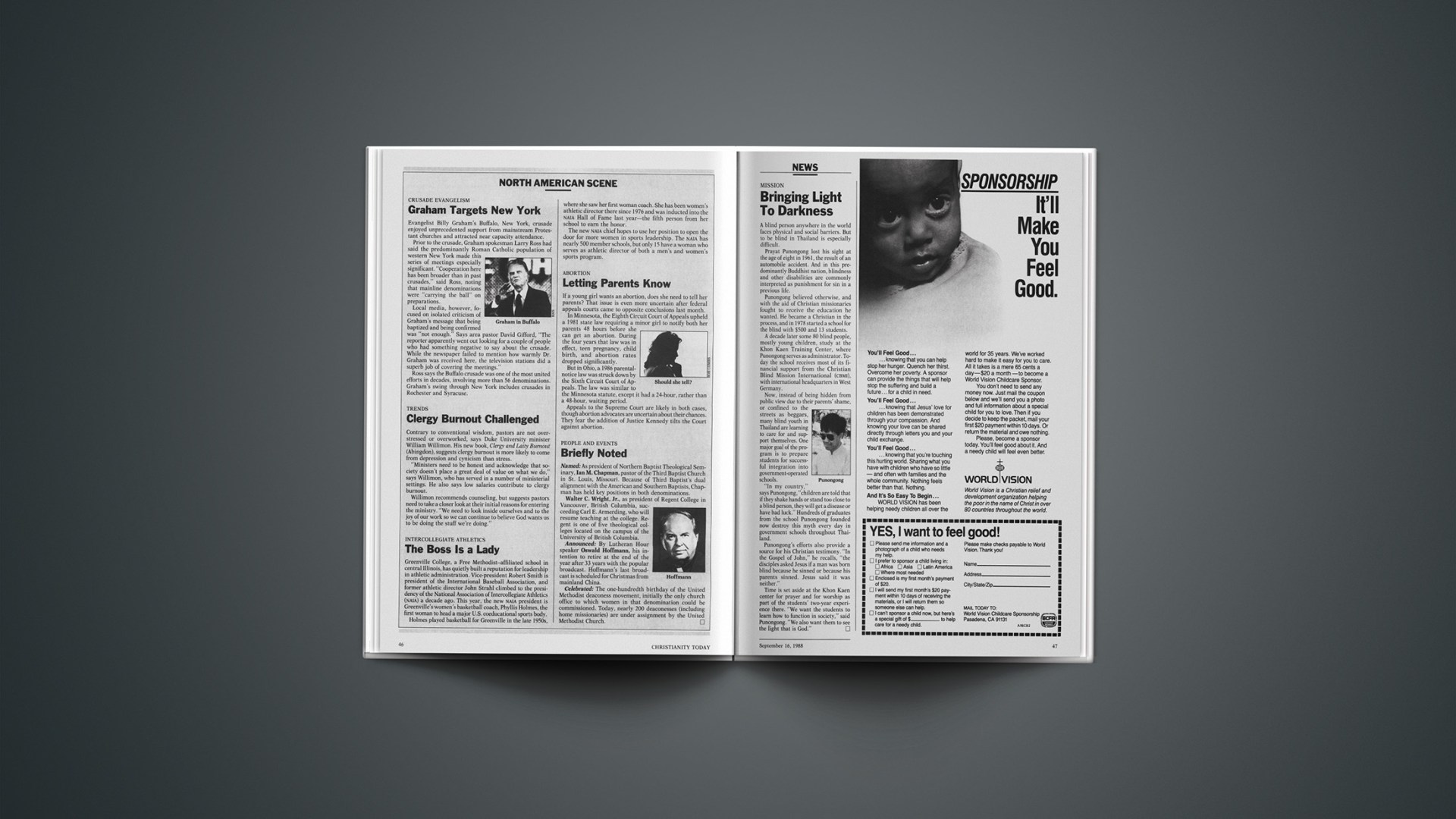
Bringing Light to Darkness

MISSION

A blind person anywhere in the world faces physical and social barriers. But to be blind in Thailand is especially difficult.

Prayat Punongong lost his sight at the age of eight in 1961, the result of an automobile accident. And in this predominantly Buddhist nation, blindness and other disabilities are commonly interpreted as punishment for sin in a previous life.

Punongong believed otherwise, and with the aid of Christian missionaries fought to receive the education he wanted. He became a Christian in the process, and in 1978 started a school for the blind with $500 and 13 students.

A decade later some 80 blind people, mostly young children, study at the Khon Kaen Training Center, where Punongong serves as administrator. Today the school receives most of its financial support from the Christian Blind Mission International (CBMI), with international headquarters in West Germany.

Now, instead of being hidden from public view due to their parents’ shame, or confined to the streets as beggars, many blind youth in Thailand are learning to care for and support themselves. One major goal of the program is to prepare students for successful integration into government-operated schools.

“In my country,” says Punongong, “children are told that if they shake hands or stand too close to a blind person, they will get a disease or have bad luck.” Hundreds of graduates from the school Punongong founded now destroy this myth every day in government schools throughout Thailand.

Punongong’s efforts also provide a source for his Christian testimony. “In the Gospel of John,” he recalls, “the disciples asked Jesus if a man was born blind because he sinned or because his parents sinned. Jesus said it was neither.”

Time is set aside at the Khon Kaen center for prayer and for worship as part of the students’ two-year experience there. “We want the students to learn how to function in society,” said Punongong. “We also want them to see the light that is God.”

World Scene

EASTERN EUROPE

Camp Meeting In Poland

Evangelistic meetings held in Poland this summer were eagerly attended, according to a report from Campus Crusade for Christ’s European office. Nearly 6,000 attended the largest of the week-long series of meetings, with 200 accepting Christ.

Observers report no interference from the Polish government. The meetings were held in a large tent in the village of Cieszyn, and Polish television produced a program about the event—a first, according to observers. Organizers of the event videotaped the proceedings and will distribute the tapes to organizers of home Bible studies this winter. Protestants in Poland number 120,000, compared to the nation’s 35 million Catholics.

TRENDS

Islam Goes To College

Over the past ten years, several British universities have established departments of Islamic or Middle Eastern studies that are heavily financed by Islamic nations or individuals. According to a report from People International, an outreach ministry to Muslims, the university centers “promote Islam” while giving it “academic credibility.”

Contributions from Persian Gulf states to Oxford University’s Center for Islamic Studies have been estimated at close to $10 million. Other British universities receiving similar aid are Exeter and Newcastle.

A spokesperson for People International says that Islamic clergy see England as a potential source of converts.

UPDATE

China Seeks Church Help

Faced with corruption in government and moral decay in society, Chinese Communist leaders may be turning to the church for help, says a report from the Hong Kong-based Chinese Church Research Centre. The report referred to conversations between premier Li Peng and American evangelist Billy Graham, where Ping suggested Christianity could play a role in China’s efforts to fight moral and social problems.

In June, the government allowed the official Protestant church to consecrate its first bishops in more than 30 years. The government also allowed a Catholic bishop who had been imprisoned for 30 years to visit the United States. The report says such activity may be the result of Chinese Christians’ reputation for being good citizens.

PACIFISTS

Baptists Study Peace Roots

Last month a group of Baptists met in Sweden for the first International Baptist Peace Conference. There were nearly 200 Baptists from 27 countries in attendance.

“We are discovering the presence of a worldwide community of Baptists who share our convictions, along with an almost-forgotten history of Baptist peacemakers,” noted Ken Sehested, the executive director of the Baptist Peace Fellowship of North America, which helped sponsor the event.

The conference focused heavily on Baptist history. Twice each day Paul Dekar, a Baptist church historian from Canada, told brief stories of Baptists who struggled to abolish slavery, oppose war, and reform prisons. But Australian history professor Heather Vose noted that the majority opinion among Baptists since the seventeenth century has been to support the use of violence in resolving conflict.

The five-day event included participants from the Soviet Union and East Germany. One specific result of the historic conference—a “Baptist Pen Pals for Peace” network—was initiated by 12-year-old Courtney Walsh of Memphis, Tennessee.

MIDDLE EAST

Plea For Jailed Christian

Christians in Egypt have begun a campaign to free a fellow believer who has been in jail for his faith for nearly two years. Abdul-Rahman Mohammed Abdul-Ghaffar was arrested on October 21, 1986, without explanation and has never been given a legal hearing.

No official charges have been brought against Abdul-Rahman, but informed sources say he will be accused of “exploiting religion to promote extremist ideas and divide national unity and social peace.” This was the same charge used against ten other Christian converts from Islam detained in 1986. They were released after widespread Western media attention.

Prompted by what he had read of Christ in the Qur’an, Abdul-Rahman, a medical doctor, began a study of the Bible in 1981, which ultimately led to his Christian conversion.

ELECTRONIC EVANGELISM

Bible Beamed To North Korea

South Korea’s Christian Broadcasting System (CBS) recently began airing a daily program of Bible reading at dictation speeds for listeners in North Korea.

“We do not know if anyone in North Korea is listening,” said the program’s sponsor,” Peter Lee. Radio ownership is carefully controlled by the North Korean government. The few that are available have no tuning dial, just an on/off switch preset to the official government channel.

According to a report from News Network International, this is believed to be the first time the Bible has been read across the airwaves to people in North Korea. However, a CBS spokesman said that “hard evidence of a Christian audience in North Korea is not available.” Most Christians fled the northern section of the Korean peninsula during the Korean War.

Showdown in Atlanta

UPDATE

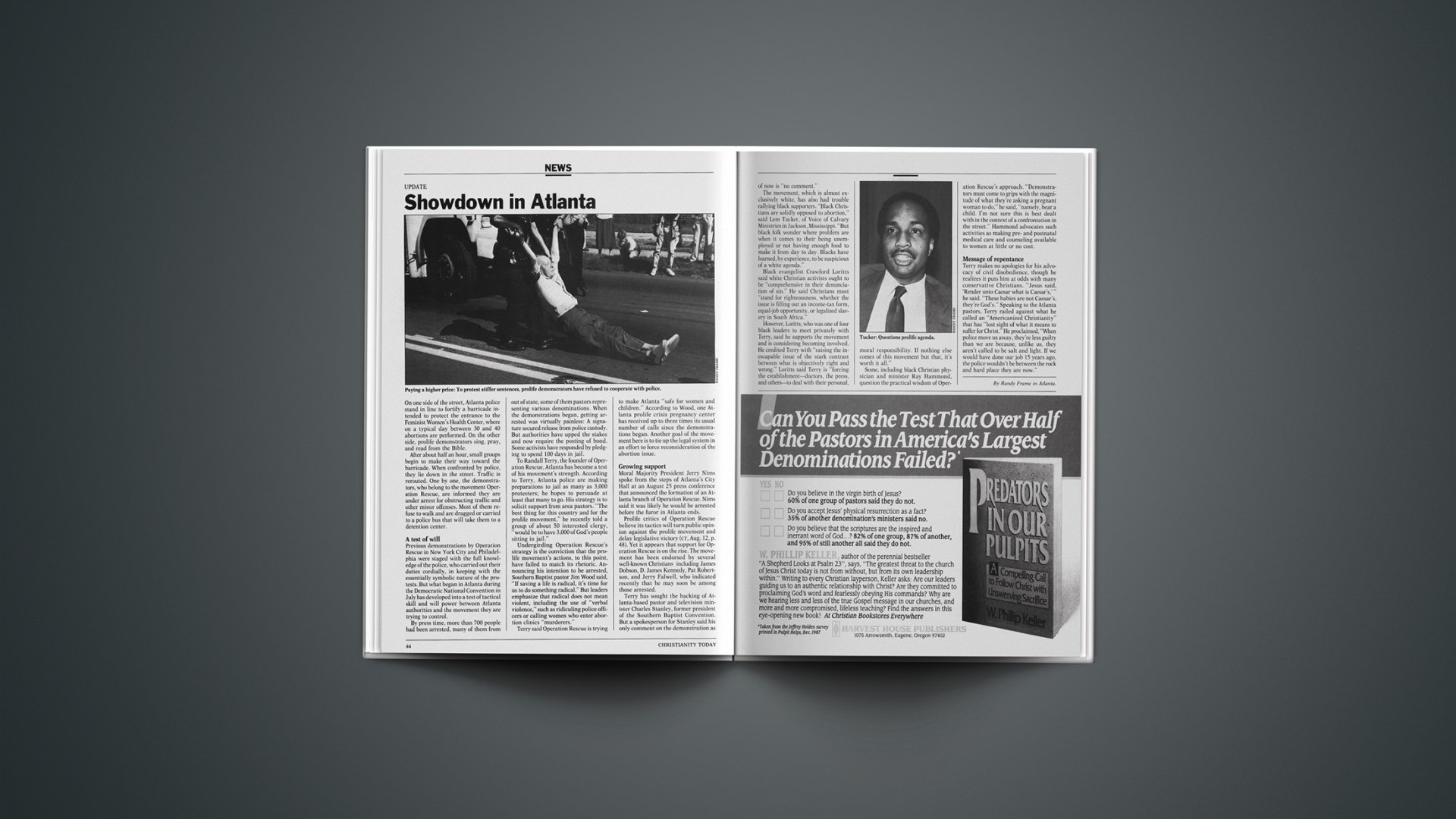
On one side of the street, Atlanta police stand in line to fortify a barricade intended to protect the entrance to the Feminist Women’s Health Center, where on a typical day between 30 and 40 abortions are performed. On the other side, prolife demonstrators sing, pray, and read from the Bible.

After about half an hour, small groups begin to make their way toward the barricade. When confronted by police, they lie down in the street. Traffic is rerouted. One by one, the demonstrators, who belong to the movement Operation Rescue, are informed they are under arrest for obstructing traffic and other minor offenses. Most of them refuse to walk and are dragged or carried to a police bus that will take them to a detention center.

A Test Of Will

Previous demonstrations by Operation Rescue in New York City and Philadelphia were staged with the full knowledge of the police, who carried out their duties cordially, in keeping with the essentially symbolic nature of the protests. But what began in Atlanta during the Democratic National Convention in July has developed into a test of tactical skill and will power between Atlanta authorities and the movement they are trying to control.

By press time, more than 700 people had been arrested, many of them from out of state, some of them pastors representing various denominations. When the demonstrations began, getting arrested was virtually painless: A signature secured release from police custody. But authorities have upped the stakes and now require the posting of bond. Some activists have responded by pledging to spend 100 days in jail.

To Randall Terry, the founder of Operation Rescue, Atlanta has become a test of his movement’s strength. According to Terry, Atlanta police are making preparations to jail as many as 3,000 protesters; he hopes to persuade at least that many to go. His strategy is to solicit support from area pastors. “The best thing for this country and for the prolife movement,” he recently told a group of about 50 interested clergy, “would be to have 3,000 of God’s people sitting in jail.”

Undergirding Operation Rescue’s strategy is the conviction that the prolife movement’s actions, to this point, have failed to match its rhetoric. Announcing his intention to be arrested, Southern Baptist pastor Jim Wood said, “If saving a life is radical, it’s time for us to do something radical.” But leaders emphasize that radical does not mean violent, including the use of “verbal violence,” such as ridiculing police officers or calling women who enter abortion clinics “murderers.”

Terry said Operation Rescue is trying to make Atlanta “safe for women and children.” According to Wood, one Atlanta prolife crisis pregnancy center has received up to three times its usual number of calls since the demonstrations began. Another goal of the movement here is to tie up the legal system in an effort to force reconsideration of the abortion issue.

Growing Support

Moral Majority President Jerry Nims spoke from the steps of Atlanta’s City Hall at an August 25 press conference that announced the formation of an Atlanta branch of Operation Rescue. Nims said it was likely he would be arrested before the furor in Atlanta ends.

Prolife critics of Operation Rescue believe its tactics will turn public opinion against the prolife movement and delay legislative victory (CT, Aug. 12, p. 48). Yet it appears that support for Operation Rescue is on the rise. The movement has been endorsed by several well-known Christians including James Dobson, D. James Kennedy, Pat Robertson, and Jerry Falwell, who indicated recently that he may soon be among those arrested.

Terry has sought the backing of Atlanta-based pastor and television minister Charles Stanley, former president of the Southern Baptist Convention. But a spokesperson for Stanley said his only comment on the demonstration as of now is “no comment.”

The movement, which is almost exclusively white, has also had trouble rallying black supporters. “Black Christians are solidly opposed to abortion,” said Lem Tucker, of Voice of Calvary Ministries in Jackson, Mississippi. “But black folk wonder where prolifers are when it comes to their being unemployed or not having enough food to make it from day to day. Blacks have learned, by experience, to be suspicious of a white agenda.”

Black evangelist Crawford Loritts said white Christian activists ought to be “comprehensive in their denunciation of sin.” He said Christians must “stand for righteousness, whether the issue is filling out an income-tax form, equal-job opportunity, or legalized slavery in South Africa.”

However, Loritts, who was one of four black leaders to meet privately with Terry, said he supports the movement and is considering becoming involved. He credited Terry with “raising the inescapable issue of the stark contrast between what is objectively right and wrong.” Loritts said Terry is “forcing the establishment—doctors, the press, and others—to deal with their personal, moral responsibility. If nothing else comes of this movement but that, it’s worth it all.”

Some, including black Christian physician and minister Ray Hammond, question the practical wisdom of Operation Rescue’s approach. “Demonstrators must come to grips with the magnitude of what they’re asking a pregnant woman to do,” he said, “namely, bear a child. I’m not sure this is best dealt with in the context of a confrontation in the street.” Hammond advocates such activities as making pre and postnatal medical care and counseling available to women at little or no cost.

Message Of Repentance

Terry makes no apologies for his advocacy of civil disobedience, though he realizes it puts him at odds with many conservative Christians. “Jesus said, ‘Render unto Caesar what is Caesar’s,’ ” he said. “These babies are not Caesar’s, they’re God’s.” Speaking to the Atlanta pastors, Terry railed against what he called an “Americanized Christianity” that has “lost sight of what it means to suffer for Christ.” He proclaimed, “When police move us away, they’re less guilty than we are because, unlike us, they aren’t called to be salt and light. If we would have done our job 15 years ago, the police wouldn’t be between the rock and hard place they are now.”

By Randy Frame in Atlanta.

North American Scene

CRUSADE EVANGELISM

Graham Targets New York

Evangelist Billy Graham’s Buffalo, New York, crusade enjoyed unprecedented support from mainstream Protestant churches and attracted near capacity attendance.

Prior to the crusade, Graham spokesman Larry Ross had said the predominantly Roman Catholic population of western New York made this series of meetings especially significant. “Cooperation here has been broader than in past crusades,” said Ross, noting that mainline denominations were “carrying the ball” on preparations.

Local media, however, focused on isolated criticism of Graham’s message that being baptized and being confirmed was “not enough.” Says area pastor David Gifford, “The reporter apparently went out looking for a couple of people who had something negative to say about the crusade. While the newspaper failed to mention how warmly Dr. Graham was received here, the television stations did a superb job of covering the meetings.”

Ross says the Buffalo crusade was one of the most united efforts in decades, involving more than 56 denominations. Graham’s swing through New York includes crusades in Rochester and Syracuse.

TRENDS

Clergy Burnout Challenged

Contrary to conventional wisdom, pastors are not overstressed or overworked, says Duke University minister William Willimon. His new book. Clergy and Laity Burnout (Abingdon), suggests clergy burnout is more likely to come from depression and cynicism than stress.

“Ministers need to be honest and acknowledge that society doesn’t place a great deal of value on what we do,” says Willimon, who has served in a number of ministerial settings. He also says low salaries contribute to clergy burnout.

Willimon recommends counseling, but suggests pastors need to take a closer look at their initial reasons for entering the ministry. “We need to look inside ourselves and to the joy of our work so we can continue to believe God wants us to be doing the stuff we’re doing.”

INTERCOLLEGIATE ATHLETICS

The Boss Is A Lady

Greenville College, a Free Methodist-affiliated school in central Illinois, has quietly built a reputation for leadership in athletic administration. Vice-president Robert Smith is president of the International Baseball Association, and former athletic director John Strahl climbed to the presidency of the National Association of Intercollegiate Athletics (NAIA) a decade ago. This year, the new NAIA president is Greenville’s women’s basketball coach, Phyllis Holmes, the first woman to head a major U.S. coeducational sports body. Holmes played basketball for Greenville in the late 1950s, where she saw her first woman coach. She has been women’s athletic director there since 1976 and was inducted into the NAIA Hall of Fame last year—the fifth person from her school to earn the honor.

The new NAIA chief hopes to use her position to open the door for more women in sports leadership. The NAIA has nearly 500 member schools, but only 15 have a woman who serves as athletic director of both a men’s and women’s sports program.

ABORTION

Letting Parents Know

If a young girl wants an abortion, does she need to tell her parents? That issue is even more uncertain after federal appeals courts came to opposite conclusions last month.

In Minnesota, the Eighth Circuit Court of Appeals upheld a 1981 state law requiring a minor girl to notify both her parents 48 hours before she can get an abortion. During the four years that law was in effect, teen pregnancy, child birth, and abortion rates dropped significantly.

But in Ohio, a 1986 parental-notice law was struck down by the Sixth Circuit Court of Appeals. The law was similar to the Minnesota statute, except it had a 24-hour, rather than a 48-hour, waiting period.

Appeals to the Supreme Court are likely in both cases, though abortion advocates are uncertain about their chances. They fear the addition of Justice Kennedy tilts the Court against abortion.

PEOPLE AND EVENTS

Briefly Noted

Named: As president of Northern Baptist Theological Seminary, Ian M. Chapman, pastor of the Third Baptist Church in St. Louis, Missouri. Because of Third Baptist’s dual alignment with the American and Southern Baptists, Chapman has held key positions in both denominations.

Walter C. Wright, Jr., as president of Regent College in Vancouver, British Columbia, succeeding Carl E. Armerding, who will resume teaching at the college. Regent is one of five theological colleges located on the campus of the University of British Columbia.

Announced: By Lutheran Hour speaker Oswald Hoffmann, his intention to retire at the end of the year after 33 years with the popular broadcast. Hoffmann’s last broadcast is scheduled for Christmas from mainland China.

Celebrated: The one-hundredth birthday of the United Methodist deaconess movement, initially the only church office to which women in that denomination could be commissioned. Today, nearly 200 deaconesses (including home missionaries) are under assignment by the United Methodist Church.

Tempest Brewing over Republican Bashing

CONTROVERSY

James Dobson, president of Focus on the Family publications, has threatened to pull his publications out of the 315-member Evangelical Press Association (EPA) because of a controversial article in the association’s March–April newsletter, Liaison. The lengthy piece, written by EPA executive director Gary Warner, consisted mainly of an attack on Republican political views. Warner calls the past eight years in this country an “unmitigated political disaster.”

Dobson, noting his own activities in the fight against pornography, told Evangelical Press (EP) News Service that he took some of Warner’s remarks as a personal affront. Warner called antipornography campaigns “the latest religious cottage industry in a culture of one-issue-at-a-time concentration,” and said that picketing convenience stores to have Playboy removed is “a waste of time.”

In the article, Warner also implied that evangelicals subscribe to too narrow a definition of “family.” He urged caution about “giving blanket approval to individuals and groups that spout ‘pro-family’ slogans.” Dobson told EP that this comment “seemed rather specific to our situation as well.”

Warner denied that his editorial was “aimed at any organization or individual.” He said Christians “raise money and establish ministries on the basis of a lot of catch slogans and catch phrases, and I simply wanted to lift our thinking beyond that level.”

Tom Minnery, senior editorial director of Dobson’s publications, raised the issue at EPA’S annual convention in May. The association responded with a new policy calling for the executive director’s articles to be reviewed by the association president. Also, opinion articles in Liaison must be labeled as such.

In the July–August Liaison, EPA President John Stapert expressed the hope that the new policy would lay the controversy “permanently to rest.” But according to Focus on the Family’s Minnery, Dobson is waiting to see if stronger actions will be taken at the EPA board meeting next month before deciding whether to pull out.

Warner said he doubted there would be a significant change in the policy since it was approved overwhelmingly by the EPA membership in May. He said it was likely a few publications would pull out, but that it would have virtually no effect on the association.

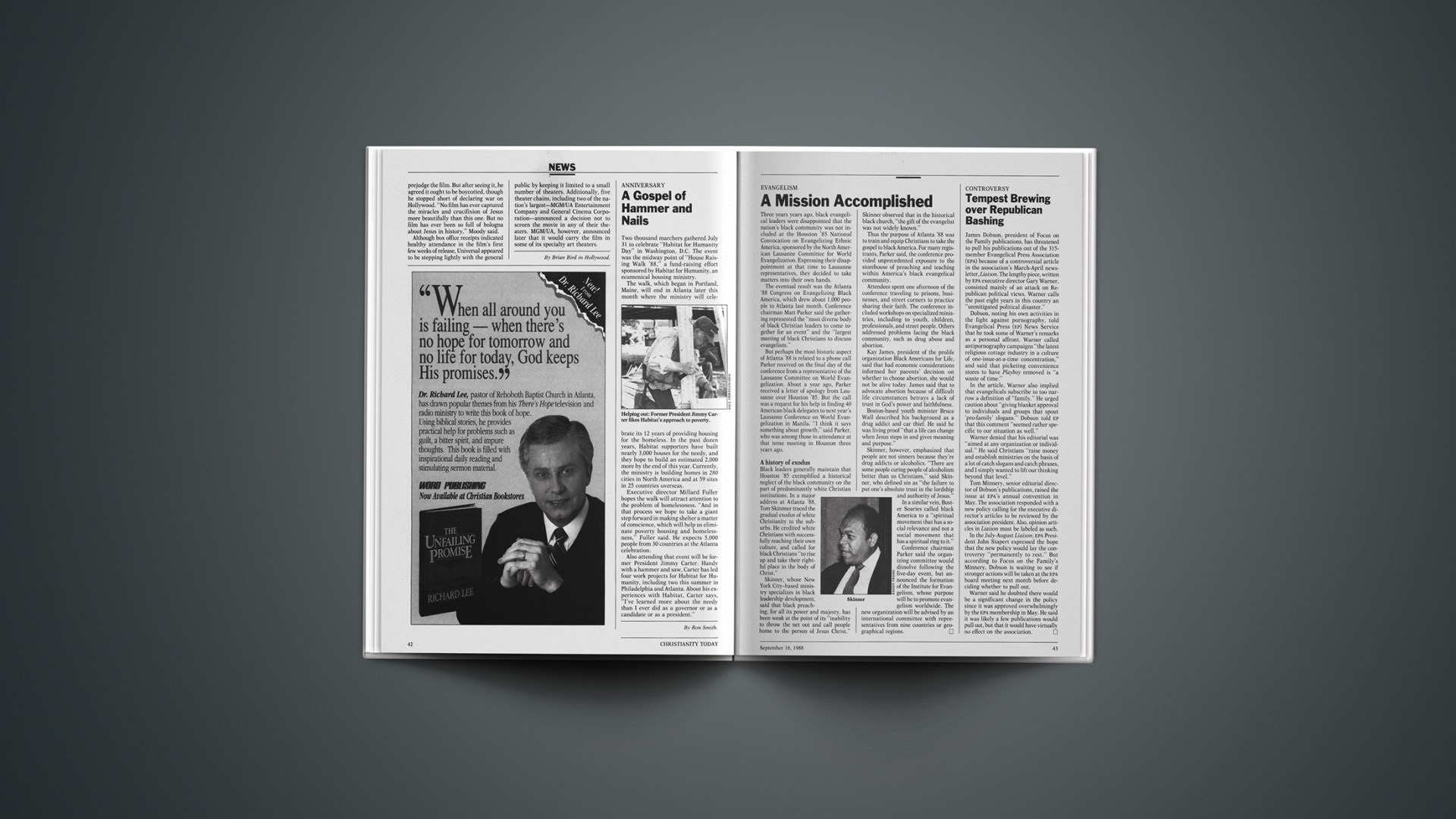
A Mission Accomplished

EVANGELISM

Three years years ago, black evangelical leaders were disappointed that the nation’s black community was not included at the Houston ‘85 National Convocation on Evangelizing Ethnic America, sponsored by the North American Lausanne Committee for World Evangelization. Expressing their disappointment at that time to Lausanne representatives, they decided to take matters into their own hands.

The eventual result was the Atlanta ‘88 Congress on Evangelizing Black America, which drew about 1,000 people to Atlanta last month. Conference chairman Matt Parker said the gathering represented the “most diverse body of black Christian leaders to come together for an event” and the “largest meeting of black Christians to discuss evangelism.”

But perhaps the most historic aspect of Atlanta ‘88 is related to a phone call Parker received on the final day of the conference from a representative of the Lausanne Committee on World Evangelization. About a year ago, Parker received a letter of apology from Lausanne over Houston ‘85. But the call was a request for his help in finding 40 American black delegates to next year’s Lausanne Conference on World Evangelization in Manila. “I think it says something about growth,” said Parker, who was among those in attendance at that tense meeting in Houston three years ago.

A History Of Exodus

Black leaders generally maintain that Houston ‘85 exemplified a historical neglect of the black community on the part of predominantly white Christian institutions. In a major address at Atlanta ‘88, Tom Skinnner traced the gradual exodus of white Christianity to the suburbs. He credited white Christians with successfully reaching their own culture, and called for black Christians “to rise up and take their rightful place in the body of Christ.”

Skinner, whose New York City-based ministry specializes in black leadership development, said that black preaching, for all its power and majesty, has been weak at the point of its “inability to throw the net out and call people home to the person of Jesus Christ.” Skinner observed that in the historical black church, “the gift of the evangelist was not widely known.”

Thus the purpose of Atlanta ‘88 was to train and equip Christians to take the gospel to black America. For many registrants, Parker said, the conference provided unprecedented exposure to the storehouse of preaching and teaching within America’s black evangelical community.

Attendees spent one afternoon of the conference traveling to prisons, businesses, and street corners to practice sharing their faith. The conference included workshops on specialized ministries, including to youth, children, professionals, and street people. Others addressed problems facing the black community, such as drug abuse and abortion.

Kay James, president of the prolife organization Black Americans for Life, said that had economic considerations informed her parents’ decision on whether to choose abortion, she would not be alive today. James said that to advocate abortion because of difficult life circumstances betrays a lack of trust in God’s power and faithfulness.

Boston-based youth minister Bruce Wall described his background as a drug addict and car thief. He said he was living proof “that a life can change when Jesus steps in and gives meaning and purpose.”

Skinner, however, emphasized that people are not sinners because they’re drug addicts or alcoholics. “There are some people curing people of alcoholism better than us Christians,” said Skinner, who defined sin as “the failure to put one’s absolute trust in the lordship and authority of Jesus.”

In a similar vein, Buster Soaries called black America to a “spiritual movement that has a social relevance and not a social movement that has a spiritual ring to it.”

Conference chairman Parker said the organizing committee would dissolve following the five-day event, but announced the formation of the Institute for Evangelism, whose purpose will be to promote evangelism worldwide. The new organization will be advised by an international committee with representatives from nine countries or geographical regions.

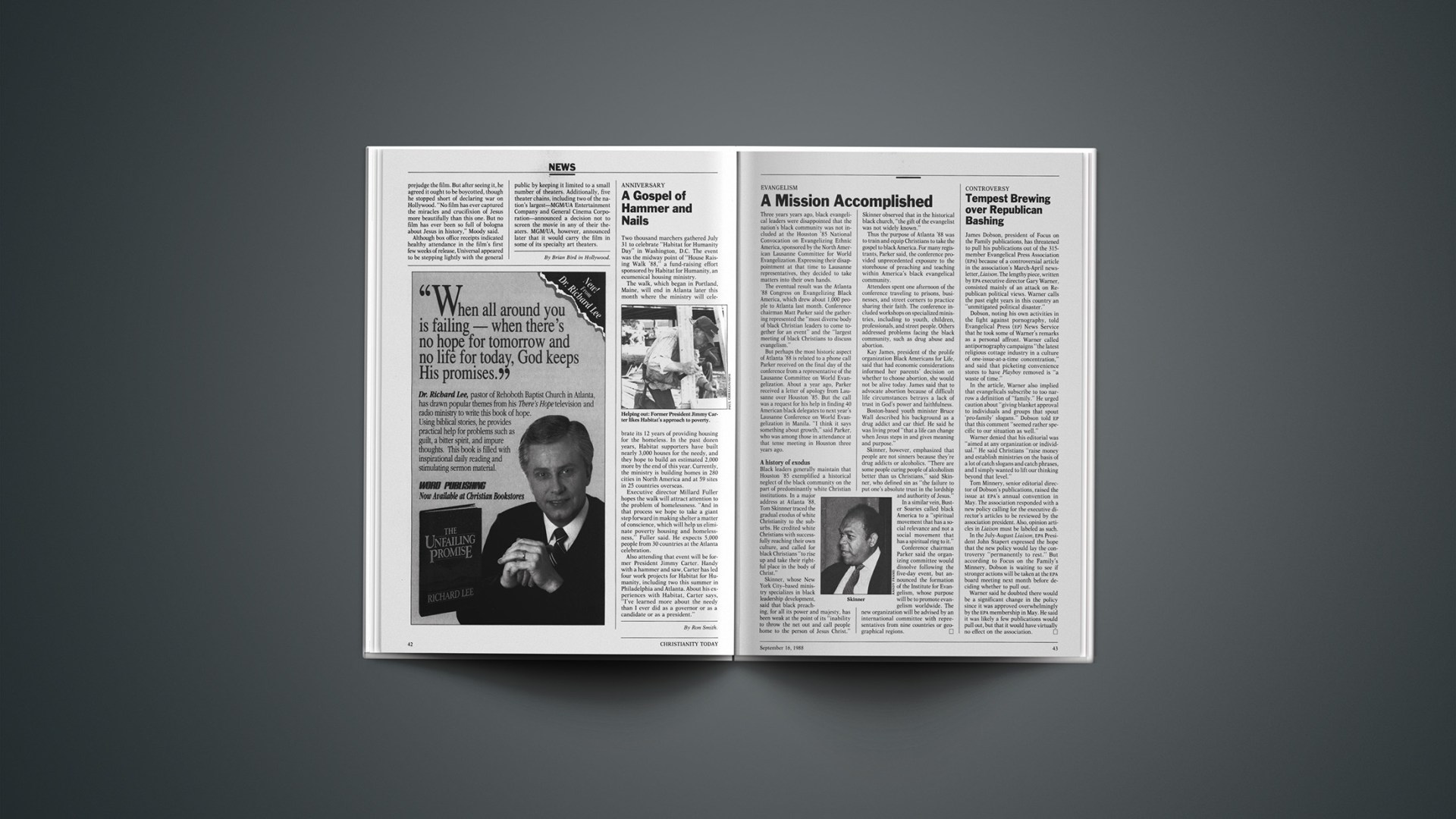
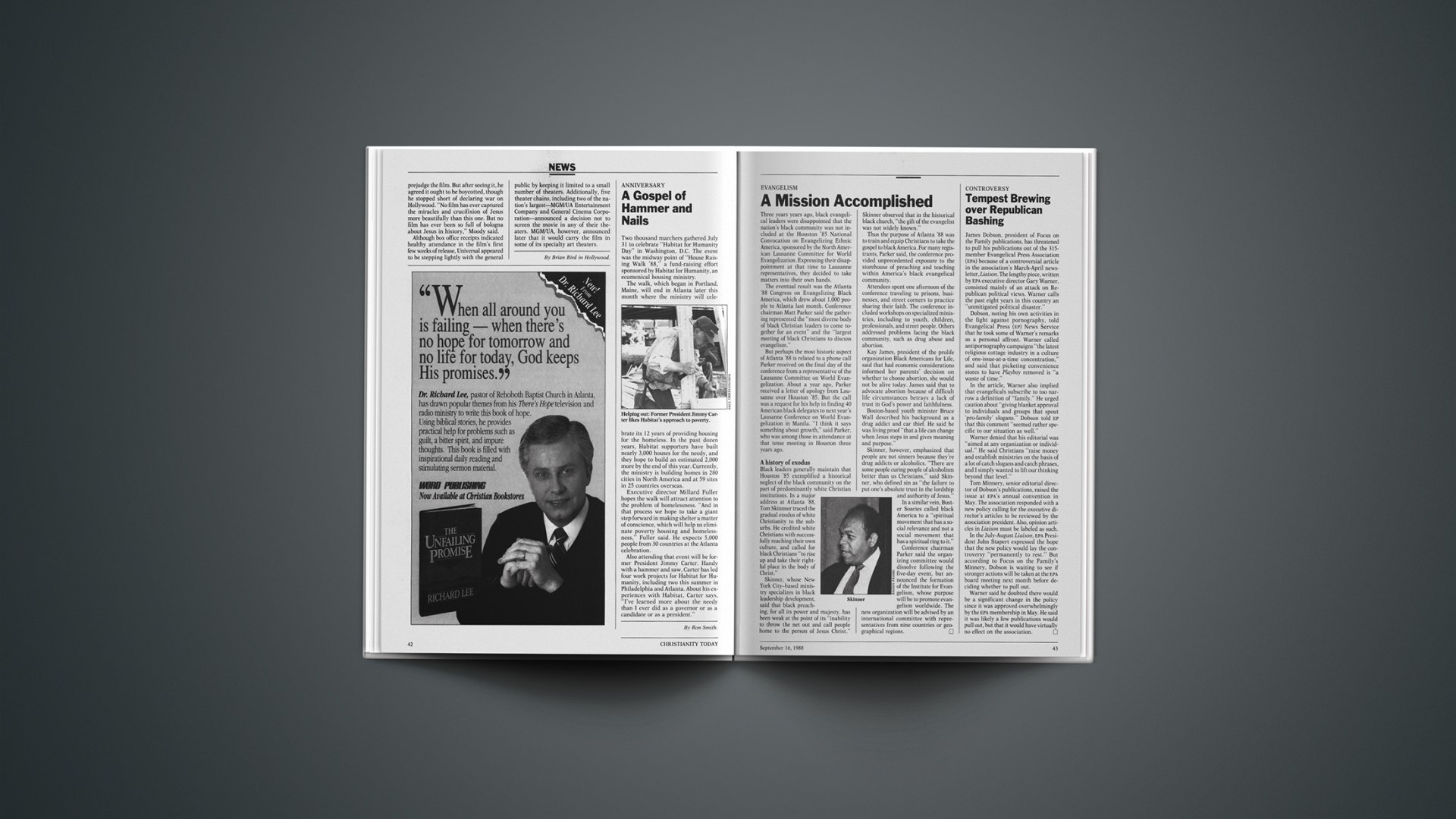
A Gospel of Hammer and Nails

ANNIVERSARY

Two thousand marchers gathered July 31 to celebrate “Habitat for Humanity Day” in Washington, D.C. The event was the midway point of “House Raising Walk 88,” a fund-raising effort sponsored by Habitat for Humanity, an ecumenical housing ministry.

The walk, which began in Portland, Maine, will end in Atlanta later this month where the ministry will celebrate its 12 years of providing housing for the homeless. In the past dozen years, Habitat supporters have built nearly 3,000 houses for the needy, and they hope to build an estimated 2,000 more by the end of this year. Currently, the ministry is building homes in 280 cities in North America and at 59 sites in 25 countries overseas.

Executive director Millard Fuller hopes the walk will attract attention to the problem of homelessness. “And in that process we hope to take a giant step forward in making shelter a matter of conscience, which will help us eliminate poverty housing and homelessness,” Fuller said. He expects 5,000 people from 30 countries at the Atlanta celebration.

Also attending that event will be former President Jimmy Carter. Handy with a hammer and saw, Carter has led four work projects for Habitat for Humanity, including two this summer in Philadelphia and Atlanta. About his experiences with Habitat, Carter says, “I’ve learned more about the needy than I ever did as a governor or as a candidate or as a president.”

By Ron Smith.

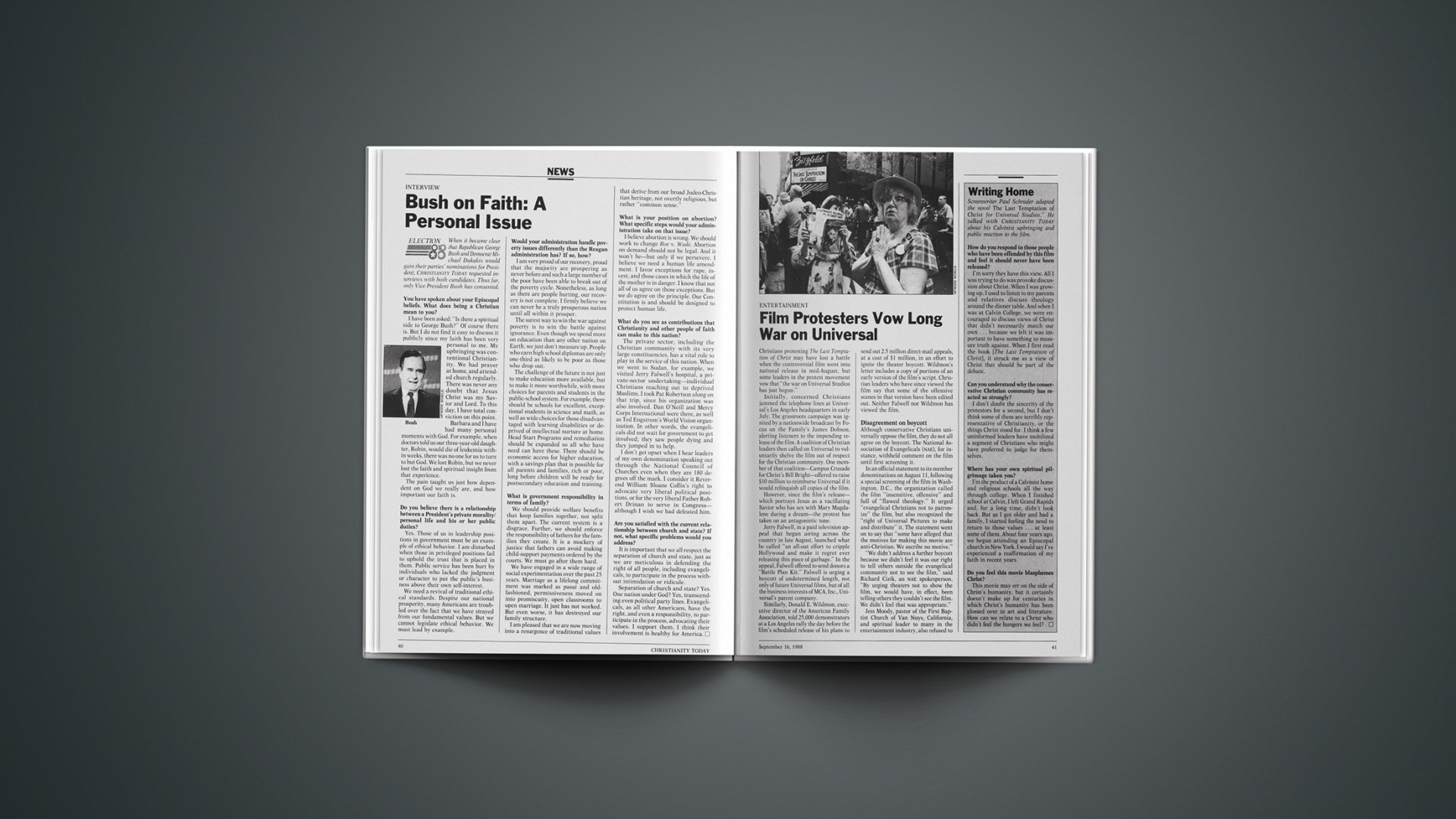
Film Protesters Vow Long War on Universal

ENTERTAINMENT

Christians protesting The Last Temptation of Christ may have lost a battle when the controversial film went into national release in mid-August, but some leaders in the protest movement vow that “the war on Universal Studios has just begun.”

Initially, concerned Christians jammed the telephone lines at Universal’s Los Angeles headquarters in early July. The grassroots campaign was ignited by a nationwide broadcast by Focus on the Family’s James Dobson, alerting listeners to the impending release of the film. A coalition of Christian leaders then called on Universal to voluntarily shelve the film out of respect for the Christian community. One member of that coalition—Campus Crusade for Christ’s Bill Bright—offered to raise $10 million to reimburse Universal if it would relinquish all copies of the film.

However, since the film’s release—which portrays Jesus as a vacillating Savior who has sex with Mary Magdalene during a dream—the protest has taken on an antagonistic tone.

Jerry Falwell, in a paid television appeal that began airing across the country in late August, launched what he called “an all-out effort to cripple Hollywood and make it regret ever releasing this piece of garbage.” In the appeal, Falwell offered to send donors a “Battle Plan Kit.” Falwell is urging a boycott of undetermined length, not only of future Universal films, but of all the business interests of MCA, Inc., Universal’s parent company.

Similarly, Donald E. Wildmon, executive director of the American Family Association, told 25,000 demonstrators at a Los Angeles rally the day before the film’s scheduled release of his plans to send out 2.5 million direct-mail appeals, at a cost of $1 million, in an effort to ignite the theater boycott. Wildmon’s letter includes a copy of portions of an early version of the film’s script. Christian leaders who have since viewed the film say that some of the offensive scenes in that version have been edited out. Neither Falwell nor Wildmon has viewed the film.

Writing Home

Screenwriter Paul Schrader adapted the novel The Last Temptation of Christ for Universal Studios.” He talked with CHRISTIANITY TODAY about his Calvinist upbringing and public reaction to the film.

How do you respond to those people who have been offended by this film and feel it should never have been released?

I’m sorry they have this view. All I was trying to do was provoke discussion about Christ. When I was growing up, I used to listen to my parents and relatives discuss theology around the dinner table. And when I was at Calvin College, we were encouraged to discuss views of Christ that didn’t necessarily match our own … because we felt it was important to have something to measure truth against. When I first read the book [The Last Temptation of Christ], it struck me as a view of Christ that should be part of the debate.

Can you understand why the conservative Christian community has reacted so strongly?

I don’t doubt the sincerity of the protestors for a second, but I don’t think some of them are terribly representative of Christianity, or the things Christ stood for. I think a few uninformed leaders have mobilized a segment of Christians who might have preferred to judge for themselves.

Where has your own spiritual pilgrimage taken you?

I’m the product of a Calvinist home and religious schools all the way through college. When I finished school at Calvin, I left Grand Rapids and, for a long time, didn’t look back. But as I got older and had a family, I started feeling the need to return to those values … at least some of them. About four years ago, we began attending an Episcopal church in New York. I would say I’ve experienced a reaffirmation of my faith in recent years.

Do you feel this movie blasphemes Christ?

This movie may err on the side of Christ’s humanity, but it certainly doesn’t make up for centuries in which Christ’s humanity has been glossed over in art and literature. How can we relate to a Christ who didn’t feel the hungers we feel?

Disagreement On Boycott

Although conservative Christians universally oppose the film, they do not all agree on the boycott. The National Association of Evangelicals (NAE), for instance, withheld comment on the film until first screening it.

In an official statement to its member denominations on August 11, following a special screening of the film in Washington, D.C., the organization called the film “insensitive, offensive” and full of “flawed theology.” It urged “evangelical Christians not to patronize” the film, but also recognized the “right of Universal Pictures to make and distribute” it. The statement went on to say that “some have alleged that the motives for making this movie are anti-Christian. We ascribe no motive.”

“We didn’t address a further boycott because we didn’t feel it was our right to tell others outside the evangelical community not to see the film,” said Richard Cizik, an NAE spokesperson. “By urging theaters not to show the film, we would have, in effect, been telling others they couldn’t see the film. We didn’t feel that was appropriate.”

Jess Moody, pastor of the First Baptist Church of Van Nuys, California, and spiritual leader to many in the entertainment industry, also refused to prejudge the film. But after seeing it, he agreed it ought to be boycotted, though he stopped short of declaring war on Hollywood. “No film has ever captured the miracles and crucifixion of Jesus more beautifully than this one. But no film has ever been so full of bologna about Jesus in history,” Moody said.

Although box office receipts indicated healthy attendance in the film’s first few weeks of release, Universal appeared to be stepping lightly with the general public by keeping it limited to a small number of theaters. Additionally, five theater chains, including two of the nation’s largest—MGM/UA Entertainment Company and General Cinema Corporation—announced a decision not to screen the movie in any of their theaters. MGM/UA, however, announced later that it would carry the film in some of its specialty art theaters.

By Brian Bird in Hollywood.

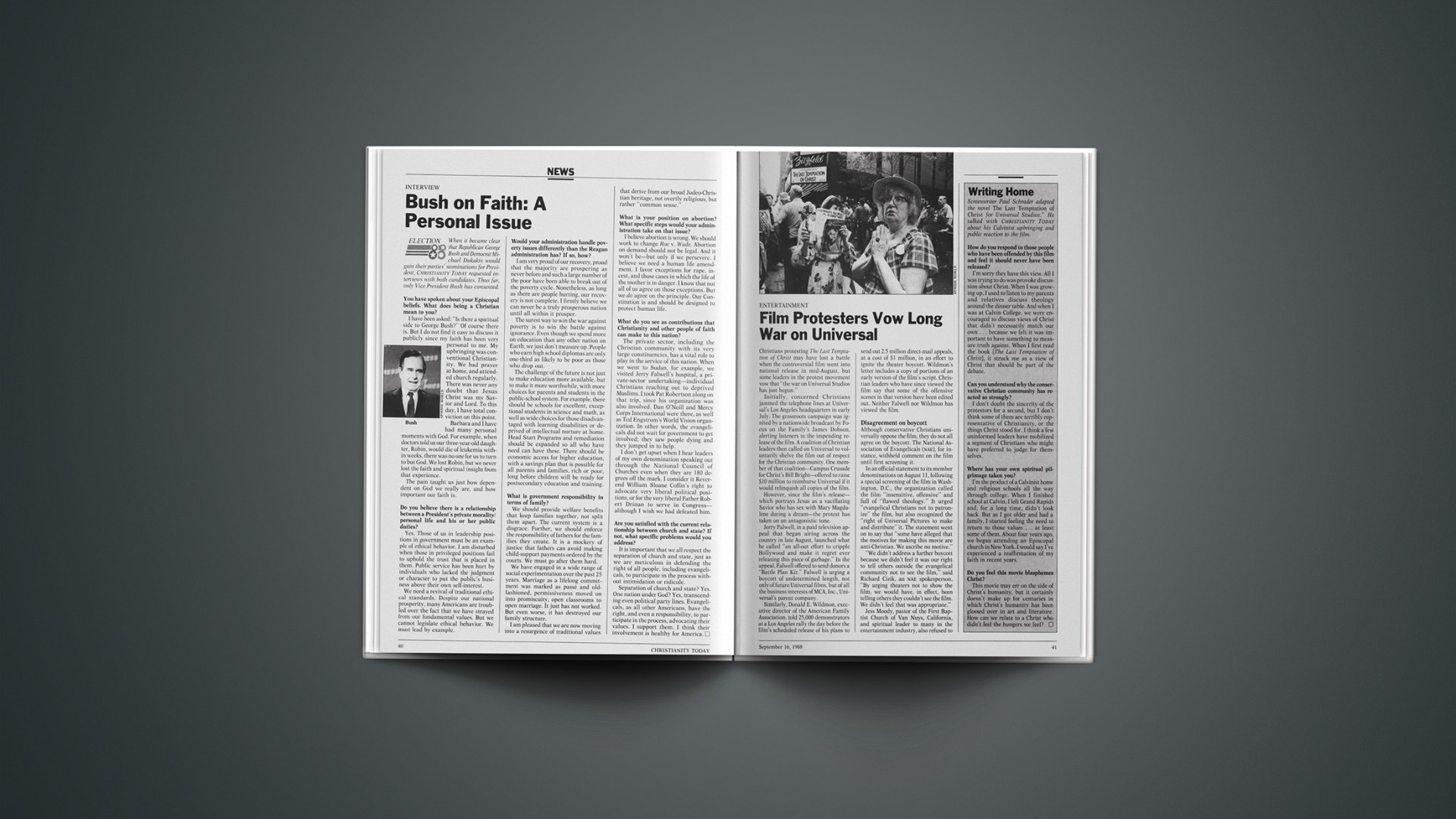
Bush on Faith: A Personal Issue

INTERVIEW

When it became clear that Republican George Bush and Democrat Michael Dukakis would gain their parties’ nominations for President, CHRISTIANITY TODAY requested interviews with both candidates. Thus far, only Vice President Bush has consented.

You have spoken about your Episcopal beliefs. What does being a Christian mean to you?

I have been asked: “Is there a spiritual side to George Bush?” Of course there is. But I do not find it easy to discuss it publicly since my faith has been very personal to me. My upbringing was conventional Christianity. We had prayer at home, and attended church regularly. There was never any doubt that Jesus Christ was my Savior and Lord. To this day, I have total conviction on this point.

Barbara and I have had many personal moments with God. For example, when doctors told us our three-year-old daughter, Robin, would die of leukemia within weeks, there was no one for us to turn to but God. We lost Robin, but we never lost the faith and spiritual insight from that experience.

The pain taught us just how dependent on God we really are, and how important our faith is.

Do you believe there is a relationship between a President’s private morality/personal life and his or her public duties?

Yes. Those of us in leadership positions in government must be an example of ethical behavior. I am disturbed when those in privileged positions fail to uphold the trust that is placed in them. Public service has been hurt by individuals who lacked the judgment or character to put the public’s business above their own self-interest.

We need a revival of traditional ethical standards. Despite our national prosperity, many Americans are troubled over the fact that we have strayed from our fundamental values. But we cannot legislate ethical behavior. We must lead by example.

Would your administration handle poverty issues differently than the Reagan administration has? If so, how?

I am very proud of our recovery, proud that the majority are prospering as never before and such a large number of the poor have been able to break out of the poverty cycle. Nonetheless, as long as there are people hurting, our recovery is not complete. I firmly believe we can never be a truly prosperous nation until all within it prosper.

The surest way to win the war against poverty is to win the battle against ignorance. Even though we spend more on education than any other nation on Earth, we just don’t measure up. People who earn high school diplomas are only one-third as likely to be poor as those who drop out.

The challenge of the future is not just to make education more available, but to make it more worthwhile, with more choices for parents and students in the public-school system. For example, there should be schools for excellent, exceptional students in science and math, as well as wide choices for those disadvantaged with learning disabilities or deprived of intellectual nurture at home. Head Start Programs and remediation should be expanded so all who have need can have these. There should be economic access for higher education, with a savings plan that is possible for all parents and families, rich or poor, long before children will be ready for postsecondary education and training.

What is government responsibility in terms of family?

We should provide welfare benefits that keep families together, not split them apart. The current system is a disgrace. Further, we should enforce the responsibility of fathers for the families they create. It is a mockery of justice that fathers can avoid making child-support payments ordered by the courts. We must go after them hard.

We have engaged in a wide range of social experimentation over the past 25 years. Marriage as a lifelong commitment was marked as passé and old-fashioned, permissiveness moved on into promiscuity, open classrooms to open marriage. It just has not worked. But even worse, it has destroyed our family structure.

I am pleased that we are now moving into a resurgence of traditional values I that derive from our broad Judeo-Christian heritage, not overtly religious, but rather “common sense.”

What is your position on abortion? What specific steps would your administration take on that issue?

I believe abortion is wrong. We should work to change Roe v. Wade. Abortion on demand should not be legal. And it won’t be—but only if we persevere. I believe we need a human life amendment. I favor exceptions for rape, incest, and those cases in which the life of the mother is in danger. I know that not all of us agree on those exceptions. But we do agree on the principle. Our Constitution is and should be designed to protect human life.

What do you see as contributions that Christianity and other people of faith can make to this nation?

The private sector, including the Christian community with its very large constituencies, has a vital role to play in the service of this nation. When we went to Sudan, for example, we visited Jerry Falwell’s hospital, a private-sector undertaking—individual Christians reaching out to deprived Muslims. I took Pat Robertson along on that trip, since his organization was also involved. Dan O’Neill and Mercy Corps International were there, as well as Ted Engstrom’s World Vision organization. In other words, the evangelicals did not wait for government to get involved; they saw people dying and they jumped in to help.

I don’t get upset when I hear leaders of my own denomination speaking out through the National Council of Churches even when they are 180 degrees off the mark. I consider it Reverend William Sloane Coffin’s right to advocate very liberal political positions, or for the very liberal Father Robert Drinan to serve in Congress—although I wish we had defeated him.

Are you satisfied with the current relationship between church and state? If not, what specific problems would you address?

It is important that we all respect the separation of church and state, just as we are meticulous in defending the right of all people, including evangelicals, to participate in the process without intimidation or ridicule.

Separation of church and state? Yes. One nation under God? Yes, transcending even political party lines. Evangelicals, as all other Americans, have the right, and even a responsibility, to participate in the process, advocating their values. I support them. I think their involvement is healthy for America.

Apple PodcastsDown ArrowDown ArrowDown Arrowarrow_left_altLeft ArrowLeft ArrowRight ArrowRight ArrowRight Arrowarrow_up_altUp ArrowUp ArrowAvailable at Amazoncaret-downCloseCloseEmailEmailExpandExpandExternalExternalFacebookfacebook-squareGiftGiftGooglegoogleGoogle KeephamburgerInstagraminstagram-squareLinkLinklinkedin-squareListenListenListenChristianity TodayCT Creative Studio Logologo_orgMegaphoneMenuMenupausePinterestPlayPlayPocketPodcastRSSRSSSaveSaveSaveSearchSearchsearchSpotifyStitcherTelegramTable of ContentsTable of Contentstwitter-squareWhatsAppXYouTubeYouTube