Civil Disobedience

Calculated civil disobedience, seemingly so innocent, has brought in an era of lawlessness and bloodshed that can plunge our nation into unbelievable chaos. The tragic death of Dr. Martin Luther King, Jr., and subsequent events bear mute testimony to the uncontrolled forces now unloosed across the land.

In recent years nearly every major denomination has passed resolutions on civil disobedience defending the principle of resistance to the law and constituted authority while admitting that those who break the law must be prepared to accept the consequences.

What a few years ago appeared to be a gesture of sympathy toward those engaged in civil disobedience has now developed into support of individuals and movements that are challenging constitutional procedures and encouraging a spirit of rebellion and anarchy. Some churchmen now say openly that there must be revolution, even bloodshed, before there can be a new social order.

Perhaps this year will prove to be the last chance for general assemblies, conferences, conventions, and the like to take a second look at a philosophy that is able to destroy the foundations of the nation. For if lawlessness prevails, the outlook for America is bleak.

Civil disobedience can lead to the dissolution of law and order, with anarchy the result. Further, it can lead to revolution. And revolution can open the way to dictatorship, with the resulting loss of freedom and ultimate bondage.

Riots, bloodshed, arson, loss of life and property—a dismal story—are the result of trying to redress wrongs in the streets rather than in the courts and at the ballot box. In rejecting “gradualism” with its attending frustrations and disappointments, many are resorting to a senseless rebellion that adds tensions and injustice.

Writing in Look magazine a few months ago under the title, “Dissent or Destruction?,” Eric Sevareid observed:

“The use of force to express conviction, even if it takes so relatively mild a form as a college sit-in that blocks the administration building, is intolerable. When Dr. Martin Luther King, who may well be one of the noblest Americans of the century, deliberately defies a court order, then he ought to go to jail. Laws and ordinances can be changed, and are constantly being changed, but they cannot be rewritten in the streets where other citizens also have their rights” (Look, Sept. 5, 1967, pp. 22, 23; copyright 1967 by Eric Sevareid; used by permission).

To engage in or condone civil disobedience is to loose a tiger of destruction. The welfare of any nation depends on respect for and enforcement of law. Lawlessness is now prevalent enough to endanger the very life of our nation. Laws that are inadequate or unjust should be changed in the courts and at the polls; they cannot be changed in the streets.

Furthermore, those who incite riots and disorder, who advocate violent disruption of communities and go about as hatemongers, whether they be members of secret organizations like the Ku Klux Klan, black-power advocates, or something else, should be handled by the law on the basis of their public threats, before they commit violent acts.

Any person who openly flouts the law should be called to account.

The hooded organization that engages in terrorism, arson, and bombings should be infiltrated by representatives of the law until its leaders are behind bars and its members scattered into oblivion.

The wave of civil disobedience that is threatening our national life seems to have paralyzed us into fear and inaction. But unless it is reversed, we face anarchy. No segment of society can be permitted to act above the law and to destroy the things on which a decent society is based.

We are on the verge of being frightened enough to believe that the outlay of hundreds of billions of dollars is the answer to our problem. No one questions the need to rebuild our cities; but chaos cannot be cured by money, no matter how great the sum. Even if every person in America were put in a mansion, without regard for law and order our problem would continue.

No one can deny that we have countenanced discrimination and humiliation to such a point that a sense of frustration is inevitable; now this frustration has caused violent reactions. These sins against human beings must cease, and equal opportunities must be available to all. But with these needed changes (and tremendous progress is being made in this direction), respect for law and law enforcement must be maintained.

This is no plea for maintaining the status quo. It is a plea for recognition that the blindness and unconcern of the dominant segment of our society must be completely changed. And on the other hand, it is an affirmation that any status and rights gained through civil disorder will be gained at too high a price.

Two centuries ago Edmund Burke, the great English statesman, gave this warning: “Men are qualified for civil liberties in exact proportion to their disposition to put moral chains upon their own appetites.… Society cannot exist unless a controlling power upon will and appetite is placed somewhere, and the less of it there is within, the more there must be without. It is ordained in the eternal constitution of things that men of intemperate minds cannot be free. Their passions forge their fetters.”

In medicine there is a condition known as “generalized carcinomatosis,” which, in layman’s language, means cancer that has spread over the entire body. At that stage there is no known cure.

The lawlessness that has entered our national life through civil disobedience—a concept having the approval of most of the major denominations—can prove to be the moral cancer that will destroy our country.

This is a plea to churchmen, who will be meeting during the coming months, to take stock of what has been loosed upon the land. Civil disobedience is not the “harmless gesture of protest” it was once said to be. Rather, it has grown into a monster of disorder, riots, and general lawlessness that is eating at the vitals of our national life. It is proving as senseless—and as devastating—as the proverbial “burning down the barn to get rid of the rats.”

Some of our most distinguished jurists and law-makers have deplored the actions of various church courts in condoning civil disobedience. Sufficient time has now elapsed to assess the damage; one has but to open his daily newspaper to realize that we totter on the brink of open rebellion.

Responsible law-makers must do everything they can to eliminate injustice, discrimination, and humiliation. At the same time, those who administer the law must be supported at all costs.

The alternative is national disaster.
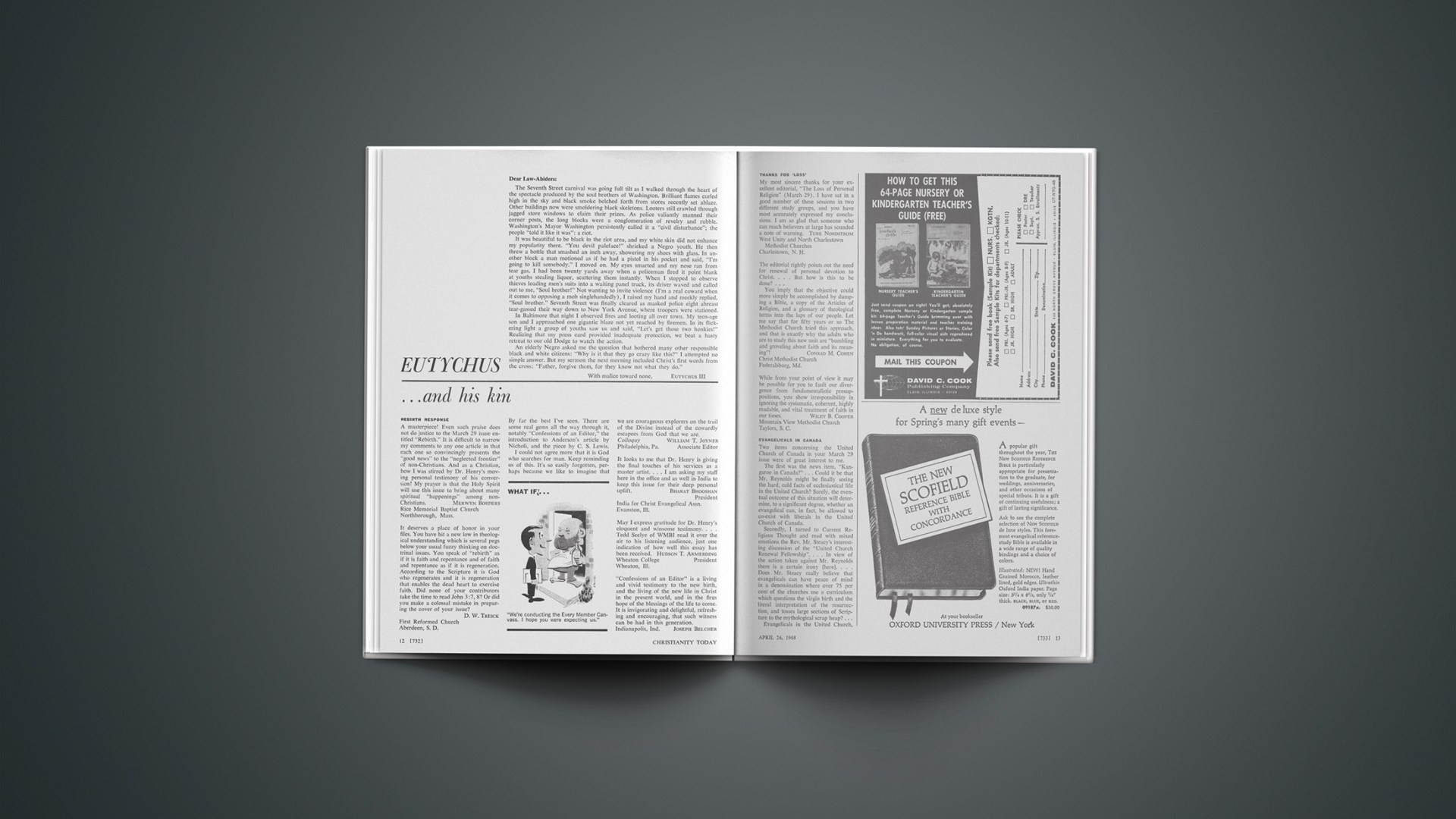
Eutychus and His Kin: April 26, 1968

Dear Law-Abiders:

The Seventh Street carnival was going full tilt as I walked through the heart of the spectacle produced by the soul brothers of Washington. Brilliant flames curled high in the sky and black smoke belched forth from stores recently set ablaze. Other buildings now were smoldering black skeletons. Looters still crawled through jagged store windows to claim their prizes. As police valiantly manned their corner posts, the long blocks were a conglomeration of revelry and rubble. Washington’s Mayor Washington persistently called it a “civil disturbance”; the people “told it like it was”: a riot.

It was beautiful to be black in the riot area, and my white skin did not enhance my popularity there. “You devil paleface!” shrieked a Negro youth. He then threw a bottle that smashed an inch away, showering my shoes with glass. In another block a man motioned as if he had a pistol in his pocket and said, “I’m going to kill somebody.” I moved on. My eyes smarted and my nose ran from tear gas. I had been twenty yards away when a policeman fired it point blank at youths stealing liquor, scattering them instantly. When I stopped to observe thieves loading men’s suits into a waiting panel truck, its driver waved and called out to me, “Soul brother!” Not wanting to invite violence (I’m a real coward when it comes to opposing a mob singlehandedly), I raised my hand and meekly replied, “Soul brother.” Seventh Street was finally cleared as masked police eight abreast tear-gassed their way down to New York Avenue, where troopers were stationed.

In Baltimore that night I observed fires and looting all over town. My teen-age son and I approached one gigantic blaze not yet reached by firemen. In its flickering light a group of youths saw us and said, “Let’s get those two honkies!” Realizing that my press card provided inadequate protection, we beat a hasty retreat to our old Dodge to watch the action.

An elderly Negro asked me the question that bothered many other responsible black and white citizens: “Why is it that they go crazy like this?” I attempted no simple answer. But my sermon the next morning included Christ’s first words from the cross: “Father, forgive them, for they know not what they do.”

EUTYCHUS III

With malice toward none,

REBIRTH RESPONSE

A masterpiece! Even such praise does not do justice to the March 29 issue entitled “Rebirth.” It is difficult to narrow my comments to any one article in that each one so convincingly presents the “good news” to the “neglected frontier” of non-Christians. And as a Christian, how I was stirred by Dr. Henry’s moving personal testimony of his conversion! My prayer is that the Holy Spirit will use this issue to bring about many spiritual “happenings” among non-Christians.

MERWYN BORDERS

Rice Memorial Baptist Church

Northborough, Mass.

It deserves a place of honor in your files. You have hit a new low in theological understanding which is several pegs below your usual fuzzy thinking on doctrinal issues. You speak of “rebirth” as if it is faith and repentance and of faith and repentance as if it is regeneration. According to the Scripture it is God who regenerates and it is regeneration that enables the dead heart to exercise faith. Did none of your contributors take the time to read John 3:7, 8? Or did you make a colossal mistake in preparing the cover of your issue?

D. W. TREICK

First Reformed Church

Aberdeen, S. D.

By far the best I’ve seen. There are some real gems all the way through it, notably “Confessions of an Editor,” the introduction to Anderson’s article by Nicholi, and the piece by C. S. Lewis.

I could not agree more that it is God who searches for man. Keep reminding us of this. It’s so easily forgotten, perhaps because we like to imagine that we are courageous explorers on the trail of the Divine instead of the cowardly escapees from God that we are.

WILLIAM T. JOYNER

Associate Editor

Colloquy

Philadelphia, Pa.

It looks to me that Dr. Henry is giving the final touches of his services as a master artist.… I am asking my staff here in the office and as well in India to keep this issue for their deep personal uplift.

BHARAT BHOOSHAN

President

India for Christ Evangelical Assn.

Evanston, Ill.

May I express gratitude for Dr. Henry’s eloquent and winsome testimony.… Tedd Seelye of WMBI read it over the air to his listening audience, just one indication of how well this essay has been received.

HUDSON T. ARMERDING

President

Wheaton College

Wheaton, Ill.

“Confessions of an Editor” is a living and vivid testimony to the new birth, and the living of the new life in Christ in the present world, and in the firm hope of the blessings of the life to come. It is invigorating and delightful, refreshing and encouraging, that such witness can be had in this generation. Indianapolis, Ind.

JOSEPH BELCHER.

THANKS FOR ‘LOSS’

My most sincere thanks for your excellent editorial, “The Loss of Personal Religion” (March 29). I have sat in a good number of these sessions in two different study groups, and you have most accurately expressed my conclusions. I am so glad that someone who can reach believers at large has sounded a note of warning.

TURE NORDSTROM

West Unity and North Charlestown

Methodist Churches

Charlestown, N. H.

The editorial rightly points out the need for renewal of personal devotion to Christ.… But how is this to be done?…

You imply that the objective could more simply be accomplished by dumping a Bible, a copy of the Articles of Religion, and a glossary of theological terms into the laps of our people. Let me say that for fifty years or so The Methodist Church tried this approach, and that is exactly why the adults who are to study this new unit are “bumbling and groveling about faith and its meaning”!

CONRAD M. COHEN

Christ Methodist Church

Federalsburg, Md.

While from your point of view it may be possible for you to fault our divergence from fundamentalistic presuppositions, you show irresponsibility in ignoring the systematic, coherent, highly readable, and vital treatment of faith in our times.

WILEY B. COOPER

Mountain View Methodist Church

Taylors, S. C.

EVANGELICALS IN CANADA

Two items concerning the United Church of Canada in your March 29 issue were of great interest to me.

The first was the news item, “Kangaroo in Canada?” … Could it be that Mr. Reynolds might be finally seeing the hard, cold facts of ecclesiastical life in the United Church? Surely, the eventual outcome of this situation will determine, to a significant degree, whether an evangelical can, in fact, be allowed to co-exist with liberals in the United Church of Canada.

Secondly, I turned to Current Religious Thought and read with mixed emotions the Rev. Mr. Steacy’s interesting discussion of the “United Church Renewal Fellowship”.… In view of the action taken against Mr. Reynolds there is a certain irony [here].… Does Mr. Steacy really believe that evangelicals can have peace of mind in a denomination where over 75 per cent of the churches use a curriculum which questions the virgin birth and the literal interpretation of the resurrection, and tosses large sections of Scripture to the mythological scrap heap?…

Evangelicals in the United Church, and indeed other conciliar churches, must prayerfully consider their status.… They must not automatically believe that grouping together in “fellowships” to contend for the faith will necessarily move these churches in a more conservative direction. This totally naïve notion has already proved to be unfounded, as liberals continue to ignore the prime spiritual mission of the Church.

As long as ecumenically aligned evangelicals continue to avoid constructive discussion of this vital issue, so long will the Church be sapped of its full strength, which it so desperately needs to reach “this present evil world” with the glorious treasures of the Gospel.

RICHARD H. MACKAY

Watertown, Mass.

A VALUABLE EXPERIENCE

In thinking over the issues presented in “Assault upon the Living God” (Mar. 15), the thought struck me (I’m no theologian) that the protagonists of the “God is dead” idea have had no experience with the revivifying and transforming power of God. They all, I imagine, have lived their lives in a so-called Christian community and under the benefits deriving from it. The resulting viewpoint is that from a completely theoretical and intellectual stance. They should live for at least a year, and preferably longer, in a heathen society, and see what Christianity can do to individuals raised in such a society. For eight years I lived in Korea under the Presbyterian Mission in Pyengyang (now Red headquarters) and saw and talked with demon-possessed persons (after their conversion), with sorcerers, and with others who had personally experienced the power of the Evil One. Such experience is the only way, I think, by which anyone raised in the comfortable conditions of life here, can fully understand what it is to come under the saving influence of Jesus Christ.

DAVID LIVINGSTONE SOLTAU

Redlands, Calif.

With pleasure and profit we read the discussion.… Every minute every man is confronted with the living God. When we do not want to believe this, we, of course, want to do away with him; and the latest assault is that “God is dead.”

D. KORT

Oak Lawn, Ill.

NCC AND UNEVEN SCALES

Re “NCC Board Passes Sweeping Political Policies (March 15): I cannot express my horror at the issues passed by this board of so-called churchmen who run this organization which is supposed to represent the majority of the churches in America. It’s true they do some good, but no amount of good could even the scales on this list of issues.… Why don’t ministers read the proposals of this group to their churches? We have no idea what is going on.… I fail to see how any pastor or Christian can proclaim God’s Word and at the same time uphold that list of proposals and the group that stands behind them!

MRS. FRED BEYER

Jacksonville, Ore.

With mixed feelings I read of the role played by fellow Missouri Synod clergyman Richard Neuhaus in support of civil disobedience by conscientious objectors to the draft. His recent public utterances on this general topic are not shared by all Missouri clergy, to be sure!

NEAL MACLACHLAN

St. Paul Lutheran Church

Emmetsburg, Iowa

VIET NAM CONTINUED

I have been an admirer of your magazine for only a short while, but I have seen that in the midst of controversy it has upheld a truly Christian perspective. What is perhaps even more impressive about CHRISTIANITY TODAY is that it has avoided endorsing political (not necessarily Christian) views. I must say, however, that “Report from Viet Nam” (March 15) repelled me. This “article” is filled with half-truths, i.e., that negotiations with the Viet Cong will “ultimately” mean a Communist takeover, or that crossing the DMZ, invading two sovereign nations (Laos and Cambodia), and chancing nuclear disaster will bring “peace” to Southeast Asia.… The author further states that those individuals who oppose the present administration’s Vietnamese policy are “aiding the enemy.” (Shades of McCarthy! Joe, not Gene.) In short, then, I am really disappointed in CHRISTIANITY TODAY. I simply expected more from you. Viet Nam is a complex situation, and you insult your readers with such short-sighted, simplistic dribble.

JOHN STANLEY

Bellevue, Wash.

The Communists believe in “wars of national liberation,” which is their [euphemism] for a war to take over a country by the Reds, and the war in Viet Nam is such a “war of national liberation.” Unless we want the Reds to expand their tyranny over more and more people, we must oppose them.…

I am very well acquainted with the Reds. I spent ten months as a missionary in territory they had captured, and then over four years and six months in various ones of their prisons. There I was subjected to much of their propaganda.

L. A. LOVEGREN

Cherry Grove, Ore.

Dr. Ockenga’s report provides interesting reading, especially … alongside the Fellowship of Reconciliation’s leaflet “Chaos in Saigon”: …

It must be clear to everyone that the people are not supporting the war effort of the Government, the Americans and the Allies. The Viet Cong are still in strength throughout the country and in Saigon, not because the people are communist, but because there is such strong resentment of the foreigners who are prolonging the war.

JOSEPH MARTIN HOPKINS

Dept. of Religion and Philosophy

Westminster College

New Wilmington, Pa.

GOING SECOND CLASS

The approval of your application for the second-class mailing privilege … is exciting.… It is an excellent example of how dedication in unique areas can be extremely meaningful in presenting the Christian message.

EDWARD L. JOHNSON

Los Angeles, Calif.

FAREWELL …

For some time I have been of a mind to write and express my profound gratefulness for CHRISTIANITY TODAY and for Dr. Henry’s expert and devoted piloting of it. A warm Christian faith pulses through its pages, and yet there is no blunting of intellectual honesty or vigor.… The Christian Century, which once had stature, seems sterile, drab, and sad by comparison.… I have never found anywhere else the treasure in conviction or ideas which I have been finding recently in CHRISTIANITY TODAY.…

But now I read that Dr. Henry is leaving.… I cannot shake the feeling of deep sadness which hit me when I first read that.… I pray that he will have many more productive days among us.

G. RUSSELL GRAHAM

St. Paul’s Community Church

Claremont, Calif.

HELLO

The news about Harold Lindsell is most exciting. I think he is a fine choice. He is a fine scholar in his own right and speaks a language that will be understandable to the average reader. Moreover, he is so warmly evangelical that his presence at the editorial helm will insure the continued strong gospel witness of the magazine.

C. DARBY FULTON

Nashville, Tenn.

BOUQUETS

I meant to write a few weeks ago and congratulate John Lawing on his [cartoon] reprint in Time.… [He does] a fine job.… As an editorial cartoonist myself I can really appreciate his efforts. His sense of humor is outstanding, and I marvel at it. I am looking forward to what he’ll offer in the months to come.… [The cartoon] is the very first thing I turn to.

WAYNE STAYSKAL

Chicago’s American

Chicago, Ill.

CHRISTIANITY TODAY has been on our table in the living room since its start.

ALFRED C. ACKENHEIL

Pittsburgh, Pa.

What Shall the Preacher Preach?

As it is better to light a candle than to curse the darkness, so in challenging ministers to proclaim the whole counsel of God it is better to suggest what to preach than to warn of what to avoid. What finer boon for Christendom could there be than for every Church of England and Episcopal rector to trumpet “Justification” next Sunday in the incisive tones of their “judicious” Richard Hooker; or for every Church of Scotland and Presbyterian minister to unite with John Maclaurin in “Glorying in the Cross” or in James Denney’s “The Death of Christ”; or for every Methodist to proclaim the Gospel as clearly as John Wesley did in his sermon “The Lord Our Righteousness”; or for every Baptist pastor to send forth the message in the urgent tones of Spurgeon’s “Pardon and Justification.”

But preachers seeking inspiration need not rely only on their denominational forebears nor assume that spiritual insight is a thing of the past. God calls a good steward to bring out of his storehouse things new as well as old, and preachers may also learn from contemporaries to keep in the center of their proclamation “Christ clothed with his Gospel.” Those who find stimulation in current European thinking are invited to turn from the liberalism of Harnack’s What Is Christianity? to the evangelical stress in J. Jeremias’s The Central Message of the New Testament (SCM, 1965), or to T. F. Torrance’s Reconstruction in Theology (Eerdmans, 1965). Those who look to Church of England scholarship are challenged to demonstrate their apostolic succession by concurring with Principal Leon Morris in The Apostolic Preaching of the Cross (IVF and Eerdmans, 1955) and in his The Cross in the New Testament (Eerdmans, 1965).

What shall the preacher preach? John Calvin, in his Instruction in Faith, answers, “God in Christ is the perpetual object of Christian faith.” Answers from other writers and ministers follow.

“It is Jesus who speaks when the word of the Gospel is truly preached. It is Jesus who is proffered and who blesses when the sacraments are rightly administered. It is Jesus who heals or helps when practical help is extended to the needy.…

“The Christian minister is called to minister Christ Himself as the Eternal Word incarnate for us men and for our salvation. The focus of attention is not preaching or teaching as such; otherwise a false importance is given to the spoken word of man. It is the theme and content of preaching. By means of the ministry Christ Himself is handed over to others to be received and then passed on by them as God’s own Word of revelation and redemption” (G. W. Bromiley, Christian Ministry, Eerdmans, 1960, pp. 17, 52).

“The sermon that does not distinctly present Christ in the beauty and glory of His mediatorial character, is no better than a cloud without water, a casket without a jewel, a shadow without the substance, or the body without the soul” (Daniel Baker, as cited by J. M. Wells, Southern Presbyterian Worthies, p. 99).

“Jesus Christ exercises His lordship in the Church by announcing and declaring to us His presence, on the basis of the apostolic witness. By His Word preached and declared, He announces to us His pardon, shows us His will, exalts and instructs us, nourishes us, and communicates His life to us in such a way as to draw near to our existence in its totality.…

“If Jesus Christ is the subject, the substance and the end of edification, it means that He calls men to participate in this work of edification” (Jean Bosc, The Kingly Office of the Lord Jesus Christ, 1959, pp. 123, 119).

“Christian ministers must take their starting point in what Christ has done, and they can do no more than minister His gospel to men. Their task is to point men to Christ that He may meet their need.…

“The really essential thing about the New Testament view of the ministry is that the one basic ministry is that of Christ Himself. Ministers in the Church are never regarded by virtue of any inherent power or right of their own. All that they do they do only because of what Christ has done for them. More than that, what they do they do not only on the basis of that work of Christ, but as the continuation of it” (Leon Morris, Ministers of God, 1964, pp. 12, 25).

In a personal letter, John Knox writes: “But consider, sister, what I have affirmed, to wit, that where Christ Jesus is not preached—marke well what I say, preached—that there hath the sacrament neither life or soule; and farther, that I say, none can be a lawful minister of Christ’s sacrament, who first is not a minister of his blessed Word” (Laing’s Works of John Konx, VI, 14).

“I would call the Church back today to its main task of proclaiming Christ and him crucified as the only panacea for the problems of the world” (Billy Graham, “False Prophets in the Church,” CHRISTIANITY TODAY, Jan. 19, 1968).

“How frequently the sermon is not an exposition of the Word of God but an exposition of the minister’s own views on this or that subject!… The whole concept of the ministry and of worship in our Reformed Churches needs to be brought back to the criticism of the Word of God, that we may learn again the meaning of justification by Christ alone in the midst of the Church’s life and work” (T. F. Torrance, Theology in Reconstruction, 1965, p. 168).

“The preacher’s task first of all is to expound the Bible, to expose a text, not force on it a meaning which is not there.…

“He is not the spokesman of a congregation, but of God” (Dietrich Bonhoeffer, No Rusty Swords, p. 20; Ethics, p. 293).

“The awakening of men to the authority of the Bible is the primary task for the Protestant Church today. It is as men find the authority of the Bible in its testimony to the saving work of God in Christ that they come to a live understanding of what it means to be members of the Church, the new humanity into which they are baptised and of which He is King and Head” (John Kennedy, Presbyterian Authority and Discipline, 1960, p. 19).

Dr. Thomas Goulding, the first professor at Columbia Theological Seminary and later a pastor in Columbus, Georgia, often expressed his favorite guideline for the benefit of young ministers: Let every sermon contain so much of the plan of salvation that someone who had never before heard the Gospel, and would never hear it again, would learn enough to know what he had to do to be saved.

“If we ask, what are [the ministry’s] specific tasks, we must answer: first and foremost, to preach the Gospel. But this preaching the Gospel is not limited to speaking alone; the ministry must preach the Gospel by living the Life of Christ in the world. We would almost say, the ministry must be the Gospel. At least it must represent Christ to the world, but primarily to the Church, so that the Church may represent Christ to the world” (A. T. Hanson, The Pioneer Ministry, 1961, p. 85).

William M. McPheeters, who preached the Gospel for half a century and taught at Columbia Seminary for nearly that long, gave this admonition for ministers a few days before his death: “Oh! that our ministers would only realize the utter reasonableness of doing just what the Apostles did: Preach the Word and pray the Holy Spirit to bless it.”

Milton D. Hunnex is professor and head of the department of philosophy at Willamette University, Salem, Oregon. He received the B.A. and M.A. degrees from the University of Redlands and the Ph.D. in the Inter-collegiate Program in Graduate Studies, Claremont, California. He is author of “Philosophies and Philosophers.”

The Problem with the Pulpit

What effective sermons have in common

Sensationalism has a new home. Formerly it was associated only with the fundamentalist; now it has come to nest in the liberal pulpit. Jazz, dramatic readings, interpretative dancing, and discussions are replacing the the sermon in some churches. The idea is not that the sermon is completely out of date but rather that preaching must take forms the modern mind can accept.

Traditional preaching is now considered ineffective, and a look at the lives of many church members might lend weight to this stand. But a longer look and a second thought would take the viewer beyond preaching itself to the heart of the problem: the preacher and his message.

If today’s sermon is irrelevant, insipid, and outmoded, is that the fault of the method? Is it not rather the fault of the maker? An ineffective message will be ineffective no matter what form it is presented in. It matters little whether spiritual shallowness is doled out as a discourse or as a dance; it is still shallowness. I heard one of the popular disc jockeys in our area say one day on his program, “I have heard very few good sermons since coming to St. Louis. Why don’t they challenge us more?” He was complaining, not about the method of preaching, but about the message of the preacher.

My own experience confirms this. In my youth I attended Protestant churches of at least four different denominations. I can remember filling in the o’s on dozens of bulletins in an attempt to escape from boredom. Not until I was twenty and went to a Billy Graham meeting did I hear, for the first time in my life, that I needed to be saved.

What had I heard before? Ethics. Ethics garnished with Christian words, but still ethics without redemption. The problem with preaching today is that too many preachers are trying to teach unregenerate men how to live as Christians. This is dangerous. As Gerard Groote wrote, “Nothing is so dangerous as to preach about God and perfection, and not to point out the way which leads to perfection.”

The world has never lacked for ethical systems. High ideals are not confined to the Christian tradition. What the world has lacked is a way to find the salvation that is the necessary foundation for righteousness. The problem with preaching is that too often it has skipped the laying of a foundation and plunged blindly into constructing a building.

An old Anabaptist confession of faith says: “To command virtue in reliance upon human strength, is nothing else than to command one to fly without wings.” Little wonder that many sermons leave hearers frustrated.

P. T. Forsyth has described what he considers to be the chief temptation of the Church:

The reformation of society by every beneficent means except the evangelical; by amelioration, by reorganization, by programmes, and policies, instead of by the soul’s new creation … the temptation to save men by rallying their goodness without routing their evil, by reorganizing virtue instead of redeeming guilt [The Person and Place of Jesus Christ, London, 1955, p. 303].

As long as preaching falls before this temptation, it will remain ineffective.

But the power of biblical preaching is unabated. It remains God’s chosen method to reach the world (1 Cor. 1:18–21). And the power of Billy Graham, Sam Shoemaker, Oswald Smith, and many others bears ample witness to the continuing effectiveness of the sermon. What do the sermons of these effective preachers of today have in common?

At least three elements:

1. Simplicity. The sermon that is laden with philosophical or psychological terms and concepts is likely to miss its mark. The largest individual vocabulary ever measured, reports Terry C. Smith in How to Write Better and Faster, included only 10 per cent of the approximately 600,000 words in the dictionary. The man on the street is said to know fewer than 2 per cent of these words, while an educated man may know a little more than 3 per cent.

Today much emphasis is placed on communicating effectively through simple, concrete words. The preacher must learn to do this. Read a sermon by Billy Graham, or one of Dr. Shoemaker’s books. You will not need a dictionary of words or of philosophical concepts to understand what these men are saying.

2. Authority. When “Thus saith the Lord” is replaced by “some theologians think” and “most psychologists agree,” the power of the sermon rapidly drains away. Mark Twain vividly illustrated the uselessness of being equivocal when he was sent to cover an important social event for a newspaper. His editor had warned him to state only facts he could verify from his own knowledge, and so he turned in this story: “A woman giving the name of Mrs. James Jones who is reported to be one of the society leaders in the city gave what is reported to be a party yesterday to a number of alleged ladies. The hostess claims to be the wife of a reputed attorney.”

Effective preaching is rooted in the authority of the Bible. A skeptical physician who was converted under the preaching of D. L. Moody said, “I tell you, Moody’s power is in the way he has his Bible at the tip of his tongue.” When the preacher uses the Bible only as a springboard for a social treatise, or when he tears it to shreds in an effort to decide what parts he can consider reliable, his message will have no force. But when the Bible is proclaimed in its fullness, the power of God will be at work.

3. Focus on Christ. Preaching must center on God’s estimate of man, not on man’s estimate of God. Its heart must be the redemption of man by the power of God, not the redemption of society by the efforts of man. It should reflect the great central emphasis of Paul, who declared to the Corinthians, “I determined to know nothing among you, save Jesus Christ, and him crucified” (1 Cor. 2:2).

When George Fox was seeking spiritual guidance, he walked seven miles to talk to a clergyman who had a reputation for being helpful, “but I found him but like an empty hollow cask.” The problem with preaching is that so often people come seeking the water of life, only to find an empty cask. But sometimes they find water—when the preacher with simplicity and authority proclaims Jesus Christ.

Milton D. Hunnex is professor and head of the department of philosophy at Willamette University, Salem, Oregon. He received the B.A. and M.A. degrees from the University of Redlands and the Ph.D. in the Inter-collegiate Program in Graduate Studies, Claremont, California. He is author of “Philosophies and Philosophers.”

The Lord Came Preaching

The main challenge to the Church in this changing world is the same one it faced at the dawn of the Christian centuries: to be the custodian of the changeless. Its first mission in Metropolis, its supreme task in the Secular City, is to execute Christ’s command: “Go ye into all the world, and preach the gospel to every creature.” Discussing the execution of this command, Gene Bartlett, in his Lyman Beecher lectures at Yale Divinity School, made a significant statement: “Essentially, the search for meaning in preaching centers in a few basic questions.… What shall we preach? Or again, How shall we preach it? Equally, in our time we have asked, To whom do we preach?” John A. Phillips, surveying the range of Dietrich Bonhoeffer’s theology, expressed the same idea: “The problem for theology is speech: what we shall say and how we shall say it; what has been said and how it may again be said.”

To achieve excellence in preaching, the Christian herald should contemplate the ministry of the Lord. The Gospels abound with portraits of Christ as preacher; to study them is to gain an authentic concept of preaching.

For one thing, the Gospels reveal that preaching was the activity to which Christ gave priority. It was his first love, his main business and most consuming concern. This is not to say that preaching excluded all other functions. Christ was indeed a man of action, healing the sick, feeding the hungry, making the blind to see, the lame to walk, the deaf to hear, the dead to live again. But most of all he was a man of words. He himself underscored his role as communicator: “Let us go into the next towns, that I may preach there also: for therefore came I forth.” He began the announcement of his mission to his hometown audience with a reading from Isaiah, “The spirit of the Lord is upon me, because he hath anointed me to preach the gospel to the poor.” In answering John’s question, “Art thou he that should come, or do we look for another?,” he concluded by saying, “The poor have the gospel preached to them.” His first command to the twelve as he sent them on the first missionary journey was, “As ye go, preach.” And his last testament to the eleven began with, “Go preach.”

George A. Buttrick explores the idea that Jesus’ preaching was of supreme importance in his book, Jesus Came Preaching. “Jesus,” he writes, “could have written books. Instead, ‘Jesus came preaching.’ He trusted His most precious sayings to the blemished reputation and precarious memory of his friends.”

The Master knew that words are weighty in determining the affairs of the world. He did not assume that any deed could substitute for the spoken word. He was aware that words are the wings on which beliefs travel from one to another; that words are vehicles on which truth or error rides; that words are motivators, arousing interest and provoking actions.

D. Elton Trueblood in The Company of the Committed, comments on the power of words:

There has to be a verbal witness because there cannot be communications of important convictions without language. “I cannot by being good,” says Samuel M. Shoemaker, “tell of Jesus’ atoning death and resurrection, nor of my faith in his divinity. The emphasis is too much on me, and too little on Him.” We must use words because our faith must be in something vastly greater than ourselves. We make a witness by telling not who we are, but whose we are.

Implicit in Christ’s preaching is the key notion that Christian theology and human destiny are inextricably bound up with words. “Whosoever therefore shall be ashamed of me and of my words in this adulterous and sinful generation, of him also shall the Son of man be ashamed, when he cometh in the glory of his Father with the holy angels.” “By thy words thou shalt be justified, and by thy words thou shalt be condemned.” He concluded his Sermon on the Mount by saying, “Whosoever heareth these sayings of mine, and doeth them, I will liken him unto a wise man, which built his house upon a rock.”

In the second place, the Lord’s preaching was Christocentric, sprinkled with references to himself. The great “I am” passages that shine like jewels in the Gospel of John are vibrant with his self-consciousness and self-esteem. “I am the way, the truth, and the life.” “I am the resurrection and the life.” “I am the good shepherd.” “I am the light of the world.” “I am the door.” “I am the bread of life.” “I am from above.” “Before Abraham was, I am.” This same self-esteem appears in his formal institution of the Lord’s Supper: he stipulated that the sacrament would be a memorial to his person in appreciation for the accomplishments of his blood. “This do in remembrance of me.” A thoughtless listener might accuse him of outrageous arrogance, callous conceit, strutting self-applause. But the discerning hearer knows that Christ’s seeming self-absorption is a trustworthy testimony to his true essence and identity.

In The Word God Sent, Paul Scherer charges that many people in the pew have never heard the Gospel. Far too many messages that pass for gospel sermons, he says, have little or nothing to say about Christ. He points out that the sermon voted best of the year by a certain polling agency was conspicuously barren in references to Christ. A minister who is trained in public speaking, gifted in social graces, and adept in business matters can gain a measure of success with these Christless communications. He may even count his church’s membership in the thousands, draw a better-than-good salary, win frequent compliments from his congregation, and achieve prestige and authority in the community. But if Christ is not the pith and marrow of his proclamation, his people hear less than the message of God.

A tragic trend in modern religion’s quest for spiritual reality, for a “new theology,” for an up-to-date Christology, is the tendency to discount the significance of divine personality. Any faith that conceptualizes God in impersonal terms and thinks of Christ as only historical, not contemporary, is unsound and unprofitable. Many American pulpits of today are manned by men who speak courageously about the Christian way of life, Christian morality, Christian conscience, and Christian concern but are cowardly about proclaiming the Christ who is the source and authority for all these. We desperately need more Christian heralds who are bold to say with the Apostle Paul, “We preach not ourselves, but Christ Jesus the Lord”; and, “I determined not to know anything among you, save Jesus Christ, and him crucified.”

Finally, the Lord’s preaching was portable. A television commercial says of Hill Brothers Coffee, “It’s reheatable.” About Jesus’ preaching we can say: It was repreachable. He structured his sermons so they could travel. He told so that hearers could retell. As far as we know, he never wrote a book, prepared a paper, or spoke from a script; like Elijah and Elisha and his forerunner, “the Baptist,” he was a non-writing “preacher-prophet.” Some in his audience grasped his message so thoroughly that they were able to furnish material that has won canonical credibility and now constitutes the major portion of the four Gospels.

Knowing that what he said would be remembered and repeated, he studded it with one-syllable words and simple sentences; he drew from material that was familiar to his hearers and made use of the sights and sounds around him; he honored the logician’s method of deductive and inductive reasoning; he depended little, if at all, on audible responses; and he had as a background for his preaching a life so unspotted that it was difficult for even his enemies to accuse him of sin.

He intended his hearers to become transmitters as well as receivers. He was aware that a Gospel that had the world for its field, all nations as its range of operation, and every creature as the object of its concern needed the voices as well as the ears of its non-professional adherents. Preaching ought to leave the listener with the challenge given to a man whom the Lord healed: “Go home to thy friends, and tell them how great things the Lord has done for thee.”

Jesus’ preaching had top priority in his schedule, was Christocentric, and was reproducible. Those who speak for him today would do well to develop the same distinctiveness.

Of Marred Creation

Done on tired days, as all work now is done

(Eve could converse and act without fatigue

That dulls perceptiveness; now no one can),

This work is flawed as all work now is flawed.

Yet it is done. In spite of weariness

The clouded eye sees forms of leaf and wing

The slow hand celebrates in steel and stone.

The frayed mind seeks the fresh, creating word.

Clay cleaves to roots of trees whose tops aspire

To unconditional sky. The cursed ground bears

Sustaining blessings. Laboring, we catch

Glimpses of Eden glimmering through dawn mists.

JANE MERCHANT

Milton D. Hunnex is professor and head of the department of philosophy at Willamette University, Salem, Oregon. He received the B.A. and M.A. degrees from the University of Redlands and the Ph.D. in the Inter-collegiate Program in Graduate Studies, Claremont, California. He is author of “Philosophies and Philosophers.”

The Great Commission

A message to the World Congress on Evangelism by a chaplain to the Queen of England

First in a Series

The Church is under orders. The risen Lord has commanded it to “go,” to “preach,” to “make disciples”; and that is enough. The Church engages in evangelism today, not because it wants to or because it chooses to or because it likes to, but because it has been told to. Evangelistic inactivity is disobedience.

It is right, therefore, to go back to the very beginning and re-examine the Church’s marching orders.

The so-called Great Commission or Universal Commission occurs five times in Scripture, at the end of each of the four Gospels and once at the beginning of the Acts. There is no need to suppose that these are five versions of a single occasion; during the forty days between the Resurrection and the Ascension, the risen Lord probably repeated the same commission many times, in differing words and with differing emphases.

John records what Jesus said on the day of the Resurrection itself (20:19–23).

Matthew records what he said later to a group of disciples on a mountain in Galilee (28:16–20).

Luke in his Gospel seems to be giving his own summary of what the Lord said on the subject during the whole forty-day period (24:44–49), for immediately before the discourse it is still Easter Day (v. 43) and immediately afterward it is already Ascension Day (v. 50).

In Acts 1:6–8 Luke gives another version of the commission, the final one, uttered just before the Ascension.

The fifth version is in Mark 16:15–18. From the plain evidence of the manuscripts it is generally acknowledged that Mark’s original conclusion has been lost and that this so-called Longer Ending is a later addition by another hand. We must therefore treat the passage with great caution; in this discussion I will omit it.

Let us begin with John’s account (20:19–23). It is the evening of the first Easter Day. For fear of the Jews, the disciples had met secretly, behind closed doors. Through these closed doors comes the risen Jesus. He has already appeared privately to Mary Magdalene and Peter, to the other women, and to the two disciples traveling to Emmaus. This, however, is the first official appearance to the Twelve. What he says to them is in striking contrast to their actual situation. They are terrified, but he tells them to have no fear and rather to be of good courage. They are in hiding, but he bids them throw open the closed doors and, risking persecution and death, march out to the spiritual conquest of the world.

He spoke four short sentences—of greeting, of command, and of promise:

1 First, “Peace be unto you!” He said this twice (vv. 19, 21), and again the next week, when Thomas was present (v. 26). Although superficially it was only the familiar Jewish greeting, there was more here, much more. As Bishop J. C. Ryle has said, “the first words that our Lord spoke to the disciples afford a beautiful proof of his loving, merciful, tender, thoughtful, pitiful, and compassionate spirit.” When Christ says, “Peace I leave with you, my peace I give unto you,” he neither speaks nor gives as the world does (John 14:27). He was actually giving the Twelve the peace they needed, and he went on to confirm his word with a sign. “He showed unto them his hands and his side” (v. 20)—visible, tangible evidence that it was he who had died for them, and that he who had died had risen again. What sort of peace was this, then?

a. It was peace of conscience through his death. Those disciples had met as fellow sinners, for they had denied and deserted their Lord. Their greatest need was forgiveness and the assurance of forgiveness. How could they proclaim forgiveness to others until they had been forgiven themselves, and knew it? So he spoke his word of peace to them, and the scars in his hands and side were evidence (however dimly they understood it) that he who promised them peace had actually “made peace through the blood of his cross” (Col. 1:20). His death had an abiding significance; he still carried its marks in his body.

Our first need, too, before we can begin to evangelize, is the forgiveness of our sins and the assurance of forgiveness. And the risen Christ still speaks peace to the conscience of his people, still confirms his word with a sign. Are not the bread and wine of Communion today what the hands and sides of Jesus were on that day? They are visible, tangible tokens that he loved us and gave himself for us.

b. The peace Christ gave was also peace of mind through his resurrection. The disciples who gathered in that room on the first Easter Day were one in doubt as well as in sin. Even though the Lord had repeatedly predicted his death, it took them by surprise. They had not expected it. How could Jesus be the Messiah if he had ended his days on a cross, on an accursed tree? Their faith lay in dishevelment; their minds were in turmoil.

So the “peace” Jesus spoke and the sign he gave were for the mind as well as for the conscience. His wounded hands and side were evidence not only that he had died but that he had risen, and that the One who had risen was the same One who had died. “Then were the disciples glad, when they saw the Lord” (v. 20). It was the same for Thomas a week later. Great is our joy when the bright light of the Resurrection shines into the dark corners of our doubt.

The Church’s very first need, then, before it can begin to engage in evangelism, is an experience and an assurance of Christ’s peace—peace of conscience through his death that banishes sin, peace of mind through his resurrection that banishes doubt. Jesus repeated his greeting for emphasis: “Peace be unto you.” We cannot preach the Gospel of peace to others unless we ourselves have peace. Indeed, the greatest single reason for the Church’s evangelistic disobedience centers in its doubts. We are not sure that our own sins are forgiven. We are not sure that the Gospel is true. And so, because we doubt, we are dumb. We need to hear again Christ’s word of peace, to see again his hands and his side. Once we are glad that we have seen the Lord, and once we have clearly recognized him as our crucified and risen Saviour, then nothing and no one will be able to silence us.

2“As my Father hath sent me, even so send 1 you” (v. 21). Although this is the simplest form of the Great Commission, it is at the same time the most profound form, the most challenging, and therefore the most neglected.

In these words Jesus gave not only a command to evangelize (“the Father sent; I send you”) but also a pattern (“As the Father sent me, so send I you”). The Church’s mission in the world is like Christ’s. He was the first missionary, and all our mission is derived from his.

How did the Father send the Son? Here are three answers:

a. The sending involved birth into the world. The Son did not stay in heaven; he was sent into the world. Nor did he come into the world in the full regalia of his divinity. He laid aside his glory. He became poor. He did not come in human disguise; he actually took our nature and was born into the world.

b. The sending involved life in the world. Having assumed man’s nature, the Son shared man’s experience. Once “the Word was made flesh,” he “dwelt among us” (John 1:14). He exposed himself to temptation, sorrow, loneliness, opposition, scorn. He mixed freely with men, even in sinful, secular society. He was criticized for fraternizing with publicans and sinners. “This man receives sinners and eats with them!” men sneered. Indeed he did. It is our boast: one of his most honorable titles is “friend of publicans and sinners” (e.g., Matt. 11:19).

c. The sending involved death for the world. God’s Son did more than just take upon himself man’s nature and life; he assumed man’s sin as well. If he was “made flesh,” he was also “made sin” and “made a curse” (John 1:14; 2 Cor. 5:21; Gal. 3:13). Of course, the sin-bearing death of Jesus in its atoning significance and power was absolutely unique. Yet in a secondary sense we too are called to die, to die for the very people we seek to serve. Not until the seed dies is the fruit borne. “The disciple is not above his master.… If any man serve me, let him follow me.… If any man will come after me, let him deny himself, and take up his cross daily, and follow me” (see John 12:24–26; Luke 9:23). We must be ready to lay down our lives for others, not only in martyrdom but also in self-denying service—to be despised and rejected sometimes in the living death of misunderstanding, misrepresentation, ridicule, and obscurity.

By his birth, by his life, and by his death, then, God’s Son identified himself with man. He did not stay aloof; he made himself one with us. All this was involved in his being sent by the Father into the world.

Now he says to us, “As the Father sent me into the world, so send I you.” Failure to obey the implications of this seems to me to be our greatest weakness in evangelism today. We do not identify. We shout advice to drowning men from the safety of the shore; we do not dive in to rescue them. But Jesus Christ did not broadcast salvation from the sky. He visited us in great humility.

Our hesitancy is somewhat understandable. It derives partly from our sharp reaction against those who lay such stress on identification that they have renounced the duty to proclaim the Gospel. “We must sit down beside these unbelievers,” they say, and they are quite right. But they wrongly continue: “We have nothing to say to them. We must listen to them. We must let them teach us.”

By all means we must be ready to listen and learn; and we must also be ready to speak. Evangelism modeled on the ministry of Jesus is neither proclamation without identification nor identification without proclamation. It is both together. Jesus Christ is the Word of God, the proclamation of God; in order to be proclaimed, however, the Word was made flesh.

Frankly, this is my own greatest problem as a parish minister. I love to preach the Gospel—to those who will listen to it. No ministerial activity brings me greater joy than the exposition of God’s Word to those believers and unbelievers who come to church to hear it. But how am I to identify with the people of the parish who will not hear? How can I become one with secular men and women, as Christ became one with us, so that I can express and demonstrate my love for them and win a right to share with them the good news of Christ? I cannot be content to shout the Gospel at them from a remote and sheltered vantage point; I want to become their friend and argue it out with them side by side. I want to witness to Christ in their very midst. Just how to do this is an urgent question for those who want to follow in the footsteps of the Master.

3“Receive ye the Holy Ghost” (v. 22). These verses have a trinitarian framework: the Church’s mission is modeled on the Father’s sending of the Son and empowered by the Son’s sending of the Spirit.

I do not think that Jesus gave these disciples a special gift of the Spirit at that moment. His teaching about the Spirit, both in the upper room and during the forty days, suggests rather that here we have a dramatic anticipation of Pentecost, when he would pour out the Spirit upon them and endue them with power for their evangelistic task. He repeatedly promised this to them during the forty days, and here he breathed on them to confirm his promise with a sign. Just as before his death, in anticipation of it, he gave them broken bread, saying, “Take, eat, this is my body,” so before his outpouring of the Spirit he breathed on them and said, “Receive the Holy Spirit.” Just as he enforced his word of peace by showing them his hands and his side, so he enforced his promise of the Spirit by breathing on them. After this experience they could never separate the Spirit from the Son. He had actually breathed on them. They knew the Spirit was his gift, the Holy Breath of Jesus Christ himself.

4 But the Church needs more than power; it needs a message. To this the Lord says: “Whosesoever sins ye remit, they are remitted unto them; and whosesoever sins ye retain, they are retained” (v. 23). Upon these controversial words (with the words in Matthew 16:19 and 18:18 about binding and loosing) the Roman Catholic Church has built its rigid structure of sacramental confession and priestly absolution. But we deny this interpretation by applying to Christ’s words the two most basic principles of biblical interpretation. A text can never be interpreted in isolation; it must be viewed in its double context, that is, in both its historical and its biblical setting.

a. The historical context. In trying to understand a text we must ask what the speaker meant by it and what his hearers understood by it. We must be careful not to read into it alien ideas of a later age. What, then, did the apostles understand by this statement about the remission and the retention of sins?

That they did not imagine they were being given priestly or judicial authority to forgive sins is abundantly plain from the fact that later they neither claimed nor exercised such powers. Never in the Acts or the epistles did an apostle (or anybody else) require the private confession of sins or grant absolution to sinners.

What the apostles did, and did constantly, was preach the Gospel, declaring with authority the terms on which God forgives sins. Throughout the Acts and the epistles they do this, promising pardon to penitent believers and warning of judgment to impenitent unbelievers. The apostles understood that the authority the risen Lord had given them was the authority of a preacher, not that of a priest.

b. The biblical context is as important as the historical. We must allow Scripture to interpret Scripture, particularly when there are parallel passages. So here we ask: What else does Scripture report about the risen Lord’s teaching on forgiveness of sins?

The answer is not far away. Luke records Christ’s commission: to preach repentance and remission of sins to all nations on the basis of his name. Christ’s charge to them was not to give remission but to preach it, on condition of repentance.

This, then, is how we must interpret the Lord’s vivid statement: “Whosesoever sins ye remit, they are remitted unto them; and whosesoever sins ye retain, they are retained.” He was not giving men authority to remit or retain sins, for, as Christ’s contemporaries rightly asked when he forgave sinners, “who can forgive sins but God only?” (Mark 2:7). He was simply telling them in a dramatic way to proclaim with authority the circumstances in which God remits sins and retains them. But the historical and the biblical context require us to interpret the verse in this way, just as the Reformers did.

Our commission, then, is to identify ourselves with the world, as Christ did, and to proclaim to the world the Gospel of divine forgiveness. In this striking paragraph in John’s account, identification and proclamation are brought together.

The whole world is burdened with a bad conscience; mental institutions are full of guilt-laden souls. But the Church has a message that can set men free, and it must proclaim that message with authority and without compromise! It is a message of blessing and of judgment: of the remission of sins to those who repent and believe, and of the retention of sins to those who will not.

In summary: In this first form of the Great Commission, given on Easter Day and recorded by the Apostle John, Christ emphasizes four marks of Christian evangelism:

1. an assured personal experience of peace in both mind and conscience;

2. a humble, sacrificial identification with those to whom we are sent;

3. the power of the Holy Spirit in our ministry;

4. an authoritative proclamation of the divine terms of peace.

This was the risen Lord’s word to the infant Church when it was still in hiding; it may yet bring the Church out of hiding today.

Milton D. Hunnex is professor and head of the department of philosophy at Willamette University, Salem, Oregon. He received the B.A. and M.A. degrees from the University of Redlands and the Ph.D. in the Inter-collegiate Program in Graduate Studies, Claremont, California. He is author of “Philosophies and Philosophers.”

Editor’s Note …

Time and again in our century the frontier demands for a relevant theology have been met by nonevangelical religious theories whose paralysis soon betrays their subtheological irrelevance. A theology so up to date that it boggles like the Boogaloo won’t survive as long as the Black Bottom.

Among the more recent victims has been Bultmannian existentialism. A theory that sought modern acceptance for Christianity by demythologizing the Bible, existentializing God’s revelation, and dehistoricizing the Gospel deserved an early death. Such gnosis can be kept afloat only by a steady stream of doctoral candidates in theology, and these religious lifeguards soon become so infatuated with their own mirages that they neglect the rescue of other men’s fantasies.

Our generation has been deprived of the truth of the Bible so long that a new opportunity now exists to present the fresh accents of the New Testament message as something novel and unique. Perhaps man is so much a stranger to the Gospel that in the twentieth century it can once again confront him with first-century newness.

God doesn’t need to talk like Woody Woodbury or wear a miniskirt to get mass exposure in 1968. All he has to do is to be himself; sooner or later twentieth-century man will either come to terms or run for cover.

Speaking that Costly Word

Designating this as International Year for Human Rights was a splendid idea. Freedom of religion and civil liberty, it is said, are like Hippocrates’ twins: they weep or laugh, live or die together. Since effective influence is usually exerted through collective action, it was fitting that the World Council of Churches a few months ago issued a statement on the subject. This said in part: “Disturbances in many countries and regions arise when human dignity is not recognized and human rights are not observed. The Universal Declaration of Human Rights warns that, if man is not to be compelled to have recourse as a last resort to rebellion against tyranny and oppression, human rights should be protected by the rule of law.” The statement called for prompt and concerted action at the national and international level.

This is altogether laudable. So too is a letter from the Archbishop of Canterbury to Mrs. Helen Joseph, whom the South African government recently placed under a second five-year confinement to her home every evening, weekend, and public holiday. Dr. Ramsey was “distressed beyond words at the injustice with which you have been treated and at the hardship and frustration which you are facing.”

These are the sort of words one expects from the WCC and from one of its presidents. Some evangelicals whose concern for human rights is no less keen than that found in Geneva or Lambeth would heartily concur with these expressions. There are others, however, whose sweeping condemnation of the WCC and its works extends to compassionate projects where doctrinal orthodoxy is utterly irrelevant.

Yet though we regret this shortsightedness in evangelical circles, some of us who cover major ecumenical occasions do become vexed at times by the selectiveness of the WCC’s public indignation. The big stick is brought out (often rightly) for South Africa and Viet Nam, while the big silence is maintained over, say, Cuba, Greece, and Cyprus. Outspoken critics over the former become embarrassed diplomats over the latter.

But why? The question of human rights knows no racial or national frontiers, a fact implicit in the proceedings of the WCC’s Hague Consultation last April. The consultation urged that in speaking out on international affairs the Church should be prepared to say a “costly word,” declaring the truth even when “men will not dare to utter it.”

Four days after that Hague meeting ended, there was a coup in Greece. Whatever the merits of the case, it has resulted in the violation of human rights. Men and women are detained on remote islands, under wretched conditions, untried and even uncharged. A recent report on Greece by Amnesty International, with its appalling account of the use of torture techniques, should elicit as much compassion and indignation as a comparable report on South Africa would. The junta, moreover, slapped a ruthless censorship on all expression of opinion; many reporters were arrested.

Those of us who belong to WCC member churches might here ask certain questions. Have the WCC’s pronouncements on human rights been directed toward Athens? There was no sign that this had been done until the executive committee met in February; then a press release suggested that the council was at last taking a stand on Greece. Three points were made. (1) “Dr. O. Frederick Nolde, director of the CCIA, reported that a letter had been sent on November 17 to the Prime Minister of Greece, Mr. Constantine Kollias, protesting the mistreatment of political prisoners.” No details of the letter were given. Kollias is no longer premier. (2) “On the basis of recently published reports by Amnesty International citing specific cases of torture, Dr. Nolde said a second protest would be forthcoming.” No details were given. (3) “The Executive Committee … agreed that it would be desirable for its General Secretary … to take advantage of an early opportunity to visit Greece in order to confer with ecclesiastical and government authorities.” No terms of reference were given, no great urgency suggested.

These formal—if imprecise—gestures were enough to trigger reaction in Athens. Archbishop Ieronymos and the Holy Synod espied “flagrant intervention” in Greece’s internal affairs, and promptly announced the Greek church would boycott the upcoming Uppsala assembly of the WCC.

The technique was familiar. Even before the 1967 Central Committee meeting in Crete, Ieronymos muzzled potential protest by threatening to take the Church of Greece out of the WCC if adverse comment were made on the Greek situation.

Archbishop Iakovos, primate of America’s Greek Orthodox and a WCC president, hoped “constructive steps” would be taken to win back the favor of Athens, since the purposes of Uppsala “should transcend all other considerations.” WCC General Secretary Blake said the WCC was working for a change in attitude. Then Ieronymos released correspondence with Blake welcoming him to visit—so long as he did not try to interfere in Greek affairs.

In some cases the WCC policy seems to involve the buying of silence by hints of delicate negotiations behind the scenes that must not be jeopardized. This seems totally reasonable unless one is tiresome enough to follow up some of the issues—as I did in visiting Cyprus, Cuba, and Greece. In Cyprus, both church and state are led by a man whose murderous anti-British (EOKA) campaign was financed by his church’s money, and who speaks of a task uncompleted until the last Turk has been driven off the island. After visiting a refugee camp outside Nicosia in which 3,000 Turkish Cypriot victims of the troubles existed in miserable conditions, I asked at the WCC’s Geneva headquarters if any official protest or statement had been made about Christian atrocities against the Muslim. Dr. W. A. Visser’t Hooft courteously produced a reply he had made to a similar query from a group of Swiss pastors. The gist of it was contained in one sentence: “It is not the task of the World Council of Churches to judge the acts of the member churches.”

I find that most revealing, for neither South Africa nor Viet Nam has a national church in WCC membership likely to be offended by any pronouncement on its affairs. Where Greece and Cyprus are concerned, here surely is a challenge for the WCC to speak that “costly word” during this International Year for Human Rights. Let it prove loyal to its own more thoughtful and less diplomatic self, remembering a section of its own report from the Hague last spring: “This costly word may create a tension not only between the Church and the society of which it forms a part, but also between those who speak and some of their fellow Christians.… They may at times have a duty to speak in warning or counsel to one or more member churches.” Until this is truly implemented without fear or favor, many can still complain that it is the WCC’s silences that are the most eloquent today.

Protestant Union Plan Due within Two Years

The Consultation on Church Union voted without a ripple March 27 to write a plan of union for 25 million Protestants. A drafting group will propose the text to representatives of the nine denominations next March in Atlanta, or by 1970 at the latest.

The work group that made the proposal called it “reckless obedience” to God. Speed is sought both by those who want COCU to settle touchy issues and by zealots who want to get a merger through (with as few advance commitments as possible) while the ecumenical tide is still running high. This year’s sessions in Dayton, Ohio, gave plan-writers little guidance as to which controversies the merger document should face head-on.

Last year COCU had stated an open-ended commitment to work on a plan, and four commissions spent the intervening months in spotty spadework on structure, unification of ministers and members, and reaction to the basic Principles of Church Union approved in 1966.

The cap has been off the bottle for seven years now, and COCU is losing its fizz. The talks have a do-or-die atmosphere. “We do not have the time to be leisurely,” said outgoing Chairman David Colwell, who thinks COCU isn’t keeping pace with “the world’s agenda, which in theological terms is God’s agenda.”

If COCU doesn’t act, some fear, scattershot mergers will occur locally, denominational boards will go ahead and create a de facto union, and youth will declare the Church irrelevant. In a bid to that youthful grandstand, COCU told denominations to add a tenth delegate under twenty-eight years of age, but the action also will add negotiators from outside the Protestant establishment.

The second key Dayton decision was to set up COCU’s first full-time secretariat later this year. A big-name executive and a public-relations aide will get a combined salary of $32,000 a year. An annual $50,000 would go for travel and for an office in the New York City area, where most union planners are centered.1COCU spent only $14,000 between April 1, 1967, and March 1, 1968.

The COCU Executive Committee met eight times since last May and stepped up the pace by ordering studies of current cooperation among denominations, guidelines for local ecumenical action, and legal obstacles to merger. (The lawyers’ advice: Go ahead, since the law is changing rapidly, and most major issues “end up” in court anyway.) This fall COCU will summon denominational executives to discuss their joint ventures. Christian-education staffs are making “definite progress in cooperative publishing.” The worship commission is urging wide use of its trial Eucharist and is working on a joint hymnal, and—with Roman Catholics and Lutherans—a common text of the Lord’s Prayer and Apostles’ Creed.

With all this harmony, can COCU go wrong?

COCU’s first significant open debate on structure gave a taste of things to come. A work group proposed a 300-member “Provisional Assembly” to assume authority over the national agencies and 25 million constituents in the first stage of union. In a compromise between COCU’s present equal vote for each denomination and the “one man one vote” ideal, each denomination would have had twenty-five votes, plus extras based on membership over one million. This would have given the United Methodist Church sixty-five and the Episcopal and United Presbyterian churches thirty-five each.

Truman Douglass of the United Church of Christ, seeing a “great danger” of domination by larger churches, pleaded for an equal twenty-five votes per denomination. After an edgy one-hour debate, Douglass got a razor-thin 38–37 victory, with help from Presbyterians and the three Negro Methodist churches.

The present strategy is to leave intact the denominations’ present regional organizations, as well as their national agencies, when the united church begins. Thus, for some years the church will really be a church federation, with a unified legislative and judicial body at the top. Proponents think this will improve continuity, make it easier to get approval from the various denominations, and head off obstruction by people who wouldn’t like their new jobs in a completely reorganized union church.

But, as the work group pointed out, no church will be anxious to go under the Provisional Assembly until “vastly more important concerns” are clarified. Dayton reached an apparent consensus on maintaining the Episcopal Church’s claim to the “historic episcopate,” while allowing varying interpretations of its meaning, under an act of unification with laying on of hands by bishops, clergy, and laity. Non-episcopal groups would “set apart” bishops at that time.

But the more troublesome issue is how powerful the bishops will be. As in the U. S. Constitution, checks and balances will play a major role. COCU founder Eugene Carson Blake said on the eve of the meeting that in such a large church congregational calls of ministers would have to give way to appointment by bishops, but Dayton dodged that one.

Unifying members should prove easier than unifying ministers, but one thorny area remains: discipline. Many delegates think union would be a good time to set up more rigorous membership demands, since, as Disciples pastor William J. Jarman put it, “the Church probably has the lowest standards of any social institution.”

A background paper on discipline by Southern Presbyterian educator Rachel Henderlite said scriptural standards of behavior are drawn from an individualistic agrarian society, while today’s “man sciences” require the Church to be less certain that “one standard is to be required of all.”

COCU may yet be pressed from the left to reopen the delicate theological accord reached in the 1966 Principles. Even though COCU requires no assent to the creeds, Dayton passed a resolution to assuage those who don’t believe certain articles by pointing out the creeds’ historical and corporate nature and stressing that their use will be persuasive, not coercive.

Princeton Seminary President James McCord said early COCU consolidated the consensus of thirty years of ecumenical effort. Now it faces a “radically different theological climate” and must mesh with radicals who are less interested in keeping “the fullness of tradition” than in confronting concrete problems of mankind.

New COCU Chairman James Mathews, Methodist Bishop of Boston, said once the formal union plan is written, the “quiescent constituency” will come alive and “the sparks will fly.” The Methodists’ first action on the plan would normally come at the 1972 quadrennial, with final approval possible in 1976. But Colwell and others would like to speed this up through special conventions. An Australian Methodist observer said he is waiting to see “how serious the American Methodists are about union.”

Dayton is headquarters city of the Evangelical United Brethren, who will dissolve into The Methodist Church later this month. And, for whatever it’s worth, a local TV station ran a poll on whether people favored merger into a few Protestant groups. Eighty per cent of the several thousand who phoned in said “No.”

MANNA FROM VIRGINIA

Atheist Garry DeYoung, one of the plaintiffs in the landmark 1964 Delaware ruling against school Bible reading, has moved to Minnesota. Last Christmas he got religious songs removed from a Duluth elementary school concert. Apparently in reprisal, somebody smashed two plate-glass windows at DeYoung’s bookstore. DeYoung, in his usual mood, said he wished “washed in the blood” Christians would pay for his broken windows instead of praying for him.

Thus challenged, the Charlottesville, Virginia, Seventh-day Adventist Church took up a special collection for DeYoung’s windows. Along with the $25, Pastor Trevor Delafield sent a letter explaining that although his members disagreed with DeYoung’s atheism, they upheld his right to his own beliefs. “Christ hates the sin but loves the sinner,” Delafield reasoned. “We try to do the same thing.”

PERSONALIA

America’s ten most powerful Protestants are ranked by United Press International religion writer Louis Cassels, in the April Christian Herald, in this order: Eugene Carson Blake, Billy Graham, Martin Luther King, Jr., John E. Hines, Franklin Clark Fry, J. Irwin Miller, J. Howard Pew, Arthur S. Flemming, Clyde W. Taylor, Robert McAfee Brown.

R. O. Corvin is being replaced as dean of the Graduate School of Theology at Oral Roberts University by Howard Erwin. Corvin may stay to teach.

America’s number one black-power churchman, the Rev. Albert Cleage, Jr., unveiled a new inter-religious effort to mobilize white affluence in behalf of the American poor. The project, a joint effort of Protestant, Catholic, and Jewish leaders, seeks to raise $10 million for pilot programs in five target cities. Cleage is co-chairman along with Presiding Episcopal Bishop John E. Hines.

Ben Hartley, editor of Presbyterian Survey, withdrew a letter of resignation after talks with a special negotiating committee named by the magazine’s board of directors. Survey is the official monthly periodical of the Presbyterian Church in the U. S.

Deaths

The Rev. Samuel H. Miller, dean of Harvard Divinity School, died in his sleep last month at the age of 68. He had planned to retire this year; Dr. Krister Stendahl, Swedish theologian at Harvard, had been named to succeed him.

Ecumenical involvement and the relevance of Christianity to modern life often occupied the former pastor’s thought. He considered the Church a boat that needed rocking before it could show twentieth-century man the way of God.

The Rev. Charles E. Fuller, radio preacher and a founder of Fuller Theological Seminary, died March 19 at the age of 80 (see editorial, p. 26).

Dr. Gilbert Bilezikian, 40, Bible teacher at Wheaton College in Illinois, will become president of Haigazian College, an evangelical school in Beirut, Lebanon, affiliated with the Armenian Evangelical Church.

Dr. Gordon Elliot Michalson was named president of the School of Theology at Claremont, California, a Methodist institution that has a cooperative relationship with the Christian Churches and the United Church of Christ. Michalson came from MacMurray College, Jacksonville, Illinois, where he has been president since 1960.

MISCELLANY

A leading rabbi proposes that chaplains in the armed forces be removed from military control. In a report to the Rabbinical Assembly, an international association of Conservative rabbis of which he is president, Rabbi Eli Bohnen said dissociation from the military establishment seems necessary so that chaplains can counsel servicemen according to conscience.

A joint degree program is planned by Kansas State University and Manhattan Bible College. Meanwhile, Messiah College, a small Christian school near Harrisburg, Pennsylvania, plans to set up a “living-learning” center on the campus of state-related Temple University at Philadelphia; a group of students and faculty from Messiah will study and teach at Temple with financial help from the federal government.

Two Christian colleges in the Los Angeles area, Arlington and Azusa Pacific, will be merged this fall. Arlington operates under the Church of God of Anderson, Indiana. Azusa is an independent evangelical school.

Martin Luther King’s “Poor People’s Campaign,” set to open April 22 in Washington, D. C. has won the support of the local United Presbyterian presbytery, officials of the council of churches, and two inter-Lutheran councils. A National Council of Churches agency plans to help, too, though the NCC has taken no official stand.

L’Osservatore Romano, Vatican City newspaper, starts publication this month of a weekly English-language edition. It will be edited by Father Lambert Greenan, an Irish Dominican.

A merger of the Texas Council of Churches and the Texas Catholic Conference has been approved by both groups and now needs a two-thirds positive vote from the communions in the council to go into effect. The council counts 1.3 million members and embraces most of the big denominations in Texas. Leading outsiders are the 1.8 million Southern Baptists in Texas.

Campus Crusade: Students Mobilize

Campus Crusade for Christ is mushrooming. It was at work on 155 campuses last May; now it’s on 303. Participating students have more than doubled in the current academic year.

Staff numbers are up 67 per cent this year also, but the press of the crowd is making the effervescent, evangelistic movement increasingly student-run. Founder-President William R. Bright denies any shift in strategy or philosophy, preferring to speak of “evolution.” He insists that basically Crusade is “not a student-led program.” On many local campuses, however, the change is dramatic. Bright sees greater student involvement as a result of Crusade’s growth. Many on campus believe a greater student role is sparking that growth.

Crusade staff members often used to direct the entire program, conduct most of the meetings, do most of the evangelism. As University of Wisconsin student mobilizer Duane Dobschuetz puts it: “Staff ran things. Students tended to sit there and watch. It was just another organization. It killed our creativity.”

The movement is growing so fast now that staffers just can’t do everything. So last summer Crusade gave the equivalent of staff training to 8,000 students at its handsome hotel-headquarters near San Bernadino, California. “We gave the students the authority to start their own ministries on their campuses if they stayed in touch with the district staff team. The team is there to advise and support,” said national field worker Stephen Meyer.

Now many staffers are not resident at a single campus but travel in teams within a geographical area, going where the Spirit and need lead. And students increasingly plan local strategy and speak in fraternity and sorority houses.

Students are also “more on their own now,” Bright said, in leading the basic Crusade units on campus, the “action groups” of about a dozen students. Midwest staffer Robert Andrews says action groups are formed by students who desire them and are run the way they choose. The purpose of the groups, he adds, is not witness but fellowship.

Indigenous student leadership. Small fellowship groups. Sounds as if Crusade is getting more and more like the older, lower-key evangelical campus movement, Inter-Varsity Christian Fellowship. Bright denies the two movements are similar or competing. He emphasizes staff control and says action groups are not IVCF-type Bible studies but “revolutionary cells” to map evangelistic strategy and share victories and defeats.

Late in January, Bright met in Denver with the IVCF directors for the United States and Canada and the president of the Navigators—the first time the leaders of the four campus movements had ever gotten together. A terse news release said the quartet explored ways in which the organizations “could complement one another.” A second meeting reportedly will be held before summer to discuss the overlap issue more directly.

Another recent Crusade change is elimination of such requirements as the one that each staff member make at least fifteen appointments a week to talk with non-Christians. To some, this made a law out of witnessing.

At a November conference where the new emphasis was discussed, Andrews told 300 Midwest collegians that without compulsion, new Christians eventually develop a natural hunger to study the Bible, and that evangelistic witnessing comes as a “natural overflow” of the Holy Spirit.

“You can’t earn God’s love. You must be willing to be a glove for God’s hand. The catch is that you don’t have to be a star to be a glove.… You just have to be available.”

Students from Northwestern University, where the new approach began last fall, said the movement had taken on a freedom and spontaneity that formerly were lacking, and was drawing more students than ever.

Andrews told the conference that in a critical self-evaluation, Crusade had concluded that staff control on campus and emphasis on crusade methods may have put a damper on things. He hammered home two points: (1) Direction of the ministry was being put squarely in the hands of students. (2) Students are totally free to live, grow, and share their faith in the manner they desire. His comments seemed aimed at freeing students from any sense of pressure or obligation regarding their Christian lives or participation in Crusade activities.

“We are experimenting,” said Dob-schuetz, a senior from Milwaukee. “We don’t talk about Crusade with students. We are not hung up on pushing Crusade. We are talking about the person of Jesus Christ.”

The student-run ministry is raising the “quality of student discipleship” as well as the numbers, says Richard Edic, one of the southern California directors. Last fall he turned the Long Beach State College work over to students whom he had trained intensively the past year. Several months later Edic returned and found that “our student leaders had grown from boys to men. They are conditioned, trained Green Berets. They aren’t soft. They have a spiritual hardness in the good sense. They have shaped up. And they are having a campus-wide impact.” He said decisions for Christ have risen “a great deal” but offered no figures.

Edic now covers forty campuses, after having spent two years “running around Long Beach State with a clipboard trying to evangelize the campus and holding Christian students’ hands.”

At the University of Texas, active Crusade membership has grown from sixty to 200 since action groups began last fall, says central Texas director Jon Buell. Growth there and on nearby campuses is “staggering,” he said. “We have never had so much to handle before.” “Student mobilization is the key in our day to a widespread evangelistic impact,” Buell believes. “It will not lower the standards or dull the edge of the ministry. Students are capable not only of reaching others for Christ but also of running a ministry.”

Wisconsin director James Green sees in Crusade a deeper emphasis on the building up of Christians. “God has been impressing the meaning of grace in a new way on the hearts of staff all over the country,” he said. “It has been talked about all down through the organization.

“A lot of students have been set free. Witness is still important, but some students used to feel they weren’t accepted if they didn’t witness. Now many of them want to witness.”

Student mobilization at the University of Wisconsin began to increase late last semester as students gained leadership roles and demanded more training from staff members, Green said.

But staff is still crucial and—despite the end of the fifteen-a-week rule—still disciplined. Workers must raise their own support, and everyone gets the same salary: $250 a month for a single person, increased $10 annually to top pay of $300 a month. Couples get from $350 to $450 monthly, with allowances for up to four children. (Couples with more than four children, in Crusade slang, have “cracked the faith barrier.”) No conscientious objectors are hired.

Even with such rigors, Bright has built a staff of nearly 1,200, including burgeoning national work in thirty-seven foreign countries. From the basic campus effort have come a series of new ministries (see story below).

“We believe the Great Commission,” Bright says. By 1976 he envisions a staff of 10,000 at work in every nation on the globe—including Communist China.

NEW FOLK

From its campus base (story above), William Bright’s Campus Crusade has developed a ministry with thirteen major divisions, using everything from sex lectures to folk songs as evangelistic wedges.

Last year 75,000 pastors and laymen attended Crusade week-long “institutes for evangelism” all over the country. In recent weeks, Bright has led institutes in Florida, Michigan, Arizona, and Illinois, while holding conferences with Crusade college staff along the way.

In the 1966–67 school year, Crusade’s biggest crowd was 2,500 for a lecture series on “Sex and the Single Collegian” by national field chief Jon Braun. This year the same series drew 6,000 students at Western Kentucky University.

Then there are two troupes of the “New Folk,” five men and four women who tour campuses with a glossily packaged folk show that ends with personal testimonies by the performers, a ten-minute gospel appeal, and a prayer of commitment.

The idea began last year, and the original troupe played to 100,000 during the first season. The group charges $160 per day for appearances, booked through Campus Crusade districts. Some concerts are free and some charge admission. Audiences are 80 per cent college students.

The entertainment part includes folk material, pop songs, spirituals, original gospel songs with lively arrangements, and some humorous sketches. The lighting, attire, staging, and pace produce an up-tempo evening. The professional quality, judging from last month’s show at the University of Maryland, makes for an unusual, appealing Christian witness.

AUSTRALIA CRUSADE BEGINS

In Sydney, Australia, sometimes called “the most evangelical city in the world,” evangelist Billy Graham opens a major nine-day crusade next week.

Perhaps the claim could be disputed, but the wholehearted sponsorship of the meetings by the Sydney Diocese of the Church of England could not. This support wholly alters the usual supporting framework of Graham crusades.

The Church of England, both in its native established form and in its far-flung “colonial” imitations, is sometimes indifferent toward—even violently against—Graham’s theology. But in Sydney the Anglican Archbishop, Marcus Loane, is president of the forthcoming crusade. Bishop Clive Kerle of the country Diocese of Armidale, 400 miles from Sydney, is chairman of the executive committee, and A. Jack Dain. bishop coadjutor of Sydney, is vice-chairman. All are staunch evangelicals.

Other colors in the theological spectrum are not absent in Sydney. But evangelicals are clearly in the ascendancy in public and church life. They do not have to fight to survive. They are not a despised minority. Rather, they are people who proudly trace their heritage back to the convict days 180 years ago when evangelical chaplains came with the ships to “convert the natives and plant the Gospel firmly in Botany Bay.”

Graham’s 1959 crusades in Australia drew the largest percentage response of any he has seen anywhere. The spirit of unity and cooperation that characterized the effort could almost be felt in the Sydney finale, when a crowd of 150,000 turned out. In four weeks, more than a million people attended, and more than 56,000 recorded decisions for Christ. In contrast, Graham’s 1966 meetings in Earls Court, London, drew 900,000 with 36,000 decisions.

But, as in every part of the world, the mood in Australia has changed since 1959 almost as drastically as the length of women’s skirts, and Graham faces a new challenge.

Australians are remarkably casual, leisure-minded, home-loving people. Many do not believe in Jesus Christ, but few list themselves as “atheist” or “non-believer” on the census form. Census statistics show 34 per cent of the population belong to the Church of England and 25 per cent are Roman Catholic. These figures bear little relation to church attendance, where the Anglicans do badly and Baptists do well.

National catastrophes like the recent drowning of Prime Minister Harold Holt cause scarcely a ripple in the nation’s comfortable affluence. The nation’s policies are tied to the United States, though a minority clamor for independence. The death of young Australians in Viet Nam seems not to have caused much of a change in attitude.

Australians are somewhat more international than they were in 1959 (more than 1,000,000 immigrants have arrived since the end of World War II). They have more cars per family, earn more money, even when inflation is considered, and work fewer hours.

The week of the 1968 crusade, April 20 to 28, is an in-between season in Sydney. It gets a bit chilly, but there are still thousands on the beaches on a fine day. Pre-season Rugby League football matches play to tens of thousands of fans.

When Billy Graham comes this time, there will be little suspicion. Last time he was accused of emotionalism, of making money and seeking publicity, and of making the Gospel too simple. All these charges proved to be false, and by the end of his stay, press and public were on his side. In 1968 the communications media have already been generous.

If theological liberalism is now much more marked in several denominations than it was in 1959, it did not seem to affect the Sydney preparations. Even when some preachers denounced Billy Graham as “unnecessary” and “fundamentalist,” many of their members supported him. Liberalism has emptied some of the theological colleges in Australia, whereas Graham filled them in 1960 and 1961, and so it is hard for liberal antagonism to get going.

Among the highlights of crusade preparations:

• A study booklet for young people, “Arresting the Mod Generation,” based on the Acts of the Apostles, was produced.

• Three series of rallies attracted more than 12,000 young people to discipleship and evangelistic meetings. Six “Flying Squads” visited more than 150 church youth groups in Sydney and forty in Newcastle, an industrial city 100 miles north. They have spoken to more than 10,000 people with a special audio-visual presentation, professionally prepared, on the theme of Andrew, who found his brother and told him of Christ. The setting is in King’s Cross (a center of night life), the Opera House, and the famous Harbour Bridge, during the 1959 crusade.

• More than 12,000 persons have attended counselor training classes. An additional 2,100 were “tuned in” via live landline relays.

• Loane wrote a booklet telling of the impact of the 1959 crusade and concluding, “May it please God to renew that faith and vision throughout the churches in Sydney and to use the crusade in April, 1968, to bring a fresh and mighty spiritual awakening into the life of our churches and our city.”

• Twelve weeks before the crusade, women began to meet for the neighborhood prayer meetings that are a regular part of Graham crusade buildups around the world. More than 4,000 homes were open.

Graham’s recent illness had a great effect on crusade preparations in Australia. It eliminated his previously scheduled meetings in Melbourne and New Zealand. After some hesitation, a crusade committee in Brisbane, capital of the northern sunshine state of Queensland, changed its dates, and Graham promised to preach there in a Palm Sunday weekend series. Associate evangelist John Wesley White preceded Graham in Brisbane.

ALAN NICHOLS

addApple PodcastsDown ArrowDown ArrowDown Arrowarrow_left_altLeft ArrowLeft ArrowRight ArrowRight ArrowRight Arrowarrow_up_altUp ArrowUp ArrowAvailable at Amazoncaret-downCloseCloseellipseEmailEmailExpandExpandExternalExternalFacebookfacebook-squarefolderGiftGiftGooglegoogleGoogle KeephamburgerInstagraminstagram-squareLinkLinklinkedin-squareListenListenListenChristianity TodayCT Creative Studio Logologo_orgMegaphoneMenuMenupausePinterestPlayPlayPocketPodcastprintremoveRSSRSSSaveSavesaveSearchSearchsearchSpotifyStitcherTelegramTable of ContentsTable of Contentstwitter-squareWhatsAppXYouTubeYouTube