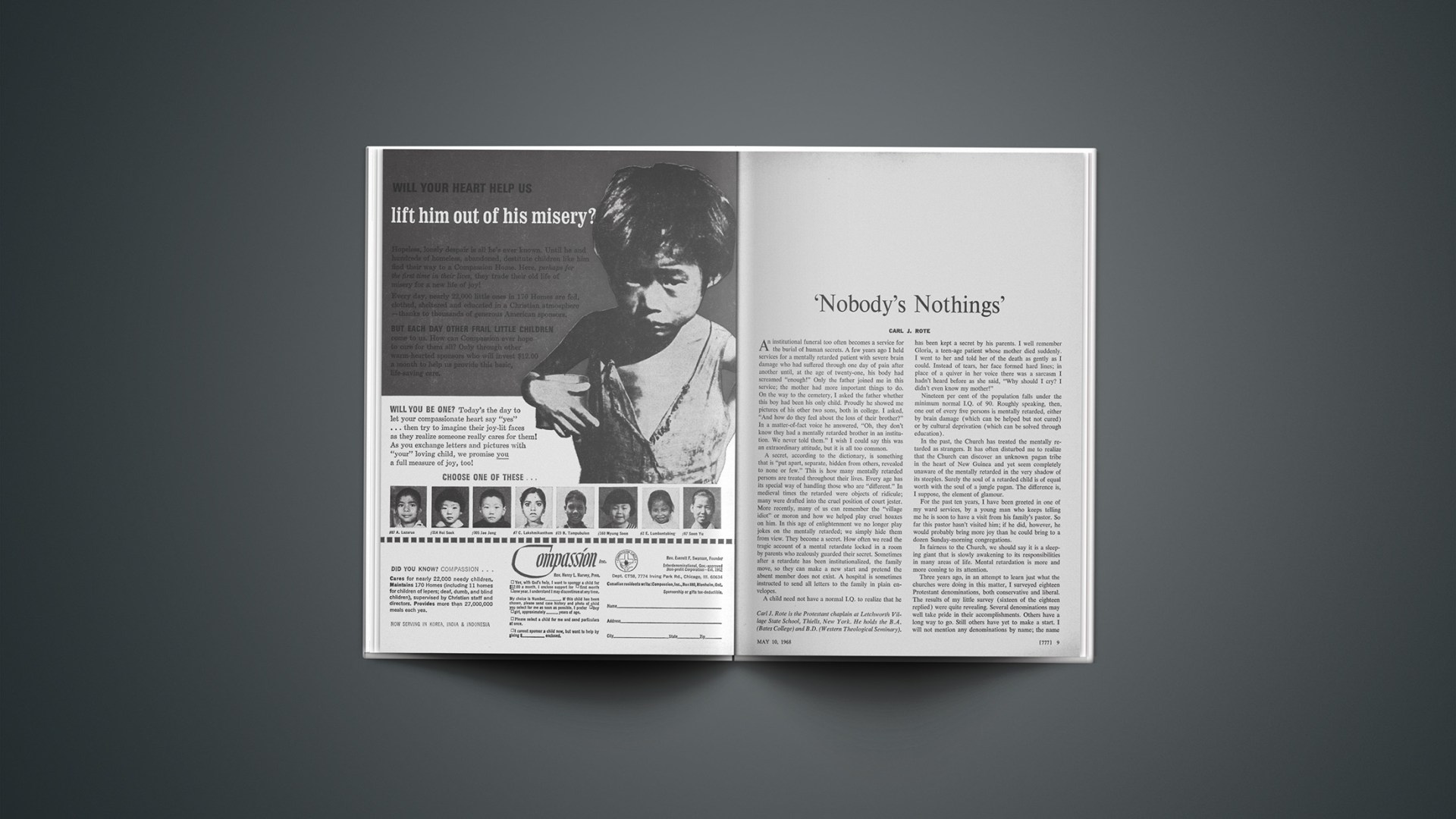
Nobody’s Nothings

An institutional funeral too often becomes a service for the burial of human secrets. A few years ago I held services for a mentally retarded patient with severe brain damage who had suffered through one day of pain after another until, at the age of twenty-one, his body had screamed “enough!” Only the father joined me in this service; the mother had more important things to do. On the way to the cemetery, I asked the father whether this boy had been his only child. Proudly he showed me pictures of his other two sons, both in college. I asked, “And how do they feel about the loss of their brother?” In a matter-of-fact voice he answered, “Oh, they don’t know they had a mentally retarded brother in an institution. We never told them.” I wish I could say this was an extraordinary attitude, but it is all too common.

A secret, according to the dictionary, is something that is “put apart, separate, hidden from others, revealed to none or few.” This is how many mentally retarded persons are treated throughout their lives. Every age has its special way of handling those who are “different.” In medieval times the retarded were objects of ridicule; many were drafted into the cruel position of court jester. More recently, many of us can remember the “village idiot” or moron and how we helped play cruel hoaxes on him. In this age of enlightenment we no longer play jokes on the mentally retarded; we simply hide them from view. They become a secret. How often we read the tragic account of a mental retardate locked in a room by parents who zealously guarded their secret. Sometimes after a retardate has been institutionalized, the family move, so they can make a new start and pretend the absent member does not exist. A hospital is sometimes instructed to send all letters to the family in plain envelopes.

A child need not have a normal I.Q. to realize that he has been kept a secret by his parents. I well remember Gloria, a teen-age patient whose mother died suddenly. I went to her and told her of the death as gently as I could. Instead of tears, her face formed hard lines; in place of a quiver in her voice there was a sarcasm I hadn’t heard before as she said, “Why should I cry? I didn’t even know my mother!”

Nineteen per cent of the population falls under the minimum normal I.Q. of 90. Roughly speaking, then, one out of every five persons is mentally retarded, either by brain damage (which can be helped but not cured) or by cultural deprivation (which can be solved through education).

In the past, the Church has treated the mentally retarded as strangers. It has often disturbed me to realize that the Church can discover an unknown pagan tribe in the heart of New Guinea and yet seem completely unaware of the mentally retarded in the very shadow of its steeples. Surely the soul of a retarded child is of equal worth with the soul of a jungle pagan. The difference is, I suppose, the element of glamour.

For the past ten years, I have been greeted in one of my ward services, by a young man who keeps telling me he is soon to have a visit from his family’s pastor. So far this pastor hasn’t visited him; if he did, however, he would probably bring more joy than he could bring to a dozen Sunday-morning congregations.

In fairness to the Church, we should say it is a sleeping giant that is slowly awakening to its responsibilities in many areas of life. Mental retardation is more and more coming to its attention.

Three years ago, in an attempt to learn just what the churches were doing in this matter, I surveyed eighteen Protestant denominations, both conservative and liberal. The results of my little survey (sixteen of the eighteen replied) were quite revealing. Several denominations may well take pride in their accomplishments. Others have a long way to go. Still others have yet to make a start. I will not mention any denominations by name; the name matters little. What is being done, or left undone, is the important thing.

One official gave me the idea that his denomination, one of the larger ones, would like to do more but that interest was lacking at the local-church level. He said: “It has fallen to me to invite correspondence from parishes desiring to institute a class for the retarded. I haven’t heard from anywhere near 100 parishes.… If we have [mentally retarded], their presence is the best-kept secret in the church.” The only thing this large denomination was doing was to send a representative to the National Council of Churches’ Committee for the Christian Education of Exceptional Persons, which was working on a curriculum for the mentally retarded.

I would be the last to discourage united effort in curriculum development, but perhaps we should take inventory. Perhaps we are spending too much time and effort developing a specialized curriculum that very few of the mentally retarded can understand, let alone read.

Nearly all the denominations had one or more clergymen working as full-or part-time chaplains in institutions for the mentally retarded. But what support were these chaplains receiving from their denominations? A typical comment was: “State institutions should receive more than local support. We received a request from the————school, where the Protestant chaplain happens to be a member of our denomination, and discovered to our chagrin that none of our activities had budgets that could be stretched to cover this request.”

I was appalled at a brisk statement from a representative of a major denomination that is making remarkable strides in human relations. In regard to mental retardation, he said: “Denominationally, we are doing nothing.” He went on to say that the church was working with the NCC on curriculum development.

But several denominations had shifted into high gear and become leaders in work with the mentally retarded. Two had developed their own curricula and were using them with good results. One of these had also produced a filmstrip on how to start special classes for the mentally retarded. At least two other denominations were developing their own curricula for church-school classes. In one large denomination, 300 churches were working with mentally retarded. At least two denominations had a seminar for ministers and a workshop for teachers. Another was holding special religious-education classes and day-care programs for retarded children.

A very high percentage of the denominations were cooperating in projects with the National Council of Churches and with local councils. Among the cooperative projects were these: the Connecticut Council of Churches had prepared some material for institutionalized retarded teen-agers; the Minnesota Council of Churches had held a number of two-week laboratory schools for teachers of retarded persons; the Greater Philadelphia Council of Churches had a pilot Sunday school for mentally retarded children.

The denominations that were assuming leadership in the field owned and operated several homes for the mentally retarded. Perhaps this was the key to their success. They dared open doors to those who found no welcome elsewhere.

The survival of the Church depends upon its interpretation of the word others! The Church cannot include the retired and exclude the retarded; it cannot include the lawyer and exclude the delinquent; it cannot include the doctor and exclude the mentally ill. The Church must be all-inclusive—not only in name, but in action.

One well-known preacher tells of watching a group of refugee children at a registration desk. His attention was attracted by a little girl with uncombed hair and tattered clothes. When the man at the desk asked her, “What’s your name, little girl?,” through her tears she replied, “I’m nobody’s nothing, I’m nobody’s nothing!”

The mentally retarded want to be remembered by a church that has too long forgotten. They have a longing to belong. And they do not deserve to be considered “nobody’s nothing.”

Milton D. Hunnex is professor and head of the department of philosophy at Willamette University, Salem, Oregon. He received the B.A. and M.A. degrees from the University of Redlands and the Ph.D. in the Inter-collegiate Program in Graduate Studies, Claremont, California. He is author of “Philosophies and Philosophers.”

The American Campus as a Spiritual Force

Since Harvard’s birth in 1636, American colleges and universities have exerted a spiritual influence on the country. Harvard was patterned after Emmanuel College, Cambridge, which has been described as the most Puritan of the Cambridge colleges. Yale was patterned after Harvard, Princeton was a duplicate of Yale founded by Yale graduates, and Yale and Princeton were models for practically all the early Midwestern colleges. Even the early state-supported institutions had a concern for the perpetuation of what might be termed religious culture.

After the Revolutionary War, deism permeated the campuses. Lyman Beecher, a student at Yale in 1795, described the religious conditions in the college:

The college was in a most ungodly state. The college church was almost extinct. Most of the students were skeptical, and rowdies were plenty. Wine and liquors were kept in many rooms, intemperance, profanity, gambling, and licentiousness were common.

In 1801, only four or five students were members of the college church. At Princeton, noted for its evangelistic fervor a generation before, only two students professed themselves Christians in 1782. The spiritual impact of the American campus was practically nil.

The Revival of 1800 reached to the college campuses. Yale President Timothy Dwight’s sermon, “You Must Take Your Side,” stirred his college community. By 1802, over half of the student body (which then numbered 160) had united with the church.

The same spirit spread to other campuses. The foreign missionary movement received its earliest inspiration at Williams College when five undergraduates decided to dedicate their lives to winning the heathen for Christ. They were later influential in creating the American Board of Commissioners for Foreign Missions, the mission agency of the Congregational churches.

By the 1830s, the Christian title was running strong in America. There was a concerted effort to win the frontier for Christ, and denominational colleges were destined to play a significant role.

The reasons given for the founding of frontier colleges reflect this spiritual enthusiasm. Again and again one finds such phrases as: “for the education of young men for the ministry”; “to prepare men who should feed the flock of God”; “a missionary establishment for planting the Gospel on a new field.”

But toward the end of the nineteenth century, theological liberalism swept from Europe to America. Darwinism and historical criticism had their way on the campuses of this country, and state institutions began to emphasize what might be called “secular culture.” By the beginning of the twentieth century, these secularized state institutions more and more set the educational pattern for the nation. Christian foundations weakened, and the spiritual impact of the American campuses was threatened.

But though the trend in educational circles was away from Christianity, many voluntary student Christian movements sprang up. These included the YMCA, the YWCA, and, perhaps most significantly, the Student Volunteer Movement for Foreign Missions that originated at a student Christian conference under Dwight L. Moody.

Bible institutes and Bible colleges also began in the United States during this period. They have, of course, played a great part in the evangelical Christian movement.

As scientism flourished after World War I, the impact of Christianity on the campuses lessened. The longing for security came to the fore. The great depression rocked man, but his survival led him to commitment to a humanly directed universe. The post-World War II generation was an “uncertain” one, and the spiritual tone of the campuses registered this uncertainty.

The number of college students has risen meteorically—from 200,000 in 1900 to 4,000,000 in 1963; the estimate for 1970 is 10,000,000. In 1900, one in twenty-five high school graduates sought a college degree; today nearly one-third do.

With all this growth, there are many new problems for the Christian community on the modern university campus.

Students are confronted on campus by divergent convictions and codes that seem to have the same validity as their own. Many come to the university attempting to find answers to life but become disillusioned, concluding that they are getting more questions than answers. Many quit; some join hippie colonies; others become “loners” and seek the meaning of life elsewhere.

The university gives the appearance of being a close community of people who share the search for truth, a place of learning where everyone reads books and talks about worthwhile things. This appearance of unity is deceptive, however; the university is really a broken, fragmented community. Its members talk of ideas but their talk lacks a common language. Faculty members really are not in touch with one another. They see the part as the whole. No wonder the student, caught up daily in this fragmentation of truth, is bewildered.

Nathan M. Pusey, president of Harvard, tells what the student is seeking:

What every young person seeks in college from liberal education—whether or not he has articulated this—is self-discovery.… What such a person wants—what we all want—is a meaning that becomes a motivating force in our lives. And when we ask this question, whether we are conscious of it or not, we have begun to think religiously, and have begun to ask of God [“Religion’s Role in Liberal Education,” Religion and Freedom of Thought, 1954].

But students are not achieving this self-discovery they seek. In the last editorial of the Yale Daily News in 1962, a student speaks for himself:

Most of us graduate unsure of life’s calling. Yet Yale, which has determined the kind of life we seek, has imposed substantial barriers in the way of that life’s accomplishment. The university has demonstrated how the daily existence of most Americans can be criticized, even ridiculed, without prescribing the formula for a useful, rewarding life—and without showing how one can reconcile himself to a ridiculous world.

The spiritual force of the campus in recent days has been spent largely in revolt. Irving Kristol says it is, “above all, an existentialist revolt”: “the students are in rebellion, not so much because things are bad for them or for others, but because things are what they are for them and for others” (“What’s Bugging the Students,” The Atlantic, November, 1965).

There is an alarming increase of drug-taking on the campuses today. Jeremy Larner, writing in the Atlantic (Nov., 1965), quotes a student in an Eastern college who claimed he had not known of a college party anywhere in the past two years where at least one-third of the kids had not been “turned on.” The use of drugs indicates the seeking nature of the student, and also points to the failure of the church on the campus.

Larner says that one of the most common, popular, and easily induced drug delusions is the fantasy of rebirth. The great American dream, he writes, is to find an absolute truth. This is illustrated by the politician’s resort to the idea that the United States is to play a divinely ordained role in directing the progress of the world. Larner quotes D. H. Lawrence, who said of Americans: “Some [insist] on the plumbing, and some on saving the world; these being the two great American specialties.” The LSD missionaries attempt to do both at once—“to save the world by tinkering with the internal plumbing.” The idea is that happiness and fulfillment can be found through the “ingestion of a synthesized additive.”

If Larner’s description is true, it points to a tragic lack of spiritual power in the churches today. The Christian message to all men, on campus and off, is the message of both the necessity and the possibility of a new birth. It is the message of happiness and fulfillment found not through the ingestion of a synthesized additive but through the indwelling of a glorious Person. How can the Church have failed so miserably to give this message to the student of today?

The American campus was a positive spiritual force; it is a lesser spiritual force today; but its spiritual potential is staggering. The present student generation, perhaps more than any other, recognizes injustice, and wants to do something about it. It is encouraging that many students today recognize the problems of human relations, realize their personal lack for these needs, and are seeking an adequate source of solution. For this reason the potential of the American campus for a positive spiritual force is greater now than ever before. How can this potential be realized, both in church-related institutions and in those with no church ties?

About one-third of all degree-granting and two-year colleges in the United States are in some way related to a church body. These relationships vary greatly, and the colleges themselves vary greatly, also, both in philosophy and in quality. There is no real meeting of the minds among them as to their basic purposes and functions.

The church-related colleges do not have the spiritual impact they should in our day. Many have tried to pattern themselves after the larger secular universities, and, to quote Myron F. Wicke’s words, “have become pale imitations.… The result has been a bloated curriculum, an inefficiency in use of resources and personnel, and a confused educational goal” (The Church-Related College, 1964). Yet the Church has in its colleges the best place for dialogue between biblical theology and other academic disciplines. Church-related colleges should not have to do the evangelistic work of the churches; they should train committed young people to face the secular world.

In the early colleges there was a real sense of mission, of the Christian’s obligation to make Christ known. Revivals on college campuses were not unusual. The enthusiasm of the early colleges to share Christ with others must be recaptured—not through “revival meetings” as such, but through the recovery of an unashamed devotion to Christ and an aggressive witness for him.

It seems to me, also, that church-related colleges must become unapologetically Christian. They must take a firm stand on the Word of God. Unfortunately, church-related colleges house many of those students who go to college to discover answers to life’s problems but find they get more questions than answers.

Church-related colleges have not had the spiritual impact they could and should have because many of them are lacking in academic quality. They need faculty members of outstanding ability, firm Christian conviction, and warm hearts who can attract exciting students and have an influence on their lives.

But most of our five to six million college students are in non-church-related schools. What kind of training are they getting? In the secular universities we have the greatest opportunity ever to make a genuine spiritual impact on the world. Most students feel that Christianity is irrelevant, a relic of the past, and that the Church is behind the times. One professor suggested that his history students become acquainted with a local Inter-Varsity group because its members were the only persons he knew who indulged in the medieval practice of an all-pervading God-consciousness. The Church must show the relevance of the Gospel to the student’s present and future way of life.

I am convinced that the secular university can best be penetrated by faculty members and students in various academic disciplines who are genuinely Christian, who are faithful in their university tasks, and who have an understanding of the current movements among college students. The person who is lax or slipshod in his own work has very little witness to the person who does his work well.

One area of concern is that Christian professors are often reluctant to teach from their religious perspective, even though it seems imperative that they do so. Their colleagues who believe in scientific humanism, for example, are certainly not bashful about teaching from their perspective. I believe the university student should hear the Christian view as a live option. The failure of the Christian professor to present it seems to say to the student that though Christianity may have some value in practical life, it is really irrelevant to intellectual life.

However, it is not enough for the Christian professor to teach from his Christian perspective; he also must have a personal relationship with his students. The friendship of a Christian professor who excels in his field with a brilliant young student who does not know Christ could have an earth-shaking effect.

The local churches also must be involved. In this day of travel, more and more students commute. There is hardly a church that does not have at least one member enrolled in a college. Pastors must prepare to minister to these students, and to help train them for service to Christ. They must take the university more seriously and try to understand and love it. They must keep up with the theological and social issues of the day and must speak to them.

Something must happen on the campus before anything will happen through the campus. I believe with all my heart that the American campus holds the greatest potential for positive spiritual force in the world, and I also believe that today that force can be released. Here on the campuses of America are tomorrow’s leaders in government, industry, science, medicine, and home life. Here are tomorrow’s university professors. Here also are many thousands of foreign students who, almost without exception, are the cream of the crop in their homeland. Here are the leaders for the nations of the world. What a tremendous impact for Christ across the world if they could be won!

Here on our campuses are the missionaries, the evangelists who can evangelize the world. They must be led to acknowledge the Lordship of Christ in their lives, and then, wherever they go in their varied vocations, they will be evangelists. The campus must be reached with the Gospel, inspired by the challenge, motivated to service, if its great potential is to be realized.

In the past the American campus has seen times of the waxing and waning of spiritual force. Today the positive spiritual force of the campus is not being exerted. But I believe we stand near the beginning of a change, the coming of a new day. A group of Prostestant monks in France has this motto: “Do not be afraid to precede the dawn.” Let the Church claim that phrase for itself.

Milton D. Hunnex is professor and head of the department of philosophy at Willamette University, Salem, Oregon. He received the B.A. and M.A. degrees from the University of Redlands and the Ph.D. in the Inter-collegiate Program in Graduate Studies, Claremont, California. He is author of “Philosophies and Philosophers.”

Jesus Christ: Focal Point of Knowledge

In this final third of the twentieth century, man faces chaos in knowledge. Acquisition of information has accelerated at such a rate over the past two decades that man has not yet caught up with and assimilated all he has discovered. Even computers have not enabled him to break the log-jam. Perhaps he will eventually “catch up with himself,” but even if he does, he will still be unable to integrate his thinking unless his whole outlook changes radically.

Modern man’s real trouble is that his thought lacks an over-arching unifying principle. His scientific studies point to a coherent universe governed by laws and principles that apply not only to this planet but also to the moon, Mars, Venus, and the farthest galaxies. Nevertheless he generally views this universe, indeed all reality, as the product of completely random forces. He therefore has no philosophy that gives both an adequate, or even possible, explanation of the universe and a means of unifying knowledge. Neither chance nor mystery provides a principle of integration.

Early in the sixteenth century man was on the way to reaching much the same position, and for the same reasons. Technical knowledge was increasing rapidly, and philosophical skepticism, the result of medieval attempts to synthesize a “sacramentalized” Christianity with pagan Greek thought, tended to destroy the idea of a unified structure of thought. At that point the Reformation exercised a powerful restraint upon the centrifugal tendency. Both Luther and Melancthon had an important influence, but Calvin’s Institutes of the Christian Religion, with its stress on the sovereignty of God and the redeeming kingship of Christ, probably did even more to stem the upsurge of irrationalism in European thought.

Today, more than four centuries later, man has come full circle, and Christians again must assert their belief that only in Christ can men find unity of knowledge.

When they do this, they simply echo Christ’s own words. More than once he insisted that he is the Truth, which in the deepest sense means that the true meaning of anything is vitally related to him. When the Apostle Paul declared that all the riches of wisdom and learning are bound up with Christ, he meant that man sees the universe—including himself and his fellow men—truly and in a unified manner only when he sees it in Christ’s light. This was also the view of the New Testament Church, and it was forcefully expressed by Augustine of Hippo, particularly in his City of God.

Most evangelicals today agree that in Christ alone one may find a true understanding of the universe and therefore true unity of knowledge, and that in Christ alone scientific pursuits and accomplishments are possible. Yet often they fail to show how Christ is the key to full human understanding. One reason may be the fear that acknowledging Christ’s lordship will endanger their independence or “freedom.” As one Christian professor put it, “we cannot so exalt God that man becomes a cipher; man has to have some freedom.”

Other Christians, though they accept Christ’s absolute lordship over all spheres of human endeavor, simply have not bothered to think deeply about the unity of truth in Christ. As a result, the concept remains vague for them, and they cannot explain it to anyone else. It is important, then, to consider some of the principal aspects of Christ’s unifying function.

A proper perspective on this subject must stem from Christianity’s basic monotheism and its two corollaries. The first corollary is that there is one God, and he is absolutely sovereign (Isa. 45:5 ff.; Deut. 4:35, 39; Eph. 1:11). This doctrine runs through the whole of biblical teaching. Behind all that is or happens is the coherence and unity of the one personal God. Although man cannot grasp the complexity or completeness of this unity, still the unity exists. Thus for Christianity the unity of all things derives not from a “general principle” of philosophy, mathematics, or some other discipline but from the eternal uniqueness of the sovereign God.

The second corollary is that within the godhead are three persons: the Father, the Son, and the Holy Spirit. Of these three, the Son, the “Word,” is specifically the revealer of God. There is no other means by which man can know the one God (Matt. 11:27; Col. 1:15) and the unity in that sovereign God of all things, including knowledge. The Christian believes Christ has expressed this unity both in the very nature of reality and by direct statement to man.

Christ has brought all things into existence out of nothing (John 1:3; Col. 1:16, 17). He has created both the “object” and the “subject” of knowledge, both the knower and the known. In his creative wisdom and power he has formed all the structures of the universe along with their complex interrelations, and thus has manifested the divine glory and wisdom spoken of in Psalm 19. This revelation by creation provides the unity man requires in his artistic and scientific pursuits; without it he would have no assurance that any one fact, including himself, was related to any other fact. The sovereign divine plan and purpose behind creation integrates the whole of temporal reality. Whether man studies the distant stars, the sub-atomic structure of matter, or the actions of man or beast, a basic oneness underlies all phenomena because they are all the product of divine wisdom, purpose, and action.

Creation, however, has not ended the divine self-revelation, for the Son is also the sustainer and upholder of all things. As Calvin pointed out, God sustains and governs all things by the secret operation of his Spirit (Institutes I,6,1; cf. also his comments on Ps. 19:1; Isa. 40:22; Acts 17:18). All things—from the smallest particle of energy to the mightiest heavenly galaxy—continue to exist and act according to the laws of their particular structures because God so wills, sustains, and governs them (Ps. 104; 107; Matt. 6:26–34; Col. 1:17). Everything depends on him. There is a basic unity to the universe, for it reveals the one God who not only originally created all things but also keeps them in existence and motion, from moment to moment.

This brings us to an important question, one on which Christians disagree. Some, seeking to protect man’s “freedom,” say that man has the unique ability to break that divine unity in the universe. At least in the intellectual sphere, they say, man must be truly independent of God in order to be truly man. But Scripture does not support this idea, for it constantly asserts God’s sovereignty over all human actions (Isa. 45; Rom. 9 and 10; Eph. 1:11). True, it never attempts to explain the relation between God’s sovereign rule and man’s responsibility; it simply insists that God is sovereign and man is responsible (cf. Acts 2:23). These two teachings the Christian must accept on faith.

The real trouble with man is that he has lost this biblical view of God’s sovereignty and so of the unity of all creation. Originally he recognized God as his lord and thus realized the unity of all knowledge in him, though he did not understand the actual relation of the various parts. The essence of man’s fall was his denial that God was sovereign, and particularly that all knowledge centered in God. Man came to believe he could obtain valid knowledge and give a correct interpretation of the universe without reference to God. Scripture describes what happened: “Ye shall be as gods, knowing good and evil,” the tempter promised (Gen. 3:5), and “professing themselves to be wise, they became fools” (Rom. 1:22). When man turned his back upon God, he lost all capacity to obtain any unity of knowledge and came to view reality as the product of disparate forces, whether of demons, of impersonal nature, or of chance. He still seeks a logical and coherent explanation for the chaos. To find the answer, however, he invariably frames some immanent, man-made “law” or “principle” of intellectual unity that ultimately disintegrates before the facts of the universe.

This human search for unity in itself seems to indicate that an ultimate unity does exist. If the universe were merely the product of an absolute chance, it would be hard to understand why man seeks unity of knowledge. To the Christian, even unbelieving man’s desire for ultimate coherence is the work of the Son, who restrains man’s sinful tendency to irrationalism. Man, despite his denials, still has a God-given sense of the unity of all things and is therefore able to gain some insight into created reality, through the concepts of law, of gravity, and of relativity, to name a few.

But when man does acquire such knowledge, he always misuses it for selfish ends. He cannot see any relation between his scientific knowledge and his ethical action, for to see this he needs more than a general impression of the unity of the physical universe; he must have a special divine revelation to give him a true understanding of the unity of all things in Christ.

Therefore God did not leave man with only an indirect knowledge of himself. Not only does he speak indirectly (Acts 17:24ff.) through creation and providence; he also speaks directly through his inspired prophets. In the Scriptures the Son constantly reveals to Israel and to all men that God remains lord despite their disobedience, that they can be delivered from sin only by returning to him in repentance and faith (Ps. 19; Isa. 45:20 ff.), and that, returning, they can find true understanding—that is, true unity of knowledge. This became crystal clear when the Son of God, the Word himself coming to man as Redeemer, enabled man once again to know the sovereign God as his Lord, and therefore as the focal point of all his knowledge of reality. For in Christ “are hid all the treasures of wisdom and knowledge” (Col. 2:3). Those who know the Son know God, the source of all there is to know.

This means that Christ becomes to the Christian the integrating principle of all knowledge because he created, sustains, and redeems both the knower and the object of his knowledge (Rom. 8:23 ff.). The redeemed man now sees light in Christ’s light. True, he does not claim to know how all things are related to one another and to the divine central point. But he does believe that all knowledge is so bound together that it is part of one great system, founded, not upon some abstract logical or mathematical principle, but upon the person of the living, risen Lord, who by his Spirit leads his people into all truth.

Milton D. Hunnex is professor and head of the department of philosophy at Willamette University, Salem, Oregon. He received the B.A. and M.A. degrees from the University of Redlands and the Ph.D. in the Inter-collegiate Program in Graduate Studies, Claremont, California. He is author of “Philosophies and Philosophers.”

Editor’s Note …

Some thirty college and university libraries now make CHRISTIANITY TODAY available on microfilm (a service provided by University Microfilms Inc., 313 N. First Street, Ann Arbor, Michigan, 48107). Across the years this magazine has won its way as a thought journal; our readers are interested, not merely in entertainment or polemic, but in a vindication of the truth.

Some people live their whole lives just around the corner from the world of truth. Yet active engagement in the realm of ideas is one of man’s unique privileges.

The other night I was thumbing through the Great Books Syntopicon, that eight-year achievement by 100 scholars at the cost of $1,000,000. (When first projected, its cost was estimated at $60,000; someone apparently had a wrong idea about the price of publishing.) What a good dictionary is to the world of words, the Syntopicon is to the world of important ideas. From this idea-index to the “great books,” any student can discover whose ideas he has been using and—if he reads long enough—what ideas he ought not to be caught with.

Although the Bible is not included in the set of “great books” (literate readers were presumed to own a version of their preference), the Great Book is nonetheless “idea-indexed” (along with the Apocrypha). The Bible has its say, in fact, on virtually all the Syntopicon’s 102 “great ideas.” Anyone who thinks revealed religion requires a “ghetto”-epistemology should ponder this challenge to get into the “great conversation” of our times.

So Far and so Fast

He was a fellow minister of like mind with me and it was about five years ago when he said it: “How have so many things slipped so far so fast?” And now, five years later, a young college chaplain—age thirty-two to be exact—has said to me: “I must be getting old. I cannot imagine what has happened to the students in the last five years. They have really gone wild.”

So what has happened and how did it happen?

Everybody knows there has been a profound theological shift in our generation. What and How? Increasingly I have come to believe that the real starting place for modern theology is found in Schleiermacher; in fact, a close reading of Schleiermacher can give the clue to almost everything that has happened since. It is an oversimplification but a sound one to say that his departure from sharp doctrinal definition and the authority of the written Word, coupled with his emphasis on individualism and especially the “feeling” of the individual as authority in religion, set all kinds of things in motion. In his case and in his time, “feeling” in religion served to point out and perhaps support orthodoxy; what has followed in his train, however, has held on to individual “feeling” but somewhere mislaid the orthodoxy.

Kierkegaard was also highly individualistic in his emphasis. He fought all his life against the reasonings of Hegel (and there might be good reasons for fighting Hegel); he attacked the organized church and especially the state church (which he called Christendom); and always, if one may simplify Kierkegaard, he underlined the existential response in faith of the individual in his awareness of God.

As everyone knows, Barth drew on Kierkegaard and certainly on Schleiermacher. Even with his great contributions of the Word, the Living Word, the responses of faith, and even with such strong points of orthodoxy as his view of the radical nature of sin and acceptance of canonical Scripture and very evident elevation of Christ, still, in the last analysis, for Barth a man’s response is only under an existential authority; the written Word of Scripture and the definitions of theology give no absolutes in his system. This open-endedness is illustrated by Barth’s refusal to be called a Barthian. He has always insisted on the incompleteness of his system in view of what the total situation might bring next year or even next week.

Reinhold Niebuhr brought this kind of theology to life in ethical practice. Man-made institutions are limited because they are man-made, and therefore democracy is under judgment, as is Communism. A good case can certainly be made for this sort of thing, and Niebuhr made it. Then came the leap. The Church is also man-made, and the Scriptures are a guide only relatively, because they are the words of men conditioned by the cultures and also by men’s ignorance. Along with Schleiermacher and Barth, Niebuhr readily accepted much of the Scriptures as legend or mythos or confusion about the cosmos.

In this tradition, it followed by logical necessity that Bultmann was enabled to erect and sustain the demythologizing process; thus much of the Gospels and also much else was subjected to the most radical criticism. The authority of “It stands written” was undermined for the sake of the language and thought-modes of the twentieth century. At last men had reached maturity! They were no longer under the judgment of the Bible; the Bible was under the judgment of men. God speaks through the Scriptures, and man responds in obedience only according to his personal existential situation.

All kinds of lesser lights appeared. There was John A. T. Robinson with Honest to God, and Joseph Fletcher with Situation Ethics. And before long Thomas Altizer, William Hamilton, and others went past the Scriptures and shot God down. So now there is a theology where God himself is dead, and an ethic where no rules still hold.

It is hard to know to what extent theology in the last century has affected disciplines and to what extent it has been affected by them. Whatever the answer, everything seems to be “up for grabs” in every discipline. What are the canons of modern art? Who can say what constitutes proper harmony or dissonance in modern music? The Constitution is always a matter of interpretation, frequently subjected to the pressures of the moment. Often laws are not only conditioned by but also undermined by equity. In education, Deweyism has made everyone wary of absolutes and of rules. At this point no self-respecting institution can keep from endless tampering with its curriculum. In ethics and social action there are no fixed points. Revolutions understand how to destroy, but they are no longer like the American Revolution, for they lack principles for rebuilding after the revolution is over. No one can censor movies or plays or books, because to censor one must have a definition of obscenity, and even the Supreme Court cannot, apparently, define that one word. To get back to religion, how can anyone, even a bishop, be condemned for heresy? A man has to be a heretic against a doctrine or a body of doctrine, and who will define that? Meanwhile, the argument is that action must be based on the love of God; but the word “love” in popular understanding runs the gamut from Hugh Heffner to Fletcher and on to Tillich. (Significantly, large masses of Christians recognize Heffner’s name better than Tillich’s!) And so things slip.

We have gone too far, and even Harvey Cox of Harvard is willing to say so (Time, March 15, 1968, page 53). Allowing for the fact that Time does not always quote a man at his best, and that some of what they quote from Cox sounds sophomoric, we have at least these words: “The world is important but not ultimately so”; “The recent focus of theology has been on doubt, unbelief, or on the church’s mission to the world.… What has been missing is the joy of serving”; or again, “Once you transform everything into a mission for social action and lose the intrinsic joy of the spirit of worship, you are in danger in losing both.”

This begins to sound better. The Puritans used to say: “Truth is toward action.” Right! It is about time now to talk about the Truth.

Peace Move Fails to Quiet Church Critics

On March 31, while President Lyndon B. Johnson announced plans to de-escalate the Viet Nam war, churchmen opening a “world peace conference” deplored U. S. hawkishness. Before the time gap was bridged, a Soviet delegate to the Prague assembly called all involved countries to a peaceful settlement of the conflict. When an East German pointed out that the same words and mild tone should not apply to both aggressor and victim, most delegates agreed to table the peace assault.

But verbal attacks on the United States were just beginning. Russian Orthodox Archbishop Michael led off with a stinging attack on “U. S. imperialism”—in “full conformity,” according to a West German newsman, “with the view of the Soviet government.”

That evening a Roman Catholic leader of South Viet Nam’s National Liberation Front charged “American pirates and their lackeys” with “crimes against us Christians of South Viet Nam” and praised the “sacred resistance” of those he represented. Joseph Maria Ho Hue Ba, who had hiked and hiked his way to Hanoi to make his first visit outside South Viet Nam, offered “profound thanks to … American Christians, youth, students, intellectuals and workers for … their acts of opposition to the repulsive war of aggression which the Johnson government is waging on our territory.… We especially call on our American friends to act still more energetically in order to force the Johnson government to end its aggression against Viet Nam.” The 75-year-old catechist got a nearly unanimous standing ovation when he commented appreciatively, “In their powerful [Tet] offensive, millions of men, among them many Christians, rose up.”

But other peace demands also clamored for the delegates’ attention. Most immediate were those of the host country, where liberalization was taking its first steps, and of other Eastern satellite states, where similar policies had reached various stages.

The Czech Revolution

Lyndon B. Johnson’s unexpected move toward de-escalation was not the only peace step to win attention in Prague. Shortly before the conference began, Czechoslovakia’s parliament replaced the country’s hardline president with the more moderate Alexander Dubcek, culminating several months of bloodless revolution. Resulting liberalization of censorship, election laws, and economic policies prompted Christian Peace Conference founder and president J. L. Hromádka to say of his country, “We are in the midst of a great renewal.”

The new privileges mean greater responsibilities for the Church, he said. “We have always excused ourselves that we could do nothing in our country because we were under pressure. Now all the pressure which may have existed has been eliminated.”

Although international ties are still restricted because Czech foreign policy remains unchanged, the new national openness seems to be easing relations between church and state. Mrs. Erika Kalecova, new head of the state office on the churches, said Christians and Marxists “can either live together or die together. It seems better for us to live together.”

One sign of change is state willingness to review what one government official called “mistakes in juridical procedure” during the Stalinist 50s. Baptists petitioned for review of spy charges that jailed thirteen ministers. Although the ten still living are free, they have no civil rights or old-age pensions and cannot serve as pastors.

Roman Catholics asked the government to allow Joseph Cardinal Beran to return from Rome as Archbishop of Prague and Primate of Czechoslovakia. Two religious orders are being reestablished; they had all but died out after 1960 decisions forced monks and nuns into “productive” work.

Although East-West conflicts seemed to approach reconciliation, other tensions appeared between the rich North and the area called the Third World, the poor South. Delegates from nearly sixty countries heard speakers from Uruguay, Madagascar, and Japan describe social and technological needs on their continents.

“Save Man—Peace Is Possible” heralded the conference theme, but opinion varied on how to reach a better, peaceful world. “That we as Christians have encountered … Jesus Christ and are continuously confronted by him in faith does not release us in any way,” said G. Casalis of France, “but on the contrary obligates us to work, to struggle, and to sacrifice … together with men of different world views.”

Not many such conventions see results of their talks and resolutions almost before the words hit the mimeograph machine. As Mennonite editor Maynard Shelly reported, a funny thing had indeed happened to the seven hundred churchmen on their way to another resolution against American bombs over North Viet Nam. Yet the Prague peacemakers reacted cautiously to news of the American bombing pause.

And they were not alone. Other clergymen, like WCC head Eugene Carson Blake, considered the action a “move in the right direction, the type of decision many people around the world have been asking for.” Rabbi Maurice N. Eisendrath, a cochairman of the U. S. Interreligious Committee on Peace, agreed the decision indicated “the power of the peoples’ will in a democracy.” That interpretation gained support in a telegram to President Johnson from twenty-three U. S. Episcopal bishops. Reminding him of their request last September for a move toward de-escalation, they commended the President “for this step which we hope and pray will be the first in a move toward an end to this tragic war and toward a lasting peace.”

The Rev. William Sloane Coffin, Jr., of Yale was “a little skeptical and quite apprehensive that the bombing halt will lead to more escalation.” And James H. Forest of the Catholic Peace Fellowship had only “severely muted enthusiasm” for the partial compliance with North Viet Nam’s request for a bombing halt. Another Roman Catholic, Jesuit Daniel Berrigan, recently returned from an official trip to North Viet Nam, denounced the statement as too little too late: “It is as if Hitler after Dachau issued a statement that he was ready to bargain with the Jews.”

Some churchmen from the Roman Catholic Church, the Christian Church (Disciples of Christ), the NCC, and the WCC expressed their hope for Hanoi’s favorable reaction to the call for negotiation. In a wire to Nguyen Duy Trinh, WCC leaders said they “fervently hope and pray that Hanoi will respond affirmatively.… We are convinced that such response will command respect and gratitude throughout the world and will facilitate deescalation.”

AUSTRALIAN CRUSADE

Billy Graham and his team climax an intensive Australian evangelistic crusade with meetings this week in Sydney. The evangelist said that after the closing service on Sunday, April 28, he might fly to Viet Nam to hold services for troops.

Before the Sydney effort, campaigns were held in Perth, Adelaide, and Brisbane. Other cities and smaller communities were reached via land-line relays.

The opening of Leighton Ford’s crusade in Perth coincided with Western Australia’s state elections last month. The Ford publicity was effective enough to prompt one woman to inquire of a local radio station which party he represented. On television a high public official told of someone who confronted him with a similar query. “He issues a better class of literature, too,” a third potential Ford-for-Parliament supporter was quoted as saying.

A Perth newspaper described the airport welcome for Ford as “one of the biggest, noisiest, and best organized” the city had ever seen. Despite the 11:30 P.M. arrival time, 2,000 gathered to meet the Canadian evangelist, who had come for an eight-day crusade in Perry Lakes Stadium. Warmly supported by the Most Rev. George Appleton, Anglican archbishop of Perth, the open-air meetings held during Perth’s coldest March on record drew nearly 60,000. A much larger number listened by means of nine country radio stations and eleven land-line relays at distances up to 600 miles.

One of the notable features of the crusade was that of the 2,000 inquirers at the stadium, 92 per cent were under thirty. Perth’s only morning newspaper was consistently hostile, but other media in the city provided good coverage and gave Ford and his six-man team a further platform for their message. In addidition, Ford spoke to Rotarians, parliamentarians, and businessmen, and dealt capably with questions from students when 1,300 came to hear him at the University of Western Australia. He also stirred Christian interest in the housing situation of the aboriginals, and invited a 6,300-audience one evening to join him in praying for peace at a time when a contingent of Australia troops was leaving for Viet Nam. An aboriginal Christian leader publicly presented Ford with a boomerang with the inscribed hope that he, like it, would return.

Some 1,300 miles to the east, the Adelaide crusade opened two days later after another tumultuous (“We’re waitin’ for Leighton”) welcome at the airport. Speaking to 10,000 at Wayville Show-grounds on Acts 17, Ford was as forthright as ever. “What would Paul say if he came to Australia in 1968?” he asked. “Would he be stirred to see us given over to our idols?” The next evening, April 1, was especially for youth, and the evangelist’s topic was, “Whose Fool Are You?”

The eight-day Adelaide crusade drew a total attendance of 64,800, and there were 1,521 inquirers. Adelaide University’s Union Hall was packed to capacity, with students jamming the doors, when Ford spoke there. A group of humanists and others heckled him during much of the forty-minute address, but by the end much of the audience was obviously impressed with the message.

As in Perth, Ford billed one meeting as “Christian Action Night,” when he urged listeners to become better informed and more involved in community needs. A folder listing several social-service agencies and an outline of their programs was distributed to interest the audience in becoming volunteer workers.

An enterprising “turf consultant” wrote to Ford from Sydney, offering the crusade the chance to win $2,000 a year at a small outlay (“horse’s name to be sent in code each Friday”), but crusade secretary Alan Quee ruled out the suggestion, noting it was “somewhat inconsistent with the vital aims of the crusade.”

Meanwhile, Graham was arriving in Sydney from Fiji. En route he recognized the pilot as the one who had flown him into the same city nine years earlier—a fact confirmed by the pilot, whose teen-age son, it turned out, has been active in current crusade preparations.

From Sydney Graham flew to Brisbane, where associate evangelist John Wesley White had drawn about 28,000 to the local showgrounds the four previous evenings. Here Graham had the support of Anglican Archbishop Strong, known as a high churchman.

During the first Brisbane meeting, a gang of twenty youths created a disturbance and upended the offering box. They subsequently quieted down, however, and six went forward at the invitation. A leading Brisbane TV announcer who two days earlier had interviewed Graham on the death of Dr. Martin Luther King, Jr., came forward hand in hand with his wife at the closing meeting. For the closing Sunday service, 67,000 persons were at the Brisbane Exhibition Grounds. Graham opened his final address by asking people to stand for a minute of silent prayer “for peace in Viet Nam, for peace on the streets of America, and for the bereaved family of Martin Luther King.”

The total turnout in Brisbane was 178,500, with 4,097 inquirers. These figures did not include statistics from the forty-two land-line relays that extended the message of the crusade more than a thousand miles from Brisbane.

J. D. DOUGLAS

CANADIAN GROWING PAINS

The Evangelical Fellowship of Canada, founded four years ago, experienced considerable growing pains at its annual meeting in Winnipeg last month. Objection to the nominating committee’s choice for president, the Rev. Hector MacRury, threatened for a time to bring down the curtain on the young organization.

A motion to erase the slate was defeated by a hand vote. But after the Rev. William Fitch was nominated for president from the floor, his fellow Toronto Presbyterian MacRury walked out of the meeting. MacRury was last year’s vice-president and—a fact irritating to some—was a member of the nominating committee.

Several delegates said it was “the beginning of the end” for the young organization. In desperation the meeting voted to reinstate last year’s officers for an interim year, but the action had to be dropped when this turned out to be unconstitutional.

Finally Fitch, who was not present, was elected president. He had agreed to let his name be put in nomination if there was no other possibility, Fitch said later, but he declined the office after learning of the Winnipeg tensions. So the office stands vacant.

This controversy all but overshadowed another action by the fifty-four delegates. They decided to open the EFC to “congregations, institutions, organizations, and evangelical groupings” as well as to individuals. But an amendment deleted the possibility of membership by evangelical denominations. The action was a victory for members from the United and Anglican Churches, who are sensitive about domination by the smaller groups.

The “renewal” groups within these two big denominations gave reports to the meeting. In other action, delegates authorized the executives to name a social-action commission and to hire an executive secretary.

The meetings were held in downtown Calvary Temple, one of the nation’s oldest and biggest Pentecostal churches.

CHURCH PANORAMA

On Palm Sunday, Pope Paul became the first pontiff ever to recite an entire Mass in Italian in St. Peter’s Basilica.

The Lutheran World Federation has appropriated $250,000 to aid Lutherans resettled in new areas under South Africa’s apartheid policy.

The Anglican-Methodist Unity Commission in England this month published the detailed union plan that is due for church action in 1968 and 1969, and warned that failure to unite would lead to schism. Meanwhile, plans for merging Congregational and Presbyterian bodies in England were postponed from 1970 to 1971.

Twenty-three missionaries from various boards working with Indians and Eskimos in Canada’s Mackenzie River basin and Western Arctic coast formed the Evangelical Fellowship of the Northwest Territories at a meeting in Yellowknife.

PERSONALIA

The widow of Paul Carlson, missionary doctor slain by Congo rebels in 1964, last month attended the opening of a medical center in his honor in Loko, the Congo. The government gave the buildings, worth $500,000, and U. S. companies donated $500,000 worth of drugs. Evangelical Covenant and other backers shipped half a ton of delicate research equipment from Chicago. The Carlson Foundation said the center, for leprosy patients, will be led by Dr. and Mrs. Wallace Thornbloom.

Pope Paul VI denied that his 1967 encyclical On the Development of Peoples intended to “open the way to the so-called theology of revolution and violence. Such an aberration is a long way from our thoughts and words. It is a very different thing from the positive, courageous and energetic activity necessary in many cases to establish new forms of social and economic progress.”

Deaths

PAUL J. HALLINAN, 56, who in less than six years as archbishop of Atlanta became a leading Roman Catholic progressive; early acts included desegregation of church schools and hospitals; in Atlanta, of hepatitis.

SIDNEY D. GAMBLE, 77, YMCA worker in China and former chairman of Church World Service; in New York.

KENNETH EUDY, Baptist pastor in Tamms, Illinois; shot to death by a farmer while counseling him and his wife about their different church memberships.

MARIO COLACCI, 57, native of Italy who left the Catholic priesthood; author, and teacher at Augsburg College and Luther Seminary; praised upon his death by the local Catholic weekly; in St. Paul, Minnesota.

PAPA EPHTHIM, 84, head of an Eastern Orthodox splinter that Turkey helped set up in 1926 to oppose the Ecumenical Patriarchate; in Istanbul.

JOHN TUTLIS, 70, apparently a near-penniless recluse who left $400,000 in mining shares to the Roman Catholic Church; in Pretoria, South Africa.

“I hope that in spite of different views and feelings we shall maintain the unity of love,” said Terence James Cooke upon being installed by Apostolic Delegate Luigi Raimondi as seventh Catholic archbishop of New York. The ceremony was attended by President Johnson, Governor Rockefeller, Mayor Lindsay, and a host of church leaders.

Anthropologist Margaret Mead, social-studies director at Fordham University’s new campus, has in the past recommended legalized childless “trial” marriages but now thinks young couples should “get legally married, use contraceptives responsibly, and risk divorce later.”

The Rev. Charles Ausherman, a Reformed Church in America pastor, was named planned-parenthood director of the National Council of Churches.

Pierre Martin Ngo Dinh Thuc, 70, has retired as archbishop of Hue, South Viet Nam. He has been living in Italy since the 1963 coup against his brother, the late President Ngo Dinh Diem.

Historian Arnold Toynbee says the peace efforts of Pope Paul and the unity emphasis of Pope John have regained and extended for the papacy the moral influence it lost in the Middle Ages through abuses of power.

The Rev. Kyung Chik Han of South Korea and Bishop Chandu Ray of Pakistan were elected chairman and vice-chairman of the Asia-South Pacific Congress on Evangelism, set for Singapore November 5–13.

Orthodox priest George Bacopulos denied a charge that the Greek government ordered him to refuse baptism to a child because arch-enemy Melina Mercouri was a godparent. The reason, said Bacopulos, is that the actress is married to a non-Christian, producer Jules Dassin, and is thus not a communicant.

Latest to quit Drew University’s seminary over last year’s firing of Dean Charles Ranson are Alfred Haas, James Ross, and William Murdock. The ten who will leave include the entire Bible staff.

Long-stagnant Conwell School of Theology in Philadelphia is hiring four new teachers for next fall, with other appointments due shortly: Philip Edg-cumbe Hughes of Columbia Theological Seminary, noted evangelical Anglican, as theology chairman; Gary Ross Collins, psychology chairman at Bethel College, Minnesota, as director of clinical training; James R. Hiles of Wellesley College in Old Testament; and Charles E. Thorne, Jr., currently completing a Ph.D. in Ireland, in church history.

Arthur S. Flemming, president of the National Council of Churches and a Methodist, is leaving the presidency of the University of Oregon to head Macalester College (United Presbyterian). Flemming, a member of the Eisenhower Cabinet, has also been president of Ohio Wesleyan.

Kent S. Knutson, graduate studies director at Luther Seminary, was nominated to the presidency of Wartburg Seminary (American Lutheran Church) in Iowa.

Edgar Carlson, 59, for twenty-four years the president of Gustavus Adolphus College (Lutheran Church in America), is resigning to direct the Minnesota Private College Council of sixteen Protestant and Roman Catholic schools.

William Banowsky, 32, of Lubbock, Texas, one of the few Churches of Christ ministers to call a debate with a Playboy editor, has been named vice-president of Pepperdine College, Los Angeles, where he will direct development of a second campus.

The Rev. Jess Moody of First Baptist Church, West Palm Beach, is acting president of Palm Beach Atlantic College, which hopes to open this fall with support from the regional Baptist Association, using the $3 million plant of Moody’s church.

Norval Hadley was named director of World Vision’s relief branch, which shipped a record tonnage of aid goods valued at $1,350,000 in the past fiscal year.

Religious Heritage of America named Methodist Bishop Gerald Kennedy as Clergyman of the Year. Lay awards went to Roman Catholic J. Peter Grace, head of a chemical firm, and Mrs. Stuart S. Sinclair, former president of Church Women United.

Wayne H. Cowan, 40, managing editor of Christianity and Crisis for a dozen years, was promoted to editor.

After some relatives got a free ride in a government plane, the Rev. Philip Gaglardi, a Pentecostal minister, resigned his thirteen-year post as highways minister of British Columbia.

MISCELLANY

On May 2, the State of Israel marks its twentieth anniversary.

A helicopter serving Wycliffe Bible Translators in remote areas of West Irian, Indonesia, may be the first in missionary aviation.

Most of the rare religious paintings in the Church of St. Paul, Antwerp, Belgium, were carried out and saved during a fire that destroyed the roof of the sixteenth-century structure. One, Rubens’s “The Flagellation,” is said to be worth $2.8 million.

Fifty Roman Catholic priests in Peru broke precedent by issuing a document denouncing social injustices and pledging to work for reform. They noted that 24,000 of the nation’s 12 million citizens get half its income.

The U. S. Jesuit weekly America praised the statement of the National Council of Churches made against religious repression in the Soviet Union at its last board meeting, but was “bewildered” by its “oversimplified, pushbutton foreign policy solutions.”

For the second year, bids to liberalize New York State’s abortion law failed.

What with violent student protests and other pressures, the American Council on Education reports that at least 300 U. S. colleges are without presidents and that 1,000 dean positions are vacant.

At their sixth theological meeting last month, U. S. Lutherans and Roman Catholics decided the “pressing and as yet unresolved” issue of intercommunion must await further work on the ministry, which will be the subject of September talks.

State accreditation has been won for the new Hellenic College in Brookline, Massachusetts, which plans to open in the fall as the first Greek Orthodox college in the hemisphere.

The Life and Death of Martin Luther King

Holy Week, 1968, both began and ended with the pall of Good Friday as the nation mourned the assassination of its greatest Negro leader and the civil-rights movement received its greatest martyr. Rarely had a clergyman so shaken a nation.

“I have seen the promised land,” said the gifted orator Dr. Martin Luther King, Jr., the night before he was shot. But his death carried no promise, only ironic dramatization of the impasse between races in America today, for a paroxysm of rioting, looting, arson, and murder in dozens of cities constituted a violent aftermath as senseless as the slaying in Memphis. A machine gun on the steps of the Capitol in Washington, D. C., symbolized the nation’s barely concealed terror over what the coming weeks—and years—would bring.

The death of King and the ensuing violence had at least one positive effect, however. Congress on April 10 passed the first federal open housing law.

Although he was in the public eye only a dozen years, the 39-year-old Baptist minister at his death was probably the American most admired in many other nations. At home his power and glory were on the wane. The 1966 Chicago drive failed to yield lasting results. Newsmen saw his Washington Poor People’s Campaign as a last lunge to outflank militant black separatists, reaffirm the philosophy of effective nonviolence, and reassert King’s civil-rights leadership.

What that campaign, scheduled to begin this week, would have done to King’s movement is impossible to guess now. But friends and foes alike were edgy when a King-led march in the Memphis garbagemen’s strike degenerated into lawlessness, just days before the murder.

King lived daily with the knowledge that he was marked for death. When it came, its violence set in bold relief the tragic predicament of the nation. Race relations has moved into another, more savage, era.

Not so long ago whites and blacks joined hands to look in buoyant faith toward King’s promised land. In Southern, often small-town battles, the target was obvious: legal obstacles against Negroes. The tactics were marches and other non-violent protests. And the victories came fast. King and his movement won by stirring the conscience and shame of white America. The spirit was that of an often joyous camp meeting, with sermons for soul food. The anthem was “Deep in my heart, I do believe, we shall overcome some day.”

From the Montgomery bus boycott of December, 1955, through the Selma march and the passage of the 1965 Voting Act, the civil-rights movement was King’s kingdom. The golden age came in the massive, integrated March on Washington in the summer of 1963 and the far-reaching Civil Rights Act of 1964. King’s personal peak came that year with his trip to Oslo to accept the Nobel Peace Prize.

But when Watts erupted in August, 1965, the battle moved out of the South. Now the challenges were more subtle, enmeshed in all the larger complexities of urban economic and social problems. And King did not transplant successfully from Southern soil to the urban ghettos.

The optimism of the late 1950s and early 1960s faded as it became obvious that the deeper issues of housing, education, and employment had been left largely untouched by the legal progress of the decade. Whites protested “too fast.” Young Negroes reacted bitterly: posthumous opportunities held no charm. King’s leadership over young Negroes waned as Malcolm X, Rap Brown, and Stokely Carmichael moved onto center stage. Although polls consistently showed King the leader most admired by Negroes, the new tribe of front-flank youths even derided him as “Uncle Tom.”

Once the bridge between white and black worlds, King now risked isolation from both. Militant blacks regarded him as too passive for the tumbling events of the late 1960s; reactionary whites saw’ him as an anarchist.

Cool it, King advised black youths. Violence is in the end self-defeating, a nihilistic philosophy that “carries the seed of its own doom,” a philosophy “born of the conviction that the Negroes can’t win,” because it fails in the long run to be effective. And any method that fails is ultimately “an expression of weakness, not of strength.” Furthermore, violence does not appeal to the conscience. At a rally in Memphis that last night before his death, King seemed to be succeeding. The young hotbloods sat in unity with the moderates.

Dealing with disenchanted whites proved no easier than handling new-breed Negroes. In happier days, civil-rights aims had seemed lofty, religious, with a churchy power base. Now the movement was material, and some of the sergeants were crass and foul-mouthed. After riots firecrackered through scores of cities, even Northern liberals were becoming confused. There were no buttons to push. The moderate center eroded. Conservatives asserted that turmoil was the inevitable result of King’s civil disobedience and demanded an immediate return to law and order.

King had to spend more and more time defending non-violent civil disobedience as an effective means of social protest. Law and order without a concern for justice is, he said, no more than crude, Hobbesian defense of vested interests. The United States, declared King, must be forced to confront its conscience.

Watts and black power were not the only factors eroding the movement. The Viet Nam war was costing the American economy nearly $30 billion a year, sapping dollars and energy from domestic effort. King jumped into the anti-war movement, seeing it as an extension of his non-violent ideal and realizing that the war was diverting attention and material resources from the problems at home.

King called America “the greatest purveyor of violence in the world today” and transmitted half-absorbed Communist charges about poison water and slaughter of a million South Vietnamese civilians. His stand cost some white support and brought as much mainstream criticism as King had ever received. In one of this month’s many twists, negotiations to end the Viet Nam killing loomed on the horizon as King fell victim to an assassin’s bullet in Memphis.

‘Mine Eyes Have Seen The Glory’

The Rev. Dr. Martin Luther King, Jr., who lived under constant threat of death, rarely spoke about it. But the night before he was shot, King uttered these remarkable words in an emotional address at a Memphis rally:

I left Atlanta this morning and as we got started on the plane there were six of us. The pilot said over the public address system, “We’re sorry for the delay but we have Dr. Martin Luther King on the plane, and to be sure that all of the bags were checked and to be sure that nothing would be wrong on the plane, we had to check out everything properly and we’ve had the plane protected and guarded all night.”

And then I got into Memphis and some began to say the threats—talk about the threats that were out, of what would happen to me from some of our sick white brothers. Well, I don’t know what will happen now. We’ve got some difficult days ahead. But it really doesn’t matter with me now, because I have been to the mountain top. I don’t mind. Like anybody, I would like to live a long life; longevity has its place. But I am not concerned about that now.

I just want to do God’s will. And he’s allowed me to go up to the mountain. And I’ve looked over, and I have seen the promised land. I may not get there with you. But I want you to know tonight that we as a people will go to the promised land. So I am happy tonight. I’m not worried about anything. I am not fearing any man. Mine eyes have seen the glory of the coming of the Lord!

FROM ATLANTA TO MEMPHIS

Two blocks from the nondescript Negro Masonic building in Atlanta where the Southern Christian Leadership Conference is based, Michael Luther King, Jr., was born on January 15, 1929, in a thirteen-room parsonage.

Michael Sr., who changed their names to Martin when his son was six, was pastor of Ebenezer Baptist Church and a champion of equal pay for Negro teachers and integrated courthouse elevators. His father-in-law, the Rev. A. D. Williams, was an early NAACP leader who made Ebenezer a prominent Negro church. Some considered him one of the South’s great preachers of the day. When he led a boycott against an anti-Negro newspaper, it died.

College classmate Lerone Bennett, Jr., editor of Ebony, says Martin Jr. was a supersensitive child who attempted suicide twice before he was 13. He was also intelligent. He skipped two grades, graduating from high school at 15.

In his last year of high school, King won an Elks oratorical contest and went to Valdosta for the statewide Negro finals. On the trip back he and his teacher sat near the front of the bus, and the driver ordered them to the rear. The teacher complied. But “I ended up standing all the way to Atlanta. That was the beginning of my determination to lead a bus boycott,” King said later.

He had been dedicated and baptized at Ebenezer and while attending Morehouse College was ordained by the church, at the age of 19. His father wanted him to be a minister, but he leaned toward medicine or law. “I had doubts that religion was intellectually respectable. I revolted against the emotionalism of Negro religion, the shouting and the stamping. I didn’t understand it and it embarrassed me.” But he was captivated by Thoreau’s writings on civil disobedience, and decided the ministry was the only place from which to launch social protest.1His younger brother, A. D. King, also decided on a clergy career and had his Birmingham parsonage bombed when he aided his brother’s drive there years later.

At Crozer Theological Seminary (American Baptist) in Chester, Pennsylvania, the enrollment was about 5 per cent Negro. King blazed through as first Negro senior-class president and top student. He won a fellowship for doctoral work wherever he wanted and chose Methodist Boston University. His Ph.D. dissertation compared the concepts of God in Paul Tillich and in neo-naturalist philosopher Henry Nelson Wieman.

After graduation he turned down offers of Northern pulpits and chose the Dexter Avenue Baptist Church in Montgomery, Alabama. When Mrs. Rosa Parks sparked the boycott of Jim Crow buses in December, 1955, King took the helm of the Montgomery Improvement Association, set up to guide the movement. By most accounts he was tapped because he was new and hadn’t had time to antagonize any of the city’s various Negro factions. One writer says he was reluctant to take the job.

The boycott lasted 381 days and by the time it succeeded, the Rev. Dr. Martin Luther King, Jr., was the first nationally known Negro activist. He organized the Southern Christian Leadership Conference as a base of operations.

In the early 1960s King was active in voter-registration drives and other desegregation efforts. A big showdown occurred in Birmingham, Alabama, in 1963, and later that year King pressed on to the March on Washington by 200,000 Negroes and whites. Many think these efforts led to the landmark 1964 civil-rights act. Also that year, King became the youngest person ever to win the Nobel Peace Prize. After the Nobel ceremony he got admitted to East Berlin without a pass, the first Westerner to do so since the erection of the Wall. On that European trip he and aide Ralph Abernathy had a private audience with Pope Paul.

King’s career crested in 1965 with the voter-registration drive in Selma, Alabama, which won unprecedented support from white clergymen. They came from all over the country to march. But Roman Catholic Archbishop Thomas Toolen accused King of “trying to divide the people.” After the tangles with Sheriff Jim Clark and the march to the state capital, Congress passed the voting-rights act, and some feel there was a connection.

But all too fast came the inner-city riots, the black-power movement, and the costly U. S. buildup in Viet Nam—problems King was still trying to confront when he was murdered.

Harry S. Truman called King a troublemaker, and J. Edgar Hoover once said he was “the most notorious liar in the country.” But other big names lent support. In 1960, presidential candidate John F. Kennedy made a celebrated phone call to a Georgia jail to express his concern for King’s welfare. Some thought this sewed up the Negro wards, and the election.

The Kings lived with their four children—Yolanda, Martin III, Dexter, and Bernice—in a comfortable house in a middle-class Negro section of Atlanta. King drew no salary from SCLC, $4,000 plus $2,000 parsonage allowance from the church, and about $6,000 a year from speaking. Profit from his writings was poured back into the movement.

King was the first man to apply the philosophy of Thoreau and the strategy of Gandhi to problems of the U. S. Negro. The emphasis of his thought was on philosophy, not theology.

In 1962, the Rev. John Morris of the Episcopal Society for Cultural and Racial Unity criticized King’s “departure from orthodox Christian tradition” and said that Christ, not Gandhi, should be “Lord of even the sit-in and the freedom-ride.”

One of the few reporters to interview King on his religious thought was Presbyterian layman Lee Dirks of the National Observer. Dirks found few traces of the “hard” fundamentalism in which King was reared.

King rejected the idea of original sin, though he believed men inevitably sin anyway. Jesus was divine in the sense that “he was one with God in purpose. He so submitted his will to God’s will that God revealed his divine plan to man through Jesus.” Reflecting his liberal instruction, he considered the virgin birth a mythological story to explain Jesus’ moral uniqueness, rather than literal fact.

Liberalism was the first major theological influence on King, but after studying Niebuhr he decided it is “all too sentimental in its analysis of man, and doesn’t grapple sufficiently with the problem of evil.” Yet Niebuhr went too far in the other direction, he thought. Though not a fundamentalist, King took Christ’s teachings on love literally. In speeches he appealed to biblical motifs repeatedly.

King applied non-violence to the extent that he refused to travel with a bodyguard and owned no guns, despite constant threats on his life by phone and letter.

In St. Augustine, King had said that “if physical death is the price that I must pay to free my white brothers and sisters from a permanent death of the spirit, then nothing can be more redemptive.”

Just before heading for supper on April 4, King was leaning over the balcony rail at the Lorraine Motel in Memphis to ask Chicago Gospel singer Ben Branch to sing one of his favorites, “Precious Lord,” at a rally that night. (The song goes, “Precious Lord, take my hand. Lead me on. Let me stand. I am tired. I am weak. I am worn. Through the storm, through the night, lead me on to the light. Take my hand, precious Lord, lead me on.”)

At that moment a single shot cracked, and the bullet passed through King’s neck, cutting his spinal cord. Less than an hour later he was pronounced dead, the twelfth and transcendent martyr of his own movement.

Key Points In Career

1929—Born on January 15 in Atlanta, Georgia, to the Rev. Michael Luther King of Ebenezer Baptist Church (who later changed his and his son’s first name to Martin) and Alberta Williams King, a former schoolteacher.

1948—Receives B.A. from Morehouse College, Atlanta, and enters Crozer Theological Seminary, an American Baptist school in Chester, Pennsylvania.

1953—Marries the former Coretta Scott, a graduate voice student at the New England Conservatory of Music.

1954—Accepts pastorate of Dexter Avenue Baptist Church, Montgomery, Alabama.

1955—Receives Ph.D. in theology from Boston University. Assumes leadership of Negro boycott of segregated city buses.

1957—Organizes Southern Christian Leadership Conference.

1960—Becomes co-pastor with his father in Atlanta.

1963—Leads protest for integrated public accommodations and employment in Birmingham, Alabama. The “I have a dream” speech at the massive March on Washington.

1964—Receives the Nobel Peace Prize for non-violent civil-rights efforts. U.S. Civil Rights Act passed.

1965—Voter registration drive in Selma, Alabama, climaxing in the march from Selma to the state capitol in Montgomery. U.S. Voting Rights Act passed. Watts riot.

1966—Chicago campaign on housing, schools, employment.

1967—Joins protest movement against U. S. war policy in Viet Nam.

1968—Calls Poor People’s Campaign to begin April 22 in Washington, D. C. Shot to death in Memphis, Tennessee, on April 4 while supporting garbage-men’s strike.

HOW THE CHURCH REACTED

Church leaders around the world joined others in speculating on the underlying causes of the murder of Martin Luther King and voicing sympathy and tributes.

“To the Church,” said a statement from Geneva, “he was the leading American minister of Christ.” The statement was signed by the heads of the World Council of Churches, the Lutheran World Federation, and the World Alliance of Reformed Churches. They said King was to have opened this summer’s Fourth Assembly of the WCC.

Dr. Clyde W. Taylor, general director of the National Association of Evangelicals, declared, “We have been grateful for the moderation which has characterized the work of Dr. King in his efforts to redress our society’s wrongs against his people. We express profound sympathy for Mrs. King and Dr. King’s family.”

Pope Paul VI paid tribute to King in a cable to Archbishop Luigi Raimondi, apostolic delegate to the United States, transmitted by Amleto Cardinal Cicognani, Vatican secretary of state. The pontiff expressed sorrow and sympathy and said he was praying that the virtues for which King labored “may be everywhere respected.”

Dr. R. H. Edwin Espy, general secretary of the National Council of Churches, expressed hope that the “wanton murder of our great prophet of justice will smite the conscience of the nation.”

Baptist leaders in the Soviet Union were quoted as saying that “a bullet sent by the evil hand of a racist closed the lips and stopped his blessed life devoted to the service of Christ and man.”

Radio preacher Joel Nederhood of the Christian Reformed Church showed a special sensitivity to King’s death by scrapping his prepared sermon and writing another that spoke to the issues. Nederhood paid tribute to King and said his murder “underscores the fact that every human effort to achieve salvation will ultimately be futile.” But he chided “the steadfast refusal of many so-called evangelicals to take their stand on the forefront of the greatest social problem of all times.” He said that ignorance may have explained it until now but that hereafter “the problem of equal rights for all citizens of our land must receive the attention of everyone who claims the name of Christian.”

LEAVING THE SCENE OF THE CRIME?

Candid self-examination sparked a citizenship seminar for 250 Southern Baptists in Washington, D. C., last month. The Church is guilty of “leaving the scene of the crime—the inner city,” said former Southern Baptist pastor William H. Crook, now executive director of VISTA. And Lewis E. Rhodes, a Knoxville, Tennessee, minister, charges that Southern Baptists are “more committed to culture than to Christian values.” The meeting took place the week before Martin Luther King was murdered.

Stetson University President Paul Geren suggested two realms for Christian action: theology and peacemaking. The realization that world disorder demonstrates original sin “is cold comfort without a doctrine of redemption,” the Florida Baptist said. Christians can “pursue the special vocation of peacemaker” at the polls, through support of relief agencies, mission programs, Bible translation, and literacy campaigns, by sponsoring foreign students in this country, and in college-level studies of war and peace.

In the White House rose garden, President Johnson commended the Baptists for “all you are doing to support compassion and understanding in our society.… Because much of the American problem began in the region you and I call home, I would like to see the solutions begin there, too.”

The three-day seminar was not intended to supply “simplistic answers,” said its aggressive organizer, Foy Valentine, executive of the denomination’s Christian Life Commission. Its aim, rather, was to “expose Southern Baptist leadership to the moral dimensions” of crime, poverty, racism, and war. Participants indicated they had been confronted with serious questions, though they did not always agree with the answers. Valentine hopes it will produce “more relevant” sermons and Sunday-school lessons.

JANET ROHLER

Moltmann: The Future Of Hope

For some years now modern theology has been as adrift as Noah’s ark, and not many theologians seem to feel that a firmer existence is in sight. Not so Jurgen Moltmann. In recent months Moltmann’s Theology of Hope has captured considerable attention in the theological world and has been hailed by many as the first evidence of solid new horizons. Early this month nearly 500 professors and students gathered at Duke University to assess Moltmann’s green branch of theology, but after considerable discussion most of the theological menagerie chose to remain in the ark.

Moltmann’s 342-page work has been called “an important step beyond the social-action Christianity of the day,” and at Duke the young professor from Tübingen, Germany, was anxious to anchor that step in history. We live in an age when “two experiences” have brought a new challenge to theology, Moltmann told delegates. One experience lies in the fact that the Church has abandoned a genuine hope for the future of the world to atheists. “This must be reversed.” The other experience lies in the present turning point of history. For the first time we see “something like one world emerging.” He argued that the survival of mankind is possible only in “a new community, not a continuation of the past.”

In light of these experiences, Moltmann called on theologians to erect a theology of the future in which the resurrection of Christ can be viewed as “a history-making event in the light of which all other history is illuminated … and transformed.” In subsequent discussion the German theologian emphasized the necessity for preserving a genuine Christology, over against the criticism of secular theologian Harvey Cox, and seemed to endorse faith in the bodily resurrection.

Cox was not alone in voicing a critique, however, and no one showed signs of following Moltmann. In fact, the lecturers seemed to use the symposium more as a forum for advancing their own highly subjective restructurings of theology than as a chance for genuine interaction and debate. It was less a judgment on Moltmann and more a judgment on his opponents, therefore, when Methodist theologian Van A. Harvey deplored the “faddist character” of much Protestant theology in the United States and abroad, while picturing modern theological history as a “series of salvage operations” to keep the ark from sinking.

In one of the conference’s most lucid moments, Harvey called for a return to basic questions: What is truth? How do we analyze doubt? What is responsible belief? But Harvey yielded the case for any certain knowledge of truth by endorsing “theological pluralism” and attacking Moltmann’s position on the resurrection of Jesus. He argued that a non-analogous event, such as the resurrection, is not believable in terms of “truth-warrants.”

Has Moltmann actually made a valuable contribution to theology? Paul Lehmann, professor of systematic theology at Union Seminary in New York, thought so. He pointed out that Moltmann was the only biblical exegete among the lecturers and that references to Scripture were strikingly absent in the conference presentations. On the other side of the scale, Harvey asked if Moltmann was now “going back to the drawing boards” as a result of the symposium, an arrogant question that justifiably drew hisses from the audience. Not a few wondered whether the faddists should not go back to Scripture.

JAMES M.BOICE

STAFF NOTE

News Editor Richard Ostling, a member of the Delaware National Guard, was activated and assigned to duty in Wilmington following an outbreak of violence there. Much of the material of this news section was prepared by him prior to the call-up.

TINKER, TINKER

Soon there will be manipulation of “the behavior and the intellectual functioning of all people through environmental and biochemical manipulation of the brain,” University of California psychologist David Krech predicted before a U. S. Senate subcommittee last month.

The same week, in Houston, German ethicist Helmut Thielicke said medical experiments to strengthen spacemen could “turn men into machines.” Paul Ramsey, who is pondering genetic ethics at Georgetown University, said it will be technically possible within fifteen years to tinker with genes of unborn babies.

Evangelicals have made few dramatic bids in the growing debate on the ethics of life control, and Christian Medical Society and CHRISTIANITY TODAY hope to correct the imbalance August 28–31. The organizations will sponsor a symposium to discuss not only such futuristic concerns but, more particularly, birth control, sterilization, and abortion. Conferees will seek to establish medical, moral, and legal guidelines for clinical management that will be medically sound, rooted in a biblical ethic, and of value to the practicing physician and clergyman. The guidelines will then be compiled and given wide distribution in printed form.

Harold John Ockenga, chairman of the magazine’s board, will be chairman of the meetings, to be held in Portsmouth, New Hampshire, and Editor-designate Harold Lindsell will attend. Papers will be presented by theologians John Warwick Montgomery, Bruce Waltke, and Paul K. Jewett; retired Supreme court Justice Tom Clark; surgeon C. Gordon Scorer; gynecologist Eugene Linton; psychiatrist Orville S. Walters; and sociologist John Scanzoni. Discussion groups will provide a chance for informal, interdisciplinary exchange of views.

KENTUCKY-IN-DEPTH

The Evangelism-in-Depth strategy of Latin America Mission is getting a cross-cultural test this year, as 250 congregations in Eastern Kentucky from three dozen denominations unite to proclaim the Gospel.

After more than three years of preparation and enlistment, action began with a “Visitation Phase,” in which thousands of churchmen called at 12,000 homes in fifteen counties. More than fifty Christian commitments were reported.

This month, evangelistic meetings under the “Local Church Revival Phase” will be an attempt to capitalize on these visits, prayer, personal witness, and mass distribution of Scripture portions.

PIG TALE

In these days of emphasis on the urban crisis, some churchmen know a few problems remain back in the sticks. Last month the Lutheran Council in the U. S. A. assembled eighty-five of them from seven Midwest states to confer in Des Moines, as a reminder that the Church is interested in seeing that the farmer gets just reward for his efforts, too.

One way to get the reward is to limit the supply, and in Indiana’s Carroll County, farmers in a dispute with meat-packers had been killing off hogs in protest.

Whatever their goal, the Rev. J. C. Chinnock, Disciples of Christ pastor in Monticello, Indiana, criticized them for destroying food while people are starving. The farmers responded after the service by offering to donate feeder pigs if they wouldn’t have to pay processing costs as well.

So Chinnock contacted Heifer Project, Inc., an interfaith relief agency, which planned to ship the first 100 pigs to Prentiss, Mississippi, where jobless cotton-pickers are being retrained as butchers.

THE UNITED METHODIST CHURCH

Threats of schism and a racial dispute cast a cloud over the Uniting Conference of The Methodist Church and the Evangelical United Brethren Church. The merger is being consummated April 23 at a special ceremony in Dallas. Out of it comes The United Methodist Church with some 11 million members, nearly three quarters of a million from the EUBs, the rest from the Methodists.

The Methodist Church had racial segregation built into its ecclesiastical structure back in 1939, and to the embarrassment of many constituents a measure of separation is being carried over into the new church. The Central (all-Negro) Jurisdiction is being abolished, but segregated annual conferences will continue. This nettles some Negro Methodists, because the jurisdiction gave them a power base. Now the power base will be gone, while racial inequities persist.

Methodists have a large Southern constituency, and this may account for the policy of gradualism. Any abrupt change would probably be met by major legal challenges and widespread defection. The problem is dramatized by the fact that Alabama’s George Wallace is a lay delegate to the two-week Dallas conference.

Another adverse note is that the EUB Church has been sharply divided over the merger question. In its Northwest Conference, at least forty-five out of seventy-nine congregations indicated at a special meeting last month that they wanted to withdraw from the denomination rather than become part of the merger. An undetermined number of local EUB churches around the country seem to be heading the same way, even though polity forbids the taking of property in the case of withdrawal. A new Evangelical Church of North America has been incorporated to make a home for parting congregations.

MORE ON ROBERTS

The week before Oral Roberts became a Methodist (April 12 issue, page 34) he had removed longtime colleague R. O. Corvin as dean of the theology school at Oral Roberts University.

Corvin is a minister in the Pentecostal Holiness Church, and he thinks his ouster may be a bid for more support from the charismatic movement within the large denominations. But in time sequence at least, the immediate cause appears to be a five-point protest he filed with Roberts nine days before he learned he would no longer be dean after June. Corvin won’t say what the protest was about, except “a shift in theology” and certain educational policies.

The problem is not that Roberts has gone liberal, Corvin explained, but that he is not an expert on theology, and Corvin fears possible inroads of existential theology at the university. However, he’s full of praise for the new dean, Howard Ervin, a Baptist who teaches Old Testament at the theology school. Corvin also complained to the Tulsa Tribune that Roberts’ control over administrative decisions at the school is harmful to its academic climate.

Roberts’ supporters on the university faculty think the dangers are exaggerated, and the shift in deans an improvement. Corvin, who is 52, holds the M.A. and D.R.E. plus two theology degrees. He has not decided whether to accept an offer to stay at the school as New Testament teacher and director of theological research.

Meanwhile, Corvin says, the old-line Pentecostals are having a “violent reaction” against Roberts’ move to Methodism. The Pentecostal Holiness Church issued a press release saying members “will continue their loyalty to their own denomination and will not be affected by Mr. Roberts’ obvious move into ecumenical circles.” The statement noted that the denomination split from “official Methodism” six decades ago over “the present-day reality of the baptism with the Holy Spirit.”

Book Briefs: April 26, 1968

New Case For A Creator-God

God the Creator, by Robert C. Neville (University of Chicago, 1968, 320 pp., $8.50), is reviewed by John F. Walvoord, president, Dallas Theological Seminary, Dallas, Texas.

The theological title of this book does not prepare the reader for its high-level abstract reasoning, which presents a new and challenging theory of creation in the Platonic-Augustinian tradition. The author, a Methodist teaching philosophy and theology at Fordham University, upholds the transcendence and immanence of God as supported broadly by three lines of argument: the metaphysical, the epistemological, and the religious. The sophisticated and creative thinking in this book will tax the best of philosophers, and its practical conclusions will prove significant to both the philosophical and the theological world.

Neville begins with consideration of the nature of being-itself and whether it has determination or non-determination. He argues that the reality of being-itself requires a Creator as its originator and explanation. His summary of the supporting argument offers three propositions:

First, that the determinations of being need a creator in order to be. Second, that the determinations of being are; therefore they are created and there is a creator. Third, the creator provides the unity of the determination of being, is transcendent and indeterminate; therefore, the creator is what we have been looking for when we have sought being-itself. Therefore, there is such a thing as being-itself and it is the creator of the determinations of being [p. 64].

Stated simply, his conclusion is that the nature of being requires a Creator, and that such a Creator must be transcendent as well as immanent.

The second part of the work deals with cosmology and cosmogony. Here Neville’s argument is that a cosmology, that is, a theory of the organized universe with its cause and effect, requires a cosmogony, a theory of creation. He attempts to show that the principle of first cause or uncaused cause is intrinsic in this whole concept Although he does not discuss the theory of evolution, he implies that being-itself is created, not derived from evolutionary processes.

Part three deals with religion—and especially God—in relation to the preceding discussion. Avoiding all reference to the content and revelation of Scripture, the author defines God as individual and as being-itself, with characteristics of holiness, truth, and power. He notably fails to prove the holiness of God.

Here is the crux of the matter. What can man know philosophically about God apart from Scripture or direct communication from God himself? The Scriptures themselves declare that the natural world can reveal the glory of God (Ps. 19), “his eternal power and Godhead” (Rom. 1:20). But they also state specifically that the righteousness of God is revealed only through the Gospel or by direct divine communication (Rom. 1:16, 17).

Brilliant as this work is in its philosophical reasoning, the thesis that God can be known fully and definitively only through Christ and Christ only through the Scriptures as interpreted by the Holy Spirit experientially is still the only satisfactory one.

New Wine In Old Skins

Nine Roads to Renewal, by Walden Howard (Word, 1967, 162 pp., $3.50), is reviewed by Richard P. Buchman, associate minister, The North Shore Church (Congregational), Milwaukee, Wisconsin.

Blame it on Gordon Cosby and his Church of the Saviour in Washington, if you will, but the question has been troubling seminarians and parish ministers for close to twenty years: Is it possible for men and women in established churches, “with steeples and ordinary congregations,” to find the kind of renewal in Christ that has been found in experimental, less-structured situations? Or must the Church abandon its traditional forms and find itself anew in the secular “underground”? Walden Howard, editor of Faith at Work, has investigated the activities of five local churches and four broader ministries from Salem, New Jersey, to Sioux Falls, South Dakota, and he is convinced that the old wineskins can indeed hold new wine.

The five churches have very little in common denominationally, economically, or socially. Before renewal, most of them were functioning fairly well by the usual standards. But the pattern of renewal is remarkably similar, from church to church. In each case one person, usually the minister, senses the absence of deep personal commitment within the congregation and sets about to encourage that commitment. Laymen, gathered together in small groups for prayer and discussion, are helped to make a Christian decision and then to become the bearers of the message to others. Never does the continuing success of the program depend solely upon ministerial leadership. The post-renewal outreach of all the groups stresses the same thing: an effective and vital lay witness that begins in personal commitment, is nurtured in a deepening sense of corporate fellowship, and explodes into action. “Get changed; get together; get going!” was the challenge of Episcopal rector Sam Shoemaker, whose spirit inspired more than one of the projects reported in Howard’s book.

One might wish the author had told us more about the history of these churches. Why did the Presbyterians of Salem and the Episcopalians of Houston call Chuck Murray and Claxton Monro to their pulpits? What brought the session of First Presbyterian in Bethlehem, Pennsylvania, to the point at which it could accept Lloyd Ogilvie’s leadership and “be the church in microcosm, putting fellowship with Christ at the center of our business”? Who plowed and fertilized these fields, and how? Will these things work—will anything work—in a congregation that has never heard the words “personal commitment”?

There is inspiration here and a wealth of ideas for the Christian who knows that he and his church are not where God intends them to be. Unfortunately, the informal style of the author, who likes first names and who can be just a bit “golly-gee-whiz” over the conversion of the town drunk, might turn off some who need to read Nine Roads to Renewal but who wonder why Christian fellowship has to be sophomoric.

The God Of Eternity

The Living God of Nowhere and Nothing, by Nets S. F. Ferré (Westminster, 1967, 240, pp. $5), is reviewed by C. Brinkley Morton, rector, Grace-St. Luke’s Episcopal Church, Memphis, Tennessee.

The arresting title of this book covers only one subject among five essays on theology, biblical interpretation, moral theology, and ethics. Four of the essays are lectures given to university and seminary audiences.

Far from joining the “death of God” theologians, Ferré makes a strong and eloquent plea for a restatement of the definition and understanding of God based upon biblical revelation. He takes to task substance theology (which he says is characteristic of Western thought), saying that to call God Being or even Supreme Being implies he is an entity, which, since he is God, he cannot be. God is, but he cannot be defined in any terms that would permit him to be finite; he can be defined only in terms of himself.

Ferré’s careful dissection of substance theology then leads him into an incisive appraisal of Whiteheadian process theology, which he holds at best to be only a bridge: “Non-being as an ultimate is hard to stand on.” Modern thinkers, he says, have largely failed to find meaning in the ultimacy of God and the reality of the Resurrection. He pleads for a “right understanding of the Christian faith,” which for him is the fundamental concept that the God of “nowhere and nothing” is precisely the God of the Bible, “who, as Spirit, the Infinite, is nothing and nowhere, no event in space time; and therefore is the living God of eternity.” The God of Christianity is not subject to diminution or relegation to anything less than ultimately infinite.

His discussion of Christology is likewise an appeal to biblical foundations, and a rejection of myth. He affirms belief in the historicity of the Incarnation and the reality of Jesus as Son of God: “in this man, Jesus of Nazareth, we encounter the reality, the will and work of God.”

Many readers may be less than satisfied by his distinction between Jesus as God and Jesus as Son of God. Although he reaffirms belief in “the transcendent living God and … his triumphant being and working in Christ for our salvation,” Ferré holds that by equating Jesus with God, we undermine his full humanity and his full relevance for us. Liturgical failure to make this distinction between Jesus as God and Jesus as Son of God, he says, leads to misdirected piety and a substitution of myth for Gospel.

His essay on “The Bible and the Book of God” urges that Christians read the Bible as an essential part of their discipleship and growth, and that it be used in a reasoned way, free from both the strictures of literalism and the abuses of extreme criticism (e.g., that of Bultmann).

Ferré assails traditional structures of moral theology, such as objective standards of moral conduct and the doctrines of conscience, by calling them “moralism” and not “morality.” His praise of situation ethics is not persuasive, in the light of the clear teachings of Scripture. No evidence is adduced to show that the Ten Commandments have been repealed, or even amended.

Ferré sees the answer to social and political concerns in an evolving “democratic socialism,” akin to that of Britain but with, he says, a greater freedom of choice. He sees the Great Society as a valid expression of the will of the people, provided it is not destroyed by “a militarily dominated foreign policy.” His evaluation of Communism and its threat to Christianity and to freedom is naïve and apparently oblivious to the historical record of Communism’s brutal methods and openly announced goals of world domination.

In several significant areas this book gives encouragement to a new direction in theology that is actually a reaffirmation of a genuine biblical view of God and of the Incarnation. This can only be salutary. His moral theology and ethics ally him with the avant-garde thinkers in these fields. Orthodox Christianity can scarcely be expected to engender much enthusiasm for the new morality, which contradicts both Old and New Testaments. Ferré does, however, present the case for both social involvement and the new morality in a clear and concise way.

Reading For Perspective

CHRISTIANITY TODAY’S REVIEW EDITORS CALL ATTENTION TO THESE NEW TITLES:

The Progress of the Protestant, by John Haverstick (Holt, Rinehart, and Winston, $14.95). Haverstick presents highlights of Protestant history from Wycliffe to Barth through 500 illustrations and a limited but lively text.

After You’ve Said I Do, by Dwight Hervey Small (Revell, $4.95). An experienced pastor-lecturer-counselor offers enlightening insights from the Bible, scholarship, and life on the complex problems of communication in marriage.

• … And Thy Neighbor, by Sam Shoemaker, edited by Cecile Offill (Word, $3.50). A sampler of sermons and writings by the late Dr. Sam Shoemaker that stresses the revolutionary spiritual power in the New Testament message and calls men to a victorious life of faith in Christ.

Jonathan Edwards As Social Prophet

Jonathan Edwards and the Visibility of God, by James P. Carse (Scribner’s, 1967, 191 pp., $4.50), is reviewed by Robert G. Clouse, associate professor of history, Indiana State University, Terre Haute.

Jonathan Edwards, philosopher and mystic, evangelist and theologian, stands out as one of the greatest figures in the intellectual life of America. Professor Carse, who teaches in the Department of Religious Studies at New York University, presents Edwards as relevant to the entire American experience. He points out that by Edwards’s time the people of his homeland were not spiritual seekers but businessmen interested in material gain. Religion, through the efforts of those who taught the Half-Way Covenant, had become mostly an inward, private affair that failed to challenge social sins. Edwards denounced this type of Christianity by insisting that a man’s faith must be demonstrated by its visibility and its beauty.

This emphasis upon a meaningful regeneration and a life of visible sainthood had a special importance in America, for that nation was to lead the world in the establishment of universal peace and justice. Edwards selected his themes from the Christian tradition in order to encourage his hearers to practice their faith and build the ultimate society. This ideal of the millennial kingdom was more important to him than his Puritan or Calvinist heritage.

The failure of Edwards is an ominous prediction of the direction of American society, says Carse, for today we still continue to separate our social goals from our personal behavior. All the high-sounding speeches of American religious leaders and politicians remain meaningless unless they are translated into a visible style of life. As Carse states:

What Jonathan Edwards preached and wrote in all of his sermons was a radical this-worldliness. It is for this reason that the failure of Jonathan Edwards is a fact of no small significance in the American civilization. After Edwards every great American prophet would fail in the same way. The American journey is over. Let the dream of the ultimate society be spoken in public ceremonies, but never dispatch the will and the intelligence in the active attempt to achieve it. The ship is at anchor, the sails down [p. 162]

One must praise Carse for his social views. In several places he brings in the many problems that face our society today. On the other hand, one may question whether it is justifiable to update Edwards in this way. The book seems less an explanation of Edwards’s thought than a series of clever sermons on social justice. Although it may be difficult to discover the “real Edwards,” Carse should have made a more strenuous and more objective attempt. Close attention to Edward’s place in the Calvinist theological tradition would have been welcome. The prologue to this book includes a discussion of some of the historiographical views of Edwards, and Carse announces that he will avoid this type of “museumship.” It appears that he has, at the expense of historical accuracy and objectivity.

Blame It On Augustine

Memory and Hope, by Dietrich Ritschl (Macmillan, 1967, 237 pp., $5.95), is reviewed by Donald W. Burdick, professor of New Testament, Conservative Baptist Theological Seminary, Denver, Colorado.

Late twentieth-century Christendom is confronted with the baffling phenomena of a godless Christianity (the God-is-dead speculation) and a morality without objective standards (the “new morality”). Where did these seemingly self-contradictory ideologies come from? In Memory and Hope Dietrich Ritschl proposes the somewhat surprising answer that they are the belated fruitage of the theology of Augustine, the beloved bishop of Hippo. Ritschl, who is professor of systematic theology at Pittsburgh Theological Seminary, says that at the very heart of the current impasse in theology there lies a fallacious concept of Christology. The proper beginning of theological thinking is not the Scriptures, nor the Incarnation, nor the historical Jesus, nor the historical-risen Christ, but the Christus praesens, the Christ who is present here and now. Writing in a style that is often oblique and indirect, Ritschl says he would replace the traditional two-nature, incarnation-oriented view of Christ’s person with a subjective, experience-centered “Christology of call and response” that springs from the concept of the Christus praesens.

And what does he mean by this old Latin phrase? He explains that the Christus praesens is “that” in Yahweh which was seen in the man Jesus, “God’s Heart,” “God’s guts,” which is set upon working and suffering in man’s behalf. It is God’s identity throughout all his changing history. In another place Ritschl employs the term “modalism” in declaring that the Holy Spirit is the Christus praesens.

No one would deny the importance of relating theology to the worship of the here-and-now-present Christ. Theologians, and for that matter Christians in general, are in danger of substituting theological definitions for Christ as the object of worship and praise. Worship, however, demands a personal object, and it is doubtful if Ritschl’s Christus praesens really is personal. Furthermore, in trying to retain the present Christ as proper object of worship one need not discard propositional definitions, as Ritschl seems to do.

Although the author speaks highly of the value of exegesis for theology, his new Christology is sadly lacking in this regard. His description of the Christus praesens as God’s identity, as God’s heart, and as the Holy Spirit fails to reckon seriously with such statements as that in John 14, “I will pray the Father, and he will give you another Counselor …, even the Spirit of truth.…” Here is no identification of Father, Son, and Spirit; here is no modalism; here are three distinct identities.

Furthermore, to ground Christology, and ultimately theology, on the experience of the Christ who is here and now present is hopelessly subjective and therefore without adequate foundation. Theology, in this case, no longer rests on the authority of divine declaration. Every man, as in the period of the Judges, is in reality free to make those theological decisions that are “right in his own eyes.”

Tribute To Two Theologians

Harnack and Troeltsch: Two Historical Theologians, by Wilhelm Pauck (Oxford, 1968, 160 pp., $5), is reviewed by Bernard Ramm, professor of systematic theology, California Baptist Theological Seminary, Covina.

One problem of all scholarship is that recent and current leaders tend to blot out or hide some of the great figures of a previous age. This has happened to Harnack and Troeltsch, who represented German theological scholarship at its best in their day. Such names as Brunner, Bultmann, Gogarten, Barth, Thielecke, and Heim have eclipsed these giants of a previous generation.

Pauck attempts to rekindle knowledge of these men and the proper admiration and credit for them. He studied under Troeltsch, and he gives us a warm, sympathetic, and accurate representation of both men. He discusses them biographically, traces out their academic careers, indicates their greater writings, and notes the honors that came their way. The book has an unusual conclusion: an extensive tribute of Troeltsch to Harnack, and Harnack’s funeral address for Troeltsch.

Both men were outstanding lecturers. Modern educators almost uniformly accuse lecturing of being an obsolete, inefficient means of teaching. They would have a hard time pinning this rap on Harnack and Troeltsch, both of whom lectured with great style and amazing effectiveness to student audiences of up to a thousand.

They were also great authors. We are still in debt to Harnack for his great work, The History of Dogma, and his brilliant summary of the liberal view of Christianity in What Is Christianity? Harnack could read a Greek or Latin page, walk into the lecture room, and reproduce the page on the blackboard. Our seminaries still have high on their ethics reading list Troeltsch’s The Social Teachings of the Christian Church.

Pauck’s treatment is very sympathetic and non-critical. In view of the development of neo-orthodox theology and the newer studies in biblical theology, the evangelical must simply state that the basic presuppositions of Harnack and Troeltsch were defective. We can use these men and respect their learning. However, we must retain the right to be critical of them. We cannot follow today Harnack’s reconstruction of the Christian Gospel in What Is Christianity? Nor can we say that the historic Christian theology of the incarnation and the trinity is nothing but the intrusion of Greek metaphysics into the Christian Church. In fact, some scholars today would say that the Fathers’ use of Greek terminology in theology showed the amazing ability of the Christian Church to adapt its theology to its culture in a dynamic way without losing the original biblical substance.

Sex Education In The Church

The Concordia Sex Education Series, W. 3. Fields, editor (Concordia, 1967, $11.30): I Wonder, I Wonder, by Marguerite K. Frey (for kindergarten—grade 3); Wonderfully Made, by Ruth S. Hummel (for grades 4–6); Take the High Road, by August J. Bueltmann (for junior high); Life Can Be Sexual, by Elmer N. Witt (for high school); Parents’ Guide to Christian Conversation About Sex, by Erwin J. Kolb; and Christian View of Sex Education, by Martin Wessler (for pastors, teachers, youth workers, and parish planners), are reviewed by Linda A. Boice, housewife and former teacher, Arlington, Virginia.

Does the Church have a role in the “sex revolution”? Is there a Christian view of sex? Should Christian parents and teachers give detailed sex instruction to children under their care? Should these questions even be discussed by Christian educators? Yes, answer the editor and authors of this unique series, published under the auspices of the Board of Parish Education of the Lutheran Church-Missouri Synod.

Citing such sociological evidence as the rising divorce rate (one out of every six marriages), the incidence of marital infidelity (20 per cent in the United States), and the startling increase in illegitimacy, illegal abortions, and homosexual activity, Wessler presents a strong case for the view that the obvious sexual illness of our country is a manifestation of America’s deeper spiritual malady. “It is significant to note that as individuals lose sight of the divine dimension of life, they also lose perspective on sex, which is subject to so many secular distortions.”

The authors start with man’s nature as God’s creature, created for fellowship with his Creator, and as a sexual being able to relate to other sexual beings. Maintaining that sex, as part of God’s creation, was pronounced “good” by God himself, they seek to present an integrated view of the human personality, corrupted by sin and in need of Christ’s redemption. Christ can restore both the divine-human relationship and the man-to-man and man-to-woman relationships that sin has badly distorted.

The first four books are, in the publisher’s words, “the first graded program for ages 5–15.” In colorfully illustrated formats that will appeal to children, they seek to convey “much more than merely the biological facts of reproduction education.” According to Kolb, “This series of books is more concerned with the development of positive, Christian attitudes toward sex and with assisting boys and girls, men and women in fulfilling their roles as Christian boys and girls and Christian men and women.” The point of view is consistently biblical. The framework for all discussion is that we are “fearfully and wonderfully made,” and that our sexuality, like every other aspect of our lives, is a gift from God to be understood as part of his plan. It is to be used, not abused, for his glory.

Two volumes for teen-agers (Take the High Road, Life Can Be Sexual) deal frankly with the adolescents’ expanding sexual awareness and involvement. The authors face the problems with honesty but reject the new morality and instead present the God-ordained morality of the biblical writers. They claim that full sexual fulfillment and happiness can only be had within the marriage relationship.

One criticism that will be raised is that while those contemplating interfaith marriages are cautioned about the added adjustment problems involved, no reference is made to what many feel is a clear biblical injunction against the union of God’s people with those who do not find Christ’s redemption at the core of their lives. Since the series stresses the need for committed Christian parents to train children in Christian attitudes, this omission presents a problem. Kolb states that “the child’s attitudes can, however, be Christian only when the child himself is a Christian. This should always be the parents’ primary concern.… For this they must bring the child into a living and vital relationship with Jesus Christ.” A Christian parent would presumably find this task very difficult if his partner did not share his concern.

Five of the books have a glossary of terms, and the last four in the series contain well-chosen suggested reading lists. Four related filmstrips with records are available. In all, this is a carefully planned and attractively executed curriculum, one that can be highly recommended to all concerned about acquiring for themselves and passing on to today’s youth a sound knowledge of sex and a Christian attitude toward it.

Is ‘Sola Scriptura’ Deficient?

Tradition and Traditions, by Yves M.-J. Congar (Macmillan, 1966, 519 pp., $14.95), is reviewed by Ralph P. Martin, lecturer in New Testament studies, University of Manchester, England.

Scripture, Tradition, Church: these are the three leading themes in this large, erudite, two-part work by a prominent Roman Catholic theologian from Strasbourg. All Christians concede that these terms denote sources of religious authority; but the question spotlighted throughout this book is: Which principle of authority has rightful claim to precedence and autonomy?

Much of Fr. Congar’s treatment is a historical study. He carefully describes the meaning and value of ecclesiastical tradition in its twofold connection with Scripture and the Church, from the New Testament period through the Fathers on to the Reformers and the Tridentine response of the Counter-Reformation and up to the most recent Protestant discussions of the World Council. He cites the authorities with ample reference, and this part of the study evokes our admiration and gratitude. It is a monumental survey and of great worth, even if some conclusions drawn from the New Testament and patristic data are far-fetched.

Congar writes, however, both as a polemicist and as a historian of dogma. In this first role his appeal is directed to “our separated brethren,” whose ignorance he seeks to dispel. His position is briefly that Scripture by itself is not sufficient as a rule of authority and needs “to be completed by another part … of the same deposit” of truth which derives from apostolic times. This link between Scripture and Tradition as two ways, two modes in which the apostolic deposit comes to us in its plenitude and authenticity is “the basis of the Catholic idea.” And though he strives to maintain that no second source of authoritative teaching is intended in the Roman Catholic dogma of Tradition and grants that “Scripture and Tradition are not on the same level; Scripture has an absolute sovereignty,” the thrust of his argument is that Scripture alone remains a deficient principle. The right of private interpretation—one of the stoutest planks in the Reformers’ platform—is denied in deference to the teaching office of the magisterium.

This book will challenge current Protestant thinking. What do we mean by the watchword sola scriptura? Does Protestantism link the Christian life to the Bible rather than to the living Christ, or is this a false impression we have given and so a caricature of the Reformed faith? What function did the apostles play in early Christianity, and was P.T. Forsyth right when he declared that their successor was not the episcopate but the New Testament?

Conger would do well to gain an understanding of the Bible that would lead him to see it as the authoritative written Word of God.

For The Still Hour

Holy Common Sense: The Lord’s Prayer for Today, by David H. C. Read (Abingdon, 1968, 96 pp., $2.50), and Finding Meaning in the Beatitudes, by John A. Redhead (Abingdon, 1968, 112 pp., $2.50), are reviewed by Ralph G. Turnbull, minister, First Presbyterian Church, Seattle, Washington.

Two books of sermons to read, and in a short time! This was a strenuous assignment but one that gave a strong feeling of the thrust and pulse of the two authors. The subject matter was first preached to persons who were listening for some new word from God, and so to think as a worshiper while reading these books is helpful. They deal with very familiar themes. What new thing can be said about the Lord’s Prayer or the Beatitudes? How does one interpret a masterpiece? The proper response to these masterpieces is to gaze and ponder, then believe and act!

Yet in these two slim books the age-old truths and familiar words are brought to bear upon the needs of today. In an age that takes pride in its disbelief, the Christian faith is just as related to common life as it ever was. To realize that prayer is just the commonsense way of talking with God is to find a key to this treasure. To see the Beatitudes as a way of living is to upset one’s selfish complacency.

In these books we find the wisdom of experienced preachers, the faith of wholly convinced believers, the clear exposition of careful scholars, and the flowing style of disciplined writers. Each preacher illustrates well and with deft touches appeals to our day. Each stresses the absolutes of our Lord’s teaching, thus unveiling ideals and ethical norms in which are found the sanctions of divine authority for life. The call is given to march with Christ and with the noble army of those who still pray the prayer that teaches us to pray and who still attempt to live by the disciples’ standard of excellence.

These are books for the still hour; Christians at every stage of growth can profit from them.

Book Briefs

Problems and Perspectives in the Philosophy of Religion, by George I. Mavrodes and Stuart C. Hackett (Allyn and Bacon, 1967, 512 pp., $8.25). An excellent college textbook of readings that introduce the student to the principal questions of the philosophy of religion.

Suffering, by T. B. Maston (Broadman, 1967, 87 pp., $2.50). In his eleventh book, this Baptist professor emeritus of Christian ethics gives his personal perspective on suffering based on knowledge from the Bible and his own experience.

Living the Great Adventure, edited by Richard Engquist (Word, 1967, 206 pp., $3.50). Honest narratives of personal spiritual crises and conversions selected from the pages of Faith at Work.

Redeeming the Time, by James V. Schall (Sheed and Ward, 1968, 244 pp., $5.50). A Catholic scholar attempts to synthesize ideas found in contemporary literature, secular theology, and biblical doctrine in order to show the relevance of Christianity for modern men. He partially succeeds.

When the Rain Falls, by Herschel H. Hobbs (Baker, 1967, 89 pp., $2.95). Inspiring, biblically based essays that offer comfort and hope to people undergoing hardship. A fine gift for those who suffer.

World Christian Handbook 1968 (Abingdon, 1967, 378 pp., $7.50). Authoritative statistics on denominations and missions in every nation.

Christian Ethics, by Isma’il Ragi A1 Faruqi (McGill University, 1967, 333 pp., $12). A Syracuse University professor’s plea for a return to Jesus as “mouthpiece for the Holy and exemplification of the moral law,” but in terms of a Neo-Protestant-Islamic refusal to recognize him as incarnate God.

Paperbacks

The Art of Teaching Christianity, by Wayne R. Rood (Abingdon, 1968, 224 pp., $2.75). Provides teachers—whom Rood calls “enablers of dialogue”—with some good insights and methods for involving learners in the communication that takes place between God and man.

Revolution in Evangelism, by W. Dayton Roberts (Moody, 1967, 128 pp., $1.25). Tells the story of Kenneth Strachan’s Evangelism-in-Depth experiment, first developed in Latin America. Recommended.

Toward Christian Maturity, by Samuel Southard (Standard, 1967, 112 pp., $1.25). Southard applies biblical teaching and psychiatric principles to problems of Christian living.

The Old and New Man, by Rudolf Bultmann (John Knox, 1967, 79 pp., $1.50). Bultmann discusses Paul’s view of ethics in Galatians 5:25, man in Romans 7, and Adam and Christ in Romans 5. Challenging reading.

Ideas

Johnson, King, and Ho Chi Minh

The breathtaking developments of the last few days provide a highly polished mirror on the unsteady American scene: President Johnson’s withdrawal from the election campaign, his peace overture toward Hanoi, the brutal and outrageous murder of Dr. Martin Luther King, Jr., and the widespread rioting and destruction that swept scores of American cities. The stunning suddenness of these events points to an even less predictable future.

King’s murder reinforced Ho Chi Minh’s claim that the United States is a nation of violence and special privilege. The task of clarifying the issues for the world at large now becomes more difficult than ever. Many persons overseas refuse to believe that American intentions in Asia are anti-aggressor and that no minority anywhere is making swifter gains than the American Negro.

America, like other nations, falls embarrassingly short of full devotion to justice and freedom. Even though the Civil War freed the slaves, many Negroes have been second-rate citizens. King emerged a powerful and persuasive leader in the movement to improve opportunities for American Negroes. He helped them develop a sense of racial pride. As that pride quickened, black men’s hearts and consciences burned indignantly over social inequalities in the South and economic inequalities in the North. The American Negro became impatient for change. Had he not become impatient, he probably would still be discriminated against in public places and unwelcome in restaurants and hotels simply because of his pigment. Avowedly as an apostle of nonviolence, King courageously led the struggle against racism. He disowned arrogant concepts of black power but encouraged nonviolent civil disobedience in the name of “higher moral law.”

King was under increasing constraint to intensify the coercive force of his protest to secure swift social change. In the last article he wrote before he was slain he said, “The tactic of nonviolence … has in the last two years not been playing” a transforming role (Look, April 16 issue). He blamed “white racism” for dividing America and asserted that “we need, above all, effective means to force Congress to act resolutely.” His program called for a series of summer “mass nonviolent protests” beginning in Washington, D. C.

King coupled civil disobedience with militant activism. In Memphis, where 200,000 Negroes seek economic parity and center their hopes in a strike of garbage workers that has inconvenienced the city since February 12, he championed mass protest as a political weapon. Although the first Memphis protest march had already been infiltrated by Negro rioters given to violence and looting, King said he would not bow to a restraining court injunction, and valued a second march above the law of the community. Before he could lead it, he was assassinated.

What the American Negro seems not to grasp is that Supreme Court decisions and the widening claim of law in American life have done more for Negro equality than has civil disobedience, except as the latter has been ventured only for the sake of a test case in the courts. Public marches have lost impact; they can regain it only through escalation. And the rioting and violence to which they easily lead breeds a counter-reaction. A public show of ugly temper, indifference to property rights, and insensitivity to the wrong of stealing may temporarily reinforce a man’s right to equality, but it also reinforces prejudices and makes him seem an undesirable neighbor.

Necessary social advances for the Negroes, including open housing, ultimately depend on more than legislation if the realities of community are to be preserved. Men must respect and obey law. Americans are in Asia presumably to rebuke lawless forces and to promote law and justice, and no American ought to minimize the importance of law at home.

It was no tribute to King’s memory that violence, looting, and arson became the widespread Negro response to the Memphis murder. Multiplied injustices hardly advance reconciliation of the races and respect for human rights. To combat widespread burning and looting in the nation’s capital, where Stokely Carmichael warned of impending “retaliation” because “white America” killed Dr. King, it was necessary to summon twice as many armed troops as were stationed at beleaguered Khe Sanh in South Viet Nam.

At the height of the tourist season in Washington, cherry blossom festivities were canceled. Instead many thousands of visitors saw downtown areas gutted as if by war, while firemen tried to cope with as many as seventy fires at once. Property damage in Washington alone ran into many millions of dollars. Hundreds were left homeless, and burned-out stores will widen unemployment and lengthen relief rolls. Newspapers carried pictures of rioters scarcely able to walk under their load of television sets and other appliances. Women filled blankets with merchandise and dragged the bundles to their homes, and even children pushed baby carriages full of booty.

The sad implication is that in an ideal society, whatever one doesn’t have he is free to grab. Should this mentality find support among the black militants, America faces not only a long, hot summer but also the chill prospect of wintry death. Most American Negroes, we believe, are upstanding, responsible citizens, but their cause and convictions were set back by the militants who turned mourning into an immoral sport. What needs to be heard now is the voice of Negro disapproval and rebuke.

The racial turmoil so complicated President Johnson’s bid for peace in Viet Nam—a bid supported by his withdrawal from another presidential race assertedly to concentrate on problem-solving—that he canceled a Hawaiian conference on the war in Asia to ready a civil-rights action program for Congress. The President’s plea that the nation “deny violence its victory” and seek rule “not … by the bullet, but only by the ballot of free and: of just men” was eloquent.

But Johnson’s move to end the Viet Nam stalemate gratified wearying doves and hawks for differing reasons. And it remained to be seen whether Ho Chi Minh would use negotiations for military advantage, and whether American de-escalation would truly promote a just and durable peace. Johnson has shown the same hesitancies in regard to domestic injustice and to international aggression; in both cases he tends to reward mere cessation from brigandry.

The root of the modern problem is summarized readily by the slogan “Great Society,” which so easily deteriorates into the idea of fulfillment of human wants by political handout. This is quite a different prospect from that of a free and just society devoted to human rights and sensitive to human needs. The American Negro has learned from the American white—victim of materialistic hallucinations that he has become—that fullness of life is to be sought especially in an abundance of posessions.

Many Washington Negroes reacted to the murder of King in a way that was primitive, even barbaric. To reward this response and not to rebuke it in depth would show hesitancy toward justice, despite the professed desire to advance it. Looters tried to rationalize their conduct in various ways; they cited unemployment, personal need, reprisal for King’s death, retaliation for race discrimination, or merely the fact that “others are doing it.” Many were well-dressed; one driver of a Cadillac made off with a television set. Washington police said the “average looter” would be a Negro of about twenty-nine earning $85–95 per week. Many speciality stores were targets, and looters converted themselves momentarily into the nouveaux riches with $40 shoes, $150 suits, and color television sets. One appliance store lost $80,000 in merchandise. The intoxication that followed widespread looting of liquor stores compounded the problem.

Some rioters grinned and asked newspaper reporters, “Now will they pass a civil-rights bill?” Their tragic misconception that the only barrier to a Negro heaven on earth—conceived in terms of material plenty—is lack of legislation and appropriation shows where modern welfare-government propaganda has brought us. To dignify any demand for blackmail would be to give a corrupt response.

The invisible thread that holds together many major headlines is the pursuit of political millennialism. Over and above the persistent and necessary denunciation of social injustice, contemporary Americans seem obsessed by a passion for social utopia and look to politico-economic forces to provide it. Whether they center the coercive pressure for a new order in revolution (as do Communists, radical theologians, and black-power militants), or in welfare legislation for a Great Society (as does Lyndon Johnson), or in nonviolence escalated into civil disobedience for political goals (as did Martin Luther King), the assumption reigns that environmental re-adjustments can achieve the future ideal society.

Despite deepening awareness of rampant wrongs and social evils, most vocal leaders today ignore human degeneracy and the stark need to humanize fallen man. Contemporary analysts focus on social and economic imbalance as the fundamental problem of history. Their underestimation of man’s sinfulness, and consequent unrealistic view of society, spells inevitable disillusionment for proponents both of reform and of revolution. Modern crusaders borrow their indignation against social evils from prophetic Judeo-Christian sources, yet forfeit the revelatory and regenerative facets of scriptural revelation. They concentrate instead on limited politico-economic objectives.

It is noteworthy that politicians now plead more often for a “reconciliation of the races” and for personal cleansing from racism. But the tendency to reward violence, to look upon wanton destruction of property and assault upon human life as something that calls for larger appropriation of funds, is so superficial—and so often coupled with political self-interest—that public resentment is mounting against an excessive economic orientation of all national concerns. Crime in the American streets may still be the dominant issue in the fall election. The public is not likely to respond happily to a political view that congressional appropriations will nullify violence.

Yet the United States has a plain duty swiftly to carry out constructive measures for overcoming racial injustice. Equal opportunity before the law ought to become a concern of every citizen. God has published the criteria by which both men and nations will be judged, and race discrimination must come to an end.

At the same time, legal structures create only the formal possibility of a just society. Desperately needed is a cultivation in American life of the simple Christian virtues of love of neighbor, good will toward men, and a spirit of reconciliation. Here the evangelical churches—if they can find the courage—stand remarkably positioned to reach across racial lines and encourage a new spirit of brotherhood. If Negroes, like their white contemporaries, are strangers to the ultimate realities, we have a more profound task than condemnation; for the fulfillment of it, white and Negro believers can and ought to venture a common witness. Martin Luther King is dead; the task of the Christian community is to rescue those who are slowly dying of the prejudice and hopelessness that leaves men strangers to the full dignity of human nature as God intends it.

If and when peace returns to Viet Nam, if and when the United States has enacted the last necessary item of civil-rights legislation, and if and when racial tension comes to an end, Americans will discover that their hearts are still restless and troubled. One can forgive Ho Chi Minh, stranger that he is to Christian views, for pursuing the delusion of political millennialism. But one can only pity Americans—white or Negro—who nibble at the same materialist bait.

Only the Christian revelation holds out firm hope for a new and better future. At a conference on urban affairs at Princeton University, a speaker emphasized that America may be counted on to solve her most vexing problems because of man’s basic rationality and goodness and faith in liberal progress. When an announcement was suddenly made that King had been murdered, the speaker confessed that his argument was now demolished. But it is precisely at the point of man’s wickedness and social deterioration that Christianity has something to say. The demolition of liberal optimism need not lead to hopelessness that turns only to violence and destruction as a last resort—a solution that undermines the foundations of social stability and human worth. Christ’s incarnation and resurrection are the pledge and assurance that human nature can be recovered for enduring righteousness and dignity. Because of his triumph, sin and injustice cannot forever prevail.

The United Church of Canada is questioning its motivations for world mission, and, to judge from papers distributed by its Board of World Mission, the new answers are not promising. The papers, written by Dr. Pieter de Jong, speak of a crisis in the world mission of the Church caused by a loss among church people of the conviction that the Christian faith is unique and that a man’s decision about Christ in this life determines his destiny. A number of Canadian pastors think the papers blunt evangelism and encourage a departure from the revealed will of God declared in Scripture.

De Jong wishes to reopen the question of the uniqueness of Jesus Christ. At one point he notes that the New Testament claims uniqueness for Jesus, but then he suggests a change in emphasis—from “exclusiveness” to “centrality.” He speaks of the possibility of an “unconscious Christianity” in which the worshiper acknowledges Jesus without actually knowing his name. Mission work, he says, is a dialogue that brings a man to awareness of “his saving relationship to Jesus Christ.”

The basis of this view of the Church’s mission is not the teaching of Scripture but the humanistic belief in an essential unity between God and man that can never be ultimately severed. The old liberals spoke of the “divine spark” in man. The new liberals, such as the late Paul Tillich, say that thinking is “rooted in the absolute as the foundation and abyss of meaning.… Theology and philosophy, religion and knowledge embrace each other.” For Tillich, man’s search for God is really a quest for his own being and meaning. Salvation becomes recognition of an already existing fact, awareness of a truth already there. Such philosophical idealism is a repudiation of biblical Christianity. It lacks an adequate doctrine of sin, of Christ, and of the way by which man accepts God’s gift of salvation.

An apostolic presentation of the uniqueness of Christ would include at least the following: (1) his pre-existence; the birth of Jesus marks not his beginning but his becoming man for us and our salvation. (2) His mediatorship; he is the mediator of creation and the only mediator of salvation. John writes that “all things were made through him” and Jesus said, “No man cometh unto the Father but by me.” (3) His person and work—the “only begotten of the Father,” the Saviour crucified “for our sins and raised again for our justification.”

“The uniqueness of Jesus Christ is the reason for his centrality in the Church’s faith, life, worship, and work,” argues William Heath in a paper commenting on the mission report. “If he is denied this biblical exclusiveness, the Church inevitably fails to worship and serve God as God and sinks into superstition and idolatry.”

A second reason given for a crisis in the “world mission of the Church” in the UCC papers is a loss of the belief that man’s decision for or against Christ determines his destiny. According to de Jong, the human race stands in a relation to grace both by its creation and by its change through the coming of Christ. He argues that God is bringing the human race under his control.

The old approach to mission, says de Jong, has two defects: dualism and individualism. Dualism gives priority to the soul and to the hereafter and only secondary interest to the here-and-now. Individualism emphasizes the necessity that each person repent and believe the holy Gospel. But if this old order of priorities is wrong, then Jesus Christ was in error when he warned against the possibility of losing one’s soul and urged his hearers to “seek … first the kingdom of God.” He claimed, “My kingdom is not of this world.” Physical birth is an individual thing, and so is spiritual birth. Both make men members of a family. The writer to the Hebrews notes the awful consequences of unbelief and urges his hearers to have faith. The New Testament makes it clear that there is no spiritual life without the new birth brought about by the creative power of the Word of God and faith in Jesus Christ.

The conviction that the Gospel makes the difference between “eternal weal or woe,” as de Jong terms it, remains sound, for it is derived from the teachings of Jesus Christ. Nowhere else in the New Testament is there a description of a lost soul more awful than that given by Jesus himself. Was he wrong in what he said about heaven and hell? If not, then this paper on mission errs in playing down the importance of the response of the individual to the Gospel.

The doctrine of the “wrath of God” comes from the Lord as a revelation of the enormity of sin. Only holiness can realize the greatness of the evil of unbelief, rebellion, and corruption in men. The Bible admits of degrees of punishment (Luke 12:47, 48; Rev. 20:12, 13) but also recognizes the persistence of habit and the failure of suffering to produce repentance. The human will, depraved by its insubordination to God, is capable of continuing to resist God, so that there is the possibility of endless sinning (Rev. 22:11; Mark 3:29). The Scriptures, especially the words of our Lord, speak of eternal punishment; they lack the notion that all punishment must be corrective.

Some strains of contemporary theology attempt to find man in a saving relationship to God by right of creation, but the Bible sees men as alienated from him. True, in Romans Paul argues that the heathen cannot escape divine revelation (1:20). The eternal power of God and his divinity are the context of their daily living. But this revelation does not result in saving knowledge. Rather it results in perversion, in man’s distortion of that revelation. Exposure to revelation does not necessarily bring a proper recognition in natural man. Man lives in the sphere of God’s sovereign working in nature, in history, in human existence. But he will not acknowledge God, and this brings guilt, condemnation, and “wrath.” Because heathen religions foster a distortion of God’s nature and encourage a departure from God as God, the missionary purpose must first be to preach the Gospel, to call men to repentance and faith. Repentance is turning from false ways, from all evil. Faith is a turning to God, to the crucified, risen, and reigning Lord who pours out the Holy Spirit on all who receive the Gospel.

A genuine “love of God” calls believers to preach the New Testament faith. Paul knew a great love—for Christ and for men. This made him the great missionary of the early Church. But he also knew a great deliverance—from sin and from the “wrath to come.” The love of Christ constrained him to preach the Gospel, and he urged men to be “reconciled to God” through the death of Jesus.

The missionary efforts of the United Church of Canada or of any Church must not move away from the motives and goals that gave rise to the modern world-missions movement. To do so would be to cherish the traditions of men more than the Word of God.

Among the centers that seek to instill new life into the Church today is the Ecumenical Institute in Chicago. However one appraises the institute’s contribution, one cannot deny that something noteworthy is happening in the heart of the West Side ghetto. In 1957 the Church Federation of Greater Chicago organized the Ecumenical Institute in Evanston as a conference center for ecumenical activities. Five years later Joe Matthews, a Methodist minister, and his wife were called from the Christian Faith and Life Community in Austin, Texas, to direct the institute program. Several other couples from the Austin community came with them to Evanston. Then in 1963 the institute, with its new dean, Joe Matthews, moved from Evanston to “where the action is,” the inner city. It is now located in an old seminary on West Congress Street. The area is 98 per cent Negro.

The Ecumenical Institute conceives of its role in various ways. First, it seeks to be a laboratory for the church of tomorrow. As Dean Matthews has expressed it, its principal task is research geared to the creating of a new church in a new world. It is also a training center where people from various races and creeds learn how to participate in revolutions in theology and culture today. Another part of the institute program is a nursery school for neighborhood children.

The Ecumenical Institute is also a religious community, a fellowship that lives a common life with financial resources channeled through a common fund. To put it more precisely, the staff of the institute is the community and the institute itself is a conference and training center. The community has more than 200 members, divided into interns or novices, fellows, and permanent members. Originally ministers and their families made up the institute staff, but now most of the members are laymen. They come drawn from all mainline Protestant denominations, and there are also six lay Roman Catholics and one Catholic priest. Jews too are welcomed as members. Only 2 per cent of the members are Negroes. Twenty per cent are single. The community views itself as a third order, i.e., one composed of married as well as single people. Every morning at 6:15 the community assembles for worship, and after breakfast there is a dialogue on some problem or concern. On Sunday evenings the Eucharist is celebrated as part of a common meal.

At this pioneering center a visitor detects enthusiasm and commitment. The community views the mission of the Church in a particular way and seeks to propagate its views through seminars and study classes. It holds that the present Church can be renewed but that renewal will entail a radical break with old thought forms and structures. As one of the staff put it: “At the institute we believe that the old brick and mortar church, with Sunday preaching and all the rest, is on the way out. We must serve human needs. And the deepest needs in our times are in the city” (quoted by Jean Orcate in Chicago, Autumn, 1966). It should be pointed out that the needs the institute speaks of are not the spiritual needs for divine forgiveness and redemption but rather the cultural needs to develop individual initiative and a positive self-image. The institute sees its role as helping the defeated people of the inner city to help themselves. This is beyond doubt a worthy objective. But we must question whether it is the Christian mission.

The traditional doctrines of the Church are drastically reinterpreted. The community holds that we are living in a one-story universe and that the idea of God as a supreme being is no longer tenable. God is redefined as a creative process within nature—or even as a “happening.” One member has described God as “the on-goingness of things.” Christ is a symbol or model of the new humanity. Whether or not Jesus actually lived is not really important; the meaning of the gospel story is that we can attain authentic selfhood by giving ourselves to others. The existential meaning of the cross of Christ is that “to die is to live.” Prayer is regarded, not as communication with a personal deity, but as a mechanism by which one articulates his deepest concerns to himself and to the community. As one member defines it: “Prayer is opening oneself to the needs of others and listening to the demands of being open.” Salvation is equated with humanization rather than justification; it is said that “the individual finds himself, saves himself, only through identification with the group,” that is, with “the family, the neighborhood, the nation, the world.”

In this community the sermon is considered a thing of the past. What is advocated in its place is a very brief witness to the Word, which means the sharing of personal insights on some matter of concern. The Bible is viewed more or less as a work of art rather than as the Word of God or a vehicle of revelation. Although the proclamation of the Word is virtually abandoned, liturgy is highly prized. Yet liturgical symbols are regarded simply as aids that help one “to dramatize his self-understanding.” What concerns these people is not God’s act of reconciliation in Christ but the breakthrough into authentic existence. They often speak of the Christ-event, but by this they mean the experience of a new reality that brings self-understanding. It is implied that such an experience is possible for non-Christians as well.

An optimistic philosophy of life pervades the community. Members speak not of the death of God but of his birth or emergence in a new secular culture. They believe that they are preparing the way for the future city of man—indeed for a new civilization in which man will be able to realize his potential to the fullest. One of the favorite slogans of the community is, “All that is, is good.” As Dean Matthews has said, one must believe that he is “totally accepted, that everything is approved, that the future is possible and open.” These new-style religionists do not, it seems, take seriously the idea of original sin. In their view, what seems evil to man can be made to work for good. Their only moral criterion seems to be: Does this thing advance or hinder the cultural or secular revolution of our time?

Education, not proclamation, is believed to be the “master key to the future.” The institute has a curriculum of sixteen intensive study courses. Over the past year 16,000 people participated in them. Nearly 300 persons are enrolled for the weekend theology course, RS-1, which introduces students to writings of Bultmann, Tillich, Bonhoeffer, and H. Richard Niebuhr.

The community sees itself as a new spiritual elite that through education and science can bend the course of history. Indeed, its members seek nothing less than the creation of a new humanity, the revolutionizing of culture. A recent community document entitled The Declaration of the Spirit Movement states that we must seek to “rebuild the economic and political design for the planet. In this hour of total cultural revolution, the people of God are those who know they must … rebuild the structures of education and the structures of urban community life” (p. 11). Again we read: “Experiencing himself as an agent in the creation of the future, man has felt the claim of the inescapable task: to predict the future and so to create it.… Man, come of age, is the master of his own destiny” (p. 9). This is not the religion of the Bible but of the emancipated post-religious man. Father Arthur McNally, a Catholic priest who took the course RS-1, has described this religion as “perilously close to atheistic humanism” (The Sign, Jan., 1968, p. 34).

The pattern of thought that has developed in the Ecumenical Institute is in a sense tragic because such a community has great possibilities. Its members can be admired for identifying themselves with the plight of the Negro and the oppressed and defeated in the inner city. They should also be praised for their selfless dedication and their high sense of vocation. Their intentions to create a new style of life for our secular age and to relate Word and deed are commendable. There is indeed a place for religious communities as vanguards in the carrying out of the Church’s authentic mission today.

Yet the Ecumenical Institute is not a community under the Word. What it espouses is a kind of secular humanism, not the evangelical catholic faith. The community seems to share Tillich’s idea of a universal Religion of the Concrete Spirit that will supersede organized Christianity. Because it erroneously believes that God blesses everything indiscriminately, it tends to hold that almost any means are acceptable in the realizing of its mission. This is pragmatic opportunism, not evangelical obedience.

Church renewal is greatly needed today, for the Church is becoming secularized, and the proclamation of its message with power and integrity is decreasing. The Ecumenical Institute is right in believing that the Church can be renewed from within through dedicated, spiritually alive laymen. But we will achieve renewal not by accommodating the message of the Church to the spirit of the age, but by bringing this present age under the judgment of the Word of God.

The Minister’s Workshop: The Cure for Egocentricity

Consider a number of facts that together make an interesting point.

First, 70 per cent of the people entering mental hospitals become well enough to go home within eighteen months, even without any medical treatment.

Second, the alcoholics that come for treatment to the neuro-psychiatric institute where I am chaplain seem to lose their compulsion to drink within about ten days. By this time their active treatment program has hardly begun. When they are discharged, however, the compulsion to drink usually returns with the force of a hurricane.

Third, the various schools of psychotherapy all seem to be about equally effective. The widely divergent Freudians and Rogerians, for example, claim about the same rate of success.

Finally, the number of self-help groups, such as Alcoholics Anonymous, Weight Watchers, Synanon, Recovery, Schizophrenics Anonymous, and Come, has grown astonishingly. There is no reasonable doubt about the effectiveness of these groups in helping people find relief from their symptoms.

This collection of data seems to point to a conclusion that may be somewhat humbling for those of us who work in hospitals. Could it be that voluntary submission to an authority-structure is the means by which one finds his emotional illness arrested?

Let us first think specifically about authority-structures by thinking of them as professional roles, institutions, and laws. We see the three in operation when a doctor (the role) in the hospital (the institution) says to a patient: “Take these pills” (the law). A pastor preaching in a church on the Ten Commandments is another example of an authority-structure. These roles, institutions, and laws are intended to represent Ultimate Authority—God. The structures have no authority in themselves; “there is no authority except from God, and those that exist have been instituted by God” (Rom. 13:1).

Authority-structures have no choice but to represent God. The custodians of authority do have to choose, however, whether they will use the structures to point to God or for their own advantage. If those charged with the care of an authority-structure have not themselves come to a recognition of Ultimate Authority, they will surely encourage those under their care to adopt an egocentric style of life, thereby nullifying the benefit of surrender to the authority-structure.

Egocentricity is the source from which all human problems flow. The great human tragedy is that each of us is in conflict with the true No. 1 (God) for his ultimate position. I, as a human being, arrogantly pretend I am No. 1. Today we might call the disease god-itis; formerly it was known as original sin.

The diagnois of god-itis seems to be well supported when we consider few of our incessant aspirations to be like God.

1. We aspire to be completely free in life. Most of us have as our motto: “Nobody is going to tell me what to do.” This may lead one young man into a life of crime and another into a business in which he can be his own boss (because he cannot work for anyone else).

2. We aspire to be omnicompetent. “All it takes is will power.” This motto is mouthed by dieters, alcoholics, and neurotics. I have even heard it from the lips of a dying woman! What is the advice given to an alcoholic by his family? “Use your will power!” This is not good advice because it assumes our ability to transcend all problems—something only God can do—and also adds fuel to the compulsion.

3. We incessantly aspire to be right. Our consistent belief in our own veracity is incredible. We even admire some very intolerant people who “stood for what they thought was right.” Perhaps they would merit our admiration more if they had listened to the superior wisdom of others.

4. We also feel we are basically good. Occasionally I ask a self-righteous parishioner if he can think of any faults in his character. Not infrequently I hear: “My biggest fault is that I am too good to others.”

5. We want to be a law unto ourselves. Each of us likes to create his private code of ethics that transcends the laws of God and man. This may lead to criminal acts; but most of us, not wishing to spend our years in prison, make a deal and agree to live as close to the edge of the law as possible. Where possible, we live above it. It is a great satisfaction to our egoism to be able to “do what I think is right for me.”

6. We constantly tend to be judgmental—a drive so strong in us that it may reach a point of violence toward others. The egocentric, self-appointed judge raises himself up above his fellows and invariably slams down a harsh judgment. This leaves him with the delicious feeling that he is righteous while others deserve only condemnation.

7. Finally, we persistently aspire to compete and to win at one-upmanship. Our motto seems to be: “If you have it, I want it.” To obtain what we want, we climb over our fellows. This maneuver positions us over and against people and leads them to complain, rightly, that we are playing god.

When we repeatedly misposition ourselves with reference to God and man by playing god, something happens to our wills and feelings as a result of the guilt we feel. “Everyone who commits sin is a slave to sin” (John 8:34). Guilt results in the bondage of our wills, a bondage that allows our feelings to go out of control. Thereafter, the emotions run wild. We can become hooked on hate, procrastination, aspirin, nail-biting, money-madness, sex, status, stealing, suicide, homicide, over-eating, overspeaking, resentment, drugs, and so on.

To become well, we must do business with God. We need to die to our phoniness if we are to become free to live.

The first word of the Kingdom of God is repent. We must resign as the Manager of the Universe—resign as the No. 1 person in this delusional world we have created. Is it not time for us all to trust God’s power and leadership, to become a No. 2 (but God forbid that we should distinguish ourselves in that sick game of one-downmanship by becoming No. 3!) along with all the rest of God’s No. 2 people? As our egocentricity dies, we can begin to live in loving relationships with people.

How? By a surrender to the real No. 1—God. This is best done through a serious, continual use of confession—a confession that, after pardon from God, includes suggested deeds of restitution, apology, and reconciliation. This will deal a murderous blow to our egocentricity, but it will also mark the beginning of our common life under God, a life of inner freedom and peace.

—EARL JABAY, chaplain, New Jersey Neuro-Psychiatric Institute, Princeton.

addApple PodcastsDown ArrowDown ArrowDown Arrowarrow_left_altLeft ArrowLeft ArrowRight ArrowRight ArrowRight Arrowarrow_up_altUp ArrowUp ArrowAvailable at Amazoncaret-downCloseCloseellipseEmailEmailExpandExpandExternalExternalFacebookfacebook-squarefolderGiftGiftGooglegoogleGoogle KeephamburgerInstagraminstagram-squareLinkLinklinkedin-squareListenListenListenChristianity TodayCT Creative Studio Logologo_orgMegaphoneMenuMenupausePinterestPlayPlayPocketPodcastprintremoveRSSRSSSaveSavesaveSearchSearchsearchSpotifyStitcherTelegramTable of ContentsTable of Contentstwitter-squareWhatsAppXYouTubeYouTube