Anglican Communion at a Turning Point

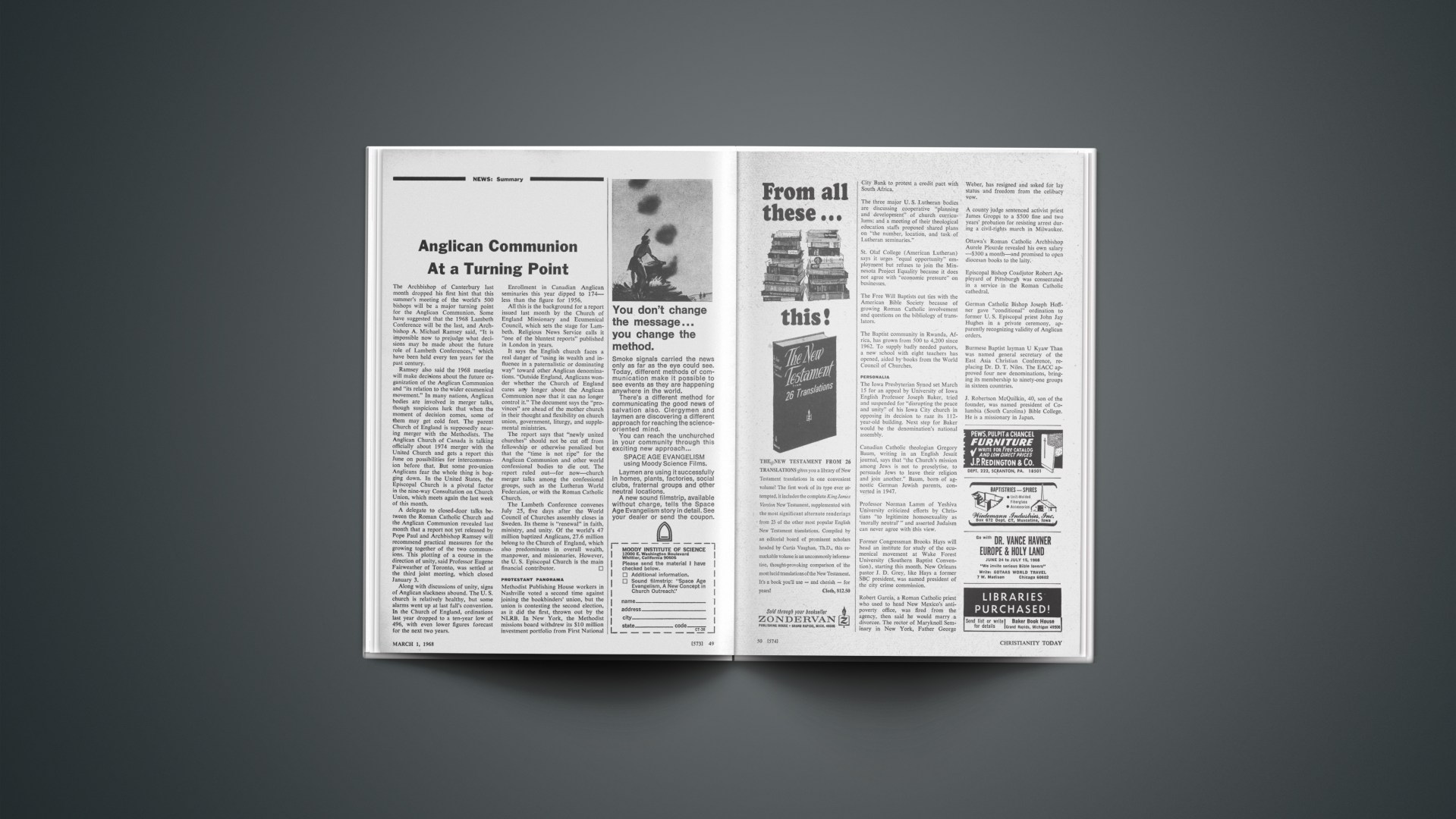
The Archbishop of Canterbury last month dropped his first hint that this summer’s meeting of the world’s 500 bishops will be a major turning point for the Anglican Communion. Some have suggested that the 1968 Lambeth Conference will be the last, and Archbishop A. Michael Ramsey said, “It is impossible now to prejudge what decisions may be made about the future role of Lambeth Conferences,” which have been held every ten years for the past century.

Ramsey also said the 1968 meeting will make decisions about the future organization of the Anglican Communion and “its relation to the wider ecumenical movement.” In many nations, Anglican bodies are involved in merger talks, though suspicions lurk that when the moment of decision comes, some of them may get cold feet. The parent Church of England is supposedly nearing merger with the Methodists. The Anglican Church of Canada is talking officially about 1974 merger with the United Church and gets a report this June on possibilities for intercommunion before that. But some pro-union Anglicans fear the whole thing is bogging down. In the United States, the Episcopal Church is a pivotal factor in the nine-way Consultation on Church Union, which meets again the last week of this month.

A delegate to closed-door talks between the Roman Catholic Church and the Anglican Communion revealed last month that a report not yet released by Pope Paul and Archbishop Ramsey will recommend practical measures for the growing together of the two communions. This plotting of a course in the direction of unity, said Professor Eugene Fairweather of Toronto, was settled at the third joint meeting, which closed January 3.

Along with discussions of unity, signs of Anglican slackness abound. The U. S. church is relatively healthy, but some alarms went up at last fall’s convention. In the Church of England, ordinations last year dropped to a ten-year low of 496, with even lower figures forecast for the next two years.

Enrollment in Canadian Anglican seminaries this year dipped to 174—less than the figure for 1956.

All this is the background for a report issued last month by the Church of England Missionary and Ecumenical Council, which sets the stage for Lambeth. Religious News Service calls it “one of the bluntest reports” published in London in years.

It says the English church faces a real danger of “using its wealth and influence in a paternalistic or dominating way” toward other Anglican denominations. “Outside England, Anglicans wonder whether the Church of England cares any longer about the Anglican Communion now that it can no longer control it.” The document says the “provinces” are ahead of the mother church in their thought and flexibility on church union, government, liturgy, and supplemental ministries.

The report says that “newly united churches” should not be cut off from fellowship or otherwise penalized but that the “time is not ripe” for the Anglican Communion and other world confessional bodies to die out. The report ruled out—for now—church merger talks among the confessional groups, such as the Lutheran World Federation, or with the Roman Catholic Church.

The Lambeth Conference convenes July 25, five days after the World Council of Churches assembly closes in Sweden. Its theme is “renewal” in faith, ministry, and unity. Of the world’s 47 million baptized Anglicans, 27.6 million belong to the Church of England, which also predominates in overall wealth, manpower, and missionaries. However, the U. S. Episcopal Church is the main financial contributor.

PROTESTANT PANORAMA

Methodist Publishing House workers in Nashville voted a second time against joining the bookbinders’ union, but the union is contesting the second election, as it did the first, thrown out by the NLRB. In New York, the Methodist missions board withdrew its $10 million investment portfolio from First National City Bank to protest a credit pact with South Africa.

The three major U. S. Lutheran bodies are discussing cooperative “planning and development” of church curriculums; and a meeting of their theological education staffs proposed shared plans on “the number, location, and task of Lutheran seminaries.”

St. Olaf College (American Lutheran) says it urges “equal opportunity” employment but refuses to join the Minnesota Project Equality because it does not agree with “economic pressure” on businesses.

The Free Will Baptists cut ties with the American Bible Society because of growing Roman Catholic involvement and questions on the bibliology of translators.

The Baptist community in Rwanda, Africa, has grown from 500 to 4,200 since 1962. To supply badly needed pastors, a new school with eight teachers has opened, aided by books from the World Council of Churches.

PERSONALIA

The Iowa Presbyterian Synod set March 15 for an appeal by University of Iowa English Professor Joseph Baker, tried and suspended for “disrupting the peace and unity” of his Iowa City church in opposing its decision to raze its 112-year-old building. Next step for Baker would be the denomination’s national assembly.

Canadian Catholic theologian Gregory Baum, writing in an English Jesuit journal, says that “the Church’s mission among Jews is not to proselytise, to persuade Jews to leave their religion and join another.” Baum, born of agnostic German Jewish parents, converted in 1947.

Professor Norman Lamm of Yeshiva University criticized efforts by Christians “to legitimize homosexuality as ‘morally neutral’ ” and asserted Judaism can never agree with this view.

Former Congressman Brooks Hays will head an institute for study of the ecumenical movement at Wake Forest University (Southern Baptist Convention), starting this month. New Orleans pastor J. D. Grey, like Hays a former SBC president, was named president of the city crime commission.

Robert Garcia, a Roman Catholic priest who used to head New Mexico’s antipoverty office, was fired from the agency, then said he would marry a divorcee. The rector of Maryknoll Seminary in New York, Father George Weber, has resigned and asked for lay status and freedom from the celibacy vow.

A county judge sentenced activist priest James Groppi to a $500 fine and two years’ probation for resisting arrest during a civil-rights march in Milwaukee.

Ottawa’s Roman Catholic Archbishop Aurele Plourde revealed his own salary—$300 a month—and promised to open diocesan books to the laity.

Episcopal Bishop Coadjutor Robert Appleyard of Pittsburgh was consecrated in a service in the Roman Catholic cathedral.

German Catholic Bishop Joseph Hoffner gave “conditional” ordination to former U. S. Episcopal priest John Jay Hughes in a private ceremony, apparently recognizing validity of Anglican orders.

Burmese Baptist layman U Kyaw Than was named general secretary of the East Asia Christian Conference, replacing Dr. D. T. Niles. The EACC approved four new denominations, bringing its membership to ninety-one groups in sixteen countries.

J. Robertson McQuilkin, 40, son of the founder, was named president of Columbia (South Carolina) Bible College. He is a missionary in Japan.

MISCELLANY

The U. S. welfare department will make offers of birth-control information mandatory for health and welfare recipients, instead of waiting for them to ask.

The Churches of God in North America want Maryland’s Court of Appeals to overthrow a county-court ruling permitting two congregations to leave the denomination and keep their church buildings. The denomination says the ruling violates church-state separation.

Catholic University law teacher John J. McGrath contends in a new book that church charities and schools “are now owned by the sponsoring body.… If anyone owns the assets, … it is the general public.”

The war on poverty gave $810,748 to maintain fifty-six schools for migrant workers run by the New Mexico Council of Churches.

Pope Paul enthusiastically praised the 1929 Lateran Pact for bringing “religious peace in the life of the Italian people.”

Wycliffe Bible Translators has published the New Testament for Mexico’s Huichol Indians. Wycliffe started work with the tribe in 1941 and now counts at least 400 believers among the group.

Fifty-four Jehovah’s Witnesses, whose troubles have been described recently in the cult’s publications, were refused admittance to Zambia and ordered back to Malawi, where several have reportedly been slain.

Orissa State in India passed a law with penalties of $1,000 fine or a year in prison for missionaries who convert minors, women, or untouchables. Penalties will be doubled if evangelism entails “force, fraud, or exploitation of property.” The Church of South India Synod protested that the bill “ignores the right of every citizen freely to hold any views and convictions.” In Bombay, Salvation Army General Frederick Coutts asked India to continue to allow foreign workers to minister there.

Deaths

EDWARD J. YOUNG, 60, Old Testament teacher for thirty-one years at Westminster Theological Seminary; of a heart attack.

ELIEZER SILVER, 86, leading Orthodox rabbi who helped rescue 500,000 Jews from the Nazis; in Cincinnati.

STEWART DOSS, 52, religion writer for the Dallas Times-Herald; of a heart attack.
Negro Methodists Map Black-Power Bloc

A national conference of Negro Methodists, meeting in a militant mood last month and embracing “black power” as the answer to racism, decided the church’s segregated Central Jurisdiction should be replaced with an all-Negro organization called “Black Methodists for Church Renewal.”

Looking ahead to the April merger meeting of the Methodists and the Evangelical United Brethren, the 250 delegates demanded that Negroes get proportional representation on all boards and agencies of the new United Methodist Church (they make up about 4 per cent of 11 million members).

There were ironical overtones to the group’s establishing the “Renewal” organization to replace the Central Jurisdiction—which it had successfully pushed into oblivion. But the Negroes saw a difference between a power base they themselves set up and a structure ordained by whites to serve as a kind of jurisdictional catch-all for Methodists with black skin. The new agency plans to hire an executive at $15,000 a year, with an operating budget of $38,000.

The delegates let it be known that the Negro voice will be heard loud and strong in the United Methodist Church. With this assertion went a not-very-veiled threat that the Church had better shape up or the Negro may ship out.

The conference concluded with lively floor fights on six papers of “findings” from committees. The one on black power asserted: “We confess our failures to be reconciled with ourselves as black men. We have too often denied our blackness rather than embrace it in all its black beauty. We are becoming new men—the old man (the nigger) is dead. The ‘boy’ is now a man. How then do we respond forcefully and responsibly to racism in America and racism in the Methodist Church? We unashamedly reply—Black Power!”

Black power was said to provide “the means by which black people do for themselves that which no other group may do for it.”

The man who coined the phrase, Methodist layman Stokely Carmichael, tiptoed down the aisle to the front pew to hear a church address by former CORE Director James Farmer. Farmer said black power is good for the nation and essential to the Negro if he is to be accepted as an equal. He said all minority groups, such as Irish and Jewish immigrants, had to form economic and political power blocs to succeed in America.

Carmichael was not introduced at the meeting and refused to talk to newsmen. He did return to the headquarters hotel to address a workshop on “Black Churchmen and the Black Revolution.” After spending the night in the hotel’s presidential suite, he slipped out of town.

The hottest floor fight at the conference was triggered by the phrase in one paper, “whether it be within or without the institution and whether it be pleasing or painful to white Methodists.”

The Rev. Merrill Nelson of Columbus, Ohio, rushed to a floor microphone and proclaimed, “I will not walk out of the Methodist Church. I will not vote for something I personally will not do.”

Then Cincinnati pastor Samuel Wright reminded delegates that the Methodist Church came out of the Church of England. “I have no hesitancy at all in walking out of an institution,” he said. “We can leave it, and if we ought to, we should. It’s a choice of radical transformation of the church or creative disaffiliation.”

When unflappable conference Chairman James Lawson of Memphis, a skilled parliamentarian, brought the issue to a vote, the explosive language was killed 51–47.

Caught up in the vortex of violence, the Negroes left open-ended the role of congregations caught in the midst of conflicts. One paper made the innocuous recommendation that the Church should “educate people relative to the role of the church in the midst of violence.” Delegates agreed that no one knew what the role was but that it should get top priority. They defeated the suggested addition of “… and, if possible, prevent violence” as part of the Church’s role.

BLOODSHED IN SOUTH CAROLINA

Negro Methodists’ concern about violence (story above) was dramatized with the news during last month’s conference that three Negro collegians had been shot and killed and fifty others wounded in the wake of demonstrations against a segregated bowling alley in Orangeburg, South Carolina. The Cincinnati conference stood for a moment of silence, then sent telegrams backing the students and deploring the killings.

The violence closed South Carolina State College, with 1,600 students, and Claflin College, nearby Methodist school with 600 students. Carolina State’s President M. Macco Nance, Jr., defended the protests but indicated that a small group of activists had taken over and that this had led to the violence and deaths.

The Rev. W. McLeod Frampton, a white Presbyterian, was named to lead the city’s new biracial Human Relations Commission. The pastor said, “Unrest and violence, hatred, prejudice, and even revolution will engulf us unless somehow we are willing to establish effective and effectual lines of communication.… No individual, no home, no community will be safe until every home and every individual is safe.…”

BAPTIST MARCH MALADY

Baptist leaders from the ten denominations joining for an unprecedented Continental Congress on Evangelism this October are running into some resistance from pastors in the host city, Washington, D. C.

National planners have scheduled a Sunday march up the Mall to proclaim Christ as “the only hope.” But one of the congress committee chairmen, Editor James Duncan of Capital Baptist, says local Baptists “are not interested” because “the psychology of this city won’t accept another parade.”

Parade equals protest in many local minds, it seems, and the shadow of the Rev. Dr. Martin Luther King, Jr., falls over much of the discussion. King—whose Negro denomination supports the congress and the huge evangelistic drive that is to follow—plans a major “camp-in” in the capital this spring to last until Congress accedes to demands for poverty legislation.

Another potential irritant—not yet surfaced—is that D. C. churches are dually aligned with the Southern Baptist Convention, which is behind the congress, and the American Baptist Convention, which has voted against any official role.

The four-day Continental Congress will be limited to 2,500 delegates from the denominations, but the hope is to swell the ranks with thousands from the D. C. area for a final Sunday march. Despite appeals from Duncan and other local leaders, parade plans were pushed forward at last month’s steering-committee meeting. North American Coordinator W. Wayne Dehoney, past president of the SBC, gave an emotional appeal for the parade at a rally for about 200 D. C. area pastors.

Dehoney reported that the 1969 Crusade of the Americas campaign now has the support of 18 million Baptists and 100,000 congregations in twenty-seven nations of the Western Hemisphere.

A.B.C. INDECISION

The General Council of the American Baptist Convention proved indecisive on crucial issues before the denomination at the meeting that closed February 1. Ecumenicity was strongly urged, but when it became evident that Cardinal Cushing was to be among the welcoming speakers at the Boston convention in May (he seemed to have partially invited himself) the council appeared alarmed at this development.

On evangelism, President L. Doward McBain reported extensive sessions with the Home Mission Society and its evangelism department, but it was clear that no meeting of the minds had been reached. On war and peace, no significant discussion was scheduled, though at the end of the meeting Iowa pastor Heinz Grabia reluctantly offered brief personal observations from a recent Viet Nam visit. In the statement—given with strong urging from McBain and enthusiastic council reception—Grabia confessed that he had gone as something of a “hawk,” but had returned less than satisfied with that position.

The council spent major time visiting Zion Baptist Church in Philadelphia, where the Rev. Leon Sullivan has led development of an extensive job-training and employment service center. After three years, more than 3,000 persons are working as a result of the effort, with 1,400 currently in training. Sullivan will get the denomination’s peace award for 1968, along with ailing Christian Century Editor Kyle Haselden.

The council also surveyed the less concrete program of the denomination’s evangelism secretary, the Rev. Dr. Jitsuo Morikawa, which seeks to enlist Philadelphia laymen to express their faith in and through vocations.

LAWRENCE T. SLAGHT

EPISCOPAL UNDERCURRENT

Liberals in the Episcopal Church get the headlines, but a revived undercurrent of traditional theology may be developing. One indication is a small, low-key group that drew 200 persons to its third annual meeting last month, held at St. James’ Church in Leesburg, Virginia.

The group is the U. S. beachhead for the Evangelical Fellowship in the Anglican Communion, the conservative group within the Church of England that includes some of the world’s best-honed evangelicals. Two of them were there: London clergyman John R. W. Stott and the Rev. Dr. Philip E. Hughes, currently teaching at Columbia Seminary in Georgia. Hughes is president of the U. S. group, but most organizational chores fall to the Rev. Peter Moore of New York, young, urbane head of the Council for Religion in Independent Schools.

The fireworks at Leesburg came from the Rev. Dr. John Rodgers, theology teacher at Virginia Theological Seminary. The heavy-set, 37-year-old theologian said, “The Good News of God’s self-disclosure in Christ is not only badly obscured but even attacked in institutions which bear his name.… The Word of God is considered to be archaic and hindering the Church.… The institutional churches to a large extent have lost the ‘pearl of great price’ in this country. Things are every bit as bad as in the sixteenth century. It is a time for reformation through the Word of God.”

Rodgers used a piece by the Rev. Dr. Daniel Day Williams in Theology Today as an example, saying that it is “wild speculation offered as Christian theology” and gives “joyous approval” to most major heresies of church history. God is described in passive terms, he said, as the mere matrix for man’s possibilities. “This is where our parishes are headed.”

In another address, his seminary colleague, the Rev. Dr. FitzSimmons Allison, discussed Freudian attacks on the fatherhood of God and asserted that the Judeo-Christian teaching is not an adolescent reversion, since the biblical God requires adventuresome service.

Suffragan Bishop Samuel Chilton of Virginia spoke on “Personal Commitment to Christ.” The meetings were also attended by a dozen Virginia seminary students, plus three from General Seminary, New York, and the Rev. Dr. Stuart Barton Babbage, president of Conwell School of Theology in Philadelphia and the former dean of the cathedrals in Sydney and Melbourne, Australia.

VOICE FOR CONSERVATIVE ORTHODOXY

A crack in the Eastern Orthodox cocoon has appeared with the slim, interesting new monthly, The Logos. Orthodoxy, the first issue complains, has disobeyed Christ by remaining silent “while Protestantism and Roman Catholicism stir restlessly in a renewed quest for what has been lost.”

Editor Eusebius Stephanou, 43, priest of Holy Trinity Church in Fort Wayne, Indiana, is no novice. He got an A.B. in history at Michigan and a divinity degree from Holy Cross Theological School in Massachusetts, and became the first Greek Orthodox to get an earned doctorate at General Theological Seminary, the Episcopal school in New York. Other ecumenical credentials: he was the first Orthodox to teach theology at Notre Dame, and represented Orthodoxy at such meetings as the Montreal Faith and Order session of the World Council of Chinches.

The result of all this is conservative theology, conservative politics, and disquiet about the ecumenical movement born of Protestant, Anglican, and Catholic doctrinal confusion.

Answering Archbishop Iakovos’s comments to the New York Times last fall, the first issue of the journal says, “Roman Catholics and Liberal Protestants leave the preaching of the total Christ to the Fundamentalists and Southern Baptist Evangelists. They are too busy either building up the defences of the crumbling institutional Church or advocating programs of social and political reform. Whatever the case may be, they are striving for a Christianity without Christ.”

Though Logos strives to be a pan-Orthodox organ, the tone is distinctly Greek. On affairs of that troubled nation, the paper says last year’s military takeover was “a blessing.… Who ever said that freedom was an end in itself? Once it is abused, it is forfeited.… Discipline and restriction of political freedom is Greece’s salvation.”

And an Athens Orthodox paper is quoted to the effect that cooperation with Western Christians in social activity is all right “so long as all proselytism on their part is put to a stop. We shall offer prayers to God for their return to the Church … to which they belonged until the ninth century.”

STORM OVER ASBURY

The Rev. Karl K. Wilson, fired after sixteen months as president of Asbury College in Wilmore, Kentucky, refused to vacate the president’s house January 31 as ordered, and is hoping for a change at the April board meeting.

After firing Wilson December 28, the board named as Interim President Cornelius R. Hager, graduate of the college and neighboring Asbury Seminary. Hager went on leave as an assistant extension dean of the University of Kentucky.

A board member said a list of twenty-nine specific instances of Wilson’s incompetence has been withheld for Wilson’s sake, but Wilson contends that he was never presented with the charges, and that the special board meeting was illegal.

Summing up the weeks of turmoil, campus editor Paul Delaney wrote: “Ill will, detectives, lawyers, falsehoods, and differing interpretations of ‘God’s Will’ have been used by both sides. And poor Asbury has been left so reeling that ‘holiness unto the Lord’ seems to be fighting against itself.”

Before the Christmas holiday, fifteen threatened faculty resignations were bolstered by a petition in which 200 of the 1,050 students at the conservative Methodist school threatened to protest in an “overt and forceful manner” if the board didn’t act. Now that the change has been made, several teachers are likely to leave anyway.

Wilson, who was a Methodist pastor in Canton, Ohio, followed the thirty-year reign of President Zachary T. Johnson. He was the dark-horse candidate who won when the board split between Johnson’s choice and a second man.

PRESBYTERIAN PLIGHT

With Presbyterian Professor Lloyd George Geering of New Zealand cleared of heresy charges (see December 8, 1967, issue, p. 40), conservative reactions are beginning. An independent Presbyterian fellowship has arisen in Auckland, New Zealand. A pastor in suburban Sydney, Australia (whose church includes five seminarians), has led his church into separation despite sacrifice of the property. The pastor, a hyper-Calvinist, spent ten days in New Zealand speaking at protest meetings called by the International Council of Christian Churches and the Presbyterian Laymen’s Association.

But the major evangelical Presbyterian voice, the New Zealand Westminster Fellowship, repudiated the campaign. Leading Australian evangelicals like Graham Hardy and Gordon Powell, who have the major Presbyterian churches in Sydney and Melbourne, criticized the Geering decision but as yet plan no separatist moves.

Moderates are chagrined that New Zealand Presbyterians have not rallied evangelical forces and have thus left the door open for the ICCC and others to capitalize upon the evident bewilderment. Some separatists look to the Australian Reformed Church, a Dutch-background body with twenty-five congregations.

Most evangelicals across the South Pacific are deeply concerned. Many hope to form a continuing Presbyterian body true to historical standards but without the extremist label, and view the first separation moves as immature.

On top of this, the New Zealand Assembly added fuel to the fire by distributing a pastoral letter with pleas for “liberality” and expressions of confidence in Geering’s stand.

CRAIG SKINNER

Six Missionaries Martyred in Viet Nam

Six American missionaries—three men and three women—died at the hands of Viet Cong terrorists during the Tet lunar New Year offensive in Viet Nam. The slayings occurred at Ban Me Thuot, some 150 miles northeast of Saigon. They are thought to have been carried out January 30 and 31 (see account on page 16).

The Viet Cong also took at least two American missionaries captive.

The dead were:

• Miss Ruth Wilting, 42, of Cleveland, Ohio.

• The Rev. Robert Ziemer, 49, of Toledo, Ohio.

• The Rev. C. Edward Thompson, 43, and his wife, Ruth, 44, of New Kensington, Pennsylvania.

• Leon Griswold, 66, and his daughter, Carolyn, 41, of White Plains, New York.

All served under the Christian and Missionary Alliance, an 81-year-old evangelical denomination that gives top priority to foreign missionary work.

Several buildings on the CMA compound at Ban Me Thuot were destroyed during the Viet Cong attacks.

The two Americans seized by the Viet Cong were Henry Blood, of Portland, Oregon, and Miss Betty Olsen, of Nyack, New York. Miss Olsen is a nurse whose services presumably were deemed valuable to the Viet Cong.

Freed by the Viet Cong was Mrs. Marie Ziemer, whose husband was killed. Mrs. Ziemer was wounded but not seriously.

Only about three days before the attack, the three Ziemer children and the five Thompson children had left Ban Me Thuot for a boarding school in Malaysia.

Dr. Nathan Bailey, CMA president, said that although the Viet Cong marauders had invaded a number of South Vietnamese cities, only the missionaries in Ban Me Thuot were victimized. “Word from the State Department indicates that all of our other missionaries are considered safe,” Bailey said. CMA missionaries have been serving in a number of areas of South Viet Nam.

Missionaries in Dalat had a close call. Some thirty-four men, women, and children were evacuated by the American military only minutes before the Viet Cong attacked in force.

Dr. Louis L. King, CMA foreign secretary, was on a tour of Europe and Africa when the slayings occurred. He went immediately to Saigon after learning the news.

Ironically, while the news broke of the Viet Nam martyrdoms, a group of prominent clergymen were releasing in New York a 421-page, soft-cover “war crimes study.” The preface states that in Viet Nam the United States “must be judged guilty of having broken almost every established agreement for standards of human decency in times of war.”

The book was published by Clergy and Laymen Concerned About Viet Nam, a two-year-old organization that claims a membership of 16,000. The group sponsored a two-day Washington protest demonstration against U. S. involvement in Viet Nam after the release of the volume.

The study, entitled In the Name of America, is signed by twenty-nine Christian and Jewish leaders, most of whom are familiar faces among the activists who have been protesting American policies in Viet Nam. They include Martin Luther King, Union Seminary President John Bennett, and Robert McAfee Brown.

A State Department official told Religious News Service the allegations against the United States “are not at all true legally and they are morally debatable.” He suggested that this war appears more awesome and gruesome than others because “for the first time in history people have been able to watch a war over a bowl of potato chips.”

Highlight of the Washington event was a silent vigil at Arlington National Cemetery by about 2,000 persons. Despite a series of legal appeals, the “Clergy Concerned” group was unable to get permission to hold a service at which King had been asked to speak. The Pentagon issued a statement saying that only a silent march would be allowed, and the courts upheld it.

ILLEGAL VOYAGES TO END?

The “Phoenix,” a fifty-foot ketch, has completed what its sponsors say will be the crew’s last effort “personally to deliver medical aid to suffering Vietnamese, no matter what the politics of the government under which they live.”

According to its Quaker sponsors in Philadelphia, the craft sailed into Haiphong, North Viet Nam, January 29 and unloaded $5,000 in surgical instruments and $2,000 worth of medicine. It was the third trip to Viet Nam for the “Phoenix” within a year. A load for South Viet Nam was never delivered because of a dispute over who should distribute it.

Quakers have acknowledged that the trips were illegal, but according to a spokesman they feel “conscience bound to do so … and … obligated to protest the brutal United States policy of terror.…”

SELECTIVE SOCIAL ACTION

Prominent churchmen joined in the condemnation of legal proceedings in South Africa under which thirty tribesmen were given prison sentences for terrorist activity. Some $37,500 in American church money had been given to aid the defendants, some of whom were accused of receiving guerrilla training in Communist China and the Soviet Union.

Dr. Arthur Larson, who flew to Pretoria to appear as an “observer” on behalf of the major ecumenical groups, called the sentencing a “monstrous travesty of law.” Larson, a Lutheran layman, teaches in a law research center at Duke University.

Dr. R. H. Edwin Espy, general secretary of the National Council of Churches, called the sentencing a “tragedy.” The NCC, along with the Lutheran World Federation and the World Council of Churches, had tried to win leniency for the tribesmen, many of whom were members of the militant South-West Africa People’s Organization. Nineteen of them were sentenced to life imprisonment on charges that they returned to South-West Africa from abroad with weapons, that they took part in raids and skirmishes with police, and that they organized a plot to kill tribal leaders.

Ecumenical spokesmen agreed with a group of 200 American lawyers who condemned the trial of the tribesmen as a “flagrant violation of international law.” The lawyers said in a statement that the prosecution was illegal because the defendants were arrested in South-West Africa. The U. N. General Assembly ended South Africa’s jurisdiction over South-West Africa in 1966, but South Africa does not recognize the action.

South Africa prosecutors also were condemned because the tribesmen were convicted under an act passed in 1967 but made retroactive to 1962. The defendants could have received the death sentence.

The American denominations that contributed to the defense of the accused terrorists were the United Presbyterian, Methodist, Episcopal, and United Church of Christ. The U. S. committee for the Lutheran World Federation also donated money, all of which was channeled through the NCC Africa Department.

That the case was a travesty of justice seemed quite clear. Similar travesties occur with discouraging regularity in Communist and other totalitarian countries. But the ecumenists ignore most of these—including those involving religious persecution—and chose instead to support apparently pro-Communist guerrillas.

DETROIT: MORE VIOLENCE?

Recent bomb threats to two moderate Negro ministers in Detroit raise fears of new racial violence in the riot-scarred city, National Catholic Reporter says.

An unexploded gasoline bomb was found at the home of the Rev. Roy Allen, head of the Detroit Council of Organizations, twenty-eight Negro groups opposing the militant-action committee headed by the Rev. Albert Cleage. The day after that bomb was found, a bomb exploded in the offices of the Baptist Pastors Council, headed by the Rev. Charles Williams, who takes a moderate civil-rights stance.

When Milwaukee activist Father James Groppi came to town recently, the meeting was disrupted by “Breakthrough,” a group that is urging whites to arm themselves.

Such activity comes in the wake of the worst city riot in American history, and a matter of weeks after participants in a social-ethics conference called by the National Council of Churches said violence may be a morally justifiable means to eradicate “systemic” violence in U. S. society.

DIGESTING THE NEW RELIGION

In honor of one of its February articles, “Are You Disturbed by the ‘New Religion’?,” Reader’s Digest sponsored a New York seminar to give the “new religionists an opportunity to speak for themselves” (which ones don’t?). The moderator was article-writer David Edman, an Episcopalian, ecumenical chaplain at Rochester Institute of Technology, and son of the late chancellor of Wheaton College, V. Raymond Edman.

First there was “new religion” jazz worship. Then a luncheon well attended by Digest brass and secretaries and by Union Seminary students who were not averse to gleaning a free lunch from a magazine few would admit ever reading.

Over lunch, the soft-spoken Edman said he left the evangelical camp after Wheaton because of its “man-centered” thrust. Now his contact with evangelicals “is rather slim—governed by their exclusiveness rather than mine.” “Biblical literalism is just uncongenial,” he added, but he refused classification as a thoroughgoing “new religionist.” His “first responsibility is Christ, out of which grow certain imperatives that deal with sins private and public.”

At the panel, Malcolm Boyd said explosively that the total death of the institutional church was needed. William Hamilton prophesied a “post-Christian, post-political mysticism” with people “who want to build a community without sin.” Rabbi Richard Rubenstein, immortalized in Time last month, said Judaism and Protestantism are in trouble because they are “religions of the Book,” whereas Catholicism is a “turned-on sensualism.”

Besides downgrading the man-God confrontation, speakers scornfully dismissed the printed word as inadequate for the new age. Yet in this McLuhan age more printed material is disseminated, and presumably read, than ever. We can wait to read the new religionists’ next books (or magazine articles).

JOHN EVENSON

The Diverse Dr. Poling

Few clergymen have involved themselves in a wider range of causes than Daniel A. Poling. The 83-year-old Poling died last month in Philadelphia, four days after attending the silver anniversary of one of these causes, the city’s Chapel of the Four Chaplains. It honors the World War II death at sea of his son Clark and three other clergymen who gave their lifebelts to others.

When Poling was a young Baptist pastor in Ohio, he ran for governor on the Prohibition ticket and got 47,000 votes, even though he was too young to serve. In his youth he also earned two college degrees, worked as a lumberjack, farmer, railroad man, and reporter, and suffered a severe gassing while doing YMCA relief work in Europe during World War I.

In the 1920s Poling entered the Reformed Church in America and became pastor of the venerable Marble Collegiate Church, New York City. He was once president of the RCA General Synod but switched again in 1936 to become pastor of Philadelphia’s Baptist Temple.

During the twenties Poling began a pioneer radio talk show on the NBC network and became editor of the sagging Christian Herald, which he turned into the biggest independent Protestant journal in the country. The journal also undertook such charitable works as the Bowery Mission, and Poling helped set up philanthropies for retailer J. C. Penney. In 1925 Poling was elected president of the International Society of Christian Endeavor, where he served for twenty-two years.

Poling’s most controversial activities were political. He lobbied long and hard for the successful Prohibition amendment. A lifelong Republican, he backed Roosevelt for president in 1944; but he believed enough in church-state separation to hire the Academy of Music in Philadelphia to announce it.

In 1951, the faltering Philadelphia Republican machine nominated Poling as its candidate for mayor, but he lost by 122,000 votes to the reform Democratic candidate Joseph Clark, now a U. S. Senator.

Poling was theologically conservative, anti-Communist, and anti-pacifist, and was one of the few big-name church leaders to oppose the Supreme Court prayer decision.

Poling received fourteen honorary degrees and all sorts of other honors. He was the author of more than two dozen books. Twice widowed, he is survived by one son, Daniel K., minister of an RCA church in New York City.

A VESSEL FOR EVANGELISM?

After plying the seas for three decades, the luxury liner “Queen Elizabeth” soon may enter her final berth. The world’s biggest passenger ship is up for sale, and chances are the buyer will put her at permanent anchor. Her sister ship the “Queen Mary” seems to have set a precedent in her new role at the dock in Long Beach, California.

One possibility for the “Queen Elizabeth” was raised by evangelist Billy Graham, who thought that use of the vessel as a floating school and/or Bible-conference facility might be worth exploring. Graham asked George Wilson, treasurer of the Billy Graham Evangelistic Association, to look into it. Wilson was in London in February attending a meeting.

The 83,000-ton vessel is more than 1,000 feet long and carries 2,288 passengers. The city of Fort Lauderdale, Florida, reportedly offered its harbor to the ship if it is purchased by Graham’s organization.

Graham says he has suspended consideration—at least for the time being—of starting a university. He feels his role in such a school would be a “great diversion” from evangelism and speaking to secular audiences. He said world conditions give these priority status.

For a number of years there has been discussion of the feasibility of establishing a new Christian university, and Graham has at times expressed an interest in spearheading the project. He estimates it might cost $50,000,000 or more just to build the plant. “Twenty-two cities over the nation have offered property and finances for the school,” Graham said.

The prime site seemed recently to be along Florida’s eastern Gold Coast, where millionaire developer John D. MacArthur is said to have offered the Billy Graham Evangelistic Association a 1,000-acre plot for a campus in Palm Beach Gardens. The Florida Baptist Convention has been holding up its own plans for a new college pending Graham’s decision on whether he would start a school there.

NOT FOR TV-WATCHERS?

“I’m trying to reach some kid who is hung up on LSD and probably hates TV,” declared adman-satirist Stan Freberg, discussing the new color TV spot he produced for the United Presbyterian Church.

The spot features a well-groomed hippie, on camera, whose “bag” is reading psychedelic posters, talking with Freberg, who is off camera.

“It’s not so much that I want people to believe in God as opposed to not believing in God,” Freberg says. “I would just like to remind them of his existence.… I believe God is present in this world and that Christ died for us and was killed and rose again and I think if you believe this you will try to stop war and nonsense and bigotry.”

Freberg is also preparing a new series of radio spots based on the “God-Is-Dead” theme. “… While it has been pretty well covered from the pulpit,” he said, “I felt that somebody should say something out here in the so-called mass media for the benefit of those people who might have been tied up the last couple of Easter Sundays.”

The spots will be distributed as public-service announcements in cooperation with the Broadcasting and Film Commission of the National Council of Churches.

CHURCH-STATE MONOLOGUE

“I gather from looking at your program you are going to be carrying on a dialogue among yourselves,” chided a Roman Catholic lawyer as the national conference of Americans United for Separation of Church and State opened last month. “You have nothing to lose by creating a little more dialogue with those with whom you differ.” Whatever the merits of the suggestion, it was ignored as the Cincinnati convention raised its traditional warning flag over blurring lines between church and state.

The opening debate on “Should Churches Pay Taxes?” proved the most provocative session. Dr. Paul A. Reynolds, philosophy professor at Wesleyan University, Middletown, Connecticut, took thirty-two pages to say “yes.” Dr. Roy Nichols, Negro minister of Salem Methodist in New York City, needed only six to say “no.”

Three reactors—a Jewish rabbi, a fundamentalist Bible-college president, and the Catholic layman—agreed with Nichols. William R. Schumacher, the Catholic layman, who is active in ecumenical circles in Cincinnati, also suggested that men of reason will have to settle the thorny problem of federal assistance to parochial schools. He said he doubted whether the courts could ever settle the issue.

Dr. C. Stanley Lowell, associate director, said many mainline Protestant denominational leaders who once were friendly to the organization have now turned against it. “We haven’t changed, they have,” he explained. “We still stand at the same place we did twenty-one years ago. The reason for their change is that they now seek … public funds for the support of their programs and institutions.”

He said activist clergymen now leave the pulpit for bureaucratic positions without missing a step or even bothering to change their collars. He estimates that 1,000 Protestant clergymen have left their parishes to work for the Office of Economic Opportunity.

Dr. Glenn L. Archer, executive director, told the 150 delegates that history shows that when church and government meet at the public treasury, the church is put in jeopardy.

“More recently, a few politicians and churchmen, tipsy with the new wine of brotherhood, have involved the church and state in social-welfare programs at public expense until the American public is beginning to wonder which is church and which is state,” he said.

During the conference Archer received a bomb threat, the fourth in his career. Someone called the hotel to say he had planted a bomb in Archer’s room. Hotel and city police combed the room carefully but found nothing.

The longest applause during the conference came at the request of the camera crew that was filming part of the program for the upcoming CBS documentary on church wealth. They asked the delegates to applaud three times for the camera.

In a 7 A. M. board meeting on the last day, an enlarged program for 1968 was adopted, calling for:

• Expanded educational program with chapters and committees in many new communities and special appearances on at least 100 college campuses.

• Broadening of already extensive legal assistance in the church-state field. Much of this is predicated on the hope the organization can win standing in courts.

• A goal of 60,000 new members, a figure well beyond that achieved in any previous year. (The group now claims 200,000 members.)

• A direct appeal to churches to refuse all tax funds for support and to exercise their ministries in the deepening of spiritual concerns.

JAMES L. ADAMS

Book Briefs: March 1, 1968

Reactions To Radicalism

The Future of Belief Debate, edited by Gregory Baum (Herder and Herder, 1967, 229 pp., $2.45), is reviewed by Milton D. Hunnex, professor of philosophy, Willamette University, Salem, Oregon.

Radical theory reaches into Catholic as well as Protestant thought. Leslie Dewart’s The Future of Belief is a “theological bombshell” designed to catapult Catholic theology into the twentieth century.

One is reminded of Anglican Bishop Robinson’s earlier bombshell, which was followed up with The Honest to God Debate. But one is also impressed by the greater philosophical strength of the Toronto professor’s book, since he works out the foundations of his existential Christianity with much greater technical adequacy. Also, his radicalism is much more far reaching. Whereas Robinson tried to recast the content of the Gospel in more intelligible form, Dewart holds that the content itself must go. What was proclaimed in the first century in Hellenic terms, he argues, can no longer be true or relevant today. Hence the contemporary Christian should not even try to say what Paul said—however differently. He should articulate the Gospel in contemporary concepts only.

Dewart’s Catholic reviewers freely acknowledge that his program reaches beyond demythologization or even dehellenization. It is revolutionary in political direction as well as theological content, since it paves the way not only for the reconciliation of all Christians but also for a rapprochement of Christianity and Marxism.

According to Dewart, “Christianity has a mission, not a message.” Its mission is to bring about the progressive intensification of man’s awareness of himself as a creature who is responsible for his own creative development. God is not the Lord of history. He does not even exist in the orthodox sense of the term. He is the ubiquitous historical presence men experience as the ground of all that happens or could happen in their lives.

According to Dewart, what makes Christianity irrelevant today is that it is promulgated as a message that must be understood in Greek metaphysical terms. The Greek approach makes Christian revelation and truth into a set of propositions that Christians are supposed to believe. But truth is existential rather than propositional, Dewart argues. We know God only as a historical and existential presence, not as something we can talk about.

Men’s concepts are not true because they accurately represent something beyond themselves. They are true only because they enlarge self-understanding. In man’s experience of himself and his world, God is experienced only as a presence, and since all men are immersed in a cultural and historical situation, truth must be taken as those concepts that illuminate this situation for them. Hence while the form and content of the New Testament were appropriate for the situation in which it was written, they are not appropriate today.

The trouble with Dewart is that, though he is radical, he is radical in the wrong way and not radical enough. If being radical means getting at the root of something, then being radical as the evangelical Christian sees it would mean getting beyond the philosophical quarrels of Catholic theology to the origin and root of Christian faith. Scholasticism must go, Dewart says. The evangelical certainly agrees, but he wonders why it should have ever been allowed to envelop the faith as it did.

Evangelical radicalism calls for a Christianity unsupported by philosophical speculation and therefore not subject to the vicissitudes of philosophical style. Dewart’s call for an existential theory of truth that is hardly congenial to the modern scientific mind simply repeats all over again the mistake of trying to articulate a philosophical Christianity. The difference now is that the new philosophy that is to replace scholasticism not only will not buttress the faith as scholasticism tried to do; it will eliminate it on the curious grounds that this is the only way to save it. What is becoming clear today is that the only Christianity that can or, for that matter, should survive is evangelical Christianity.

Actually Dewart’s program for dehellenizing Christianity is itself another form of hellenistic philosophical distortion. The difference is that he prefers Heraclitus and Protagoras to Parmenides and Plato. Also, his appeal to “contemporary experience” is unconvincing, since there is no such thing as a homogeneous “contemporary experience” to which one can appeal. Moreover, many people still find that what the New Testament says in the way it is said is more radically relevant to their lives than the radical but secular reformulations of the faith.

The Inner Life Of A Missionary

Who Shall Ascend: The Life of R. Kenneth Strachan of Costa Rica, by Elisabeth Elliot (Harper & Row, 1968, 171 pp., $5.95), is reviewed by Frank E. Gaebelein, headmaster emeritus of the Stony Brook School and former coeditor ofCHRISTIANITY TODAY.

The reader of this book should not neglect Elisabeth Elliot’s introduction, in which she states her attitude toward the responsibility entrusted to her by the Latin America Mission, of which Kenneth Strachan was the distinguished head. That she has endeavored honestly to see him in the light revealed by the material so unreservedly made available to her is plain. Apparently very much of this material is in the form of letters; this is understandable, for Strachan was separated from his parents in his youth and later traveled much of the time during his missionary service.

Mrs. Elliot uses her sources with integrity and sensitivity. Out of them she gives us a portrayal of Kenneth Strachan reminiscent of the biographical genre of psychography (soul-portraiture) that made Gamaliel Bradford famous. For Who Shall Ascend is much more concerned with Strachan’s inner pilgrimage than with the outward details of his career as a missionary administrator and statesman.

Some aspects of the book will disturb those who think that Christian leaders are somehow exempt from personal tensions and uncertainties. To such readers, as well as to the Christian community as a whole, Mrs. Elliot has rendered a service in this discerning study of a man who, despite inward problems, to say nothing of outward trials, pressed unremittingly on and, through the idea of evangelism-in-depth, made one of the greatest missionary contributions of this century. Surely the evangelical missionary enterprise must be mature enough to look below the surface of its success and realize more fully the ways of God with his servants.

The title with its allusion to Psalm 24 is apt. But these absorbing pages also bring to mind the first beatitude, “Blessed are the poor in spirit; for theirs is the kingdom of heaven.” No one could accuse Kenneth Strachan of thinking of himself more highly than he ought to think. Yet what great things God did through this gifted, humble, and sorely tried man!

A question remains to be asked. To what extent do letters, even private family letters, really reflect the full truth about a person? Or, to put it another way, are not what a person does and his influence upon others as revealed by what they say of him also important means for understanding who he was? Nevertheless, it must be granted that, working within her established framework, Elisabeth Elliot has helped us know the kind of man Kenneth Strachan was. And we are indeed the better for this knowledge. Incidentally, a side of missionary life too little known—its human cost in separation of children from parents—comes through the lines of Who Shall Ascend.

The Latin America Mission has set a worthy example in giving this talented writer access to confidential materials and in not interfering with her conscientious use of them.

Views From The Quad

Never Trust a God Over Thirty, edited by Albert H. Friedlander (McGraw-Hill, 1967, 209 pp., $5.95), is reviewed by Paul E. Little, director of evangelism, Inter-Varsity Christian Fellowship, Chicago, Illinois.

“Do you believe all that?” This was the pointed question a student put to his campus pastor after a conversation about the historic Christian faith. The six religious counselors at Columbia University whose essays appear in this book would answer that question in varying ways.

The rabbi feels that though his function is varied in the complex Columbia context, he must be more concerned for the student than for the institution. He acts with the knowledge that the sacred realm of institutional religion has been rejected by the mainstream of Jewish tradition—that from the time of the Pharisees, the task of the rabbi has been the sanctification of the secular, a daily existence.

A Protestant counselor to Episcopal students feels that the new theology rules our present-day styles of campus ministry by offering new understandings about God, his Church, and “Jesus who is called the Christ.” He seems to feel that we should give greater emphasis to listening to the world than to declaring any message from God—a message about which he, in accordance with the mood of the new theology, is clearly uncertain.

The associate counselor to Protestant students and Presbyterian university pastor describes the student radicals and the campus ministry in relation to them. He feels that those campus pastors who have become involved in activist enterprises have established rapport with this group, but he observes that student radicals in their response to “marching” clergy have not been drawn into a formal religious stance. However, he does not consider this necessary. He says: “There is no place in the world for the old proselytizing spirit of the past, especially when the issues which confront us all demand understanding and acceptance of one another rather than attempts at converting one another.”

Only in the writing of the counselor to Catholic students and the Lutheran university pastor does one sense any feeling of a mission to communicate a God-given message. In contrast to some of his colleagues, the counselor to Catholic students feels that to abandon any rational element in religion is to commit intellectual as well as spiritual suicide. The church belongs on the campus primarily in an educative and intellectual capacity. I do not think that theology is to be forever in exile from the university anymore than I believe that revelation is now in exile from the world of man. For the Catholic, God’s revelation is now an objective fact—the fact of God’s action is history. From that divine action have emerged certain truths, which, as indicated, can be formulated, even if inadequately, in intellectual propositions.

He is concerned for real assent, which is reached only when what is apprehended becomes the motivation of one’s life and actions. This is in sharp contrast to mere conformity to rituals.

The Lutheran pastor sees the problem for the student as a combination of tradition, the intellectual content of tradition, and ethical considerations. To separate science, which is in the realm of reason, from a personal realm of values where preference is largely emotional, private, and distinct from the objective and rational, is disastrous. It leads to a relativism that says, “I don’t object to your faith, but I do object to any suggestion that it might be good for anyone else.” This relativism, he points out, evaporates when an appeal is made to “the moral issue” either for or against the Viet Nam war in campus discussions. Here the subjectivity of values disappears, and the “right” conclusion is supposed to be immediate and obvious.

Relativism and positivism create a mood pressuring students to discount religious assertions, and in effect narrow experience to its internal dimensions. He points out:”One does not have to work at attaining this point of view on the campus—it is in the very air we breathe. It is a mood. It is not the clear conviction of all concerned but a steady pressure in common contacts which surrounds the discussion of almost any subject imaginable.”

He urges that in the campus ministry it is essential to tackle once again the problem of faith and reason.

As an illuminator of campus attitudes in some quarters and of churchmen’s attempts—or lack of attempts—to shed light on the hard questions of existence, this book is helpful. I agree with the acerbic critic-at-large Paul Goodman, who writes in the introduction, “In my observation it is an error to say, like some of the writers in this book, that the present-day young are not interested in religion in a metaphysical sense.” It is only when those involved in campus ministry know clearly what they believe and why they believe it and are committed to it with “real assent,” so that this commitment is apparent in their lives, that they will make an impact on this student generation.

Reading For Perspective

CHRISTIANITY TODAY’S REVIEW EDITORS CALL ATTENTION TO THESE NEW TITLES:

Christ in the Communist Prisons, by Richard Wurmbrand (Coward-McCann, $5). A heroic Rumanian minister, fourteen years a prisoner of the Communists, vividly describes the opposition to Christianity behind the Iron Curtain.

Religion Across Cultures, by Eugene A. Nida (Harper & Row, $4.95). The American Bible Society’s noted linguist takes a fresh look at the psychological and dynamic factors related to effective communication in diverse cultures.

Who Shall Ascend, by Elisabeth Elliot (Harper & Row, $5.95). At the request of the Latin America Mission, a gifted missionary-novelist has written an intimate, probing biography of R. Kenneth Strachan, Costa Rica mission leader who developed “Evangelism-in-Depth.”

Preaching To Prisoners

Call for God, by Karl Barth (Harper & Row, 1967, 125 pp., $3.95), is reviewed by Andre Bustanoby, pastor, Temple Baptist Church, Fullerton, California.

Suppose a pastor were to pull out of his files his last twelve Christmas and Easter sermons and, instead of tearing them up, bundled them up and submitted them to a publisher. What would happen? He would probably receive a rejection slip promptly. But not if his name were Karl Barth.

That is more or less the story of Call for God, a collection of twelve sermons for Christmas, New Year, Easter, and other special occasions preached by Karl Barth to prisoners in Basel, Switzerland. Weighed in the homiletical balances, Call for God is found wanting in several respects.

Barth is often obscure. For example, he says in his sermon “You May” (Jer. 31:31) that the law of God is not an oppressive thing when it is written on the heart of man. It is no longer “you must obey” but “you may obey.” Unfortunately, the preacher does not tell us how the law of God comes to be written on a man’s heart so that obedience becomes a normal outworking of the life of faith.

Historical background must be taken into account in preaching from the prophets. But Barth preaches four sermons from Isaiah with little or no attention to historical background. The only connection between Isaiah 54:7, 8 and his Easter sermon “Brief Moment” is the phrase “the LORD, your Redeemer.”

Application is skimpy. Barth talks about “we,” “people,” and “the community” but does not address himself specifically to his audience—men in prison uniforms doing time for armed robbery and murder, suffering the frustrations of prison discipline and regimentation.

His Christmas sermon on Luke 1:53, “He has filled the hungry with good things,” offers an excellent opportunity to show how Christ can fill the void in the prisoners’ lives, and Barth makes a stab at it. But he speaks only in generalities, about such things as receiving a good conscience from Christ. He fails to tell how that prisoner who has murdered his wife in a fit of rage can receive the gift of a clear conscience and a cool head. He does not say what one should do about his uncontrollable temper. Barth never gets down to the nitty gritty.

Despite these liabilities, the book will probably sell. There is magic in the name Barth.

The Thesis Of Dodd Is Dead!

Preaching and Teaching in the Earliest Church, by Robert C. Worley (Westminster, 1967, 199 pp., $5.95), is reviewed by Benjamin L. Rose, professor of pastoral leadership and homiletics, Union Theological Seminary, Richmond, Virginia.

A neat distinction between preaching and teaching did not exist in the earliest Church (despite what C. H. Dodd said), and the effort today to differentiate the two creates confusion about the purpose and direction of church education. That is the thesis of this book. In five chapters that are well documented but at times very tiresome reading, the author, associate professor of theology at McCormick Seminary, challenges Dodd’s thesis that there was in the New Testament a clear distinction between kerygma and didache.

Four kinds of data are Worley’s basis for a critical evaluation of Dodd: word-studies of the use of preaching and teaching in the New Testament literature; recent studies in the speeches in Acts; information on intertestamental Jewish usage, practice, and background; and a variety of critical arguments by New Testament scholars. By the end of four chapters, Dodd’s thesis is as dead as a dormouse. (But I wondered whether the poor little dormouse merited all the ammunition expended on him; he was pretty sick before the shooting started.)

In the fifth and final chapter, which is the most readable in the book, Worley offers some practical advice about the Church’s educational program. The preaching-teaching task is one, not two, and must be stripped of its institutionalized distinctions (e.g., Director of Christian Education in contrast to Preacher). Preacher and church educator must take up and blend into one program the tasks of (1) teaching the Scriptures, (2) offering guidance in Christian living, including ethics, and (3) instructing in the history of the Church, as well as calling to commitment.

This is a helpful book, recommended for all who are responsible for the educational program of the Church. If they haven’t time to read the whole book, they should at least read the last chapter.

A Warm-Hearted Historian

Beyond the Ranges, by Kenneth Scott Latourette (Eerdmans, 1967, 155 pp., $3.95), is reviewed by Sandford Fleming, president emeritus, Berkeley Baptist Divinity School, Berkeley, California.

This is a brief autobiography of a great scholar who is a warm-hearted Christian and missionary statesman. It deals with Dr. Latourette’s years of preparation, his brief period of missionary service abroad, cut short by ill health, and his long teaching and writing career, together with his constant participation in various kinds of Christian service. This is a challenging record of one whose life has been richly lived, who has always been primarily concerned with persons, notably students, and who brings to every task the carefulness and thoroughness of good scholarship.

Especially significant are Dr. Latourette’s accounts of the decisions he made at a YMCA summer conference in 1903 and of a physical and emotional crisis that came during his first decade on the Yale faculty. In describing the latter, he says he had become deeply concerned by “the seamy side of ecclesiastical and official religious life,” and had begun to doubt whether Christianity was really confirmed by its fruits. His release came through the recognition that the “fruits of the Spirit” are to be found in men and women both in humble walks of life and in high ecclesiastical and academic positions. Most striking is his witness to the validity of the evangelical faith: “Increasingly I rejoiced in the Gospel … I was confirmed in my conviction that when all the best scholarship is taken into account we can know Christ as He was in the days of His flesh.… I was convinced that the historical evidence confirms the virgin birth and the bodily resurrection of Christ. Increasingly I believed that the nearest verbal approach that we humans can come to the great mystery is to affirm that Christ is both fully man and fully God.”

In a brief review it is difficult to do justice to this intimate portrayal of one of the great Christians of our time. Always the reader is aware that here is a life constantly guided by the Spirit of God. Dr. John A. Mackay says it well: “In these fascinating pages we follow the career of a young saint who became a scholar and of an aged scholar who has not ceased to be a saint.”

One regrets only that this account of a noble life is so brief, realizing as he comes to the end how much more fully the story might have been told.

Electrons With Mentality?

Evolution and the Christian Doctrine of Creation, by Richard Overman (Westminster, 295 pp., $7.50), is reviewed by A. E. Wilder Smith, professor of pharmacology, University of Illinois, Chicago.

Dr. Overman has swallowed not only the evolutionary bait but the hook, line, and sinker as well. The scholarship of the book, insofar as it reports on the works of Whitehead (it is a Whiteheadian interpretation), Bergson, Bultmann, Brunner, Barth, Teilhard de Chardin, Lamarck, Darwin, and others, is impeccable. The reference citations are copious, except those to orthodox evangelical scholars. The general index is scanty.

Basically, Overman grapples with the problem of explaining the evolutionary upsurge of order out of the natural chaos surrounding us: “How are we to express this in the face of evidence that indicates man appeared on the planet as a result of a ‘make-do’ process with no intrinsic long-term goals?” “Design, we might say, was somehow thwarted by the swarming, purposeless Newtonian atoms.” Over against this surging force of disorder stands the “fact of evolution” with its high order in cells and complex organisms.

To account for this evolution without invoking direct, supernatural interference in design, Overman assumes (in common with Teilhard de Chardin and others) that each basic unit of matter has a primitive “mentality” that ensures, without exogenous interference, an upsurge of order out of chaos: “This provides us with one reason for attributing to electrons some glimmering of mentality.…” Rock molecules, likewise, may have “flashes of conceptual novelty,” apples, their “consciousness.” An x-ray particle is conceived of as having a “pulse of emotion.” Electrons are “obedient.” Maupertuis’s idea that the Newtonian particles possess a “glimmer of mentality” is cited in support. An electron within a living body is maintained to be “different” from one outside it. With the help of this hypothesis, Overman and his friends try to relate the upward surge of evolutionary processes to the “subjective aims of actual occasions” in the atomic and subatomic world, which would otherwise be offset by the downward tendency towards chaos.

This line of thought seems to me, as a mere experimental scientist, to be a very shaky philosophical house of cards. We have no evidence, of course, of any “conceptual inwardness” of any non-living matter. In fact, the weight of experimental evidence is against such a proposition for the simple reason that mere compositions of matter, left to themselves, show no tendency whatever toward “conceptual synthesis” or toward mounting order leading to increased complexity and reduction of entropy. Decay and loss of complexity according to the second law of thermodynamics are the firm observations on which the success of modern science has been built. The only way the down-to-earth scientist knows of obtaining results that appear to be “conceptual”—i.e., that overcome the innate trend toward increased chaos and entropy—is through the intelligent (or conceptual!) application of energy.

On Overman’s and similar theories, non-living matter, left to itself, ought to show some sort of primitive conceptual trend toward higher order, even over the short experimental periods at our disposal. That it does not discredits all this sort of theory. It cannot. That the available energy is lacking (the sun’s energy is not available, as such, for such processes), discredits these fundamentally pantheistic theories involving “conceptual” atoms or electrons. Such theories are an attempt to avoid the necessity of the supernatural as an explanation for archebiopoiesis by attributing creative concepts to matter itself. Overman invokes the usual evolutionary hypothesis of huge time spans to allow this covert conceptual property of matter to reveal itself in upward evolution. (I have dealt with this whole problem in my book Herkunft und Zukunft des Menschen, which will soon appear in English under the title Origin and Destiny of Man.)

Besides these matters of principle, other indigestible fare is offered. The prodigious age of the coelacanth fish is mentioned, but the conclusion to be drawn from this—that species can be extraordinarily stable and not subject to transformism—is not drawn. More serious, in Overman’s thinking God is not omniscient and did not create by fiat, because that would have involved “capricious divine power.” Although God’s power is unrivaled, Overman says, it is not absolute. No mention is made of the fact of redemption in creation (Christ was the Lamb slain from the foundation of the world, Revelation 13:8).

The book is toilsome to read—the paper is poor and the type small—and expensive. It does contain a wealth of accurate bibliographical material which evangelical Christians would do well to know, and for which the author is to be thanked.

The Date Of Deuteronomy

Deuteronomy and Tradition, by E. W. Nicholson (Fortress, 1967, 145 pp., $3.25), is reviewed by Samuel J. Schultz, professor of Bible and theology, Wheaton College, Wheaton, Illinois.

In these pages the reader is offered an excellent example of trends in Old Testament scholarship since the turn of the century. The author discusses the relation of Deuteronomy, a book that is crucial in Old Testament studies, to tradition, as held by a large segment of modern scholarship.

Nicholson retains the basic theory of DeWette (1805), popularized by Wellhausen, that Deuteronomy was written in the seventh century B.C. Reflecting the influence of form criticism and the traditio-historical investigation of Old Testament literature, he rejects the conclusions of the nineteenth-century critical school that regarded Deuteronomy as primarily projecting the ethical teaching of the eighth-century prophets.

Deuteronomic traditions, according to this author, had their beginnings with the sacral and cultic festivals in the pre-monarchial ampichtyony of Israel. These were adapted and modified during the monarchial period by the prophetic circles—not the Levites, as advocated by von Rad and Wolff—primarily in the Northern Kingdom. After the fall of Samaria (722 B. C.) this prophetic circle moved into the Southern Kingdom, where they embodied the basic principles of Hezekiah’s reforms. During Manasseh’s reign they composed the basic book of Deuteronomy—chapters 5–26 and part of 28. When the Deuteronomy-Second Kings corpus was composed some time after the fall of Judah (586 B.C.), chapters 1–4; 27; 29, and most of 31 were added. At a later date editorial expansion throughout Deuteronomy and the addition of chapters 32 and 33 may reflect the combination of Deuteronomy and the Genesis-Numbers corpus to form the Pentateuch.

Nicholson correctly acknowledges that J. Reider, G. T. Manley, E. J. Young, and other scholars advocate the Mosaic authorship of Deuteronomy. He reflects familiarity with some of the research into the form and content of Ancient Near Eastern covenant foundations but fails to acknowledge the incisive analysis and research Meredith Kline (Treaty of the Great King, Eerdmans, 1963) brings to bear upon the composition and authorship of Deuteronomy.

How Presbyterians Worship

Presbyterian Worship in America: Changing Patterns Since 1797, by Julius Melton (John Knox, 1967, 173 pp., $5.75), is reviewed by Clifford M. Drury, professor emeritus of church history, San Francisco Theological Seminary, San Francisco, California.

Here is an excellent historical review of the philosophy of worship and the development of liturgy in the Presbyterian Church. Julius Melton, who teaches religion at Southwestern University in Memphis, shows a thorough grasp of his subject and writes clearly and forcefully.

He points out the strong Puritan anti-liturgical feeling that the first Presbyterian immigrants brought to this country (more could have been said about an even stronger feeling that came from North Ireland) and skillfully traces the attitudes toward liturgy of both the Old and New Schools. Some questioned even the use of the Lord’s Prayer. Both schools were united in rejecting the Anglican prayer book; for the most part, however, the Old School was willing to adopt some guides for worship, while the New School was inclined to be free and independent.

In time anti-liturgical sentiment diminished. Among the factors leading to change were the introduction of better music, the use of Gothic architecture, the need for some worship guides for laymen, the need for a prayer book for use in the military chaplaincy, and developments in Christian education. In 1906 the General Assembly approved a prayer book for “voluntary use.” Since then there have been four revisions.

Melton brings on the stage a number of well-known Presbyterian leaders, such as Samuel Miller and Charles Hodge of Princeton; Charles G. Finney, the New School evangelist; Robert Baird and his two sons, Charles and Henry; and Charles Briggs, Louis Benson, and Henry Jackson Van Dyke, all of whom were active in the Church Service Society.

This book merits the attention of all Presbyterian pastors and seminary students.

Book Briefs

A Search for Strength, by H. C. Brown, Jr. (Word, 1967, 126 pp., $2.50). A seminary professor tells movingly and intimately how he faced his wife’s death and gives his prescription for victory over sorrow.

Luther and the Reformation, by Hanns Lilje (Fortress, 1967, 223 pp., $5.95). In a book handsomely illustrated with wood-cuts, engravings, and portraits, the Lutheran bishop of Hannover, Germany, sets Luther and the Reformation in their historical context.

The World of the New Testament, edited by Abraham J. Malherbe (R. B. Sweet, 1967, 186 pp.). A worthy volume on historical, geographical, cultural, and religious backgrounds of the biblical world.

The Risen Christ in the Fathers of the Church, edited by Thomas P. Collins (Paulist, 1967, 118 pp., $3.50). This Catholic work brings together statements on the Resurrection by Church Fathers from Clement of Rome to Augustine.

Divine Science and the Science of God, by Victor Preller (Princeton University, 1967, 282 pp., $8.50). A reformulation of Thomas Aquinas’s ideas about religious language in light of current analytic philosophy.

Once upon a tree …, by Calvin Miller (Baker, 1967, 128 pp. $2.95). Devotional essays on the Cross that show spiritual perception and deep faith.

Up Tight!, by John Gimenez with Char Meredith (Word, 1967, 168 pp., $3.95). An ex-junkie describes his life as an addict and tells how Christ delivered him from it. Stirring.

Hyper-Calvinism, by Peter Toon (Olive Tree [2 Milnthorpe Rd., London, W.4., England], 1967, 176 pp., cloth $3.50, paper $1.50). Toon offers an informed perspective of eighteenth-century rationalistic hyper-Calvinism, distinguishing it from the doctrine of Calvin. A first-rate work.

Billy Graham the Preacher, by James E. Kilgore (Exposition, 1968, 70 pp., $4). An interesting but superficial analysis and assessment of the preaching of the man heard in person by more people than any other speaker in history.

Ideas

Is Ecumenism Running Out of Fuel?

Behind the continuing rah-rah façade of the ecumenical movement things look something less than cheery. Even avid disciples of the ecumenical ideal now concede a darkening picture. The drive to unify Christendom on an organic, worldly scale has bogged down.

“At the moment the drive, in this country at least, seems stalled and plagued with uncertainty,” says William MacKaye in the Washington Post.

Methodist theologian Albert Outler’s analogy of the mood is more graphic, if somewhat indelicate. “It’s a feeling that the movement is a kind of ecclesiastical coitus interruptus,” Newsweek quotes him as saying.

Perhaps at long last the ecumenists are facing up to hard realities, realizing that true Christian oneness can be built neither upon sentiment nor upon subjectivity. And they are increasingly embarrassed by the mawkish overkill that has assessed virtually every ecclesiastical development solely on the basis of whether or not it furthered an ambiguous ecumenicity.

Yet ecumenically oriented Christianity still shows no signs of correcting its insensitivity toward theological affirmation and its preoccupation with particulars in the social sphere to the neglect of scripturally revealed truths and principles. The good judgment of countless devout Christians continues to be brought under open or implicit rebuke while the rampant theological skepticism of influential ecclesiastical figures goes unchallenged. Church bureaucrats float from one perspective to another, drifting with the headlines, never anchoring long enough to make a dynamic difference or to arrest the enduring interest of the laity.

Lack of potent theological “fuel” to empower the ship Oikoumene is as much the conciliar movement’s problem as the shallow waters in which that vessel seeks to sail. Now that social action has failed to provide an adequate dynamic, some activists are hopefully seizing upon “renewal” as a reactivating force to push ecumenism ahead. Since everyone from Pentecostals to Unitarians senses the need for church renewal, this is seen as an especially appealing concept.

Where do the evangelicals stand in all this? Certainly they have little reason for self-content. MacKaye asserts that “the anti-ecumenical drive of the New Evangelicals” is making no headway. This judgment somewhat overstates the case, though in some respects it is correct. For one thing, the evangelical drive is better characterized as para-ecumenical rather than “anti-ecumenical.” It both permeates the conciliar movement and exists beside and above it. But evangelicals are indeed lagging in top-echelon denominational influence, and not because they prefer it so. As Harvey Cox notes in The Secular City, social-activist clergymen “have moved into key positions in churches, seminaries, and city-mission structures.” Anti-evangelical spokesmen are often entrenched in major ecumenical posts, and they welcome evangelical participation only within an avowedly pluralistic dialogue.

Evangelical anxiety about the nature and desirability of the ecumenical movement as now constituted is surely not grounded in a distaste for Christian togetherness itself. CHRISTIANITY TODAY has consistently stood for oneness among like-minded believers. “Principles of Christian Unity,” which appeared in the January 29, 1965, issue as editorial policy, included an appeal for union among churches whose existence derives only from sociological, racial, or cultural differences. It also urged that churches whose separate existence is grounded in basic theological differences of faith and order should seek to resolve these differences.

But as long as theological skepticism finds a sounding board in the conciliar ecumenical movement, and ecclesiastical energies are concentrated on debatable concerns while the prime spiritual and moral task of the Church is neglected, evangelicals will find there neither a comfortable home nor peace of mind and conscience.

One of the most curious aspects of today’s Church in the Western world is that it has no formidable foes on the outside. All the troublesome skeptics are inside. They fight the Church with the Church’s own resources. More and more the question seems to be one of faith versus skepticism. Jesus asked, “When the Son of Man cometh, will he find faith?” Is the Church he founded going to stand for something or isn’t it? Inasmuch as the Church’s mandate and mission, clearly given in its New Testament charter, are now routinely violated, is the institutional church any longer of a mind to hear and listen to its legitimate Head? What would Jesus have said to the 1966 Geneva meeting or the 1967 Detroit conference? Suppose he should appear at Uppsala?

Ideologically barren ecumenists in search of fuel will find the ultimate in the New Testament. Indeed, those true to Christ’s Word have found that they become one in the best sense when they work together for the Gospel. The most memorable examples of ecumenicity have been found in common spiritual causes.

Evangelicals worked together in hundreds of city missions, ministering to the underprivileged and distraught, long before ecumenists discovered the challenge of the inner city. Denominational missionary boards know all too well that most of their recruits have been and still are theologically conservative. Christians in North America and abroad have now for nearly two decades found common cause in the Graham crusades in ways that no amount of ecumenical promotion has been able to achieve. Most evangelical education was interdenominational before the current ecumenical emphases in liberal schools. Consider also the many years during which summer Bible camps and conferences have drawn together believers from different streams of Protestantism. The ecumenical movement as such still has nothing to match that dynamic.

Biblical Christianity has a built-in dynamic that ecumenical engineering cannot duplicate. The ecumenical movement has failed to capture the imagination of the Christian laity in any appreciable depth. It is being carried along by the ecclesiastical establishment. History shows that the establishment has never originated any great spiritual movement; it is too much concerned with self-perpetuation of its own leadership. Either it must find enthusiasm among the common people or it fails.

Social activists of the Protestant establishment were at it again in February, picketing Washington to protest American involvement in Viet Nam. They were duly countered by demonstrators from the American Council of Christian Churches, who used the opportunity to put in a good word for present government policy.

It is a significant footnote to church history that both these wings of American Protestantism showed general interest in Viet Nam only after the Communists had made a bid there. By contrast the Christian and Missionary Alliance, which avoids a political role, has been sending missionaries to Viet Nam since 1911. For a long time the Alliance was virtually alone in doing so. Sometimes it paid a dear price, as the recent martyrdoms attest. But today, as a result of these efforts, the Protestant Church in Viet Nam numbers more than 40,000 baptized members (see chart on page 17).

There is little doubt that the struggle in Viet Nam involves complex matters of freedom and human dignity. Those who think these values are best preserved by an end to effective resistance to Communist expansionism seem incredibly naïve. When churchmen publicly take that line, and profess to speak for Christian conscience as such, or for their church constituencies, their presumptuousness needs to be challenged.

But the stance of the well-publicized church movements on Viet Nam confirms the impression that what is most neglected is an evangelical crusade to confront Asian nations with the Gospel of Christ, and with a discerning critique of atheistic Communism as well. The primary task of the churches seems to have become something other than the proclamation of good news. It is reassuring to know that while American churchmen seem less and less interested in the regeneration of men, the Asian Congress of Evangelism, scheduled for Singapore in November, will rally Asian Christians to these spiritual dynamisms that political Christianity in the West so readily ignores.

The Political Priests

… Instead of proclaiming the good news of eternal life, the political priests have allowed themselves to become preoccupied with a social gospel concerned with housing rather than heaven, with race relations rather than salvation.…

This increasing preoccupation of the Church, or at least of a clamorous part of it, with worldly politics has been accompanied, not unexpectedly, by an increasing carelessness about the actual doctrines of Christianity.

Religion … is an assertion about the nature of the universe. If religious doctrines have any validity, there can be nothing approaching them in importance.… An uncommitted spectator might be pardoned for scepticism when he sees clergymen, whose business is the saving of souls for eternity, devoting themselves to the most ephemeral of worldly disputes.

And, when they do turn their attention away from politics and sociology to the small matter of God’s existence, they seem as uncertain, as muddled, as distracted by twentieth-century doubts, as the least resolute of their flock. Only the Anglican Church, perhaps, would tolerate in its pontiffs such quasi-atheism as the Bishop of Woolwich has publicly paraded for the confusion of the faithful; but he has his equivalents in the other Churches.…

If the Church has nothing more than the world to offer, why go to the Church? If the Church provides no escape from the spirit of the times, what help is it? If we want politics, there are politicians and political parties in plenty. If we want philanthropy, there are a multitude of charitable bodies. If we want practical advice, there are counsellors, lawyers, doctors and psychologists.

But these are not what we want. These are the diversions and trivia of the world. They leave us, as they left our remotest ancestors, gazing out uncomforted into the awful darkness. The Church’s function is to bring light into that darkness, to take the sting from death itself, to preach good news which no election manifesto can promise. Anything which hinders, or distracts from, this function is unworthy and a betrayal.

The case for secular involvement is familiar enough. The Church, the argument runs, in order to capture the hearts and minds of twentieth-century men, must be in the forefront of the campaigns which absorb them: campaigns for social and economic equality, for better housing and welfare services, for the advancement of the coloured races. But the argument is a fallacy. For the Church to identify itself with secular causes will inevitably scandalise some of the faithful and deter some waverers, and it can have no compensating advantage unless, sooner or later, it actually brings irreligious people into the religious fold, persuading them to believe in God and to pursue the salvation of their own souls. That this latter result in fact occurs there is no evidence whatever.

The secular causes which most absorb people in any age are exactly those which the Church should examine most suspiciously. A heresy is dangerous in proportion to its popularity, and today’s favourite heresy is the secular gospel, the doctrine of omniscient science, omnipotent welfarism and democracy as the touchstone of all good. Here, therefore, is the enemy. What the Church needs is not compromise with the Zeitgeist but an up-to-date Syllabus of Errors.—ANTHONY LEJEUNE in the Weekend Telegraph, published by the Daily Telegraph, London, England.

The age of innocence in America is past. The acceleration of degeneracy in the public and private lives of Americans shows itself in increasingly bitter disunity and in devil-may-care attitudes toward morality and law. The moral toboggan slide evident in our national life during the past decade leads many observers to speculate that America may have passed her peak and begun to decline as the moral and political leader of the world.

The conflict in Viet Nam—the most unpopular war in our history—has created great disunity and frustration among the populace. A national consensus on America’s role in furthering freedom and opposing tyranny throughout the world is fast evaporating. Sharp disagreements on our responsibility to honor our international commitments and on our means of exercising power have crippled our national will. Debate and dissent over our Viet Nam policy have resulted in acrimonious denunciations, glaring examples of a “credibility gap,” violent demonstrations, and surly defiance of the draft—symptoms of a sick society.

Disrespect for law has been seen further in the race riots that have plagued more than 100 cities during the past four years. Hatred by blacks and whites has spawned violence and destruction. Reason and law have been pushed aside by inflamed men concerned only for their own desires.

Many Americans continue in hot pursuit of materialistic goals and give low priority to spiritual aspirations and eternal purpose. Harvard sociologist Pitirim A. Sorokin, who died February 10, frequently predicted the decline of Western civilization because of its preoccupation with materialism. He warned of the dangers inherent in the “sensate” or materialistic way of life and called for a return to “ideational” values based on faith and love. Yet a large proportion of Americans today devote their lives primarily to amassing money and possessions, unaware that in the process they may be losing their souls.

Other examples of degeneration are evident. Crime in the streets has increased so much that it promises to be a major campaign issue in 1968. The incidence of divorce—which William Rickenbacker considers a “frontal attack on society”—continues to mount. The “sexplosion” in America, aided and abetted by a constant flow of salacious visual and verbal stimuli in books, magazines, and movies, is leading more and more people to engage in sexual relations that transgress God’s law and create personal and social problems. Freedom for unmarried women to use “the pill” is promoted more vigorously now than the importance of premarital chastity. Homosexuality is boosted as a socially acceptable way of life—not only by deviates but by leading clergymen and social engineers. Adultery is advocated as a healthful practice by certain psychologists.

Although sexual degeneracy has not overwhelmed the populace, there are signs that it is increasing. A recent issue of the Berkeley Barb, a newspaper published by the avant-garde existing outside the fringes of the University of California campus, contained no fewer than fifty want ads from people seeking homosexual partners and twice that many from males seeking female sex mates. Other advertisements invited couples to participate in Sexual Freedom League orgies and husband-wife swaps. Although such appeals are now found mainly in pornographic publications and a score of “underground” newspapers throughout the country, we may expect this open solicitation of degenerate practices to become more widespread as our sex standards continue to plunge.

If Americans—Christians and non-Christians alike—do not soon repent of their sins of hatred, greed, violence, crime, divorce, and illicit sex—as well as other personal and social sins—turn to God, and live in accordance with his commandments, our decline will inevitably lead to the fall of the American nation.

DANIEL A. POLING

Daniel A. Poling, who died February 7 at the age of 83, was an outstanding leader in an age of mediocre Protestantism. From the early days of his ministry, when he stumped the state of Ohio on a Prohibition ticket, Poling was active in public as well as purely religious affairs. He edited the monthly Christian Herald from 1925 to 1965, was pastor of the Marble Collegiate Church in New York and the Baptist Temple in Philadelphia, served as president of the World Christian Endeavor Union, and presided over the work of Christian Herald Charities, a foundation that directs the Bowery Mission and other projects. In recent years Poling emerged as the catalyst of new interest among evangelical leaders in the Conwell School of Theology, which, under its new program, could become one of the great interdenominational, evangelical seminaries of our day.

At times Poling seemed to divert his efforts to marginal concerns, as when he ran unsuccessfully for mayor of Philadelphia to buttress the Republican cause. But he always operated on principles that he felt were grounded in the Gospel. He argued that “the Gospel is first, personal, and always social.” But he added, “The place of the Church is not to change society, but to change men and women who will then do the changing of society.” Poling himself was a changed man. He lived to see others changed and to labor for the transformation of society.

THE CHALLENGE OF SOKA GAKKAI

In a little less than forty years adherents of the Soka Gakkai religion in Japan have increased from zero in 1930 to more than ten million today. Militantly nationalistic after World War II, Soka Gakkai appealed to a new reconstructionist spirit among Japanese youth while waging a vigorous offensive against so-called Western Christianity. The handbook of Soka Gakkai charges Christianity with a lack of logic and power and with outrageous hypocrisy. “Comparatively few in Western countries any longer follow Christ’s teachings; we earnestly believe that we hold the surge of the future for all.” The handbook argues that “Christians adhere to their faith with a head knowledge only.”

There is irony in some of the criticisms of Christianity made by Soka Gakkai. A religion that claims its god is all powerful has some difficulty in explaining the defeat of Japan in World War II (he “was absent from Japan at the very time he was most needed,” says the handbook). And although the religion stresses logic, it seems strangely insensitive to the depth of human sin or the need for a divine initiative in salvation. At the same time, Christians cannot take too lightly the charge that Christ’s followers fail to live morally superior lives. Christians are to shine as lights in the midst of a dark and wayward world. Christ must be seen in them. Soka Gakkai’s success is a challenge to Christians to present tangible evidence of the One who really holds the future, not only in their doctrine, but in their lives.

CHANGE IN THE CHURCH

A survey of three thousand Protestant ministers, reported in McCall’s February issue, revealed the startling difference that exists between the beliefs of younger ministers and those of older ministers. Writer Ardis Whitman stated, “A tide of angry, anxious dissatisfaction with the church washed through the responses of the ministers who came out of the seminary … since World War II. The church will change, they said, because it has to.”

Nearly half of all ministers in their twenties and thirties had seriously considered leaving the ministry. The most common complaint—voiced by 40 per cent of the younger group as against 20 per cent of the oldest—concerned the problem of “relevance.” Firmly committed to social objectives, the younger ministers showed less interest in theology. A majority did not believe in the Virgin Birth or regard Jesus as divine in the traditional sense. While prayer was a “problem” for 20 per cent of the whole sample, “young ministers were three times as likely to find it a problem as the oldest group.” Salvation was not seen as the major task of the Church and “in any case has little to do with the hereafter—if there is a hereafter.”

A change is needed in the Church—but not the kind advocated by many young secular theological rebels. The Church needs to move forward to a new realization of the power of the living Christ, a new respect for biblical authority, a new desire to proclaim the Gospel and serve mankind. Only faithfulness to the message of Christ can unite Christians, young and old, in the world’s greatest mission.

The Incarnation

Explain the Incarnation? The human mind can grasp the fact but never adequately explain it. It is a divine mystery that is beyond human comprehension.

There is much about the Christian faith that, because it is supernatural and has to do with God himself, must be accepted by faith and then acted upon in that light.

This is not an unreasonable demand. Many things that are part of our lives are to us unexplainable. We simply accept them by faith.

Who can explain electricity? We know that it exists; that it can be generated and transmitted; that it can produce light, heat, and power; that, misdirected or uncontrolled, it can kill; that it can be stored in batteries; that it can be measured in volts and watts. We recognize that electricity is a fundamental physical agency and that it can be described in terms of electrons and protons that have opposite qualities—positive and negative, repelling and attracting.

But to this day science has never come to a full understanding of this strange and mysterious force. Explanations are largely limited to facts about it that can be demonstrated, and, knowing these facts, we accept and make use of electricity by faith.

When we speak of the Incarnation of Jesus, the Son of God, who came into this world in the person of a little baby, who grew to manhood and for three years taught, preached, and healed, who died on a cross for the redemption of mankind and then arose from the grave, overcoming the power of death, and who went back to heaven and will some day return to this earth in power and great glory to judge and to rule—when we speak of these things, we are dealing with a set of historical incidents. But at the same time we are speaking of a profound mystery that must be accepted by faith, something only dimly apprehended, not fully understandable this side of eternity.

The Apostle Paul has stated the fact of the Incarnation with a clarity and detail the Holy Spirit alone could have given him: “He [Christ] is the image of the invisible God, the first-born of all creation; for in him all things were created, in heaven and on earth, visible and invisible, whether thrones or dominions or principalities or authorities—all things were created through him and for him. He is before all things, and in him all things held together. He is the head of the body, the church; he is the beginning, the first-born from the dead, that in everything he might be preëminent. For in him all the fullness of God was pleased to dwell, and through him to reconcile to himself all things, whether on earth or in heaven, making peace by the blood of his cross” (Col. 1:15–20).

What a glorious statement of truth—to be accepted by faith! If we use electricity by the exercise of faith, how much more should we finite men, limited as we are, accept and believe this revelation of the infinite God in the person and work of His Son!

Recently I stood on a mountain gazing across the valley at another range. Distance made it impossible to see anything clearly. Then a friend handed me a pair of binoculars, a new type with a battery and adjustment controlled by the simple pressing of a button. At first all was blurred. Then, as I touched the control, distant objects leaped into clear view and I saw them in their true perspective.

Let the Holy Spirit enable us to get our own hearts into their proper perspective to Almighty God. He lives in eternity, we live in time. He is the Creator, we his creatures. He is infallible, we are fallible. He is infinite, we are finite. We can be in only one place at any given moment, but God is everywhere. We can live only one second at a time. We cannot relive one moment of the past, nor can we live one second of tomorrow today. But for God, all time and eternity are as one—today, the past, the infinite future.

It is obvious that man, the creature, limited by time, space, and circumstances, must accept God by faith. Neither reason, nor education, nor worldly wisdom can avail. With childlike faith he must believe, accept, and act on what God offers in his Son.

In Revelation the risen and ascended Lord says, “ ‘I am the Alpha and the Omega,’ says the Lord God, who is and who was and who is to come, the Almighty” (Rev. 1:8). Before such a one, mortal man should kneel and worship!

In this recognition of God and his loving providence there is unspeakable comfort for the Christian. Those who reject him find themselves the victims of circumstances, seemingly buffeted by chance; but for the Christian, things are on a different basis: “We know that in everything God works for good with those who love him, who are called according to his purpose” (Rom. 8:28).

What has this to do with the Incarnation? Everything, for the coming of God into this world opened the way for the solution of all our problems, now and for eternity.

Once we have accepted the Incarnation and all its implications, questions and doubts begin to fade away. Jesus, God’s Son, performed miracles as the natural expression of his deity, and in them demonstrated not only who he is but also his infinite love and compassion for us.

Let’s face the facts: Without the Incarnation there is no such thing as Christianity. The deity of Jesus Christ is at the very heart of our faith.

The reason for the Incarnation was man’s desperate need and God’s yearning love. The effects of it are more evident and far reaohing than anything in the physical realm—that is, for those with faith and spiritual insight.

Millions of people give glorious evidence of transformed lives. For them the love of God in his Son is the most precious thing in all the world. We have as Saviour one who has been confronted with all that confronts us and tempted as we are tempted, but who never sinned. We have an Advocate with the Father, the power to overcome, victory where there was once defeat. We have an anchor in eternity, a sure foundation that can never be moved, the certain hope of heaven.

Our Lord’s quiet affirmation, “He who has seen me has seen the Father,” enables us to understand something of what God is like. The freedom he offers is expressed by the Apostle Paul, “God has done what the law, weakened by the flesh, could not do: sending his own Son in the likeness of sinful flesh and for sin, he condemned sin in the flesh” (Rom. 8:3).

Without the Incarnation there would be no Christ and no hope. But Christ, “being the brightness of his glory, and the express image of his person” (Heb. 1:3), has brought forgiveness and hope for all who believe.

The Apostle Paul called the Incarnation a “mystery,” and it is just that. But it is also a glorious fact that links God with man and heaven with earth. It is the foundation of our faith and our hope of eternity.

Eutychus and His Kin: March 1, 1968

Dear Theological Pea-pickers:

In the bountiful harvest of new translations of Holy Scripture, there has never been one quite like The Cotton Patch Version of Paul’s Epistles by Dr. Clarence Jordan (Association, $2.25 paper). This cotton pickin’, chicken pluckin’ colloquial version moves the locale of Paul’s letters below the Mason-Dixon line and makes the Apostle a hard-hitting, warm-hearted converted Southerner. He addresses letters to Christians in Atlanta (I and II Corinthians), Birmingham (Ephesians), Selma (I and II Thessalonians), the Georgia Convention (Galatians), Washington (Romans), and the Alabaster African Church in Smithville, Alabama (Philippians). Admittedly strained, crude, and at times perhaps inaccurate, this translation of Paul’s ideas (not his words) is an attempt to take the Scripture “out of the stained-glassed sanctuary” and place it “under God’s skies where people are toiling and crying and wondering.”

New Testament scholar Jordan, founder of the inter-racial Koinonia Farm in Americus, Georgia, freely utilizes modern situations in the South to communicate appropriate mood and meaning. Jews and Gentiles are seen as whites and Negroes; the crucifixion becomes a lynching; “eating meat sacrificed to idols” is translated as “working on Sunday.” Occasionally Jordan puts rough words in Paul’s mouth: “So what are we advocating? ‘Let’s wallow in sin so more grace may pour forth?’ Hell, no! How can we who died in sin still live in it?” (Washington 6:1). He refers to “the Man of Tyranny, the damned bastard, who opposes and lords it over everything called God or sacred; in fact, he sits in God’s house and claims that he himself is God” (II Selma 2:5). Robust language, that’s what I like about the South!

The Cotton Patch has row upon row of passages that usually illuminate, sometimes irritate, but invariably captivate the reader. Here’s one I like: “Don’t get drunk on wine and carry on a lot of foolishness. Tank up on the Spirit and do your talking with hymns and songs and spirituals, singing and strumming in your hearts to the Lord” (Birmingham 5:18, 19).

Your KJV, RSV, or even Phillips’ translation will never be replaced by The Cotton Patch Version. But as a colloquial version of Paul’s epistles that combines savvy, humor, earthiness, and excitement—and despite its liberties with text and taste—it’s finger-lickin’ good.

EUTYCHUS III

It’s quittin’ time, y’all.

RESOURCES UNREALIZED

At first glance $27.8 million for the Foreign Mission Board of the Southern Baptist Convention seems a fantastic sum for missions and is certainly praiseworthy (“Protestant Panorama,” News, Feb. 2). However, when I turned to “New Statistics from NCC,” I was forced to my knees to pray. The $27.8 million represents about $2.55 per member per year. This could easily be a goal for each month. What untapped and unmobilized resources for world evangelism!

DAVID DESGRANGES

Lamorlaye, France

DIRECTING ATTENTION

Lest your readers gain the impression from your editorial “Philosophers and the Faith” (Feb. 2) that the new Encyclopedia of Philosophy completely evades the influence of sound theological doctrine, their attention should be directed to the excellent entry on John Calvin by Professor Nicholas Wolter-storff of Calvin College.

RICHARD MOUW

Chicago, Ill.

NOT HIS ‘ILK’

I do not appreciate your reference to “hard-hitting evangelists of the Billy Sunday ilk” (“Bob Jones: He Bridged a Great Gap,” Feb. 2). Surely you could find a better word. The article is good.

GEORGE SAGEN

Dorris, Calif.

IT RINGS THE BELL

Lowell W. Raymond really “rang the bell” in his article, “For an Effective Ministry” (Jan. 19). And that in your magazine will undoubtedly bring a response—both pro and con! God bless you for letting that man write and “set the record straight.”

JOHN M. BERENTSCHOT

Central Baptist Church

Sacramento, Calif.

Mr. Raymond’s evaluation is valuable, and partially valid, but what he leaves unsaid, and what seems to come through between the lines is disturbing. We must admit that even in our seminaries we sometimes become overly concerned with the academics in contrast to the spiritual or practical nature of our work, but this is probably a reaction to what we have seen and heard for much of our life.…

The author states that the disciples never went to school, but that they “knew what they proclaimed, and they proclaimed it in the power of the Holy Spirit.” This is the problem with many ministers, that they do not know what they are proclaiming. Rather than presenting the critique he did, it might have been asked, “Is it necessary to divorce godliness and scholarship?” Part of the reason many students in the seminaries are choosing a teaching vocation rather than a pastoral ministry is that we have become convinced that most evangelical churches have no place for the man who wants to be both godly and a scholar. Godliness must come first, but godliness and scholarship are not antithetical. An effective ministry must combine both.

C. E. CERLING, JR.

Deerfield, Ill.

DISCOVERING 2+2

Addison Leitch’s question in “Signs of the Times” (Current Religious Thought, Jan. 19) (“Do we really believe that God is more interested in atheistic democracy than in atheistic communism?”) actually results from the simple adding together of two evangelical commonplaces—the materialistic threat from international or foreign communism, and that materialism which is home-grown within our own society. It may seem odd to compliment Leitch on having performed such a simple step, but when evangelical spokesmen can endlessly discuss two and two without arriving at four, the one who finally does so must be hailed as a new Columbus. (Pardon the shift of metaphor; it’s hard to locate the names of the first discoverers of arithmetic.) Perhaps a Vasco da Gama will come along and make some applications of Leitch’s suggestions which will revolutionize the political and international thinking of many evangelicals. But then, we evangelicals are at least as good as most people of our time at allowing any number of ideas to float around in our heads without affecting each other.

D. W. DOERKSEN

Madison, Wis.

VIEWS FROM E.T.S.

It seems to me that your summary (“Evangelicals Debate New Views,” News, Jan. 19) of the position I espoused at the recent meeting of the Evangelical Theological Society in Toronto might create misunderstanding at two points.

First, in representing my position by saying “God ‘deliberately accommodated’ errors in non-theological and non-moral facets of biblical teaching …” there is the implication that I believe that there are errors in what the Bible teaches. This is emphatically not the case. My position is that the Bible is not setting forth teaching in its non-revelational aspects.

Second, to represent my position by the use of the word “errors” is to give it an emphasis which I do not intend. During the panel I voiced my great distaste for the use of this word. My only desire is to take cognizance of the fact that in non-revelational matters the biblical writers do speak as men of their time.

DANIEL P. FULLER

Dean

Fuller Theological Seminary

Pasadena, Calif.

A point of clarification, re CHRISTIANITY TODAY’S helpful report: while correct in reporting Dr. Daniel Fuller as contending for “errors in non-theological … facets of biblical teaching,” you should perhaps have added that he spoke explicitly as a visitor to the organization. All members of the Evangelical Theological Society resubscribe annually to the E.T.S. affirmation of the inerrancy of the biblical autographs; the society’s primary aim, in fact, is to witness to the trustworthiness of Scripture “in its entirety.”

J. BARTON PAYNE

Past president

Evangelical Theological Society

Wheaton College

Wheaton, Ill.

MORMON THEOLOGY LESSON

Since Professor Hoekema has treated details of Mormon theology (“Ten Questions to Ask the Mormons,” Jan. 19) with unusual accuracy, it is all the more important to expose misstatements of main issues.… As a teacher of New Testament for fifteen years in Mormon institutions, I see the following as the most serious misrepresentations:

First, the article is inexact in claiming that Mormonism denies the unique incarnation of Christ. Although Mormonism denies the unique premortal existence of Christ, its theology nevertheless portrays Christ as possessing the unique relationship of God’s chosen son even in that stage.

Second, the article is inaccurate in restricting the effect of Christ’s atonement to salvation from death. Latter-day Saint revelations teach clearly that good works without acceptance of Christ merit the second, not the highest, degree of glory.…

Third, the article is in error to neatly claim that works are determinative but “Christ’s atonement is not determinative” for Latter-day Saint salvation. Each is partly determinative, since Mormon revelation insists upon a Christian life as the proof of intention to accept Christ’s atonement.

RICHARD L. ANDERSON

Professor of History and Religion

Brigham Young University

Provo, Utah

CHRISTMAS IN BETHLEHEM

Let us sing glory and chant hymns that Bethlehem was still standing … for Christmas in Israel this year.… Your eagerness to report on Israel’s expectations (“Israel: Things to Come,” Dec. 22) should be followed up by a report on the actual facts of Christmas in that city. There were, according to an eyewitness account, less than 5,000 tourists in Bethlehem this year. This is less than the 20,000 that were in Bethlehem last year during the Western Christmas, and this is a great deal less than the 50,000 your information had predicted. Also, among these tourists were over 1,000 heavily armed policemen and soldiers.…

It is time for American Christians of all eschatological stripes to examine the present conditions more carefully than we have before. We are doing all parties here a disservice when we support the Zionist aggression here in the Middle East because it seems to fit our prophetic expectations. Our Lord said that he will come as a thief in the night, and all of us may find our most cherished ideas stolen by his coming. Once one takes away the propaganda and sentiment of this area, one can see the struggle of two nations for the land of Palestine. The West needs to know more about the Arab rights to this land.

DAVID BENTLEY

Amman, Jordan

NOT EITHER—OR

A clarification should be made concerning the announcement under “Church Panorama” (News, Jan. 19) that the Evangelical Free Church has endorsed Scripture Press curriculum as the denomination’s official departmental study course. The Evangelical Free Church has for over ten years endorsed the Gospel Light Publication study course for closely graded use and continues to do so, but as of April 1, the endorsement will extend to the Scripture Press curriculum.

KENNETH M. MEYER

Executive Secretary

Dept. of Christian Education

Evangelical Free Church of America

Minneapolis, Minn.

MELODY OR MADNESS

I want to express my appreciation for your fine magazine for which I have recently subscribed. These articles are like a song in the night. I note the hand of good scholarship together with love and careful restraint, all of which make it acceptable to numbers of ministers of my faith.

CLAUDE A. BROWN

Poplar Methodist Church

Porterville, Calif.

When I read your magazine, it drives me mad.… What gets me is that, if you are trying to “sell” [Christianity], why don’t you?

I can tell you right now that I’d like to be sold on it, as I was brought up to believe in it, and I wish I could go back to age ten, twelve, fifteen, or even twenty-one. Your magazine would never sell me.…

If you want to talk to today’s people, you have to talk today’s language—unless, of course, you don’t want to talk to the kind of people Jesus was willing to talk to. (That ends in a preposition, but today’s people understand preposition endings. They aren’t a sin in my communications book!) … Nobody will convince me that God is dead. But if Christianity dies, it will suffocate in pomposity of its own making!

BARBARA BLANCHARD

The Daily Sentinel

Fairmont, Minn.

Letter From A Homosexual

A recent issue ofCHRISTIANITY TODAY(January 19) carried an editorial on “The Bible and the Homosexual,” calling for compassion for those who find themselves tempted to homosexual relations but reasserting the biblical strictures against any sexual act outside a heterosexual marriage. Among the letters of comment was this one from a Christian minister with acknowledged homosexual tendencies. It gives stirring evidence of the power of Jesus Christ to forgive sin, to cleanse of guilt, and to provide a continuing victory over sin through the working of the Holy Spirit.—ED.

I am a homosexual and a minister of the Gospel. This may be shooking to many people, but it is not so shocking to Jesus Christ. He has been all sufficient, not only to forgive me, but also to give me control over this problem. Still I am a homosexual.

The homosexual’s problem is very similar to the alchoholic’s. Although he never seems to overcome the temptation, he is able to withstand it through the power of God. A homosexual is usually considered to be one who practices sexual activity with someone of his own sex; but a person can have homosexual tendencies without ever committing a homosexual act. Many happily married men have these tendencies. They enjoy sexual relations with their wives but also have drives toward other men.

Homosexuality is a manifestation of the lust of the flesh, never, in my opinion, of the love set forth in the Word of God. Love binds two people together and is a manifestation of the love of God. The love of a man and a woman draws them together to become husband and wife, to be joined as one in sexual union. To try to fit people of the same sex into the biblical picture of marriage is impossible at every point. The sex act in marriage is the ultimate expression of love. The sex act performed apart from marriage falls short of this ultimate expression and leaves much to be desired. Often, if not always, it leaves both persons with a sense of guilt and lack of fulfillment. This is true of loveless marriages, of masturbation, and of homosexual activity.

The homosexual often falls into a life of constant searching for sexual fulfillment; but he doesn’t find it. He has sexual relations with many different people—many of whom he will never see again—and admits that there is no expression of love in the act. Two people might become emotionally attached to one another because of their similar problem, but this cannot be classified as love.

Legalizing homosexuality would only bring into the open what is now practiced by some behind closed doors and what is constantly suppressed by many others. Since practicing homosexuals are, I suspect, a small percentage of the total homosexual population, legalizing such activity would affect only a few of those bothered by the problem. And it would have little to do with the accompanying guilt.

Most male homosexuals are drawn to young men in their adolescence and early adulthood. To legalize homosexual activity—or give it church approval—would result in more aggressiveness of adults among youth. Many young people have participated in such acts with a sense of thrill in their first sexual act only to find themselves scarred in their sexual relationships in later life. A large number of adult-child sexual acts occur in what appear to be normal homes. Neither the children nor the adults ever reveal this activity. But the scars remain, and later the young people have difficulty adjusting to a God-given relationship in marriage.

Young homosexuals are often sent to reform schools, and there, in isolation with others of their own sex, their problem inevitably increases. Prisons are filled with homosexual activity.

Society looks with great disfavor on the practicing homosexual, and he moves from place to place, job to job. He is running, not only from society, but also from the lust within him. Finally he is discovered and condemned.

What is the solution? Only the forgiveness of sin through Jesus Christ and constant deliverance through the Holy Spirit. The Word of God, in Romans 1:24–28, classifies homosexuality as sin—but by no means as the only or the gravest sin. It is listed among the sins of pride, boasting, gossiping, and others. Let us not condemn homosexuality any more—or less—than we would condemn the other sins in Romans 1.

The temptation to homosexual activity endured by many Christians is like the “thorn in the flesh” that constantly bothered Paul. This temptation has drawn me closer to God than any other, and I can attest to the sufficiency of his Holy Spirit to give constant deliverance.

I am a homosexual—but I am also a servant of the living Christ who experiences God’s forgiveness and deliverance. By the grace of God this temptation does not express itself, and I am victorious through Christ.

The Vulnerable Ones

Four missionaries slain in a garbage pit, two others die in a bomb blast. A report on modern martyrdom—and on church growth amid adversity.

A blast shattered the calm of the warm tropical night. The tan-walled house, one of three in the Christian and Missionary Alliance compound at Ban Me Thuot, was blown apart. Killed immediately was mission worker Leon Griswold, a retired insurance man from White Plains, New York. His daughter Carolyn, 41, was badly hurt. The local Viet Cong had begun their part of the bloody Tet lunar New Year offensive.

Missionaries in the adjoining residences nursed Miss Griswold through the next day. The Rev. Robert Ziemer and the Rev. C. Edward Thompson realized they were vulnerable to more attacks, even though their concrete buildings were virtually within earshot of American military outposts. They dug a trench out of a garbage pit, just big enough for the whole staff to huddle down for the night.

As expected, the Viet Cong blew up the other two homes. When daylight broke, the two men decided they would appeal to the Viet Cong to get Carolyn to a hospital. They were shot dead on the spot. Then the guerrillas strafed the trench, killing Thompson’s wife and 42-year-old Ruth Wilting, a nurse from Cleveland.

Ziemer’s wife and Miss Betty Olsen, 32, were forced to lead the attackers to the nearby home of Henry Blood, of Wycliffe Bible Translators. Blood and Miss Olsen were taken captive. The others eventually were let go. Mrs. Ziemer and Carolyn Griswold were airlifted to a hospital at Nha Trang, where Miss Griswold died.

Worst in Sixty-Eight Years

Dr. Nathan Bailey, CMA president, called it “the greatest tragedy in the history of our society since the Boxer Rebellion of 1900,” when some thirty workers were slain. All CMA missionary women and pre-school children were evacuated from Viet Nam as swiftly as possible and housed in temporary quarters elsewhere in the Far East. School-age children of the missionaries have been attending a boarding school in Malaysia.

“This is the first time we have had a deliberate wiping out of missionaries,” said Dr. Bob Pierce, retired president of World Vision, the organization that has led Protestant relief work in Viet Nam. Pierce said missionaries in Viet Nam are open to attack because they work among the people but are not shielded by the military. He expressed fear that they may now be targets of a “calculated exercise in terrorism.”

The six dead at Ban Me Thuot form another length in the scarlet thread of martyrdom that has stretched across 2,000 years of Christian history. More people have died for Christian faith than for any other one cause. As the thread unravels it brings grief and pain and even temporary retreat. But historians always conclude that violence and bloodshed impose no permanent harm on the Church. Indeed, such is the stuff of Christianity that persecution always redounds to the ultimate benefit of the true Church. Tertullian saw the truth when at the outset of the third century he recorded the memorable line, “The blood of the martyrs is the seed of the Church.”

Children Are Left

Ziemer, 49, son of a noted preacher in Toledo, Ohio, had spent twenty years in Viet Nam. He had translated the entire New Testament into the Raday dialect, spoken by some 200,000 tribespeople in the central highlands. He was the father of three children.

The Thompsons left five children, all of whom were in Malaysia at the time of the attack. The 43-year-old father’s life had been a story of victory in the midst of adversity. He grew up in New Kensington, Pennsylvania. After his conversion during boyhood, his agnostic stepfather abused him severely, and finally he had to take refuge in the home of a Sunday-school teacher. He saved money earned as a hospital aide to enter college, and just three days before he was to enroll all of it was stolen. He got in line to register anyway, and a telephone call informed him that a friend of his mother had left him a legacy. Thompson and his wife were originally assigned to Cambodia and were shifted to Viet Nam not long ago when Cambodia evicted all Christian missionaries.

Miss Griswold, pleasant and attractive, had served in Viet Nam since 1952. She was particularly popular with children and young people. After her mother’s recent death, her father, still vigorously healthy at 66, decided to spend at least part of his retirement in Viet Nam. He was assigned administrative work for the mission at Ban Me Thuot.

The death of Miss Wilting ended a sad episode. She was the fiancée of Dan Gerber, a Mennonite who was one of three missionaries kidnapped by the Viet Cong May 30, 1962, at a CMA leprosarium just outside Ban Me Thuot. Gerber and Miss Wilting had just announced their engagement and were out for a walk when he was seized. She had kept up hope that he was still alive and would someday be released.

The two others taken captive were Dr. Ardel Vietti and the Rev. Archie Mitchell. Nothing is known of their fate. Dr. Vietti, unmarried, was a surgeon from Houston, Texas. Mitchell’s first wife was killed during World War II when a Japanese balloon bomb exploded at a Sunday-school picnic in Port Angeles, Washington. His second wife lost a sister and brother by the same bomb. The Mitchells have four children.

So far, nine Protestant foreign missionaries have died at the hands of the Viet Cong. Two Wycliffe Bible translators were slain in March, 1963. In January, 1966, during a lull in fighting and a temporary halt in U. S. bombing, 29-year-old John Haywood of the Worldwide Evangelization Crusade was shot to death in a Viet Cong ambush. Haywood, who was from Birmingham, England, ran a hospital for lepers near Da Nang. The day after his funeral his wife gave birth to their first child.

Evangelism Amidst War

The Viet Nam war has many peculiarities, and one is that missionary activity has continued despite the military escalation. There have been few wars in which organized evangelistic effort has been carried on as aggressively as it is in this one. Says the Rev. Louis L. King, foreign secretary of the CMA, which has done the bulk of the Viet Nam missionary work: “Far from sounding the death knell to evangelism, the war has opened new doors of remarkable opportunity, and people are generally more responsive than they were.”

The CMA has had missionaries in Viet Nam since 1911, and during most of this time the country has been engaged in one conflict or another. A succession of French officials and Japanese occupation forces kept missionaries under their thumbs. The dominating Roman Catholic Vietnamese have also been a hindrance. But Protestantism has shown steady progress, and baptized adult membership climbed from 14,000 in 1948 to 44,000 last year. There were 200 churches in North and South Viet Nam in 1948. Now there are about 400 churches in South Viet Nam alone, most characterized by a little sign over the door proclaiming Tin Lanh (good news).

Although the missionaries are subject to the same temptations as comfort-loving North Americans, the need for a Viet Nam witness has been their overriding concern. Most adjust readily, even to such local delicacies as goat blood and sauce made of rotten fish. “One never hears a complaint,” says the Rev. Gordon Cathey, pastor of the International Protestant Church in Saigon. “The joy of seeing men and women come to Christ and increase in faith is reward enough for the weariest missionary.”

The missionaries do not panic easily, but they do take their vulnerability seriously, as do missionaries everywhere. Through the centuries believing men of every class and on every continent have felt the fury of anti-Christian feeling. The lions that devoured early Christians are well known, but historian Edward Gibbon declared that the number of Protestants executed by the Spaniards “in a single province and a single reign, far exceeded that of the primitive martyrs in the space of three centuries.” The number of Dutch martyrs has been estimated as high as 100,000, and the savagery is said by one authority to have included the tearing of unborn babies from the living bodies of their mothers.

The vision for the evangelization of Viet Nam originated with Dr. A. B. Simpson, Presbyterian minister who founded the CMA, during a round-the-world trip that included a stop in Singapore in 1893. The field work was implemented by Dr. R. A. Jaffray, one of the twentieth century’s great missionary pioneers. Jaffray was the son of the owner and publisher of the Toronto Globe, long known as Canada’s national newspaper, and could have succeeded his father. But he wanted to be a participant as well as an observer and chronicler, and he went first as a missionary to South China, then down the Indo-China peninsula, and finally to Indonesia. He left an area as soon as he felt it had a self-propagating church.

Initial missionary expeditions into what is now Viet Nam included a thirteen-day hike and a cruise down the Red River around the turn of the century. One hitch came in 1897 when agents of a Bible society were arrested and their Bibles burned. But hostility was not generally overt, and by 1911 missionaries had sailed into Da Nang (formerly Tourane) to buy property and set up the first permanent Protestant mission station. The Bible agents had been able to build some good will, and the missionaries inherited it. A tiny thatched chapel was built at Da Nang in 1913.

During World War I, the suspicions of French officials who ruled the area ran high. Jaffray talked to the governor-general in 1916, cleared up a lot of misunderstanding, and won authorization for the mission to work in parts of the country considered French colonies, including Hanoi and Haiphong. “The work in the north prospered particularly well,” says the Rev. W. Alfred Pruett, who got there in 1924. “Eventually every big city and many villages had churches. As I recall, the churches in Hanoi and Haiphong had between 200 and 300 members.” Some of the first CMA missionaries are believed to have befriended Ho Chi Minh in his early days.

A milestone in the history of the Church was reached in 1926, when the whole Bible became available in the Vietnamese language. The missionaries had been fortunate in getting the services of a non-Christian Vietnamese with unusual literary skill who also spoke French. He is said to have given the prose such elegant style that the Vietnamese Christians do not welcome new translations.

The French however were still putting up resistance. And it was not until 1929 that “the tide turned,” according to an official CMA account. “Instead of bitter antagonism to the Gospel on the part of the officials, and in the place of strong edicts prohibiting Protestant propaganda in various places, official authorizations were granted giving the missionaries freedom to reside and labor in many different parts of Annam [Viet Nam].”

During World War II, when the Japanese occupied the land, missionaries either fled or were taken prisoner. Jaffray died in a concentration camp. Churches were looted, but none were destroyed. After the war missionaries returned to find a new conflict—between the French and the Communist-supported Viet Minh—and more adversity.

Post-War Persecution

The Rev. Le Van Thai, a leader of the Vietnamese church, said then of the Christian workers, “When they have not clothes enough they coil up on a heap of straw. One of them has only a coat and a Bible left, but keeps on living with his little flock.” One Vietnamese preacher told of being accosted at home by armed soldiers, who, not believing he had no money, forced him to his knees, placed bayonets at his throat, and tried to strangle his wife. In 1949 a pastor asked for a dozen books from the American Bible Society “so Christians can study at home when they dare not go to church. So many have either been killed or imprisoned that no one dares to go to church any more.”

Then came the defeat of the French. The Geneva agreement of 1954 sealed off North Viet Nam from foreign missionaries but opened up big areas of the south that under the French had been out of bounds for Protestant missionaries.

Under Ngo Dinh Diem, Protestants prospered. But some hostility still dogged them, and now it came from the dominant Roman Catholics. At Nha Trang, a beautiful Bible school was built on a hill overlooking the South China Sea. Catholics had a monastery on an adjoining hill and got worried about evangelical progress. For one period of eighteen months, Diem would not allow missionaries to enter the country. He was obliged to ease restrictions, however, when American military help began to pour in to try to arrest the guerrilla activity of the Communist Viet Cong.

The current war climaxes the adversity suffered by the Protestants for more than half a century. “The persecution in Viet Nam has not been nearly so severe as Protestants have suffered in other parts of the world,” says the Rev. John Sawin, unofficial CMA historian. “But it has been a significant factor.”

Today the Evangelical Church of Viet Nam has more than four hundred ministers and employees who are nationals. Under their president, the Rev. Doan-van-Mieng, they are prepared to assume full responsibility for further evangelization if foreign missionaries have to leave. But the going is rough, and Protestant workers are now losing their lives with sad regularity. They never know when a military skirmish will threaten them. On Easter Sunday 1966 a Vietnamese pastor and his wife got up early to prepare for special services and suddenly found themselves caught in the crossfire of a new battle.

But the military action has also created new opportunities. A year ago the pastor of a church in Quang Ngai was about to ask for a transfer. He earned only twelve dollars a month, had a wife and six children to support, and had to pay two dollars for a scrawny little chicken for Sunday dinner. The enemy had dug in less than 200 yards from the church. But he decided to stay put, and soon the U. S. Army began securing the area and setting up an effective pacification program. The church blossomed.

The New York-based CMA, which maintains mission work in twenty-five countries at an annual cost of more than $5 million, has given top priority to Viet Nam during the past decade. More than 100 of the 900 members of its missionary task force have been assigned to Viet Nam. World Vision has also become increasingly active, establishing schools and orphanages and importing relief supplies. Mennonites too have been stepping up relief work. The National Association of Evangelicals has helped to establish servicemen’s centers in at least half a dozen big cities and has lent support to a unique lay-leadership and vocational-training school at Hue. Billy Graham, John Haggai, Oral Roberts, Merv Rosell, and a number of other evangelists have traveled to Viet Nam to hold preaching missions. Viet Nam Christian Service has some sixty-eight doctors, nurses, agriculturalists, and other specialists doing volunteer work.

More American Help

American servicemen have helped to build churches in Viet Nam, both Protestant and Catholic. And some American communities have taken responsibilities for special projects; in Omaha, for example, the World-Herald raised more than $17,000 for an orphanage.

CMA missionaries have always shown special compassion for the mountain people, who are in most respects very distinct from the Vietnamese and as a result are ostracized by them. There are numerous dialects among the twenty-eight mountain tribes, most of whom are animists. The Vietnamese themselves are nominally Buddhist, as the whole world learned when monks began burning themselves in the streets. But it was the interest in the mountain people that prompted CMA workers to set up work in the central-highlands town of Ban Me Thuot.

And now Ban Me Thuot has been immortalized. The names of Thompson, Griswold, Ziemer, and Wilting join those of Carlson and Elliott, of Polycarp and Justin, of Stephen and James, in the numberless ranks of those who have died for the faith. Generations to come will learn of the Viet Nam martyrdoms and be inspired to risk their own lives for the ongoing work of the Church. They will feel the spirit of the sixteenth-century English reformer Hugh Latimer, who at the stake exhorted a fellow victim, “Be of good comfort, Master Ridley, and play the man; we shall this day light such a candle by God’s grace in England as I trust shall never be put out.”

Comic Relief to Christian Art

Scripture gives us an amusing description of a lazy man. He turns over in bed the way a door creaks open on its hinges. He lets his hand sink down into a bowl of food but finds it just about exhausts him to bring it back to his mouth. And he cries, “There is a lion in the road! There is a lion in the streets!”

The writer goes on to say (Prov. 26:16) that the sluggard thinks he is wiser than any seven discerning fellows taken together; yet here he is, saying, “I’m not going to go outside, not me! There’s a lion out there!” A lazy man can make fantastic excuses for not going to work, can dream up the most elaborate rationalizations for his inactivity. “There’s a lion outside the door!” So Scripture pokes fun at the fellow.

A quite different situation occasioned the celebrated laughter of Sarah. When Jehovah told Abraham his ninety-year-old wife would still have a baby, he laughed, and later on she laughed, her joy mixed with incredulity, just as Christ’s disciples are reported to have been amazed, not believing because of their joy, when Christ suddenly appeared in the room with them after the resurrection. Sarah, like some Christians today, felt guilty about laughing and lied about it, though after Isaac was born (Isaac means “laughter”) she said believingly, “God made me laugh so that all who hear about it will laugh with me.”

Laughing along with Sarah—that is the direction our thinking and encouraging of Christian art should take.

What makes something funny? The element of incongruity is certainly central; the unexpected juxtaposition or intersection of opposite matters sets up a humorous state of affairs. Once I ate dinner opposite Gerbrandy, the iron-willed wartime prime minister of the Netherlands, who flinched not a bit before the Nazis. I watched him with his huge, white, handlebar mustache sip hot tomato soup and try to keep stray whiskers from getting red. Incongruity! Great courage and dinner-table helplessness.

Exaggeration, too—whether it be that of the Coney Island mirrors that distort the viewer’s anatomy, making him lopsided and pin-headed with monstrous feet, or the lion-in-the-street impossibility—is an element of humor. Whenever exaggeration is patently false or a grand pretense is punctured, there are the makings of comedy. This is why teachers, preachers, and other men of authority are good prospects for the deflation of laughter. The holes in human importance easily show through. The comical has a way of appropriately leveling people.

But there is always a framework of seriousness behind what is funny. Perhaps it is only the plodding determination of a year-old child to walk—step … step … step, till he abruptly stumbles and falls on his face in the grass, a delightfully comical, pleasant failure to a young mother marveling at the fruit of her womb. There must always be some kind of background security, responsible purpose, or norm that gets broken, frustrated, undone, to deliver the element of surprise that is built into something funny. This is why art, if it is indeed intrinsically metaphorical in relating dissimilars, has, because of its serious, constantly surprising character, a subliminal laughter in its products.

Now it is a fact that the same comic discrepancies in reality can be conceived and shared either in Christian charity or in non-Christian disdain. Nietzsche epitomizes the delighting scorn a keen observer of human frailties can voice. Jonathan Swift’s righteous satire, Daumier’s softer yet biting political caricatures, some of Picasso’s violent derangements of figures—all these testify to a severe judgment on the out-of-joint character of society. There is ice in their laughter, a touch of the ridicule that the old revolutionary sophist Gorgias recommended—destroying the seriousness of your enemies with laughter and their laughter with seriousness. But the cold remoteness of such a comic critique of life betrays a restless spirit foreign to the biblical gentleness of rejoicing with those who rejoice and weeping with those who weep (Rom. 12:15). Such critically comic art and literature seems to play the supercilious moralizer it rightly condemns.

I do not mean to suggest that the happily-ever-after endings are a mark of a Christian grasp of reality, or that a tragic, humorless vision like Wagner’s bespeaks God’s world. I just mean that there is a secular, high-handed, polished, black humor that is deep, that bites deep, and that does not heal.

Much modern art, from music to sculpture to poetry, seems to have lost any sense of humor, to have become so professionalistic that it has its head in a bag of double sharps, acetylene torches, and polyglot acrostics. We should not wish to make jokes about abstract, drip-and-drag art, or about difficult atonal music; that would reveal the tasteless pride of a Christian who does not know the deep agony of hopelessness that has gone into some of these contorted creations. But it is worth noticing that, when art has lost the naïve sense of humor, fun, and sheer joy, there is little to protect it from becoming bizarre or barren. And then humorless contemporary art seems to go to one of two ends: either “The Big Mouth” (Rev. 13:5), where it experiments, sexualizes, casts about into dark mythologies with its false prophetic word, becoming something that is absurd for hanging in museums or treating respectfully between hard covers; or a nervous tittering, the unraveled conclusion in pop, op, and bop art to what are indeed the valuable, purging innovations of a Kandinsky, Mondrian, or Stravinsky. One can laugh in art galleries, book stores, and concert halls today; but often this laughter is not so much comic relief as an embarrassed response to the nitrous oxide and frenetic tickling of tricksters making the popularity circuit.

Christian art does not and will not succumb to the secular sickness and the positivistic inheritance of the Renaissance-schooled intelligence with its ideal of harmony, nor to the Romantic revolutionary and his affinity for anarchy and meaninglessness. Christian art is born out of a perspective revealed in the eighth chapter of Proverbs, where Wisdom says: “And there I was, all playfulness, laughing daily, continually, before God’s face; playing with the inhabited portion of his earth, I enjoyed myself with the sons of men.”

That is, the biblical Christian is not bluffed by the fashion of Big Mouths or the whine of chitter-chatter, because he knows that from the beginning God was in Christ reconciling the world to himself, and that therefore our created situation is not hopeless—it is an arena in which God’s trustworthy grace covers men of faith till Christ comes back to earth and finishes righting the broken world that we inhabit, or wear like a cloak.

The human condition, to the eye of biblical faith, is funny! Not that sin is a humorous matter, nor God’s covenanting, jealous anger not a terrifying reality, nor the evils of war and rumors of war not enough to freeze the smiles on little girls’ faces. But this: revelation shows unmistakably the childish folly of us two-legged men trying so hard to walk by ourselves and falling flat on our faces with our lion-tired rationalizations and our exaggerated estimate of our strivings. Revelation makes clear the joke God has played on mankind, how in a little Jewish baby he answered the questions that for centuries have taxed the brains of the greatest philosophers. And to top off the incongruity, for the ultimate rule of his world God chooses, not the especially intelligent, gifted, or good-looking people, but the apparently foolish, the weak, the meek.

Furthermore, these followers of faith are, it seems, misfits, people who are able to rejoice at death, suffering, and daily persecution when they could be carefree, who thrive on marriage but act as if they were not married, who intensely enjoy the world but can let it go (1 Cor. 7:29 f.). This sainthood business is a joke. Disciples of Christ cut the figure of a clown in the world; they are buffoons, going the extra mile, turning the other cheek.

Yet it is this comical reality—funny because God’s hand cradles the whole inexplicable, laughing, homely matter in certain hope—this delightful surprise of mercies each new morning despite our sin, that deserves creative artistic form. This kind of buoyancy should typify Christian art.

By comic relief to Christian art, I do not mean an anecdotal temper, a reformed take-off on Salvador Dali’s mystifying practical jokes in art, or even Ionesco’s visionary dramatic enigmas. Rather, I mean that Christian art—one must be careful not to dictate its forms a priori—in the spirit of Schütz, Bach, Melville, Alan Paton, Rouault, will disclose a spirit of holy contentment not gone to comfortable seed, an apocalyptic prophecy that still encourages reconciliation. It has in it the joyful victory laughter of Psalm 126 sung before the final battle, though perhaps mute in time of deep trouble; the relief in toil of Romans 8 (“nothing can separate us from the love of God in Christ Jesus our Lord”); the incredulous, quiet, humanly sinful but forgiven joy of Sarah. This sin-sensitive, Father-in-heaven-comforted comic relief will come through subtly in Christian art.

Too often artistically talented young Christians hover on the edges of the Church. There seems to be little room for them within a given evangelical communion; they are asked to squeeze their lump of art somehow into a liturgical shape—if they cannot, then what is it good for? This unhappy situation, which is generally foreign to Roman and Anglo-Catholic communions, comes from the inability of most evangelical churches to know how to laugh Christianly or to recognize that there is more to our Father’s world than piously delimited space.

There are lions in the city streets and country roads of America today. But our task as Christians is to go outside.—our Lord is at hand!—to judge what we see in the name of Jesus Christ, to trample lions under foot, and thus to be built up in the faith. Otherwise, what we are inescapably exposed to culturally will judge us on the Last Day. This means that those interested in art must find out what the color signature of Matisse, or an Emil Nolde, is saying, that they must study the verse form of Hopkins, Emily Dickinson, Alan Ginsberg, and T. S. Eliot, to discern what is excellent and what is not. We may neither flirt indiscriminately with our cultural surroundings (cf. Matt. 6:13) nor try to escape earth for an ivory palace (1 Cor. 5:10). Here and now we must let the compassionate, purifying love of Christ in us spill over into our daily experience and into every sensation we feel (Phil. 1:9), including our appreciation of art. Here too Christ must rule.

Yet for the Christian community, critique is not enough. Especially those believers who are true to the fundamentals of the faith once delivered to the saints must busy themselves with the positive, full-orbed witness of praise. And if art is anything, according to the Old Testament psalms, it is a vehicle of praise.

But art will not grow Christianly strong within evangelical circles unless (1) men see that the proper ministry of art is first of all not evangelizing but a praising edification (the root meaning is rough-hewn, earthy building up, not cloying, heavenly platitudes), and (2) the Church does not expect full-blown Christian masterpieces from its young artists in the first generation but has the wisdom to be happy with little artistic comic reliefs.

Evangelical Christians should not take themselves too seriously just because they take Christ’s mission in the world very seriously. The legitimate “burden for souls” needs the relaxing biblical perspective that all things present as well as future belong to us, and we “are Christ’s, and Christ is God’s” (1 Cor. 3:21–23). Therefore, let us work out our everlasting salvation with fear and trembling—and with Sarah’s holy laughter.

We Bible believers do not need an up-to-date dialectical theology that is really old as the hills, nor do we need to learn to speak with a secular voice to a dechristianized world. What we really need to know is how to laugh for God’s sake. Then Christian art, because of its intrinsic comic relief, will be both evidence of the evangelical community’s robust faith and a pointer toward the way God’s people should go.

Thee, Thou, And All That

The nominating committee asked Bill Sykes to be president of our men’s group and he refused; so I went around to talk with him. After giving all the bad reasons he gave the real one: he didn’t want to lead in public prayer.

“Do you pray in private?” I asked.

He said, “Of course I do.” (I guess Bill doesn’t know how many Christians have difficulty in this department.)

“Well, public prayer is the same except you do it out loud,” I said.

“Oh, no, it isn’t,” he replied. “In private I just talk with my Father, but in public I have to say thee, thou, and all that, and I can’t get the hang of the lingo.”

A good many conversations with men like Bill have begun to convince me that the twentieth century is here and that perhaps we should recognize the fact in public prayer. The traditional language of devotion is stately and beautiful, when used correctly. But there is much to be said in favor of talking with our Father in the same language we use the rest of the time.

Traditional prayer language is based upon the justly beloved Authorized Version, which was published in 1611. The most noticeable difference between the language of that day and ours is in the pronoun “you.” In 1611 “one of you” was “thee” or “thou”; “two or more of you” was “you” or “ye.” Today, unfortunately, “you” serves both purposes.

By 1611 a change dictated by politeness was already far advanced. Medieval rulers called themselves “we the king,” the plural of majesty. Those who addressed the king naturally said “you” (plural) instead of “thee.” Bit by bit the plural “you” spread from royalty to any superior, and thence to almost anyone. The old terms “thee” and “thou” were reserved more and more for the family; words that once were just convenient ways of speaking to other people became suffused with intimate, beautiful, family associations.

Our fathers prayed to God as “thee,” first because it was the only possible word, and later, as the language changed, because it was the close, endearing term. Today the obsolete term may increase the distance to God, instead of drawing his children close to him.

Post-Elizabethan English is stately, dignified, and beautiful. But is it the only proper way to address the Deity? A man might say to his boss, “How do you want me to handle this correspondence, Mr. Smith?” A few minutes later he might pray about the same matter, “Holy Father, infinite in mercy, do thou guide me through the perplexities that beset me.” He is probably unconscious of shifting centuries; archaic English is his natural prayer language. But how about his neighbor who is just learning to pray? Must he learn a new language before he can begin?

A seminary classmate, leading in chapel prayer, spoke to our heavenly Father as “you.” Afterward a professor commented, “That was a thoughtful prayer. I would suggest, however, that in the future you speak to God as ‘thee.’ It’s more respectful.” By that time I had already discovered that seminary professors are not always right. And here was one of them telling us to use yesterday’s language for the exact opposite of the reason that led our fathers to use it.

“Hallowed be thy name.” Sometimes I think “thy” is the most important word in the prayer. Here children speak to their Father in an intimate, family manner. We address the King of Kings and Lord of Lords, whom we call “Abba” (“Daddy”). I join my professor in believing that all prayer should be respectful; but there is distant respect and affectionate respect, and Christians are called to the latter.

Two reasons for using modern English in prayer seem forceful. First, and less important, the old-fashioned English sounds ghastly unless used correctly. It isn’t just the pronouns. The verbs are inflected along with them, and wrong inflection produces such oddities as “O thou that arteth” and “we cometh to thee.” Prepositions are different, too. And word order is different.

The second reason for using modern English is far more important. Many believe that in order to pray they must use the kind of language they hear in church. And since they can’t twist their tongues around all these unfamiliar forms, they don’t pray. Doesn’t the use of antiquated language bind unnecessary burdens upon God’s people?

If modern language in prayer is good, it does not follow that traditional language is always bad. Hallowed liturgical prayers are seldom improved by the use of contemporary forms. Consider one that is beloved throughout the English-speaking world:

Almighty God, unto whom all hearts are open, all desires known, and from whom no secrets are hid; cleanse the thoughts of our hearts by the inspiration of thy Holy Spirit, that we may perfectly love Thee and worthily magnify Thy holy Name; through Christ our Lord, Amen.

If you tamper with that prayer you make a complete botch. Shift “thy” to “your” and “thee” to “you.” Nobody says “unto” any more, so change it. “Hidden” is more natural today, and we would probably say “so that.” Make all the other shifts that occur to you, and what do you have? A botch. And you haven’t made the prayer one bit more understandable. If you are going to use a classical prayer, use it correctly. But when you compose your own prayer, speak good contemporary English.

It’s hard to mix the old and the new successfully. I’m sure the Lord understands when a prayer alternates between “you” and “thee,” but a human listener may decide the one praying doesn’t think prayer important enough to get it right. (Men who pray this way usually do it with their hands in their pants pockets.)

If my arguments have left you unmoved and you still think you should pray in King James’s English, then do so—correctly. But always remember why you are leading in prayer. You are not praying to display your command of historical grammar. You are praying to praise God (which you can do in any language) and to help people. What language is most likely to help the people you are leading in prayer? Jesus, the Apostles, the Reformers, and the translators of the Authorized Version all thought that the language of their own day was the best.—The Rev. ANDREW W. BLACKWOOD, JR., Covenant Presbyterian Church, Atlanta, Georgia.

The Resurgence of Spiritism

The Mediator, not a medium, is the way to spiritual communion

The supreme mystery of all human experience is not life but death. It has teased and tortured the mind of man in every age. He is depressed by its inevitableness, challenged by its unknowableness. From the beginning of the race man has sought to lift aside the veil that hides from our eyes that “undiscovered country from whose bourne no traveler returns.”

Not surprisingly, necromancy, the cult of the dead, has existed in many lands, including Assyria, Babylon, Egypt, Greece, and Rome. In the ancient world the Hebrew people were unique in the outlawing of necromancy. The prophets forthrightly condemned such practices as a sin against Jehovah their God. This is how the law was expressed: “When you enter the land which the LORD your God is giving you, you must learn not to imitate the abominable practices of these nations. There must not be found among you anyone who makes his son or his daughter pass through fire [a reference to infant sacrifice], a diviner, a soothsayer, an augur, a sorcerer, a charmer, a medium, a magician or a necromancer. For anyone given to these practices is an abomination to the LORD” (Deut. 18:9–11). Those who disobeyed were severely punished, sometimes put to death.

The most flagrant violation of this law was by a man entrusted with enforcement of it—King Saul. He knew that an immense battle was shaping up and that his enemy, the Philistines, greatly outnumbered him. Because of his rebellion against God, Saul could not look for help to the One who had blessed and guided him in other days. So he resorted to a woman known to history as “The Witch of Endor.” Nowadays she would be called a “clairvoyant” or a “medium.” She pretended to bring the Prophet Samuel from the dead as King Saul had requested. The king said, “What do you see?” He himself saw no one but the medium and had to depend on what she told him. She replied, “I see an old man coming up, and he is covered with a mantle.” Then, we are told, “Saul perceived that it was Samuel.” This is evidence of his mental deterioration and astonishing credulity. Ten thousand old men in those days were clad in mantles. The woman told him only what every intelligent person in the land knew—that he would be hopelessly defeated in the Battle of Gilboa by the vast host of Philistines advancing upon Israel.

A Hollow Sound

The Hebrew word used to describe the witch is b. The word describes the sound of a voice spoken into an empty wineskin—today we might say, into an empty rain barrel. It was hollow! mysterious! unearthly! For such a purpose the Greek and Roman necromancers often used a cave in which a voice would echo to simulate the dead—or a deity.

The Jewish Encyclopedia points out that the word Ob suggests ventriloquism. It is entirely likely that the Witch of Endor—or the Medium of Endor, if you prefer—employed ventriloquism to imitate the voice of Samuel. She was an b—one whose voice made a hollow, unearthly sound. When the Prophet Isaiah thundered condemnation on necromancy, he referred to the mediums as people “who chirp and mutter.” This too suggests ventriloquism.

Spiritism became a vogue in Britain during the last quarter of the nineteenth century, with F. W. H. Meyer its leading exponent. Again in the early decades of the twentieth century the cult became quite prevalent. That it should flourish after World War I is understandable, in view of the untimely death of hundreds of thousands of young men in the war. But many people soon lost interest because of the uncritical attitude taken by notable adherents of the cult, such as Sir Oliver Lodge, who among other things referred to the spiritual cigars his dead son Raymond was smoking, and Sir Arthur Conan Doyle, who let himself be completely hoodwinked by an unscrupulous medium. Since 1930 there has been little development in the field, though there are a few well-known mediums and an active Society for Psychical Research.

Early in 1930 a number of professional people attempted to conduct a scientific investigation of spiritism. The leader was Dr. T. Glenn Hamilton, a well-known physician of Western Canada. I was invited to participate in these scientific studies and for four months met once a week with one or the other of the two groups, the investigators and the practitioners. Fourteen sealed cameras were placed in the séance room. All were triggered to take simultaneous pictures from different angles. Many pictures showed masses of “ectoplasm” proceeding from one or more of the three mediums. But my suspicions were sharply aroused when on examining one of the pictures I noticed that a large piece of “ectoplasm” in which a face showed plainly had cast a shadow on the wall when the flash bulbs ignited. That gave the game away! Spirits are not spirits if they cast shadows; they are substance or matter.

More Fraud

But the climax of disillusionment came when I was given the privilege of “shaking hands” with the great Bible preacher Charles Haddon Spurgeon, who had been dead for many years. Of course, this was by means of the medium’s hand. The identity of the great preacher became dubious when in conversation with him I found he had considerable difficulty naming in order the four Gospels: Matthew, Mark, Luke, and John! Two of the three mediums were later exposed.

To assume that all mediums are fradulent would be a mistake. Some are sincere and are self-deluded rather than deliberately deceptive. Furthermore, there are phenomena in this field that merit reliable scientific investigation.

Two classes of people in particular should not dabble in spiritism. First, persons who are not emotionally mature or who are subject to any type of emotional imbalance. Second, persons who have been recently bereaved. They are in no mental or emotional condition to weigh evidence in this field. When people take up spiritism for solace or comfort, they are so eager for help that they become notably credulous and uncritical.

Sympathy for Bishop Pike

A while ago Bishop James A. Pike announced his belief that he had been in contact with his dead son and had received messages from him. Although one may disapprove of this public relation of spiritist happenings, one cannot but feel deep sympathy for the bishop in his tragic bereavement. Since his announcement a number of pastors have reported that bereaved parishioners have been asking them for guidance in this area. There is growing need for clarification by persons who have studied spiritism.

The experiences narrated by Bishop Pike—displacing of books and other physical and psychic happenings—are neither new nor surprising; in fact, they are now largely outdated. Very little attention is paid nowadays to such physical manifestations as the movement of tables and chairs or books. The interest lies almost wholly in purely psychic phenomena.

Hesketh Pearson in his life of Sir Arthur Conan Doyle remarks that “spiritually underdeveloped people are attracted … by the exotic and occult.” I suppose an instance of this would be the Beatles, who supposedly found nothing acceptable in Christianity but then journeyed to India to sit starry-eyed at the feet of Maharashi Mahesh Yogi, a Hindu mystic.

The Communion of Saints

The convinced Christian does not need a medium because he has a Mediator, who through spiritual communion makes the eternal world real to him. The Christian doctrine of the communion of saints has never been given its due. Through Christ we can have spiritual fellowship with those who have gone before. I firmly believe that the world of spiritual reality is not in some far-removed region beyond the stars but is truly “closer … than breathing, and nearer than hands and feet.” To enter it requires no lengthy journey, only the opening of our eyes.

We would do well to ponder certain episodes in the Scriptures that suggest that an unseen world impinges upon our material world. A case in point is the panic of Elisha’s servant at the sight of a host of enemy surrounding the city where Elisha dwelt. In response to Elisha’s prayer that the young man’s eyes might be opened, the servant suddenly became aware of a host of heavenly defenders around Elisha. On the Mount of Transfiguration our Lord conversed with Moses and Elijah, a law-giver and a prophet of an earlier age. Stephen, the first Christian martyr, in the moment of death cried, “Look, the heavens are opened, and I can see the Son of Man standing at God’s right hand!”

Shaw and the Savior

It may have been the story of Stephen’s martyrdom that inspired Bernard Shaw to write a deeply moving passage on the death of Joan of Arc. Shaw makes the prelate Ladvenu tell how he took the cross from the church and held it before Joan’s eyes as the flames leaped up around the stake. When Joan saw the danger that Ladvenu was in, she warned him to move away. After her death, Ladvenu said to a group of churchmen:

A girl who could think of another’s danger in such a moment is not inspired of the devil. When I had to snatch the cross from her sight she looked up to heaven. And I do not believe that the heavens were empty. I firmly believe that the Savior appeared in his tenderest glory. She called to him and died. This is not the end for her but the beginning.

In the same order is the truly high moment in the life of a pastor when he sees the face of a dying parishioner suddenly light up with the radiance of heaven and hears him call out the name of a loved one who had died years before, then watches as he sinks into unconsciousness and death with a look of inexpressible happiness on his face. I have seen this happen more than once, and it is a never-to-be-forgotten experience.

Members of Dwight L. Moody’s family witnessed such a happening. Some years before the evangelist’s death two of his well-loved grandchildren had died. As the end of his own life approached he suddenly looked up and cried in tones of triumph—“Dwight! Irene! I can see the children’s faces!”

addApple PodcastsDown ArrowDown ArrowDown Arrowarrow_left_altLeft ArrowLeft ArrowRight ArrowRight ArrowRight Arrowarrow_up_altUp ArrowUp ArrowAvailable at Amazoncaret-downCloseCloseellipseEmailEmailExpandExpandExternalExternalFacebookfacebook-squarefolderGiftGiftGooglegoogleGoogle KeephamburgerInstagraminstagram-squareLinkLinklinkedin-squareListenListenListenChristianity TodayCT Creative Studio Logologo_orgMegaphoneMenuMenupausePinterestPlayPlayPocketPodcastprintremoveRSSRSSSaveSavesaveSearchSearchsearchSpotifyStitcherTelegramTable of ContentsTable of Contentstwitter-squareWhatsAppXYouTubeYouTube