Republicans or Reaganites?

NEWS

NATIONAL ELECTIONS

A conservative platform may help George Bush hold on to Democrats who helped elect his boss.

With the conventions behind them, Michael Dukakis and George Bush have cranked up their campaigns another notch as they head for their November showdown. The Democrats will try to recruit the so-called Reagan Democrats who voted for Ronald Reagan in 1980 and 1984 (CT, Sept. 2, 1988, pp. 38–10). Conversely, Republicans hope to hold on to the coalition that gave them the White House for the past eight years.

Polls show that an important part of that coalition was the evangelical community, which in recent years has turned from its traditionally Democratic leanings to vote Republican in the presidential elections. By November, it should be clear whether it was the person of Ronald Reagan or the priniciples of the Grand Old Party (GOP) that has attracted such a large percentage of the evangelical community.

Family, Faith, And Freedom

The Republicans claim it was their principles that attracted conservative Democrats; and indeed, the 1988 party platform has won high marks from conservative Christian groups. GOP leaders speak proudly of their 105-page document, which is nearly ten times the size of the Democratic platform. Claiming the Republicans were not ashamed of what they believe in, Platform Committee Chair Kay Orr of Nebraska said “family values, patriotism, and the belief in God” are an “integral part of the platform.”

Among the principles articulated in the document:

• Opposition to abortion and abortion funding; opposition to the withholding of care and medical treatment on the basis of age, infirmity, or handicap; support for the appointment of judges that “respect traditional family values and the sanctity of innocent human life.”

• Defense of religious freedom, including support for voluntary school prayer, equal access to school facilities for student religious groups, and the daily recitation of the Pledge of Allegiance in public schools; condemnation of the American Civil Liberties Union’s attacks on the tax status of the Catholic church and other religious institutions.

• Support for the emphasis that “abstinence from drug abuse and sexual activity outside of marriage is the safest way” to avoid contracting AIDS.

• Pledges to fight drug abuse, pornography, homelessness, and crime.

• Support for the family in all government policies, particularly in economic areas such as tax benefits and opportunity for self-help.

The 1988 platform echoes previous Republican platforms in advocating the Strategic Defense Initiative and a “peace through strength” philosophy, but it breaks with the past in devoting more attention than ever before to environmental and poverty issues.

God’S Own Party?

Many observers say the conservative nature of the platform is due partly to the Christian influence within the party—an influence that was especially unmistakable during the convention. Estimates that as many as a third of the delegates were born-again Christians gave a deeper meaning to Reagan’s joke that he always knew when he got to the “home of the Saints, they’d all be Republicans.”

From the delegates to the speakers, evangelicals played a prominent role in the convention. On one night alone, evangelicals Sandi Patti, E. V. Hill, Kay James, William Armstrong, Elizabeth Dole, Jack Kemp, and Billy Graham were all on the program.

The lingering influence of Pat Robertson and his supporters was also present at the convention, but is likely to be a bigger factor in the days to come. Robertson has given his full support to Bush and is promising to campaign actively for the Republican ticket. In the interests of party unity, a tentative peace has been declared in many of the bitter struggles waged at the state level over recent months between Bush and Robertson factions of the GOP.

At a joint press conference, Robertson and the Vice President’s son George W. Bush declared a truce in the “Civil War II” that had been going on for two years over the delegate selection process in Michigan. “We had a tough fight in Michigan,” Robertson said, “but we’re no longer in a position to fight Republicans. We have to fight Democrats.”

Yet, tensions remain in many states between party regulars and the new Robertson activists. Robertson supporters have taken control of “party machinery” in Hawaii, Alaska, Washington, and Nevada and have a significant influence in several other states. Robertson delegate David Paco, a former Democrat from Hawaii, acknowledges there are still tensions in his state, but he is hopeful things can be resolved. “I think there is an attempt to build together,” he said. “It’s just a matter of time, because the wounds are still so fresh.”

Contrary to much early speculation, both Robertson and his supporters appear to be in Republican politics for the long haul. Many Robertson activists are throwing their hats into local political races.

But Robertson supporters do not represent the only evangelical presence in the GOP. Many Christians began active involvement in party politics in 1980, with the help of Reagan and a number of grassroots groups like the Moral Majority. Many of those more experienced Christian activists supported candidates other than Robertson.

Arkansas State Rep. Tim Hutchinson, general manager of a Christian radio station, is one such Bush delegate. Hutchinson said he believed Bush was the “strongest standard bearer for the fall.” According to Hutchinson, the Robertson campaign will have a significant impact on the entire party structure in his overwhelmingly Democratic state by bringing many new people into the process.

Hutchinson called the intraparty tensions “inevitable” because of the altering of the state-level GOP power structure. Also, he noted that some of the new Christians “are very much political novices and sometimes go about things in less-than-diplomatic ways.” Yet, he said, “the establishment wing of the party needs evangelicals and vice versa, so the coalition has to stay together.”

Reaching Out

Republicans are hoping their efforts will keep conservative Christians—including the evangelical Reagan Democrats—in the coalition. The Bush campaign has formed a Family Issues Coalition to reach out to people who advocate traditional family values. Doug Wead, director of the coalition, has been acting as the campaign’s liaison to the evangelical community and says evangelicals will be involved in all aspects of the campaign.

Bush may further endear himself to evangelicals with his recent statements about his faith in God (see interview, p. 40). And the choice of Sen. Dan Quayle—a Presbyterian—as a running mate also pleased conservative Christians.

Christian leaders in the party assert the GOP has much to offer evangelicals. Ohio Congressman Bob McEwen believes the Republicans can retain the votes of the Reagan Democrats even though Reagan is not on the ballot. “It’s not the person, but the values of the platform and the principles that will be implemented that are at risk,” he said. Colorado Sen. William Armstrong agrees. “The contrast between where Mr. Bush stands and Mr. Dukakis stands on issues that are absolutely fundamental—particularly on things evangelicals stand for—is very, very direct,” he said.

By Kim A. Lawton in New Orleans.

Friendly Confines

Media coverage of last month’s Republican convention left some stories untold:

Cabinet preacher. Interior Secretary Donald Hodel invited delegates attending an ecumenical prayer breakfast to give their lives to Christ. He and his wife, Barbara, began by relating how the suicide of their 17-year-old son led them to trade their “cultural Christianity” for a personal relationship with Jesus Christ. “If you have never asked Christ into your life, I’d like to close with an opportunity for you to pray that prayer,” Hodel said.

Mutual fans. Vice President George Bush and contemporary Christian singer Sandi Patti are apparently big fans of one another. Bush requested that Patti sing the National Anthem at the convention after he heard her performance during the Statue of Liberty Celebration in New York. According to a campaign spokesman, Bush “loves her music” and often “pops her cassettes into the player.” For her part, Patti says she is a “big Bush supporter.”

Nonpartisan praying. Evangelist Billy Graham, who reminded reporters he is a registered Democrat, stayed in New Orleans for the entire convention. President Reagan had asked Graham to give the invocation the night he addressed the convention, and the Bushes asked their long-time friend to be with the family the night the Vice President accepted the nomination. Careful to remain nonpartisan, Graham was also at the Democratic convention in July, and he prayed a similar prayer at both events.

Family ties. In keeping with convention themes of faith and family, the Bush campaign sponsored a week-long “Salute to the Family” and gave special awards to individuals promoting “traditional family values.” Among the honorees: Teen Challenge’s Snow Peabody, Angie Holroyd of Clean Teens USA, Jean Johnson, wife of Assemblies of God General Chairman Don Johnson, Ruby Lee Piester of the National Committee for Adoption, and the Robert Schuller and Jerry Falwell families.

Classic & Contemporary Excerpts from September 16, 1988

Classic and contemporary excerpts.

Called to entertain?

It’s hard to imagine:

—Paul having the gift of entertainment.

—Barnabas being the minister of entertainment, rather than the minister of encouragement.

—Jesus selling tickets to the feeding of the 5,000.

—James begging money for “tickle the ear and emotion programs” of people in his church who had developed wrong expectations.

—Peter peddling his “Feed My Sheep” seminars.

Far too often, we’ve tried to bring ministry, music, and entertainment together, and in so doing, we’ve lost the integrity and true meaning of the music of the church. No one can honestly say they’ve been “called by God to entertain.”

Glenn W. Harrell in Creator (April 1988)

Forget the “competition”

It is too bad that anything so obvious should need to be said at this late date, but from all appearances, we Christians have about forgotten the lesson so carefully taught by Paul: God’s servants are not to be competitors, but co-workers.

A. W. Tozer in The Next Chapter After the Last

God never made birdcages

The Spirit of God is always the spirit of liberty; the spirit that is not of God is the spirit of bondage, the spirit of oppression and depression. The Spirit of God convicts vividly and tensely, but He is always the Spirit of liberty. God who made the birds never made birdcages; it is men who make birdcages, and after a while we become cramped and can do nothing but chirp and stand on one leg. When we get out into God’s great free life, we discover that that is the way God means us to live “the glorious liberty of the children of God.”

Oswald Chambers in The Moral Foundations of Life

“Just good business”?

The phrase “It’s just good business” is often used to excuse an act or practice that, when examined critically, could scarcely be called Christian. The companion phrase “Sorry, it’s just not good business” is also used by businessmen as a valid reason for refusing to act in a Christian manner to their suppliers, customers, competitors, or employees.… In such matters, the Church continues to look in upon itself and not out upon the world. A large percentage of its members, when they enter its portals, check an important part of their lives in the cloakroom.

Pierre Berton in The Comfortable Pew

The wrong kind of pity

Pity is one of the noblest emotions available to human beings; self-pity is possibly the most ignoble. Pity is the capacity to enter into the pain of another in order to do something about it; self-pity is an incapacity, a crippling emotional disease that severely distorts our perception of reality. Pity discovers the need in others for love and healing and then fashions speech and action that bring strength; self-pity reduces the universe to a personal wound that is displayed as proof of significance. Pity is adrenalin for acts of mercy; self-pity is a narcotic that leaves its addicts wasted and derelict.

Eugene H. Peterson in Earth and Altar

The Father’s son

A child is not likely to find a father in God unless he finds something of God in his father.

Austin L. Sorensen in These Times (June 1979)

The big picture

Looking through a peephole is no way to stay motivated when you’re moving toward a goal.

The big view is important. It takes big dreams—big goals—big rewards—big faith—to keep us moving through obstacles and fatigue and discouragement. To maintain momentum requires constantly reminding ourselves what we are working toward.

Charles Paul Conn in Making It Happen

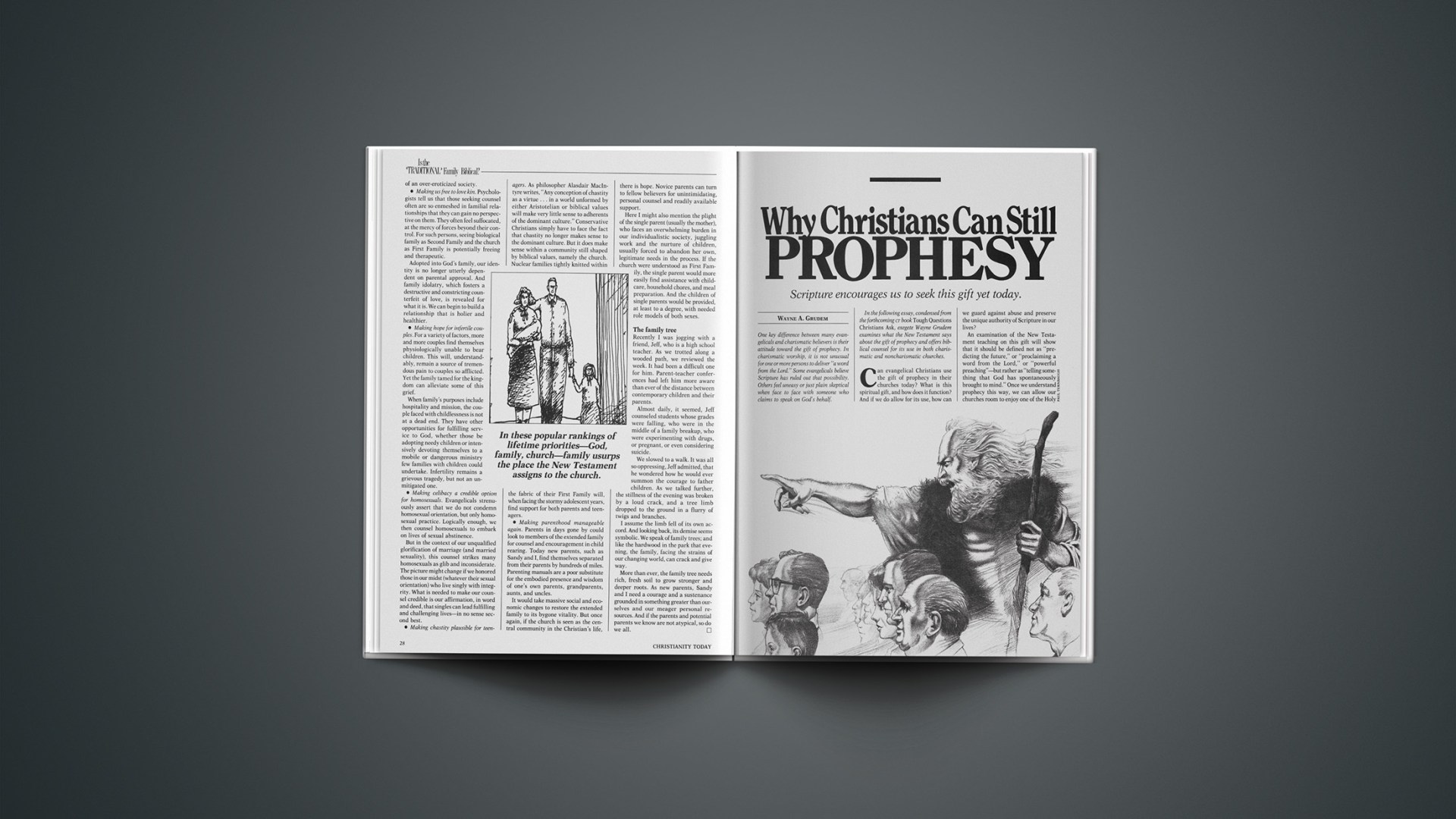
Why Christians Can Still Prophesy

Scripture encourages us to seek this gift yet today.

One key difference between many evangelicals and charismatic believers is their attitude toward the gift of prophecy. In charismatic worship, it is not unusual for one or more persons to deliver “a word from the Lord.” Some evangelicals believe Scripture has ruled out that possibility. Others feel uneasy or just plain skeptical when face to face with someone who claims to speak on God’s behalf.

In the following essay, condensed from the forthcoming CT book Tough Questions Christians Ask, exegete Wayne Grudem examines what the New Testament says about the gift of prophecy and offers biblical counsel for its use in both charismatic and noncharismatic churches.

Can evangelical Christians use the gift of prophecy in their churches today? What is this spiritual gift, and how does it function? And if we do allow for its use, how can we guard against abuse and preserve the unique authority of Scripture in our lives?

An examination of the New Testament teaching on this gift will show that it should be defined not as “predicting the future,” or “proclaiming a word from the Lord,” or “powerful preaching”—but rather as “telling something that God has spontaneously brought to mind.” Once we understand prophecy this way, we can allow our churches room to enjoy one of the Holy Spirit’s most edifying gifts.

Less Authority Then Scripture

How did the New Testament church regard the gift of prophecy? Did it have more or less authority than Scripture or apostolic teaching? Let us compare what the two testaments say about prophecy.

Old Testament prophets had an amazing responsibility—to speak and write words that had absolute divine authority. They could say, “Thus says the Lord,” and what followed were the very words of God. They wrote their words as God’s words in Scripture for all time (see Deut. 18:18–20; Jer. 1:9; Num. 22:38; Ezek. 2:7). Therefore, to disbelieve or disobey a prophet’s words was to disbelieve or disobey God (Deut. 18:19; 1 Sam. 8:7; 1 Kings 20:36).

In the New Testament there were also people who could speak and write God’s very words and record them as Scripture. However, Jesus no longer called them “prophets,” but used a new term, “apostles.” The apostles are the New Testament counterpart to the Old Testament prophets (see, for example, Gal. 1:8–9, 11–12; 1 Cor. 2:13; 14:37; 2 Cor. 13:3; 1 Thess. 2:13; 4:8, 15; 2 Pet. 3:2). It is the apostles, not the prophets, who have authority to write the words of New Testament Scripture. And when the apostles want to establish their unique authority, they never appeal to the title prophet, but rather call themselves “apostles” (Rom. 1:1; 1 Peter 1:1).

Is Prophecy Too Subjective?

The “gift of prophecy” requires waiting on the Lord, listening for his prompting in our hearts. Christians who are completely evangelical, doctrinally sound, intellectual, and “objective,” probably need most the balancing influence of a vital “subjective” relationship with the Lord. And these people are also those who have the least likelihood of being led into error, for they already place great emphasis on solid grounding in the Word of God.

Yet there is an opposite danger of excessive reliance on subjective impressions for guidance, and we must clearly guard against that. People who continually seek subjective messages from God to guide their lives must be cautioned that subjective personal guidance is not the main function of New Testament prophecy. They need to place more emphasis on seeking God’s sure wisdom written in Scripture.

Many charismatic writers would agree with this caution from Anglican charismatic pastor Michael Harper: “Prophecies which tell other people what they are to do—are to be regarded with great suspicion.”

And Donald Gee of the Assemblies of God says, “Many of our errors where spiritual gifts are concerned arise when we want the extraordinary and exceptional to be made the frequent and habitual. Let all who develop excessive desire for ‘messages’ through the gifts take warning from the wreckage of past generations as well as of contemporaries.… The Holy Scriptures are a lamp unto our feet and a light unto our path.”

By Wayne A. Grudem.

Why did Jesus use this new term? It was probably because the Greek word prophētēs at the time of the New Testament had a very broad range of meanings. It generally did not have the sense of “one who speaks God’s very words,” but rather “one who speaks on the basis of some external influence” (often a spiritual influence of some kind).

Titus 1:12 uses the word this way, where Paul quotes a pagan poet: “One of their own prophets has said, ‘Cretans are always liars, evil brutes, lazy gluttons’ ” (NIV). The soldiers who mock Jesus also seem to use the word prophesy this way, when they blindfold Jesus and demand, “Prophesy! Who is it that struck you?” (Luke 22:64). They do not mean, “Speak words of absolute divine authority,” but “Tell us something that has been revealed to you.”

Many writings outside the Bible use the Greek word prophētēs in this way, without signifying any divine authority in the words of the “prophet.” In fact, by the time of the New Testament, the term prophet in everyday use often simply meant “one who has supernatural knowledge” or “one who predicts the future”—or even just “spokesman” (without any connotation of divine authority).

Of course, the words prophet and prophecy could sometimes be used of the apostles when the context emphasized an external spiritual influence (from the Holy Spirit) under which they spoke (see Rev. 1:3; 22:7; Eph. 2:20; 3:5), but this was not the ordinary terminology used for the apostles, nor did the terms prophet and prophecy in themselves imply divine authority for their speech or writing.

Much more commonly, prophet and prophecy were used of ordinary Christians who spoke not with absolute divine authority, but simply to report something God had laid on their hearts or brought to their minds. There are many indications in the New Testament that this ordinary gift of prophecy had authority less than that of the Bible, and even less than that of recognized Bible teaching in the early church.

Testing The Prophecies

There are clear indications that New Testament prophets did not speak with divine authority. For example, in Acts 21:4, we read of the disciples at Tyre: “Through the Spirit they told Paul not to go on to Jerusalem.” This seems to be a reference to prophecy directed towards Paul, but Paul disobeyed it. He never would have done this if this prophecy contained God’s very words.

Then in Acts 21:10–11, Agabus prophesied that the Jews at Jerusalem would “bind Paul and deliver him into the hands of the Gentiles,” a prediction that was only nearly correct—the Romans, not the Jews, bound Paul (v. 33), and the Jews did not deliver him voluntarily, but tried to kill him, and Paul had to be taken from them by force. Such inaccuracies in detail would have called into question the validity of any Old Testament prophet.

Paul tells the Thessalonians, “Do not despise prophesying, but test everything, hold fast to what is good” (1 Thess. 5:20–21). If prophecy had equalled God’s word in authority, he would never have had to tell them not to despise it, for they had “received” and “accepted” God’s word “with joy from the Holy Spirit” (1 Thess. 1:6; 2:13; cf. 4:15). But when Paul tells them to “test everything,” it must include the prophecies mentioned in the previous phrase. He implies that prophecies contain some things that are good and some that are not when he encourages them to “hold fast to that which is good.” This could never have been said of the words of an Old Testament prophet, or the authoritative teachings of a New Testament apostle.

Moreover, in Acts 21:9, we read that Philip had “four unmarried daughters who prophesied.” Whatever we may think about the appropriateness of Bible teaching by women today, this prophesying would be difficult to reconcile with prohibitions against authoritative teaching by women (see 1 Tim. 2:12) if prophecy had absolute divine authority, or even authority greater than or equal to Bible teaching. Similar reasoning applies to 1 Corinthians 11:5 where Paul allows women to prophesy in church even though he later apparently forbids them to speak up publicly during the evaluation or judging of prophecies (1 Cor. 14:34–35).

Sifting Prophecies In Corinth

Let us look more closely at 1 Corinthians 14, where extensive evidence on New Testament prophecy can be found. When Paul says, “Let two or three prophets speak and let the others weigh what is said” (v. 29), he suggests that they should listen carefully and sift the good from the bad. We cannot imagine that an Old Testament prophet like Isaiah would have said, “Listen to what I say and weigh what is said—sort the good from the bad, what you accept from what you should not accept”! If prophecy had absolute divine authority, this would have been sin. But here Paul commands that it be done.

In verse 30, Paul allows one prophet to interrupt another one: “If a revelation is made to another sitting by, let the first be silent. For you can all prophesy one by one.” If prophets had been speaking God’s very words, it is hard to imagine that Paul would say they should be interrupted and not allowed to finish their message.

Paul suggests that no one at Corinth, a church that had much prophecy, was able to speak God’s very words. He says in verse 36, “What! Did the word of God come forth from you, or are you the only ones it has reached?”

All these passages indicate that the common idea that prophets spoke “words of the Lord” when the apostles were not present in the early churches is simply incorrect.

There is one other type of evidence that New Testament congregational prophets spoke with less authority than the apostles or Scripture: The apostles did not solve the problem of who would speak for God when they were gone by encouraging Christians to listen to “prophets,” but by pointing to Scripture.

So Paul, at the end of his life, emphasizes “rightly handling the word of truth” (2 Tim. 2:15), and the “God-breathed” character of Scripture “for teaching, for reproof, for correction, and for training in righteousness” (2 Tim. 3:16). Jude urges his readers to “contend for the faith which was once for all delivered to the saints” (Jude 3). Peter, at the end of his life, encourages his readers to “pay attention” to Scripture, which is like “a lamp shining in a dark place” (2 Pet. 1:19–20), and reminds them of the teaching of the apostle Paul “in all his letters” (2 Pet. 3:16). In no case do we read exhortations to “give heed to the prophets in your churches” or to “obey the words of the Lord through your prophets.”

There certainly were prophets in local congregations after the death of the apostles. But it seems they did not have authority equal to the apostles—and the authors of Scripture knew that.

Not “The Words Of God” For Today

If the New Testament authors considered congregational prophecies to be sometimes flawed and definitely less authoritative than either Scripture or apostolic teaching, we in the church today should consider prophecy to be merely human words, not God’s words, and not equal to God’s words in authority. But does this conclusion conflict with current charismatic teaching or practice? I think it conflicts with much charismatic practice, but not with most charismatic teaching.

Most charismatic teachers today would agree that contemporary prophecy is not equal to Scripture in authority. Though some speak of prophecy as being the “word of God” for today, there is almost uniform testimony from all segments of the charismatic movement that prophecy is imperfect and impure, and will contain elements that are not to be obeyed or trusted.

For example, Bruce Yocum, author of a charismatic book on prophecy, writes, “Prophecy can be impure—our own thoughts or ideas can get mixed into the message we receive—whether we receive the words directly or only receive a sense of the message.… (Paul says that all our prophecy is imperfect.)”

But it must be said that in actual practice much confusion results from the habit of prefacing prophecies with the Old Testament phrase “Thus says the Lord” (a phrase not used by any recorded prophets in New Testament churches). This is unfortunate, because it gives the impression that the words that follow are God’s very words, whereas most responsible charismatic spokesmen would not want to claim it for every part of their prophecies anyway. There would be much gain and no loss if that phrase were dropped.

If someone really does think God is bringing something to mind that should be reported in the congregation, there is nothing wrong with saying, “I think the Lord is putting on my mind that …” or some similar expression. Of course, that does not sound as forceful as “Thus says the Lord,” but if it is really from God, the Holy Spirit will cause it to speak with great power to the hearts of those who need to hear.

If prophecy does not contain God’s very words, then in what sense is it a gift from God?

Paul indicates that God could bring something spontaneously to mind so that the person prophesying would report it in his or her own words. Paul calls this a “revelation”: “If a revelation is made to another sitting by, let the first be silent. For you can all prophesy one by one, so that all may learn and all be encouraged” (1 Cor. 14:30–31).

Paul is simply referring to something that God may bring to mind or impress on someone’s heart in such a way that the person has a sense that it is from God. It may be that the thought is surprisingly distinct from the person’s own train of thought, or accompanied by a sense of urgency or persistence.

Thus, if a stranger comes in and all prophesy, “the secrets of his heart are disclosed; and so, falling on his face, he will worship God and declare that God is really among you” (1 Cor. 14:25). I heard a report of this happening in a clearly noncharismatic Baptist church in America: A missionary speaker paused in the middle of his message and said something like this: “I didn’t plan to say this, but it seems the Lord is indicating that someone in this church has just walked out on his wife and family. If that is so, let me tell you that God wants you to return to them and learn to follow God’s pattern for family life.” The missionary did not know it, but in the unlit balcony sat a man who had entered the church for the first time just moments before. The description fit him exactly, and he made himself known, acknowledged his sin, and began to seek after God.

Prophecy And Teaching: What’S The Difference?

New Testament prophecy was based on spontaneous promptings from the Holy Spirit (compare Acts 11:28; 21:4, 10–11; and note also the ideas of prophecy that are represented in Luke 7:39; 22:63–64; John 4:19; 11:51).

By contrast, no human speech that is called “teaching” is ever said to be based on a revelation in the New Testament. Rather, teaching is often simply an explanation or application of Scripture (Acts 15:35; 11:12, 26; Rom. 2:21; 15:4; Col. 3:16; Heb. 5:12) or a repetition and explanation of apostolic instructions (Rom. 16:17; 2 Tim. 2:2; 3:10). It is what we would call “Bible teaching” or “preaching” today.

Although a few people have claimed that the prophets in New Testament churches gave “charismatically inspired” interpretations of Scripture, it is hard to find any convincing examples in the New Testament where the “prophet” word group is used to refer to someone interpreting Scripture.

Prophecy has less authority than teaching, and prophecies in the church are always to be subject to the authoritative teaching of Scripture. The Thessalonians were not told to hold firm to the traditions that were “prophesied” to them but to the traditions they were “taught” by Paul (2 Thess. 2:15). It was teachers, not prophets, who gave leadership and direction to the early churches.

Among the elders, therefore, were “those who labor in the word and teaching” (1 Tim. 5:17), and an elder was to be “an apt teacher” (1 Tim. 3:2; cf. Titus 1:9). But nothing is said about any elders whose work was prophesying. In his leadership, Timothy was to take heed to himself and to his “teaching” (1 Tim. 4:16), but he was never told to take heed to his prophesying. James warned that those who teach, not those who prophesy, will be judged with greater strictness (Jas. 3:1).

The distinction is clear: If a message is the result of conscious reflection on the text of Scripture, containing interpretation and application to life, then it is teaching. But if a message is the report of something God brings suddenly to mind, then it is a prophecy. Of course, even prepared teachings can be interrupted by unplanned additional material the teacher suddenly feels God is bringing to his mind. This would be a teaching with prophecy mixed in.

By Wayne A. Grudem.

In this way, prophecy serves as a “sign” for believers (1 Cor. 14:22)—a clear demonstration that God is at work in their midst. And since it will work for the conversion of unbelievers as well, Paul encourages this gift to be used when “unbelievers or outsiders enter” (1 Cor. 14:23).

Many of us have experienced or heard of similar events: For example, an unplanned but urgent request may have been given to pray for certain missionaries. Much later those who prayed discovered that just at that time the missionaries had been in an auto accident or at a point of intense spiritual conflict, and had needed those prayers. Paul would call the intuition of those things a “revelation,” and the report to the assembled church of that prompting from God, a “prophecy.” It may have elements of the speaker’s own understanding in it, and it certainly needs to be tested; yet it is of value in the church.

The Benefits Of Prophecy

Prophecy in the New Testament is not merely “predicting the future.” There were some predictions (Acts 11:28; 21:11), but there was also the disclosure of sins (1 Cor. 14:25). In fact, anything that edified could have been included, for Paul says, “He who prophesies speaks to men for their upbuilding and encouragement and consolation” (1 Cor. 14:3). Here is another indication of the value of prophecy: It could speak to the needs of people’s hearts in a spontaneous, direct way.

At two significant points in our marriage, my wife, Margaret, and I visited and prayed with Christian friends in another part of the United States. On both occasions, during our time of prayer, the husband of the family paused and spoke a sentence directly to Margaret. On both occasions, the messages hit home and brought the Lord’s comfort regarding deep concerns we had not mentioned at all. Here is the value of prophecy for “upbuilding and encouragement and consolation.”

There is another great benefit of prophecy: It provides opportunity for everyone in the congregation to participate, not just those who are skilled speakers or who have gifts of teaching. Paul says he wants all the Corinthians to prophesy (1 Cor. 14:5). And he says, “You can all prophesy one by one, so that all may learn and all be encouraged” (v. 31). Greater openness to the gift of prophecy could help cure the malaise in our churches where many are mere spectators. Perhaps we contribute to the problem of spectator Christianity by quenching the work of the Spirit in this area.

Until The Lord Conies

Many evangelicals claim that gifts such as prophecy were given to the church for the apostolic age only. The apostle Paul, on the other hand, expected prophecy to continue until the Lord returns.

Paul says, “Our prophecy is imperfect; but when the perfect comes, the imperfect will pass away” (1 Cor. 13:9–10). So he says that prophecy will pass away at a certain time, namely, “when the perfect comes.” But when is that? It has to be when the Lord returns, because it has to be the same time indicated by the word then in verse 12: “Now we see in a mirror dimly, but then face to face. Now I know in part; then I shall understand fully, even as I have been fully understood.” Face to face is an Old Testament phrase for seeing God personally (see Gen. 32:30; Exod. 33:11; Deut. 5:4; 34:10; Judg. 6:22; Ezek. 20:35—the only Old Testament occurrences of this phrase, and they all refer to seeing God). The time when I shall know “as I have been known” also must refer to the Lord’s return.

Some have argued that “when the perfect comes” refers to the time when the New Testament canon is complete. (Revelation, the last book to be written, was composed at the latest about 35 years after 1 Corinthians.) But would the Corinthians ever have understood that from what Paul wrote? Is there any mention of a collection of New Testament books anywhere in the context of 1 Corinthians 13? Such an idea is foreign to the context. Moreover, such a statement would not fit Paul’s purpose. Would it be persuasive to argue as follows: “We can be sure that love will never end, for we know that it will last more than 35 years!”? This would hardly be convincing. The context requires rather that Paul be contrasting this age with the age to come, and saying that love will endure into eternity.

D. Martyn Lloyd-Jones observes that the view that makes “when the perfect comes” equal the time of the completion of the New Testament encounters another difficulty: “It means that you and I, who have the Scriptures open before us, know much more than the apostle Paul of God’s truth.… It means that we are altogether superior … even to the apostles themselves, including the apostle Paul! It means that we are now in a position in which … ‘we know, even as also we are known’ by God.… Indeed, there is only one word to describe such a view, it is nonsense.”

The conclusion is that in 1 Corinthians 13:10 Paul says that prophecy will continue in the church until Christ returns.

Paul valued this gift so highly that he told the Corinthians, “Make love your aim, and earnestly desire the spiritual gifts, especially that you may prophesy” (1 Cor. 14:1). Then, at the end of his discussion of spiritual gifts, he said again, “So, my brethren, earnestly desire to prophesy” (1 Cor. 14:39). And he said, “He who prophesies edifies the church” (1 Cor. 14:4).

If Paul was eager for the gift of prophecy to function at Corinth, troubled as the church was by immaturity, selfishness, and divisions, then should we not also actively seek this valuable gift in our congregations today? We evangelicals who profess to believe and obey all that Scripture says, should we not also believe and obey this? And might a greater openness to the gift of prophecy perhaps help to correct a dangerous imbalance in our church lives, lives that are too often exclusively intellectual, objective, and narrowly doctrinal?

A Cautious Approach

All Christians who desire to use the gift of prophecy in their churches, but especially pastors and others who have teaching responsibilities, would be wise to take several steps:

• Pray seriously for the Lord’s wisdom on how and when to approach this subject in the church.

• Teach on this subject, if you have teaching responsibilities, in the regular Bible teaching times that the church already provides.

• Be patient and proceed slowly—church leaders should not be “domineering” (1 Pet. 5:3), and a patient approach will avoid frightening people or alienating them unnecessarily.

• Recognize and encourage the gift of prophecy in ways it has already been functioning—at church prayer meetings, for example, when someone has felt unusually led by the Spirit to pray for something, or when it has seemed that the Spirit was bringing to mind a hymn or Scripture passage, or giving a common sense of the focus of a time of group worship.

Even Christians in churches not open to prophecy can be sensitive to promptings from the Holy Spirit regarding what to pray for in church prayer meetings, and can then express those promptings in the form of a prayer.

• If the first four steps have been followed, and if the congregation and its leadership will accept it, make opportunities for the gift of prophecy in the less formal worship services of the church, such as Sunday evenings, Wednesday prayer meetings, or smaller house groups. If this is allowed, those who prophesy should be kept within Scriptural guidelines (1 Cor. 14:29–36), should genuinely seek the edification of the church and not their own prestige (1 Cor. 14:12, 26), and should not dominate the meeting or be overly dramatic in their speech (and thus attract attention to themselves rather than to the Lord). Prophecies should be evaluated according to the teachings of Scripture.

• If the gift of prophecy begins to be used in your church, place even more emphasis on the vastly superior value of Scripture as the place where Christians can always go to hear the voice of the living God. Prophecy is a valuable gift, but it is in Scripture that God speaks to us his very words today. Rather than hoping at every worship service that the highlight will be some word of prophecy, those who use the gift of prophecy need to be reminded that we should focus our expectation of hearing from God toward the Bible, and we should delight in God himself as he speaks through the Bible. And rather than seeking frequent guidance through prophecy, we should emphasize that it is in Scripture that we are to find guidance for our lives.

Wayne A. Grudem is associate professor of biblical and systematic theology at Trinity Evangelical Divinity School, Deerfield, Illinois. He is the author of The Gift of Prophecy in the New Testament and Today (Crossway) and 1 Peter in the Tyndale New Testament Commentary (Eerdmans).

Is the “Traditional” Family Biblical?

The answer begins with a better understanding of the church and its role as First Family.

A few weeks after we learned that my wife, Sandy, was pregnant with our first child, we spent a summer weekend with a friend at his parents’ lakeside home. On Saturday night all of us, except Sandy, stayed up late. Tired by sailing and swimming, she retired early.

Around midnight I decided to join her, but when I opened the door into the bedroom, I saw Sandy sitting straight up in bed. She looked shocked, as if she were in extreme pain. I asked her what was wrong, and before she could answer I had crossed the room and was sitting next to her, pressing urgently on her abdomen. “It’s my allergies,” she said. “My throat is burning up.”

It was hard not to display my relief. Sandy was no less distressed, but the baby was in no danger, and that had been my immediate, visceral fear.

Looking back on the moment, I was intrigued by the intensity of my protective feelings. I had heard plenty of fathers talk about how much their children meant to them, but still I was surprised when the feelings overwhelmed me, unbidden, and certainly uncultivated during the four or five years I had debated whether or not I truly wanted children.

Of course, starting a family “changes your life”—if I ever had a question about that, it dissolved with Sandy’s pregnancy. But certain Scriptures made me wonder: Does it automatically change your life for the better in Christian terms? Does it make you more likely and better equipped to serve God and others?

These seemed to be important questions, considering the enormous emotional, spiritual, physical, and financial investment that children entail. So while Sandy’s waistline expanded, my library did as well. I was on a search: reading, praying, consulting those wiser than me to appreciate better two of the most important questions one could ever ask: Why do Christians have children? What is the purpose of family?

Are The Gospels Profamily?

There is good reason to doubt the Gospels are as profamily as we often pretend they are. After all, in their accounts Jesus is unmarried, and his 12 disciples are either single or leave families as decisively as they drop their fishing nets. Even as a boy, Jesus exhibits a startling detachment from his biological family. Luke records anxious parents returning to the Jerusalem temple, asking their son why he has been so inconsiderate of their feelings. His bemused reply signaled his own priority: “Did you not know I was bound to be in my Father’s house?” (Luke 2:49; all references, NEB).

Later in the Gospels, the adult Jesus forthrightly proclaims a kingdom that will—he makes no bones about it—divide and destroy families. Brother will betray brother to death; parents and children will turn on one another (Matt. 10:21). “I have come,” Jesus says, “to set a man against his father, a daughter against her mother, a son’s wife against her mother-in-law …” (Matt. 10:35).

To one who wishes to bury his father before initiating his own discipleship, Jesus bluntly demands, “Leave the dead to bury their dead; you must go and announce the kingdom of God” (Luke 9:60). He suggests a recent marriage is an inadequate reason to delay answering the call of the kingdom (Luke 14:18–20). And, echoing his childhood words in the temple, he deems that his true mother, brothers, and sisters are not his biological kin, but those who do the will of God are (Mark 3:35). “No man is worthy of me who cares more for father or mother than for me; no man is worthy of me who cares more for son or daughter; no man is worthy of me who does not take up his cross and walk in my footsteps” (Matt. 10:37–38).

As hard as these words are to hear today, they must have been even more difficult to their original audience. In Jesus’ day the family was integrally linked to economic survival. More than that, the Hebrew tradition promised personal survival after death mainly through the memory of one’s children. (This fact largely accounts for the anguish of Old Testament men and women who were unable to produce heirs.)

In Jesus’ eyes, however good family may be, it is not sacred. Family—like possessions, reputation, and religion itself—is clearly subordinated to the mission of the kingdom of God.

In Need Of Redemption

The Gospels make me look harder at family, forcing me to stop merely applauding family as it is and to ask what it should be in the light of Christ. In subordinating the natural family to the kingdom, Jesus was apparently indicating that it, too, stands in need of redemption.

My own family life has been decidedly positive, but the experience of some friends has taught me how destructive it can be. Some tell of huddling in childhood bedrooms, listening to their parents fight and damn one another. Others remember extramarital affairs, dictatorial stepfathers, and weakened mothers who expected their children to stabilize a capsizing world. Today these friends struggle with their own relationships, with an inability to trust, with a lurking suspicion of the universe in general and God in particular. Apparently there are few wounds that sear deeper, or last longer, than those inflicted by family.

But the message of the gospel is that family needs to be, and can be, redeemed. In their own way, the ancient Hebrews looked ahead to this hope in God. They were sometimes caught up in the fatalism of believing they could never escape the repetition and effects of the sins of their fathers. This fatalism is reflected in a proverb repeated twice in the Old Testament: “The fathers have eaten sour grapes, and the children’s teeth are set on edge.”

But the proverb is refuted in both of the instances it is cited (Jer. 31:29–30 and Ezek. 18:2–3). God offers a new beginning, and will consequently call each to account only for his or her own sins.

Hope for a new beginning, for a breaking of the cycle of pain, is exactly what my friends from unfortunate families need. If they had nothing to look to beyond family, if that was the only place they could go for love and meaning, they would be locked in despair. But since family is not sacred, since there is a gracious God above and beyond it, they can transcend the ugly limitations put on them by their natural families. In fact, so may we all, since—no matter how idyllic our families—we are all wounded to some degree.

Bourgeois Or Biblical?

Any current search for the purpose of family encounters the many Christian appeals made today on behalf of the “traditional family.” Is this family according to God’s purposes?

In Evangelicalism: The Coming Generation, sociologist James Davison Hunter and coauthor Helen V. L. Stehlin draw from the avalanche of evangelical literature on the family and conclude that evangelicals have adopted a nineteenth-century bourgeois (that is, a middle-class) understanding of family. This view concentrates on family as a place of peace and familiarity, a refuge from the hard world of commerce and politics. For evangelicals, Hunter and Stehlin believe, “The utopian qualities of the notion of family and home as Edenic retreat cannot be overemphasized.”

They cite several evangelical family books:

• “In such times as these … the Christian home should be a holy refuge. A place of peace. An enclave of loving authority and Godly grievances and truth.”

• “Our earthly family should be the ones to whom we want to run, cry, telephone, telegraph—when we feel overwhelmed by failure! An earthly family is meant to be a shelter, a solid, dependable ‘ear’ that will hear and understand, as well as a place to run.”

• “[The home is] an island of serenity and support and in a hectic, plastic, often avaricious world. A Christian oasis far from the maddening throng and godless currents and pressures.”

Surely there are valuable and biblically valid features inherent in the bourgeois family. But just as clearly, there are problems with adopting this as the traditional family, the model for families today.

The meaning and purposes of the family have, in fact, changed through the ages. From the late Middle Ages into the eighteenth century, the family served as an economic unit (with the entire household, including children, working to fill the family table) and a vehicle for the transmission of property from generation to generation. Medieval family life, unlike today’s evangelical ideal, was hardly a private refuge or shelter.

With the Industrial Revolution, work was separated from home, and urbanization developed, dividing nuclear families from a hamlet hub of relatives and placing them in cities with thousands of strangers. Eventually, the middle classes no longer needed to concentrate on mere economic survival. And only then, within the past two centuries, was the stage set for a family whose raison d’être was the cultivation of intimacy. On a simple historical basis, then, we cannot identify this “traditional” family with biblical family.

Other aspects of the bourgeois family clash with family submitted to the redemptive and transforming gospel. Bourgeois family is exclusivistic, emphasizing its privacy over the good of others. It leaves the public life of commerce and industry untouched by the ideals of the kingdom, while maintaining its private comfort and order. Bourgeois family is flawed to the degree that it helped us so long neglect the social implications of the kingdom. It is flawed to the degree that it encourages blithe individualism and erodes a sense of the common good.

One other shortcoming of the bourgeois family needs mentioning. In its aim to be a private haven, this version of family often displaces the church. For years it has been popular among evangelicals to list three lifetime priorities, in this order: God, family, and church. More blatantly, one evangelical family expert has written that “family—next to God—is the most important and influential agent on earth.” In these popular rankings, family usurps the place the New Testament assigns to the church. It is “through the church,” according to Ephesians 3:10, that “the wisdom of God in all its varied forms” is made known to the powers and principalities. It is the church, according to 1 Peter 2:9, that is called to “proclaim the triumphs of him who has called you out of darkness into his marvelous light.” And we are, above all—according to 1 Corinthians 14—to seek and cultivate gifts that “build up the church.”

First Family, Second Family

I found myself led to reconsider, then, the family’s relation to the church. And in the strange seventh chapter of 1 Corinthians, I found a handle on the matter. I say “strange” because here Paul’s statements run hard against our modern grain.

Biblical scholars tell us we can shed some light on this enigmatic chapter only if we realize that here Paul is presenting the kingdom’s most radical implications for family life. He is telling the Corinthians how to understand and live their intimate lives in light of the fact that the Messiah has come and, with him, the beginning of the world’s end (v. 29). As New Testament scholar Gordon Fee comments, this means “that the future, which was set in motion by the event of Christ and the Spirit, has been ‘shortened’ so that it is now in plain view.”

Seeing how the story will come out shapes how we live in the present. And in Christ, Paul reminds the Corinthians, we know the end of the world’s story. Christ will vanquish sin and death. “Paul’s concern, therefore, is not with the amount of time [the Corinthians] have left, but with the radical new perspective the ‘foreshortened future’ gives one with regard to the present age,” Fee writes. “Those who have a definite future and see it with clarity live in the present with radically altered values as to what counts and what does not. In that sense it calls for those who want to get married to rethink what that may mean.…”

Here, then, is Paul’s clear call to reenvision family and singleness as they encounter the kingdom come. They are transcended and limited by the “shortening” of the present age. Family (and celibacy, too) belong to the frame of things passing away (v. 31). Accordingly, in Fee’s words, we are beckoned to live “totally free from its control,” no longer determined or entrapped by it.

Paul is not at all condemning marriage or family. (As do neither Jesus nor Scripture in general: Consider Gen. 2–3, the Decalogue, Song of Solomon, Prov. 30:10–31; Mark 10:6–9; John 2:1–11; Eph. 5:21–33; 1 Tim. 5:14; Heb. 13:4, and 1 Peter 3:1–7.) He is careful only to instruct the Corinthians that they are now free to live in the world without living by its values.

In the words of theologian Stanley Hauerwas, no longer was one’s future “guaranteed by the family, but by the church. The church, that harbinger of the kingdom of God, is now the source of our primary loyalty.” And the church is itself a family. Jesus tells his disciples they may lose families, but will receive new ones a hundredfold (Mark 10:29–30). He invites them to recognize and pray to a new Father, “who art in heaven” (Matt. 6:9). Christians are adopted, out of slavery, into God’s family (Rom. 8:14–16; Gal. 4:5–7). The church is a “household of faith” (Gal. 6:10).

For the Christian, church is First Family. The biological family, though still valuable and esteemed, is Second Family. Husbands, wives, sons, and daughters are brothers and sisters in the church first and most importantly—secondly they are spouses, parents, or siblings to one another.

And exactly as family is how the New Testament church behaves: opening homes to the Christian community (Acts 2:46; 1 Cor. 16:15), extending hospitality to a wide network of Christians, including missionaries and even those on business trips (2 Cor. 8:23). It is no accident that the church’s central sacrament, the Lord’s Supper, symbolizes a basic domestic activity.

Tamed For The Kingdom

If, then, family is itself in need of reformation, what might that reformed family look like? What alterations in our vision of family do Jesus and Paul introduce in fidelity to the kingdom?

We cannot ignore the fact that they assert the value of singleness. To be single is not to be a second-class member of the church, nor simply to be in a holding pattern until one can land in the higher state of marriage. The single man or woman, far from being spiritually crippled, is especially free and unencumbered for mission (1 Cor. 7:32–34). The faithful single, moreover, is a living sign that all Christians’ ultimate trust and approval comes from God, not posterity. Singles and marrieds share the First Family of the church, and should complement one another in that family, each bringing special gifts and resources to the service of the kingdom.

Marriage, in light of the biblical vision, channels sexuality to the service of the kingdom. Sexuality can be shaped and used for different ends. For instance, as C. S. Lewis observed, “There are people who want to keep our sex instinct inflamed in order to make money out of us. Because, of course, a man with an obsession is a man who has very little sales resistance.” This is sexuality in service of Mammon, sexuality trivialized and rendered manipulative.

Sexuality in service of the kingdom, on the other hand, is substantially free of its destructive possibilities. It is freed from service to compulsive promiscuity, dissolution, or trivial hedonism, and instead binds one person to another in love and continuing commitment. On one level, married sexuality is simply an enjoyment of God’s gracious creation, male and female. But on another level, it is the base for a stable home from which to minister to the wider Christian community.

If Paul in 1 Corinthians 7 almost seems to present singleness as a higher station in the kingdom, we do well to remember that in other contexts he is effusive in his praise for married couples whose homes are apparently the hub of the church in several cities (Rom. 16:5, 23; 1 Cor. 16:15, 19; Col. 4:15; Philemon 2). Singles have the missionary advantage of mobility, but marrieds have the missionary advantage of hospitality.

It is impossible to read Scripture and not notice that hospitality is a crucial Christian virtue. Unlike the bourgeois family, Christian family is haven not only for the members of the nuclear family. Christians are called to open their homes to others, and particularly other Christians: “Never cease to love your fellow-Christians. Remember to show hospitality. There are some who, by so doing, have entertained angels without knowing it” (Heb. 13:1–2).

Hospitality, I discovered, may be the key to answering the difficult question, Why do Christians have children? The kingdom beckons us to the arduous task of loving other people, with all their concrete faults.

Children, seen in this light, are precious gifts given to us so that—among other things—we might learn how to love others. Parents cannot deny that their children are different persons from themselves. Yet to see through their eyes is to see the world afresh.

As Jesus suggested in his embrace of children, their free dependency and openness ushers them into the kingdom of God (Mark 10:13–16). Thus, children teach that others bring newness and change that is sometimes unimaginably better than what we had formerly accepted as unalterable. When we learn how to love a child, we are acquiring a transferrable skill—the skill of loving others.

It is children and others who kindle our imaginations in new and unexpected ways, enabling us to become the sort of people we could never have been without them. So openness to children also signifies openness to the future, to the belief that there is a future. What, after all, could be a more profound signal of one’s despair for the future than the refusal to have children?

The Christian family, then, bears children to bear witness. It bears witness to the Christian trust that there is more to this world than sorrowfully meets the eye. It signifies that everything is not up to us bedraggled men and women who live in the present; that we need no longer be slaves to the tyrannical illusion of self-sufficiency. Children are sign gifts of the love of a God of gracious surprises, to whom we dare entrust not only our own future, but also that of our children.

In Everyday Terms

In general, then, family tamed for the kingdom is both a base of hospitality within the church and a training ground for learning how to live hospitably. But can this make any practical difference? The kingdom-centered family can indeed affect several pressing contemporary issues:

Making divorces fewer. Historian Edward Shorter has observed that marriages were once held together by the indispensable purpose of economic production. Today, sexual intimacy is practically the only thing cementing the marriage relationship. And sexual attachment, while it is a gracious gift of God, is notoriously explosive and unstable. Marriages based on it too easily come apart.

Marriage for the kingdom is different. While rejoicing in sexuality, it tames and harnesses sexuality to serve the needs of mission. Those couples who see their marriage as a station for evangelism and hospitality will not find it as easily shaken by the tremors of an over-eroticized society.

Making us free to love kin. Psychologists tell us that those seeking counsel often are so enmeshed in familial relationships that they can gain no perspective on them. They often feel suffocated, at the mercy of forces beyond their control. For such persons, seeing biological family as Second Family and the church as First Family is potentially freeing and therapeutic.

Adopted into God’s family, our identity is no longer utterly dependent on parental approval. And family idolatry, which fosters a destructive and constricting counterfeit of love, is revealed for what it is. We can begin to build a relationship that is holier and healthier.

Making hope for infertile couples. For a variety of factors, more and more couples find themselves physiologically unable to bear children. This will, understandably, remain a source of tremendous pain to couples so afflicted. Yet the family tamed for the kingdom can alleviate some of this grief.

When family’s purposes include hospitality and mission, the couple faced with childlessness is not at a dead end. They have other opportunities for fulfilling service to God, whether those be adopting needy children or intensively devoting themselves to a mobile or dangerous ministry few families with children could undertake. Infertility remains a grievous tragedy, but not an unmitigated one.

Making celibacy a credible option for homosexuals. Evangelicals strenuously assert that we do not condemn homosexual orientation, but only homosexual practice. Logically enough, we then counsel homosexuals to embark on lives of sexual abstinence.

But in the context of our unqualified glorification of marriage (and married sexuality), this counsel strikes many homosexuals as glib and inconsiderate. The picture might change if we honored those in our midst (whatever their sexual orientation) who live singly with integrity. What is needed to make our counsel credible is our affirmation, in word and deed, that singles can lead fulfilling and challenging lives—in no sense second best.

• Making chastity plausible for teenagers. As philosopher Alasdair MacIntyre writes, “Any conception of chastity as a virtue … in a world unformed by either Aristotelian or biblical values will make very little sense to adherents of the dominant culture.” Conservative Christians simply have to face the fact that chastity no longer makes sense to the dominant culture. But it does make sense within a community still shaped by biblical values, namely the church. Nuclear families tightly knitted within the fabric of their First Family will, when facing the stormy adolescent years, find support for both parents and teenagers.

Making parenthood manageable again. Parents in days gone by could look to members of the extended family for counsel and encouragement in child rearing. Today new parents, such as Sandy and I, find themselves separated from their parents by hundreds of miles. Parenting manuals are a poor substitute for the embodied presence and wisdom of one’s own parents, grandparents, aunts, and uncles.

It would take massive social and economic changes to restore the extended family to its bygone vitality. But once again, if the church is seen as the central community in the Christian’s life, there is hope. Novice parents can turn to fellow believers for unintimidating, personal counsel and readily available support.

Here I might also mention the plight of the single parent (usually the mother), who faces an overwhelming burden in our individualistic society, juggling work and the nurture of children, usually forced to abandon her own, legitimate needs in the process. If the church were understood as First Family, the single parent would more easily find assistance with child-care, household chores, and meal preparation. And the children of single parents would be provided, at least to a degree, with needed role models of both sexes.

The Family Tree

Recently I was jogging with a friend, Jeff, who is a high school teacher. As we trotted along a wooded path, we reviewed the week. It had been a difficult one for him. Parent-teacher conferences had left him more aware than ever of the distance between contemporary children and their parents.

Almost daily, it seemed, Jeff counseled students whose grades were falling, who were in the middle of a family breakup, who were experimenting with drugs, or pregnant, or even considering suicide.

We slowed to a walk. It was all so oppressing, Jeff admitted, that he wondered how he would ever summon the courage to father children. As we talked further, the stillness of the evening was broken by a loud crack, and a tree limb dropped to the ground in a flurry of twigs and branches.

I assume the limb fell of its own accord. And looking back, its demise seems symbolic. We speak of family trees; and like the hardwood in the park that evening, the family, facing the strains of our changing world, can crack and give way.

More than ever, the family tree needs rich, fresh soil to grow stronger and deeper roots. As new parents, Sandy and I need a courage and a sustenance grounded in something greater than ourselves and our meager personal resources. And if the parents and potential parents we know are not atypical, so do we all.

1001: A Spiritual Odyssey

What will the Russian Orthodox Church he like after its millennial celebration?

The fate suffered by the venerable Russian orthodox Danilov Monastery in Moscow following the 1917 Bolshevik Revolution symbolizes the relationship between church and state foisted upon the Russian people by its then new Soviet government. Communists gutted its halls and churches, and painted over the icons. They dismantled the bell tower over the main gate and sold its bells to an American. Over time, the 14-acre compound was converted first into an umbrella factory, then a refrigerator plant, and finally a children’s detention center; there the children from the Pentecostal families known as the Siberian Seven were once housed.

Then, in 1983, the Soviet government returned the 700-year-old monastery to the Russian Orthodox Church, and $45 million was spent on its restoration. Last June, with official sanction of the Communist party chief, Mikhail Gorbachev, a culminating event of the 1988 Millennium of Christianity in Kievan Rus’ was celebrated at the reconstructed monastery.

A Curious Church-State Linkage

Throughout 1988, Soviet Communist party leaders have encouraged the celebration of 1,000 years of Christianity on Russian soil. They have even linked the Russian Orthodox Church with Russian patriotism. As early as December 1987, in an interview with NBC’S Tom Brokaw, Mikhail Gorba chev—who only one year earlier had urged “an uncompromising struggle with religion”—promised: “Next year we shall be celebrating the millennium of Christianity.” In subsequent months, further statements supportive of religion were made—particularly of the Russian Orthodox Church.

Whose Millennium Is It?

While traveling in the West in March 1987, Alexei Bychkov, general secretary of the All Union Council of Evangelical Christians-Baptists, told a group of American pastors that no one should say of the church celebrations taking place in the USSR, “It is the millennium of Russian Orthodoxy.” Rather, he urged, it is the millennium of Christianity in Russia.

While no doubt using Russia as a synonym for Soviet Union, Bychkov, a Russian, nevertheless overlooked Ukrainian sensitivities—even as he expressed concern that evangelicals not be slighted by the Orthodox.

Just who were the people baptized in Kiev in 988? Were they Russians, Ukrainians, Byelorussians—or a proto-Slavic people yet to be differentiated in modern nationalistic terms? Ukrainians clearly have geography on their side, with Kiev their historic capital and the Russian heartland lying to the north and east. And because Ukrainians far outnumber Russians in emigration to the West—as well as outorganize and outspend them—the various small Russian Orthodox bodies outside Russia cannot compete with the well-funded efforts of North American Ukrainians.

But the Ukrainians have by no means won the battle of claim to the millennium. When Russia conquered Ukraine centuries ago, the winner took not only the spoils, but also the history. Thus, the writing of Russian history tends to marginalize Ukrainian experience by reducing it to a single chapter in a larger story of the “gathering in of the Russian nations.” According to this interpretation, modern Russia and its Orthodox church are the natural successors of Kievan Rus’. Western Slavic specialists have been heavily influenced by this perspective.

Without question, the Russian Orthodox Church is a descendent of Kievan Christianity. The question is whether it deserves to be designated as the descendent. Recognizing that the Kremlin suppressed both the Ukrainian Autocephalous Orthodox Church and the Ukrainian Catholic Church in the 1930s and 1940s, the politically derived advantage the Moscow Patriarchate enjoys in asserting its ownership of the millennium is evident.

Yet neither Ukrainian nor Russian claims to exclusive ownership of the millennium hold up historically. As Keston College’s Ukrainian researcher Andrew Sorokowski has sensibly put it: Russians, as we think of Russians, and Ukrainians, as we think of Ukrainians, did not exist in 988. Prince Vladimir was no more exclusively a member of either nationality than Charlemagne was exclusively German or French. In all fairness, there are “multiple claimants” to the Kievan legacy.

It is important to remember that evangelicals have outstanding differences with Orthodox and Eastern-Rite Catholic Christians. These include the relative importance of Scriptures and church tradition, the sacraments, ordination, the intercessory role of Mary and saints, icons, and monasticism. Less often noted, however, are the absolutely central tenets of historic Christian faith we share in common, including the integrity and trustworthiness of Scripture, the nature of God, and the saving work of Jesus Christ.

A thousand-year church anniversary in the USSR is hard for evangelicals to grasp. And a history lesson alone is not enough to cause us to develop enthusiasm for the celebration. After all, the event being commemorated was an involuntary, mass conversion (see p. 20). Prizing personal piety and recalling the Reformation, we can hardly be expected to warm to faith by state decree.

Evangelicals might best observe this millennium of Eastern Slavic Christianity by commending Orthodox and Eastern Catholic faithful for remaining true to the undeniable essentials of biblical faith, honoring and learning from Christians tested by persecution, and rejoicing with all Eastern Christian traditions celebrating the millennium.

By Mark Elliott, director of the Institute for the Study of Christianity and Marxism at Wheaton College (Ill.).

Last April 29, in the first meeting in 45 years between heads of state and church, Secretary Gorbachev met with Russian Orthodoxy’s Patriarch Pimen and five other church leaders, and promised “a new law on freedom of conscience.” He declared that “mistakes made with regard to the church and believers in the 1930s and the years that followed are being rectified.” Gorbachev pledged “new approaches to state-church relations” and said that “believers are Soviet people, workers and patriots, and they have the full right to express their convictions with dignity.” He referred to the millennium of Orthodoxy as a “significant milestone” in the history, culture, and political development of Russia.

In the early eighties, as the millennium of Orthodoxy approached, attacks initially appearing in the Soviet press both discredited and downplayed the event. A 1984 government-sponsored panel emphasized that “any attempt to treat the coming of Christianity to Russia as an event of epochal universal significance for the nation must be countered by atheist propagandists with well-argued, serious criticism.” Other pronouncements accused the church of using the millennium to present itself falsely as heir and preserver of the cultural traditions of Russian people. Still other articles belittled Christian morality and attempted to prove the leading role of atheism in both ancient and contemporary Russia.

But following the accession of Mikhail Gorbachev, Soviet authorities began to shift their stance toward the millennial event, endorsing the celebration, and even exploiting it as a proof of perestroika (restructuring). The official Communist party atheist publication, Nauka i religiya (Science and Religion), declared in 1987 that “The Christianization of Rus’ was an epoch-making event, the significance of which transcends confessional and national frontiers.” Also in 1987 the Soviet government even proposed that UNESCO adopt a special resolution: “On the Celebration of the Millennium of the Introduction of the Christianity of Rus.”

The millennium has also been marked by government permission for Orthodox and other Christians to import or print comparatively large quantities of Christian literature. The Russian Orthodox Church, for example, received approval to print 100,000 Bibles—within the USSR. In addition, Metropolitan Filaret of Minsk and Byelorussia received permission through the United Bible Societies for 100,000 copies of the Bible in Ukrainian. The Soviet state also gave the Russian Orthodox Church permission to import 150,000 sets of a three-volume Russian study Bible, which is being reprinted in Scandinavia. And in August, Open Doors International was given permission to send one million New Testaments to Soviet Christians.

A sobor, a main event of the 1988 millennium celebration, was held in early June, and the Soviet government helped the church roll out the red carpet (see sidebar, p. 20). The 1988 millennial celebrations have provided an especially rare glimpse of relations between the Soviet state and its largest church. The life of the Russian Orthodox Church in the USSR—with its 50 to 70 million adherents—is best understood, however, in light of its thousand-year history.

Russian Christianity’S Thousand Years

Traditionally, Orthodox Christianity among Eastern Slavs is dated from the conversion of Prince Vladimir of Rus’, a principality cradled in Kiev. Vladimir was a leader whose turn to Christianity seemed unlikely. Before his conversion, he trod a bloody path, killing relatives and recalcitrant subjects, including two Christians who refused to sacrifice to pagan gods. Preoccupied with sex, war, and power, Vladimir initially spurned the influence of his godly grandmother, Olga, who had encountered Christianity in Constantinople.

The prince’s change of heart in 988 may have been primarily political: religions were rising and paganism was declining in the kingdoms around Kiev. Also, Byzantine Emperor Basil II promised his royal sister, Anna, in marriage to Vladimir if the prince would convert to Christianity. So early in 988 the prince ordered the mass baptism of his subjects in the Dnieper River.

Waiting For The Church’S Gorbachev

Last June’s national council of the Russian Orthodox Church—called a sobor—was only the fourth held since 1917. This was the first sobor since the Bolshevik Revolution to be convened for anything other than election of a new patriarch. It was attended by 74 Russian Orthodox bishops and held in the historic Trinity-Saint Sergius Monastery in Zagorsk, outside Moscow.

Before the sobor, some Orthodox Christians were calling for the resignation of Patriarch Pimen, who is both elderly and ill, and who has carefully cooperated with the government during his 17-year leadership of the church. Although speculation circulated unofficially during the sessions about which younger metropolitan might succeed Pimen, a new patriarch was not elected. Noted Suzanne Massie of Harvard’s Russian Research Center, “I’m waiting for the Gorbachev of the Russian Church.”

A primary accomplishment of the sobor was adoption of a new Polozheniye (statute) of the church. Among provisions, the statute reinstated the priest as head of the local parish, overturning a restriction forced on the church by the state in 1961.

According to Keston College researcher Jane Ellis, three of the provisions of the new statute contradict present state law on religious associations, offering the church more freedoms to purchase property, have representation in court, and participate in charitable activities.

As church bells pealed freely, other official millennium celebrations surrounding the June sobor took place in the dioceses of Kiev, Vladimir, and Leningrad. Celebrations were also held in Moscow at the Danilov Monastery and in the Bolshoi Theater. Approximately 500 religious leaders from 100 nations, as well as state dignitaries that included Raisa Gorbachev, attended the June 10 celebration in the Bolshoi Theater. Evangelist Billy Graham and Archbishop of Canterbury Robert Runcie were present. Notably absent, however, were Ecumenical Patriarch Dimitros of Constantinople, who declined to attend due to a dispute with Patriarch Pimen, and Pope John Paul II, who was not invited.

Delegates from the Evangelical Christians-Baptists also attended Orthodox millennial celebrations in Moscow and elsewhere. A message from Baptist leadership recognized major differences in doctrinal matters, but urged Baptist believers to strengthen relations with Orthodox believers, and recommended that local Baptist churches commemorate the millennium with special services.

By Anita Deyneka.

Vladimir’s selection of Christianity was systematic and shrewd. He explored and rejected Islam, Judaism, and Western Christianity before he chose Eastern Christianity. Tradition tells us that the splendor of the Cathedral of Hagia Sophia in Constantinople, with its 10,000 flickering candles and gold mosaics, staggered the emissaries Vladimir had sent from Kiev. “We knew not whether we were in heaven or on earth, for on earth there is no such beauty,” they reported.

However politically motivated Vladimir’s conversion may have been, history hints at some traits of true piety in his life. He swiftly purged his principality of pagan idols, and with a passion he constructed cathedrals and churches, dispatched priests to provide Christian teaching, and defended the poor. The monk Jacob wrote, “I cannot even enumerate all his charities.” Regardless of the depth of his conversion experience, 1,000 years of Christian heritage have flowed from his realm’s acceptance of Christianity and through the culture of the Ukrainians, Russians, and Byelorussians. All of these Eastern Slavs have marked the 1988 millennium, often with varying views of Orthodox Christianity’s source and significance (see sidebar, p. 18).

After its establishment as the state religion under Vladimir, the Orthodox church rapidly became the preserver of Eastern Slavic national identity, especially during domination of the Mongols (1240–1480). Eventually an Orthodox patriarchate arose in Moscow, and Russia proclaimed itself the third Rome after Constantinople (the second Rome) fell to Muslim Turks in 1453.

As its temporal power increased, the church presumed a role at least equal, and sometimes superior, to civil rulers. Though wracked by schism in 1666, it maintained its position until Peter the Great became czar. He abolished the patriarchate and relegated the church to a role of subservience to the state. Nevertheless, until the twentieth century the church still possessed status and wealth sufficient to persecute non-Orthodox Christians. By the time of the Bolshevik Revolution, about 55,000 Orthodox churches, 25,000 chapels, and more than 1,000 monasteries dominated Russia’s landscape.

But while the presence of the Orthodox church was everywhere, its spiritual vitality was sapped by its alliance with the czarist state. The church had largely lost its prophetic voice. By the late nineteenth century, there were calls for reform. Some came from young Christian intellectuals like Nikolai Berdyaev, who had turned from compromised Orthodoxy, explored Marxism, then returned to his Russian Orthodox roots.

In August 1917, after nearly 200 years without a patriarch, the church gathered in a sobor and elected Patriarch Tikhon. The new leader was enthroned in the Cathedral of the Dormition in the Kremlin, which had been damaged by shells in the tumult of the 1917 civil war. It was symbolic of savagery the Communists would soon unleash on the entire church.

The Church Under Communism

Patriarch Tikhon tried to withstand the Communist onslaught, anathematizing the Bolsheviks: “Think what you are doing, you madmen! Stop your bloody outrages! Your acts are not merely cruel, they are the works of Satan, for which you will burn in hell fire in the life hereafter and will be cursed by future generations in this life.” His successor, Metropolitan Sergei (locum tenens, 1927–43), became patriarch in 1943. He was pressured relentlessly and aligned with the new Soviet state. The two subsequent patriarchs, Alexi (1945–70), and Pimen (1971–), have increasingly adopted a submissive stance.

Their subjection did not prevent antireligious assaults under Lenin, however. This was intensified by Stalin with a ferocity felt by Christians of all traditions. Almost all Russian Orthodox church bells were carted off and melted down in the twenties and thirties. Icons were often expropriated and burned publicly; relics of saints were dug up and profaned. By the end of 1938, the Communists had closed more than 70,000 Russian Orthodox churches and chapels, and all of the monasteries and seminaries. Two-hundred-eighty Orthodox bishops and as many as 45,000 priests had perished; only four active bishops remained.

Then, during World War II, Stalin relaxed repression against religion to rally support of the Soviet citizens to resist the Nazis. The eviscerated Russian Orthodox Church, by then largely consigned to a catacomb existence, suddenly took on new life. The number of parishes rose from approximately 1,500 to some 20,000; two theological academies, eight seminaries, and a few monasteries were reopened. And even though scarred by 24 years of persecution—as vicious as the church had suffered in the Roman empire—the Russian Orthodox hierarchy cooperated ever more closely with the Soviet government after the war. It served as a mouthpiece for Soviet policies and promoted one-sided Communist peace campaigns.

Nevertheless, such collusion did not exempt the church—or non-Orthodox Christians—from Nikita Khrushchev’s ravaging antireligious campaign in the sixties. By 1964, only about 7,000 Russian Orthodox churches remained open—fewer than one-third of those permitted to reopen under Stalin.

A Compromised Faith

With their position so precarious even during the period of Khrushchev’s reforms, Russian Orthodox leadership has continued a cautious course that is characterized by some critics as compromising. In a 1972 Lenten letter to Patriarch Pimen, Alexander Solzhenitsyn accused the church of being “ruled dictatorially by atheists—a sight never seen before in two millennia!”

But increasingly, Orthodox laypersons have begun to challenge the servility of their hierarchy. After the Moscow patriarchate issued a message in October 1987 on the seventieth anniversary of the Bolshevik Revolution—which lauded Soviet church-state relations and ignored 70 years of Soviet restrictions and repressions against the church—two Russian Orthodox priests and nine laymen penned a painful response:

“The message of the patriarch and the Holy Synod concerning the 70th anniversary of the October revolution caused much bewilderment and bitterness among believers. It depicts the situation of the church in our country and church-state relations as an ideal symphony in terms characteristic of the Stalin era. This message is a political anarchism from beginning to end even though, these days, government leaders are saying that ‘the time has come to stop misrepresenting history.…’ ”

Following the millennial celebration at the Bolshoi Theater last June 10 attended by Soviet officials (including Raisa Gorbachev) and churchmen from around the world, a dozen prominent Russian Orthodox dissidents had a round-table discussion with Father Victor Potapov, Voice of America radio broadcaster. Zoya Krakhmalnikova, a contemporary Russian Orthodox dissident writer who has been imprisoned for her religious beliefs, said: “Today the Communists are constantly canonizing the martyrs of their Communist ideas, but our hierarchs are still insisting there was no repression. Everybody else is lining up to denounce Stalin, but our hierarchs are still expressing gratitude to Stalin, Brezhnev, Khrushchev, Gorbachev.… Yesterday we heard the Patriarch hailing the restoration of ‘Leninist norms,’ the slogan with which Khrushchev closed 10,000 churches.”

Corruption and compromise have been part of the biography of the Russian Orthodox Church throughout its 1,000-year history. And Russian Orthodoxy has been so intertwined with Russian nationalism that its appeal for many of its adherents may be primarily nationalistic, not spiritual. Nevertheless, Eastern Orthodoxy is also characterized by roots in the very soul of early Christianity, producing a tradition of deep spirituality. In the moral wasteland of Marxism, millions of Soviet citizens seek truth in the Orthodox church. Their hierarchs recently noted that in some areas of the USSR, more than half of all newborns are baptized, and nearly half of all couples have their marriage blessed.

Tatiana Goricheva, a Russian Orthodox Christian, says: “Christian rebirth is the most joyful and hope-giving fact of our Russian reality. Russia is awakening from a nightmare and discovering God. This is the beginning of a slow but sure spiritual recovery in ever-increasing numbers; various segments of our population are being drawn into this process, overcoming fear which had paralyzed Russian souls and driving out death by life.”

A New “Babylonian Captivity”

In the past 70 years, the Orthodox church has carried Christ’s cross through depths of suffering that have purged, purified, and brought renewal to many of its members. Although this ancient, onceprivileged Constantinian church of the Russian empire is still the church most recognized by the Soviet government, it has been toppled from power by the 70-year-old Soviet Communists and forced to find a new temporal identity. Russian Orthodox samizdat (underground publishing) author Kyril Golovin writes: “The Russian church is not celebrating the millennium with imperial pomp and circumstances of yesteryear but from within a sort of ‘Babylonian captivity’—a cleansing, purifying ordeal.… Each Orthodox Christian in our country will commemorate the … millennium of the Russian church, remembering this heroic feat of captivity and not in triumphant worldly ways but with humble prayers for God’s forgiveness, for the sins that were committed by Russia, brought upon it by God’s righteous anger.”

During this momentous millennial year, many voices within the church are urging reexamination of the role of Russian Orthodoxy. For example, the Eastern Orthodox Church has for centuries largely chosen to isolate itself from Western Christianity. And for the last 70 years the church has been caught in the cocoon of communism and permitted only state-sanctioned ecumenical contacts. A Russian Orthodox émigré priest, Michael A. Meerson, observes that his church has been “stripped of its inner consciousness and of the intellectual instruments needed to formulate its own theological evaluation of this or that question of contemporary reality, especially those in the field of culture and sociopolitical life.” Meerson notes that the entire activity of the church is “limited virtually to ritual. The regime permits lengthy ceremonial services in the old Slavonic language, which is poorly understood by the people, but practically does not allow sermons and categorically forbids religious education. The regime tolerates religion—because it has had to tolerate it—as an emotion, a spiritual sentiment evoked by colorful ancient rite. But it does not tolerate religion as the ‘Word,’ as the ‘Message of God’ or as ‘Gospel’.”

Resistance to such secular suffocation and isolation is rising in the Russian church especially during this millennial year. One group of Russian Orthodox Christians has formed an unofficial millennium committee, urging mass collection of signatures to call for the release of all prisoners of conscience and revision of Stalinist legislation on religious cults in order to restore to the church, “first and foremost, freedom of speech.” Other Orthodox Christians have signed an open letter to Andrei Gromyko listing needed legal changes.

Church At The Crossroads

Now, more than at any other time during the church’s tenuous 70-year existence under communism, the event of the millennium has placed it at a pivotal point in its history. Father Gleb Yakunin, a Russian Orthodox who served time as a prisoner of conscience, says of the millennium: “… Having survived the catastrophe of the ‘great retreat’ and slowly recovering from it, today a weakened and devastated Russia is at a crossroads.” Today, at this crossroads, though the fate of the Orthodox church is above all in God’s hands, its future path will be at least partially decided by the direction taken by Soviet rulers.

One thousand years ago a pagan prince converted to Christianity and shaped Russia. Today Mikhail Gorbachev, with his policies of perestroika and glasnost, has taken significant steps that may favorably mold the future of the Soviet Union and provide new freedoms for its Christian citizens. Speculation abounds about Gorbachev’s own religious roots. In 1984 he said his grandparents had kept icons in their home. Biographers have written that he was baptized in the church as a child and that his mother still regularly attends Russian Orthodox church services.

Indeed, Gorbachev’s government has brought some relief to repressed Christians. Not only have a few revered monasteries been reopened, but so have a few more churches. Furthermore, some 270 religious prisoners have been released; the press has occasionally defended believers’ rights; and religious leaders occasionally appear on Soviet television as religion receives more favorable media coverage—all in addition to granting permission for increased importation and publishing of Bibles.

But crippling restrictions and repressions remain—not only against Orthodox Christians, but against all Christian believers. The supply of Bibles is but a trickle compared to the scarcity of Christian literature and the thirst for it. And at least 107 religious believers, including Russian Orthodox Christians, are still in prison. The right to emigrate freely is still not respected, and though fundamental changes in legislation related to religion have been proposed, they have not been enacted. Such changes are essential if discrimination against Christians—constructed into present Communist laws—is to be eliminated.

Furthermore, history suggests caution in presuming there will be radical reform of religious rights under Gorbachev. Stalin, for example, received the hierarchy of the Russian Orthodox Church in the Kremlin in 1943 in a meeting reminiscent of Gorbachev’s recent reception of Russian Orthodox hierarchs, but after the war he resumed his purges. Yet, under Mikhail Gorbachev, perhaps the Soviet Union will at last move in a more democratic direction. Certainly the need for reforms is indisputable if the Soviet Union is to remain a superpower.

Gorbachev Needs Soviet Christians

To insure the success of his ambitious reconstruction plan, Gorbachev is seeking the support of all Soviet citizens—including Christians. Orthodox adherents alone constitute perhaps one-fourth of the Soviet population. Although Gorbachev has made overtures only to the officially recognized Russian Orthodox Church (largely ignored the unrecognized Uniate, Ukrainian, and Byelorussian Orthodox who are also heirs of the millennium), like Stalin he may need the moral support of all Christian citizens to help reconstruct a disintegrating Soviet society.

Last June, the Soviet news agency Tass declared that Russian Orthodoxy “expounds love and mercy and denounces idleness and money grubbing and inculcates in people high moral standards, which are needed in our socialist society.” Russian Orthodox Metropolitan Filaret recently observed: “If religion was seen before as a brake on development of society, now it is benefiting from the fact that our society is in a period of spiritual and moral renovation.” And Father Gleb Yakunin argues that a revived Russian Orthodox Church can become an ally for Gorbachev in his efforts to combat drinking, drug abuse, prostitution, corruption, and moral deterioration.

Nevertheless, many Orthodox believers are well aware that periods of relaxation and reform have not proven irreversible. Alexander Ogorodnikov recently told a Canadian interchurch delegation that “the current Millennium of Christianity celebrations will only mask the real problems of believers.… The church in the USSR is like a growing child with chained hands and feet.”

When NAE President Billy Melvin visited the USSR in March of this year, he met a Soviet Protestant pastor who had been told by KGB officials he could relax during 1988. But, he was warned, “When the [millennial] celebrations are over. I’ll be back. We know where to find you.”

Father Leonid Kishkovsky, American Orthodox Church bishop and president-elect of the National Council of Churches, also visited the USSR during 1988. He notes: “Many Soviet believers are afraid that what occurs in the 1988 millennial year may not occur in 1989.”

As has so often been true in its 1,000-year history, the fate of Orthodox Christianity in Russia is uncertain. But there is a greater certainty: Orthodoxy is deeply embedded in Eastern Slavic souls. And a succession of Communist leaders has now discovered that such roots are not readily deracinated.

In celebration of the millennium of Orthodoxy in Rus’, bells in many Orthodox churches were rung after 70 years of silence. Perhaps all Orthodox churches—both those banned by the Soviet government and those recognized officially—may find new voices this millennial year.

Anita Deyneka teaches in the Institute of Soviet and East European Studies of the Slavic Gospel Association; her husband, Peter, is director of the sga, based in Wheaton, Illinois.

Ideas

The ABC’s of Day Care

Although major new programs are proposed, crucial spiritual questions go unanswered.

After years of being an issue reserved for Christian education committees and baby sitters, day care is suddenly hot. At the July Democratic National Convention, it was the topic de rigueur. The same month, George Bush made the headlines of the New York Times with his day-care proposals. And Congress at this minute is doing legislative battle over day-care specifics highlighted in the bills masterminded by presidential candidates Michael Dukakis and George Bush.

Several crucial issues converge in the concept of day care. Feminists see it as one more way to free role-bound women. Economists see it as either creeping socialism or a logical extension of the welfare system. Family activists, depending on their perspective, see it as a threat to the traditional family unit or an opportunity for government to serve beleaguered, unparented children.

Indeed, several crucial concerns must be taken into account in deciding the wisdom of national day-care legislation: It is very expensive, with little government money currently available to pay for it; the positive economic impact on impoverished families could be considerable; and it could relieve pressure on welfare agencies currently strapped with the lion’s share of the problems generated by single-parent families.

But three distinctly spiritual questions beg for answers, and Christian citizens must insist on their inclusion in any debate about proposed day-care programs:

• Are provisions for day-care legislation further tipping the balance against the traditional family unit? Mothers who wish to stay home and raise children full-time should not be discriminated against at the expense of those who work.

• Is government control of religiously sponsored day care minimal (addressing such matters as physical safety) and in no way co-opting the right of religious organizations to organize and staff day-care centers?

• Is the quality of child care uncompromised? Children learn more than facts at any care facility—they learn values and attitudes, and need more than food and shelter.

In order to get a handle on this question of quality and its spiritual implications, Christians need to be concerned with what it does to children to be cared for outside the home for 40, 50, or 60 hours per week. Existing research such as that done by Dr. Jay Belsky, a Penn State authority on child care, warns that infants seem to be most at risk, although he says, “I have no doubt that when the quality of infant day care is good, risk is reduced. Whether or not risk disappears when quality is good awaits further research.”

Good quality is usually defined as trained care givers in settings where the infant/care giver ratio is no higher than three to one. Christians would want to add that part of the quality of a day-care setting is its lack of bias against religious concerns.

The Programs

Two major approaches for day care have emerged in this election year. Each needs to be evaluated against the above concerns. The Act for Better Child Care Services of 1987 (ABC, for short), sponsored by Sen. Christopher Dodd (D-Conn.), is strongly supported by Democrats and endorsed in principle by Michael Dukakis, the Democratic presidential nominee. It would cost $2.5 billion and would reserve 75 percent of that money for low and middle-income parents. Parents would have to use the money to pay for care at state-regulated centers that would be required to meet minimum federal safety and staffing standards. The other 25 percent of the money would be used by the states for capital improvements of centers, to train and pay staff members, and for administrative costs.

The Republican nominee, George Bush, has proposed a plan that would cost $2.2 billion. It would provide low-income families a tax credit of up to $1,000 for each child under four years of age—even if one parent in the family stays home to take care of the child.

Both programs would cost a great deal of money, and neither candidate has offered much clue as to where the money would come from, since tax increases do not make good pre-election promises. But there do appear to be pros and cons on each program when evaluated against our spiritual concerns.

The Programs Evaluated

The Bush proposal scores well in recognizing that some parents of low-income families would like to stay home—at least part-time—and care for their children. A tax credit is available to all and does not discriminate in favor of mothers who work outside the home.

It also allows parents to choose what kind of child care they would like, should they decide to work. Religiously sponsored centers are as much an option as state-run centers or private sector day-care center chains. Even if parents choose more traditional options such as relatives and baby sitters, they still get the tax credit. The decision about child-care options remains where it should remain—with the parents.

This particular strength of the Bush proposal may also be its weakness, however. The quality of care must somehow be insured. Although Christian parents cannot allow total federal control over choice of teachers and the atmosphere of religious day-care centers, they must recognize that some kinds of safety and quality standards are necessary. It is possible that when the Bush legislation reaches final form this will be handled in an acceptable way. We must insist on it.

The ABC bill, supported by Michael Dukakis, is not as sensitive to the traditional family unit. It favors low-income mothers who want to, or must work. It provides no relief for the low-income parents who want to stay home during their child’s crucial first three years. Financial support is only available if parents send their child to a federally funded day-care center.

Thus, federal day-care centers become the only financially subsidized game in town. And stringent guidelines rule the operation of those centers. As currently written, those regulations unfairly discriminate against religious day-care centers. A day-care center in a church basement, for example, cannot be involved in “advancing or promoting a particular religion.” And “all religious symbols and artifacts” must be covered or removed. Such a blatantly antireligious bias is unbecoming any legislation in a country that advocates religious freedom. Adequate state guidelines can be written to allow for the spiritual concerns of religiously sponsored day-care centers.

One of the ABC bill’s strengths is its attempt to insure the quality of care givers. Money is set aside for training day-care workers, and good standards for care givers (if we could be sure they would be religiously neutral) would go a long way toward improving overall child-care quality.

Both bills recognize that the federal government can do something to provide for overworked parents and their disadvantaged children. But Christians must insist that if more than $2 billion of our country’s money is to be spent, it must be spent in a way that does not discriminate against their values.

By Terry Muck

Gustavo’S Surprise

Proponents of liberation theology celebrated three birthdays this summer. The conference of bishops held in Medellín, Colombia, at which Latin American Catholic leaders committed the church to the liberation of the poor, turned 20. A Theology of Liberation, the seminal work that launched a movement, turned 15. And the book’s author, Gustavo Gutiérrez, turned 60.

In interviews with the news media and addresses to well-wishers, Gutiérrez made some significant assertions about liberation theology:

• It has become more sophisticated and nuanced in recent years, no longer depending on a simple Marxist analysis of politics and economics to understand the plight of the poor. Racial, cultural, and gender factors have been added to the mix.

Although Gutiérrez claimed that liberation theology had never accepted Marx’s materialism, atheism, or economic determinism, many critics believe it has been impoverished by its general reliance on Marxist analysis. Perhaps as liberationists continue to discover the complexity of life, their program will begin to appreciate more the ways in which God works through personal spirituality as well as political history.

• Although liberation theology remains bitterly opposed to the Third World capitalism it knows (an economic system that philosopher Michael Novak says more closely resembles feudalism than democratic capitalism), Gutiérrez says he is willing to entertain the idea that, if the evidence showed capitalism effectively relieving poverty, there could be a capitalist liberation theology. In his 1986 book, Will It Liberate?, Novak lauded Gutiérrez’s spirituality while criticizing his economics. Perhaps the door is finally opening for a dialogue that can create a capitalist theology with a preferential option for the poor.

• Liberation theology is not an ideology. “I don’t believe in liberation theology,” Gutiérrez said. “I believe in Jesus Christ. I was a Christian before liberation theology and will be a Christian after liberation theology.” Gutiérrez claims that liberation theology has never reduced Christianity to politics. But its effect has often been to produce political activists who focus almost solely on the problems of structural sin to the exclusion of personal sin.

Theologies that apply the radical gospel of the kingdom of God to this business-as-usual world appear to be subject to a politicization that can kill the spiritual motivation behind them. For instance, some pacifist organizations that were once agents of Christ’s peace have turned into hotbeds of revolutionary politics.

No doubt some of this is inevitable for liberationism as well, because of a basic flaw—it defines theology as praxis, or application of truth, downplaying the orthodoxy that undergirds any solid grasp of the truth. Nevertheless, Gutiérrez’s public repudiation of the worst aspects of Marxism, along with his growing political and economic openness, are signs of hope for a host of Latin Christians who are, after all, willing to give their lives for their fellow humans.

By David Neff.

Keeping the down and out Afloat

Inside the old Elkhom Valley Grocery Company, an aging and poorly heated, four-story brick structure smack dab in the heart of West Virginia’s coal country, Bob Drake and a couple of other volunteers are laboring over the frame of a fiberglass canoe.

A 61-year-old retired Union Carbide lab technician with a head of hair gone white, Drake is the cocreator and manager of an entrepreneurial venture called Keystone Enterprises. “Our bank balance is zilch,” he says. “You talk about faith, we’re sort of going on it.”

Drake and Dave Parker, a businessman turned Episcopal priest, have long been stewing over the problem of unemployment in southern West Virginia, particularly in Keystone. A mile-long stretch squeezed between two mountain ranges in the state’s southernmost county, the town is a dusty collection of vacant and crumbling brick structures. The only bright spots are the newly built Heilig-Myers Furniture Store and the First National Bank of Keystone, on Route 52, which winds its way through the town and into neighboring Northfork.

About a hundred yards from the fledgling canoe business is one of the county’s largest coal mines, now flooded with water. “The company has pretty much kissed it off,” says Drake. Once employing several hundred miners, it now stands as a symbol of what has happened to so many other mines in the county and the rest of the state. Only the accompanying coal preparation plant is still operational, and that with a skeleton crew. Like many other West Virginia communities built for the purpose of extracting coal, Keystone and its residents have been abandoned as the declining market for U.S. coal has forced thousands of miners out of work.

“When the companies go, the people are left,” says Parker, who is Episcopal rector at Church of the Heavenly Rest in Princeton, about 30 miles away. “Alternatives to coal have not been developed, and we’re seeing the consequences of that.”

It was Parker, a boat enthusiast who worked in transportation management for ten years, who hit on the idea of fiberglass canoe manufacturing after eyeing a New Hampshire canoe factory advertised for sale in a boat journal. With $10,000 in seed money in hand from the Episcopal bishops, Parker headed north to purchase the canoe molds from the factory soon after that.

“We’re not hoping to be profit making,” says Drake. “Our big desire is to put people to work and stay in business.”

What money the business does pull in will be used to buy equipment and start new businesses.

Drake and his wife, Betty, codirectors of an Episcopal outreach center on the edge of Keystone, have watched the unemployed file through their doors for the past few years, looking for food, clothing, and educational opportunities. Drake grew weary of the Band-Aid approach and began looking for ways to create jobs. The idea of the canoe factory appealed because it is labor intensive and West Virginia is rich in waterways.

“The church has always found it acceptable to give handouts,” says Parker. But in wrestling with the fundamental questions of long-term poverty, he says, “I think all the churches of West Virginia have failed miserably.

“If we can bring this about as one tangible sign of healing, then it’s been well worth it.”

It is more than canoes that Drake has on his mind, though. It is fiberglass buckets for utility poles, fiberglass shower stalls, and fiberglass Porta-potties. It is diversification.

Since production startup, however, Drake and Keystone Enterprises have been busy proving they can build canoes and hoping to land financial support from a foundation. The project does not fit any of the neat categories required for government assistance. Banks and charitable foundations are still unconvinced the enterprise is a good risk.

From the start, the venture has operated on donations and capital from the sale of canoes. The only money spent on labor costs thus far has been for unemployment compensation for employees on workfare. Gainful employment for the jobless was the reason for the factory, and Drake is not happy that he is still unable to hire workers.

“We haven’t given up on it,” he insists. “Our intention is to put out a fairly attractive, handcrafted canoe at a moderate price ($450 to $625). We’re in the canoe business to stay.”

Keystone Enterprises has had a lot of help. Drake, who had not even climbed into a canoe until the summer of 1986, spent a week not long afterward at the Tartan Marine Co., a Hamlet, North Carolina, yacht factory, learning how to build fiberglass boats. Workers offered their time and knowledge, and volunteered to help Drake train his own employees when production was ready.

Inside his office, recent issues of In Business, Inc., and Canoe can be found stacked on the bookshelves. “I’m becoming a business tycoon,” he says with a grin. “I always worked for someone else. Now I’m a plant manager.”

A volunteer crew of businessmen, lawyers, and marketing specialists in Virginia and West Virginia also offered their counsel free of charge, including a promotional and marketing package. The Elkhom Valley Grocery Company, 25,000 square feet of work space, was a donation.

When Drake and Parker took a demonstrator, one of five models, to a spring diocesan convention, they got instant results. “First thing we knew,” says Drake, “we had orders for nine canoes in hand. Our marketing is ahead of our production. Everybody and his uncle’s interested in ‘em.”

With limited funds and workers, however, Keystone Enterprises is still unable to shift into full production and makes only as many canoes as it can afford to build. At Christmas time, Drake said the company needed $25,000.

Drake will admit at times that he has been tempted to abandon the project. But the temptation always passes.

“I’m a stubborn person, too,” he says. “I’m just an old country boy that doesn’t know any better. We’ll keep crackin’ ”

By Pam Hoffman, a writer living in South Hamilton, Massachusetts.

Minding Someone Else S Business

How will future archaeologists be able to unlock the secrets of our contemporary society? In what cultural artifacts will the essence of our present beliefs and values be found? Computer chips? Movie cassettes buried amid the ruins of our ubiquitous video rental shops?

I suggest they look to the bumper stickers we plaster on our vehicles. Here are some examples that should help future archaeologists understand what kind of people we were. “HAVE YOU HUGGED YOUR KID TODAY?” “MILK DRINKERS MAKE BETTER LOVERS.” “WE ARE SPENDING OUR CHILDREN’S INHERITANCE.” “NEED A COP? CALL A DONUT SHOP.” “I FOUND IT!” And “BUTT OUT!”

I saw this last one on a pickup truck recently. How nice, I thought. Here is a fellow crusader against smoking.

But I was wrong. As we stopped for a red light, I saw that the “BUTT OUT!” bumper sticker had an important subscript: “BUTT OUT! AND MIND YOUR OWN D ___ BUSINESS.” That, I am afraid, expresses a dominant perspective of our day.

Most of us don’t want our individual rights curtailed by anyone for any reason. We resent those who may deliberately or inadvertently challenge our personal agendas. “I did it my way,” sings Frank Sinatra, and several generations would seem to have followed his lead. Rarely do people acknowledge that they are accountable to others or that accountability is a necessary condition of life together in a community, church, or campus.

There is a flip side to this rejection of our accountability to others. We are also not ready to accept responsibility for others and for their actions. Even when someone has made different choices than I would make—foolish choices—I prefer to shrug and say, “Well, that’s the way she prefers to live. I can’t meddle in her life.” The same unwillingness to accept responsibility for another person is expressed in phrases like “Live and let live.” “Everybody ought to be able to do their own thing.” “What he does is his business.”

What is missing is a sense of responsibility both for the well-being of the other person and for the good of the group in which we both participate. And the situation is not much different in the church than it is in society at large. Church discipline is rarely practiced. Oh, the preacher may occasionally “lay down the law,” but he is not expected to “butt in” outside of the pulpit. And few of us feel obligated for what others in our fellowship do and become.

I really don’t want to be a busybody intruding into other people’s lives. But I can’t help believing that that is what is expected of me by the teaching of Scripture. To “butt in” is biblical. Remembering that all those who are redeemed and following Christ are described as priests, I note what Malachi included in his description of the ideal priest of God (chap. 2): To worship, to give instruction in righteousness, and “to turn many from sin.” It is the latter task that sometimes requires that I “butt in” to somebody else’s business.

Paul knew what it meant to “butt in” and he did it. (Just ask Peter.) But he also gave some guidance for those who are responsible to hold another accountable. We are to respect those the Lord leads to admonish us, and then, in turn, warn, encourage, and help others who are struggling and stumbling. And we are to do it patiently (1 Thess. 5:12ff.). If someone goes astray, we must very gently set that person right—but also watch ourselves (Gal. 6:1ff.). When it is necessary to “butt in” we are to do it with utmost wisdom, taking care to act and speak only as representatives of the Lord Jesus (Col. 3:16ff.).

Paul was pretty clear. As servants of Christ and members of his body we are responsible to “butt in” when necessary. He was equally clear that we are also accountable to our brothers and sisters in Christ and ultimately to the Lord himself.

Would that more of us were willing and able to “butt in” on one another—gently, patiently, wisely—with an eye to mutual accountability: beginning with our Christian leaders.

GEORGE BRUSHABER

Letters

A Real Eye Opener

William Eisenhower’s “Your Devil Is Too Small” [July 15] was articulate and scripturally sound. Hopefully, this article will be a real eye opener to many nominal Christians who simply equate the Devil with fairytale lore. I was raised in a church where, at times, chasing the Devil around seemed to be of more importance than seeking the face of God. However, Eisenhower has captured the necessary balance; if we truly believe in a God who is the same yesterday, today, and forever, and who has promised to pour out his Spirit on all flesh, our greatest adversary will do all in his power to keep us from knowing and experiencing the Truth.

DAN SCHERLING

Tacoma, Wash.

Eisenhower refers to Satan as “your Devil” and “our Devil.” The words your and our indicate ownership or possessiveness. The only “our” in our lives should be Jesus!

MARIA HINES

Reno, Nev.

I agree: The Devil is alive and working hard to discredit our faith in Jesus Christ today. I know this is true, for he is constantly attempting to turn my head with business problems. Yet, our business continues to grow and prosper, for we have long since turned it over to our Lord. Thank you for such a fine article.

GEORGIA W. BANGE

Leesburg, Va.

Give us more graduate schools

W. Ward Gasque’s Speaking Out column [“Give Us More Christian Professors,” July 15] was both timely and on target. As a college student and new Christian in the 1970s, I craved the sort of faculty Gasque is calling for. As a new professor in the 1980s, I see the critical need for Christian scholars even more powerfully.

But assuming evangelicals act on Gasque’s challenge, where will they go for graduate training? With one or two notable exceptions, aspiring Christian scholars (unless they plan to be theologians) have nowhere to turn for biblically based graduate programs, especially in the humanities. Too often, the net result is a Ph.D. whose humanistic graduate program has either suffocated faith or reduced it to a merely private matter. Either way, the kingdom of God loses.

I want to “second” every one of Gasque’s suggestions, but add another. Christians must also work toward the establishment of graduate schools. There scholars such as Gasque calls for can be nurtured and trained to avoid the greatest danger to Christian learning—a lively personal faith coupled with thoroughly secular scholarship. The danger of the latter easily cancels the benefit of the former.

GEORGE N. PIERSON

Trinity Christian College

Palos Heights, Ill.

My husband is pursuing his Ph.D. in structural engineering at City College, New York. In the four years he has been preparing to teach at the college level, we have received little encouragement from the Christian community aside from family and several close friends. Yet we continue in the self-sacrifice to which Gasque refers because we believe it is God’s unique calling for our lives. It is regrettable that the church at large has failed to recognize the potential impact that Christ’s followers can have in teaching at the college level.

CAROL J. HEYMSFIELD

Williston Park, N.Y.

Positively Negative

Most growing churches, I am told, have a “positive atmosphere.” This means they accentuate the positive, highlight possibilities, avoid controversy, and, of course, don’t say anything negative. This last item is the one that requires today’s pastors to do the most creative phrasing.

Over the years I’ve learned to translate what positive preachers say—and what they really mean. For example:

“The elders and I are working closely together on this.” We could get something done if somebody would get me out of this straitjacket.

“Diversity is an energizing force in the church.” Abraham Lincoln had it easy compared to the civil war in this congregation.

“Ours is a close-knit church.” We haven’t had a new member in years.

“Everyone’s opinion counts around here.” But we all wish Mrs. Thundermuffin didn’t have quite so many of them.

“We’re building the kingdom.” Some of our best people are leaving us for another church.

“We want our music ministry to stand for excellence.” Get ready to give to the new pipe organ fund.

“We believe in friendship evangelism.” We can’t get anyone to do door-to-door evangelism.

If only Jesus had understood the importance of an upbeat atmosphere, he would not have talked about throwing tares on the fire, turning the other cheek, and hungering and thirsting after righteousness. I’m positive.

EUTYCHUS

Hospice: An effective response

Congratulations on a really fine article dealing with the hospice movement [“A Genuinely ‘Good Death,’ ” July 15]. It must be more than 20 years ago that I first became enthusiastic about the work of Cicely Saunders and have wondered why, after an initial surge of interest, the enterprise has not caught on here the way it should. Certainly, as your article suggests, this is one of the most effective ways for Christians to respond to the agitations for euthanasia and the widespread fears about medically prolonged dying.

I hope CT will come back to this subject often and persuasively—underscoring the very practical initiatives that can be taken by local churches.

RICHARD JOHN NEUHAUS

The Center on Religion & Society

New York, N.Y.

Facing working moms’ problems

Almost daily I read about possible solutions to the myriad of troubles encountered by working women. Perhaps your article, “When Mothers Must Work” [July 15], would serve us better by more clearly differentiating between the problems faced by working women and working moms. Also, a clearer definition of the “must” in the title would be helpful.

Churches can choose to work with the symptoms of the problem (providing day care, maternity pay, teaching “joint parenting” of husbands) or face the source of the problem (lack of support for women who stay home). If churches are “empty during the day,” then the homemakers are being slighted. If “the family must be preserved, and the welfare of our children be seen as a top priority,” does the answer lie in encouraging more moms out of the home?

MRS. MARILYN PASSWATER

Redlands, Calif.

I fear Ruth Tucker seems more committed to keeping pace with current social trends than with maintaining spiritual ideals. I wonder why she even bothers to cite the apostle Paul’s admonition to older women to teach young women to be “keepers of the home,” since she apparently regards it as an anachronism to be ignored by up-do-date preachers busy calling for more day care.

BRYCE J. CHRISTENSEN

The Family in America

Rockford, Ill.

I guess I’m one of those old-fashioned men. Even though we had to buy our clothes at the Salvation Army and the only meat we saw for months was the cheapest hamburger sold, nevertheless, the greater necessity in our family was that the children should have a mother at home to help. I never saw this issue dealt with in Tucker’s article—the need small children have for their mother during their formative years. A big house with the best of appliances is far less comfortable and far less secure when a mother is not there for her children. The greatest necessity is for mothers and fathers to become more involved with the raising of their own children.

MOISHE ROSEN

Jews for Jesus

New York, N.Y.

We are not the sort of mothers who think women should be chained to their children around the clock and never consider work outside the home, whether for financial gain or personal enjoyment. But we wish Christians today would slow down in their acceptance of the notion of the “working mother” long enough to pay attention to: (1) the effects of day care on their offspring, (2) the Pauline call to women to be “keepers of the home” and how that can be lived out in today’s world, and (3) the need for courage and self-sacrifice—a concept almost totally lacking in feminism and, unfortunately, Tucker’s article.

GAYLE SOMERS

Essex, Mass.

LESLIE GURLEY

Alexandria, Va.

Tucker’s rhetoric is common in misguided feminist and secular literature, and is now apparently infiltrating Christian thought. As a woman with an M.B.A. who is also a nurse but has chosen to stay at home, I feel I must continually defend my lifestyle.

I spend my days interacting with my toddler and caring for a busy husband, providing them with a neat, peaceful home environment. I bring meals to sick neighbors, witness the gospel to unsaved friends during play groups and coffee Matches (the homemaker’s version of “power lunches”), direct the women’s ministry program at my church, volunteer in the community, and hold office in Republican women’s clubs as well as assist in political campaigns. You are invited to stop by my home anytime. I doubt you will find me at the television set.

Darlene Parsons

Durham, N.C.

The idea of “keeping women in the home” I find mildly humorous. To me it’s a privilege and something I often thank God for. What other job would allow me the freedom to change my schedule at will, take a nap along with the children, spend half a day cooking a special dinner or baking delicious bread, or chuck it all and head for the beach for the day, while spending time with the most important people in my life—my kids? At least as a wife I have the choice to stay home, while virtually every husband has to work.

DEBBIE DEHART

Beacon, N.Y.

Women must be prepared to help support the family unit if the husband loses his job, dies, or divorces. All three of these fates could await any family in our day and time. That is one reason I went back to school and became a registered nurse. Though my family unit is strong, we’ve known times when there was no job and little money. I pray and work toward some security.

But most important, I think, is I’m called to serve. I’m called to tend the sick, comfort the dying, and support their families in Jesus’ name. In an intensive care unit, the Lord provides many opportunities to serve. This makes me no less a mother to my children.

CAROL A. GOOTEE

Louisville, Ky.

Two types of Puritans

I’ve a few comments on the book review on Puritans [“Plymouth Rock Revisited,” July 15]: The reviewer noted that the Puritans did not really experience the Spirit. The question is which Puritans. This certainly is not true of the revivalist Puritans described in Ian Munoy’s The Puritan Home. Apparently there were two types of Puritans; the revivalist Puritans had extraordinary experiences of the power of the Spirit falling again and again.

DANIEL C. JUSTER

Union of Messianic

Jewish Congregations

Gaithersburg, Md.

More balance wanted

Your article on the Oral Roberts University medical scholarship situation sounded as if it could have come from the Tulsa World or Tulsa Tribune. While I consider some of it indefensible, I feel a more balanced view should have been given. To paraphrase what Richard Wurmbrand once said to liberal Christians: “If you can’t support your Christian brothers, at least don’t side with our tormentors.” Maybe I have missed it, but I have never seen in your publication an article giving a true complete picture of the ORU Medical School with its unique implication for the Christian world at large in its endeavor to reach the world for Christ.

CAROLYN L. BLIGHT, M.D.

Tulsa, Okla.

“I’ve Never Seen Anything like It”

With timing being an obvious (and major) consideration in issue planning, we had originally scheduled our coverage of the millennial year of the Russian Orthodox Church for June—the month of the actual anniversary. However, after talking with Soviet watchers Anita and Peter Deyneka, we were convinced that a “postcelebration” report would help our readers get a better handle on how the millennium will impact Soviet Christianity “after the party’s over.”

Thus, three months after the fact, our focus is not so much year 1000, but year 1001—and the face of Russian Christianity into the next century.

As you will see in the Deyneka report, and as has been the case since its writing, that “face” continues to change almost daily. For example, just before press time we heard of an open baptism held in Ukraine where 20,000 were in attendance. The police were called out not to disband the worshipers, but simply to maintain order.

And at a Baptist church, curiosity piqued by invitations others received to an open baptism prompted government officials and casual observers to seek “invitations” for themselves. “In all our years of observing the Soviet government and the church,” Anita told us, “I’ve never seen anything like it.”

HAROLD B. SMITH, Managing Editor

Cover illustration by Chris Gall.

Apple PodcastsDown ArrowDown ArrowDown Arrowarrow_left_altLeft ArrowLeft ArrowRight ArrowRight ArrowRight Arrowarrow_up_altUp ArrowUp ArrowAvailable at Amazoncaret-downCloseCloseEmailEmailExpandExpandExternalExternalFacebookfacebook-squareGiftGiftGooglegoogleGoogle KeephamburgerInstagraminstagram-squareLinkLinklinkedin-squareListenListenListenChristianity TodayCT Creative Studio Logologo_orgMegaphoneMenuMenupausePinterestPlayPlayPocketPodcastRSSRSSSaveSaveSaveSearchSearchsearchSpotifyStitcherTelegramTable of ContentsTable of Contentstwitter-squareWhatsAppXYouTubeYouTube