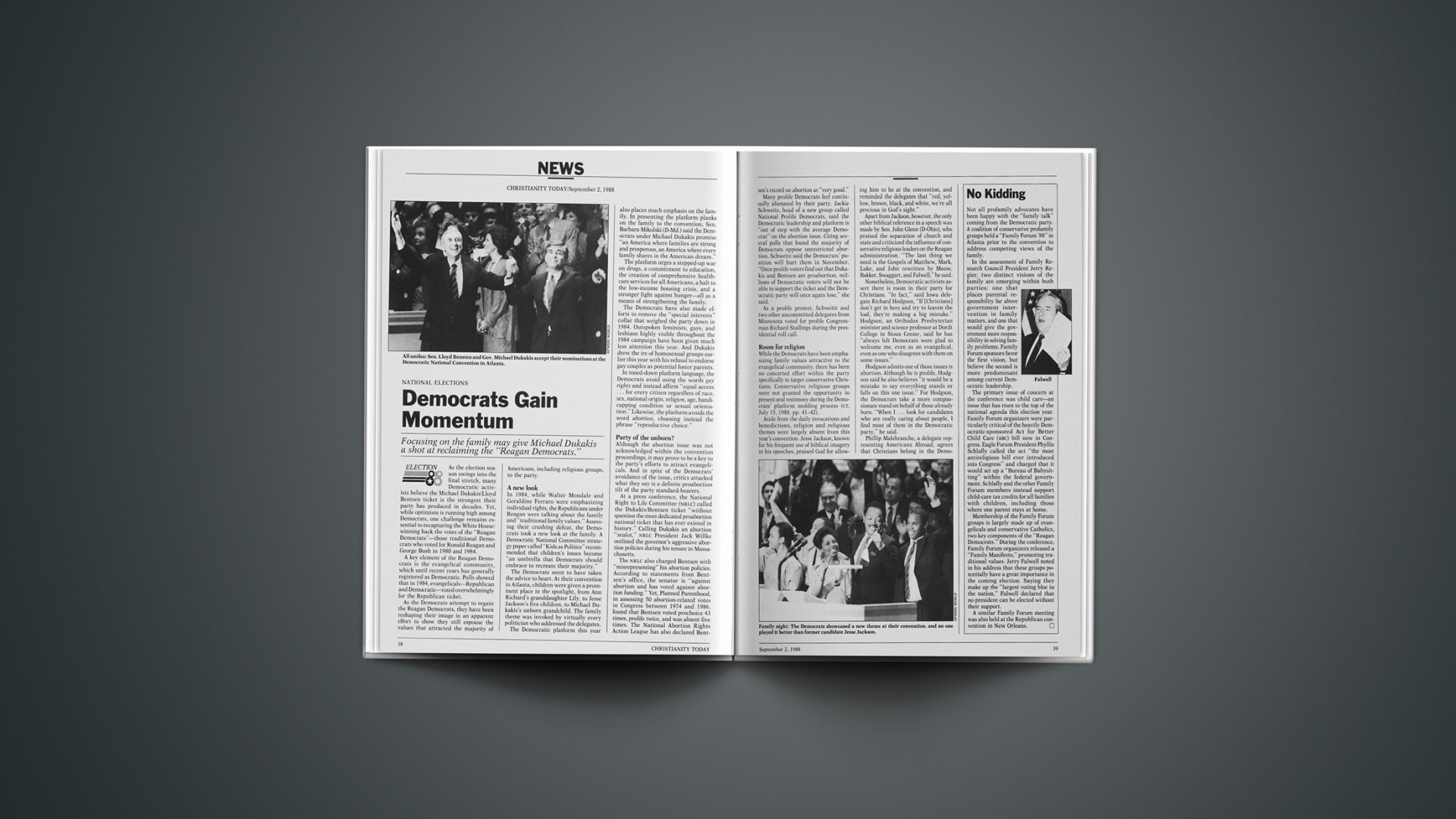
Democrats Gain Momentum

NEWS

NATIONAL ELECTIONS

Focusing on the family may give Michael Dukakis a shot at reclaiming the “Reagan Democrats.”

As the election season swings into the final stretch, many Democratic activists believe the Michael Dukakis/Lloyd Bentsen ticket is the strongest their party has produced in decades. Yet, while optimism is running high among Democrats, one challenge remains essential to recapturing the White House: winning back the votes of the “Reagan Democrats”—those traditional Democrats who voted for Ronald Reagan and George Bush in 1980 and 1984.

A key element of the Reagan Democrats is the evangelical community, which until recent years has generally registered as Democratic. Polls showed that in 1984, evangelicals—Republican and Democratic—voted overwhelmingly for the Republican ticket.

As the Democrats attempt to regain the Reagan Democrats, they have been reshaping their image in an apparent effort to show they still espouse the values that attracted the majority of Americans, including religious groups, to the party.

A New Look

In 1984, while Walter Mondale and Geraldine Ferraro were emphasizing individual rights, the Republicans under Reagan were talking about the family and “traditional family values.” Assessing their crushing defeat, the Democrats took a new look at the family. A Democratic National Committee strategy paper called “Kids as Politics” recommended that children’s issues become “an umbrella that Democrats should embrace to recreate their majority.”

The Democrats seem to have taken the advice to heart. At their convention in Atlanta, children were given a prominent place in the spotlight, from Ann Richard’s granddaughter Lily, to Jesse Jackson’s five children, to Michael Dukakis’s unborn grandchild. The family theme was invoked by virtually every politician who addressed the delegates.

The Democratic platform this year also places much emphasis on the family. In presenting the platform planks on the family to the convention, Sen. Barbara Mikulski (D-Md.) said the Democrats under Michael Dukakis promise “an America where families are strong and prosperous, an America where every family shares in the American dream.”

The platform urges a stepped-up war on drugs, a commitment to education, the creation of comprehensive health-care services for all Americans, a halt to the low-income housing crisis, and a stronger fight against hunger—all as a means of strengthening the family.

The Democrats have also made efforts to remove the “special interests” collar that weighed the party down in 1984. Outspoken feminists, gays, and lesbians highly visible throughout the 1984 campaign have been given much less attention this year. And Dukakis drew the ire of homosexual groups earlier this year with his refusal to endorse gay couples as potential foster parents.

In toned-down platform language, the Democrats avoid using the words gay rights and instead affirm “equal access … for every citizen regardless of race, sex, national origin, religion, age, handicapping condition or sexual orientation.” Likewise, the platform avoids the word abortion, choosing instead the phrase “reproductive choice.

Party Of The Unborn?

Although the abortion issue was not acknowledged within the convention proceedings, it may prove to be a key to the party’s efforts to attract evangelicals. And in spite of the Democrats’ avoidance of the issue, critics attacked what they say is a definite proabortion tilt of the party standard-bearers.

At a press conference, the National Right to Life Committee (NRLC) called the Dukakis/Bentsen ticket “without question the most dedicated proabortion national ticket that has ever existed in history.” Calling Dukakis an abortion “zealot,” NRLC President Jack Willke outlined the governor’s aggressive abortion policies during his tenure in Massachusetts.

The NRLC also charged Bentsen with “misrepresenting” his abortion policies. According to statements from Bentsen’s office, the senator is “against abortion and has voted against abortion funding.” Yet, Planned Parenthood, in assessing 50 abortion-related votes in Congress between 1974 and 1986, found that Bentsen voted prochoice 43 times, prolife twice, and was absent five times. The National Abortion Rights Action League has also declared Bentsen’s record on abortion as “very good.”

Many prolife Democrats feel continually alienated by their party. Jackie Schweitz, head of a new group called National Prolife Democrats, said the Democratic leadership and platform is “out of step with the average Democrat” on the abortion issue. Citing several polls that found the majority of Democrats oppose unrestricted abortion, Schweitz said the Democrats’ position will hurt them in November. “Once prolife voters find out that Dukakis and Bentsen are proabortion, millions of Democratic voters will not be able to support the ticket and the Democratic party will once again lose,” she said.

As a prolife protest, Schweitz and two other uncommitted delegates from Minnesota voted for prolife Congressman Richard Stallings during the presidential roll call.

Room For Religion

While the Democrats have been emphasizing family values attractive to the evangelical community, there has been no concerted effort within the party specifically to target conservative Christians. Conservative religious groups were not granted the opportunity to present oral testimony during the Democrats’ platform molding process (CT, July 15, 1988, pp. 41–12).

Aside from the daily invocations and benedictions, religion and religious themes were largely absent from this year’s convention. Jesse Jackson, known for his frequent use of biblical imagery in his speeches, praised God for allowing him to be at the convention, and reminded the delegates that “red, yellow, brown, black, and white, we’re all precious in God’s sight.”

Apart from Jackson, however, the only other biblical reference in a speech was made by Sen. John Glenn (D-Ohio), who praised the separation of church and state and criticized the influence of conservative religious leaders on the Reagan administration. “The last thing we need is the Gospels of Matthew, Mark, Luke, and John rewritten by Meese, Bakker, Swaggart, and Falwell,” he said.

Nonetheless, Democratic activists assert there is room in their party for Christians. “In fact,” said Iowa delegate Richard Hodgson, “If [Christians] don’t get in here and try to leaven the loaf, they’re making a big mistake.” Hodgson, an Orthodox Presbyterian minister and science professor at Dordt College in Sioux Center, said he has “always felt Democrats were glad to welcome me, even as an evangelical, even as one who disagrees with them on some issues.”

Hodgson admits one of those issues is abortion. Although he is prolife, Hodgson said he also believes “it would be a mistake to say everything stands or falls on this one issue.” For Hodgson, the Democrats take a more compassionate stand on behalf of those already born. “When I … look for candidates who are really caring about people, I find most of them in the Democratic party,” he said.

Phillip Malebranche, a delegate representing Americans Abroad, agrees that Christians belong in the Democratic party. “If some doors [in the party] have recently been closed to Christians, I believe Christians have to keep pounding on those doors,” he said.

No Kidding

Not all profamily advocates have been happy with the “family talk” coming from the Democratic party. A coalition of conservative profamily groups held a “Family Forum ‘88” in Atlanta prior to the convention to address competing views of the family.

In the assessment of Family Research Council President Jerry Regier, two distinct visions of the family are emerging within both parties: one that places parental responsibility far above government intervention in family matters, and one that would give the government more responsibility in solving family problems. Family Forum sponsors favor the first vision, but believe the second is more predominant among current Democratic leadership.

The primary issue of concern at the conference was child care—an issue that has risen to the top of the national agenda this election year. Family Forum organizers were particularly critical of the heavily Democratic-sponsored Act for Better Child Care (ABC) bill now in Congress. Eagle Forum President Phyllis Schlafly called the act “the most antireligious bill ever introduced into Congress” and charged that it would set up a “Bureau of Babysitting” within the federal government. Schlafly and the other Family Forum members instead support child-care tax credits for all families with children, including those where one parent stays at home.

Membership of the Family Forum groups is largely made up of evangelicals and conservative Catholics, two key components of the “Reagan Democrats.” During the conference, Family Forum organizers released a “Family Manifesto,” promoting traditional values. Jerry Falwell noted in his address that these groups potentially have a great importance in the coming election. Saying they make up the “largest voting bloc in the nation,” Falwell declared that no president can be elected without their support.

A similar Family Forum meeting was also held at the Republican convention in New Orleans.

Religious Credentials

Thanks to the efforts of Jesse Jackson, the Democrats can probably count on the support of large segments of one Christian community: the black church. Throughout his campaign, Jackson used black churches as headquarters for stump speeches and fund raising. Although some political pundits had suggested Jackson supporters would walk away from the party because of the Dukakis campaign’s handling of the vice-presidential slot, Jackson seems to have forestalled such a walk.

South Carolina African Methodist Episcopal Bishop Frederick C. James said he and others in his denomination are taking their cue from Jackson. “He expressed a sense of satisfaction with how he related to Mr. Dukakis, … and I stand by his statement,” James said.

James, who led a benediction prayer at the convention, said AME members who supported Jackson “will work hard for the Democratic ticket because of the platform and the involvement of the Democratic party as it relates to black Americans.”

Another religious community, the Greek Orthodox Church, appears largely supportive of the Democratic party and of its favorite son. Michael Dukakis has been somewhat reticent to discuss his religious views publicly. “My own feelings about religion and my own church are very personal to me,” he said. Dukakis said he is a “good member of the Greek Orthodox Church,” and attends church “10, 12, 14 times a year.” His wife, Kitty, is Jewish, and Dukakis said they “respect each other’s religious tradition and belief” and have raised their children “in both cultures.”

Lloyd Bentsen, a Presbyterian, has a few more ties to the evangelical community. A supporter of congressional voluntary school prayer amendments, Bentsen has attended prayer breakfasts sponsored by the National Religious Broadcasters and has spoken at a National Association of Evangelicals (NAE) federal seminar meeting.

The extent to which the Democrats will be able to translate their efforts into evangelical votes remains to be seen. Yet, in a close election, this task may prove crucial. The NAE thinks an evangelical voting bloc could account for 2.5 percent of the total vote—enough to have reversed the outcome of four presidential elections since World War II.

By Kim A. Lawton in Atlanta.
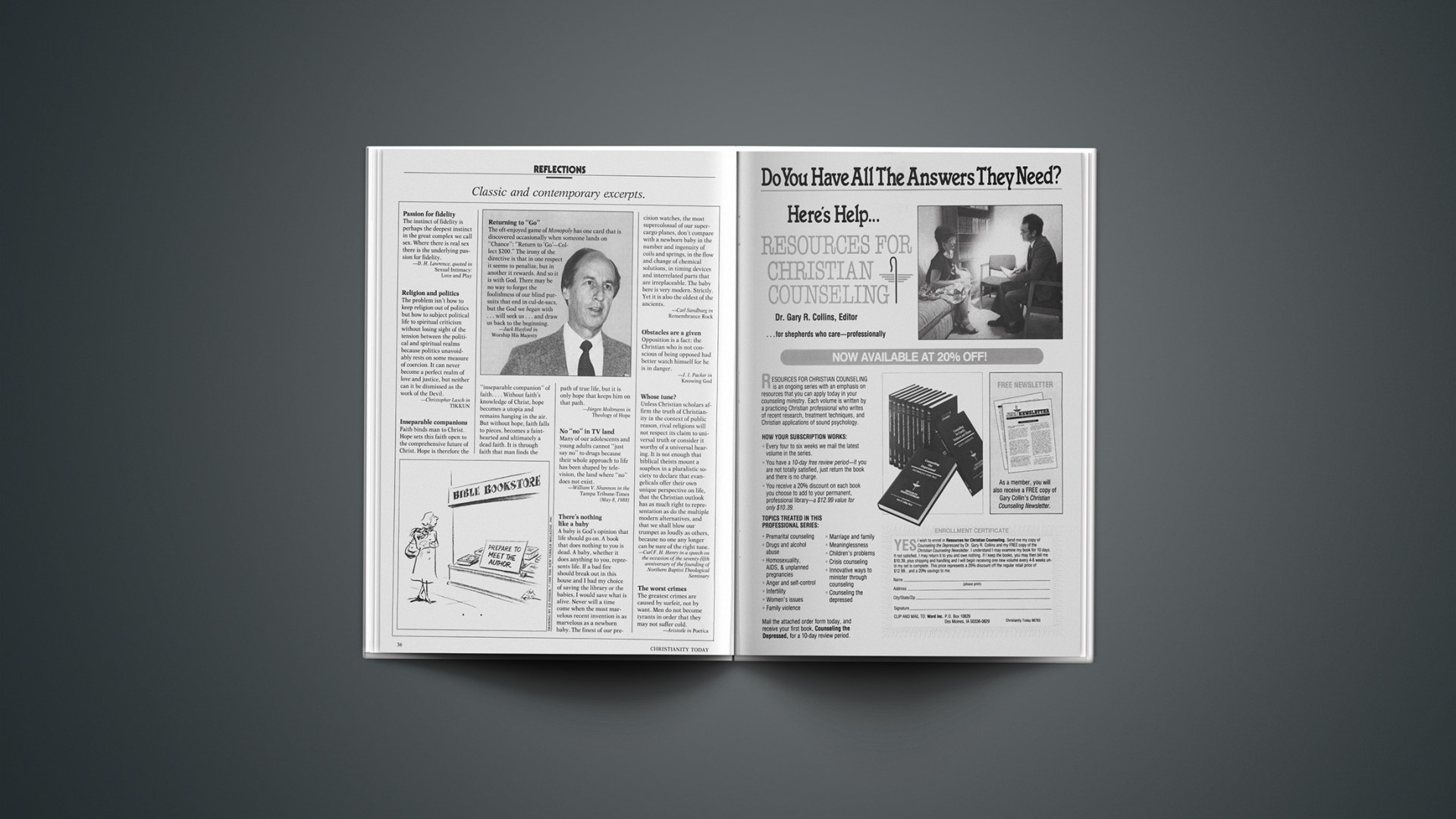
Classic & Contemporary Excerpts from September 02, 1988

Classic and contemporary excerpts.

Passion for fidelity

The instinct of fidelity is perhaps the deepest instinct in the great complex we call sex. Where there is real sex there is the underlying passion for fidelity.

D. H. Lawrence, quoted in Sexual Intimacy: Love and Play

Religion and politics

The problem isn’t how to keep religion out of politics but how to subject political life to spiritual criticism without losing sight of the tension between the political and spiritual realms because politics unavoidably rests on some measure of coercion. It can never become a perfect realm of love and justice, but neither can it be dismissed as the work of the Devil.

Christopher Lasch in TIKKUN

Inseparable companions

Faith binds man to Christ. Hope sets this faith open to the comprehensive future of Christ. Hope is therefore the “inseparable companion” of faith.… Without faith’s knowledge of Christ, hope becomes a utopia and remains hanging in the air. But without hope, faith falls to pieces, becomes a fainthearted and ultimately a dead faith. It is through faith that man finds the path of true life, but it is only hope that keeps him on that path.

Jürgen Moltmann in Theology of Hope

Returning to “Go”

The oft-enjoyed game of Monopoly has one card that is discovered occasionally when someone lands on “Chance”: “Return to ‘Go’—Collect $200.” The irony of the directive is that in one respect it seems to penalize, but in another it rewards. And so it is with God. There may be no way to forget the foolishness of our blind pursuits that end in cul-de-sacs, but the God we began with … will seek us … and draw us back to the beginning.

Jack Hay ford in Worship His Majesty

No “no” in TV land

Many of our adolescents and young adults cannot “just say no” to drugs because their whole approach to life has been shaped by television, the land where “no” does not exist.

William V. Shannon in the Tampa Tribune-Times (May 8, 1988)

There’s nothing like a baby

A baby is God’s opinion that life should go on. A book that does nothing to you is dead. A baby, whether it does anything to you, represents life. If a bad fire should break out in this house and I had my choice of saving the library or the babies, I would save what is alive. Never will a time come when the most marvelous recent invention is as marvelous as a newborn baby. The finest of our precision watches, the most supercolossal of our supercargo planes, don’t compare with a newborn baby in the number and ingenuity of coils and springs, in the flow and change of chemical solutions, in timing devices and interrelated parts that are irreplaceable. The baby here is very modern. Strictly. Yet it is also the oldest of the ancients.

Carl Sandburg in Remembrance Rock

Obstacles are a given

Opposition is a fact: the Christian who is not conscious of being opposed had better watch himself for he is in danger.

J. 1. Packer in Knowing God

Whose tune?

Unless Christian scholars affirm the truth of Christianity in the context of public reason, rival religions will not respect its claim to universal truth or consider it worthy of a universal hearing. It is not enough that biblical theists mount a soapbox in a pluralistic society to declare that evangelicals offer their own unique perspective on life, that the Christian outlook has as much right to representation as do the multiple modern alternatives, and that we shall blow our trumpet as loudly as others, because no one any longer can be sure of the right tune.

Carl F. H. Henry in a speech on the occasion of the seventy-fifth anniversary of the founding of Northern Baptist Theological Seminary

The worst crimes

The greatest crimes are caused by surfeit, not by want. Men do not become tyrants in order that they may not suffer cold.

Aristotle in Poetics

Streams of Renewal in the Mainline Church

Is evangelical renewal possible for mainline and liturgical churches? Is it happening? Is it genuine? For many evangelicals (with Baptist, Presbyterian, or Pentecostal roots), these churches are unfamiliar territory. But several new books shed light on twentieth-century renewal movements in these churches. Highlighted here are those of the Lutherans, Episcopalians, Methodists, and Catholics.

Two books serve as general introductions to the renewal movements in these and other denominations. The Believable Futures of American Protestantism, edited by Richard John Neuhaus (Eerdmans, $7.95) presents essays and discussion from a diverse group of experts at the Center on Religion and Society in New York.

Evangelical Renewal in the Mainline Denominations, edited by Ronald H. Nash (Crossway, $7.95), surveys eight denominations (including American Baptist, Presbyterian, Disciples of Christ, and United Church of Christ, in addition to those mentioned above). Each essay is written by a church member who is sympathetic to renewal. Directories of renewal groups and publications are included for most denominations.

Methodism

Thomas C. Oden, professor of theology at Drew University, offers commentary on the Wesleyan tradition through two different writings. In his Believable Futures essay, “Toward a Theologically Informed Renewal of American Protestantism,” he argues that the renewal of the sacred ministry (bishops and elders) and careful preordination preparation in the apostolic tradition is the way to contemporary renewal. The early church rejoiced in cultural pluralism, but rejected doctrinal pluralism, Oden writes. And he warns that such apostolic tradition must not be abandoned. He presents 47 theses, attested by quotations from “centrist classical sources—patristic to Reformation.”

To confront theological pluralism, Oden released his book Doctrinal Standards in the Wesleyan Tradition (Zondervan, $15.95) at the United Methodist General Conference last April (see CT News, June 17, 1988, p. 60). In this book he contends that the basic teaching of the Methodist church family has been textually defined since 1763 and that it is enforceable.

Episcopalianism

John Throop’s essay on the Episcopal church in Evangelical Renewal not only describes the current three-stream renewal (evangelical, charismatic, and anglo-catholic) in that church, but also gives a “quick tour of English church history [to provide] a framework for understanding renewal in the Episcopal Church.”

According to Throop, evangelical renewal is distinguished by commitment to “the primacy and unremitting authority of Scripture,” which gives priority to exposition, study, and preaching of the Word; personal conversion and holy living; and a view of the church as God’s herald and as the fellowship of the saved. Throop points to the influence of Philip Edgecombe Hughes and Stuart Barton Babbage, when they taught at Columbia Theological Seminary during the mid-sixties, as “the key to the development of a viable evangelical movement among Episcopalians in this country.”

As supplements to Throop’s essay, The Episcopal Church in Crisis, by John Booty (Cowley, $8.95), and The Episcopal Church’s History: 1945–1985, by David E. Sumner (Morehouse-Barlow, $24.95), provide us with a detailed look at the past 40 years. Booty traces a series of Episcopal identity shifts related to issues (Vietnam and sexism, for example). Sumner has written a series of individual chronicles, telling the story of major areas of church life (such as education, ecumenicity, missions, Prayer Book revision, women’s ordination, and civil rights). The book is an evenhanded resource (well-documented, with a glossary and a bibliography) for either new member or curious outsider.

Lutheranism

Waldo J. Werning’s essay on the Lutheran churches (also in Evangelical Renewal) is more an assessment of the need for renewal and a description of what renewal would be than an account of ongoing renewal in this denomination. The Evangelical Movement: Growth, Impact, Controversy, Dialog, by Mark Ellingsen (Augsburg, $24.95), is a thorough study, undertaken to help world Lutheranism clarify its relationship to evangelicalism. The first three parts of the book survey evangelicalism.

Chapters entitled “The Essence of Conservative Evangelicalism” and “The Proclamation of the Gospel in Contemporary Society” compare evangelicalism with Lutheranism and move Ellingsens argument to a fourth section, “Dialogue with a Mainline Church Heritage: Biblically Based Theology for Born-Again Christians.” He observes that confessional Lutheranism’s emphasis on justification by grace through faith provides a basis for conversation and mutual reinforcement. The question evangelicals often ask, of course, concerns the twentieth-century Lutheran church’s degree of faithfulness to the Augsburg Confession.

Catholicism

Kevin Perotta’s essay on the U.S. Catholic church in Evangelical Renewal views the period between Vatican II (1962–65) and the 1985 synod of bishops as a watershed, during which the church moved out of its defensive stance toward the modern world, revised its structures, articulated the Christian faith for the twentieth century, and experienced renewal of its liturgy. However, Perotta states “the Council’s call for personal and corporate renewal, renewal in relationship with Christ and His Word, was actually followed by widespread confusion and loss of commitment.…”

Indeed, he sees the trend as decidedly secularistic. Vigorous leadership by Pope John Paul II and the 1985 synod to correct aberrations in teaching, coupled with the impact of charismatic renewal are signs of hope for Perotta.

The Emerging Parish: The Notre Dame Study of Catholic Life Since Vatican II, by Joseph Gremillion and Jim Castelli (Harper & Row, $16.95), seeks through survey and statistical analysis to assess the impact of Vatican II on parish life. Separate chapters detail findings in the areas of decision making, worship, education, evangelization, social action, and ecumenical action. The evaluation is more optimistic than Perotta’s.

By Larry Sibley, who teaches practical theology at Westminster Theological Seminary in Philadelphia.

Hawks in Doves’ Clothing

Peace and Revolution: The Moral Crisis of American Pacifism, by Guenter Lewy (Eerdmans, 284 pp.; $18.95, cloth). Reviewed by Doug Bandow, senior fellow at the Cato Institute and a syndicated columnist for Copley News Service. Bandow is author of Beyond Good Intentions: A Biblical View of Politics (Crossway).

In early 1975, the American-backed government of South Vietnam disintegrated in the face of a massive Communist military offensive. Leading pacifist groups uniformly hailed the conquest of North Vietnamese arms: A writer in WIN magazine, published by the War Resisters League, acclaimed the “triumph for revolutionary politics.” The few activists who condemned a military offensive that violated the Paris peace accords, left thousands dead, and trapped millions under Communist rule were roundly criticized for their arrogance in attacking the forces that had brought “peace” to Vietnam.

There was a time when pacifists truly believed in nonviolence, but Guenter Lewy, professor emeritus of political science at the University of Massachusetts, documents how the Vietnam War transformed antitotalitarian adherents of pacifism into left-wing advocates of revolutionary violence.

A National Conscience

Lewy reviews the tragic corruption of four major pacifist groups: the American Friends Service Committee (AFSC), nominally a Quaker organization; the Women’s International League for Peace and Freedom (WILPF), many of whose members were Quakers; the Fellowship of Reconciliation (FOR), originally founded as a Christian association; and the War Resisters League (WRL), a secular group. His tone is one of sadness rather than anger, which makes the impact of his book all the more powerful.

“Until the 1960s,” writes Lewy, “American pacifism enjoyed a generally undisputed reputation of moral rectitude.” In 1933, for instance, the membership of the FOR voted overwhelmingly to oppose class warfare as well as international conflict; the group also rejected cooperation with Communist-front organizations. The three other pacifist bodies maintained similar policies. Over the ensuing years the pacifist movement, though small, acted as a national conscience, challenging the realpolitik guiding America’s foreign policy.

However, the groups’ orientations shifted as they began cooperating with leftist organizations to oppose the Vietnam War. Lewy may make too much of the AFSC’S switch from advocating a withdrawal of all outside forces to working for a unilateral American pullout—after all, the group could directly influence only U.S. policy. But he also documents the profound ideological move from opposing American intervention to supporting North Vietnamese aggression. All four of the major pacifist organizations suffered from wrenching internal conflict as principled pacifists resisted, unsuccessfully, the decision to back revolutionary violence.

This philosophical schizophrenia manifested itself not only in the macabre celebrations of North Vietnam’s military victory, but also in a profound reluctance to criticize Communist Vietnam for its massive human-rights violations. In 1977, for instance, FOR’S executive committee dissociated itself from an appeal circulated by two staff members, lamenting that the controversy “has tended to divide and disrupt the peace community.”

Leaning To The Left

This callous indifference to the victims of Marxist-Leninist revolutions persists. Pacifist groups lauded social progress in Cuba and the “experiment in new forms of social organization and development” in Grenada, and they now propagandize on behalf of Nicaragua’s Sandinistas.

But while opposition to U.S. intervention in Central America is eminently defensible, support for the Ortega regime is not. (Lewy sharply criticizes the pacifists’ noninterventionist stance, although it is certainly consistent with their principles.)

Indeed, the groups have been almost obsequious in dealing with the Sandinistas. According to Peace and Revolution, Joanne Sheehan of the WRL wrote Nicaragua’s ambassador to the U.S. to complain about the lack of conscientious-objector status for Nicaraguans; she prefaced her letter by assuring the ambassador that “the WRL is very much in support of the people’s revolution in Nicaragua.”

Also Reviewed In This Section:

The Excellent Empire, by Jaroslav Pelikan

Abortion: A Christian Understanding and Response, edited by James K. Hoffmeier

What Is Judaism?by Emil L. Fackenheim

The Believable Futures of American Protestantism, edited by Richard John Neuhaus

Evangelical Renewal in the Mainline Denominations, edited by Ronald H. Nash

Doctrinal Standards in the Wesleyan Tradition, by Thomas C. Oden

The Episcopal Church in Crisis, by John Booty

The Episcopal Church’s History: 1945–1985, by David E. Sumner

The Evangelical Movement, by Mark Ellingsen

The Emerging Parish, by Joseph Gremillion and Jim Castelli

Communing With Great Minds

The Excellent Empire: The Fall of Rome and the Triumph of the Church, by Jaroslav Pelikan (Harper & Row, 133 pp.; $18.95, hardcover). Reviewed by Mark Noll, professor of history at Wheaton College (Ill.), and author of One Nation Under God? (Harper & Row).

Jaroslav Pelikan, Sterling Professor of History at Yale, is the author of several large works on the history of Christianity, especially his multivolume study of The Christian Tradition. But Pelikan is also the master of the literary cameo—the slim, but no less learned treatment of a specific theme. Books like The Vindication of Tradition, Bach Among the Theologians, and now The Excellent Empire testify to Pelikan’s mastery of this short form.

This book can best be called a thematic meditation in response to Edward Gibbon’s History of the Decline and Fall of the Roman Empire. To Gibbon, who shared the skepticism about supernatural Christianity characteristic of the Enlightenment, the fall of Rome resulted from “the triumph of barbarism and religion.” Pelikan’s intent is to contrast Gibbon’s interpretation with that of early leaders in the church who actually lived through “the decline and fall of Rome.”

Thus, while Gibbon saw the conversion of Constantine to Christianity as a portent of weakness, the early church historian Eusebius hailed it as the very climax of Rome’s glory.

Gibbon regarded the sack of Rome by Alaric the Goth in 410 as melancholy proof of decline. To the Bible translator Jerome, the same event was rather an apocalyptic sign of the in-breaking rule of Christ.

Gibbon, somewhat reluctantly, saw at least a little virtue in the Christianity that otherwise seemed to him the advance of superstition. But to Augustine of Hippo, the early church’s greatest theologian, the fall of Rome was the source of yet deeper ambiguities, as set out in The City of God, an even more monumental book than Gibbon’s.

Pelikan’s meditation on these themes is subtle, his writing is filled with quotations, and the themes of this short book are complex. It is, nonetheless, a delightful opportunity to peer over the shoulder of one of our age’s great minds as it communes with the great minds of the past.

American pacifism truly faces what Lewy calls a “moral crisis.” For while principled pacifism can be criticized for utopianism in a world in which freedom and justice can, at times, be maintained only by resort to the sword, it nevertheless offers an important moral standard by which to periodically measure our actions.

The corrupt form of pacifism that now animates the AFSC and its soulmates is, in contrast, dangerous as well as fraudulent, for it provides a humanitarian gloss for totalitarian ideologies that have institutionalized violence and suffering on a global scale.

This disturbing book by Guenter Lewy should cause those pacifists who have sold their moral inheritance for a pottage of political activism to return to their roots.

Highlighted

Life After Moses

In Congregation: Contemporary Writers Read the Jewish Bible (Harcourt, Brace, Jovanovich; xiv + 526 pp.; $29.95, hardcover), 37 leading writers—all American, all Jewish—reflect on the Hebrew Scriptures. The authors range from Max Apple to Elie Wiesel (with Mordecai Richler and Isaac Bashevis Singer in between). The tone ranges from angry to reverent. Here is Houston novelist Max Apple on the Book of Joshua:

No doubt in the history of another people Joshua might be the chief hero. After all, it is Joshua who leads his army into the land of his enemies and triumphs there, Joshua who leads his people to the fulfillment of the Lord’s promise to Abraham, Joshua who is the powerful, unyielding, triumphant general.

Alas, poor Joshua: to him falls the role of warrior among shepherds, soldier among dreamers, servant of the Lord who serves after Moses.…

Joshua knows that to succeed Moses is more difficult than to overcome Canaanites, Moses talked to God. Moses ascended Mount Sinai and returned with the Ten Commandments. Moses shaped a nation out of slaves, a moral nation, and then ‘though his eye was not dim, nor his natural force abated,’ Moses died. At that dramatic moment the Torah ends. After Moses, in spite of all his accomplishments, everything is still to be done.

… [Joshua] is a powerful general, but how he wishes for the certainty of Moses, his ‘father’; how he wishes that the times were not out of joint, that he was still free to roam in the desert, in the great afterglow of the escape from Egypt and the numbing pleasure of the Manna which glistens like the dew and satisfies all hunger; how Joshua still longs to be the young man following orders; how much easier it is to spy out the land than to send in spies; how much easier to be the son than the father.”

Not Quite A Consensus

Abortion: A Christian Understanding and Response, edited by James K. Hoffmeier (Baker, 260 pp.; $10.95, paper). Reviewed by Guy M. Condon, executive director of Americans United for Life Legal Defense Fund.

Fifteen Wheaton College faculty members have taken an interdisciplinary tug at one of the most pressing moral issues of our time.

The title, Abortion: A Christian Understanding and Response, as well as the foreword by Wheaton College President Richard Chase and introduction by editor James K. Hoffmeier, suggest this collection of essays will foster a uniquely and definitively Christian view of abortion. However, while for the most part the book does move in that direction, it fails to show a consensus. In fact, in a few cases, it expresses views about the unborn more typically held by people who consider themselves atheists and in favor of abortion on demand.

The book first reviews historical, biblical, and theological perspectives on abortion. Its second section analyzes current ethical and philosophical trends, and a third section gives practical information about pregnancy, politics, the judiciary, statistics, sociological trends, and abortion counseling.

Unthinkable

The first section, for the most part, exhibits a coherent analysis of biblical perspectives. According to Andrew E. Hill, “Abortion was apparently too unthinkable to the Hebrew mind—given ancient Near Eastern legal norms and divinely revealed covenant stipulations pertaining to life and godliness—that it did not even warrant treatment in the Old Testament legal corpora.” Hoffmeier, who teaches Old Testament at Wheaton College, tackles Exodus 21:22–25, which prescribes the punishment for one who harms a pregnant woman, causing her to deliver prematurely. The passage contains a vexing ambivalence over whether further retaliation, including death, relates to the injury brought to the child born prematurely or to the mother. Hoffmeier places the verses in context and effectively argues that “harm” appears to apply to the prematurely born child as well as the mother.

C. Hassell Bullock observes that “the prophetic and poetic books offer no prescriptive word on the subject of abortion.” But while these books do not give rules, “they say much about the supreme value of life.” And Victor R. Gordon writes that “the New Testament makes no mention of abortion,” but points out “abortion was not addressed, because it was not an issue for the Jewish community.…

“It was not until the second century that abortion became a serious temptation to Christians,” then influenced by Greco-Roman support of abortion practices.

A few hairline cracks in this first section begin to weaken the cohesion of the work as a whole, however. For example, Donald M. Lake tampers with the traditional idea that unborn life is sacred because it mysteriously embodies the image of God from the point of conception. He states that “image of God” is not something static, but dynamic, and regards the fetus as something less than a complete human being.

Ethical problems

Cracks give way to fissures in the section on ethics. Philosophy teacher Arthur F. Holmes writes: “A human life is a created thing, therefore not of absolute, unconditional value.” Along the same lines, “abortion becomes increasingly objectionable” only “as pregnancy proceeds.”

Holmes, in referring to current U.S. policy, claims that “the law does [emphasis mine] and must enforce at least a minimal morality that is essential to the harmoniously functioning society.”

He encourages Christians to work toward a consensus that objects to late-term abortions, then expresses the consensus by proposing legislation that regulates abortion after the first trimester. Unfortunately, this would still permit 90 percent of the abortions taking place today.

Such a compromise seems to ignore Holmes’s opening statement that “the value Scripture places on human fetal life as a trust from God stands against abortion on demand.” It certainly conflicts with Hoffmeier’s conclusion: “Looking at Old Testament law from a proper cultural context, it is evident that the life of the unborn is put on the same par as a person outside the womb.”

In the final section, Lyman A. Kellstedt gives a pithy summary of how abortion on demand became public policy. James L. Rogers, who is currently researching the effects of public policy on moral behavior, provides an authoritative critique of research that has been used erroneously to support the abortion logic. Other essays give a biological description of pregnancy, some sociological insights on teen pregnancy, and insights on how to counsel people about abortion.

Hoffmeier and his colleagues have properly identified an urgent need within the Christian community to develop consensus, not to mention conviction, regarding abortion. Much of Abortion: A Christian Understanding and Response serves that purpose. But the work overall stands in need of a second editing that either leaves out Holmes’s chapter or rewrites the title and introduction to inform readers that they should expect diverse and traditionally unorthodox perspectives within the collection.

Commuing With Great Minds

What Is Judaism? An Interpretation for the Present Age, by Emil L. Fackenheim (Summit Books, 292 pp.; $18.95, hardcover). Reviewed by Reed Jolley, pastor of Santa Barbara (Calif.) Community Church.

In an essay entitled “On the Reading of Old Books,” C. S. Lewis argued that if one wants to understand Plato, for example, he should read Plato instead of a book explaining Platonism. Likewise, Christians should turn to Emil Fackenheim’s What Is Judaism? An Interpretation for the Present Age to understand twentieth-century Judaism, for here the reader encounters a cogent, lucid, and readable description from one within that faith.

At 22 years of age, Fackenheim, a rabbinical student, found himself in a Nazi jail cell with 20 other Jews. In that lurid setting, one of his cell mates asked, “What does Judaism have to say to us now?” Fackenheim remained silent.

What Is Judaism? is his belated attempt at an answer. The author asks what it means to be Jewish in light of the Holocaust, the death of European Jewry, and the creation of the State of Israel. In so doing he grapples with secularism, pluralism, higher critical studies of the Old Testament, the rise of Islamic fundamentalism, and Christian particularism. The net result is a refreshingly honest and insightful glimpse into modern Judaism.

Love For The Torah

As the author interacts with the modern world, he exposes the reader to the Jewish way of thinking and being. Throughout his pondering, Rabbi Fackenheim expresses his love for the Torah. Grace came into the world through Abraham, Moses, and, in particular, through the gift of the Torah, he says. Therefore, the Law is a “yoke,” not a burden. The Law teaches the Jew how best to live his or her life in today’s world.

Fackenheim also exposes the reader to his lifelong love of Midrash (Jewish commentary on the Law). In the various citations of Midrash, the world view of rabbinic Judaism shines warmly: “On Judgement Day every person will have to give account of every good that he might have enjoyed and did not” (quoted from Rabbi Rav in the third century).

Attempts At Conversion

Christian readers, pastors, and laymen alike will gain valuable insight by reading Fackenheim’s work. The author explains why Christian attempts at proselytizing are offensive to the Jew.

“A post-Holocaust Jew can still view Christian attempts to convert Jews as sincere and well intended. But even as such they are no longer acceptable: They have become attempts to do in one way what Hitler did in another.” In other words, the attempt to convert a Jew is to ask him to cease being Jewish and thus to undermine Judaism.

The author also offers evangelical readers a Jewish understanding of the Jewish scriptures. His understanding of the first part of our Bible is priceless for those reared in dispensational and Reformed traditions.

Fackenheim asks the right questions. Does God exist after Auschwitz? Is prayer efficacious? Is the Jewish tradition viable in our time? Is Messiah coming? His answers will both intrigue and grieve those who have placed their faith in Jesus as the Lion of the tribe of Judah.

Confessions of a Former Sabbath Breaker

Earlier this year, CHRISTIANITY TODAY asked a random sample of readers to rate the importance to them of a series of religious and theological questions. The editors were surprised by the results: Higher than the problem of pain, and more important than the charismatic renewal—indeed highest of all, these readers rated “Should Christians take their Lord’s Day observance more seriously?”

The results of this survey have guided the editors in commissioning chapters for a book to be published jointly early in 1989 by CHRISTIANITY TODAY and Scripture Press. Here, as a foretaste of things to come, is Pastor Eugene Peterson’s answer to our readers’ number one question.

I got onto it early, and engaged in my sin with gusto. As I developed in the Christian faith, I was examined and instructed in ways to discern, repent of, and defend against the classic sins that interfered with faith and love and hope. When I became a pastor, I was subject to even more rigorous examination. But not once did anyone call me on this sin. Instead, I was—if you can believe it—commended in my law-breaking. In fact, at one critical point in my life, when I was out-of-control obsessive in my indulgence of this sin, I was rewarded with the largest single annual increase in salary I have ever received.

It is the American bargain-basement sin, on sale in virtually every American church. The sin? Sabbath breaking, the willful violation of the fourth commandment.

I saw this sin rampant in others long before I saw it in myself. And what I saw was not attractive: an entire culture living on the edge of panic. A mind-boggling technology that could do almost anything in and with space, but fidgety, nervous, and spastic with time. I saw the people around me work masterfully with computers, organizations, and electronic equipment, but when presented with an unplanned or undefined ten minutes, or hour, or day, suddenly overtaken with the Saint Vitus’ Dance. Can’t stand still. Can’t be still. There was the refusal to be still and be silent. The refusal to look and listen. The refusal that then becomes an inability to stop and rest and behold what is “very good” in the creation and in the Cross.

Is God doing anything in this world? Is God saying anything to this people? Who knows? If anyone is going to know, it will require some first-class looking and listening, the kind of first-class looking and listening that Sabbath keeping nurtures, and matures.

Sloth And Sabbath Breaking

The source sin behind Sabbath breaking is sloth. But isn’t sloth doing nothing at all? No, it is just doing nothing of what we are created to do as beings made in the image of God and saved by the Cross of Christ. Sloth is laziness at the center, while the periphery is adazzle with a torrent of activity and talk. Laziness, the seventh of the deadly sins, is the refusal to do our real work—deal with God, deal with ourselves. It is the sin that unobtrusively avoids Creator-attentiveness and creature-awareness, and then noisily and busily diverts attention from the great avoidance with a smoke screen of activity.

Christians are in the vanguard of this sin and escape detection even more successfully than non-Christians because they label this sloth-originating hyperactivity with euphemisms: “ministry,” “witness,” “the Lord’s work.” They pretend to keep a Sabbath by Sunday churchgoing, and then stuff the day with meetings, responsibilities, committees, and concerns until it looks (and feels) tight as a German sausage. Pastors are usually in charge of the stuffing.

I looked at this sloth-activated Sabbath breaking and was staggered by the ruinous effects in the culture, in the church, and in myself. The incredible shoddiness in personal relationships that characterizes our culture is more than anything else a consequence of sins against time—for intimacy requires time, affection requires time. Without time neither the best of intentions nor the highest standard of living penetrates the human relationships by which we realize our dignity and our worth. And the outrageous adolescence in religion that is the scandal of our churches is, more than anything else, a consequence of sins against time—for maturity requires time, worship requires time.

Doing anything about the sloth in American culture seemed beyond me, and in church culture even more so. But I thought I might do something about myself.

A Monday Sabbath

I started by keeping a Sabbath myself. Sunday is a work day for me, and so unavailable for a Sabbath. I decided to keep a Monday Sabbath. My wife joined me in the observance. We agreed that it would be a true Sabbath, and not a “day off.” We didn’t have much to follow in the way of precedents since few of the Christians and none of the pastors of our acquaintance kept a Sabbath, but we knew that it must be a day for praying and playing, the two elements we noticed were woven in and out of all the healthy biblical, Jewish, and Christian observances.

We knew we needed a place and a routine (a sanctuary and a ritual) to support our practice. We chose to use the forest trails for our sanctuary and devised a simple ritual of silence for the morning hours; we break the silence over lunch with audible prayers and are free to converse through the afternoon and evening. We birdwatch, smell flowers, pray the psalms, feel the weather, reflect, listen, look. We keep these Monday Sabbaths in all kinds of weather and whether we feel like it or not, intending to be as diligent in our Sabbath keeping as we want our parishioners to be in theirs. No other single thing that we have ever done comes close to being as creative and deepening in our marriage, in our ministry, and in our faith.

The Leisure Of Contemplation

I began to want this for my congregation, too. I saw them mostly as victims of a culture that had been subverted by “angel of light” tactics without anyone even noticing, for they genuinely supposed their Sabbath breaking to be virtuous and were habituated to pastoral commendation for their sloth. I wanted to recover, if possible, the vast leisure of contemplation, recover the Sabbath margins to the week that would allow for joy and dignity.

I was not in a position to impose a common observance, and I did not want even to hint at a guilt-trap legalism. I knew how long it had taken me to recognize the actual virulence in the virtue-appearing charades of my own sloth, and how difficult it is to stand against the pressures of the culture. I determined to provide a worship that was centered, surrounded, and rooted in prayer—not a day for recruitment, or entertainment, or for launching projects. I tried to keep Sundays free for them, free from church business and free for worship; free from my work and free for their leisure. I knew this would take a long time and could only be realized incrementally. After several years of this behind-the-scenes “not doing,” I came out in the open with a letter to the congregation: “Why Your Pastor Wants You to Keep a Sabbath.”

A Pastoral Letter

“One day a week I stand before you and call you to worship God. The conviction behind the act is that time is holy. But how often do you hear anyone say so? More likely you hear, ‘Time is money.’ And, as with money, you mostly feel that you don’t have enough of it, ever. On occasion, when you have time for which nothing is scheduled you will ‘kill time.’

“Odd, isn’t it? We have more leisure hours per person per year as a country than anyone could have guessed a hundred years ago. But we are not leisurely. We are not relaxed. We are anxious. We are in a hurry. The anxiety and the hurry ruin intimacy and sabotage our best intentions in faith, hope, and love—the three actions in which most of us set out to do our best.

“That is why I as your pastor want you to keep a Sabbath. I want you to live well. I want you to live whole and mature, with appreciation and pleasure, experiencing the heights and depths of God’s glory in your bodies and your work, your friends and your gardens, your minds and your emotions, at the ocean and in the mountains. You can’t do that if you are ‘on the run.’ You can’t do that if you are watching the clock.

“Sabbath is the biblical tool for protecting time against desecration. It is the rhythmic setting apart of one day each week for praying and playing—the two activities for which we don’t get paid, but which are necessary for a blessed life. A blessed life is what we are biblically promised. A blessed life is not a mere survival life, but a bountiful life. Praying and playing are warp and woof in the bounty.

“Keeping a Sabbath is simple and easy: We pray and we play, two things we were pretty good at as children, and can always pick up again with a little encouragement and if we can only find the time. But we don’t have to find the time, it is given to us. A day a week. A Sabbath. A day to pray and play. God’s gift.

“Christian practice orients the first element of the day around the act of worship—praying. This is the great act of freedom in relation to heaven. This is the exercise of our bodies and minds in acts of adoration and commitment, supplication and praise, ventures of forgiving and giving. We explore, enjoy, and share it in our assembly for worship. For most of you this praying will start out in our sanctuary each Sunday when I call you to worship God. Simple.

“The second element of the day is for playing. This is the great act of freedom in relation to earth. We exercise our bodies and minds in games and walks, in amusement and reading, in visiting and picnicking, in puttering and writing. We take in the colors and shapes, the sounds and smells. We let the creativity of the creation nudge us into creativity. We surprise ourselves by creating a meal, or a conversation, or an appreciation, or some laughter that wasn’t in our job description. We have some fun. Easy.

“So—if it is so simple and easy, why do we find it so hard? Because the world is in a conspiracy to steal our Sabbath. It is a pickpocket kind of theft (nothing like an armed robbery) and we aren’t aware of it until long after its occurrence. The ‘world’ is sometimes our friends, sometimes our families, sometimes our employers—they want us to work for them, not waste time with God, not be our original selves. If the world can get rid of Sabbath, it has us to itself. What it does with us when it gets us is not very attractive: after a few years of Sabbath breaking we are passive consumers of expensive trash, and anxious hurriers after fantasy pleasures. We lose our God and our dignity at about the same time.

“That is why I want you to keep a Sabbath. Guard the day. Protect the leisure for praying and playing.”

Coral In The Chaos

I didn’t expect a rush of compliance in response to the letter; nor was I disappointed. But here and there, now and then, individuals, and sometimes families, venture into the practice of Sabbath keeping and work out ways to participate in the sanctification of time in the particular circumstances of their own temperaments and routines, jobs and schedules.

The conviction behind Sabbath is that time is holy. But how often do you hear anyone say so? More likely you hear, “Time is money.” And, as with money, you mostly feel that you don t have enough of it, ever.

Sabbath keeping, at least in our American culture, cannot (must not!) be imposed. It can only be realized by the person of faith who is caught by a sense of reverence and grace inherent in time and wills to honor it in rhythmic faithfulness through a lifetime of weeks, following the counsel of Jesus who told us that we were not made for the Sabbath, but the Sabbath for us (Mark 2:27).

I have in my imagination a picture of coral formations in an ocean, gradually but surely growing, eventually accreting into an island that emerges out of the watery chaos, a safe place for the shipwrecked to land. These Sabbath islands appear from time to time, from place to place, the consequence of praying-playing Christians who mock the noisy pretensions of the world’s winds and waves by attending to God, and to themselves before God. Each Sabbath, act is a grain that adheres to another, Sabbath to Sabbath, and, unlikely as it seems, through a process of organic accretion, lifts a time island above the fretful seas. These islands in ages past became continents, and could become so again.

But I must post a warning here: This is incredibly perilous, this Sabbath keeping. Keeping the Lord’s Day holy is as dangerous to soul and spirit as driving an automobile at high speeds is to life and limb. For every Christian who experiences this day as redolent with freedom and sunny with grace, there seem to be a dozen who tell stories of childhood Sundays corseted with whalebone prohibitions. It is too little noticed and remarked upon that among the numerous and solemn commands in Scripture to keep the Sabbath are some extraordinarily fierce condemnations of those who did keep it in such a way that was ruinous to them and everyone around them.

Isaiah, with angry sarcasm, calls Sabbath keeping the “trampling” of God’s courts (Isa. 1:12–14). Hosea (2:11); Amos (8:5), and Jeremiah (chapter 7) are equally strident in their denunciations of Sabbath keepers. Jesus received more hostile criticism from Sabbath keepers than from any other single class of people. Paul was irritably impatient with the people who were insistent on a recovery of Sabbath keeping (see Rom. 14:5–9 and Gal. 4:8–10).

Clearly, every Christian who agrees to keep a Sabbath enters high-risk territory. But Sabbath keeping is no more dangerous than the practice of marriage, or the rearing of children, or the worship of God. Whenever we are working at the optimum of our powers as human beings, the temptations to evil are also at their heights.

The surest way to keep Sabbath keeping honest and holy is to return the practice continually to its biblical reasons. In its basic form the Sabbath command is given twice, first in Exodus, then in Deuteronomy, but each time with a different reason. The Exodus reason is that God rested the seventh day, marking it with blessing and holiness. Sabbath keeping gets us into step with the rhythm of the Creator. It is a day for praying (Exod. 20:8–11).

The Deuteronomy reason is that the people had been saved from Egyptian slavery, 400 years without a day off. Sabbath keeping gets us into step with the rhythm of the Savior. It is social justice, the gracious relief from the oppression of sin. It is a day for playing (Deut. 5:12–15).

How we keep the day is not biblically prescribed. That we keep the day is commanded. By giving us clear reasons foundational to Sabbath keeping, and by not giving instructions on how to implement them in our situation, has not our Lord the Spirit dignified us with creativity and initiative? He trusts us to work out practices of prayer and play that honor and participate in holiness. Should we not be equally trusting of each other, and diligently refrain from imposing methods of Sabbath keeping? There is scope for endless creativity here when we encourage a return to the source reasons of praying and playing.

Praying is the action by which we attend to God, stretching out in daring acts of intimacy beyond ourselves, risking ourselves in meetings on holy ground. Praying is the instinctive act of responding to our Creator, of pleading to our Savior, of praising our Provider. Everyone does it: children and adults, the primitive tribes and civilized nations, paleolithic hunters and space-age astronauts. From time to time people quit doing it. Gradually life flattens into two-dimensional predictability.

Playing is the action by which we explore our humanity, experimenting with the movements of our body, discovering and testing limits, entering into the swift and kaleidoscopic energies of other persons in combinations of opposition and cooperation, heightening the interplay of space and time in their multiple diversities. Playing extends the range of human experience, and in the process we find that we like being human—play exhilarates, gives pleasure. Nearly everyone does it. But not all the time. And some people withdraw from the game entirely. When they do, the people around them feel diminished, feel that there is less humanity in the room.

It is too little noticed that among the solemn scriptural commands to keep the Sabbath are some extraordinarily fierce condemnations of those who did keep it in such a way that was ruinous to them and everyone around them.

Good Sabbath Keeping

Both playing and praying, praying and playing, are essential for good Sabbath keeping. A Sabbath that omits one or the other is not a true Sabbath. But it is difficult to integrate them. Our commonest experience is with their separation. In America we have conspicuous examples of widespread observance of half-Sabbaths, prayerful Sabbaths without any play, and playful Sabbaths without any prayer. Our Puritan ancestors practiced the first; our pagan contemporaries practice the second.

The Puritan America of 200 years ago was good at Lord’s Day prayer, but gave play short shrift. The Puritans were on a serious expedition, intent as they were on establishing the “city on the hill.” Prayer and work were the yoked oxen of their enterprise. Prayer came to have less and less to do with adoring God, and became more and more utilitarian—a supernatural assist to making a profit. Tragically, and un-biblically, they left out, and in some instances actually banned, play. It did wonders for the economy, but blighted the human spirit into a dutiful but cheerless religion.

The pagan America of today is good at Lord’s Day play, but is anemic in prayer. The revival of pagan enthusiasm for the body fills sports stadiums and crowds recreation areas with persons on a religious quest for fun. The occasional prayers offered are on the model of ritual incantations supplicating the Greek fates for a favorable breeze. By trivializing prayer, their lives are trivialized and the play that they had expected to give them pleasure leaves them greedy, anxious, and fatigued. Such play, instead of venturing an exploratory celebration of being human, becomes an escape from the human and dehumanizes the players.

Christians serious about the redemption of a Devilharrassed society and advertising our Lord’s invitation to “all who labor and are heavy laden” (Matt. 11:29) can hardly begin better than by enacting with their lives Sabbaths that carve out time for long and loving looks at Christ and his creatures. This cannot be accomplished by a Panzer assault: bully preaching or blue laws. But as a few Christians in a few churches in a few communities in America keep a Sabbath, pockets of resistance are formed that provide access to leisured and loving time for the people around them, in the same way that national parks preserve access to the beauties of wilderness space. These pockets of hidden holiness preserve our American days and keep each week accessible to creation work and resurrection appearances.

Eugene H. Peterson is pastor of Christ Our King Presbyterian Church in Bel Air, Maryland. His latest book is Reversed Thunder: The Revelation of John and the Praying Imagination.

Reasonable Christianity

Wolfhart Pannenberg turns 60.

In the latter half of the twentieth century, the American theological climate has been characterized by shifting winds. The Barthianism of the 1950s gave way to “pop” theology in the 1960s with its search for relevance in the “secular city” where God was thought to be dead. Then the “theology of hope” found God once again beckoning from the divine habitat in the absolute future. This in turn gave birth to liberation theology in the 1970s, first imported by spokespersons for the economically marginalized as a gift from the Third World to the theologically impoverished North. But “liberation” was quickly co-opted by establishment theologians in America and made, together with “process,” a shibboleth for all truly revelant theology.

In spite of these “winds of doctrine,” the 1980s have witnessed a new interest in the systematic presentation of Christian doctrine, a task all but ignored after the writing of Barth’s Church Dogmatics. Among the voices in the current emphasis on systematic theology is one of the most renowned theologians of the latter half of the twentieth century—Wolfhart Pannenberg, who celebrates his sixtieth birthday this month.

Faith Without History Is Dead

Since the Enlightenment, many theologians have moved away from basing Christian faith on the historical events of Jesus’ life. Some of them chose rather to make faith self-authenticating, to base faith on faith itself. Pannenberg, however, has clung to the reality of these historical events—including Jesus’ miracles and his resurrection—as the necessary basis for faith. Thus his critics have called him a rationalist.

“Perhaps if you have heard anything about my work you have learned that I’m accused of being a rationalist by some people,” Pannenberg told a group of American theology students in 1975. “Others call me a fundamentalist. But there is one thing I am certainly not, I am certainly not a pietist.”

This description, now 13 years old, remains an accurate portrayal of the program this important German theologian has been developing throughout his career of nearly four decades. When viewed within the context of the German academic community, Pannenberg’s outlook does bear some resemblance to both fundamentalism and rationalism; but it is neither. And his program is directed against pietism, by which he means approaching the theological enterprise from a decision of faith (even though Panneberg himself is a man of faith).

Pannenberg’s statement about his theological identity must be understood within the context of his appraisal of the theology of the last two centuries. His main concern is one that moves modern theology as a whole: the necessity of dealing with the Enlightenment. This era is important for theology because it brought an intellectual revolution that drastically altered the understanding of the basis of the Christian faith. Before the Enlightenment, theologians accepted the events of salvation-history that provided the foundation for faith on the basis of the authoritative witness of God—mediated either by the teaching office of the church (the Roman Catholic view) or by the Bible (the Reformers’ position).

In the Enlightenment, however, the understanding of an authoritative testimony to historical knowledge was replaced by science and a newer historical methodology that sought to reconstruct past events by employing scientific and critical tools. As a result, people were no longer certain about the historicity of events, and the historical basis for Christian faith was called into question. In the post-Enlightenment world, then, humanity lives without “revelation” (in the sense of a Word from beyond history by means of which reality can be viewed through the eyes of God).

In Pannenberg’s estimate, the attempt by post-Enlightenment theology to deal with this monumental revolution has tended in the wrong direction. To avoid making faith uncertain and dependent on historical research, theology has unfortunately moved the foundation for faith away from historical events to the experience of conversion, which is seen as providing its own certainty. A shift has been made from the rational appeal to historical fact to the subjective experience of the believer.

This basic position has given birth to two distinct alternatives, both of which Pannenberg believes share in a basically pietistic orientation. Some theologians dismissed the historical content of the Christian tradition as irrelevant (the position of the radical pietists in whose ranks Pannenberg includes Rudolf Bultmann and Herbert Braun). Others follow the path of what he terms “conservative pietism.” Here the plausibility of the historical aspects of the faith is grounded in the experience of faith. Thus, for example, the conversion experience itself is made the basis for the certainty of such events as Jesus’ miracles and the resurrection.

Pannenberg rejects both options, asserting that neither can claim the legacy of the Reformation. Luther and the other Reformers, he argues, clearly knew the necessity of grounding faith in the objective historical events of salvation-history.

At the heart of Pannenberg’s proposal is Luther’s thesis that by nature faith cannot be derived from itself, but only beyond itself in Christ. From this Pannenberg concludes that faith is dependent on a historical basis. Specifically, the historical revelation of God must form the foundation for the act of trust if faith is to be trust in God and not in itself. He admits the revelation that grounds faith remains contestable in this world, but he adamantly declares that only careful argument and not an irrational decision of faith can meet the philosophical and historical challenge to the Christian claim to knowledge of God.

Pannenberg’s theology, then, is essentially an attempt to place Christian faith on firm footing once again, and this despite, and even by means of, insights from the Enlightenment. He seeks to offer an alternative to the subjectivist approach of persons as widely diverse as Bultmann and the conservative pietists—an approach he finds present even in Karl Barth.

Flooded By A Sea Of Light

This theological program, which has been central to Pannenberg’s work, was shaped early in his life. A crucial factor in this molding process was the path that led him to faith, as well as to his choice of theology as his life’s pursuit. A series of experiences launched him in this direction.

The first experiences occured when he was about 16 years old. While browsing through the public library, Pannenberg happened on a book by atheist philosopher Friedrich Nietzsche. Thinking it was a work on music, his first love at the time, Pannenberg read it. Although Nietzsche’s writings convinced Pannenberg at that time that the influence of Christianity was responsible for the disastrous shape of the world, they were of lasting importance as the spark for his interest in philosophy.

At about the same time, what Pannenberg has termed “the single most important experience” occurred. While walking home during sundown one winter afternoon, he reports, he experienced being flooded by a sea of light. As Pannenberg now reflects on this experience, he sees in it Jesus Christ making claim on his life, even though he was not yet a Christian. Over the ensuing years, this experience became the basis for his keen sense of calling.

His first positive experience with Christianity itself came in his final school years through a literature teacher who had been a lay member of the Confessing church during the Third Reich. Pannenberg saw in this professing Christian a contradiction to his earlier view that Christianity is responsible for the distortions of human life. Because he was at this time wrestling with the question of the deeper meaning of reality, Pannenberg decided to look more closely at the Christian faith by studying theology and philosophy. It was from this study that he concluded that Christianity is the best philosophy. This launched him both as a Christian and a theologian.

As the war was coming to an end, Pannenberg was among the many youths forced to participate in the desperate attempt to defend Germany from the advancing Allied armies. Soon after the experience of light, the Pannenberg family left their home east of Stettin, now a part of Poland, in the wake of the Soviet offensive. Two years later he began studies at the University of Berlin. His initial fascination with Marxism gave way to opposition as he subjected the system to rigorous intellectual scrutiny. At the same time, Marxists were conducting their reign of terror. These two experiences of the evils of human social orders—Nazi Germany and Stalinist Eastern Europe—formed part of the background to Pannenberg’s conclusion that no human political system can ever fully mirror the social structure that one day will come as a divine gift in the kingdom of God.

Pannenberg’s theology is essentially an attempt to place Christian faith on firm historical footing once again.

As a student in Berlin, Pannenberg was impressed with the work of Karl Barth. He saw in Barth’s early writings an attempt to establish anew the sovereignty of God and to claim all reality for the God of the Bible. But subsequent study with Barth himself resulted in Pannenberg becoming uneasy—not with his goal, but with what he perceived to be a dualism in his teacher’s thought between natural knowledge and the divine revelation in Christ.

Out of this reaction to Barth has grown one important aspect of Pannenberg’s theological program: the attempt to show that God’s revelatory work does not come as a stark contradiction to the world, but is the completion of creation. In other words, Pannenberg seeks to draw out the religious implications found in all secular experience, for there is a continuity between redemption and creation, a continuity he found in the historical process.

One Church In A Secularized World

Pannenberg has carried with him these lessons of experience. However, he has come to determine more exactly the ultimate goal of his program, a goal that relates to the unity of the church and to the place of the one church in a secularized world.

Pannenberg has been able to distinguish himself not only through his theological writings, but also through his untiring efforts on behalf of ecumenism. For over 30 years he has offered important service to the Lutheran-Roman Catholic dialogue in Germany. As a member of the Faith and Order Commission, he was involved in the drafting of the monumental ecumenical document, Baptism, Eucharist and Ministry.

However, Pannenberg has been no friend of the political orientation of the World Council of Churches in recent years. Not only do such activities constitute a type of Christian imperialism, he declares, but they take away from what he sees as the central task of the ecumenical movement: the establishment of eucharistic fellowship among the churches. This understanding combined with his critique of Marxism formed the basis for his cautionary stance toward liberation theology, which he believes is fraught with dangers (CT, May 15, 1987, p.44).

Behind Pannenberg’s work to promote church unity lies a broader purpose. Christian unity, he believes, is the only way the church’s voice can speak with credibility in contemporary secular society. His intent, however, is not to reestablish the church’s past pattern of dominating society. Rather, Pannenberg sees the function of the church in the world as being a witness to the temporality of all human institutions before the coming of the kingdom of God. As it gives expression to fellowship among humans and between humans and God, he declares, the church becomes the sign of God’s eschatological kingdom, which is the hope of the world. Theology, in turn, is a servant to this task.

Pannenberg is more than a theologian, although his theological task pervades his entire life. He and his wife have been married for over 30 years, evidence of his high view of marriage. In fact, insofar as Christian marriage serves as a testimony to the coming kingdom, he is willing to speak of it theologically as “sacramental.” For this reason, Pannenberg bemoans the breakdown of marriage in society, especially among Christians, and the rise of abortion on demand.

He is also the epitome of the renaissance ideal. With his wife, he shares a deep appreciation for the cultural heritage of the world, especially its music and art. This too has theological overtones. Pannenberg sees these cultural treasures as an important inheritance belonging to the church as a whole. Therefore, European art and music may be claimed by the church elsewhere—not as an outgrowth of imperialism, but as part of the common heritage of all Christians. At the same time, he calls on the churches in other culturally rich lands, such as India, to place the treasures of their national heritage at the disposal of the body of Christ in worshiping the King of Kings.

In a certain sense, then, Pannenberg agrees with his critics that he is a rationalist, if this label is seen in contrast to the term pietist. In response to what he sees as a wrong turn made by theology at the post-Enlightenment fork in the road, he is seeking to return to a balanced understanding of the role of reason in establishing faith. While before the eschaton only a debatable answer can be made to the question of life’s meaning, Pannenberg claims that Christians can obtain a greater degree of certainty than is often admitted. They have good reasons to affirm their faith, which need not be based on an irrational decision.

Pannenberg admits that humans do not live only on the basis of reason, and cautions against thinking that through rational arguments people will be brought to faith. Nevertheless, he points out that if the reasonableness of Christianity is not made clear, the step to faith is made difficult.

Pannenberg has set himself the task of changing the climate that presupposes that Christianity fails the test of reason. Pannenberg at 60, like Pannenberg at 30, stands as a formidable defender of reasonable Christianity.

Stanley J. Grenz is professor of Christian theology at North American Baptist Seminary, Sioux Falls, South Dakota. Grenz wrote this article from Munich, where he has been on sabbatical writing a book on Pannenberg s systematic theology.

The Soul of the New Age

The advent of a new way of thinking has paved the way for the Age of Aquarius.

“I just love Shirley MacLaine. She says it all. It’s what I’ve always believed. What courses do you teach that will help me come to a greater knowledge of the truth? I really believe I’ve lived before. Do you teach past-life regression? My parents are members of the Baptist church and I’m a Christian, but you can be a Christian and believe in reincarnation, can’t you?”

The student paused. We quickly assured her that we did not teach past-life regression and that, although we do teach a course dealing with cults and new religions, she would not find us saying the sorts of things Shirley MacLaine proclaims with zeal. Fortunately, our negative response did not put this particular student off.

About a month later she turned in an essay in which she recanted all the views she had so enthusiastically espoused only a few weeks before. Reading Doug Groothuis’s Unmasking the New Age (InterVarsity), in conjunction with George Mosses The Crisis of the German Ideology (Fertig), cured her of her illusions about the so-called New Age and gave her the courage to renounce them publicly.

“If I hadn’t taken your course and read those books, I’d have left my church by now,” she told us several weeks later. “I knew something was wrong [with the New Age], but all my friends at the university told me that my Christianity was old-fashioned. And Shirley MacLaine did make a big impression on me. Now I see how I was drawn into another religion without realizing what was happening. It’s so clever. You accept one belief and then another, and before you know it you no longer feel comfortable with Christian beliefs. No wonder so many people I know cease to be Christian altogether.”

That story reflects the experience of hundreds of people we interviewed while collecting material for our book Understanding Cults and New Religions (Eerdmans). It is indicative of the subtle, yet real, influence of a belief system whose mythological basis has often unwittingly become more accepted by non-Christians and Christians alike. While evangelical Christians have done some excellent work exposing the New Age movement, they have failed to recognize the mythological basis upon which it is built.

Myths: True And False

Evangelical Christianity’s failure to deal adequately with the mythological basis of the New Age is not surprising, given the antipathy of Christians to any mention of “myth.” Correctly defined, a myth is a narrative (true or false) that seeks to express in imaginative form beliefs about human beings, the world, and God or gods that cannot be adequately expressed in simple propositions. While a myth is a story, it is not simply a story told for entertainment. It has culturally formative power. In other words, a myth is a story that affects the way an individual, group, or society lives.

Thus, stories about King Arthur, for example, which contain little historical truth, served as myths in Elizabethan England to legitimize the monarchy. Stories about the Great Trek in South Africa, which are historically true, function today as myths in Afrikaner society to legitimize apartheid.

When we come to Christianity, we understand the stories of the Gospels to be historically true accounts of the life of Jesus. But we also recognize that in the development of Western society they have functioned as myths—individuals, groups, and entire nations having accepted the gospel stories and changed their ways of living accordingly. Therefore, to speak about a “Christian mythology” is not to question the truth of the New Testament. It is simply to make an observation about the way true stories have shaped people’s lives.

Since at least the Middle Ages, Christianity has provided the basic myths that direct Western society. Stories like the confrontation between the prophet Nathan and King David after the murder of Uriah have taught Western peoples that their rulers are not above the law, and like everyone else are responsible to God.

But during the nineteenth century, things began to change. Christianity came under severe attack from rationalists. As a result, the Christian mythology was rejected by the educated elite, and a new mythology of science was generally accepted. Instead of merely understanding science and the scientific method, people came to believe in science. Science thus functioned as a myth, rather than a method.

This mythic function can be seen easily today, for example, in television advertising. Again and again products are promoted because they contain ingredient “X,” the “latest scientific discovery.” Instead of explaining how and why “X” works, we are asked to believe in it in the name of science. Recognizing such an approach goes a long way toward explaining the growth of the New Mythology.

Preparing The Way For The New Mythology

As a result of the growing acceptance of science and technology early in the nineteenth century, people began to look for alternative mythologies to the stories of the Bible. The results of one such search can be seen in the Book of Mormon and the rise of Mormonism. As Joseph Smith developed his new religion, he incorporated many contemporary stories and speculations, such as ideas about life on other planets, the pre-existence of souls, and an explanation for the native American ruins of New England. All of this made Smith’s religion look modern, while traditional Christianity seemed outdated.

Many other people created new religions, few of which survive today. An important exception is Theosophy, invented in the 1880s by a Russian spiritualist medium, Madame Helena Blavatsky. Unlike Joseph Smith, Madame Blavatsky did not build on the Bible for her basic religion. Instead, she went to half-understood and greatly confused versions of Buddhism and Hinduism. The result was a strange mix: Stories of Atlantis, ancient Egypt, and a variety of other “lost civilizations” were mingled with religious doctrines derived from Eastern religions.

Initially, Theosophy was very successful among a small group of upper middle-class people. And though its influence waned as the twentieth century progressed, its basic ideas were popularized by many writers, such as the best-selling Lopsang Rampa in the 1950s and 1960s. According to the British press, Rampa was a plumber from Bradford, England. But he managed to market himself as a Tibetan lama who had acquired immense wisdom through the opening of his “third eye.” In fact, most of his books are simply a modernized and simplified version of Madame Blavatsky’s teachings.

Until the appearance of Lopsang Rampa, new mythologies were contained in the confines of religious movements. Mormonism had its new myths, as did Theosophy. Yet Western culture at large remained loyal to the Judeo-Christian tradition. In the 1960s, however, the new mythology developed a life of its own apart from specific religious groups and began to take the form in which we know it today.

Getting The Whole Picture

A quick visit to any bookstore, newsstand, or supermarket check-out counter will provide ample evidence of the New Age movement. But anyone examining the growth of the New Age at such a “micro” level is bound to miss the complexity and overall coherence of its myths. Stories of UFOS, hauntings, predictions, premonitions, ghosts, mysterious happenings, psychic powers, and ESP appear to be a disjointed collection of stories and ideas that serve no particular purpose. Yet to look only at these individual stories is like looking at a Rembrandt with one’s nose touching the canvas. Only by standing back can the whole picture be appreciated.

The New Mythology’s argument is, in fact, circular. But the circle is so large that most people are unaware of its fallacious nature.

Seen as a whole, the New Age rag bag of ideas displays an amazing unity. It is not a deliberately created system, but rather a pattern that is reinforced by sheer repetition.

The result is that most people begin to accept elements of the New Mythology without realizing they are doing so. Some latch on to the idea of reincarnation. Others are fascinated by UFOS. Healings and distant miracles attract more people, until a critical mass is reached and the general ideas of the New Mythology find vague social acceptance.

Only when prominent people like Shirley MacLaine begin to expound the New Mythology do most people take notice. Her books and films gain credibility because in them she is not expounding new ideas, but simply giving voice to things many people already believe. More important, she is taking isolated myths and weaving them into a pattern which, once seen, makes sense to the believer. “Why didn’t I see it before?” is a common response, like the reaction of our student who said MacLaine was teaching things she had “always believed.”

Themes Of The New Age

Three main themes make up the New Mythology: decline beliefs; New Age beliefs; and other civilization beliefs.

Decline beliefs were particularly important during the 1960s and expressed a general pessimism about the future. Arising out of fears of atomic war and ecological collapse, they predict the imminent destruction of modern society.

Hal Lindsey’s The Late Great Planet Earth and earlier articles about doomsday in the Plain Truth and The Watch-tower added theological fuel to these beliefs, convincing many people that “the Bible says the world is soon coming to an end.”

A more secular approach was to be found in the “prophecies” of Nostradamus. The publication of Limits to Growth by the Club of Rome in the early 1970s added an apparently scientific certainty to these ideas and further increased their secular appeal.

Despite the apparent novelty of these views, doom-and-gloom mongers have been around for a long time and seem to have a revival every 50 years or so. Old editions of Harper’s or the Saturday Review of Literature reveal there is nothing new in predicting doomsday. What was new in the early 1970s was the convergence of apparently theological and scientific justifications. Separated, neither made much sense. But together they scared many people.

The fact that the Club of Rome’s computer simulations were thoroughly discredited and the Global 2000 Report to the President (commissioned by Jimmy Carter) was shown to be equally flawed missed popular attention. Many other intelligent critiques failed to reach a broad public, and a general belief in the approach of doomsday permeated the popular imagination.

New Age beliefs are the reverse of decline beliefs, representing both hope and optimism in an otherwise gloomy world view. The principal New Age belief concerns the dawning of the Age of Aquarius. Though not as popular today as in the 1960s, it is still an important element in the mythology and lies at the root of many other beliefs.

The Return Of “Christ”

From the beginning, New Age beliefs have been closely linked with teachings about the return of Christ. Here Christians need to be particularly careful, because New Age terminology does not mean what Christians normally mean by the return of Christ.

Some New Age advocates clearly expect the physical return of Jesus of Nazareth and are clearly influenced by orthodox teachings at this point. But most mean something quite different from the biblical teachings that Christians accept. Some expect a new charismatic leader to emerge who can be identified with Christ. In many ways, the Unification Church represents this outlook. For others, “Christ” means a “spiritual force” or “cosmic influence” they can identify with “the spirit of Christ.”

If ideas about Christ’s return are unclear, there is general agreement about what his return will involve. Christ is coming to change the world: to make it good. Judgment seems implicit in all versions of beliefs about the return of Christ. But it is not the biblical idea of judgment. Rather, the judgment will be a vindication of New Agers and their beliefs against an unbelieving world.

However, Christ is not the only figure involved in New Age expectations. In the late sixties, some American hippies actually believed in the return of Gandalf, the fictitious character from Tolkein’s trilogy The Lord of the Rings. British contemporaries developed beliefs about the return of King Arthur. And more recently, figures like Ramtha, Seth, and a host of other entities contacted by so-called trans-channelers often assume the role of a Christ figure. Indeed, some even claim to be a new incarnation of Jesus.

All these beliefs express the same desire for a world free of toil and care—a world where justice reigns and death, evil, and sorrow will be overcome by a perfect harmony based on a holistic approach to life and the world. These beliefs are, in fact, expressions of archetypal values and longings deeply lodged in the hyman psyche.

The idea of a “new age” was first hinted at in Theosophical circles around the turn of the century. The first complete exposition of these beliefs is found in the writings of the Afrikaner “prophet” Johanna Brandt. Her books, from The Millennium (published in 1916) to The Paraclete or Coming World Mother (published in 1936), emphasize the “dawning of the Age of Aquarius.” South Africa may seem a long way from the counterculture of the sixties, but somehow Brandt’s ideas managed to appear in the United States.

With the success of the musical Hair, the “Age of Aquarius” became a popular myth. The idea itself is rooted in the astrological theory known as “mundane astrology.” According to proponents of this theory, there exist “star ages” during which the Earth and its inhabitants are exposed to certain astral influences that mold social and cultural life.

Believers in this theory, including Brandt, argue that for the past 2,000 years the Earth has been influenced by the sign of Pisces, the fish. This sign is identified with Christianity because the symbol of the fish was one of the marks of identification adopted by the early church. Astrologers say the Piscean Age was a “watery” one in which occult knowledge was undervalued and occult powers were in decline.

But now we stand on the threshold of the Age of Aquarius. Exactly when a new star age begins is difficult to predict. Each is supposed to last 2,200 years, and the best guess astrologers can give is plus or minus 100 years. So, based on astrological theory, all we can really say is that we are on the verge of the Aquarian Age. Shirley MacLaine and many others believe that the Aquarian Age has already begun.

According to the astrologers, the Aquarian Age will be one of humanism, brotherhood, and occult happenings. For believers, the promise of this new age helps mitigate the depressing influence of decline beliefs and gives them a great source of confidence, as can be seen from MacLaine’s recent books. The true believer now becomes both the herald of the New Age and a participant in it.

Looking For Atlantis

Other civilization beliefs form an essential link between the pessimism of decline beliefs and New Age beliefs. They bring together fears about the misuse of scientific knowledge with a basic faith in science. These beliefs, drawn from numerous sources, are concerned either with lost civilizations or extraterrestrial ones. They usually involve the suggestion, popularized by Erich Von Daniken, that people in the remote past had contact with extraterrestrial beings. There is also usually some link between civilizations of Earth’s past and UFO encounters today, suggesting that the survivors of our lost civilizations took to space and will surely return to save mankind.

These beliefs often concern a past golden age (or series of golden ages) before recorded history, from which the human race has fallen. Men and women are said to have lived during these ages in harmony with nature, using only natural forces in a grand cosmic design. But because of pride and the misuse of science, the human race lost its mystical powers and a long decline began, leading to our present predicament.

To support such claims, many stories are told about Atlantis, Stonehenge, the pyramids of Egypt, South American ruins, and a host of other ancient artifacts. The purpose of these stories is to provide a powerful apologetic that links the meditative practices of New Age believers with apparent evidence that what they believe is true.

Their argument is, in fact, circular. But the circle is so large that most people are unaware of its fallacious nature. Thus, beliefs about the end of the world are linked with the hope of a new age, which is said to be proven by accepting the evidence of ancient ruins. These ruins in turn come alive when the believer meditates in them and, like Shirley MacLaine herself, experiences contact with mystic or extraterrestrial entities in their vicinity.

By themselves, encounters with beings from another reality would be easily dismissed as imaginary if it were not for the visual reality of the ancient ruins, interpreted as evidence within the mythology of the New Age. Similarly, the basis of hope in the face of a prevailing pessimism would seem absurd without the “reality” of mystic encounters. So a circle is forged, which becomes self-authenticating by providing a comprehensive mythological interpretation of life.

Evolution: The Central Myth

“I believe in UFOS because I know we simply can’t be alone in the universe,” a young student declared during a class discussion on new religions. Once she had broken the ice, several others quickly supported her point. All of them argued that the “facts of evolution” point to life on other planets. Indeed for these folks, evolution “proved” that UFOS must exist. And once the existence of UFOS was established, it didn’t take long to get around to Atlantis and a host of occult-related beliefs.

To appreciate the impact of the New Mythology, we have to understand the role of a belief in evolution as the central myth of the New Mythology. Without the idea of evolution, the New Mythology would not be able to provide its believers with sufficient integrating elements to make it hold together. But the myth of evolution creates a comprehensive system that can embrace the entire mythology in all its diversity. Apart from all the debates about evolution as good or bad science, evolution exists as a mythology.

Evolution plays a central role in the mythologies of almost all religious movements that have come into existence during the past 150 years. From Mormonism to Theosophy, from modern Westernized forms of Vedanta to German National Socialism, evolution has provided an essential, integrative element.

As C. S. Lewis pointed out in his essay “The Funeral of a Great Myth,” the scientific theory deals with development, while the myth deals with improvements. It is the idea of spiritual improvement reaching to godhood that inspires new religions, from the established theologies of Latter-day Saints to the fragmented insights of Shirley MacLaine.

New Age myths need not be systematic or logically connected, provided they can tie into the grand myth of evolution and so become supporting elements in a greater whole.

A Christian Response

Once Christians realize that the New Age movement draws its strength and inspiration from the myths of the New Age, they can begin to counter the propaganda of the New Age believers at the source. This means Christians will become sensitive to a host of issues they have previously ignored.

When electronic and print media promote the occult by featuring stories about UFOS, ghosts, dreams, visions, prophecies, miraculous healings, and other New Age fads, they should be challenged to prove their case. Our media are full of stories that help create the new mythology but that are, in fact, totally false.

A helpful book for Christians to read is Curtis D. MacDougall’s Superstition and the Press (Prometheus). Written by a skeptic, it debunks hundreds of press stories and shows how easily our media promote irrationalism. MacDougall repeatedly illustrates how a story is initially reported in banner headlines as an example of some “strange” occurence. Later a natural explanation, often simple dishonesty and deception, is discovered. But the explanation is downplayed or ignored.

Another valuable source of assistance is The Skeptical Inquirer, a journal published by the Committee for the Scientific Investigation of Claims of the Paranormal. Although The Skeptical Inquirer is highly critical of Christian orthodoxy, it nevertheless contains valuable exposés of alleged occult encounters, New Age healings, and other stories that promote paganism. Christians ought to make common cause with its authors to share what is true, presenting a Christian alternative when needed.

Finally, Christians need to recognize the theological impetus behind the myths of the New Age: a basic faith in science. Real knowledge of how science works has been replaced by blind, baseless faith, which must be exposed for what it is: a leap in the dark and nothing more.

The Question Of Origins

We also need to realize that talk about lost civilizations and extraterrestrial visitors to Earth simply defers the question of origins. These stories are a response to the popular way evolution is taught. Most people find it impossible to conceive of mankind evolving from an amoeba over millions of years. A belief in space people who “originally populated the Earth” removes that barrier, while avoiding a return to biblical truth.

At the same time, an eschatological element is introduced: If space people originated life on Earth, surely they must have continued to guide its development. That means we are not alone. And however threatening our situation is in the final analysis, our creators are going to intervene to save us. Hence, we have the common belief that space people are seeking to communicate with mankind and that their actions will avert atomic war or ecological collapse.

Belief in space people also serves as an extension of popular belief in evolution. If mankind evolved on Earth, then surely other creatures have evolved on other planets. And once the notion of an infinite number of worlds and life forms is accepted, any number of beings can possibly exist. In reality, this apparently scientific way of thinking is a return to the prescientific, medieval world view in modified form.

The theory of evolution has created a new “scientific” version of the ancient notion of plenitude—the fullness of being—which originated the medieval belief in the Great Chain of Being. This explains why so many New Age thinkers are hostile to the Reformation: It was the Reformation that rejected a hierarchical view of the universe, positing instead God’s direct rule of his creation through his law. Belief in law, rather than personified messengers as God’s agents in creation, made modern science possible. But the New Age mythology returns to a world inhabited by fauns and spirits, who control both nature and human destinies.

With the New Mythology, old superstitions have returned in a scientific guise. They must be stripped of their scientific trappings and exposed for what they are: crass superstitions unworthy of serious consideration. Only when Christians begin to meet these challenges can they possibly hope to see a return to biblical faith and the decline of the New Age movement.

In the early church, Christians faced similar challenges. Classics like Augustine’s City of God show how Christians responded to those challenges and met head-on the superstitions of their day. We must do the same. And that means, like the early church, we must outthink as well as outlive our opponents. As Christians we have no need to fear the truth, because “it is the truth that sets us free.”

Karla Poewe-Hexham is professor of anthropology at the University of Calgary, Alberta, Canada, where her husband, Irving Hexham, is associate professor of religious studies. They are the authors and editors of nine books, and joint authors of Understanding Cults and New Religions (Eerdmans).

Ideas

Supply-side Morality

The first step in attaining economic equity is the individual’s sense of responsibility.

Political success relies on voter self-interest: The individual voter hears the campaign promises (especially those affecting his own financial well-being) and votes for the candidate whose program offers him a better tomorrow. Moral considerations rarely take precedence over practical ones.

Such is the politics of self-interest under which Messrs. Bush and Dukakis currently labor, a politics made even stronger in an American society where getting all the toys is the highest good. And to the have-nots go the leftovers—maybe.

It is little wonder, then, that we find interesting what England’s Prime Minister Margaret Thatcher has been saying about the Judeo-Christian basis for her own booming British economy. Speaking as a Christian (and an outspoken one, at that), Thatcher is declaring that “individual responsibility, the family, and work are the key elements by which the Bible instructs us to shape economic and social life.”

“[I]t is not the creation of wealth that is wrong,” Thatcher told the General Assembly of the Church of Scotland in May, “but love of money for its own sake. The spiritual dimension comes in deciding what one does with the wealth. How could we respond to the many calls for help, or invest for the future, … unless we had first worked hard and used our talents to create the necessary wealth?”

While critics of the “Gospel According to Saint Margaret” claim the prime minister is calling upon deity to sanction a nation of greedy materialists (not to mention her own brand of conservatism), her argument to reinstill a moral impulse in our individual and social economic agendas is music to our ears.

Work And The Tgif Society

Not that we are ready to make God out to be a capitalist. It is just that this surprising British ballad sounds a note that is little heard on this side of the Atlantic. There are two points relating to work, in particular, that are worth hearing.

Margaret Thatcher has dared to equate the Judeo-Christian tradition with “the moral impulses which alone can lead to peace” and economic stability.

First of all, in the Thatcher economy, establishing a moral tone begins with the building of individual self-reliance and a sense of personal responsibility. And the foundation for this character building is honest work. “The Good Samaritan,” said Thatcher, “first has to earn the means to be generous.”

Biblically, work is not simply or primarily for the financing of weekend relaxation. On the contrary, it is the essential ingredient to economic morality; it is not just work for the individual’s sake, but for society’s sake as well. Indeed, the Bible clearly spells this out in such passages as Colossians 3:22–24, where work is to be done as a “service to Christ”; and Ephesians 4:28, where we are urged to work so that we may have “something to share with those in need.”

In the context of our own secularization, we have lost this biblical sense of “work purpose.” And unlike Thatcher, no U.S. official would dare incur the ire of the ACLU to equate the truths of the Judeo-Christian tradition “with the moral impulses which alone can lead to that peace … for which we all long.” But in thwarting its own brand of incipient materialism, the church can begin to redefine work purpose in the context of the kingdom, giving work a significance beyond simply being a means to a weekend. As comments historian Bruce Shelley: “Serious-minded Christians bring to work a new dignity, a new responsibility, and a new excellence.”

All of which leads to a corollary to Thatcher’s work emphasis. There is a second truth stemming from her pursuit of a moral economy, concerning the immorality of a society that fails to fight unemployment. Unemployment is dangerous to all because it undermines self-reliance, weakens individual character, and keeps the individual from fully participating in the maintenance of society as a whole. We have lost sight of this simple truth in our own self-obsessions. The dignity of the individual and the morality of an economic program are intimately related, and thus the critical importance of supplying meaningful jobs for all people.

And it is on this point that Thatcher’s moral agenda gets a bit sticky. Where moral tone is sought, moral tensions collide: Responsibility meets compassion head-on. And on the matter of unemployment, the Thatcher vision is more easily given assent than acted upon. The Family Security Act, a bill currently before Congress (with the possibility of a vote later this month), offers a case in point.

Compassion And Incentive

In a sentence, the Family Security Act endorses the idea that the 3.7 million adults on Aid to Families with Dependent Children (our major welfare program) should work for their weekly checks. As with all such “workfare” proposals, however, the bill’s backers (Democrats and Republicans) are able to agree on the necessity of work but disagree over other, equally pressing, equally moral, considerations.

In the name of compassion, Democrats point to the fact that over 80 percent of AFDC recipients are single mothers, the majority of whom have children under six. (The stereotypical recipient, a young male not wanting to work, is just that—stereotypical, not truly typical.) This raises the question of government-subsidized day care. And here difficult objections arise from liberals and conservatives. Speaking on behalf of liberals, the New Republic asks: “Can a compassionate society force a 20-year-old high-school dropout with three kids to make her already bleak life even less bearable by adding 40 hours a week on an assembly line?”

Republicans, in the name of fiscal responsibility, balk at the high cost of such day care, not to mention the high cost of creating jobs for the 3.7 million people. (The Family Security Act calls for $2.8 billion over the next five years.) And in the name of personal responsibility, they gasp over the specter of more governmental involvement in supplying individual life needs—thereby removing an incentive to be responsible for one’s self.

Clearly, finding a middle ground where compassion and responsibility can complement each other is a moral dilemma not easily, and perhaps never, overcome. But that is what makes Thatcher’s current crusade for a moral impulse in her nation’s economy so refreshing: It not only doesn’t avoid the dilemma, but addresses the dilemma head-on in specifically moral terms (Judeo-Christian terms at that). In doing so, it presents a specific starting point for dealing with the dilemma. “Any set of social and economic arrangements which is not founded on the acceptance of individual responsibility will do nothing but harm,” Thatcher has rightly said. “We are all responsible for our own actions.…”

Perhaps in all their pre-election promises about economic boom and blessing, Michael Dukakis and George Bush can keep this in mind, and realize that a first step in attaining economic equity is the individual’s own sense of responsibity—to himself and his neighbor.

By Harold B. Smith.

A Sexperts Ethics

It had to come to this. In a world where professional athletes and movie stars talk like experts on everything from politics to pottery, we now have television talk-show host Dr. Ruth writing a book on the ethics of sex. This is a little like Jack the Ripper writing a book on the ethics of population control.

In addition to her duties as a television talk-show host, Dr. Ruth Westheimer is an adjunct associate professor at New York University. She and her coauthor, Dr. Louis Lieberman, a sociologist at the City University of New York, have written Sex and Morality: Who Is Teaching Our Sex Standards? Many have long suspected that Dr. Ruth’s qualifications lie principally in her talent for talking about sexual immorality without blushing. This book adds weight to that view. Its overall impact is embarrassing, even to those who might agree with her free-love view of the world.

Some good points are made in the book. The authors note correctly that our children are not being taught to make wise choices in the area of sexual morality. They outline the church’s dismal failure in educating our youth with good sexual values. Too often, they rightly assert, the church has used fear, misinformation, and neurotic inhibitions instead of education about how to make conscious choices for the good.

Yet when the authors begin to talk about what the good is they become hopelessly confused, even dangerous. They begin by stating that the reason we are in this fix is because there is no single standard of sexual goodness any more—there are many. Even the religious communities, they say, cannot agree on a single standard. By quoting radical and liberal representatives of Judaism, Catholicism, and Protestantism on the growing acceptability of, say, premarital intercourse and “responsible” adultery, they ignore the fact that all of the world’s major religions have traditionally condemned both—and that the majority of adherents of these faiths today still hold to those absolute standards, even if practice falls short of the ideal.

It is a short step from this first fallacy to the second: If there is no single agreed-upon standard, then we must each choose our own. The authors are coy about stating this second fallacy: They refuse to endorse the “if-it-feels-good-do-it” ethic, and say we must choose values consistent with those of society. But since in the first fallacy they claim that society has no single set of values, we are left with no standard for choosing values except our own thinking and feelings. In other words, the authors are typical examples of the relativistic moral climate of the day.

What Dr. Ruth and Dr. Lieberman really do is ignore the obvious solution—God’s absolute commands. The Bible soundly condemns homosexuality, unfaithfulness, and fornication. The authors don’t, and in so doing they merely contribute to the problem they say they have written this book to address—our children’s lack of sexual moral education. The Bible says that a loving father, when his child asks for fish, does not give him snakes. Sex and Morality is full of snakes.

By Terry C. Muck.

Just Say No to Uncle Sam’s Money

Four years ago the name of Grove City College, where I serve as president, appeared in headlines as a party in an important Supreme Court decision. In that case, Grove City v. Bell, the government claimed jurisdiction over Grove City College, even though it received no federal funds, because about 400 of its 2,200 students—as individuals—received federal tuition grants. The Court ruled that only one specific program at the college could be considered to receive federal aid, our financial aid office, which therefore must be subject to federal jurisdiction.

The impact of the Court’s decision, however, lasted only until last March, when the name Grove City again appeared in the news. This time it was Congress acting to pass the Civil Rights Restoration Act, also known as the “Grove City Bill,” to overturn the “program specific” portion of the Supreme Court’s decision. The effect of the new law is that if a single dollar of federal aid is received, an entire institution must comply with far-reaching federal antidiscrimination rules.

Discrimination was not the issue at Grove City College, a Presbyterian-related school north of Pittsburgh. We never have been accused of discrimination and have always been committed to policies of nondiscrimination. The issue was—and is, for us and hundreds of other Christian institutions and programs—freedom from government entanglement; for with federal money comes federal control.

Grassroots regulations

With the passage of the Civil Rights Restoration Act, every organization that even indirectly benefits from federal money is subject to federally mandated policies. Even though the act provides exemption for church-controlled organizations, it leaves the status of many religious institutions, ministries, and programs unresolved.

Today the federal bureaucracy can reach into virtually any grassroots entity. It can require costly paperwork, adherence to federal policies, and random on-site compliance checks. Stores that accept food stamps; farmers who receive crop subsidies; corporations that provide subsidized education, health care, social services, or housing; church-sponsored day-care centers or food pantries that receive government surplus food—all eventually may be subjected to the whole panoply of federal regulations and policies.

Federal public policies increasingly are at odds with biblical values. The character of American society is changing before our eyes as America’s institutions are being conformed incrementally to the secular values implicit in much federal public policy. The new civil rights legislation has positioned the government to impose secular philosophy and policies upon additional millions of Americans. The only way Christian institutions can maintain their distinctiveness and freedom is to separate themselves completely from the federal largess.

What money cannot buy

This will not be an easy course of action. Too many Americans, including Christians, have developed a dependency upon Washington. In this election year, we have heard political candidates time and again seek to demonstrate their support for one concern or another by pledging to spend federal dollars. The promises are appealing to many, especially when they are made to areas of personal concern.

For example, politicians are scrambling to outdo one another in promising more aid for America’s schools. I am all for improving education; yet I note that between 1965 and 1980, more than $85 billion was earmarked by the government for improving public education, which at the same time declined in quality to the point that the Department of Education reported we were “A Nation at Risk.” Are we now to believe that the problems of the past 20 years can be corrected by more billions? Money is not the ultimate answer, particularly if it brings federal control.

As one observer from overseas put it, “Americans are demanding more and more from a government they respect less and less.” If American institutions are to be free from a secularizing government, they must resist the trend to look to Washington as their source of support. More people—Christians especially—must declare their independence from federal funds.

At Grove City College, not wanting even the nose of the camel in our tent, we decided not to certify students for federal grants any longer and replaced them with privately financed scholarships. To date, we have successfully avoided federal funds and controls.

Leaders of Christian institutions must think long and hard before accepting federal money. With money inevitably comes control. Caesar must not be allowed to seize that which belongs to God.

Charles S. MacKenzie is president of Grove City College, Grove City, Pennsylvania.

SPEAKING OUT offers responsible Christians a forum for their views on contemporary issues. It does not necessarily reflect the opinions of CHRISTIANITY TODAY.

Evangelism’s Search for Tomorrow

I smiled for about two seconds, and then was filled with a deep sadness.

I was looking at a political cartoon reprinted from a Canadian paper (although it could have come from anywhere). It pictured a row of sleazy motels, with dozens of vacancy signs jamming the sky. Prominently hanging from one was the sign: “Special Rates for Evangelists.”

No, this is not another rehash of the televangelist scandals that have embarrassed us all; I don’t want to read still another analysis any more than you do. Nor is it another effort (at least directly) to speculate on their impact on American evangelicalism—its present or its future. My intent instead is to focus on a much narrower (but more crucial) question: In light of those headlines, What will happen to evangelism?

No one can answer that question with certainty, of course. It will depend in large measure on our ability to develop new evangelistic strategies in the face of a spiritual climate that is rapidly changing and becoming more complex—and becoming increasingly hostile to the gospel.

Let us not deceive ourselves. What we are seeing in America is nothing less than a sea change—a reversal of the tide—in regard to the secular public’s attitude toward evangelism and its message.

To be sure, we have always been a secular society, and we have become more so at a geometric rate in recent decades. At the same time, the attitude of most nonbelievers to the gospel has usually run from indifference to vague curiosity. Now this is rapidly shifting, and the televangelist scandals—while not the sole cause—have been the catalyst. Now the prevailing public attitude runs the gamut from smug cynicism and suspicion to disillusionment and open antagonism.

The political cartoon I mentioned is but a symptom of this shift. David Broder reports in the Washington Post on “the surprise hit of the spring theater season”—a “delightful” new musical version of Sinclair Lewis’s Elmer Gantry. A recent poll reveals one in three academics now view evangelicals as a “serious threat to democracy.” As an astute friend observed to me the other day, “Never again will we see a cover on Time magazine proclaiming ‘The Year of the Evangelical.’ ”

The question remains: What will happen to American evangelism in the future?

There are three approaches to answering this critical question.

First, we could remain oblivious to the changes, complacently doing business as usual—and becoming increasingly ineffective. And second, we could become intimidated and shell-shocked, abandoning evangelism altogether (and perhaps straining to win back our respectability with programs that make us popular but are gutted of the gospel).

But there is a third alternative: We could rise to the challenge, reaffirming the biblical priority of evangelism, and discovering afresh our total dependence on the wisdom and power of the Holy Spirit in evangelism.

Fortunately, evangelism is far greater than what comes over the tube. Even a casual reading of Acts reveals the early church embraced an astonishing variety of evangelistic methods without compromising the gospel message—from Peter’s preaching to the thousands at Pentecost to Paul’s private conversations in his rented house in Rome. “We have renounced secret and shameful ways; we do not use deception, nor do we distort the word of God … setting forth the truth plainly” (2 Cor. 4:2).

It is not a time for complacency or hand wringing. It is a time for prayer and fresh vision.

May we be equal to the life-changing challenge before us.

JOHN N. AKERS

Apple PodcastsDown ArrowDown ArrowDown Arrowarrow_left_altLeft ArrowLeft ArrowRight ArrowRight ArrowRight Arrowarrow_up_altUp ArrowUp ArrowAvailable at Amazoncaret-downCloseCloseEmailEmailExpandExpandExternalExternalFacebookfacebook-squareGiftGiftGooglegoogleGoogle KeephamburgerInstagraminstagram-squareLinkLinklinkedin-squareListenListenListenChristianity TodayCT Creative Studio Logologo_orgMegaphoneMenuMenupausePinterestPlayPlayPocketPodcastRSSRSSSaveSaveSaveSearchSearchsearchSpotifyStitcherTelegramTable of ContentsTable of Contentstwitter-squareWhatsAppXYouTubeYouTube