Letters

Understanding Working Mothers

Thank you for Ruth Tucker’s informative overview on “Working Mothers” [July 15]. The 70 percent of working women who are “single, widowed, divorced, or married to men who are either unemployed or earn less than $15,000 a year” surely need the support of caring Christians.

I am concerned, however, about those of the remaining 30 percent who are Christian mothers employed at “meaningful careers,” or, as stated in Karen Hiner’s letter in the same issue, those with “achievement needs that can only be filled in a career.” How do they support pursuing “achievement needs” scripturally? Jesus taught a life of “denying one’s self” (Luke 9:23) and “emptying one’s self” (Phil. 2:6). Where did he teach pursuing self-fulfillment, especially at the expense of one’s family?

MARY HANSON

Apple Valley, Minn.

“Working Mothers” is the best overview of the situation I have read. I am a career wife considering starting a family. One of my great fears is the large opposition I know I will encounter from Christians if I decide to continue to work. It is time for the church to support working mothers instead of condemning them.

LINDA VAN GRISVAN

Apalachin, N.Y.

Does CT really need to side with the fashionable view that puts working mothers ahead of those who work at home? At least you could have balanced this article with one that would articulate the biblical priority of the young Christian wife and mother.

MRS. TOM DODSON

Fairfax, Va.

Some mothers don’t have to work? Only those who hold salaried jobs outside the home are working mothers? When will conservative Christians, who supposedly hold motherhood and home life in such high regard, learn to avoid the kind of stereotypical language that implicitly trivializes those concepts?

VIRGINIA HEARN

Berkeley, Calif.

Biblical Christianity has always been most powerful in its effect upon society by calling people to God’s higher standards, not by accommodating majority trends. Churches and their family ministries can best help Christian wives not by accepting their working-mother lifestyle, but by calling them to consider carefully their biblical roles above middle-class “needs” and self-realization.

MICHAEL STOKKE

The Chapel

Solon, Ohio

The vast majority of married women in the paid labor force are there by choice; they are working not for survival, but because they are unwilling to accept the standard of living they would have on only their husband’s income. The notion that society is obligated to provide day care for the children of these mothers is ridiculous. Once we supply them with free babysitting, what will they demand next? Will we be asked to provide them with cars and gas so they can get to work?

LUCY RUDENBORG

Menomonie, Wis.

In the city in which I live, the approximate average price of a home is close to $120,000. Perhaps the well-meaning Schlaflys and LaHayes should concentrate their energies on reversing the economic momentum of our country. Or, perhaps, they could expedite a little of this energy to unite our churches on the issue of good quality day care for the little ones whose daddies are not in the position to bring home $50,000 and above in order to provide a decent and safe home environment, therefore requiring both parents to work.

PAM PHAIRAS

San Diego, Calif.

Needed: A theology of dying

Beth Spring’s article on the ministry of hospice to the terminally ill was excellent and needed to be said [“A Genuinely ‘Good Death,’ ” July 15]. Southwest Christian Church is to be honored for their caring and providing financing so liberally.

As a ten-year veteran of our local hospice, I know how hard it is to finance such a program. Seminaries need to revise their training to provide a theology of dying, death, and the hereafter.

ROBERT W. DINGMAN

Westlake Village, Calif.

Take Me Out To The Ball Game

Baseball’s got almost everything we want in a church: Excitement. Anticipation. Crowds. And maybe, just maybe, there’s something in America’s pastime that church-growth experts should be paying attention to. The thought struck me while talking with a friend from another church. They needed a youth pastor. We needed a second-string … er, substitute pianist. He offered a trade (their keyboard bench is deep). I held out for a preacher to be named later, and the trade fell through. But it started me thinking.

Instead of handing out bulletins, the ushers could walk up and down the aisles: “Programs! Programs here! Can’t tell your hymns without a program!” Inside, worshipers would find the pastor’s stats: won-lost record, errors (people already keep track of them), and EAA (Earned Amen Average).

At strategic moments during the service the organist could play “CHARGE”! If the soloist were especially good, fireworks in the choir loft could touch off a celebration.

Vendors in the aisles could replace stewardship drives, selling pens and highlighters to take notes. Or Bibles and commentaries. If the sermon ran a bit long, peanuts and chili dogs could ease the congregation past noon.

If the pastor were having trouble with his sermon, he could be pulled by the elders for a “pinch preacher.” Of course, if that happened too often he might be fired, or sent down to a minor league church. I could name several elders who already act like George Steinbrenner. And a few pastors who feel about as secure in their positions as Billy Martin!

There are still a few flaws in the plan, however. For instance, just think what cleats would do to the carpeting.

EUTYCHUS

What middle of the road?

Julia Duin’s coverage of the Southern Baptist Convention in San Antonio was excellent, particularly in view of the way the secular media wrote it up [News, July 15]. I especially enjoyed her quotation of “moderate” Winfred Moore’s grandfather that “there isn’t anything in the middle of the road cept a yellow line and dead possums.” The “moderates,” including Winfred Moore, have been trying desperately to get in the middle of the road but can’t quite get there. A “moderate” Southern Baptist pastor recently tried for over an hour to convince me that his thinking was “in the middle of the road,” but made it abundantly clear that he didn’t believe in the articles of faith, in some of the miracles in the Bible, and in the historicity of Adam and Eve. Winfred Moore’s grandfather was right; there isn’t anything “in the middle of the road cept a yellow line and dead possums.”

JOSEPH J. BROOKS

Falls Church, Va.

Duin’s article creates more smoke for the clouds surrounding the real issues, which are a political power grab, definition of historic Baptist traditions and distinctives, and style of leadership.

Duin’s use of conservatives and moderates as defining the SBC factions does not accurately reflect the positions. Baptists have been and continue to be conservative people, committed to the Bible as their authority for faith and practice. The article itself recognizes more distinction than its writer was willing to admit when she wrote, “Theologically, the candidates were indistinguishable.”

The title for the article, “Conservatives Rule Southern Baptists,” implies that nearly one-half of the convention messengers are not conservatives simply because they did not vote as the other half did. The title gives credence to Criswell’s crude humor that moderates are liberals.

RODGER D. EAKIN

Colleyville, Tex.

Your magazine reported that “… SBC conservatives completed a ten-year campaign to regain control of their … denomination.” If that statement isn’t a prime example of revisionist history, I don’t know what is! The Right-wing fundamentalist party that engineered the takeover of the SBC never regained control of anything because it never was their denomination to begin with. There was a time when it belonged to all Southern Baptists. To state they regained control is to legitimize one of the most deplorable cases of denominational bullying that has ever occurred.

EDWARD R. CARDOZA

Indianapolis, Ind.

An apalling decision

The judicial decision documented in Charles Colson’s column [“A Remedy for Christian ‘Homophobia’: Coercive Enlightenment,” July 15] was appalling. If the stated purpose of a religious organization is to discourage sin, and if that organization considers homosexuality to be sin, then it follows that to force that organization to fund a group that promotes homosexuality is to undermine its own reason for being. Ironically, in the name of pluralism, the leaders of Georgetown University have been forbidden to put their beliefs into practice.

MARK PETTIGREW

Springfield, Mo.

Does the church have the right to do as the Bible says or must it do as the state says? What most people don’t realize is that because almost all of our Christian institutions are incorporated, the state has the final say as to the practices of these institutions.

MARK HILVERTY

Macomb, Ill.

The U.S. as democracy?

Thank you for Terry Muck’s rather serious editorial on the relationship between the U.S. and the USSR [“Still the Evil Empire?” July 15]. May I offer one bit of correction? The United States of America has never been, is not now, and (I pray) never will be a democracy. Our Founding Fathers recognized the dangers of democracy. John Adams declared that democracy “has never been and never can be so desirable as aristocracy or monarchy, but while it lasts, is more bloody than either. Remember, democracy never lasts long. It soon wastes, exhausts, and murders itself. There never was a democracy that did not commit suicide.”

“Democracy” is not mentioned in the “Declaration of Independence,” the Constitution, nor the Amendments. However, Article IV, section 4, of the Constitution asserts that “The United States shall guarantee to every State in this Union a Republican Form of Government.…” And if the states are republican, then so must be the federal government.

THOMAS L. NICHOLS

Temple, Tex.

Outright deceptiveness

I am a student at California State University where it is not uncommon to hear others scorn Christianity. The message of the gospel of Christ is put down in large measure not because it is foolishness to the world, but because those who bring the message have made fools of themselves. Specifically, I am thinking of Oral Roberts’s plaintive call to raise $8 million to support his medical school—under the duress that should he fail to do so, God would take his life—and his subsequent reneging on the commitment to use the money as he said he would [“$8 Million Worth of Unanswered Questions,” July 15].

Aside from the outright deceptiveness of Roberts’s appeal, the theatrics he engaged in to raise the money were enough in themselves to bring justified ridicule of the church. Few voices within the body of Christ were raised in protest of Roberts’s bizarre and affected behavior. Such silence could only be interpreted by those outside the church as patent approval of his methods. It’s no wonder students in the university laugh contemptuously when presented with the claims of Christianity.

STACEY T. WARDE

Cayucos, Calif.

Sunday, Sunday

Quite frankly, we were surprised. In a survey asking CT readers to list the doctrinal/spiritual life questions that concern them most, the conundrum most often rated “important” or “very important” was not the problem of pain or the deciphering of God’s plan in an individual’s life (the “classic” chart busters). It was, instead: Should Christians take their Lord’s Day observance more seriously?

Whether an attempt to assuage workaholic guilt or to find God’s true meaning of “rest,” the question presented pastor Eugene Peterson an opportunity to share his own Sabbath-breaking past along with some ways he and his Maryland congregation remember the Sabbath and keep it holy.

An expanded treatment of Peterson’s article will appear early next year in one of the first of a new line of books to be copublished by Christianity Today and Victor Books. Tough Questions Christians Ask will feature discussion of other questions that CT readers considered critical in their Christian walk. Among them: Is the Bible completely accurate and trustworthy? Will a just God condemn to hell those who have never heard of Jesus Christ? Is Christianity the only way to God?

Contributors include CT senior editor Kenneth Kantzer, theologians Colin Brown and Wayne Grudem, developmental psychologist Bonnidell Clouse (with historian husband, Bob), philosopher Peter Kreeft, and, of course, pastor Eugene Peterson.

CT will be featuring edited versions of some of these chapters in the months to come.

HAROLD B. SMITH, Managing Editor

Cover illustration by Paul Turnbaugh.

As Casey Stengel Said …

Iam an inveterate collector of trivia and miscellany. Some of the purloined stories, quotes, and facts edge their way into my writings, while others sit forlornly in file folders. It occurred to me that the unwanted orphans might make for a colorful, crazy-quilt collection:

Sixty-five thousand Americans drink Coca-Cola for breakfast. Half a million Americans buy plastic flamingos each year.

In 1870, fully 60 percent of employed American women worked as household servants. Fifty years later, inventions such as electric vacuums and washing machines had made virtually all such jobs obsolete.

The word latchstring has six successive consonants.

The 1883 eruption of the volcano Krakatoa made the loudest sound ever; it could be heard clearly in Ceylon, 2,058 miles away.

Bats spend most of their lives hanging upside-down in caves. Their knees bend the opposite direction from ours so that they can walk around the roof of the cave without scraping them. A female bat gives birth upside-down, folding one wing underneath her body to catch the baby, and nursing mothers can suckle their young in flight.

Ho Chi Minh worked as a short-order cook in Harlem in the 1920s.

Nikola Tesla was the eccentric inventor of the alternating current method of generating electricity. During electrical storms he would sit on a black mohair couch by a window and privately applaud bolts of lightning—one artist appreciating the work of another.

Little is known about San Isidro, patron saint of Madrid, except that he was a peasant. His very lack of learning helped his status in sixteenth-century Spain where conservatives, who were reacting against educated Jewish converts, approved only of uncultivated cristianos viejos—old Christians.

Toward the end of his life, Albert Einstein removed the portraits of two scientists—Newton and Maxwell—from his wall and replaced them with portraits of Gandhi and Schweitzer. He explained it was time to replace the image of success with the image of service.

A journalist researching gangs in Los Angeles County came up with the following statistics on compensation:

• A youth gang worker trying to save the lives of teenagers earned $1,100 a month.

• A teacher trying to educate teenagers earned $1,700 a month—slightly more than a mail carrier.

• A lawyer hired to deal with the legal problems of teenagers earned about $4,500 a month.

• A TV producer who made documentary films about teenage gangs earned $8,000 a month.

• A Hollywood star who killed teenage actors with a prop Uzi machine gun earned an incalculable sum.

Cyrus the Great could address every soldier in his army by name.

Picasso, after painting Guernica, was asked by police, “Did you do that?” His reply: “No, you did.”

In czarist times, Russian folk orchestras were composed of illiterate peasants who had no musical training. The conductor would assign each player a single note, say, E-flat or G-sharp, and teach them all when to play their respective notes in the piece. (To simplify matters, many Russian folk tunes had just four or five notes in the melody.) Once the following notice appeared in an old Russian journal: “Reward: F-sharp and A-flat escaped from the orchestra. F-sharp is tall, bald, big blue eyes; A-flat is shorter, rounder, dark hair.”

Julius Caesar especially valued one honor granted him by the senate: the right to wear a laurel wreath at all times. It helped hide his baldness, the cause of much embarrassment.

Once a knight fell asleep while Emperor Caligula’s favorite actor was giving a performance. Caligula ordered the knight to travel to distant Mauritania with a sealed message to the king, Ptolemy. When Ptolemy opened the message, he read, “Do nothing at all to the bearer, either good or bad.”

A Roman senator said to Tiberius Caesar, “But if you speak first no one will want to refute you, and if you speak last we will not want to have spoken against your position.” The problem with tyrants, precisely.

When Benigno Aquino stepped off the plane in Manila, just before his assassination, he was holding a speech that contained the following quote from Gandhi: “The willing sacrifice of the innocent is the most powerful answer to insolent tyranny that has yet been conceived by God or man.”

In his Autobiography, Benjamin Franklin tells of one of his ancestors in Catholic England who taped an English Bible to the underside of a stool. To read to his family, he would hold the stool upside-down in his lap—with a lookout posted at door to watch for church authorities.

Saint Teresa of Avila, offended by the sexual content of the Song of Solomon, held public burnings of the book, and led campaigns against anyone who preached or taught from it.

Queen Victoria’s advice to her daughter on her wedding night: “Close your eyes and think of England.”

The following questions appeared on a 122-question application form for the Christian Dating Club of Minneapolis, an organization that seeks to match compatible singles:

• Contrary to Acts 15:20, do you order and eat meat rare or medium rare?

• Should an employed wife pay one-half of the rent and grocery bill, instead of wasting her paycheck on travel, hairdressers (especially male hairdressers), unnecessary and expensive clothes, antiques and knickknacks, psychologists, drugs, etc.?

• Should a pre-engaged couple share the same bedroom?

• Should paintings and photos of nude men in museums be restricted to viewing by men only, and paintings and photos of nude females restricted to viewing by females only?

Casey Stengel, then manager of the cellar-dwelling Mets, on being mathematically eliminated from the pennant race in early July: “Well, now that the pressure’s off, maybe we can play better.”

I will conclude with the most profound comment of all from my files: Publisher Wilfrid Sheed opines, “One reason the human race has such a low opinion of itself is that it gets so much of its wisdom from writers.”

Book Briefs: August 12, 1988

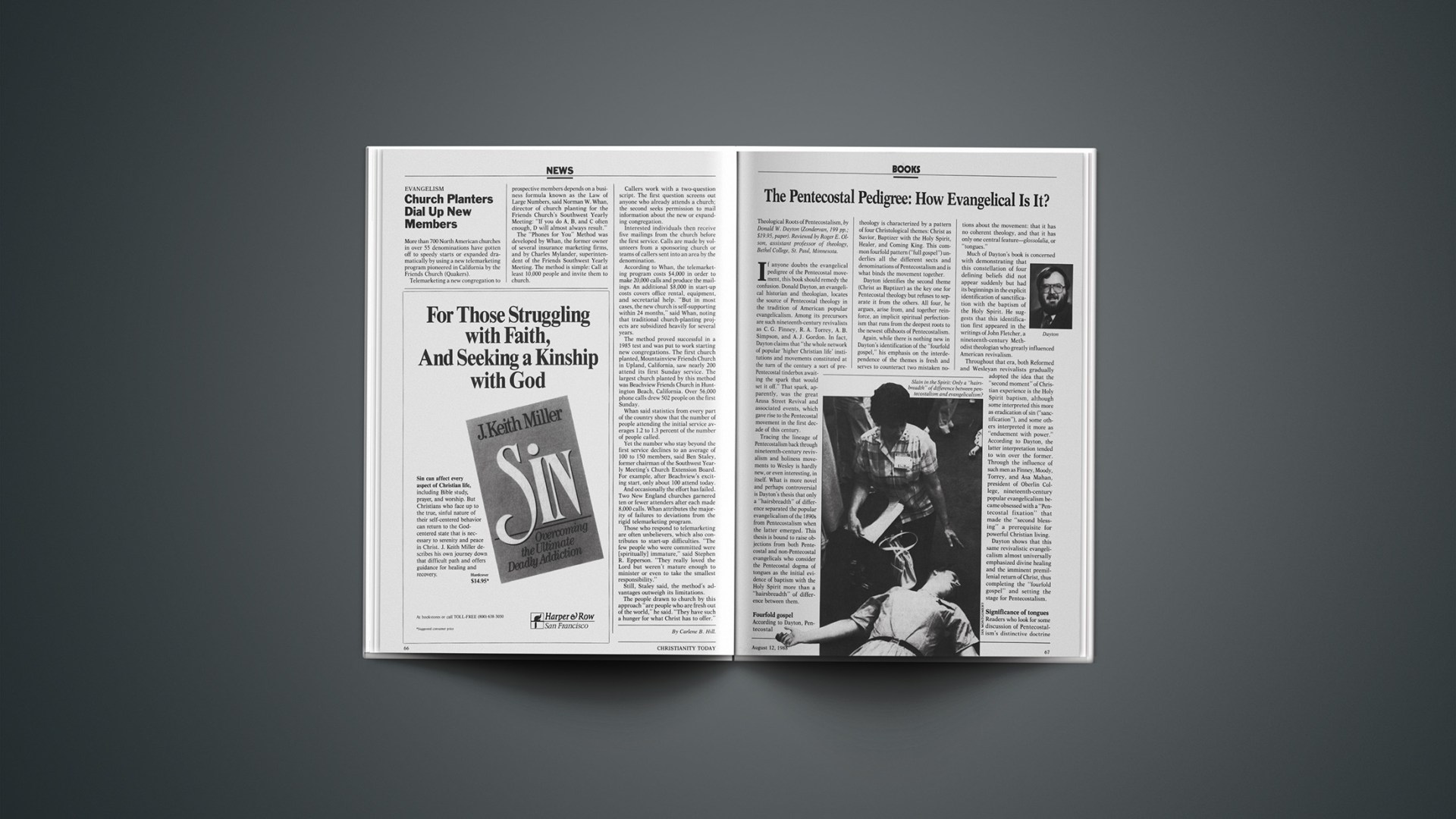
The Pentecostal Pedigree: How Evangelical Is It?

Theological Roots of Pentecostalism, by Donald W. Dayton (Zondervan, 199 pp.; $19.95, paper). Reviewed by Roger E. Olson, assistant professor of theology, Bethel College, St. Paul, Minnesota.

If anyone doubts the evangelical pedigree of the Pentecostal movement, this book should remedy the confusion. Donald Dayton, an evangelical historian and theologian, locates the source of Pentecostal theology in the tradition of American popular evangelicalism. Among its precursors are such nineteenth-century revivalists as C. G. Finney, R.A. Torrey, A. B. Simpson, and A. J. Gordon. In fact, Dayton claims that “the whole network of popular ‘higher Christian life’ institutions and movements constituted at the turn of the century a sort of pre-Pentecostal tinderbox awaiting the spark that would set it off.” That spark, apparently, was the great Azusa Street Revival and associated events, which gave rise to the Pentecostal movement in the first decade of this century.

Tracing the lineage of Pentecostalism back through nineteenth-century revivalism and holiness movements to Wesley is hardly new, or even interesting, in itself. What is more novel and perhaps controversial is Dayton’s thesis that only a “hairsbreadth” of difference separated the popular evangelicalism of the 1890s from Pentecostalism when the latter emerged. This thesis is bound to raise objections from both Pentecostal and non-Pentecostal evangelicals who consider the Pentecostal dogma of tongues as the initial evidence of baptism with the Holy Spirit more than a “hairsbreadth” of difference between them.

Fourfold Gospel

According to Dayton, Pentecostal theology is characterized by a pattern of four Christological themes: Christ as Savior, Baptizer with the Holy Spirit, Healer, and Coming King. This common fourfold pattern (“full gospel”) underlies all the different sects and denominations of Pentecostalism and is what binds the movement together.

Dayton identifies the second theme (Christ as Baptizer) as the key one for Pentecostal theology but refuses to separate it from the others. All four, he argues, arise from, and together reinforce, an implicit spiritual perfectionism that runs from the deepest roots to the newest offshoots of Pentecostalism.

Again, while there is nothing new in Dayton’s identification of the “fourfold gospel,” his emphasis on the interdependence of the themes is fresh and serves to counteract two mistaken notions about the movement: that it has no coherent theology, and that it has only one central feature—glossolalia, or “tongues.”

Much of Dayton’s book is concerned with demonstrating that this constellation of four defining beliefs did not appear suddenly but had its beginnings in the explicit identification of sanctification with the baptism of the Holy Spirit. He suggests that this identification first appeared in the writings of John Fletcher, a nineteenth-century Methodist theologian who greatly influenced American revivalism.

Throughout that era, both Reformed and Wesleyan revivalists gradually adopted the idea that the “second moment” of Christian experience is the Holy Spirit baptism, although some interpreted this more as eradication of sin (“sanctification”), and some others interpreted it more as “enduement with power.” According to Dayton, the latter interpretation tended to win over the former. Through the influence of such men as Finney, Moody, Torrey, and Asa Mahan, president of Oberlin College, nineteenth-century popular evangelicalism became obsessed with a “Pentecostal fixation” that made the “second blessing” a prerequisite for powerful Christian living.

Dayton shows that this same revivalistic evangelicalism almost universally emphasized divine healing and the imminent premillenial return of Christ, thus completing the “fourfold gospel” and setting the stage for Pentecostalism.

Significance Of Tongues

Readers who look for some discussion of Pentecostal ism’s distinctive doctrine of speaking in tongues as the evidence of Spirit baptism will be disappointed. According to Dayton, this feature of the movement’s theology has no historical antecedent and is a “significant novum … that truly does set Pentecostalism apart from the other ‘higher Christian life’ movements.”

The overall thrust of this book, however, suggests that this emphasis on tongues places only a “hairsbreadth” between classical Pentecostalism and evangelicalism. But this underestimates the practical significance of tongues for most Pentecostals as well as the discontinuity with the rest of evangelicalism that glossolalia represents.

Nevertheless, Dayton’s book makes a significant contribution to the evangelical community by placing Pentecostalism in its proper theological and ecclesiastical context. Far from being relegated to a lunatic fringe or castigated as a “cult,” it should be recognized as a vital branch of the evangelical family tree with deep roots in the American revivalist tradition.

A Scapegoat’S Death

A Southern Family, by Gail Godwin (Morrow, 540 pp., $18.95, cloth). Reviewed by Katie Andraski, a poet living in Belvidere, Illinois. She is the author of When the Plow Cuts (Thorntree Press).

Theo Quick is dead. On a Sunday afternoon he killed his girlfriend and himself. At least, that is the simplest explanation of the facts. But no one really knows what happened.

“It was his own family that killed him, and he let them do it,” says Snow, his ex-wife. The Quicks are shaken. They did not hate Theo, the most sensitive and most obnoxious member of the family. They ignored him. After his death they become aware he was the scapegoat, the sacrifice for their sins.

Who is to blame, and why? That is what A Southern Family, by Gail Godwin, is about. The book is divided into two parts. In part one, Theo’s parents, ex-wife, brother, half-sister, and her friend tell their individual stories in relation to Theo. The result is an insider’s look at the dysfunctional family, where appearances are more important than the substance of the love, where the members are required to fill rigidly defined roles, where the family cannot talk about root problems.

Godwin flashes light on each character, showing how each family member contributed to Theo’s death. But she does so without judgment. She portrays characters the reader would normally shun—the possessive mother, the adulterous father, the hillbilly wife—so humanly that the reader sympathizes with them and even begins to like them.

In part two, time adds to the insights the family has gained in Theo’s death. His half-sister, Clare, throws away a novel she is working on and writes a letter to Theo instead. Snow fights for the custody of their son and wins, even though the family sees her as white trash. Theo’s father freezes in denial. He persists in believing that someone else killed his son, putting ads in the paper offering a reward for any information. Rafe, Theo’s brother, medicates his pain with booze. And Lily, Theo’s mother, digs deep into her religious convictions.

Through Lily, hope emerges. She interprets a dream about Theo: “But in the realm that matters, the realm where the indestructible personality lives on, the realm mere history can’t touch, Theo lives. He lives, and right now he’s in the process of climbing a very steep hill to sanctity; he’s on the way to wash his hands so that he’ll be fit to … shake hands with God.”

Echoes of sacrifice

Godwin claims A Southern Family is her most personal novel yet, born out of the death of her own brother: “It remains unsolved just like [the death] in the book. The only way I could express myself about it or even think about it was to write a novel about it.”

The author also says her religious background and ties show through (as much as she wishes to reveal) in this novel. In light of those comments, it is interesting to note that Theo, the Greek word for God, is the name she chose for the character who portrays her brother. And that the name Quick may be taken from the Apostles’ Creed—” From thence he shall come to judge the quick and the dead.” The line echoes through the novel. Theo judges the family by his death. Each member stands in the dock and must answer. As in the Bible, the sacrifice permeates the story.

Load of sorrows

In the end, Lily opens herself to the grace of repentance. She contemplates walking up the gravel road leading to her home, barefoot, “letting desolation and hopelessness embrace her like a lover, feeling the ache in her heart swell and swell like a sponge as it absorbed death and betrayal and cowardice and willful, damaging ignorance—her own as well as other people’s. If she could make it to the top of the hill carrying her entire and acknowledged load of sorrows and mistakes, as well as the evil [that] experience had taught her human beings were capable of visiting on one another, it seemed to her she might be granted a kind of spiritual second wind.”

Godwin leaves the reader with hope, closing the novel with a prayer: “May the Lord bless us, protect us from all evil, and bring us to everlasting life.

“Amen.”

A Southern Family offers us a long, thoughtful examination of dysfunctional relationships, something from which our doctrine does not exempt us. It respects the power of faith, and through its wounded and grieving family, offers us insight and hope into our own guilt and sacrifice.

The Tension Of Mind And Heart

A Pauline Theology of Charismata, by Siegfried Schatzmann (Hendrickson Publishers, 117 pp.; $7.95, paper); Spirit and Gospel in Mark, by M. Robert Mansfield (Hendrickson Publishers, 191 pp.; $9.95, paper). Reviewed by Gordon D. Fee, professor of New Testament at Regent College, Vancouver, British Columbia.

Despite their diverse contents, these two books hold several things in common: Both authors are New Testament professors at Oral Roberts University; both books reflect their authors’ doctoral dissertations; and both are serious pieces of scholarship by Pentecostals, though clearly both are intended for a much larger audience. With these and several other books of note, Hendrickson Publishers is establishing itself as the leading outlet of Pentecostal and charismatic scholarship. Siegfried Schatzmann’s study is as straightforward as its title suggests. The first half is an exegetical study of the passages in which the term charisma(ta) (defined as “concrete expressions of grace,” usually “spiritual gifts”) occurs in Paul’s letters.

The final three chapters are theological, discussing in turn charismata as “the church’s equipment for service,” as “ministerial function,” and as “expressions of authority.” In these final chapters, Schatzmann moves far beyond traditional Pentecostal/charismatic concerns, engaging the scholarly literature of the past several decades (for the most part, non-Pentecostal) in a discussion of these topics.

The result is a book that takes some unexpected turns. Discussion of the gifts as such is limited to the exegetical chapter. The theological chapters do not deal with the individual gifts at all, but with the role of charismata in Pauline theology. This is a refreshing discussion from a Pentecostal, and one that scarcely surfaces in the popular literature.

Although I disagree with the author at places (e.g., on the “discerning of spirits” and the meaning of 1 Tim. 4:10), the exegetical work is carefully done. But one wonders why it was limited only to those places where the term charisma(ta) appears. After all, since Paul twice calls “prophecy” a charisma, the omission of such texts as 1 Thessalonians 5:19–22 and Ephesians 4:11–16 seems unfortunate for what is otherwise a very helpful study. Indeed, scholar and lay person alike may benefit from this volume.

Combating The False Prophets

M. Robert Mansfield’s study, on the other hand, is not a book for beginners. He carries into his study a clearly Pentecostal concern: to demonstrate a much greater role for the Spirit in Mark’s gospel than previous scholarship has been willing to concede. Mansfield is not writing with an eye toward either the lay person or the traditional Pentecostal / charismatic reader. Here is heady stuff, written by a New Testament scholar for other New Testament scholars.

His thesis can be simply put: Two themes dominate Mark’s presentation of Jesus—“gospel” and “Spirit.” These two themes are his special interest because of the situation in the church in Rome in the A.D. 60s, a situation Mansfield understands to be reflected in one text in particular, Mark 13:22. Here the church in Rome has in its midst a group of “pneumatic-prophetic ecstatics,” who “rely upon immediate revelation or signs and wonders from the Spirit for authority” and thereby are making “exaggerated, erroneous claims” both in doctrine and practice.

Mark intends to counteract these false prophets by insisting that the “gospel,” which is preached in the church by the “orthodox,” is based on the preaching/teaching/healing of Jesus himself, who above all else was empowered by the Spirit. Indeed, it is argued that Mark understands “the Risen Christ and the Holy Spirit [to be] inseparable, if not identical.”

Since the risen Christ is also identical with the historical Jesus of his gospel, Mark expects his readers’ encounter with Jesus in the gospel to be a genuine encounter with the Spirit. At the same time, he expects his readers not to lose touch with the historical character of the story itself.

Unproven Thesis

Although the author is to be praised for this provocative study—one is certainly forced to think through Mark’s gospel all over again—and for his thorough knowledge and critique of Markan studies over the past three decades, one suspects that these studies provide the basic premises for this book far more than does the text of Mark itself. My own Pentecostal instincts resonate with the author’s thesis; but my better judgments as a New Testament scholar conclude that it is finally unproven. The author’s thesis seems to fit contemporary Tulsa far more than what we know about first-century Rome.

These two books together highlight some continuing tensions in Pentecostalism. On the one hand, they offer clear evidence that Pentecostal scholarship is coming of age. However, how much Pentecostals will find to rejoice in that maturation remains moot—at least as far as these two books are concerned. My guess is that the age-long tension in Pentecostalism between mind and heart (education and experience) will scarcely be ameliorated by such books.

Church Planters Dial up New Members

EVANGELISM

More than 700 North American churches in over 55 denominations have gotten off to speedy starts or expanded dramatically by using a new telemarketing program pioneered in California by the Friends Church (Quakers).

Telemarketing a new congregation to prospective members depends on a business formula known as the Law of Large Numbers, said Norman W. Whan, director of church planting for the Friends Church’s Southwest Yearly Meeting: “If you do A, B, and C often enough, D will almost always result.”

The “Phones for You” Method was developed by Whan, the former owner of several insurance marketing firms, and by Charles Mylander, superintendent of the Friends Southwest Yearly Meeting. The method is simple: Call at least 10,000 people and invite them to church.

Callers work with a two-question script. The first question screens out anyone who already attends a church; the second seeks permission to mail information about the new or expanding congregation.

Interested individuals then receive five mailings from the church before the first service. Calls are made by volunteers from a sponsoring church or teams of callers sent into an area by the denomination.

According to Whan, the telemarketing program costs $4,000 in order to make 20,000 calls and produce the mailings. An additional $8,000 in start-up costs covers office rental, equipment, and secretarial help. “But in most cases, the new church is self-supporting within 24 months,” said Whan, noting that traditional church-planting projects are subsidized heavily for several years.

The method proved successful in a 1985 test and was put to work starting new congregations. The first church planted, Mountainview Friends Church in Upland, California, saw nearly 200 attend its first Sunday service. The largest church planted by this method was Beachview Friends Church in Huntington Beach, California. Over 56,000 phone calls drew 502 people on the first Sunday.

Whan said statistics from every part of the country show that the number of people attending the initial service averages 1.2 to 1.3 percent of the number of people called.

Yet the number who stay beyond the first service declines to an average of 100 to 150 members, said Ben Staley, former chairman of the Southwest Yearly Meeting’s Church Extension Board. For example, after Beachview’s exciting start, only about 100 attend today.

And occasionally the effort has failed. Two New England churches garnered ten or fewer attenders after each made 8,000 calls. Whan attributes the majority of failures to deviations from the rigid telemarketing program.

Those who respond to telemarketing are often unbelievers, which also contributes to start-up difficulties. “The few people who were committed were [spiritually] immature,” said Stephen R. Epperson. “They really loved the Lord but weren’t mature enough to minister or even to take the smallest responsibility.”

Still, Staley said, the method’s advantages outweigh its limitations.

The people drawn to church by this approach “are people who are fresh out of the world,” he said. “They have such a hunger for what Christ has to offer.”

By Carlene B. Hill.

Abortion Takes Center Stage for Presbyterians

DENOMINATIONAL REPORT

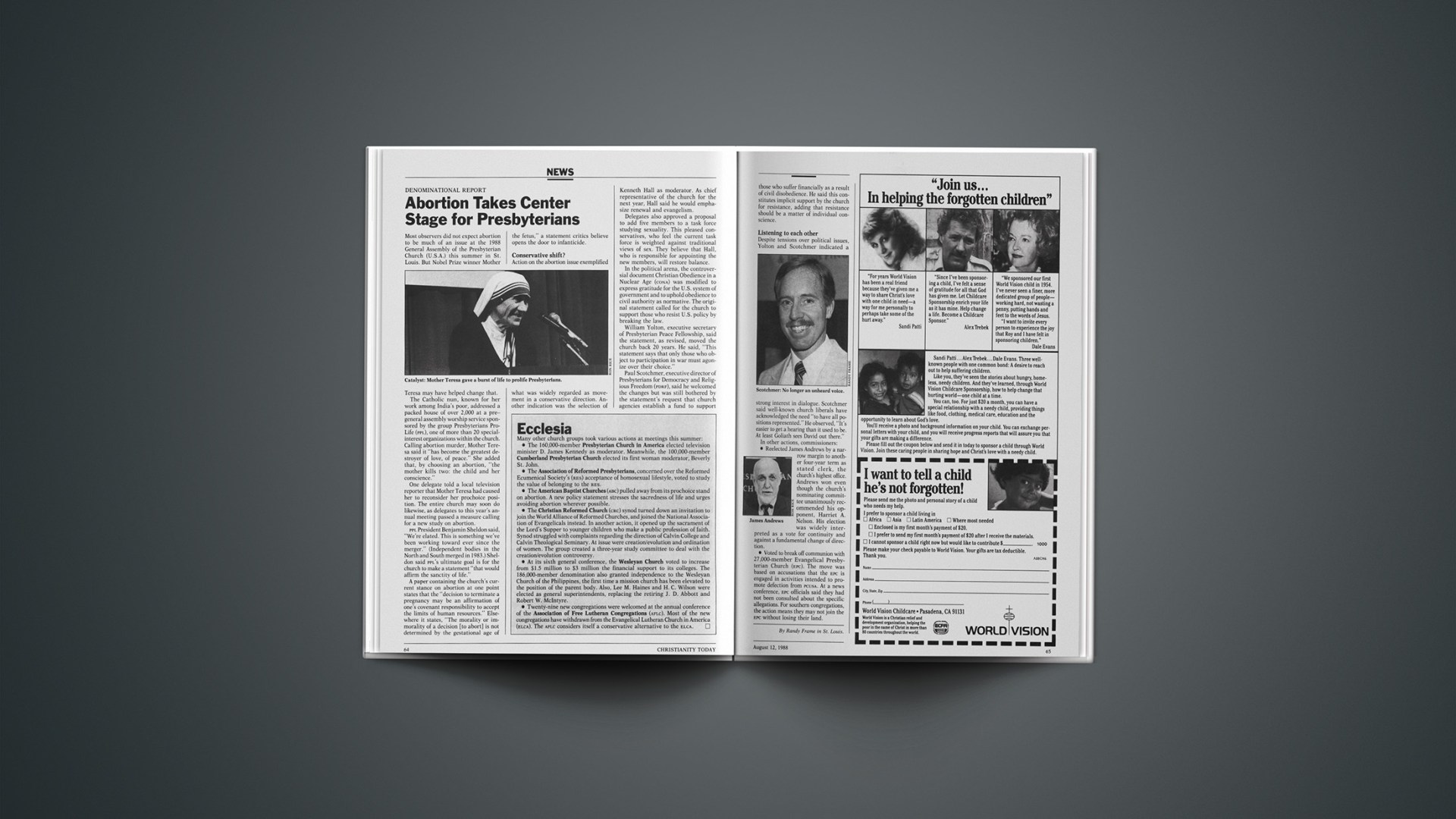
Most observers did not expect abortion to be much of an issue at the 1988 General Assembly of the Presbyterian Church (U.S.A.) this summer in St. Louis. But Nobel Prize winner Mother Teresa may have helped change that.

The Catholic nun, known for her work among India’s poor, addressed a packed house of over 2,000 at a pre-general assembly worship service sponsored by the group Presbyterians Pro-Life (PPL), one of more than 20 special-interest organizations within the church. Calling abortion murder, Mother Teresa said it “has become the greatest destroyer of love, of peace.” She added that, by choosing an abortion, “the mother kills two: the child and her conscience.”

One delegate told a local television reporter that Mother Teresa had caused her to reconsider her prochoice position. The entire church may soon do likewise, as delegates to this year’s annual meeting passed a measure calling for a new study on abortion.

PPL President Benjamin Sheldon said, “We’re elated. This is something we’ve been working toward ever since the merger.” (Independent bodies in the North and South merged in 1983.) Sheldon said PPL’S ultimate goal is for the church to make a statement “that would affirm the sanctity of life.”

A paper containing the church’s current stance on abortion at one point states that the “decision to terminate a pregnancy may be an affirmation of one’s covenant responsibility to accept the limits of human resources.” Elsewhere it states, “The morality or immorality of a decision [to abort] is not determined by the gestational age of the fetus,” a statement critics believe opens the door to infanticide.

Conservative Shift?

Action on the abortion issue exemplified what was widely regarded as movement in a conservative direction. Another indication was the selection of Kenneth Hall as moderator. As chief representative of the church for the next year, Hall said he would emphasize renewal and evangelism

Ecclesia

Many other church groups took various actions at meetings this summer:

• The 160,000-member Presbyterian Church in America elected television minister D. James Kennedy as moderator. Meanwhile, the 100,000-member Cumberland Presbyterian Church elected its first woman moderator, Beverly St. John.

• The Association of Reformed Presbyterians, concerned over the Reformed Ecumenical Society’s (RES) acceptance of homosexual lifestyle, voted to study the value of belonging to the res.

• The American Baptist Churches (ABC) pulled away from its prochoice stand on abortion. A new policy statement stresses the sacredness of life and urges avoiding abortion wherever possible.

• The Christian Reformed Church (CRC) synod turned down an invitation to join the World Alliance of Reformed Churches, and joined the National Association of Evangelicals instead. In another action, it opened up the sacrament of the Lord’s Supper to younger children who make a public profession of faith. Synod struggled with complaints regarding the direction of Calvin College and Calvin Theological Seminary. At issue were creation/evolution and ordination of women. The group created a three-year study committee to deal with the creation/evolution controversy.

• At its sixth general conference, the Wesleyan Church voted to increase from $1.5 million to $3 million the financial support to its colleges. The 186,000-member denomination also granted independence to the Wesleyan Church of the Philippines, the first time a mission church has been elevated to the position of the parent body. Also, Lee M. Haines and H. C. Wilson were elected as general superintendents, replacing the retiring J. D. Abbott and Robert W. McIntyre.

• Twenty-nine new congregations were welcomed at the annual conference of the Association of Free Lutheran Congregations (AFLC). Most of the new congregations have withdrawn from the Evangelical Lutheran Church in America (ELCA). The AFLC considers itself a conservative alternative to the ELCA.

Delegates also approved a proposal to add five members to a task force studying sexuality. This pleased conservatives, who feel the current task force is weighted against traditional views of sex. They believe that Hall, who is responsible for appointing the new members, will restore balance.

In the political arena, the controversial document Christian Obedience in a Nuclear Age (CONA) was modified to express gratitude for the U.S. system of government and to uphold obedience to civil authority as normative. The original statement called for the church to support those who resist U.S. policy by breaking the law.

William Yolton, executive secretary of Presbyterian Peace Fellowship, said the statement, as revised, moved the church back 20 years. He said, “This statement says that only those who object to participation in war must agonize over their choice.”

Paul Scotchmer, executive director of Presbyterians for Democracy and Religious Freedom (PDRF), said he welcomed the changes but was still bothered by the statement’s request that church agencies establish a fund to support those who suffer financially as a result of civil disobedience. He said this constitutes implicit support by the church for resistance, adding that resistance should be a matter of individual conscience.

Listening To Each Other

Despite tensions over political issues, Yolton and Scotchmer indicated a strong interest in dialogue. Scotchmer said well-known church liberals have acknowledged the need “to have all positions represented.” He observed, “It’s easier to get a hearing than it used to be. At least Goliath sees David out there.”

In other actions, commissioners:

• Reelected James Andrews by a narrow margin to another four-year term as stated clerk, the church’s highest office. Andrews won even though the church’s nominating committee unanimously recommended his opponent, Harriet A. Nelson. His election was widely interpreted as a vote for continuity and against a fundamental change of direction.

• Voted to break off communion with 27,000-member Evangelical Presbyterian Church (EPC). The move was based on accusations that the EPC is engaged in activities intended to promote defection from PCUSA. At a news conference, EPC officials said they had not been consulted about the specific allegations. For southern congregations, the action means they may not join the EPC without losing their land.

By Randy Frame in St. Louis.

Jewish Missions Face Surging Opposition

CONFLICT

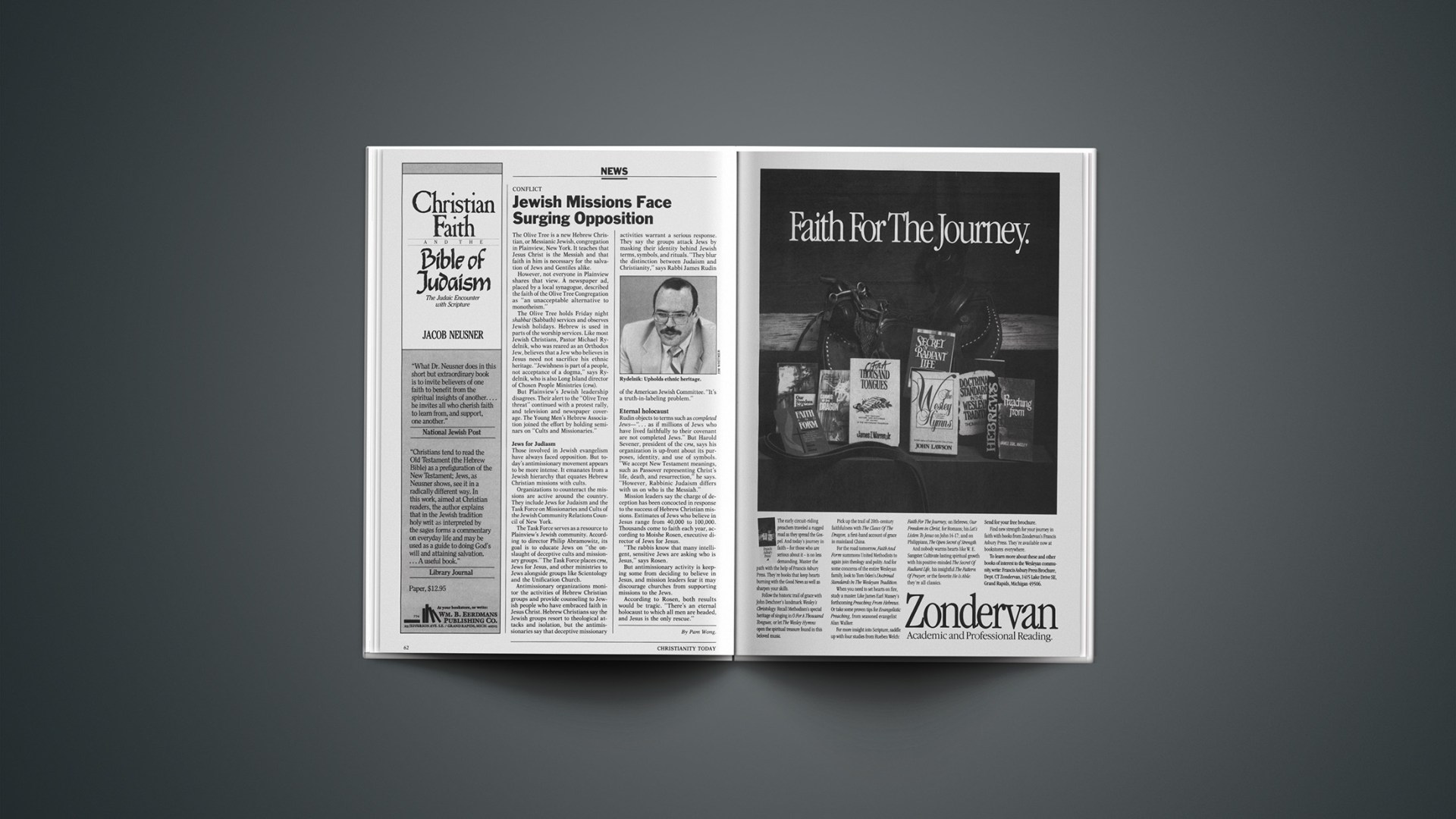
The Olive Tree is a new Hebrew Christian, or Messianic Jewish, congregation in Plainview, New York. It teaches that Jesus Christ is the Messiah and that faith in him is necessary for the salvation of Jews and Gentiles alike.

However, not everyone in Plainview shares that view. A newspaper ad, placed by a local synagogue, described the faith of the Olive Tree Congregation as “an unacceptable alternative to monotheism.”

The Olive Tree holds Friday night shabbat (Sabbath) services and observes Jewish holidays. Hebrew is used in parts of the worship services. Like most Jewish Christians, Pastor Michael Rydelnik, who was reared as an Orthodox Jew, believes that a Jew who believes in Jesus need not sacrifice his ethnic heritage. “Jewishness is part of a people, not acceptance of a dogma,” says Rydelnik, who is also Long Island director of Chosen People Ministries (CPM).

But Plainview’s Jewish leadership disagrees. Their alert to the “Olive Tree threat” continued with a protest rally, and television and newspaper coverage. The Young Men’s Hebrew Association joined the effort by holding seminars on “Cults and Missionaries.”

Jews For Judiasm

Those involved in Jewish evangelism have always faced opposition. But today’s antimissionary movement appears to be more intense. It emanates from a Jewish hierarchy that equates Hebrew Christian missions with cults.

Organizations to counteract the missions are active around the country. They include Jews for Judaism and the Task Force on Missionaries and Cults of the Jewish Community Relations Council of New York.

The Task Force serves as a resource to Plainview’s Jewish community. According to director Philip Abramowitz, its goal is to educate Jews on “the onslaught of deceptive cults and missionary groups.” The Task Force places CPM, Jews for Jesus, and other ministries to Jews alongside groups like Scientology and the Unification Church.

Antimissionary organizations monitor the activities of Hebrew Christian groups and provide counseling to Jewish people who have embraced faith in Jesus Christ. Hebrew Christians say the Jewish groups resort to theological attacks and isolation, but the antimissionaries say that deceptive missionary activities warrant a serious response. They say the groups attack Jews by masking their identity behind Jewish terms, symbols, and rituals. “They blur the distinction between Judaism and Christianity,” says Rabbi James Rudin of the American Jewish Committee. “It’s a truth-in-labeling problem.”

Eternal Holocaust

Rudin objects to terms such as completed Jews—“… as if millions of Jews who have lived faithfully to their covenant are not completed Jews.” But Harold Sevener, president of the CPM, says his organization is up-front about its purposes, identity, and use of symbols. “We accept New Testament meanings, such as Passover representing Christ’s life, death, and resurrection,” he says. “However, Rabbinic Judaism differs with us on who is the Messiah.”

Mission leaders say the charge of deception has been concocted in response to the success of Hebrew Christian missions. Estimates of Jews who believe in Jesus range from 40,000 to 100,000. Thousands come to faith each year, according to Moishe Rosen, executive director of Jews for Jesus.

“The rabbis know that many intelligent, sensitive Jews are asking who is Jesus,” says Rosen.

But antimissionary activity is keeping some from deciding to believe in Jesus, and mission leaders fear it may discourage churches from supporting missions to the Jews.

According to Rosen, both results would be tragic. “There’s an eternal holocaust to which all men are headed, and Jesus is the only rescue.”

By Pam Wong.

Lutherans Seek a Remedy for Membership Loss

EVANGELISM

Like other mainline Protestant groups, U.S. Lutheranism has been failing to add enough new members to offset membership losses. In 1986, the 11,000 congregations of what is now the Evangelical Lutheran Church in America (ELCA) averaged fewer than one adult baptism.

The situation is no better in the second-largest U.S. Lutheran body, the more conservative Lutheran Church—Missouri Synod (LCMS), which last year, according to one synod leader, lost 51.000 members.

Many attribute the decline among Lutherans to a lost emphasis on evangelism. Determined to change this, some 1,000 Lutherans registered for the three-day conference “Lutherans Evangelizing Together” in late June in Bloomington, Minnesota.

Between 1,000 and 2,000 additional people turned out for nightly conference rallies. Even so, overall attendance was disappointing if the selection of the 15,000-seat Metropolitan Sports Center as the meeting site is a fair indication of what organizers expected.

The conference was intended in part to substitute for the annual International Lutheran Conference on the Holy Spirit, which customarily has drawn thousands of charismatics each August to the Minneapolis Auditorium, now being razed to make way for a new convention center. Perhaps due to the absence of a big-name charismatic leader among the major speakers, turnout of charismatics was low.

Most of the registrants, and all but one of the main speakers, came from the five million-member ELCA. The exception was Ronald Fink, president of the Atlantic District of the LCMS, who called evangelism “the battleground where the Lutheran church lives or dies—on every level.”

Fink said, “The Lord’s mandate to evangelize, make disciples, and to lift high the cross should be the primary task of Christians.”

Herbert W. Chilstrom, the ELCA’S first presiding bishop, said at the opening session of the conference that he was “ashamed to be identified with a declining mainline denomination.” Prior to becoming the leader of the ELCA, which was formed last year by a three-body merger, Chilstrom rallied the Minnesota Synod of the former Lutheran Church in America to annual membership gains.

The presiding bishop, who had insisted on including “evangelical” in the name of the new church, emphasized “absolute dependence on the Holy Spirit” in seeking church renewal. Stating that Lutheranism abandons its young people at confirmation, Chilstrom stressed the need for the church to encourage youth to be more bold about sharing their faith.

Conference chairman Merv Thompson, pastor of a fast-growing ELCA congregation in Burnsville, Minnesota, said in an interview that Chilstrom’s “powerful evangelical witness” provided people with “a wonderful sense of confidence” in ELCA leadership.

Thompson added that a Bible study led by David Tiede, the new president of Luther Northwestern Theological Seminary in St. Paul (the denomination’s largest), should assure evangelicals within the ELCA that they “have a strong evangelical leader at the seminary.”

By Willmar Thorkelson in Bloomington.

World Scene

NICARAGUA

Sandinista Crackdown

In the past, crackdowns by the government of Nicaragua have meant imprisonment for some evangelical pastors, allegedly for antigovernment political activities. But there are no indications that Protestant Christians in Nicaragua were directly affected by last month’s actions to curb opposition.

The country’s Sandinista government did, however, shut down the Catholic radio station Radio Catolica indefinitely, as well as the opposition newspaper La Prensa for 15 days. In addition, Sandinista police squelched a rally of political dissenters on July 10 in the town of Nandaime, 35 miles south of the capital of Managua. Police used tear gas and rifle butts to break up the rally; among those beaten was a reporter for the New York Times. The government defended its measures by claiming that the rally was part of a United States-orchestrated effort to overthrow the Sandinistas.

Among political opponents arrested as a result of the rally was Roger Guevara Mena, secretary general of the Democratic Coordinator, a coalition of opposition groups. Guevara, a Catholic who was interviewed by CHRISTIANITY TODAY late last year (CT, Jan. 15, 1988, p. 44), has voiced a commitment to peaceful political change in Nicaragua. According to Nina Shea of the Washington, D.C.-based Puebla Institute, Guevara was sentenced to six months in prison for disturbing the peace.

The Institute on Religion and Democracy, which monitors the political activities of mainline churches, has drafted a letter to Nicaraguan President Daniel Ortega, deploring especially “the official silencing of Radio Católica” as a direct assault on the church’s freedom “to proclaim its message and to apply it to society.” The IRD is seeking signatures from leaders of mainline denominations and renewal groups within them.

CHINA

A Word On Forced Abortions

A Chinese government official has said that coerced abortions in her country are the exception, not the rule.

Shen Guoxiang, of China’s Family Planning Commission, told the Washington Post that her government hopes to meet its goal of holding China’s population to 1.2 billion by 2000. Thus it will train an additional 25,000 family-planning workers and attempt to discourage early marriages.

In this regard, Shen says China’s abortion rate is lower than Japan’s (17.1 a year per 1,000 women) and the Soviet Union’s (102.4 a year per 1,000 women, 10 years ago). The rate of abortion in the United States is 27.4 a year per 1,000 women.

HIGHER EDUCATION

Third World Seminarians

Three years ago, the Netherlands-based Tyndale Theological Seminary was only an idea. Founded by Robert P. Evans and sponsored by Greater Europe Mission, the school has operated successfully with help from visiting American faculty members. Earlier this summer, ten students received degrees and made history as Tyndale’s first graduating class.

Seminary president Arthur P. Johnston hailed the event as part of “God’s purpose and plan for world evangelism.” Half of Tyndale’s students come from countries representing the Two-thirds World. Graduates received either a certificate in Biblical Studies, master of arts in World Evangelization, or master of divinity degree. Some of these graduates have already begun ministries in their native countries or are serving as missionaries in other countries.

UPDATE

Lausanne Moves To Manila

The first World Congress on Evangelization was held in Lausanne, Switzerland, giving birth to the Lausanne Committee on World Evangelization (LCWE) in 1974. A second congress sponsored by LCWE was to be held next year in Singapore, international headquarters for the organization. But due to construction delays in that city, the second Lausanne Congress on World Evangelization will be held in Manila, the Philippines.

Congress organizers agree the change might be confusing, and that it came as a surprise. “We were stunned,” said LCWE Chairman Leighton Ford on learning of the construction problems in Singapore. The official congress name will now be “Lausanne II in Manila,” and the selected theme is “Proclaim Christ Until He Comes: A Call to the Whole Church to Take the Gospel to the Whole World.”

CUBA

Church Is Off Limits

David Howard, executive director of World Evangelical Fellowship, recently found himself on an unexpected three-day vacation on the island of Cayo Largo, just south of Cuba. But he would rather have spoken at a pastors’ conference, which was his reason for going to Cuba in the first place.

Howard was assured prior to departing for Havana that the airline would secure his visa. However, upon arriving in Cuba, immigration officials said he could enter the country only by getting a temporary tourist visa. They told Howard he could neither preach nor attend church. In a memo to the WEF executive council, Howard wrote, “In all my visits to different socialist countries, this was the first time I had ever been denied permission even to attend church.”

Howard said a Christian colleague in Cuba was “terribly embarrassed and distraught about the situation,” and cautiously suggested Howard return to the U.S. Unfortunately, all flights were booked for several weeks.

A New Generation of Leaders Receives the Baton

LEADERSHIP

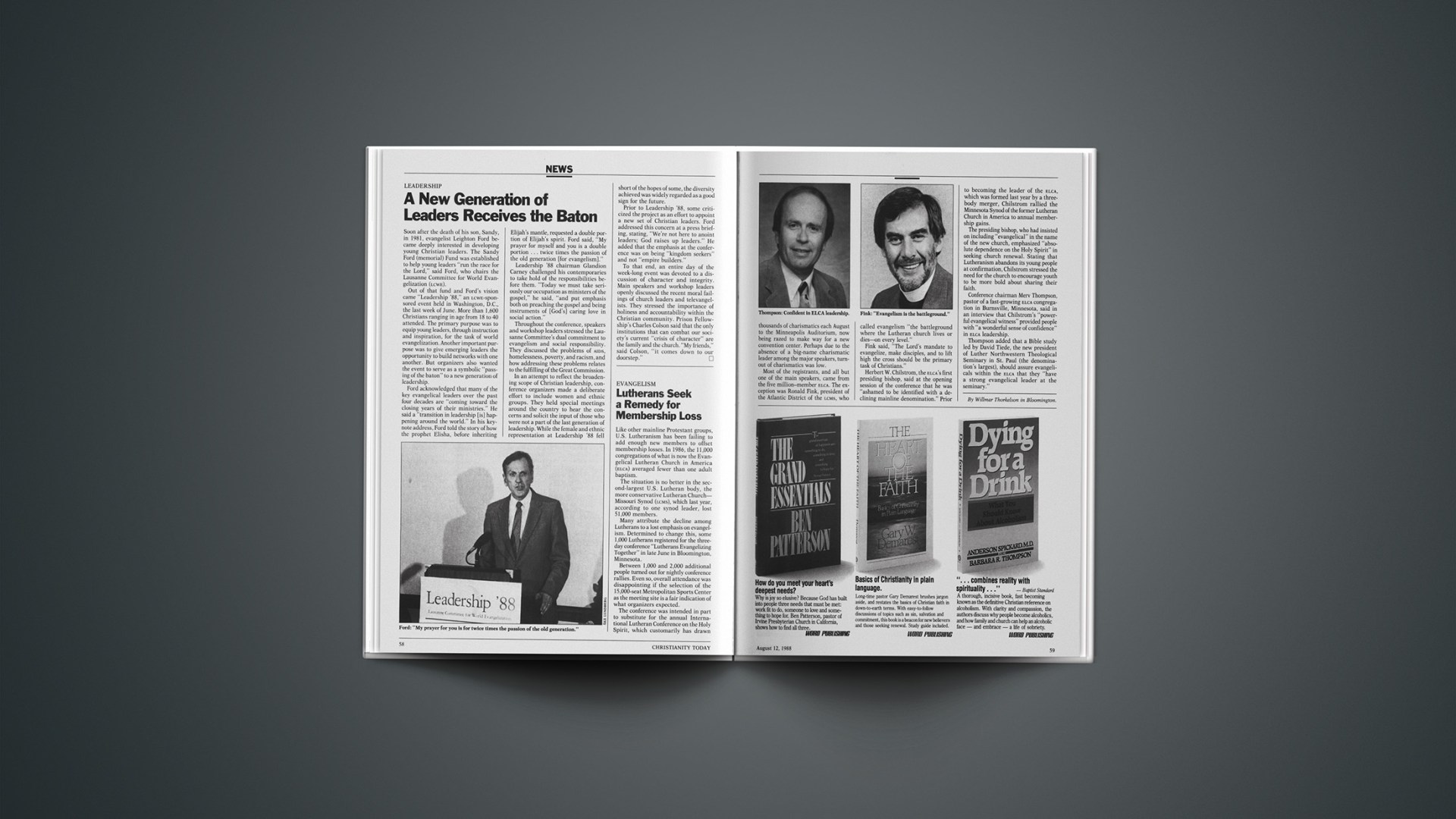
Soon after the death of his son, Sandy, in 1981, evangelist Leighton Ford became deeply interested in developing young Christian leaders. The Sandy Ford (memorial) Fund was established to help young leaders “run the race for the Lord,” said Ford, who chairs the Lausanne Committee for World Evangelization (LCWE).

Out of that fund and Ford’s vision came “Leadership ‘88,” an LCWE-spon-sored event held in Washington, D.C., the last week of June. More than 1,600 Christians ranging in age from 18 to 40 attended. The primary purpose was to equip young leaders, through instruction and inspiration, for the task of world evangelization. Another important purpose was to give emerging leaders the opportunity to build networks with one another. But organizers also wanted the event to serve as a symbolic “passing of the baton” to a new generation of leadership.

Ford acknowledged that many of the key evangelical leaders over the past four decades are “coming toward the closing years of their ministries.” He said a “transition in leadership [is] happening around the world.” In his keynote address, Ford told the story of how the prophet Elisha, before inheriting

Elijah’s mantle, requested a double portion of Elijah’s spirit. Ford said, “My prayer for myself and you is a double portion … twice times the passion of the old generation [for evangelism].”

Leadership ‘88 chairman Glandion Carney challenged his contemporaries to take hold of the responsibilities before them. “Today we must take seriously our occupation as ministers of the gospel,” he said, “and put emphasis both on preaching the gospel and being instruments of [God’s] caring love in social action.”

Throughout the conference, speakers and workshop leaders stressed the Lausanne Committee’s dual commitment to evangelism and social responsibility. They discussed the problems of AIDS, homelessness, poverty, and racism, and how addressing these problems relates to the fulfilling of the Great Commission.

In an attempt to reflect the broadening scope of Christian leadership, conference organizers made a deliberate effort to include women and ethnic groups. They held special meetings around the country to hear the concerns and solicit the input of those who were not a part of the last generation of leadership. While the female and ethnic representation at Leadership ‘88 fell short of the hopes of some, the diversity achieved was widely regarded as a good sign for the future.

Prior to Leadership 88, some criticized the project as an effort to appoint a new set of Christian leaders. Ford addressed this concern at a press briefing, stating, “We’re not here to anoint leaders; God raises up leaders.” He added that the emphasis at the conference was on being “kingdom seekers” and not “empire builders.”

To that end, an entire day of the week-long event was devoted to a discussion of character and integrity. Main speakers and workshop leaders openly discussed the recent moral failings of church leaders and televangelists. They stressed the importance of holiness and accountability within the Christian community. Prison Fellowship’s Charles Colson said that the only institutions that can combat our society’s current “crisis of character” are the family and the church. “My friends,” said Colson, “it comes down to our doorstep.”

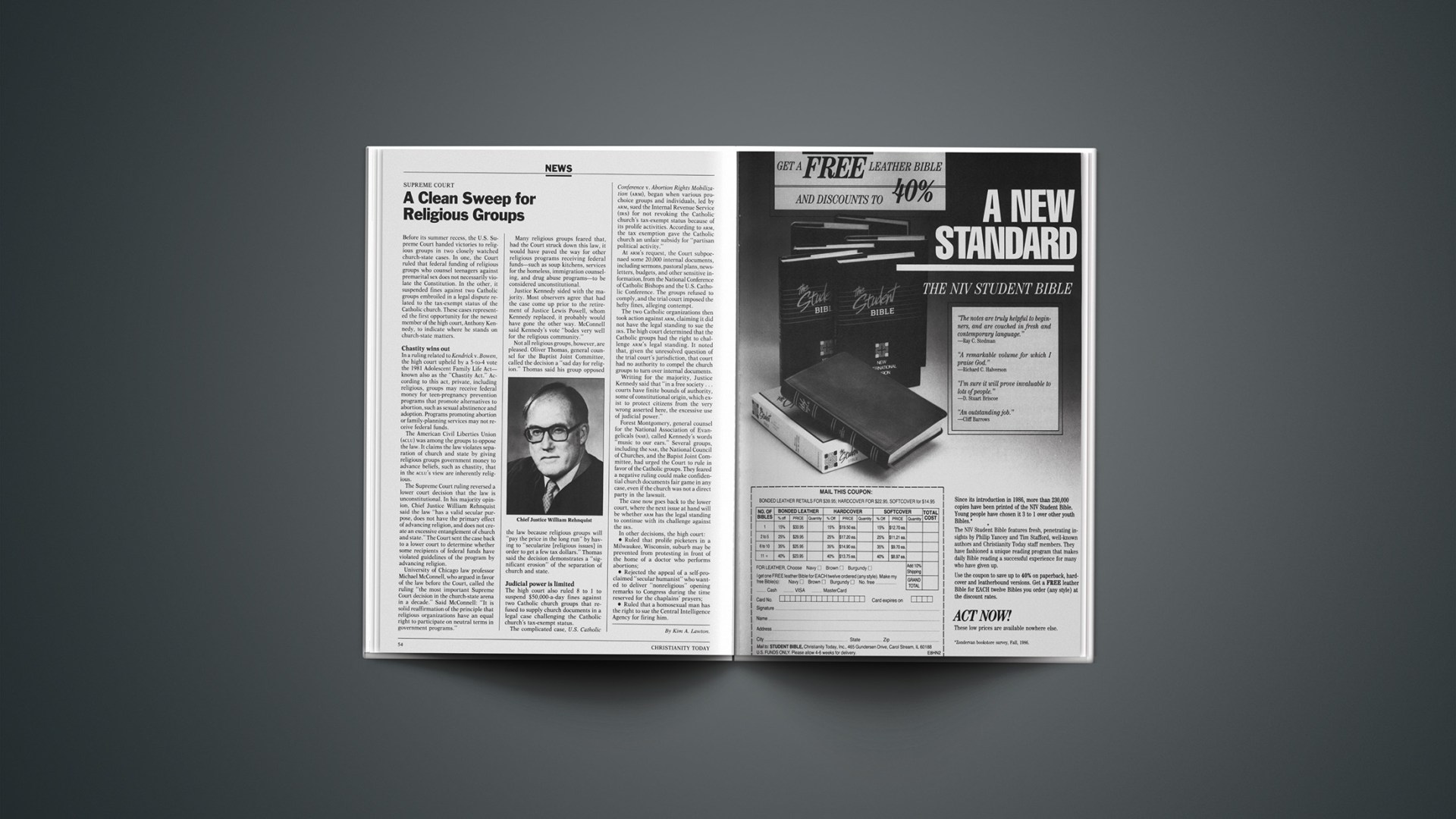
A Clean Sweep for Religious Groups

SUPREME COURT

Before its summer recess, the U.S. Supreme Court handed victories to religious groups in two closely watched church-state cases. In one, the Court ruled that federal funding of religious groups who counsel teenagers against premarital sex does not necessarily violate the Constitution. In the other, it suspended fines against two Catholic groups embroiled in a legal dispute related to the tax-exempt status of the Catholic church. These cases represented the first opportunity for the newest member of the high court, Anthony Kennedy, to indicate where he stands on church-state matters.

Chastity Wins Out

In a ruling related to Kendrick v. Bowen, the high court upheld by a 5-to-4 vote the 1981 Adolescent Family Life Act—known also as the “Chastity Act.” According to this act, private, including religious, groups may receive federal money for teen-pregnancy prevention programs that promote alternatives to abortion, such as sexual abstinence and adoption. Programs promoting abortion or family-planning services may not receive federal funds.

The American Civil Liberties Union (ACLU) was among the groups to oppose the law. It claims the law violates separation of church and state by giving religious groups government money to advance beliefs, such as chastity, that in the ACLU’S view are inherently religious.

The Supreme Court ruling reversed a lower court decision that the law is unconstitutional. In his majority opinion, Chief Justice William Rehnquist said the law “has a valid secular purpose, does not have the primary effect of advancing religion, and does not create an excessive entanglement of church and state.” The Court sent the case back to a lower court to determine whether some recipients of federal funds have violated guidelines of the program by advancing religion.

University of Chicago law professor Michael McConnell, who argued in favor of the law before the Court, called the ruling “the most important Supreme Court decision in the church-state arena in a decade.” Said McConnell: “It is solid reaffirmation of the principle that religious organizations have an equal right to participate on neutral terms in government programs.”

Many religious groups feared that, had the Court struck down this law, it would have paved the way for other religious programs receiving federal funds—such as soup kitchens, services for the homeless, immigration counseling, and drug abuse programs—to be considered unconstitutional.

Justice Kennedy sided with the majority. Most observers agree that had the case come up prior to the retirement of Justice Lewis Powell, whom Kennedy replaced, it probably would have gone the other way. McConnell said Kennedy’s vote “bodes very well for the religious community.”

Not all religious groups, however, are pleased. Oliver Thomas, general counsel for the Baptist Joint Committee, called the decision a “sad day for religion.” Thomas said his group opposed the law because religious groups will “pay the price in the long run” by having to “secularize [religious issues] in order to get a few tax dollars.” Thomas said the decision demonstrates a “significant erosion” of the separation of church and state.

Judicial Power Is Limited

The high court also ruled 8 to 1 to suspend $50,000-a-day fines against two Catholic church groups that refused to supply church documents in a legal case challenging the Catholic church’s tax-exempt status.

The complicated case, U.S. Catholic Conference v. Abortion Rights Mobilization (ARM), began when various prochoice groups and individuals, led by ARM, sued the Internal Revenue Service (IRS) for not revoking the Catholic church’s tax-exempt status because of its prolife activities. According to ARM, the tax exemption gave the Catholic church an unfair subsidy for “partisan political activity.”

At ARM’S request, the Court subpoenaed some 20,000 internal documents, including sermons, pastoral plans, newsletters, budgets, and other sensitive information, from the National Conference of Catholic Bishops and the U.S. Catholic Conference. The groups refused to comply, and the trial court imposed the hefty fines, alleging contempt.

The two Catholic organizations then took action against ARM, claiming it did not have the legal standing to sue the IRS. The high court determined that the Catholic groups had the right to challenge ARM’S legal standing. It noted that, given the unresolved question of the trial court’s jurisdiction, that court had no authority to compel the church groups to turn over internal documents.

Writing for the majority, Justice Kennedy said that “in a free society … courts have finite bounds of authority, some of constitutional origin, which exist to protect citizens from the very wrong asserted here, the excessive use of judicial power.”

Forest Montgomery, general counsel for the National Association of Evangelicals (NAE), called Kennedy’s words “music to our ears.” Several groups, including the NAE, the National Council of Churches, and the Bapist Joint Committee, had urged the Court to rule in favor of the Catholic groups. They feared a negative ruling could make confidential church documents fair game in any case, even if the church was not a direct party in the lawsuit.

The case now goes back to the lower court, where the next issue at hand will be whether ARM has the legal standing to continue with its challenge against the IRS.

In other decisions, the high court:

• Ruled that prolife picketers in a Milwaukee, Wisconsin, suburb may be prevented from protesting in front of the home of a doctor who performs abortions;

• Rejected the appeal of a self-proclaimed “secular humanist” who wanted to deliver “nonreligious” opening remarks to Congress during the time reserved for the chaplains’ prayers;

• Ruled that a homosexual man has the right to sue the Central Intelligence Agency for firing him.

By Kim A. Lawton.

North American Scene

DENOMINATIONAL

Heresy Case Miffs Geisler

For more than a decade, well-known evangelical scholar Norman Geisler has accused Trinity Evangelical Divinity School professor Murray J. Harris of heresy. When Geisler’s denomination, the Evangelical Free Church of America (EFCA), with which Trinity is affiliated, studied the accusations and pronounced Harris orthodox, Geisler left the EFCA.

The denomination reported at its national convention that Harris’s positions are “in accord with the EFCA statement of faith.” Geisler, a professor at Dallas Theological Seminary, charged that Harris had denied the inerrancy of the Bible by claiming the apostle Paul had “changed his mind” about the physical nature of Jesus’ resurrection. After delegates to the convention cleared Harris, Geisler accused the denomination of “making personal threats” and “engaging in verbal abuse” against him. But Thomas McDill, president of the denomination, said Geisler “must have a personal agenda here that goes far beyond theological questions.”

MISCONDUCT

Prominent Pastors Resign

Acknowledging questionable relationships with women, two popular pastors recently resigned from ministry.

Marvin Rickard, senior pastor of the San Francisco Bay-area Los Gatos Christian Church for 29 years, resigned after admitting to a relationship he characterized as “a friendship that became an infatuation that lasted 11 months and that shouldn’t have happened.” The incident occurred seven years ago and was initially confessed to a church elder. Church directors issued a statement calling Rickard’s indiscretion “a sin of adultery.” According to a church official, Rickard will not return as pastor of the 6,000-member fundamentalist church.

And in Detroit, Truman Dollar, pastor of the 9,000-member Temple Baptist Church and columnist for the Fundamentalist Journal, stepped down after being confronted by church officials with a morally questionable incident. According to church officials, Dollar resigned at the request of the board of deacons “for verbal indiscretions with a woman who is not connected with this church.”

TRENDS

More Ministries Head West

The International Bible Society and the Christian and Missionary Alliance have both selected Colorado Springs as their new headquarters. They join Navigators, Young Life, Compassion International, and the Christian Booksellers Association at the more-than-mile-high city at the base of Pikes Peak.

“Colorado Springs was the most affordable,” said Alliance President David Rambo. His organization, which will move next year, had considered sites in Atlanta, Indianapolis, Kansas City, and Charlotte, North Carolina.

Colorado Springs officials are pleased with their new corporate citizens. “This kind of development is part of our ongoing effort to attract association headquarters to our city,” said Alice Neddo, acting director of the Economic Development Council of Colorado Springs.

CONTROVERSY

A Change Of Philosophy

For 23 years, the preschool operated by the First Presbyterian Church of Sherman Oaks, California, has offered an ecumenical environment to its students. This year, nearly half the student population and 5 of its 14 teachers are Jewish.

But when church elders decided to bar non-Christians from teaching there, all but one teacher resigned. One Sunday more than 50 demonstrators marched in front of the church to protest the action.

According to a memo from church official Joe Kelly, a special committee studied the school program and found it was moving from its original philosophy of education. He said the nursery school will return to providing a more active witness to the lordship of Christ.

Copastors John and Pamela Powell have borne the brunt of criticism for the church’s actions, but received support from Rabbi Harvey J. Fields of the Community Relations Committee of the Jewish Federation of Los Angeles. “I regret that this action … has been misconstrued by some as an action of anti-Semitism,” Fields told the Los Angeles Times. And the American Civil Liberties Union (ACLU) agreed that the church is exempt from a federal law banning discrimination on grounds of religion because of its right to practice religion freely under the First Amendment of the Constitution.

PEOPLE AND EVENTS

Briefly Noted

Named: As head of Prison Fellowship/USA, Alan K. Chambers. According to Charles W. Colson, chairman of Prison Fellowship Ministries, the promotion of Chambers from chief of staff to executive vice-president makes him one of the highest-placed black ex-offenders in American business.

Elected: As general secretary of the American Baptist Churches, Daniel E. Weiss. Weiss has served as president of the American Baptist-related Eastern College and Eastern Baptist Theological Seminary, and most recently served as executive director of the American Baptist Board of Educational Ministries.

Changed: The name of Marion College in Marion, Indiana, to Indiana Wesleyan University. Officials say the name change more clearly describes the school as an undergraduate and graduate institution of higher learning sponsored by the Wesleyan Church.

Apple PodcastsDown ArrowDown ArrowDown Arrowarrow_left_altLeft ArrowLeft ArrowRight ArrowRight ArrowRight Arrowarrow_up_altUp ArrowUp ArrowAvailable at Amazoncaret-downCloseCloseEmailEmailExpandExpandExternalExternalFacebookfacebook-squareGiftGiftGooglegoogleGoogle KeephamburgerInstagraminstagram-squareLinkLinklinkedin-squareListenListenListenChristianity TodayCT Creative Studio Logologo_orgMegaphoneMenuMenupausePinterestPlayPlayPocketPodcastRSSRSSSaveSaveSaveSearchSearchsearchSpotifyStitcherTelegramTable of ContentsTable of Contentstwitter-squareWhatsAppXYouTubeYouTube