Compassion and Contempt

Does six-year-old Adam Siemieniec wish he had never been born? According to a lawsuit his parents filed on his behalf, he would have been better to have been aborted than to have been born with hemophilia B.

After conceiving Adam in 1980, Janice Siemieniec, who had two hemophilic cousins, sought medical advice, informing her physician that she desired to terminate the pregnancy if there was a substantial risk of her bearing a hemophilic child. She was told on the advice of a specialist that her risk of being a carrier of classic hemophilia was “very low.” The Siemieniecs proceeded with the pregnancy, and Adam was born without factor IX coagulation activity in his plasma.

The suit brought on behalf of Adam to recover medical expenses he will incur as an adult and the suit brought by his parents both to recover the extraordinary costs of raising Adam and to be compensated for emotional distress are part of a larger trend of “wrongful life” and “wrongful birth” torts. Unlike medical malpractice suits that claim prenatal injury, these suits do not claim that a child like Adam should have been born healthy, but rather that he should not have been born at all. The court is therefore asked to assess damages not by comparing a medically burdened life with a healthy existence, but by comparing a burdened life to nonexistence. And that’s mighty tricky.

Although the Illinois Supreme Court inconsistently allowed the parents to sue for the medical costs of raising Adam while denying him the right to sue for similar costs he will face as an adult, the court fortunately refused to recognize “a fundamental legal right not to be born when birth would necessarily entail a life of hardship.”

Justice Howard Ryan’s opinion quoted tellingly from the New York Court of Appeals: “Whether it is better never to have been born at all than to have been born with even gross deficiencies is a mystery more properly to be left to the philosophers and the theologians.”

The key moral and ethical issue in these cases is whether we will promote the notion of a eugenic society by agreeing that a medically handicapped life is a “wrongful life.” Will we agree with the widespread assumption that if a person’s intelligence or mobility is potentially impaired that he should be aborted rather than burden his family or society? Will we, claiming to pity the flawed fetus, cover our unwillingness to sacrifice with the mask of mercy?

No. To quote Clarke Forsythe, staff counsel for Americans United for Life, “The implication is that … any handicapped life is wrongful.… These suits foster the most blatant form of discrimination against the handicapped imaginable.… This is compassion as contempt.”

Currently six states have passed legislation prohibiting suits like this. Such laws must be passed in every state to help stop the slide toward a society where only the intelligent, the fit, and the beautiful will have a right to live.

By David Neff.
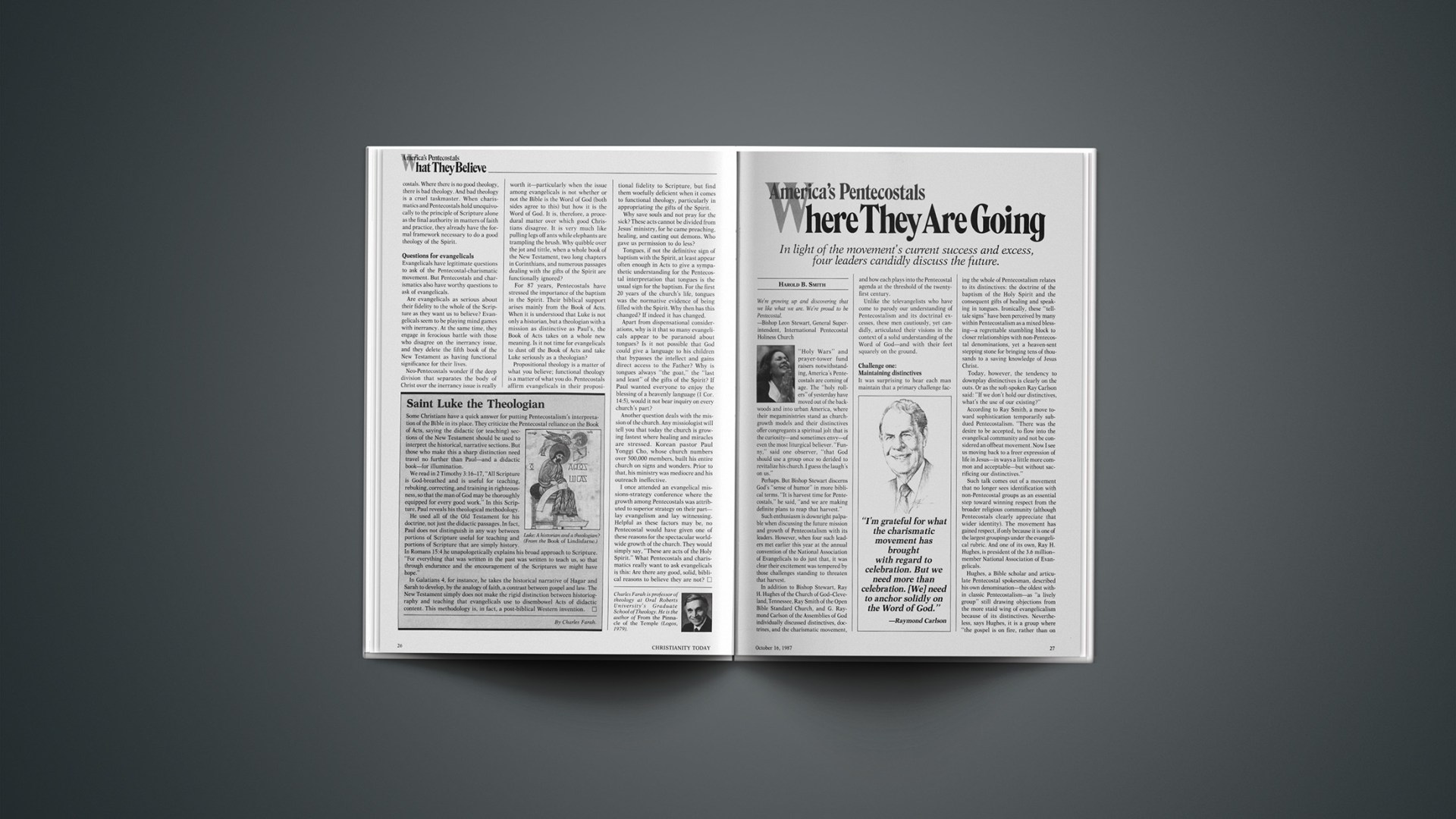
America’s Pentecostals: What They Believe

Speaking in tongues isn’t everything.

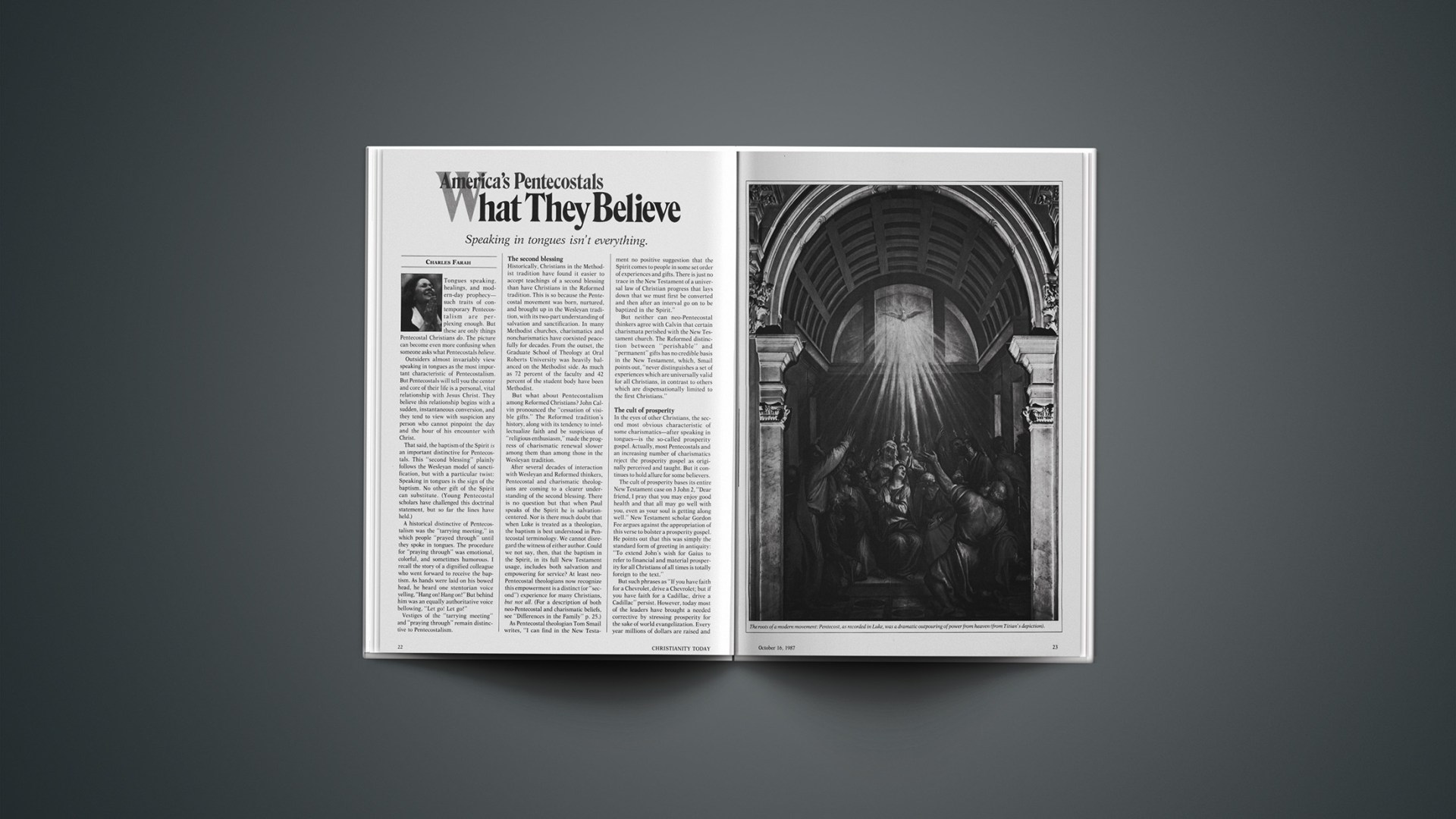
Tongues speaking, healings, and modern-day prophecy—such traits of contemporary Pentecostalism are perplexing enough. But these are only things Pentecostal Christians do. The picture can become even more confusing when someone asks what Pentecostals believe.

Outsiders almost invariably view speaking in tongues as the most important characteristic of Pentecostalism. But Pentecostals will tell you the center and core of their life is a personal, vital relationship with Jesus Christ. They believe this relationship begins with a sudden, instantaneous conversion, and they tend to view with suspicion any person who cannot pinpoint the day and the hour of his encounter with Christ.

That said, the baptism of the Spirit is an important distinctive for Pentecostals. This “second blessing” plainly follows the Wesleyan model of sanctification, but with a particular twist: Speaking in tongues is the sign of the baptism. No other gift of the Spirit can substitute. (Young Pentecostal scholars have challenged this doctrinal statement, but so far the lines have held.)

A historical distinctive of Pentecostalism was the “tarrying meeting,” in which people “prayed through” until they spoke in tongues. The procedure for “praying through” was emotional, colorful, and sometimes humorous. I recall the story of a dignified colleague who went forward to receive the baptism. As hands were laid on his bowed head, he heard one stentorian voice yelling, “Hang on! Hang on!” But behind him was an equally authoritative voice bellowing, “Let go! Let go!”

Vestiges of the “tarrying meeting” and “praying through” remain distinctive to Pentecostalism.

The Second Blessing

Historically, Christians in the Methodist tradition have found it easier to accept teachings of a second blessing than have Christians in the Reformed tradition. This is so because the Pentecostal movement was born, nurtured, and brought up in the Wesleyan tradition, with its two-part understanding of salvation and sanctification. In many Methodist churches, charismatics and noncharismatics have coexisted peacefully for decades. From the outset, the Graduate School of Theology at Oral Roberts University was heavily balanced on the Methodist side. As much as 72 percent of the faculty and 42 percent of the student body have been Methodist.

But what about Pentecostalism among Reformed Christians? John Calvin pronounced the “cessation of visible gifts.” The Reformed tradition’s history, along with its tendency to intellectualize faith and be suspicious of “religious enthusiasm,” made the progress of charismatic renewal slower among them than among those in the Wesleyan tradition.

After several decades of interaction with Wesleyan and Reformed thinkers, Pentecostal and charismatic theologians are coming to a clearer understanding of the second blessing. There is no question but that when Paul speaks of the Spirit he is salvation-centered. Nor is there much doubt that when Luke is treated as a theologian, the baptism is best understood in Pentecostal terminology. We cannot disregard the witness of either author. Could we not say, then, that the baptism in the Spirit, in its full New Testament usage, includes both salvation and empowering for service? At least neo-Pentecostal theologians now recognize this empowerment is a distinct (or “second”) experience for many Christians, but not all. (For a description of both neo-Pentecostal and charismatic beliefs, see “Differences in the Family” p. 25.)

As Pentecostal theologian Tom Smail writes, “I can find in the New Testament no positive suggestion that the Spirit comes to people in some set order of experiences and gifts. There is just no trace in the New Testament of a universal law of Christian progress that lays down that we must first be converted and then after an interval go on to be baptized in the Spirit.”

But neither can neo-Pentecostal thinkers agree with Calvin that certain charismata perished with the New Testament church. The Reformed distinction between “perishable” and “permanent” gifts has no credible basis in the New Testament, which, Smail points out, “never distinguishes a set of experiences which are universally valid for all Christians, in contrast to others which are dispensationally limited to the first Christians.”

The Cult Of Prosperity

In the eyes of other Christians, the second most obvious characteristic of some charismatics—after speaking in tongues—is the so-called prosperity gospel. Actually, most Pentecostals and an increasing number of charismatics reject the prosperity gospel as originally perceived and taught. But it continues to hold allure for some believers.

The cult of prosperity bases its entire New Testament case on 3 John 2, “Dear friend, I pray that you may enjoy good health and that all may go well with you, even as your soul is getting along well.” New Testament scholar Gordon Fee argues against the appropriation of this verse to bolster a prosperity gospel. He points out that this was simply the standard form of greeting in antiquity: “To extend John’s wish for Gaius to refer to financial and material prosperity for all Christians of all times is totally foreign to the text.”

But such phrases as “If you have faith for a Chevrolet, drive a Chevrolet; but if you have faith for a Cadillac, drive a Cadillac” persist. However, today most of the leaders have brought a needed corrective by stressing prosperity for the sake of world evangelization. Every year millions of dollars are raised and sent to the mission field. Single churches sometimes have more than a million-dollar missions budget.

Dozens of missionary training institutes have sprung up in the larger churches throughout the country where hundreds of students are being trained and sent overseas.

Although the New Testament does not condemn riches as such, it should give us pause to realize there are 13 New Testament warnings against riches and none against being poor. German theologian Jürgen Moltmann is right: “The Bible tilts in favor of the poor.”

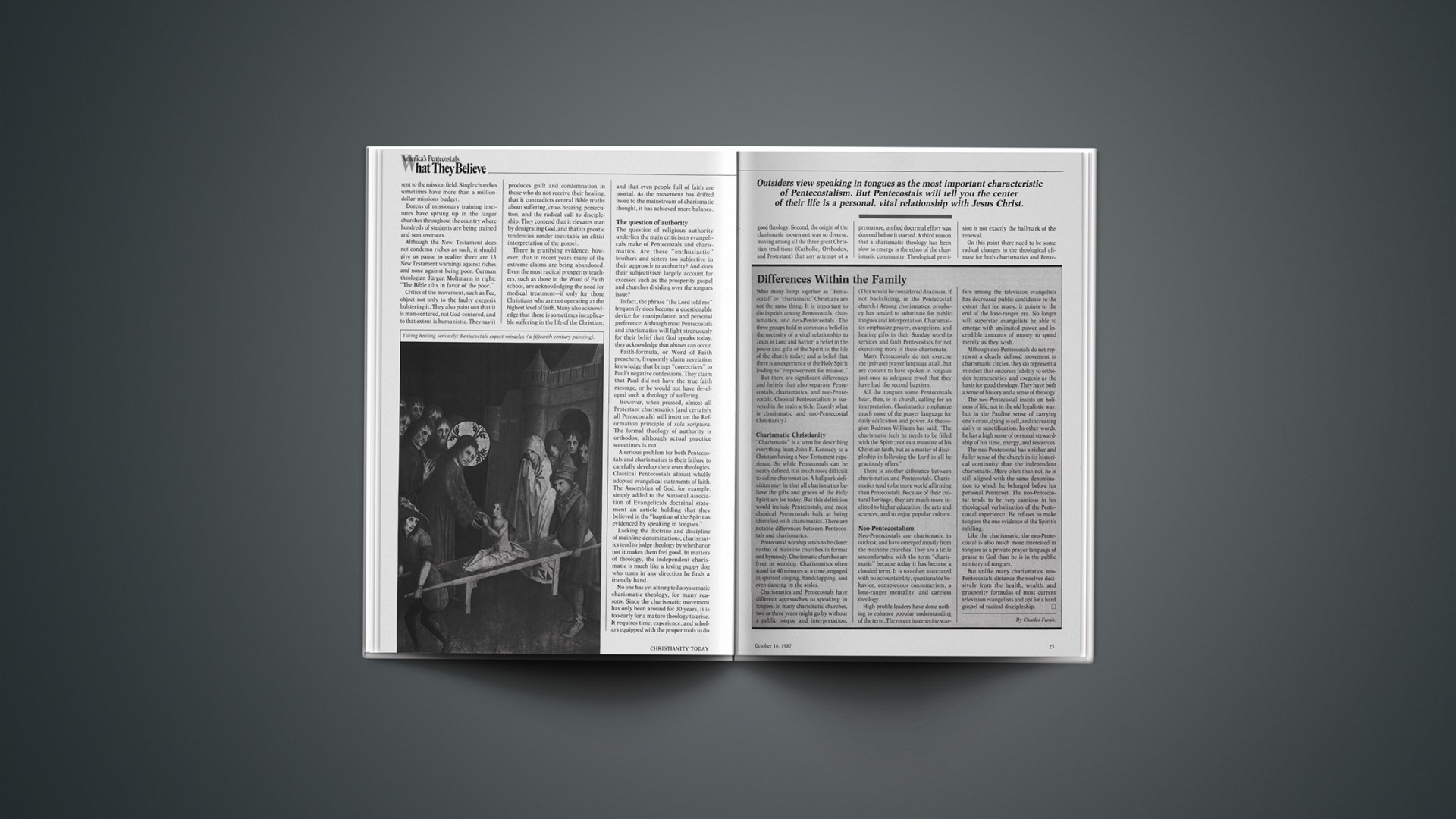
Critics of the movement, such as Fee, object not only to the faulty exegesis bolstering it. They also point out that it is man-centered, not God-centered, and to that extent is humanistic. They say it produces guilt and condemnation in those who do not receive their healing, that it contradicts central Bible truths about suffering, cross bearing, persecution, and the radical call to disciple-ship. They contend that it elevates man by denigrating God, and that its gnostic tendencies render inevitable an elitist interpretation of the gospel.

There is gratifying evidence, however, that in recent years many of the extreme claims are being abandoned. Even the most radical prosperity teachers, such as those in the Word of Faith school, are acknowledging the need for medical treatment—if only for those Christians who are not operating at the highest level of faith. Many also acknowledge that there is sometimes inexplicable suffering in the life of the Christian, and that even people full of faith are mortal. As the movement has drifted more to the mainstream of charismatic thought, it has achieved more balance.

The Question Of Authority

The question of religious authority underlies the main criticisms evangelicals make of Pentecostals and charismatics. Are these “enthusiastic” brothers and sisters too subjective in their approach to authority? And does their subjectivism largely account for excesses such as the prosperity gospel and churches dividing over the tongues issue?

In fact, the phrase “the Lord told me” frequently does become a questionable device for manipulation and personal preference. Although most Pentecostals and charismatics will fight strenuously for their belief that God speaks today, they acknowledge that abuses can occur.

Faith-formula, or Word of Faith preachers, frequently claim revelation knowledge that brings “correctives” to Paul’s negative confessions. They claim that Paul did not have the true faith message, or he would not have developed such a theology of suffering.

However, when pressed, almost all Protestant charismatics (and certainly all Pentecostals) will insist on the Reformation principle of sola scriptura. The formal theology of authority is orthodox, although actual practice sometimes is not.

A serious problem for both Pentecostals and charismatics is their failure to carefully develop their own theologies. Classical Pentecostals almost wholly adopted evangelical statements of faith. The Assemblies of God, for example, simply added to the National Association of Evangelicals doctrinal statement an article holding that they believed in the “baptism of the Spirit as evidenced by speaking in tongues.”

Lacking the doctrine and discipline of mainline denominations, charismatics tend to judge theology by whether or not it makes them feel good. In matters of theology, the independent charismatic is much like a loving puppy dog who turns in any direction he finds a friendly hand.

No one has yet attempted a systematic charismatic theology, for many reasons. Since the charismatic movement has only been around for 30 years, it is too early for a mature theology to arise. It requires time, experience, and scholars equipped with the proper tools to do good theology. Second, the origin of the charismatic movement was so diverse, moving among all the three great Christian traditions (Catholic, Orthodox, and Protestant) that any attempt at a premature, unified doctrinal effort was doomed before it started. A third reason that a charismatic theology has been slow to emerge is the ethos of the charismatic community. Theological precision is not exactly the hallmark of the renewal.

On this point there need to be some radical changes in the theological climate for both charismatics and Pentecostals. Where there is no good theology, there is bad theology. And bad theology is a cruel taskmaster. When charismatics and Pentecostals hold unequivocally to the principle of Scripture alone as the final authority in matters of faith and practice, they already have the formal framework necessary to do a good theology of the Spirit.

Questions For Evangelicals

Evangelicals have legitimate questions to ask of the Pentecostal-charismatic movement. But Pentecostals and charismatics also have worthy questions to ask of evangelicals.

Are evangelicals as serious about their fidelity to the whole of the Scripture as they want us to believe? Evangelicals seem to be playing mind games with inerrancy. At the same time, they engage in ferocious battle with those who disagree on the inerrancy issue, and they delete the fifth book of the New Testament as having functional significance for their lives.

Neo-Pentecostals wonder if the deep division that separates the body of Christ over the inerrancy issue is really worth it—particularly when the issue among evangelicals is not whether or not the Bible is the Word of God (both sides agree to this) but how it is the Word of God. It is, therefore, a procedural matter over which good Christians disagree. It is very much like pulling legs off ants while elephants are trampling the brush. Why quibble over the jot and tittle, when a whole book of the New Testament, two long chapters in Corinthians, and numerous passages dealing with the gifts of the Spirit are functionally ignored?

For 87 years, Pentecostals have stressed the importance of the baptism in the Spirit. Their biblical support arises mainly from the Book of Acts. When it is understood that Luke is not only a historian, but a theologian with a mission as distinctive as Paul’s, the Book of Acts takes on a whole new meaning. Is it not time for evangelicals to dust off the Book of Acts and take Luke seriously as a theologian?

Propositional theology is a matter of what you believe; functional theology is a matter of what you do. Pentecostals affirm evangelicals in their propositional fidelity to Scripture, but find them woefully deficient when it comes to functional theology, particularly in appropriating the gifts of the Spirit.

Why save souls and not pray for the sick? These acts cannot be divided from Jesus’ ministry, for he came preaching, healing, and casting out demons. Who gave us permission to do less?

Tongues, if not the definitive sign of baptism with the Spirit, at least appear often enough in Acts to give a sympathetic understanding for the Pentecostal interpretation that tongues is the usual sign for the baptism. For the first 20 years of the church’s life, tongues was the normative evidence of being filled with the Spirit. Why then has this changed? If indeed it has changed.

Apart from dispensational considerations, why is it that so many evangelicals appear to be paranoid about tongues? Is it not possible that God could give a language to his children that bypasses the intellect and gains direct access to the Father? Why is tongues always “the goat,” the “last and least” of the gifts of the Spirit? If Paul wanted everyone to enjoy the blessing of a heavenly language (1 Cor. 14:5), would it not bear inquiry on every church’s part?

Another question deals with the mission of the church. Any missiologist will tell you that today the church is growing fastest where healing and miracles are stressed. Korean pastor Paul Yonggi Cho, whose church numbers over 500,000 members, built his entire church on signs and wonders. Prior to that, his ministry was mediocre and his outreach ineffective.

I once attended an evangelical missions-strategy conference where the growth among Pentecostals was attributed to superior strategy on their part—lay evangelism and lay witnessing. Helpful as these factors may be, no Pentecostal would have given one of these reasons for the spectacular worldwide growth of the church. They would simply say, “These are acts of the Holy Spirit.” What Pentecostals and charismatics really want to ask evangelicals is this: Are there any good, solid, biblical reasons to believe they are not?

Polling Television Preachers

The results of a major survey of television ministries on the topic of financial accountability appear on a chart on pp. 48–49. CHRISTIANITY TODAY asked the ministries that produce the 15 most-watched religious television programs (according to the Arbitron Ratings Company) to participate. Evangelist Billy Graham was included because of his high visibility as a television minister, though he does not appear on Arbitron’s list of the top 15 since he does not have a regular program.

Jimmy Swaggart Ministries, which produces the most popular religious television show (193 viewer markets; 1.76 million households), chose not to respond to the survey. A representative for Swaggart said the organization was willing to discuss its finances “in detail” only after Congress is through examining the finances of television ministries.

Two other organizations, PTL and Kenneth Copeland Ministries, also did not respond. PTL expressed a willingness to do so in the future. A spokesperson explained that PTL is in the midst of a major reorganization and that policies that would determine the answers to many of the questions on the CHRISTIANITY TODAY survey have not been finalized. A spokesperson for Copeland merely said the survey had been referred to the evangelist’s attention.

The Oral Roberts Evangelistic Association, which accounts for 2 of the top 15 programs (“Expect a Miracle” and “Richard Roberts Live”) also did not respond directly to the survey questions. A press spokesperson said information on the organization’s finances would be appearing in Abundant Life magazine and that it wanted donors to be the first to see it.

The organization did send copies of the articles appearing in Abundant Life to CHRISTIANITY TODAY. Some of the information from the magazine appears on the chart.

The Worldwide Church of God responded to the survey with a letter describing the organization. Some of the information gleaned from the letter is included on the chart.

The letter states that the Worldwide Church of God does not consider its show “The World Tomorrow” part of the American “electronic church” since “no worship services are aired as part of the program.” According to the letter, the show does not solicit funds or attempt to convert people. Also, it points out that all publications promoted on the air are offered free of charge and free of obligation, and that the program is apolitical.

The information on the chart reflects only how participants responded to the survey. There was no investigation to determine to what extent the information given is accurate or complete.

In some cases, respondents handled questions in different ways. For example, some considered all of their activities to be potentially revenue producing, while others did not. Some disclosed all sources of financial remuneration for the ministry head, while others disclosed only ministry-related compensation.

The issue of what ought to be considered ministry-related income is a sticky one, particularly as it relates to publishing royalties. Some maintain that Christian leaders have a right to profit from books they write and sell outside the ministry.

Others maintain that a person is not entitled to profit personally from books if sales of those books result in part from that person’s visibility as the head of a not-for-profit organization. Arthur Borden, president of the Evangelical Council for Financial Accountability, said this is one of a number of gray areas in defining what constitutes legitimate income and ethical financial disclosure.

World Scene from October 16, 1987

SOVIET UNION

Setting The Captives Free?

Konstantin Kharchev, the Soviet official in charge of religious affairs, has assured U.S. Sen. Richard Lugar (R-Ind.) that “by November, all prisoners of faith [in the Soviet Union] will be freed.”

During a meeting in Washington, D.C., Lugar called for the amnesty of more than 200 Christian prisoners jailed for religious reasons, the lifting of restrictions on the religious education of children, permission for churches to perform charitable work, and the printing of the Bible and other religious materials. The senator also urged the reopening of churches, the cessation of official attacks on churches, and approval for a greater number of Christians and Jews to emigrate.

Lugar’s office said Kharchev admitted the Soviet Union’s 70-year history contains many difficult pages. “We … recognize we committed mistakes in our relations with religion,” the Soviet official said. “Many problems you mention we are trying to correct.”

A statement released by Lugar’s office after the meeting expressed cautious optimism. “Even while the Soviets talk about ‘glasnost,’ many enormous problems remain,” the statement read. “Whether these steps of improvement are evidence of a broad new spirit of tolerance or simply token gestures remains to be seen.”

ETHIOPIA

Another Famine

A former Ethiopian official in charge of famine relief says hunger is spreading rapidly in that impoverished African nation.

“It appears there are now about 5 million people affected by famine …,” said Dawit Wolde Giorgis, who defected to the United States in 1985. “In what is now considered a normal year, 3 million Ethiopians have little or nothing to eat.” Dawit blamed widespread hunger on an ongoing civil war, inadequate rainfall, and government policies designed to exert control over the population at the expense of increased production.

The Ethiopian government has issued a request for 950,000 tons of emergency aid. The U.S. government has approved a shipment of 20,000 tons of food, and private American relief agencies are attempting to provide an additional 115,000 tons of food. In the massive famine of 1984 and 1985, about 9 million Ethiopians were on the point of starvation, and as many as 1 million are believed to have died.

VIETNAM

Reopening A Seminary

For the first time since the Communist government reorganized Vietnam’s Catholic church, a second seminary has been reopened to train candidates for the priesthood.

Saint Joseph’s Seminary reopened this year in Ho Chi Minh City (formerly Saigon) with an enrollment of 49. Previously, Vietnam’s Catholic church was allowed to operate only one seminary. The church hopes to open four additional seminaries in various parts of the country.

Fewer than 2,500 priests serve Vietnam’s 4.5 million Catholics. At least 200 priests have been arrested since the southern part of the country came under Communist rule in 1975, according to David Marr, an American who recently completed a study of religion in Vietnam. Some of the imprisoned priests had served as South Vietnamese military chaplains, he says, and others may have been suspected of having links to antigovernment exile groups.

“In most cases, however, they have probably incurred government wrath by ignoring warnings to limit their activity to prayers and rituals,” he wrote in a report for the Washington, D.C. based Center for International Policy. “Instead, they tried to serve their flocks in whatever way seemed beneficial at the time.”

AUSTRALIA

Breakaway Anglican Church

Opponents of women’s ordination have left Australia’s Anglican Church to form the Anglican Catholic Church. The new denomination counts seven parishes and more than ten priests among its supporters.

The new church will be under the spiritual oversight of bishops in Canada and the United States. Alfred Woolcock, presiding bishop of the Anglican Catholic Church of Canada, will be in charge of churches in eastern and southern Australia. Archbishop Louis Falk, head of the Anglican Catholic Church of America, will oversee churches in western Australia.

Earlier this year, the general synod of the Anglican Church in Australia narrowly defeated a motion to ordain women as priests. It was the second time in as many years that the measure failed to gain synod approval.

“The issue is not the ordination of women, but the authority of the general synod,” said Albert Haley, a retired Anglican Church rector who has sided with the new church. “We simply do not recognize the power of local synods to alter the faith and practice of the worldwide church.”

Anglican Church Archbishop Keith Rayner said more parishes might leave the denomination if it should decide to ordain women in the future. “But the threat is far greater,” he said, “if we avoid facing this issue squarely.”

INDIA

A Bishop Is Arrested

For the first time in the Indian state of Madhya Pradesh, a law against forced religious conversions has been invoked to arrest a Roman Catholic bishop.

Bishop Pascal Topno was charged with converting members of two Hindu families to Christianity and then failing to report the action to authorities. The law banning forced conversions in Madhya Pradesh requires evangelists to report all conversions to the government.

The church newspaper Kerala Times said the real reason behind Topno’s arrest was Hindu “intolerance and ill will” against missionary activities that have helped tribal people escape economic oppression at the hands of non-tribalists.

America’s Pentecostals: See How They Grow

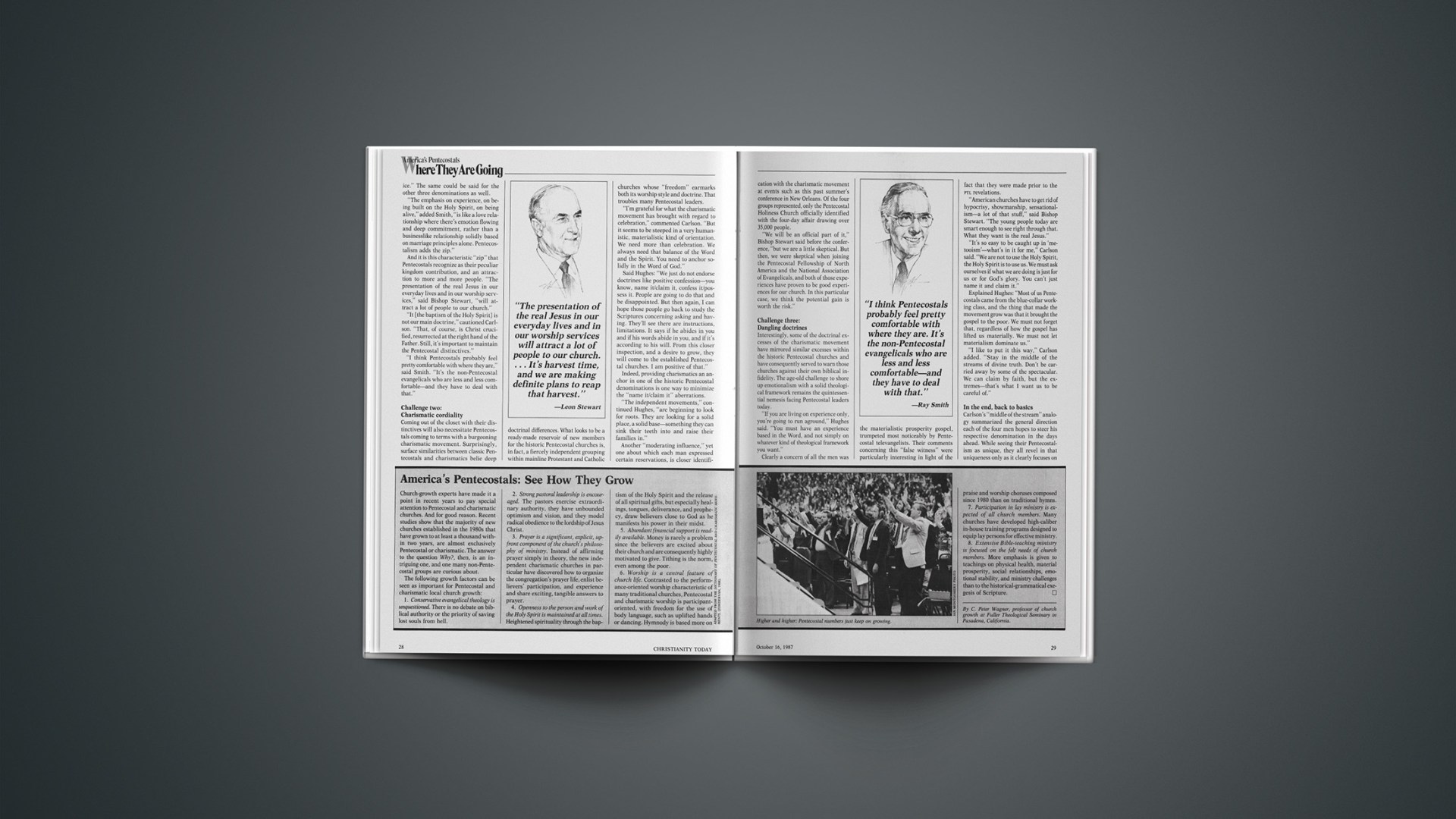
Church-growth experts have made it a point in recent years to pay special attention to Pentecostal and charismatic churches. And for good reason. Recent studies show that the majority of new churches established in the 1980s that have grown to at least a thousand within two years, are almost exclusively Pentecostal or charismatic. The answer to the question Why?, then, is an intriguing one, and one many non-Pentecostal groups are curious about.

The following growth factors can be seen as important for Pentecostal and charismatic local church growth:

  1. Conservative evangelical theology is unquestioned. There is no debate on biblical authority or the priority of saving lost souls from hell.
  2. Strong pastoral leadership is encouraged. The pastors exercise extraordinary authority, they have unbounded optimism and vision, and they model radical obedience to the lordship of Jesus Christ.
  3. Prayer is a significant, explicit, up-front component of the church’s philosophy of ministry. Instead of affirming prayer simply in theory, the new independent charismatic churches in particular have discovered how to organize the congregation’s prayer life, enlist believers’ participation, and experience and share exciting, tangible answers to prayer.
  4. Openness to the person and work of the Holy Spirit is maintained at all times. Heightened spirituality through the baptism of the Holy Spirit and the release of all spiritual gifts, but especially healings, tongues, deliverance, and prophecy, draw believers close to God as he manifests his power in their midst.
  5. Abundant financial support is readily available. Money is rarely a problem since the believers are excited about their church and are consequently highly motivated to give. Tithing is the norm, even among the poor.
  6. Worship is a central feature of church life. Contrasted to the performance-oriented worship characteristic of many traditional churches, Pentecostal and charismatic worship is participant-oriented, with freedom for the use of body language, such as uplifted hands or dancing. Hymnody is based more on praise and worship choruses composed since 1980 than on traditional hymns.
  7. Participation in lay ministry is expected of all church members. Many churches have developed high-caliber in-house training programs designed to equip lay persons for effective ministry.
  8. Extensive Bible-teaching ministry is focused on the felt needs of church members. More emphasis is given to teachings on physical health, material prosperity, social relationships, emotional stability, and ministry challenges than to the historical-grammatical exegesis of Scripture.

By C. Peter Wagner, professor of church growth at Fuller Theological Seminary in Pasadena, California.

Saint Luke the Theologian

Some Christians have a quick answer for putting Pentecostalism’s interpretation of the Bible in its place. They criticize the Pentecostal reliance on the Book of Acts, saying the didactic (or teaching) sections of the New Testament should be used to interpret the historical, narrative sections. But those who make this a sharp distinction need travel no further than Paul—and a didactic book—for illumination.

We read in 2 Timothy 3:16–17, “All Scripture is God-breathed and is useful for teaching, rebuking, correcting, and training in righteousness, so that the man of God may be thoroughly equipped for every good work.” In this Scripture, Paul reveals his theological methodology.

He used all of the Old Testament for his doctrine, not just the didactic passages. In fact, Paul does not distinguish in any way between portions of Scripture useful for teaching and portions of Scripture that are simply history. In Romans 15:4 he unapologetically explains his broad approach to Scripture. “For everything that was written in the past was written to teach us, so that through endurance and the encouragement of the Scriptures we might have hope.”

In Galatians 4, for instance, he takes the historical narrative of Hagar and Sarah to develop, by the analogy of faith, a contrast between gospel and law. The New Testament simply does not make the rigid distinction between historiography and teaching that evangelicals use to disembowel Acts of didactic content. This methodology is, in fact, a post-biblical Western invention.

By Charles Farah.

Differences within the Family

What many lump together as “Pentecostal” or “charismatic” Christians are not the same thing. It is important to distinguish among Pentecostals, charismatics, and neo-Pentecostals. The three groups hold in common a belief in the necessity of a vital relationship to Jesus as Lord and Savior; a belief in the power and gifts of the Spirit in the life of the church today; and a belief that there is an experience of the Holy Spirit leading to “empowerment for mission.”

But there are significant differences and beliefs that also separate Pentecostals, charismatics, and neo-Pentecostals. Classical Pentecostalism is surveyed in the main article. Exactly what is charismatic and neo-Pentecostal Christianity?

Charismatic Christianity

“Charismatic” is a term for describing everything from John F. Kennedy to a Christian having a New Testament experience. So while Pentecostals can be neatly defined, it is much more difficult to define charismatics. A ballpark definition may be that all charismatics believe the gifts and graces of the Holy Spirit are for today. But this definition would include Pentecostals, and most classical Pentecostals balk at being identified with charismatics. There are notable differences between Pentecostals and charismatics.

Pentecostal worship tends to be closer to that of mainline churches in format and hymnody. Charismatic churches are freer in worship. Charismatics often stand for 40 minutes at a time, engaged in spirited singing, handclapping, and even dancing in the aisles.

Charismatics and Pentecostals have different approaches to speaking in tongues. In many charismatic churches, two or three years might go by without a public tongue and interpretation. (This would be considered deadness, if not backsliding, in the Pentecostal church.) Among charismatics, prophecy has tended to substitute for public tongues and interpretation. Charismatics emphasize prayer, evangelism, and healing gifts in their Sunday worship services and fault Pentecostals for not exercising more of these charismata.

Many Pentecostals do not exercise the (private) prayer language at all, but are content to have spoken in tongues just once as adequate proof that they have had the second baptism.

All the tongues some Pentecostals hear, then, is in church, calling for an interpretation. Charismatics emphasize much more of the prayer language for daily edification and power. As theologian Rodman Williams has said, “The charismatic feels he needs to be filled with the Spirit; not as a measure of his Christian faith, but as a matter of discipleship in following the Lord in all he graciously offers.”

There is another difference between charismatics and Pentecostals. Charismatics tend to be more world affirming than Pentecostals. Because of their cultural heritage, they are much more inclined to higher education, the arts and sciences, and to enjoy popular culture.

Neo-Pentecostalism

Neo-Pentecostals are charismatic in outlook, and have emerged mostly from the mainline churches. They are a little uncomfortable with the term “charismatic” because today it has become a clouded term. It is too often associated with no accountability, questionable behavior, conspicuous consumerism, a lone-ranger mentality, and careless theology.

High-profile leaders have done nothing to enhance popular understanding of the term. The recent internecine warfare among the television evangelists has decreased public confidence to the extent that for many, it points to the end of the lone-ranger era. No longer will superstar evangelists be able to emerge with unlimited power and incredible amounts of money to spend merely as they wish.

Although neo-Pentecostals do not represent a clearly defined movement in charismatic circles, they do represent a mindset that endorses fidelity to orthodox hermeneutics and exegesis as the basis for good theology. They have both a sense of history and a sense of theology.

The neo-Pentecostal insists on holiness of life, not in the old legalistic way, but in the Pauline sense of carrying one’s cross, dying to self, and increasing daily in sanctification. In other words, he has a high sense of personal stewardship of his time, energy, and resources.

The neo-Pentecostal has a richer and fuller sense of the church in its historical continuity than the independent charismatic. More often than not, he is still aligned with the same denomination to which he belonged before his personal Pentecost. The neo-Pentecostal tends to be very cautious in his theological verbalization of the Pentecostal experience. He refuses to make tongues the one evidence of the Spirit’s infilling.

Like the charismatic, the neo-Pentecostal is also much more interested in tongues as a private prayer language of praise to God than he is in the public ministry of tongues.

But unlike many charismatics, neo-Pentecostals distance themselves decisively from the health, wealth, and prosperity formulas of most current television evangelists and opt for a hard gospel of radical discipleship.

By Charles Farah.

Ideas

Jim Bakker Made Me Do It

Columnist; Contributor

I had hoped to make it through 1987 without writing anything about this year’s number one religious news event: the PTL scandal. What more could be said about all the bizarre events that have unfolded since March in Fort Mill, South Carolina?

But one evening, as news reports flashed back and forth between the Bakkers and Jerry Falwell, my thoughts drifted back to a seminal book I had read nearly two decades earlier: Christ and Culture, by H. Richard Niebuhr. It seemed to me the television news clips were revealing the stark contrast between two Christian approaches to culture that Niebuhr had delineated.

Some Christians embrace culture. Niebuhr included social-gospel types in this category. As they spend their energies reforming society, these folks tend to adopt the general characteristics of the culture around them. After a while the distinctives of their faith may disappear, absorbed by the outside culture.

Have Jim and Tammy introduced a whole new strain of culture embracing, one never envisioned by H. Richard Niebuhr? Whatever the world around them does, they can do better. Don’t settle for a Chevrolet, Jim used to say—if you really want a Cadillac, pray for a Cadillac! Some people felt a sense of shock, even betrayal, over the disclosures of a Rolls Royce, million-dollar salaries, six luxury homes, and the infamous air-conditioned doghouse.

But why? You can read about similar American lifestyles in any issue of Fortune or Vanity Fair. The shock comes from our instinctive belief that Christians should somehow be different from the world around them. Joan Collins may indulge herself conspicuously, but a minister of the gospel? A television evangelist supported by charitable contributions?

The Bakkers evidently saw no such contradiction. Once, Tammy blurted out that she deals with stress by going on shopping binges. These people incarnate the American dream. Rising spectacularly from poverty, they have embraced in triumph a society that honors wealth and fame. It is no accident that a replica of Main Street USA anchored the center of their theme park.

Enter Jerry Falwell, who represents the true fundamentalist tradition of rejecting, not embracing, culture. Christians are to be “separate” from the culture around them. They should stand out. One of Falwell’s first actions at Heritage USA was to regulate the wearing of bikinis. In press conferences, he clearly showed discomfiture with some of the trappings of the place (many of which he promptly sold off at auction). Can a giant water slide really be significant to a minister of “The Old-Time Gospel Hour”?

Niebuhr freely admits that members of both traditions, the culture embracers and the culture rejecters, can find biblical support for their approach. Abraham and Solomon (who, interestingly, set the pattern for moral slippage) embraced the culture of their day. Others, like John the Baptist and many Old Testament prophets, took a different tack, rejecting the wider culture. They wore camel’s-hair garments, ate locusts, and called down judgment on society. As a result, many ended up in jail or in an early grave.

It happened that around the same time I was watching news clips of the Bakkers and Falwell, I was studying some of the stronger pronouncements of the Old Testament prophet Isaiah. That particular prophet had a love/hate relationship with culture: he wrote magnificent poetry and served as an adviser to kings, and yet he never minced words when delivering the judgment of God.

“See, the Lord is going to lay waste the earth and devastate it; he will ruin its face and scatter its inhabitants,” Isaiah 24 begins. “The earth will be completely laid waste and totally plundered. The Lord has spoken this word.” I can’t imagine the writer of that chapter investing much money in a luxury home in Jerusalem.

But, as is typical of Isaiah, the very next chapter turns from dark words of judgment to a shining vision of the future, when the Lord will wipe away every tear and spread a banquet feast for all people, rich or poor. In chapter 25, and elsewhere in Isaiah, the prophet seems to be presenting a third approach to culture entirely. God neither embraces it (read chapter 24) nor rejects it permanently. Rather, he plans (to use another of Niebuhr’s categories) to transform culture, to restore it back to its original state before the Fall.

Throughout, Isaiah chooses images from the material world to convey the future—a banquet table, a rebuilt city, a place full of houses and vineyards and strangely tame animals.

In this light, the kingdom proclaimed by Christ takes shape as a model settlement on Earth, an advance announcement of what the new creation will be like. It is lived out in our material world, yes, but by a different set of rules. For example, we welcome rich and poor, and people of all races—because God welcomes them. We value the weak and the oppressed—because God values them.

In our years on Earth, we do not merely “mark time,” waiting for God to step in and set right all that is wrong. Rather, we contribute to the process of transforming a fallen world. Through our examples, we awaken longings for a new heaven and a new Earth that God will someday bring to pass.

And here is what saddens me most about the whole PTL fiasco. This year evangelicals have received more hours of network air time and appeared on more magazine covers than ever before. But I doubt very seriously that the watching world has had longings for God awakened while listening to the endless news reports. I wonder whether anyone has seen a glimpse of the difference God can make in a people transformed by him. Tragically, the evangelicals who dominated the news in 1987 came across looking just like everybody else, only more so.

Christian Nursing Center Adopts Life-Support Policy

Under guidelines adopted by the largest Christian retirement community in the Pacific Northwest, food, water, and oxygen cannot be withdrawn from nursing-center patients who need artificial life support.

Crista Ministries in Seattle, Washington, developed the guidelines in response to a controversy caused by the organization’s role in withholding artificially administered food and water from two patients in 1985 (CT, Mar. 6, 1987, p. 17). One of the patients had suffered a stroke that made it necessary to feed her through tubes. The patient’s family obtained medical certification that she had no chance of recovering, and obtained a physician’s directive to remove the feeding tube. After Crista refused to comply with the request, the family obtained a court order. The patient was moved to another facility, where she died.

Five months later, another patient’s family ordered an end to artificial feeding. This time Crista complied. Discontinuing tube feeding in certain cases is considered acceptable, according to recent legal rulings and current ethical standards of the American Medical Association. But Crista’s actions raised controversy within the Christian community.

Crista Ministries is part of a far-reaching, $30 million nondenominational initiative that includes a relief organization (World Concern) and a service that provides listings of Christian vocational opportunities (Inter-cristo). The organization’s board of trustees appointed a committee to investigate procedures at the nursing center. The committee proposed the new guidelines, which affirm the authority of Scripture and the special worth of human beings in God’s creation.

Life-Support Guidelines

As a general principle, the guidelines recognize that “the informed and competent patient has the right to refuse or forgo treatment” within legal limits that prohibit euthanasia, or deliberate mercy killing. Medical treatment is automatically given preference, unless the patient’s condition is irreversible and death is imminent.

“Food, water and oxygen, and the necessary and natural supports for life, will be provided as long as such provision is not detrimental to other aspects of the patient’s physical well-being,” the guidelines state. A similar approach governs pain medication.

Other life-sustaining medical treatments can be ended—in accordance with a patient’s advance directions—when three physicians concur that the patient faces imminent death from an irreversible illness. If a mentally incompetent patient did not provide advance directions, the patient’s immediate family can make a decision to end treatment.

Crista is forming an ethics committee, including a physician, nurse, and clergyman, to implement the new guidelines and provide ongoing advice. Patients choosing treatment options not permitted under the guidelines will be transferred to other facilities upon request.

By Ed Larson.

Great Britain’s Alternative Churches

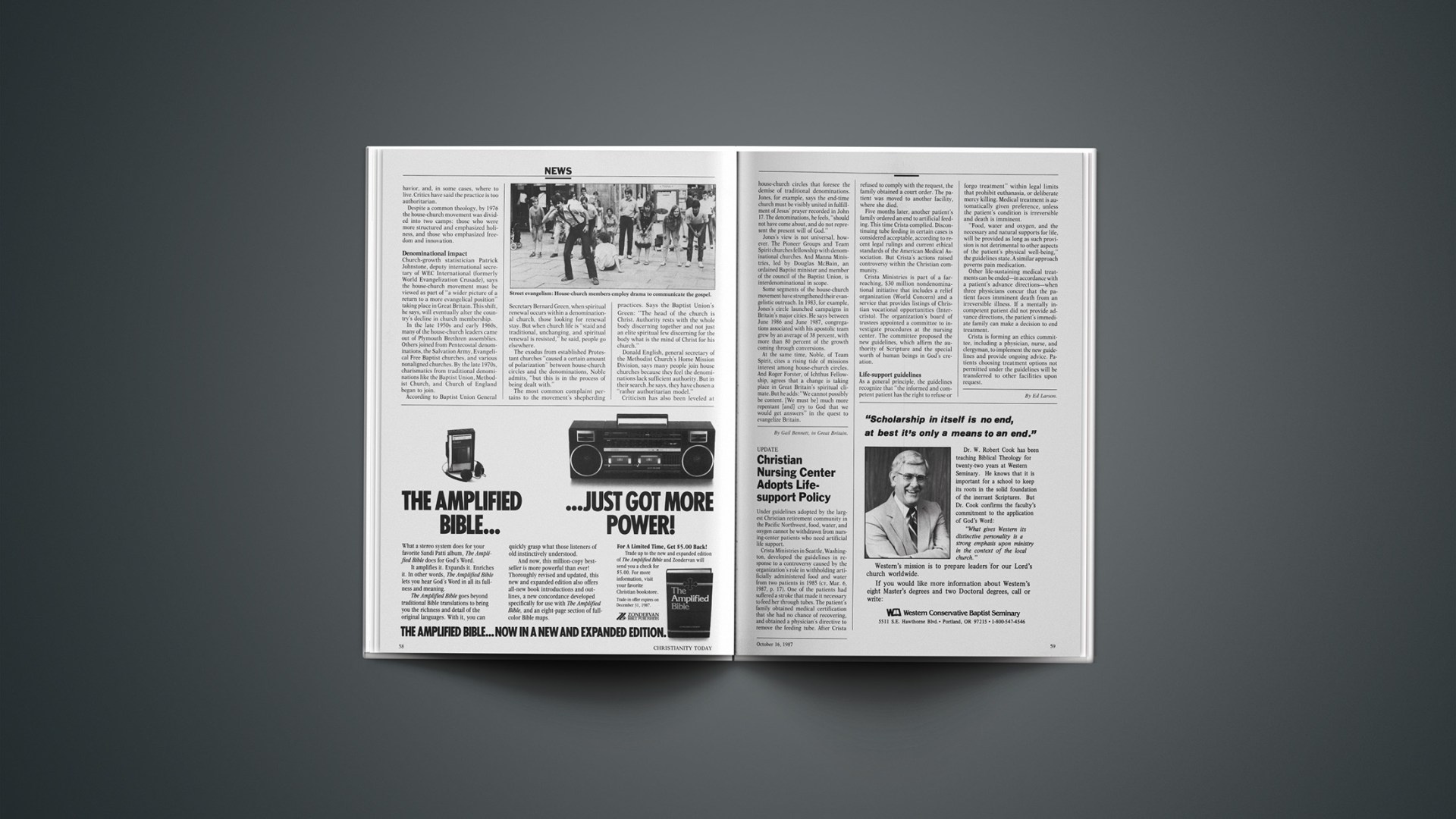
In Great Britain, a nation where traditional churches have seen their Sunday-morning attendance plummet, a nondenominational house-church movement is alive and thriving.

The movement is made up of some 650 congregations, which are loosely affiliated in more than 20 associations known as “circles.” Between 1980 and 1985, the movement nearly quadrupled in size, reaching a membership of 75,000. An estimated 94,000 people currently attend house-church meetings.

In the movement’s early years, meetings were held in members’ homes. But soon they had to rent facilities or construct buildings to accommodate their growing numbers. According to the 1987/88 UK Christian Handbook, only 2 percent of Great Britain’s house churches still meet in homes.

Restoring The Church

Adherents vary in style and organization, but in general they share charismatic convictions and a similar vision of the end times. According to John Noble, leader of a circle called Team Spirit, most house churches assert that believers must “be active and working with the Holy Spirit to bring back the King.”

House-church members believe God is in the process of restoring the church to its New Testament origins in preparation for the second coming of Christ. Says Bryn Jones, head of a house-church circle often referred to as the Bradford Churches: “God wants to restore into the church all that has been lost in former generations as well as take the church on to the maturity that was envisaged by the Christ and the early apostles.”

Part of that restoration process, the leaders contend, is the re-emergence of the ministries of apostolic teams. “Apostles have always been there,” Jones says, “they were just called by other names [such as missionaries or circuit riders].” Apostolic teams consist of apostles, prophets, evangelists, pastors, teachers, and helpers such as musicians and drama groups. They travel about planting, establishing, and overseeing churches.

Some observers say the house-church movement has been further radicalized by the fusion of apostolic authority with shepherding practices. Each member of a congregation is under the authority of a church leader who functions as a “shepherd.” Church members are given advice and direction in virtually every area of life, including marriage, the role of women, social behavior, and, in some cases, where to live. Critics have said the practice is too authoritarian.

Despite a common theology, by 1976 the house-church movement was divided into two camps: those who were more structured and emphasized holiness, and those who emphasized freedom and innovation.

Denominational Impact

Church-growth statistician Patrick Johnstone, deputy international secretary of WEC International (formerly World Evangelization Crusade), says the house-church movement must be viewed as part of “a wider picture of a return to a more evangelical position” taking place in Great Britain. This shift, he says, will eventually alter the country’s decline in church membership.

In the late 1950s and early 1960s, many of the house-church leaders came out of Plymouth Brethren assemblies. Others joined from Pentecostal denominations, the Salvation Army, Evangelical Free Baptist churches, and various nonaligned churches. By the late 1970s, charismatics from traditional denominations like the Baptist Union, Methodist Church, and Church of England began to join.

According to Baptist Union General Secretary Bernard Green, when spiritual renewal occurs within a denominational church, those looking for renewal stay. But when church life is “staid and traditional, unchanging, and spiritual renewal is resisted,” he said, people go elsewhere.

The exodus from established Protestant churches “caused a certain amount of polarization” between house-church circles and the denominations, Noble admits, “but this is in the process of being dealt with.”

The most common complaint pertains to the movement’s shepherding practices. Says the Baptist Union’s Green: “The head of the church is Christ. Authority rests with the whole body discerning together and not just an elite spiritual few discerning for the body what is the mind of Christ for his church.”

Donald English, general secretary of the Methodist Church’s Home Mission Division, says many people join house churches because they feel the denominations lack sufficient authority. But in their search, he says, they have chosen a “rather authoritarian model.”

Criticism has also been leveled at house-church circles that foresee the demise of traditional denominations. Jones, for example, says the end-time church must be visibly united in fulfillment of Jesus’ prayer recorded in John 17. The denominations, he feels, “should not have come about, and do not represent the present will of God.”

Jones’s view is not universal, however. The Pioneer Groups and Team Spirit churches fellowship with denominational churches. And Manna Ministries, led by Douglas McBain, an ordained Baptist minister and member of the council of the Baptist Union, is interdenominational in scope.

Some segments of the house-church movement have strengthened their evangelistic outreach. In 1983, for example, Jones’s circle launched campaigns in Britain’s major cities. He says between June 1986 and June 1987, congregations associated with his apostolic team grew by an average of 38 percent, with more than 80 percent of the growth coming through conversions.

At the same time, Noble, of Team Spirit, cites a rising tide of missions interest among house-church circles. And Roger Forster, of Ichthus Fellowship, agrees that a change is taking place in Great Britain’s spiritual climate. But he adds: “We cannot possibly be content. [We must be] much more repentant [and] cry to God that we would get answers” in the quest to evangelize Britain.

By Gail Bennett, in Great Britain.

Apple PodcastsDown ArrowDown ArrowDown Arrowarrow_left_altLeft ArrowLeft ArrowRight ArrowRight ArrowRight Arrowarrow_up_altUp ArrowUp ArrowAvailable at Amazoncaret-downCloseCloseEmailEmailExpandExpandExternalExternalFacebookfacebook-squareGiftGiftGooglegoogleGoogle KeephamburgerInstagraminstagram-squareLinkLinklinkedin-squareListenListenListenChristianity TodayCT Creative Studio Logologo_orgMegaphoneMenuMenupausePinterestPlayPlayPocketPodcastRSSRSSSaveSaveSaveSearchSearchsearchSpotifyStitcherTelegramTable of ContentsTable of Contentstwitter-squareWhatsAppXYouTubeYouTube