Ideas

Great Falls of Fire

How Jimmy Swaggarts legacy of scandal shaped the evangelical landscape.

Jimmy Swaggart preaching.
Christianity Today July 11, 2025
Thomas S England / Contributor / Getty / Edits by CT

On July 13, Jimmy Swaggart, a prominent Pentecostal televangelist of the 1980s, will be laid to rest in Baton Rouge, Louisiana, leaving behind a legacy of scandal. His ministry was marked by two prostitution-related incidents—first in 1988, when he tearfully confessed on television, and again in 1991, when he defiantly told his congregation, “The Lord told me it’s flat none of your business.” Swaggart’s denomination, the Assemblies of God, defrocked him, but his congregation proved to be remarkably forgiving. Although the televangelist’s work never reached its pre-1988 heights, Swaggart remained in the pulpit and on television until the day of his death at age 90.

Swaggart’s sex life was big news, especially in televangelist circles. Other Christian TV stars of the ’80s and ’90s, like Jerry Falwell and Pat Robertson, were using their media platforms to promote conservative political policies and rigorous personal standards of holiness when it came to human sexuality. But while Swaggart’s “fall from grace” was salacious, it was certainly not unique. He joined a long line of American celebrity preachers who lived and died (and then were often resuscitated) by the sword of American celebrity culture.

Swaggart’s distinct contribution to American Christianity and culture is interwoven with the legacy of his tight-knit Pentecostal family from Ferriday, a small Delta town in north-central Louisiana. In the 1950s, Ferriday would have seemed like an unlikely place to find figures who would shape mainstream American culture; the town was characterized by deep Pentecostal roots, entrenched poverty, limited educational access, and stark racial and economic divides that marginalized both working-class white people and African Americans.

Yet those seemingly inauspicious factors combined to change the trajectory of American popular culture when figures like Jimmy Swaggart’s cousin Jerry Lee Lewis brought the sights and sounds of Ferriday’s Pentecostal revivals to national audiences. Emerging from a wave of young Southern musicians in the 1950s, Jerry Lee embodied the ecstatic energy of Pentecostal and Holiness church services—both Black and white—and brought it to mainstream American airwaves.

Lewis and others introduced to the nation and then to the world a flamboyant performance style marked by driving rhythms, fervent vocals, and gyrating dance moves rooted in Southern Pentecostalism from places like Macon, Georgia; Tupelo, Mississippi; and Ferriday. As a son of Pentecostalism, Lewis caused a pop culture sensation—and quite a bit of public consternation—when he transformed the Pentecostal exclamation “great balls of fire,” used to describe encounters with the Holy Spirit from Acts 2 that led to the signature practice of speaking in tongues, into a provocative anthem with unmistakable sexual undertones.


Like Jerry Lee Lewis, Swaggart was an accomplished musician—but he was also among those who condemned rock as the “Devil’s music.” Conservative white Protestant critiques of rock-and-roll in the 1950s often reflected anti-Black racism, portraying the sounds of the genre, rooted in African American music forms like jazz and boogie-woogie, as especially distasteful, occult, and morally corrupting. And Pentecostals like Swaggart—both Black and white—were deeply frustrated that the sounds of their churches were used by “worldly” rock-and-rollers. Rock was, for them, a particular spiritual threat, mocking God and desecrating what was holy.

Jimmy Swaggart may have decried rock. But in the end, the same environment that helped birth the Devil’s music fostered the spiritual intensity, commercialism, celebrity, and populist appeal that would later define his Pentecostal preaching.

Like the equally infamous Assemblies of God televangelists Jim and Tammy Faye Bakker, Swaggart commodified Pentecostal culture by packaging its emotional fervor, miracle narratives, and apocalyptic urgency into polished, watchable television. As Christian television expanded globally, Swaggart translated the ecstatic worship of backwoods Southern revival tents into a mass-media empire that reached millions. His broadcasts featured fiery sermons, gospel music, altar calls, and plenty of opportunities to purchase merchandise.

In this way, both Swaggart and Lewis helped turn a once-marginal religious tradition into one of the largest, fastest-growing forms of Christianity in the United States and beyond. In fact, recent research funded by the Public Religion Research Institute (PRRI) reveals that charismatic and Pentecostal Christianity is rapidly growing within the population of self-identified “born-again” or evangelical Christians, reshaping both the religious and the political landscape in the US.

Historically marginalized by evangelical leaders, charismatic practices that Swaggart promoted, such as speaking in tongues, prophecy, and divine healing, have gained broad acceptance, especially among younger generations. Gen Z and millennial Christians are more likely to attend charismatic or Pentecostal services, which suggests that the future of evangelicalism may be increasingly charismatic. As traditional evangelical denominations decline and nondenominational charismatic congregations ascend, the rise of charismatic Christianity may increasingly shape the future of Christian conservative activism in America.

Like Swaggart’s congregation in Louisiana, some charismatics and Pentecostals have shown a high tolerance for disgrace. Assemblies of God, the denomination that defrocked Swaggart, is now the denomination most supportive of President Donald Trump, a man with his own lengthy history of defying the traditional moral claims of conservative white Protestantism. In charismatic church circles, Swaggart’s return to Christian ministry after public embarrassment has been imitated by celebrity preachers like Ted Haggard, Carl Lentz, and many others who endure public embarrassment and find their way back to the spotlight, albeit often in diminished fashion.

Eventually, in spite of critiques from church gatekeepers, Pentecostals and charismatics found a way to create rock music that conservative white Protestants could enjoy and endorse. Evangelical media makers turned that music into a profitable market niche known as contemporary Christian music, which became the soundtrack for evangelical activism in the late 20th century. Through their knack for utilizing the power of media and the marketplace, Pentecostal and charismatic musicians now create a significant portion of new church music in America.

The story of Jimmy Swaggart, then, is not only the story of one famous Christian leader’s lasciviousness. It is also the story of how celebrity culture and mass media are shaping the American evangelical landscape. If evangelical voters had been of the Moral Majority ilk, for instance, Trump’s political career probably would have been quite short. But for communities shaped by Swaggart’s legacy, scandal does not have to be an end. It can also be a beginning.

Leah Payne is professor of American religious history at Portland Seminary and an affiliated scholar at the Public Religion Research Institute, as well as host of the podcast
Spirit and Power: Charismatics and Politics in American Life. Her book, God Gave Rock & Roll to You: A History of Contemporary Christian Music, won Christianity Today’s 2024 book award for history and biography.


Ideas

Disdain, Dallas Willard, and Donald Trump

“Anger is the most fundamental problem in human life,” Willard taught. Last summer’s assassination attempt was a vivid illustration.

Trump yelling in front of a protesting crowd
Christianity Today July 10, 2025
Illustration by Christianity Today / Source Images: Getty

“Anger is the most fundamental problem in human life.” So said Dallas Willard. Yet despite my admiration for Willard, whose books I’ve dutifully kept on my shelves if not always before my eyes, this particular conclusion was one I long questioned. Perhaps that was because I could internally categorize my own anger as righteous, a trick I couldn’t manage with my lust and pride.

Last July, when a would-be assassin fired on Donald Trump in a field in Butler, Pennsylvania, Willard’s words sprang to mind again. I began to question my prior skepticism anew. At that moment, mismanaged anger certainly presented itself as a fundamental problem, and the sadly successful assassination of a Minnesota state lawmaker and her husband this June has only amplified my concern.

After the Butler shooting, I reengaged with Willard’s sweeping classic work The Divine Conspiracy and sought to uncover the story of the man behind it. Willard’s biography involves an unlikely journey from undergoing family tragedy in rural Missouri to becoming a philosophy professor at the University of Southern California. There, he argued for the reality of reality in an academic milieu often content with declaring all to be a mere illusion.

But beyond any biographical detail, the true source of Willard’s declaration about the problematic primacy of anger was Jesus, whom Willard asserted was not just nice or good but smart—really smart. “My hope is to gain a fresh hearing for Jesus,” Willard boldly wrote at the opening of his book, “especially among those who believe they already understand him.”

Willard argued that in the Sermon on the Mount, Jesus was not just pulling marbles from a bag, presenting individual gems of wisdom that could be considered independently. Instead, the order of the presentation mattered greatly. “It is the elimination of anger and contempt,” he asserted, “that [Jesus] presents as the first and fundamental step toward the rightness of the kingdom heart.”

Conversely, today it is the systematic elevation of anger and contempt that is often rewarded across the political spectrum. One can argue whether Trump is a symptom, a cause, a catalyst, or a victim (or some combination of all those), but doubtless he is today’s central figure in America’s political culture of anger.

Trump’s famous fist-pumping response in Butler—plus a well-placed American flag and photographer—may have cemented his 2024 victory. His cry of “Fight! Fight! Fight!” would be emblazoned on the minds of millions and on the front of nearly as many T-shirts. In May, Trump replaced a White House portrait of former president Barack Obama with a canvas depicting the moment.

For me, though, the most-lasting memory from watching the events at Butler unfold on television was seeing a gray-haired man who, with his middle finger extended and cheeks flushed with rage, turned his face away from Trump, who was being loaded into an SUV behind him, and toward the cameras. From behind sunglasses, he yelled at the top of his lungs with words that matched his sign language. (You can catch a glimpse of him, in a red shirt and dark ball cap, on the right side of this video at the 2:15 mark.)

Were his curses directed toward the media, the would-be assassin, or just an amorphous them? Whatever his answer might be, from that moment, it seemed our national anger would only rise.

Though some of Trump’s supporters have declared him a changed man since the shooting, sadly he remains a contributor to that bitterness and mutual contempt, routinely calling people who pose obstacles to his agenda “fool,” “scum,” and “sleazebag.” These are not the words of a man who has absorbed the meaning of Jesus’ preaching on anger, where he taught that “anyone who says, ‘You fool!’ will be in danger of the fire of hell” (Matt. 5:22). Jesus was not prescribing a new, pick-your-insults-carefully legalism here, Willard explained, but “giving us a revelation of the preciousness of human beings.”

In fairness to Trump, this kind of contempt has been with us since the days of Cain. The president is far from alone in missing the enormity of the fact that every person on the planet is created in the image of God. As C. S. Lewis put it, “There are no ordinary people. You have never talked to a mere mortal.” 

Still, the Christian conviction is that the dignity of the imago Dei is universal and must be extended not only to those holding the levers of power but also to those on the lowest rungs of influence and respectability. The imago Dei must be extended to Trump himself, and it must be extended to people like Kilmar Abrego Garcia, the man whose legal saga—a wrongful deportation to an El Salvador prison, followed by court battles, then weeks of administration foot-dragging, and finally a return to the US to face freshly minted criminal charges that reportedly led one prosecutor to resign—has come to symbolize a larger debate around due process and individual rights.

That dignity is not tied to any special merit Abrego Garcia may boast. Indeed, some enthusiasm for his cause waned as evidence emerged that Abrego Garcia may have beaten his wife and been involved in human trafficking. Members of the Trump administration and their allies have pointed to those allegations to speak of Abrego Garcia in angry, dehumanizing terms. 

Harsh comments from White House Press Secretary Karoline Leavitt and Attorney General Pam Bondi have been particularly striking to me, as both women prominently wear crosses around their necks. “With the tongue we praise our Lord and Father, and with it we curse human beings, who have been made in God’s likeness. Out of the same mouth come praise and cursing. My brothers and sisters, this should not be” (James 3:9–10).

Willard described contempt as “a kind of studied degradation of another.” For those of us dismayed by that degradation in our politics, however, the task at hand is resisting the temptation to degrade the degraders. I’ve fallen prey to this myself in moments of anger at the president and his policies, and I have nothing good to show for it. “The delicious morsel of self-righteousness that anger cultivated always contains comes at a high price in the self-righteous reaction of those we cherish anger toward,” as Willard warned. “And the cycle is endless as long as anger has sway.”

Breaking that cycle is not easy, but it is essential for our personal and communal well-being. “To cut the root of anger,” Willard wrote, “is to wither the tree of human evil.” That is not a call to ignore injustice or, worse yet, to embrace evil under a cultish loyalty masquerading as love. Rather, according to Willard, “the answer is to right the wrong in persistent love.”  We do so recognizing, as Willard also observed, that if you “find a person who has embraced anger, … you find a person with a wounded ego.”  

This is the orientation that can produce a book title like I Love Idi Amin from the Anglican bishop Festo Kivengere, who in the 1970s opposed the Ugandan dictator without demonizing him. Kivengere expressed love and concern for one called “Africa’s Hitler”—and he is far from being the only model available to us. I have met the Nassar family of Bethlehem, Christians who, facing anger from every side, nevertheless live by the motto “We refuse to be enemies.” 

Last summer, the assassination attempt in Butler reminded me of the great challenge of anger. I prayed then and still pray today that the experience will change Trump himself, helping him understand anger’s sheer destructiveness to those who wield it and those it targets. But at least for now, the cycle of anger continues in America. As individuals, we can’t quickly change that national dynamic. But we can take steps to address that cycle in our own hearts.

“Nothing can be done with anger that cannot be done better without it,” Willard concluded. We do not need bitterness and contempt to oppose evil well. Kivengere looked to Jesus forgiving his unrepentant executioners from the cross and realized what that example meant for his own thinking about the dictator who had killed his friends and forced him into exile. “As evil as Idi Amin was,” he asked, “how can I do less [than forgive] him?”

Christ called his disciples to “take up their cross” (Matt. 16:24–26), and Paul wrote of his desire to know “the fellowship of his sufferings” (Phil. 3:10, NASB). In that vein, Willard taught, “Jesus did not die on the cross so that we wouldn’t have to die on the cross. He died on the cross so that we could join him in his death on the cross.” Willard called this the “meaning of the cross in spiritual growth.” And one way that we join with Jesus is by surrendering our will to God and rejecting the anger we coddle in our hearts.

John Murdock is an attorney who writes from Texas.

Theology

Shiites Await a Savior. How Should They Govern Now?

Rule by the minority Muslim sect is rare in history, but two premodern dynasties help explain Iran.

Shiite Muslim devotees reach to receive a blessing from the tomb of Imam Hussein, the Prophet Mohammed's grandson, at the Imam's shrine in the holy city of Karbala, Iraq.

Shiite Muslim devotees reach to receive a blessing from the tomb of Imam Hussein, the Prophet Mohammed's grandson, at the Imam's shrine in the holy city of Karbala, Iraq.

Christianity Today July 10, 2025
HUSSEIN FALEH / Contributor / Getty

(This is part three of a four-part series on Shiite Islam and the Iranian regime. Please click here to read parts one and two.)

The previous articles centered on the origins of Shiite Islam and its political history to examine the Shiite basis for Iran’s vision of government, one that is based on the central concept of wilayat al-faqih, translated literally as “guardianship of the jurist,” meaning the rule of a sharia expert. 

A brief recap: The two primary theological concerns of Shiism are Islamic justice and leadership, both represented in the figure of the imam. The large majority of Shiites, including most in Iran, are called Twelvers since they follow the line of 12 imams beginning with Ali, Muhammad’s cousin, whom they believe should have immediately inherited the prophet’s political position—but was wrongly denied.

Iran returned Shiites to power. Prior to the Islamic Republic, the ruling shah belonged to the sect but was a secular and modernizing leader. But does the restoration of religious government honor or betray the Shiite heritage? To evaluate, we will now examine the end of the lineage of imams and the two rare instances when Twelver dynasties ruled in Iran—without a rightful imam.

Ali did eventually lead the Islamic community as the fourth caliph, and Sunni Muslims agree his governance was just. Yet when civil war and assassination ended Ali’s rule, Sunnis controlled the empire and often persecuted Shiites as rival claimants to Muhammad’s mantle. The imams counseled patience to the Shiite community, knowing they were a vulnerable political minority. They focused on religion, guiding their followers in the right understanding of Islam.

But in AD 874, the Twelfth Imam, a five-year-old boy, disappeared.

This threw the Twelver community into confusion, and many drifted toward a rival Shiite sect called Ismailism, which had broken off from the Twelvers in AD 765 and ruled a powerful dynasty from Cairo. But Twelvers said that the child did not simply vanish but that Allah had preserved his life in occultation.

In astronomy, the term refers to one celestial body passing in front of another and blocking its view. Here Shiites said that Allah was hiding the imam from public view—especially from the Sunni authorities—until he could grow up and restore Shiites to Islamic political leadership. In the immediate aftermath, the treasurer of the deceased 11th imam continued to collect the Shiite tithe and answer believers’ questions, claiming to communicate with the child in secret.

After nearly 70 years passed without the imam’s reappearance, this “minor” (or short-term) occultation gave way to a “major” occultation that lasts to this day. Twelver scholars held that Allah has preserved the Twelfth Imam for centuries at the peak of his physical power. He is popularly believed to appear in dreams and visions to advise and encourage the community.

But one day, Shiites say, he will return in power as the Mahdi, the awaited one who would lead Muslims back to the just practice of their religion. Jesus, they believe, will appear at his side in assistance, and all the world will submit to Islam. The scholars counseled Shiites to endure patiently their place in the Sunni caliphate until then but not admit to its religious legitimacy.

In AD 934, however, a Shiite revolt led by Zaydis succeeded in the Caspian region of what was then Persia. Zaydis differed from Twelvers, as they believed the imam’s legitimacy rested less on his spiritual heritage and more on his commitment to confront injustice. They established the Buyid dynasty and switched religious orientation to adopt a Twelver position as their territory expanded to Baghdad, in modern-day Iraq. Some scholars say that once in power, Buyid leaders preferred subjects without a religious heritage of revolt.

Perhaps recognizing the limitations of regional geopolitics, they reached an accord with the Sunni Abbasid caliphate and sided with it against the rival Ismailis in Egypt. Tolerant toward their Sunni-majority population, the Buyids defended the religious legitimacy of their dynasty by supporting Shiite scholars. Otherwise, why should they be independent of the Sunni caliph?

Twelvers were confused. But also privileged. The Mahdi had not returned, yet Shiites held sway. Scholars deduced that ultimate political authority was still illegitimate absent the Twelfth Imam. Participation in government, however, no longer felt treasonous. Cooperation was possible as long as the authorities ruled consistently with Shiite conceptions of justice and protected their community.

In time, both the Buyid and the Ismaili dynasties collapsed, and Sunnis resumed control over the Arab and Persian worlds. But it was the Ottoman Turks who eventually rose in strength, creating a sultanate that absorbed the Sunni caliphate in 1517.

At the turn of the century, however, a different Turkish clan emerged from the Caucasus highlands to found the Safavid Empire in Iran. During the centuries in between, Shiites did not have a state of their own. Sometimes they faced persecution and had to hide their faith. Other times, if they did not rebel, the Sunni caliphs left them alone. The heritage of Ali, representing the family of Muhammad, protected them somewhat since it held great symbolic religious weight.

The Safavids also adopted a Twelver identity and, during their two-century rule, forcefully imposed it to create a Shiite majority. The shah—or king—defined his dynasty in opposition to Sunni powers and to minimize internal opposition.

But Shiism took hold. It appealed to Iranians as a national faith against the dominance of Arabs and Turks. The shah claimed to descend from Ali and to rule as the Hidden Imam’s representative. This accorded with the Iranian political culture that had viewed the leader as semi-divine since its origins in the ancient Zoroastrian religion. Iranians also cherished the tradition of a social contract that upholds the ruler’s legitimacy. The Safavids preached the example of Ali and brought prosperity to the nation. Constantly at odds with stronger Sunni powers, the people also resonated with the idea of a Mahdi who would lead them to eventual victory.

Both Buyids and Safavids faced the same problem, however: How should they legislate their state without an imam? The original 12 imams could directly interpret the Quran and Muslim traditions. In their absence, scholars now had to do the work—supported officially by the governing regime. 

The leading experts ruled that multiple sharia scholars could produce different but equally valid verdicts. A system developed akin to peer review in Western academia. Seminaries trained the religiously inclined, who were licensed and rose in clerical rank as senior scholars recognized their aptitude. And in the late 18th century, Twelvers developed a position for the top Shiite scholar: the marja al-taqlid, meaning the source of emulation for other to follow.

The prestige of the marja al-taqlid is comparable to that of the Catholic pope. Islam, however, lacks an authoritative religious establishment, so the idea developed that individual Shiites could follow a legitimate sharia scholar of their choice. While the marja al-taqlid was undoubtedly a senior cleric, others felt inclined to follow other figures. Several maraji (the Arabic plural of marja) emerged as their students multiplied in number and esteem. Some lived in Sunni areas, others in Twelver domains. But all recognized that ultimate governance rested solely with the Mahdi.

Christians and Jews are no strangers to the idea of waiting for the return and ultimate rule of a Messiah and living in the tension of what is not yet here. The political nature of Islam complicates it further for Shiites. Is wilayat al-faqih the best solution? Part four of this series concludes with modern-day Iran’s supreme leader, Ayatollah Khomeini.

Ideas

God Is Jealous, but Never Envious

Columnist; Contributor

We often treat these words as synonyms. In Scripture, they’re near opposites.

A broken heart and golden calf.
Christianity Today July 10, 2025
Illustration by Elizabeth Kaye / Source Images: Getty, Wikimedia Commons

In Deuteronomy, as Moses addresses Israel on the eve of entering the Promised Land, he makes regular mention of God’s jealousy. This must be one of the least celebrated of God’s attributes. It is certainly one of the most misunderstood.

In our culture, jealousy is almost always portrayed as a bad thing. “O, beware, my lord, of jealousy,” says Iago to Othello in Shakespeare’s play. “It is the green-eyed monster which doth mock / The meat it feeds on.” Or think of the chorus of “Mr. Brightside”by The Killers, with its wails against “jealousy, / Turning saints into the sea, / Swimming through sick lullabies, / Choking on your alibis.” Many even use the word—wrongly, I think—to describe the seething resentment that rival siblings might feel over each other’s toys.

In this context, proclaiming God’s jealousy can feel like an embarrassing reminder of the overweening pettiness of Bronze Age religion. A jealous God? How primitive! This awkwardness leaves noticeable gaps in our worship services and our private spiritual lives. When was the last time you sang a song praising God for being jealous? When did you last hear a sermon on the subject? When did you last mention it in prayer?

Yet God’s jealousy is integral to the way Scripture describes him. It appears in the Ten Commandments: “For I, the Lord your God, am a jealous God” (Ex. 20:5). It is revealed as part of God’s name: “Do not worship any other god, for the Lord, whose name is Jealous, is a jealous God” (34:14). It is repeated several times in Deuteronomy, and it undergirds the theology of Ezekiel, Nahum, and Zechariah in particular. There is no getting away from it.

Here is the problem. In modern English, most people do not distinguish between jealousy and envy. The two words sound identical. Yet in reality they are near opposites. Envy is a fierce desire for something that rightly belongs to someone else. In Scripture, we see it exposed as a disorder-sowing (James 3:16), bone-rotting (Prov. 14:30), Christ-killing (Matt. 27:18) work of the flesh. Jealousy, by contrast, is a fierce desire for something that rightly belongs to you. Envy is when you want to sleep with someone else’s husband or wife. Jealousy is when you don’t want anyone else to sleep with yours.

When we grasp that, we can see why a perfectly faithful lover would feel jealous when jilted by a loved one. In fact, no other response would be fitting. If I did not feel jealous about someone else having an affair with my wife or taking my children from me, I would only be showing how little I loved them.

The point is much sharper when we consider things from God’s perspective. Having taken the Israelites out of Egypt and carried them through the wilderness, how could he greet his people building idols and worshiping foreign gods with anything but fierce jealousy? That is how lovers react when they are betrayed—and the greater the love, the greater the betrayal and the greater the jealousy.

This is personal for Moses in Deuteronomy 4. He has experienced the consequences of God’s jealousy for Israel: “The Lord was angry with me because of you, and he solemnly swore that I would not cross the Jordan. … I will die in this land” (vv. 21–22). But he is not bitter. Rather, he urges the people to learn from his experience. “Be careful not to forget the covenant of the Lord your God that he made with you; do not make for yourselves an idol” (v. 23), because “the Lord your God is a consuming fire, a jealous God” (v. 24).

Happily, Moses’s sermon does not end there. Granted, it immediately mentions the possibility—later a reality—that Israel may provoke God’s jealousy by falling into idolatry after settling in the land (v. 25) and face destruction and exile as a result (vv. 26–27). But then comes hope. If, after all this has happened, Israel comes to its senses in the pigsty of exile and seeks the Lord, then “you will find him if you seek him with all your heart and with all your soul” (v. 29).

This is a prophecy, not a mere possibility (v. 30). Because, besides being a jealous God, “the Lord your God is a merciful God” (v. 31). His jealousy brings judgment, but his mercy brings restoration. His jealousy will take his people into exile, and his mercy will bring them back again. And ultimately, the consuming fire of God’s jealousy and the overflowing waters of his mercy will meet at the cross.

Andrew Wilson is teaching pastor at King’s Church London and author of Remaking the World: How 1776 Created the Post-Christian West.

Theology

Today Is Dharma Day

What you should know about the basics of Buddha’s life and teaching.

Buddha statue and lotus flower
Christianity Today July 10, 2025
Illustration by Christianity Today / Source Images: Unsplash

In this series

Buddhism benefits from a superb public image in America, judging by the comments students offered during the eight years I taught a class called Journalism and Religion at the University of Texas at Austin. They described Buddhism as “peace, love, and goodness. Very calm. Super chilled out. Centered. Nonviolent.”

CT’s foray into Jewish history last month looked at Orthodox Judaism, the oldest of the three main schools of American Judaism. To go deeper into Buddhism, we should examine the older of the two main schools, Theravada Buddhism, which has one of its major festivals today, July 10. Asalha Puja, known also as Dharma Day, commemorates the first sermon by Siddhartha Gautama, known as Buddha (“enlightened one”). He spoke to 5 people. Now Buddhists may number more than 1 billion.

Buddha’s sermon is a good place to start, because classic Buddhism, like Christianity, centers on the life of one person. Siddhartha Gautama, born near the border of present-day India and Nepal, lived sometime in the sixth and fifth centuries BC (his followers disagree on the dates). The standard story is that Siddhartha’s parents were the king and queen of the Shakya kingdom, one of many Indian principalities. (Others, though, say that the Shakyas had no king but were ruled by an oligarchic council of elders.)

According to legend, Siddhartha’s mother dreamed the night before his birth that an elephant carrying a lotus flower in its trunk entered her womb through the right side of her body, signifying that the child would be great. Soon after birth, the infant Siddhartha purportedly walked seven steps in each of the four directions. Lotus flowers sprouted where his feet touched the earth, and the baby announced, “No further births have I to endure, for this is my last body. Now shall I destroy and pluck out by the roots the sorrow that is caused by birth and death.”

The story is that Siddhartha lived in great luxury and wealth and that his father, King Śuddhodana, tried so hard to keep him from being upset that when Siddhartha went out for a walk, the king employed smiling people to fill the path. Buddha later said of his childhood, “I was delicately nurtured. … I had three palaces: one for winter, one for summer and one for the rainy season, [where] during the four months of the rains, entertained only by female musicians, I did not come down from the palace.”

When he was 29, though, sheltered Siddhartha saw “a sick man, suffering and very ill, fallen and weltering in his own excreta.” Agitated upon seeing a dead body, he viewed a wandering monk serene in the face of such misery. Siddhartha wanted to be like him and made the Great Renunciation: “Give up the princely life and become a wandering ascetic.”

He immediately left his wife and infant son and headed south to centers of spiritual discipline. Siddhartha hopped from teacher to teacher, unsatisfied, and almost starved himself over the next six years: “All my limbs became like some withered creepers with knotted joints … the skin of my belly came to be cleaving to my backbone.” He became so weak that he saw he could not gain enlightenment that way and started taking care of himself.

Within the traditional Buddhist story, then came a night when Siddhartha sat at the base of a tree and liberated his mind by realizing what he called the Four Noble Truths: Life is suffering. Suffering is caused by our attachments to the world and people around us. We end suffering by developing nonattachment to anything and anyone. We advance our consciousness by taking the Noble Eightfold Path.

That path includes a lot of “thou shalt nots.” No lies, abusive or divisive speech, idle chatter. No killing or injuring, stealing, engaging in sexual misconduct. No trading in weapons, slaves, meat, liquor, poisons. It also includes “thou shalts”: Resolve to leave home and renounce worldliness. Avoid unwholesome environments and situations. Monitor your thoughts. Meditate.

Dharma Day celebrates the first time Buddha communicated those Four Noble Truths that together make up dharma, the ethical standard for Buddhists. His sermon is the Buddhist equivalent of the Sermon on the Mount—except that while Jesus spoke of those who are blessed, Buddha emphasized the bad news: “Birth is stressful, aging is stressful, death is stressful; sorrow, lamentation, pain, distress, & despair are stressful; association with the unbeloved is stressful, separation from the loved is stressful, not getting what is wanted is stressful.”

The only way out is “renunciation, relinquishment, release.” Buddha spent the next 45 years of his life traveling on foot through Northern India and preaching about avoiding fleshly delights. In that way, Buddhism is the opposite of Islam, which emphasizes the physical world. And yet we do have to eat to live, so part of celebrating Dharma Day is eating simple food—traditionally laba congee, porridge with rice.

Shortly before death, when asked who would succeed him as the authority concerning matters of doctrine, Buddha replied that each individual’s sense of dharma—the cosmic law underlying all existence—should rule. Buddhism thus became more a general philosophy than a fixed doctrine.

It’s hard to know in Buddhist teaching what authentically came from Buddha. He had many disciples and a large following, but his words were not written down until about 250 years later. And then the writing went on and on. The scriptures of one of the two main divisions of Buddhism, Theravada, are 11 times longer than the Bible. The scriptures of the other main division, Mahayana, are more numerous still, encompassing more than 5,000 volumes.

This means no one can carry all of Buddhist scripture to temple worship as many Christians carry the Bible to church. Sects typically emphasize favorite sutras (writings) and downplay others. Moreover, various Buddhist leaders quarrel about even the core teachings of their faith. Individual teachers have great latitude to shape their particular kinds of Buddhism. They sometimes become heated in criticizing other Buddhists.

But with all the battles, the appeal of Buddhism is strong for those who have tasted the world’s pleasures and found them wanting. Buddhism, born and developed in a culture of great poverty and suffering, opposes the greed, hatred, and ignorance that naturally envelop us. And it fits with the spirit of an age in which many think we humans can turn ourselves into wise beings without needing God.

Inkwell

Stop Dressing like a Transcendentalist

Maybe relating our fashion choices to dead philosophers can keep us from disastrous consequences.

Inkwell July 10, 2025
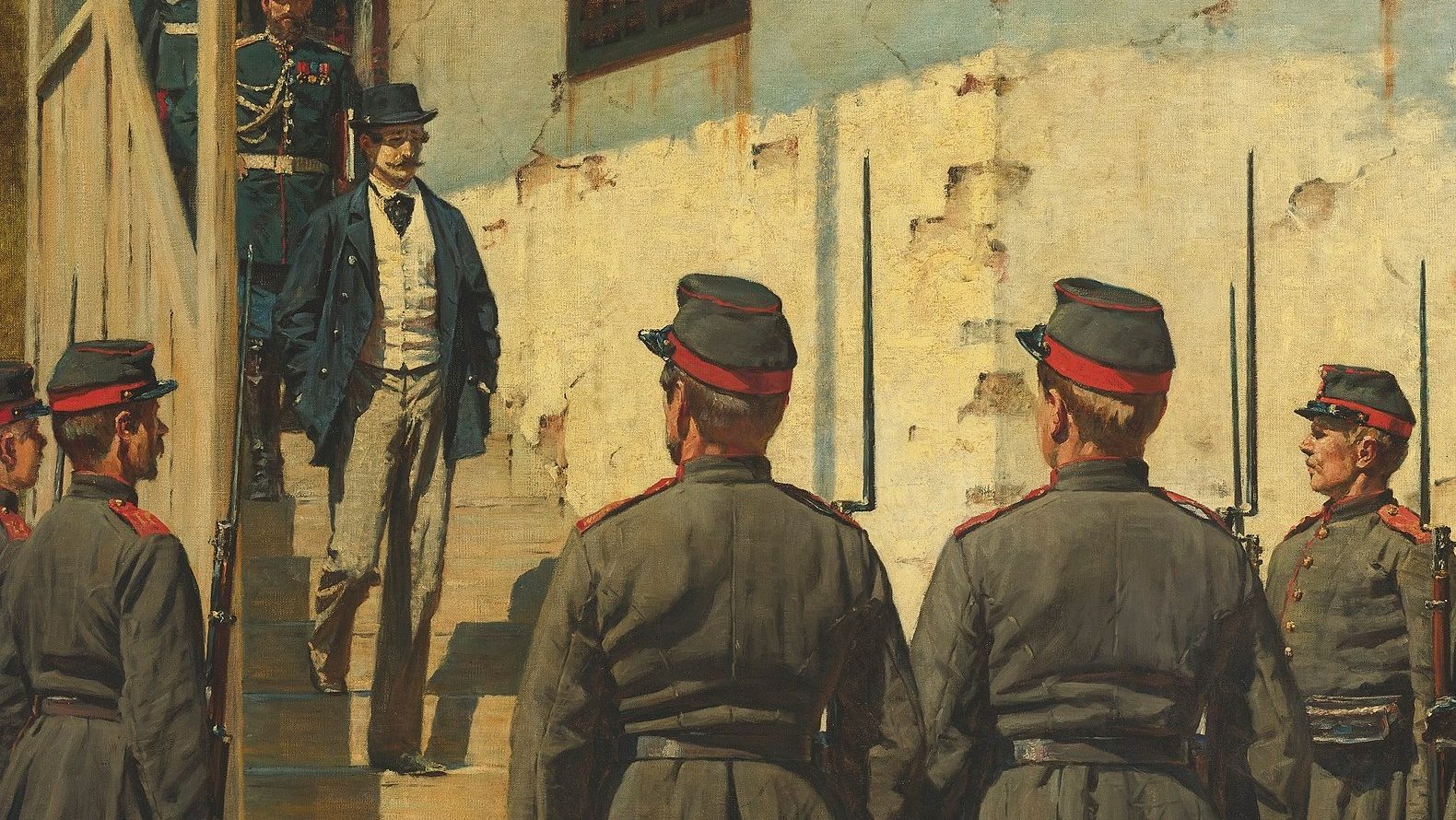
"The Spy" by Vasily Vasilevich Vereshchagin

The wake-up call came over the loudspeaker and sank into our barrack’s stone walls. It was still dark outside and cold. I shifted under my quilt and guessed the time. When Blake returned from the showers, there would be an eight-minute window to get up, break down our institute-issued mattresses and wooden bed frames, put on the correct uniform, and walk to formation. 

Our heavy wooden door swung open. My mental timer started. I rolled out of bed and wordlessly began the day. I put on “winter class dyke,” our cold weather uniform: grey wool pants that were notoriously itchy until you wore them for a few days, and a long-sleeve black button-up with a corresponding black tie. 

I tucked the tie between the shirt’s second and third button, a mid-century GI style that our superintendent preferred, then opened the door and listened. The Virginia Military Institute bustled in the darkness. Another muffled announcement: “Class Dyke. Rain cape. Rain cap cover.” 

Naturally, we all tired of the strict regimen and sameness of our uniforms. When leaving post for an open weekend or furlough, we relished putting on normal clothes. It was always odd seeing friends in civilian attire; 90 percent of the time with them was spent in uniform. The oddness was also due to the wild divergences in style, until then undisclosed. There were Hawaiian shirts, cargo pants, hipster fits, tactical clothing brands, wild fluorescent colors, skater fits, tank tops, and other methods of asserting one’s individuality. The result: cacophony.

But somehow, outside of their uniforms, my friends seemed less like themselves.

Swathes of modern dressers, just like Virginia Military Institute cadets, are trying to assert their identity against the group, against that unnerving sameness that pervades modern style. Walk across a college campus or a shopping mall, and you will notice waves upon waves of athleisure wear and ubiquitous configurations of popular trends. In response to this homogeneity, many dressers are desperately trying to be unique. Bright colors. Bizarre mismatches. Ironic kitsch. Clothes that are sausage-link-skinny or grocery-bag-baggy.

As Ezra Pound and the Vorticist movement declared a century ago, the only rule is to make it new. Uniqueness has become the standard by which fashion is measured. Yet uniqueness is no longer measured in relation to the town or community; one must compete with a global network of new. Social media is a constant stream of trends and fads that leave the individual scrambling to find something exceptional.

The current proliferation of options means a further individualization of style. Clothes have largely abandoned utilitarian purposes. We no longer think about what we wear primarily in regard to a vocation. Although we have “work clothes,” these are only a fraction of our wardrobes. 

Americans buy four times as many new articles of clothes as they did in 2000, even though one study found that we don’t wear 50 percent of the clothes we own. Even worse, every year, we prematurely throw out approximately 400 billion dollars’ worth of clothing. Of course, fast fashion accelerates our already extreme consumption and waste. Manufacturers are producing 100 billion new garments (globally) per year. This is more than ten times the number of people on earth.

This surplus, symptomatic of a broader affluenza that is both personally and ecologically harmful, has also changed how we see our clothes. They have become signals, more than ever, of how we conceive of ourselves. Today, it’s less about representing a group or a socioeconomic status and more about defining a personal ethos or, in modern parlance, a vibe.

When we conceptualize style as a project in order to assert the authentic self against the masses, we begin to dress like Transcendentalists. Transcendentalism was an early 19th-century literary and philosophical movement that sought to reestablish individual flourishing in the face of a rapidly industrializing economy, a default intellectual conformity, and a tumultuous political era, which would soon culminate in the American Civil War. 

If we peel back our current anxiety about unique style, we find that this tradition of thought has helped define the American cultural imagination for 200 years. Understanding the dangers of Transcendentalism might help us reconceive how the individual can relate to society, revealing how our style can move past the reactionary and endless search for newness.

This tradition is not the only one to have contributed to the hyper-individualization we see in culture today. There are many major philosophers and thinkers who have described the relationship between the individual and society as antagonistic. There’s Nietzsche’s fictional character, Zarathustra, who heroically rejects the masses of “last men.” There’s Freud’s Civilization and Its Discontents, a bleak book in which the individual willingly accepts societal oppression in exchange for safety. And, moving out of the 19th century, there’s Camus and Sartre and their individualized brand of existentialism.

But in this essay, I’m interested in this widespread and pervasive movement (largely in the West) that has made the individual the arbiter of identity. The Transcendentalists, specifically Ralph Waldo Emerson, offer a clear presentation of the broad themes that these various philosophies uphold, making Transcendentalism an ideal representative.

In Emerson’s famous essay “Self-Reliance,” he writes, “Man is timid and apologetic. He is no longer upright. He dares not say ‘I think,’ ‘I am,’ but quotes some saint or sage.” Emerson fears that true education and meaningful action are giving way to mimesis, where the individual merely parrots a sage or popular opinion, never daring to think for themselves. 

Although this danger was more pressing in the early 19th century when tradition held an authoritative position in social and educational life, we still face the essential danger of groupthink, which has proliferated rapidly through digital communication.

Surveying his cultural moment, Emerson concluded that “society everywhere is in conspiracy against the manhood of every one of its members.” This persistent struggle between society and the individual forms the bedrock of his response. If society is a crushing force, the individual must respond with gritty independence.

Emerson counsels, “Insist on yourself; never imitate”—a mantra that ought to sound extremely familiar. It’s posted (in some version) every day on every social media platform. It’s behind the clerk at the DMV. It’s hanging in your dentist’s office. It’s proclaimed by influencers and politicians and your grumpy uncle. We don’t exaggerate when claiming that this insistence upon the self is a fundamental ethos of the American national identity.

I certainly don’t want to demonize Transcendentalism. It can offer a helpful and often necessary corrective. It startles us out of the dangerous lullaby of rote tradition. It asks us to take account, to face ourselves. It calls for heroism. 

As another early 19th-century American, Henry Wadsworth Longfellow, would write, “Be not like dumb driven cattle, be a hero in the strife.” In this heroic approach to the self, Transcendentalism urges us to embrace action and accountability for our lives. Thoreau’s famous opening to Walden, “I went into the woods because I wished to live deliberately,” is one of my favorite passages in American literature. He earnestly desires to see for himself, to “cut a broad swath and shave close, to drive life into a corner.”

Transcendentalism is a philosophy with a pumping, vital heart. Yet its adherents’ correction—as with so many other philosophies—overreaches, swinging us toward consequences that can be disastrous if left unchecked.

The first consequence of rampant Transcendentalism is that the individual becomes isolated from others and tradition. “It is only as man puts off from himself all external support and stands alone, that I see him to be strong and to prevail,” Emerson writes. “He is weaker by every recruit to his banner.” 

The strong Transcendentalist is by necessity alone; Emerson calls for the removal of all external support. Solitude is not always lonely, but when all support is cut and every “recruit” turned away, the individual is dangerously isolated. When our actions and thoughts lose the barometer of community, they can careen wildly. Hermitage is almost always unhealthy.

Furthermore, if human community weakens the individual, then nonhuman community, like tradition and culture, present a similar danger to the Transcendentalist. Tradition is a form of communion, with Chesterton memorably describing it as the “democracy of the dead.” Transcendentalism, however, casts a disparaging eye on tradition. Recall Emerson’s lament about the “saint or sage,” admonishing readers to preference individual belief over inherited wisdom.

Second, Transcendental individualism is erratic and volatile, closely correlated with increased isolation. Because the individual is only accountable to himself, he achieves an odd infallibility. Listen to Emerson’s confidence: “Suppose you should contradict yourself; what then? … Speak what you think to-day in words as hard as cannon-balls, and to-morrow speak what to-morrow thinks in hard words again, though it contradict every thing you said to-day.” 

The emphasis is not on truth or congruity; instead, the most important factor is that the words be spoken with resolute conviction, “as hard as cannon-balls.” Authenticity becomes the measurement of our speech, regardless of whether our “authenticities” vary from day to day.

Our search for a unique, individual style manifests both of these philosophical consequences. Our wardrobes are increasingly defined by isolation (you have to be “one in a million”) and volatility (the trends are wild and fast; see “sardine summer”). Because we have abandoned the judgment and taste of tradition, we are left with the avant-garde. And the avant-garde is constantly changing, constantly pushing further. A cursory review of the Met Gala displays this trajectory. There is nowhere to rest.

As long as we dress like Transcendentalists and set ourselves against society, we’ll be trapped between the dichotomy of dressing like the dull masses or breaking with all convention. While this binary is ultimately false, it does highlight a central dilemma: Can I express myself without being ostentatious? Can I imitate others without being dominated by tradition? 

We can give an affirmative answer to both questions, but to do so, we need a different paradigm to capture the relationship between the individual and society. I’d like to offer one as an exemplar: the interpersonalism of Martin Buber.

In his famous book I and Thou, Buber explores two distinct modes of relating to the world: I-It and I-Thou. The first mode (I-It) relates to the world as a series of objects that can be used instrumentally and coordinated within our tasks. The second mode (I-Thou) relates to the world as a reciprocal encounter that transcends instrumental use. In an I-Thou encounter, we are influenced by the other as we influence them, and neither of us is coerced into a relationship of “use.” Buber extends these paradigms in a number of philosophical, sociological, and theological directions.

Crucially, beneath each of these extensions is a fundamental claim about the self: “Man becomes an I through a You.” Rather than positioning the individual contra others, Buber makes the relationship between others (and the Other, God) the central feature of our identities. We have no conception of a self without the other, through whom our self is constituted and contrasted.

Both ways of relating are necessary, but each way is dependent on context. In an I-Thou relationship, both parties mediate each other; imagine two children playing with a jump rope, shaking their respective handles. The waves sent from one side influence the other and vice versa. 

In an I-It relationship, only one side mediates, attempting to control and use the other. In this case, only one of our players swings the rope. The other side is motionless and completely defined by the movement of the other. Obviously, this is appropriate in some cases (such as bringing my coffee mug to my lips) but harmful in other cases (such as trying to emotionally control my friend). 

Importantly—don’t miss this—the silencing can happen in both directions. I can impose myself on others. Or society can impose itself on me. A true relationship is always a balance: “Relation is reciprocity.”

Buber’s interpersonal philosophy, like Transcendentalism, has important and far-reaching consequences. First, it resolves our central dilemma. Because the individual’s relationship with others is reciprocal (I-Thou), we can relate to society without silencing others or losing our voice. The rope can move on both ends.

Second, interpersonalism shifts the telos of style. Rather than establishing myself, the goal becomes relating positively to other people. We begin to dress for the other. This doesn’t mean pandering, seducing, or mimicking. It means that we understand our responsibility toward others; after all, we are helping to constitute their self as well. We are the Thou to their I. Each of us bears a responsibility to model to others what we value in the world.

We can feel this when talking around children. We realize that children soak up the speech and habits of adults, so we are especially careful with our words. We know our words have influence. 

Your style has influence too. It’s a contribution to a collective conversation. For good reason, menswear writer Derek Guy has compared style to language. Stylish fashion is a dialogue with culture and society. As mentioned before, this dialogue must go in both directions. We have to guard ourselves from being swept up and defined by larger trends, while also recognizing that all of our choices emerge from past traditions and historical precedents.

Back at the Virginia Military Institute, our uniforms weakened our personal voice, quieting our end of the rope. In response, cadets shook the rope wildly when the opportunity arose, losing the balance in the opposite direction. But the uniforms also produced a sense of collective identity, both among ourselves and with past school traditions. Successful style needs balance and reciprocity. Can we achieve this tender tension today?

Thankfully, there’s a common (although underappreciated) custom that offers individual agency while tying us to a broader community: the dress code. Although dress codes have grown more and more niche (reflecting the hyper-individualism of fast fashion), they do offer a kind of practical solution for developing lasting and meaningful style. At their core, they are a set of conventions that can direct our choices. When I read “business casual” or “cocktail attire,” I am given constraints that encircle a wide range of individual possibilities. Both ends of the rope move.

Next time you’re wondering what you should wear to dinner, ask yourself: “What would Martin Buber do?” Maybe relating your fashion choices to dead philosophers is just what you need to make your style decisions for the evening. 

Whatever you do, don’t be like Ralph. Keep him tucked away in the drawer. We don’t need to forfeit individual style, but we can make little choices that bring us closer to the world around us. Because it’s only in relationship with others, as in life, that style can blossom with balanced freedom.

Carter Davis Johnson is a writer and teacher whose work has been published in Road Not TakenFlyover Country, Warkitchen, RovaNew Verse Review, and Front Porch Republic. He also writes a Substack publication called Dwelling: Embracing the non-identical in life and art.

Theology

Why Superman Matters

Columnist

What we love about the hero is not his power so much as his vulnerability.

A superman statue
Christianity Today July 9, 2025
Illustration by Christianity Today / Source Images: WikiMedia Commons

This piece was adapted from Russell Moore’s newsletter. Subscribe here.

As I’m writing this, I am preparing to go with my sons to see a one-day-early screening of the new Superman film by James Gunn. I can hardly wait.

No doubt that moviegoers and my fellow Superman fans will argue about the movie—its continuity in the tradition of the classic 1978 Superman with Christopher Reeve, and so forth.

One debate trope I hope does not return, though, is the well-worn argument that “Superman is boring because he’s too powerful and can’t be hurt.” Here’s why that matters.

I do not write this as a neutral observer but as a fan of the character—and of the larger DC universe—since before I was even able to read. The stories from Smallville and Metropolis (and Gotham and Central City and Paradise Island) populated the Fortress of Solitude that was my childhood imagination in ways that, looking back, I think pointed me onward to the writings of Lewis and Tolkien and beyond.

But why did I and millions of others over the past 80 years want to put that red blanket over our shoulders and pretend to fly?

Author Grant Morrison (himself a prolific writer of comic books and graphic novels) has argued that Superman persists because he represents hope and power; he is the pop-culture equivalent of a sun god.

Some psychologists would say that Superman appeals to us because of his power. We long for the grandiosity inherent in the ability to fly, outpace bullets, see through walls, or, as on the cover of that first Action Comics, lift a car over our heads.

Some would say that children especially identify with the phenomenon of the secret identity: “I might seem to be bumbling, bespectacled Clark Kent, but if you could just see me in my Kryptonian battle armor …”

The idea of Superman as the idealization of strength and power would make sense. His name, after all, comes from Friedrich Nietzsche and his idea of the Übermensch in Thus Spoke Zarathustra. But if Nietzschean power were what we longed for, then there would be other characters more powerful than Superman to stand in for hope. The atomic symbol of Watchmen’s Doctor Manhattan, for example, would be far more appropriate than the S-shaped logo of the House of El.

No, what we love about Superman is not his power so much as his vulnerability. In this, playwright David Mamet was right when he wrote in the 1980s that the real draw of Superman is not flight or x-ray vision but kryptonite. “Kryptonite is all that remains of his childhood home,” Mamet wrote. “It is the remnants of that destroyed childhood home, and the fear of those remnants, which rule Superman’s life.” He continues,

Far from being invulnerable, Superman is the most vulnerable of beings, because his childhood home was destroyed. He can never reintegrate himself by returning to that home—it is gone. It is gone and he is living among aliens to whom he cannot even reveal his rightful name.

The Superman mythos, he concludes, is a fable not of strength but of a “cry for help.”

Mamet is partly right. An inexpressibly powerful alien force would not be as beloved, because it wouldn’t seem to ring true in our own lives. Kryptonite is the symbol of brokenness.

More than the literal kryptonite, though, is the metaphorical kryptonite in the background. Superman wears the uniform of a lineage far away and lost forever. Beyond that, he has learned to lose those who welcomed him into the human family—the Kents.

Superman may be the Man of Tomorrow, but he can be hurt; he can even be killed. And even worse, he can lose those he loves. We can identify with this. We don’t all come from Krypton, but we all have kryptonite.

This brokenness, however, leads to purpose and mission. In the Geoff Johns era of Action Comics (one of the best, in my opinion), Jonathan Kent tells his son, “Your greatest power isn’t being able to fly or see through walls. It’s knowing what the right thing to do is.” That’s consistently true of the character over the past 80 years. That’s one of the reasons the incarnation of Superman as a husband and a father is especially inspiring, as he tries to do his best to balance family and work.

One of my favorite Superman scenes is from Scott Snyder and Jorge Jiménez in their run on the Justice League comics series of June 2019. Superman, drained off-world of his power, reignites out of sheer force of will. The scene—expertly drawn by Jiménez—shows Superman charging through the sky between the reflections of his father, Jonathan Kent, and his son, also named Jonathan Kent. The scene sums up a legacy and a future that gives Clark Kent his power and also makes him able to be hurt.

This sense of mission, and the ethical framework undergirding it, is activated not by a yellow sun but by patient parenting. It didn’t come from Krypton but from Kansas. Superman may carry out his adventures with the powers of Kal-El, but all the while, he’s really Clark Kent. Those principles point him back to the joy and hurt of a love that can die but is as strong as death (Song 8:6)—stronger, even.

That’s why the other “boring” charge against Superman—that he’s too much of a Boy Scout—doesn’t work either. In a 2021 piece in Entertainment Weekly, journalist Darren Franich explores why the concept of an “Evil Superman” keeps reappearing, whether it’s the twisted Ultraman version of Earth-Three, the red kryptonite storyline of the Smallville television series of a quarter century ago, or the diabolical Homelander of Amazon Prime’s The Boys. Franich writes:

The arrival of an Evil Superman is meant to connote adulthood and maturity—the kind of stuff you could never ever get away with in kid stuff. Mature content isn’t the same as maturity, though, and it’s notable how often an Evil Superman is also a character without a supporting cast, a proper job, or even any motivation beyond pure lizard-brain violence.

How often is that version of “maturity”—of the Evil Superman kind—seen right now in this era, both in the church and in the world? Hedonism is maturity. Rage is passion. Propaganda is vision. Cruelty is strength. Intuitively we know this isn’t right, and we have to shut down our consciences to pretend it is.

One of the most striking Superman covers of all time would have to be in the J. Michael Straczynski “Grounded” run of 2010–2011, depicting a little boy wearing a Superman-logo T-shirt as he looks upward. He has a black eye. The story—one of the few in which we see a Superman in his right mind and furious at the same time—depicts the little boy asking Superman, who bears a similar mark of injury, “Does your Dad beat you too?”

No, he didn’t. And that’s why the fury-filled Superman goes to find this abusive father. He knows that this isn’t normal, that it isn’t right.

Much has been made of the religious imagery in the Superman mythos, especially the Old Testament echoes of Moses in the basket. Some have suggested that Superman is a Christ figure, a concept implicit throughout the Superman Returns film and elsewhere.

As a Christian, though, I think we identify with Superman not so much because he is godlike but because he is, underneath it all, so very human. We might be thrilled to see a superhero flying upward in the skies above us, but really, we’re looking past him for Someone else.

We all like to be saved from danger by a real or imagined Superman every once in a while. But Supermen have come and gone. This character has persisted for almost a century. That’s not because we think he can save us, but because we know, deep in our hearts, that a Superman needs a savior too.

Note: This is a revised, expanded, and updated version of “Who Will Save Superman?” published on the author’s website on April 17, 2018, on the 80th anniversary of the creation of the character.

Russell Moore is the editor in chief at Christianity Today and leads its Public Theology Project.

Theology

Imam’s the Word

Shiite sects differ on what matters most in a leader.

Shiite Muslims carry a portrait of Imam Ali bin Abi Talib, as they attend a symbolic funeral to commemorate the death of Imam Musa al-Kadhim in Basra, Iraq on January 26, 2025.

Shiite Muslims carry a portrait of Imam Ali bin Abi Talib, as they attend a symbolic funeral to commemorate the death of Imam Musa al-Kadhim in Basra, Iraq on January 26, 2025.

Christianity Today July 9, 2025
HUSSEIN FALEH / Contributor / Getty

(This is part two of a four-part series on Shiite Islam and the Iranian regime. Please click here to read part one.)

The previous article introduced the Shiite concept of justice through Ali ibn Abi Talib, cousin of Islam’s prophet Muhammad. Ali is a linchpin for understanding the difference between Sunni and Shiite Islam, the former representing the majority of Muslims in the world and the latter representing the majority in Iran. In 1979, Iran led a revolution that resulted in the world’s only Shiite government, establishing wilayat al-faqih, the “guardianship of the jurist,” meaning the rule of an expert scholar in sharia law.

This article will continue our examination of Shiite history, starting with the way Shiites see the Quran as containing both literal commands and mystical values. Shiites say it takes spiritual insight to understand the Quran correctly. And there are a multitude of traditions—the Sunna, from which Sunnis take their name—describing what Muhammad said and did.

Sunni scholarship recognizes many of these reports as authentic and others as uncertain or outright invented to support a political cause. They exist in the thousands, and although the standards of determining authenticity are internally rigorous, the task is a human endeavor.

Shiites say the Sunni criteria are necessarily insufficient. They believe proper Islamic leadership requires supernatural insight passed directly from Muhammad to his offspring—those who knew him best. Ali married the prophet’s daughter Fatimah, and they had two sons, Hasan and Hussein. Recall that Ali was assassinated in an Islamic civil war and leadership passed into Sunni hands.

In AD 680, Hussein led a revolt against Yazid, the sixth caliph, whom many Sunnis consider impious. Yazid’s army slaughtered Hussein with his small contingent in Iraq, marking another blow to Shiites while reinforcing their understanding of themselves as an oppressed but righteous minority. Shiites mark this event yearly during a commemoration called Ashura, honoring and mourning Hussein as the “Lord of the Martyrs.”

More description of this event will follow in part four. But its impact was profound. Hussein’s oldest son did not take part in battle due to illness, and he retreated to Medina, the holy city of Muhammad’s leadership in present-day Saudi Arabia. Here Shiites maintained a base of support, far from the Sunni center of power in Damascus.

Hussein’s son succeeded his father as imam, and the line continued for a total of 12 imams. Throughout this time, the Shiite community kept its distance from politics but often suffered persecution by the Sunni caliphs. Yet imams gave Shiites guidance—encouraging a quietist posture in formal submission toward unjust rulers. This involved taqiyya, hiding one’s true beliefs to survive an oppressive regime. Coming from Muhammad’s household, they believed they had the right to rule. Given their stature in society, wisdom advised them not to proclaim it aloud.

This, at least, is the interpretation given by the largest branch of Shiite Muslims, known as Twelvers. Another sect of Shiites centered its theology of the imam on the tradition, mentioned last article, in which Muhammad spoke in support of the oppressed. Known as Zaydis, they exist today primarily in Yemen and maintained that imams earn legitimacy not from family inheritance but by leading their people in revolt against unjust rulers. That willingness to fight is one reason why Sunni caliphs consistently persecuted the partisans of Ali—Zaydis and other Ali-linked movements constantly rebelled.

The other primary sect of Shiite Islam is the Ismailis, most prominent in Central Asia and the Indian subcontinent, led today by the Aga Khan. Of the twin Shiite theological concerns—justice and leadership—Ismailis focus on the esoteric knowledge they say the imam should have to lead well. Though Ismailis once commanded a powerful dynasty in Egypt, since the mid-19th century they have not sought to seize political power.

Iran is primarily a Twelver nation. And Twelvers had a particular problem after the line of imams ended with the disappearance of the twelfth: Who would guide the community? (The next article will describe the circumstances and implications of this disappearance.) A Zaydi imam could arise at any time. For Ismailis, the line veered to another figure and continues today. The Aga Khan claims to be the fiftieth in succession.

But Twelvers have an additional problem. After Ali, the imams did not possess political power. If Shiites did come to rule, how could they govern without an imam? Which leads back to the original question of this series: Is Iran’s Islamic Republic a faithful model of Shiite governance? Shiites are keen to apply their definition of justice in society through the Quranic injunctions to “command the right and forbid the wrong,” reflected—rightly or wrongly—in the role of morality police in Sunni Saudi Arabia and Shiite Iran.

The religious legitimacy of Iran’s Islamic Republic, however, does not rest solely on how well it applies the Quran. Some Iranians favor strict enforcement of female head covering, others less so. And although many courts have issued verdicts against converts to Christianity, others have ruled on their behalf.

The test comes in evaluating political power in the absence of the imam. Ayatollah Ruhollah Khomeini, Iran’s first supreme leader, offered a particular solution: The jurist, the religious scholar, rules in his stead. But he was not the first Twelver to confront this conundrum. The next article will continue the history of Shiite politics, from which Shiites can judge whether wilayat al-faqih is a consistent or aberrant answer.

News

Pro-Lifers Strategize as the UK Expands Abortion Access

With abortion pills by mail and a new amendment decriminalizing women who end their own pregnancies, can evangelicals convince their country that Both Lives Matter?

A man holding a green sign reading "our bodies, our right to decide" stands in front of the UK Parliament building.

Members of Parliament voted on the decriminalization of abortion on June 17, 2025 in London.

Christianity Today July 9, 2025
Alishia Abodunde / Getty Images

Debating abortion law in the United Kingdom last month, members of Parliament were warned that access to abortion was “increasingly under attack.”

Stella Creasy, a Labour MP from London, pleaded with colleagues to “listen to our American counterparts, who bitterly regret not having acted under Biden and Obama to protect abortion access and who now find medics being prosecuted and dragged across state lines.”

Conservatives dismissed her claim. Julia Lopez, an MP representing an outer London suburb, suggested that “the boogeyman of the US right” had made a return to the chamber. “Apparently, unless we agree to these amendments, evangelical religious groups paid for by US cash are going to start rolling back women’s reproductive rights in this country,” she told MPs. “This is utter nonsense.”

The exchange illustrates a sharp divide in how the British interpret the state of abortion access. While pro-life campaigners fear that the country is moving toward an “extreme” position, pro-choice voices see access under threat.

Overturning Roe v. Wade in the US prompted media outlets in the UK to speculate about whether the same could happen in other countries. Dr. Jonathan Lord, a consultant gynecologist for the National Health Service, told The Guardian newspaper earlier this year that “the radical American right wing” had been “empowered” and was attempting to push its “extreme anti-abortion views in the UK and around the world.”

During debate of the UK’s wide-ranging Crime and Policing Bill, MPs rejected Creasy’s proposal to make abortion access a human right in England and Wales but adopted an amendment to decriminalize women who terminate their own pregnancies, regardless of the number of weeks of gestation.

The vote in favor of this change—by a comfortable majority of 379 to 137—was front-page news in the UK, with headlines including “MPs vote to decriminalise abortion at any point up to birth.”

The reality is more nuanced. The 1967 law that legalized abortion in the UK stipulates that abortions will not be criminal offenses provided that they meet certain criteria. Two registered medical practitioners must agree in “good faith” that the woman is not more than 24 weeks pregnant and that there’s a risk to the woman’s physical or mental health, a “substantial risk” that the baby would be “seriously handicapped,” or other limited factors.

The recent amendment does not change this. Anyone other than pregnant women acting outside these conditions—including medical professionals—could still face prosecution. Nevertheless, it aroused strong emotions in Parliament, and Christian groups have voiced their condemnation of the change.

“Dangerous and late-term, self-induced abortion has been legitimised,” wrote Dawn McAvoy, who leads Both Lives UK, an Evangelical Alliance initiative. “Instead of the law protecting both lives in pregnancy, all unborn children have lost legal protections, and women have been abandoned by those tasked and paid to provide care.”

The vote follows a spike in prosecutions of women accused of having illegal abortions since the introduction of “pills by post” during the pandemic. The program, which allows women up to 10 weeks pregnant to receive abortion pills in the mail after a phone consultation, was made permanent in 2022.

Since its introduction, more than 100 women have been criminally investigated, 6 have faced court, and 1 has been sent to prison. During the debate, MPs were told that prior to it, only 3 women had been on trial over the past 160 years.

Among the Christian MPs who spoke during the debate was Rebecca Smith, a Conservative who suggested that a return to face-to-face consultations represented a “better way forward.”

Dr. Caroline Johnson, a Conservative MP who is also a consultant pediatrician, agreed and warned that under pills by post, women accessed abortion pills late in their pregnancies and were left “traumatized.”

Some women have lied to access the pills, while others have been mistaken about the stage of their pregnancies.

Last year, a man was sent to prison for spiking a woman’s drink with abortion pills obtained via the program. The year the program became permanent, a BBC poll of 1,000 women found that 15 percent reported “pressure to terminate a pregnancy when they didn’t want to.”

The Crime and Policing Bill debates renewed conversation about the UK’s abortion laws. Unlike the vast majority of European countries, the UK does not have abortion on request, although many argue that this is what exists in practice.

According to government figures, every year more than 250,000 abortions take place, and one in three women in the UK will have an abortion at some point in their lives.

The country also has some of the most liberal laws in Europe when it comes to late-term abortions. The evangelical Both Lives initiative has highlighted that the vast majority of abortions are carried out for undisclosed mental health reasons.

Against this backdrop, the overwhelming majority of the British public—87 percent—supports access to abortion, though a quarter believe that restrictions should fall earlier than the current 24-week limit.

Although pro-life groups and campaigns exist in the UK, they have nothing like the convening power evident in the United States. Fewer Brits than US citizens identify as Christian, and the constituency most opposed to abortion in the United States—white evangelicals—is a fraction of the size in the UK.

Furthermore, as a report by the think tank Theos observed, the UK lacks “the kind of tight-knit, symbiotic relationship between a right-of-centre political party and a unified Christian constituency” that emerged in the latter decades of the 20th century in the US.

Although some Christian charities are dedicated to campaigning against abortion, they have had to adopt tactics alternative to aligning with a single political party with a set of demands.

James Mildred of the charity CARE (Christian Action Research and Education) has noted that an “absolutist” approach to ending abortion “avoids pragmatism about what is politically possible and therefore gains little support from lawmakers—who are the ones actually able to change the law.”

The Both Lives initiative, first launched by the Evangelical Alliance in Northern Ireland in 2017, now seeks to engender a “new conversation” across the UK around the complexities of abortion.

“For decades British governments have provided—and privileged—one response to a pregnancy crisis: abortion,” said McAvoy. “Despite the language of ‘choice,’ we must ask honestly, ‘Is this system truly pro-choice or simply pro-abortion?’

“Unless we offer meaningful alternatives—real, supported, viable choices—abortion rates will continue to rise. Women who, in other circumstances, might choose to carry, birth, and love their child are being left with no visible path but termination. And disproportionately, it is the most vulnerable—the disadvantaged, the disabled, the unwell—whose lives are being ended.”

In the intermediate term, the initiative aims to see a return to in-person consultations, as MP Johnson had proposed.

Other aims include reducing the time limit “as far as Parliament will accept it,” McAvoy said, and tackling the “disability discrimination” inherent in permitting abortion after 24 weeks in cases of fetal disability.

McAvoy would also like to see the provision of independent counseling for pregnant women to avoid the “conflict of interest” whereby those providing counseling are also those providing abortion.

In common with other pro-life groups, Both Lives is investing in education—marshaling facts and data to better inform the current conversation. CARE has produced material such as “6 things abortion campaigners won’t tell you about decriminalisation.”

Polling is also a popular tactic, testing whether the public’s views on abortion are really that settled. Last month, the Society for the Protection of Unborn Children commissioned a poll that found that 67 percent of respondents agreed that “abortion is a matter of life and death, and it is therefore appropriate that the criminal law provides a clear boundary to protect everyone involved.”

The charity has campaigned to end the government’s “two-child benefit cap,” under which only the first two children of a family qualify for some forms of welfare, and it cited evidence that the cap is influencing women’s decisions to have abortions.

In 2022, Christian charities spoke in support of Heidi Crowter, a young women with Down syndrome who unsuccessfully challenged in court the provision of abortion past 24 weeks in the case of babies thought to be disabled.

The Both Lives initiative, with its emphasis on “gracious” and “respectful” conversation, is evidently wary of entering the waters of a culture war. A notable line in the guide states, “We don’t want to see the UK church following a more fundamentalist-partisan-political line when it comes to this issue.”

It’s an approach that mirrors that of other charities. In 2013, the head of CARE, founded in 1983, told Theos:

When CARE started, it would be true to say that CARE staff would, on occasion, march—perhaps with a banner saying “abortion kills” … Very quickly we said we wouldn’t ever do that again because what does that say to the woman who’s standing by the road? … There will be Christians who will say either we’ve gone too soft and lost it … but then we’ll be attacked from the other side who say we’re pro-life and therefore we’re not caring for women.

This is a key challenge that pro-life campaigners must grapple with in the UK. Though they may stress the importance of gracious, respectful debate, in a country with such strong support for abortion, the very act of opposing it is likely to offend.

“We seek to protect life and so have always supported legislative initiatives that seek to lower abortions, whether through changing the legal time limit for abortions or clarifying that sex-selective abortions are illegal under UK law,” said Caroline Ansell, director of advocacy and policy at CARE.

“How we communicate on this issue is of paramount importance,” she said. “Our model is Jesus, who came from the Father, full of truth and grace. We want to hold out a better story on abortion than the one our society tells. That story is based on the amazing truth that a person comes into existence at conception and their life has intrinsic dignity from this point through to its natural end.”

The Both Lives guide warns that the UK church cannot “remain silent and apathetic” on the matter of abortion and cautions that “in the society we live in, the idea of any limit on bodily autonomy will be inherently offensive to many. The church therefore should stand firmly on the truth that all life has inherent dignity and value from the moment of conception.”

In recent years, one tactic adopted by pro-life campaigners has attracted more media attention than any other: prayer outside abortion clinics.

In her book Anti-Abortion Activism in the UK, Pam Lowe, a sociologist, suggests that “anti-abortion activism lacks public support and has largely been unsuccessful since 1967.” She also reports “evidence of increased activism outside abortion clinics, with more faith-based groups beginning to organise ‘vigils’ which seek to deter women from entering.”

In October last year, a new law came into effect prohibiting all protest activity within 150 meters of an abortion clinic. This includes any attempt to “influence” a person’s decision to access the clinic. It’s a rule supported by 77 percent of the public, according to a 2023 poll.

Speaking at the Munich Security Conference earlier this year, US vice president JD Vance cited the case of Adam Smith-Connor, a man convicted of breaching a safe access zone after refusing to move on while praying outside a clinic, as evidence of “the retreat of Europe from some of its most fundamental values.” His intervention was condemned by Creasy in Parliament.

Creasy’s criticism of pro-life campaigning has been challenged by other MPs. The activities she has listed—the March for Life, activities on university campuses, and the lobbying of MPs—are all the rights of citizens in a free country.

Last year, the Northern Irish MP Carla Lockhart, a member of the evangelical Free Presbyterian Church of Ulster, accused her of having “demonized” such campaigners, who “value life and who value both lives in every pregnancy.” For its part, the current Labour government has said it is “wholly committed to ensuring access to safe, regulated abortions.”

Creasy is right that American organizations have influence on the landscape in the UK. One example is the Alliance Defending Freedom, a US-based legal organization that provides free representation in cases concerning “religious freedom, free speech, and the sanctity of life.”

Its clients include Smith-Connor and Isabel Vaughan-Spruce, the director of the UK March for Life, also arrested and charged after praying outside a clinic.

Meanwhile, the UK affiliate of the Center for Bio-Ethical Reform (CBR UK) is committed to using the tactics of the founding American organization: graphic images of abortion deployed on the premise that “we will never truly understand the horror of abortion until we see it.”

In 2019, it paid for a billboard campaign in the London area represented by Creasy. The owner of the billboards removed them after Creasy complained she was being harassed. She was pregnant at the time.

The charity’s head of training and development, Aisling Goodison, argues that to end abortion, campaigners must learn the lessons from historical campaigns, including the abolition of slavery and the Civil Rights Movement in the US—both of which, she argues, deployed graphic images.

While Creasy and others warn of the rise of pro-life activism, the fear among some in this constituency is that the campaign isn’t loud enough.

“Most Christians in the UK today think and behave much like the rest of the world when it comes to abortion,” according to Dave Brennan, the leader of Brephos, CBR UK’s initiative that encourages churches to speak about abortion. “We’ve accepted the rhetoric of choice.”

“Silence has pervaded the church, and we need to find a renewed confidence in the good news of the gospel for both lives in pregnancy,” said McAvoy. “Women facing pregnancy crises and considering abortion, and all those living with post-abortion pain and loss, deserve the hope, help, and healing that we know is found in Jesus.”

Dismissing the “boogeyman of the US right” in the House of Commons last month, Lopez spoke of a “very different and a more balanced national conversation” in the UK.

“It is not extremist to want protections for viable babies, and it is not anti-women to say that coercion or dangerous self-medication should not be outside the reach of the law,” she argued.

The country’s pro-life campaigners agree. But as they seek to turn the tide of public opinion, views within the movement on the right methods remain divided. While some caution against a conversation in the US mold, others see helpful lessons.

Apple PodcastsDown ArrowDown ArrowDown Arrowarrow_left_altLeft ArrowLeft ArrowRight ArrowRight ArrowRight Arrowarrow_up_altUp ArrowUp ArrowAvailable at Amazoncaret-downCloseCloseEmailEmailExpandExpandExternalExternalFacebookfacebook-squareGiftGiftGooglegoogleGoogle KeephamburgerInstagraminstagram-squareLinkLinklinkedin-squareListenListenListenChristianity TodayCT Creative Studio Logologo_orgMegaphoneMenuMenupausePinterestPlayPlayPocketPodcastRSSRSSSaveSaveSaveSearchSearchsearchSpotifyStitcherTelegramTable of ContentsTable of Contentstwitter-squareWhatsAppXYouTubeYouTube