News

Hundreds of Positions Eliminated at Evangelical Colleges and Universities

Ongoing financial concerns exacerbated by COVID-19.

Mnchick894 / Wikimedia Commons

Mnchick894 / Wikimedia Commons

Christianity Today August 10, 2020

Update (August 10): Heading into the fall semester, evangelical colleges and universities have eliminated more than 230 faculty and staff positions. Dozens of faculty and staff were cut in the spring, with schools citing COVID-19 and ongoing financial concerns. Scores more were eliminated from four institutions over the summer:

  • Southwest Baptist University (Missouri)—24 faculty and staff
  • Walla Walla University (Washington)—15 faculty and staff
  • Calvin University (Michigan)—12 faculty, two majors, and four minors
  • Spring Arbor University (Michigan)—11 faculty positions, one study abroad program

Matt Kucinski, a spokesperson for Calvin, said the school has been, “Preparing for several years now to meet the reality that more extreme enrollment declines are predicted for higher education institutions around 2026 as enrollment continues to reflect the demographic decline of university-aged students worldwide.”

Walla Walla spokesman Aaron Nakamura said COVID-19 has made everything more complicated. “We have found that we have had to be more flexible than normal,” he said.

———-

Original post (June 22): Five evangelical Christian colleges and universities have eliminated more than 150 faculty and staff positions this spring. While some officials cite COVID-19 as the reason for the cuts, most say the financial reckoning comes in response to the ongoing crisis of higher education and their efforts to prepare for the future.

School officials have confirmed the following cuts:

  • Bethel University (Minnesota)—36 faculty, 28 staff, two masters programs, 11 majors
  • Southeastern University (Florida)—32 faculty and two staff
  • Hardin-Simmons University (Texas)—17 faculty, 14 staff, 22 programs and seminary
  • John Brown University (Arkansas)—25 positions, including at least five faculty
  • Harding University (Arkansas)—10 faculty and administration and closed North Little Rock location

Other schools, including Taylor University in Indiana and Charleston Southern University in South Carolina have furloughed employees to save money, but not eliminated positions.

“Institutions are often required to make strategic and necessary changes based on a number of factors,” said Shirley Hoogstra, president of the Council for Christian Colleges and Universities (CCCU). “But at the end of the day, these decisions are made to ensure the future financial viability of the institution.”

Eliminating positions may, in some cases, mean laying off faculty or staff. More often, however, administrators make cuts by not filling vacant positions, declining to replace people who have retired or taken another job. Many schools across the country have had hiring freezes, and some make the smaller rosters permanent after a period of time.

School administrators say the decisions hurt but are necessary. They hope the tough calls may make the difference in the future health of their institutions.

“These changes, while painful, are a necessary part of our work to ensure Bethel will thrive well into the future,” said Deb Harless, executive vice president and provost, in a press release.

Only two of the five schools, Southeastern and Harding, cite COVID-19 as a primary reason for the financial situation requiring cuts. Small, evangelical colleges were already in a precarious position due to lower enrollment, relatively small endowments, and shrinking donor bases. COVID-19 only made it worse.

Ten CCCU schools made similar cuts in 2019, according to press reports, including Gordon College in Massachusetts, Malone University in Ohio, Indiana Wesleyan University, and Azusa Pacific University in California. Evangelical seminaries have been navigating financial pressures made worse by COVID-19 as well.

A number of conservative Christian schools that are not part of the CCCU have also reduced their budgets this year. Ashland University laid off several faculty as part of a plan to discontinue 40 programs. Liberty University announced it is discontinuing its philosophy major. Some schools have also completely closed: Nebraska Christian College and Concordia University-Portland shut their doors this spring.

Declining enrollment is a major factor in the ongoing financial crisis. From 2014 to 2018, Bethel’s enrollment declined by 6 percent, John Brown’s by 9 percent, and Harding’s by 10 percent, according to the Integrated Postsecondary Education Data System (IPEDS). McKinsey & Company, a higher education trade company, predicts first-year undergraduate enrollment will drop 15 percent this fall. If true, schools that are tuition dependent with small endowments will be hit especially hard.

Enrollment isn’t the decisive issue for every institution, however. In the same five-year span, Hardin-Simmons’ enrollment increased by 11 percent, Ashland’s by 36 percent, and Southeastern’s by 80 percent, according to IPEDS.

The larger challenge, for schools, is not knowing what to expect. Dramatic changes from year to year, whether caused by enrollment decline or a pandemic, make it very hard to plan for the future.

Colleges are “having to make high-impact decisions,” Hoogstra said, “when predictability about the future is low and there are many variables outside of their control.” Administrators have to be “extraordinarily strategic,” and that’s still no guarantee of survival.


Pastors

The Craftsman in the Pulpit

The secret to pastoral passion? Get better at your job.

CT Pastors August 10, 2020
Illustration by Mallory Rentsch / Source Images: Mint Images / Getty Images / Ben White / Lightstock

I’ve lost my passion for ministry.” Many pastors have heard this ominous statement uttered by a colleague or maybe even said it themselves. The statement is always taken seriously. Why? Because in ministry, passion is considered an essential ingredient. A passionless pastor is depressing (and often depressed). So, here’s the question: How does a pastor find and sustain a passion for ministry?

“Passion” is a slippery word. True passion is not an adrenaline-fueled burst of emotion. It’s also not the unbridled enthusiasm that initially allows us to pour ourselves into a really good business idea or topic for a book. If that’s passion, we’ll all eventually lose it. Emotional highs wear off. Enthusiasm dissipates, especially when we begin to realize how much work that business or book will require.

What we’re after is sustainable passion. Sustainable passion is that long-term zeal that reminds us month after month, year after year, that despite the sometimes-crummy aspects of our occupation we love our work and don’t want to do anything else.

Attempts to sustain passion for ministry often rest on the assumption that the issue is spiritual—the pastor must increase his personal time in Scripture and revitalize his prayer life. If spiritual focus fails, the next possibility usually considered is burnout.

Certainly, a lackluster relationship with God points to spiritual problems. Yet not every pastor is in this boat. Many pastors I know devote conscientious time and effort to their walk with God, yet over time still see their passion for ministry subside. They assume the problem is spiritual, when in fact their waning enthusiasm may have less to do with spiritual stagnation and more to do with how they approach their work.

What about burnout? Again, this is possible. There are pastors—particularly solo pastors—who are terribly overworked. But I don’t readily buy the burnout excuse. An exhausted pastor might be spending beaucoup hours at the office; however, a little time-tracking will reveal how many of those “working” hours are wasted on web surfing, social media, podcasts, YouTube, or obsessively checking texts and email. Burnout is often alleviated by using the time available to do the work that matters. In fact, within this idea of focusing energy on work that matters, we find the solution to the passion problem.

In his book So Good They Can’t Ignore You: Why Skills Trump Passion in the Quest for Work You Love, Georgetown University computer science professor Cal Newport described his own career journey and search to answer this question: “How do people end up loving what they do?”

The answer Newport discovered is surprisingly simple and applicable to any field: Find a job that people value and get really good at it. If you do this, then in your work you will enjoy the freedom, creativity, and impact granted to people who possess an in-demand skillset. It follows that anyone who finds freedom, creativity, and impact in their work will love what they do (sustainable passion). Or, as Scott Galloway puts it,

Your job is to find something you’re good at, and after ten thousand hours of practice, get great at it. The emotional and economic rewards that accompany being great at something will make you passionate about whatever that something is.

Newport and Galloway are highlighting an often-overlooked piece of the passion puzzle. Simply put, loving one’s work has less to do with finding the perfect job and more to do with getting really good at one’s job.

Proverbs 22:29 communicates something similar: “Do you see someone skilled in their work? They will serve before kings.” Proverbs doesn’t directly state it, but I think it’s safe to assume that a person with that level of skill and opportunity thoroughly enjoys his or her work.

Now as pastors, we have an advantage. We already have a vocation that adds immense value to people’s lives. Now we must ask: How do we not just “do ministry,” but instead get good at ministry, and thus obtain the kind of long-term, sustainable passion described by Newport and Galloway? The answer requires us to quit worrying about passion for a while and instead embrace what Newport calls the craftsman mindset. The craftsman mindset means that we choose to approach our work like an aspiring master craftsman, regardless of how we feel towards our work on any particular day.

If you’ve ever had your home remodeled, you know that all contractors are not created equal. Some just work construction. They do a good enough job to get paid. But others make you look at that flawless tile job in the shower and wonder at its beauty. These contractors are craftsmen. Everyone wants to hire a craftsman. In the same way, not all pastors are equally good at their jobs. Some pastors preach powerfully. Others could use another preaching class. Some pastors set organizational vision and mission and successfully execute both. Other pastors seem to barely see beyond next Sunday. Some pastors are excellent leaders. Others don’t have terms like “delegate” and “timing” in their vocabulary.

Nobody is good at everything. But are we as pastors approaching our work like aspiring master craftsmen? Are we continually doing the hard work necessary to improve and refine our ministerial skills? Or, are we allowing our skill level to plateau because we don’t feel passionate enough to get better? As Cal Newport says, craftsmanship precedes passion: “You adopt the craftsman mindset first and then the passion follows.”

Some would disagree and argue that passion always comes first. In other words, a pre-existing passion for ministry is what drives the pastor to get better at doing ministry. However, this idea has little support. Scripture is clear that passion is not required to enter ministry. It is important to remember that we are called. For example, consider Moses. God appeared to Moses via the burning bush and told him to lead Israel out of Egypt. Could anyone ask for a clearer calling than that? And how did Moses respond? “Pardon your servant, Lord. Please send someone else” (Ex. 4:13). Nevertheless, Moses obeyed—not because he felt passionate about leading Israel, but because God told him to do it. Look at the calling of Gideon (Judges 6) and Jonah (Jonah 1). Gideon questioned God’s call and needed signs. Jonah got on a boat and fled. Neither of them had a drop of passion! But that didn’t matter. What did matter was their obedience to God’s call.

Realistically, even though a pre-existing passion isn’t required for ministry, as pastors we still want to love what we do. That’s where the craftsman mindset comes in. Attempting to become a master ministry craftsman, however, requires answering the logistical and practical question of, how do we get better at our work? Because for pastors, improvement isn’t always quantifiable. It’s not like we’re athletes and can look at our stats. Still, we must strive to improve our craft.

Here are three steps to hone your ministry skills.

Make a list.

Ministry craftsmanship begins by identifying your most important ministry responsibilities. Don’t list random areas of ministry you’d like to improve in or only list things you feel passionate about. At this stage of the game, passion or lack thereof is irrelevant. (Remember, first comes craftsman then comes passion.) For example, one of my major responsibilities is being the second member of a two-man preaching team. Preaching is without a doubt the most visible part of my job. Preaching is also when I can publicly cast vision for discipleship, small groups, and leadership development (my other areas of responsibility). Therefore, preaching is at the top of my list. Your list might look different than mine depending upon your ministerial role.

Pursue professional development.

Nothing tricky about this step—look at the items on your list and write down specific ways you will improve at each item. But stick to the listed items. A worship leader, for example, probably shouldn’t spend energy improving her counseling skills if counseling isn’t one of her major responsibilities. The worship leader should devote energy instead to improving singing, musical arrangement, or whatever is necessary to become an outstanding worship leader. In my ministry, I decided to hone the skills on my list by enrolling in a Doctor of Ministry program. The DMin training will help improve my preaching, firstly, as well as other items on my list, like leadership development.

Prioritize work that matters.

As my dad would always say, “You never have time for what’s important. You have to make it.” Man, was Pops right. As a husband, father of three kids and full-time pastor, I feel like there is never enough time. So, I have to carve out room for what matters.

Making time for what matters is straightforward. First, spend a couple of weeks tracking how you spend every hour of your workday. Second, get rid of all the unproductive junk eating up those hours. Third, devote your newly discovered free time to items on your list.

Now before you start accusing me of being overly simplistic, give it a try. Track your time and you will be amazed how much of it is wasted on non-essential tasks. Sermon preparation is essential. Reading Twitter feeds, checking the news, looking at your phone for the umpteenth time, listening to another podcast, or surfing the web, is not. Choose instead to approach your work as an aspiring master craftsman and devote time to becoming an exceptionally skilled minister. In time, sustainable passion will follow.

Seth Gheen is pastor of discipleship at Community Bible Church in Omaha, NE. You can follow him at clergycraftsman.com.

Church Life

Learning to Long for the Beloved Community

How one Indiana church is taking steps towards racial justice.

Christianity Today August 10, 2020
Illustration by Rick Szuecs / Source images: Pearl / Lightstock / Wikimedia Commons

On a cool morning in March, I gather at my church with fellow members in Marion, Indiana. We stand in a circle in the parking lot, holding hands, praying not only for our body of believers but also for our town.

This is a church plant of the Evangelical Community Covenant Church, which we call R.E.A.L. Community Covenant Church. We attempt to incarnate our name: We are Relational, Evangelical, Authentic, and Loving. Despite our location in a city with a fraught place in America’s ugly racial history, ours is the only integrated church in the area.

We are a multiethnic, multiclass church, with different experiences of life in America and different journeys to this place. But we have a clear mission: To reconcile residents to Christ and to one other. Colossians 1:20 directs our path. It is Christ—God incarnated, crucified, and resurrected—who will reconcile all people, all things, to himself.

Which is why we are here, holding hands in a stony parking lot. Every one of our prayer walks begin and end here. I’ve been a long time in getting to this place.

I grew up in south Jersey in an affluent suburb, where the schools were so good that my brother, sister, and I had our choice of AP courses and studied Latin for four years. We enjoyed the pleasure of the countryside, too. A few times a year, my parents would pack us up and take us to the Pocono Mountains in Pennsylvania. There, my great-grandfather would lead us through his 40 acres of meadows and woods, remarking on bears and deer that had left their marks and complaining about the loggers who were clearing yet another part of the forest beyond his property.

You could look at my family in that moment and see how we’d earn advanced degrees, establish comfortable lifestyles, and raise our own children in safe neighborhoods.

I was a child of white privilege, though I had no idea. Even after college and graduate school, it was easy for me to believe in the American dream. Hard work and decent living would ensure success. I believed that anyone could achieve the American dream and our laws ensured equality for all. Segregation was over, everyone had the right to vote, and racism was a thing of the past.

But in 1990, I began to teach at Wilberforce University. The school is our nation’s oldest private historical black university, affiliated with the African Methodist Episcopal Church. I quickly learned how many misconceptions I had. A student, for instance, came to me one day before class to let me know she’d missed the previous class because of an appointment at the public assistance office. She whispered this information so low I could barely hear her. Her words destroyed the racist stereotype of the “welfare queen” in 60 seconds.

My students taught me what it was like to hear white passersby hurl racial epithets at them, shop owners follow them around stores, and police officers pat them down because of cross-racial misidentifications. They also taught me hard work isn’t a guarantee of opportunity. And they made me wonder why the depictions of Jesus I had seen all my life were white. Wasn’t our savior a Middle Eastern Jew?

Above all, my students taught me about community. When we talked in class about their educational goals, they would talk about their neighborhoods, families, and friends back home. They were compelled to get an education so they could go back and, as they’d often say, reach back and help someone else up the ladder.

A New Vision of Community

In all my years at church, I had never seen such conviction and solidarity. I’d never seen that commitment to any beloved community. To my shame, I’d never even thought of it. When I was in college, I had two goals: Glorify the Lord and pursue the American dream—both on a fairly individual basis. My objectives included graduating, landing a good job, getting married, and buying a house. Sure, I’d serve in church and cook dinners for people. Maybe I’d even support a missionary. But return to my hometown and help the people I grew up to survive and succeed? Until I taught at Wilberforce, I had never even heard of that. Some of my fellow R.E.A.L. church members have had similar journeys. Like me, they too spent years worshiping in predominately white churches, never questioning why, as Martin Luther King Jr. said, 11 a.m. on Sundays was the most segregated hour of the week. Shara McClanahan, one such member, echoes this experience: “Before R.E.A.L., I primarily did life with people who looked like me, thought like me, talked like me, and believed like me. R.E.A.L. has called me, a white, educated, middle-class female, to join arms with others, to cultivate heaven on Earth through resisting, interrupting, and transforming the systems that create inequity in our world.”

Focused on that mission, our church seeks to develop a beloved community. Just as God the Father, God the Son, and God the Spirit mysteriously work together to convict us, redeem us, and sanctify us from sin, we must work together—carrying each other’s burdens, empowering each other to use our diverse gifts, and reconciling with one another.

As our pastor, Drew Morrell, says, “Don’t roll solo.”

We leave the stony parking lot together and head one block away to Drake’s Outdoor Court, which is located in a resident’s yard. A married couple who once lived there built it when the city of Marion eliminated the two public parks in the neighborhood. Pastor Drew and other men in the church frequent this spot to play games with the kids, get to know them, and invite them to church. We hold our annual church picnic here, too, when we invite police officers and neighbors alike.

We pause beneath the basketball hoop, standing on the blacktop painted with white arcs, circles, and lanes, to pray for this community, the kids who play here, and their families. We invite the Holy Spirit to indwell this place and bless these beloved people.

We continue our prayer walk down the road to St. Martin Community Center. The place bustles with activity because Marion is one of the poorest cities in Indiana. Volunteers serve free lunch, stock the food in the pantry, and sell clothes in the shop for $1. Local businesses donate more than enough food, but the center is often too low on toiletries. We pray with the director for ongoing donations and volunteers, and the strength to carry on. We take with us the idea to do a toiletry drive later, to support the community center’s good work.

We walk several more blocks, and the aroma of barbecue wafts through the air. Someone is always grilling or smoking meat in the neighborhood. We pray at one of many local bars, where some have lost their lives; at the women’s shelter, where two R.E.A.L. women have led Bible studies; and at the Affordable Housing Community Development Corporation, which has helped people in our church.

When we come to the Marion Police Headquarters and Grant County Jail, we pray for our officers to do justly, walk humbly, and love mercy. We pray for their safety. We pray for the prisoners held captive by their sins. We pray for the growing number of women there, due mainly to the opioid crisis here in the Midwest. We pray for those prisoners Pastor Drew holds Bible studies with each week.

A Pastor in His Hometown

As we pray, I recall how Pastor Drew’s first 25 years of life were characterized by deep disillusionment and distraction. He could’ve ended up in this prison, too. His self-destructive trajectory came to a screeching halt, however, when he was shot in the back of the head. It’s almost clichéd to say: He was in the wrong place at the wrong time. A drug deal gone bad. Pastor Drew, the bullet’s unintended victim. It entered from the neck and exited from his jaw. Although he could’ve been involved in something like that—he was involved in similar illegal activities back then—that night, he was just minding his own business. The unbelievable story of his survival made the news, an article he keeps. A reminder of what God saved him from. Oh, how the effectual prayers of righteous men are answered: Drew turned his life over to Christ, enrolled in Indiana Wesleyan University, earned his Bible degree, and now pursues the vital vision God has given him. He seeks to minister in his own hometown, where everyone knows his name.

Jesus himself knows how hard such a mission is. When he returned to Nazareth to teach, the people viewed him with suspicion. He’s just a carpenter! they scoffed. He’s that son of Mary’s. Just a regular Joe. Why should we believe him?

After enduring such disregard, Jesus turned to his disciplines, and said, “A prophet is not without honor except in his own town, among his relatives and in his own home.” And Mark 6:5 then informs us, “Jesus couldn’t do any miracles there, except lay hands on a few sick people and heal them.” The Nazarenes’ lack of faith stunned even Christ, the next verse says.

Perhaps, this is why, at least in my experiences in all my past churches, all of my pastors had come from elsewhere. Frequently, they wouldn’t stay long, either, leaving us after just three, four, or five years. Until Pastor Drew, I have never attended a church in a place where the pastor grew up.

I wonder if there is a connection between proximity and façades, transparency and condemnation. I learned throughout my church life that being honest about one’s struggles means inviting judgment. Better to keep that upper lip stiff, that pain to one’s self. Make everything look good. I remember being a young wife and mother and feeling compelled one Sunday to go forward after the message to ask for prayer. I wanted to reinvigorate my commitment to Christ, which had turned stale. My husband at the time was a deacon, and we’d led the youth group in the past. I was nursery supervisor. One elderly woman in the church who was dear to all of us stunned me afterwards, saying, “I can’t believe you went forward. I always thought you were strong.”

And I was equally at fault, judging others. How deeply sorry I am. How many regrets I have for careless, insensitive things I said.

Pastor Drew doesn’t have the luxury of a façade. When you minister around people who know your every mistake and flaw, you can’t fake it till you make it. It’s a tough assignment, to minister to your hometown.

Yet, there’s something merciful in this, too. Authenticity is possible. People who know Pastor Drew know he knows them, too. He is the one they call to do the funerals when their sons succumb to lethal gunshots. He is the one who welcomes them when they smell his meat grilling and they show up at his back door. Our assistant pastor, Ronnie Farmer, jokes that Drew is the worst person to go to Walmart with because any quick errand can transform into an hour-long trip as he talks to everyone he knows.

Pastor Drew isn’t perfect—and he knows we all know that. But he also says he often wakes at night, weeping for those lost in Marion, asking God to save them.

Prayer is necessary for repair, no doubt about it, but the work is as physical as it is spiritual. Bodies matter. So when he preaches, Pastor Drew insists that as a biracial man, born of a union once illegal in this nation, his very body illustrates both the struggle and the goal: Unite as though you’re one body.

Remembering Our History

We keep walking. Keep praying. We come to our mission’s ground zero: The site of a 1930 lynching. The old courthouse isn’t here anymore. It has been renovated into apartments that the real estate listings call “historic.” Grant County Superior Court now stands across the street.

Like a West African griot, Pastor Drew recounts Marion’s lynching. He tells the story so we may remember, for he has taught us the wisdom in First Nations activist Georges Erasmus’s words: “Where common memory is lacking, where people do not share in the same past, there can be no real community. Where community is to be formed, common memory must be created.”

The story’s hard truths sink in: On August 6, 1930, three African American adolescents, Abe Smith, Tom Shipp, and Jimmy Cameron, were arrested for shooting Claude Deeter during a robbery attempt. Deeter and his fiancée, Mary Ball, both white citizens, sat in his car, parked at the local lovers’ lane. Earlier in the day, Smith had convinced Shipp and Cameron to join him in doing “stick-ups.” Cameron left the scene, however, once he recognized Deeter and decided he didn’t want anything to do with it. Afterwards, Deeter was shot, the police were called, and all three teens were arrested.

Deeter died the following afternoon. All day long, the phones rang with another part of the story sure to rile the white citizens: Mary Ball said the black boys had also raped her.

The lynch mob, led by the Ku Klux Klan and composed of 15,000 white residents, gathered around the maple tree in front of the court house that night. They believed Ball’s story. Besides, Deeter was dead. That much was certain. His bloody shirt had hung from the old jail’s window on Boots Street all day like a flag.

The same townspeople who’d been to church Sunday morning demanded vigilante justice on Thursday night. The sheriff, a KKK member himself, made only a feeble attempt to stop them.

Shipp was first. The mob brutally beat him, then hanged him from the bars on the jail’s window. Smith was next. When he struggled to get the rope off his neck, the crowd beat and stabbed him with tools they took from the iron works nearby. Once dead, he was lynched on the maple tree. Then the men moved Shipp’s body and strung him up there, too. The crowd continued beating the bodies and even stripped clothes off them to take as souvenirs.

An infamous photo of the lynching was snapped by a local photographer named Lawrence Beitler. In the picture, the white people gather together like they would at any public event, like a picnic or parade. One of the women is pregnant. They smile. A man points up at the bodies, hanging above them.

The men brought Cameron to the tree, too. A still-unidentified voice cried out, insisting he had nothing to do with the crime. The voice told the crowd to let him go. No wonder Cameron, the only American to ever survive a lynch mob, later described this voice as “angelic.”

Later, Ball recanted her story. The rape was pure fiction.

We remember.

Moving to Repentance

We let the whole disturbing history spur us to repentance. We pray Daniel 9: “Lord, the great and awesome God, who keeps his covenant of love with those who love him and keep his commandments, we have sinned and done wrong. We have been wicked and have rebelled; we have turned away from your commands and laws” (vv. 4–5).

Individual responsibility is not the point. It’s our country, our city. And the effects of sin are not confined to individuals. Sin harms generations upon generations. So it is for Marion. We follow Daniel’s example, confessing these sins, asking for justice and reconciliation. Prayer is one of the ways to get there.

Another way is to restore broken relationships. In fact, in the name of such justice and reconciliation, 60 Marion residents, led by local activist Torri Williams and Pastor Drew (they attended high school together), have now gathered with representatives from the Equal Justice Initiative (EJI). EJI encourages the healing most of these town members long for as it collects soil from the sites of the lynchings for its Legacy Museum and provides memorials for towns like Marion.

Some citizens have bristled at the idea of a memorial because they don’t want to dig up the past terror. And some of them already are weighed down by the traces of that terror within their DNA.

A growing field of research now concerns epigenetics—what our ancestors pass on to us in addition to eye color and skin tone, proclivities and mannerisms. Apparently, genes remember. These scientists theorize that trauma can actually affect the expression of the genes, though the sequence of the DNA does not change. Thus, just like a family disease, pain can be passed down to subsequent generations.

And so it is in Marion, where some relatives of Shipp and Smith don’t want to reanimate the trauma that has already left its indelible mark on them. And who came blame them?

Epigenetics also tells us some good news, however: The epigenetic effects are apparently reversible. Just recently, Grant County Commissioners gave the green light to Williams and Pastor Drew to have EJI collect the soil, the first step in this process that we pray will lead to deep restoration.

At the end of our prayer walk, when we return to our church, our feet sore, our legs tired, we stretch, drink water, and laugh about our feeble human condition. And it dawns on me as I drain my water bottle that this is the community I’ve longed for all my life, the community my Wilberforce students taught me about three decades ago.

This church, this town—so far away from my suburban Jersey childhood—is a place of healing. Because we can’t flourish on our own, can’t roll solo.

Together, we disparate church members, with our unique journeys to this place, know that in the face of oppression and unending work, our prayers gird the church we are building. Our lives braid a cord that won’t easily be broken.

Julie L. Moore is an associate professor of English and director of the writing center at Taylor University in Indiana. Her most recent book is Full Worm Moon: A Book of Poems.

News

Christian Camps Tried to Keep COVID-19 Away. It Didn’t Always Work.

Can schools learn from summer successes and outbreaks?

Christianity Today August 10, 2020
Faith Wake / Lightstock

Even with increased safety protocols in place, some Christian camps could not keep out COVID-19 this summer.

Week after week, the headlines tracked the outbreaks: 82 cases at Camp Kanakuk in Missouri, an evangelical camp that draws kids from 10 states. Dozens at a church camp in Keller, Texas, and more at Allaso Ranch in Hawkins, Texas, where kids worshiped together unmasked. At least 54 people at Springs Ministries Summer Camp in Michigan tested positive. Another 25 campers and staff, all under 20, caught the virus at Trout Creek Bible Camp in Oregon.

Then, a Centers for Disease Control investigation revealed the largest case: a single YMCA camp session in Lake Burton, Georgia, where 260 of the 597 campers and staff members (44%) contracted the virus within days.

According to the Christian Camping and Conference Association (CCCA), the outbreaks represent a minority of its 870 member camps, only 7 percent of which had reported confirmed COVID-19 cases among campers or staff last month. Camp High Harbor, the YMCA camp in Georgia, is not a CCCA member.

“CCCA has encouraged our members who have chosen to open to stringently follow the CDC guidelines and to adhere to local health department regulations,” CCCA president Gregg Hunter said. “The report out of Georgia punctuates that need with an emphasis on the need for vigilance in mask-wearing.”

As CT previously reported, camps wrestled with regulations and risks in the spring, and many opted to cancel in-person programing (62% of camps overall, according to a survey by camp technology platform CampMinder). Some, like Kanakuk in Missouri, opened but then canceled when the coronavirus situation changed.

Even though Camp High Harbor started sending home campers the same day they learned of the positive COVID-19 test, it wasn’t enough to contain the spread. The camp had organized the campers into smaller groups, encouraged social distancing and hand washing, and required staff to wear face masks, but failed to follow several key recommendations. It had not required campers to wear masks, had not opened windows and doors when campers were inside, and had held activities that included “daily vigorous singing and cheering.”

“This investigation adds to the body of evidence demonstrating that children of all ages are susceptible to SARS-CoV-2 infection and, contrary to early reports, might play an important role in transmission. The multiple measures adopted by the camp were not sufficient to prevent an outbreak in the context of substantial community transmission,” the CDC report said.

The outcomes from summer camp during the pandemic can be worrying for schools preparing to reopen for the fall in some places.

“Is the Georgia summer camp episode a harbinger of what’s to come if in-person classrooms resume in the fall?” The Washington Post editorial board wondered. “The Georgia summer camp outbreak is a warning that children may not be spared sickness, nor the adults around them.”

But the American Camping Association (ACA) disputed the assertion that the situation at Camp High Harbor spells doom for schools that bring students back to the classroom.

“More than 3,000 day and overnight camps are running in-person programming for children across the US this summer," said Tom Rosenberg, CEO of the ACA (a quarter of its members are faith-based camps). “Camp directors reported that many children arrived feeling anxious, out of shape, or disconnected. They desperately sought—and ultimately found—the belonging, independence, and resilience they have needed for months. If schools are going to be successful this fall, they must act on what we’ve learned at camp this summer.”

Even with truncated or adjusted camp sessions, many Christian leaders agreed.

“Parents and campers have been so grateful for the opportunity to safely gather and encounter God in new ways,” said Deanna Christensen, executive director of Cross Trails Ministry, which operates two camps in West Texas. The theme for this summer was “Tales of an Epic God,” which “turned out to be a great theme for the time we are in.”

Cross Trails delayed the start of camp by two weeks, operated at 50 percent capacity, and reported no COVID-19 cases, yet called off the camp for the summer after three camp sessions as the number of cases surged in nearby Austin and San Antonio, and the state of Texas issued more stringent guidelines for overnight camps.

Outside Houston, Camp Cho-Yeh had 13 coronavirus cases among 1,001 campers, all of which were reported after leaving camp. President and CEO Garret Larsen still counts 2020 as a successful summer. Cho-Yeh initially canceled summer programming in March, but decided in June to open the camp on a smaller scale.

With cabins filled to half capacity, the Cho-Yeh experience was more intimate than before, and Larsen believes campers appreciated it after months in isolation. At the conclusion of one camp session, parents reported to Larsen that the smile they saw on their daughter’s face was the first they had seen in months.

“The resounding theme among our camper parents has been that the benefit of camp far outweighs the risk of COVID-19 for our campers,” Larsen said.

Church Life

How I Explained Beirut’s Explosion to My Kids

As Christian parents, our children must know we will keep them safe. But that does not mean keeping them comfortable.

A soldier walks at the devastated site in the port of Beirut, two days after a massive explosion devastated the Lebanese capital in a disaster that has sparked grief and fury.

A soldier walks at the devastated site in the port of Beirut, two days after a massive explosion devastated the Lebanese capital in a disaster that has sparked grief and fury.

Christianity Today August 7, 2020
Thibault Camus / AFP / Getty Images

Our family was sitting down to dinner when the walls rumbled.

Assuming it was just an unusual surge of electricity preceding one of Lebanon’s frequent power outages, we readied to say our prayers.

And then came the boom, and the whole house shook.

“An earthquake?” I wondered, as we rushed our four children, ages 7 to 13, outside to presumed safety. But there we found neighbors, anxiously skimming through Twitter on their balconies, shouting out the news.

Beirut had just suffered one of the largest non-nuclear explosions in human history.

My nerves for my family’s security settled when I learned it was not an earthquake. But then the political nerves took over.

Was it an assassination? An Israeli strike?

Reporting for Christianity Today from Cairo during the Arab Spring, our family had become somewhat accustomed to instability. But that was my realm: attending demonstrations, visiting attacked churches. Yet there was always a sense that life carried on, like the ever-calm waters flowing in the nearby Nile River, where we would often board a felucca boat and float in peace.

Our year in Lebanon has been much different.

Within two weeks of our arrival, Israel and Hezbollah exchanged fire at the border. Tensions rose quickly after a drone crash-landed in the Shiite Muslim suburbs of Beirut.

Within two months of arrival, we were greeted with another popular uprising. By some counts, a quarter of Lebanon’s 4 million citizens poured into the streets to demand a change in their political class.

Within half a year of arrival, the currency collapsed. We can escape the rampant inflation better than most, due to foreign income. But like the rest of Lebanese, we couldn’t get dollars into the country.

And when you add instability in current events to Lebanon’s history of war and famine, worry weighs not just on the reporter, but on the parent.

The Lebanese are very adept at adjusting to crises, and we aimed to learn along with them. But to do so, we all needed to learn the sectarian system.

“That is a picture of President Michel Aoun,” I pointed out to our children during an autumn drive through a mountain neighborhood on our way to hike in the shadow of the world-famous cedars. “His position is reserved for the Maronite Christians of Lebanon. Do you remember that monastery we just passed?”

But then after a bend in the road, the banners changed.

“That is Nabih Berri, the leader of the Amal Movement,” I said. “He is the speaker of parliament, a position reserved for the Shiites.

“No, they’re not the same as Hezbollah, but they are allied. At least they are now. Do you remember what I told you about the civil war?”

A later trip to downtown Beirut brought up Saad Hariri.

“The prime minister position is for Sunni Muslims,” I explained. “But he’s not prime minister anymore after the uprising. And the man pictured next to him is his father Rafik. He was assassinated 15 years ago.

“There was this car bomb …”

Fast-forward to this week’s explosion. I walked my children down the street to overlook Beirut. A cloud of pink smoke rose from the Mediterranean shoreline. We are blessed to live in the mountains, a 30-minute drive from what was once known as the Paris of the Middle East. While 300,000 Beirut residents are now without a home, we can go back inside and eat dinner.

But first we finished our prayers.

I didn’t eat much; there was too much to debrief. The children were calm, but they could tell another politics lesson was coming. My third daughter calls it our family podcast.

“We don’t know what that explosion was,” I told them. “It may have just been an accident. Tonight you will go to bed like the rest of us, not knowing for sure. And that is okay.”

But it might not be. I walked them through the possibilities. The UN court formed to investigate and try the assassins of Rafik Hariri was due to give its verdict in a few days. Was this a warning? Is Saad now dead also?

Hezbollah and Israel had been trading minor attacks again, careful not to escalate as neither side would profit from a full-fledged war. But Israeli President Benjamin Netanyahu had just warned Lebanon to rein in the Shiite militia, or else Tel Aviv would strike Lebanese infrastructure.

And then 2,750 metric tons of ammonium nitrate detonated at the port.

“Lebanon has not witnessed explosions like this for several years,” I told the kids. “But we must be aware they might return.”

As of now, though conspiracies are whirling, there is no evidence of foul play.

It is important for our kids to know that we will keep them safe. But it is more important for them to know that God will keep us in his care, wherever we are.

One daughter asked that, if the bombings continue, would we return to the United States?

“I don’t know, maybe,” I said. “God has given you to us as our responsibility.

“But he has also given to me the responsibility to report about Lebanon, and to us the privilege of caring for this nation. If we can live in his comfort, then we can comfort others.”

Still, is this easier to say from the comfort of the mountains?

Our American friends volunteer through Ras Beirut Baptist Church in the historic heart of downtown. He works at the Arab Baptist Theological Seminary; she oversees an orphan ministry.

Their oldest daughter was taking a shower when the explosion rattled like a sonic boom through their apartment. They have lived in Beirut for years and know a second bombing sometimes follows the first. Rather than running outside, they huddled together in the bathroom.

When the facts were known, they dropped their kids in front of Netflix.

That is no criticism; they had to settle themselves first. The window vents were blown open, pouring in dust. Their dog pooped in fear throughout the apartment. Sirens were wailing. How many were dead? What about their friends and neighbors?

When calm returned, their family talked through the very same issues. Like us, they woke the next morning and checked in again.

“How are you feeling? Are you scared?”

In separate apartments, we listened, we answered questions. We made sure to laugh, while cautioning sensitivity.

And then our friends went out to clean up the church.

“We feel like God calls us to be uncomfortable—to be the people who will run toward problems, and not away from them,” my friend told me. “But we also must know our limits.”

Their oldest daughter had a panic attack during the next day’s shower. Her mother joined her in the bathroom, talking her through it.

And then they went out again to serve.

“This event will shape the rest of their lives,” my friend said. “We don’t want it just to be something that happened, but for them to play a part in the story.”

We agree.

Yesterday, as I wrote my first dispatch for CT, my wife had the kids downtown. It is not easy to volunteer in a disaster. Despite following directions given by well-known ministries, they mostly drove around in traffic.

Today was more successful. While I was writing this reflection, and updating yesterday’s article with more ministry testimonies, they helped the seminary prepare rooms to house the displaced, alongside our downtown friends.

“Everyone has their role,” I told the kids. “You recall my tears from yesterday, overwhelmed by events, and not sure what to write? God helped me to help.

“And soon, he will help you to help also. Your role might just be to be kids. To have fun with the others. You can lighten their spirits, and free up their parents.”

And then we prayed, and had dinner again.

I have the privilege to live amid Middle East politics, and I trust my kids will benefit. But I believe the key to family stability in a crisis is found in those two practices.

Communicate consistently. And give your lives to God.

By his grace, we trust he will keep us in the next crisis also. This is neither Lebanon nor America; it is simply our citizenship in the kingdom of heaven.

Theology

Public Theology Isn’t Just for Academics

Our faith comes to life when we share our stories.

Christianity Today August 7, 2020
Prixel Creative / Lightstock

After the police shooting of Michael Brown in October of 2014 in Ferguson, Missouri, Cornel West and other clergy organized an interfaith service to protest Brown’s murder. Yet young protestors in attendance rejected what they interpreted as theological platitudes offered from the stage, wrote Leah Gunning Francis. Allegedly, a seminarian asked the platform speakers to change their chant from “Show us what democracy looks like” to “Show us what theology looks like”—in effect, asking the ministers to publicly weave the structure of their faith into their activism. Don’t tell us, write about it, or preach it. Show us your theology.

This chant could apply to the many situations of oppression and abuse the church is witness to today. From the recent deaths of George Floyd and Ahmaud Arbery to the ever-growing #MeToo movement, socially situated abuse and trauma continue to stump evangelical religious leaders reaching for a theological response. Many evangelical Christians are ill-equipped to respond to racism, abuse, and trauma with much more than time-worn words. And a recent Barna study showed that most pastors feel only “somewhat” equipped to help congregants with any kind of significant trauma.

Can we show each other, or even simply articulate to each other, what our theology looks like? Our shared stories—of trauma or otherwise—and what we do with them, can offer our listeners a path back to God.

In June 2019, the Southern Baptist Convention’s Ethics & Religious Liberty Commission released the Caring Well Report, detailing decades of sexual abuse within the SBC. I wrote the report’s introduction, which described my story of abuse by my youth minister and pastor, my criticism of the SBC’s entrenched problem of sexual abuse, and my call for change. On the eve of the denomination’s annual meeting, I told my story to a large audience for the first time—unwittingly moving my theology out of my private life and forming me into a public theologian. For years, overwhelming shame had buried my understanding of my theology, yet God had cultivated it.

When I was given an opportunity to speak directly to the church culture that silenced me, I unearthed a deeply held personal theology of trauma—that my relationship with God rests upon his grace alone, and that he redemptively rescues and restores me from suffering I’ve experienced by the abuse of power.

Not just for professionals

Public theology is a purposeful effort to place our faith in the public square and make room for others to join us. One of the best ways to do this is through our own stories of faith. Acting as a public theologian means I intentionally let my theology inform my personal experiences to engage publicly in social issues. My faith is no longer exclusively an internal dialogue with God, but rather a public conversation between myself, God, and society—informed and infused by my experiences. Moreover, I don’t express my public theology simply by sharing my testimony. I also advocate for the vulnerable based on both my good and bad experiences in the church. By sharing the story of my suffering through the framework of my theology, I can help others to regain their view of God, which may have been eclipsed by their own pain.

Our shared stories—of trauma or otherwise—can offer our listeners a path back to God.

In a 2009 article for the International Journal of Public Theology, David J. Neville calls Isaiah and Jeremiah’s public insistence on justice the moral equivalent of “holy ground.” Neville goes on to say that we can measure the value of public theology by “the extent to which its voice challenges and unsettles entrenched structures that make injustice systemic and thereby endemic.” God’s action to free the Israelite slaves from Egypt, he writes, established a social sense of justice for those most likely to be ignored, disadvantaged, poor, and most vulnerable, and pairs this with the frequent extensions of love by Jesus to the same segments of society.

Jesus, standing under trial, held a public theology that enabled him to reject a defense about his actions. Prior to his arrest, some of his last words to his disciples established that God honors those who care for the socially vulnerable (Mt. 25:34-40). But Jesus didn’t just give a testimony. His entire life was an intentional public witness to his purpose. The martyr Stephen, vulnerable himself, unveiled a public theology in a point-by-point recitation of Jewish rebellion against God before leveling the same charge at the Sanhedrin, who subsequently stoned him to death. The prophet Nathan confronted King David without hesitation, speaking freely on the authority of the Lord. Scripture is full of examples of people who point people back to God through their stories.

We are all public theologians

Civil rights pioneer Ruby Sales told me that holding a public theology adds authority when we share our stories publicly to improve the common good. What matters is how we tell those stories, she said. Do we speak from vengeance or self-righteousness or hope for retribution? Or, do we tell our stories out of righteous indignation, hoping for change and holding out the possibility that the church can change?

We are all public theologians, Sales said. Even without academic credentials in theology, all Christians develop a theological framework based on our experiences and faith. We have an obligation to break down barriers to stand on common ground, finding each other and God through the knowledge of our common histories. We perform public theology, as Katie Day and Sebastian Kim write in Companion to Public Theology. We exercise it by affirming that all creatures reflect the imago Dei of the Creator and then treating each other that way. The key is that we do this publicly with the intent of improving the common good. We often do this best from the perspective of suffering.

In one of Dietrich Bonhoeffer’s essays in Letters and Papers from Prison, he describes the “view from below.He claims that we see the great events of the world best from the perspective of “the outcast, the suspects, the maltreated, the powerless, the oppressed, and the reviled—in short, from the perspectives of those who suffer.” My perspective as a sexual abuse survivor looking up from below for three decades gives voice to my public theology of trauma and credentials me to advocate for other vulnerable people in the church.

Beyond a testimony

Growing up as a Southern Baptist after the Jesus People Movement in the late 1960s and the Asbury College revival in 1970, my earliest understanding of public religion came through the genre of testimonies. In The Jesus People Movement: A Story of Spiritual Revolution among the Hippies, Richard Bustraan writes about the value placed on conversion during the Jesus People years and described a common motif of drug and alcohol addictions dramatically reversed by conversions to Christ, culminating in riveting personal testimonies. Bustraan notes that more banal conversion stories were pushed aside to emphasize dramatic, hardcore testimonies of coming from horrific sin to find Jesus. The more breathtaking the story, Bustraan reports, the more credibility it carried.

In my teenage years, my Southern Baptist church regularly bused my youth group to crusades and rallies featuring men like Mike Warnke, a Christian comedian who wrote a book called The Satan Seller, detailing his conversion from Satanism and the occult. Warnke, whose legitimacy was later questioned, plied his stories with shock value, warning his audiences about the perils of satanic games and scaring us straight back inside the church. Even today, the 700 Club maintains a website for testimonies with categories like drugs, alcohol and addictions, cults, witchcraft and false religions, life after death, and miracle survival stories.

But a testimony is a snapshot, not a comprehensive public theology. Testimonies followed a predictable three-point story arc of graphic sin, radical conversion, and miraculously changed lifestyle, leading many to feel that without such a template, they had nothing to share. They preceded urgent altar calls made more potent by the inescapable fear that we might be left behind because we hadn’t all been ready. Despite my once-saved-always-saved Baptist theology, this fear-based testimony culture led me to recite the sinner’s prayer every night just in case. Repeatedly, the testimony narrative I internalized was that Christ rescues rather than restores. Much later, I would learn he does both.

Walter “Buddy” Shurden describes soul freedom as the inalienable right and responsibility of every person to deal with God—without the imposition of creed, the interference of clergy, or the intervention of civil government. My freedom to know and live in Christ, despite the trauma imposed by clergy, became the basis of my testimony, but more so, of my broader public theology.

Avoiding the overshare

Just as being a public theologian doesn’t mean simply sharing a testimony, it also doesn’t mean sharing everything. The testimony culture in which I grew up has evolved into the transparency movement we see in the social media and book industries today. The modern genre of the testimony has become an ongoing, lifelong disclosure of often excruciating details. In her book The Preacher’s Wife: The Precarious Power of Evangelical Women Celebrities, Kate Bowler describes the “industry of disclosure,” in which Christian women celebrities build their brands on the ongoing public disclosure of their imperfections, sins, and brokenness, orchestrating mass vulnerability to stir emotion, sometimes negligently so. This is testimony as complete and continuous transparency, the revealing of personal shame via public confession that inadvertently can overshadow the message of the gospel. Instead, public theology places faith on common ground and avoids centering salacious personal details as the core of social discourse.

If all Christians act as public theologians by sharing our stories in a collective history that improves the common good of the church and the world, we can challenge the systemic social problems of racism, sexual abuse, misogyny, and domestic violence with courage—hoping for change, not retribution. We make our public theology compelling by being willing to walk boldly into the public square and engaging society with our beliefs and experiences. Stories are useful, but using them to instigate public action over time creates change.

Dietrich Bonhoeffer, in his essay “After Ten Years,” pleaded for responsible believers to publicly stand fast in the face of horrible atrocities.

Who stands fast? Only the man whose final standard is not his reason, his principles, his conscience, his freedom, or his virtue, but who is ready to sacrifice all this when he is called to obedient and responsible action in faith and in exclusive allegiance to God––the responsible man, who tries to make his whole life an answer to the question and call of God. Where are these responsible people?

Like Bonhoeffer, I wonder where the responsible people are who will intentionally enter the public square for God with their stories. Then I realize anew that I am one. As are you. Our theology matters, and now is the time to share it.

Susan Codone, PhD, is a professor of technical communication and director of the Center for Teaching and Learning at Mercer University.

Theology

The Gospel Has Never Been Colorblind

With eyes wide open to the colorfulness of distinction, we can see the full beauty of humanity.

Christianity Today August 7, 2020
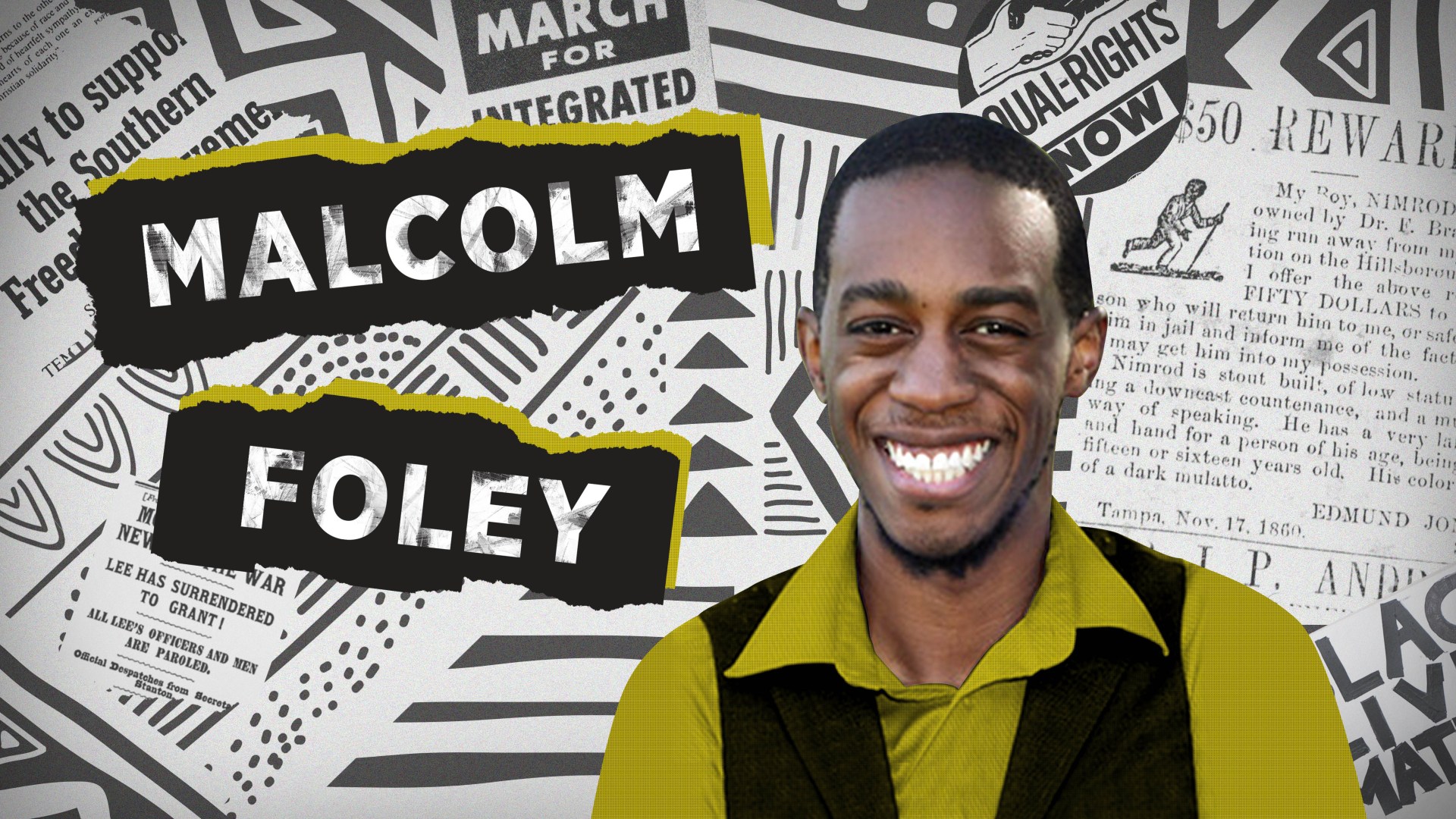
Illustration by Mallory Rentsch / Portrait: Courtesy of Malcolm Foley / Background Images: WikiMedia / Unsplash / New York Public Library

It is often suggested (usually by white brothers and sisters in Christ) that the good news of Jesus Christ drives the Christian to no longer "see color". The stated rationale for this comes from a certain interpretation of Galatians 3:28: We are all one in Christ! Apparently, union with Christ destroys distinctions to the point that those distinctions disappear. If that were the case, the virtue of a Gospel-shaped community would be conformity rather than true unity. Such conformity wrongly sidesteps a robust reckoning with the violent history of race in America.

The Scriptures give us a different understanding of how to address ethnic conciliation: active peacemaking. Malcolm X said that progress is found in healing the knife wound of racism in the backs of Black people. The issue is that while some refuse to pull the knife out, many deny the knife even exists. You must “see color” for true ethnic conciliation and racial healing to happen. To insist on colorblindness ignores the beauty of God's creation and shields one's eyes from the historic subjugation and demeaning of His image-bearers. As a Black man, to see me means to understand that I navigate the world in a different way from my non-Black brothers, sisters and neighbors. Due to the racialization of American society, I must navigate differently to survive. If you are blind to my Blackness, you are blind to me.

Our ethic as Christians is guided not by self-interest and the normalization of our own blinders, but by sympathy and empathy.

Our ethic as Christians is guided not by self-interest and the normalization of our own blinders, but by sympathy and empathy. We must “feel with” one another, as well as “feel in” one another. We place our trust in a Savior who did not pluck us out of our own fallenness in a fallen world, but assumed our human nature, became Jewish flesh, “felt in” that flesh and dwelt among us in a profound and unrepeatable act of covenant faithfulness and divine sympathy. He commands us to love our neighbors as much as we love ourselves.

Do we understand the Gospel we proclaim and obey? Do we follow the Lord in his example? The Bible calls for active peacemaking, which in America essentially includes ethnic conciliation and resistance to white supremacy. Ethnic conciliation has been integral to the Gospel from the beginning. Jews and Gentiles were ethnically distinct, but the gospel neither distinguished nor dissolved the differences but brought together with the differences intact. Neither was compelled to become the other, only to love the other as each loved themselves. Colorblindness resists this. Space permits me a few examples.

In the book of Acts, when Christ ascended, the community of the Way consisted of about 120 Jewish women and men. By the end of the book, the narrative focus shifts to a Jewish man who vigorously persecuted Christians, but who now ministered particularly to Gentiles. How did this happen? The unifying work of the Spirit tangibly manifested in the Church by refusing to ignore or paper over Jew/Gentile differences. The early church was characterized by equity and power-sharing, with the added recognition that perhaps Gentile deacons knew what is best for Gentile widows (Acts 6:1-6). The Jerusalem Council, Paul’s rebuke of Peter in Galatians 2:11-14, and Peter’s visions and interactions with Cornelius in Acts 10 each reveal that ethnic boundaries provided an occasion to experience God’s grace.

The book of Ephesians overflows with Paul’s amazement at this reality. Racial reconciliation in Christ is among the “mysteries” he reveals (Ephesians 3:4-6). In “the mystery of Christ,” ethnic categories find meaning in God who emphatically drained Jew and Gentile of any hierarchical distinction. Affirmed instead are that “Gentiles are fellow heirs, members of the same body, and partakers of the promise in Christ Jesus through the gospel” (Ephesians 3:6). With racial categories of Jew and Gentile stripped of any hierarchical distinction in Christ, how dare we erect categories of race and ethnicity to rebuild walls of hostility! Having created such walls, the onus falls on us to dismantle them. Colorblindness only reinforces the walls.

Brothers and sisters, let us not be blind. Our Savior died, got up, ascended, sent the Holy Spirit, and will come back and we will see clearly. Therefore let us look as clearly as possible now and see one another with all the glories and tragedies of our histories. Advocating for colorblindness, however well-intentioned, not only runs counter to the gospel, but like white supremacy more broadly, exploits the gospel. Energy that could be spent loving our neighbors is spent rationalizing why we won’t love them in particular ways. Love must be manifested in the wise and constant struggle for racial justice, especially once one becomes more aware of the profound levels of injustice our neighbors, brothers and sisters endure. Insofar as we have the personal and systemic influence to alleviate one another’s suffering, we ought to do it.

White supremacy is not merely an ideological threat. It is an existential and bodily threat that snuffs out lives with long, constricting tendrils and sharp, ripping talons. I have argued for racial justice as a Christian imperative. The two most important things for us to do going forward are to repent and repair in order for healing to happen. For those within the body of Christ, judgment must begin with the household of God. May we not be found wanting, but found truly in union with Christ, with His mind and with His heart. When our Savior returns, we will be examined as to whether we fed the hungry, gave drink to the thirsty, welcomed the stranger, clothed the naked, and visited the sick and imprisoned. Our ability to do so includes care for individuals but it is not limited to that. Our capacity to care for the suffering extends much further than giving a meal to the hungry man we meet on the street. It includes battling, in every lawful way, for the lives, well-being, and protection of the marginalized. As our social power increases, so also does our social responsibility.

“Did you feed the hungry?” becomes “Did you, insofar as you were able, reduce the conditions that make hunger the reality for so many?” “Did you visit the prisoner?” becomes “did you consider and resist a system that tends to target racialized minorities for incarceration?” As with all of the Lord’s commandments, whereas it may be comfortable to focus entirely on action, His desire is to reveal and interrogate impact and intention. Sin is personal, communal and cosmic and our resistance to and confession of sin must be as well. After all, it is this Gospel and this comprehensive Savior who separates the sheep from the goats.

Malcolm Foley is Special Advisor to the President for Equity and Campus Engagement, Baylor University and Director, Black Church Studies Program, Truett Seminary.

Ideas

I’ve Experienced This Cultural Moment Before … in Russia

Why America today feels like Russia in the early ’90s and why that’s an opportunity for Christians.

Christianity Today August 7, 2020
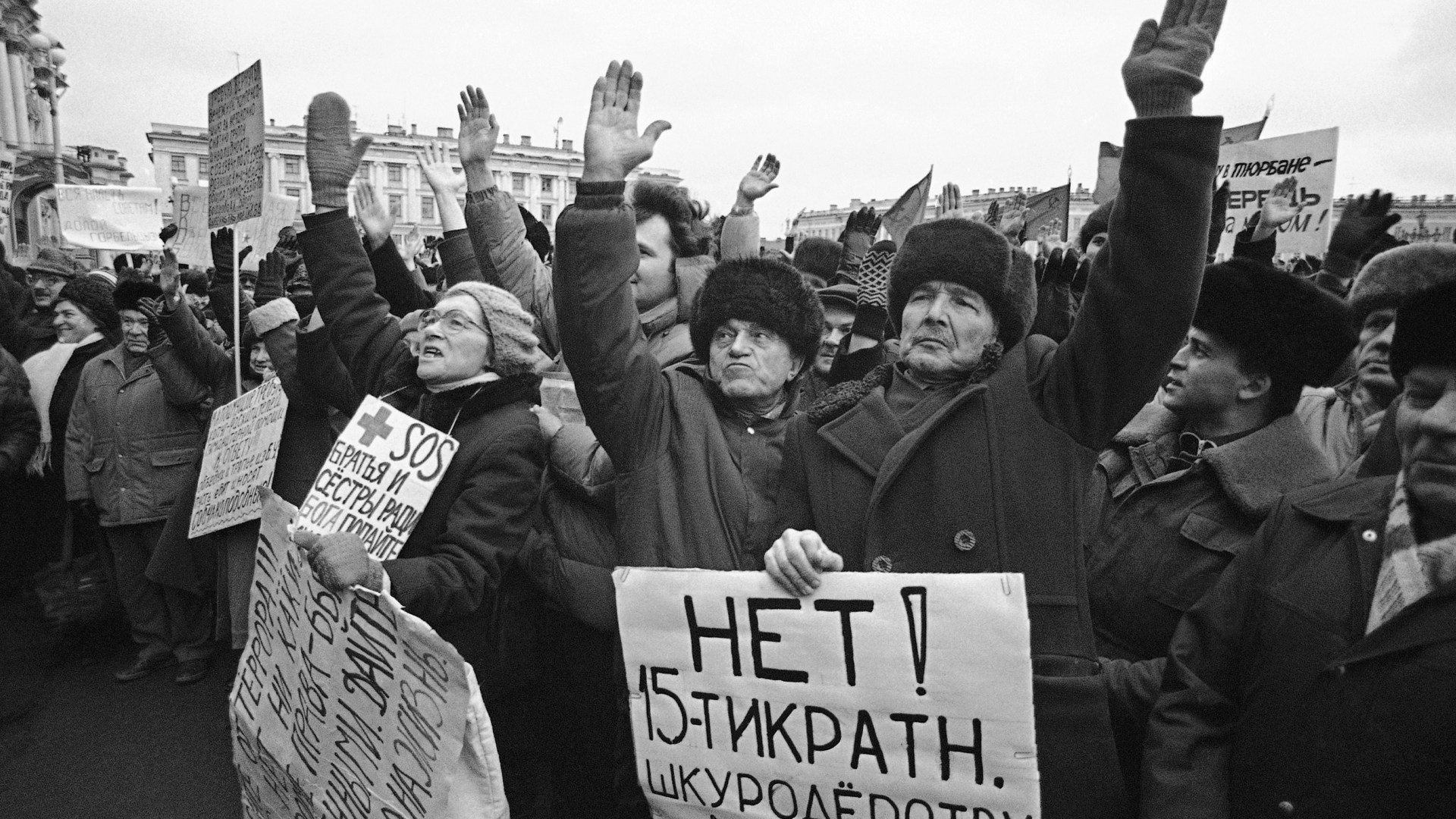
Anatoly Maltsev / AP Images

The country seems to be divided as it has not been for a long time. The grand narrative that has united the country is being vigorously questioned. People cannot agree on basic values. Public discourse has become toxic. Deep divisions run through nearly every public institution. The media have become polarized. You can tell people’s political leanings by the media outlets they draw information from. People on the other side are not simply wrong on some issues, they are bigots, entitled elitists, foreign agents, ivory tower weirdos, or some combination of these. Reasonable discourse with them is not possible, so eventually they have to be shut out of public life.

It is becoming more and more challenging to have a calm, lighthearted conversation about public issues with friends who disagree. Tension is palpably in the air, and sporadic street clashes are beginning to erupt. There are some who call for peace and reconciliation, but their voices are drowned out by those who think that peace and reconciliation with their opponents are impossible. And, to make matters worse, a deadly contagious disease has arrived from another continent.

You may be thinking that I am describing the current state of affairs in the US, but I’m actually describing my experience of living in the Soviet Union during the final years of its existence. Lately, though, my experience of living in the US feels eerily similar.

As a seminary professor, I often wonder how Christians should respond to this situation. But divisions among Christians tend to mirror divides in society at large. Moreover, these divisions have seeped into my classroom, and sometimes they burst into the open. How should I react? Should I steer clear of discussing this subject? If not, what answers should I give? Is one of the sides clearly in the wrong? Questions like these have been on my mind a lot.

Once, I asked William Galston, Brookings Institution Senior Fellow and Wall Street Journal columnist, how seminaries, churches and other religious institutions can serve the society best at the present moment. His answer was “by emphasizing reconciliation.” Galston added that they should model what my former Soviet leaders called peaceful coexistence. Even though I felt ambivalent about the concept at the time, by and large I agree with Galston, primarily because I feel that the polarization that is tearing American society apart is not being taken with the seriousness it requires.

Déjà vu

In March 1985, when Mikhail Gorbachev ascended to power, everyone expected the Soviet Union to be around for a long time. However, I remember vividly the feeling in the air during the mid-1980s; everyone knew changes needed to be made. Gorbachev shared this intuition and encouraged an open discussion. But when that discussion started, the dark sides of Soviet history came to the fore. The media was full of stories about the horrors of Stalin years, and this quickly devolved into the debate of whether the country’s history contained substantial moral flaws to be accounted for.

Some called for dismantling memorials to founding fathers, such as Lenin. The dominant narrative began to be questioned. As a result, the narrative could no longer discharge its unifying function. Subsequently, the societal fissures that were thought long healed resurfaced with vengeance. While riding public transportation, I could tell people’s leanings from the papers they read. There could be no compromise between the right and the left. Gorbachev tried to govern from the center, but the center was left with increasingly shrinking room for maneuvering.

As a result of these developments, the public no longer trusted societal institutions. There was the general sense that country’s elites were corrupt and self-serving. The situation was exacerbated by the arrival of HIV/AIDS. People thought elites were mostly concerned with preservation of their power and privileged access to resources, not with the common good. Populists seized on these sentiments successfully. Eventually these snowballing developments damaged the heretofore dominant narrative beyond repair. Within a few short years, the Soviet Union was gone. Many said good riddance, myself included.

Some of the developments in North America over the past few years echo those I saw in the Soviet Union back then, such as renewed questioning of the grand narrative that unifies the country, the attendant societal polarization, the resurfacing of racial and ethnic tensions, a populist wave, and the contempt for the elites. Seemingly apolitical things, such as wearing masks, have become subjects of heated political debates. How should evangelicals address these developments? What, if anything, can they take away from developments in the Soviet Union more than a quarter of a century ago?

Four Lessons

First, they need to contribute to healing cultural divides. To do so, they should heed Galston’s advice and model to the world diverse communities where reconciliation in Christ is taking place. This will not be easy. As a leadership professor, I believe there is no alternative to modeling as the first step. Unless Christians lead by example, their entreaties will ring hollow. Having fellowships intentionally designed to bring together people with different cultural backgrounds and views could be a viable starting point.

Second, there must be broad societal consensus that the order that emerged is just. The Russian revolution was set back when people saw elderly teachers digging in dumpsters while moneyed mobsters were driving around in expensive cars. To that end, Christians need to present a robust model of justice that, among other things, would provide a meaningful redress to past and current inequities.

The third lesson could be the most encouraging. Christians will do well to remember that a desecularization, even a rapid one, is possible. It happened in Russia a quarter of a century ago, and it can happen in North America today. Being a Christian can become cool again, as it did in Russia of the late 1980s. Thankfully, given North American traditions, desecularization is unlikely to take the form of Christendom 2.0. Nor is it likely to mean a complete return to pre-secularization forms. But it would mean, I hope, renewed interest in Christian spirituality in all walks of life.

Fourth, Christians must balance their undeniable prophetic responsibility with the equally important emphasis on peacemaking and bridging cultural divides. The Scriptures provide ample references. Jesus blesses peacemakers in the Beatitudes (Matt. 5:9); Paul maintains that the kingdom of God is “righteousness, peace and joy in the Holy Spirit” (Rom. 14:17); and James says that “peacemakers who sow in peace reap a harvest of righteousness” (Jam. 3:18). Jeremiah calls his fellow Jews to seek the peace and prosperity of their city, even though that city was in a foreign land (Jer. 29:7). Peacemaking does not need to impede our prophetic ministry. As Martin Luther King Jr. has shown us, prophetic responsibility is best discharged in peaceful, nonviolent ways. Today we need to strive for that fusion of peacemaking and prophecy without losing sight of either.

Andrey Shirin is an associate professor of divinity and director of transformational leadership at John Leland Center for Theological Studies Arlington, Virginia, where he researches and teaches at the intersection of theology, leadership, and public life.

Speaking Out is Christianity Today’s guest opinion column and (unlike an editorial) does not necessarily represent the opinion of the publication.

Editor’s note: You can now read or share this article in Russian as 1 of 200+ CT Global translations.

You can also now follow CT on WhatsApp and Telegram.

News

Jerry Falwell Jr. Takes Leave of Absence from Liberty

The university’s board of trustees met Friday following controversy over a photo circulating on social media.

Christianity Today August 7, 2020
Chip Somodevilla / Getty Images

Jerry Falwell Jr. has agreed to take an indefinite leave of absence from Liberty University, the evangelical school he has led since 2007 as president and chancellor.

The executive committee of Liberty’s board of trustees, of which Falwell is a member, met today and made the decision, according to a statement posted on the university site. The leave is effective immediately.

The announcement did not indicate the reason for Falwell’s leave. In a follow-up statement, board chair Jerry Prevo cited the “substantial pressure” on Falwell’s leadership as well as the “concerns of everyone in the LU community.”

This week, a wave of Liberty alumni and supporters spoke out against Falwell after a recent photo circulated of him posing with a woman at a party with their zippers down and midsections exposed.

The critics included a US Republican congressman, an executive board member of the state Southern Baptist Convention (SBC), and several evangelical pastors. Multiple members of the Liberty community told CT they had been hopeful the criticism would shift the university’s response to the latest controversy and were encouraged by the board’s response.

Marybeth Davis Baggett, who concluded 17 years as a professor at Liberty this spring, told CT she was “surprised and profoundly grateful to hear about the board’s decision.” Baggett didn’t expect the board to recommend leave since Falwell had kept his position despite prior scandals.

“I am relieved for my former colleagues, for their students and parents, and for Liberty’s alumni that there is now an opportunity for the board to install leadership more fitting of the high calling of this great institution,” she said.

A group of African American alumni who previously called for Falwell’s resignation said the board “made the right decision.” Pastors Chris Williamson, Eric Carroll, and Maina Mwaura said they hoped the move would allow for healing for Falwell and for godly leadership for its next season.

Karen Swallow Prior, another former Liberty professor who left earlier this year, likewise extended prayers for the university and the Falwells.

“Liberty University is a Spirit-filled university with many godly professors doing the good work of teaching and discipling young Christians. Any squandering of these talents is grievous, but fortunately we serve a God who, I believe, will continue to bless this school into the future,” she wrote in a statement to CT. “I don’t believe I poured my life into the school for two decades for nothing. I love the Falwell family and will be praying for godly sorrow that brings the repentance that leads to life.”

A current professor, who asked to be unnamed because Liberty faculty do not have tenure, said Falwell’s leave “begs the question, ‘What’s next?’” since the school has not shared plans regarding an interim leader or his potential return.

He celebrated the board’s decision as addressing “a disconnect between what the university has been asking from its students and … hypocritical behavior from leadership.”

The response to the vacation photos had swelled on Twitter on Thursday night, as Rep. Mark Walker of North Carolina, a former pastor who serves as an advisor to Liberty’s music department and spoke at a campus-wide convocation last year, tweeted, “Jerry Falwell Jr’s ongoing behavior is appalling … I’m convinced Falwell should step down.”

Alumnus Colby Garman, pastor of Pillar Church in Virginia and an executive board member with the SBC of Virginia, said the board’s support had been “bewildering” and, “If I posted the photo my church would rightly ask me to resign.”

Dean Inserra, a Southern Baptist pastor in Florida, called on the board to “show some courage.” Mark Davis, a pastor in Texas who also graduated from the university, said he worried Falwell dishonored “the name of Christ and the reputation of Liberty.”

Falwell clarified in an interview with a Lynchburg radio station that the pictures came from a party held on a yacht during his family vacation. He said it was “just in good fun” and apologized for embarrassing the woman in the picture, his wife’s assistant.

During his tenure—succeeding his father and the school’s founder, Jerry Falwell Sr.—the younger Falwell has expanded Liberty into one of the biggest Christian colleges in the world, now reporting an enrollment of over 120,000 students. But his leadership has also drawn controversy, including around his politics—such as his friendship with President Donald Trump—and personal life—like photos of him and his family at a Miami nightclub.

In June, Falwell apologized for a tweet that included an image of the yearbook photo from Virginia Gov. Ralph Northam’s blackface scandal. Dozens of black alumni said he should “withdraw the racist tweet” and resign to focus on politics.

Though he deleted the post, a string of black students and employees left Liberty this summer over concerns with its treatment of racial issues. Trustees had addressed the tweets with Falwell and defended his leadership.

Even before the news of his leave, multiple Liberty professors told CT that the concerns raised by the recent controversy had taken on more urgency and weight than before.

“It feels like more people are speaking up,” one said, “and it’s hot on the heels of his misstep earlier this summer.”

Faculty return to the Lynchburg, Virginia, campus next week, and classes begin August 24.

Four members of Liberty’s board of trustees and Liberty’s spokesperson were contacted by CT Thursday night for comment on the photo and resulting criticism. They did not respond prior to the announcement.

On Friday evening, SBC of Virginia executive director Brian Autry, who is a Liberty trustee but not a part of the executive committee that met with Falwell, tweeted that he was “thankful” for the decision asked followers to “continue to be prayerful in the days ahead for all concerned.”

Ideas

John Ortberg and the Pitfalls of Pastoral Discernment

When we consent to our calling as ministers of the gospel, we assent to be public imitators of all it proclaims.

Christianity Today August 6, 2020
Courtesy of Menlo Church and Google Maps

John Ortberg’s resignation statement as senior pastor of Menlo Church, given all that transpired, provoked more sadness than surprise. I never knew Ortberg personally. Professionally, I appreciated his contributions as a writer and thinker and ministry leader. Many pastors aspire to the kind of reach Ortberg enjoyed, though few of us ever achieve it. This is perhaps its own blessing.

The cause behind Ortberg’s resignation was disconcertingly public. Ortberg allowed his son, who admitted being attracted to children, to serve as a volunteer with children. Social media furiously fluttered, drew hard lines, and lobbed rocks. Some cited 1 Timothy 3 expectations for leaders. The story has it all—family conflict, high profile missteps and miscalculation, obfuscation, and blind loyalties. As Menlo’s motto on its homepage reads, “Nobody’s perfect. Anything’s possible.”

The fierce reactions found fuel from the combustibility of call-out and cancel culture. It’s been painful to read. As a pastor for 35 years with my own laundry list of mistakes, I recall Jesus’ words. “Let any one of you who is without sin be the first to throw a stone” (John 8:7). Nevertheless, actions have consequences. Pastors are sinners to be sure, but when we consent to our calling we assent to a high standard—public obedience atop pedestals and in fishbowls—on display not for show (Matt. 6:1), but as examples to imitate, like it or not (1 Cor. 4:16, 2 Thess. 3:9, Heb. 13:7). High, public standards mean certain failure, an opportunity in itself to exhibit the high calling of humble repentance and recommitment. We do not lower standards for the sake of preserving and performing a fake righteousness. As sinners, we embrace grace as pardon and as incentive. To recall Jesus’ words against stone-throwing, one must likewise recall his words to the sinner caught but no longer condemned: “Go and sin no more” (John 8:11, KJV). In doing so, we aspire to “the whole measure of the fullness of Christ” (Eph. 4:13).

The path to such fullness depends on honest self-suspicion and truth both spoken in love and heeded. Christianity teaches that even our best motives come tinged with self-interest (Jer. 17:9; Rom. 7:15). Called to be shepherds, we choose to lead by going first and somehow showing the path as possible, in both its hardships and joys.

Ortberg acknowledged, “I want to express again my regret for not having served our church with better judgement.” In his final sermon on Sunday, Ortberg confessed his was a “broken story.” It was hard for him and hard to watch but also hard not to imagine church lawyers had a hand in it. In his statement, he wrote, “… I did not balance my responsibilities as a father with my responsibilities as a leader.” I wondered whether the concern should have been more about boundaries than balance. As shepherds of congregations, pastors’ primary responsibility is care for their flock, watching over, serving with love, being an example (1 Pet. 5:2–3). A congregation’s safety and well-being is paramount. Whenever the real strain of ministry on families emerges, it must be focused on and addressed rather than balanced, which sometimes may mean handing over responsibility and leadership to trusted others for a season. This models faithfulness and love.

Given his high profile and ministerial accomplishments, perhaps Ortberg felt he knew best at the time. We do not know of anyone who suffered abuse, but if there are victims, then our compassion should be firstly for them. Perhaps Ortberg sought counsel, but if he did, the counsel was misguided or went unheeded. If the counsel came primarily from loving friends, did their love discount the severity of the danger? Friendly counsel often supplies more support and even rationalization than the confrontation and rebuke that may be required. This is why I think it’s always good to check in with a few detractors. They care less about your feelings and tend to shell out truth with no sugar (another reason to love your enemies—Luke 6:27).

Thinking back on my own spectacular sins, my church leadership would intervene to surround me with loving truth-tellers who shined necessary light onto my oblivious blind spots. We pastors tend to polish our personas to a sparkling sheen and then grow bedazzled with our own reflections. Thinking back to Paul before he was Paul on that road to Damascus (Acts 9:2–8), Jesus’ indictment against him was not against his wickedness as a reverend as much as against his goodness. Self-made and assured, Paul (as Saul) had been a first-rate Pharisee, successful and strong, in need of nobody’s grace. On his way to take down a few heretics, “a light from heaven” stopped Saul in his tracks. This was no spotlight from God for being so faithful, but the blinding, hot light of Jesus on account of Saul’s arrogance. Prestige had been his poison. Success can be prelude to failure. Confidence can sour into arrogance. Jesus exposed Paul’s spiritual deficiency as a spiritual necessity. The grace that saves us first shows us our need for salvation.

Out of this brokenness, finally filled with the Spirit, Paul found his true purpose and power. The Lord always prefers broken pots to porcelain perfection (2 Cor. 4:7). “We always carry in our body the death of Jesus,” Paul learned and applied, “so that the life of Jesus may also be revealed in our body” (2 Cor. 4:10; Rom. 6:10-11). And this too for people to see, “to show that this all-surpassing power is from God and not from us” (2 Cor. 4:7).

Even in pieces, we are not cursed or unlovable or worthless. On the contrary, in Christ, to be broken is to be ripe for redemption by a crucified Savior whose body was broken for us. Ortberg said he doesn’t know what happens next or yet what he’s learned—except that his story is broken. The late Catholic mystic Henri Nouwen went so far as to equate being broken with being blessed. “In a strange way,” he wrote, “the spiritual life isn’t ‘useful’ or ‘successful.’ But it is meant to be fruitful. And fruitfulness comes out of brokenness.”

Daniel Harrell is Christianity Today’s editor in chief.

Apple PodcastsDown ArrowDown ArrowDown Arrowarrow_left_altLeft ArrowLeft ArrowRight ArrowRight ArrowRight Arrowarrow_up_altUp ArrowUp ArrowAvailable at Amazoncaret-downCloseCloseEmailEmailExpandExpandExternalExternalFacebookfacebook-squareGiftGiftGooglegoogleGoogle KeephamburgerInstagraminstagram-squareLinkLinklinkedin-squareListenListenListenChristianity TodayCT Creative Studio Logologo_orgMegaphoneMenuMenupausePinterestPlayPlayPocketPodcastRSSRSSSaveSaveSaveSearchSearchsearchSpotifyStitcherTelegramTable of ContentsTable of Contentstwitter-squareWhatsAppXYouTubeYouTube