Ideas

The Old Testament Calls Out Cancel Culture

Staff Editor

The Bible features flawed characters called to do the will of the Lord.

Christianity Today August 6, 2020
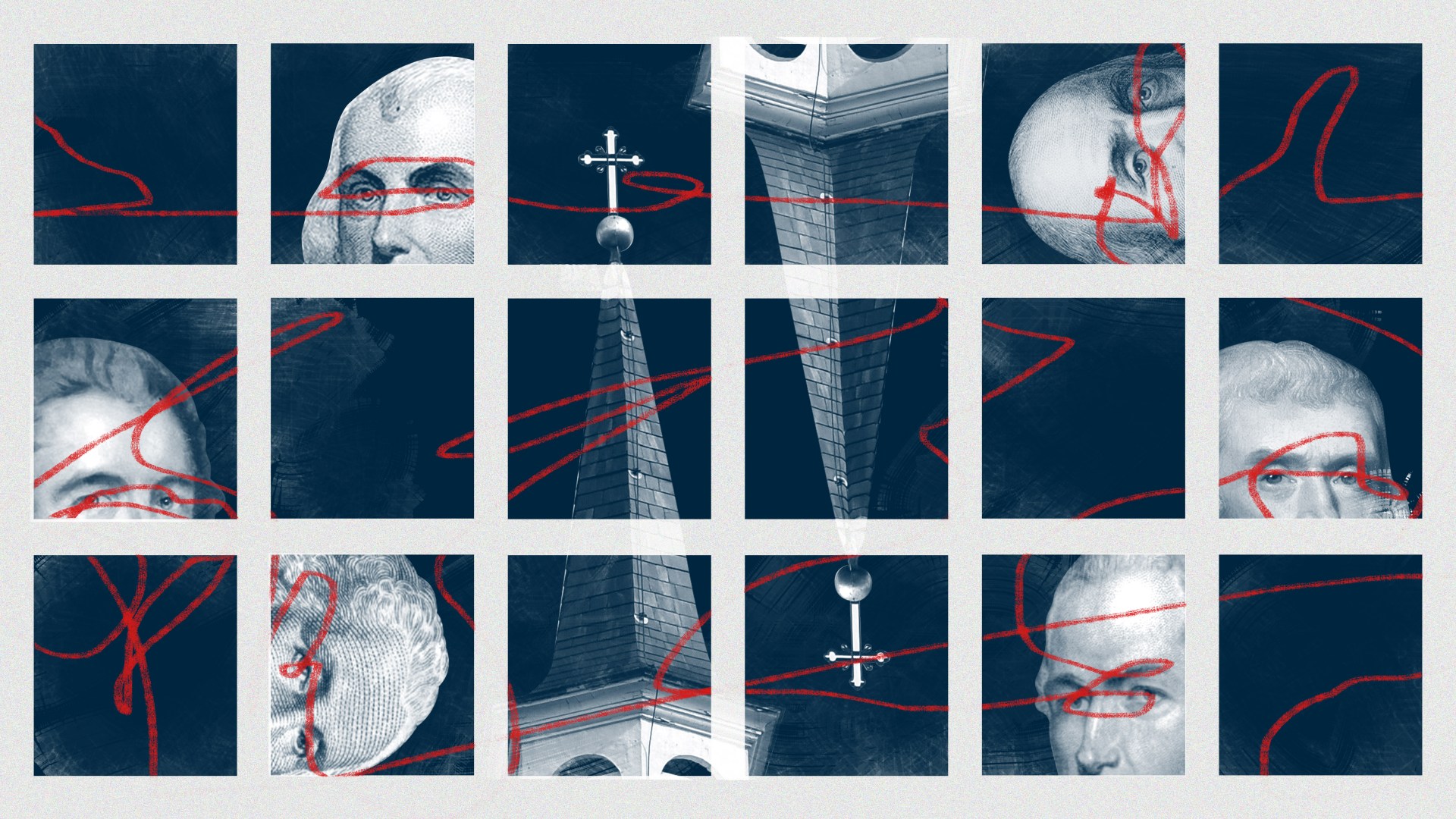
Illustration by Mallory Rentsch / Source Images: WikiMedia Commons

Marcionism is a heresy, but I understand why Marcion did it.

Disgusted with the evil that plagues our world and struggling with confounding portrayals of God in Scripture, the second-century theologian sliced up the Bible to his liking by excluding all the Old Testament and even some of the New. I can’t follow Marcion in his editing project, but I certainly get the tension that prompted it: The Old Testament is a difficult book full of difficult stories and difficult people. In many ways, it would be easier to safely scuttle its strange and grim passages out of the canon.

I suspect Marcion’s end product possessed a clarity the unabridged version frankly lacks. But I also suspect it would leave Christians far less equipped to grapple with the moral ambiguity we cannot edit out of our society’s past—or its present.

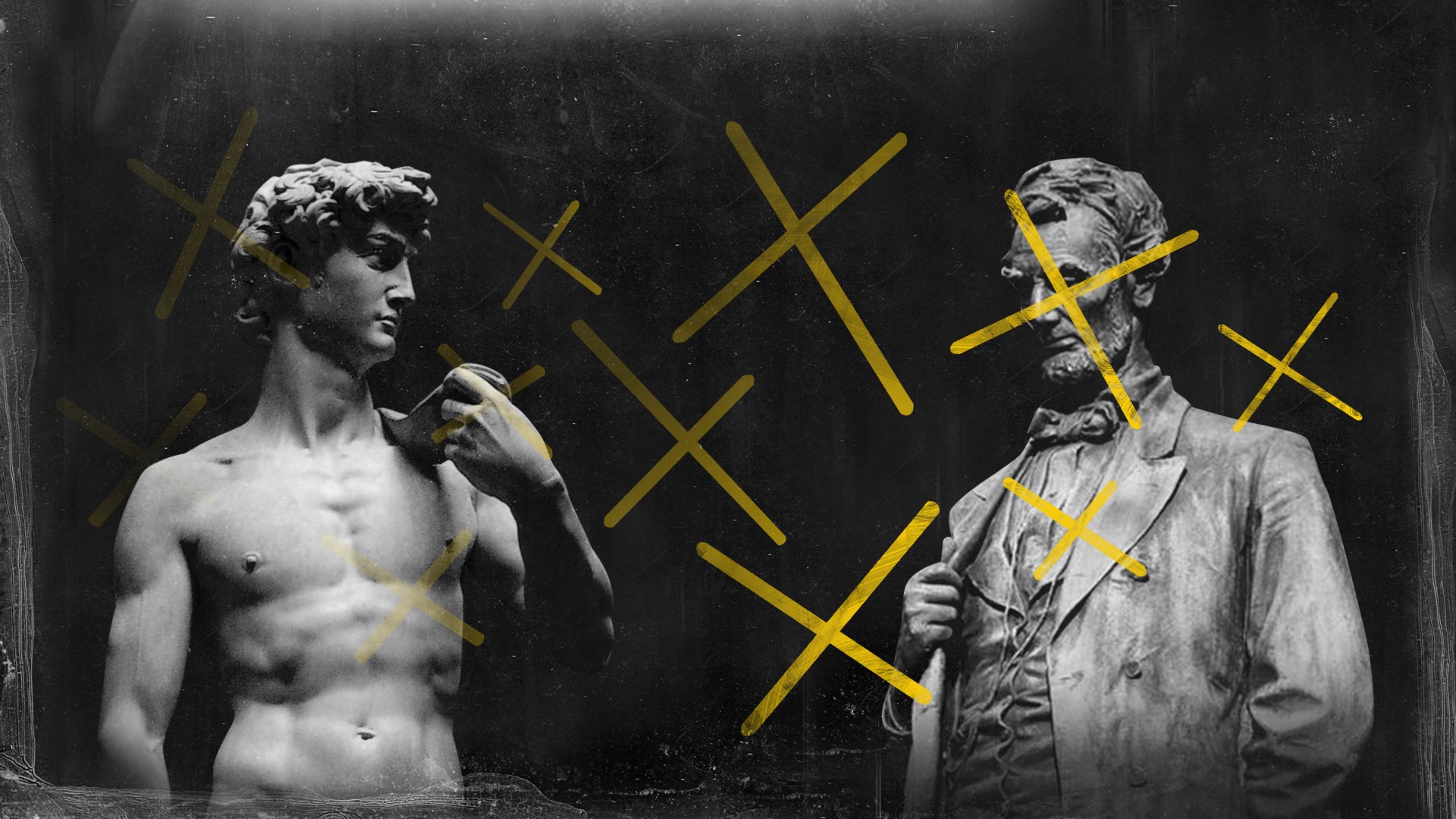
This has been a summer of iconoclasm. Protests sparked by the killing of George Floyd by Minneapolis police officers have picked up the purgatorial impulse of previous demonstrations against police brutality and racial inequality. Protestors demanded the removal of—or, in many cases, simply vandalized—Confederate statues and flags. Then the scrutiny broadened. A mere three years ago, President Donald Trump was roundly mocked for his musing that progressive iconoclasts eventually would come after George Washington or Thomas Jefferson. This year they did exactly that. Monuments of other historical figures (including Abraham Lincoln, Teddy Roosevelt, and Ulysses S. Grant) were torn down, voted down, or became the subject of contentious debates.

What do we make of someone like Thomas Jefferson? Should he be honored or deplored?

These conflicts are not easy to resolve. What do we make of someone like Jefferson? Should he be honored or deplored? He wrote about the inherent rights of all humanity in words that have inspired movements for freedom the world over—but at the same time he enslaved hundreds and raped Sally Hemings, impregnating her when she was about 15.

Jefferson condemned slavery but did not act to end it, even rejecting, as columnist Noah Millman describes, “a large bequest from his old friend, the Polish nobleman and Revolutionary War hero Thaddeus Kosciusko, intended for the purchase of slaves to give them their freedom, along with land, livestock, and farm equipment to enable them to live the life of yeoman independence that Jefferson claimed to favor over all others.” And yet, for all that, abolitionist Frederick Douglass deemed Jefferson’s Declaration of Independence “the ring-bolt to the chain of [our] nation’s destiny,” a document of “saving principles” to which we should be true “on all occasions, in all places, against all foes, and at whatever cost.”

There is a pleasing ethical simplicity in the idea of taking Marcion’s sharp knife to historical figures like Jefferson (who was, funnily enough, something of a Marcionite himself). Toss him entirely on account of his grossest sins, or paper them over with his wonderful words? We dare not settle for less than ideological purity. A flawless hero is the most comfortable kind.

Christians can do better. The Old Testament has trained us for it. If Jefferson is the archetypal difficult figure of American history, his biblical analogue is surely King David: the passionate and poetic psalmist who raped Bathsheba. What do we make of someone like David? There’s no option here to keep the words and dispense with the man, because the man is all over the Bible. Again and again the Gospels reiterate that Jesus is the “son of David” long awaited, born in David’s village and destined to sit on David’s throne. David appears in the Apostle Paul’s great argument on justification in Romans, and he makes the Hebrews 11 roster of (very flawed) heroes of the faith. In Revelation 22:16, Jesus confirms his testimony with a self-description as “the root and the descendant of David, the bright morning star.” To take a high view of Scripture forces us to confront the moral complexity of David along with so many other scriptural characters, neither tossing them for their sins nor papering over those sins with their faithful achievements. Such confrontation serves as practice for similar discernment of more recent history.

Moreover, we are not the first Christians to contend with complicated people, stories, and ideas. The early church dealt with this often. Many of the first Christian apologists employed the religion and philosophy of the surrounding pagan culture to help make sense of the new Christian faith. Paul’s sermon on Mars Hill in Acts 17 referenced Athenian monuments he wouldn’t otherwise honor and incorporated insights of Greek poets whose whole body of thought he wouldn’t otherwise endorse. Similarly, Augustine advised Christians to “claim … for our own use” whatever we find “that is true and in harmony with our faith,” wherever we find it. “All truth is God’s truth,” the Augustinian logic affirms. We can examine our national history with a similar eye: critical and distant on the one hand, but also receptive to whatever goodness and truth we find on the other.

Finally, basic Christian anthropology prepares us for dealing with historical tension, too. “The culture warriors want to avoid … cognitive dissonance by seeing the [American] Founders as flawless saints or irredeemable sinners,” former CT editor Skye Jethani recently wrote. “They were neither,” he continued, which we ought to know well. The first two things the Christian story says about humanity (Gen. 1–3) is that we are made in God’s image and we are subject to the Fall. We are created for good but, without Christ, we are captive to evil (Rom. 6:17–23). Any understanding of human beings with this beginning will not be shocked to find real good and great evil in the same life, as indeed we find both in our own hearts (Rom. 7:19).

Bonnie Kristian is a columnist at Christianity Today, a contributing editor at The Week, a fellow at Defense Priorities, and the author of A Flexible Faith: Rethinking What It Means to Follow Jesus Today (Hachette).

News

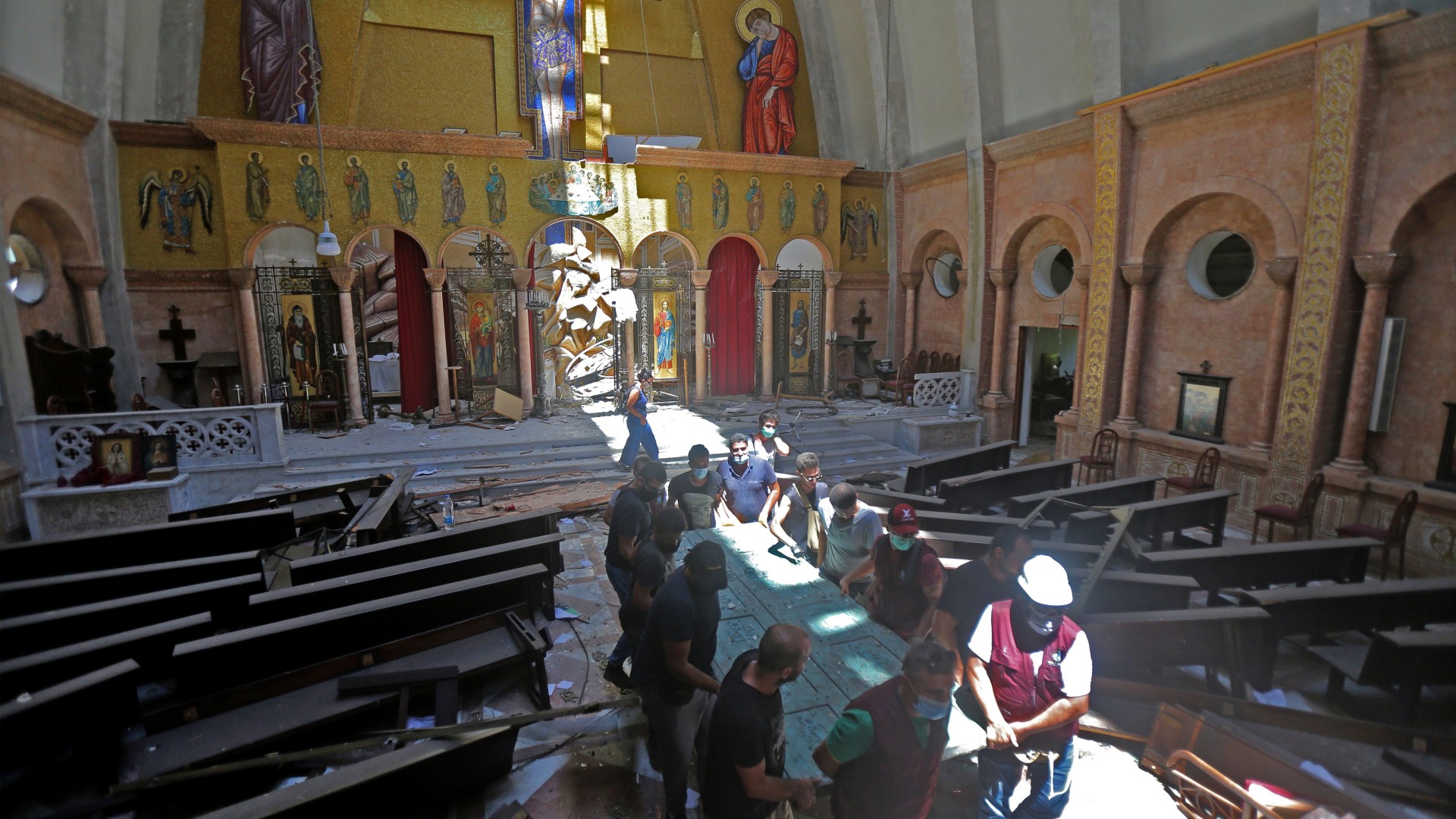
16 Beirut Ministries Respond to Lebanon Explosion

(UPDATED) Evangelical leaders describe the damage, how Christians are helping, and the need for a hope beyond politics.

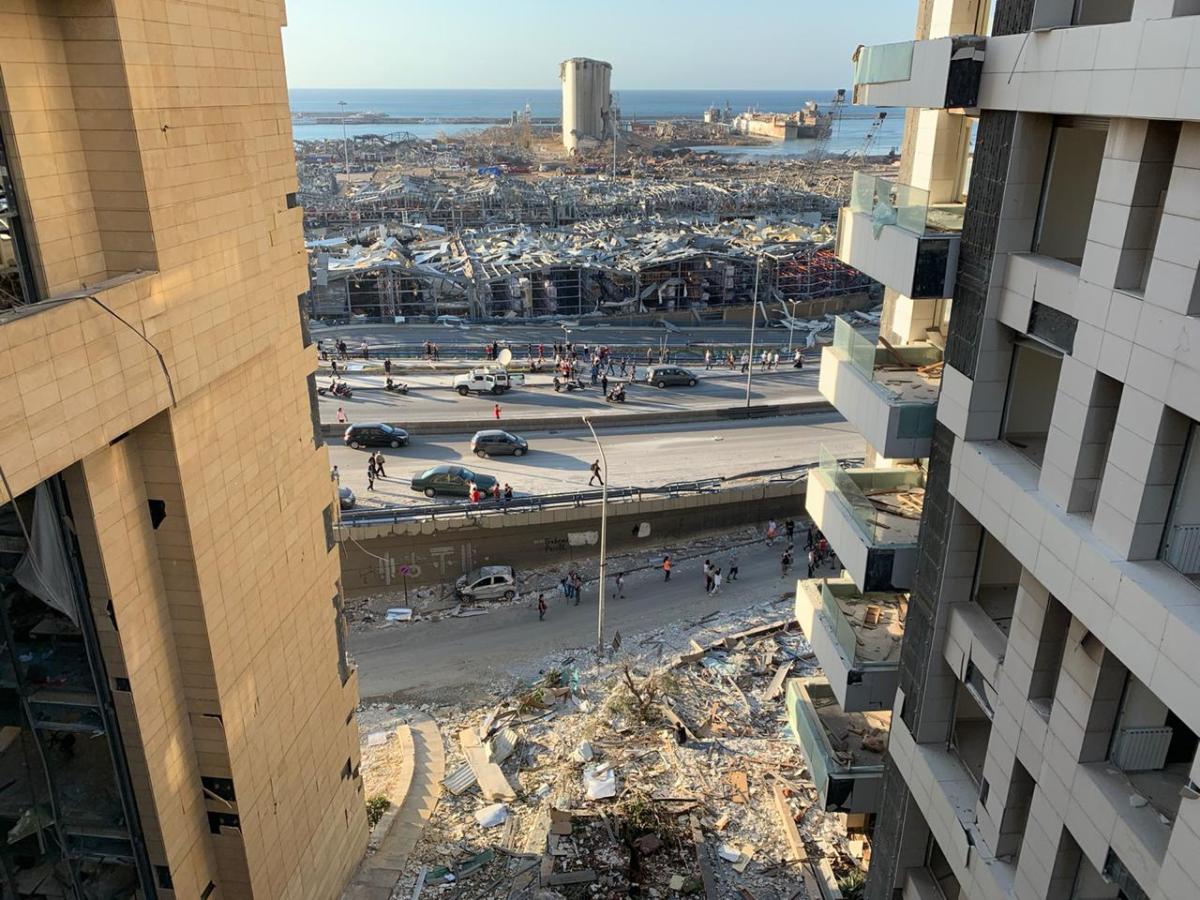
Smoke rises above wrecked buildings at Beirut's port, devastated by an explosion a day earlier, on August 5 in Lebanon's capital.

Smoke rises above wrecked buildings at Beirut's port, devastated by an explosion a day earlier, on August 5 in Lebanon's capital.

Christianity Today August 5, 2020
Marwan Tahtah / Getty Images

[Updated with details from more ministries and links to their emergency response efforts]

One hour later at work, and Sarah Chetti might have been one of thousands in a Beirut hospital.

Director of the INSAAF migrant worker ministry in Lebanon, Chetti’s colleagues described shards of broken glass flying through the air, and the metal frames of doors ripped from their hinges.

It was a similar experience for the one staff member inside the Youth for Christ youth center not far from the blast. To avoid the “colossal damage,” he ducked to the floor. Re-welding was necessary just to lock up the next day.

Peter Ford was fortunate. Working quietly in his faculty office at the Near East School of Theology near downtown Beirut, the first small reverberations stirred his curiosity to investigate the problem.

Moments later, the huge blast blew in his window and spewed the glass across his desk.

Miraculously, the dozen evangelical churches and ministries in Lebanon contacted by CT reported no deaths and few serious injuries caused by the massive explosion. The official national tally is now over 100 dead, with over 5,000 injured.

If they had, there would be nowhere for the bodies to go.

Habib Badr of the historic National Evangelical Church was forced to conduct the burial of two elderly members (whose deaths were unrelated to the explosion) as Beirut’s hospitals and morgues were all full.

Two Filipinos, however, were killed in the blast. And amid the ongoing economic suffering of Lebanon, several migrant domestic workers have been abandoned by families no longer able to pay for their services.

“They are distraught, worried, and scared,” said Chetti. “Problems are piling up one after the other. I’m reaching out to each one individually and praying for them, assuring them things will be okay.”

But migrants are not the only foreigners who are suffering.

“Many of our youth are Syrian refugees, so this is churning up all that stuff for them,” said Scot Keranen, director of operations for Youth for Christ. “We’re just checking in on them, and that is really tough right now.”

Lebanese trauma goes further back in history. But this explosion was incomparable.

St. Anthony of Padova Maronite ChurchP. Clarkson
St. Anthony of Padova Maronite Church

“Throughout the whole civil war [1975–1990], we never experienced anything like this blast,” said Tony Skaff, pastor of Badaro Baptist Church in Beirut.

“But this incident made us remember, triggering many very sad memories within our community.”

His members suffered only minor injuries, though the church itself has much exterior damage. The tragedy is bringing everyone closer together to jump at the chance to help, he said.

Though charity efforts are underway, it is not their primary currency.

“More than anything else, the Lebanese people need hope,” said Skaff. “They lost it in their politicians, in the health situation, in everything.

“The church has the calling to answer this need, by standing firm and continuing its ministry.”

Many evangelical ministries are answering this challenge.

Aftermath of Beirut explosionP. Clarkson
Aftermath of Beirut explosion

Arab Baptist Theological Seminary (ABTS), located in the mountains overlooking Beirut, was spared the worst of the emanating shockwaves. Having lost its students due to COVID-19, it had already opened its dormitories to frontline health workers.

Now, in cooperation with the “Our Home, Your Home” ministry, the seminary is welcoming a fraction of the 300,000 Lebanese displaced from their homes.

“It’s terrible, horrible. We won’t have empty rooms when there are people on the streets,” said Elie Haddad, president of ABTS.

“At least it is something, and I’m not sure what else we can do.”

Resurrection Church of Beirut had many member families suffer damage to their homes. So it has organized a furniture drive, and sent volunteers downtown to clean up the mess—for their community, and others.

“Now is the time for the wounded church to rise again,” said pastor Hikmat Kashouh, “and be a healing agent of God’s restoring presence in a practical and caring way.”

But it is not the only way. Andrew Salame, district superintendent for the Nazarene Church in Lebanon, picked up the phone.

“We are devastated and angry with the government because of what happened,” he said. “I reached out to our [Protestant] member of parliament to get an answer from those in authority.

“And I asked him to resign his position, and stand with the people.”

Located one mile from an epicenter that would comparably include all five boroughs of New York City, Salame’s Beirut church suffered more damage than others.

He described a “night of horror,” with his whole house shaking and his son momentarily missing. He eventually located him with the neighbors, unhurt.

Jean Moussa attends the Evangelical Free church, which escaped mostly unhurt. He thanked God for their protection.

But he also put questions to the government, which stated the 2,750 tons of explosive material had been stored at the port since 2013.

“Who permitted this boat to make a delivery of so much ammonium nitrate?” asked the coordinator for evangelical church outreach of the Lebanese Forces political party. “How could anyone comprehend it would be left in a civilian area for so long?”

Aftermath of Beirut explosionP. Clarkson
Aftermath of Beirut explosion

Lebanon’s Christians, however, are not united over the source of national danger. In a nation roughly divided into thirds between Christians, Sunni Muslims, and Shiite Muslims, their community is given the national presidency. (Egypt’s Coptic Christians, by comparison, compose only about 10 percent of its population.)

Ralph Zarazir, the representative of the Free Patriotic Movement to the national dental board, puts questions to the West.

So far, all aid has been conditional upon economic, and—perhaps less formally stated—political reform.

“Despite the presence of certain groups disliked by the West, we are a country with the biggest percentage of Christians in the Middle East, and a large evangelical community,” he said.

“We have something special. But when we get squeezed, the Christians are the first to leave.”

This is not a good strategy, Zarazir added, though he is not sure the West cares at all. He hopes the explosion will result in Western countries helping Lebanon get back on its feet.

Whether or not other governments do, Lebanese evangelicals can only trust that God will—at least in their individual lives.

“We pray for those who lost loved ones,” said Raymond Abou Mekhael, pastor of Christ Bible Baptist Church in Keserwan, undamaged and far from the site of the explosion.

“We ask the Lord to use these circumstances to bring people back to the word of God, to seek his will in their lives.”

As for the nation, like for Lebanese in general, it is a moment of collective despair.

“We have hit rock bottom as a country. Other things could go wrong, but the worst-case scenario cannot be any worse than this one,” said Charlie Costa, pastor of Ras Beirut Baptist Church.

“Is there any glimmer of hope? Only that God is sovereign.”

UPDATE (August 6):

A few evangelical ministries responded after publication, sometimes with apologies that they were overwhelmed yesterday.

Lighthouse Arab World is temporarily shifting its media ministry to facilitate help to those on the street. Near East Organization was able to feed 250 people yesterday, aiming to continue this service for at least three weeks.

And some had to attend to personal difficulties.

Joseph Nejm, pastor of the Free Evangelical Church of Beirut, needed to take care of his mother. She suffered a brain hemorrhage and broken hands in the blast.

Camille Melki’s mother, meanwhile, played the piano as volunteers cleaned up the debris in her family home. The video went viral within Lebanon.

“It is a symbol of our resilience,” said Melki, “and our hope in Christ.”

Melki heads Heart for Lebanon, which began serving Lebanese displaced by the Israeli invasion in 2006, and now ministers to Syrian refugees.

Their 60 volunteers have split into 5 teams to secure homes and clear broken glass.

“It’s a mess. It’s a total mess,” he said. “But they have to be made safe to be lived in again.”

One church must be rebuilt to be made safe at all.

City Bible Church was the closest congregation to the blast, only a quarter mile away. In a video, pastor Marwan Abou-Zelouf showed the massive structural damage to his church which had been built by the community’s own hands.

“The people here feel forgotten,” he told The Gospel Coalition. “They feel cursed because Lebanon in recent months has been ravaged. It seems unimaginable that something like this could happen right now.

“[But] Beirut’s greatest hope isn’t a stable economy or honest politicians, but blood-bought believers who carry with them the hope and power of the gospel. So, we’re praying and trusting that the church of Jesus Christ in Lebanon will be a shining light amid all the darkness and destruction.”

Damage was also suffered by the Beirut Baptist School and the Gateway Bookshop.

“We as Lebanese people find ourselves in a prison with walls made of economic crisis, COVID outcomes, and explosion disaster,” Lina Raad, a vice president for the Baptist World Alliance, told Word&Way.

“The only way that can help us is prayers from the Earth to get rains of mercy from above.”

The walls of this prison may not hold back Christians from emigration.

Julie Tegho told CBN she thought she would die as the building shook and glass broke all around her.

“This is what death looks like,” the Philos Project researcher recalled thinking. “For many Christians who were thinking about leaving, yesterday’s explosion may be the reason they were waiting for.”

But for now, with the airport operating at limited capacity, few will be able to migrate. In the meantime, Horizons International is providing free food and medical aid as well as plastic sheeting to cover broken windows.

“We pray that before the rainy and cold winter comes people can find better solutions, but plastic will have to do for now,” said executive director Pierre Housney.

“Our hearts are very heavy with a considerable amount of survivor’s guilt. But we are pushing past it to do our best to help.”

Andrew Salame clarified that his message to the Protestant member of parliament, Edgar Traboulsi, was sent in electronic discussion with other evangelical church leaders. While respecting the help he offers in defense of evangelical pastors, Salame did not wish Traboulsi’s good name tainted by continuing in office with the political class.

But Traboulsi, also the pastor of the Lebanon Baptist Church in the mountainous Metn region overlooking Beirut, views his political role as part of his spiritual responsibility.

“I am not the type of pastor who will abandon my role and be unfaithful to my calling, during a time of calamity and need,” he said.

“My constituency is my flock, as much as my congregation.”

And in times of calamity, even the wounded must keep serving. Abbas Sibai, multi-area projects coordinator with World Vision Lebanon, crawled under the fallen wall that had smashed against his back in the blast. It was all he could do to shield from the falling debris.

Eventually he staggered into the emergency room, surprised at each step how terrible the situation was becoming.

“I suffered so much less than others, it makes me feel guilty,” said Sibai, who was hospitalized for his injuries. “Especially in that I can’t help others, and have no idea what to do next.”

He is trying. World Vision is putting together a fundraising campaign for food, medicine, and housing supplies, as its Beirut warehouse was severely damaged in the explosion. Sibai hasn’t slept well for the past two nights, but is pitching in as he can.

Just like his mother. A chief X-ray technician, she is back working in the hospital despite being injured herself.

“I always told my colleagues: We have chosen this track in life, so we are doomed to be hopeful,” Sibai told CT.

“That doesn’t sound right. But in the ministry sector we have to support others, no matter how much we are suffering ourselves.”

In an earlier CT interview, Joseph Kassab, president of the Supreme Council of the Evangelical Community in Syria and Lebanon, described the work of the Compassion Protestant Society.

Her Pandemic Prayers Went Viral

Jen Pollock Michel’s call to the church to cry out to God during COVID-19 has traveled around the world.

Her Pandemic Prayers Went Viral
Photo Courtesy of Jen Pollock Michel

Jen Pollock Michel wrote “20 Prayers to Pray During This Pandemic” for Christianity Today in March, while being quarantined for two weeks at her home in Toronto, Ontario.

“I felt powerless in the first weeks of the pandemic,” she said. “All of a sudden we’re all at home. It was a moment of testing. It’s easy to face doubts and wonder if prayer goes any further than the ceiling.”

The piece came after friends in a WhatsApp group began sharing prayer requests in the chat.

“I thought, ‘I’m a writer. I could share these,’” she said.

The article was in Google’s top search results for “prayers for coronavirus” or variations of that phrase for months. Through July, it’s been read by 850,000 people and has been published in eight languages including Spanish, Portuguese, French, Traditional and Simplified Chinese, Korean, Italian, and Indonesian.

Churches from diverse theological backgrounds have reposted the article on their websites including St. Louis de Montfort Parish, a Roman Catholic parish in California, Life Fellowship Church, a non-denominational church in Texas, and the Village Presbyterian Church in Illinois, to name a few.

“Efharisto (Greek)/thank you for seeking Divine intervention as a source of hope in COVID fallout relief!” wrote one Greek Orthodox Church reader. “May our mighty God grant us all His mercy!”

CT Senior Associate Editor Andrea Palpant Dilley said, “In this piece, Jen Pollock Michel gives us words to pray with and also categories of people to pray for—let’s pray for doctors and nurses, let’s pray for missionaries, let’s pray for the homeless. In a time of uncertainty and isolation, readers (including me) feel joined together through these prayers.”

After the success of her first piece, Pollock Michel also published “20 More Prayers to Pray as We Approach the Pandemic’s Peak” in April.

“Under normal conditions, there would be meals to make and hospital visits to pay,” she said. “But these are not normal days.”

During the pandemic, Pollock Michel and her family have worshiped with their Presbyterian church online. She doesn’t expect to return before September.

“We have a narrow entrance to our building, a historic 1876 church. It doesn’t allow for distancing. Leadership is going to have to get very creative,” she said.

She started writing for the Hermeneutics blog at CT in 2012. Soon after, she met Katelyn Beaty, CT’s former print managing editor, for breakfast. To this day, Michel says this was an important moment in writing career.

“I wasn’t always a person who read the headlines. Writing for Hermeneutics was a really important part of forming my faith—thinking carefully about how faith would interpret the news of the day,” she said.

Beyond writing articles, Pollock Michel is also the author of Surprised by Paradox: The Promise of “And” in an Either-Or World, which won an Award of Merit for the Beautiful Orthodoxy Book of the Year in 2020, Keeping Place: Reflections on the Meaning of Home, and Teach Us to Want, CT’s 2015 Book of the Year.

“I really believe in the mission of CT. CT covers subjects that are cultural, political, and social—all through a biblical lens,” she said. “Churches don’t always delve into that. You don’t always find a perspective that’s both informed and moderate.”

Pollock Michel’s editors at CT have felt equally blessed by her perspectives.

“Jen puts obvious care and concern into everything she writes. Few Christian writers can match the grace and beauty of her prose,’ said CT Books Editor Matt Reynolds. “It’s equally clear, however, that Jen labors over matters of style not to exalt herself as a wordsmith, but to communicate the grace and beauty at the heart of our gospel.”

Pollock Michel’s COVID-19 prayer habits are waking up at 5 a.m., writing in her journal at her desk, and reading from a One Year Bible which has passages from the Old Testament, New Testament, Psalms, and Proverbs.

“I’m reminded of the Benedictine practice of stability, this staying put which forces us to be content despite our appetite for change. We like change because it’s easier than dealing with the reality of our lives sometimes. Being home is good. It means contending with reality, not evading it,” she said.

Her and her son memorized a portion of Psalm 119 during the shutdown. She pointed out how the Psalms invite Christians into an honest conversation with God about our emotions and faith.

“On the days I struggled to rally any kind of emotion, I just kept praying the prayers.”

Kelsey Collister is digital marketing associate at Christianity Today.

News

Lebanon Was Already in Turmoil. Then Came the Blast.

An evangelical Christian leader’s grief over a divided—and now devastated—country.

Christianity Today August 5, 2020
MAHMOUD ZAYYAT / Getty Images

The massive explosion that rocked Beirut on Monday evening has left dozens dead, hundreds injured, and more than 300,000 displaced from their homes.

Millions around the world watched in horror as the detonation of 2,750 tons of confiscated ammonium nitrate laid waste to the Mediterranean port and surrounding neighborhoods. The equivalent of a 3.3-magnitude earthquake was felt deep into the coastal mountains of Lebanon and as far away as Cyprus.

The images of destruction reminded many of the small Middle Eastern nation’s 15-year civil war that lasted from 1975 to 1990.

In addition to interviewing leaders from 12 evangelical ministries in Beirut, Christianity Today also spoke with Joseph Kassab, president of the Supreme Council of the Evangelical Community in Syria and Lebanon. Based in Beirut but born in Aleppo, Syria, Kassab reflected on the damage suffered in Christian neighborhoods, early efforts to assist the suffering, and hope for what this tragedy might produce in the Lebanese church.

These are very difficult days in Lebanon. What happened, and how bad is it?

It is very bad. I’ve been in Lebanon since 1984, experiencing the civil war. This is the first time that one single explosion caused such damage. People were terrified.

Until now, there is no agreement on the explanation, with many speaking according to their political point of view. Some say it was an electrical problem. Some say it was arson. Others assure that they heard jet fighters. We have to wait, hoping that the coming days will provide an answer.

Joseph Kassab

This explosion destroyed so much of Beirut, across sectarian lines. What is the impact on the Christian community?

The areas nearest the port in East Beirut are primarily Christian neighborhoods, and generally poorer than others. But even we here in the mountains suffered broken windows.

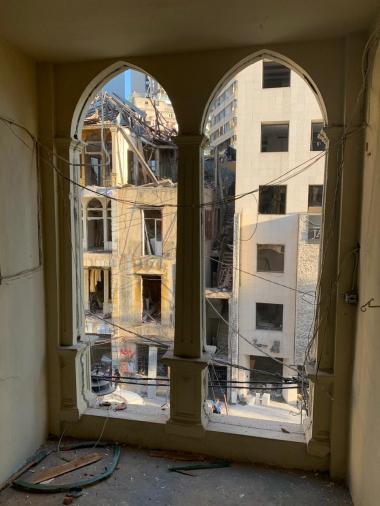
One of the worst affected was Jesus Light of the World church in the Qarantina neighborhood, affiliated with the Christian Alliance denomination. But similar was the downtown All Saints Anglican church. And the historic National Evangelical Church had all its stained-glass windows blown out. The pastor was startled by the first vibration, and then the second explosion sent shards down right where he had been standing.

But everyone is affected. Catholics, Orthodox, and as you move a little further away you see the damage in Muslim neighborhoods also.

How difficult will it be to clean up and rebuild?

My niece’s family came and stayed with us because her apartment is a mess. You cannot imagine what happened. Her cupboards fell on top of her as she protected her two-year-old.

There are up to 100 casualties, and I expect more. There are over 3,000 injured. It is a disaster for a small country like Lebanon.

How could such explosive material be kept in the port, stored for the past six years, close to civilian areas and vital sectors of the government? We lost the port, and this is the sector we need most in this time of economic collapse. It is a chronic situation of corruption, mismanagement, and selfish interests.

Lebanese people deserve better leaders. Even the leaders know this.

Back in October, they admitted the country was almost bankrupt; but since then, the situation has only gotten worse. Inflation has risen 85 percent. The government is running out of hard currency in the central bank. And ordinary citizens are denied access to the dollars they have in their personal accounts.

Already many people have lost their jobs, and those still working only receive half their salary. And this morning they woke up having to repair their homes. Where will they get the money from?

We are a bankrupt country, becoming a failed state.

How can American Christians help in this time of need?

We need money for repairing houses, medical care, and food baskets.

The Compassion Protestant Society of the Presbyterian synod is helping the most affected families reinstall their windows. The costs of replacement is now twice the true minimum monthly wage. And it must be paid in cash dollars, which almost no one has.

So many people are displaced from their homes.

The explosion also destroyed essential goods at the port, like our wheat supply. Every day we will be hearing about new shortages.

There is no one organization for all evangelicals, and every church has its own programs. Everyone can give through the denomination they belong to.

We are also suffering in education, and ask our evangelical friends to support the institutions of the Protestant community. This is part of our identity and mission; we need to keep the level high.

The Fellowship of Evangelical Schools in Lebanon is under the umbrella of our Supreme Council. It will form a delegation to ask for help from the US and British embassies, just as the French foreign minister promised assistance for the Catholic schools.

But we want to raise the awareness of our brothers and sisters in the West and especially in the United States. We have a common history and a common mission, started 200 years ago. Do you still care? We are continuing what your ancestors started, and this is our shared spiritual heritage.

Do you have hope for the future? What are your fears?

The most important thing is for Lebanon to have peace with itself. We do not want conflicting political views to lead to clashes or a new civil war, as we see now in Syria. Whatever is external, we can deal with it. But internal conflict will devastate the country.

For the church, we are afraid of a coming train of migration. But this is an opportunity to sharpen our calling and live our ministry. We have to help people with their needs and lessen the damages suffered by the Christian community.

In the midst of such pain, we need to become a better church. We are not called to sit in the pews, but to witness for Christ and work for the kingdom of God.

Books
Review

An Attack on Faith-Based Exemptions Is an Attack on the Founders’ Vision

A historian’s “intentionally provocative” account of religious liberty in America leaves too little room for claims of conscientious dissent.

Christianity Today August 5, 2020
Illustration by Mallory Rentsch / Source Images: WikiMedia Commons / Pixabay / Pexels

American religious-liberty watchers are likely familiar with the case of Barronelle Stutzman. A grandmother from Washington State, Stutzman has worked as a florist for most of her professional life. For more than nine years, she willingly served Robert Ingersoll and his same-sex partner. She created numerous floral arrangements to help them celebrate anniversaries, birthdays, and other special events.

Beyond Belief, Beyond Conscience: The Radical Significance of the Free Exercise of Religion (Inalienable Rights)

In 2012, an employee told Stutzman that Ingersoll was going to ask her to provide flowers for his wedding ceremony. She talked it over with her husband and concluded: “My faith teaches me that marriage is between one man and one woman. Marriage is a sacred covenant between a man and a woman, as Christ is to the church. To create and design something from my heart that helps celebrate their marriage would be dishonoring to God, and my convictions.”

When Ingersoll came to Stutzman’s store with his request, she gently told him no, gave him a hug, and referred him to a florist who had no such objections. Washington State’s attorney general and the American Civil Liberties Union responded with ruinous lawsuits that may drive her out of business. Attorneys from the Alliance Defending Freedom representing Stutzman contend that religious-freedom guarantees in both the state and federal constitutions protect her decision. Do they?

Historian Jack N. Rakove considers such questions in Beyond Belief, Beyond Conscience: The Radical Significance of the Free Exercise of Religion. The book, an account of religious liberty in America that Rakove calls “intentionally provocative,” is serviceable as a work of history. But as a polemic it represents yet another assault on the ability of some citizens to act on their religious convictions.

The Boundaries of Toleration

Historically, religious toleration has been the exception rather than the rule. But early modern thinkers such as John Milton and John Locke argued in favor of tolerating dissenters, and in 1689 England’s Parliament passed the Toleration Act, which offered limited protections to non-Anglican Protestants. Rakove states that the act “did not legally bind Americans,” but he suggests that it did “influence their behavior.” However, Rhode Island, Maryland, and Pennsylvania were already doing a superior job protecting religious liberty, and many American colonies soon joined them in surpassing their mother country. (I do not mean to imply that religious liberty was always and everywhere advancing in British North America. For instance, in 1692, following the Glorious Revolution, Maryland repealed its groundbreaking 1649 toleration act.)

In the Anglo-American world, the boundaries of religious toleration were regularly tested by members of the Society of Friends—better known as Quakers. Among other peculiarities, Friends decline to swear oaths, a practice Rakove attributes to the Fourth Commandment. I suspect he means either the Second or Third Commandment’s admonition not to “take the name of the Lord your God in vain” (Ex. 20:7, ESV). (Different traditions number the commandments differently.) But even citing Exodus is incorrect—Quakers refuse to swear oaths because they take literally biblical passages such as Matthew 5:34–37, where Jesus says, “Do not swear an oath at all. … All you need to say is simply ‘Yes’ or ‘No’; anything beyond this comes from the evil one” (NIV). Furthermore, Quakers are pacifists and so refuse to serve in the military. They were routinely jailed because they acted on these convictions.

In 1696, Parliament passed a law permitting Quakers in England to affirm rather than swear some oaths. However, they were not allowed to be witnesses in criminal cases or hold civic offices—disabilities that remained until 1826 and 1832, respectively. Yet as early as 1647, Rhode Island permitted them to affirm rather than swear. Many American colonies followed this example and, in addition, exempted them from militia duty. The United States Constitution bans religious tests for office and permits anyone to affirm rather than swear oaths, which enabled Quakers to serve in the national government 44 years before they could do so in England. Rakove almost completely ignores these important advances for religious liberty in America.

The View Beyond Monticello and Montpelier

Religious “toleration” suggests that majorities will put up with religious minorities. Rakove is correct that by the late 18th century, many Americans rejected toleration in favor of the more robust idea that all citizens have a natural right to religious liberty. This freedom includes the ability to believe whatever one desires and, significantly, the ability to act upon one’s religious convictions—albeit within reasonable boundaries.

Like far too many scholars, Rakove exaggerates the influence of Thomas Jefferson and James Madison. Indeed, his introduction is titled “The View from Monticello and Montpelier,” his chapter on the founding era is called “The Revolutionary Legacy: Jefferson’s and Madison’s Great Project,” and his final section is “Madison’s Razor.” He occasionally concedes that Jefferson and Madison are not “the sole or supreme representatives of the best American thinking on religious liberty,” but these qualifications are too few and far between.

Overemphasizing Jefferson and Madison makes little difference with respect to religious liberty, because by the late 18th century, most civic leaders agreed that this right must be vigorously protected. But it is misleading with respect to American church-state relations because, as I have argued elsewhere, Jefferson and Madison desired a greater degree of separation between these institutions than almost any other founders.

Only in the context of an excessive focus on Jefferson and Madison can the following claim, from Rakove, seem viable:

An enlightened skepticism that had little interest in doctrinal orthodoxy was present in late eighteenth-century America. The intellectual advantage seemed to be shifting to the secular and the skeptical rather than the devout and the orthodox. Many of the nation’s Founders shared the Deist sentiments that this attitude supported.

This is a reasonable description of Jefferson’s views, and it fits a few other founders (like Benjamin Franklin, Thomas Paine, and Ethan Allen) as well. But as I demonstrate in Did America Have a Christian Founding?, it is wildly inaccurate to suggest that deist sentiments were the norm among America’s founders.

Debating Exemptions

The concluding chapters of Beyond Belief, Beyond Conscience show that ratifying the First Amendment did not immediately result in religious liberty for all. Minorities such as Roman Catholics, Mormons, and Jehovah’s Witnesses often faced discrimination because of their religious convictions. Only in the mid-20th century did the United States Supreme Court begin taking significant steps to protect religious freedom.

Today, no one would argue that a legislature can pass a law deliberately targeting a religious practice purely as a gesture of religious disapproval. Debates begin when a neutral law applying to all citizens has the incidental effect of keeping some citizens from acting on their religious convictions. To address such problems, legislatures often create religious exemptions or accommodations to protect citizens of faith. Rakove briefly acknowledges that America’s founders were aware of religious exemptions, but he thinks that nothing they contemplated “verges anywhere near our modern disputes over exemptions and accommodations.”

Rakove is very concerned about religious traditionalists who object to funding abortions and participating in same-sex wedding ceremonies. He suggests that a historian “has no ready answers” to such disputes but then follows progressive law professors in contending that exemptions are impermissible in these areas. Among the objections he raises is that such exemptions create “third party effects.”

However, concerns about third-party harms are nothing new. From the early colonies to the present day, religious pacifists have been granted exemptions from military service. Surely, increasing non-pacifists’ chances of being drafted constitutes a harm to non-pacifists who do not want to serve in the military. An unwilling draftee might well view this burden as substantially greater than the burden faced by a same-sex couple unable to obtain custom flowers from a particular florist.

Or consider the harms caused by speech protected by the First Amendment. The Supreme Court has ruled in favor of a constitutional right to burn the American flag as a form of political protest. It has ruled, as well, to protect demonstrations by members of the Westboro Baptist Church at military funerals. In both cases, the court has permitted these forms of free expression even though they are virtually certain to cause pain and give offense.

Of course, religious liberty is not a trump card that must win in every dispute. Legislatures may reasonably ban practices when they have a compelling reason to do so. For instance, states can and do prohibit female genital mutilation, and they appropriately require Christian Scientists to provide medical care for their children.

As mentioned earlier, Rakove cautions that his book is “intentionally provocative,” and indeed, the last dozen pages contain a great deal of provocation. For instance, in language better suited for Twitter than a careful work of history, he calls President Trump “as woeful a sinner and morally wretched an individual as has ever occupied the White House.” This is quite a claim, especially as the White House has been occupied by numerous slave owners and womanizers—and even a slave owner who killed another man in a duel (Andrew Jackson).

Beyond Belief, Beyond Conscience provides a serviceable treatment of religious liberty in America. Alas, Rakove’s approach to religious traditionalists today shows that he fails to grasp the fundamental importance of protecting religious freedom for all citizens. If we hope to live up to the founders’ vision, we should work to ensure that all Americans can act upon their religious convictions whenever possible.

Mark David Hall is the Herbert Hoover Distinguished Professor of Politics at George Fox University. He is the author of Did America Have a Christian Founding?: Separating Modern Myth from Historical Truth (Thomas Nelson).

Pastors

Preserving Our Body and Bodies for Worship

Has online worship acclimated us to our screens, or can we get physical again?

CT Pastors August 4, 2020
Illustration by Rick Szuecs / Source images: Priscilla Du Preez / Unsplash / Aaron Menken / Prixel Creative / Lightstock

Last summer I baptized my friend’s daughter. Though small and wiggly, the baptizand remained calm in the arms of her father as I gently poured water over her head. Her godparents and older brother crowded around the font, and another priest held the liturgy for me as I prayed and blessed this newest member of the church.

In my Anglican tradition, the congregation participates in this blessing and vows to help raise the newly baptized as a member of God’s family. That morning they proclaimed, “We receive you into the fellowship of the Church. Confess the faith of Christ crucified, proclaim his resurrection, and share with us in the royal priesthood of all his people.” As I heard the voices beside, behind, and before me, I was struck by how many bodies necessarily participate in the baptism of one person.

The rite of baptism is corporeal and communal. It is the initiation of a physical body, a human being, into the social and spiritual body of Christ, the church. Baptism signifies the nature and shape of the whole Christian life: to follow Jesus is to be bodily assumed into his body (1 Cor. 12:12). As Christians, we submit our individual bodies to God as instruments of righteousness (Rom. 6:12–13). We humbly offer our individual strengths to other members of God’s family, for we are members of one another (Rom. 12:3–5).

Corporate worship demonstrates this reality weekly. We gather as bodies, presenting our whole selves to God in praise and thanksgiving. We sing and lift our hands, we kneel to confess and to pray, we take the bread in our hands and eat. But we also gather as a body of bodies, embedding our individual faith within a larger, corporate reality. Christianity is never merely personal and private, but interpersonal and familial. Our communion with God is the fellowship of a family.

The pandemic has obscured these realities from our view. Foregoing public worship forced necessary isolation as an expression of love for neighbor, but as time goes on, our acclimation to digital connection—or, in some cases, no connection with the gathered church—risks our forgetting who we are. Streaming or podcasting church services seduces us into believing we are souls on a stick, our worship merely a matter of downloading Christian content. We lose touch (pun intended) with our bodily participation in worship as we “catch church” on our headphones, or while driving, or while folding laundry on the sofa.

Such individualized, on-demand worship also puts us in danger of forgetting the larger body of worship, the church. We don’t see the other members of our congregation or hear their voices when we sing. We aren’t confronted with their tears or reminded of their particular struggles. Due to the widespread availability of streamed services, we easily “church hop” over to a different congregation’s Zoom worship or skip worship altogether, exchanging it for other Christian media consumption.

This is not new. In 2000, Rodney Clapp wrote prophetically in his book Border Crossings about what he called the “double disembodiment” of modern Christianity:

Disciples … are separated from the social body of the church, and their faith, as belief, is separated from their own physical bodies and the social, material world they inhabit. Corporate worship is subordinated to individual worship, made an adjunct or ancillary practice of the worship private persons undertake on their own. … Such worship and spirituality is, of course, eminently agreeable to capitalism’s ethos, which favors the endless multiplication of individual choice.

American Christianity has been detrimentally influenced by consumerism. Capitalism prizes the individual and teaches us to engage everything, including church, through the lens of customer satisfaction. This makes it hard for us to embrace the church as a family to which we belong, to whom we have responsibility.

Our forced separation in the pandemic is a disembodiment that none of us has chosen. But it has created the conditions that exacerbate consumerism’s impact on the church.

Our forced separation in the pandemic is a disembodiment that none of us has chosen. But it has created the conditions that exacerbate consumerism’s impact on the church: Our physical dispersion and increased reliance on privatized, digitized worship reinforce the lie that we are anonymous consumers of Christian content rather than interdependent members of a Christian community. This lie disembodies our worship and dismembers our fellowship.

What is the solution? While the pandemic rages, online worship remains a necessity. But we can “discern the body” even as we remain apart physically.

First, as much as possible, we can engage our bodies in worship. We can sing along in our living rooms. We can kneel or lift our hands or take notes during the sermon or physically participate in other ways available to us.

Bodily worship can also help engage children. My toddlers struggle to sit through an entire online service but they love to dance during the songs. Families can recruit older children to cultivate a sacred space in their home for Sunday mornings, decorating with candles or crosses or Bibles or other tangible reminders that we enter into God’s presence as physical beings rooted in time and space. Worship is more than content consumption; it is embodied response.

Second, we can creatively re-member the social body with which we worship and to which we belong. Some churches incorporate videos or prayer requests from members into their Sunday services. A few families in my church formed a small watching group so that they could still worship together. Research suggests that live services foster greater connection than pre-recorded worship, but even those who must watch recorded services can discuss the sermon and pray with church friends over the phone during the week. Livestream chat windows, “virtual coffee hours” before or after the service, and virtual choir anthems are all ways to facilitate engagement and interaction. Seeing faces and naming names reminds us that the church is a community, not a consumable.

Third, we can pray that God will use the pandemic to heal our “double disembodiment.” Social distancing and quarantine have already led to a resurgence of appreciation for embodied connection. What we once took for granted—handshakes, dinners with friends, singing together—we now cherish and long for. Perhaps this season of isolation and social recession will lead to renewal in the church as well.

We can pray that our loneliness will reveal our need for true belonging, exposing the insufficiency of digital intimacy and anonymous consumption. We can pray for an increased commitment to the body of bodies that is the church—sometimes separated by time and space but held together by the risen Christ. We can pray for the grace to remember our baptism and the vows inherent in them. “For in one Spirit we were all baptized into one body … for the body does not consist of one member but of many” (1 Cor. 12:13–14, ESV).

Hannah King is a priest in the Anglican Church in North America and associate rector at Village Church in Greenville, SC.

News

Christians Worry Hong Kong’s New Law Will Hamper Missions

Recent Chinese regulations on foreign interference extend into the diaspora and raise questions for longstanding ministries.

Christianity Today August 4, 2020
Anthony Kwan / Getty Images

For Christians outside of China who have connections in Hong Kong, or for international ministries with offices there, a new Beijing-imposed security law prompts a raft of troubling questions and unknowns.

The law—which broadly criminalizes any act of secession, subversion, terrorism, and collusion with foreign forces in the Chinese Special Administrative Region—went into effect late on June 30. The first 10 people arrested included a 15-year-old girl and a man who unfurled a Hong Kong independence flag during a demonstration. An additional 360 protesters were also detained in the first 24 hours.

Written in secret by Chinese officials and only made public after it had been passed, the law reclassifies what were previously considered minor infractions as serious crimes, punishable by a life sentence. Damaging public transport facilities, for example, a tactic frequently used by pro-democracy activists in the past year, is now considered an act of terrorism. The law also circumvents Hong Kong’s well-established judicial processes, allowing for warrantless wire-tapping, extradition to the mainland, and closed criminal proceedings.

But Hong Kong residents are not the only ones who should be wary. Buried within the law’s 7,000 words is one statement that seems to extend the reach of the decree far outside of China’s borders: “The law applies to persons who do not have permanent resident status in Hong Kong and commit crimes under this law outside Hong Kong,” reads Article 38.

In other words, anyone in the world could be held accountable for acts of subversion against the Chinese government.

As extraordinary as this provision may sound, it is not unusual for the Chinese Communist Party (CCP) to pass sweeping laws that can be open to broad interpretation.

“I think it’s a trend in China to make these laws vague, so that they can enforce it and interpret it based on what the party desires to accomplish,” Chinese American Luke Wong (a pseudonym), a longtime missionary in China who was detained, interrogated, and deported back to the US last year, told me. “It is also designed to instill fear in the people who have a different opinion, so that they may not rise up. It's kind of like a shape-shifting cage that the government has total control of.”

So Christians living outside of China now wonder: Is it still safe for them to communicate openly with friends and colleagues in Hong Kong? For years, the territory has served as a staging ground for ministry organizations operating across the region. But now, will they face pressure or persecution, as those in the mainland do? If they are critical of Beijing on social media or in an article such as this, will they be denied entry to Hong Kong—or worse, detained and possibly imprisoned upon landing in Hong Kong?

In the month since the passage of the anti-sedition law, China has already stretched its limits. Despite Hong Kong Chief Executive Carrie Lam’s assurances that “this law will be enforced very stringently,” Chinese officials now claim that 600,000 people—or 8 percent of the city’s entire population—who voted in a primary election for pro-democracy parties on July 12 may have broken the law.

Last week, the Chinese government announced arrest warrants for six pro-democracy activists living abroad, including Samuel Chu, a former pastor who has been a US citizen for 25 years.

“There is a specific provision in the law that prohibits any foreign interference,” Stephen Leung (a pseudonym), a church planter and entrepreneur who collaborates extensively with partners in China, said in an interview with me. “What constitutes foreign interference? You’re a foreigner, and you’ve interfered in some way. That’s pretty broad.” After the passage of the law, Leung is now “really hesitant to go to Hong Kong or China.”

His concern may not be misplaced, given that even the Vatican is worried about ruffling China’s feathers. On Sunday, July 5, Pope Francis had prepared remarks for his regular Angelus address that included comments critical of the new security law in Hong Kong. When he actually gave the address, he skipped over those comments—perhaps out of fear of retribution against the Catholic church’s many bishops in China.

Gee Lowe, the recently retired academic dean of China Evangelical Seminary North America, thinks it’s too soon to know to what extent the CCP will try to impose the law on foreigners. Speaking on his own behalf, he said, “we have no idea how the Beijing authorities will react to people making statements.” As a result, here in the US, “Chinese church leaders are being very careful about it.”

Foreign missionaries and international missions based in Hong Kong have sensed Beijing’s grip tightening long before the passage of the security law. According to Jonathan Lee (a pseudonym), a Chinese American who has been a missionary in China for several years, his US-headquartered ministry stopped holding trainings and conferences in Hong Kong about five years ago, though fellow missionaries continued their outreach activities among the local population.

Then, in 2019, Chinese officials approached Lee’s organization to inform them that their work in Hong Kong was being monitored. “They told us they were watching our colleagues in Hong Kong. They knew what our colleagues were doing,” he explained.

If Chinese officials were already tracking foreign missionaries in Hong Kong a year before it was technically legal, Christians assume such activities will continue and possibly expand now. They fear the heavy persecution that churches, missionaries, and faith-based organizations in China have experienced under President Xi Jinping is a probable harbinger of Hong Kong’s future.

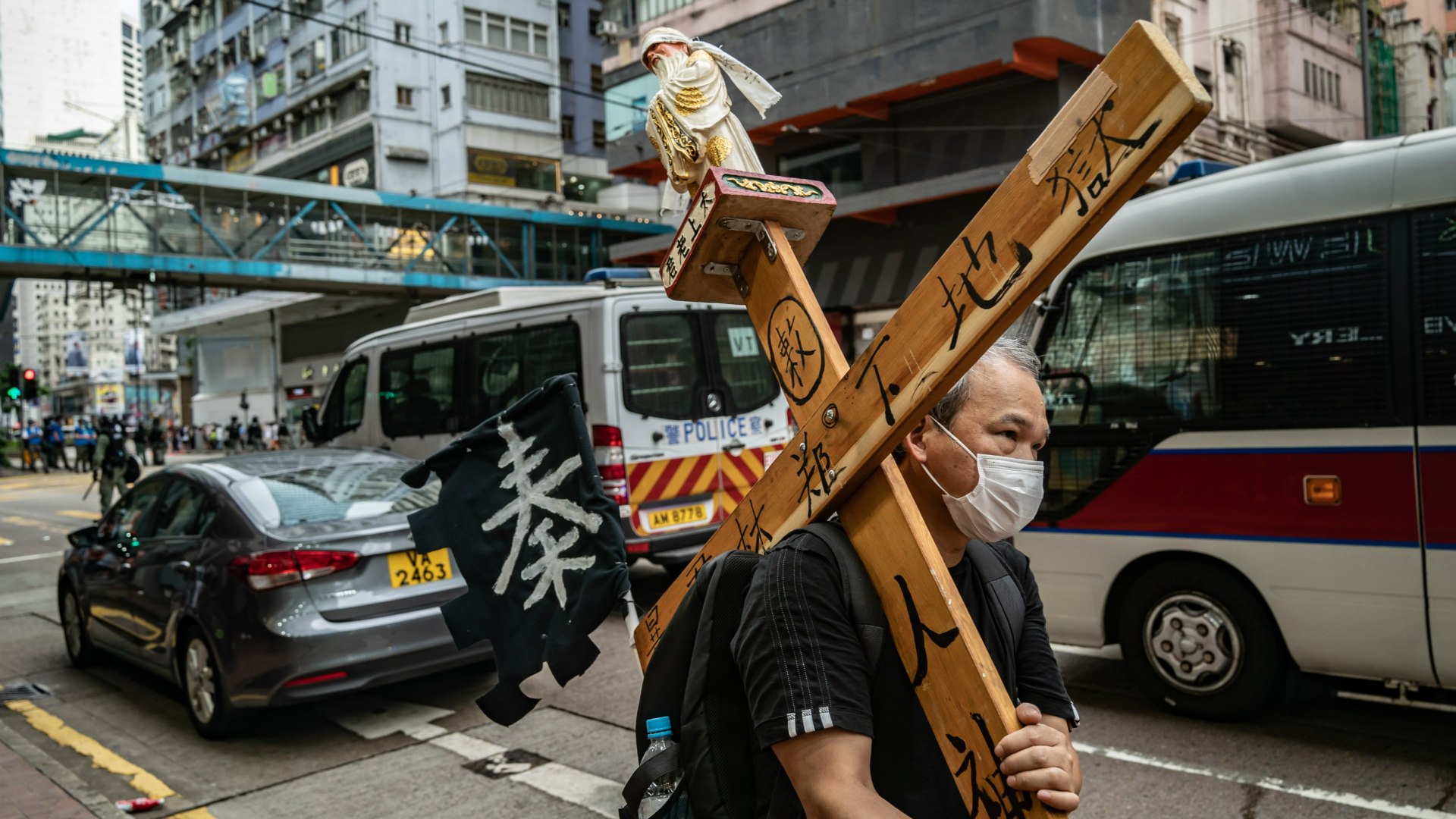
“Beijing is tearing down churches, taking down crosses, putting up portraits of Xi Jinping in churches in mainland China. They are really closing in, becoming more and more restrictive,” said Lowe. “We can safely predict that’s the direction Hong Kong will be heading in.”

But he doesn’t think international missions organizations need to immediately close up shop in Hong Kong. He believes “the window is still open in Hong Kong” for international organizations to operate. “But we need to be careful. It probably will be closing soon.”

Other Christian leaders in Hong Kong, especially those from older generations, have been critical of the strategies employed by protesters—specifically, incidents of vandalism and violence—and how the political movement has divided the church. They defend the new law as justified under China’s rightful oversight of national security (under the Basic Law that governs the former British territory) and look forward to order being restored in their usually peaceful city.

They say the pushback and concerns raised by Western organizations are further evidence of the kind of foreign interference the Chinese government is trying to quell.

T. Leung, a Christian conference speaker and academic in Hong Kong who studies the intersection of Chinese culture and Christianity, is more optimistic about what the new law means for Hong Kong Christians.

Responding to a recent CT op-ed by ChinaSource founder Brent Fulton, Leung argues that overlooked by the media are the Christian leaders trying to heed the Apostle Paul: “Let everyone be subject to the governing authorities, for there is no authority except that which God has established” (Rom. 13:1).

“The so-called democratic believers, including some pastors and politicians who claimed to be Christians, attained an authoritarian way of doing things—a ‘with us or against us’ mentality,” said Leung. “All of those who disagreed with the movement did not dare to speak publicly due to such threats.”

“According to the Bible, Christians believe that humans cannot act as God and that justice only comes from God. The gospel shall come first before politics,” he told CT. “Hong Kong people do not want to see riots and rioting on a weekly basis again. Those with moderate political views hope for peaceful and rational reform and they more or less support this new law.”

Wendy Chu (a pseudonym), a Hong Kong-based management consultant who has been training missionaries and leading missions trips to China for nearly two decades, is more worried. She believes the CCP is focused on suppressing political dissidents at the moment, but it will likely begin turning its attention toward Christian organizations, including international missions agencies, relatively soon.

“For existing international organizations, they can’t treat it like before. If they still want to stay in Hong Kong, they should think about using another status, not a nonprofit. The Chinese government already knows all the nonprofit organizations that are related to Christians,” Chu told me. She knows of a number of ministries in Hong Kong that are already making plans to set up a limited liability company. Shifting their operations and financial resources to a for-profit company will offer them more cover for their evangelical work.

She encourages Christians outside of China to also take precautions, especially as they communicate with friends and colleagues in Hong Kong.

While no one knows the extent to which Chinese authorities may attempt to monitor communications between Hong Kongers and foreigners, Chu is certain that “they will use IT to collect all the data.” She cites an incident with the WhatsApp office in Hong Kong last year, when it was rumored that security officers from the mainland had attempted to seize data. “Under the new law, they have the authority to go in and collect data.”

That may be the most immediate threat for Christian organizations in Hong Kong, according to Edward Auyeung (a pseudonym), a Hong Kong–born Chinese American actor and entrepreneur whose family has been involved in missions in China and other parts of Asia.

“This law can force religious organizations to release information about ties to underground churches in China,” he explained. And if organizations refuse to comply, “their assets may be frozen.”

Auyeung believes Chinese authorities will leverage Hong Kong ministries to crack down further on Christians in the mainland before eventually turning their attention to believers in Hong Kong.

Hong Kong Christians have already begun deleting Facebook pages, switching to more secure messaging services, such as Signal, and setting up secure email accounts. More prominent, outspoken Christians outside of Hong Kong should also be cautious. Edward Auyeung steers clear of any China-owned apps, such as TikTok and WeChat. He recommends that others do the same.

After the law went into effect, Gee Lowe began receiving dozens of Facebook friend requests from people he didn’t know. He suspects these may be part of a larger effort by Beijing to monitor what people like him are saying and doing.

While the future of Christianity in Hong Kong remains vastly uncertain, there are still reasons for optimism.

Just across the border, despite decades of persecution, the church in mainland China continues to grow and thrive. In fact, government oppression seems to have fueled the church and its believers, who continue to courageously and creatively find ways of following Jesus and spreading the gospel. Already, Christians in Hong Kong and their overseas partners are adapting strategies from their mainland counterparts to safely and effectively continue to engage in ministry.

And despite how important it is to the CCP to save face and not back down, the reality is that they care deeply about their standing in the world. “I think [Chinese authorities] thought they could sneak this through the international community while the world is focused on the coronavirus,” said Auyeung. “They didn’t realize the international community would go so far in their condemnation. If there’s a big major crackdown on religion in Hong Kong, the backlash is going to get worse.”

In other words, the new security law does not necessarily offer the final word on the fate of Christians and Christian ministries in Hong Kong. The voices of the people of God carry weight when advocating for our brothers and sisters in Hong Kong—on social media, within our churches and communities, and before our King.

“I believe prayer is very, very important,” said Wendy Chu. She then gave me this exhortation: “Please pray for all the Christians in Hong Kong, not just to attend church and enjoy a good life in Hong Kong, but that we would do what the Lord wants us to do.”

News

Why Many Christians Want to Leave Palestine. And Why Most Won’t.

Survey of a thousand local believers finds majority desire a one-state solution, while few complain about religious freedom.

Christianity Today August 4, 2020
WikiMedia Commons

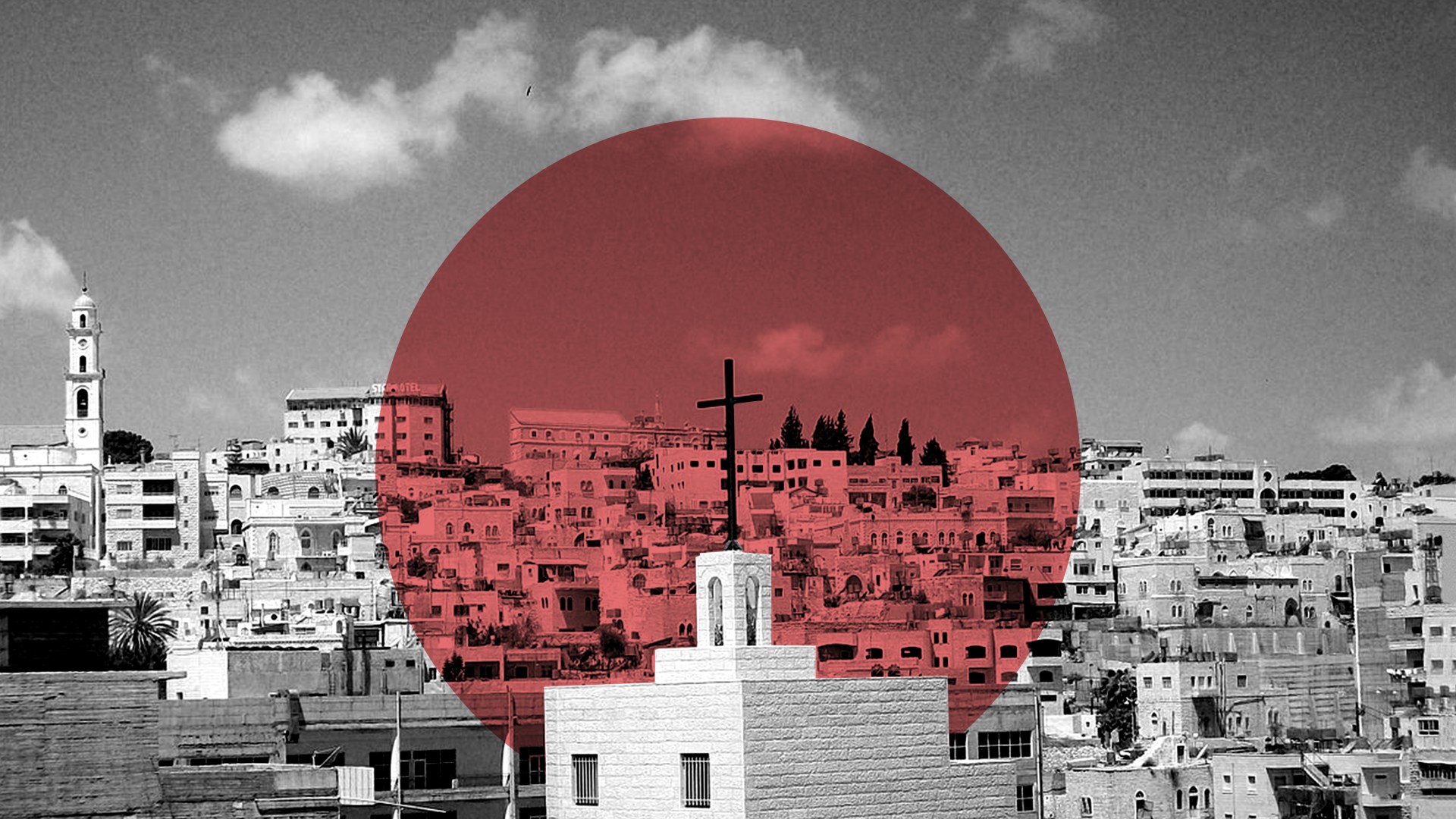
In Bethlehem—the little town of Jesus’ birth—only 1 in 5 residents today are Christians (22%). A century earlier, more than 4 in 5 were believers (84%).

The steep decline is reflected in other traditional Christian cities in the Holy Land. In Beit Jala, the Christian majority has fallen from 99 percent to 61 percent. In Beit Sahour, it has fallen from 81 percent to 65 percent.

When the Ottoman era ended in 1922, Christians were 11 percent of the population of Palestine—about 70,000 people. According to the 2017 census by the Palestinian Authority (PA), they now number 47,000—barely 1 percent.

There are competing explanations of what—or who—is to blame. Some identify the Israeli occupation. Others describe Muslim chauvinism.

The overwhelming answer, according to a new survey of local Christians by the Palestinian Center for Policy and Survey Research (PCPSR), is economics.

Nearly 6 in 10 respondents identified this as the main reason they consider emigration (59%).

The poll, commissioned by the Philos Project, a US-based initiative promoting positive Christian engagement in the Middle East, surveyed 995 Christians in 98 Palestinian locations throughout the West Bank and Gaza Strip in January and February.

Compared to the economy, other cited reasons paled in significance.

Security conditions were named by 7 percent. Another 7 percent cited better education. And another 7 percent blamed the political situation.

Only 4 percent blamed corruption, while 3 percent gave a religious explanation.

But this particular question measured the primary driver of desire to leave the Holy Land. What secondary factors might be involved?

Philos “affirms the right of all Christians to live and flourish as indigenous citizens,” and its Gaza-born Palestinian advocacy officer, now living in the West Bank, wanted to discover the reality—or at least the perception—about why many believers were not flourishing.

“Step-by-step, we worked on questions that represent concrete situations,” said Khalil Sayegh. “I personally experienced them, and I know that our community did too.”

About half of Palestinian Christians are Greek Orthodox (48%), while 38 percent are Latin Catholic. Evangelicals and Lutherans represent 4 percent. (The rest are Greek Catholics or Syriac Orthodox/Catholics.)

Overall, about 1 in 3 label themselves as “religious” (36%), up from 23 percent two years earlier.

The gain corresponded to a decline among the “not religious,” who fell from 27 percent to 17 percent. The somewhat-religious middle held steady at about 46 percent.

“Historically in the Middle East, when nationalism becomes weaker, one’s religious/ethnic identity becomes more dominant,” said Salim Munayer, executive director of the Jerusalem-based Musalaha Ministry of Reconciliation.

“Those with a stronger religious identity feel a sense of mission: willing to pay the price to remain.”

Only 1 in 4 “religious” Palestinian Christians (24%) are considering emigration, compared to 41 percent of the “somewhat religious” and 45 percent of the “not religious.”

But for all Christians who are not considering emigration, the sense of mission is evident in 4 of 5 of them: 43 percent want to demonstrate Palestinian solidarity, while 39 percent refuse to abandon their family and friends.

A loss of a sense of belonging, however, roughly corresponds to the 36 percent considering emigration. While 70 percent of Christians feel “fully integrated” into Palestinian society, 30 percent do not.

Munayer described one factor as the corruption of the PA, the local government, which 4 in 5 Christians agree on: 52 percent see a “great deal” of corruption in the PA, while 30 percent see it “to some extent.”

And overall, 2 out of 3 Christians have little to no trust in the PA (66%). The courts (trusted by only 16%) and police (trusted by only 22%) fare even worse. One out of five Christians report discrimination when seeking PA services (20%). And 3 out of 4 are “dissatisfied” with how Christianity is portrayed in the PA educational system (76%).

But while Munayer recognizes these failures as part of the reason why Christians are emigrating, there is a clearer culprit behind the economic crunch: Israeli occupation and the siege on Gaza. These “restrict and choke” the possibility for development, he said.

Munther Isaac, pastor of the Evangelical Lutheran Christmas Church in Bethlehem, agrees.

“It is important to stress that this is not a religious conflict—it is political,” he said, while acknowledging a religious dimension.

“The situation is complex and has many elements, but clearly the Israeli occupation is ultimately the one that determines what happens here.”

The concerns of the Palestinian Christians surveyed bear this out.

About 8 in 10 worry about attacks from Jewish settlers and being driven from their homes (83%). About 7 in 10 worry about Israeli annexation (67%). And about 6 in 10 believe Israel’s goal is to expel Christians from their homeland (62%).

And in terms of actual experience, 42 percent must regularly cross Israeli checkpoints, and 14 percent have lost land to the occupation.

“We are frustrated by how some try to manipulate the reality using certain figures in order to serve certain agendas,” said Isaac, who frequently provides pastoral care to youth contemplating emigration.

“It suits some to blame ‘Muslims’ for our situation, trying to hide the reality of decades of Israeli occupation and forced migration.”

But high percentages also reveal concerns about their fellow Muslim citizens: 77 percent are worried about the presence of austere Salafi Muslims, 69 percent are worried about armed factions like Hamas, and 67 percent are worried about Palestinian Basic Law referring to sharia (Islamic law).

More than 2 in 5 believe that Christians are discriminated against for employment in the private sector (44%). The same share believe that Muslims don’t want Christians in the land (43%).

In terms of actual experience, 1 in 4 report being called an infidel (27%). And 1 in 10 reported ill treatment, where their children are made fun of at school for their religion (11%) or they themselves suffer harassment by Muslim neighbors (10%).

“Despite positive experiences Christians might have with their Muslim neighbors,” Sayegh said, “there is always skepticism as long as they know that their Muslim neighbors believe they will go to hellfire.”

Most Christians do report general friendliness. While 2 in 3 live primarily in a Christian-majority area (66%), 24 percent reside in mixed neighborhoods, and 11 percent are minorities among Muslim neighbors.

Nearly 2 in 3 said they had “excellent or normal” relations with Muslim neighbors (65%), while only 10 percent described relations as “medium or bad.”

This corresponded with their evaluation of their neighbors’ religious outlook. Two in five Christians consider their Muslim neighbors to be “liberal or open minded” (20%), while 64 percent find their neighbors “moderate,” and only 9 percent describe their neighbors as “too religious or extreme.”

Isaac blamed the “fear and suspicion” on the rise of ISIS. Munayer cited extremist Islamic propaganda in the media for the “gap between reality and perception.”

Munir Kakish agreed.

“You can build a good relationship with your neighbors,” said the president of the recently recognized Council of Evangelical Churches in the Holy Land, “but not with an online hate group.”

Yet despite positive interactions with Muslims, and while identifying the occupation as an important driver of emigration, Kakish cites the promise of Israel as contributing to a striking statistic.

Six in 10 Christians favor a one-state solution (61%).

A similar PCPSR poll during the same time period found only 37 percent support among Palestinians overall. But for Christians, it was seen as the best means to achieve peace while securing safety for their community.

“There will be less discrimination from the Israelis in a one-state solution,” said Kakish. “And Israel has better living conditions, such as in hospitals and employment.”

Munayer agreed.

“The rights-based approach is what is most appealing,” he said, “as Christians are being denied many basic human rights at the moment.”

Isaac recently published The Other Side of the Wall to theologically advocate for a “shared land” perspective. Whatever the perceived advantages of Israel, he said the traditional two-state solution is “collapsing before our eyes.”

Sayegh attributed one-state support to Palestinian Christian belief in democracy, coupled with the above described fear of an Islamic Palestine. Three in four (73%) view a single state as the best model for governance, while only 11 percent view the PA as democratic.

Yet even with the PA’s faults, Christians cited a striking level of religious freedom in Palestine. Half said it was “high or high enough” (50%), while an additional quarter said it was “medium or average” (27%).

And 8 percent reported inviting Muslim acquaintances to convert to Christianity.

Kakish said that despite Christians being “cautious” in outreach, it is acceptable to discuss religion and “there is more openness than ever before.”

While Muslims have always challenged Christian belief—23 percent of respondents stated that Muslims have asked them to convert to Islam—Christians now “feel more empowered” due to better apologetic resources available online, Sayegh said.

However, Munayer, who teaches a course at Musalaha on freedom of religion and belief, believes the increase in Christian religiosity has fueled an increasing self-isolation. While they are “not shy” in expressing their beliefs, Christians are detaching themselves from both Jews and Muslims. (He surveyed Christian university students around Bethlehem and found they show less interest in interfaith friendships than their Muslim peers.)

So while Christian numbers continue to dwindle, where should their hope come from?

More than half said they need more jobs: 56 percent have asked the church about this, and 52 percent ask the PA. Only 2 percent and 6 percent, respectively, believed these institutions should do more to secure religious freedom.

Perhaps this is because Palestinian Christians already believe they are living their faith.

“We have a committed community that understands our mission to witness, to serve, and to advocate for justice and peace,” said Isaac.

“Our role as churches is to bring the message of hope, as we find it in the gospel.”

Additional reporting by Jeremy Weber

Editor’s note: You can read and share this article in Arabic as 1 of 150+ CT Global translations across 10 languages. Share your feedback here.

You can also now follow CT on WhatsApp and Telegram.

News
Wire Story

US Capitol to Install Billy Graham Statue in 2021

After five years of planning, the Bible-wielding preacher will replace a white supremacist North Carolina governor in the national collection.

Christianity Today August 4, 2020
Drew Angerer / Getty Images

A life-sized statue of Billy Graham will be installed in the US Capitol’s Statuary Hall collection sometime next year, replacing a statue of a white supremacist that both the state of North Carolina and the US House want removed.

Last week, a North Carolina legislative committee approved a 2-foot model of the statue depicting the famous evangelist who died in 2018.

The sculptor, Chas Fagan, will now begin working on a life-sized model that will have to be approved by a congressional committee. Fagan has previously created several statues of religious figures, including St. John Paul II for Washington’s Saint John Paul II National Shrine, as well as Mother Teresa for the Washington National Cathedral.

The US Capitol, Statuary Hall collection consists of 100 statues of prominent people—two from each state. Graham, a North Carolina native who was born on a dairy farm in Charlotte, will take the place of Charles Aycock (1859–1912), a former governor.

Aycock was one of the masterminds of the 1898 Wilmington, North Carolina, race riot and coup, in which a local government made up of black Americans was overthrown and replaced by white officials. North Carolina’s other statue is of Zebulon Vance (1830–1894), a former governor and US senator who was also a Confederate military officer.

With statues to white supremacists and Confederate leaders toppling across the nation, North Carolina’s reconsideration might seem timely. But in fact, installing a statue of Graham at the US Capitol had widespread support long before the most recent reckoning on race.

Former North Carolina State Sen. Dan Soucek pushed for the new statue in 2015 while Graham was still living. Soon after Graham’s death, the process kicked into gear.

“From a Christian religious point of view, Billy Graham is an undeniable worldwide icon,” Soucek said. He cited the six decades Graham placed among the top 10 in Gallup Poll’s list of the most admired people.

For years, Graham has been one of North Carolina’s most famous luminaries. There are two state highways named to honor him. One of Charlotte’s biggest tourist attractions is the barn-shaped library documenting his life and ministry that includes his restored childhood home and gravesite.

Graham’s son, Franklin, whose Samaritan’s Purse ministry is also located in North Carolina, said he has seen a rendering of the statue, which features the elder Graham as he looked in the 1960s, preaching and holding a Bible in one hand.

Franklin Graham said the statue is not something his father would have pushed for.

“My father would be very pleased that people thought of him in this way,” he said. “But he would want people to give God the glory and not himself.”

The Billy Graham Evangelistic Association, in partnership with the state, is raising money for the statue and its installation—which is estimated to cost $650,000. No state funds will be used.

Garrett Dimond, general counsel for the state’s legislative services office, said that once the 10-foot, 10-inch-tall clay statue is completed it must be reviewed by a congressional committee before it can be cast in bronze.

Last month, a bill by the Democratic-led House Appropriations Committee called for the removal of “any individual who served voluntarily at any time as a member of the armed forces of the Confederate States of America.” It specifically cited Aycock.

“They know we’re replacing the statue,” Dimond said, referring to Congress. “I think we’ll get the approval quicker than you normally would, given what’s going on in the country.”

In an executive order issued ahead of Independence Day, President Donald Trump also listed Graham among the leaders he’d like to memorialize in a statuary park called the “National Garden of American Heroes.”

News

Brethren Against Brethren: LGBT Fight Divides Peace Church

Departing congregations want stricter enforcement of official positions.

Christianity Today August 3, 2020
Xtian Designs / Lightstock

A regional body of the Church of the Brethren split late last month over the issue of homosexuality. This is the first official rift in a long-expected division of the Pietistic-Anabaptist denomination historically known as “Dunkers.”

Nineteen of 42 churches withdrew from the Southeastern District Conference during an annual meeting in Jonesborough, Tennessee on July 25, according to the denomination’s official news site. The departing congregations want the Brethren to exercise more authority over ministers and congregations that deviate from the church’s official positions on human sexuality.

The Church of the Brethren does not affirm LGBT ministers, unless they are committed to celibacy, nor does it allow ministers to perform same-sex wedding ceremonies. However, about 40 of the denomination’s roughly 1,000 congregations belong to the Supportive Communities Network, organized by the Brethren Mennonite Council for Lesbian, Gay, Bisexual, and Transgender Interests, and they have not been punished or expelled.

One of the distinctives of the historic peace church has been its refusal to punish dissenters. The Brethren traditionally claim there should be “no force in religion.”

Before the Tennessee meeting closed, moderator Steven Abe led the remaining churches in a blessing for the withdrawing churches and the withdrawing churches in a blessing for the remaining churches.

The southeastern district, which includes Alabama, South Carolina, Tennessee, and parts of North Carolina and Virginia, is one of 24 in the US. The majority of the churches that decided to leave are in East Tennessee and western North Carolina. Some are expected to join the Covenant Brethren Church, which was formed as a “haven” for potentially departing churches in 2019 with a statement about “failure of the denomination to stand strong on biblical authority” and address “the homosexual issue.”

The Church of the Brethren’s official statement about same-sex marriage dates to 1983, saying that “covenantal relationships between homosexual persons” are not acceptable. The statement also committed the Brethren to “challenging openly the widespread fear, hatred, and harassment of homosexual persons” and “advocating the right of homosexuals to jobs, housing, and legal justice.” It was reaffirmed in 2011.

In 2017, though, the church’s annual conference recognized a lesbian couple co-pastoring a congregation in Pacific Northwest District, prompting talks of a split and a debate about the authority of the national organization to enforce the doctrinal standard. A faction of church leaders pushed for new policies allowing for tougher enforcement in 2018.

“The problem is that our denomination is being perceived as becoming a pro-homosexual denomination by default,” Atlantic Northeast District representative Jim Myer said at the time. “Not by a decision we’d made, but by a default by not standing on the decision that we have made.”

Opponents warned that the solution could be more divisive than the problem.

“If you have a big hammer for same-sex marriage, the same big hammer is for women in ministry. The same big hammer is for church property matters,” annual conference moderator Carol Sheppard told the Mennonite World Review. “We sit in the middle, not making everyone perfectly happy but attempting to live with one another and prioritizing that.”

The enforcement proposals did not pass. Instead, the church launched a denomination-wide conversation called the “Compelling Vision Process,” which organized small discussion groups to consider the question, “What compels you to follow Jesus?”

At a national young adult conference, the top answers to the question were: “Jesus’s love for us,” “community,” “discipleship,” “the life of Jesus,” “transformation,” and “God’s acceptance of all.” At the 2019 annual conference, the adults’ top answers were “salvation,” “Jesus’s love for us,” “discipleship,” and “Jesus’s love for others.”

The annual conference intends to produce a vision statement for all the churches, based on the two years of conversations. The statement is supposed to unify the Brethren and present the churches with a clear vision—notwithstanding ongoing disagreements and doctrinal diversity—going forward. The articulation of the statement was scheduled for this year, but has been postponed to the 2021 meeting because of the pandemic. Critics say the process does nothing to address the “elephant in the room.”

According to Brethren general secretary David Steele, the process was never supposed to be about homosexuality. It was intended “to move the conversation above that to matters of faith and vision and where the church ought to be.” Steele said the church’s response to division and controversy ought to be “continuing conversation and prayer and reading Scripture together.”

For the dissenting Brethren, that’s not good enough.

“You can’t do outreach and mission work when your foundation is crumbling with a major issue that’s sitting there,” said Grover Duling, temporary head of the Covenant Brethren Church. “I hope and pray that there’s a miraculous healing … that hasn’t been present in the 40 years we’ve been trying to find our way around this huge divisive issue.”

Apple PodcastsDown ArrowDown ArrowDown Arrowarrow_left_altLeft ArrowLeft ArrowRight ArrowRight ArrowRight Arrowarrow_up_altUp ArrowUp ArrowAvailable at Amazoncaret-downCloseCloseEmailEmailExpandExpandExternalExternalFacebookfacebook-squareGiftGiftGooglegoogleGoogle KeephamburgerInstagraminstagram-squareLinkLinklinkedin-squareListenListenListenChristianity TodayCT Creative Studio Logologo_orgMegaphoneMenuMenupausePinterestPlayPlayPocketPodcastRSSRSSSaveSaveSaveSearchSearchsearchSpotifyStitcherTelegramTable of ContentsTable of Contentstwitter-squareWhatsAppXYouTubeYouTube