Love Thy Extraterrestrial Neighbor

The burgeoning field of astrobiology and what it tells us about the meaning of life.

Christianity Today November 20, 2019
Rakicevic Nenad / Pexels

Every week that somber gatekeeper of human knowledge and wisdom—the internet—is abuzz with UFO sightings and strange alien encounters, all in an effort to bring the truth that is out there to the rest of us. Although these world-changing images are often more fizzle than flash, they serve as a testament to the fascination people have for the possibility of life that is out of this world.

Popular speculations like these, coupled with pronouncements every few years that scientists have found new evidence of alien life, lead us to believe that we are on the cusp of great discovery.

One of the recent advances making the news and fueling our interest in alien life is the recent discovery of exoplanets in the “Goldilocks,” or habitable, zone. As of this month, out of the 4,118 exoplanets now confirmed, 55 exist in the habitable zone. As new astronomical technology comes online in the next decade, this number is expected to rapidly increase.

As our focus on these extrasolar worlds become sharper, finding life—of any sort—on any one of them becomes more credible with each passing year. As a result, there has been an explosion of interest in a new field of research, astrobiology, the study of alien life and its origins and occurrences in our universe.

But there’s one thing you need to know about astrobiology: it is the only science that has no subject for study. Internet aside, we have no aliens.

This fact hasn’t dissuaded astrobiologists in the least. Instead, what makes astrobiology one of the most interesting fields of study is that it is in some ways a new kind of science—one that links physics with ethics, astronomy with philosophy, and biology with theology in a unique new way.

Some of these links are most apparent when we stop to consider what “life” is. On Earth, we tend to think of life as anything that crawls around. Alien life may be quite different, necessitating a new look on seemingly settled ideas.

The interest in extraterrestrial life is not new. Its origins lie not in the Space Age but in the Iron Age. Starting as early as the fifth century BC, Greek philosophers and mathematicians looked at the movement of the stars and understood there was something out there, even if they did not have the vocabulary to describe it the way modern science does today.

While ancient theories about the universe—such as its composition of earth, air, fire, and water—seem mythological by modern sensibilities, there is one important area of agreement: ancients didn’t imagine the universe as merely a flat Earth as modern people often assume. Instead, they viewed the Earth as one part of a greater universal system, teeming with life.

Who Is My Neighbor?

“As an astrobiologist I’m always asking, ‘Who is my neighbor?’” says Lucas J. Mix, a Harvard astrobiologist and Episcopal priest. “We want to talk about aliens as though there were ‘us’ and ‘them.’ I really think it’s a question of understanding more broadly and more deeply. Who is my neighbor? Astrobiology is part of this process of reaching out and understanding that even familiar life is more alien than we realize—and therefore alien life might be more familiar than we realize.”

It is not just astronomical discoveries such as exoplanets that powers the ongoing astrobiological renaissance. It is the discoveries of life that is occurring right in our own little world.

For example, even as we find ourselves in the 21st century, scientists estimate they still discover on average one new animal species every day. Our own understanding of “the meaning of life” is constantly being adjusted.

Perhaps the most exciting—and cutest—example of these recent life discoveries is the newfound resilience of tardigrades, also known as water bears or moss piglets. First discovered in 1773 by the German pastor Johann August Ephraim, these creatures were known to be hardy, but recent advances in biology show them to be as indestructible as anything on Earth. Or perhaps, the moon, as thousands of little water bears likely survived the crash of Israel’s Beresheet lunar lander in April 2019.

“We are entering a renaissance of life discovery, for a number of reasons,” notes Mix. “We have discovered life a mile down in the earth, and floating in the atmosphere, and in the middle of the desert, and living in nuclear reactors, and surviving in spacecraft. What we’ve discovered is that the same basic kind of life is living in a much richer and broader way than we previously understood.”

It’s as though the palette of life is never exhausted, even here on Earth. Just when we think we understand life and have an it-can’t-get-any-better-than-this moment, we discover something even more amazing than the last. The richer and broader we discover life to be, the richer and broader we discover our Creator to be.

What Are the Odds?

Around every tree, under every rock, and in every Martian lava tube there is new form or variation of life just waiting to be discovered. Discovered by people; already known by God.

Even as we extol God for the fascinating and colorful diversity of life on Earth, are we ready to find life on other worlds? Last month, NASA’s Chief Scientist Jim Green suggested we are close to finding life, perhaps even evidence on Mars, but far from being able to accept it.

If we send a robotic lander to Europa, moon of Jupiter, we may discover evidence of life. Then again, if we send a robotic lander to Europa we may discover no evidence of life. Either way, it has profound implications for what life means for us. The stakes are high. Enter astrobiology—perhaps the only scientific field where philosophy, ethics, and even theology are trying to get ahead of the science.

If we find life out there, the chemistry must suggest it is life, the biology must confirm that it is life, the philosophy must decide if it is life, the ethics must adopt expectations for its life, and theology must consider its relationship to other life. And if we don’t find life out there, the same questions still remain, yet in reverse.

Green’s point is well-taken. This is happening faster than we may be ready for. And surprisingly, the best place we may soon find neighbors may actually be Mars. Yes—life on Mars.

According to Roger Wiens, a scientist at Los Alamos National Laboratory and principle investigator for the Mars Curiosity rover’s ChemCam, terrestrial scientists have already found more than one hundred and fifty Martian rocks on Earth. In times past, when Mars was hit by a meteor, the impact catapulted rocks from the Martian surface into space to take a short 30-million-mile hop, skip, and jump over to our planet. Because life is so abundant on Earth, when large meteors make a similar impact on our planet, any rocks skipping their way to Mars could carry with them bacteria or archaea. These rocks would likely introduce life onto an alien planet—much in the same way we may have accidentally seeded the moon with water bears.

When we ask, “Who is my neighbor?” we may not imagine the Earth-born, Mars-raised kind. Or the Europa born-and-bred kind. What we do know is that our imagination of life on Earth keeps expanding. God wasn’t satisfied with just a few makes and models of species. His creation could have been simple, yet it was engineered for so much more.

We may see alien life as strange—from our human perspective—but from God’s perspective it is just another part of his creation.

Life Redux

The study of what “life” means, and therefore the meaning of life, is an idea recently found in the province of theology and philosophy. But the possibility of life on other worlds stirs the thoughts of astrobiologists, so while biologists study life as it occurs, astrobiologists imagine life, pushing the boundaries of their parent discipline.

Surfing that somber gatekeeper of human knowledge and wisdom—the internet—might lead one to assume that the discovery of life on another world would become its own religion. If we have ET, we can dispense with Jesus. It would only be a matter of time before humanity moved on to something much more … universal.

But what if the opposite is true? Life on other worlds may actually stir our Christian faith. Just as many early biologists such as Ephraim were people of faith, amazed at what our world revealed about God, so too are many astrobiologists today asking the hard questions—not just about what life is but what life could be. Their work will open the lander’s hatch for future generations of Christians to see the signs of God’s created endeavors spread not just across our world but others.

The heavens declare the glory of God. So too do exoplanets and alien life. God’s creation extends not just to the plants and rocks on Earth but to the amino acids and methane waves of alien worlds.

When and if we discover alien life, humans will call it “alien.” Though maybe Christians should call it “our neighbor.” But of course, God will simply call it “good.”

Douglas Estes is associate professor of New Testament and practical theology at South University. He is the editor of Didaktikos, and his latest book is Braving the Future: Christian Faith in a World of Limitless Tech.

News
Wire Story

Half of Pastors Say the Opioid Epidemic Has Hit Their Church

The demands of addiction can go beyond typical spiritual and physical help offered by congregations.

Christianity Today November 19, 2019
Chalermphon

Like most US pastors, Robby Gallaty knows someone who has been affected by opioid abuse. But unlike most pastors, Gallaty has personally suffered through addiction.

Twenty years ago this month, Gallaty endured a near-fatal car accident. When he left the hospital, the club-bouncer-turned-church-leader took with him several prescriptions for painkillers.

“My descent into full-scale drug abuse was amazingly rapid,” he writes in his new book, Recovered: How an Accident, Alcohol, and Addiction Led Me to God. “In November of 1999, before the accident, I was selling cars, training for the Ultimate Fighting Championship, and thinking about business opportunities. By early the next year, I was looking for faster and better drug connections.”

After stealing $15,000 from his parents to feed his addiction, Gallaty found himself at his lowest point—kicked out of his parents’ home and told not to come back. “It was the hardest three months of their lives, and they’ll tell you that,” he said. “But it was the best thing for me. I knew that I couldn’t fix myself.”

This led Gallaty, now pastor of Long Hollow Baptist Church in Hendersonville, Tennessee, to what he calls a “radical, Paul-like conversion” on November 12, 2002.

Most pastors don’t have the intimate knowledge of addiction Gallaty has, but most say they’ve seen it face to face through people connected to their church and among members of their congregation.

Nashville-based LifeWay Research asked 1,000 Protestant pastors about their personal connections to the opioid epidemic and how their churches are looking to address the issue.

Two-thirds of pastors (66%) say a family member of someone in their congregation has been personally affected by opioid abuse.

More than half (55%) say they or someone in their congregation knows a local neighbor suffering through opioid abuse.

For half of pastors (52%), someone directly in their church is dealing with an opioid addiction.

Fewer than a quarter (23%) of pastors say they don’t know anyone personally affected by it.

“The drug epidemic has infiltrated our churches and neighborhoods. It is not localized to a particular region or socio-economic class,” said Gallaty. “Addiction is no respecter of persons.”

Pastors of the smallest churches (fewer than 50 in attendance) are most likely to say they don’t know anyone connected to their congregation or community affected by opioid abuse (31%).

Pastors in the Northeast (11%) are least likely to say they don’t have any such personal connections.

“More than two-thirds of even the smallest churches have connections to people affected by opioid abuse,” said Scott McConnell, executive director of LifeWay Research. “Opioid addiction can impact people who aren’t a significant risk for other types of drugs.”

Church response

Despite most pastors having a personal experience with someone suffering from opioid abuse, Gallaty said many church leaders don’t know where to start in responding to the opioid epidemic.

“Some pastors are at a loss to understand the issues surrounding personal struggles and don’t have a plan of action to help those in need,” he said.

Unfortunately, Gallaty said some pastors are dismissive of “those drugheads” from a certain area of their town, but he says that attitude is wrong for two reasons.

Being a college graduate with a full-time job and having a good home with hard-working parents means Gallaty didn’t fit those stereotypes. “I never asked to be injured, nor did I intend to get addicted to pain medication,” said the Recovered author. “Still, it happened to me, like it has to so many others.”

Even more importantly, Gallaty said “‘those drugheads are sons and daughters of people in our congregations and communities. They are all made in the image of God and need to know that addiction, like any sin, can be broken through the healing power of the gospel.”

According to the LifeWay Research study, most churches are trying to do something.

Around 4 in 5 pastors (82%) say their church currently serves people with opioid addiction by offering spiritual support including prayer or discipleship.

Close to half (46%) say they offer physical support including food, shelter or clothing, while slightly fewer (40%) offer a 12-step program or other support groups for substance abuse.

Around 1 in 8 pastors (13%) admit their church currently isn’t doing any of those things for people with opioid addiction.

“When churches offer spiritual and physical help to those in their community, they will meet people with many needs that go beyond those offerings,” said McConnell. “Churches have a choice of whether they will address those more complex needs, connect the hurting with help elsewhere, or ignore the needs.”

Larger churches—those with more resources and more personal connections to the crisis—are most likely to say they offer both spiritual and practical help for those with an opioid addiction.

Gallaty said one simple way churches can address the problem is by “educating our people on the dangers of addiction by talking about it publicly and preaching sermons about the topic. Pastors shouldn’t shy away from it.”

As people with addictions come to the attention of the church, however, Gallaty said congregations and leaders must be ready. “When people come to our churches as hospitals for healing, pastors should have a game plan to help them,” he said.

“We can stick our heads in the sand and hope the issue dissolves, or we can recognize the need and take steps to come alongside those struggling.”

Aaron Earls is a writer for LifeWay Christian Resources.

Methodology: The phone survey of 1,000 Protestant pastors was conducted August 29 to September 11, 2018. The calling list was a stratified random sample, drawn from a list of all Protestant churches. Quotas were used for church size.

Each interview was conducted with the senior pastor, minister or priest of the church called. Responses were weighted by region to more accurately reflect the population. The completed sample is 1,000 surveys. The sample provides 95% confidence that the sampling error does not exceed plus or minus 3.2%. Margins of error are higher in sub-groups.

News
Wire Story

Planned Parenthood Wins $2.2M Suit Against Pro-Life Investigators

The jury said the undercover activists who exposed the organization’s sale of fetal parts could not use journalism as a defense.

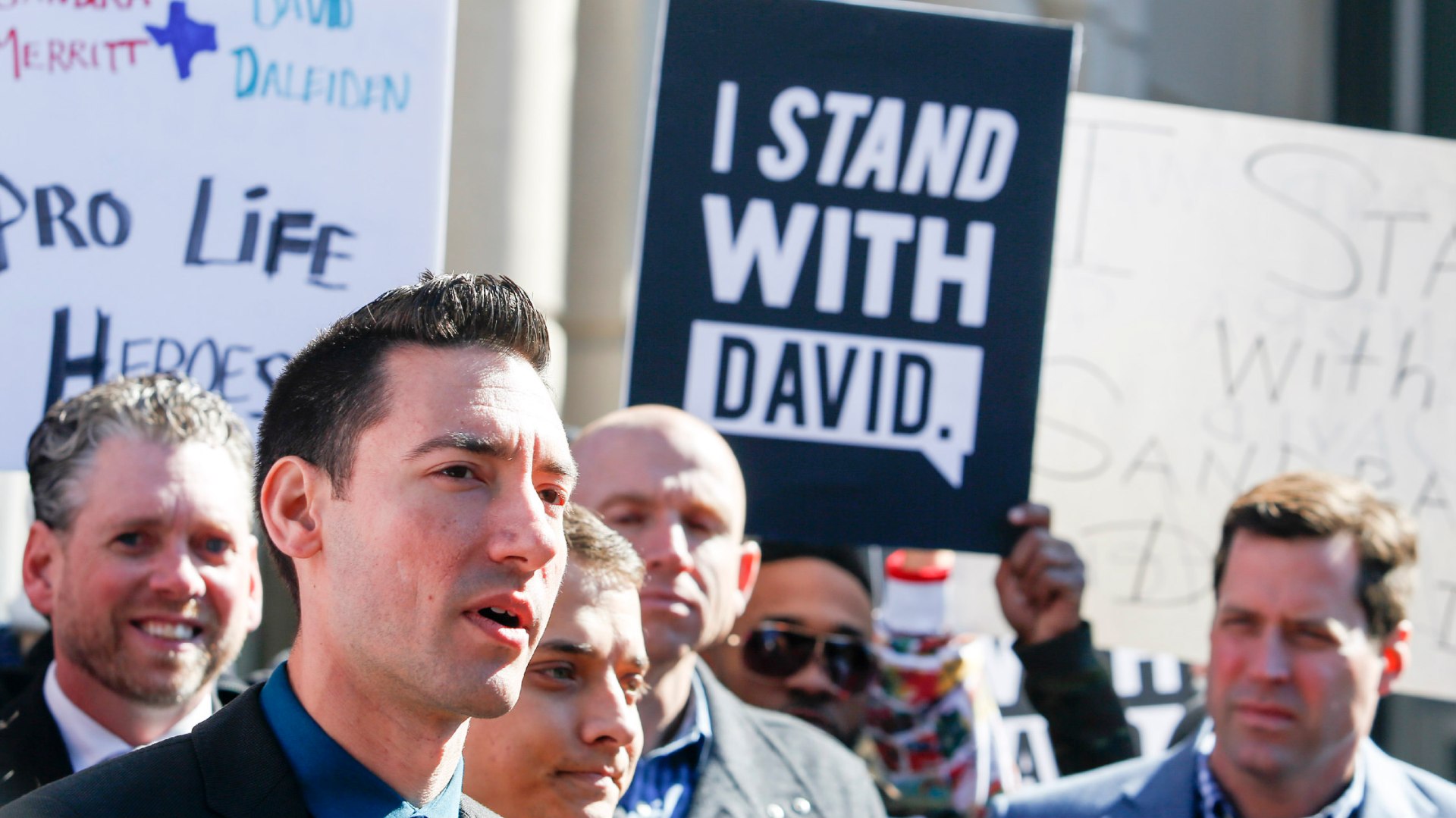
David Daleiden also faced an indictment in 2016.

David Daleiden also faced an indictment in 2016.

Christianity Today November 19, 2019
Eric Kayne / Getty Images

Pro-life advocates decried an award of more than $2.2 million to Planned Parenthood in a suit involving undercover investigations that provided evidence the country’s leading abortion provider traded in the sale of baby body parts.

A federal jury in San Francisco issued the penalties last Friday against the Center for Medical Progress (CMP) and, among others, two investigators who secretly recorded videos of Planned Parenthood executives discussing their sale of fetal parts, as well as their willingness to manipulate the abortion procedure to preserve organs for sale and use. David Daleiden and Sandra Merritt also clandestinely recorded conversations with officials of fetal tissue procurement businesses that worked with Planned Parenthood.

The jury agreed with Planned Parenthood that the defendants were guilty of fraud, trespassing, illegal recording, racketeering and breach of contract, according to The San Francisco Examiner. It awarded Planned Parenthood $870,000 in punitive damages, about $470,000 in compensatory damages and—under a federal anti-racketeering law—triple compensatory damages of more than $1.4 million, The Examiner reported. The total was $2.28 million.

“Regardless of what any court decides, the videos of Planned Parenthood speak for themselves,” said Russell Moore, president of the Southern Baptist Ethics and Religious Liberty Commission (ERLC), in written comments for Baptist Press. “They reveal an organization whose profit structure is built on violence against women and their unborn children.

“Whatever questions some may have about the legality of the recordings, we should not forget what the recordings revealed: The cruelty, dishonesty and lawlessness of Planned Parenthood.”

The National Right to Life Committee called the judgment “chilling for anyone acting in good faith to reveal what they feel is criminal activity or behavior. This judgment is a miscarriage of justice and threatens [First Amendment] rights and investigative journalism.”

Planned Parenthood was “thrilled with today’s verdict,” said Alexis McGill Johnson, acting president of the Planned Parenthood Federation of America (PPFA). “The jury recognized today that those behind the campaign broke the law in order to advance their goals of banning safe, legal abortion” in the United States.

The legal organizations representing the pro-life investigators criticized the decision and said they would appeal.

“It is as though the jury completely disregarded every piece of evidence we produced,” said Alexandra Snyder, executive director of the Life Legal Defense Foundation. “Not only does Planned Parenthood engage in illegal and morally repugnant practices, but its agents never bothered to tell the defendants that the conversations about things like ‘crushing above and crushing below’ to get more desirable and salable body parts were confidential.”

Peter Breen, lawyer for the Thomas More Society, said the lawsuit “is payback for Daleiden exposing Planned Parenthood’s dirty business of buying and selling fetal parts and organs. His investigation into criminal activity by America’s largest abortion provider utilized standard investigative journalism techniques, those applied regularly by news outlets across the country.”

(Editor’s note: In the wake of the video clips, Planned Parenthood ended its practice of accepting payment for fetal tissue and parts, and CMP called the move an admission of guilt: “If the money Planned Parenthood has been receiving for baby body parts were truly legitimate ‘reimbursement,’ why cancel it?”)

Following the 2015 release of the first undercover videos, Daleiden, CMP’s founder, spoke at the inaugural Evangelicals for Life conference in January 2016 in Washington, D.C. The ERLC sponsors the event.

At the time, Daleiden explained his ethical approach to the clandestine operation: “I think that undercover work is fundamentally different from lying, because the purpose of undercover work is to serve the truth and to bring the truth to greater clarity and to communicate the truth more strongly.”

Federal Judge William Orrick, who presided over the trial, ruled journalism could not be a defense in the face of Planned Parenthood’s claims, thereby dealing a blow to the defendants’ arguments. Testimony during the six-week trial appeared to affirm statements made by Planned Parenthood officials and others on CMP’s secret videos.

Those undercover videos included evidence of the dissection of live babies outside the womb to remove organs.

Planned Parenthood centers performed more than 332,000 abortions nationwide during the most recent year for which statistics are available. PPFA and its affiliates received $563.8 million in government grants and reimbursements in its latest financial year.

Pastors

The Inspirational, Interdenominational, Multi-Congregational Ministry Movement

What happens when local churches stop competing and start seeing themselves as multiple sites of God’s Church in a city?

CT Pastors November 19, 2019
Source images: Envato

When four churches in Amarillo, Texas, joined forces, their city took notice. Central Church of Christ, First Baptist Church, First Presbyterian Church, and Polk Street United Methodist Church are all large, long-established churches in the downtown area, and together they form “4 Amarillo,” a cross-denominational partnership that started with a friendship between two pastors.

This friendship grew to four, and as the pastors’ relationships developed and they learned how much they had in common theologically, they began meeting regularly. They discovered opportunities for cooperation around a shared sense of mission. Now the four churches worship together twice a year, at Thanksgiving and on Maundy Thursday, in a unified service hosted by one of the four. Each summer they join forces for a “stay-at-home mission experience,” a local project that ministers to their city: rebuilding a house, renovating apartments. Each summer they work together to lead vacation Bible school programs in two local elementary schools.

Murray Gossett, pastor of outreach and missions at First Presbyterian Church, is one of those responsible for helping these cooperative initiatives happen. “It’s a lot of fun,” he said. “The key is the trust relationships that have grown between the senior pastors.” Those senior pastors plan the unified worship services, but they delegate much of the cooperative work to others, like Gossett. “That brings all of us together. There is a lot of collegiality and very little sense of competitiveness. We’re all part of the kingdom, and we’re 95 percent in agreement. We agree to disagree on the rest. It doesn’t even come up, actually.”

According to Gossett, who has been at First Presbyterian since 1990, 4 Amarillo represents something new in the city. “Nothing like this has happened in my time. I don’t think anything at this level ever has. We were operating very independently before. Now we consider ourselves sister churches,” he said. “We talk positively about each other because we really know the people and their hearts. We’ve moved from benign neglect to real cooperation and congeniality. We’re supporting each other.”

A similar initiative is happening in the very different setting of Holden, Missouri. Holden is a town of 2,200 people, about an hour outside Kansas City. For more than 10 years, pastors in town and the surrounding area have come together across denominational lines, including Catholic and a wide range of Protestant denominations. These pastors meet weekly, and every time there’s a fifth Sunday in a month, their churches come together for an evening service.

The churches of Holden see themselves as one church: a multisite megachurch with more than 2,000 members, meeting in different locations and belonging to different denominations.

Christ Together

“Jesus has one bride,” said Will Plitt. “Why do we act as if he has many?”

Plitt serves as executive director for Christ Together, a loose network that exists to “initiate conversations and create environments for kingdom leaders to pray, learn, strategize, and act in concert with God’s mission in their community, town, city or region.” Christ Together supports churches as they come together, and it currently works with groups in more than 60 cities throughout the United States.

Christ Together challenges churches to rally around a specific common mission: gospel saturation. In bringing churches together, Plitt said, “there are a lot of great things you can put in the center of a vision: prayer, social causes, events, church planting. We believe when you put gospel saturation in the center, you’ll have to do all those things.” They ask groups of churches to take mutual responsibility for reaching their geographical areas, making sure each person in their community has an opportunity to understand and respond to the gospel of Jesus Christ. The specific expression of this mission looks as different as the communities where it is happening.

“The Holy Spirit is getting God’s people together all over the place at a level we’ve never seen,” said Dan Weyerhaeuser, senior pastor of Lakeland Church in Gurnee, Illinois. More than 10 years ago, one pastor proposed interdenominational cooperation at a gathering of senior pastors from their suburban-Chicago community. This led to a monthly meeting of pastors and collaborative service projects with participation from around 85 churches in the county.

Out of those connections, a tighter network formed. Among the pastors at these countywide gatherings were 10 who were leading Gurnee churches committed to evangelism. “We were like 10 boats in a pond, all trying to snag whoever we could.” About six years ago, they asked themselves, “Should we try to work together?” The next step was to put everyone in their churches into one database so they could map where their congregants lived. As it turned out, together they had 6,000 people in church every weekend, in a community of 35,000. They had Christians in every neighborhood in Gurnee and the surrounding area. One out of every five people was part of their combined churches. But they hadn’t been connected.

Now “there’s one Church in Gurnee, and we co-pastor her,” Weyerhaeuser said. “We stopped duplicating ministries. We started filling in the gaps instead. We send people we encounter to the ministry they need in the Church instead of our individual churches.” So when church leaders come across people in need of a specific type of ministry, they don’t develop a new version of that ministry if it already exists within the Church in Gurnee. Instead, they refer people to other churches in the network who offer what’s needed. When they see unmet opportunities for ministry, they decide who among them is best positioned to address them.

Chad Clarkson holds a similar view of Houston, Texas. Executive Director of Houston Church Planting Network (HCPN), he helps facilitate collaboration between churches throughout the city, across ethnic, denominational, and geographical lines. HCPN organizes eight to ten gatherings for church leaders each year to encourage and strengthen church leaders, cast vision for collaboration, and spend time praying for the city together. HCPN is focused on training church planters, and they have organized dozens of churches throughout Houston who partner to train, coach, and provide resources for those starting new churches—of any denomination. Clarkson also serves as Houston’s city director for Christ Together.

Similar efforts are underway and maturing in areas like Austin, Texas; Buffalo, New York; Orange County, California; and Columbia, South Carolina, where Jeff Shipman serves as national director of Christ Together, lead pastor of Crossroads Church, and an active member of the local network of churches. “Church collaboration is no longer a nicety; it’s a necessity. There’s no way we can do this without cooperation,” he said. In the two-mile radius surrounding his church, eight churches are working together, no two in the same denomination. And while Crossroads is affiliated with the Christian and Missionary Alliance and the Southern Baptist Convention, the church is currently incubating a new Presbyterian church.

The eight pastors of these cooperating churches meet monthly and report how their churches are doing in reaching their shared vision: to give every man, woman, and child in Columbia a chance to see, hear, and respond to the gospel of Jesus Christ. Based on the demographics of their area of the city, they evaluated their existing ministry efforts in four areas: people who are incarcerated, people living in poverty, refugees and other people from other nations, and schools. Then they began to partner on projects related to all four. Around 50 churches in Columbia are cooperating in similar fashion, with five other geographical areas covered. Christ Together is hoping for nine more cooperative groups to cover the remaining areas.

Jeff Gokee is new to the pastoral team at Hillside Community Church in Rancho Cucamonga, California. He came from Chandler, Arizona, where he served as executive director of Phoenix/One, a multidenominational movement designed to engage millennials in the church. Modeled after a similar ministry in Charlotte, North Carolina, Phoenix/One is centered on a unified pursuit of justice. The organization builds relationships among pastors, among millennials, and between the two groups. With partnership from up to 75 churches, they help forge intergenerational connections and assimilate millennials into local churches of various denominations. They also host interdenominational worship gatherings for young people, with up to 1,000 in attendance. And in at least one case, a few churches came together cross-denominationally and decided to teach the same series—with each pastor preaching at one of the other churches.

“Millennials are pushing the envelope,” Gokee said. “Within a political system that’s so divided and so ugly, this is the greatest opportunity for the church to stand apart as a result of the way we stand together and care for one another.”

That All of Them May Be One

When talking about their cross-denominational efforts at unity, every one of these church leaders quoted from John 17:20-23, Jesus’ prayer that his church may be unified in its witness. Each of them is excited about unity itself—seeing the church come together. They’re also excited about some of the results they see in their individual churches and communities. “It’s been a real testimony to the community,” Gossett claimed, referring to the media attention 4 Amarillo has attracted. Television and newspaper reporters regularly highlight the churches’ collaboration and service.

When one of the pastors in Shipman’s group of eight was afflicted with cancer, all eight held a night of prayer for him and his church. “We prayed over the pastor and the church for over two hours. We had different views on gifts and healings. But people just kept coming down front and weeping and praying.”

Over Labor Day weekend, the unified Gurnee Church hosted 72 backyard barbecues in neighborhoods all over the community, inviting friends and neighbors. “It was so fun to celebrate how much more we could do together with simple things like that,” Weyerhaeuser said. They also hosted a forum on policing and racial tension, with about half the people in attendance coming from outside the hosting churches. The police chief and mayor both attended, and Weyerhaeuser credits their unity for the attention they attracted. “They came because the church is united. The mayor is interacting with one broader Church, not individual churches.”

“There is a mainstream, denominationally-transcendent movement of the Holy Spirit that is calling Christians to unity in diversity,” said John Armstrong, president and founder of ACT3 Network. “We can keep our diversities, but we can’t keep our divisions.” Broad church unity has long been a passion for Armstrong, who started a luncheon fellowship for pastors in Chicago’s western suburbs in 1982. In 1991, the last year of his work as a pastor, he started ACT3 Network to promote what he calls “missional-ecumenism: the idea that unity among the whole church is central to spreading Christ’s kingdom to the ends of the earth.” He believes God has called him to seek the unity of the church, and for the first 10 years it was slow going. “I was met almost entirely by hostility from leaders in churches. To follow this vision was to go down a road that I found my peers didn’t want any part of in the 1990s.”

The last 10 years have been dramatically different.

“I have no doubt this movement is large, vast, global. God is doing something, and this is going to extend way beyond my lifetime,” Armstrong said. He believes church leaders are now more receptive to cooperation, and younger Christians are leading the way: “The millennial generation is not going to do church the way we have traditionally done it. Denominationalism isn’t going to go away, but it’s going to look different.”

Value Relationships

Although more pastors are interested in efforts at unity, the work still has its challenges. For unified worship services and mission projects, Gossett says the task of coordinating church schedules can be complicated. And different traditions can mean different sets of expectations.

Multiple leaders pointed to the importance of humility in seeking to come together with other churches and their leaders. Clarkson warned, “You can’t come in saying, ‘I have all the answers.’ You can’t carry the vibe that it’s about the leader, one particular denomination, or network.”

Weyerhaeuser called for humility in relationships between pastors, “coming to realize how great they are and how serious the other churches in the area are. Recognize and value gifts and strengths you don’t have. See them ministering to people in different ways.” If true cooperation and unity are going to happen among churches, he said, “you have to be for the kingdom, not just your own individual church.”

Along with “a hermeneutic of humility,” Gokee said, church leaders need “a high view of relationship.” Gossett agreed: “You have to be willing to invest yourself in relationships that maybe don’t immediately benefit your congregation.”

For pastors interested in initiating cross-denominational cooperation in their own communities, Clarkson advised a similar focus on relationships. “I had dozens of cups of coffee and lunches with people across the city,” he said. “When it was time to collaborate, these relationships made it that much easier. A cup of coffee with someone is never a waste of time.” Weyerhaeuser agreed: “Start with friendship. That’s what makes it go. Your theological differences may not be as significant as you thought they were.”

Gokee emphasized the importance of keeping the effort truly non-denominational. “If it’s not neutral, it doesn’t work very often. Give it away. It doesn’t have to have a church brand around it. The brand is the Church. Be willing to give money to something that means people will show up at a church somewhere, not necessarily your church.”

Shipman stressed the importance of a rallying point. “You have to define what’s going to be at the center. Whatever you start with is what you end with.” He encourages church leaders to think through their sense of mission and theology behind a desire to unify. “If you’re not careful, everyone who walks in the door will have their own vision and you won’t be able to hold the line.”

These leaders agree this movement must start with the leaders themselves. Plitt said, “As leaders, we can’t export a vision we haven’t imported into our lives. This is a great place to start. Ask the Lord to give you a vision for your city and for all the churches centered on the mission and work of Jesus.”

These pastors are energized by the sense of unity and encouragement that comes from working together with other churches, and for them there’s no going back. “For so many years we have just built our churches,” Shipman said. “God is saying, ‘This is about my kingdom.’” Weyerhaeuser said he’s now working toward a much larger vision: “I’ll give my life for this. It feels like we’re a part of something so much bigger than our church’s progress.”

Amy Simpson is a leadership coach and an acquisitions editor for Moody Publishers living in the suburbs of Chicago. Her newest book is Blessed Are the Unsatisfied: Finding Spiritual Freedom in an Imperfect World(IVP, 2018).

This article originally appeared in CT Pastors’ Guide to New Church Models , which offers an overview of the model-rich landscape of church ministry. It can be found at BuildingChurchLeaders.com.

Books

Pastors and Teachers: First Pray for God’s Presence

The effectiveness of our theological instruction depends ultimately on the presence and activity of the Holy Spirit.

Christianity Today November 19, 2019
Pearl / Lightstock

I have been a professor in the theology department at Whitworth University for the past sixteen years. Most of my students think I am a good teacher. I know that because they tell me so and because they write sweet things in their course evaluations. But with every year that passes, I become more acutely aware of my weaknesses and more in touch with the ways I fail them.

Anyone who claims to have mastered the art of teaching the Christian faith is a fool. No one possesses the necessary knowledge, wisdom, eloquence, or imagination. Anyone who doesn’t find it strange that he or she should be the one to stand in front of a group of people and talk about God is either deluded or hasn’t thought very deeply about what is happening. My guess is that many teachers recognize this. We know we’re not up to the challenge, and so we wonder, “Okay, well now what?”

We’ve been given an impossible task. We want students to know God—not merely to know about God, but to know God personally. We want them to engage with Scripture, doctrine, art, history, philosophy, and plenty of other things, but knowledge of those things is not our ultimate goal—or at least it shouldn’t be. In the midst of all this, we hope our classrooms become places where students encounter the living God—places where they become contemporaneous with Christ, to use Søren Kierkegaard’s way of speaking.

According to Kierkegaard, the goal of theological study is not merely to understand but “to exist in what one understands,” and that kind of knowledge is not something teachers can engineer in their students, nor can students realize it on their own. It depends ultimately on God himself.

But if teachers are incapable of accomplishing our most basic task, of achieving our most important goal, shouldn’t that shape the way we teach? And if so, how? If Jesus Christ is truly God and truly human, if he reveals God to us and us to ourselves, if “through him God was pleased to reconcile to himself all things” (Col. 1:20), then how should that influence the way we think about teaching the Christian faith? In other words, how do we develop a specifically Christian approach to teaching Christian theology?

The task of teaching theology falls not only to folks like me who teach in universities or seminaries but also to the countless pastors, parents, Christian educators, and study group leaders who teach the Christian faith in a wide variety of contexts. By the grace of God, we sometimes participate in the spiritual movement of disturbance, awakening, and renewal through which people come to see and embrace who they are in Christ. But we are never in control of this process. If the truth is not something a teacher possesses, the truth is not something a teacher dispenses—no matter how gifted one happens to be. God alone reveals God.

Thankfully God chooses to do so through human witnesses, but the effectiveness of our teaching depends ultimately on the presence and activity of the Holy Spirit. God is the primary teacher in our classrooms: “No one can say ‘Jesus is Lord’ except by the Holy Spirit” (1 Cor. 12:3). Thus our teaching will be successful, at least in the deepest sense of that word, only when the Spirit uses it to make God known to students.

Many of us who teach Christian theology are keenly aware of the poverty of our language in comparison to the reality of God. We try our best to speak truthfully and faithfully, but our words often seem thin and unreal, they taste like ashes on our tongues, and we wonder if our teaching will add up to anything more than wasted time. In extreme cases, this trajectory of thought and feeling can lead to a deadening acedia that takes root within us and leaves us hopeless or in despair.

But an awareness of our dependence on the Spirit moves us in the opposite direction. It eases the pressure by displacing the teacher from the center of the educational process. It relativizes our weaknesses. It does not eliminate them, and it certainly does not excuse them, but it assures us that God rises above them. And this awareness becomes an essential source of freedom and joy for those who believe and depend on it, whereas for those who do not, teaching can become a burden too heavy to bear—at least for teachers who want their students to know God personally.

Our confidence that God will reveal himself to students is grounded not in our own competence, character, or powers of persuasion, but in God’s desire to be known and in the eloquent presence of the risen Christ, who makes himself known in the power of the Spirit.

If this is true, if knowledge of God and the obedience of faith are gifts of divine grace, then prayer is the sine qua non of teaching Christian theology—the essential pedagogical practice. Augustine expressed this in a formulation that cannot be improved upon: “Let one be a pray-er before being a speaker.”Teaching in a context that does not permit public prayer is certainly not an exception to this rule, since in that case one would simply pray in silence and outside of class. No matter the context, the effectiveness of our teaching depends ultimately on a movement of the Spirit of God. Kierkegaard’s observation about the Christian life in general certainly applies to teaching Christian theology: “To need God is our highest perfection.”

But we must also reckon with the fact that the Spirit does not have to move in our classes. While our need is absolute, God is under no obligation to make use of our teaching. To assume otherwise is to presume upon his grace, which is why prayer is so urgently necessary. And notice—the call is not merely to think about prayer, or to agree that prayer would be a good idea, but actually to spend time asking the Spirit to act in our classes.

Consider the pedagogical implications of this claim. The freedom of the Spirit of God implies that there are no fail-safe strategies capable of guaranteeing success in the classroom, no foolproof rhetorical methods for us to learn, and certainly no “instruments” for quantitatively assessing the effectiveness of our teaching that would appease the accreditors.

No matter how skilled or industrious we are, there is no guarantee that our teaching will amount to anything more than wasted time. What worked yesterday might not work today, and what works tomorrow might never work again. A Christian teacher, writes Karl Barth, “cannot continue to build today in any way on foundations that were laid yesterday by oneself, and one cannot live today in any way on the interest from a capital amassed yesterday. One’s only possible procedure every day, in fact, every hour, is to begin again at the beginning.”

To use this as a pretext for excusing pedagogical incompetence would be to miss the point entirely. Of course pedagogy matters; everyone knows that. But competence alone is not enough, since “unless the Lord builds the house, those who build it labor in vain” (Ps. 127:1).

It has become clear that the future of teaching Christian theology in this country is not in universities. Most universities have long since ceased to offer classes in Christian doctrine taught by Christian theologians in distinctly Christian ways. The number of universities in America where it is possible to take classes in Christian theology from a professor who openly confesses belief in the truth of God’s self-revelation in Christ, and who attempts to teach in a way that is faithful to that reality, is smaller than perhaps many Christians realize. (The lack of such institutions largely explains why so many excellent theologians have no prospect of a tenure-track university position.)

Meanwhile, the church sinks deeper into its educational crisis, one where most Christians have trouble articulating even the most basic Christian doctrines, and where they receive very little if any training to think creatively about the difference Christian theology makes for navigating ordinary life. And this at a time when Christians in the Western world are encountering more persuasive counter-narratives about the meaning of human existence than they have for a very long time.

But teaching the Christian faith has never been easy, and the resurrection of Jesus Christ from the dead defies despair. Yes, we face new and pressing challenges, but it would be a mistake to conclude that our task is more difficult today than it has always been. In one way or another, the church has always struggled to teach faithfully, creatively, and persuasively. And in any case, the Spirit alone has the power to awaken people to the love of God in Christ—to draw people into communion with the one in whom “are hidden all the treasures of wisdom and knowledge” (Colossians 2:3).

Which is why progress in the art of teaching necessarily includes progress in the art of prayer.

Adam Neder is the Bruner-Welch Professor of Theology at Whitworth University in Spokane, Washington. He has been voted Most Influential Professor by four senior classes.His latest book is Theology as a Way of Life: On Teaching and Learning the Christian Faith, from which this essay is adapted. Used by permission from Baker Academic, a division of Baker Publishing Group copyright 2019.

News

Chick-fil-A Stops Giving to Salvation Army, FCA Amid LGBT Protests

Some evangelical supporters consider the shift away from Christian charities a betrayal.

Christianity Today November 18, 2019
Andrew Renneisen / Getty Images

Chick-fil-A has announced plans to end charitable giving to Christian organizations—including the Salvation Army and the Fellowship of Christian Athletes (FCA)—amid concern over LGBT backlash as the popular Christian-owned business expands beyond the US.

The strategic shift has disappointed evangelicals who admired the chain’s stance and leaders at Salvation Army, who say its outreach supports members of the LGBT population facing homelessness and poverty.

“There’s no question we know that, as we go into new markets, we need to be clear about who we are,” Chick-fil-A President and Chief Operating Officer Tim Tassopoulos told the site Bisnow on Monday. “There are lots of articles and newscasts about Chick-fil-A, and we thought we needed to be clear about our message.”

Chick-fil-A—the country’s third largest fast-food chain, behind McDonald’s and Starbucks—has been blocked from opening new locations in the San Antonio and Buffalo airports this year over criticism for donating to organizations with a traditional Christian view of sexuality. Previously, it has faced resistance for the same reason from politicians in Boston, San Francisco, and Chicago.

Internationally, a shopping center in Reading, England, announced eight days into Chick-fil-A’s lease on a new location that the lease would not be renewed when it expired. The mall cited a desire to “offer an inclusive space where everyone is welcome.”

An unnamed Chick-fil-A executive told Biznow the chain was “taking it on the chin” in media reports about LGBT protests and could not ignore the threat to its growth.

Several years ago, the restaurant chain stopped giving to some organizations that oppose same-sex marriage, like the Family Research Council, but continued to support groups like FCA and Salvation Army, which are not focused on political action. Going forward, it will end multiyear commitments to both charities after donating $1.65 million to FCA and $115,000 to the Salvation Army in 2018, according to tax forms.

The Salvation Army, the Christian denomination now better known as one of the biggest charities in the US, told Christianity Today it is “saddened to learn that a corporate partner has felt it necessary to divert funding to other hunger, education and homelessness organizations—areas in which The Salvation Army, as the largest social services provider in the world, is already fully committed.”

The Salvation Army brings in $4.3 billion in revenue annually and says it does not discriminate against the LGBT community in its programs, services, and hiring. Officers in the Salvation Army, who are ordained as ministers, are asked to comply with its theological teachings on sexuality.

“We serve more than 23 million individuals a year, including those in the LGBTQ+ community,” the Salvation Army stated. “In fact, we believe we are the largest provider of poverty relief to the LGBTQ+ population. When misinformation is perpetuated without fact, our ability to serve those in need, regardless of sexual orientation, gender identity, religion or any other factor, is at risk. We urge the public to seek the truth before rushing to ill-informed judgment and greatly appreciate those partners and donors who ensure that anyone who needs our help feels safe and comfortable to come through our doors.”

FCA did not respond to CT’s request for comment. According to its own report, FCA brought in $141 million in 2018, but financial support from foundations like Chick-fil-A’s make up just 14 percent of its donations. The FCA asks leaders to sign a purity statement, committing to avoid homosexual activity and sex outside of marriage.

Beginning in 2020, Chick-fil-A’s charitable arm, the Chick-fil-A Foundation, will instead focus $9 million in philanthropic gifts on three initiatives: promoting education, combating youth homelessness, and reducing hunger, Chick-fil-A announced.

For years, evangelicals in particular have appreciated the Christian identity and values espoused by the popular closed-on-Sunday restaurant chain, founded by the late Truett Cathy, a faithful Baptist. In a brand study by Morning Consult, 62 percent of evangelicals said Chick-fil-A had a positive impact on their community, compared to 48 percent of Americans on average.

Conservative politician and commentator Mike Huckabee, who organized a campaign to support Chick-Fil-A amid pushback from LGBT advocates in 2012, said “Today, @Chickfila betrayed loyal customers for $$. I regret believing they would stay true to convictions of founder Truett Cathey [sic]. Sad.”

Columnist Rod Dreher wrote, “I love Chick-fil-A, but it’s going to be a while before I go there again. This is nothing but gutless surrender.” Wheaton College professor Ed Stetzer tweeted, “Biblical orthodoxy matters—and biblical orthodoxy increasingly has a cost in #America2019.”

Chick-fil-A’s new charitable focus directs funds to Junior Achievement USA, Covenant House, and local food banks. The restaurant said it will dedicate $25,000 to a local food bank at each new Chick-fil-A opening.

The chain’s mission statement, established by Cathy, is “to glorify God by being a faithful steward of all that is entrusted to us. To have a positive influence on all who come in contact with Chick-fil-A.”

Tassopoulos, the current president and COO, told Bisnow that the foundation will be open to partnering with faith-based charities in the future, but that “none of the organizations have anti-LGBT positions.”

He said the shift in giving is “just the right thing to do: to be clear, caring and supportive, and do it in the community.”

David Roach is a writer in Nashville, Tennessee.

News

Praying for Hong Kong Can Be Politically Disruptive—Even in America

Why Chinese diaspora churches remain silent while Christians in Hong Kong take to the streets.

Christianity Today November 18, 2019
Nicolas Asfouri / Contributor / Getty

On the afternoon of Sunday, August 18, about 70 people gathered for a prayer meeting at a church in Vancouver organized by the group Vancouver Christians for Love, Peace, and Justice. Their focus was the same as their three previous gatherings: to pray for the ongoing demonstrations in Hong Kong, for those affected, and for human rights and freedom in the city of 7.4 million people.

Before the meeting ended, the Tenth Avenue church building was surrounded by as many as 100 pro-China demonstrators waving Chinese and Canadian flags. The attendees inside, according to a spokesperson, feared for their safety and were escorted out by Vancouver police officers.

This confrontation took place more than 6,300 miles from Hong Kong and six months after Chief Executive Carrie Lam introduced a controversial extradition bill that would allow fugitives to be extradited into mainland China. The proposal was seen as a ploy to grant Beijing more power over the city, setting off large-scale demonstrations that have continued to this day.

While Lam canceled the extradition bill in September, unrest has continued as protesters press for Lam’s resignation, an inquiry into police brutality during the protests, the release of those arrested, and greater democratic freedoms.

The situation in Hong Kong hits close to home for the 500,000 Hong Kong immigrants residing in Canada and the more than 200,000 in the US. Many still have relatives and friends in Hong Kong, which is part of China but governed by separate laws. Others have directly benefitted from the freedoms and opportunities offered by the semi-autonomous region.

Pastor John D. L. Young grew up in Guangdong Province in mainland China, and then spent about six years studying for his doctoral degree in Hong Kong before immigrating to the US. “I have great affection for Hong Kong. My studies in Hong Kong were financially supported by churches there,” Young, who now leads two Methodist Chinese churches in the New York metropolitan area, said in a recent interview with CT. Speaking in Cantonese, he explained, “The church in Hong Kong has given me a lot of support and encouragement. They provide a lot of love and financial support to the church in China also.”

But these deep ties to Hong Kong have not been enough for Chinese churches in North America to take a public stance. Meanwhile, Christians in Hong Kong have played an active role in the protests: marching, offering food and shelter to demonstrators, and attempting to diffuse tensions with the police.

The Hong Kong Christian Council published a strongly worded statement in July, calling for the suspension of the extradition bill and an independent inquiry into police brutality. In contrast, the Chinese church in North America—numbering more than 1,000 institutions in the US alone—has been largely silent.

The choice not to publicly comment on the Hong Kong protests is an intentional one, with Chinese Christian leaders fearing repercussions from both their own congregants and external supporters of Beijing.

According to Fenggang Yang, founding director of the Center on Religion and Chinese Society at Purdue University and author of Chinese Christians in America, the majority of Chinese churches in the diaspora have members who come from different regions of East Asia. “In most congregations, you will find people from Hong Kong, Taiwan, mainland China, and southeast Asia,” Yang told CT. “Ten years ago, mainland Chinese were still a minority in many churches. Now many have a majority from the People’s Republic of China.”

Different origins among ethnic Chinese immigrants can foster different political views, with more Christians from China supporting the policies of the Chinese government, and those from elsewhere often more critical of the Chinese Communist Party. Even among Chinese immigrants from the same place, views on the situation in Hong Kong can diverge greatly depending on age, personal politics, and tolerance for civil disobedience.

“When you have very nationalistic Chinese Christians and more democratic Chinese Christians, it’s hard for them to have any meaningful conversation,” said Yang. At his own home church in Indiana, a longtime member from Taiwan offered a prayer for the situation in Hong Kong, and another member from China immediately filed a complaint with church leaders.

The simplest solution, then, among Chinese church leaders and laypeople in the diaspora, is to remain avidly apolitical. There is a hard-fought sense of unity within Chinese churches, which gather immigrants of diverse backgrounds around shared culture and ethnicity. But this unity can be easily disrupted by discussions of controversial or complex political issues.

The current situation in Hong Kong is particularly fraught, as it presses on uncomfortable questions of sovereignty, nationalism, freedom of religion, freedom of speech, civic responsibility, and personal loyalties.

“Just as Hong Kong Christians most want peace, those in the diaspora also want peace in their churches and in Hong Kong,” explains Justin Tse, a social and cultural geographer and the lead editor of Theological Reflections on the Hong Kong Umbrella Movement, which covers the 2014 protests considered a precursor to today’s demonstrations.

As violence has escalated between Hong Kong protesters, opponents of the demonstrations, and the police, leading to several fatalities and serious injuries in recent weeks, prayers for peace are not inconsequential. Prayers for peace are certainly significant for the number of Hong Kong pastors who are regularly serving as front-line peacemakers in the demonstrations, trying to calm tensions and act as buffers in confrontations between protesters and police

But Tse is concerned that broad statements or prayers about peace have become a proxy for more substantive conversations.

“One of my longstanding concerns about the Chinese church is that when stuff happens that is upsetting to people in general, they don’t want to talk about it,” Tse explains. “Because they don’t want to talk about it, they don’t want to learn about it. But in not talking about it, they are talking about it.”

There’s a belief among many Chinese pastors that it’s simply not their place. Chinese churches in North America have generally stayed out of partisan debates, with the notable exception of being vocal opponents of same-sex marriage.

Joseph Chun, a Hong Kong native who is now the senior pastor of First Chinese Baptist Church, San Gabriel Valley, said that he has his own personal views of the demonstrations in Hong Kong. “But I would not influence my people to have the same opinion I have,” he told CT. “That is not my role, to press my opinion upon my people that I am shepherding.” Instead, he focuses on teaching them biblical principles, such as what is evil and good and merciful, and lets them make up their own minds.

Several Chinese pastors in the US declined to be interviewed for this article, citing similar reasons: They don’t want to speak for their congregations; they don’t want to risk harming the unity of their community; they don’t feel like they know enough; or they haven’t discussed the Hong Kong protests at all with their churches.

Kevin Xiyi Yao, a native of mainland China who is now an associate professor of World Christianity and Asian Studies at Gordon-Conwell Theological Seminary, understands why Chinese congregations in North America choose not to take sides on controversial political issues. But, in this case, he believes they’re missing an opportunity to address a fundamental challenge that extends beyond current events and plagues Chinese people as a whole: a strong prejudice against other Chinese based on language, culture, and geographic origin.

In the current demonstrations, “I would say there is a lot of rhetoric and mentality of parochialism and outright discrimination,” he told CT in a recent interview. Among many Hong Kong protesters, there is an overt bias against people from mainland China. Many mainland Chinese, in turn, see Hong Kongers as entitled troublemakers. Such prejudices are often brought into Chinese churches in the diaspora—but they aren’t discussed.

Addressing such biases “could be painful in the short term, but in the long term it’s good for the health of the church, to make the church stronger. If you want to cover it over to maintain the peace on the surface, then you end up with a weak church,” said Yao. As an alternative, he recommends that church leaders “talk about what reconciliation means. Let’s talk about issues of social justice. What’s the Christian vision of a just and peaceful society?”

For now, these kinds of conversations are rare among North American Chinese churches. And while church leaders fear that speaking out about Hong Kong or other hot button topics could drive out members, silence could very well have the same effect.

Tse, for example, is part of a group of second-generation Chinese Americans and Chinese Canadians who left the evangelical church after its refusal to address the 2014 Umbrella Movement in Hong Kong.

As the few churches and Chinese Christian leaders who have spoken out have discovered, there are risks to being vocal. Tse knows of several congregations that support the Hong Kong protests, including his own Eastern Catholic congregation in the suburbs of Vancouver, that have been visited by strangers who photographed all the attendees and posted their images on social media. Others, like Vancouver Christians for Love, Peace, and Justice, have been harassed by pro-China demonstrators.

It’s also common for Chinese churches in the diaspora to be connected to ministries and Christian leaders in Hong Kong and China through giving, missions work, and denominational ties. They fear that if they become known as outspoken pro-democracy advocates, their partners could face harassment and oppression by Chinese authorities.

And yet refusing to engage with current events, especially when it concerns human rights and social justice, comes with its own costs, according to Tenth Church senior pastor Ken Shigematsu. “There’s a danger in being politically partisan, but there’s also a danger in not speaking out prophetically and boldly on the issues of our day,” he told CT. “And I would say that’s an even greater danger.”

Despite the incident on one of his church’s five sites back in August, Shigematsu continues to encourage prayer and dialogue about the demonstrations in Hong Kong within his multiethnic congregation. He hopes that more pastors will do the same.

“I would say that it’s important to be informed on the issues, to be praying for wisdom and discernment. But when we see human rights violated, intimidation and violence, I believe that it’s important as pastors to speak out against those kinds of injustices,” he said. “There sometimes is an overlap between justice issues and political issues. When that happens, we’re not going to shy away from the issue. We’ll sometimes wade into controversy.”

News

What Research Tells Us About the ‘Seal’ of Believer’s Baptism

A new study suggests that the rite doesn’t bind young Christians to a certain level of faith commitment, but to a faith community.

Christianity Today November 18, 2019
Nicolas Castro / Lightstock

Most researchers studying religious trends among young people tend to focus on what’s making younger Americans walk away from religion. Some have emphasized life course transitions such as leaving home, going to college, or becoming sexually active. Others have examined frustration with politics. And still others have rightly pointed out that younger Americans are increasingly raised him homes where they’re no longer exposed to religious faith in the first place.

In a recent study, we decided to explore one factor that might contribute to young people staying in their faith: undergoing a traditional religious “initiation rite” like believer’s baptism, first communion, or bar mitzvah.

Scholars of religion have always been fascinated with rites of passage and particularly what they accomplish for the group itself. The collective benefits are obvious. When we celebrate the entrance of new members into our community of faith, we’re collectively reminded about our common heritage, our core doctrines, and our eternal bond with one another.

The possibility that these rites of passage might have a long-term impact on the individuals themselves can seem so self-evident that it often goes unquestioned. We decided to test how powerful that impact might actually be.

Using data from the National Study of Youth and Religion, a nationally representative panel study of young Americans, our study looked at participants at two points in time: when they were ages 13–17 and one decade later when they were ages 23–28. Depending on their religious affiliation as teens, the survey asked if they had been confirmed or baptized, not including infant baptism (if Protestant); had a bar/bat mitzvah (if Jewish); had taken First Communion (if Catholic); or if they had undergone another religious rite of passage or public affirmation of their religious faith.

We compared American teenagers who had undergone any of these religious rites of passage with those who had not in order to see whether those who had undergone a rite of passage were (1) more or less religious and (2) more or less likely to remain affiliated with their religious faith by the time they were in their mid-twenties.

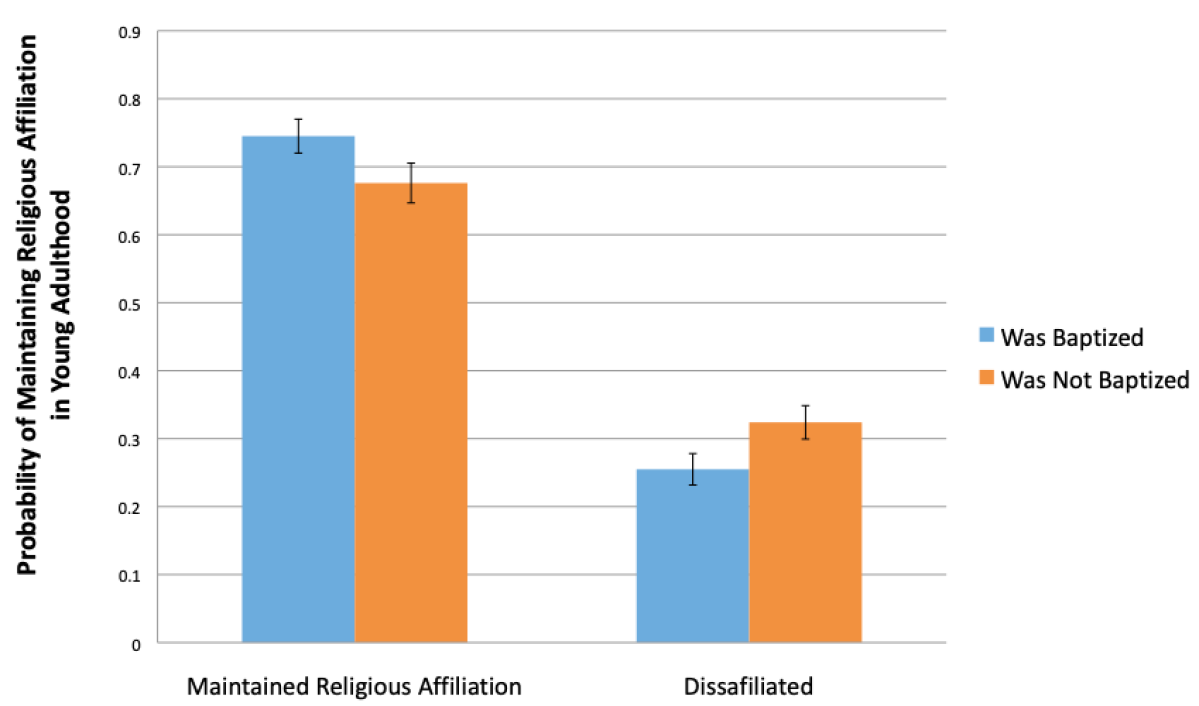
Our study showed that participants who had undergone any religious rite of passage during or before their teenage years did not necessarily turn out more religious than those who had not undergone a rite of passage. However, they were 30 percent more likely to stay in their religious faith.

Though the pattern was the same across all religious rites and groups, the figure below shows the trend when we focus on believer’s baptism and disaffiliation among Protestant youth.

Samuel Perry

Notice first, most young people in the sample maintained their initial Christian affiliation whether or not they were baptized. But even after we accounted for teens’ initial religious commitment along with that of their parents and friends and other relevant factors, those who had undergone believer’s baptism before or during their teenage years were less likely to indicate they were “unaffiliated” in their mid-twenties.

So how does this work? The Westminster Confession calls baptism (applied to infants or adults) the “sign and seal of the covenant of grace.” What might grant believer’s baptism its “sealing” potential for young Americans?

We think the fact that baptism didn’t predict how religiously committed someone would be in their mid-twenties provides a clue. The experience of baptism doesn’t seem to have a lasting influence on one’s day-to-day religious practice, likely because that sort of influence requires a more consistent infusion of religious energy (or “grace”) from rites like regular worship attendance, or other sacraments, like The Lord’s Supper. Typically a one-time event, believer’s baptism doesn’t bind us to a certain level of faith commitment, but to a faith community. It’s about belonging and identity.

Much like the common finding that couples who are formally married are more likely to stay together than cohabiting couples who remain unmarried, for young Americans there is something binding about commitment that is declarative, formal, and public.

Consider baptism at my own church in Norman, Oklahoma. Our baptisms do not happen spontaneously without some sort of vetting on the part of parents and church leaders. There is often a formal process that includes a waiting period. The baptism ceremony is not only preceded by the affirmation of important questions, but for years now, those who are baptized provide a public reading of their personal testimony. Nervousness and tears are the norm here.

And the ceremony itself—though beautiful, given what it signifies—is messy, unnatural, and awkward. People have to change their clothes afterwards. Emerging from the water, one is greeted with thunderous applause and yells that border on the hysterical. One’s baptism, in other words is memorable. And it is social. And it is memorable because it is social.

Protestants have had long theological debates about the “efficacy” of believer’s baptism and what exactly God accomplishes through it as a “means of grace.” From what we can observe in the data, believer’s baptism accomplishes a durable social identity for young Americans. It may not make them more committed to their faith as young adults (participation of other kinds will be necessary for that), but it may help them weather some of the assaults of young adulthood such that they emerge on the other side with their faith intact.

Samuel Perry is an assistant professor of sociology and religious studies at the University of Oklahoma. His books include

Growing God’s Family, Addicted to Lust,

and

Taking America Back for God

. Follow him on Twitter at @socofthesacred.

Pastors

Where Can a Pastor Find Church?

Can those who lead congregations receive ministry from them as well?

CT Pastors November 15, 2019
Prixel Creative / Lightstock

Many of us chose to become pastors because we love the church.

We love the strange blend of characters who have been brought to this place. We love the sound of many voices singing the same songs over and over. We love the way a community of ordinary, broken people can somehow express something transcendent to the world.

Given our desire to see people brought together and cared for, it’s a strange, sad reality that often pastors—the ones who love and lead the church—find ourselves without a church. At least not in the same way others have a church. In a cruel twist of irony, the church we lead isn’t really church for us. Some of the biggest challenges we face may come from the very congregation we lead. Maybe someone who reminds you of your estranged father rejects you just like he did, or you endure a sleepless night after receiving petty criticism from a parishioner. Who will be church for us when we have to talk to someone about the pain or loneliness of leading a church?

Scripture describes a unique role for leaders. Paul calls himself and Apollos fellow workers who planted and watered. The recipients of his letter were the field (1 Cor. 3:1–9). James 3:1 cautions, “Not many of you should become teachers, my fellow believers, because you know that we who teach will be judged more strictly.” Clearly the leaders of a congregation are there to serve the congregation, not themselves.

At the same time, as part of our service to the congregation, we need to be personally invested. We do our congregations a disservice if we pretend we have no need for church. How well could a chef cook if he never tasted the food? If we pretend we have no need for church, we minimize the very thing we’re leading. If we are only functionaries, not participants, we risk communicating a closed, distanced kind of leadership. If we only engage professionally in the church we lead, we’ll lose touch with everyone else there who is engaging personally.

I remember the time a prayer training I’d organized became an unexpected opportunity to learn my need for my own congregation. During the training, I raised a question which was obviously connected to some deep ministry disappointment in me. The trainer responded with, “That seems significant, Mandy. Can we pray for you now?” Although I was uncomfortable, I chose to let 15 members of my community gather around me and pray for me. I sat cross-legged on the floor and sobbed while they laid hands on me, and I felt surrounded by the body of Christ in a way I’d never known before. And although I would have preferred to calmly tell the church about a time when people prayed for me, it was more meaningful for them to get to participate in it, to watch me trust in God and in the power of communal prayer. While I gathered myself afterwards, wondering if I should be ashamed for letting my people see me in need, several folks approached me to say it was the most powerful part of the training. Somehow I blessed them by letting them bless me.

If we only engage professionally in the church we lead, we’ll lose touch with everyone else there who is engaging personally.

It’s a fine line to walk—to know we’re responsible for tending the garden, yet to admit we need nourishment from what grows there. How can we acknowledge our need for church while also leading a church? We can’t just let what feels right determine our engagement since that will likely grow from our personality and family of origin. More extraverted pastors may have a tendency to overshare and become connected in a way that is not healthy for their congregations. Introverted pastors may keep to themselves in a way that feels selfless but actually keeps people at arm’s length. As a peacemaker and people-pleaser, I love connection with folks and have a tendency to be everyone’s best friend in a way that is not always helpful for them or for me. And simultaneously, as an introvert, I tend to process privately and keep my needs to myself in a misdirected effort at selflessness which actually makes people feel I’m trying to be self-sufficient. How do we engage with our congregations in a way that is healthy for them and for us, for the sake of the kingdom?

Without taking a consumerist view of the congregation, it may be helpful to break down some of the key spiritual, emotional, and relational needs that a church often meets. Participants in a local congregation find various spiritual hungers fed by that congregation. The congregations we lead can be our church in some of these ways, yet other needs must be met apart from our congregations.

Spiritual Leadership

It’s hard to find people who can think of us as a brother or sister without thinking of how our needs or questions might affect them as a member of our congregation. And even if we have spiritual leaders in place in our congregations or denominations, they may not be a natural connection for us because of power dynamics or personality. Thankfully the Lord has provided several older, wise folks in my congregation who knew me before I was pastor and so can see me not only as their pastor but also as a sister in Christ.

Not everyone is so lucky. It is especially crucial for these pastors to find insight through regular time with a spiritual director. Sustainable Faith and Grafted Life Ministries are both excellent places to find a spiritual director. I see a sister at a local monastery once a month. Since the Catholic church has a rich tradition of spiritual direction, you could contact a local monastery or Catholic retreat center to ask if they offer this service.

Teaching

While we may not have a pastoral teacher in the sense others in the congregation do, the work of living among followers and watching how they know God is one of our best teachers. In sermons and bible studies I often share things I’m sensing from God that seem significant but vague. Then someone in the congregation takes hold of them and applies them to their life in a beautiful way. The original insight takes on new meaning for me as I watch someone live it out. In conversation with folks throughout the week, I often find myself surprised and edified by the ways they see and live Scripture. And that includes children. They are some of my best teachers.

Of course, we’ll have many opportunities to listen to other teachers through reading, podcasts, and conferences. But some of the best learning opportunities come from attending to the Lord on a daily basis. He, ultimately, is the leader and teacher of this congregation and of this pastor. He somehow knows how to interweave the week’s sermon theme with my personal struggles and what a staff member says on Tuesday morning with what a woman says at Thursday evening prayer group. Out of trust in this possibility, I choose to begin sermon prep by lying in bed and listening to the Bible passage over and over, resting from my efforts to make something amazing for others and resting in the possibility that whatever he wants to say through me he first wants to say to me.

Friendship and Community

I haven’t always done this perfectly. One time I spotted a church member in the park on my day off. At first I enjoyed chatting with him without being in pastor mode—until he began to complain about our church. Instead of my usual pastoral response, my guard was down and I responded from hurt feelings.

It’s a fine line to walk—to know we’re responsible for tending the garden, and at the same time, to acknowledge we also need nourishment from what grows there.

Then there was the time I was grieving, but because I didn’t want to “burden” anyone, I soldiered on resentfully. Folks were (understandably) hurt that I didn’t trust them enough to care for me. Even the work of discerning this balance puts us in a unique situation in our congregations.

Because of these difficult dynamics, we need friends outside of our congregations to help us learn how to be friends with those in our congregations. Perhaps your denomination offers opportunities to gather with other leaders. If not, I recommend reaching out to pastors in your city for a monthly time to pray and support one another. I’ve found it meaningful to join a network of churches—Ecclesia Network—since my church is nondenominational. Every year at our national gathering, I say, “Here I can just go to church instead of planning it!” I also had a great experience with Fuller Seminary’s Micah Groups where pastors participate in an online curriculum and then gather with a closed group of other pastors 12 times for one or two years.

Opportunities to Serve

In addition to the things outlined in our job descriptions, pastors have opportunities—often unknown to others—to serve outside our professional roles. My church building is on a busy, urban street corner, and every Sunday morning the street shows evidence of the previous night’s parties. I don’t look forward to finding this mess early on a Sunday morning, especially when the sermon is defying my efforts to shape it. But on the days that I grab a broom and trash bag, my heart changes. I move from irritation to calm. The task invites me to pray for the folks who were on the street late the night before. The sweeping slows my racing heart, reminds me why I’m here, why I’m even writing a sermon. By the time I finish, the street and my heart are better off.

And, just like others in the congregation, we sometimes need permission to say no to some service opportunities, taking into consideration our capacity, our health, and how much else we’re doing on any given day. When we can’t get to the store in time for a food drive or we aren’t able to visit a person in the hospital, we have to trust that we’re helping to shape a community that will help meet those needs. The many hours we invest developing other servants also counts as service.

Practical Help and Assistance

Our own churches can and should walk alongside us in the daily things and provide practical help in times of crisis. Of course, we have to be thoughtful about how we share our needs and the needs of our family. For example, one of my greatest sources of pain is living far from extended family in a culture not my own. But if I talk about it too much with my congregation, I fear they will hear me saying I’m not invested in this neighborhood, in this culture. But if I communicate this loneliness carefully, it can be an opportunity for connection with my congregation—especially those who are also far from home. When I’ve most missed my family in Australia, folks here have been my family, and I have been blessed by knowing they can meet that need in my life. As humbling as it is to confess my needs, if I am blessed by blessing them, why would I withhold an opportunity for them to be blessed by blessing me?

Being Part of Something Bigger Than Ourselves

Pastors bear significant burdens. Within one week, we may chair a tense meeting, take a midnight phone call about burst pipes, get bad news about the offering, and walk a parishioner through a suicide attempt—all while managing our personal lives. And no one in the congregation may know all that we’re carrying.

Yet pastors also have a front row seat to miracles. We get to hear stories of healing and hope, sometimes stories no one else will know. Some of the most transcendent moments of my life come from the unique place from which I’m allowed to watch God at work in his church. I get to see many different stories blend into one voice. Every Sunday morning, when I end the service by leading the doxology, all I have to do is sing the first note and then the rest of the congregation comes in. The sound builds and washes over me. My voice blends with many others, and what I began grows so much bigger than me.

As always, our best model in this is Jesus. He took the risk to call his disciples friends, letting three of them into his closest confidence. He let them see him in his moments of greatest brokenness. Yet he found his deepest connection with the Father, always returning to the Father’s guidance and comfort. Jesus did not lose himself in an effort to please people. His connection to the Father gave him wisdom about how and where to share himself. I need to remind myself to follow his example, as described in John 2:24–25: “Jesus would not entrust himself to them … for he knew what was in each person.”

We will not get it right every time. We will overshare and under-share. We will become codependent and self-sufficient. Even the process of discerning this is a spiritual discipline teaching us God’s grace. When we’re having a hard day and a mature congregant asks how they can pray for us, will we share? And if so, how much? When our own marriage needs some help, will we participate in the marriage class alongside our congregants? This teaches us, as pastors, the experience that all church members have: to have grace for human beings’ and the church’s imperfections. As people learn to set appropriate expectations of us and we learn to share ourselves with them, we will all be released from our temptation to idolize human leadership (even our own). And we will all learn to find our deepest connection in the One who is our truest friend of all.

Mandy Smith is lead pastor of University Christian Church in Cincinnati, Ohio, and author of The Vulnerable Pastor.

News

Black Pastor Candidate Withdraws After Controversial Vote at SBC Megachurch

First Baptist Church of Naples, Florida, continues to investigate whether Marcus Hayes’s rejection was the result of racial prejudice or preexisting turmoil following its previous pastor’s departure.

Christianity Today November 15, 2019
Andrij Bulba / Flickr

A black Southern Baptist minister has withdrawn his name from further consideration at the Florida megachurch that failed last month to achieve the supermajority vote required to call him as pastor, sparking accusations of racism from within and outside the congregation.

First Baptist Church of Naples, Florida, announced yesterday in an email to members that Marcus Hayes “has asked that his name be removed from consideration to be our next Senior Pastor.” The email, signed by the congregation’s eight-member senior pastor search team, called the withdrawal of Hayes’ candidacy “a major disappointment to several thousand members and supporters of First Baptist.”

Hayes has declined to make a statement to media regarding his decision.

Search team chairman Neil Dorrill had told the congregation November 2 he hoped Hayes, an African American, would allow himself to be considered a second time as a candidate for the senior pastor vacancy.

Currently a campus pastor at Biltmore Baptist Church in Arden, North Carolina, Hayes was presented October 26 and 27 as the candidate for the top leadership spot at the predominantly Anglo church. Its bylaws require “at least an 85% majority vote by secret ballot” to elect a senior pastor. But Hayes garnered only 1,552 of the 1,917 votes cast (81%).

Following the vote, FBC Naples’ executive pastor John Edie claimed in an open letter to the Southern Baptist Convention (SBC) that there were “racial prejudices” behind the vote, which manifested themselves in a “campaign that started just days before.” The church, he said, had already begun “to make sure that this sinful cancer is dealt with.”

That week, First Baptist’s deacons voted to remove from membership at least 18 people as an act of church discipline. One of those disciplined members, Bob Caudill, a former deacon and member of the pastor search committee, was told his expulsion came as consequence of breaking the church covenant, failing to protect the church’s unity, not acting in love, gossiping, and failing to follow church leaders.

But Caudill told Christianity Today a different story. He said he and 17 others who also received church discipline from the deacons raised questions about Hayes that had nothing to do with racism but that stemmed from at least seven months of church conflict.

While the church is attempting to discern which interpretation of events is correct, the SBC more broadly has been paying attention. As the denomination continues its efforts to raise up more leaders of color, it has been forced to confront an ongoing history of racism. (Just this week a 2012 letter from former seminary president Paige Patterson was made public, indicating that he worried about a theological backslide under the denomination’s first black president.)

Southern Baptists took note of Edie’s letter regarding the FBC Naples vote and shared their reactions online. Dwight McKissic, an African American pastor in Texas, called it “shameful” and stated he may make a motion in 2020 for the SBC to withdraw fellowship from First Baptist. Former SBC President Jack Graham said it “appears that there was racism” involved in the vote.

First Baptist declined to share further details about its allegation of racism, though Dorrill said at an October 24 Q&A session with Hayes that “inappropriate emails” were sent to Hayes’s church in North Carolina. CT was not able to confirm whether the North Carolina congregation received such communications.

Additionally, a lengthy email was sent last month to hundreds of First Baptist members, criticizing Hayes’ positions on race in the church based on his posts on social media and implying Hayes espouses liberal views. When asked in a Q&A session about accusations of liberalism, Hayes said he is “as conservative as they come,” the Naples Daily News reported.

The 2,500-word message, which was obtained by CT, called out Hayes’s endorsement of Eric Mason’s book Woke Church, calling it “cultural Marxism forged in the ovens of Godless leftist ideologues.” The email cited Florida pastor Tom Ascol’s critique of what he sees as encroaching liberalism in the SBC.

In Naples, the population is nearly 94 percent Anglo, according to US Census data. First Baptist’s former pastor Hayes Wicker, who left this spring following a 27-year pastorate, told CT he never saw evidence of racism among the congregation, which grew to around 4,000 under his leadership.

“Knowing the sinful hearts of man, I am sure that some votes were racially motivated,” he said, “but from our own personal experience, our African American granddaughter was always welcomed with love and acceptance by our church body. Racism certainly exists in our world, but we sought to make our church a haven for people of all socioeconomic, cultural, and ethnic backgrounds.”

Caudill, the former First Baptist deacon, said the church’s turmoil dates back at least to the spring, when Wicker’s plan to transition gradually out of First Baptist’s pastorate and make way for younger leadership went awry. Some of leaders claimed Wicker, a former president of the SBC Pastors’ Conference, attempted to exert inordinate influence on the search for his successor—a charge Wicker and his supporters deny.

Wicker resigned in April due to a combination of family- and church-related concerns, and a church committee decided to make his resignation effective immediately. By the time Hayes was announced as a pastoral candidate, more than 700 church members had signed a petition requesting a special business meeting to discuss issues dividing the church. In an October 14 letter to Hayes obtained by CT, a group identifying itself as “Concerned Members of First Baptist Naples” said the church’s “pastoral leadership refuses to cooperate” with the business meeting request.

Two current concerned members and one expelled member declined to discuss the conflict on the record—the current members for fear of retaliation and the expelled member because he didn’t want “to publicly condemn the church and felt led to let the Lord handle his church.”

Disunity had compounded by the time Hayes traveled to Naples, Caudill said, and opposition to his candidacy centered on three issues: a feeling by some that he did not have sufficient experience to pastor First Baptist; a notion he didn’t “address properly” First Baptist’s disunity; and a concern about his approach to social justice and racial issues. The latter concern may have been what Edie referenced in his letter as evidence of “racial prejudices” apparent from a campaign by “a few disgruntled people in our church.”

But for First Baptist, it has become a moot point. The pastor search committee lamented in its November 14 email to First Baptist members that the church has been “tainted by negative publicity” surrounding its vote on Hayes.

Moving forward, the committee said, the church will consider calling an interim pastor as well as amending its bylaws to require only a two-thirds majority to call a senior pastor.

“Are we disappointed? Yes,” the search committee asked. “Are we discouraged? Not at all. Are we defeated? Never. We will spend eternity together with our Savior and defeat is simply not an option.”

David Roach is a writer in Nashville, Tennessee

Apple PodcastsDown ArrowDown ArrowDown Arrowarrow_left_altLeft ArrowLeft ArrowRight ArrowRight ArrowRight Arrowarrow_up_altUp ArrowUp ArrowAvailable at Amazoncaret-downCloseCloseEmailEmailExpandExpandExternalExternalFacebookfacebook-squareGiftGiftGooglegoogleGoogle KeephamburgerInstagraminstagram-squareLinkLinklinkedin-squareListenListenListenChristianity TodayCT Creative Studio Logologo_orgMegaphoneMenuMenupausePinterestPlayPlayPocketPodcastRSSRSSSaveSaveSaveSearchSearchsearchSpotifyStitcherTelegramTable of ContentsTable of Contentstwitter-squareWhatsAppXYouTubeYouTube