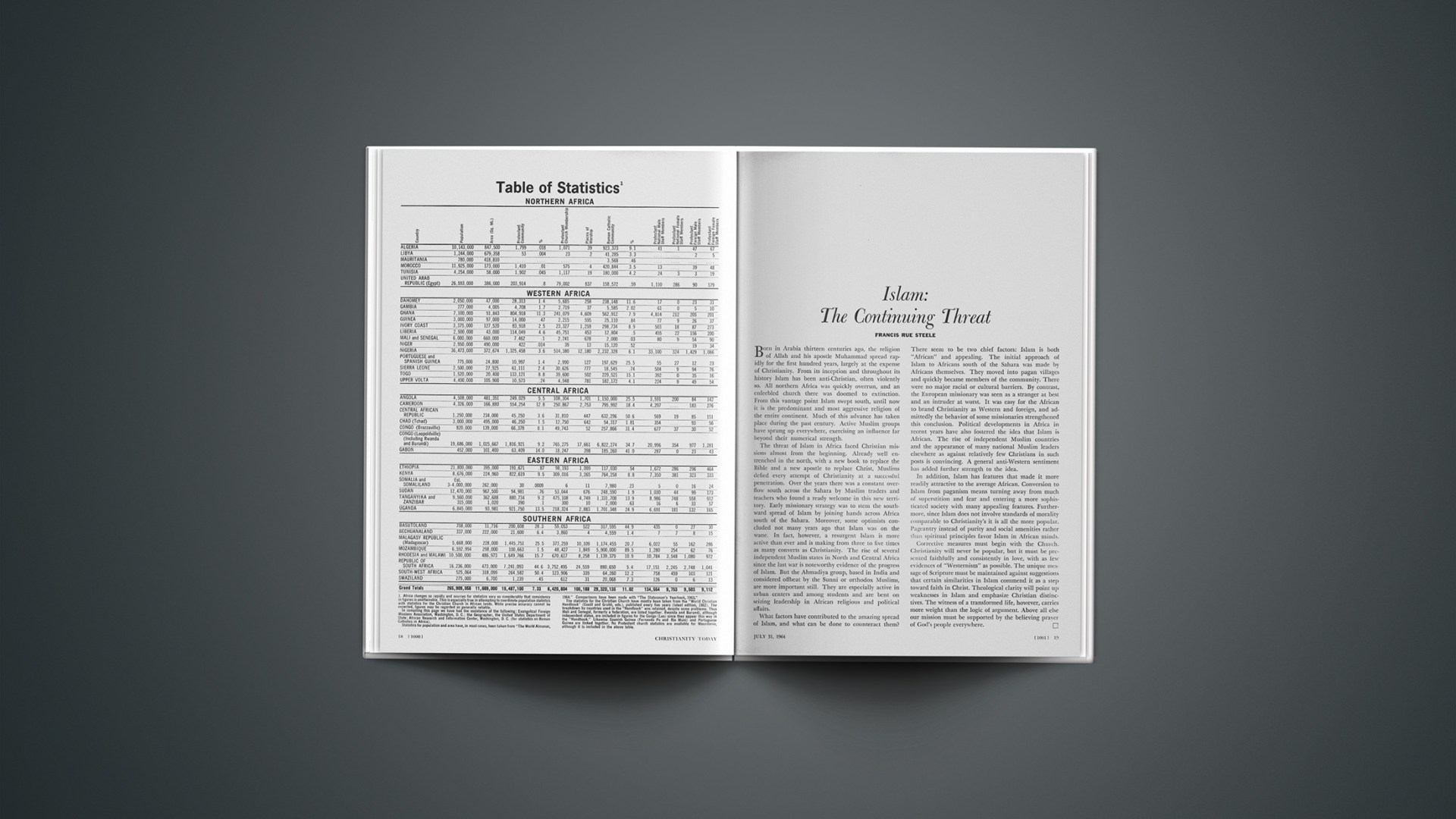
Born in Arabia thirteen centuries ago, the religion of Allah and his apostle Muhammad spread rapidly for the first hundred years, largely at the expense of Christianity. From its inception and throughout its history Islam has been anti-Christian, often violently so. All northern Africa was quickly overrun, and an enfeebled church there was doomed to extinction. From this vantage point Islam swept south, until now it is the predominant and most aggressive religion of the entire continent. Much of this advance has taken place during the past century. Active Muslim groups have sprung up everywhere, exercising an influence far beyond their numerical strength.
The threat of Islam in Africa faced Christian missions almost from the beginning. Already well entrenched in the north, with a new book to replace the Bible and a new apostle to replace Christ, Muslims defied every attempt of Christianity at a successful penetration. Over the years there was a constant overflow south across the Sahara by Muslim traders and teachers who found a ready welcome in this new territory. Early missionary strategy was to stem the southward spread of Islam by joining hands across Africa south of the Sahara. Moreover, some optimists concluded not many years ago that Islam was on the wane. In fact, however, a resurgent Islam is more active than ever and is making from three to five times as many converts as Christianity. The rise of several independent Muslim states in North and Central Africa since the last war is noteworthy evidence of the progress of Islam. But the Ahmadiya group, based in India and considered offbeat by the Sunni or orthodox Muslims, are more important still. They are especially active in urban centers and among students and are bent on seizing leadership in African religious and political affairs.
What factors have contributed to the amazing spread of Islam, and what can be done to counteract them? There seem to be two chief factors: Islam is both “African” and appealing. The initial approach of Islam to Africans south of the Sahara was made by Africans themselves. They moved into pagan villages and quickly became members of the community. There were no major racial or cultural barriers. By contrast, the European missionary was seen as a stranger at best and an intruder at worst. It was easy for the African to brand Christianity as Western and foreign, and admittedly the behavior of some missionaries strengthened this conclusion. Political developments in Africa in recent years have also fostered the idea that Islam is African. The rise of independent Muslim countries and the appearance of many national Muslim leaders elsewhere as against relatively few Christians in such posts is convincing. A general anti-Western sentiment has added further strength to the idea.
In addition, Islam has features that made it more readily attractive to the average African. Conversion to Islam from paganism means turning away from much of superstition and fear and entering a more sophisticated society with many appealing features. Furthermore, since Islam does not involve standards of morality comparable to Christianity’s it is all the more popular. Pageantry instead of purity and social amenities rather than spiritual principles favor Islam in African minds.
Corrective measures must begin with the Church. Christianity will never be popular, but it must be presented faithfully and consistently in love, with as few evidences of “Westernism” as possible. The unique message of Scripture must be maintained against suggestions that certain similarities in Islam commend it as a step toward faith in Christ. Theological clarity will point up weaknesses in Islam and emphasize Christian distinctives. The witness of a transformed life, however, carries more weight than the logic of argument. Above all else our mission must be supported by the believing prayer of God’s people everywhere.