





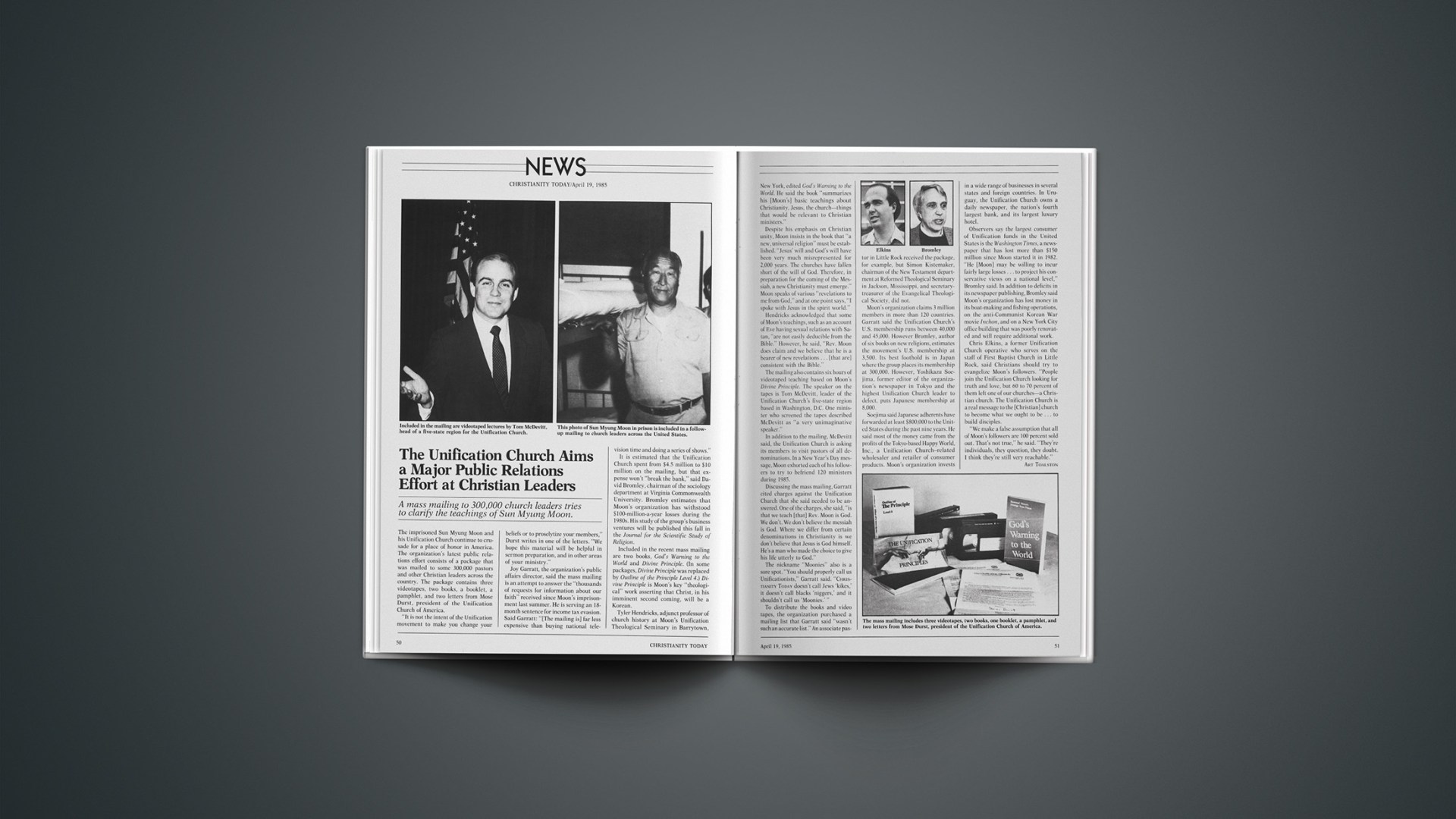

A mass mailing to 300,000 church leaders tries to clarify the teachings of Sun Myung Moon.
The imprisoned Sun Myung Moon and his Unification Church continue to crusade for a place of honor in America. The organization’s latest public relations effort consists of a package that was mailed to some 300,000 pastors and other Christian leaders across the country. The package contains three videotapes, two books, a booklet, a pamphlet, and two letters from Mose Durst, president of the Unification Church of America.
“It is not the intent of the Unification movement to make you change your beliefs or to proselytize your members,” Durst writes in one of the letters. “We hope this material will be helpful in sermon preparation, and in other areas of your ministry.”
Joy Garratt, the organization’s public affairs director, said the mass mailing is an attempt to answer the “thousands of requests for information about our faith” received since Moon’s imprisonment last summer. He is serving an 18-month sentence for income tax evasion. Said Garratt: “[The mailing is] far less expensive than buying national television time and doing a series of shows.”
It is estimated that the Unification Church spent from $4.5 million to $10 million on the mailing, but that expense won’t “break the bank,” said David Bromley, chairman of the sociology department at Virginia Commonwealth University. Bromley estimates that Moon’s organization has withstood $100-million-a-year losses during the 1980s. His study of the group’s business ventures will be published this fall in the Journal for the Scientific Study of Religion.
Included in the recent mass mailing are two books, God’s Warning to the World and Divine Principle. (In some packages, Divine Principle was replaced by Outline of the Principle Level 4.) Divine Principle is Moon’s key “theological” work asserting that Christ, in his imminent second coming, will be a Korean.
Tyler Hendricks, adjunct professor of church history at Moon’s Unification Theological Seminary in Barrytown, New York, edited God’s Warning to the World. He said the book “summarizes his [Moon’s] basic teachings about Christianity, Jesus, the church—things that would be relevant to Christian ministers.”
Despite his emphasis on Christian unity, Moon insists in the book that “a new, universal religion” must be established. “Jesus’ will and God’s will have been very much misrepresented for 2,000 years. The churches have fallen short of the will of God. Therefore, in preparation for the coming of the Messiah, a new Christianity must emerge.” Moon speaks of various “revelations to me from God,” and at one point says, “I spoke with Jesus in the spirit world.”
Hendricks acknowledged that some of Moon’s teachings, such as an account of Eve having sexual relations with Satan, “are not easily deducible from the Bible.” However, he said, “Rev. Moon does claim and we believe that he is a bearer of new revelations … [that are] consistent with the Bible.”
The mailing also contains six hours of videotaped teaching based on Moon’s Divine Principle. The speaker on the tapes is Tom McDevitt, leader of the Unification Church’s five-state region based in Washington, D.C. One minister who screened the tapes described McDevitt as “a very unimaginative speaker.”
In addition to the mailing, McDevitt said, the Unification Church is asking its members to visit pastors of all denominations. In a New Year’s Day message, Moon exhorted each of his followers to try to befriend 120 ministers during 1985.
Discussing the mass mailing, Garratt cited charges against the Unification Church that she said needed to be answered. One of the charges, she said, “is that we teach [that] Rev. Moon is God. We don’t. We don’t believe the messiah is God. Where we differ from certain denominations in Christianity is we don’t believe that Jesus is God himself. He’s a man who made the choice to give his life utterly to God.”
The nickname “Moonies” also is a sore spot. “You should properly call us Unificationists,” Garratt said. “CHRISTIANITY TODAY doesn’t call Jews ‘kikes,’ it doesn’t call blacks ‘niggers,’ and it shouldn’t call us ‘Moonies.’ ”
To distribute the books and video tapes, the organization purchased a mailing list that Garratt said “wasn’t such an accurate list.” An associate pastor in Little Rock received the package, for example, but Simon Kistemaker, chairman of the New Testament department at Reformed Theological Seminary in Jackson, Mississippi, and secretary-treasurer of the Evangelical Theological Society, did not.
Moon’s organization claims 3 million members in more than 120 countries. Garratt said the Unification Church’s U.S. membership runs between 40,000 and 45,000. However Bromley, author of six books on new religions, estimates the movement’s U.S. membership at 3,500. Its best foothold is in Japan where the group places its membership at 300,000. However, Yoshikazu Soejima, former editor of the organization’s newspaper in Tokyo and the highest Unification Church leader to defect, puts Japanese membership at 8,000.
Soejima said Japanese adherents have forwarded at least $800,000 to the United States during the past nine years. He said most of the money came from the profits of the Tokyo-based Happy World, Inc., a Unification Church—related wholesaler and retailer of consumer products. Moon’s organization invests in a wide range of businesses in several states and foreign countries. In Uruguay, the Unification Church owns a daily newspaper, the nation’s fourth largest bank, and its largest luxury hotel.
Observers say the largest consumer of Unification funds in the United States is the Washington Times, a newspaper that has lost more than $150 million since Moon started it in 1982. “He [Moon] may be willing to incur fairly large losses … to project his conservative views on a national level,” Bromley said. In addition to deficits in its newspaper publishing, Bromley said Moon’s organization has lost money in its boat-making and fishing operations, on the anti-Communist Korean War movie Inchon, and on a New York City office building that was poorly renovated and will require additional work.
Chris Elkins, a former Unification Church operative who serves on the staff of First Baptist Church in Little Rock, said Christians should try to evangelize Moon’s followers. “People join the Unification Church looking for truth and love, but 60 to 70 percent of them left one of our churches—a Christian church. The Unification Church is a real message to the [Christian] church to become what we ought to be … to build disciples.
“We make a false assumption that all of Moon’s followers are 100 percent sold out. That’s not true,” he said. “They’re individuals, they question, they doubt. I think they’re still very reachable.”







