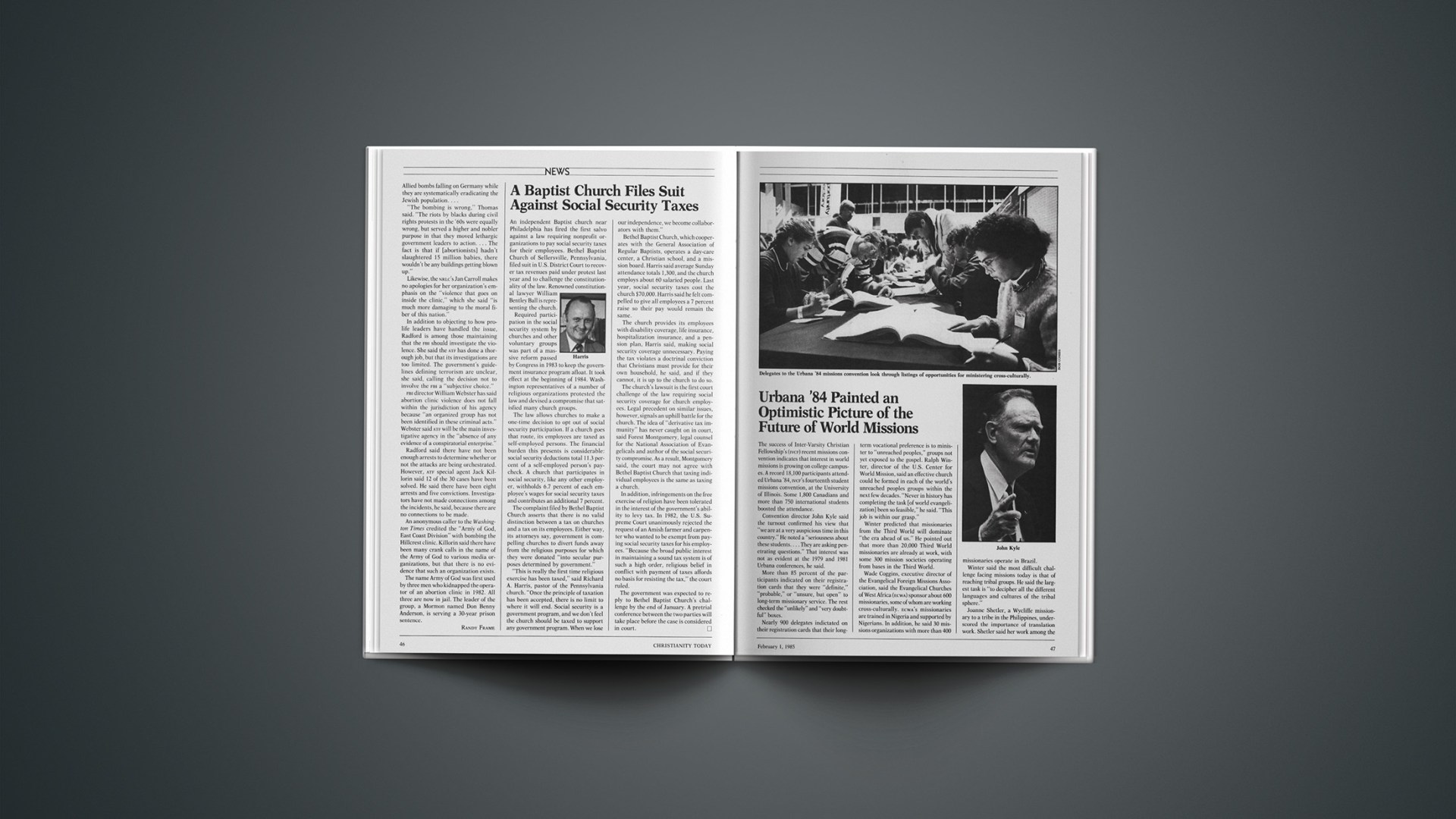

The success of Inter-Varsity Christian Fellowship’s (IVCF) recent missions convention indicates that interest in world missions is growing on college campuses. A record 18,100 participants attended Urbana ’84, IVCF’s fourteenth student missions convention, at the University of Illinois. Some 1,800 Canadians and more than 750 international students boosted the attendance.
Convention director John Kyle said the turnout confirmed his view that “we are at a very auspicious time in this country.” He noted a “seriousness about these students.… They are asking penetrating questions.” That interest was not as evident at the 1979 and 1981 Urbana conferences, he said.
More than 85 percent of the participants indicated on their registration cards that they were “definite,” “probable,” or “unsure, but open” to long-term missionary service. The rest checked the “unlikely” and “very doubtful” boxes.
Nearly 900 delegates indictated on their registration cards that their long-term vocational preference is to minister to “unreached peoples,” groups not yet exposed to the gospel. Ralph Winter, director of the U.S. Center for World Mission, said an effective church could be formed in each of the world’s unreached peoples groups within the next few decades. “Never in history has completing the task [of world evangelization] been so feasible,” he said. “This job is within our grasp.”
Winter predicted that missionaries from the Third World will dominate “the era ahead of us.” He pointed out that more than 20,000 Third World missionaries are already at work, with some 300 mission societies operating from bases in the Third World.
Wade Coggins, executive director of the Evangelical Foreign Missions Association, said the Evangelical Churches of West Africa (ECWA) sponsor about 600 missionaries, some of whom are working cross-culturally. ECWA’s missionaries are trained in Nigeria and supported by Nigerians. In addition, he said 30 missions organizations with more than 400 missionaries operate in Brazil.
Winter said the most difficult challenge facing missions today is that of reaching tribal groups. He said the largest task is “to decipher all the different languages and cultures of the tribal sphere.”
Joanne Shetler, a Wycliffe missionary to a tribe in the Philippines, underscored the importance of translation work. Shetler said her work among the primitive Balangao tribe and her battle with the evil spirits that controlled their lives made significant strides only when Scripture was made available in the tribe’s language.
Unreached peoples groups include more than 350,000 international students studying in the United States, said Arthur Everett, director of the Association of Christian Ministries to Internationals. “While Christian ministry to internationals has expanded tremendously, there’s still a great deal to be done.” He said some 80 American cities with 500 or more international students have no viable, ongoing ministry.
Internationals sometimes take the initiative to meet their own spiritual needs. Urbana ’76 saw the formation of the African Christian Fellowship in the United States. At Urbana ’84, Tokunboh Adeyemo, executive council chairman of the World Evangelical Fellowship, said Africa is preparing for its own student missions convention in 1986. Adeyemo said organizers hope to attract 10,000 university students from across the African continent.
In contrast to the generally upbeat spirit at the convention, one seminar leader criticized Urbana ’84 for a lack of attention to social issues. Harvie Conn, director of the urban missions program at Westminster Theological Seminary, said there was less emphasis on social action at Urbana ’84 than at any of IVCF’s three previous missions conventions. Among the plenary speakers, Conn said, only Adeyemo spoke about social justice.
He noted, however, that the conventions’s elective seminars “continue to be very wholistic.” Conn’s seminar, Evangelism and Social Justice, drew capacity crowds totaling about 600 participants.
Conn’s concern was not new to convention director Kyle. “I have been listening to him for two Urbana conventions,” Kyle said. “You have got to trust your [plenary] speakers.” The speakers would have addressed social justice questions “if they felt led,” he said. What was missing from the plenary addresses was balanced by the elective seminars, Kyle said.