






The city that launched Graham as an internationally known evangelist welcomes him back in record numbers.
A young Billy Graham was the evangelist for a 1949 tent meeting in downtown Los Angeles. He said someone later told him that William Randolph Hearst had attended the crusade out of curiosity. The influential publisher must have been impressed, because reporters and photographers suddenly descended on the tent meeting.
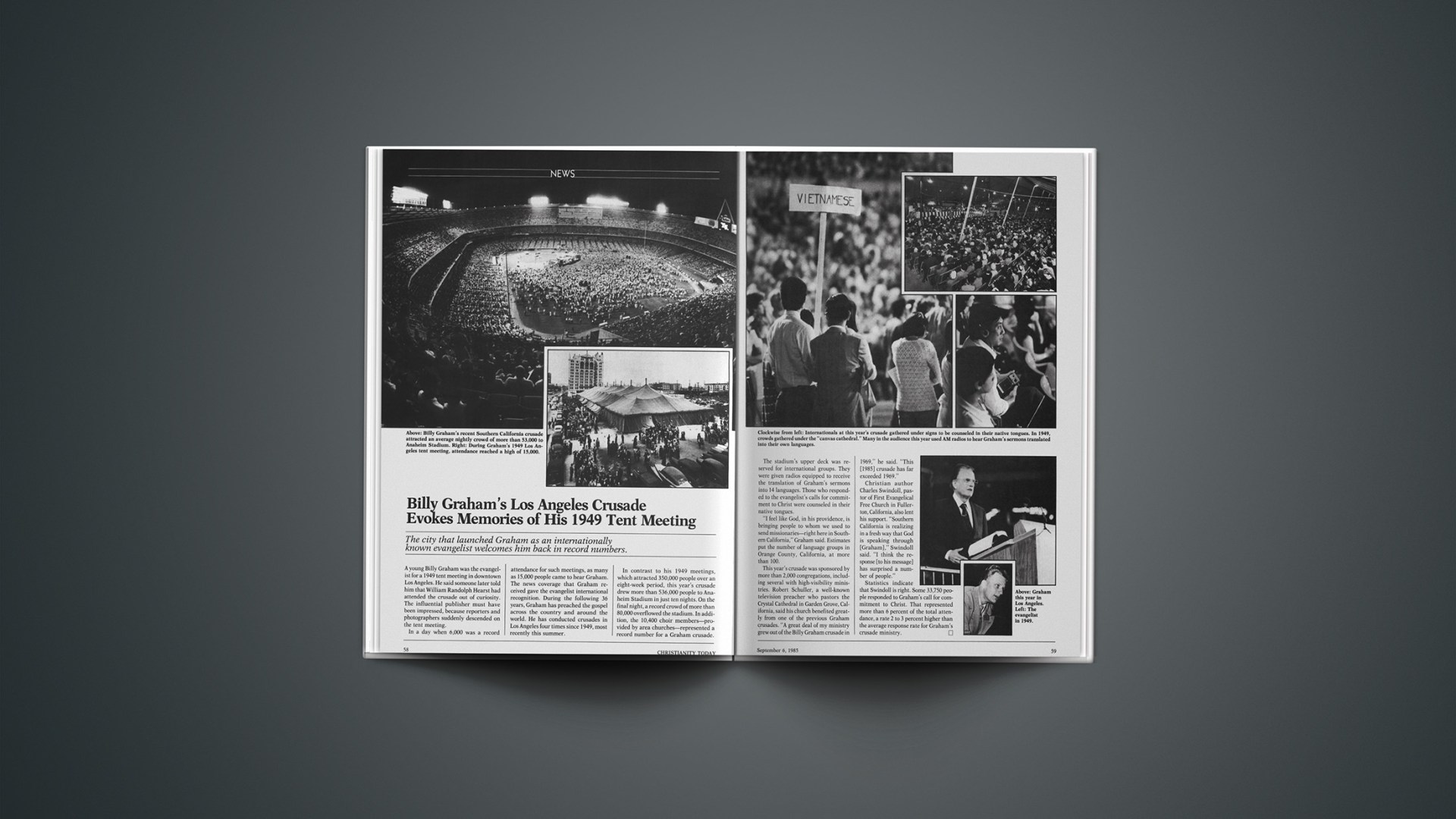
In a day when 6,000 was a record attendance for such meetings, as many as 15,000 people came to hear Graham. The news coverage that Graham received gave the evangelist international recognition. During the following 36 years, Graham has preached the gospel across the country and around the world. He has conducted crusades in Los Angeles four times since 1949, most recently this summer.
In contrast to his 1949 meetings, which attracted 350,000 people over an eight-week period, this year’s crusade drew more than 536,000 people to Anaheim Stadium in just ten nights. On the final night, a record crowd of more than 80,000 overflowed the stadium. In addition, the 10,400 choir members—provided by area churches—represented a record number for a Graham crusade.
The stadium’s upper deck was reserved for international groups. They were given radios equipped to receive the translation of Graham’s sermons into 14 languages. Those who responded to the evangelist’s calls for commitment to Christ were counseled in their native tongues.
“I feel like God, in his providence, is bringing people to whom we used to send missionaries—right here in Southern California,” Graham said. Estimates put the number of language groups in Orange County, California, at more than 100.
This year’s crusade was sponsored by more than 2,000 congregations, including several with high-visibility ministries. Robert Schuller, a well-known television preacher who pastors the Crystal Cathedral in Garden Grove, California, said his church benefited greatly from one of the previous Graham crusades. “A great deal of my ministry grew out of the Billy Graham crusade in 1969,” he said. “This [1985] crusade has far exceeded 1969.”
Christian author Charles Swindoll, pastor of First Evangelical Free Church in Fullerton, California, also lent his support. “Southern California is realizing in a fresh way that God is speaking through [Graham],” Swindoll said. “I think the response [to his message] has surprised a number of people.”
Statistics indicate that Swindoll is right. Some 33,750 people responded to Graham’s call for commitment to Christ. That represented more than 6 percent of the total attendance, a rate 2 to 3 percent higher than the average response rate for Graham’s crusade ministry.







