
The brain-teasing disputes within modern-day Christian theology rarely cross over into popular discussion. Yet, a sharp disagreement between two accomplished evangelical theologians over the nature of the resurrection body of Jesus has increasingly been played out in public, fueled in part by an escalating use of emotional and inflammatory accusations.
The so-called battle for the resurrection has become a theological street brawl of sorts in which the one side alleges “dirty tricks” and a “coverup,” while the other charges “ruthless” and “unethical” actions.
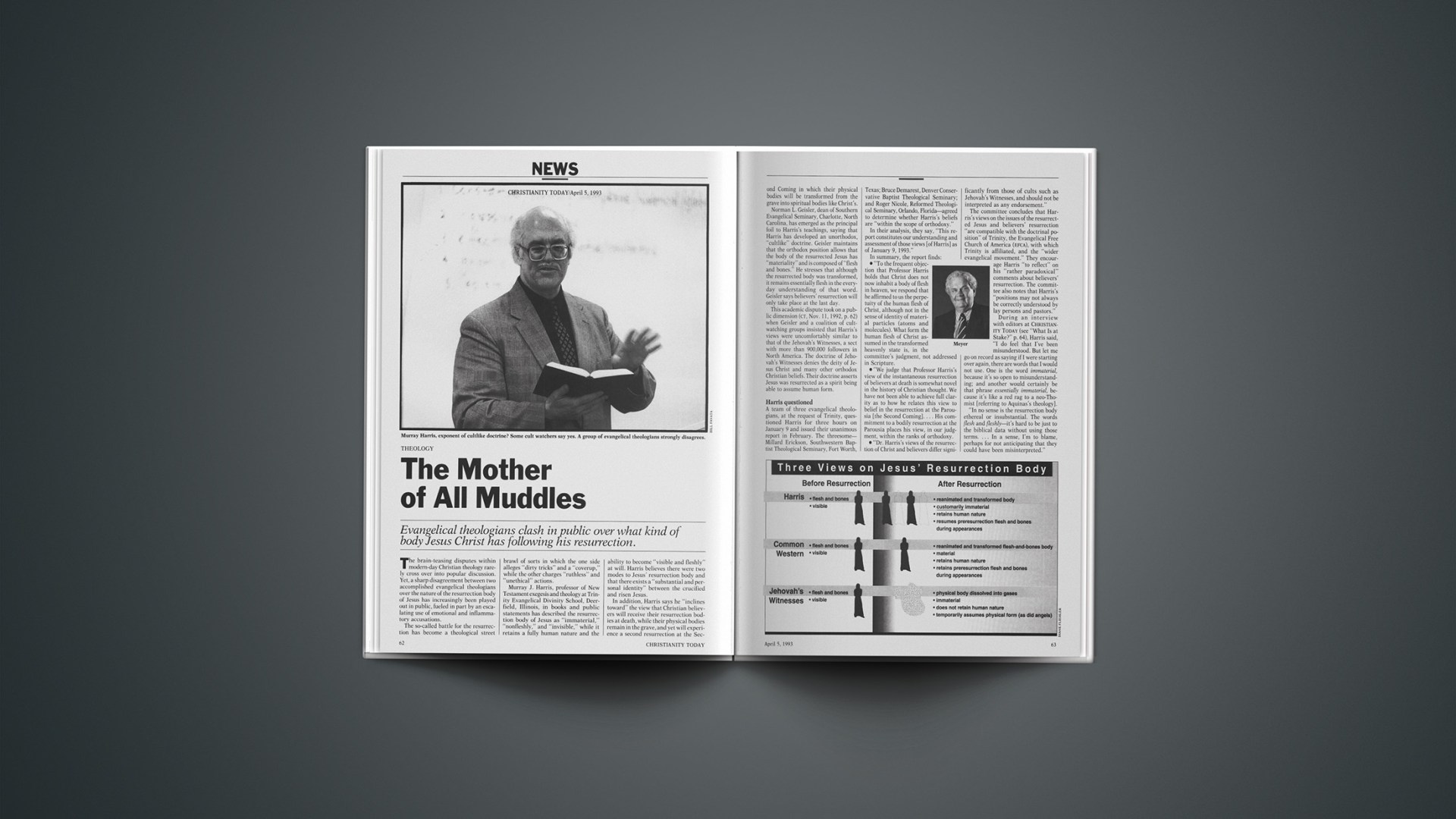
Murray J. Harris, professor of New Testament exegesis and theology at Trinity Evangelical Divinity School, Deerfield, Illinois, in books and public statements has described the resurrection body of Jesus as “immaterial,” “nonfleshly,” and “invisible,” while it retains a fully human nature and the
ability to become “visible and fleshly” at will. Harris believes there were two modes to Jesus’ resurrection body and that there exists a “substantial and personal identity” between the crucified and risen Jesus.
In addition, Harris says he “inclines toward” the view that Christian believers will receive their resurrection bodies at death, while their physical bodies remain in the grave, and yet will experience a second resurrection at the Second Coming in which their physical bodies will be transformed from the grave into spiritual bodies like Christ’s.
Norman L. Geisler, dean of Southern Evangelical Seminary, Charlotte, North Carolina, has emerged as the principal foil to Harris’s teachings, saying that Harris has developed an unorthodox, “cultlike” doctrine. Geisler maintains that the orthodox position allows that the body of the resurrected Jesus has “materiality” and is composed of “flesh and bones.” He stresses that although the resurrected body was transformed, it remains essentially flesh in the everyday understanding of that word. Geisler says believers’ resurrection will only take place at the last day.
This academic dispute took on a public dimension (CT, Nov. 11, 1992, p. 62) when Geisler and a coalition of cultwatching groups insisted that Harris’s views were uncomfortably similar to that of the Jehovah’s Witnesses, a sect with more than 900,000 followers in North America. The doctrine of Jehovah’s Witnesses denies the deity of Jesus Christ and many other orthodox Christian beliefs. Their doctrine asserts Jesus was resurrected as a spirit being able to assume human form.
Harris questioned
A team of three evangelical theologians, at the request of Trinity, questioned Harris for three hours on January 9 and issued their unanimous report in February. The threesome—Millard Erickson, Southwestern Baptist Theological Seminary, Fort Worth, Texas; Bruce Demarest, Denver Conservative Baptist Theological Seminary; and Roger Nicole, Reformed Theological Seminary, Orlando, Florida—agreed to determine whether Harris’s beliefs are “within the scope of orthodoxy.” In their analysis, they say, “This report constitutes our understanding and assessment of those views [of Harris] as of January 9, 1993.”
In summary, the report finds:
• “To the frequent objection that Professor Harris holds that Christ does not now inhabit a body of flesh in heaven, we respond that he affirmed to us the perpetuity of the human flesh of Christ, although not in the sense of identity of material particles (atoms and molecules). What form the human flesh of Christ assumed in the transformed heavenly state is, in the committee’s judgment, not addressed in Scripture.
• “We judge that Professor Harris’s view of the instantaneous resurrection of believers at death is somewhat novel in the history of Christian thought. We have not been able to achieve full clarity as to how he relates this view to belief in the resurrection at the Parousia [the Second Coming].… His commitment to a bodily resurrection at the Parousia places his view, in our judgment, within the ranks of orthodoxy.
• “Dr. Harris’s views of the resurrection of Christ and believers differ significantly from those of cults such as Jehovah’s Witnesses, and should not be interpreted as any endorsement.”
The committee concludes that Harris’s views on the issues of the resurrected Jesus and believers’ resurrection “are compatible with the doctrinal position” of Trinity, the Evangelical Free Church of America (EFCA), with which Trinity is affiliated, and the “wider evangelical movement.” They encourage Harris “to reflect” on his “rather paradoxical” comments about believers’ resurrection. The committee also notes that Harris’s “positions may not always be correctly understood by lay persons and pastors.”
During an interview with editors at CHRISTIANITY TODAY (see “What Is at Stake?” p. 64), Harris said, “I do feel that I’ve been misunderstood. But let me go on record as saying if I were starting over again, there are words that I would not use. One is the word immaterial, because it’s so open to misunderstanding; and another would certainly be that phrase essentially immaterial, because it’s like a red rag to a neo-Thomist [referring to Aquinas’s theology].
“In no sense is the resurrection body ethereal or insubstantial. The words flesh and fleshly—it’s hard to be just to the biblical data without using those terms.… In a sense, I’m to blame, perhaps for not anticipating that they could have been misinterpreted.”
Harris says the current dispute is a return to an ancient controversy between the Eastern and Western branches of Christianity. He said the Western church stresses the continuity between earthly bodies and heavenly ones. “The Greek fathers stressed rather the radical difference; that it is unimaginably different in heaven.
“I prefer to go with the Greek emphasis on the radical transformation that there is. And to say that ultimately what is the material substance of the spiritual body is not disclosed. Some will say it’s a body of glory. It’s made up of glory. Well, what is glory?” He says these discussions should be made with the realization that bodily resurrection is a mysterious and miraculous event outside normal human experience.
On the question of believers’ resurrection, Harris is unwilling to “exclude as impossible” the view that believers receive a resurrection body at death, based on his analysis of 2 Corinthians 5. “But where people can’t live with that: ‘Well, which is it?’ Well, I am happy to say we will discover it at death.”
Harris summarizes his understandings by saying, “Life in heaven is not identical with life on earth, so that a body that is fitted for heaven can’t be the same as a body that’s fitted for earth. There is both continuity because we have bodies here and there—but that [heavenly] one is going to be different, but it’s still a body.”
Contra Harris
A remarkably large number of organizations and individuals have lined up against Harris’s views on resurrection bodies as he outlined them in From Grave to Glory (Zondervan, 1990).
Witness Inc., headed by a former Jehovah’s Witness, Duane Magnani of Clayton, California, has served as an informal rallying point for those opposed to Harris’s writings. To date, about 90 organizations and individuals have signed on with Magnani. At least 34 of the groups are different local chapters of Witness Inc. In addition, well-known groups such as the Christian Research Institute (CRI), Personal Freedom Outreach, and the Spiritual Counterfeits Project have joined Witness in questioning Harris’s views.
They assert that the close parallels between Harris’s writings and the position of Jehovah’s Witnesses on the resurrection will undercut the efforts of Christians who work in ministry to aberrant religious groups. In 1992, Magnani was a guest on a CRI radio program, “The Bible Answer Man,” when a Jehovah’s Witness on the air said Harris’s doctrine was “sound,” in his view.
Although much of the criticism has been aimed at Harris himself, Magnani has increasingly focused on Trinity and the EFCA. During an interview, Magnani said the EFCA position on the resurrection was “extremely fuzzy.”
Recently, Trinity notified three members of the Witness coalition, Personal Freedom Outreach, Cornerstone magazine, and CARIS that while on campus for a seminar that they would not be permitted to be “openly critical” of Trinity’s support for Harris. Magnani alleges that such action is censorship, saying in a press statement, “It is most unfortunate that Trinity is determined to ban even the possibility of dialogue.”
However, W. Bingham Hunter, Trinity academic dean, said that no censorship was intended. He said the focus of the annual Tanner Lecture series this year is Mormonism. He said, “We wish to focus on Mormonism.”
Even before the Trinity ad hoc committee released its report, Magnani issued a press statement calling the panel a “rubber stamp committee,” because two of the three members were reportedly sympathetic to Harris.
Magnani also alleges “dirty tricks” by Trinity president Kenneth Meyer to misinform an EFCA pastor that the coalition against Harris was eroding.
As a result of these developments, there has been a sharp deterioration in the atmosphere for discussion and open dialogue. Geisler said in an interview, “It’s one thing to disagree about a doctrinal matter, and it’s quite another thing to engage in attack on someone else’s personality and character. While I attack the issue, they decided to attack the person instead.”
In Battle for the Resurrection (Nelson, 1992), Geisler devotes an entire chapter to Harris and is widely considered the most prominent critic. Geisler said the dispute is not just a matter of semantics. “It’s a matter of a significant deviation from one of the great fundamental doctrines of the Christian church.”
He agrees, however, that Harris is otherwise orthodox. “This is the only fundamental of the Christian faith that I know of that he holds an unorthodox view on. He’s a very sincere person, very scholarly. He is someone who believes he is fully orthodox.”
Geisler believes that Harris has not changed in spite of his attempts to explain his views further. “Harris needs to recant,” Geisler says. “He needs to retract the statement that believers receive their resurrection bodies at the moment of death.
“Second, I think he needs to say the resurrection body, though immortal and imperishable, and though [it has] certain supernatural features which enable it perhaps to go through doors and move with tremendous speeds, still was a material body of flesh and bones, the same one in which Jesus died.”
Geisler says former Jehovah’s Witnesses are justified in their concerns that Harris’s writings are useful to the Jehovah’s Witnesses. Geisler believes that when Harris states the resurrection body of Jesus has flesh and substance that Harris is speaking of a “nonphysical substance.”
In Harris’s view, Geisler says, “the numerical identity is not in the physical body, it’s in the person … a numerical identity of person, not numerical identity of the same physical body.”
Geisler says, “It’s a cultlike doctrine. It needs to be exposed and the smoke blown away so that people will realize what the Trinity leaders are attempting to do to cover up a very bad mistake.”
President Meyer, in an interview, says Witness Inc. “needs this issue” and will not be satisfied unless Harris resigns. Referring to the differences within the academic community on resurrection doctrine, he says, “Good people can differ on nuances.” He sees “prejudices” on both sides in this clash between “intellectuals” and “pragmatics.”
Meyer says Geisler in the past has “broken credibility,” deals in “half-truths,” and uses “intimidation.” Yet, in the same breath, Meyer calls Geisler “one of the world’s finest apologists.”
A point of similarity?
Robert M. Bowman, a former CRI staffer and author of three books on the Jehovah’s Witnesses, has written an unpublished research paper, examining the controversy. “There certainly is a point of similarity, and that is that both the Jehovah’s Witnesses and Harris deny that the present resurrection body of Jesus possesses fleshly substance, flesh and bones,” Bowman said in an interview. “They both deny the materiality of the resurrection body. That’s about where the similarity ends.”
He says the Jehovah’s Witnesses believe that Jesus’ resurrection body is composed of a spirit substance. “Harris explicitly denies a belief in that.… Harris qualifies his denial of the materiality of the resurrection body by saying that Jesus retains human nature.”
Bowman says Jehovah’s Witnesses would never qualify their views the way in which Harris does. He says, “Harris’s view appears to be an aberration of an otherwise orthodox theology.… I strongly object to people saying that Harris, Trinity, or EFCA teaches cultic doctrine.” After talking with “key individuals” in the countercult movement, Bowman says, “They recognize that Dr. Harris cannot be put in the same category as JWs.”
Bowman says Geisler’s analysis of Harris’s views are based on a “domino theory” in which all the orthodox dominos fall down if there is a denial of the materiality of the resurrection body of Jesus.
In early March, Geisler was planning to deliver in Nashville a paper at a regional conference of the Evangelical Theological Society about the controversy. In the advance copy of the paper, Geisler traces the evolution of the dispute and his own role of “blowing the whistle” about Harris. He also says that Roger Nicole, a member of the team that examined Harris, told Geisler he suggested to Harris that he offer “retractions” as Saint Augustine once did.
However, Nicole in an interview said, “Dr. Geisler makes arrows out of every word he finds in the forest.” He said the possibility of retractions was discussed in “a mood of understanding, acceptance, and spiritual charity.” He said Harris has acknowledged using words that were “infelicitous,” which gave rise to the misunderstanding. Yet Geisler says the issue is not what words are used, but what Harris “means by them when he uses them.”
Gretchen and Bob Passantino, both active in countercult ministry for 20 years, are conspicuous by their absence from the Witness coalition. In a joint interview, they said they are declining to take a public stand on the Harris controversy because of their long association with Geisler.
Gretchen Passantino says Harris “at best is ambiguous and at worst inconsistent.” They believe Trinity and the world of academic theologians “can’t see the threat” from Harris’s writings. They said cult apologetics ministries and the academic world “speak different languages” and that “the academic community has closed ranks behind Harris.” They suggest that a possible way to resolve this conflict is for Trinity to recognize the legitimacy of the cult ministries’ concerns by sponsoring a session with Harris and members of the Witness coalition.
President Meyer might consider further dialogue if Geisler is willing “to apologize” for his behavior. Otherwise, Meyer says, “The issue is closed.”
In the meantime, Trinity and the Witness coalition are both making extensive efforts nationwide to publicize their differing points of view on Harris and resurrection doctrine.