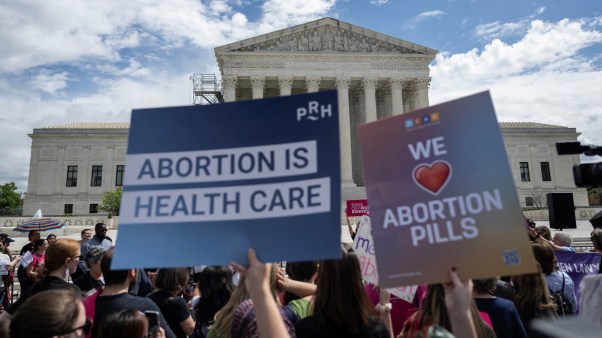

The abortion debate is over—settled by the democratic process. At least that’s what pundits are telling us.
On the Left, Michael Kinsley, anticipating the passage of the Freedom of Choice Act, has enthused that America will finally get a “democratically enacted choice law.” With it abortion will be guaranteed by that most sacred of democratic conventions: “the consensus of the citizenry.”
And on the Right, generally level-headed columnist Charles Krauthammer says that “the great national debate is over.… Democracy works.”
Democracy works? What does that mean? That a majority of citizens have cast their vote and so the issue is settled?
With all due respect to Krauthammer, Kinsley, and their ilk, this is not liberal, Western democracy as it has been classically understood. Democracy is not simply a mechanism for counting votes. (Our Founders recognized that such “pure” democracy could be as tyrannical as any totalitarian state, so they enacted checks and balances on unrestrained majority will.)
Democracy is more than a political system. It is a vision, a conviction of freedom and justice that depends not on the rule of the majority, but the rule of an idea. That idea is of a just society, “a more perfect union” in which life, liberty, and the pursuit of happiness could flourish.
It is a vision based on several critical assumptions, however—ideas that we seem recently to have forgotten.
Who defines justice?
The first pillar of democracy is the desire of the citizenry for righteousness, a corporate aspiration to be a “good” society. This requires the cultivation of public virtue, which is dependent on a common value system rooted in absolute standards of right and wrong. Only a society that seeks virtue can ensure political and economic freedom.
Yet, criminologist James Q. Wilson writes, “We have become a nation that takes democracy to mean maximum self-expression (though it never meant that originally), and to be suspicious of any effort to state or enforce a common morality. Democracy has become an end, though it originally was embraced as a means to other ends—a way [of] securing the blessings of liberty.”
A second pillar is the sense of civic duty. Former British Prime Minister Margaret Thatcher has called this the “moral impulse”—that which causes citizens to rise above their own interests for the greater good.
Historically, this moral impulse has come from the religious element, those who believe that their role in life is to love God and neighbor. As James Madison wrote 200 years ago, “We have staked the whole of all our political institutions upon the capacity of … each of us to govern ourselves … according to the Ten Commandments of God.”
Yet, in recent decades, the Ten Commandments have been literally stripped from public-school walls and figuratively scrubbed from the public square. Those seeking to free society from religious influence would eliminate the very element upon which the democratic experiment depends.
A third pillar is the recognition that human beings are sinful. Two essential restraints buttress this pillar.
The first is the republican tradition of respecting covenants with the past, the written and unwritten social contracts by which a people have agreed to be governed, what G. K. Chesterton described as “the democracy of the dead.” We are not free to cast aside capriciously the fundamental principles for which those who preceded us invested their lives and treasure.
A second restraint is the idea of a Law beyond the law. Whether seen as the Judeo-Christian tradition or natural law, this is the inherent understanding that all persons are created equal, endowed by their Creator with certain unalienable rights.
Under the Law beyond the law, no person, no group—not even the majority—defines what is just. Justice is defined by a higher standard, and whether a state is indeed just is determined by how well it protects unalienable rights. Democracy is simply a political system—merely a mechanism—operating within this framework to protect people’s most essential rights.
In 1973 I had to argue for these rights in the Soviet Union. Sent to Moscow by President Nixon to negotiate for the release of Soviet Jews, I spent five days nose-to-nose with Vasiliy Kuznetsov, the hard-line Soviet negotiator. Kuznetsov pounded the table intermittently and shouted, “You have no right to interfere in our internal affairs.”
My reply, always the same, eventually prevailed. “These aren’t your internal affairs. Human rights are not conferred by government; they cannot be denied by government. They are unalienable.” I was not a Christian then, but at least I understood democracy’s most basic truth.
So when U.S. commentators conclude that “democracy works,” and the abortion debate is over, we do well to sound the alarm. The issue of preborn life cannot be settled by a court decision or an act of Congress. It cuts to the heart of the definition of a just society, to the heart of the ideal of virtue that assures freedom and liberty, to the essence of democracy’s protection of those who cannot protect themselves. We had better understand that—or we are in danger of gutting history’s most noble democratic experiment.
Little did I dream that day in the Kremlin in 1973, as I sat across from Vasiliy Kuznetsov, that 20 years later I would find myself again arguing for the essence of true democracy—this time with my fellow citizens.