





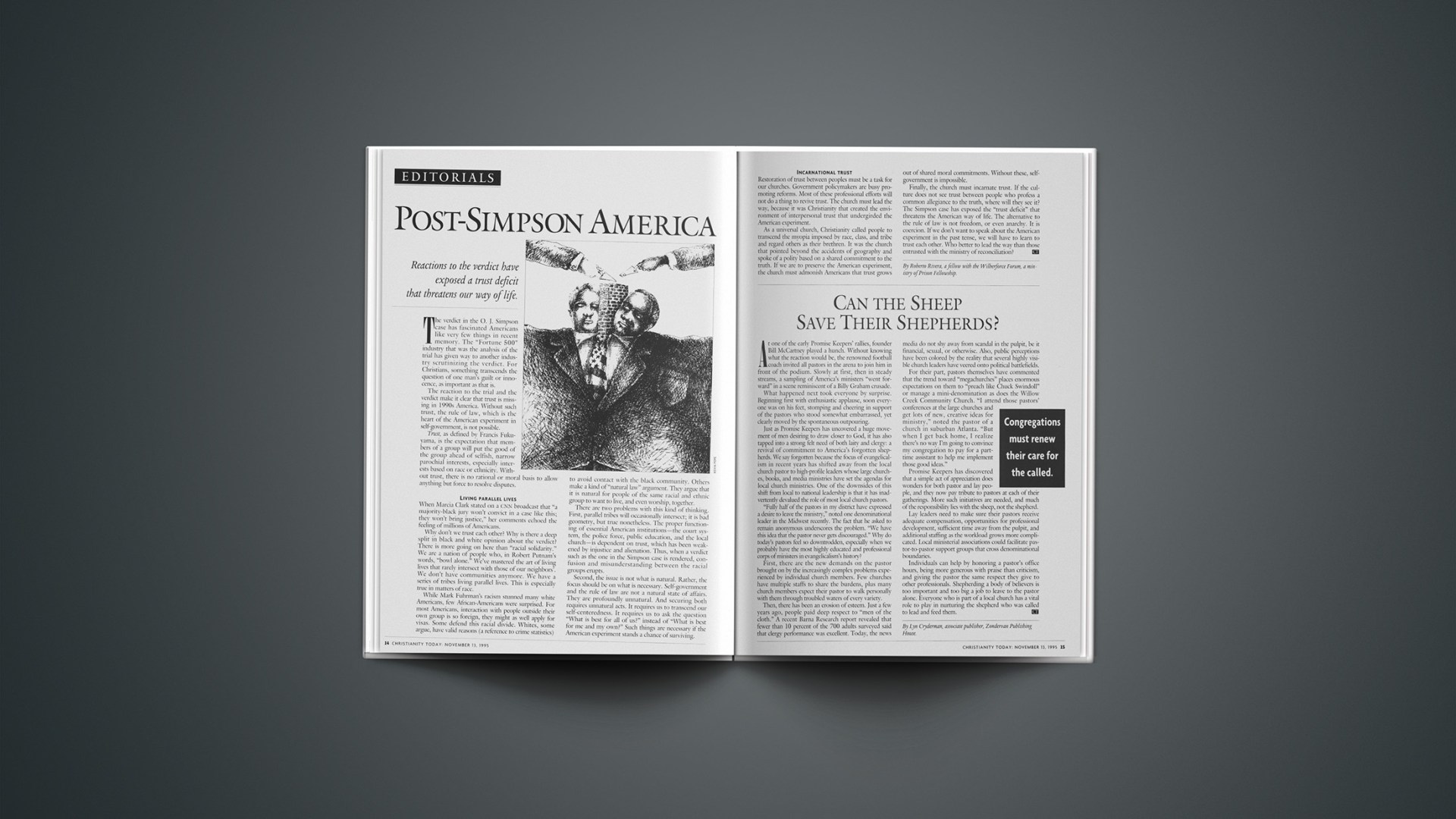

The verdict in the O. J. Simpson case has fascinated Americans like very few things in recent memory. The “Fortune 500” industry that was the analysis of the trial has given way to another industry scrutinizing the verdict. For Christians, something transcends the question of one man’s guilt or innocence, as important as that is.
The reaction to the trial and the verdict make it clear that trust is missing in 1990s America. Without such trust, the rule of law, which is the heart of the American experiment in self-government, is not possible.
Trust, as defined by Francis Fukuyama, is the expectation that members of a group will put the good of the group ahead of selfish, narrow parochial interests, especially interests based on race or ethnicity. Without trust, there is no rational or moral basis to allow anything but force to resolve disputes.
LIVING PARALLEL LIVES
When Marcia Clark stated on a CNN broadcast that “a majority-black jury won’t convict in a case like this; they won’t bring justice,” her comments echoed the feeling of millions of Americans.
Why don’t we trust each other? Why is there a deep split in black and white opinion about the verdict? There is more going on here than “racial solidarity.” We are a nation of people who, in Robert Putnam’s words, “bowl alone.” We’ve mastered the art of living lives that rarely intersect with those of our neighbors’. We don’t have communities anymore. We have a series of tribes living parallel lives. This is especially true in matters of race.
While Mark Fuhrman’s racism stunned many white Americans, few African-Americans were surprised. For most Americans, interaction with people outside their own group is so foreign, they might as well apply for visas. Some defend this racial divide. Whites, some argue, have valid reasons (a reference to crime statistics) to avoid contact with the black community. Others make a kind of “natural law” argument. They argue that it is natural for people of the same racial and ethnic group to want to live, and even worship, together.
There are two problems with this kind of thinking. First, parallel tribes will occasionally intersect; it is bad geometry, but true nonetheless. The proper functioning of essential American institutions-the court system, the police force, public education, and the local church-is dependent on trust, which has been weakened by injustice and alienation. Thus, when a verdict such as the one in the Simpson case is rendered, confusion and misunderstanding between the racial groups erupts.
Second, the issue is not what is natural. Rather, the focus should be on what is necessary. Self-government and the rule of law are not a natural state of affairs. They are profoundly unnatural. And securing both requires unnatural acts. It requires us to transcend our self-centeredness. It requires us to ask the question “What is best for all of us?” instead of “What is best for me and my own?” Such things are necessary if the American experiment stands a chance of surviving.
INCARNATIONAL TRUST
Restoration of trust between peoples must be a task for our churches. Government policymakers are busy promoting reforms. Most of these professional efforts will not do a thing to revive trust. The church must lead the way, because it was Christianity that created the environment of interpersonal trust that undergirded the American experiment.
As a universal church, Christianity called people to transcend the myopia imposed by race, class, and tribe and regard others as their brethren. It was the church that pointed beyond the accidents of geography and spoke of a polity based on a shared commitment to the truth. If we are to preserve the American experiment, the church must admonish Americans that trust grows out of shared moral commitments. Without these, self-government is impossible.
Finally, the church must incarnate trust. If the culture does not see trust between people who profess a common allegiance to the truth, where will they see it? The Simpson case has exposed the “trust deficit” that threatens the American way of life. The alternative to the rule of law is not freedom, or even anarchy. It is coercion. If we don’t want to speak about the American experiment in the past tense, we will have to learn to trust each other. Who better to lead the way than those entrusted with the ministry of reconciliation?
Roberto Rivera is a fellow with the Wilberforce Forum, which is a ministry of Prison Fellowship.
Copyright © 1995 Christianity Today. Click for reprint information.







