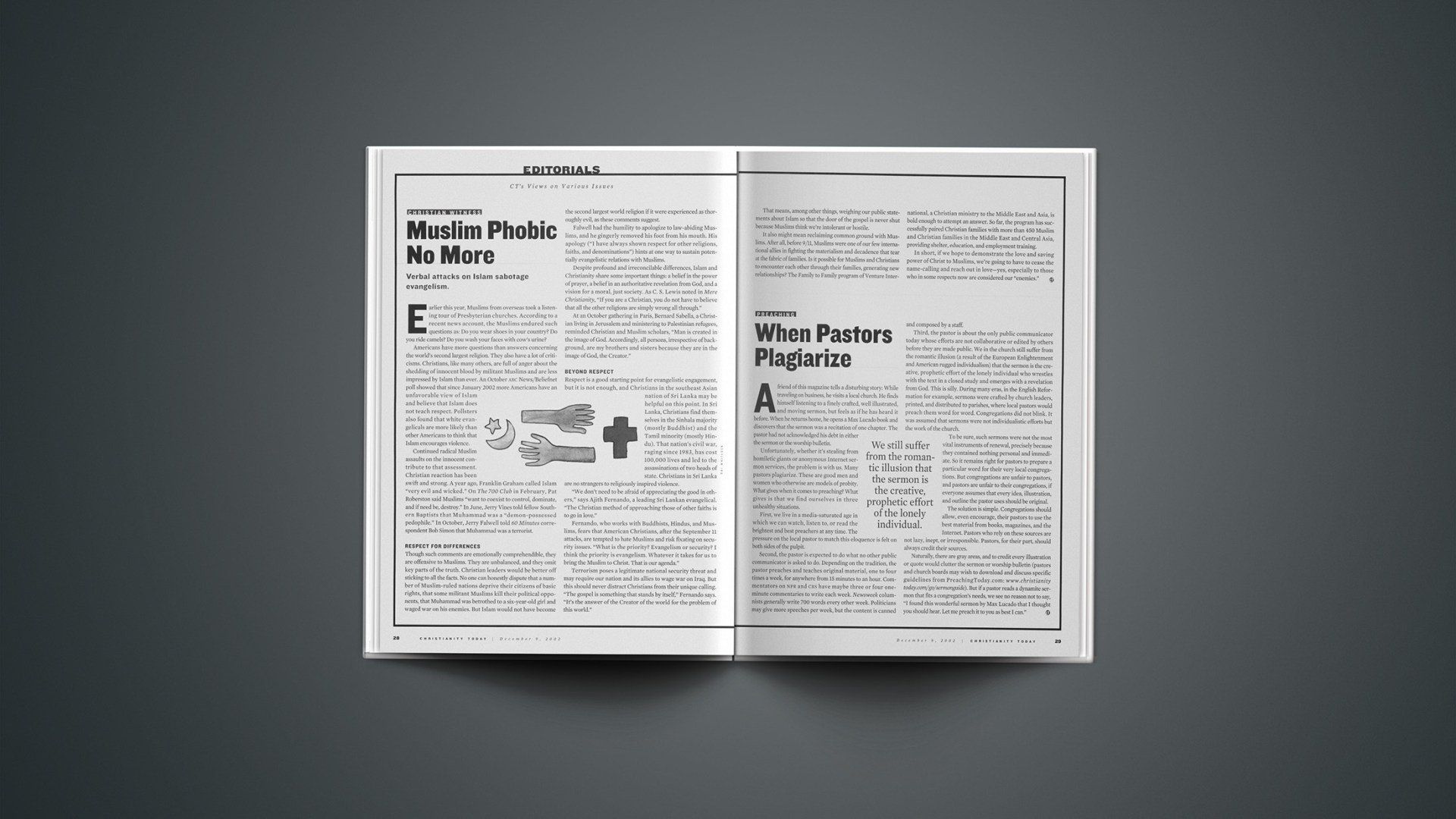

A friend of this magazine tells a disturbing story: While traveling on business, he visits a local church. He finds himself listening to a finely crafted, well illustrated, and moving sermon, but feels as if he has heard it before. When he returns home, he opens a Max Lucado book and discovers that the sermon was a recitation of one chapter. The pastor had not acknowledged his debt in either the sermon or the worship bulletin.
Unfortunately, whether it’s stealing from homiletic giants or anonymous Internet sermon services, the problem is with us. Many pastors plagiarize. These are good men and women who otherwise are models of probity. What gives when it comes to preaching? What gives is that we find ourselves in three unhealthy situations.
First, we live in a media-saturated age in which we can watch, listen to, or read the brightest and best preachers at any time. The pressure on the local pastor to match this eloquence is felt on both sides of the pulpit.
Second, the pastor is expected to do what no other public communicator is asked to do. Depending on the tradition, the pastor preaches and teaches original material, one to four times a week, for anywhere from 15 minutes to an hour. Commentators on npr and cbs have maybe three or four one-minute commentaries to write each week. Newsweek columnists generally write 700 words every other week. Politicians may give more speeches per week, but the content is canned and composed by a staff.
Third, the pastor is about the only public communicator today whose efforts are not collaborative or edited by others before they are made public. We in the church still suffer from the romantic illusion (a result of the European Enlightenment and American rugged individualism) that the sermon is the creative, prophetic effort of the lonely individual who wrestles with the text in a closed study and emerges with a revelation from God. This is silly. During many eras, in the English Reformation for example, sermons were crafted by church leaders, printed, and distributed to parishes, where local pastors would preach them word for word. Congregations did not blink. It was assumed that sermons were not individualistic efforts but the work of the church.
To be sure, such sermons were not the most vital instruments of renewal, precisely because they contained nothing personal and immediate. So it remains right for pastors to prepare a particular word for their very local congregations. But congregations are unfair to pastors, and pastors are unfair to their congregations, if everyone assumes that every idea, illustration, and outline the pastor uses should be original.
The solution is simple. Congregations should allow, even encourage, their pastors to use the best material from books, magazines, and the Internet. Pastors who rely on these sources are not lazy, inept, or irresponsible. Pastors, for their part, should always credit their sources.
Naturally, there are gray areas, and to credit every illustration or quote would clutter the sermon or worship bulletin (pastors and church boards may wish to download and discuss specific guidelines from PreachingToday.com: www.christianity today.com/go/sermonguide). But if a pastor reads a dynamite sermon that fits a congregation’s needs, we see no reason not to say, “I found this wonderful sermon by Max Lucado that I thought you should hear. Let me preach it to you as best I can.”
Copyright © 2002 Christianity Today. Click for reprint information.
Related Elsewhere
Earlier this year, the St. Louis Post-Dispatch reported that across the country several “preachers have been caught delivering sermons verbatim—and without attribution—that they purchased from online and print sermon services.” Christianity Today covered the story in “Today’s Sermon: Thou Shalt Not Steal.”
Christianity Today’s sister publication Leadership provides valuable insight and practical advice for preaching. In 2000, Chris Stinnett gave tips on how to credit sources without distracting your hearers.
Also, pastors and church boards can download and use the PreachingToday.comsermon guide.