
Nigerian con artists are targeting unsuspecting Christians and others using a new wrinkle in the long-running 419 advance fee scam. (419 refers to the Nigerian law banning the schemes.)
Christians are receiving a letter or e-mail supposedly from a retired Nigerian military officer who has converted from Islam to Christianity. The letter writer claims to have diverted $45 million from the Nigerian government. But the officer writes that after converting to Christianity, he has “received instruction from God through divine revelation” and wants to donate the $45 million to God’s work, specifically to “your ministry.”
The most common form of such scams promises the reader a percentage of a large fortune. The con artist asks for help in getting the cash out of the country (often Nigeria).
Nigerian 419 cons have defrauded Americans for years by inducing them to wire money to an overseas bank account. The National White Collar Crime Center and the FBI established an Internet Fraud Complaint Center last year, and Nigerian 419 fraud was third on its list of the top Internet scams. Auction fraud and nondelivery of goods were the top two.
According to the FBI, the average 419 victim has lost $5,575, making 419 fraud one of the nation’s most costly financial scams for individuals. But some people have lost more than $100,000. Federal officials estimate a 900 percent increase in 419 e-mail scams from 2000 to 2001.
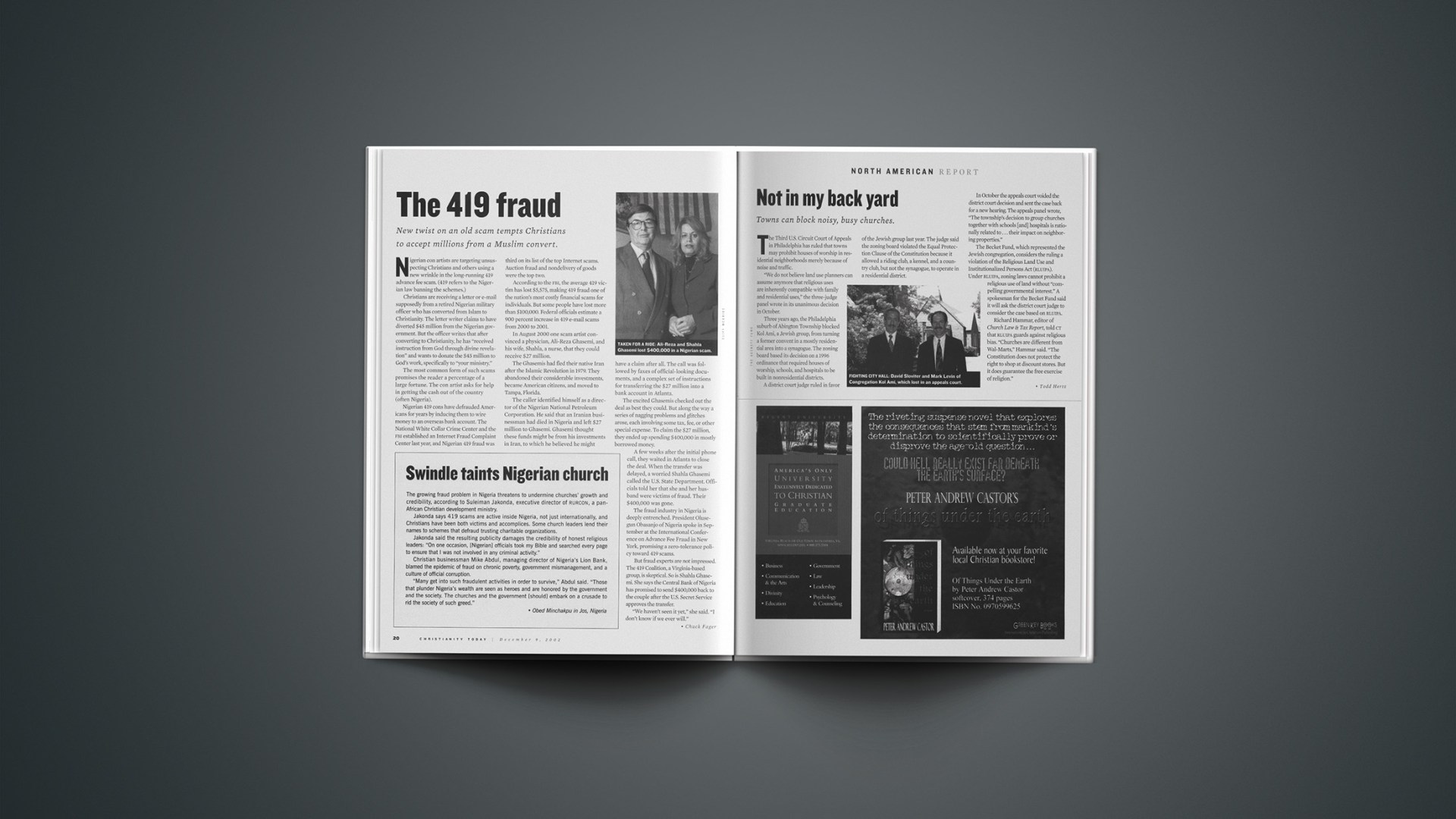
In August 2000 one scam artist convinced a physician, Ali-Reza Ghasemi, and his wife, Shahla, a nurse, that they could receive $27 million.
The Ghasemis had fled their native Iran after the Islamic Revolution in 1979. They abandoned their considerable investments, became American citizens, and moved to Tampa, Florida.
The caller identified himself as a director of the Nigerian National Petroleum Corporation. He said that an Iranian businessman had died in Nigeria and left $27 million to Ghasemi. Ghasemi thought these funds might be from his investments in Iran, to which he believed he might have a claim after all. The call was followed by faxes of official-looking documents, and a complex set of instructions for transferring the $27 million into a bank account in Atlanta.
The excited Ghasemis checked out the deal as best they could. But along the way a series of nagging problems and glitches arose, each involving some tax, fee, or other special expense. To claim the $27 million, they ended up spending $400,000 in mostly borrowed money.
A few weeks after the initial phone call, they waited in Atlanta to close the deal. When the transfer was delayed, a worried Shahla Ghasemi called the U.S. State Department. Officials told her that she and her husband were victims of fraud. Their $400,000 was gone.
The fraud industry in Nigeria is deeply entrenched. President Olusegun Obasanjo of Nigeria spoke in September at the International Conference on Advance Fee Fraud in New York, promising a zero-tolerance policy toward 419 scams.
But fraud experts are not impressed. The 419 Coalition, a Virginia-based group, is skeptical. So is Shahla Ghasemi. She says the Central Bank of Nigeria has promised to send $400,000 back to the couple after the U.S. Secret Service approves the transfer.
“We haven’t seen it yet,” she said. “I don’t know if we ever will.”
Copyright © 2002 Christianity Today. Click for reprint information.
The U.S. Secret Service site has an advisory on the 419 schemes. Nigeria: The 419 Coalition Website has extensive information on avoiding the scam and a list of other 419 websites.
Other stories include:
Billions lost in bank scams—The Oakland Press (November 17, 2002)
Beware the ‘419’ scam letter from Nigerian con artists—Michelle Singletary, Seattle Post Intelligencer (November 9, 2002)
E-mail to launder money lures many—The Oregonian (October 28, 2002)