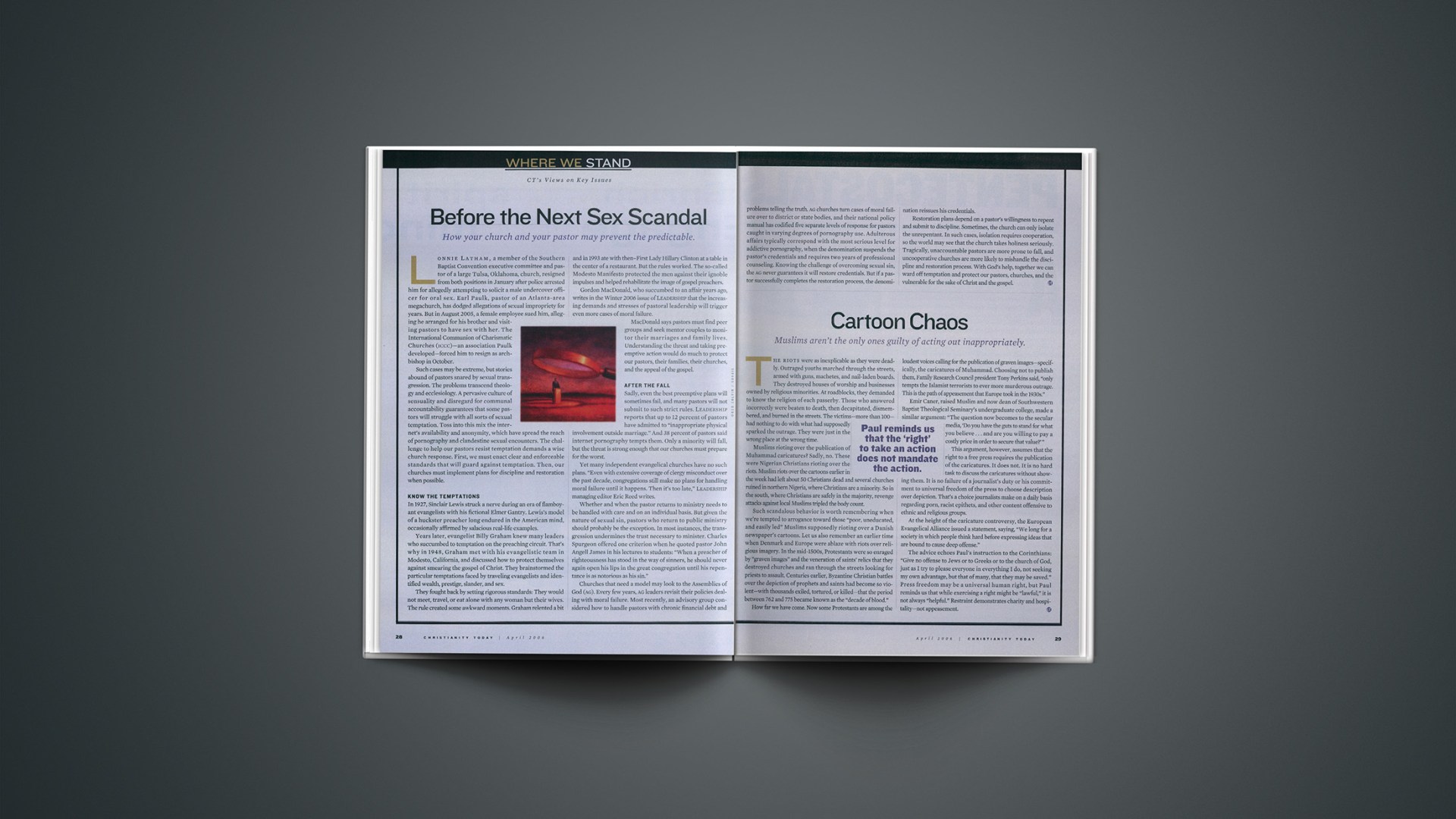

The riots were as inexplicable as they were deadly. Outraged youths marched through the streets, armed with guns, machetes, and nail-laden boards. They destroyed houses of worship and businesses owned by religious minorities. At roadblocks, they demanded to know the religion of each passerby. Those who answered incorrectly were beaten to death, then decapitated, dismembered, and burned in the streets. The victims—more than 100—had nothing to do with what had supposedly sparked the outrage. They were just in the wrong place at the wrong time.
Muslims rioting over the publication of Muhammad caricatures? Sadly, no. These were Nigerian Christians rioting over the riots. Muslim riots over the cartoons earlier in the week had left about 50 Christians dead and several churches ruined in northern Nigeria, where Christians are a minority. So in the south, where Christians are safely in the majority, revenge attacks against local Muslims tripled the body count.
Such scandalous behavior is worth remembering when we’re tempted to arrogance toward those “poor, uneducated, and easily led” Muslims supposedly rioting over a Danish newspaper’s cartoons. Let us also remember an earlier time when Denmark and Europe were ablaze with riots over religious imagery. In the mid-1500s, Protestants were so enraged by “graven images” and the veneration of saints’ relics that they destroyed churches and ran through the streets looking for priests to assault. Centuries earlier, Byzantine Christian battles over the depiction of prophets and saints had become so violent—with thousands exiled, tortured, or killed—that the period between 762 and 775 became known as the “decade of blood.”
How far we have come. Now some Protestants are among the loudest voices calling for the publication of graven images—specifically, the caricatures of Muhammad. Choosing not to publish them, Family Research Council president Tony Perkins said, “only tempts the Islamist terrorists to ever more murderous outrage. This is the path of appeasement that Europe took in the 1930s.”
Emir Caner, raised Muslim and now dean of Southwestern Baptist Theological Seminary’s undergraduate college, made a similar argument: “The question now becomes to the secular media, ‘Do you have the guts to stand for what you believe … and are you willing to pay a costly price in order to secure that value?'”
This argument, however, assumes that the right to a free press requires the publication of the caricatures. It does not. It is no hard task to discuss the caricatures without showing them. It is no failure of a journalist’s duty or his commitment to universal freedom of the press to choose description over depiction. That’s a choice journalists make on a daily basis regarding porn, racist epithets, and other content offensive to ethnic and religious groups.
At the height of the caricature controversy, the European Evangelical Alliance issued a statement, saying, “We long for a society in which people think hard before expressing ideas that are bound to cause deep offense.”
The advice echoes Paul’s instruction to the Corinthians: “Give no offense to Jews or to Greeks or to the church of God, just as I try to please everyone in everything I do, not seeking my own advantage, but that of many, that they may be saved.” Press freedom may be a universal human right, but Paul reminds us that while exercising a right might be “lawful,” it is not always “helpful.” Restraint demonstrates charity and hospitality—not appeasement.
Copyright © 2006 Christianity Today. Click for reprint information.
Related Elsewhere:
Tony Perkins full statement on the non-publication of the cartoons in the U.S. is available from the Family Research Council.
Emir Caner’s statement is quoted in a Baptist Press article.
The World Evangelical Alliance statement on the publication of the cartoons is available on their website.