
Rowan Williams, the archbishop of Canterbury, is caught in the crossfire between warring parties in the Anglican Communion. They are fighting over how the church relates to sexuality, to Scripture, and to the church’s member bodies.
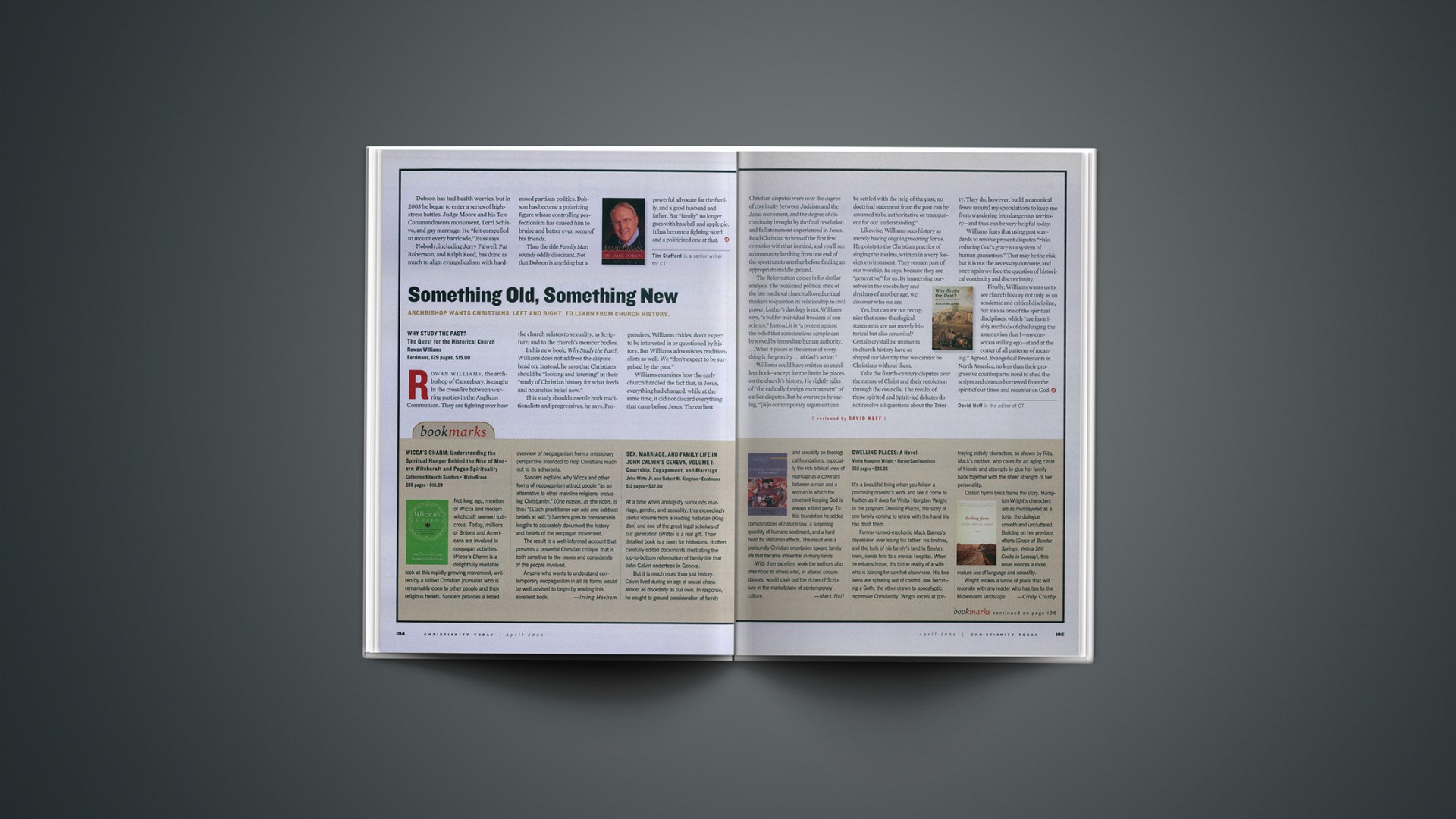
 Why Study the Past?The Quest for theHistorical Churchby Rowan WilliamsEerdmans129 pp.; $15.00 |
In his new book, Why Study the Past?, Williams does not address the dispute head on. Instead, he says that Christians should be “looking and listening” in their “study of Christian history for what feeds and nourishes belief now.”
This study should unsettle both traditionalists and progressives, he says. Progressives, Williams chides, don’t expect to be interested in or questioned by history. But Williams admonishes traditionalists as well: We “don’t expect to be surprised by the past.”
Williams examines how the early church handled the fact that, in Jesus, everything had changed, while at the same time, it did not discard everything that came before Jesus. The earliest Christian disputes were over the degree of continuity between Judaism and the Jesus movement, and the degree of discontinuity brought by the final revelation and full atonement experienced in Jesus. Read Christian writers of the first few centuries with that in mind, and you’ll see a community lurching from one end of the spectrum to another before finding an appropriate middle ground.
The Reformation comes in for similar analysis. The weakened political state of the late medieval church allowed critical thinkers to question its relationship to civil power. Luther’s theology is not, Williams says, “a bid for individual freedom of conscience.” Instead, it is “a protest against the belief that conscientious scruple can be solved by immediate human authority. … What it places at the center of everything is the gratuity … of God’s action.”
Williams could have written an excellent book—except for the limits he places on the church’s history. He rightly talks of “the radically foreign environment” of earlier disputes. But he oversteps by saying, “[N]o contemporary argument can be settled with the help of the past; no doctrinal statement from the past can be assumed to be authoritative or transparent for our understanding.”
Likewise, Williams sees history as merely having ongoing meaning for us. He points to the Christian practice of singing the Psalms, written in a very foreign environment. They remain part of our worship, he says, because they are “generative” for us. By immersing ourselves in the vocabulary and rhythms of another age, we discover who we are.
Yes, but can we not recognize that some theological statements are not merely historical but also canonical? Certain crystalline moments in church history have so shaped our identity that we cannot be Christians without them.
Take the fourth-century disputes over the nature of Christ and their resolution through the councils. The results of those spirited and Spirit-led debates do not resolve all questions about the Trinity. They do, however, build a canonical fence around my speculations to keep me from wandering into dangerous territory—and thus can be very helpful today.
Williams fears that using past standards to resolve present disputes “risks reducing God’s grace to a system of human guarantees.” That may be the risk, but it is not the necessary outcome, and once again we face the question of historical continuity and discontinuity.
Finally, Williams wants us to see church history not only as an academic and critical discipline, but also as one of the spiritual disciplines, which “are invariably methods of challenging the assumption that I—my conscious willing ego—stand at the center of all patterns of meaning.” Agreed. Evangelical Protestants in North America, no less than their progressive counterparts, need to shed the scripts and dramas borrowed from the spirit of our times and recenter on God.
David Neff is the editor of CT.
Copyright © 2006 Christianity Today. Click for reprint information.