





A couple years ago when the presidential race was heating up and immigration reform was again a hot-button issue, we heard many statistics, facts, and proposals about immigration in America. At the time I was volunteering with an English as a Second Language class for immigrants and refugees, so I had a heightened awareness of all these discussions. This wasn’t just an issue for me, this was daily life for Jose and Fatima and Dula. I was frustrated that stories such as theirs—the real people and faces and realities of immigration—weren’t also a part of our collective conversations.
Thankfully, several films in recent years have filled that void. The Visitor, God Grew Tired of Us, Babel, and others have fleshed out the issue of immigration—both legal and illegal—and have added another dimension to this complicated issue. Amreeka is the latest entry in this growing and needed genre of films. It’s the labor of love from Cherien Dabis, who was the first in her Palestinian/Jordanian family to be born in the U.S. The film draws heavily on Dabis’s experiences growing up in rural Ohio, torn between two cultures.
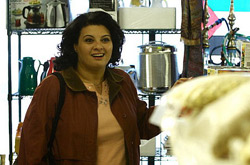
We first meet Amreeka‘s protagonist, Muna (Nisreen Faour), single mom to son Fadi (Melkar Muallem), in the midst of their complicated life on the West Bank. Muna’s daily commute has grown from 15 minutes to two hours due to new military checkpoints. Her husband found a new, younger wife, and Muna faces the humiliation of running into them around town. Her mother, who lives with Muna and her son, is a merciless nag. And Muna’s bank job is tedious and seemingly a dead end.
So when the letter approving the green card she applied for years earlier arrives in the mail one day, it’s like a life preserver. Muna and Fadi pack up their modest belongings and make the long trek to rural Illinois, where they move in with Muna’s sister Raghda (Hiam Abbass), her husband Nabeel (Yussef Abu Warda), and their three daughters.
But it doesn’t take long for Muna to realize that she’s only traded one set of problems for another. The tin of cookies in which she’s naively socked away all her money gets confiscated by U.S. customs officials when she’s not looking. Her sister’s family is having financial problems of their own. Despite her two degrees and ten years of work in banking, the only job Muna’s able to get is at a local White Castle. And her son starts rebelling and getting in trouble with the law.
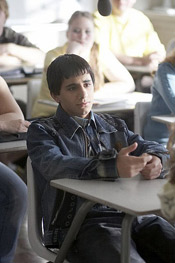
Through it all, Muna remains endearingly optimistic and plucky. Nisreen Faour is real and likable as Muna. Her child-like charm is a needed element in this movie about the difficult realities of immigrant life. Without it, the film would be heavy-handed and depressing—or, more accurately, more so than it already is at times.
The realism Nisreen brings is present in the overall production, like the real home in Winnipeg, Canada where much of the film was shot, or the White Castle set constructed with many real supplies provided by the fast-food chain. Amreeka doesn’t have the slick polish of a Hollywood production, instead offering a small, messy, authentic feel that’s just perfect for the subject and story.
A couple of conversations in the film offer a keen perspective on the simple things that can trigger homesickness, the complicated systems that exist in every culture, and the intangible qualities that make a place home.
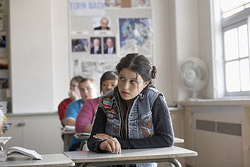
While Amreeka does an apt job of showing us the challenges of immigrant life in America, the overall effect would have been stronger and more believable if there had been a few more positive and uplifting moments in between—like the too-brief scene when Muna first sees snow. With so many hurdles and mishaps throughout the film, they almost start to lose their impact. The individual challenges start to blend into an overall negative cloud, instead of painting a realistic and three-dimensional picture.
It’s also unfortunate that most of the American characters are either Really Good or Really Bad. Mr. Novatski (Joseph Ziegler), the principal at Fadi’s school, is a kind-hearted man who goes the extra mile to help Muna and Fadi—even offering a hint of love interest for Muna. Most of the classmates at Fadi’s school are bigoted creeps who torment both Fadi and Muna. Muna’s main co-worker at White Castle is a blue-haired, multi-pierced high school dropout.
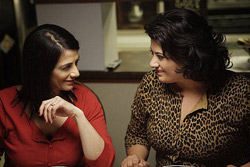
All of these unrealistic extremes make these people seem like caricatures. And they also threaten the realism this film is trying to convey.
And then for all the many challenges throughout the film, there’s a sudden positive sweep at the end that feels a bit jarring. It’s nice to have some of that needed uplift, but by that point in the film, it feels a bit like too much, too little, too late.
Still, this is a needed angle on the immigrant experience, told from an authentic voice. It offers a lot of heart and food for thought on an issue that Amreeka will certainly be wrestling with for a long time to come.
Talk About It
Discussion starters- Did Amreeka challenge or change any of your opinions about immigration?
- If you were Muna, would you have stayed in your homeland or moved away from all things familiar in hopes of a better life for you, and especially your child?
- Do you think suspicions about those who look Arab in the film are acts of prejudice—or wise caution?
- Amreeka seems to take place a few years ago, sooner after the 9/11 attacks in 2001. Do you think Muna and Fadi would have faced some of the same prejudices if the movie had been set in 2009? Do you think much has changed in opinions and cautions since 9/11?
- What do you think the film says about what makes a place home?
The Family Corner
For parents to considerAmreeka is rated PG-13 for brief drug use involving teens (Fadi, his teenage cousin, and another boy smoke a joint) and some language (it’s fairly mild). We also see bigoted teens saying racial slurs and being disrespectful to an adult. Fadi retaliates against the teens by letting the air out of their tires. The police arrest Fadi—and then also seem to do some stereotyping of their own.
Photos © National Geographic Entertainment
Copyright © 2009 Christianity Today. Click for reprint information.







