





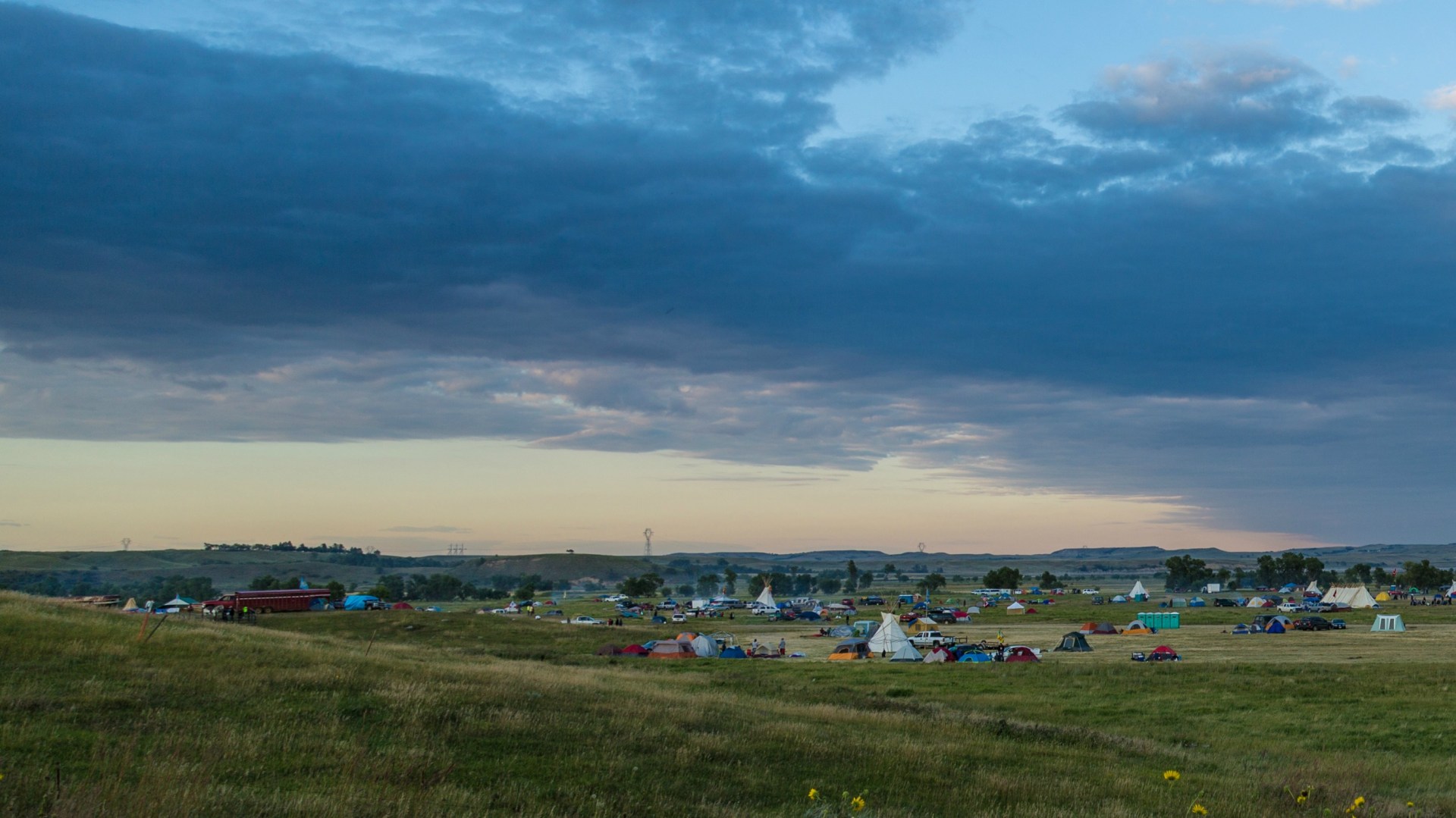
Assemblies of God pastor Tonya White Mountain regularly makes the nearly two-hour drive from her home on the Standing Rock Sioux reservation to Bismarck, North Dakota, the closest place to shop at Walmart and get medical checkups.
During a recent trip, a truck tried to drive her off the road. After her twin sister recounted several incidents of aggression toward Native American drivers and cars with bumper stickers opposing the planned Dakota Access pipeline (DAPL), she realized it might not have been a random case of road rage.
For locals like White Mountain, the contentious pipeline debate isn’t constrained to the protest sites covered on the news. The tension spills over to the roadways, the hair salons, and even the church pews.
“It’s been divisive, plain and simple,” said White Mountain, who has lived on the reservation since 1991 and served for two decades with the tribal housing authority. “Over the years, I thought this whole race issue, this ‘us and them’ attitude, was decreasing. With this whole DAPL business, it has resurfaced with a vengeance.”
The greatest challenge for churches like hers, Good News Assembly of God Church in McLaughlin, South Dakota, is being a faithful witness amid political and racial polarization.
Despite the rush of mostly mainline denominations that rallied alongside Native Americans protesting the pipeline, local Christians are a minority. White Mountain’s small congregation draws about 20 to 40 people to worship in their gray building each Sunday, surrounded by neighbors whose kids mostly “only know Jesus as a swear word.” (Among all Native Americans, about 5 percent identify as born-again.)
“We represent Christ,” said White Mountain, whose brother, Rocky, and sister, Sonya, preceded her as pastors at Good News. “My brother used to say that we are children of God first, and Native Americans second.”
Reporter Kate Shellnutt spoke with her a day after government officials decided to not to permit the proposed pipeline to go through the contested Missouri River site, a development celebrated by tribe leaders as a “historic decision” in their favor.
What is your response to the recent news that permit for the pipeline was denied?
Speaking as a Native American, I have to say that the Standing Rock Sioux Tribe has never ceded the lands north of the Cannonball River. Those were lands that were “given” to the Standing Rock tribe during the treaty of Fort Laramie. Our tribe never did cede those lands back. They were chipped away at over the years. It’s an issue that for me, personally, I feel strongly about. But being that it’s a personal issue as a Native American, I did not, have not, and will not take a stand behind the pulpit. To me, it’s more of a political issue.
I would hope that this would be the end of it. But I cannot see them giving up this quickly when they’re talking about billions of dollars. The methods that they’ve used this far, being questionable at best, I just don’t see this being the end of it. They were ordered to halt construction months ago, and they continued.
How do you think of this issue differently as a Christian?
My brother, when he was pastoring, addressed the issue of non-discrimination. And what he said was, “It’s not skin; it’s sin.” That has stuck in my mind and my heart ever since then.
… In my travels, I noticed—all over the country—wherever there’s a minority, there’s going to be issues of discrimination. But it’s not really discrimination. It does boil down to the fact that it is the sin nature of human beings. As strongly as I feel about the whole DAPL issue, it does boil down to the fact that we are dealing with a fallen race. Until our Lord returns, there will always be issues that divide.
What about the environmental concerns?
My mother was a strong Christian, so I was not raised in the polytheistic beliefs of the native religion. I do believe the Bible tells us we are stewards of this earth and as such, we are to take care of it and not endanger the things that our Lord has entrusted to us.
I would take steps, of course, but I do not believe we are to have a religious attitude toward environmentalism. I believe that too many people have bowed to it as an idol, as opposed to taking to it that we are simply called to steward.
What have you been praying for regarding the pipeline?
Every time I mention it when I’m behind the pulpit or in prayer meetings, I remind people that we are called to pray for everyone, and we are called to pray for those in authority over us. I reminded the congregation that whether or not we agree with either side, we are to pray for souls. I remind them that the things we see on Facebook or TV, we should be praying for the safety of the people—the police included. Anytime I ask for people to pray for the water protectors, I also reminded them to pray for the police, the military, and even the DAPL security. We’re all souls in need of saving.
Is your position in the community different because of your faith?
I would say probably yes. I don’t know if I would call myself a pacifist … but I do have more of an attitude of being a peacemaker, because we are called to be peacemakers. When it comes down to the issue, when people ask me my opinion, I tend to give it in as gracious a manner as possible, whether it be my cousin or my hair stylist.
What do you think God has taught you through this situation?
As always, to be careful about what I say. Discussing this issue was so inflammatory. It reminded me that people feel strongly about things, and I believe everybody is searching for a cause. What most people don’t realize is it’s kind of like the old song, “There’s a God-shaped hole in all of us.” So many people are ignoring the fact that it’s the cry of their souls for their Father. They’re searching for a cause. Whether that cause be pro-DAPL or against DAPL, they feel strongly.
Last month, CT Podcasts discussed the Dakota Access pipeline, along with other issues of concern for Native Americans, with George Fox University professor Randy Woodley. More of CT’s coverage of faith among Native Americans can be found here.







