Movies created for a Christian audience by Christian production houses are historically a mixed bag. Some are decent. Some are embarrassing. Few are truly great. But a new film, The Shift, released in theaters on Friday, December 1, is a promising step for the genre.
The movie presents itself as a retelling of the biblical Book of Job. Although it covers some of the same philosophical ground, you won’t find burnt offerings or camels here. The setting is modern-day—the plot akin to The Matrix meets It’s a Wonderful Life—and the script is a meditation on love and joy as much as inexplicable loss in a chaotic world.
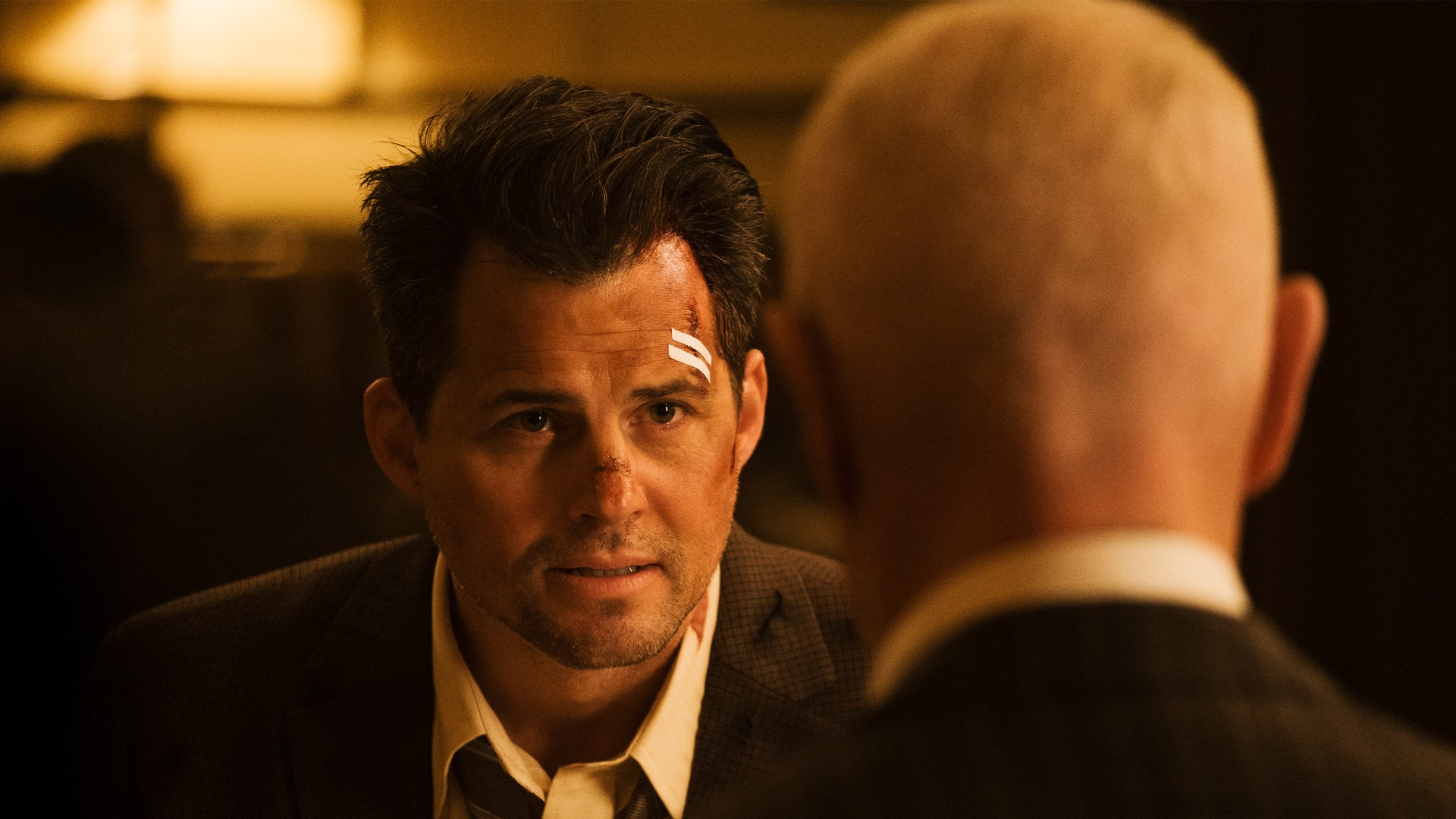
At the center of the story is Kevin (Kristoffer Polaha), a man pulled away from the life he loves into another dimension by a malignant entity called “The Benefactor” (Neal McDonough). Kevin fights to return to his wife, Molly (Elizabeth Tabish), and in the process weighs ideas about suffering, loss, evil, and the God who allows it all.
While the scale of The Shift is small—you won’t find grandiose special effects or casts of thousands—the directing is confident, the cinematography professional, and the pacing (for the most part) well done. There’s also real talent in this movie, and not only from its one big name, Sean Astin of Rudy and the Lord of the Rings trilogy. Tabish is riveting, and her chemistry with Polaha gives the film the interest needed to sustain the story. Their love is believable, and it’s what makes the pain of loss so searing.
Like many faith-based films, The Shift has a bit too much telling and too little showing. Skilled storytellers rely less on explanatory dialogue and more on moments, tableaus that move past the brain to touch the heart. Some such moments do come in this movie, and they hit harder than the talking when they do. Hopefully writer and director Brock Heasley’s next offering will lean further into that mode of storytelling.
Still, on balance, the cast is served well by Heasley’s script, which is generally fluid and well-observed. It’s also entertaining, something message movies often miss. The characters act and sound like real people, not archetypes in an extended metaphor. This is more than some huge-budget films manage to achieve (looking at you, Napoleon).
Yet even if it largely avoids the heavy hand of a message movie, The Shift undeniably has a message. In Heasley’s universe, suffering doesn’t just happen. Rather, the Devil—rebranded, with dark irony, as The Benefactor—has free rein to toy with human beings, sometimes on a whim, sometimes overtly to harm them. He is active, determined, and directly engages with the people he torments.
By contrast, God never shows his face. He is not entirely absent but distant, silent, slow to come to the rescue. Why, asks The Benefactor, if he loves you, does he let me hurt you?
It’s a fair question.
As in Job, there is no simple answer, as if human suffering were a math problem to be solved. To its credit—and unlike some faith-based films given to tidy conclusions and trite endings—The Shift does not try to provide a mathematical proof. Instead, Kevin glimpses a vision of joy and goodness, linked to his love for his wife, which provides him with a reason to remain faithful to God.
This love is the heart of the story. It’s nothing new to theology (Eph. 5:32) for the purity and irrationality of the love between husband and wife to at once echo and point to the love of God, which transcends human reason (1 Cor. 1:18–25). Whether the makers of The Shift made this connection intentionally or not, it is a theologically profound theme in the film.
Love and joy don’t necessarily make sense on a rational level in our deeply sorrowful and bleeding world. But on another level, love is the only thing that makes sense. And joy points us toward, flows from, and has its being in the source of all good things.
Throughout The Shift, Kevin keeps telling other characters he’s being tested, but in the end, it’s not about testing. His trials and temptations fall by the wayside. Aligning himself with God’s side is not about passing a test. It is about joy. And it becomes a joy.
The Book of Job concludes with God praising Job’s honesty and search for truth while rebuking his erroneous thinking and highlighting how little truth he knows (40:2, 42:7). Here, too, the questions are just as important as the answers. The movie doesn’t take a shortcut to eliminate sorrow in the end—this is not the easy theology of God as spiritual bellhop, handing out happy endings. There is loss, and loss is real, but God-given joy transcends and transforms loss too.
The Book of Job, after all, is poetry. Many have tried and failed to reduce it to if this, then that, to force it into some simple answer, much like the answers Job’s friends tried to provide. The fact is, Job does not make sense until it is lived, breathed. And then it is life itself. The Shift makes a credible effort at putting flesh on these particular questions—this particular poetry.
Rebecca Cusey is a lawyer and movie critic in Washington, DC.