 Pastors frequently cited COVID-19 as a source of political polarizing and ideological conflict in focus groups, interviews, and survey comments. A pastor in Jackson, Mississippi reflected, “We couldn’t please anybody. You had this binary thinking about everything that was happening.”
A second pastor shared,
Over the past 24 months, the most challenging aspect has been the emotional toll that COVID has brought onto the church staff. Between being both wrong and right with every decision made, and the stress that comes with always feeling that you have to defend your decision to a group of congregants, the stress can become unbearable.
Before COVID-19, the battle lines between politics, faith, and community in many American churches were already overlapping. During the pandemic, they seemed to disappear entirely.
As you listen to this week’s discussion, please understand that our desire is simply to shine a light on what actually happened—the lived experiences of countless pastors and congregations across America. Our sole aim is to facilitate reconciliation, healing, unity and the proclamation of the Gospel, and our prayer for the American Church is the same as Jesus in John 17:20–21:
“I ask not only on behalf of these but also on behalf of those who believe in me through their word, that they may all be one. … so that the world may believe that you have sent me.”
Based on chapter 7 of the report, in this episode host Aaron Hill (editor of ChurchSalary) sits down with two researchers from the Arbor Research Group, Jesse Brown and Tyler Greenway, to talk about the negative effects of polarization on pastors and congregations. This episode also features interviews with several pastors and lay leaders who were directly affected by political polarization and friendly fire during the pandemic.
Hosted by Aaron Hill, editor of ChurchSalary
“COVID and the Church” is produced in conjunction with the Arbor Research Group and funded by the Lilly Endowment Inc. through a grant from the Economic Challenges Facing Pastoral Leaders (ECFPL) initiative.
Executive produced by Aaron Hill, Terry Linhart, and Matt Stevens
Director for CT Media is Matt Stevens
Audio Engineering, Editor, and Composer is Tyler Bradford Wright
Artwork by Ryan Johnson
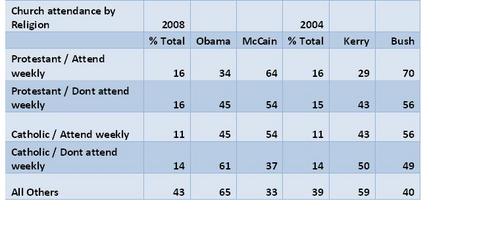
One thing that puzzles me about these numbers: Obama’s progress among Catholics is with those who don’t attend mass weekly. But among Protestants, he improved among those who do attend weekly.
One possible theory: abortion. Mass-attending Catholics are more likely to care about abortion than those who go less regularly. Protestant weekly attenders, on the other hand, include Mainline Protestants that are not necessarily pro-life.
But that’s just a theory. Based on very preliminary exit polls.
(Originally posted at Steve Waldman’s blog at Beliefnet.)