





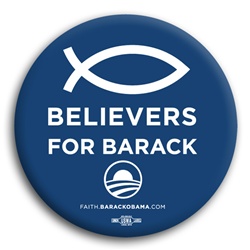
The Obama campaign just launched a line of merchandise, most of which specifically target Christians.
 The pandemic held up a mirror to the American church. Congregations that rarely stepped back to evaluate their endless calendars of events were forced to assess whether their ministry models reflected the mandates given by Christ and the example of the early church. For many congregations, what they saw in the mirror was not pretty.
One East Coast pastor gave a common assessment.
“We’re not really as open and involved in the community as we could be, as we should be. I see nice little buildings. I see fancy decorations outside on the lawns, manicured perfectly, and the steeple is still bold and standing. I just think that as a household of God, there’s so much more we could do.”
For many, COVID-19 became a catalyst for change, an opportunity to recalibrate rhythms and fall in better alignment with the church we are called to be in Scripture.
Based on Chapter 6 of the report, in this episode host Aaron Hill (editor of ChurchSalary) sits down with two researchers from the Arbor Research Group, Ebonie Davis and Terry Linhart, to talk about how the pandemic pushed some churches to venture outside the walls of their church building in new and exciting ways. Featuring an in-depth interview with Dan Nold, a lead pastor of a multisite church who leveraged the pandemic to launch a monthly “Church Without Walls” Sunday, where instead of gathering for worship at church, members venture out and minister to their neighbors.
Hosted by Aaron Hill, editor of ChurchSalary
“COVID and the Church” is produced in conjunction with the Arbor Research Group and funded by the Lilly Endowment Inc. through a grant from the Economic Challenges Facing Pastoral Leaders (ECFPL) initiative.
Executive produced by Aaron Hill, Terry Linhart, and Matt Stevens
Director for CT Media is Matt Stevens
Audio Engineering, Editor, and Composer is Tyler Bradford Wright
Artwork by Ryan Johnson
The campaign is selling “Believers for Barack,” “Pro-Family Pro-Obama,” and “Catholics for Obama” buttons and bumper stickers for $3 each and signs for $2.50 each.
The “Believers for Barack” button includes the ichthys, the fish outline that became a secret symbol for persecuted Christians in the early church.
“When threatened by Romans in the first centuries after Christ, Christians used the fish mark meeting places and tombs, or to distinguish friends from foes,” Elesha Coffman wrote for Christian History, CT’s sister publication.
Also, I’ve only heard “believers” apply only to Christians. The campaign seems to be targeting Christians specifically, since it usually uses broader terms like “people of faith.”







