A Pastor's Heart


Like Paul at Miletus, Jan Hus bid a tender farewell to his congregation at Bethlehem Chapel as he departed for Constance.
"Faithful and dear friends," he said, "you know that for a long time I have faithfully labored among you, preaching to you the Word of God without heresy or errors. Your salvation was, is now, and shall remain my desire until my death."
Hus knew he might never return to Prague. But if not, "we shall, of course, meet one another in the heavenly joy."
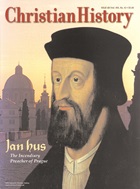
We think of him as "Jan Hus, the martyr." But before that, he was Jan Hus, the pastor—passionate about reform yet gentle toward his flock.
Leading by example
The Council of Constance charged Hus with "Wyclifism." The charge misrepresented Hus's theology (Martin Luther would later criticize Hus for accepting too much Catholic doctrine) but caught the spirit of his attack on the excesses of the medieval church.
What Hus desired was not a radical shift in church teaching, but for the church to be more worthy of its calling. This meant a return to the model of the early church and a complete re-evaluation of what it meant to be a priest.
First, Hus believed a priest's authority should be tied to his character and not merely his office. Naturally, this shook the foundations of the Roman Catholic hierarchy, which maintained that as long as a priest was in good standing with the Church, his ministry would remain effective regardless of his morality.
Hus, in contrast, believed it a priest's duty to model the godly life. As Wyclif had written, "Living a good life stirs rude men more than true preaching by word only."
For Hus, the "good life" began with ascetic simplicity. He demanded that priests live in apostolic poverty, being satisfied with the food and clothing provided by their office and giving the rest away. This idea arose both from Scripture and from Wyclif, who wrote that priests must "live a humble life, of poor men's alms and goods … and the remainder give truly to poor men that have not of their own."
Hus did not go so far as to deny the ministry of immoral priests. He maintained that sacraments in the hands of an unworthy priest remain valid, but the usefulness of the priest is undermined by his unseemly behavior.
Second, Hus wanted to narrow the gap between priest and people by giving lay people access to the Communion cup. Restoring the laity's right to take the chalice in Holy Communion became the battle cry for the whole Hussite movement.
For centuries the Holy Church had restricted the cup to the priest, lest the clumsy laity should spill any of the "blood of God." But the Hussites pointed to the words of Christ, "Drink of it, all of you."
Finally, Hus denounced as blasphemous the claim of priests to forgive sins directly, of their own power, whenever and wherever they wanted. He growled and barked at the practice of some priests who demanded money for such "forgiveness." Hus emphasized that it is God and Christ alone who forgive sins. Priests only declare such forgiveness.
The Czechs generally rejected the idea that the Church is restricted to the pope, cardinals, bishops and clergy. Hus insisted that the Church comprises the common people, the nobles, and the clergy.
The clergy, he said, constitute the best part of the Church if they perform their duties rightly, but that means they should relinquish the world and follow Christ most closely. If they are unfaithful to their duties, they become the worst part of the Church, laboring against Christ.
Godly words
Hus's own ministry centered in his pulpit. His emphasis on preaching echoes Wyclif, and like Luther, he was a preaching professor. "Preachers," he once said, "count for more in the church than prelates."
In 1402, professor Hus was named rector and preacher of Bethlehem Chapel, which had been founded with the clear purpose of providing preaching in the Czech language. Except for the cathedral, where his colleague Peter of Stupno delivered sermons in Czech, there was no church in Prague with preaching in the vernacular.
After this appointment, Hus continued his practice of gathering students about him and teaching them. A hospice called Nazareth, built in the immediate vicinity of Bethlehem, provided students room and board. Hus supervised both chapel and hospice.
Bethlehem itself was a large, extremely plain structure, capable of accommodating 3,000 hearers. Hus preached godliness and castigated corrupt priests, once instructing the clerics in his audience "to preach the gospel, not some entertainment, or fables [priests at the time often based sermons on hagiographies of saints], or plundering lies, so that the people with attentive minds will accept the gospel and both the preacher and the hearer will be grounded by faith in the gospel."
Even the chapel walls proclaimed a message of reform. They were decorated with several pictures, always arranged in pairs. One of them portrayed the pope astride a large horse, resplendent in all his papal pomp; its counterpart portrayed Christ in all his poverty, carrying the cross.
In another set, the pope was depicted sitting haughtily on his throne having his feet kissed, while Christ was shown in a kneeling position washing his disciples' feet.
Hus approved of this use of pictures in the churches, provided they were not worshiped for themselves. He held that pictures were useful because the common people could not read and because the mind has a surer grasp of concepts when they are seen as well as heard.
When forced into exile in 1412, he said, "I have preached in towns and market-places; now I preach behind hedges, in villages, castles, fields, woods. If it were possible, I would preach on the seashore, or from a ship, as my Savior did."
Labor of love
Many reforming preachers get caught up in their cause and neglect pastoral care. Not Hus. His consistent care for the spiritual welfare of his congregation won him the hearts of those he called, in a letter from Constance, "my beloved brothers in Christ, cobblers, tailors, and scribes."
"Dearly beloved," he wrote his Praguers from prison, "I desire zealously, with my whole heart, that you be freed through Jesus Christ from all sins, and despising the vanities of this world, you would conquer the flesh, the world, and the devil. … I have labored among you for more than 12 years in the Word of God—as God is my witness … "
Some scholars consider these letters from Hus during his months of imprisonment "among the world's treasures." Many of the letters remind us of the apostle Paul's prison epistles. They reflect his pastoral heart like none other of his writings.
Hus knew so many of his people personally. In a letter to his disciple Martin, he writes tenderly, "My grey gown you can keep as a memento. But I think you do not care for grey; so give it to whom you like. My white gown give the curate. To my pupil George Grizkon give … my grey gown, because he has faithfully served me."
Just months before he was martyred, Hus was still teaching. Early in November 1414, he wrote from his prison in Constance to an unknown priest:
"Dearest brother! Be diligent in preaching the gospel and do the work of a zealous evangelist. … Labor as a good soldier of Christ. First of all, live a devout and holy life, and then teach faithfully and truly. … I admonish you not to attend taverns with guests, lest you become familiar to men, for the more a preacher keeps his distance from the people, the more acceptable he is. Nevertheless, do not refuse such help as you can render to others."
To the very end, Jan Hus was an ardent reformer with a pastor's heart.
Bruce L. Shelley is senior professor of church history at Denver Seminary and author of Church History in Plain Language (Word).
Copyright © 2000 by the author or Christianity Today/Christian History magazine.
Click here for reprint information on Christian History.

Support Our Work
Subscribe to CT for less than $4.25/month