Once when I was dining with a group of writers, the conversation turned to letters we get from readers. Richard Foster and Eugene Peterson mentioned an intense young man who had been seeking spiritual direction from both of them. They responded as best they could, answering questions by mail and recommending books on spirituality. Foster had just learned that the same inquirer had also contacted Henri Nouwen. "You won't believe what Nouwen did," he said. "He invited this stranger to live with him for a month so he could mentor him in person."
Most writers jealously protect their schedules and privacy. Nouwen, who died of a heart attack this past September, broke down such barriers of professionalism. His entire life, in fact, displayed a "holy inefficiency."
Trained in Holland as a psychologist and a theologian, Nouwen spent his early years achieving. He taught at Notre Dame, Yale, and Harvard, averaged more than a book a year, and traveled widely as a conference speaker. He had a resume to die for—which was the problem, exactly. The pressing schedule and relentless competition were suffocating his own spiritual life.
Nouwen went to South America for six months, scouting a new role for himself as a missionary in the Third World. A hectic speaking schedule on his return to the United States only made things worse. Finally, Nouwen fell into the arms of the L'Arche community in France, a home for the seriously disabled. He felt so nourished by them that he agreed to become priest in residence at a similar home in Toronto called Daybreak. There, Nouwen spent his last ten years, still writing and traveling to speak here and there, but always returning to the haven of Daybreak.
I once visited Nouwen, sharing lunch with him in his small room. It had a single bed, one bookshelf, and a few pieces of Shaker-style furniture. The walls were unadorned except for a print of a Van Gogh painting and a few religious symbols. A Daybreak staff person served us a bowl of Caesar salad and a loaf of bread. No fax machine, no computer, no Daytimer calendar posted on the wall—in this room, at least, Nouwen had found serenity. The church "industry" seemed very far away.
After lunch we celebrated a special Eucharist for Adam, the young man Nouwen looked after. With solemnity, but also a twinkle in his eye, Nouwen led the liturgy in honor of Adam's twenty-sixth birthday. Unable to talk, walk, or dress himself, profoundly retarded, Adam gave no sign of comprehension. He seemed to recognize, at least, that his family had come. He drooled throughout the ceremony and grunted loudly a few times.
Later Nouwen told me it took him nearly two hours to prepare Adam each day. Bathing and shaving him, brushing his teeth, combing his hair, guiding his hand as he tried to eat breakfast-these simple, repetitive acts had become for him almost like an hour of meditation.
I must admit I had a fleeting doubt as to whether this was the best use of the busy priest's time. Could not someone else take over the manual chores? When I cautiously broached the subject with Nouwen himself, he informed me that I had completely misinterpreted him. "I am not giving up anything," he insisted. "It is I, not Adam, who gets the main benefit from our friendship."
All day Nouwen kept circling back to my question, bringing up various ways he had benefitted from his relationship with Adam. It had been difficult for him at first, he said. Physical touch, affection, and the messiness of caring for an uncoordinated person did not come easily. But he had learned to love Adam, truly to love him. In the process he had learned what it must be like for God to love us—spiritually uncoordinated, retarded, able to respond with what must seem to God like inarticulate grunts and groans. Indeed, working with Adam had taught him the humility and "emptiness" achieved by desert monks only after much discipline.
Nouwen has said that all his life two voices competed inside him. One encouraged him to succeed and achieve, while the other called him simply to rest in the comfort that he was "the beloved" of God. Only in the last decade of his life did he truly listen to that second voice.
Ultimately Nouwen concluded that "the goal of education and formation for the ministry is continually to recognize the Lord's voice, his face, and his touch in every person we meet." Reading that description in his book ¡Gracias!, I understand why he did not think it a waste of time to invite a seeking stranger to live with him for a month, or to devote two hours a day to the menial care of Adam.
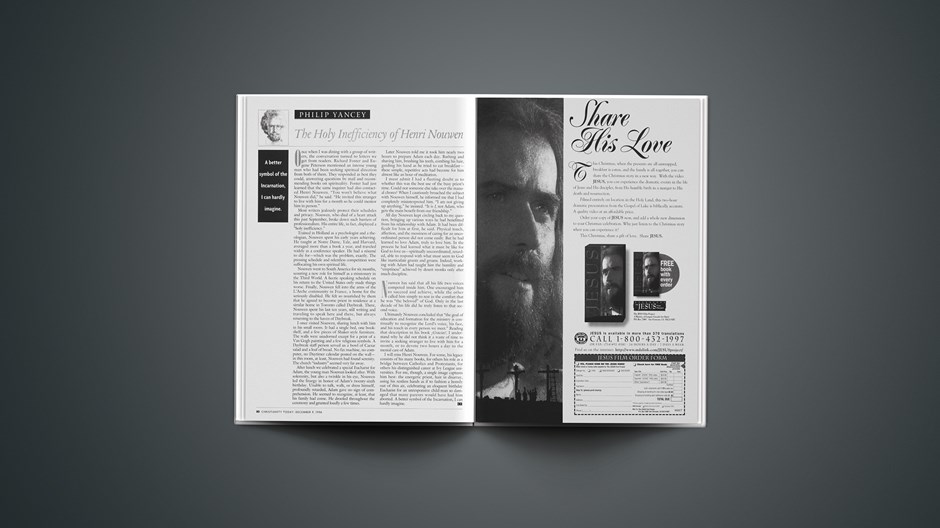
I will miss Henri Nouwen. For some, his legacy consists of his many books, for others his role as a bridge between Catholics and Protestants, for others his distinguished career at Ivy League universities. For me, though, a single image captures him best: the energetic priest, hair in disarray, using his restless hands as if to fashion a homily out of thin air, celebrating an eloquent birthday Eucharist for an unresponsive child-man so damaged that many parents would have had him aborted. A better symbol of the Incarnation, I can hardly imagine.
Philip Yancey is editor at large of Christianity Today and cochair of the editorial board for Books and Culture. Yancey's most recent book is What Good Is God?: In Search of a Faith That Matters. His other books include Prayer (2006), Rumors of Another World (2003), Reaching for the Invisible God (2000), The Bible Jesus Read (1999), What's So Amazing About Grace? (1998), The Jesus I Never Knew (1995), Where is God When It Hurts (1990), and many others. His Christianity Today column ran from 1985 to 2009.















 While we pray for peace, we need moral clarity about this war.
 A Christian reconciliation group in Israel and Palestine warned that war would come. Now the war threatens their relevance.españolالعربيةFrançaisрусскийУкраїнська
 The government plans to close its porous border with Myanmar to boost security, separating ethnic groups that straddle the boundary.






