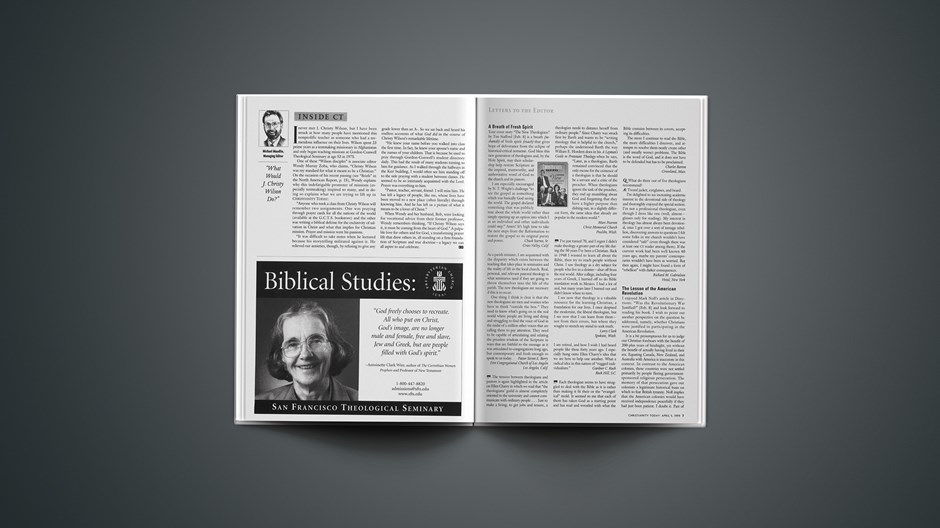
Your cover story "The New Theologians" by Tim Stafford [Feb. 8] is a breath (neshamah) of fresh spirit (ruach) that gives hope of deliverance from the eclipse of historical-critical nonsense. God bless this new generation of theologians and, by the Holy Spirit, may their scholarship help restore Scripture as the inspired, trustworthy, and authoritative word of God to the church and its pastors.
I am especially encouraged by N. T. Wright's challenge "to see the gospel as something which was basically God saving the world. The gospel declared something that was publicly true about the whole world rather than simply opening up an option into which I as an individual and other individuals could step." Amen! It's high time to take the next steps from the Reformation to restore the gospel to its original purity and power.
Chuck Starnes, Sr.
Grass Valley, Calif.
As a parish minister, I am acquainted with the disparity which exists between the teaching that takes place in seminaries and the reality of life in the local church. Real, personal, and relevant pastoral theology is what seminaries need if they are going to throw themselves into the life of the parish. The new theologians are necessary if this is to occur.
One thing I think is clear is that the new theologians are men and women who have to think "outside the box." They need to know what's going on in the real world where people are living and dying and struggling to find the voice of God in the midst of a million other voices that are calling them to pay attention. They need to be capable of articulating and relating the priceless wisdom of the Scripture in ways that are faithful to the message as it was articulated to congregations long ago, but contemporary and fresh enough to speak to us today.
Pastor Steven E. Berry
First Congregational Church of Los Angeles
Los Angeles, Calif.
* The tension between theologians and pastors is again highlighted in the article on Ellen Charry in which we read that "the theologians' guild is almost completely oriented to the university and cannot communicate with ordinary people. … Just to make a living, to get jobs and tenure, a theologian needs to distance herself from ordinary people." Since Charry was struck first by Barth and wants to be "writing theology that is helpful to the church," perhaps she understood Barth the way William E. Hordern does in his A Layman's Guide to Protestant Theology when he says, "Later, as a theologian, Barth remained convinced that the only excuse for the existence of a theologian is that he should be a servant and a critic of the preacher. When theologians ignore the task of the preacher, they end up mumbling about God and forgetting that they have a higher purpose than dishing out, in a slightly different form, the same ideas that already are popular in the modern world."
Marc Pearson
Christ Memorial Church
Poulsbo, Wash.
* I've just turned 70, and I regret I didn't make theology a greater part of my life during the 50 years I've been a Christian. Back in 1948 I wanted to learn all about the Bible, then try to reach people without Christ. I saw theology as a dry subject for people who live in a cloister—shut off from the real world. After college, including four years of Greek, I hurried off to do Bible translation work in Mexico. I had a lot of zeal, but many years later I burned out and didn't know where to turn.
I see now that theology is a valuable resource for the learning Christian, a foundation for our lives. I once despised the modernist, the liberal theologian, but I see now that I can learn from them—not from their errors, but where they sought to stretch my mind to seek truth.
Larry Clark
Spokane, Wash.
I am retired, and how I wish I had heard people like these forty years ago. I especially hung onto Ellen Charry's idea that we are here to help one another. What a radical idea in this nation of "rugged individualism."
Gardner C. Koch
Rock Hill, S.C.
* Each theologian seems to have struggled to deal with the Bible as it is rather than making it fit their or the "evangelical" mold. It seemed to me that each of them has taken God as a starting point and has read and wrestled with what the Bible contains between its covers, accepting its difficulties.
The more I continue to read the Bible, the more difficulties I discover, and attempts to resolve them neatly create other (and usually worse) problems. The Bible is the word of God, and it does not have to be defended but has to be proclaimed.
Charles Barton
Groveland, Mass.
Q: What do three out of five theologians recommend? A: Tweed jacket, eyeglasses, and beard.
I'm delighted to see increasing academic interest in the devotional side of theology and thoroughly enjoyed the special section. I'm not a professional theologian, even though I dress like one (well, almost—glasses only for reading). My interest in theology has almost always been devotional, once I got over a sort of teenage rebellion, discovering answers to questions I felt some folks in my church wouldn't have considered "safe" (even though there was at least one ct reader among them). If the current work had been well known 40 years ago, maybe my parents' contemporaries wouldn't have been as worried. But then again, I might have found a form of "rebellion" with darker consequences.
Article continues below
Richard M. Gabrielson
Vestal, New York
The Lesson of the American Revolution
I enjoyed Mark Noll's article in Directions: "Was the Revolutionary War Justified?" [Feb. 8] and look forward to reading his book. I wish to point out another perspective on the question he addressed, namely, whether Christians were justified in participating in the American Revolution.
It is a bit presumptuous for us to judge our Christian forebears with the benefit of 200-plus years of hindsight, yet without the benefit of actually having lived in their era. Equating Canada, New Zealand, and Australia with America is inaccurate in this context. In contrast to the American colonies, those countries were not settled primarily by people fleeing government-sponsored religious persecution. The memory of that persecution gave our colonists a legitimate historical basis on which to fear British tyranny. Noll implies that the American colonies would have received independence peacefully if they had just been patient. I doubt it. Part of the reason Great Britain granted independence peacefully to those countries was the painful lesson of the American Revolution.
Revolution against our government may yet be justified to the American Christian. The abortion-slavery comparison is apt and well known. Federal taxes can conceivably increase to the point where they make it impossible for Christians to tithe. To the extent that these and other government-sponsored evils contravene God's Word, the plain language of the U.S. Constitution, or the original intent of the Framers, such actions are illegitimate. A government that habitually engages in illegitimate actions itself becomes illegitimate. Whether Christians are obliged to submit to an illegitimate government is, ultimately, a matter of individual conscience.
Attorney John S. Harrison
Winston-Salem, N.C.
My patriotism has been impugned due to my suspicion that the war was unnecessary to secure our rights and liberty and moreover had more negative than positive effects. As an English colony, we would have terminated slavery decades before 1864 and therefore made improbable the horror of the Civil War. Our basic democratic principles and freedom would be retained as they were in Canada and Australia. There is good reason to suspect that the Tories in our country were right in advocating a peaceful resolution of our differences with England. Expression of this often brings the illogical and unfair accusation of favoring tyranny over freedom, for which, you will no doubt learn from printing this article, you are to be commended.
Article continues below
Gene Lutz
Canandaigua, N.Y.
* In the first pages of the Bible, God makes it clear that we are independent agents, created in his image. If any authority is from God and therefore God's authority, then a government that takes away the basic freedom of self-determination is no longer representative of God's authority and therefore forfeits its right to govern. I believe that the American Revolution was justified because English royalty did not listen to the wishes of the people. Laws should do no more than protect us from one another, and not just the rich and powerful from the disenfranchised. Mark Noll's article is fundamentally flawed in that it asserts there is a difference between African Americans who are held in bondage and other people who are oppressed by their governments. The difference is one of degree only.
Manfred Lutje
Delta, B.C., Canada
* My first impression was to be thrilled that someone was willing to take up the discussion—one American Christians have long avoided by assuming the righteousness of American action. However, I was quickly disappointed by the shallow nature of the discussion. The question that introduced the article was based on scriptural teaching to submit to civil authorities. The article never addressed that teaching but instead referred to "classical Christian reasoning" to determine whether the revolutionary actions were "just." The author emphasizes the need to "use the Scriptures for public disputes," and then proceeds to ignore this need himself. Perhaps this is one of the problems facing the American church today—we are more interested in whether we measure up to American, "classical Christian," or "evangelical" standards than whether our actions and beliefs measure up to Scripture.
Randy Christian
Beaverton, Oreg.
Iraq Sanctions: Losing an Opportunity
* Thank you for your editorial urging the lifting of the sanctions on Iraq ["A Silent Holocaust," Feb. 8]. It's a no-brainer to see that Saddam Hussein is a horrible dictator, but the people of Iraq should not be the ones that face the punishment. The United States is losing an opportunity to help bring peace to that region of the world. If sanctions were lifted and the middle class was strengthened, they could work to bring down the Baathist regime. As Christians, we are called by God to be people of justice. Allowing babies to die is not justice but a sin, and the U.S. has a lot to answer before God if we do not change our ways.
Article continues below
Dennis Sanders
St. Paul, Minn.
You make a compelling argument for human compassion. But does compassion in this context make good global policy from any of the perspectives from which you argue their error, when viewed in the light of world history and a long-term perspective? As usual, the short term seems more compelling when viewing policy. The benefit of history is that it gives us a point of reference beyond that limited view.
It seems to me, that when we look back at the world's policy of reaction (or lack thereof) to the handling of the initial offensive thrusts of Hitler's Germany into its neighbors' territory and the results that came from that policy, we see that doing what has and is being done with regard to Hussein is more compassionate in the long run than allowing his actions to go unchecked. While it is no doubt true the sanctions are imposing a terrible hardship on the people of Iraq, considering his past actions of cruelty to his own people, how much better off would the Iraqi people be without the sanctions?
What is different in this case is that, unlike the people whose homelands were taken over by Hitler's Germany, these hardships are only being imposed on the people of the offending power.
So while it is good that we keep the people of Iraq in our hearts and prayers and we should do everything we can to relieve their pain and isolation, I believe it is folly to suggest that continued imposition of these sanctions by the United Nations and the United States represents flawed policy because in this short term innocent people will suffer. Far more innocent people will suffer if Hussein is not checked, and they will be people who are not in a position to change the government because they will be an enslaved people. We cannot turn our backs on these people or on the lessons of history.
W. Boone Vastine II
Houston, Tex.
Understanding Kosovo
I just wanted to offer kudos and thanks for the Special News Report "Bridging Kosovo's Deep Divisions" in the February 8 issue. After reading and hearing many news reports, finally I understood (at least a little) of what the Kosovo issue is about. I loved being able to read about a significant current international issue through the lens of our brothers and sisters living there. Tomas Dixon's writing was crisp and intelligible, and very nicely combined historical background, political aspects, and a Christian perspective.
Article continues below
Please continue to use your news section to cover both "Christian" world events and to bring a Christian perspective to "secular" world events.
Laura McLean
Glastonbury, Conn.
Oops!
* Noticing Max Seabaugh's map on page 60, part of the article "Bridging Kosovo's Deep Divisions," is incorrect. Northwest of Croatia is the former Yugoslav republic of Slovenia, which Miroslav Volf speaks of in the article "The New Theologians" [in the same issue]. Austria, which your map has on Croatia's northern border, is actually north of Slovenia. Granted, Slovenia is small, but it is there.
David Sims
Bridgeport, Conn.
Clarification:
The February 8, 1999, issue, page 62, inaccurately detailed Serbian history. In 1877, Serbia was internationally recognized as independent. In 1929 Yugoslavia was formed, including Serbia. In 1991-92, several Yugoslav republics declared independence, while Serbia and Montenegro remain as a unified republic.—Eds.
A Balanced Perspective
Thank you so much for the insightful cover article in the January 11 issue ["Are You Tolerant? (Should You Be?)"]. Daniel Taylor's methodical style with an evangelical element was refreshing and interesting. As a 17-year-old homeschooled senior, I know the article will broaden my understanding of this issue and enable me to stand up to charges of "narrow-minded intolerance" I will likely face in college. I would also like to thank all of you at ct for helping young people like me gain a balanced perspective on topics such as this. Your efforts are much appreciated.
Jeremy Knapp
Hebron, Ky.
* If we put 500 Christians together in an auditorium with their spectrum of beliefs on abortion and homosexuality, what would toleration look like at its best?
Don Ferrell
Hampshire, Ill.
* The article is a real winning thought-provoker! During the 1960s civil-rights days, I used to say, "I am prejudiced only toward those who are prejudiced." Now I can say, "I am intolerant only toward those who are intolerant."
George C. Kaulbach
Stone Mountain, Ga.
Brief letters are welcome. They may be edited for space and clarity and must include the writer's name and address if intended for publication. Due to the volume of mail, we cannot respond personally to individual letters. Write to Eutychus, Christianity Today, 465 Gundersen Drive, Carol Stream, IL 60188; fax: 630-260-0114. E-mail: cteditor@christianitytoday.com ( * ).















 While we pray for peace, we need moral clarity about this war.
 A Christian reconciliation group in Israel and Palestine warned that war would come. Now the war threatens their relevance.españolالعربيةFrançaisрусскийУкраїнська
 Beyoncé’s right. Whether listening to Cowboy Carter or reading theology, diversity is a good thing.






