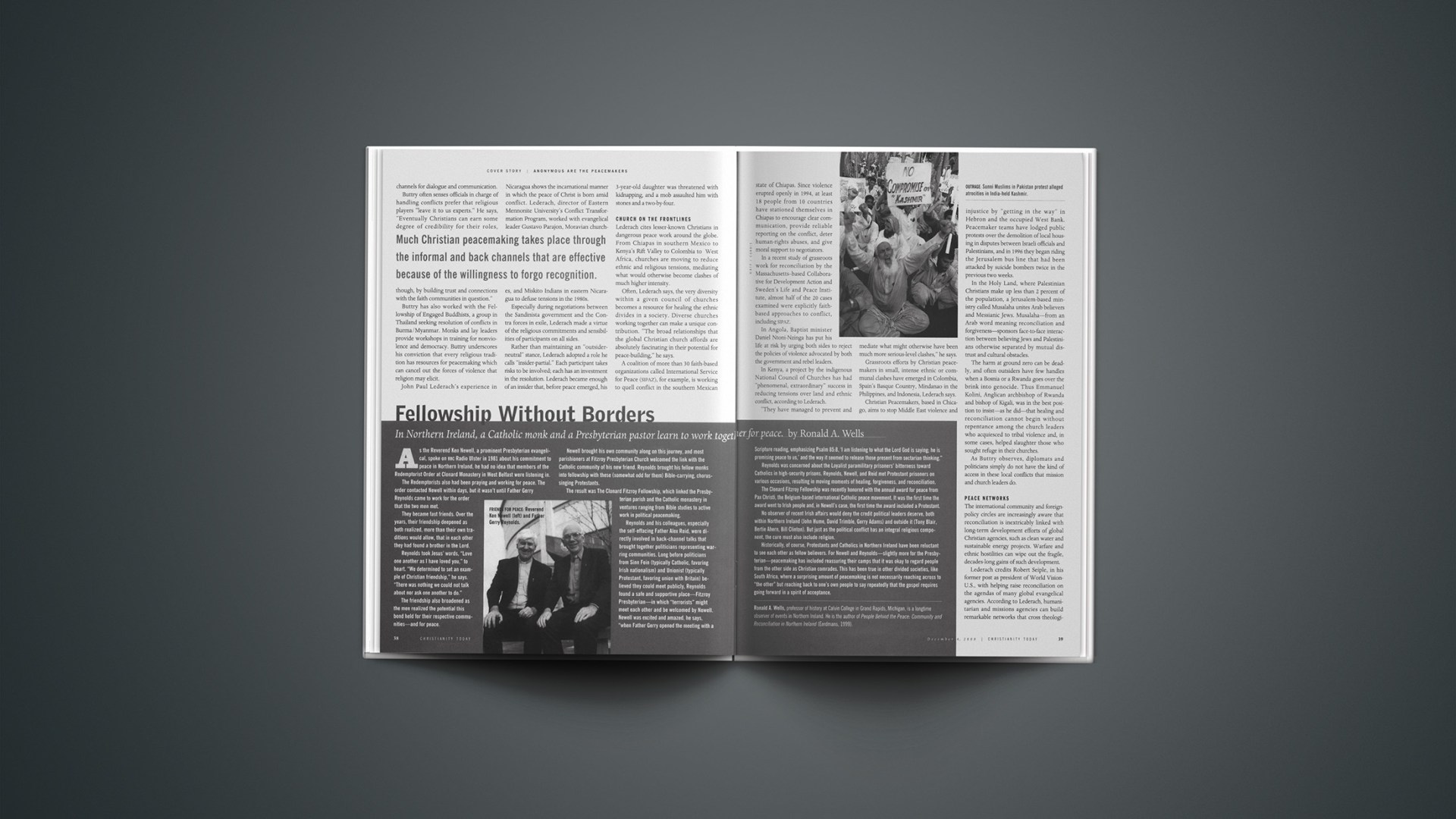

As the Reverend Ken Newell, a prominent Presbyterian evangelical, spoke on BBC Radio Ulster in 1981 about his commitment to peace in Northern Ireland, he had no idea that members of the Redemptorist Order at Clonard Monastery in West Belfast were listening in.
The Redemptorists also had been praying and working for peace. The order contacted Newell within days, but it wasn’t until Father Gerry Reynolds came to work for the order that the two men met.
They became fast friends. Over the years, their friendship deepened as both realized, more than their own traditions would allow, that in each other they had found a brother in the Lord.
Reynolds took Jesus’ words, “Love one another as I have loved you,” to heart. “We determined to set an example of Christian friendship,” he says. “There was nothing we could not talk about nor ask one another to do.”
The friendship also broadened as the men realized the potential this bond held for their respective communities—and for peace.
Newell brought his own community along on this journey, and most parishioners at Fitzroy Presbyterian Church welcomed the link with the Catholic community of his new friend. Reynolds brought his fellow monks into fellowship with these (somewhat odd for them) Bible-carrying, chorus-singing Protestants.
The result was The Clonard Fitzroy Fellowship, which linked the Presbyterian parish and the Catholic monastery in ventures ranging from Bible studies to active work in political peacemaking.
Reynolds and his colleagues, especially the self-effacing Father Alex Reid, were directly involved in back-channel talks that brought together politicians representing warring communities. Long before politicians from Sinn Fein (typically Catholic, favoring Irish nationalism) and Unionist (typically Protestant, favoring union with Britain) believed they could meet publicly, Reynolds found a safe and supportive place—Fitzroy Presbyterian—in which “terrorists” might meet each other and be welcomed by Newell.
Newell was excited and amazed, he says, “when Father Gerry opened the meeting with a Scripture reading, emphasizing Psalm 85:8, ‘I am listening to what the Lord God is saying; he is promising peace to us,’ and the way it seemed to release those present from sectarian thinking.”
Reynolds was concerned about the Loyalist paramilitary prisoners’ bitterness toward Catholics in high-security prisons. Reynolds, Newell, and Reid met Protestant prisoners on various occasions, resulting in moving moments of healing, forgiveness, and reconciliation.
The Clonard Fitzroy Fellowship was recently honored with the annual award for peace from Pax Christi, the Belgium-based international Catholic peace movement. It was the first time the award went to Irish people and, in Newell’s case, the first time the award included a Protestant.
No observer of recent Irish affairs would deny the credit political leaders deserve, both within Northern Ireland (John Hume, David Trimble, Gerry Adams) and outside it (Tony Blair, Bertie Ahern, Bill Clinton). But just as the political conflict has an integral religious component, the cure must also include religion.
Historically, of course, Protestants and Catholics in Northern Ireland have been reluctant to see each other as fellow believers. For Newell and Reynolds—slightly more for the Presbyterian—peacemaking has included reassuring their camps that it was okay to regard people from the other side as Christian comrades. This has been true in other divided societies, like South Africa, where a surprising amount of peacemaking is not necessarily reaching across to “the other” but reaching back to one’s own people to say repeatedly that the gospel requires going forward in a spirit of acceptance.
Ronald A. Wells, professor of history at Calvin College in Grand Rapids, Michigan, is a longtime observer of events in Northern Ireland. He is the author of People Behind the Peace: Community and Reconciliation in Northern Ireland (Eerdmans, 1999).
Related Elsewhere
See today’s related articles, ” Anonymous Are the Peacemakers | For the past century, the Nobel Peace Prize has spotlighted those who work for ‘fraternity among the nations.’ But strife and warfare are often thwarted by Christians working quietly and prayerfully” and ” 100 Years of Beatitude | Nobel Peace Prize winners explicitly influenced by Christian principles.”
Visit the Clonard Reconciliation Ministry ‘s Web site and the Clonard/Fitzroy Fellowship page.
Fitzroy Presbyterian Church of Belfast has its own site, as well.
Read an article about the Clonard/Fitzroy Fellowship being awarded the Pax Christi prize in 1999.
Copyright © 2000 Christianity Today. Click for reprint information.