
“. … To the person who shall have done the most or the best work for fraternity among nations, for the abolition or reduction of standing armies, and for the holding and promotion of peace congresses.”
—Alfred B. Nobel, testament, 1895
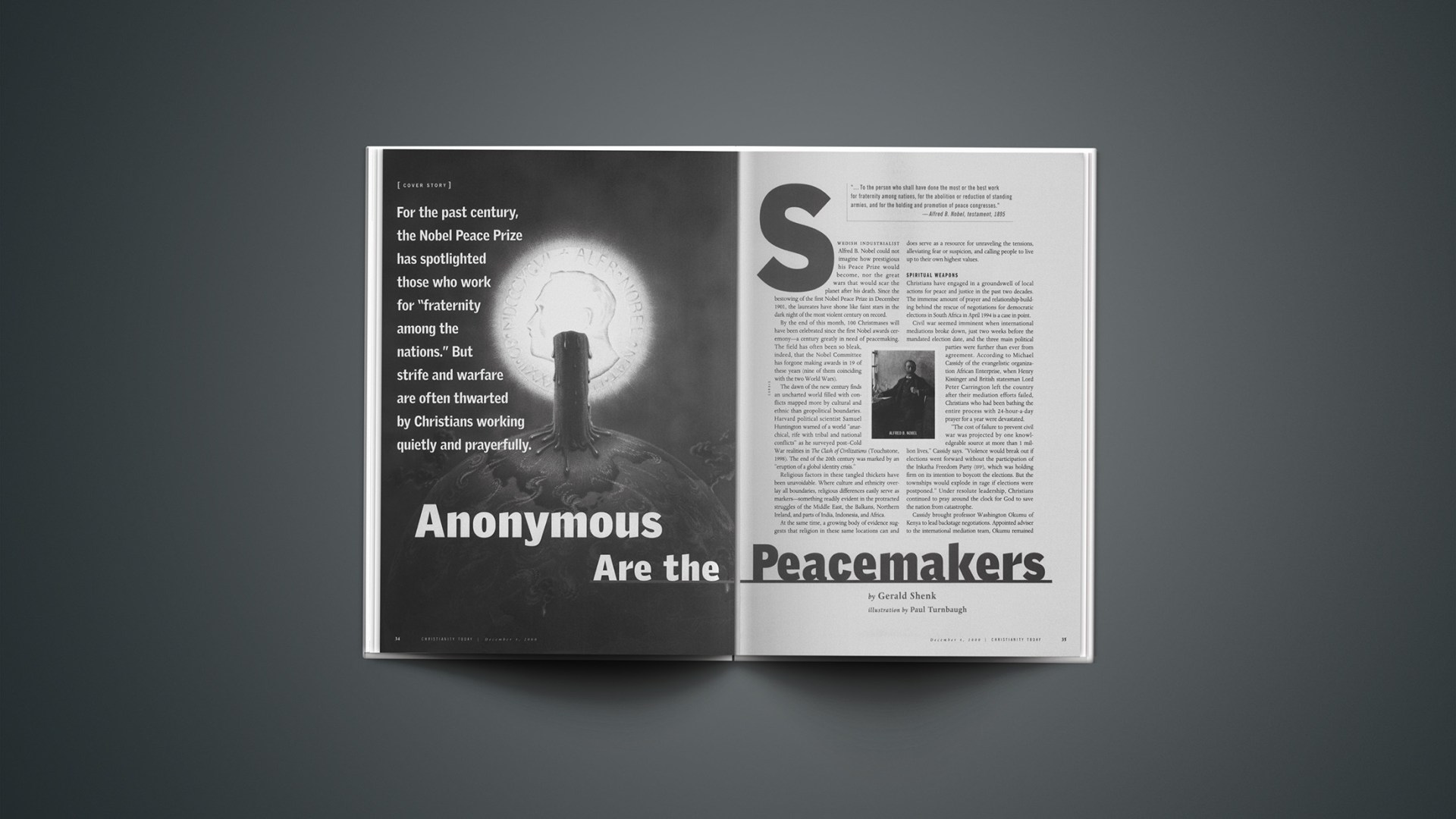
Swedish industrialist Alfred B. Nobel could not imagine how prestigious his Peace Prize would become, nor the great wars that would scar the planet after his death. Since the bestowing of the first Nobel Peace Prize in December 1901, the laureates have shone like faint stars in the dark night of the most violent century on record.
By the end of this month, 100 Christmases will have been celebrated since the first Nobel awards ceremony—a century greatly in need of peacemaking. The field has often been so bleak, indeed, that the Nobel Committee has forgone making awards in 19 of these years (nine of them coinciding with the two World Wars).
The dawn of the new century finds an uncharted world filled with conflicts mapped more by cultural and ethnic than geopolitical boundaries. Harvard political scientist Samuel Huntington warned of a world “anarchical, rife with tribal and national conflicts” as he surveyed post–Cold War realities in The Clash of Civilizations (Touchstone, 1998). The end of the 20th century was marked by an “eruption of a global identity crisis.”
Religious factors in these tangled thickets have been unavoidable. Where culture and ethnicity overlay all boundaries, religious differences easily serve as markers—something readily evident in the protracted struggles of the Middle East, the Balkans, Northern Ireland, and parts of India, Indonesia, and Africa.
At the same time, a growing body of evidence suggests that religion in these same locations can and does serve as a resource for unraveling the tensions, alleviating fear or suspicion, and calling people to live up to their own highest values.
Spiritual weapons
Christians have engaged in a groundswell of local actions for peace and justice in the past two decades. The immense amount of prayer and relationship-building behind the rescue of negotiations for democratic elections in South Africa in April 1994 is a case in point.
Civil war seemed imminent when international mediations broke down, just two weeks before the mandated election date, and the three main political parties were further than ever from agreement. According to Michael Cassidy of the evangelistic organization African Enterprise, when Henry Kissinger and British statesman Lord Peter Carrington left the country after their mediation efforts failed, Christians who had been bathing the entire process with 24-hour-a-day prayer for a year were devastated.
“The cost of failure to prevent civil war was projected by one knowledgeable source at more than 1 million lives,” Cassidy says. “Violence would break out if elections went forward without the participation of the Inkatha Freedom Party (IFP), which was holding firm on its intention to boycott the elections. But the townships would explode in rage if elections were postponed.” Under resolute leadership, Christians continued to pray around the clock for God to save the nation from catastrophe.
Cassidy brought professor Washington Okumu of Kenya to lead backstage negotiations. Appointed adviser to the international mediation team, Okumu remained after the other mediators departed.
“The climactic and successful breakthrough synchronized with a ‘Jesus Peace Rally’ where 25,000 Christians gathered to pray amidst high political tension,” Cassidy says. “It was extraordinary. With only 10 days until the election, what the newspapers called ‘the miracle’ of peace descended on South Africa as the IFP decided to participate in the elections at almost the very last moment.”
Ziba Jiyane, a central official in the IFP, sensed the supernatural in the retreat from civil war’s brink. “In the ranks of many in the political groupings of both IFP and ANC [African National Congress], we politicians have become more keenly aware of the helplessness of humanity in our own wisdom,” he said after the election. “We had reached a point where, on our own, we had failed and were irrevocably fixated in the path of doom—until God’s intervention.”
The final, frantic efforts to bring political opponents to the negotiating table, however, were made possible by painstaking groundwork two years before the intensity of electoral transition. Cassidy and his colleagues had convened a series of informal sessions among political enemies at a remote hunting lodge. As Cassidy relates in A Witness For Ever (Hodder & Stoughton, 1995), there Christians created a safe space for en trenched opponents to hear each other’s stories and learn of their hopes for a new South Africa.
Whites and blacks (and those of other colors), former prisoners and exiles, guards and jailers, those on the left and right, came together with and without bodyguards to find the deeper human layers beneath the bellicose rhetoric of their political profiles. Many participants were surprised to hear individuals describe their life pilgrimages and openly acknowledge both their faith as well as barriers to faith.
Much Christian peacemaking takes place in the trenches of such track-two diplomacy, the informal and back channels that are effective precisely because of the willingness to forgo recognition. New relationships characterized by personal warmth can lead to unforeseen possibilities when parties return to formal negotiations.
Participants not only learn the life stories of their opponents but also come to comprehend just why their opposites think the way they do. Sometimes the fruits of this patient investment are not evident until a much later crisis requires the kind of trust that makes negotiations work.
In the previous decade, Cassidy had often taken on the unsavory task of direct personal encounters at the highest levels of political decision-making. He would be sent to deliver a message from a crucial church gathering; government officials would show only irritation or deep-rooted skepticism. Why should political leaders entrenched in a failing apartheid system pay any attention to nettlesome church leaders?
But the churches’ witness against racial hatred and discrimination began to introduce cracks in the social order of South Africa. Cassidy recalls spending “the roughest hour of [his] life” in 1985 with then-President P. W. Botha, asking him to release Nelson Mandela from prison, remove the army from the black townships, and revoke the ban on political parties. Faith communities undergirded this effort by engaging in a “Pray-Away,” a suspension of normal economic activities in favor of prayer.
Government leaders did not receive these proposals favorably. Yet after six years of prayer and intervention by various Christian representatives—including the (Afrikaner) Dutch Reformed Church’s declaration that apartheid is a sin—President Fredrik Willem de Klerk enacted these same measures. Whether de Klerk’s dramatic about-face was rooted in pragmatic politics or, as Cassidy believes, in “a real Christian heart,” the result reinforced the evangelist’s conviction that patient preparation, bold confrontation, and constant intercession are the Christian contributions to peaceful social and political change.
Religion: Missing in action?
Christians concerned for peace and justice have helped develop the relationships key to softening enemy hearts in hot spots around the globe. Religion, the Missing Dimension of Statecraft (Oxford, 1994) describes the peacemaking role of Christianity and other religions in Nicaragua, Nigeria, East Germany, the Philippines, South Africa, and Zimbabwe.
Doug Johnston, the book’s coeditor, says the collection of essays by members of the Center for Strategic and International Studies grew out of discussions at the National Prayer Breakfast Fellowship. It reflects a growing body of authentic religious engagement with conflict that may be reproduced in other situations.
The approaches accept the prospect that Christians are likely to be found on both sides of a conflict; no one has the privilege of clambering onto the historical stage in all innocence. These experiences have created a growing network of practitioners with the confidence to intervene in difficult and protracted conflicts.
Peacemaking at the grassroots level depends on building relationships between once faceless adversaries—whether Los Angeles gang members or Sri Lankan ethnicities, says American Baptist peace activist and pastor Daniel Buttry.
Carl Upchurch, a thug-turned-Christian in Los Angeles, has built relationships between opposing gang members in a ministry that has blossomed into churches holding peace conferences, as it were, for gang members across the nation.
Similarly, in Sri Lanka Baptist pastor Arty de Silva began a refugee-aid program in which the warring Sinhalese and Tamil peoples work alongside each other to rebuild communities, according to Buttry’s Christian Peacemaking: From Heritage to Hope (Judson, 1994). Christians from both groups train displaced persons from each side to run a printing business established for that purpose.
Buttry’s direct involvement in northeast India with the Naga people’s 55-year campaign for independence typifies the emerging opportunities for Christian peacemakers. In a lengthy armed struggle that has caused more than 200,000 deaths since 1955, Buttry has used his entree with local Baptist leaders of the insurgency to open channels for dialogue and communication.
Buttry often senses officials in charge of handling conflicts prefer that religious players “leave it to us experts.” He says, “Eventually Christians can earn some degree of credibility for their roles, though, by building trust and connections with the faith communities in question.”
Buttry has also worked with the Fellowship of Engaged Buddhists, a group in Thailand seeking resolution of conflicts in Burma/Myanmar. Monks and lay leaders provide workshops in training for nonviolence and democracy. Buttry underscores his conviction that every religious tradition has resources for peacemaking which can cancel out the forces of violence that religion may elicit.
John Paul Lederach’s experience in Nicaragua shows the incarnational manner in which the peace of Christ is born amid conflict. Lederach, director of Eastern Mennonite University’s Conflict Transformation Program, worked with evangelical leader Gustavo Parajon, Moravian churches, and Miskito Indians in eastern Nicaragua to defuse tensions in the 1980s.
Especially during negotiations between the Sandinista government and the Contra forces in exile, Lederach made a virtue of the religious commitments and sensibilities of participants on all sides.
Rather than maintaining an “outsider-neutral” stance, Lederach adopted a role he calls “insider-partial.” Each participant takes risks to be involved; each has an investment in the resolution. Lederach became enough of an insider that, before peace emerged, his 3-year-old daughter was threatened with kidnapping, and a mob assaulted him with stones and a two-by-four.
Church on the frontlines
Lederach cites lesser-known Christians in dangerous peace work around the globe. From Chiapas in southern Mexico to Kenya’s Rift Valley to Colombia to West Africa, churches are moving to reduce ethnic and religious tensions, mediating what would otherwise become clashes of much higher intensity.
Often, Lederach says, the very diversity within a given council of churches becomes a resource for healing the ethnic divides in a society. Diverse churches working together can make a unique contribution. “The broad relationships that the global Christian church affords are absolutely fascinating in their potential for peace-building,” he says.
A coalition of more than 30 faith-based organizations called International Service for Peace (SIPAZ), for example, is working to quell conflict in the southern Mexican state of Chiapas. Since violence erupted openly in 1994, at least 18 people from 10 countries have stationed themselves in Chiapas to encourage clear communication, provide reliable reporting on the conflict, deter human-rights abuses, and give moral support to negotiators.
In a recent study of grassroots work for reconciliation by the Massachusetts–based Collaborative for Development Action and Sweden’s Life and Peace Institute, almost half of the 20 cases examined were explicitly faith-based approaches to conflict, including SIPAZ.
In Angola, Baptist minister Daniel Ntoni-Nzinga has put his life at risk by urging both sides to reject the policies of violence advocated by both the government and rebel leaders.
In Kenya, a project by the indigenous National Council of Churches has had “phenomenal, extraordinary” success in reducing tensions over land and ethnic conflict, according to Lederach.
“They have managed to prevent and mediate what might otherwise have been much more serious-level clashes,” he says.
Grassroots efforts by Christian peacemakers in small, intense ethnic or communal clashes have emerged in Colombia, Spain’s Basque Country, Mindanao in the Philippines, and Indonesia, Lederach says.
Christian Peacemakers, based in Chicago, aims to stop Middle East violence and injustice by “getting in the way” in Hebron and the occupied West Bank. Peacemaker teams have lodged public protests over the demolition of local housing in disputes between Israeli officials and Palestinians, and in 1996 they began riding the Jerusalem bus line that had been attacked by suicide bombers twice in the previous two weeks.
In the Holy Land, where Palestinian Christians make up less than 2 percent of the population, a Jerusalem-based ministry called Musalaha unites Arab believers and Messianic Jews. Musalaha—from an Arab word meaning reconciliation and forgiveness—sponsors face-to-face interaction between believing Jews and Palestinians otherwise separated by mutual distrust and cultural obstacles.
The harm at ground zero can be deadly, and often outsiders have few handles when a Bosnia or a Rwanda goes over the brink into genocide. Thus Emmanuel Kolini, Anglican archbishop of Rwanda and bishop of Kigali, was in the best position to insist—as he did—that healing and reconciliation cannot begin without repentance among the church leaders who acquiesced to tribal violence and, in some cases, helped slaughter those who sought refuge in their churches.
As Buttry observes, diplomats and politicians simply do not have the kind of access in these local conflicts that mission and church leaders do.
Peace networks
The international community and foreign-policy circles are increasingly aware that reconciliation is inextricably linked with long-term development efforts of global Christian agencies, such as clean water and sustainable energy projects. Warfare and ethnic hostilities can wipe out the fragile, decades-long gains of such development.
Lederach credits Robert Seiple, in his former post as president of World Vision-U.S., with helping raise reconciliation on the agendas of many global evangelical agencies. According to Lederach, humanitarian and missions agencies can build remarkable networks that cross theological, political, and social divides.
Conflict-resolution workshops and seminars are proliferating as resources developed in one setting are quickly borrowed and adapted for use in another.
Practitioners at the frontlines can benefit from opportunities to step back and confer with colleagues engaged elsewhere in similar struggles, as happens at the Sum mer Peacebuilding Institute at Eastern Mennonite University.
Franciscan Friar Ivo Markovic of Bosnia might benefit from such communion. In the face of death threats from each of the embattled communities (Muslims, Serbs, and his own Croats), Markovic has worked from his post in Sarajevo to limit violence, deter aggression, and bind up wounds of victims on all sides.
Walking straight into freshly erected barricades that separated Muslims and Catholics in central Bos nia, he insisted that religious leaders from both sides get together over coffee to arrange a ceasefire. They in turn convened the local military commanders, who agreed to terms that held for a full year amid trauma gathering all around them.
Now his ministry includes a peace center and an interreligious choir called Pontanima, whose members are dedicated to the dangerous task of singing each other’s sacred music. Death threats continue.
Markovic has lost eight close relatives, including his father, in the violence. But he vows, “As long as there is just one person on the other side still working for peace, I will continue also.”
The enemy is enmity
Few are in a better position to reflect theologically on the complex interplay of violence and religion in today’s world than Yale Divinity School’s Miroslav Volf. Out of the atrocities committed in the name of ethnicity and religion in his homeland, the former Yugoslavia, Volf has offered a groundbreaking and impassioned approach to conflict in Exclusion and Embrace: A Theological Exploration of Identity, Otherness and Reconciliation (Abingdon, 1996).
The simple categories of victim, oppressor, and even liberation must give way; in stead we must recognize that even the enemy (the alienated “other”) is part of one’s own identity, Volf asserts.
Christians are called to make room for the enemy and his viewpoint in an attitude of open-armed embrace, Volf says, and failure to do so renders us incomplete or sin-stained.
“At the deepest levels, our own wholeness depends on some strained recognition of the humanity of the other,” Volf says. This speaks directly to the horrendous violence committed in conflicts that are Christian at least in name.
“There are characteristically two main functions which religion may serve in the midst of such a clash,” Volf says. “Christian faith and symbols may act as a cultural marker to reinforce an individual’s identity”—and thus continue to divide. Or, because of its central commitments, Christian faith may become a resource to help enemies embrace: the grace inherent in vulnerable acceptance of the enemy flows when Christian faith (not Christian identity) informs choices, he says.
This distinction will make all the difference when faced with the enemy’s transgression, even if that “other” in name belongs to one’s own faith. “At the center of Christian faith we find not justice so much as justification,” Volf says.
In the shadows
Nobel, the inventor of dynamite, died in 1896. It took five years to work out the complex international arrangements for his estate to be used as he had directed. The nomination and selection process, cloaked in confidentiality, has honored some notable church figures, such as Dr. Martin Lu ther King Jr. and South African Archbishop Desmond Tutu [see “100 Years of Beatitude,” p. 36]. From the Nobel’s inception, humanitarian efforts have been considered key contributions to peace; Mother Teresa of Calcutta received the Prize in 1979.
Not only Christians have been so honored, of course: The Dalai Lama, Elie Wiesel, Anwar Sadat, and Menachem Begin all drew upon their own religious traditions for the bold moves they made for peace. (One of the most obvious candidates is conspicuous by his absence: Mahatma Gandhi.) Generally, though, the task of a peacemaker is appropriately located “behind the scenes, predicated on a low visibility,” Volf says.
Lederach quotes his Quaker mentor, the venerable Adam Curle of London: “You can do the work or get the credit. You don’t get both.”
Lederach, however, does offer the name of one Christian who deserves recognition: former President Jimmy Carter, for his contribution to breaking an impasse between North and South Korea.
After two days of talks with President Carter in June 1994, then-President Kim Il Sung of North Korea agreed to freeze his nuclear program in exchange for resumption of dialogue with the United States; the Clinton administration had begun a push for U.N. sanctions after North Korea expelled International Atomic Energy Agency inspectors.
The first talks between North Korea and the United States in 40 years followed Carter’s intervention. “Carter may well have averted a nuclear war with millions of casualties,” Lederach says.
To stand at the cusp of a new millennium and recall the mortal struggles that swept the globe in the past century inspires little warmth. At the same time, to dismiss faith as a healing factor in current conflicts would invite greater suffering. Countless religiously-grounded heroes escape the attention of the watching world, and few of these actors will come up for consideration as Nobel nominees.
Celebrated peace activist Walter Wink of Auburn Theological Seminary is certain about whom Nobel Peace Prizes should not go to.
“Don’t waste the Nobel Prize on people like us,” he says. “Save it for obscure folks struggling under oppressive regimes. The Prize can lift them to prominence, make them bulletproof, as it were. The process has been used very judiciously to target these people well before they hit the headlines, making it virtually impossible for their regimes to single them out and kill them.”
As for the quietly heroic efforts of frontline Christian peacemakers, he simply says, “They’ll do it anyway, without the recognition.”
Gerald Shenk is professor of church and society at Eastern Mennonite Seminary in Harrisonburg, Virginia. He studied and worked for nine years with churches in the former Yugoslavia and has returned each year since its breakup to encourage ministries of reconciliation.
Related Elsewhere
See today’s related articles, ” 100 Years of Beatitude | Nobel Peace Prize winners explicitly influenced by Christian principles” and ” Fellowship Without Borders | In Northern Ireland, a Catholic monk and a Presbyterian pastor learn to work together for peace.”
Read about the 2000 Nobel Peace Prize winner , Kim Dae Jung.
Read an essay about some of the women who have won the Nobel Peace Prize .
Learn more about Michael Cassidy and his organization, African Enterprise , at its homepage.
Read the Dutch Reformed Church’s report on church involvement with Apartheid in South Africa.
Visit the International Service for Peace (SIPAZ) homepage.
Musalaha , a group that unites Arabic Christians and Messianic Jews, also has a site.
The Institute for Justice and Peacebuilding at Eastern Mennonite University offers summer courses in conflict transformation .
To read Volf’s vita and publications , visit the Yale Divinity School site.
Volf’s articles for Christianity Today about peace and reconciliation include:
Peace Be With You | Looking beyond naivete and cynicism about peacemaking at Wheaton’s Christianity and Violence conference. (March 20, 2000) Miroslav Volf: Speaking truth to the world | (Feb. 8, 1999) The Clumsy Embrace | Croatian Miroslav Volf wanted to love his Serbian enemies; the Prodigal’s father is showing him how. (Oct. 5, 1998) Finding the Will to Embrace the Enemy | What it means to follow the crucified Christ in the midst of ethnic and racial conflict. (April 28, 1997)
Volf’s Exclusion and Embrace : A Theological Exploration of Identity, Otherness, and Reconciliation is available from Amazon.com and other book retailers.
Amazon also carries Huntington’s The Clash of Civilizations and Religion, The Missing Dimension of Statecraft , edited by Jimmy Carter.
Christian Peacemaking: From Heritage to Hope by Daniel L. Buttry is available from the ChristianityToday.com bookstore and other book retailers.
Copyright © 2000 Christianity Today. Click for reprint information.