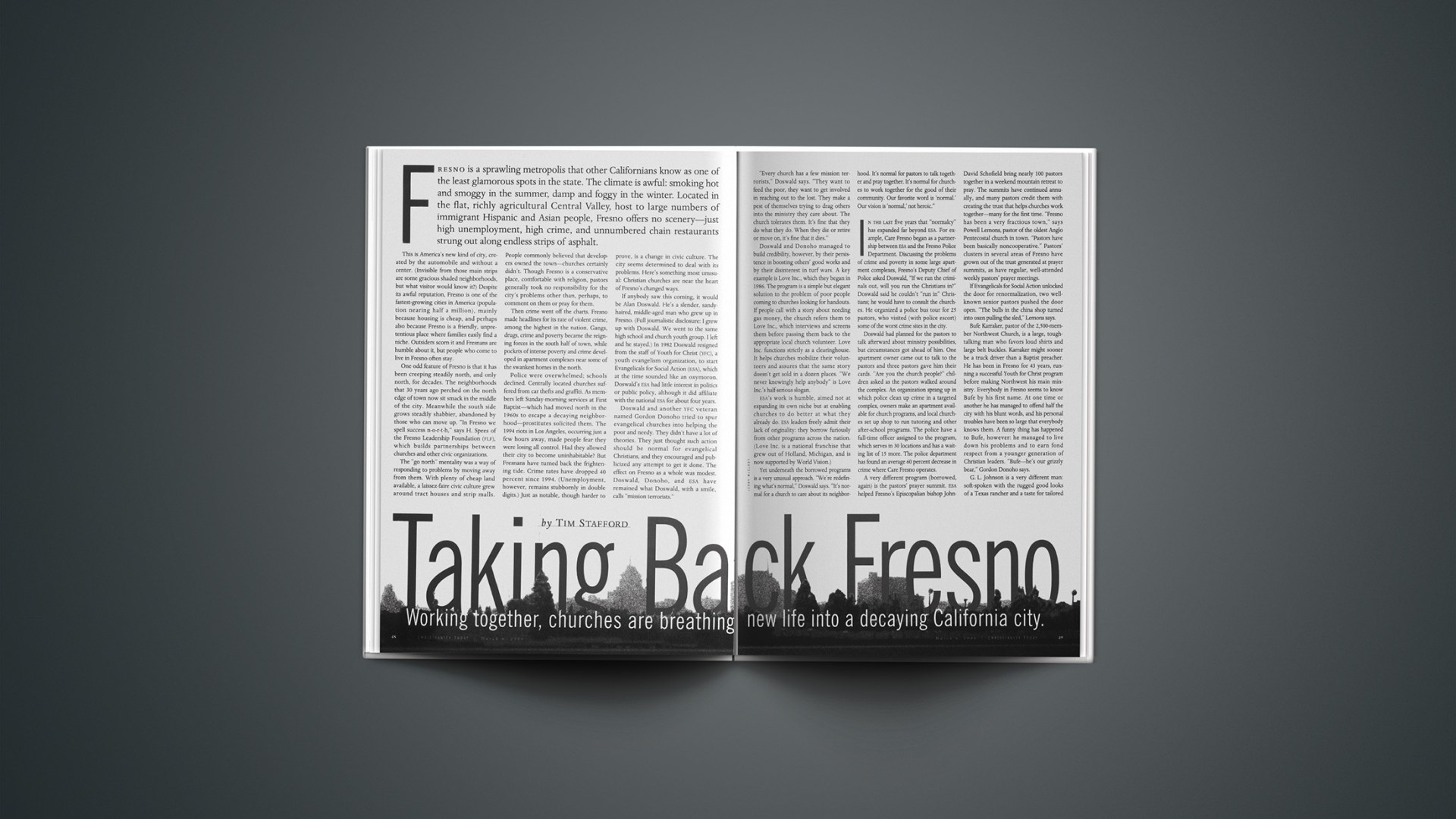

Fresno is a sprawling metropolis that other Californians know as one of the least glamorous spots in the state. The climate is awful: smoking hot and smoggy in the summer, damp and foggy in the winter. Located in the flat, richly agricultural Central Valley, host to large numbers of immigrant Hispanic and Asian people, Fresno offers no scenery—just high unemployment, high crime, and unnumbered chain restaurants strung out along endless strips of asphalt. Southern Baptists have asked their denomination-owned retail chain to stop selling a best-selling Bible translation, saying it contains errors when it comes to language about gender.
Church delegates—known as messengers—passed a resolution at their June annual meeting in Phoenix criticizing the 2011 update to the New International Version (NIV) as an "inaccurate translation of God's inspired Scripture." They asked LifeWay Christian Resources not to sell the NIV 2011, which avoids using male terms in passages where context suggests that both genders are intended, except where the pronoun in question has messianic allusions.
"This is as big as it gets," said Jim Overton of Halteman Village Baptist Church in Muncie, Indiana. "This is the word of God. … As Southern Baptists, I don't think we have the luxury of not speaking to this important issue."
But the convention's resolution committee disagreed. They declined Overton's resolution when it was first submitted to them.
Committee member Russell Moore, dean of Southern Baptist Theological Seminary, told delegates that he has concerns about the new NIV but didn't think it "rose to the level of needing to be addressed by this year's convention."
Moore authored a 2002 resolution against a previous update, Today's New International Version (TNIV), which asked LifeWay not to sell that product. In that case, LifeWay's leadership decided not to sell the edition.
The TNIV was a publishing flop, in part because of opposition by groups like Focus on the Family and the Council on Biblical Manhood and Womanhood.
That opposition was part theological and part personal.
Critics felt like the Committee on Biblical Translation (CBT), which produced the NIV and TNIV, had broken a promise they'd made to James Dobson and other conservative leaders not to produce a gender-inclusive NIV.
Moore said the TNIV was a stealth project that Southern Baptists needed to oppose.
But this time, members of the CBT reached out to critics like Moore.
That didn't lead critics to embrace the new NIV. But it seems to have muted the criticism.
Doug Moo, Blanchard Professor of New Testament at Wheaton College and spokesman for the CBT, said the Southern Baptist resolution was unfair.
He said that the committee, comprising both complementarian and egalitarian scholars, followed the same translation standards as groups like Wycliffe Bible Translators. Their goal, he said, was not to appease TNIV critics but to create an accurate translation.
"That was our only agenda," he said.
Verne Kenney, executive vice president of sales at Zondervan, which publishes the NIV, said sales of the NIV 2011 have exceeded expectations. "They are up in what has been a declining trade-book market."
Zondervan and the CBT have taken a wait-and-see approach to the possibility that LifeWay would drop the latest NIV.
The Christian-retail chain currently sells both the latest NIV and the older version. LifeWay does not reveal sales numbers, but a search of LifeWay.com produced a list of more than 200 NIV products, from the "NIV Study Bible: Update Edition" to the digital "GoBible Player Complete, NIV."
"[We] will continue to sell the 2011 NIV while working through the process of review with our board of trustees," said LifeWay spokesman Micah Carter.
That delay reflects Southern Baptist policy. LifeWay's trustees—not the annual meeting—make policy decisions.
"Resolutions are statements of opinion by messengers at a particular convention," said Frank Page, president of the convention's executive committee. "They are not legally binding."
Page said that trustees shouldn't ignore the resolution. But they are free to make their own decision. He's a fan of the older edition of the NIV.
"I do wish Zondervan would continue publishing and printing the older edition, which I love dearly," he said.
That option isn't part of Zondervan's long-term plan, said Kenney. He said that the NIV was originally published in 1978, and that edition went out of print once the translation was updated in 1984. The publisher plans the same approach with the 2011 edition.
But some pew editions are still being sold during the transition period. "We're doing that as a convenience to churches."
Copyright © 2011 Christianity Today. Click for reprint information.
Related Elsewhere:
Additional coverage of gender issues and Bible translation includes:
| Catherine Clark Kroeger championed women's equality without budging on scriptural authority. (July 12, 2011)
| To see it go won't mean that much, actually. (September 3, 2009)
| "We fell short of the trust that was placed in us." (September 1, 2009)
See Christianity Today's news section and liveblog for more news updates.
This is America’s new kind of city, created by the automobile and without a center. (Invisible from those main strips are some gracious shaded neighborhoods, but what visitor would know it?) Despite its awful reputation, Fresno is one of the fastest-growing cities in America (population nearing half a million), mainly because housing is cheap, and perhaps also because Fresno is a friendly, unpretentious place where families easily find a niche. Outsiders scorn it and Fresnans are humble about it, but people who come to live in Fresno often stay.
One odd feature of Fresno is that it has been creeping steadily north, and only north, for decades. The neighborhoods that 30 years ago perched on the north edge of town now sit smack in the middle of the city. Meanwhile the south side grows steadily shabbier, abandoned by those who can move up. “In Fresno we spell success n-o-r-t-h,” says H. Spees of the Fresno Leadership Foundation (FLF), which builds partnerships between churches and other civic organizations. The “go north” mentality was a way of responding to problems by moving away from them. With plenty of cheap land available, a laissez-faire civic culture grew around tract houses and strip malls. People commonly believed that developers owned the town—churches certainly didn’t. Though Fresno is a conservative place, comfortable with religion, pastors generally took no responsibility for the city’s problems other than, perhaps, to comment on them or pray for them.
Then crime went off the charts. Fresno made headlines for its rate of violent crime, among the highest in the nation. Gangs, drugs, crime and poverty became the reigning forces in the south half of town, while pockets of intense poverty and crime developed in apartment complexes near some of the swankest homes in the north.
Police were overwhelmed; schools declined. Centrally located churches suffered from car thefts and graffiti. As members left Sunday-morning services at First Baptist—which had moved north in the 1960s to escape a decaying neighborhood—prostitutes solicited them. The 1994 riots in Los Angeles, occurring just a few hours away, made people fear they were losing all control. Had they allowed their city to become uninhabitable? But Fresnans have turned back the frightening tide. Crime rates have dropped 40 percent since 1994. (Unemployment, however, remains stubbornly in double digits.) Just as notable, though harder to prove, is a change in civic culture. The city seems determined to deal with its problems. Here’s something most unusual: Christian churches are near the heart of Fresno’s changed ways.
If anybody saw this coming, it would be Alan Doswald. He’s a slender, sandy-haired, middle-aged man who grew up in Fresno. (Full journalistic disclosure: I grew up with Doswald. We went to the same high school and church youth group. I left and he stayed.) In 1982 Doswald resigned from the staff of Youth for Christ (YFC), a youth evangelism organization, to start Evangelicals for Social Action (ESA), which at the time sounded like an oxymoron. Doswald’s ESA had little interest in politics or public policy, although it did affiliate with the national ESA for about four years.
Doswald and another YFC veteran named Gordon Donoho tried to spur evangelical churches into helping the poor and needy. They didn’t have a lot of theories. They just thought such action should be normal for evangelical Christians, and they encouraged and publicized any attempt to get it done. The effect on Fresno as a whole was modest. Doswald, Donoho, and ESA have remained what Doswald, with a smile, calls “mission terrorists.”
“Every church has a few mission terrorists,” Doswald says. “They want to feed the poor, they want to get involved in reaching out to the lost. They make a pest of themselves trying to drag others into the ministry they care about. The church tolerates them. It’s fine that they do what they do. When they die or retire or move on, it’s fine that it dies.”
Doswald and Donoho managed to build credibility, however, by their persistence in boosting others’ good works and by their disinterest in turf wars. A key example is Love Inc., which they began in 1986. The program is a simple but elegant solution to the problem of poor people coming to churches looking for handouts. If people call with a story about needing gas money, the church refers them to Love Inc., which interviews and screens them before passing them back to the appropriate local church volunteer. Love Inc. functions strictly as a clearinghouse. It helps churches mobilize their volunteers and assures that the same story doesn’t get sold in a dozen places. “We never knowingly help anybody” is Love Inc.’s half-serious slogan.
ESA’s work is humble, aimed not at expanding its own niche but at enabling churches to do better at what they already do. ESA leaders freely admit their lack of originality: they borrow furiously from other programs across the nation. (Love Inc. is a national franchise that grew out of Holland, Michigan, and is now supported by World Vision.)
Yet underneath the borrowed programs is a very unusual approach. “We’re redefining what’s normal,” Doswald says. “It’s normal for a church to care about its neighborhood. It’s normal for pastors to talk together and pray together. It’s normal for churches to work together for the good of their community. Our favorite word is ‘normal.’ Our vision is ‘normal,’ not heroic.”
In the last five years that “normalcy” has expanded far beyond ESA. For example, Care Fresno began as a partnership between ESA and the Fresno Police Department. Discussing the problems of crime and poverty in some large apartment complexes, Fresno’s Deputy Chief of Police asked Doswald, “If we run the criminals out, will you run the Christians in?” Doswald said he couldn’t “run in” Christians; he would have to consult the churches. He organized a police bus tour for 25 pastors, who visited (with police escort) some of the worst crime sites in the city.
Doswald had planned for the pastors to talk afterward about ministry possibilities, but circumstances got ahead of him. One apartment owner came out to talk to the pastors and three pastors gave him their cards. “Are you the church people?” children asked as the pastors walked around the complex. An organization sprang up in which police clean up crime in a targeted complex, owners make an apartment available for church programs, and local churches set up shop to run tutoring and other after-school programs. The police have a full-time officer assigned to the program, which serves in 30 locations and has a waiting list of 15 more. The police department has found an average 60 percent decrease in crime where Care Fresno operates.
A very different program (borrowed, again) is the pastors’ prayer summit. ESA helped Fresno’s Episcopalian bishop John-David Schofield bring nearly 100 pastors together in a weekend mountain retreat to pray. The summits have continued annually, and many pastors credit them with creating the trust that helps churches work together—many for the first time. “Fresno has been a very fractious town,” says Powell Lemons, pastor of the oldest Anglo Pentecostal church in town. “Pastors have been basically noncooperative.” Pastors’ clusters in several areas of Fresno have grown out of the trust generated at prayer summits, as have regular, well-attended weekly pastors’ prayer meetings.
If Evangelicals for Social Action unlocked the door for renormalization, two well-known senior pastors pushed the door open. “The bulls in the china shop turned into oxen pulling the sled,” Lemons says.
Bufe Karraker, pastor of the 2,500-member Northwest Church, is a large, tough-talking man who favors loud shirts and large belt buckles. Karraker might sooner be a truck driver than a Baptist preacher. He has been in Fresno for 43 years, running a successful Youth for Christ program before making Northwest his main ministry. Everybody in Fresno seems to know Bufe by his first name. At one time or another he has managed to offend half the city with his blunt words, and his personal troubles have been so large that everybody knows them. A funny thing has happened to Bufe, however: he managed to live down his problems and to earn fond respect from a younger generation of Christian leaders. “Bufe—he’s our grizzly bear,” Gordon Donoho says.
G. L. Johnson is a very different man: soft-spoken with the rugged good looks of a Texas rancher and a taste for tailored suits. Johnson has been in Fresno 40 years and has built Peoples Church, probably the only true megachurch in town. Somehow he has managed to inspire more appreciation than jealousy from other pastors. Paul Binion, African-American pastor of Westside Church of God, says Johnson is a pastor’s pastor. “If a pastor calls him, he calls back.” Johnson, he said, is a very influential man who doesn’t try to manipulate or to control.
As it happened, Bufe and Johnson were neighbors. They met on the street one warm evening a dozen years ago, chatting about common interests, when suddenly Bufe blurted out, “G. L., let’s take over this city.” Both men remember the conversation as pivotal. “We began to build churches that would see the city,” Bufe says.
In reality, both men had taken a wide view for a long time. “Just building his church was never enough” for Bufe, says Richard Kriegbaum, past president of Fresno Pacific College. In his Youth for Christ days Bufe had developed contacts in service groups and school administrations that kept his focus large. In a different mode, Johnson was similar. For 20 years he has prayed every Sunday morning for another church in the city—asking God’s blessing on the pastor and the church by name. “You are entering the mission field,” a large sign announces to people leaving the parking lot of Peoples Church.
When Fresno’s crime crisis developed, Bufe and Johnson gathered a handful of church leaders, along with the mayor, the chief of police, and the county sheriff. Group members invited John Perkins, the renowned African-American community organizer and evangelical author, to talk to them. They put their weight behind an effort that became No Name Fellowship.
Doswald says there are a dozen versions of how No Name got started: each person has a story that places himself at ground zero. Essentially eight or ten mostly white, middle class, male veterans of evangelical organizations and churches, men who had known each other for years, developed a consensus that something must be done about Fresno. They recognized that they could not manage the crisis themselves; it would take a broad cross-section of leadership. “No Name” was an attempt to say that the organization, such as it was, would belong to no one and that members would not honor turf or status. No Name always meets in a public facility and never in a church. A small steering committee plans the monthly meetings. The agenda is informational. Church leaders, business leaders and public officials are invited to eat sandwiches and learn what’s going on in their city. The month I visited, No Name met at Juvenile Hall to see and hear firsthand about juvenile crime from those who deal with it constantly. At every meeting No Name members sing “On Christ the Solid Rock I Stand” and say their purpose aloud: “To release God’s resources through reconciled relationships to rebuild our city.” That’s it. There’s no predetermined outcome, no action agenda.
It’s a very simple thing, but it carries a powerful message: Christian leaders care about Fresno. Of course, the active presence of the two best-known pastors in the city helps legitimatize the meetings. So does the frequent presence of the mayor and the deputy police chief and the fire chief. In 1994 No Name Fellowship met at one of the city’s aging high schools. Fresno is a conservative city, unfriendly to tax hikes, and voters had rejected a school bond bill three times. People at the Fresno High School meeting reached an informal consensus that they would support the school bond bill. They had enough influence to make the difference: it passed.
That’s exceptional. Politics does not play a big role in the Fresno churches’ work. Much more typical is the growth of after-school tutoring programs, for which churches provide volunteers, or the inception of the Fresno Leadership Foundation. FLF came into being to act on ideas that surfaced at No Name Fellowship. FLF is modeled on the Pittsburgh Leadership Foundation (borrowing again). In a short time it has become a major influence in Fresno.
While ESA focuses on churches, FLF’s scope includes governmental agencies and other nonprofit organizations. Various initiatives try to build consensus and partnership between groups that might otherwise act independently. FLF concentrates on neighborhoods, advancing a view that not all Christian leaders would accept. “God’s view of Fresno does not have the church in the middle,” Rich Kriegbaum says. “He has the people of Fresno in the middle.” FLF’s leader, H. Spees, has a remarkable ability to communicate with high-level executives as well as with working-class people. Spees, who worked with community activist John Perkins in Mississippi before coming to Fresno, has been important in building consensus and alleviating suspicion in all sectors.
When I visited Fresno, people kept telling me stories about what had happened with this church or that neighborhood. For example, in one troubled neighborhood the police asked West McKinley Assemblies of God to move its Sunday-evening services to the park, so the congregation’s presence would inhibit crime and develop the expectation that ordinary citizens spend time there. Ironically, the police helped a Pentecostal church return to its roots.
I heard of the pastors’ prayer group that went, all together, to visit and pray for a neighboring pastor whose church had just split in an ugly fight. (Twice as many pastors attended after that.) Or the young urban professionals from a Presbyterian church who targeted a tough neighborhood and moved into it. Or the cooperation of a half-dozen churches in one neighborhood to purchase adjoining apartments where they could minister to troubled families. Or the woman who got burned out of her home and, practically overnight, saw it rebuilt and refurbished by church volunteers. A reporter could glean dozens of “Church in Action” stories from the activities of particular churches or Christian organizations in Fresno.
The larger story of how the church of Fresno has changed its attitude is unspectacular, however, barely registering on the town’s radar screen. One senses that even church members only dimly grasp that the landscape has changed. But it has. In a modern placeless city where churches got planted on their locations like Wal-Marts, showing no interest in the neighborhood beyond the amenities of good traffic patterns, many churches in Fresno think more like the old-fashioned parish. They see that their neighborhoods are not an accident; they take responsibility for the neighborhood’s welfare.
It’s now the ordinary thing for Fresno churches to send volunteers into local schools to read to children, or to offer after-school programs aimed at poor immigrant children in their neighborhood. Civic and school authorities and police officers now think of churches as a resource and an ally. It’s the ordinary thing for schools to use church facilities for special assemblies. It’s the ordinary thing for the police department to sponsor a block party or community fair and then ask local churches to provide leadership. Lately many churches have taken up prayer walks and Lighthouses of Prayer in their neighborhoods, and this fits perfectly into the mindset. Why wait for people to come in and ask for prayer? Why not assume that the neighborhood is your mission field and go out into it, praying and meeting needs? On a larger scale it’s clear that Fresno pastors are beginning to look at the whole city as their responsibility. “Fresno is a big city,” pastor Powell Lemons says, “but it has a small-town flavor.” In the old days pastors were important civic leaders. Fresno pastors are discovering that they still are meant to be.
Why is it happening in Fresno? Four factors readily come to mind. First, two respected Christian organizations (ESA and FLF) promote cooperation for the good of the city, and particularly for the good of the poor. It’s rare to find such strength in groups that exist simply to encourage and to catalyze others. The long, good history of ESA and the dynamic, trusted leadership of FLF bring people together in common purpose.
Second, for years pastors from many denominations have prayed together and built mutual trust. It’s something when an African-American pastor like Paul Binion, who takes a somewhat jaundiced view of white evangelicalism, can say, “I know all the players and they know me. When we don’t agree, we can duke it out and still love each other.”
Racial reconciliation is not the end, it’s a means,” Binion says. “Just because we can get along doesn’t mean we’ve arrived.”
Third, seasoned Christian leaders in government and in some of the best-known churches in town led the way. No Name Fellowship served as a bridge for them to share concerns. Again, Paul Binion: “Leadership at this level must come together and decide to do it. They must intentionally decide to have an interest in our city.”
Fourth, desperation forced the city’s leadership to change. “I think many cities have never reached that critical need,” says Jim Westgate, a professor at Mennonite Brethren Biblical Seminary. “We could no longer ignore our problems. They were just out of control.” That operated from the government side as well. “Institutions that had kept Christians and Christian institutions at arm’s length really denied themselves the generosity and fervor of Christian people in problem-solving,” says Mayor Jim Patterson. “For the community as for the person, when we’ve tried everything, we finally went to God.”
I don’t know how unusual Fresno is, but its pattern needs to spread. It’s clear that all through America a divide is growing between the rich and poor, the educated and those who have missed the “knowledge society.” Voluntarism is also growing as people look to private initiatives for answers both to their personal needs for meaningful participation, and to the dilemmas of hurting people.
Meanwhile the bias against religion has declined in secular society—increasingly Americans see that faith-based organizations are valuable to civic culture—and so has the bias within churches against providing practical help to needy people. (The demise of theological liberalism has lowered evangelical fears of falling into moralistic theology.) The conditions for Christian involvement are improving, but that does no good if churches don’t identify themselves as responsible.
As a journalist I’ve looked at a good many ministries in urban settings. I’ve read many books and articles about model ministries. Most of these reports—my own and others’—focus on a single church or organization affecting a single neighborhood. Most of the time there’s one big personality whose vision and commitment drive the work. I find a discouraging common thread in these model ministries: they may create a buzz at a conference 2,000 miles away, but ten blocks away at a nearby church they often make little impact. Neighboring churches may not even know about the model church, and if they do they’re more likely to offer caveats than admiration. Perhaps jealousy or turf pride keep them from learning from the models. Perhaps they can’t match the driving personality at the heart of the model, or the fiery missionary commitment that’s required. So celebrated model programs often remain isolated examples in their own city. Fresno’s story is very different. Dozens of leaders in dozens of institutions are involved, with dozens of styles, so there’s no one model, no single leader. The church in Fresno is all over the map, literally and figuratively. It’s premature to say that what’s happening in Fresno will make a lasting difference.
Nevertheless, in talking to many of those leaders, I came away believing that the story in Fresno is worth our attention, precisely because it requires rethinking what is normal for the church in America today.
Perhaps most encouraging is the optimism and energy one finds among Fresno’s leaders. They don’t seem beaten down by the problems of the city, which remain daunting. “A lot of people are thoroughly enjoying the challenge and the work,” Mayor Patterson says. “There’s a joy rising in Fresno.”Tim Stafford is Senior Writer for Christianity Today.
Related Elsewhere
How God Won When Politics Failed | Learning from the abolitionists during a time of political discouragement. (Jan. 28, 2000)
CT Classic: Bethlehem on a Budget | Planning a church budget and the Christmas story share surprising similarities (Dec. 23, 1999)
The Business of the Kingdom | Management guru Peter Drucker thinks the future of America is in the hands of churches (Nov. 8, 1999)
The Criminologist Who Discovered Churches | Political scientist John DiIulio followed the data to see what would save America’s urban youth. (June 14, 1999)
The New Theologians | These top scholars are believers who want to speak to the church (Feb. 8, 1999)
God Is in the Blueprints | Our deepest beliefs are reflected in the ways we construct our houses of worship. (Sept. 7, 1998)
God’s Green Acres | How Calvin DeWitt is helping Dunn, Wisconsin, reflect the glory of God’s good creation. (June 15, 1998)
Anatomy of a Giver | American Christians are the nation’s most generous givers, but we aren’t exactly sacrificing. (May 19, 1997)
Stafford also writes the “Love, Sex, and Real Life” column for Campus Life magazine, another Christianity Today, Inc. publication.
Copyright © 2000 Christianity Today. Click for reprint information.