
At that same Bible college, however, I first encountered the writings of C.S. Lewis and G.K. Chesterton. Although separated from me by a vast expanse of sea and culture, they kindled hope that somewhere Christians existed who loosed rather than restrained their minds, who combined sophisticated taste with a humility that did not demean others and, above all, who experienced life with God as a source of joy and not repression. Ordering tattered used copies through bookshops in England, I devoured everything I could find by these men, one an Oxford don and the other a Fleet Street journalist. As Lewis himself wrote after discovering Chesterton while recovering in a hospital during World War I, “A young man who wishes to remain a strong atheist cannot be too careful of his reading.”
Their words sustained me as a lifeline of faith in a sea of turmoil and doubt. I became a writer, I have said, in large part because I realized the power of words in my own life, words that could sail across time and an ocean and quietly, gently, work a transformation of healing and hope. More time would pass before I fully returned to faith, but at least I had models of what life-enhancing faith could look like.
In his story of the Prodigal Son, Jesus does not dwell on the prodigal’s motive for return. The younger son feels no sudden remorse or burst of love for the father he insulted. Rather, he tires of a life of squalor and returns out of selfish motives. Apparently, it matters little to God whether we approach him out of desperation or out of longing. Why did I return? I ask myself.
My older brother, who played the role of prodigal more dramatically, demonstrated what could happen if I chose to leave everything behind. In an attempt to break the shackles of a confining upbringing, he went on a grand quest for freedom, trying on worldviews like changes of clothing: Pentecostalism, atheistic existentialism, Buddhism, New Age spirituality, Thomistic rationalism. He joined the flower children of the 1960s, growing his hair long and wearing granny glasses, living communally, experimenting with sex and drugs. For a time he sent me exuberant reports of his new life. Eventually, however, a darker side crept in. I had to bail him out of jail when an LSD trip went bad. He broke relations with every other person in the family and burned through several marriages. I got late-night calls concerning his suicide threats. Watching my brother, I saw up close the destructive power of casting off faith with nothing to take its place.
At the same time, more positively, my career as a journalist gave me the opportunity to investigate people who demonstrate that a connection with God can enlarge, rather than shrink, life. I began the lifelong process of separating church from God. Though I had emerged from childhood churches badly damaged, as I began to scrutinize Jesus through the critical eyes of a journalist, I saw that the qualities that so upset me—legalism, self-righteousness, racism, provincialism, hypocrisy—Jesus had fought against, and were probably the very qualities that led to his crucifixion. Getting to know the God revealed in Jesus, I recognized I needed to change in many ways—yes, even to repent, for I had absorbed the hypocrisy, racism, and self-righteousness of my upbringing and contributed numerous sins of my own. I began to envision God less as a stern judge shaking his finger at my waywardness than as a doctor who prescribes behavior in my best interest in order to safeguard my health.
Surprised by ‘Orthodoxy’
“I am the man who with the utmost daring discovered what had been discovered be fore,” G.K. Chesterton declared triumph antly. “I did try to found a heresy of my own, and when I had put the last touches to it, I discovered that it was orthodoxy.” Guided in part by Chesterton, I landed in a similar place after a circuitous journey.When someone asked Chesterton what one book he would want to have along if stranded on a desert island, he paused only an instant before replying, “Why, A Practical Guide to Shipbuilding, of course.” If I were so stranded, and could choose one book apart from the Bible, I may well select Chesterton’s own spiritual autobiography, Orthodoxy (1909). Why anyone would pick up a book with that formidable title eludes me, but one day I did so and my faith has never recovered. Orthodoxy brought freshness and a new spirit of adventure to my faith as I found odd parallels between my own odyssey and that traveled by its author, a 300-pound, scatterbrained Victorian journalist.
Gilbert Keith Chesterton has sometimes been called “the master who left no masterpiece,” perhaps the curse of his chosen profession. For most of his life (1874-1936) he served as editor of a weekly newspaper of ideas, in the process writing some 4,000 essays on topics both trivial and important. He straddled the turn of the century, from the 19th to the 20th, when such movements as modernism, communism, fascism, pacifism, determinism, Darwinism, and eugenics were coming to the fore. As he surveyed each one, he found himself pressed further and further toward Christianity, which he saw as the only redoubt against such potent forces. Eventually he accepted the Christian faith not simply as a bulwark of civilization but rather as an expression of the deepest truths about the world. He took the public step of being baptized into the Roman Catholic church in a mostly Protestant nation.
As a thinker, Chesterton started slowly. By the age of 9, he could barely read, and his parents consulted with a brain specialist about his mental capacity. He dropped out of art school and skipped university entirely. As it turned out, however, he had a memory so prodigious that late in life he could recite the plots of all 10,000 novels he had read and reviewed. He wrote five novels of his own, as well as 200 short stories, including a series of detective stories centered on Father Brown; tried his hand at plays, poetry, and ballads; wrote literary biographies of such characters as Robert Browning and Charles Dickens; spun off a history of England; and tackled the lives of Francis of Assisi, Thomas Aquinas, and Jesus himself. Writing at breakneck speed, getting many facts wrong, he nevertheless approached each of his subjects with such discernment, enthusiasm, and wit that even his harshest critics had to stand and applaud.
Chesterton traveled occasionally out of England, and made it across the Atlantic to visit the United States (prompting the book What I Saw in America), but mostly he stayed at home, read widely, and wrote about everything that crossed his mind. The rollicking adventures took place inside his great, shaggy head. One can hardly overestimate his impact on others, though. Mahatma Gandhi got many of his ideas on Indian independence from Chesterton; one of his novels inspired Michael Collins’s movement for Irish independence; and C.S. Lewis looked to Chesterton as his spiritual father.
Chesterton had been dead more than 30 years when I first discovered him, but he resuscitated my moribund faith. As I look back now, and ask in what way he affected me, I see that he helped awaken in me a sense of long-suppressed joy.
Albert Einstein once articulated the most important question of all: “Is the universe a friendly place?” In childhood and adolescence, I received mixed messages at best. Like the children of alcoholics—who subliminally learn “Don’t talk, Don’t trust, and Don’t feel”—I had responded by flat-lining emotionally. Even as my brother turned outward, launching his grand tour of freedom, I turned inward, sealing off one by one any avenue whereby people could get to me, either to manipulate me or cause pain. I read the novels of Sartre and Camus, whose heroes would stab themselves in the hand or murder someone on the beach just for the experience of it. Especially I read Nietzsche, who described a Superman impervious to suffering. I learned not to laugh or smile, and not to cry.
I see now what I could not see then, that I was erecting a strong stone fortress against love, for I thought myself unlovable. In the most unlikely place, the Bible college I viewed as a kind of asylum, that inner fortress began to crumble. I found solace not in religion, where everyone around me claimed to find it, but in music. Late at night I would steal out of the dormitory and make my way to the chapel and its nine-foot Steinway grand. I never performed in public, but I could passably sight-read Mozart, Chopin, Beethoven, and Schubert, and that is how I spent many evenings, pressing some order into my disordered world. I was creating something, and in spite of myself it seemed beautiful as it echoed through the dark and empty chapel.
Then I fell in love. Janet and I drew together for all the wrong reasons—mainly we sat around and complained about the oppressive atmosphere of the school—but eventually the most powerful force in the universe, love, won out. I had found someone who pointed out everything right with me, not everything wrong. Hope aroused. I wanted to conquer worlds and lay them at her feet. For her birthday I learned Beethoven’s Sonata Pathetique and asked, trembling, if she would be the very first audience to hear me play. It was an offering to new life, and to her who had called it forth.
The Problem of Pleasure
“The worst moment for the atheist is when he is really thankful and has no one to thank,” wrote Chesterton. And also, “Joy, which was the small publicity of the pagan, is the gigantic secret of the Christian.” I know well that worst moment and know too the first stirrings of joy that flapped fresh air into crevices long sealed off. Great joy carries within it the intimations of immortality. Suddenly I wanted to live, even to live forever.Chesterton viewed this world as a sort of cosmic shipwreck. A person in search of meaning resembles a sailor who awakens from a deep sleep and discovers treasure strewn about, relics from a civilization he can barely remember. One by one he picks up the relics—gold coins, a compass, fine clothing—and tries to discern their meaning. Fallen humanity is in such a state. Good things on earth—the natural world, beauty, love, joy—still bear traces of their original purpose, but amnesia mars the image of God in us.
After Orthodoxy I read many of Chesterton’s other works. (He wrote more than 100 books, and as a writer it depressed me for weeks to learn that he dictated most of them to his secretary, and made few changes to the first drafts.) I was writing on the problem of pain at the time, and found much insight in The Man Who Was Thursday (1907), his fictional treatment of that dark subject. Amazingly, considering their differences in style, he wrote it and Orthodoxy during the same year. He later explained that he had been struggling with despair, evil, and the meaning of life, and had even approached mental breakdown. When he emerged from that melancholy, he sought to make a case for optimism amid the gloom of such a world. He had been studying the biblical book of Job, and Orthodoxy and The Man Who Was Thursday resulted, one a book of apologetics full of unexpected twists and turns, the other best described as a combination spy thriller and nightmare.
In The Man Who Was Thursday, Chesterton does not diminish the incaluable mysteries of suffering and free will. Rather, he transforms them into the simplest argument for faith. At its worst, with nature revealing only the backside of God, the universe offers reasons for belief. In God’s speech to Job, God pointed to the fierce wildness of nature—the hippopotamus and crocodile, thunderstorms and blizzards, the lioness and mountain goat, untamed oxen and ostriches—and not its friendly side. If nothing else, nature reveals God as mysterious, incalculable, “wholly other,” worthy of worship. We may have limited clues to the secrets of reality, but what wondrous clues they are. “Even mere existence, reduced to its most primary limits, was extraordinary enough to be exciting. Anything was magnificent as compared with nothing,” Chesterton testified later.
For Chesterton, and also for me, the riddles of God proved more satisfying than the answers proposed without God. I too came to believe in the good things of this world—first revealed to me in music, romantic love, and nature—as relics of a wreck, and as bright clues into the nature of a reality shrouded in darkness. God had answered Job’s questions with more questions, as if to say the truths of existence lie far beyond the range of our comprehension. We are left with remnants of God’s original design and the freedom, always the freedom, to cast our lots with such a God, or against him.
In addition to the problem of pain, G.K. Chesterton seemed equally fascinated by its opposite, the problem of pleasure. He found materialism too thin to account for the sense of wonder and delight that gives an almost magical dimension to such basic human acts as sex, childbirth, play, and artistic creation.
Why is sex fun? Reproduction surely does not require pleasure: some animals simply split in half to reproduce, and even humans use methods of artificial insemination that involve no pleasure. Why is eating enjoyable? Plants and the lower animals manage to obtain their quota of nutrients without the luxury of taste buds. Why are there colors? Some people get along fine without the ability to detect color. Why complicate vision for all the rest of us?
It struck me, after reading my umpteenth book on the problem of pain, that I have never seen a book on “the problem of pleasure.” Nor have I met a philosopher who goes around in head-shaking perplexity over the question of why we experience pleasure. Yet it looms as a huge question—the philosophical equivalent, for atheists, to the problem of pain for Christians. On the issue of pleasure, Christians can breathe easier. A good and loving God would naturally want his creatures to exper ience delight, joy, and personal fulfillment. Christians start from that assumption and then look for ways to explain the origin of suffering. But should not atheists have an equal obligation to explain the origin of pleasure in a world of randomness and meaninglessness?
Where does pleasure come from? After searching alternatives, Chesterton settled on the Christian answer as the only reasonable explanation for its existence in the world. Moments of pleasure are the remnants washed ashore from a shipwreck, he believed, bits of Paradise extended through time. We must hold these relics lightly, and use them with gratitude and restraint, never seizing them as entitlements.
The churches I attended had stressed the dangers of pleasure so loudly that I missed any positive message. Guided by Chesterton, I came to see sex, money, power, and sensory pleasures as God’s good gifts. Every Sunday I can turn on the radio or television and hear preachers decry the drugs, sexual looseness, greed, and crime that are “running rampant” in the streets of America. Rather than merely wag our fingers at such obvious abuses of God’s good gifts, perhaps we should demonstrate to the world where good gifts actually come from, and why they are good. Evil’s greatest triumph may be its success in portraying religion as an enemy of pleasure when, in fact, religion accounts for pleasure’s source: Every good and enjoyable thing is the invention of a Creator who lavished gifts on the world.
Prophet of Mirth
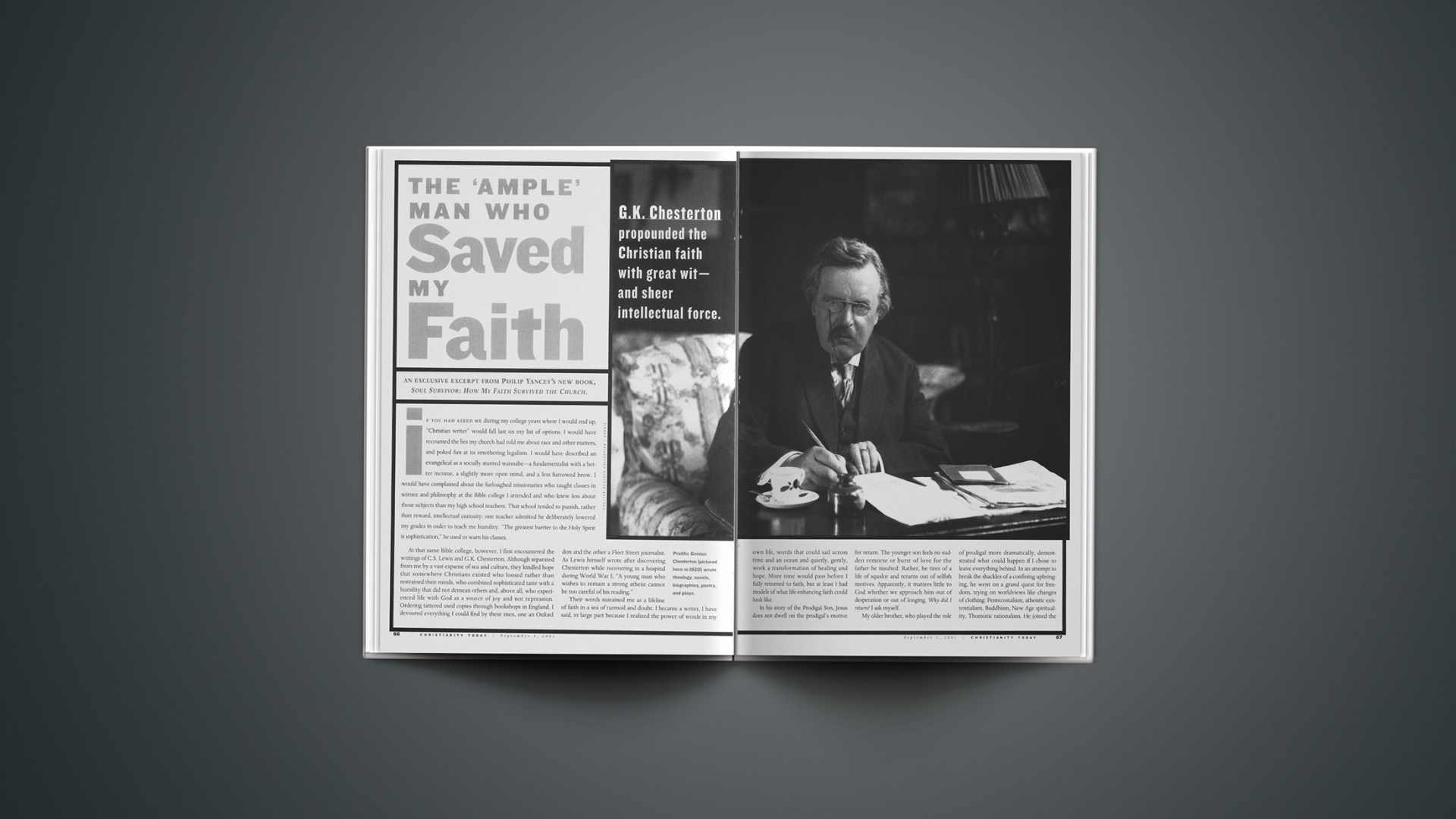
“There are an infinity of angles at which one falls, only one at which one stands,” said Chesterton, and he ultimately fell from excess, never achieving the balance he preached so convincingly. Not only did he tend to pluck five pears in a mere absence of mind—he ate them. His weight hovered between 300 and 400 pounds, and that combined with general poor health to disqualify him from military service, a fact that led to a rather brusque encounter with a patriot during World War I. “Why aren’t you out at the front?” demanded the indignant elderly lady when she spied Chesterton on the streets of London. He coolly replied, “My dear madam, if you will step round this way a little, you will see that I am.”That distinctive shape made Chesterton a favorite of London caricaturists. It took only a few strokes for a skilled cartoonist to capture his essence: from the side he looked like a giant capital “P.” Chesterton rounded out his reputation with other eccentricities, most of which suited the stereotype of a slovenly, absent-minded professor. He would show up at a wedding wearing no tie and with a price tag on his shoes. Using any available paper, even wallpaper, he would scribble notes when ideas came to him, sometimes standing, oblivious, in the middle of traffic as he did so.
Once he sent his wife this telegram: “Am at Market Harborough. Where ought I to be?”
She telegraphed back, “Home.”
Chesterton cheerfully engaged in public debates with agnostics and skeptics of the day, most notably George Bernard Shaw—this at a time when a debate on faith could fill a lecture hall. Chesterton usually arrived late, peered through his pince-nez at his disorderly scraps of paper, and proceeded to entertain the crowd, making nervous gestures, fumbling through his pockets, laughing heartily in a falsetto voice at his own jokes.
Typically he would charm the audience over to his side, then celebrate by hosting his chastened opponent at the nearest pub. “Shaw is like the Venus de Milo; all there is of him is admirable,” he toasted his friend affectionately.
In Chesterton’s day, sober-minded modernists were seeking a new unified theory to explain the past and give hope to the future. Shaw, seeing history as a struggle between the classes, proposed a remedy of socialist utopianism. The early H.G. Wells interpreted history as an evolutionary march toward progress and enlightenment (a view the rest of the century would do much to refute). Sigmund Freud held up a vision of humanity free of repression and the bondage of the unconscious. Ironically, all three of these progressives had in common a rather stern countenance. With furrowed brows and dark, haunted eyes, they would expostulate on their optimistic visions of the future.
Meanwhile, puffing through his incongruously blond moustache, with a pinkly beaming face and a twinkle in his eye, Chesterton would cheerfully defend “reactionary” concepts like original sin and the Last Judgment. Chesterton seemed to sense instinctively that a stern prophet will rarely break through to a society full of religion’s “cultured despisers”; he preferred the role of jester.
Chesterton claimed to distrust “hard, cold, thin people,” and perhaps that’s why I have grown so fond of the jolly fat apologist. Nowadays in the church, sober-mindedness has won the day. Evangelicals can be the kind of responsible citizens most people appreciate as neighbors but don’t want to spend much time with. Theologians with long faces lecture on “the imperatives of the faith.” The Religious Right calls for moral regeneration, and ordinary Christians point to temperance, industriousness, and achievement as primary proofs of their faith. Could it be that Christians, eager to point out how good we are, neglect the basic fact that the gospel sounds like good news only to bad people?
I have had to forgive the churches I was raised in, much as a person from a dysfunctional family forgives mistakes made by parents and siblings. An irrepressible optimist, G.K. Chesterton proved helpful in that process too. “The Christian ideal has not been tried and found wanting. It has been found difficult and left untried,” he said. The real question is not “Why is Christianity so bad when it claims to be so good?” but rather “Why are all human things so bad when they claim to be so good?” Chesterton readily admitted that the church had badly failed the gospel. In fact, he said, one of the strongest arguments in favor of Christianity is the failure of Christians, who thereby prove what the Bible teaches about the Fall and original sin. As the world goes wrong, it proves that the church is right in this basic doctrine.
For this reason, when people tell me their horror stories of growing up in a repressive church environment, I feel no need to defend the actions of the church. The church of my own childhood, as well as that of my present and my future, comprises deeply flawed human beings struggling toward an unattainable ideal. We admit that we will never reach our ideal in this life, a distinctive the church claims that most other human institutions try to deny. Along with Chesterton, I’ve had to take my place among those who acknowledge that we are what is wrong with the world. What is my snobbishness toward my childhood church, for instance, but an inverted form of the harsh judgment it showed me? Whenever faith seems an entitlement, or a measuring rod, we cast our lots with the Pharisees and grace softly slips away.
We could use another Chesterton today, I think. In a time when culture and faith have drifted even further apart, we could use his brilliance, his entertaining style, and above all his generous and joyful spirit.
For all his personal quirkiness, he managed to propound the Christian faith with as much wit, good humor, and sheer intellectual force as anyone in recent times. With the zeal of a knight defending the last redoubt, he took on anyone who dared interpret the world apart from God and Incarnation.
Chesterton himself said that the modern age is characterized by a sadness that calls for a new kind of prophet, not like prophets of old who reminded people that they were going to die, but someone who would remind them they are not dead yet. The prophet of ample girth and ample mirth filled that role splendidly. T.S. Eliot judged, “He did more, I think, than any man of his time. … to maintain the existence of the important minority in the modern world.” I know he did that for me. Whenever I feel my faith going dry again, I wander to a shelf and pick up a book by G.K. Chesterton. The adventure begins all over again.
Philip Yancey is a CT editor at large. This excerpt is adapted from his book, Soul Survivor, ©2001 by Someone Cares Charitable Trust. Used by permission of Doubleday, a division of Random House Inc.
 |
Soul Survivorby Philip Yancey (Random House, Inc)Preorder now, available 10/1/01Buy Now |
Copyright © 2001 Christianity Today. Click for reprint information.
Related Elsewhere
A ready-to-download Bible Study on this article is available at ChristianBibleStudies.com. These unique Bible studies use articles from current issues of Christianity Today to prompt thought-provoking discussions in adult Sunday school classes or small groups.
Also appearing on our site today is a Christianity Today classic from 1974, G.K. Chesterton, the Eccentric Prince of Paradox.The American Chesterton Society gives a good introduction to Chesterton and a “basic course” on his works.
G.K. Chesterton’s writings, including his religious essays, fiction, and poems, are available all over the web.
The Chesterton Photograph and Portrait Page includes good images and descriptions of Chesterton’s appearance.
Gilbert! is a magazine devoted to the ideas and orthodoxy of Chesterton. Read sample articles or read its mission statement. (The magazine’s site also has an extensive page of links to writings by and about Chsterston)
Last year, Christianity Today’s sister publication Books & Culturerevisited Chesterton’s masterpiece, The Man Who Was Thursday.
Christianity Today looked at Christianity’s master of irony last September with a series of quotes showing Chesterton’s Paradoxical Orthodoxy.
Philip Yancey’s book Soul Survivor (book | audiocassette) is available through Christianbook.com.
His other books include Reaching for the Invisible God (2000), The Bible Jesus Read (1999), The Jesus I Never Knew (1995), Where is God When It Hurts (1990).
Philip Yancey is also a columnist for Christianity Today. Recent columns include:
Fixing Our Weakest Link | Evangelicals should be more “needful of the minds of others.” (July 3, 2001)
Replenishing the Inner Pastor | Churches should take greater interest in their shepherds’ spiritual health. (May 14, 2001)
Beyond Flesh and Blood | I used to disdain biblical talk of “invisible spirits.” No more. (Mar. 27, 2001)
God at Large | A look around the globe reveals a God as big as we want him to be. (Jan. 31, 2001)
Humility’s Many Faces | Everyone I’ve looked up to has shared one trait. (Dec. 4, 2000)