In the 1990s, Americans—evangelicals included—were beguiled by grand utopian illusions. Basking in prosperity, we assumed our 401Ks would keep us fabulously wealthy. One scholar, Francis Fukuyama, famously wrote that we had arrived at The End of History; Western liberal democracy had won the great ideological struggle of the 20th century. Some interpreted this to mean that, with America the only remaining superpower, peace and prosperity were assured.
Those visions lie in the twisted wreckage of September 11.
The most accurate prophet of the '90s, it turns out, was Harvard's Samuel Huntington, who warned of a clash of civilizations in the 21st century, divided along historic religious boundaries—the Christian West, the Confucian East, and Islam's scattered nations.
The attacks proved Huntington right. Great clashes of worldview—that is, how people understand ultimate reality—continue to divide the world, and will do so until the true end of history when the Lord returns.
More than ever, Christians must be aware of new battle lines in the struggle of worldviews. The terrorist attacks delivered a body blow to postmodernism. Can anyone who saw the incineration of thousands of innocent Americans believe, as postmodernists teach, that there is no objective reality, no good or evil, or that all cultures are morally equivalent?
At the same time, the attacks sharpened the lines between extreme Islam and the Christian West, which were drawn in blood 13 centuries ago. Islam is not a monolith, and even now Muslims are struggling afresh to define it; but on key points it radically differs from Christianity.
Islam's worldview sees God as remote, utterly transcendent. Christians worship a God who became flesh and intimately knowable and personal through the Incarnation. Muslims believe that humans are born good but are corrupted by non-Islamic cultures. Christians believe we are fallen and thus in need of salvation.
This leads to profound differences. For Islamists, the best hope of salvation is to eliminate non-Muslim influences and to advance Islam (by force if necessary, for which there are heavenly rewards, as the terrorists believed). The Muslim faces an uncertain outcome on Judgment Day based on his works. Christians are confident of a full pardon because of Christ's work.
Because they do not believe in original sin, fundamentalist Muslim leaders are utopian; they seek the perfect society by strictly enforcing Islamic law. But this utopian worldview has already brought tyranny and disaster, just as communist utopianism led to the tragic deaths of tens of millions in the former Soviet Union.
While Islamists want to enforce a theocracy, most Christians live peacefully with competing value systems. Christians believe in winning people through love, not conquest. Although most Muslims are peace-loving, the Qur'an does speak of jihads.
Why is it important to understand these differences?
First, it is important in evangelizing Muslims, many of whom are disillusioned by the terrorist violence. Second, it is necessary to resist Muslims who are evangelizing Americans. Muslims, who consider the Trinity blasphemy against Allah, are handing out tracts on college campuses charging that Christians worship three gods. Christians must defend Trinitarian doctrine as well as expose the flaws in Islam's worldview.
It is important also for geopolitical reasons. Osama bin Laden is bent on overthrowing moderate Muslim governments and leading a holy war. Understanding this agenda and the Islamic injunctions that drive it informs our political judgments.
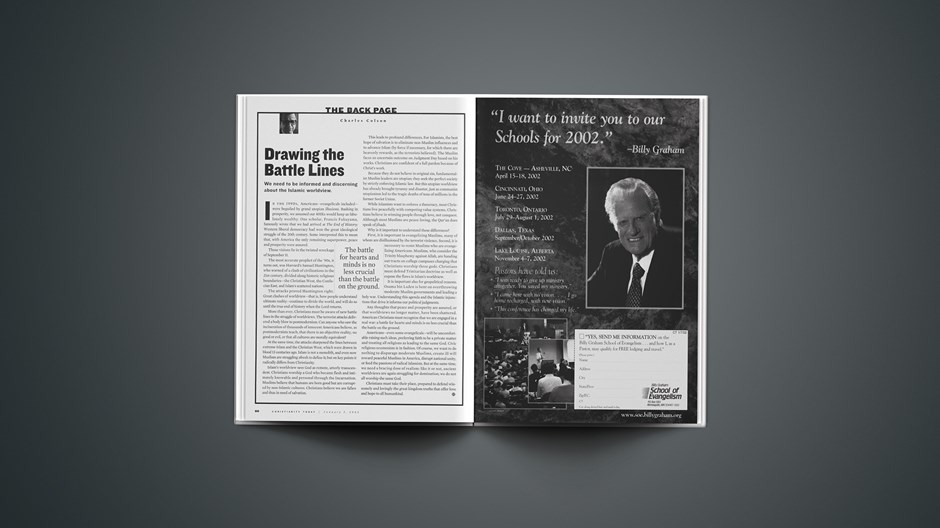
Any thoughts that peace and prosperity are assured, or that worldviews no longer matter, have been shattered. American Christians must recognize that we are engaged in a real war: a battle for hearts and minds is no less crucial than the battle on the ground.
Americans—even some evangelicals—will be uncomfortable raising such ideas, preferring faith to be a private matter and treating all religions as leading to the same God. Civic religious ecumenism is in fashion. Of course, we want to do nothing to disparage moderate Muslims, create ill will toward peaceful Muslims in America, disrupt national unity, or feed the passions of radical Islamists. But at the same time, we need a bracing dose of realism: like it or not, ancient worldviews are again struggling for domination; we do not all worship the same God.
Christians must take their place, prepared to defend winsomely and lovingly the great kingdom truths that offer love and hope to all humankind.
In the 1998 article, "Is Islam the enemy?," Sojourners magazine said that the navigation of the road ahead for Christians and Muslims would have profound consequences for both communities—and for the world.
In 2000, Christianity Today focused on Muslim-Christian relations in a series by Wendy Murray Zoba. Articles included:
Islam, U.S.A.Are Christians prepared for Muslims in the mainstream? (March 27, 2000)
Islamic FundamentalsChristians have a responsibility to understand our Muslim neighbors and their beliefs. (March 28, 2000)
How Muslims See ChristianityMany Muslims don't understand Christianity—especially the idea of salvation by grace through faith. (March 29, 2000)
Engaging Our Muslim NeighborsThe Church faces a challenge not just to understand Muslims, but to befriend them. (March 30, 2000)
For more perspective on the aftermath of the September 11 terrorist attacks, see previous Christianity Today essays including:
Letter from a Muslim SeekerChristians aren't the only ones asking 'Why?' after September's tragedy. (Dec. 5, 2001)
Leaving 'Normal' BehindLife before September 11 seemed more secure, but do we really want it back? (Dec. 12, 2001)
Blame GameSeeking mercy is a better response to 9/11 than seeking meaning. (Nov. 8, 2001)
To Embrace the EnemyIs reconciliation possible in the wake of such evil? (Sept. 21, 2001)
After the Grave in the AirTrue reconciliation comes not by ignoring justice nor by putting justice first, but by unconditional embrace. (Sept. 21, 2001)
Charles Colson was the founder of Prison Fellowship Ministries, an outreach to convicts, victims of crime, and justice officers. Colson, who converted to Christianity before he was indicted on Watergate-related charges, became one of evangelicalism's most influential voices. His books included Born Again and How Now Shall We Live? A Christianity Today columnist since 1985, Colson died in 2012.















 While we pray for peace, we need moral clarity about this war.
 As my doubts about his teachings grew, so did a secret fascination with Jesus.
 The rage of the mob is a poor substitute for real community.






