Last fall Network Associates Inc., the manufacturer of McAfee software, announced it had joined San Francisco's 24-hour news station, KCBS, in a goodwill promotion—purchases of McAfee products would result in a donation to Bay Area Habitat. I called the station's marketing director, Noel Wax, to ask if he knew that Habitat for Humanity was a Christian organization. After all, KCBS appeals to the broadest possible market, and San Francisco is not in the Bible belt.
"Does it make any difference to you?" I asked. "No," Wax said. "No difference whatsoever."
The station offers its partnership with Habitat as an incentive to potential advertisers, which are more than willing to pay for association with the Habitat name. Cisco Systems, Whirlpool, General Motors, Bank of America, and Home Depot are among the many companies that have partnered with Habitat.
Politicians from Newt Gingrich to Bill Clinton have made media splashes participating in Habitat projects. Habitat for Humanity has made it into the American mainstream.
Born of a spiritual crisis in the life of its founders, Millard and Linda Fuller, and incubated at Koinonia, a communal Christian farm with Southern Baptist roots, Habitat grew out of evangelical soil and maintains a vital Christian identity. Its mission statement mentions God three times, and its four official purposes include "to witness to the Gospel of Jesus Christ throughout the world" and to exemplify "the Gospel of Jesus Christ through loving acts and the spoken and written word."
After 26 years of growing into one of the nation's largest homebuilders, Habitat's 2,000 affiliates worldwide and revenues of $550 million make it one of America's leading charities. It has built more than 120,000 homes for poor people both here and overseas.
Habitat is one of the few organizations as popular with college students (it has 600 campus chapters) as with corporate America.
Popularity, however, threatens to dilute Habitat's Christian identity.
"We feel daily pressure to secularize," Fuller says. Habitat's corporate and political partnerships raise money and create media attention, but they also push Habitat to downplay its faith. For example, Habitat usually presents a Bible along with house keys to new homeowners; some sponsors would just as soon omit that part of the ceremony.
This pressure is not unique to Habitat. Other widely respected Christian organizations, like World Vision and the Salvation Army (among others), also struggle to remain Christian while partnering with non-Christians. Habitat's struggle merely illustrates a larger challenge.
Habitat gladly partners with people of other faiths—it's not unusual to see a synagogue sponsoring a Habitat home. With each affiliate acting as an independent corporation, Habitat is structured more as a movement than a top-down organization, which also could leave the door open for straying from the Christian hearth. Nonetheless, Fuller is determined to both expand Habitat's role in society and maintain its core Christian identity. That identity is unmistakable to anyone who has met Fuller.
"I'm a strong social activist," he says, "but in a lot of ways, I'm very fundamentalist. I believe Jesus is who he says he is. I believe Jesus is the way, the truth, and the life—that's the way to the Father, through Christ. But I'm liberal in not standing in judgment on those who differ from me."
Fuller is unapologetic about the faith basis of Habitat, but he's equally clear that Habitat is not a church, doesn't have a statement of faith, and works as an equal partner with people of all faiths and no faith. His way of safeguarding Habitat's Christian identity is to "try to keep the flame alive" by speaking and writing with a strong Christian message.
Side by Side
It's Saturday afternoon at a Habitat project in Redwood City, California. Low clouds spit rain on a strip of two-story townhouses under construction along a freeway frontage road. Farther along Rolison Road, run-down apartments stare up at a huge brick noise barrier.
Despite the locale, Habitat's neat homes of 1,100 to 1,300 square feet (there will be 36) don't look like poverty housing. In fact they will sell to qualified families for about $150,000, far more than the price of Habitat homes in other parts of the country. We're in the heart of Silicon Valley, where modest suburban houses can go for a million dollars. Here the issue isn't substandard housing; it's affordable housing of any kind for teachers, plumbers, gardeners.
Somewhere between 30 and 50 volunteers swarm the site today, all under the watch of Volunteer Supervisor Dawn Adams. Two years out of college, she seems too gentle to boss construction crews. Adams volunteered during her undergrad years at nearby Stanford, then spent a year as an AmeriCorps volunteer before Peninsula Habitat offered a permanent position. Initially she knew little about construction, but she must be a quick learner: she's got all the volunteers organized and working hard.
Today there's a team from Christ Church (Episcopal), a group of Intel employees, and a cadre of Buddhists. Adams says that church volunteers make up the backbone of her regulars, but this particular Habitat affiliate downplays its faith connection. For example, most Habitat work sites begin each day with brief devotions; not Peninsula Habitat. Disappointed at first, Adams says she has learned to appreciate working alongside people who don't necessarily share her faith.
Article continues below
"It's a Buddhist-Christian weekend—they go together rather well," says Jennifer, a volunteer from Christ Church. With a laugh she says she first learned of Habitat by watching a parody on The Simpsons. Another volunteer, Dean, came with a group from Intel. He says employees receive regular e-mails encouraging them to volunteer at Habitat.
Armando is also hard at work, with a brother and a friend. He is a prospective Habitat homeowner putting in his 500 hours of "sweat equity." He first heard of Habitat when a letter came to his family inviting them to apply for a home. One of Peninsula Habitat's brochures mentions the difficulty of building trust with prospective homeowners, and perhaps Armando is an example of that—he's mildly troubled by the requirement that his family not sell the house on the open market. In this area, such a sale might double your money overnight.
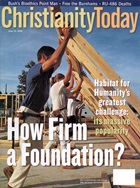
Even in Silicon Valley, the classic Habitat method applies. It starts with volunteer labor. Habitat builds simple homes that volunteer crews can manage. (A few jobs, like site surveying, plumbing, and fire sprinkler systems, go to paid subcontractors.) Volunteers say they do it because it's fun. They can see what they accomplish, there's great camaraderie, and they work side by side with the people they're helping.
On the other side of the equation, poor people can afford these homes because of the volunteer labor and, often, donated materials. By not taking a profit or charging interest, Habitat cuts payments in half. Yet homeowners don't feel like recipients of charity. They put in 500 hours of work—that's more than a year of Saturdays—and make house payments. Many Habitat affiliates also require homeowners to take classes in home maintenance and budgeting. Everybody comes out with dignity, and people who can't afford a house get one.
The Evangelical Disconnect
"An evangelical by definition is one who seeks to evangelize," Fuller says. "Well, how can you evangelize if you only associate with people who agree with you?"
Fuller feels frustrated that evangelicals have been slow to embrace Habitat. At a Habitat building site, you're more likely to find Methodists and Episcopalians than Baptists and Pentecostals.
Article continues below
"They're nervous about going into a situation where someone is going to challenge them on what they believe," Fuller says. "And on a Habitat work site, we have an open door. We don't have a gatekeeper who says I've got to check out your doctrine before you can hammer nails."
Habitat's success owes partly to its formula of building simple houses with volunteers; partly to the promotional genius of Fuller and Jimmy Carter; but partly, surely, to its open-ended religious stance. With a stricter identity, Habitat could never be so widely accepted.
"I want to end poverty housing in the world, and you've got to have a big crowd to do it," Fuller says.
Habitat Vice President Ted Swisher says the arm's-length approach to Christianity that I experienced in Redwood City is "very, very extreme," and "a problem." Most affiliates carry on the practices of giving away a Bible with every new home and of beginning workdays with devotions; most volunteers continue to be church people. All members of the international board are Christians, Fuller says. So are all top leaders of Habitat.
They don't sign a statement of faith, though, so there's no institutional framework for assuring that Habitat's Christianity remains strong. Indeed, affiliates aren't required to take any religious position beyond agreeing to a covenant that states Habitat's Christian purposes. Fuller does not want Habitat to become like the Salvation Army, a highly structured church, but he also doesn't want to go the way of the Young Men's Christian Association.
"I didn't go into Habitat because I love housing," he says. "My passion was to be a witness for Jesus in the world, and this is my way of doing it. I want to keep Habitat firmly Christian, but I also want it to be very open."
I asked Fuller why he chose to start Habitat in Americus, rather than Atlanta or a host of other places. "I was fascinated by the dynamics of this place," he said. "It was a challenge." He quoted Southern theologian Clarence Jordan: "Everybody I ever read about in the Bible, I met them in Sumter County."
Initial Challenges
Americus had never been easy on liberal do-gooders. Jailed there in 1961, Martin Luther King Jr. referred to the local sheriff as "the meanest man in the world," according to Taylor Branch's Parting the Waters. In 1976 Fuller joined African Americans in protest marches against police brutality, and became a prominent state leader opposing capital punishment. The locals did not like it. When they first moved to Americus, Fuller and his family began their mornings sweeping broken glass off their driveway.
Article continues below
Fuller proved a hard man to hate, though. Rather than nursing enmity, he made a practice of cutting up the Americus newspaper to extract every local name and photograph. He sent the clippings to the persons mentioned with a friendly letter of congratulations. In time, he won the town over. It did not hurt that Habitat became one of Americus's biggest employers and drew thousands of tourists to the town. (At the moment, Habitat is building a Global Village and Museum. Tourists will arrive on a federally financed train that will also carry them to Jimmy Carter sites in nearby Plains.)
Fuller put his office in a modest house (cost: $5,000) near downtown. He had two phones on the desk, one for Habitat and the other for his law practice. His wife, Linda, worked alongside, managing the office and its volumes of paperwork. He was the all-purpose promoter of the vision. Habitat soon spread to other regions and other countries. The majority of Habitat homes are built in 76 countries outside the United States. Every affiliate is asked to give 10 percent of its revenues to Habitat homebuilding in another country.
Habitat now builds about 20,000 houses a year, which means that its 26-year achievement of 120,000 houses can be duplicated in another five years. Is it enough? Not for Fuller. In The Theology of the Hammer he describes realizing in 1992 that, at the rate Habitat was building, it would have replaced the last shack in Americus a hundred years later. Characteristically, Fuller upped the ante.
He presented to the Habitat board the goal of eliminating all substandard housing in the county by the end of the decade. He met a stunned silence. When board members moved to table his motion, he stood his 6-foot, 4-inch frame up on the table to argue, ran a lap around the room, leaped over the table, and fell to his knees to plead with them to pass his initiative. "It worked!" he writes. "The board not only voted to proceed—the vote was unanimous!"
Later, when local officials dragged their feet, he reportedly dressed down the city council and threatened to move the Habitat office out of Americus. That, too, worked. Now Habitat is trying to persuade other communities to follow Sumter County's example: establish a plan, agreed on by all civic stakeholders, to eliminate substandard housing within a 20-year period.
Article continues below
Leveraging its reputation to get a whole community behind its goals is a new approach for Habitat. It means taking on a more political role and working more closely with government. Habitat does not accept government funds for building houses (it does accept land and infrastructure improvements), but community-wide plans must involve government. About 10 communities, mostly modest towns in the South, have so far signed on.
Given Habitat's sterling reputation, it's possible to imagine success in this new game. It's also possible to imagine losing traction. It's one thing to mobilize church volunteers to come out on Saturday and build houses. It's another to unlock the snarled and contentious forces of a community. But Fuller and the organization he has built are not designed for limited aims.
Political involvement may be inevitable. Swisher, who oversees Habitat's U.S. affiliates, says political and legal barriers to homebuilding present the biggest challenge. He described a recent project in Long Beach, California.
"You have to build two-car garages in Long Beach—that kind of regulation is immoral," he says. "When people don't have houses and you have to build houses for cars, it's immoral. And that kind of regulation seems to be increasing."
Not Wanting to Be a Millionaire
A folksy, gangly Southerner, Millard Fuller has a tooth-displaying grin so big he might have lockjaw. By Fuller's own telling his young-man's ambition was to make a pile of money. From his law office in Montgomery, Alabama, Fuller cut deals to sell tractor seat cushions to Future Farmers of America and cookbooks of favorite recipes from America's home economics teachers to Future Homemakers of America. With business partner Morris Dees, he printed and sold national directories of high school coaches and a magazine for students called Off to College. It was grassroots capitalism and nothing fancy about it: find a niche and fill it. Before he was 30, Fuller was a millionaire.
Fuller was a sincere, churchgoing Christian, but business came before ideals, he says. The civil rights movement tested those priorities. In 1961 Fuller was deeply disturbed as he watched a white mob savagely beat a recently arrived group of Freedom Riders—a group of blacks and whites who boarded buses for the Deep South to test the 1960 Supreme Court ruling outlawing segregation. With that, his social conscience began awakening.
Nothing really changed for him personally, though, until November of 1965, when Fuller's neglected wife Linda left him, going off to New York to ponder the future of their marriage. After an agonizing week, Fuller followed her. They reconciled, spent much of a night praying and singing euphoric choruses of "We're Marching to Zion," and shortly made a decision. They would give away everything they owned and search for a life with new meaning. (Dees would later experience a transformation of his own, selling the business Fuller sold to him and founding the Klan-fighting Southern Poverty Law Center.)
Article continues below
A few days later, traveling between Montgomery and Florida, Fuller decided to look up an old friend he vaguely remembered to be living on some kind of Christian farm. The place was called Koinonia. As Fuller likes to say, he and his family stopped for an hour and stayed a month. What grabbed Fuller's mind and heart was Koinonia's guiding spirit, a farmer-theologian named Clarence Jordan.
Jordan was a Southern Baptist theologian, with a Ph.D. in New Testament Greek, who thought living communally and helping poor rural farmers (nearly all black) would further the kingdom of God. More than 20 years before, he and a handful of others had purchased a run-down farm outside Americus. They intended to change the world beginning with their neighborhood.
The experiment did not succeed. Local African Americans never took to the idea of shared finances. During the turbulent '50s, Sumter County whites persecuted Koinonia farmers for their integrationist ways, firing bullets into buildings and burning down the store where they sold vegetables. The farm floundered. When the Fullers arrived, Koinonia was down to two families.
While milking the farm's cow, Fuller often talked with Jordan. They would set up on opposite sides of the beast and converse while squirting milk into a common pail. At the time Jordan was translating the New Testament into an earthy Georgia dialect and setting. (This became known as the Cotton Patch Version, and eventually he published portions of his New Testament.) Most of Jordan's conversation with Fuller was about Jesus and the kingdom of God, and it set the direction for Fuller's departure from the life of a successful businessman.
After a short stint away, Fuller was back at Koinonia, reinvigorating the farm by developing partnerships with local African Americans. The term partnership was a more flexible version of the share-everything communalism that Koinonia had begun with.
Article continues below
It included various local business ventures—raising worms, making ladies' pants— along with lectures and conferences that Jordan led. The most viable partnership, however, turned out to involve building simple homes for local farmers. When Koinonia had seemed likely to close down, some of those farmers had asked if they could buy a plot of land.
Jordan and Fuller decided not only to offer land but also to build on it. Following Jordan's understanding of biblical principles, they would make no profit and charge no interest. The homeowners would buy the houses on 20-year mortgages. Their installments would replenish a "Fund for Humanity" to build more homes.
Clarence Jordan died in 1969 just as these partnerships got started. Fuller assumed de facto leadership of Koinonia. The partnerships built dozens of houses, but Fuller found that others at Koinonia weren't ready to follow his direction. In 1973 he took his family to Zaire (now the Democratic Republic of Congo), where the mission board of the Disciples of Christ had asked him to revive a variety of foundering development projects.
Through sheer doggedness, Fuller got one concrete-block factory running. Then, using the blocks, he began constructing homes. In three years he had 114 simple homes built or under construction. Fuller is the sort of energetic entrepreneur who, parachuting into any alien territory, would have its dormant industry reorganized and making money in a matter of months. Building houses for the poor suited him—it was practical and required energy, ingenuity, and salesmanship. In 1976 he returned to Georgia. He aimed to build a lot more houses.
The immodest goal of Habitat for Humanity is to "eliminate poverty housing and homelessness from the face of the Earth." Fuller first announced that aim in 1981, when Habitat was a fledgling operation. In only one place so far has Habitat met the goal: Sumter County. A poor, rural region of pine trees, peanuts, and cotton, half white and half black, Sumter County once housed a good many of its population in shacks. Now you can crisscross the county and find no trace of the broken-down wooden wrecks that people called home for so long.
Out There Sweating
Dwight and Valerie Harrison live at 101 Town Creek Circle in Americus. Built in 1994, the small, wood-frame house was designated Habitat's 30,000th home. (Habitat took 18 years to build 30,000 homes; in eight years since, it has built 90,000 more.) The home is situated in a neighborhood that is almost painfully tidy, devoid of bushes, trees, and old cars under repair.
Article continues below
When I visited the Harrisons, Dwight still had on his coveralls from his work as an installer with Parker's Heating & Air Conditioning. Valerie had also just returned from her work in a nursing home. She recalled the week-long "building blitz," when thousands of volunteers invaded Sumter County for a week, and 30 houses were built on Town Creek Circle.
After working the night shift, Valerie began working at the construction site at 8 A.M. She didn't mind the sweltering June heat—the sight of swarming volunteers inspired her. A local bank sponsored her house, and its employees came out to build. "I never thought I would see people from the bank out there sweating," she says.
At a joint home-dedication ceremony, "I had tears in my eyes, I was so happy," she says. "They gave me the keys to the house, and we slept there that night. It has taught me to appreciate the people of God giving their all."
Dwight, by far the quieter of the two, was asked what the house meant to him. He spoke gravely: "It means that my children will always be able to call home."
Valerie's mother chipped in: "I know if God hadn't sent Habitat to this town, none of us sitting at this table would have a decent place to live."
Trusting God
Fuller has deliberately built an organization that relies on personal inspiration and motivation. He can't give orders, because each of the 2,000 affiliates is an independent corporation. And Habitat depends on volunteers who do only what they want.
It's an extraordinarily open-ended structure for an organization this big, but it suits Fuller and the way he sees the world. As God has moved him in so many improbable directions, he may be counting on God to preserve Habitat's inspiration. Or, to put it another way, perhaps he hopes Habitat's Christians will be strong enough to spread their faith rather than surrender it.
For the last 100 years, secularization has seemed like an unstoppable force in American institutions. Capturing so many schools, hospitals, and charities, it appears as inevitable as gravity.
Secularization is not inevitable for Habitat, though. By not drawing lines or screening partners on the basis of religion, the organization seems to have released the forces of faith rather than squeezed them. Habitat has raised the reputation of all Christians through its unimpeachable popularity, and as Fuller says, influence runs in all directions. Optimist that he is, Fuller trusts Habitat's influence will continue to run outward—key in his hope to accomplish Habitat's lofty goals.
A ready-to-download Bible Study on this article is available at ChristianBibleStudies.com. These unique Bible studies use articles from current issues of Christianity Today to prompt thought-provoking discussions in adult Sunday school classes or small groups.
Also appearing on our site today:
Keeping the FaithHow other Christian organizations stay true to their mission.
Philip Yancey's most recent Christianity Today column focused on Jimmy Carter, the "Servant in Chief."
The "Keeping the Faith" sidebar about how other Christian organizations stay true to their mission is a shorter version of a CT online exclusive article from April, "Keeping Christ in Christian Organizations."
Have something to add about this? See something we missed? Share your feedback here.
Our digital archives are a work in progress. Let us know if corrections need to be made.
















 While we pray for peace, we need moral clarity about this war.
 A Christian reconciliation group in Israel and Palestine warned that war would come. Now the war threatens their relevance.españolالعربيةFrançaisрусскийУкраїнська
 The plan would organize UMC churches in four global regions, with each given more leeway around same-sex marriage and other theological issues.






