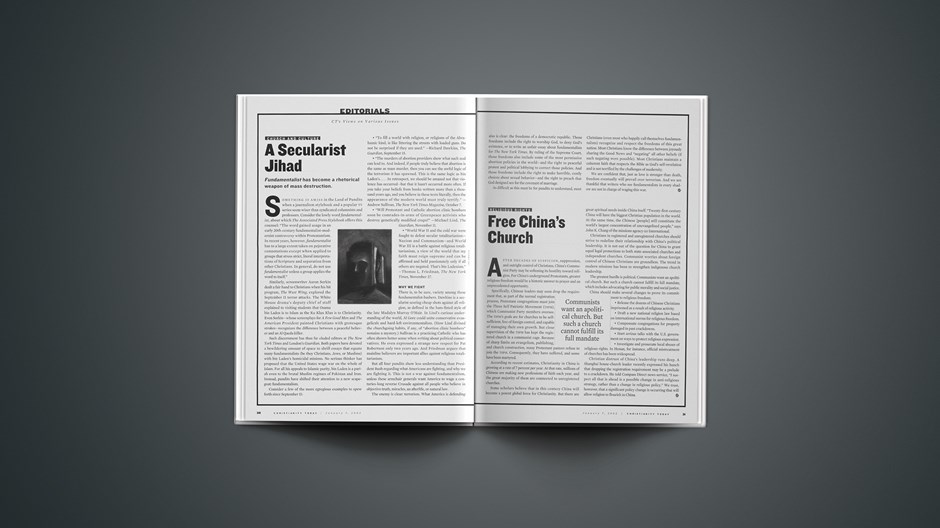
Something is amiss in the Land of Pundits when a journalism stylebook and a popular tv series seem wiser than syndicated columnists and professors. Consider the lowly word fundamentalist, about which The Associated Press Stylebook offers this counsel: "The word gained usage in an early 20th-century fundamentalist-modernist controversy within Protestantism. In recent years, however, fundamentalist has to a large extent taken on pejorative connotations except when applied to groups that stress strict, literal interpretations of Scripture and separation from other Christians. In general, do not use fundamentalist unless a group applies the word to itself."
Similarly, screenwriter Aaron Sorkin dealt a fair hand to Christians when his hit program, The West Wing, explored the September 11 terror attacks. The White House drama's deputy chief of staff explained to visiting students that Osama bin Laden is to Islam as the Ku Klux Klan is to Christianity. Even Sorkin—whose screenplays for A Few Good Men and The American President painted Christians with grotesque strokes—recognizes the difference between a peaceful believer and an Al Qaeda killer.
Such discernment has thus far eluded editors at The New York Times and London's Guardian. Both papers have devoted a bewildering amount of space to shrill essays that equate many fundamentalists (be they Christians, Jews, or Muslims) with bin Laden's homicidal minions. No serious thinker has proposed that the United States wage war on the whole of Islam. For all his appeals to Islamic purity, bin Laden is a pariah even to the brutal Muslim regimes of Pakistan and Iran. Instead, pundits have shifted their attention to a new scapegoat: fundamentalism.
Consider a few of the more egregious examples to spew forth since September 11:
"To fill a world with religion, or religions of the Abrahamic kind, is like littering the streets with loaded guns. Do not be surprised if they are used." —Richard Dawkins, The Guardian, September 15.
"The murders of abortion providers show what such zeal can lead to. And indeed, if people truly believe that abortion is the same as mass murder, then you can see the awful logic of the terrorism it has spawned. This is the same logic as bin Laden's . …In retrospect, we should be amazed not that violence has occurred—but that it hasn't occurred more often. If you take your beliefs from books written more than a thousand years ago, and you believe in these texts literally, then the appearance of the modern world must truly terrify." —Andrew Sullivan, The New York Times Magazine, October 7.
"Will Protestant and Catholic abortion clinic bombers soon be comrades-in-arms of Greenpeace activists who destroy genetically modified crops?" —Michael Lind, The Guardian, November 11.
"World War II and the cold war were fought to defeat secular totalitarianism—Nazism and Communism—and World War III is a battle against religious totalitarianism, a view of the world that my faith must reign supreme and can be affirmed and held passionately only if all others are negated. That's bin Ladenism." —Thomas L. Friedman, The New York Times, November 27.
Why We Fight
There is, to be sure, variety among these fundamentalist-bashers. Dawkins is a secularist scoring cheap shots against all religion, as defined in the ham-fisted style of the late Madalyn Murray O'Hair. In Lind's curious understanding of the world, Al Gore could unite conservative evangelicals and hard-left environmentalists. (How Lind divined the churchgoing habits, if any, of "abortion clinic bombers" remains a mystery.) Sullivan is a practicing Catholic who has often shown better sense when writing about political conservatives. He even expressed a strange new respect for Pat Robertson only two years ago. And Friedman argues that mainline believers are important allies against religious totalitarianism.
But all four pundits show less understanding than President Bush regarding what Americans are fighting, and why we are fighting it. This is not a war against fundamentalism, unless these armchair generals want America to wage a centuries-long reverse Crusade against all people who believe in objective truth, miracles, an afterlife, or natural law.
The enemy is clear: terrorism. What America is defending also is clear: the freedoms of a democratic republic. Those freedoms include the right to worship God, to deny God's existence, or to write an unfair essay about fundamentalists for The New York Times. By ruling of the Supreme Court, those freedoms also include some of the most permissive abortion policies in the world—and the right to peaceful protest and political lobbying to correct those policies. And those freedoms include the right to make horrible, costly choices about sexual behavior—and the right to preach that God designed sex for the covenant of marriage.
As difficult as this must be for pundits to understand, most Christians (even most who happily call themselves fundamentalists) recognize and respect the freedoms of this great nation. Most Christians know the difference between joyously sharing the Good News and "negating" all other beliefs (if such negating were possible). Most Christians maintain a coherent faith that respects the Bible as God's self-revelation and is not terrified by the challenges of modernity.
Article continues below
We are confident that, just as love is stronger than death, freedom eventually will prevail over terrorism. And we are thankful that writers who see fundamentalists in every shadow are not in charge of waging this war.
Religion's misguided missilesPromise a young man that death is not the end and he will willingly cause disaster (Richard Dawkins, The Guardian, September 15)
This is a religious warThe religious dimension of this conflict is central to its meaning (Andrew Sullivan, The New York Times, October 7)
Fundamental flawsAmerica's religious Right and the West's romantic Left now share an Arcadian, pre-modern vision similar to that of Muslim conservatives (Michael Lind, The Guardian, November 11)
Foreign affairs; The Real WarThe current war against terrorism is not about eradicating terrorism but seeks to defeat an ideology, namely, religious totalitarianism (Thomas L. Friedman, The New York Times, November 27)
Christianity Today'sWeblog commented in October that several columnists and pundits—such as Dawkins and Sullivan—turned the war on terrorism into a war against exclusivism.
In 2000, Sullivan wrote an article on his interaction with conservative Christians (his "enemies") at Pat Robertson's 70th Birthday celebration. He found them to be "really quite nice."
Recently, The Washington Post interviewed Friedman about his increased exposure and controversial columns since the September 11 attacks.
Prayer After 9.11.01The author of The Prayer of Jabez says now, more than ever, we need to seek God's power. (Sept. 28, 2001)
Judgment DayGod promised that calamity would follow disobedience. So why are we quick to dismiss it as a reason for the September 11 attacks? (Sept. 25, 2001)
Now What?A Christian response to religious terrorism. (Sept. 21, 2001)
To Embrace the EnemyIs reconciliation possible in the wake of such evil? (Sept. 21, 2001)
After the Grave in the AirTrue reconciliation comes not by ignoring justice nor by putting justice first, but by unconditional embrace. (Sept. 21, 2001)
A Wake-Up Call to Become Global ChristiansThe deadly attacks on America will provoke many responses, but Christians are commanded to love our neighbors. (Sept. 12, 2001)















 While we pray for peace, we need moral clarity about this war.
 We’ve got little information on Jesus’ appearance and personality. But that’s the way God designed it.españolFrançais
 Beyoncé’s right. Whether listening to Cowboy Carter or reading theology, diversity is a good thing.






