A homeschooling mom visits one of the largest conventions in the country and notes how this form of alternative education has changed—to the chagrin of traditionalists
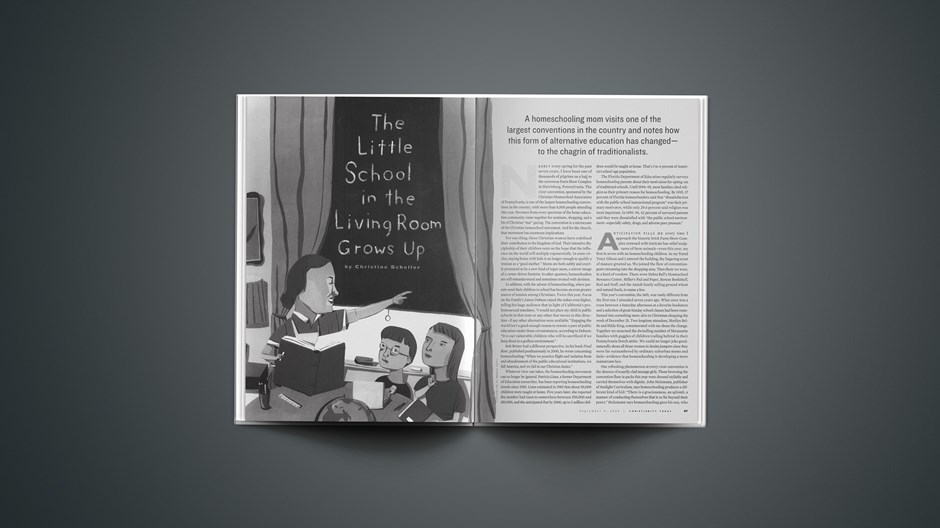
Nearly every spring for the past seven years, I have been one of thousands of pilgrims on a hajj to the cavernous Farm Show Complex in Harrisburg, Pennsylvania. The chap convention, sponsored by the Christian Homeschool Association of Pennsylvania, is one of the largest homeschooling conventions in the country, with more than 8,000 people attending this year. Devotees from every spectrum of the home education community come together for seminars, shopping, and a bit of Christian "star" gazing. The convention is a microcosm of the Christian homeschool movement. And for the church, that movement has enormous implications.
For one thing, these Christian women have redefined their contribution to the kingdom of God. Their intensive discipleship of their children rests on the hope that the influence on the world will multiply exponentially. In some circles, staying home with kids is no longer enough to qualify a woman as a "good mother." Moms are both subtly and overtly pressured to be a new kind of super mom, a mirror image of a career-driven feminist. In other quarters, homeschoolers are still misunderstood and sometimes treated with derision.
In addition, with the advent of homeschooling, where parents send their children to school has become an even greater source of tension among Christians. Twice this year, Focus on the Family's James Dobson raised the stakes even higher, telling his huge audience that in light of California's pro-homosexual mandates, "I would not place my child in public schools in that state or any other that moves in this direction—if any other alternatives were available." Engaging the world isn't a good enough reason to remain a part of public education under those circumstances, according to Dobson: "It is our vulnerable children who will be sacrificed if we keep them in a godless environment."
Bob Briner had a different perspective. In his book Final Roar, published posthumously in 2000, he wrote concerning homeschooling: "When we practice flight and isolation from and abandonment of the public educational institutions, we fail America, and we fail in our Christian duties."
Whatever view one takes, the homeschooling movement can no longer be ignored. Patricia Lines, a former Department of Education researcher, has been reporting homeschooling trends since 1985. Lines estimated in 1985 that about 50,000 children were taught at home. Five years later, she reported the number had risen to somewhere between 250,000 and 350,000, and she anticipated that by 2000, up to 2 million children would be taught at home. That's 3 to 4 percent of America's school-age population.
The Florida Department of Education regularly surveys homeschooling parents about their motivation for opting out of traditional schools. Until 1994-95, most families cited religion as their primary reason for homeschooling. By 1995, 37 percent of Florida homeschoolers said that "dissatisfaction with the public school instructional program" was their primary motivator, while only 29.6 percent said religion was most important. In 1995-96, 42 percent of surveyed parents said they were dissatisfied with "the public school environment—especially safety, drugs, and adverse peer pressure."
Anticipation fills me every time I approach the historic brick Farm Show Complex crowned with intricate bas-relief sculptures of farm animals—even this year, my first in seven with no homeschooling children. As my friend Tracy Gibson and I entered the building, the lingering scent of manure greeted us. We joined the flow of convention-goers streaming into the shopping area. Then there we were, in a herd of vendors. There were Debra Bell's Homeschool Resource Center, Miller's Pad and Paper, Berean Bookshelf, Rod and Staff, and the Amish family selling ground wheat and natural foods, to name a few.
This year's convention, the 16th, was vastly different from the first one I attended seven years ago. What once was a cross between a Saturday afternoon at a favorite bookstore and a selection of great Sunday school classes had been transformed into something more akin to Christmas shopping the week of December 25. Two longtime attendees, Marilyn Beltle and Hilde King, commiserated with me about the change. Together we mourned the dwindling number of Mennonite families with gaggles of children trailing behind in their Pennsylvania Dutch attire. We could no longer joke good-naturedly about all those women in denim jumpers since they were far outnumbered by ordinary suburban moms and dads—evidence that homeschooling is developing a more mainstream face.
One refreshing phenomenon at every chap convention is the absence of scantily clad teenage girls. Those browsing the convention floor in packs this year were dressed stylishly and carried themselves with dignity. John Holzmann, publisher of Sonlight Curriculum, says homeschooling produces a different kind of kid: "There is a graciousness, an aplomb, a manner of conducting themselves that is so far beyond their peers." Holzmann says homeschooling gave his son, who struggled with reading into the sixth grade, the self-confidence to become valedictorian of his public high school class.
Article continues below
Some people attend the convention for a dose of exhortation and encouragement from gifted speakers, while others can't wait to get their hands on shiny new books. For rookies, the chap convention's 180 vendors and 70 seminars can induce sensory overload.
The Sonlight Curriculum catalog called out to me from the cacophony the first time I attended chap. Sonlight's literature-rich design and rigorous goal of training ambassadors for Christ appealed to me, but what really hooked me was a little statement in the catalog's list of 32 reasons not to buy from Sonlight Curriculum. Holzmann had included an admonition to those desiring to raise "hermits for Christ" to look elsewhere. With that phrase, Holzmann has framed a growing dissent within the Christian homeschool movement. Since the 1980s, homeschoolers have been widely identified with fundamentalism. But as the movement expanded and those suburban moms kept jumping on the bandwagon, the separatist mindset of some faded into the background.
Andrea Locke, a mother of four in Belmar, New Jersey, is a Sonlight customer. Locke says she admires the concern Holzmann shows for the sensibilities of potential customers, believing his honesty reflects a Romans 14 attitude of looking out for "weaker brothers." At one time she worried that she might lead her children astray if she had the "wrong" kinds of books in her home, but the Lord reassured her, and she resisted the temptation to create a narrow educational world for her children. Locke need not have been concerned, because she has never been uncomfortable with the content of a single Sonlight book.
Seven years ago, textbook publishers A Beka, Bob Jones University Press, and Christian Light drew swarms at their booths. Many wanted the tried and true—what worked for professional teachers in a classroom setting. KONOS, a curriculum centering study units on various godly character traits, was the hip idea that same year. KONOS is typical of homeschool resources in that it was designed by two homeschool moms, Carol Thaxton and Jessica Hulcey, who preferred to integrate learning with real life rather than emulating a traditional classroom.
The very identity of homeschooling moms is also shifting. Mitchell Stevens, a Hamilton College sociologist and author of Kingdom of Children: Culture and Controversy in the Homeschooling Movement, believes homeschooling mothers bear "the clear imprint of … liberal feminism." He says, correctly I think, that homeschooling gives women something challenging and meaningful to do. Margaret Talbot expressed this view in the November 2001 Atlantic Monthly, writing that homeschooling is a "souped-up domesticity with higher stakes and more respect."
Article continues below
Stevens concedes that he didn't interview any homeschool moms who had begun the journey for their own fulfillment, but he sees a feminist influence nonetheless. He mentioned Mary Pride, a defector from the feminist cause and publisher of Practical Homeschooling magazine, as a prime example of a traditional-sounding woman who embodies feminist values in her lifestyle.
Pride, though, rejects the notion outright, saying a feminist analysis of homeschooling women is a "debating tactic to marginalize traditional women … just trying to defend and protect their children." She cites the Proverbs 31 woman as evidence that there is "no hypocrisy doing that in the public and economic arena." She thinks prominent homeschooling businesswomen probably would prefer that their husbands completely ran their businesses, many of which grew out of the communal spirit of the homeschool movement, and she laments the effect her business has on her family life.
At the vanguard of homeschool ideology evident at this year's convention was classical education-a pattern of learning that shaped the Western world and that may be the most intellectually ambitious out there. Veritas Press is the leading supplier of Christian classical curriculum. I didn't even try to get near the Veritas booth until the second day of the convention. Parents, arms piled high with supplies, were jammed together, overwhelming the cashier. Five years ago, Veritas Press was brand new and a blip at the outer edges of the convention's radar screen. Marlin Detweiler, the company founder, says Veritas experienced growth of 150 to 250 percent per year in its first couple of years. While sales have slowed, Detweiler expects classical education to continue as the fastest-growing pedagogy in the Christian homeschool marketplace.
Holly Gross, cofounder and board president of the Maine Classical School, which opened its doors in 2001 with a kindergarten-through-second grade day school and twice-a-week courses for junior and senior high homeschoolers, says she was attracted to the classical approach four or five years ago, when her oldest child was in first grade, because it seemed like the "right way to teach."
Article continues below
"Christian education is not education where there are Christian students or teachers, Bible verses on every page, or where a creationist viewpoint is promoted," Gross says. It is "an education that has a biblical worldview, that recognizes the Lordship of God in all, recognizes God's common grace in civilization, and is able to embrace all inspired art and culture." She identifies the apostle Paul as an example of "a classically educated man able to eloquently defend the faith."
Along those lines, an organized effort to prepare teenagers for the cultural assault on their faith began to emerge in the last decade. Speakers such as Bill Jack of Worldview Academy have become staples at homeschooling conventions. A worldview seminar I attended highlighted the incompatibility of the Christian faith with hedonism. With comedic and rhetorical brilliance, Jack convinced his large audience that "Fun Should Not Be a Part of a Christian's Vocabulary." The irony, of course, was that we all had so much fun with Jack as he bounded up and down aisles and onto chairs-handcuffing an audience member to illustrate one point-that the seriousness of his message burrowed deep into our hearts.
Ted Tripp, a darling among homeschooling parents, was another keynote speaker at this year's convention. Tripp, author of Shepherding a Child's Heart, reflected the evolving values within the Christian homeschool community by admitting without apology that his children had attended a public high school. Tripp is convinced there is "no one-size-fits-all answer" for where kids should go to school. His kids were educated with a combination of homeschooling, Christian school, and public high school. He says some homeschoolers are doing a "phenomenal job" and some are "barely educating."
Larry Huber, chap board chairman, said homeschooling is "not a cure-all." He said it can be a "stumbling block to children if parents are not tending their spiritual health." Jerry Schmoyer, a Pennsylvania homeschool dad, outlined "Lies Homeschoolers Believe," including: "Children don't need peers, family is all they need, parents who send their children to public school aren't good Christians."
One thing hasn't changed at chap: the rhetoric of Homeschool Legal Defense Association (HSLDA) speakers. Chris Klicka, an HSLDA attorney and author of Homeschooling: The Right Choice, spoke at the convention several years ago. He irritated my exegetically inclined husband by saying that it is a sin for Christian parents to send their kids to public school because allowing them to be indoctrinated with anti-Christian philosophies is "provoking them to wrath." But this year, Larry Huber, the CHAP board chairman, challenged parents to live an authentic faith before their children: "Our hypocrisy is the thing that provokes our children to wrath."
Article continues below
Scott Somerville, a gregarious Harvard-educated attorney, was this year's HSLDA representative. At the seminar I attended, Somerville worked the room like a political pro, disarming the crowd with lawyer jokes, framing the legal struggles of homeschoolers in dire terms, and finally rallying grassroots support for pending changes to Pennsylvania's onerous homeschool law. Like an old-time hellfire-and-brimstone preacher, he described those on the other side of one legal battle as "evil people trying to enact an evil law," and he claimed that it is no longer "suburban middle-class families" that the "wolves" are going after, but "black families in the inner cities" and "single moms." Somerville acknowledged that homeschooling is now legal in all 50 states, but warned that there is a "new cloud on the horizon" for homeschooling families: government regulation.
Holly Gross attended the Homeschoolers of Maine convention this year. She says that although Maine legislators want to restrict homeschooling, she walked out of a HSLDA seminar in irritation because the speaker's "examples and illustrations were frightening."
On the other hand, I wondered as I listened to Somerville, why would he give so much ammunition in a public forum to HSLDA's abundant critics? Some blame HSLDA spokesmen for alienating and marginalizing nonsectarian homeschoolers.
For example, New Jersey homeschoolers had reportedly been networking for a good ten years, choosing to focus on what they had in common rather than on their differing religious convictions, before some Christians started an exclusive organization in the late 1980s. According to a 25-year veteran homeschooler (who asked not to be named), it was insulting: "We thought we were pretty good people."
New Jersey is known for having one of the friendliest homeschool laws in the country. Many homeschooling parents took a head-'em-off-at-the-pass approach to legal questions by sending a yearly letter and a curriculum outline to their public school officials.
But HSLDA reportedly told members to stop the yearly correspondence because the law doesn't require it. Instead HSLDA advocated sending a one-time affidavit notifying the school district of the intent to homeschool. "HSLDA was appalled that we were consorting with the enemy," the New Jersey veteran says. She says HSLDA took an "I don't have to tell you anything" posture, which many believe alienates professional educators and the many homeschooling families who are not HSLDA members.
Article continues below
"Our position has been the same all along—that homeschooling families are not required to file anything in New Jersey, an HSLDA spokesman told CT. "We are not in the habit of unilaterally conceding points to the government."
Valerie Bacmeister, a mother of two in Holmdel, New Jersey, trusts HSLDA. When Bacmeister pulled her kids out of their public school in the middle of a school year, her school district hired a lawyer, alleging truancy. Her HSLDA representative exchanged letters with the Holmdel Board of Education and Bacmeister has never again had a legal problem. She is so grateful to HSLDA that she always pays the full $100 membership fee, turning down any discount.
I spoke to HSLDA's Somerville after the CHAP convention. Somerville concedes that, in New Jersey at least, HSLDA has done "some stupid things." He said when he became the attorney responsible for the state, he tried to "make things right," apologizing to one of the HSLDA's more vocal critics (not the one I interviewed) and trying to get at the source of her problem. Somerville says he receives hate mail from people who think the group is evil. But Somerville says HSLDA's public enemies "keep us honest."
Some have said that because homeschooling is now legal in all 50 states, there is no reason for more than 70,000 families to pay $85 to $100 annually to HSLDA. When I questioned Somerville about the continuing relevance of HSLDA, he told me about his day. In addition to speaking with me, he had written an article for HSLDA's newsletter, gave telephone advice to two moms with social workers at their doors, solved a problem with a convention in Tennessee, and talked with someone about state legislation related to the Pennsylvania diploma program.
Michael Farris, HSLDA's chairman, believes the group's critics are mostly "secular humanists [who are] jealous and bitter that a Christian organization has been by far the most successful." He told me about a Michigan case in which HSLDA defended a secular family while the ACLU was nowhere to be found. He reminded me that in 1999 Education Week selected him among 100 people who shaped American education "in ways big and small, for better or sometimes for worse," in the 20th century. "Their real issue," Farris says, "is that they hate people who believe in Jesus."
Article continues below
In Kingdom of Children, Mitchell Stevens details the tensions between Christian and secular homeschoolers. He says problems are solvable. "Christian homeschool leaders would need to take the concerns of secular homeschoolers more seriously than they have in the past and-here's the hard part-compromise, not necessarily on spiritual convictions, but on the degree to which faith commitments are allowed to shape the organizational structure of the cause."
"On the other hand, the homeschool movement is now sufficiently mature that it can accommodate a wide array of organizations. Homeschool diversity comes at the price of unity, but many would seem to prefer it that way."
Margaret Talbot paid Christian homeschooling families a high compliment in her Atlantic Monthly article: "Christian homeschoolers embody a coherent, living critique of mainstream education and child-rearing that can be bracing, a model of carefully negotiated, mildly irritating separateness, of being in but not of modern consumer society. The tensions that creates may be the most useful thing about them."
As long as their "living critique" is expressed with an active love for their neighbors, those 8,000-plus CHAP conventioneers and their kids are making a significant contribution to our world and to the furtherance of the gospel.
Christine Scheller is a freelance writer living in Newport Beach, California.
A ready-to-download Bible Study on this article is available at ChristianBibleStudies.com. These unique Bible studies use articles from current issues of Christianity Today to prompt thought-provoking discussions in adult Sunday school classes or small groups.
A ready-to-download Bible Study on this article is available at ChristianBibleStudies.com. These unique Bible studies use articles from current issues of Christianity Today to prompt thought-provoking discussions in adult Sunday school classes or small groups.
Also appearing on our site today:
No Dissing This LearningHomeschools do as well, if not better, than their classroom counterparts.
Recent Christianity Today articles on homeschooling include:
Teach Your Children WellHearing 'When I was in school' helps our children no more than it helped us. (Oct. 16, 2001)
Two Schools of ThoughtMany parents wonder what's best for their children—Christian or public education. Two Dallas schools suggest an answer. (May 18, 2001)
In Focus on the Family radio broadcasts July 8 (audio) and July 9 (audio), James Dobson reiterated a call from his March 28 program for parents to pull their children out of public schools in some states. Christianity Today coverage of the story includes:
Children First, Schools NextChristian parents should not face social stigma for removing kids from public schools. (Sept. 5, 2002)
'Get Our Kids Out' |Dobson says pro-gay school curriculum has gone too far. (July 29, 2002)
For more articles on schools and homeschooling, see our Education archive.















 While we pray for peace, we need moral clarity about this war.
 As my doubts about his teachings grew, so did a secret fascination with Jesus.
 The plan would organize UMC churches in four global regions, with each given more leeway around same-sex marriage and other theological issues.






