
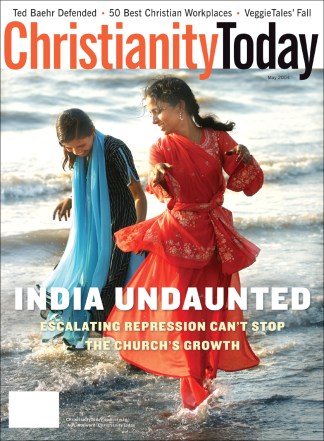
Tucked into an auto-rickshaw, the three-wheeled open-air taxis that swarm Indian cities like a plague of beetles, I survey my Sunday morning Delhi surroundings. By Indian standards the traffic is light, but it would make Manhattan seem orderly. Cars, trucks, pushcarts, pedestrians, scooters, motorcycles, bicycles, bicycle-rickshaws, and bullock-carts jostle for place. And the costumes! Business suits, sarongs, turbans, saris, burhkas, and many variations of dress I cannot name, all paying no attention to each other whatsoever. For stunning displays of diversity, an Indian city street beats any place I have ever seen.
I tell my driver “St. James Church, Kashmiri Gate,” and he sets off without hesitation. It is not much direction in a sprawling city of 12 million, but he inquires of pedestrians along the way. Eventually someone lights up. “Church?” He points, and I am deposited at the front gate of a spacious, apparently deserted compound.
‘God is really at work in India—in every part of India. Even in the mainline churches, God is at work.’—Church of North India priest Paul Swarup
In the center sits a domed and columned church building. Inside, I find a small Indian congregation at worship. The sanctuary is high Anglican, with marble and mahogany memorials for British colonels. A sung-and-chanted liturgy begins when a robed priest and altar boys process, accompanied by organ.
Afterward the 100 or so worshipers gather outside for tea in a frigid fog. A friendly member explains a bit of church history: St. James is the oldest church in Delhi. James Skinner, an Anglo-Indian cavalry officer, built it in fulfillment of a battlefield vow. I cannot help thinking of this place as an alien survivor, a sleepy relic of British rule that can hardly relate to the dynamic, hustling world outside its compound.
Next morning I return for conversation with the Rev. Paul Swarup, who helps me see it differently. Swarup is a young man not long back from Cambridge University, where he earned his Ph.D. in Old Testament. “The exciting thing is,” he says, “God is really at work in India—in every part of India. In the last ten years, our situation has definitely changed.” He laughs. “Even in the mainline churches, God is at work.”
Swarup tells how home groups at St. James have recently taken form. Members are beginning to invite their neighbors from other faiths.
“Christians don’t feel cut off from their neighbors?” I ask.
“I don’t think so,” Swarup answers. “At the local level, I don’t think there is any animosity.”
Each week, he says, two or three people seek him out wanting to become Christians. “They don’t know the gospel. They just know this God may answer my prayer.” A Hindu couple began to worship every Sunday, even though they speak no English. “They were troubled by evil spirits. I got them a Hindi Bible, and they began to read it. They said they wanted to be baptized.”
Students from nearby university dormitories often come to the church to pray. Some ask for Bible study, to learn about Jesus. At Christmas, hundreds will come for special services, and will, at Swarup’s invitation, approach the altar to receive a blessing. Even here in North India, where Christians are few and resistance can be fierce, boundaries are porous. Spiritual seeking leads people to St. James Church.
As for the persecution that makes international news, St. James experiences none. “There’s complete freedom of worship here. We experience no pressure. Hindu militants will not make a noise in the city. If a church were burned in Delhi, it would be front-page news in every paper.”
Growth Amid Threats A week later I worship in a very different church—a poor, rural Pentecostal congregation outside Bangalore, in the south of India. A new, plastered structure, almost devoid of furniture, vibrates to earsplitting rhythms of song, accompanied only by drum. Women in brilliant saris sit on mats and lift up their hands; men take plastic chairs in back. The air is close with body heat and perspiration. I am scheduled to preach—a fact I discovered upon my arrival an hour before. No matter. I have visited rural churches in Third World countries before. I know it pays to keep a three-point outline handy.
After the service, I am besieged with people seeking spiritual help, so many crowding around me that I get backed into a corner and can’t move. My translator tells me the request of each person, and I lay hands on their heads or hold their calloused hands while I pray. Some are sick; some need work; some want husbands to return home. They are oppressed by spirits, worry about pending school exams, or have family disputes. One complaint I do not immediately understand. “She has Fitz,” my translator says. “What?” I ask. “Fitz,” he says again. “You know, Fitz! Fitz!” It dawns on me: the lady has fits. Epilepsy, perhaps. I pray for her.
Over lunch Pastor Jayakanth explains how the church came into existence. He is a matter-of-fact young man with a handsome face. Seven years ago, his job with the electricity utility brought him to town. Coming from a thriving Assemblies of God congregation in the city, he found no church of any denomination, and no Christians. The region was known for its staunch Hindu beliefs. Local people said they had murdered the last Christian who came to win converts.
Nevertheless Jayakanth rented a 10-by-10-foot room, recruited a handful of believers whose work had also transferred them into the region, and began to hold services. It took a year to make his first convert. A breakthrough came with the local prostitutes, whom he witnessed to on the street late at night. A congregation began to grow. When Jayakanth’s wife gave birth to premature twins, each weighing less than two pounds, doctors predicted they could not live. Pastor Jayakanth fasted and prayed for three days, the children survived, and word of a miracle spread. More people came to church and were baptized. Temple leaders began to ask why they didn’t come to temple anymore, or contribute to temple offerings. Some of the former prostitutes’ customers complained about their changed way of life.
On Good Friday, a mob interrupted church services and forcibly dragged Jayakanth to the temple. He estimates that a thousand people gathered, shouting insults and cursing him. He was beaten and threatened, then hauled to the police station. Police officers accused him of disturbing the peace. Hadn’t he come into the district trying to convert people to his religion? They browbeat him into signing a statement that he would no longer go out into surrounding villages to preach.
After that, the pastor says, “We don’t go to villages, but we are on our knees, and people are coming to us.” The church continued to grow, which led to a second attack. This time Jayakanth was away when a mob came to the church, beating up those they could catch before taking the church’s sound equipment and all its books—including 5,000 New Testaments—and burning them.
This time, to Jayakanth’s surprise, the police arrested the men who had attacked the church. (He did not press charges.) They even assigned seven officers to provide protection to the church—all of whom, with their families, have since become Christians.
Opposition has vanished, Jayakanth says. One of the men who led the mob came to the church before his wedding and gave money to help the church obtain electricity. “Thank you for your testimony,” he said. Altogether 400 new Christians have been baptized—including ten upper-caste Brahmin families—and seven churches have been launched in surrounding villages. (Later in the day I visit one, 75 to 100 people jammed shoulder to shoulder in a small apartment.) Jayakanth still works for the electric utility, using his salary for expenses, such as rent for the outlying churches. Money is tight. But he sees no limit to the growth of the church.
Legacies of Imperialism India is changing fast, thanks to money. The economy opened up a decade back. Now cell phones are ubiquitous. Every city corner features a family restaurant. Ten years ago, the roads featured sedate, ancient Ambassadors; now ubiquitous traffic jams include new cars of every make. Poverty remains, but you can’t miss the buzz of fresh expectations.
Not just the economy is changing. While interviewing church leaders and pastors throughout India, I heard again and again that the church is growing. No reliable statistics exist, but for the first time in generations, there is talk of general revival. Optimism prevails. The Bible Society of India says that Bible sales have doubled in the last five years.
At the same time, persecution in rural areas has risen to alarming levels, and bids to grow stronger. Open-air evangelism and literature distribution have largely ceased, especially in the north. Four states have passed ironically named “freedom of religion” bills, which outlaw or strictly regulate Christian conversions. Harassment of evangelists and pastors is common, and outright violence breaks out frequently.
The causes of persecution can be put down to three interlocking factors. First is a general antipathy toward Christianity as a “foreign” religion. “When you say you are a Christian,” the leader of a major relief and development agency told me, “the majority of Indians say, ‘Go home.’ ” Christianity came to India in the first century, tradition says, but colonial associations stain the church. Since most Indian Christians come from a Dalit, or untouchable, background, Christianity is also associated with poor and ignorant people beyond the pale of Hindu society. I asked Paul Swarup what would happen if students in his Bible studies chose to be baptized. “They would be put out by their families,” he said without hesitation. Converting to Christianity automatically makes you a traitor to your family and community.
Many ordinary Indians assume that only foreign money could entrap people into such treachery. The word conversion suggests to them imperialistic Westerners preying on poor Indians.
News Today, “Chennai’s No. 1 English evening daily since 1982,” conducted a front-page interview with Swami Dayandanda Saraswati on January 7, 2003, on his campaign against religious conversions, which he called violence. Here is an excerpt:
“What is violence? When you physically hurt me it is violence. When you do anything that can instigate physical violence, that is an act of violence, too. And if you can hurt me emotionally, it is also violence. If you can hurt me spiritually, that is the worst violence, rank violence. All those are there in conversion because it leads to physical violence. When you convert someone, you have to criticize the person’s religion, his worship, his culture; all of these hurt. … He has to disown his parents, and their wisdom and their culture, his ancestors and entire community; you are isolating him, uprooting him, and all uprooted people are emotionally unsettled.”
Well-organized Hindu militancy is second among the factors that set off persecution. Rashtriya Swayamsevak Sangh (RSS), or the Association of National Volunteers, is the key organization. An important early theorist wrote admiringly of Hitler, and it was an RSS extremist who assassinated Gandhi for supposedly coddling Muslims. In the last decade, the RSS and its family of organizations (the “Sangh Parivar”) have become a potent factor in Indian life. Dominated by well-educated Brahmins, they have mobilized and trained thousands of volunteers. They want an India closely identified with Hinduness, or Hindutva. “Foreign” forces like Islam or Christianity should exist only if they accept a subservient place, according to the RSS.
The Bharatiya Janata Party (BJP) completes the picture. As the largest political party in the coalition governing India, the BJP sometimes looks progressive. Certainly it has helped open India’s economy, bringing about the near euphoria of 8 percent growth and greater opportunities for India’s educated middle class. But it is also the political wing of the RSS. The BJP rode to national power on a wave of xenophobic Hindu feeling that the party itself stirred up by campaigning to destroy an ancient mosque at Ayodhya and to replace it with a temple to the Hindu god Ram. Rioters egged on by BJP leaders tore down the mosque in December 1992. Terrible anti-Muslim violence followed. Thus far no temple has been built, but the BJP still claims that as its goal.
The most egregious cases of religious violence—pogroms against Muslims, church burnings, and assaults on pastors and nuns—often smell of political manipulation, which is the third main cause of persecution. It’s the same tactic used by segregationist politicians in the pre-Civil Rights South: find an enemy to vilify, and unify your base by appealing to paranoia. Given the popular antipathy toward Christianity, evangelists fit the BJP’s political need. In a vast nation divided by religion, language, region and caste, anti-Muslim or anti-Christian agitation can galvanize a majority.
How fervently the BJP will follow the extreme RSS line remains to be seen. Political parties must appeal to moderate Indians, who dislike extremist tactics. The BJP base, however, looks for a more chauvinistic approach.
“They have poisoned the minds of the youth,” says one evangelist with 30 years of experience in an urban, middle-class area in the South. “They have changed the spirit of India. As soon as you begin to speak of Jesus, you get a violent reaction. Some opposition is not political but religious: ‘My religion is superior to all.’ That is understandable. Okay, we can discuss. But political poisoning—things are much worse than five years before. There are no limits to what they will do.”
Two weeks before I went to India, newspapers were reporting the latest anti-Christian outrage. A nine-year-old girl was assaulted and murdered in Jhabua, a town in the state of Madhya Pradesh where the BJP had recently come to power. The girl’s killer dumped her body in a Catholic mission school compound.
Within a day, the case had become a cause. A crowd of 500 gathered outside the school, forcing its way into the compound, chanting anti-Christian slogans and throwing rocks. Unable to control the mob—including people reportedly brought in from neighboring areas—police instead arrested the school’s staff.
‘I feel the persecution is exaggerated. I was beaten up a year ago, and I am still here.’—Pastor C. B. Elijah
A few days later, police accused an itinerant laborer—not a Christian—of the murder. Hindu leaders nevertheless continued to stir up crowds against local Christians. A Protestant church was burned down, as were several homes belonging to Christians. Anti-Christian pamphlets were distributed, warning against conversion drives sponsored by “anti-nationalist forces and missionaries,” and urging Hindus to band together and defend India as a Hindu nation.
Jhabua appears to have the same elements that Pastor Jayakanth faced, but with this difference: the BJP’s control of state government meant anti-Christian agitators operated with a sense of legal impunity. Local religious feeling could be stirred up into a regional cause.
The BJP has called for national elections for April and May, and most people expect the party to do well. Many Christians fear that, should the BJP win an outright majority, it will pursue Hindutva with renewed vigor. A national anti-conversion law is one distinct possibility.
Publicizing Persecution John Dayal is general secretary of the All India Christian Council (AICC), an organization founded to protect Christians after the 1999 murder of Australian missionary Graham Staines and his two sons. I meet Dayal at his home, a modest apartment where he keeps an office stuffed with computers and filing cabinets. With his full silver beard, husky build, and commanding presence, Dayal can easily overwhelm gentler voices.
“The repression is unprecedented,” he tells me, barely bridling his indignation. “The total space in which the church can function is shrinking. We are recording a new case of violence every 36 hours. Let’s get out of this myth of Hindu tolerance. The more you research, the more you find it is an extremely intolerant religion. You must listen to them, but they don’t have to listen to you. They believe it’s a Hindu country, and I am a foreigner and an alien.”
The AICC has taken an approach that appeals to Americans, though not, I discover, to many Indian Christians. The AICC loves publicity. Whenever it receives a report of abuse, it sends out an investigative team and, if the case seems justified, it publicizes the offense. It fires off demands for legal intervention, issues strong statements, and raises the stakes as high as possible.
The organization began with backing from a wide variety of churches, but lost credibility when it helped sponsor events in which it predicted thousands of Dalits—untouchables—would publicly convert to Buddhism or Christianity. Few converts appeared. The AICC blamed government interference, but several Christian leaders told me that there never was much substance behind the claims—it was all done to draw support from gullible Western donors.
Nevertheless the AICC (and other similar groups, such as the Global Council of Indian Christians) keep Christian concerns in the eye of the press, which is lively and free in India. As a tiny minority, Christians need support from other minority communities, as well as from advocates for the poor, for human rights, for children, and the disabled. (Hindutva activists often criticize Christian aid to the needy, claiming that Christians are buying conversions through their good deeds.)
We have to forgive. Jesus taught us to forgive.—Missionary Gladys Staines
Dayal fiercely criticizes Christians who won’t find common cause with non-Christians: “Do you want a bilateral peace? ‘Please don’t rape a nun, or murder a pastor, but please feel free to murder a Muslim.’ The church is very naïve.” He contends that the church cannot seek its own protection, but rather must pursue a just and free society for all.
When I ask Dayal what American Christians should do, he has a quick response. “Stop funding itinerant evangelists who send you a picture of the five black Indians [they have] converted. There’s no pastoral care. There’s no social uplift.”
Dayal’s human-rights approach makes sense to me. Most of the Indians I talk to, however—especially those who have suffered from persecution—seem surprisingly uninterested. Consider the pastor I will call C. B. Elijah. I find him in his small office above a car repair shop—an unprepossessing setup for a man who runs two large independent city churches, while overseeing 40 full-time pastors in outlying churches.
“I feel the persecution is exaggerated,” Elijah tells me. “A few pastors get beaten up, mainly in the coastal belt of our state.” He shrugs his narrow shoulders. “I was beaten up a year ago, and I am still here.”
In fact, his beating put him in the hospital for several days. He deals with violent episodes regularly. Just last week a church prayer meeting was disrupted by a group that wanted to put up an image of the god Ram, and tried to put bindis (colored dots) on people’s foreheads. “We are not allowed to meet in a few places,” Elijah says, downplaying the incident. “Still, people are responding, and the church is growing. I say to my pastors, ‘If you are afraid, you should go do something else.’ “
We talk for a time about a subject that seems to interest him more: pastors who abuse their authority. “A lot of money is dumped into India, and I feel there is very little reality. For many, the call of God is unemployment.”
Returning to the subject of persecution, he says, “Everybody talks about rights, but who benefits? Even Muslims [a much larger group] never got justice. How will we? I think the response of Graham Staines’s wife, Gladys, is the best: ‘Forgive them.’ “
The Forgiving Widow Gladys Staines has become the best-known Christian in India after Mother Teresa. She and her husband—both from Australia—worked anonymously for decades among leprosy victims in the state of Orissa. Five years ago an anti-Christian mob set upon Graham’s Jeep while he and his two young sons were sleeping in it, parked outside a church. The mob doused the car with fuel and set it on fire. Graham and his sons perished in the flames.
During the trial and conviction of a charismatic Hindu activist who led the mob, Staines was accused of converting hundreds of poor Indians and provoking local outrage. His leprosy mission was said to be a front for evangelism. Nevertheless, public opinion was sympathetic to the Staines family, especially when Gladys said she intended to remain in India and continue her husband’s work. She said she forgave his killers.
I happen to hear Gladys speak to morning chapel at Bangalore’s Southern Asia Bible College (SABC). She is a tall, middle-aged woman, by no means a charismatic figure. Speaking slowly and hesitantly to the 250 students who attend this Assemblies of God training institution, she recalls events leading up to her husband’s murder. Anti-Christian riots in the state of Gujarat burned dozens of churches just weeks before. “I said, a little blasé, ‘Well, Christians also need to forgive.’ I little thought that, ten days later, I would need to do so.”
“We have to forgive,” she says. “Jesus taught us to forgive.”
Ivan Satyavrata, SABC’s president, is a wiry man with an expressively melancholy face. “We always get asked why India has not turned to Christ,” he says in closing the meeting. “We all know the answer.” He paraphrases something Mahatma Gandhi once said: “I would like to be a Christian, if I could find one.”
“Christians were looked at as people who made tall claims about Christ,” Satyavrata says. “There were many sermons preached, thousands of rupees invested. But forgive was the shortest, most eloquent, most powerful sermon India has ever heard. It has done something for the church that our sister, through her pain, through her tears, did what Jesus would do. I don’t think it is an accident that after that event, we have seen unprecedented numbers of people turning to Christ.”
Looking slowly over the crowd of ardent young people gathered in SABC’s chapel, Satyavrata concludes, “Some standing here may be called on to pay the same price.”
Clash of Civilizations India is walking a knife edge. On one side is its democratic tradition, and its openness to the global economy. Hindus, I hear again and again, are tolerant and open-minded. “Don’t forget, all of us have many Hindu friends,” Babu Verghese, a Christian editor, tells me. “We know these guys. They are good guys. But it’s their fascist, fanatic fringe that is creating problems.”
On the other side is Hindu pride, which political forces can manipulate toward xenophobia. The insecurities of the modern world, along with the historic divisions of Indian society, allow the RSS to portray Hinduism as under attack, and Indian society at risk. “Persecution will not slow down,” predicts Richard Howell, general secretary of the Evangelical Fellowship of India (EFI). “It has come to stay. As long as the church keeps growing, persecution will continue.”
Virtually every church leader I speak with emphasizes that evangelists sometimes bring on their own persecution through cultural insensitivity, making life harder for all Christians. Leaders talk of the need to Indianize the church, so that any offense would come from the gospel, not cultural trappings or needless insult.
Given the independent style of many evangelists, however, offenses are bound to continue. The larger problem lies in the current Indian environment. Will India move toward openness and tolerance? Or will it narrow its identity and oppress minorities?
Global attention has focused on Islamic nations and the so-called clash of civilizations. Arguably more is at stake in India. One billion people—a sixth of the world’s population—could emerge as a role model for a democratic, free society incorporating a variety of cultures, languages and religions. (India has more Muslims, for example, than any country in the world save Indonesia.) If India continues to emerge as a world economic power, such an outcome could have untold implications throughout Asia. It could, for example, nudge China toward freedom. It could provide a hopeful model for other Asian countries tempted by religious intolerance, such as Indonesia, Sri Lanka, and Malaysia.
Though a tiny minority, Christians are prominently involved in India’s future. Christian activism is clashing with Hindu militancy, and no one can say for certain where India will go. Amid much uncertainty and opposition, Christians seem remarkably undaunted. “The mood of the church is very optimistic,” Howell says. “It is a mood of expectancy.”
Tim Stafford is a Christianity Today senior writer.
Copyright © 2004 Christianity Today. Click for reprint information.
Related Elsewhere:
This main article is accompanied by two sidebar articles:
SIDEBAR
The Immense Commission | Most postal areas still don’t have any Christian workers living in them.
SIDEBAR
Watch Those Web Postings | What Indians say American Christians should, and shouldn’t, do to help.
Other articles on India include:
Blockbuster Evangelism | Millions have been converted after seeing films about Jesus, and Hindu radicals are responding with violence. (Nov. 26, 2003)
Hindu Leaders Crack Down on Conversions | Potential converts must ask permission (Oct. 13, 2003)
Weblog: Bogus Claims of Abuse Leveled Against Martyred Missionary (June 13, 2003)
Power in Punjab | Christians see churches—and opposition—grow among Sikhs. (June 18, 2003)
Fending off Hindutva | Indian Christians blast Nazi-like survey, “draconian” conversion law. (May 16, 2003)
Gujarat Religious Survey Troubles Indian Christians | Government of Indian state says it has been gathering statistics on the minority at the behest of federal officials. (March 14, 2003)
Machete Attack on American Alarms Local Christians | Hindu militants threaten to expel evangelists, stop conversions. (Feb. 18, 2003)
Indian Christians ‘Living in Terror,’ Rights Groups Report | Accusations against priest lead to intense conversion pressure in Rajasthan. (Nov. 6, 2002)
Indian State Bans Conversion | Christians say Tamil Nadu ordinance threatens relief work. (October 11, 2002)
Hounded, Beaten, Shot | What you can do to help persecuted Christians in India. (June 11, 2002)
Critics Assail Dialogue with Hindu Radicals | But some Christians see talks as an opportunity to build bridges in times of persecution. Critics Assail Dialogue with Hindu Radicals. (May 14, 2002)
New Curriculum ‘Tampering’ with History, Indian Churches Protest | Christian leaders allege that a current education proposal promotes Hindu nationalism. (Dec. 12, 2001)
Law Could Curb Foreign Donations To Churches, Indian Christians | Worry Stringent legislation is aimed at cutting off terrorist funding, but could hurt non-government organizations. (Nov. 9, 2001)
Christians Encouraged as 50,000 Dalits Leave Hinduism | Low-caste Hindus see conversion as their only escape from oppression. (October 11, 2001)
India’s First Dalit Archbishop Holds ‘No Grudge’ Over Predecessor’s Attack | Once “untouchable” Dalits make up bulk of country’s Christians. (May, 11, 2001)
Plans to Resolve India’s Interfaith Tensions Face Delays and Accusations | Did India’s National Commission for Minorities plan a meeting to discredit Christians? (July 20, 2000)
Foes Claim BJP is Using Arms Training to Win Crucial Election in India | Fears mount that reason for camps is to galvanize support for temple construction. (June 29, 2001)
Bomb Explosion During Mass Stirs Fear, Public Outcry in Bangladesh | Suspects linked to rash of attacks. (June 25, 2001)
Christians Say Sikh Book Threatens Centuries of Harmony Between Faiths | Author arrested on three counts, including “derogatory language.” (June 11, 2001)
India Election Results Rattle Ruling Nationalists | Hindu BJP “getting irrelevant day by day” say rivals. (June 13, 2001)
Militants Blamed for Death of Three Missionaries in India | 5,000 attend funeral, Catholic schools close in mourning. (June 7, 2001)
Churches Adopt Entire Villages in Devastated Gujarat to Help the Homeless | Charities aim to meet basic needs after January’s western India earthquake (June 7, 2001)
Communist-Backed Orthodox Priest Loses Election for Kerala Assembly | Nooranal’s electoral campaign annoyed some Christians with support of Communists (June 7, 2001)
Despite Tensions, Indian Churches Agree to Talks With Hindu Groups | Mainline churches will join talks, but other Christians say “partisan” meeting is dangerous. (Apr. 11, 2001)
India Relief Abuses Rampant | Radical Hindus hijack supplies in quake intervention. (Mar. 20, 2001)
In Orissa, You Must Ask the Government If You Want to Change Religion | Christian church leaders say they’re trying to ignore the controversial law, but police aren’t doing the same. (Mar. 12, 2001)
Churches Angry that Indian Census Ignores 14 Million Christian Dalits | Only Hindu, Sikh, and Buddhist members of “untouchable” caste being counted. (Mar. 2, 2001)
India’s Christians Face Continued Threats | We must preach what we believe in spite of Hindu pressure, says Operation Mobilization India leader. (Feb. 15, 2001)