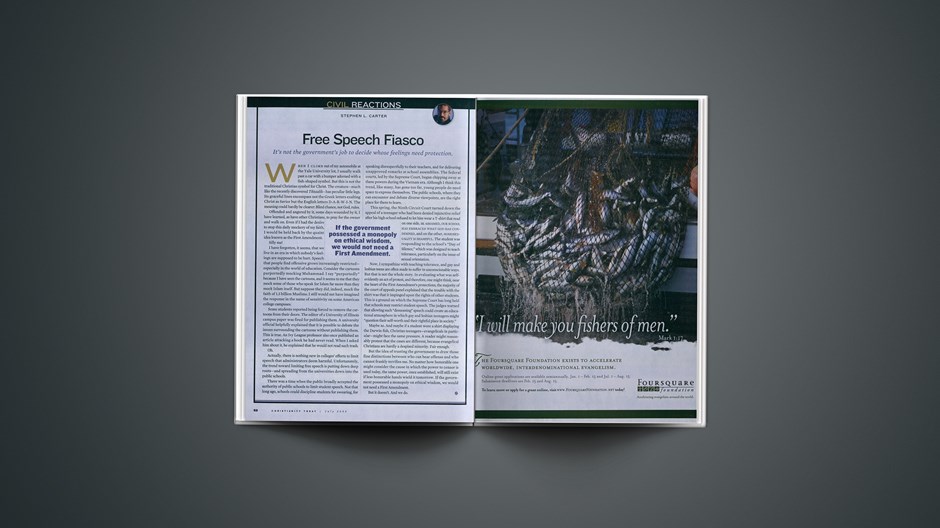
When I climb out of my automobile at the Yale University lot, I usually walk past a car with a bumper adorned with a fish-shaped symbol. But this is not the traditional Christian symbol for Christ. The creature—much like the recently discovered Tiktaalik—has peculiar little legs. Its graceful lines encompass not the Greek letters exalting Christ as Savior but the English letters D-A-R-W-I-N. The meaning could hardly be clearer: Blind chance, not God, rules.
Offended and angered by it, some days wounded by it, I have learned, as have other Christians, to pray for the owner and walk on. Even if I had the desire to stop this daily mockery of my faith, I would be held back by the quaint idea known as the First Amendment.
Silly me!
I have forgotten, it seems, that we live in an era in which nobody's feelings are supposed to be hurt. Speech that people find offensive grows increasingly restricted—especially in the world of education. Consider the cartoons purportedly mocking Muhammad. I say "purportedly" because I have seen the cartoons, and it seems to me that they mock some of those who speak for Islam far more than they mock Islam itself. But suppose they did, indeed, mock the faith of 1.3 billion Muslims. I still would not have imagined the response in the name of sensitivity on some American college campuses.
Some students reported being forced to remove the cartoons from their doors. The editor of a University of Illinois campus paper was fired for publishing them. A university official helpfully explained that it is possible to debate the issues surrounding the cartoons without publishing them. This is true. An Ivy League professor also once published an article attacking a book he had never read. When I asked him about it, he explained that he would not read such trash.
Oh.
Actually, there is nothing new in colleges' efforts to limit speech that administrators deem harmful. Unfortunately, the trend toward limiting free speech is putting down deep roots—and spreading from the universities down into the public schools.
There was a time when the public broadly accepted the authority of public schools to limit student speech. Not that long ago, schools could discipline students for swearing, for speaking disrespectfully to their teachers, and for delivering unapproved remarks at school assemblies. The federal courts, led by the Supreme Court, began chipping away at these powers during the Vietnam era. Although I think this trend, like many, has gone too far, young people do need space to express themselves. The public schools, where they can encounter and debate diverse viewpoints, are the right place for them to learn.
This spring, the Ninth Circuit Court turned down the appeal of a teenager who had been denied injunctive relief after his high school refused to let him wear a T-shirt that read on one side, BE ASHAMED, OUR SCHOOL HAS EMBRACED WHAT GOD HAS CONDEMNED, and on the other, HOMOSEXUALITY IS SHAMEFUL. The student was responding to the school's "Day of Silence," which was designed to teach tolerance, particularly on the issue of sexual orientation.
Now, I sympathize with teaching tolerance, and gay and lesbian teens are often made to suffer in unconscionable ways. But that is not the whole story. In evaluating what was self-evidently an act of protest, and therefore, one might think, near the heart of the First Amendment's protections, the majority of the court of appeals panel explained that the trouble with the shirt was that it impinged upon the rights of other students. This is a ground on which the Supreme Court has long held that schools may restrict student speech. The judges warned that allowing such "demeaning" speech could create an educational atmosphere in which gay and lesbian teenagers might "question their self-worth and their rightful place in society."
Maybe so. And maybe if a student wore a shirt displaying the Darwin fish, Christian teenagers—evangelicals in particular—might face the same pressure. A reader might reasonably protest that the cases are different, because evangelical Christians are hardly a despised minority. Fair enough.
But the idea of trusting the government to draw those fine distinctions between who can bear offense and who cannot frankly terrifies me. No matter how honorable one might consider the cause in which the power to censor is used today, the same power, once established, will still exist if less honorable hands wield it tomorrow. If the government possessed a monopoly on ethical wisdom, we would not need a First Amendment.
Stephen Carter is the William Nelson Cromwell Professor of Law at Yale University. He is the author of The Impeachment of Abraham Lincoln (2012), The Violence of Peace, The Emperor of Ocean Park, and many other books. His column, "Civil Reactions," ran from 2001 until 2007.















 While we pray for peace, we need moral clarity about this war.
 We’ve got little information on Jesus’ appearance and personality. But that’s the way God designed it.españolFrançais
 Beyoncé’s right. Whether listening to Cowboy Carter or reading theology, diversity is a good thing.






